




KCET 2026 Chemistry Question Paper is available for download here. KEA conducted KCET 2026 Chemistry exam on April 23 in Shift 2 from 2.30 PM to 3.50 PM.
Also Check: Expected KCET Marks vs Rank for April 23 Chemistry Exam
- KCET Chemistry Question Paper consists of 60 questions to be attempted in 80 minutes.
- Each correct answer will get you 1 mark and there is no negative marking for incorrect answers.
Candidates can download KCET 2026 Chemistry Question Paper with Answer Key and Solution PDF from the links provided below. Based on initial student reaction, KCET 2026 Chemistry Paper was of moderate difficulty and included tricky questions.
KCET 2026 Chemistry Question Paper with Solution PDF
| KEAM 2026 Chemistry Question Paper Code D3 | Download PDF | Check Solution |

R-CH\(_2\)OH is converted into R-CHO by reacting with \rule{5cm{0.1mm.
Glycerol is a trihydric alcohol. It contains \rule{5cm}{0.1mm}.
The correct IUPAC name of CH\(_3\) - C(CH\(_3\))\(_{2}\) - O - C\(_2\)H\(_5\) is
C\(_4\)H\(_{10}\) \(\xrightarrow{i) (BH_3)_2, ii) H_2O_2/NaOH}\) P \(\xrightarrow{CrO_3, anhydrous medium}\) Q \(\xrightarrow{i) CH_3MgBr, ii) H_3O^+}\) R + Mg(OH)Br
The organic compounds P, Q and R are
Match the reagents in List - I with products obtained from their carbonyl compounds in List - II.
| List - I | List - II | ||
|---|---|---|---|
| (a) | NH2OH | (i) | Cyanohydrin |
| (b) | R-NH2 | (ii) | Oxime |
| (c) | R-OH | (iii) | Schiff base |
| (d) | H-C≡N | (iv) | Acetal |
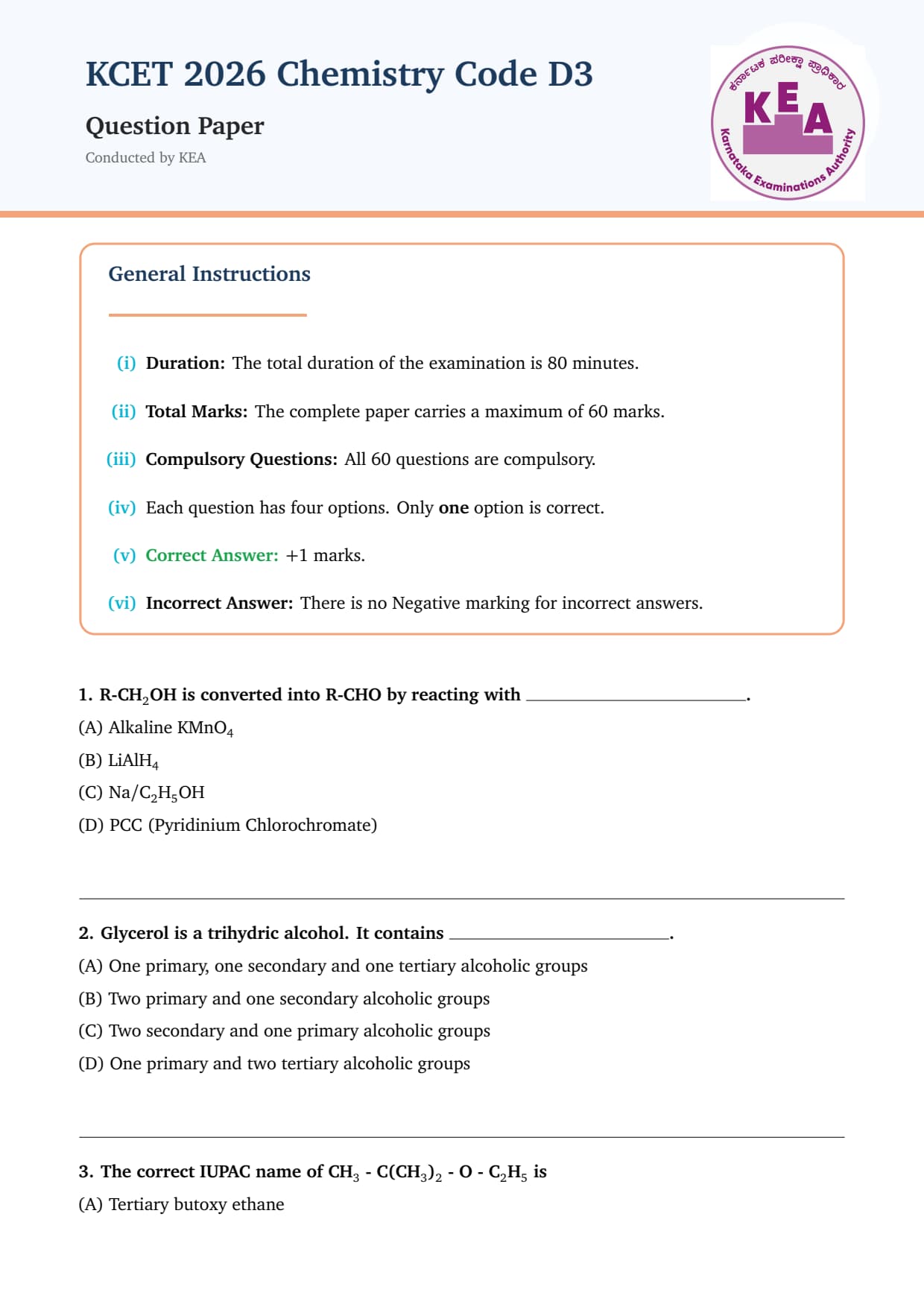
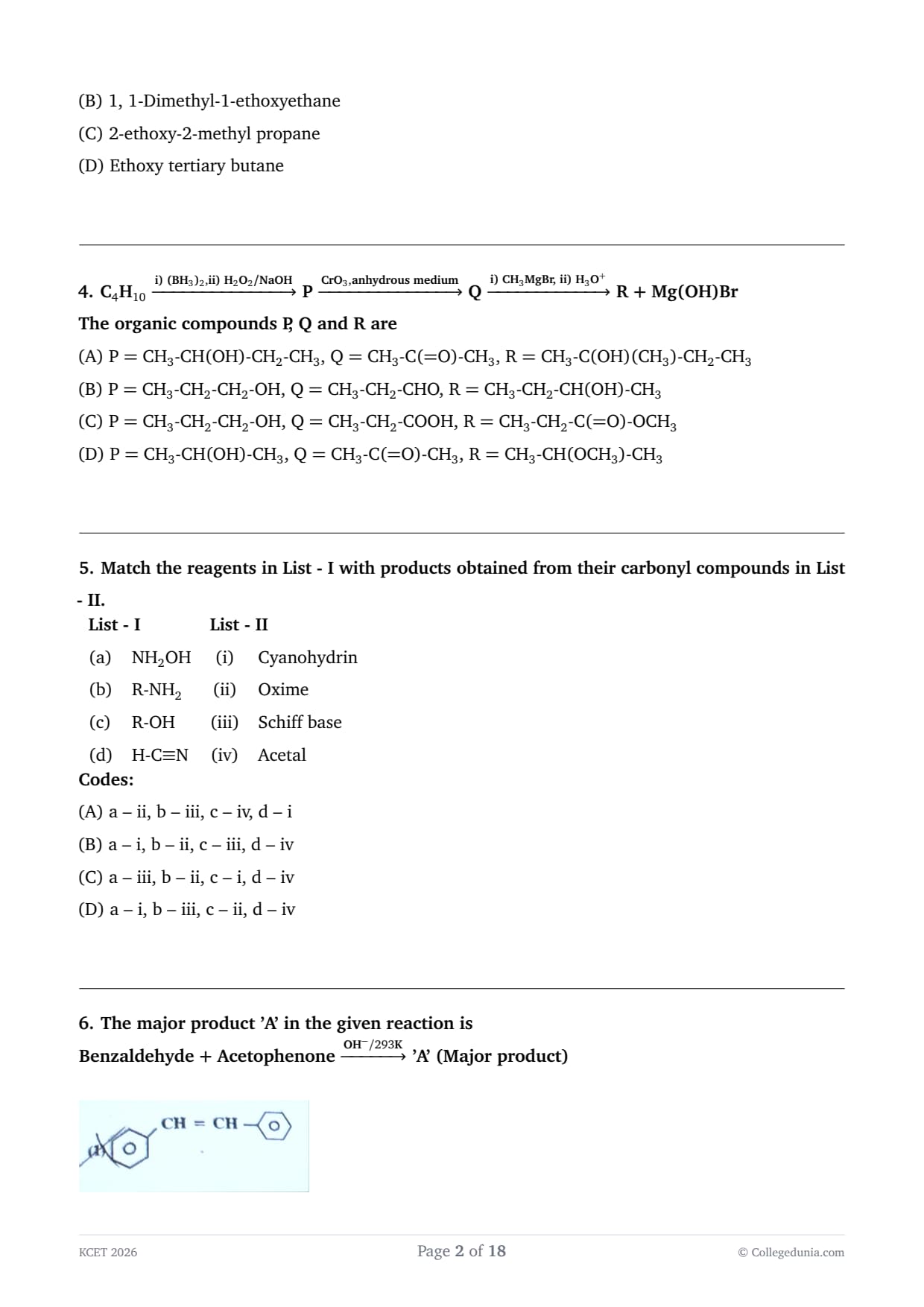
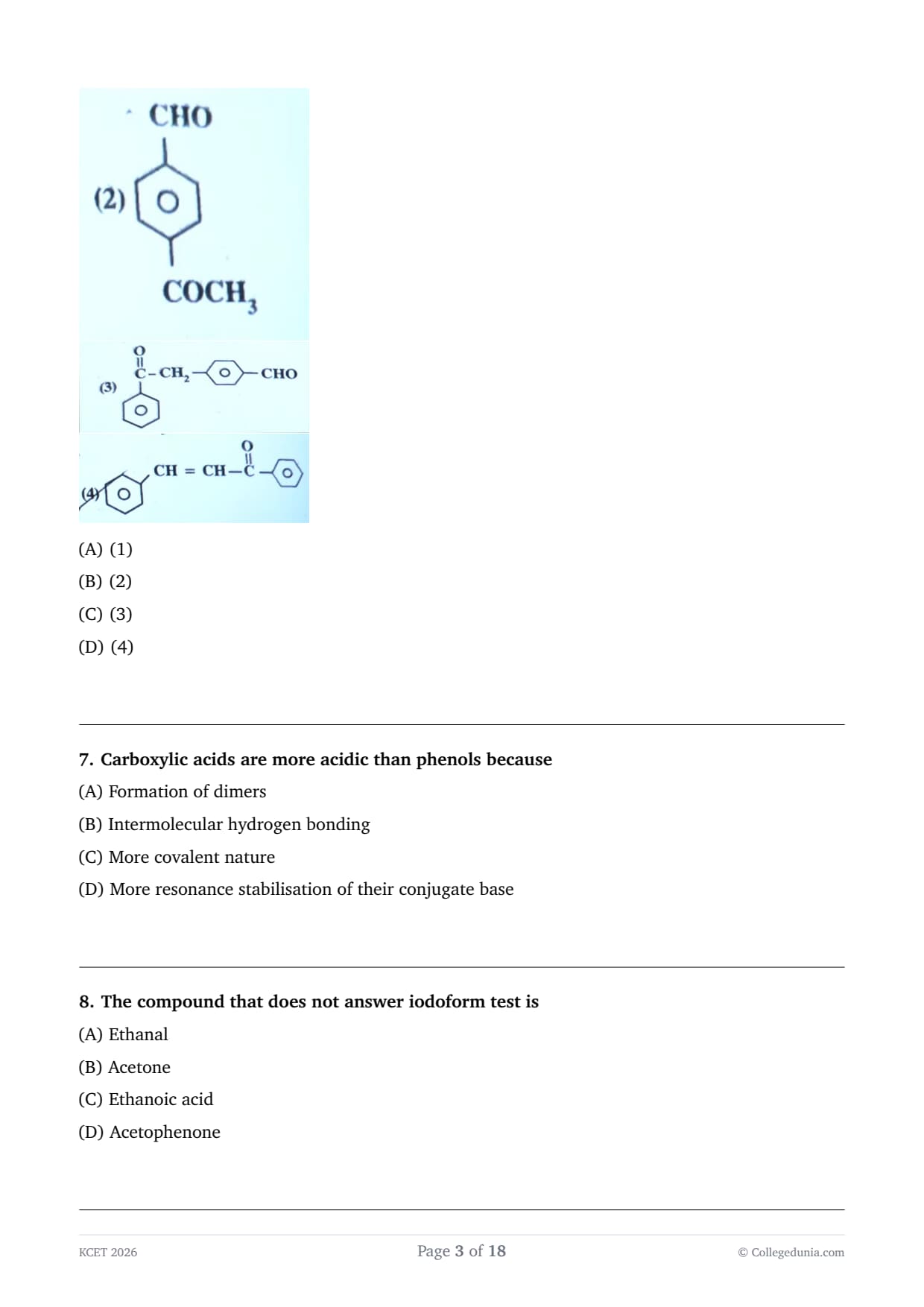
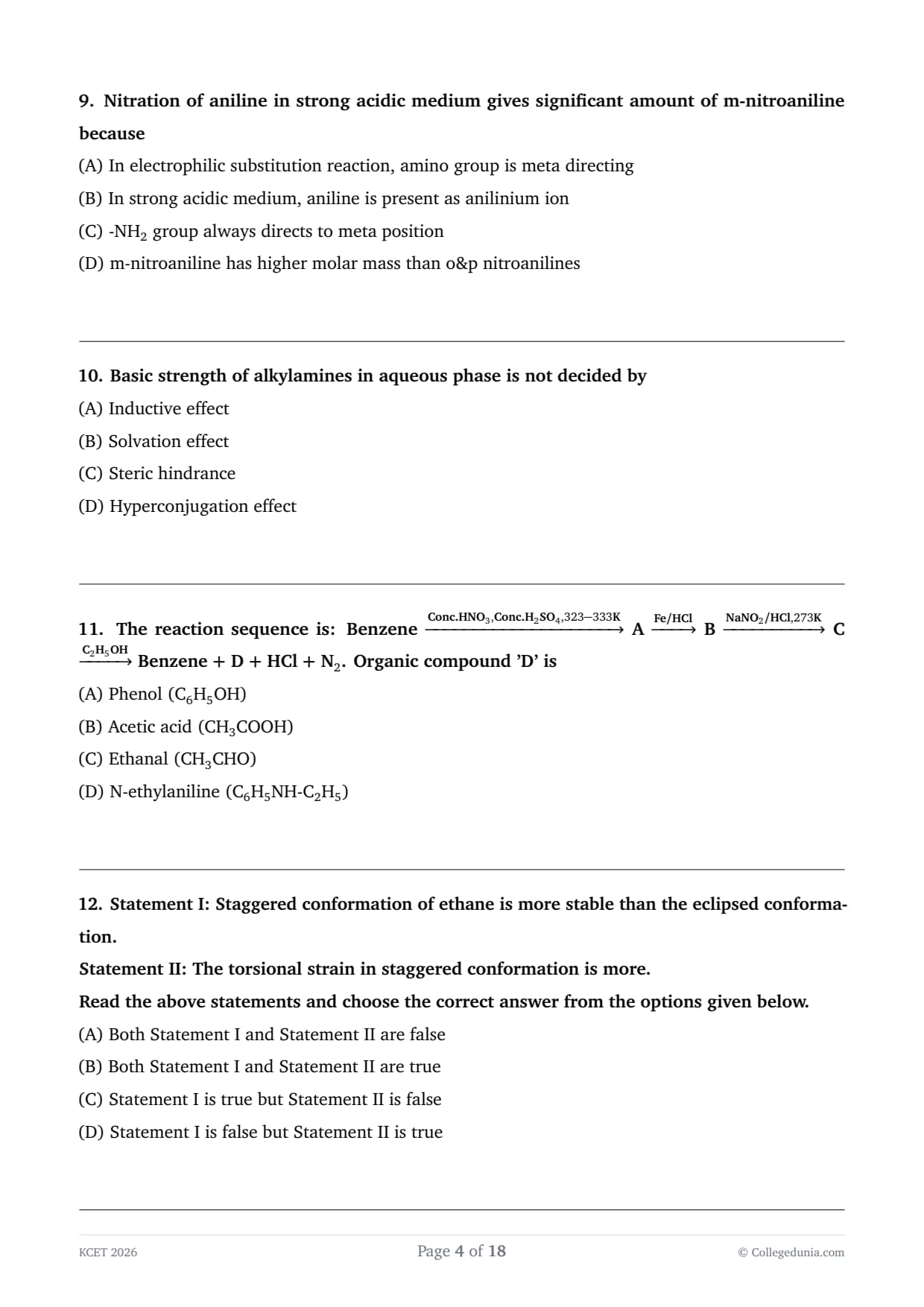
The major product 'A' in the given reaction is
Benzaldehyde + Acetophenone \(\xrightarrow{OH^- / 293K}\) 'A' (Major product)


Carboxylic acids are more acidic than phenols because
The compound that does not answer iodoform test is
Nitration of aniline in strong acidic medium gives significant amount of m-nitroaniline because
Basic strength of alkylamines in aqueous phase is not decided by
The reaction sequence is: Benzene \(\xrightarrow{Conc.HNO_3, Conc.H_2SO_4, 323-333K}\) A \(\xrightarrow{Fe/HCl}\) B \(\xrightarrow{NaNO_2/HCl, 273K}\) C \(\xrightarrow{C_2H_5OH}\) Benzene + D + HCl + N\(_2\). Organic compound 'D' is
Statement I: Staggered conformation of ethane is more stable than the eclipsed conformation.
Statement II: The torsional strain in staggered conformation is more.
Read the above statements and choose the correct answer from the options given below.
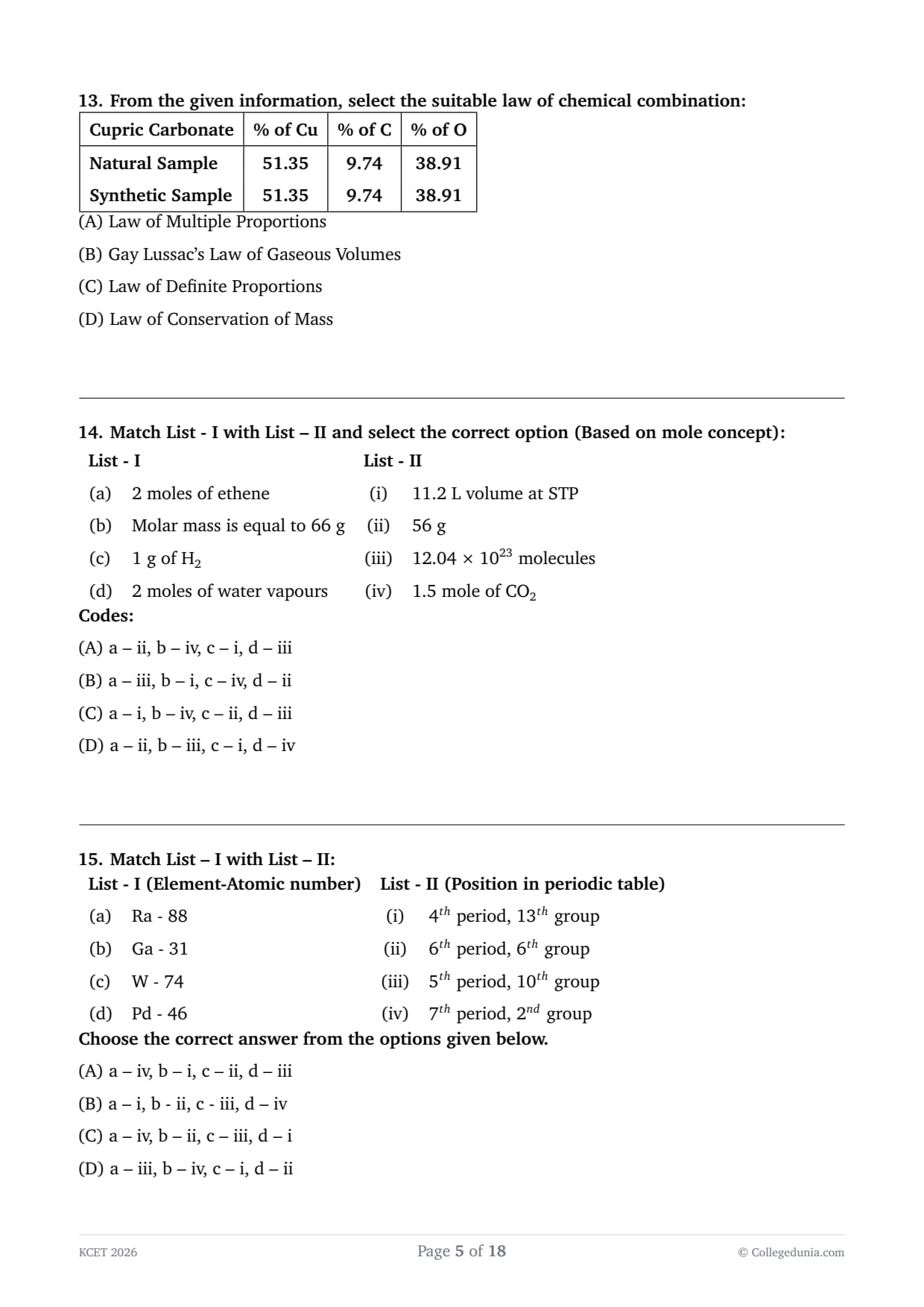
From the given information, select the suitable law of chemical combination:
| Cupric Carbonate | % of Cu | % of C | % of O |
|---|---|---|---|
| Natural Sample | 51.35 | 9.74 | 38.91 |
| Synthetic Sample | 51.35 | 9.74 | 38.91 |
Select the correct option:
- (A) Law of Multiple Proportions
- (B) Gay Lussac's Law of Gaseous Volumes
- (C) Law of Definite Proportions
- (D) Law of Conservation of Mass
Match List - I with List – II and select the correct option (Based on mole concept):
| List - I | List - II | ||
|---|---|---|---|
| (a) | 2 moles of ethene | (i) | 11.2 L volume at STP |
| (b) | Molar mass is equal to 66 g | (ii) | 56 g |
| (c) | 1 g of H2 | (iii) | 12.04 × 10²³ molecules |
| (d) | 2 moles of water vapours | (iv) | 1.5 mole of CO2 |
Codes:
- (A) a – ii, b – iv, c – i, d – iii
- (B) a – iii, b – i, c – iv, d – ii
- (C) a – i, b – iv, c – ii, d – iii
- (D) a – ii, b – iii, c – i, d – iv
Match List – I with List – II:
| List - I (Element - Atomic number) | List - II (Position in periodic table) | ||
|---|---|---|---|
| (a) | Ra - 88 | (i) | 4th period, 13th group |
| (b) | Ga - 31 | (ii) | 6th period, 6th group |
| (c) | W - 74 | (iii) | 5th period, 10th group |
| (d) | Pd - 46 | (iv) | 7th period, 2nd group |
Choose the correct answer from the options given below:
- (A) a – iv, b – i, c – ii, d – iii
- (B) a – i, b – ii, c – iii, d – iv
- (C) a – iv, b – ii, c – iii, d – i
- (D) a – iii, b – iv, c – i, d – ii
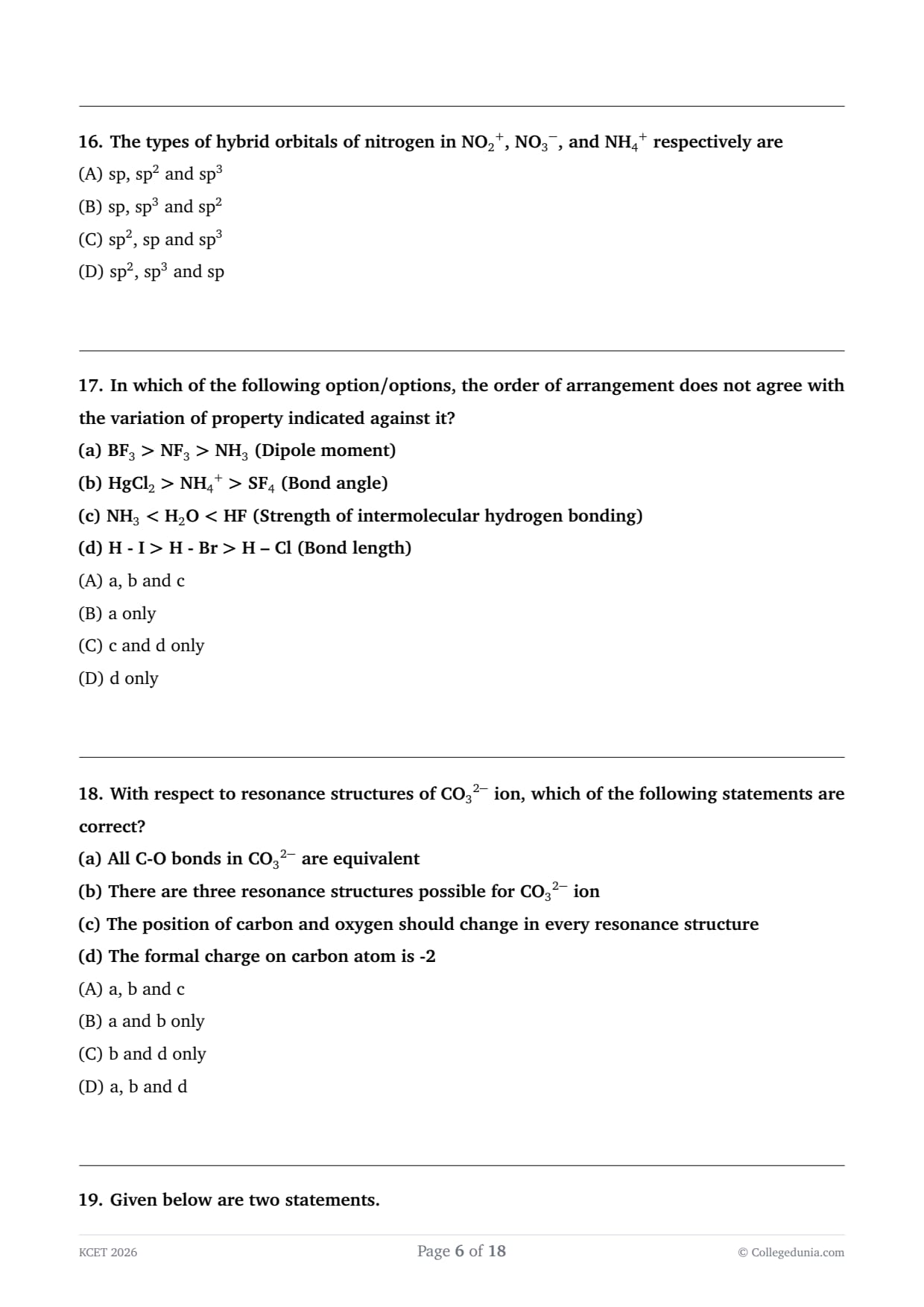
The types of hybrid orbitals of nitrogen in NO\(_2\)\(^+\), NO\(_3\)\(^-\), and NH\(_4\)\(^+\) respectively are
In which of the following option/options, the order of arrangement does not agree with the variation of property indicated against it?
(a) BF\(_3\) > NF\(_3\) > NH\(_3\) (Dipole moment)
(b) HgCl\(_2\) > NH\(_4\)\(^+\) > SF\(_4\) (Bond angle)
(c) NH\(_3\) < H\(_2\)O < HF (Strength of intermolecular hydrogen bonding)
(d) H - I > H - Br > H – Cl (Bond length)
With respect to resonance structures of CO\(_3\)\(^{2-}\) ion, which of the following statements are correct?
(a) All C-O bonds in CO\(_3\)\(^{2-}\) are equivalent
(b) There are three resonance structures possible for CO\(_3\)\(^{2-}\) ion
(c) The position of carbon and oxygen should change in every resonance structure
(d) The formal charge on carbon atom is -2
Given below are two statements.
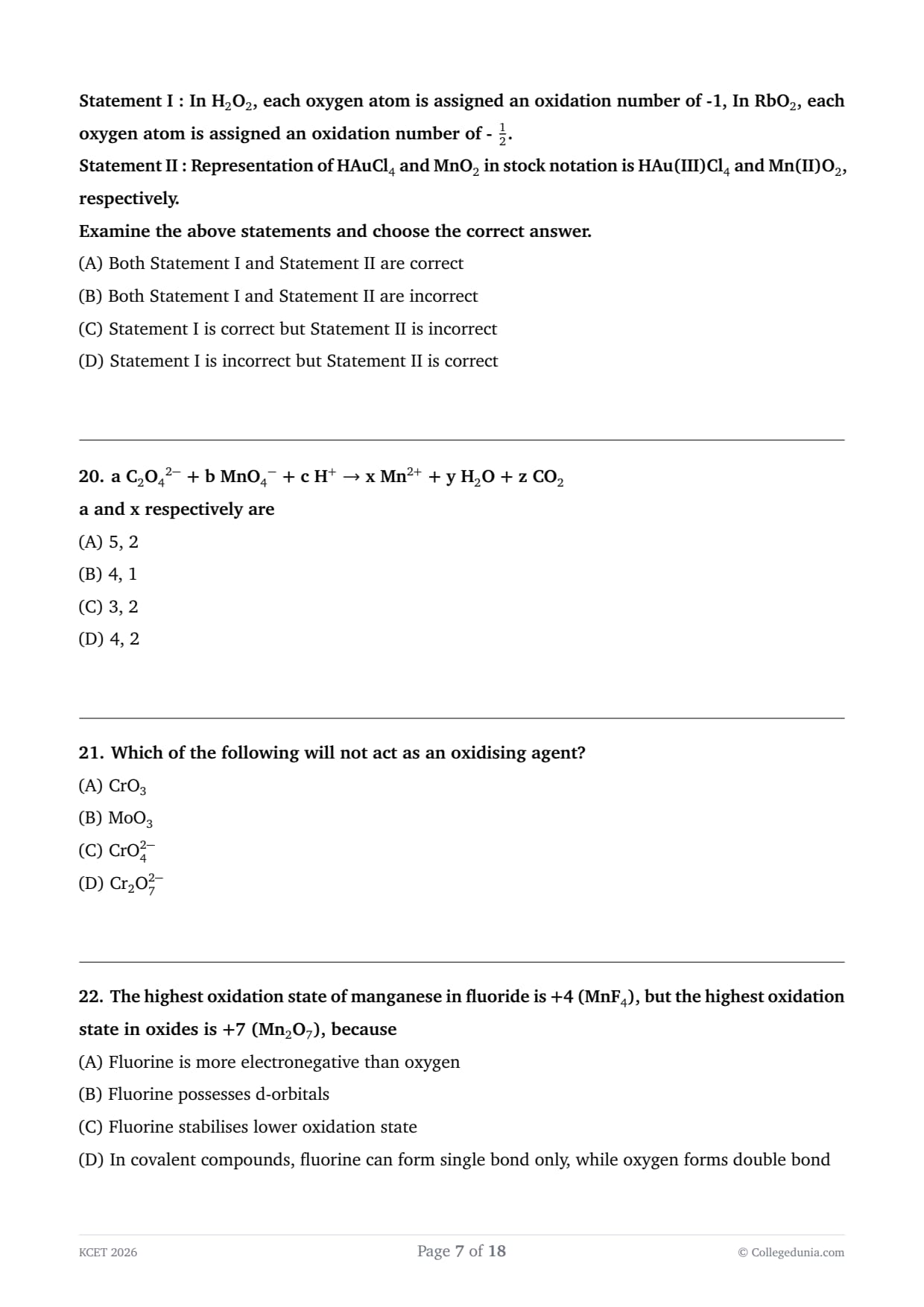
Statement I : In H\(_2\)O\(_2\), each oxygen atom is assigned an oxidation number of -1, In RbO\(_2\), each oxygen atom is assigned an oxidation number of - \(\frac{1}{2}\).
Statement II : Representation of HAuCl\(_4\) and MnO\(_2\) in stock notation is HAu(III)Cl\(_4\) and Mn(II)O\(_2\), respectively.
Examine the above statements and choose the correct answer.
a C\(_2\)O\(_4\)\(^{2-}\) + b MnO\(_4\)\(^{-}\) + c H\(^+\) \(\rightarrow\) x Mn\(^{2+}\) + y H\(_2\)O + z CO\(_2\)
a and x respectively are
Which of the following will not act as an oxidising agent?
The highest oxidation state of manganese in fluoride is +4 (MnF\(_4\)), but the highest oxidation state in oxides is +7 (Mn\(_2\)O\(_7\)), because
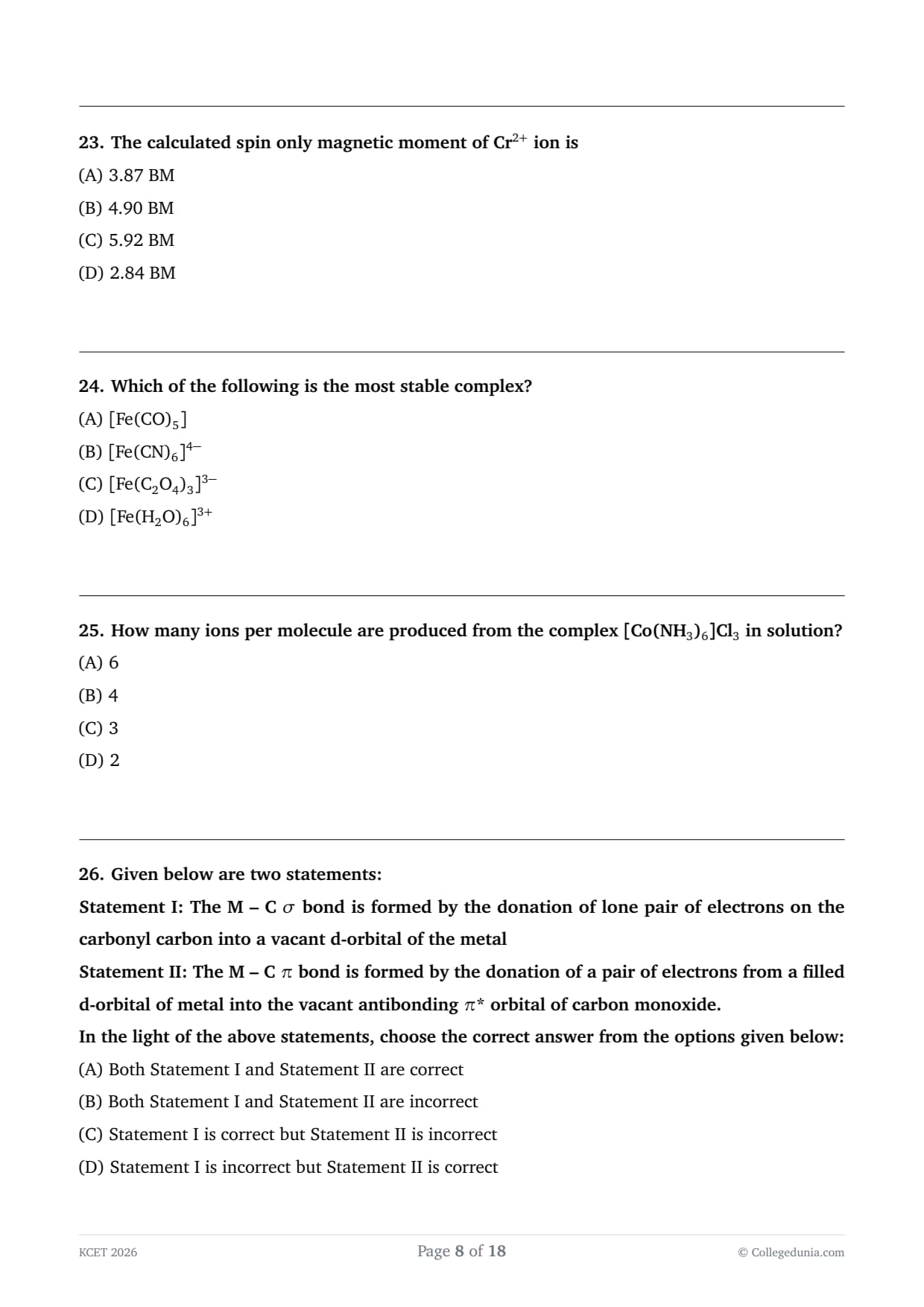
The calculated spin only magnetic moment of Cr\(^{2+}\) ion is
Which of the following is the most stable complex?
How many ions per molecule are produced from the complex [Co(NH\(_3\))\(_6\)]Cl\(_3\) in solution?
Given below are two statements:
Statement I: The M – C \(\sigma\) bond is formed by the donation of lone pair of electrons on the carbonyl carbon into a vacant d-orbital of the metal
Statement II: The M – C \(\pi\) bond is formed by the donation of a pair of electrons from a filled d-orbital of metal into the vacant antibonding \(\pi\)* orbital of carbon monoxide.
In the light of the above statements, choose the correct answer from the options given below:
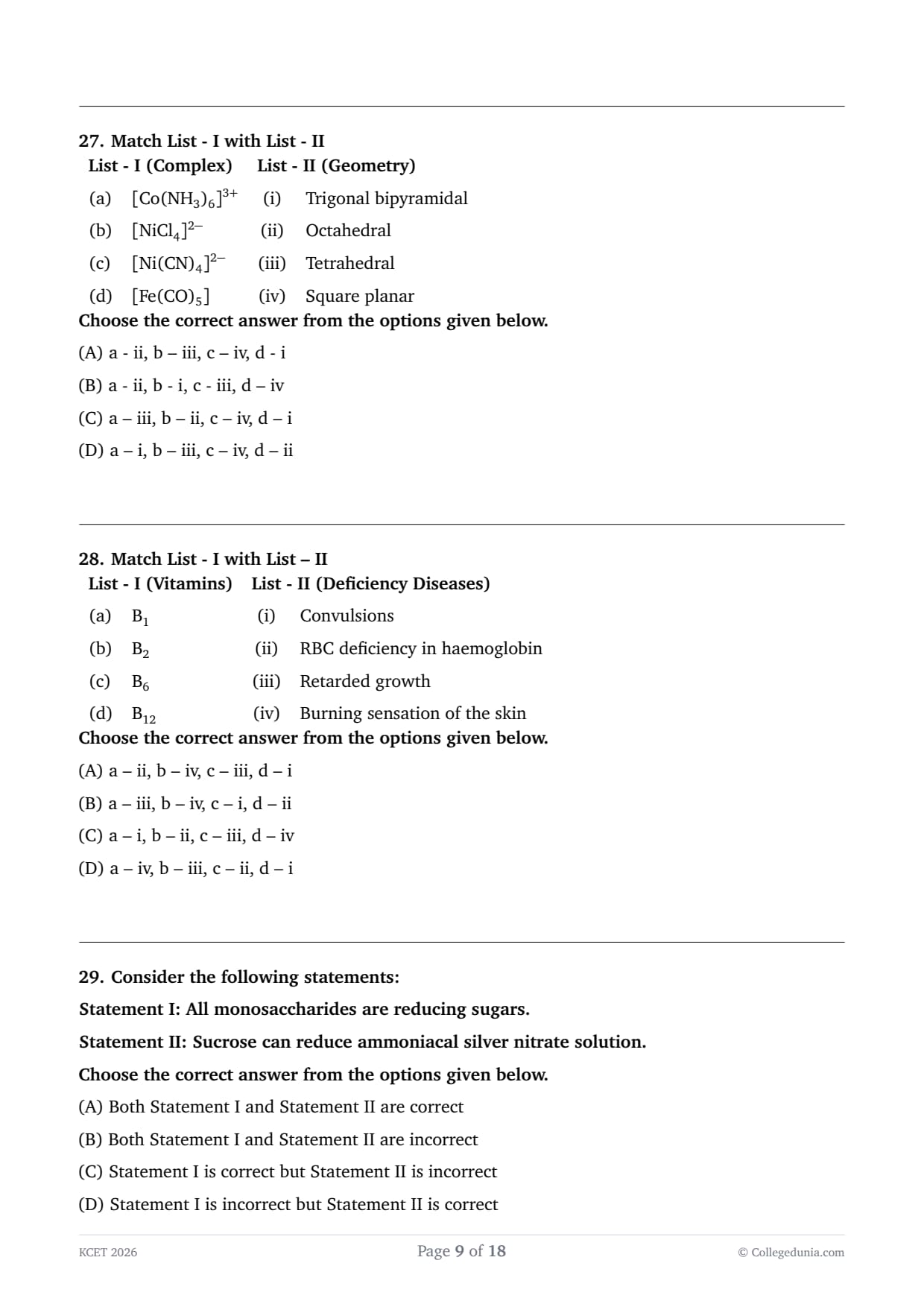
Match List - I with List - II:
| List - I (Complex) | List - II (Geometry) | ||
|---|---|---|---|
| (a) | [Co(NH3)6]3+ | (i) | Trigonal bipyramidal |
| (b) | [NiCl4]2− | (ii) | Octahedral |
| (c) | [Ni(CN)4]2− | (iii) | Tetrahedral |
| (d) | [Fe(CO)5] | (iv) | Square planar |
Choose the correct answer from the options given below:
- (A) a - ii, b – iii, c – iv, d - i
- (B) a - ii, b - i, c - iii, d – iv
- (C) a – iii, b – ii, c – iv, d – i
- (D) a – i, b – iii, c – iv, d – ii
Match List - I with List – II:
| List - I (Vitamins) | List - II (Deficiency Diseases) | ||
|---|---|---|---|
| (a) | B1 | (i) | Convulsions |
| (b) | B2 | (ii) | RBC deficiency in haemoglobin |
| (c) | B6 | (iii) | Retarded growth |
| (d) | B12 | (iv) | Burning sensation of the skin |
Choose the correct answer from the options given below:
- (A) a – ii, b – iv, c – iii, d – i
- (B) a – iii, b – iv, c – i, d – ii
- (C) a – i, b – ii, c – iii, d – iv
- (D) a – iv, b – iii, c – ii, d – i
Consider the following statements:
Statement I: All monosaccharides are reducing sugars.
Statement II: Sucrose can reduce ammoniacal silver nitrate solution.
Choose the correct answer from the options given below.
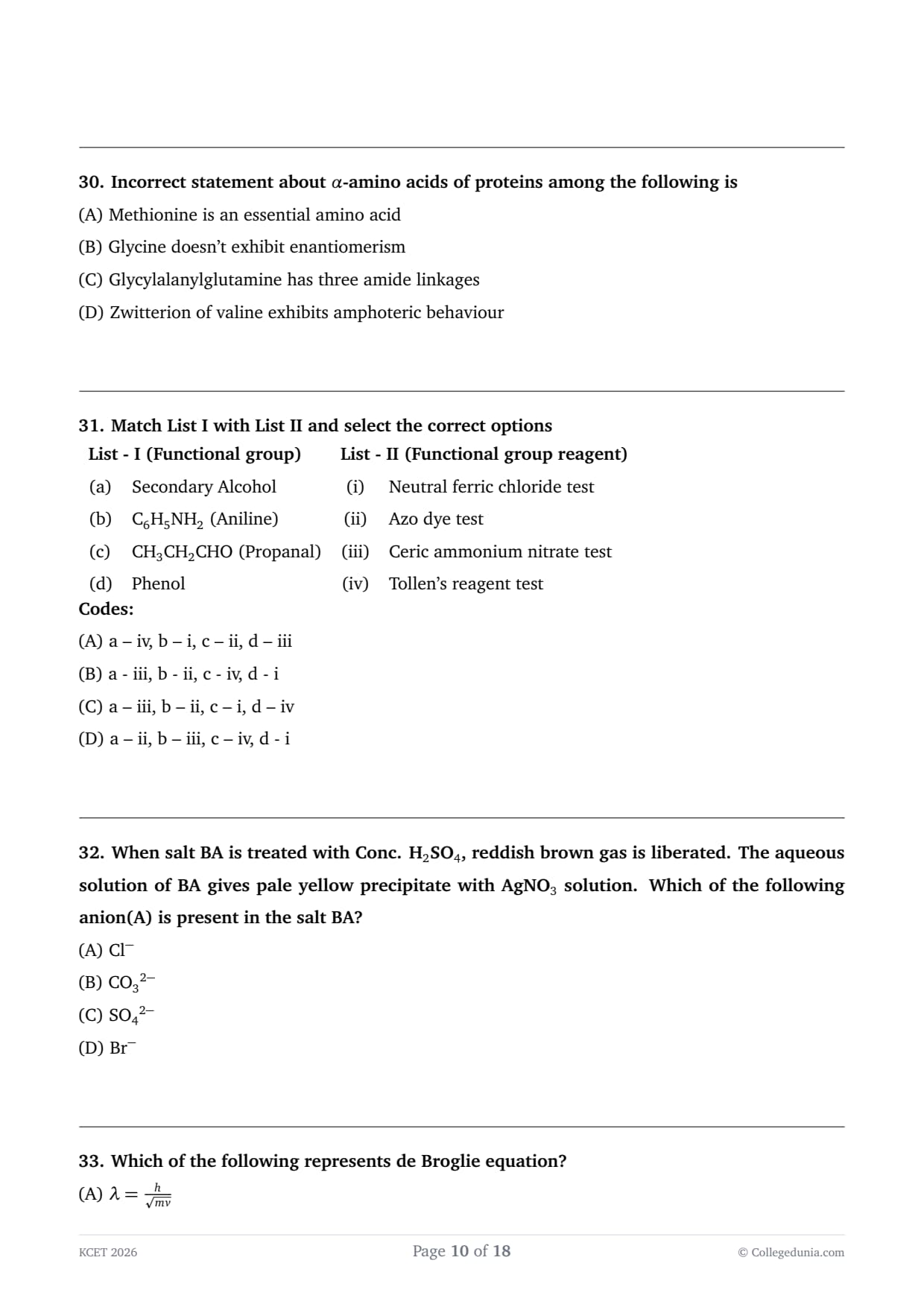
Incorrect statement about \(\alpha\)-amino acids of proteins among the following is
Match List I with List II and select the correct option:
| List - I (Functional group) | List - II (Functional group reagent) | ||
|---|---|---|---|
| (a) | Secondary Alcohol | (i) | Neutral ferric chloride test |
| (b) | C6H5NH2 (Aniline) | (ii) | Azo dye test |
| (c) | CH3CH2CHO (Propanal) | (iii) | Ceric ammonium nitrate test |
| (d) | Phenol | (iv) | Tollen's reagent test |
Codes:
- (A) a – iv, b – i, c – ii, d – iii
- (B) a - iii, b - ii, c - iv, d - i
- (C) a – iii, b – ii, c – i, d – iv
- (D) a – ii, b – iii, c – iv, d - i
When salt BA is treated with Conc. H\(_2\)SO\(_4\), reddish brown gas is liberated. The aqueous solution of BA gives pale yellow precipitate with AgNO\(_3\) solution. Which of the following anion(A) is present in the salt BA?
Which of the following represents de Broglie equation?
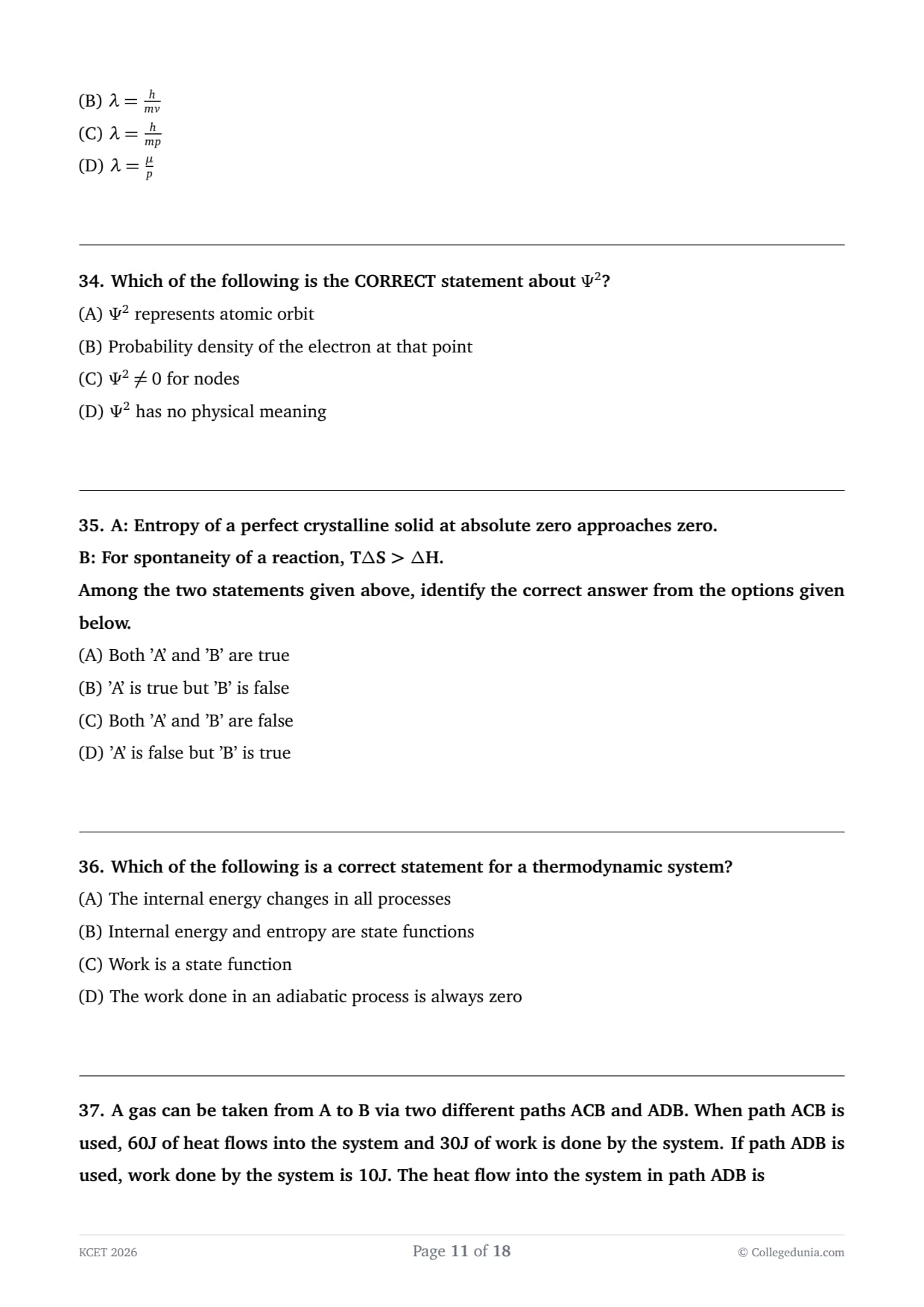
Which of the following is the CORRECT statement about \(\Psi^2\)?
A: Entropy of a perfect crystalline solid at absolute zero approaches zero.
B: For spontaneity of a reaction, T\(\Delta\)S > \(\Delta\)H.
Among the two statements given above, identify the correct answer from the options given below.
Which of the following is a correct statement for a thermodynamic system?
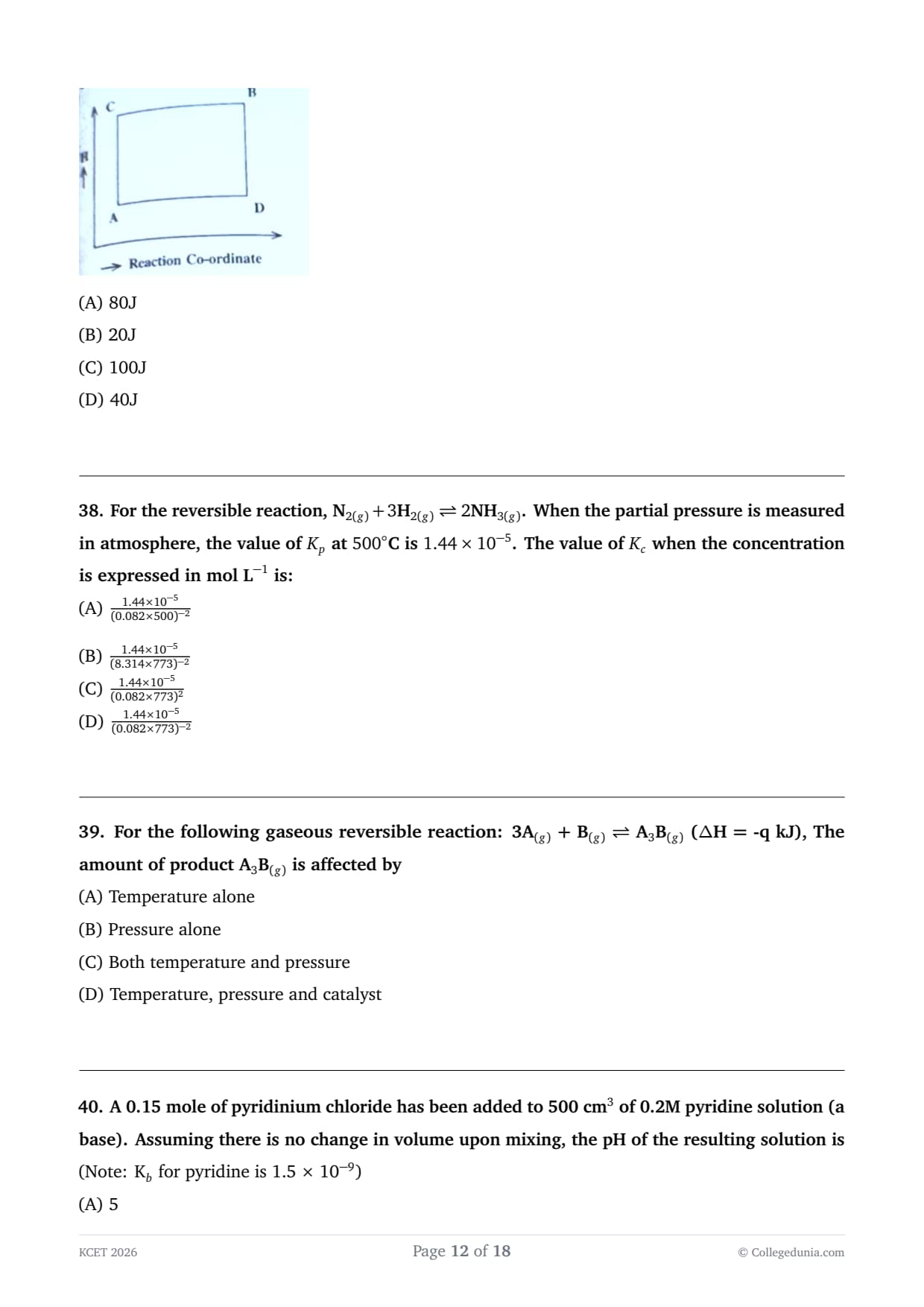
A gas can be taken from A to B via two different paths ACB and ADB.

When path ACB is used, 60J of heat flows into the system and 30J of work is done by the system. If path ADB is used, work done by the system is 10J. The heat flow into the system in path ADB is
For the reversible reaction, N2(g) + 3H2(g) ⇌ 2NH3(g). When the partial pressure is measured in atmosphere, the value of Kp at 500°C is 1.44 × 10⁻⁵. The value of Kc when concentration is expressed in mol L-1 is:
- (A) 1.44 × 10⁻⁵ / (0.082 × 500)-2
- (B) 1.44 × 10⁻⁵ / (8.314 × 773)-2
- (C) 1.44 × 10⁻⁵ / (0.082 × 773)2
- (D) 1.44 × 10⁻⁵ / (0.082 × 773)-2
For the reaction: 3A(g) + B(g) ⇌ A3B(g) (ΔH = -q kJ), the amount of product A3B is affected by:
- (A) Temperature alone
- (B) Pressure alone
- (C) Both temperature and pressure
- (D) Temperature, pressure and catalyst
A 0.15 mole of pyridinium chloride has been added to 500 cm\(^3\) of 0.2M pyridine solution (a base). Assuming there is no change in volume upon mixing, the pH of the resulting solution is
(Note: K\(_b\) for pyridine is 1.5 \(\times\) 10\(^{-9}\))
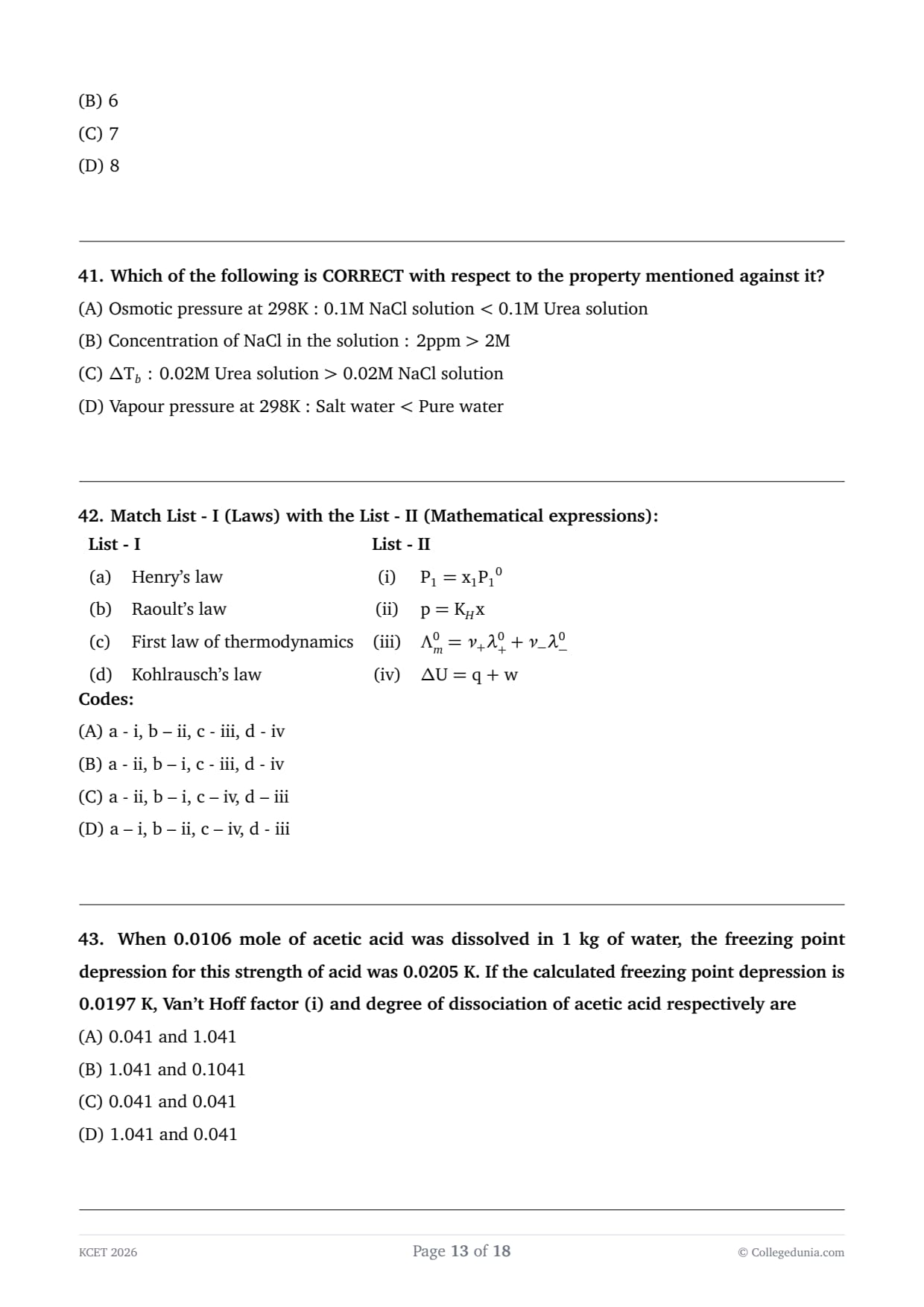
Which of the following is CORRECT with respect to the property mentioned against it?
Match List - I (Laws) with the List - II (Mathematical expressions):
| List - I | List - II | ||
|---|---|---|---|
| (a) | Henry's law | (i) | P1 = x1P10 |
| (b) | Raoult's law | (ii) | p = KHx |
| (c) | First law of thermodynamics | (iii) | Λ0m = ν+λ0+ + ν-λ0- |
| (d) | Kohlrausch's law | (iv) | ΔU = q + w |
Codes:
- (A) a - i, b – ii, c - iii, d - iv
- (B) a - ii, b – i, c - iii, d - iv
- (C) a - ii, b – i, c – iv, d – iii
- (D) a – i, b – ii, c – iv, d - iii
When 0.0106 mole of acetic acid was dissolved in 1 kg of water, the freezing point depression for this strength of acid was 0.0205 K. If the calculated freezing point depression is 0.0197 K, Van't Hoff factor (i) and degree of dissociation of acetic acid respectively are
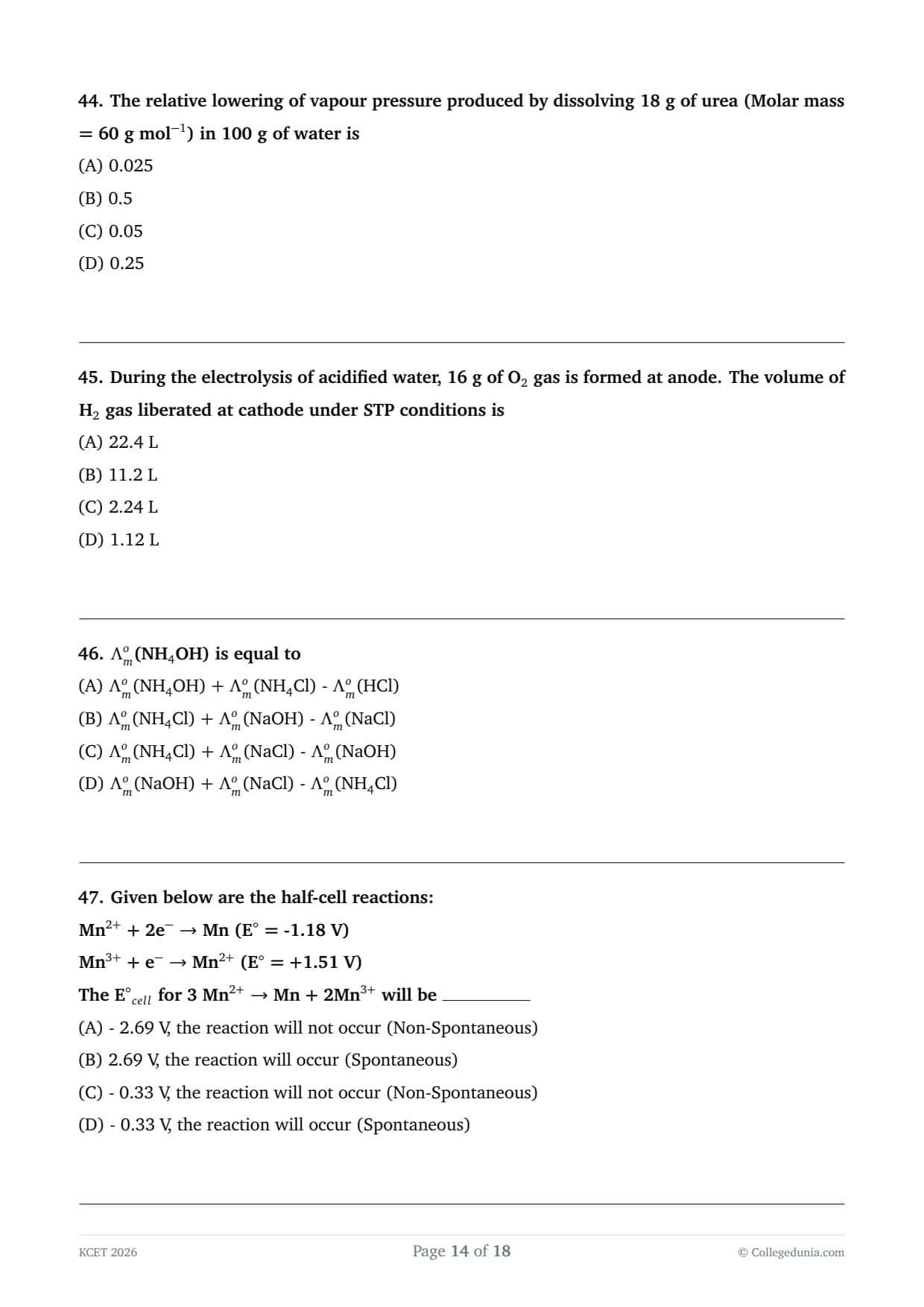
The relative lowering of vapour pressure produced by dissolving 18 g of urea (Molar mass = 60 g mol\(^{-1}\)) in 100 g of water is
During the electrolysis of acidified water, 16 g of O2 gas is formed at anode. The volume of H2 gas liberated at cathode under STP conditions is:
- (A) 22.4 L
- (B) 11.2 L
- (C) 2.24 L
- (D) 1.12 L
\(\Lambda^o_m\)(NH\(_4\)OH) is equal to
Given below are the half-cell reactions:
Mn\(^{2+}\) + 2e\(^-\) \(\rightarrow\) Mn (E\(^\circ\) = -1.18 V)
Mn\(^{3+}\) + e\(^-\) \(\rightarrow\) Mn\(^{2+}\) (E\(^\circ\) = +1.51 V)
The E\(^\circ\)\(_{cell}\) for 3 Mn\(^{2+}\) \(\rightarrow\) Mn + 2Mn\(^{3+}\) will be \rule{2cm{0.1mm
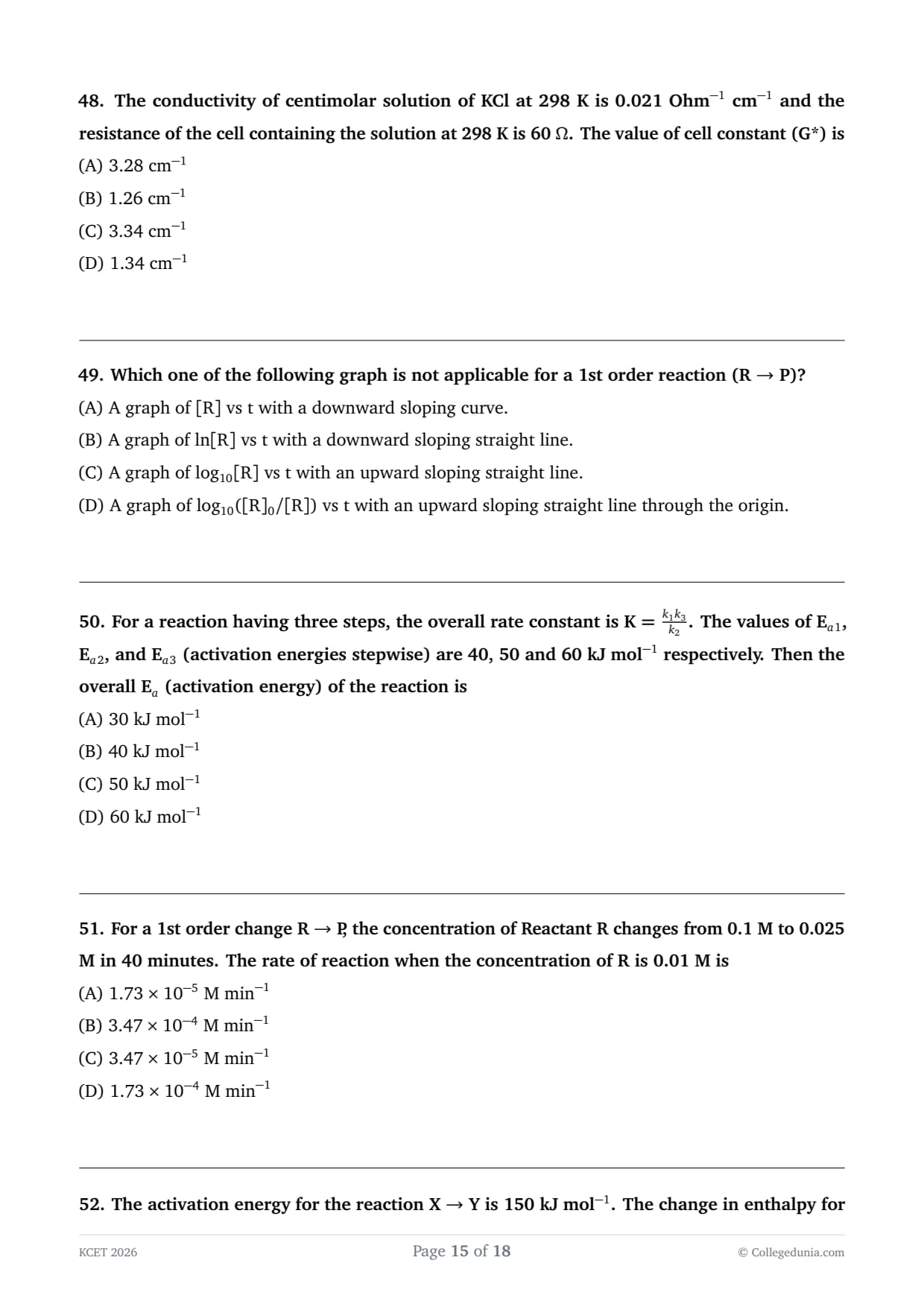
The conductivity of centimolar solution of KCl at 298 K is 0.021 Ohm\(^{-1}\) cm\(^{-1}\) and the resistance of the cell containing the solution at 298 K is 60 \(\Omega\). The value of cell constant (G*) is
Which one of the following graph is not applicable for a 1st order reaction (R \(\rightarrow\) P)?
For a reaction having three steps, the overall rate constant is K = (k1 k3) / k2. The values of Ea1, Ea2, and Ea3 (activation energies) are 40, 50, and 60 kJ mol-1 respectively. The overall activation energy (Ea) is:
- (A) 30 kJ mol-1
- (B) 40 kJ mol-1
- (C) 50 kJ mol-1
- (D) 60 kJ mol-1
For a 1st order change R \(\rightarrow\) P, the concentration of Reactant R changes from 0.1 M to 0.025 M in 40 minutes. The rate of reaction when the concentration of R is 0.01 M is
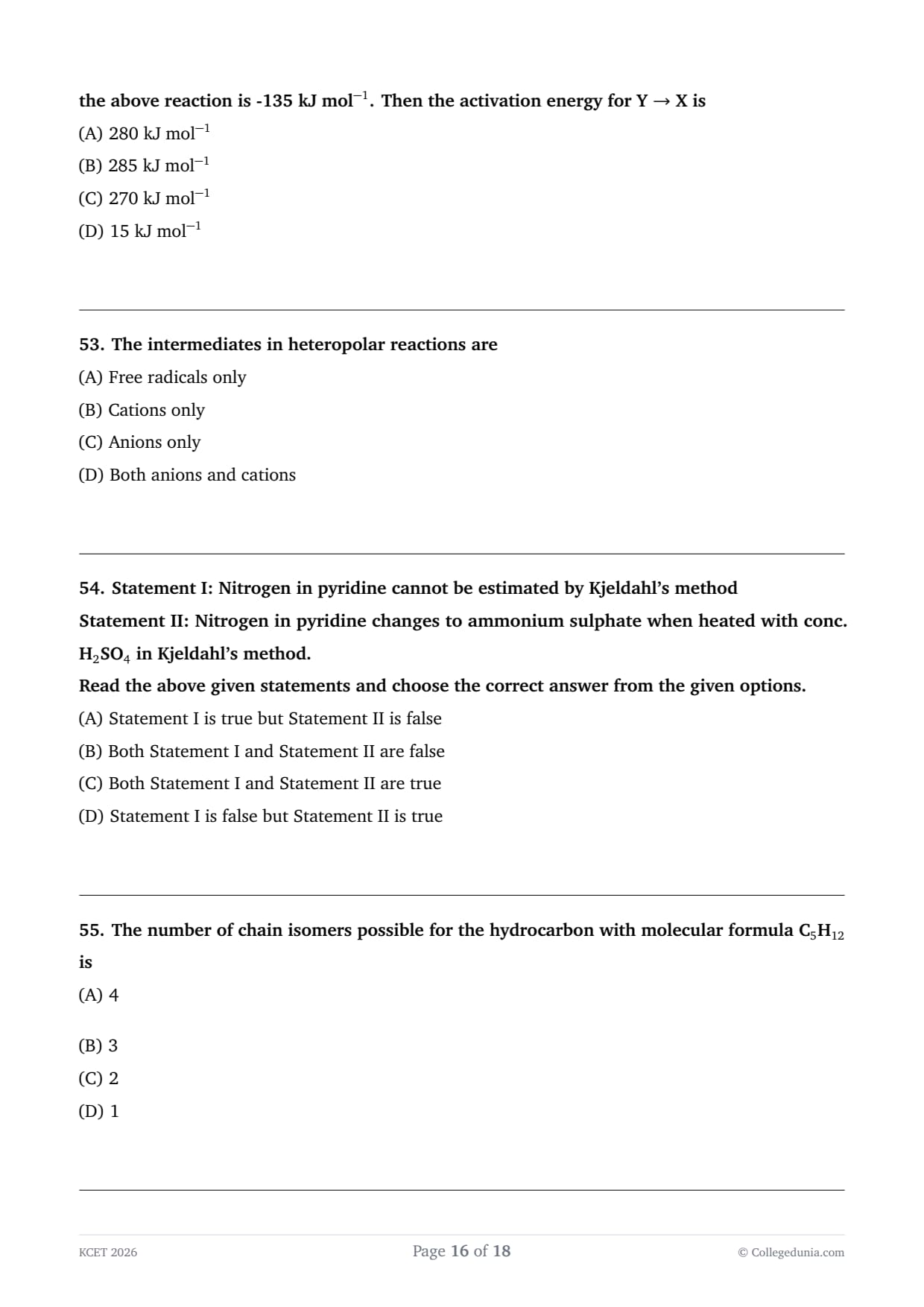
The activation energy for the reaction X \(\rightarrow\) Y is 150 kJ mol\(^{-1}\). The change in enthalpy for the above reaction is -135 kJ mol\(^{-1}\). Then the activation energy for Y \(\rightarrow\) X is
The intermediates in heteropolar reactions are
Statement I: Nitrogen in pyridine cannot be estimated by Kjeldahl's method
Statement II: Nitrogen in pyridine changes to ammonium sulphate when heated with conc. H\(_2\)SO\(_4\) in Kjeldahl's method.
Read the above given statements and choose the correct answer from the given options.
The number of chain isomers possible for the hydrocarbon with molecular formula \( C_5H_{12} \) is
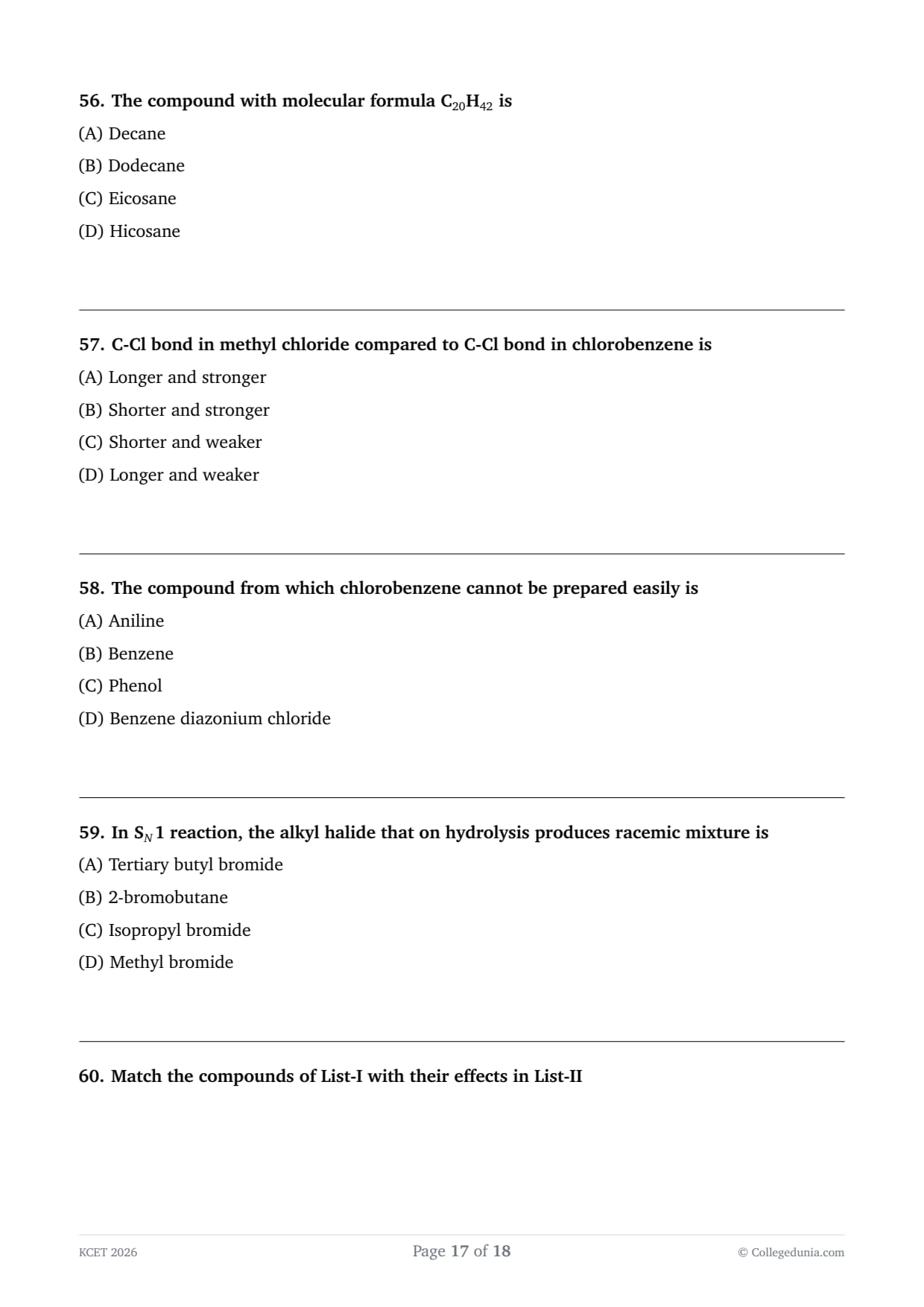
The compound with molecular formula C\(_{20}\)H\(_{42}\) is
C-Cl bond in methyl chloride compared to C-Cl bond in chlorobenzene is
The compound from which chlorobenzene cannot be prepared easily is
In S\(_N\)1 reaction, the alkyl halide that on hydrolysis produces racemic mixture is
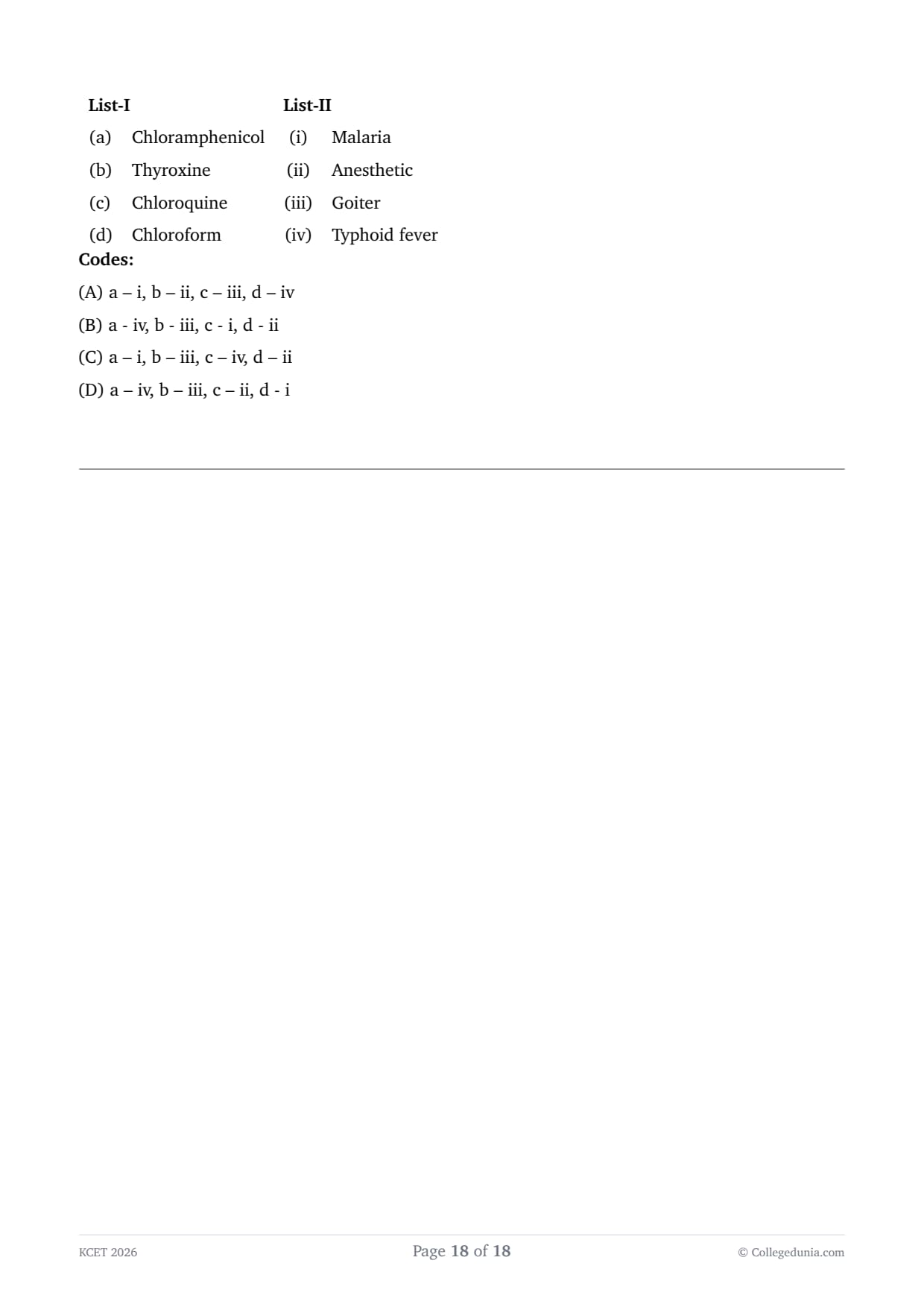
Match the compounds of List-I with their effects in List-II:
| List-I | List-II | ||
|---|---|---|---|
| (a) | Chloramphenicol | (i) | Malaria |
| (b) | Thyroxine | (ii) | Anesthetic |
| (c) | Chloroquine | (iii) | Goiter |
| (d) | Chloroform | (iv) | Typhoid fever |
Codes:
- (A) a – i, b – ii, c – iii, d – iv
- (B) a – iv, b – iii, c – i, d – ii
- (C) a – i, b – iii, c – iv, d – ii
- (D) a – iv, b – iii, c – ii, d – i
KCET 2026 Chemistry: Expected Section-Wise Weightage
| Topic | Expected Weightage |
| Thermodynamics | 8–10% |
| Chemical Kinetics | 6–8% |
| Equilibrium (Chemical + Ionic) | 6–8% |
| Electrochemistry | 5–7% |
| Hydrocarbons | 6–7% |
| Alcohols, Phenols, and Ethers | 6–7% |
| Aldehydes, Ketones, Carboxylic Acids | 6–8% |
| Coordination Compounds | 5–7% |
| p-Block Elements | 6–7% |
| d- and f-Block Elements | 4–6% |
| Basic Principles of Organic Chemistry | 5–6% |
| Environmental Chemistry | 2–3% |
| Chemistry in Everyday Life | 2–3% |



Comments