The NEET PG 2013 question paper with solutions is compiled here for download, with every recalled question worked out and explained. NEET PG 2013 (run as AIPGMEE 2013) was the first fully computer-based all-India PG medical entrance, conducted by the National Board of Examinations (NBE) across late November to early December 2012, with the merit list released in early 2013. The paper carried 300 single-best-answer MCQs covering the full MBBS syllabus.
What you get on this Collegedunia page is the 2013 paper rebuilt as 200 fully solved recall questions, not a bare scan. Each item ships with the verified answer key and a reasoning-first explanation that walks you through why the distractors fail, so the set doubles as a revision drill. Pull the question PDF from the table above, attempt it cold, then open Check Solutions to mark and learn.
NEET PG 2013 Questions with Solutions
Question 1:
Which is the first carpal bone to ossify (appear)?
- (A) Trapezium
- (B) Capitate
- (C) Pisiform
- (D) Lunate
Question 2:
Which muscle is derived from the third pharyngeal arch?
- (A) Tensor tympani
- (B) Stylopharyngeus
- (C) Cricothyroid
- (D) None
Question 3:
Which of the following is true about cardiac muscle?
- (A) Spindle shaped
- (B) Large central nucleus
- (C) No gap junctions
- (D) Arranged in sheets
Question 4:
The radial bursa is the synovial sheath covering the tendon of which muscle?
- (A) Flexor digitorum superficialis (FDS)
- (B) Flexor digitorum profundus (FDP)
- (C) Flexor pollicis longus (FPL)
- (D) Flexor carpi radialis (FCR)
Question 5:
All of the following are contents of the midpalmar space EXCEPT:
- (A) 2nd lumbrical
- (B) Flexor digitorum profundus (FDP) tendon of the 3rd finger
- (C) 1st lumbrical
- (D) Flexor digitorum profundus (FDP) tendon of the 4th finger
Question 6:
Which structure passes deep to the flexor retinaculum at the ankle?
- (A) Posterior tibial artery
- (B) Long (great) saphenous vein
- (C) Tibialis anterior tendon
- (D) Peroneus tertius
Question 7:
The skin and fascia of the great toe drain into which group of lymph nodes?
- (A) Superficial inguinal lymph nodes
- (B) External iliac nodes
- (C) Internal iliac nodes
- (D) Deep inguinal nodes
Question 8:
Which of the following is NOT true about the right principal (main) bronchus?
- (A) Shorter
- (B) Wider
- (C) More horizontal
- (D) In the line of trachea
Question 9:
Which part of the levator ani provides support to the prostate (levator prostatae)?
- (A) Pubococcygeus
- (B) Ischiococcygeus
- (C) Iliococcygeus
- (D) None of the above
Question 10:
What is the approximate length of the anal canal?
- (A) 10 - 15 mm
- (B) 15 - 20 mm
- (C) 25 - 30 mm
- (D) 35 - 40 mm
Question 11:
The chorda tympani is a content of which part of the ear?
- (A) Middle ear
- (B) Inner ear
- (C) External auditory canal
- (D) None of the above
Question 12:
Which is the chief (main) artery supplying the lateral surface of the cerebral hemisphere?
- (A) Anterior cerebral artery
- (B) Posterior cerebral artery
- (C) Middle cerebral artery
- (D) Posterior inferior cerebellar artery
Question 13:
Type 3 respiratory failure occurs due to which of the following?
- (A) Post-operative atelectasis
- (B) Kyphoscoliosis
- (C) Flail chest
- (D) Pulmonary fibrosis
Question 14:
Hypoxic pulmonary vasoconstriction is best described as which of the following?
- (A) Irreversible pulmonary vasoconstriction due to hypoxia
- (B) Reversible pulmonary vasoconstriction due to hypoxia
- (C) Directs blood to poorly ventilated areas
- (D) Occurs hours after pulmonary vasoconstriction
Question 15:
Direct Fick method of measuring cardiac output requires estimation of:
- (A) O2 content of arterial blood
- (B) O2 consumption per unit time
- (C) Arteriovenous O2 difference
- (D) All of the above
Question 16:
The temperature regulating centre is located in the:
- (A) Supraoptic nucleus of hypothalamus
- (B) Paraventricular nucleus of hypothalamus
- (C) Preoptic nucleus of hypothalamus
- (D) Suprachiasmatic nucleus of hypothalamus
Question 17:
Joint position sense and vibration sense are carried by which type of nerve fibre?
- (A) A alpha
- (B) A beta
- (C) A gamma
- (D) B
Question 18:
Normal cerebral blood flow is approximately how many ml/min?
- (A) 55
- (B) 150
- (C) 750
- (D) 1000
Question 19:
Cell bodies of orexigenic neurons are present in the:
- (A) Dorsal raphe
- (B) Locus coeruleus
- (C) Lateral hypothalamic area
- (D) Hippocampus
Question 20:
Hyperosmolarity of the renal medulla is most importantly due to:
- (A) Potassium
- (B) Sodium
- (C) Glucose
- (D) Chloride
Question 21:
Which cells are referred to as pacemaker cells in relation to the basic electrical rhythm (BER) of the gut?
- (A) SA node
- (B) AV node
- (C) Interstitial cells of Cajal
- (D) Pyramidal cells
Question 22:
Which hormone increases with age?
- (A) GH
- (B) Prolactin
- (C) Parathormone
- (D) Insulin
Question 23:
In the breast, lactiferous ducts are formed under the influence of which hormone?
- (A) Estrogen
- (B) Progesterone
- (C) LH
- (D) FSH
Question 24:
The most common type of calcium channels in skeletal muscle are?
- (A) T type
- (B) L type
- (C) R type
- (D) N type
Question 25:
Blood supply of the liver (in ml/100 g/min) is?
- (A) 1500-2000
- (B) 1000-1500
- (C) 50-60
- (D) 250-300
Question 26:
Von Willebrand factor is synthesized by all except?
- (A) Endothelial cells
- (B) Megakaryocytes
- (C) Hepatocytes
- (D) None
Question 27:
Which element is required by phosphofructokinase?
- (A) Magnesium
- (B) Inorganic phosphate
- (C) Manganese
- (D) Copper
Question 28:
Which of the following is a serine protease?
- (A) Pepsin
- (B) Trypsin
- (C) Carboxypeptidase
- (D) None
Question 29:
Which of the following is an aldosugar?
- (A) Fructose
- (B) Erythrulose
- (C) Glucose
- (D) None
Question 30:
Gluconeogenesis from lactate needs all of the following except?
- (A) Transport of lactate from muscle to liver
- (B) Conversion of lactate to pyruvate
- (C) Transamination of pyruvate to alanine
- (D) None of the above
Question 31:
Reducing sugar in urine can be detected by?
- (A) Benedict's test
- (B) Fehling's solution
- (C) Glucose-oxidase test
- (D) All of the above
Question 32:
Ketone body formation without glycosuria is seen in?
- (A) Diabetes mellitus
- (B) Diabetes insipidus
- (C) Starvation
- (D) Obesity
Question 33:
Apolipoprotein E is rich in which amino acid?
- (A) Lysine
- (B) Arginine
- (C) Histidine
- (D) Methionine
Question 34:
Ninhydrin test is used for the detection of?
- (A) Bile salts
- (B) Amino acids
- (C) Nucleic acid
- (D) Lipids
Question 35:
Sweaty feet odour in urine is seen in?
- (A) Phenylketonuria
- (B) Maple syrup urine disease
- (C) Isovaleric acidemia
- (D) Alkaptonuria
Question 36:
Okazaki fragments are formed during which process?
- (A) Transcription
- (B) Translation
- (C) DNA replication
- (D) None
Question 37:
The chemical process involved in the conversion of progesterone to glucocorticoids is:
- (A) Methylation
- (B) Hydroxylation
- (C) Carboxylation
- (D) None
Question 38:
Glutathione requires which vitamin to act as an antioxidant?
- (A) Vitamin E
- (B) Niacin
- (C) Vitamin C
- (D) Vitamin A
Question 39:
During starvation, muscle primarily uses which fuel?
- (A) Fatty acids
- (B) Ketone bodies
- (C) Glucose
- (D) Proteins
Question 40:
All are true about chaperones except:
- (A) Cause folding of proteins
- (B) Are lipid in nature
- (C) May have ATPase activity
- (D) Include heat shock proteins
Question 41:
Amyloidosis occurs in all of the following except:
- (A) Tuberculosis
- (B) Chronic bronchitis
- (C) Osteomyelitis
- (D) Bronchiectasis
Question 42:
An example of apoptosis is:
- (A) Councilman bodies
- (B) Gamna Gandy body
- (C) Russell bodies
- (D) None
Question 43:
Syphilitic aneurysm most commonly involves which part of the aorta?
- (A) Arch of aorta
- (B) Descending aorta
- (C) Abdominal aorta above the renal arteries
- (D) Abdominal aorta below the renal arteries
Question 44:
Increased vascular permeability in acute inflammation is mainly due to which mediator?
- (A) Histamine
- (B) IL-2
- (C) TGF-beta
- (D) FGF
Question 45:
Which cytokine activates macrophages?
- (A) IL-8
- (B) IFN-gamma
- (C) PAF
- (D) Leukotriene B4
Question 46:
What is the chance of a child having cystic fibrosis if one parent is affected and the other parent is a carrier?
- (A) 25%
- (B) 50%
- (C) 70%
- (D) 80%
Question 47:
What is the terminal (final) stage of lobar pneumonia?
- (A) Congestion
- (B) Red hepatization
- (C) Gray hepatization
- (D) Resolution
Question 48:
Michaelis-Gutmann bodies are seen in which condition?
- (A) Xanthogranulomatous pyelonephritis
- (B) Pyelonephritis
- (C) Malakoplakia
- (D) Nail patella syndrome
Question 49:
All of the following immunohistochemical markers are positive in the neoplastic cells of granulocytic sarcoma, except:
- (A) CD45 RO
- (B) CD43
- (C) Myeloperoxidase
- (D) Lysozyme
Question 50:
Donath-Landsteiner antibody is seen in?
- (A) PNH
- (B) Waldenstrom's macroglobulinemia
- (C) Paroxysmal cold hemoglobinuria
- (D) Malaria
Question 51:
Multiple epidermoid cysts are seen in?
- (A) Turcot's syndrome
- (B) Gardner's syndrome
- (C) Peutz-Jeghers syndrome
- (D) Familial polyposis coli
Question 52:
Perifascicular atrophy of muscle fibres is seen in?
- (A) Steroid myopathy
- (B) Dermatomyositis
- (C) Inclusion body myositis
- (D) Nemaline myopathy
Question 53:
Flexner-Wintersteiner rosette is seen in?
- (A) Hepatoblastoma
- (B) Nephroblastoma
- (C) Neuroblastoma
- (D) Retinoblastoma
Question 54:
Elimination after 4 half lives in first order kinetics is?
- (A) 84%
- (B) 93%
- (C) 80.5%
- (D) 4.75%
Question 55:
Type E adverse reaction is?
- (A) Toxicity
- (B) Augmented effect
- (C) Teratogenesis
- (D) Withdrawal reaction
Question 56:
Besides its property of decreasing intraocular pressure, timolol is preferred in the treatment of glaucoma because it?
- (A) Produces no miosis
- (B) Possesses membrane stabilizing activity
- (C) Increases outflow of aqueous humor
- (D) Is a selective beta-adrenoceptor blocker
Question 57:
Which of the following is true about calcium channel blockers?
- (A) Verapamil causes reflex tachycardia
- (B) Diltiazem causes reflex tachycardia
- (C) Nifedipine causes reflex tachycardia
- (D) Nifedipine has a longer t1/2 than felodipine
Question 58:
Which second generation antihistaminic does NOT produce an active metabolite?
- (A) Loratadine
- (B) Terfenadine
- (C) Cetirizine
- (D) None
Question 59:
Thiazide diuretics act on which part of the nephron?
- (A) Proximal convoluted tubule (PCT)
- (B) Distal convoluted tubule (DCT)
- (C) Glomerulus
- (D) Descending limb of the loop of Henle
Question 60:
Which of the following is true about lamotrigine?
- (A) Decreased efficacy in depression
- (B) First choice in absence seizure
- (C) t1/2 is 24 hours
- (D) Not metabolised in liver
Question 61:
Anandamide is which type of substance?
- (A) Opioid
- (B) CK 1 antagonist
- (C) D2 blocker
- (D) Cannabinoid neurotransmitter
Question 62:
Metformin is used in the treatment and control of which condition(s)?
- (A) Diabetes
- (B) Polycystic ovarian disease (PCOD)
- (C) Pregnancy induced hypertension
- (D) Both a and b
Question 63:
Which of the following drugs reduces the efficacy of oral contraceptives?
- (A) Erythromycin
- (B) Griseofulvin
- (C) Cimetidine
- (D) Disulfiram
Question 64:
Which drug binds bile acids in the intestine and prevents their return to the liver via the enterohepatic circulation?
- (A) Niacin
- (B) Fenofibrate
- (C) Cholestyramine
- (D) Gugulipid
Question 65:
Which of the following anticoagulants is given orally?
- (A) Argatroban
- (B) Alteplase
- (C) Rivaroxaban
- (D) Fondaparinux
Question 66:
Raltegravir can cause which of the following?
- (A) Hypokalemia
- (B) Hypocalcemia
- (C) Hyperkalemia
- (D) Hypercalcemia
Question 67:
Which one of the following statements is FALSE regarding vincristine?
- (A) It is an alkaloid
- (B) Its use is associated with neurotoxicity
- (C) It does not cause alopecia
- (D) It is a useful drug for induction of remission in acute lymphoblastic leukaemia
Question 68:
Which of the following is NOT a hepatotoxic drug?
- (A) Chlorpropamide
- (B) Allopurinol
- (C) Streptomycin
- (D) Halothane
Question 69:
IPC Section 197 is related to:
- (A) Causing disappearance of evidence
- (B) Issuing false certificate by a doctor
- (C) Giving false evidence
- (D) b and c both
Question 70:
A Class I judicial magistrate has the power to give a punishment of:
- (A) 5 years, Rs. 3000
- (B) 3 years, Rs. 5000
- (C) 5 years, Rs. 5000
- (D) 3 years, Rs. 3000
Question 71:
The first fingerprint bureau of the world was first established in which country?
- (A) England
- (B) China
- (C) India
- (D) Singapore
Question 72:
The ideal site to record the body temperature in a dead body is?
- (A) Rectum
- (B) Axilla
- (C) Mouth
- (D) Groin
Question 73:
A graze is a type of?
- (A) Bruise
- (B) Contusion
- (C) Laceration
- (D) Abrasion
Question 74:
Choking of the respiratory passage by a bolus of food is known as?
- (A) Gagging
- (B) Overlying
- (C) Cafe coronary
- (D) Burking
Question 75:
Immersion syndrome is also called as?
- (A) Hydrocution
- (B) Wet drowning
- (C) Dry drowning
- (D) Secondary drowning
Question 76:
The term Quoad Hanc means?
- (A) Passive partner in sexual intercourse
- (B) Woman having high sexual desire
- (C) Sexual partner in pedophilia
- (D) Male impotent to a particular woman
Question 77:
Regarding pseudomembranous colitis, all of the following are true except?
- (A) Toxin A is responsible for the clinical manifestations
- (B) Toxin B is responsible for the clinical manifestations
- (C) Blood in stools is a common feature
- (D) Summit lesions are an early histopathological finding
Question 78:
Spores of bacteria are destroyed by which of the following agents?
- (A) Alcohol
- (B) Lysol
- (C) Halogen
- (D) Ionizing radiation
Question 79:
What is the correct arrangement of lenses from the eye to the source of light in a light microscope?
- (A) Ocular lens : Objective lens : Condenser lens
- (B) Objective lens : Ocular lens : Condenser lens
- (C) Condenser lens : Objective lens : Ocular lens
- (D) Objective lens : Condenser lens : Ocular lens
Question 80:
The vaccine against Neisseria meningitidis contains which of the following?
- (A) Whole bacteria
- (B) Capsular polysaccharide
- (C) Somatic 'O' antigen
- (D) None of these
Question 81:
Glomerulonephritis following streptococcal infection is diagnosed by which of the following tests?
- (A) Blood culture
- (B) Throat culture
- (C) ASO titre
- (D) PCR
Question 82:
All of the following are non-sporing anaerobes of medical importance except:
- (A) Actinomyces
- (B) Bacteroides
- (C) Clostridia
- (D) Fusobacterium
Question 83:
Consumption of uncooked pork is likely to cause which of the following helminthic diseases?
- (A) Taenia saginata
- (B) Taenia solium
- (C) Trichuris trichiura
- (D) None of these
Question 84:
A case of giardiasis typically presents with which of the following?
- (A) Nausea and vomiting
- (B) Abdominal pain
- (C) Steatorrhea and flatulence
- (D) All of the above
Question 85:
Aspergillus causes all of the following except?
- (A) Bronchopulmonary allergy
- (B) Otomycosis
- (C) Dermatophytosis
- (D) Allergic sinusitis
Question 86:
What is the site for injection of cell culture rabies vaccine?
- (A) Gluteus
- (B) Subcutaneous
- (C) Deltoid
- (D) Anterior abdominal wall
Question 87:
The immunoglobulin antigenic determinant that changes in the variable region is the?
- (A) Idiotype
- (B) Isotype
- (C) Allotype
- (D) Epitope
Question 88:
The cytolytic activity of the membrane attack complex is modulated by?
- (A) Factor I
- (B) Factor B
- (C) Factor S
- (D) Factor H
Question 89:
Which of the following is a bioterrorism Category A agent?
- (A) Q fever
- (B) Typhus fever
- (C) Brucella
- (D) Anthrax
Question 90:
What is the most common organism causing ventilator associated pneumonia?
- (A) Legionella
- (B) Pneumococcus
- (C) Pseudomonas
- (D) Coagulase negative staphylococcus
Question 91:
According to the Millennium Development Goals, by how much was child mortality to be reduced by 2015?
- (A) One third
- (B) Half
- (C) Two third
- (D) One fourth
Question 92:
A person has lost his leg in an accident because of which he is not able to walk. This is -
- (A) Disease
- (B) Disability
- (C) Impairment
- (D) Handicap
Question 93:
Ideal temperature for DPT storage?
- (A) Room temperature
- (B) 4 to 8 degree C
- (C) 0 to -20 degree C
- (D) None
Question 94:
A 3 month old infant with no chest indrawing and a respiratory rate of 52 per minute. Diagnosis is -
- (A) No pneumonia
- (B) Pneumonia
- (C) Severe pneumonia
- (D) Very severe disease
Question 95:
Shortest incubation period is of which infection?
- (A) Chicken pox
- (B) Measles
- (C) Rubella
- (D) Influenza
Question 96:
Dose of chloroquine at 4 to 8 years is -
- (A) 150 mg
- (B) 300 mg
- (C) 450 mg
- (D) 600 mg
Question 97:
Based on the type of life cycle, zoonoses are classified into all of the following except -
- (A) Cyclo-zoonoses
- (B) Meta-zoonoses
- (C) Anthropozoonoses
- (D) Sporo-zoonoses
Question 98:
Disease not covered under the Integrated Disease Surveillance Project (IDSP) is?
- (A) Meningococcal disease
- (B) Tuberculosis
- (C) Herpes zoster
- (D) Cholera
Question 99:
Which of the following is a natural family planning method?
- (A) Abstinence
- (B) Coitus interruptus
- (C) BBT (basal body temperature method)
- (D) Safe period
Question 100:
What is the present general fertility rate (per 1000 women aged 15-49 years)?
- (A) 84
- (B) 118
- (C) 128
- (D) 138
Question 101:
The richest source of vitamin D is:
- (A) Fish
- (B) Soyabean
- (C) Halibut liver oil
- (D) Vegetables
Question 102:
Sandfly transmits all of the following diseases, EXCEPT:
- (A) Oriental sore
- (B) Leishmaniasis
- (C) Kala-azar
- (D) Relapsing fever
Question 103:
The pattern of inter-relationships between persons in a society is called:
- (A) Social structure
- (B) Social psychology
- (C) Herd structure
- (D) Social science
Question 104:
People are separated into groups, and from each group people are selected randomly. What type of sampling is this?
- (A) Simple random
- (B) Stratified random
- (C) Systematic random
- (D) Cluster
Question 105:
One Primary Health Centre (PHC) covers how much population in a hilly area?
- (A) 10000
- (B) 20000
- (C) 30000
- (D) 50000
Question 106:
Indira Gandhi Matritva Sahyog Yojana (IGMSY) is for women of which age group?
- (A) > 65 years old
- (B) > 50 years old
- (C) > 30 years old
- (D) > 19 years old
Question 107:
The ossicles of the middle ear are mainly responsible for which of the following?
- (A) Amplification of sound intensity
- (B) Reduction of sound intensity
- (C) Protecting the inner ear
- (D) Reduction of impedance to sound transmission
Question 108:
In pure tone audiometry, the red line on the audiogram represents which of the following?
- (A) Bone conduction
- (B) Air conduction
- (C) Right ear
- (D) Left ear
Question 109:
Bullous myringitis is most commonly caused by which of the following organisms?
- (A) Pseudomonas
- (B) Mycoplasma
- (C) Pneumococcus
- (D) Candida
Question 110:
The delta sign on imaging is seen in which of the following conditions?
- (A) Petrositis
- (B) Acute mastoiditis
- (C) Sigmoid sinus thrombosis
- (D) Glomus tumor
Question 111:
Gelle's test is used in the diagnosis of which of the following conditions?
- (A) Otosclerosis
- (B) Juvenile angiofibroma
- (C) Nasal polyp
- (D) None
Question 112:
All of the following cranial nerves may be involved in acoustic neuroma, EXCEPT?
- (A) Vagus
- (B) Glossopharyngeal
- (C) Oculomotor
- (D) Facial
Question 113:
Which of the following is true about the external nose?
- (A) Upper 2/3 is bony
- (B) Lower 1/3 is cartilaginous
- (C) Single lateral cartilage
- (D) Two nasal bones
Question 114:
Posterior epistaxis occurs from which of the following?
- (A) Woodruff's plexus
- (B) Kiesselbach's plexus
- (C) Atherosclerosis
- (D) Little's area
Question 115:
What is the investigation of choice for nasopharyngeal angiofibroma?
- (A) X-ray
- (B) MRI
- (C) Plain CT
- (D) CT with contrast
Question 116:
Regarding acute retropharyngeal abscess, which of the following is NOT true?
- (A) Due to lymphadenitis
- (B) Common in adults
- (C) Swelling on one side of midline
- (D) Incision and drainage
Question 117:
What is the most common cause of oroantral fistula?
- (A) Tuberculosis
- (B) Penetrating injury
- (C) Tooth extraction
- (D) Iatrogenic
Question 118:
Killian's incision is used for which of the following procedures?
- (A) Septoplasty
- (B) Submucous resection (SMR)
- (C) Proof puncture
- (D) Modified radical mastoidectomy
Question 119:
A child has a congenital cataract involving the visual axis which was detected by the parents right at birth. This child should be operated:
- (A) Immediately
- (B) At 2 months of age
- (C) At 1 year of age when the globe becomes normal sized
- (D) After 4 years when entire ocular and orbital growth becomes normal
Question 120:
Which are the first order neurons in the optic pathway?
- (A) Bipolar cells
- (B) Ganglionic cells
- (C) Cells of lateral geniculate body
- (D) Astrocytes
Question 121:
During retinoscopy of a 30 year old male, which cycloplegic is used routinely?
- (A) Atropine 1% ointment
- (B) Cyclopentolate 1% drop
- (C) Homatropine 2% drop
- (D) None of the above
Question 122:
All statements are true about trachoma except:
- (A) Trachoma is caused by a bedsonian organism of the psittacosis-lymphogranuloma-trachoma (PLT) group.
- (B) Strains mainly responsible are A, B, Ba and C.
- (C) Marked papillary hyperplasia with limbal follicles is seen in stage III.
- (D) Corneal ulceration is a complication.
Question 123:
Immune ring is a feature of?
- (A) Interstitial keratitis
- (B) Fungal corneal ulcer
- (C) Bacterial corneal ulcer
- (D) Herpes simplex keratitis
Question 124:
Red keratic precipitates are seen in?
- (A) Granulomatous uveitis
- (B) Hemorrhagic uveitis
- (C) Old healed uveitis
- (D) Acute anterior uveitis
Question 125:
Posterior lenticonus is seen in?
- (A) Alport's syndrome
- (B) Lowe's syndrome
- (C) Marfan syndrome
- (D) Homocystinuria
Question 126:
Acute angle closure glaucoma first line treatment?
- (A) IV mannitol
- (B) Acetazolamide
- (C) Pilocarpine
- (D) Beta blocker eyedrops
Question 127:
Photoretinitis is due to?
- (A) Snow reflection
- (B) Solar eclipse
- (C) Blunt trauma
- (D) None of the above
Question 128:
Altitudinal visual field defect is seen in?
- (A) Papilloedema
- (B) Retinitis pigmentosa
- (C) Anterior ischemic optic neuropathy
- (D) Buphthalmos
Question 129:
Positive forced duction test is seen in?
- (A) Extraocular muscle palsy
- (B) Mechanical restriction of ocular movement
- (C) Concomitant squint
- (D) None
Question 130:
Dacryocystorhinostomy involves?
- (A) Opening up the terminal blocked end of nasolacrimal duct
- (B) Connecting the lacrimal sac to nose by breaking the medial wall
- (C) Complete excision of lacrimal sac
- (D) Insertion of drainage tube in the lacrimal sac
Question 131:
Parachute lesions (sea-fan neovascularization) are seen in?
- (A) Eales disease
- (B) Diabetes
- (C) Sickle cell anemia
- (D) All of the above
Question 132:
Nelson syndrome is most likely seen after:
- (A) Hypophysectomy
- (B) Adrenalectomy
- (C) Thyroidectomy
- (D) Orchidectomy
Question 133:
Blood transfusion should be completed within how many hours of initiation?
- (A) 1 to 4 hours
- (B) 3 to 6 hours
- (C) 4 to 8 hours
- (D) 8 to 12 hours
Question 134:
A patient has ascitic fluid with a serum-ascites albumin gradient (SAAG) greater than 1.1 g/dL and an ascitic total protein concentration of 2.8 g/dL. The most likely cause is:
- (A) Nephritic syndrome
- (B) Cardiac failure
- (C) Tuberculosis
- (D) Portal hypertension
Question 135:
In chronic obstructive pulmonary disease (COPD), which of the following spirometry findings is true?
- (A) FEV1/FVC less than 0.7
- (B) Normal FEV1/FVC ratio
- (C) Reduced residual volume
- (D) Increased FEV1
Question 136:
A chest X-ray shows bilateral lung infiltrates suggestive of diffuse parenchymal lung disease. The next most appropriate investigation is:
- (A) Sputum examination
- (B) CT scan (HRCT)
- (C) Bronchoscopy
- (D) Empirical antibiotics
Question 137:
Calciphylaxis is a severe, life-threatening condition that occurs most commonly in:
- (A) Parathyroidectomy
- (B) Medullary carcinoma of thyroid
- (C) Hyperthyroidism
- (D) End-stage renal disease
Question 138:
Excluding head trauma, the most common cause of subarachnoid haemorrhage is:
- (A) Arterio-venous malformation
- (B) Cavernous angioma
- (C) Aneurysm
- (D) Hypertension
Question 139:
Liver biopsy is indicated in all of the following except:
- (A) Amoebic hepatitis
- (B) Wilson's disease
- (C) Chronic hepatitis B and C
- (D) Autoimmune hepatitis
Question 140:
Treatment of hypercalcemia includes all of the following except:
- (A) Steroids
- (B) Bisphosphonates
- (C) Phosphate
- (D) Strontium
Question 141:
Which is the most common malignancy associated with rheumatoid arthritis?
- (A) Diffuse large B cell lymphoma
- (B) Large granular lymphocytic leukemia
- (C) Chronic lymphocytic leukemia
- (D) None of the above
Question 142:
Deficiency of vitamin E typically causes which of the following?
- (A) Hemorrhagic stroke
- (B) Cardiac failure
- (C) Ataxia
- (D) Megaloblastic anemia
Question 143:
A 25 year old woman presents with generalized restriction of eye movement in all directions, intermittent ptosis, proximal muscle weakness, and fatigability. Which is the MOST useful test in making the diagnosis?
- (A) CPK
- (B) Edrophonium test
- (C) EMG
- (D) Muscle biopsy
Question 144:
The tensile strength of a healing wound reaches that of unwounded tissue by which time?
- (A) 6 weeks
- (B) 2 months
- (C) 4 months
- (D) None
Question 145:
Complications of total parenteral nutrition include which of the following?
- (A) Hyperglycemia
- (B) Hyperkalemia
- (C) Hyperosmolar dehydration
- (D) a and b
Question 146:
Which is a premalignant lesion for carcinoma of the rectum?
- (A) Familial polyposis
- (B) Familial adenomatous polyposis (FAP)
- (C) Juvenile polyp
- (D) Adenomatous polyp
Question 147:
Which are clinical or investigative features of intestinal obstruction?
- (A) Abdominal distension
- (B) Vomiting
- (C) Fluid level in X-ray more than 4
- (D) a and b
Question 148:
Carcinoma of the breast is least commonly seen in which quadrant?
- (A) Superior outer quadrant
- (B) Inferior outer quadrant
- (C) Subareolar region
- (D) Lower inner quadrant
Question 149:
Sistrunk's operation is used in the treatment of which of the following?
- (A) Parotid tumour
- (B) Thyroglossal fistula
- (C) Thyroglossal cyst
- (D) Both b and c
Question 150:
Which of the following nerves is commonly damaged during a McBurney's incision?
- (A) Subcostal nerve
- (B) 10th thoracic nerve
- (C) 11th thoracic nerve
- (D) Iliohypogastric nerve
Question 151:
During functional endoscopic sinus surgery (FESS), the patient is usually placed in which position?
- (A) Trendelenburg
- (B) Lateral
- (C) Reverse Trendelenburg
- (D) Lithotomy
Question 152:
In rheumatic fever, steroids are indicated when there is which of the following?
- (A) Carditis
- (B) Chorea
- (C) Subcutaneous nodules
- (D) All of the above
Question 153:
Nocturnal enuresis may be considered normal up to what age?
- (A) 3 years
- (B) 4 years
- (C) 5 years
- (D) 6 years
Question 154:
Which prostaglandin analogue is used to keep the ductus arteriosus patent in patent ductus arteriosus (PDA)?
- (A) Anaprostone
- (B) Misoprostol
- (C) Danaprostone
- (D) PGE-2
Question 155:
In which of the following conditions is differential cyanosis found?
- (A) VSD with reversal of shunt
- (B) PDA with reversal of shunt
- (C) ASD with reversal of shunt
- (D) Tetralogy of Fallot
Question 156:
Treatment of bronchiolitis includes all except:
- (A) Macrolides
- (B) Humid oxygen
- (C) Bronchodilator
- (D) All of the above
Question 157:
Which of the following is best for transport of the newborn with maintenance of warm temperature?
- (A) Kangaroo Mother Care (KMC)
- (B) Transport incubator
- (C) Thermacol box
- (D) Hot bottle
Question 158:
Features of hypothyroidism in infancy include the following except:
- (A) Premature closure of posterior fontanelle
- (B) Coarse facies
- (C) Umbilical hernia
- (D) Constipation
Question 159:
Features of Refsum disease are all except:
- (A) Ataxia
- (B) CCF
- (C) Ichthyosis
- (D) Retinitis pigmentosa
Question 160:
Diagnostic sign of a fracture:
- (A) Abnormal mobility at fracture site
- (B) Pain at the fracture site
- (C) Tenderness
- (D) Swelling
Question 161:
For a fracture of the proximal forearm, the cast position is:
- (A) Pronated flexion
- (B) Neutral position
- (C) Supinated position
- (D) Position does not matter
Question 162:
Block vertebrae are seen in which of the following conditions?
- (A) Paget's disease
- (B) Leukemia
- (C) Tuberculosis
- (D) Klippel-Feil syndrome
Question 163:
Which of the following is a radiological sign in Perthes disease?
- (A) Epiphyseal calcification
- (B) Organized calcification
- (C) Lateral subluxation of femoral head
- (D) Restriction of abduction
Question 164:
Picture frame vertebra is seen in which of the following?
- (A) Paget's disease
- (B) Osteopetrosis
- (C) Osteoporosis
- (D) Ankylosing spondylitis
Question 165:
All of the following are common sites of primary tumour for bone metastasis EXCEPT:
- (A) Breast
- (B) Prostate
- (C) Brain
- (D) Lung
Question 166:
Which arthritis causes NO periosteal reaction?
- (A) Psoriatic arthritis
- (B) Reactive arthritis
- (C) Neuropathic arthritis
- (D) Rheumatoid arthritis
Question 167:
A short fourth metacarpal is a feature of which condition?
- (A) Hyperparathyroidism
- (B) Acromegaly
- (C) Pseudohypoparathyroidism
- (D) Scleroderma
Question 168:
Ovarian reserve is best indicated by which of the following?
- (A) LH
- (B) FSH
- (C) LH/FSH ratio
- (D) Estrogen
Question 169:
Oligomenorrhoea means?
- (A) Cycle < 20 days
- (B) Cycle more than 45 days
- (C) Cycle more than 28 days
- (D) Cycle more than 35 days
Question 170:
Trial of labour in previous caesarean section can be done in?
- (A) Placenta previa type III
- (B) Previous two classical caesarean section
- (C) Suspected CPD
- (D) Previous caesarean section with adequate pelvis
Question 171:
Type of suture used in complete perineal tear is?
- (A) Catgut
- (B) Silk
- (C) Vicryl
- (D) Vicryl and catgut
Question 172:
Red degeneration of fibroid is seen in?
- (A) Early pregnancy
- (B) Mid pregnancy
- (C) Puerperium
- (D) Nulliparous women
Question 173:
Percentage of ectopic pregnancy seen in fallopian tube is?
- (A) 75%
- (B) 90%
- (C) 80%
- (D) 67%
Question 174:
Most common presenting symptom of TB endometritis is?
- (A) Abdominal pain
- (B) Infertility
- (C) Amenorrhoea
- (D) Vaginal discharge
Question 175:
A female with hirsutism, amenorrhoea and obesity. Diagnosis?
- (A) PCOD
- (B) Ovarian tumor
- (C) Androgen insensitivity syndrome
- (D) Turner syndrome
Question 176:
A young sexually active female presents with intense pruritus and a watery vaginal discharge. A wet-mount smear is examined. What does the smear most likely show?
- (A) Trichomonas vaginalis
- (B) Candida vaginitis
- (C) Gardnerella vaginalis
- (D) HIV
Question 177:
Which hormone is most responsible for the development of acne?
- (A) Estrogen
- (B) Thyroid hormone
- (C) Testosterone
- (D) Gonadotropins
Question 178:
Nikolsky's sign is seen in which of the following conditions?
- (A) Pemphigus
- (B) Herpes zoster
- (C) Bullous impetigo
- (D) All of the above
Question 179:
An ulceronecrotic nodule is characteristically seen in which type of leprosy?
- (A) Lucio leprosy
- (B) Lepromatous leprosy
- (C) Indeterminate leprosy
- (D) Histoid leprosy
Question 180:
All of the following are features of Behcet's syndrome EXCEPT:
- (A) Genital ulcers
- (B) Uveitis
- (C) Oral ulcers
- (D) Pyoderma gangrenosum
Question 181:
Schamberg's purpura is most characteristically seen on the:
- (A) Face
- (B) Feet and lower legs
- (C) Chest
- (D) Arms
Question 182:
Ether was first publicly used as a surgical anaesthetic by:
- (A) Priestley
- (B) Morton
- (C) Wells
- (D) Simpson
Question 183:
In ophthalmology, a patient is allergic to amino-ester local anaesthetics. Which agent can be safely used instead?
- (A) Cocaine
- (B) Procaine
- (C) Prilocaine
- (D) Bupivacaine
Question 184:
Which of the following intravenous anaesthetic agents is safe even if accidentally injected intra-arterially?
- (A) Thiopentone
- (B) Propofol
- (C) Midazolam
- (D) Methohexitone
Question 185:
Which inhalational anaesthetic agent is contraindicated in renal failure?
- (A) Isoflurane
- (B) Desflurane
- (C) Halothane
- (D) Methoxyflurane
Question 186:
High spinal anaesthesia is associated with which of the following haemodynamic changes?
- (A) Decreased blood pressure and decreased heart rate
- (B) Increased blood pressure and decreased heart rate
- (C) Decreased blood pressure and increased heart rate
- (D) Increased blood pressure and increased heart rate
Question 187:
The Doppler effect results from a change in which property of sound?
- (A) Amplitude of sound
- (B) Frequency of sound
- (C) Direction of sound
- (D) None of the above
Question 188:
In a patient with a high clinical suspicion of pulmonary thromboembolism, which is the best investigation?
- (A) D-dimer
- (B) CT angiography
- (C) Catheter angiography
- (D) Colour Doppler
Question 189:
For detecting pericardial calcification, which is the best investigation?
- (A) MRI
- (B) Transesophageal echocardiography
- (C) USG
- (D) CT scan
Question 190:
Wireless capsule endoscopy is done to visualize which of the following conditions?
- (A) Esophageal varices
- (B) Gastric carcinoma
- (C) Crohn's disease
- (D) Ulcerative colitis
Question 191:
Investigation of choice for whole body imaging in metastasis is
- (A) Magnetic Resonance Imaging
- (B) Angiography
- (C) Venography
- (D) CT Scan
Question 192:
The term Psychiatry was coined by?
- (A) Moral
- (B) Johann Reil
- (C) Bleuler
- (D) Pinel
Question 193:
A patient is a known alcoholic since the last 20 years. He suddenly develops restless tremors and agitation. The diagnosis is?
- (A) Delirium tremens
- (B) Psychosis
- (C) Wernicke's encephalopathy
- (D) Korsakoff's syndrome
Question 194:
Bleuler's symptoms for schizophrenia are all except?
- (A) Loosening of association
- (B) Affect disturbances
- (C) Autism
- (D) Hallucinations
Question 195:
The neurotransmitter change in mania is
- (A) Increased dopamine
- (B) Decreased dopamine
- (C) Increased norepinephrine
- (D) Decreased norepinephrine
Question 196:
Doppelganger is
- (A) Shadow following a person
- (B) Feeling of a double of oneself
- (C) Identification of a stranger as familiar
- (D) None of the above
Question 197:
Suspiciousness is a characteristic feature of which personality disorder?
- (A) Paranoid personality disorder
- (B) Schizoid personality disorder
- (C) Schizotypal personality disorder
- (D) Anankastic personality disorder
Question 198:
Sleep walking is seen in which stage of sleep?
- (A) REM
- (B) Stage 1-2 NREM
- (C) Stage 2-3 NREM
- (D) Stage 3-4 NREM
Question 199:
Repressed information can be brought into the conscious mind by all of the following except?
- (A) Dream
- (B) Focused attention
- (C) Hypnosis
- (D) Somatic stimulation
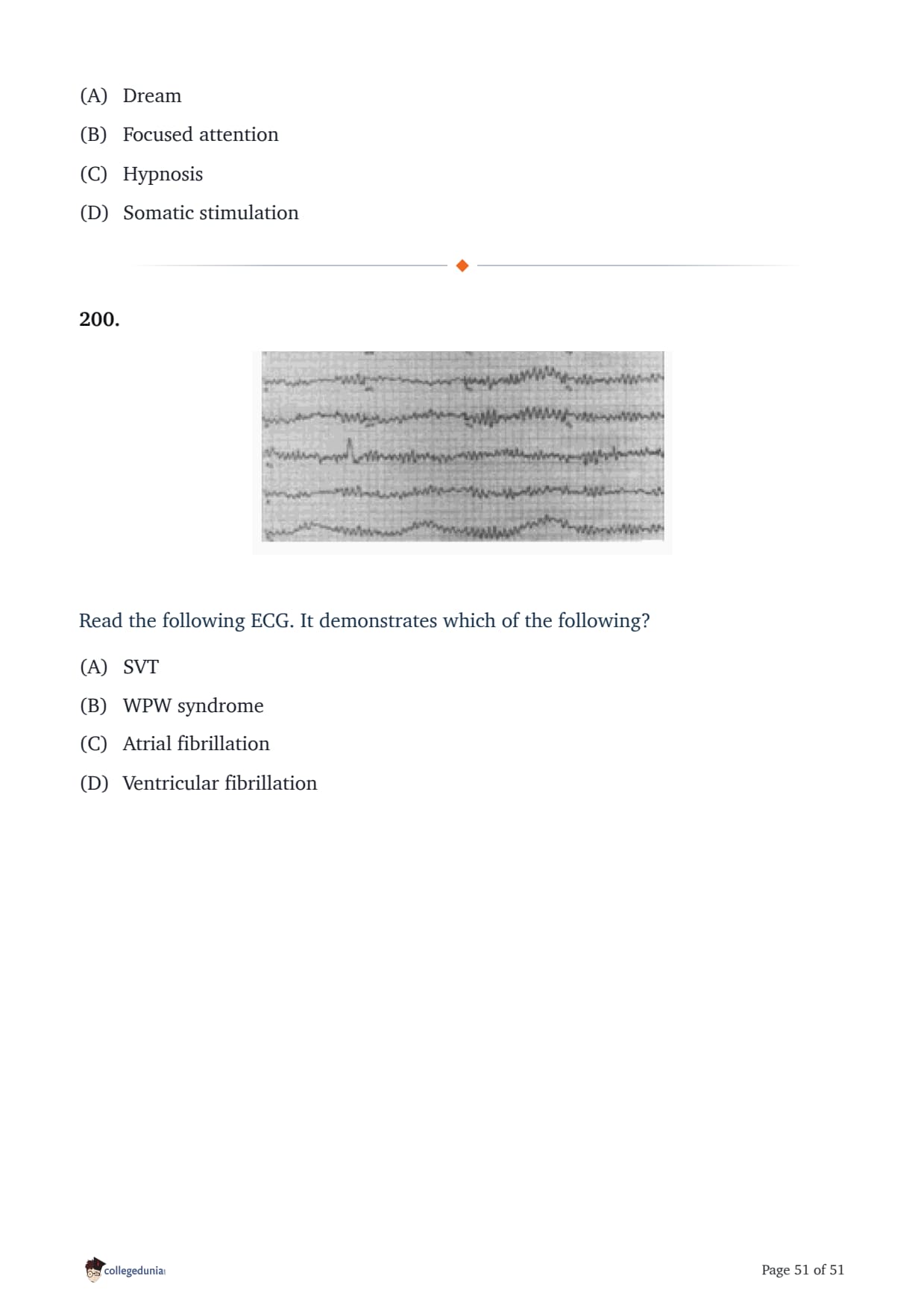
Question 200:
![]()
Read the following ECG. It demonstrates which of the following?
- (A) SVT
- (B) WPW syndrome
- (C) Atrial fibrillation
- (D) Ventricular fibrillation
NEET PG 2013 Exam Pattern and Marking Scheme at a Glance
Before you sit the 2013 paper, it helps to know how the test was framed. AIPGMEE 2013 was the debut online edition, and its structure set the template that later NEET PG papers carried forward.
- Conducting body: National Board of Examinations (NBE), now NBEMS
- Mode: computer-based test, the first all-India PG entrance to go fully online
- Total questions: 300 single-best-answer multiple-choice questions
- Marking: positive marking for each correct answer with negative marking for wrong attempts
- Coverage: all 19 MBBS subjects, from anatomy and biochemistry through to medicine, surgery, and PSM
High-Yield Subjects to Attack First in the NEET PG 2013 Paper
The 2013 recalls cluster the same way every PG paper does: a handful of clinical subjects carry most of the marks, with a dense pre-clinical scoring band right behind them. When you redo this Collegedunia set, open with the heavyweights below rather than working strictly in serial order.
- Medicine: the largest single block, dominated by clinical diagnosis, lab interpretation, and management lines
- Surgery: a thick band of instrument, procedure, and pre-operative recalls that repeat across years
- Obstetrics and Gynaecology: steady high-yield questions on contraception, labour, and high-risk pregnancy
- Pharmacology: mechanism-of-action, antimicrobial, and adverse-effect recalls that reward pattern memory
- Pathology and Microbiology: the densest pre-clinical scoring zone, heavy on classic associations
- Forensic Medicine and PSM: short, direct fact recalls you can bank quickly under time pressure
NEET PG 2013 Question Paper Walkthrough Video
Source: PrepLadder NEET PG
How to Use the NEET PG 2013 Solved Paper in Your Revision
This is an old paper, but the concepts it tests are still live in current NEET PG papers, so treat it as an active drill rather than archive reading. The method below squeezes the most out of the 200 solved questions on this page.
- Run the question PDF as a timed block first, roughly 45 to 50 minutes per 100 questions, before you peek at a single answer.
- Review with the solution PDF in full, including questions you got right, so the reasoning sticks and not just the key.
- Log every miss against its subject, then redo that subject as a focused block instead of re-reading the whole paper.
- Re-attempt the set after a week and aim to convert earlier guesses into answers you can justify.
NEET PG Qualifying Percentile Benchmark
- General-category candidates clear at the 50th percentile, which makes them eligible for counselling.
- SC, ST, and OBC candidates qualify at the 40th percentile, and PwD candidates at the 45th percentile.
- For a usable rank, prioritise accuracy on the clinical subjects above over attempting every last question.
NEET PG 2013 Question Paper FAQs
Ques. Who conducted NEET PG 2013 and in what mode was it held?
Ans. NEET PG 2013, then called AIPGMEE 2013, was conducted by the National Board of Examinations (NBE) as the first all-India PG medical entrance to be held in a fully computer-based mode. The test ran across late November to early December 2012, with the merit list declared in early 2013.
Ques. How many questions were there in the NEET PG 2013 paper?
Ans. The 2013 paper carried 300 single-best-answer multiple-choice questions spanning all 19 MBBS subjects, with positive marking for correct answers and negative marking for wrong ones. This Collegedunia set reconstructs 200 of those recalled questions in fully solved form.
Ques. Which subjects carried the highest weightage in NEET PG 2013?
Ans. Medicine led the paper, followed by Surgery and Obstetrics and Gynaecology among the clinical subjects. Pharmacology, Pathology, Microbiology, and PSM made up the next high-yield band, so the clinical trio plus these pre-clinical subjects decided most of the score.
Ques. Are NEET PG 2013 questions still useful for current preparation?
Ans. Yes. A meaningful share of every current NEET PG paper maps back to concepts first tested in older papers, so the 2013 recalls remain high-yield. Solve them as concept drills rather than memorised answers and they still pay off.
Ques. What was the qualifying percentile for NEET PG 2013?
Ans. General-category candidates had to clear the 50th percentile, while SC, ST, and OBC candidates qualified at the 40th percentile and PwD candidates at the 45th percentile. Clearing the percentile makes a candidate eligible for counselling but does not by itself guarantee a seat.
Ques. Where can I download the NEET PG 2013 question paper with solutions PDF?
Ans. Use the download table at the top of this Collegedunia page to get the NEET PG 2013 question paper PDF and the matching solutions PDF. For the official record, the NBE archives are available on nbe.edu.in.








Comments