The NEET PG 2012 question paper with solutions is available here for free download, with every question solved and explained. NEET PG 2012, then run as AIPGMEE (All India Post Graduate Medical Entrance Examination), was conducted by AIIMS, New Delhi on January 8, 2012, and carried 300 single-best-answer MCQs in 3 hours 30 minutes. This was the last AIIMS-run AIPGMEE before the National Board of Examinations took over the all-India PG seats and the exam later became NEET PG.
This Collegedunia set rebuilds the 2012 paper as 200 fully solved, recall-based questions you can actually work through. Each one carries the correct answer plus a step-by-step explanation, so you are not just checking a key, you are learning why the other three options are wrong. Use the table above to grab the PDF, then open the Check Solutions link for the worked answers.
NEET PG 2012 Questions with Solutions
Question 1:
Which muscle is inserted into the floor of the intertubercular sulcus of the humerus?
- (A) Latissimus dorsi
- (B) Teres major
- (C) Pectoralis major
- (D) Deltoid
Question 2:
All are derived from ectoderm except -
- (A) Hypophysis
- (B) Retina
- (C) Spinal cord
- (D) Adrenal cortex
Question 3:
Cytotrophoblast invades which structure?
- (A) Decidua parietalis
- (B) Decidua basalis
- (C) Decidua capsularis
- (D) None
Question 4:
Inferior parathyroid develops from which pharyngeal arch?
- (A) 1st
- (B) 2nd
- (C) 3rd
- (D) 4th
Question 5:
Multi-unit smooth muscle is present at all of the following except?
- (A) Blood vessels
- (B) Iris
- (C) Gut
- (D) Ductus deferens
Question 6:
A patient is found to have a melanoma originating in the skin of the left forearm. After removal of the tumor from the forearm, all axillary lymph nodes lateral to the medial edge of the pectoralis minor muscle are removed. Which axillary nodes would NOT be removed?
- (A) Apical lymph nodes
- (B) Central lymph nodes
- (C) Lateral lymph nodes
- (D) Pectoral lymph nodes
Question 7:
Which structure(s) passes behind the inguinal ligament?
- (A) Femoral branch of genitofemoral nerve
- (B) Femoral vein
- (C) Psoas major
- (D) All
Question 8:
An inferior vena cava (IVC) filter is used for all of the following purposes except:
- (A) To reduce symptoms
- (B) Negligible size of emboli
- (C) To prolong life
- (D) To prevent progression of native blood vessel disease
Question 9:
The surface marking of the oblique fissure of the lung includes all of the following except:
- (A) T3 spine
- (B) 5th rib
- (C) 7th rib
- (D) 6th costal cartilage
Question 10:
Which of the following structures is seen passing through the cavernous sinus?
- (A) Maxillary division of the V nerve
- (B) Mandibular division of the V nerve
- (C) Internal carotid artery
- (D) Facial nerve
Question 11:
Renal vein thrombosis is associated with all of the following except:
- (A) Trauma
- (B) Sickle cell anemia
- (C) Nephrotic syndrome
- (D) Dehydration
Question 12:
Regarding celiac plexus block, all of the following are true except:
- (A) Relieves pain from gastric malignancy
- (B) Causes hypotension
- (C) Can be used to provide anesthesia for intra-abdominal surgery
- (D) Can be given only by the retrocrural (classic) approach
Question 13:
All of the following are branches of the inferior mesenteric artery except:
- (A) Left colic artery
- (B) Sigmoidal artery
- (C) Middle rectal artery
- (D) Superior rectal artery
Question 14:
The ophthalmic artery is a branch of which of the following?
- (A) Cavernous part of the internal carotid artery (ICA)
- (B) Cerebral part of the internal carotid artery (ICA)
- (C) Middle cerebral artery (MCA)
- (D) Facial artery
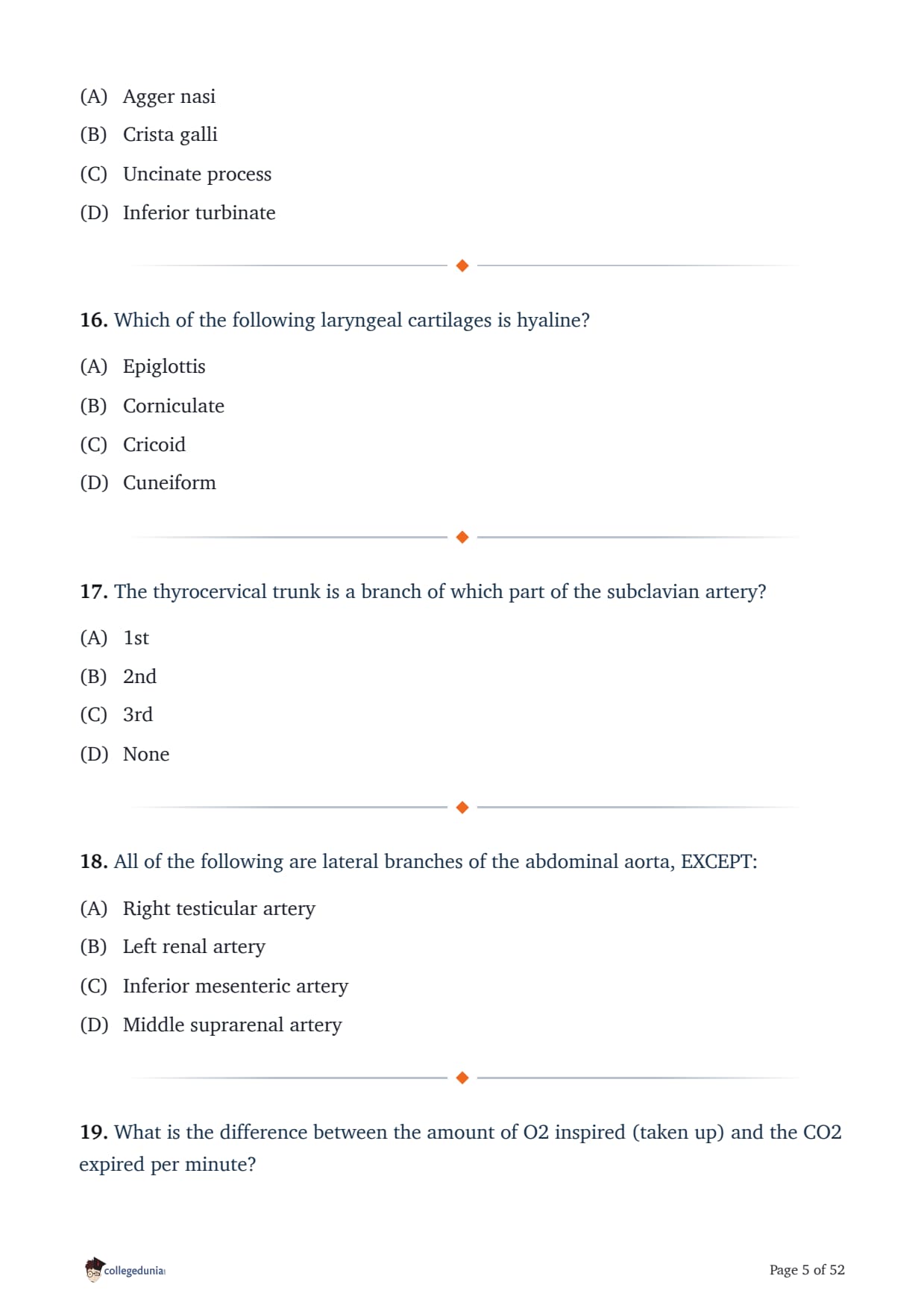
Question 15:
Which of the following is not a part of the ethmoid bone?
- (A) Agger nasi
- (B) Crista galli
- (C) Uncinate process
- (D) Inferior turbinate
Question 16:
Which of the following laryngeal cartilages is hyaline?
- (A) Epiglottis
- (B) Corniculate
- (C) Cricoid
- (D) Cuneiform
Question 17:
The thyrocervical trunk is a branch of which part of the subclavian artery?
- (A) 1st
- (B) 2nd
- (C) 3rd
- (D) None
Question 18:
All of the following are lateral branches of the abdominal aorta, EXCEPT:
- (A) Right testicular artery
- (B) Left renal artery
- (C) Inferior mesenteric artery
- (D) Middle suprarenal artery
Question 19:
What is the difference between the amount of O2 inspired (taken up) and the CO2 expired per minute?
- (A) 20 ml/min
- (B) 50 ml/min
- (C) 75 ml/min
- (D) 100 ml/min
Question 20:
What is the approximate daily volume of pancreatic secretion?
- (A) 1.5 L
- (B) 2.5 L
- (C) 5.0 L
- (D) 10 L
Question 21:
Einthoven's law is best expressed as:
- (A) I + III = II
- (B) I - III = II
- (C) I + II + III = 0
- (D) I + III = aVL
Question 22:
Normal interstitial fluid hydrostatic pressure is?
- (A) 10 to 15 mmHg
- (B) -5 to 0 mmHg
- (C) 20 to 30 mmHg
- (D) -10 to -20 mmHg
Question 23:
CSF to plasma glucose ratio is?
- (A) 0.2 - 0.4
- (B) 0.6 - 0.8
- (C) 1.2 - 1.6
- (D) 1.6 - 2.2
Question 24:
The distance by which two touch stimuli must be separated to be perceived as two separate stimuli is greatest at?
- (A) The lips
- (B) The palm of the hand
- (C) The back over the scapula
- (D) The dorsum of the hand
Question 25:
The resting membrane potential in a nerve fibre:
- (A) Is equal to the potential of ventricular muscle fibre
- (B) Can be measured by surface electrodes
- (C) Increases as extracellular K+ increases
- (D) Depends upon K+ equilibrium
Question 26:
Which of the following is NOT TRUE about CSF?
- (A) Removal of CSF during dural tap causes intense intracranial headache
- (B) Normally contains no neutrophils
- (C) Formed by arachnoid villi within the ventricles
- (D) pH is less than that of plasma
Question 27:
The cephalic phase of gastric secretion occurs?
- (A) On food entering the stomach
- (B) On food entering the intestine
- (C) On seeing food
- (D) On stress
Question 28:
What is the effect of acetylcholine on the lower oesophageal sphincter (LES)?
- (A) Contraction
- (B) Relaxation
- (C) No effect
- (D) Contraction followed by relaxation
Question 29:
Major adrenal androgen is?
- (A) Testosterone
- (B) 11-hydroxy derivative of androstenedione
- (C) 17-ketosteroid dehydroepiandrosterone
- (D) Cortisol
Question 30:
Growth hormone level is decreased in?
- (A) Hypoglycemia
- (B) Fasting
- (C) Sleep
- (D) Exercise
Question 31:
Glucose is transported in renal tubular cells by?
- (A) K symport
- (B) K antiport
- (C) Na antiport
- (D) Na cotransport
Question 32:
Myosin filament has a fixed length of?
- (A) 0.16 nm
- (B) 1.6 micrometers
- (C) 16 nm
- (D) 1.6 mm
Question 33:
Glucose-6-phosphate dehydrogenase needs?
- (A) NAD
- (B) NADP
- (C) FAD
- (D) FMN
Question 34:
Km value is defined as?
- (A) Substrate concentration at Vmax/2
- (B) Substrate concentration of twice Vmax
- (C) Substrate concentration of thrice Vmax
- (D) Substrate concentration of one third Vmax
Question 35:
In the electron transport chain, cyanide inhibits?
- (A) Complex I
- (B) Cytochrome C oxidase
- (C) Complex IV
- (D) Complex III
Question 36:
Enzymes of glycolysis are found in:
- (A) Cytosol
- (B) Cell membrane
- (C) Mitochondria
- (D) Ribosomes
Question 37:
Rate limiting step in TCA cycle is catalyzed by:
- (A) Alpha-ketoglutarate synthase
- (B) Fumarase
- (C) Aconitase
- (D) Thiokinase
Question 38:
Glycogen storage disease which presents as a lysosomal storage disease is:
- (A) Von Gierke's disease
- (B) Pompe's disease
- (C) McArdle's disease
- (D) Andersen's disease
Question 39:
Mutation in GLUT-2 causes:
- (A) Dandy-Walker syndrome
- (B) Fanconi-Bickel syndrome
- (C) Beckwith syndrome
- (D) Menke's disease
Question 40:
Citrate used in fatty acid synthesis uses which enzyme?
- (A) Citrate synthase
- (B) ATP citrate lyase
- (C) Aconitase
- (D) Malic enzyme
Question 41:
Regarding apoprotein-C, which of the following is true?
- (A) Activates lipoprotein lipase
- (B) Inactivates lipoprotein lipase
- (C) Facilitates triglyceride transport
- (D) All of the above
Question 42:
What will you give in the diet to stop chyluria?
- (A) Short chain fatty acids
- (B) Medium chain fatty acids
- (C) Long chain fatty acids
- (D) Omega-3 unsaturated fatty acids
Question 43:
In Zellweger syndrome, there is accumulation of which type of fatty acids?
- (A) Accumulation of long fatty acids
- (B) Accumulation of short chain fatty acids
- (C) Accumulation of very long chain fatty acids
- (D) Accumulation of medium chain fatty acids
Question 44:
Selenocysteine is associated with which of the following?
- (A) Carbonic anhydrase
- (B) Catalase
- (C) Deiodinase
- (D) Transferase
Question 45:
The urea cycle and the Krebs cycle are linked at which intermediate?
- (A) Arginine
- (B) Ornithine
- (C) Oxaloacetate
- (D) Fumarate
Question 46:
Light of 250 nm wavelength is absorbed by which amino acid?
- (A) Arginine
- (B) Alanine
- (C) Tyrosine
- (D) Histidine
Question 47:
Why is the citric acid cycle called an amphibolic pathway?
- (A) Both exergonic and endergonic reactions take place
- (B) Metabolites are utilized in other pathways
- (C) It can proceed both in forward and backward direction
- (D) Same enzymes can be used in reverse directions
Question 48:
Which one of the following statements concerning gluconeogenesis is correct?
- (A) It occurs in muscle
- (B) It is stimulated by fructose 2,6-bisphosphate
- (C) It is inhibited by elevated levels of acetyl CoA
- (D) It is important in maintaining blood glucose during the normal overnight fast
Question 49:
During overnight fasting, what occurs?
- (A) Glucose decreases
- (B) FFA increases
- (C) Increased gluconeogenesis
- (D) Increased beta-hydroxybutyrate
Question 50:
The coenzyme form of pyridoxine (vitamin B6) is?
- (A) ADP
- (B) NAD
- (C) PLP
- (D) FAD
Question 51:
Uric acid is formed by?
- (A) Catabolism of proteins
- (B) Catabolism of ketones
- (C) Catabolism of purines
- (D) Catabolism of pyrimidines
Question 52:
A nucleotide consists of all of the following except?
- (A) Sugar
- (B) Phosphate
- (C) Fatty acid
- (D) Base
Question 53:
The function of a primer is in?
- (A) Transcription
- (B) Translation
- (C) Initiation of DNA replication
- (D) Termination of DNA replication
Question 54:
Which of the following usually requires an RNA intermediate for cloning or replication?
- (A) Transposons
- (B) Plasmids
- (C) Phages
- (D) Cosmids
Question 55:
The folds in collagen are due to?
- (A) Glycine
- (B) Alanine
- (C) Arginine
- (D) Histidine
Question 56:
This molecule attaches to a protein before its destruction?
- (A) Ubiquitin
- (B) RNAse F
- (C) Zymase
- (D) Chaperone
Question 57:
Which isoform of LDH is raised in anemia?
- (A) LDH 5
- (B) LDH 4
- (C) LDH 3
- (D) LDH 2
Question 58:
Cell-matrix adhesions are mediated by?
- (A) Cadherins
- (B) Integrins
- (C) Selectins
- (D) Calmodulin
Question 59:
Regarding neurofibromatosis, all are true except:
- (A) Autosomal recessive
- (B) Associated with cataract
- (C) Scoliosis
- (D) Multiple fibroma
Question 60:
Regarding desmoid tumour, which is not correct?
- (A) Often seen below the umbilicus
- (B) Unencapsulated
- (C) More common in women
- (D) Highly radiosensitive
Question 61:
Most common cause of dissecting hematoma is because of:
- (A) Hypertension
- (B) Marfan's syndrome
- (C) Iatrogenic
- (D) Kawasaki disease
Question 62:
Creola bodies are seen in:
- (A) Bronchial asthma
- (B) Chronic bronchitis
- (C) Emphysema
- (D) Bronchiectasis
Question 63:
Renal papillary necrosis is almost always associated with one of the following conditions:
- (A) Diabetes mellitus
- (B) Analgesic nephropathy
- (C) Chronic pyelonephritis
- (D) Post streptococcal glomerulonephritis
Question 64:
Starry sky appearance is seen in -
- (A) Burkitt lymphoma
- (B) CLL
- (C) Diffuse large B cell lymphoma
- (D) ALCL
Question 65:
Russell bodies are found in -
- (A) Multiple myeloma
- (B) Gonadal tumor
- (C) Parkinsonism
- (D) Intracranial neoplasms
Question 66:
The anaemia associated with leukaemia is?
- (A) Iron deficiency
- (B) Megaloblastic type
- (C) Myelophthisic type
- (D) All of the above
Question 67:
Pathological manifestation of chronic alcoholism includes all of the following except -
- (A) Piecemeal necrosis
- (B) Ballooning degeneration
- (C) Microvesicular fatty changes
- (D) Central hyaline sclerosis
Question 68:
What is the histological appearance of brain in Creutzfeldt-Jakob disease -
- (A) Neuronophagia
- (B) Spongiform change in brain
- (C) Microabscesses
- (D) Demyelination
Question 69:
Most common malignancy of fallopian tube
- (A) Squamous cell carcinoma
- (B) Serous carcinoma
- (C) Teratoma
- (D) Choriocarcinoma
Question 70:
Glomus tumor is seen in -
- (A) Retroperitoneum
- (B) Soft tissue
- (C) Distal portion of digits
- (D) Proximal portion of digits
Question 71:
Type B adverse drug reaction is -
- (A) Augmented effect of drug
- (B) Unpredictable bizarre reaction
- (C) Effect seen on chronic use of drug
- (D) Delayed effect of drug
Question 72:
Which of the following causes increased renin on prolonged use?
- (A) Clonidine
- (B) Enalapril
- (C) Methyldopa
- (D) Beta blocker
Question 73:
Which drug is not included among DMARDs?
- (A) Chloroquine
- (B) Vincristine
- (C) Azathioprine
- (D) Leflunomide
Question 74:
Desmopressin is preferred over vasopressin because desmopressin -
- (A) More potent
- (B) More selective for V1 receptor
- (C) Has little vasoconstrictor activity
- (D) a and c
Question 75:
Which is a short acting non-depolarizing neuromuscular blocker?
- (A) Rocuronium
- (B) Suxamethonium
- (C) Mivacurium
- (D) Pancuronium
Question 76:
Finasteride is a:
- (A) 5 alpha reductase inhibitor
- (B) PDE inhibitor
- (C) Alpha 1a blocker
- (D) Androgen receptor blocker
Question 77:
An 86 year old lady presented with severe constipation. She was a known hypertensive on medications for 10 years. In clinic, her BP was 157/98 mm Hg with a heart rate of 58/min. On taking her BP in the supine position it was found to be 90/60 mm Hg. She had a recent history of depression. She is taking atenolol, thiazide, imipramine, haloperidol and docusate. What will be the next best step in the management?
- (A) Change atenolol and thiazide to a calcium channel blocker and ACE inhibitor and add bisacodyl for constipation
- (B) Change imipramine and haloperidol to fluoxetine and risperidone and add bisacodyl for constipation
- (C) Only add bisacodyl for constipation and continue rest of the medications
- (D) Discontinue all her medications and start her on steroids
Question 78:
Longest acting sulphonamide is -
- (A) Sulfadiazine
- (B) Sulphadoxine
- (C) Sulfamethoxazole
- (D) Sulfamethiazole
Question 79:
Sulphonamide injection causes decrease in folic acid by?
- (A) Competitive inhibition
- (B) Non competitive inhibition
- (C) Uncompetitive inhibition
- (D) Allosteric inhibition
Question 80:
All are true regarding Sunitinib except -
- (A) It inhibits tyrosine kinase receptors
- (B) It is used for renal cell carcinoma
- (C) It is used for the treatment of GIST
- (D) It is excreted primarily in urine
Question 81:
Plaintiff is a person who?
- (A) Files case in civil court
- (B) Acts as defender
- (C) Gives judgement
- (D) None
Question 82:
Which of the following is not seen in finger prints?
- (A) Loop
- (B) Circles
- (C) Whorl
- (D) Arch
Question 83:
In medicolegal autopsy, cavity to be opened first is?
- (A) Thoracic
- (B) Abdomen
- (C) Cervical
- (D) Any of the above
Question 84:
Marshall's triad is seen in?
- (A) Explosive injury
- (B) Gunshot injury
- (C) Drowning injury
- (D) None
Question 85:
A victim was choked with the mouth and nose covered, while the neck was held in the bend of the assailant's elbow from behind. This method of strangulation is called?
- (A) Mugging
- (B) Garrotting
- (C) Bansdola
- (D) None of the above
Question 86:
Which of the following substances acts as both a poison and an antidote?
- (A) Copper sulphate (CuSO4)
- (B) Mercuric chloride (HgCl2)
- (C) Arsenic trioxide (As2O3)
- (D) Thallium arsenate
Question 87:
Muttering delirium is characteristically seen in poisoning with:
- (A) Ricinus (castor)
- (B) Dhatura (Datura)
- (C) Cocaine
- (D) Aconite
Question 88:
The term vitriolage means:
- (A) Using vitriol for suicide
- (B) Using vitriol for murder
- (C) Vitriol throwing
- (D) Perforation of the stomach caused by H2SO4
Question 89:
Who is regarded as the Father of Toxicology?
- (A) Paracelsus
- (B) Galen
- (C) Galton
- (D) Orfila
Question 90:
Lendrum stain (Phloxine-Tartrazine) is done at autopsy for the diagnosis of?
- (A) Air embolism
- (B) Fat embolism
- (C) Amniotic fluid embolism
- (D) None
Question 91:
In nutrient agar, the concentration of agar is:
- (A) 1%
- (B) 1.5%
- (C) 3%
- (D) 4%
Question 92:
A child comes with fever, cold, cough and a membrane over the tonsils. A nasal swab is taken. Culture should be done on which medium for the earliest diagnosis?
- (A) Loeffler's serum slope
- (B) L. J. medium
- (C) MacConkey's agar
- (D) Citrate medium
Question 93:
Cholera toxin is due to -
- (A) Chromosome
- (B) Plasmid
- (C) Phage
- (D) Transposons
Question 94:
A child with fever, red blood cells (RBCs) and pus in the stool. The causative organism is?
- (A) ETEC (Enterotoxigenic E. coli)
- (B) EHEC (Enterohaemorrhagic E. coli)
- (C) EPEC (Enteropathogenic E. coli)
- (D) EAEC (Enteroaggregative E. coli)
Question 95:
Reactive tubercular arthritis is known as:
- (A) Spina ventosa
- (B) Pott's disease
- (C) Poncet's disease
- (D) None
Question 96:
In malaria, the sexual cycle is -
- (A) Sporozoite to gametocytes
- (B) Gametocytes to sporozoite
- (C) Occurs in humans
- (D) Responsible for relapse
Question 97:
Toxoplasma in children causes:
- (A) Chorioretinitis
- (B) Conjunctivitis
- (C) Keratitis
- (D) Papillitis
Question 98:
Which of the following is a primary cell line?
- (A) Chick embryo fibroblast
- (B) HeLa cells
- (C) Vero cells
- (D) WI-38
Question 99:
Bollinger bodies are seen in?
- (A) Chickenpox
- (B) Cowpox
- (C) Fowlpox
- (D) Smallpox
Question 100:
Binding of gp120 causes:
- (A) Infection of target cell
- (B) Facilitation of co-receptor
- (C) Fusing of virus and target cell
- (D) None
Question 101:
Prozone phenomenon is seen with?
- (A) Same concentration of antibody and antigen
- (B) Antigen excess to antibody
- (C) Antibody excess to antigen
- (D) Hyperimmune reaction
Question 102:
Which of the following T cell independent antigen acts through?
- (A) T-cell
- (B) B-cell
- (C) Macrophages
- (D) CD8+ T cells
Question 103:
Complement components formed in the liver are?
- (A) C2, C4
- (B) C3, C6, C9
- (C) C5, C8
- (D) C1
Question 104:
An 18 year old girl presents with watery diarrhea. The most likely causative agent is?
- (A) Rotavirus
- (B) V. cholerae
- (C) Salmonella
- (D) Shigella
Question 105:
Use of iodized salt in the iodine deficiency control programme is an example of?
- (A) Primary prevention
- (B) Secondary prevention
- (C) Tertiary prevention
- (D) None
Question 106:
Which study is best to establish the definitive cause of a disease?
- (A) Case-control
- (B) Cohort
- (C) Ecological
- (D) Cross-sectional
Question 107:
The time interval between receipt of infection and the point of maximum infectivity of the host is known as?
- (A) Incubation period
- (B) Serial interval
- (C) Generation time
- (D) Communicable period
Question 108:
Mass vaccination is ineffective in which of the following?
- (A) Measles
- (B) Polio
- (C) Tetanus
- (D) None
Question 109:
At what age is the first dose of measles vaccination given?
- (A) 9 months
- (B) At birth
- (C) 4 weeks
- (D) 8 weeks
Question 110:
What is the amount of diphtheria toxoid present in the pediatric DT vaccine?
- (A) 5 Lf
- (B) 10 Lf
- (C) 15 Lf
- (D) 25 Lf
Question 111:
What is the osmolarity of the new (reduced osmolarity) ORS in mmol per litre?
- (A) 270
- (B) 245
- (C) 290
- (D) 310
Question 112:
In leprosy, a duration of 2 years is relevant with regard to which of the following?
- (A) Treatment of paucibacillary leprosy
- (B) Treatment of multibacillary leprosy
- (C) Post-treatment surveillance of paucibacillary leprosy
- (D) Post-treatment surveillance of multibacillary leprosy
Question 113:
Which of the following is the most common cancer in men?
- (A) Bladder cancer
- (B) Colorectal cancer
- (C) Prostate cancer
- (D) Oral cancer
Question 114:
Net reproduction rate is defined as which of the following?
- (A) Number of live births per 1000 mid-year population
- (B) Number of live births per 1000 women of child bearing age
- (C) Number of daughters a newborn girl will have during her life time
- (D) None of the above
Question 115:
Which of the following is the least common cause of infant mortality in India?
- (A) Infections
- (B) Prematurity
- (C) Birth injuries
- (D) Congenital malformations
Question 116:
What is the approximate total daily energy requirement in late pregnancy?
- (A) 2500 cal
- (B) 1400 cal
- (C) 1000 cal
- (D) 1800 cal
Question 117:
Which toxin is responsible for epidemic dropsy?
- (A) BOAA
- (B) Aflatoxin
- (C) Sanguinarine
- (D) Pyrrolizidine
Question 118:
Which is the recommended measure for the iodine deficiency control programme?
- (A) Health education
- (B) Water testing
- (C) Fortification of salt
- (D) None
Question 119:
What amount of bleaching powder is necessary to disinfect choleric stools?
- (A) 50 gm/lit
- (B) 75 gm/lit
- (C) 90 gm/lit
- (D) 100 gm/lit
Question 120:
Which is the most common heavy metal poisoning in the world?
- (A) Lead
- (B) Arsenic
- (C) Mercury
- (D) Cadmium
Question 121:
What is the approximate amount of infectious waste produced in hospitals (as a fraction of total hospital waste)?
- (A) 45%
- (B) 65%
- (C) 80%
- (D) 100%
Question 122:
In a left (negatively) skewed distribution curve, which statement is true?
- (A) Mean = Median
- (B) Mean < Mode
- (C) Mean > Mode
- (D) Mean = Mode
Question 123:
The Ujjwala scheme is meant for the prevention of which problem?
- (A) Child abuse
- (B) Child trafficking
- (C) Child labour
- (D) None
Question 124:
Above which level of the heat stress index (HSI) is it not possible to work comfortably?
- (A) 20 - 40
- (B) 40 - 60
- (C) 60 - 80
- (D) 80 - 100
Question 125:
The visual axis of the eye is best defined as the line from the:
- (A) Center of cornea to retina
- (B) Object to fovea
- (C) Center of lens to cornea
- (D) None
Question 126:
Which of the following are features of vernal keratoconjunctivitis?
- (A) Shield ulcer
- (B) Horner-Trantas spots
- (C) Papillary hypertrophy
- (D) All of the above
Question 127:
Disciform keratitis is seen in infection with which of the following?
- (A) HSV
- (B) HIV
- (C) HBV
- (D) Rubella
Question 128:
What is the most common cause of anterior uveitis?
- (A) CMV
- (B) Ankylosing spondylitis
- (C) Toxoplasma
- (D) None
Question 129:
Second sight is seen in which type of cataract?
- (A) Nuclear cataract
- (B) Cortical cataract
- (C) Zonular cataract
- (D) Punctate cataract
Question 130:
Laser iridotomy is done in which type of glaucoma?
- (A) Angle closure glaucoma
- (B) Open angle glaucoma
- (C) Pigmentary glaucoma
- (D) None
Question 131:
What is the characteristic deposit seen in retinal macular degeneration?
- (A) Iron
- (B) Drusen
- (C) Lipochrome
- (D) Hemosiderin
Question 132:
All of the following are seen in third (3rd) cranial nerve palsy EXCEPT?
- (A) Mydriasis
- (B) Loss of light reflex
- (C) Loss of abduction
- (D) Ptosis
Question 133:
Which of the following is the longest extraocular muscle?
- (A) Superior rectus (SR)
- (B) Medial rectus (MR)
- (C) Superior oblique (SO)
- (D) Inferior oblique (IO)
Question 134:
The most common orbital tumor has its origin from which structure?
- (A) Blood vessels
- (B) Nerves
- (C) Muscle
- (D) Lymph node
Question 135:
An abnormally eccentric placed pupil is called?
- (A) Polycoria
- (B) Corectopia
- (C) Aniridia
- (D) Ectopia lentis
Question 136:
Iris coloboma is most commonly located in which quadrant?
- (A) Inferotemporal
- (B) Superotemporal
- (C) Inferonasal
- (D) Superonasal
Question 137:
A left axis deviation of \(-30^\circ\) to \(-60^\circ\) on the ECG is seen in?
- (A) Left ventricular hypertrophy
- (B) Right ventricular hypertrophy
- (C) Aortic stenosis
- (D) Left atrial enlargement
Question 138:
A person has asthma attacks more than once during the day and at least once during the night. This is classified as?
- (A) Mild intermittent asthma
- (B) Mild persistent asthma
- (C) Moderate asthma
- (D) Severe asthma
Question 139:
The most common presentation of IgA nephropathy is?
- (A) Nephrotic syndrome
- (B) Nephritic syndrome
- (C) Microscopic hematuria
- (D) Repeated gross hematuria
Question 140:
All of the following are used for treatment of H. pylori, except?
- (A) Gentamycin
- (B) Clarithromycin
- (C) Metronidazole
- (D) Amoxicillin
Question 141:
Secretory diarrhea is NOT seen in which of the following conditions?
- (A) Phenolphthalein
- (B) Celiac disease
- (C) Cholera
- (D) Addison's disease
Question 142:
Predominantly sensory neuropathy is/are caused by:
- (A) Cisplatin
- (B) Pyridoxine excess
- (C) Suramin
- (D) a and b
Question 143:
Regarding herpes encephalitis, all are true EXCEPT:
- (A) Focal symptoms common
- (B) Temporal lobe involved
- (C) MRI is diagnostic
- (D) EEG not diagnostic
Question 144:
The immunoglobulin most commonly involved in multiple myeloma is:
- (A) IgG
- (B) IgM
- (C) IgA
- (D) IgD
Question 145:
The most classical symptom of VIPoma is:
- (A) Gall stones
- (B) Secretory diarrhea
- (C) Steatorrhea
- (D) Flushing
Question 146:
Antibodies most commonly seen in drug-induced lupus are:
- (A) Anti-ds DNA antibodies
- (B) Anti-Sm antibodies
- (C) Anti-Ro antibodies
- (D) Antihistone antibodies
Question 147:
Muir-Torre syndrome shows:
- (A) Sebaceous keratomas
- (B) Lisch nodules
- (C) Intestinal polyp
- (D) Hyperelastic joints
Question 148:
All of the following are risk factors for deep vein thrombosis (DVT) except -
- (A) Duration of surgery more than thirty minutes
- (B) Obesity
- (C) Age less than forty years
- (D) Use of the oestrogen-progesterone contraceptive pills
Question 149:
Inverted Champagne bottle appearance is seen in -
- (A) Varicose veins
- (B) DVT
- (C) Lipodermatosclerosis
- (D) Venous ulceration
Question 150:
Which of the following findings in ascitic fluid is diagnostic of spontaneous bacterial peritonitis?
- (A) Neutrophils > 250/mm3
- (B) WBC < 100/mL
- (C) Ascitic lactate level < 25 mg/dL
- (D) Ascitic fluid pH > 7.35
Question 151:
Ogilvie's syndrome most commonly involves -
- (A) Stomach
- (B) Colon
- (C) Gallbladder
- (D) Small intestine
Question 152:
Raspberry tumor is seen in -
- (A) Umbilical fistula
- (B) Meckel's diverticulum
- (C) Umbilical adenoma
- (D) Umbilical granuloma
Question 153:
In injury to the penis, which of the following prevents extravasation of blood -
- (A) Buck's fascia
- (B) Fascia of Camper
- (C) Fascia transversalis
- (D) None
Question 154:
Which of the following is FALSE about hepatic adenoma?
- (A) Benign lesion
- (B) OCP use
- (C) Older females
- (D) Cold on isotope scan
Question 155:
VIPoma is associated with which syndrome?
- (A) Zollinger Ellison
- (B) Verner Morrison
- (C) Carcinoid syndrome
- (D) Cushing's syndrome
Question 156:
In Marfan's syndrome, aortic aneurysm occurs most commonly in:
- (A) Ascending aorta
- (B) Descending aorta
- (C) Abdominal aorta
- (D) Arch of aorta
Question 157:
Dosage of intravenous fluid for a 2 month old child with diarrhoea and severe dehydration:
- (A) 100 ml/kg in 6 hours
- (B) 50 ml/kg in 6 hours
- (C) 75 ml/kg in 6 hours
- (D) 80 ml/kg in 6 hours
Question 158:
LEOPARD syndrome includes all except:
- (A) Growth retardation
- (B) ECG changes
- (C) Hypertelorism
- (D) Hypergonadism
Question 159:
Most common cerebellar tumour in children?
- (A) Astrocytoma
- (B) Medulloblastoma
- (C) Ependymoma
- (D) DNET
Question 160:
Upper segment to lower segment ratio in a 3 year old child is:
- (A) 1.2
- (B) 1.3
- (C) 1.4
- (D) 1.6
Question 161:
Diarrhoea in a child of 12 months, the dose of zinc is?
- (A) 1 mg / 10 to 14 days
- (B) 10 mg / 10 to 14 days
- (C) 15 mg / 10 to 14 days
- (D) 20 mg / 10 to 14 days
Question 162:
A baby is born at 27 weeks of gestation, required mechanical ventilation for the next 4 weeks and oxygen for the next 1 week. He was maintained at room air subsequently. As per the new Bronchopulmonary dysplasia (BPD) definition, he has which of the following?
- (A) Mild BPD
- (B) Moderate BPD
- (C) Severe BPD
- (D) No BPD
Question 163:
Which of the following statements regarding fetal circulation is correct?
- (A) The liver and heart of the fetus receive blood with very high oxygen saturation
- (B) PO2 of fetal blood leaving the placenta is slightly greater than maternal mixed venous PO2
- (C) The presence of fetal hemoglobin shifts the oxyhemoglobin dissociation to the right
- (D) The foramen ovale closes during the third trimester unless the fetus has an atrial septal defect
Question 164:
Cause of conjugated hyperbilirubinemia is?
- (A) Rotor syndrome
- (B) Breast milk jaundice
- (C) Crigler-Najjar syndrome
- (D) Gilbert syndrome
Question 165:
Highest cure rate is of:
- (A) Wilms tumor
- (B) Retinoblastoma
- (C) Rhabdomyosarcoma
- (D) All
Question 166:
The MOST common type of dislocation of the elbow joint is:
- (A) Posterior
- (B) Posterolateral
- (C) Posteromedial
- (D) Lateral
Question 167:
Most common complication of fracture neck of femur is:
- (A) Malunion
- (B) Avascular necrosis (AVN)
- (C) Nonunion
- (D) Arthritis
Question 168:
Partial anterior dislocation of one segment of the spine over another is:
- (A) Spondylosis
- (B) Spondylolisthesis
- (C) Kyphosis
- (D) Scoliosis
Question 169:
In a child with suspected developmental dysplasia of the hip (DDH), what is the investigation of choice?
- (A) X-ray
- (B) MRI
- (C) USG
- (D) CT scan
Question 170:
Which is the most common organism causing infection after an open fracture?
- (A) Pseudomonas
- (B) Staphylococcus aureus
- (C) Klebsiella
- (D) Gonococcus
Question 171:
In tuberculosis of the spine, which is the most common site of involvement?
- (A) Sacral
- (B) Cervical
- (C) Dorsolumbar
- (D) Lumbosacral
Question 172:
In Volkmann's ischaemic contracture, which artery is involved?
- (A) Radial
- (B) Brachial
- (C) Ulnar
- (D) Interosseous
Question 173:
Why should a fracture of the shaft of the femur be stabilised early?
- (A) To prevent blood loss
- (B) ARDS
- (C) Non union
- (D) Compartment syndrome
Question 174:
Hydrops fetalis is due to?
- (A) Rh mismatch
- (B) Hyperproteinemia
- (C) Placental hypoplasia
- (D) All of the above
Question 175:
What is the most common type of degeneration seen in uterine fibroids (leiomyomas)?
- (A) Calcareous
- (B) Hyaline
- (C) Red
- (D) Cystic
Question 176:
Which of the following is true regarding fallopian tube tuberculosis?
- (A) Most common type of genital TB
- (B) Size of the tubes is unchanged
- (C) Is asymptomatic
- (D) Primary focus of infection is always in the fallopian tubes
Question 177:
Regarding intrahepatic cholestasis of pregnancy, the FALSE statement is?
- (A) Bilirubin level > 2 mg%
- (B) Most common cause of jaundice in pregnancy
- (C) Oestrogen is involved
- (D) Manifestations usually appear in the last trimester
Question 178:
Which of the following pelvic measurements is most commonly used clinically?
- (A) Diagonal conjugate
- (B) Anteroposterior diameter of the inlet
- (C) Transverse diameter of the outlet
- (D) Oblique diameter of the pelvis
Question 179:
Maximum chance of transmission to the baby during delivery is seen with which infection?
- (A) HSV (Herpes simplex virus)
- (B) CMV (Cytomegalovirus)
- (C) VZV (Varicella zoster virus)
- (D) Rubella
Question 180:
What is the preferred treatment for menorrhagia in the reproductive age group?
- (A) NOVA T (copper IUCD)
- (B) Cu IUD (copper intrauterine device)
- (C) OCPs (oral contraceptive pills)
- (D) Hysterectomy
Question 181:
A 45 year old female patient underwent hysterectomy. On the 7th post-operative day she complains of continuous dribbling of urine and fever. Micturition was not voluntary. What is the diagnosis?
- (A) Vesicovaginal fistula
- (B) Ureterovaginal fistula
- (C) Vesicouterine fistula
- (D) Urethrovaginal fistula
Question 182:
Regarding Hegar's sign, all are true EXCEPT?
- (A) It is elicited by the bimanual palpation method
- (B) It is difficult to elicit in obese women
- (C) It can be done at 14 weeks
- (D) It is present in about two-thirds of cases
Question 183:
In a non-stress test (NST), all of the following are assessed except?
- (A) Variability
- (B) Acceleration
- (C) Time period
- (D) Oxytocin
Question 184:
During pregnancy, cardiac output increases to its maximum at which week?
- (A) 26-28 weeks
- (B) 30-32 weeks
- (C) 32-34 weeks
- (D) 34-36 weeks
Question 185:
What is the presenting part in a transverse lie?
- (A) Shoulder
- (B) Face
- (C) Vertex
- (D) Brow
Question 186:
Which of the following is NOT a nevus of melanocytic origin?
- (A) Mongolian spot
- (B) Nevus of Ito
- (C) Nevus of Ota
- (D) Becker nevus
Question 187:
Oculo-oro-genital ulcers are a feature of which condition?
- (A) Behcet disease
- (B) Lichen planus
- (C) SLE
- (D) Psoriasis
Question 188:
The levels (stages) of ether anaesthesia were demonstrated by whom?
- (A) Morton
- (B) Guedel
- (C) Thompson
- (D) None
Question 189:
Which anaesthetic agent is neither metabolised by the liver nor by the kidney?
- (A) Atracurium
- (B) Vecuronium
- (C) Pancuronium
- (D) Rocuronium
Question 190:
Which is the inducing agent of choice in a patient presenting with shock?
- (A) Isoflurane
- (B) Desflurane
- (C) Ketamine
- (D) Thiopentone
Question 191:
Which drug is used for analgesia in OPD or day-care (outpatient) surgical settings?
- (A) Morphine
- (B) Pethidine
- (C) Fentanyl
- (D) Alfentanil
Question 192:
The Hounsfield unit (HU) is a measure used in which imaging modality?
- (A) CT
- (B) MRI
- (C) PET
- (D) USG
Question 193:
Corkscrew esophagus on a barium study is characteristically seen in which of the following conditions?
- (A) Carcinoma esophagus
- (B) Scleroderma
- (C) Achalasia cardia
- (D) Diffuse esophageal spasm
Question 194:
What is the investigation of choice for screening of proximal internal carotid artery stenosis?
- (A) Doppler flow USG
- (B) CT subtraction angiography
- (C) MRI
- (D) Angiography (DSA)
Question 195:
What is the physical half-life of Iodine-131?
- (A) 8 hours
- (B) 8 days
- (C) 8 weeks
- (D) 8 months
Question 196:
Formication (a sensation of insects crawling on or under the skin) is characteristically seen with which of the following?
- (A) Acute amphetamine intoxication
- (B) Chronic use of amphetamine
- (C) Alcohol withdrawal
- (D) Cannabis poisoning
Question 197:
In depression, there is a deficiency of which neurotransmitter?
- (A) 5-HT
- (B) Acetylcholine
- (C) Dopamine
- (D) GABA
Question 198:
Persistent preoccupation with having a serious illness despite normal body function is called?
- (A) Obsession
- (B) Somatization
- (C) Hypochondriasis
- (D) Conversion disorder
Question 199:
How do you differentiate between psychological and organic erectile dysfunction?
- (A) Nocturnal penile tumescence
- (B) PIPE therapy
- (C) Sildenafil induced erection
- (D) Squeeze technique
Question 200:
![]()
The type of connective tissue present in the arrow-marked area is:
- (A) Loose and irregular
- (B) Specialized
- (C) Dense irregular
- (D) Dense regular
NEET PG 2012 (AIPGMEE) Exam Pattern and Marking Scheme Explained
AIPGMEE 2012 was the all-India MD/MS/Diploma entrance run by AIIMS, New Delhi, and it tested the full MBBS syllabus across pre-clinical, para-clinical, and clinical subjects in one single-best-answer paper.
- Total questions: 300 single-best-answer MCQs covering all 19 MBBS subjects
- Duration: 3 hours 30 minutes for the full paper
- Total marks: 1500 (each correct answer carried 5 marks)
- Marking scheme: +1 for a correct answer and -0.25 for a wrong one, scaled across the paper, so blind guessing cost you marks
- Question types: single-best-response MCQs, with a heavy block of one-liner recall and a smaller set of clinical-vignette questions
High-Weightage Subjects in NEET PG 2012 to Focus On First
The 2012 paper followed the classic AIPGMEE split where the three big clinical subjects alone decided most ranks, so plan your revision around them before touching the smaller subjects.
- Medicine: the single largest block at roughly 30 to 35 questions, heavy on cardiology, endocrine, and infectious disease one-liners
- Surgery: close behind with about 25 to 30 questions, including GI surgery, breast, and trauma recall
- Obstetrics and Gynaecology: around 25 questions, with contraception, antenatal care, and oncology repeats
- Pharmacology: a high-yield 20-plus question block, dominated by mechanism of action and drug-of-choice items
- Pathology and Forensic Medicine: together 30-plus questions, where short fact-based recall let you bank quick marks
NEET PG 2012 Question Paper Analysis Video
Source: Dr. Aditya Sanjay Gupta
How to Use the NEET PG 2012 Question Paper for Practice
Treat this 200-question solved set as a recall drill, not a reading exercise, because nearly a third of NEET PG questions echo earlier-year concepts like the ones in this 2012 paper.
- Solve it as a timed block first, then open the solution PDF only after you have committed to an answer
- Mark every question you got from elimination rather than knowledge, and revise that concept the same day
- Redo the Medicine, Surgery, and Pharmacology sets twice, since they carry the most repeats
- Build a one-liner sheet from the recall questions, as those exact facts resurface in later papers
NEET PG Good Attempts and Qualifying Score Benchmark
- For a 300-question AIPGMEE-style paper, attempting 240 to 260 with high accuracy was the safe zone for a strong rank
- The 50th percentile qualifying line for the general category typically sat around the 50 percent net-score mark
- Use these as weekly targets when you redo this paper as a mock
NEET PG 2012 Question Paper with Solutions FAQs
Ques. Was NEET PG in 2012 the same exam as AIPGMEE?
Ans. Yes. In 2012 the all-India PG entrance was called AIPGMEE and was conducted by AIIMS, New Delhi on January 8, 2012. It was the last AIIMS-run edition before the National Board of Examinations took over, and the exam was later rebranded as NEET PG.
Ques. How many questions were there in the NEET PG 2012 (AIPGMEE) paper?
Ans. The 2012 paper had 300 single-best-answer MCQs in 3 hours 30 minutes, covering all 19 MBBS subjects. This Collegedunia set rebuilds it as 200 fully solved, recall-based questions with detailed explanations.
Ques. Which subjects had the highest weightage in NEET PG 2012?
Ans. Medicine led with roughly 30 to 35 questions, followed by Surgery at about 25 to 30 and Obstetrics and Gynaecology at around 25. Pharmacology and Pathology together added another 50-plus high-yield questions, so these five subjects decided most ranks.
Ques. Are NEET PG questions repeated from previous-year papers like 2012?
Ans. Roughly 30 percent of NEET PG questions echo concepts from earlier papers, and one-liner recall items from a 2012-style paper resurface often. Solving this set and building a one-liner sheet from it is one of the highest-return things you can do.
Ques. What was the negative marking in NEET PG 2012 (AIPGMEE)?
Ans. AIPGMEE 2012 used negative marking of -0.25 for every wrong answer against +1 for a correct one, so blind guessing cost you marks. Educated elimination down to two options was usually worth the risk, pure guessing was not.
Ques. Where can I download the NEET PG 2012 question paper with solutions PDF for free?
Ans. Use the download table at the top of this page on Collegedunia to grab the question paper PDF and open the Check Solutions link for the worked answers. For official notifications and archives you can also visit the conducting body at aiimsexams.ac.in.








Comments