MHT CET 2024 May 9 Shift 1 PCM Question Paper is available for download here. Maharashtra State CET Cell conducted MHT CET 2024 PCM Exam on May 9 in Shift 1 from 9 AM to 12 PM in CBT mode.

The MHT CET 2024 PCM question paper includes the following:

  • The MHT CET 2024 PCM Question Paper consists of 150 multiple-choice questions (MCQs) totalling 200 marks divided into 3 sections: Physics, Chemistry, and Mathematics, with 50 questions in each subject.
  • Physics and Chemistry questions carry 1 mark each while Mathematics questions carry 2 marks each.
  • There is no negative marking for incorrect answers.

MHT CET 2024 May 9 Shift 1 PCM Question Paper with Solution PDF

CD PDF CD PDF with Solutions
Download Collegedunia PDF 0.87 MB -

Also Check:

MHT CET 2024 May 9 Shift 1 PCM Questions with Solutions


Physics (Q1 - Q50)

Question 1:

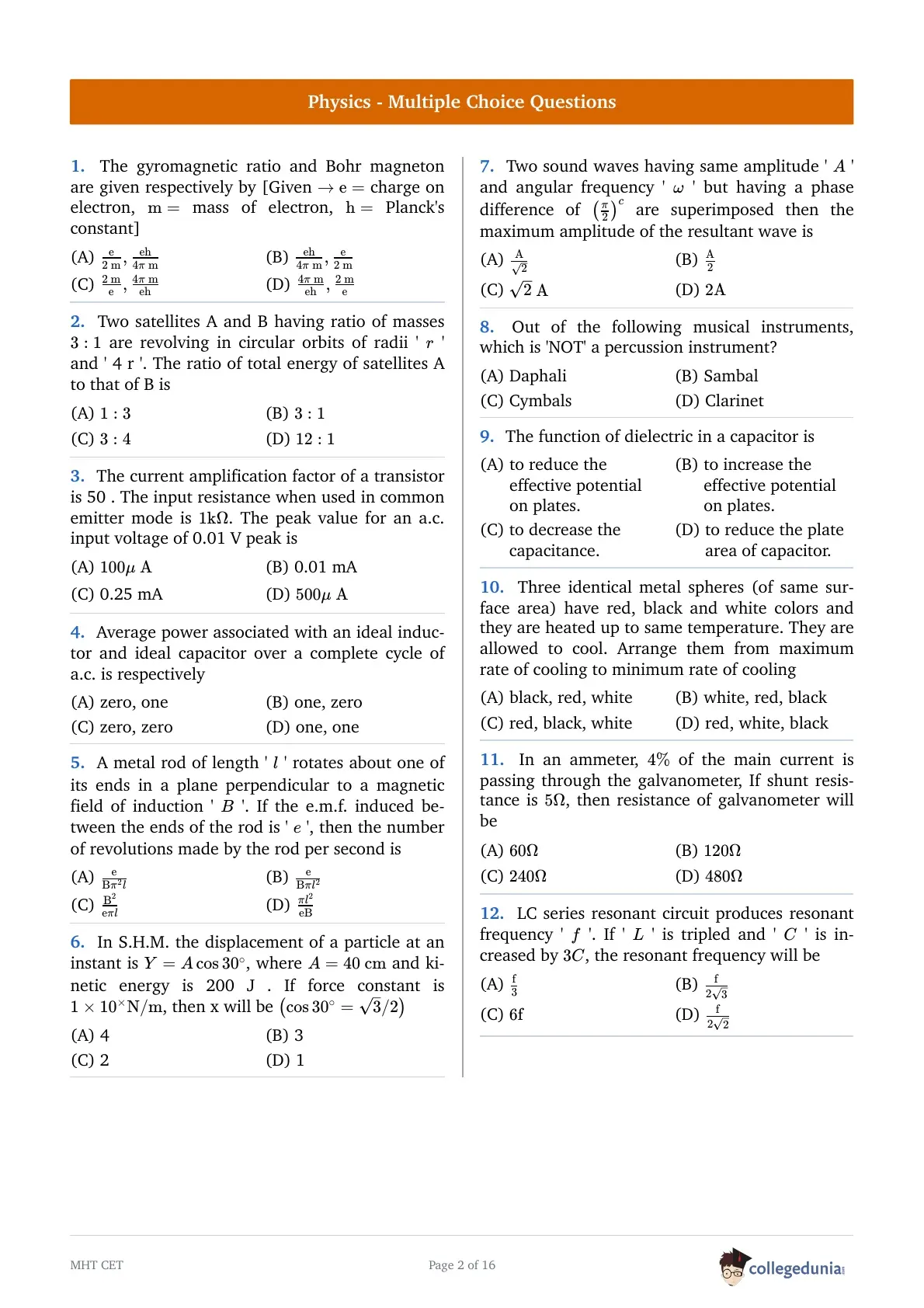
The gyromagnetic ratio and Bohr magneton are given respectively by [Given \(\rightarrow \mathrm{e}=\) charge on electron, \(\mathrm{m}=\) mass of electron, \(\mathrm{h}=\) Planck's constant]

  • (A) \(\frac{\mathrm{e}}{2\text{ }\mathrm{m}},\frac{\mathrm{eh}}{4\pi \text{ }\mathrm{m}}\)
  • (B) \(\frac{\mathrm{eh}}{4\pi \text{ }\mathrm{m}},\frac{\mathrm{e}}{2\text{ }\mathrm{m}}\)
  • (C) \(\frac{2\text{ }\mathrm{m}}{\mathrm{e}},\frac{4\pi \text{ }\mathrm{m}}{\mathrm{eh}}\)
  • (D) \(\frac{4\pi \text{ }\mathrm{m}}{\mathrm{eh}},\frac{2\text{ }\mathrm{m}}{\mathrm{e}}\)

Question 2:

Two satellites A and B having ratio of masses \(3: 1\) are revolving in circular orbits of radii ' \(r\) ' and ' 4 r '. The ratio of total energy of satellites A to that of B is

  • (A) \(1:3\)
  • (B) \(3:1\)
  • (C) \(3:4\)
  • (D) \(12:1\)

Question 3:

The current amplification factor of a transistor is 50 . The input resistance when used in common emitter mode is \(1 \mathrm{k} \Omega\). The peak value for an a.c. input voltage of 0.01 V peak is

  • (A) \(100\mu \text{ }\mathrm{A}\)
  • (B) 0.01 mA
  • (C) 0.25 mA
  • (D) \(500\mu \text{ }\mathrm{A}\)

Question 4:

Average power associated with an ideal inductor and ideal capacitor over a complete cycle of a.c. is respectively

  • (A) zero, one
  • (B) one, zero
  • (C) zero, zero
  • (D) one, one

Question 5:

A metal rod of length ' \(l\) ' rotates about one of its ends in a plane perpendicular to a magnetic field of induction ' \(B\) '. If the e.m.f. induced between the ends of the rod is ' \(e\) ', then the number of revolutions made by the rod per second is

  • (A) \(\frac{\mathrm{e}}{\mathrm{B}\pi ^{2}l}\)
  • (B) \(\frac{\mathrm{e}}{\mathrm{B}\pi l^{2}}\)
  • (C) \(\frac{\mathrm{B}^{2}}{\mathrm{e}\pi l}\)
  • (D) \(\frac{\pi l^{2}}{\mathrm{eB}}\)

Question 6:

In S.H.M. the displacement of a particle at an instant is \(Y=A \cos 30^{\circ}\), where \(A=40 \mathrm{~cm}\) and kinetic energy is 200 J . If force constant is \(1 \times 10^{\times} \mathrm{N} / \mathrm{m}\), then x will be \(\left(\cos 30^{\circ}=\sqrt{3} / 2\right)\)

  • (A) 4
  • (B) 3
  • (C) 2
  • (D) 1

Question 7:

Two sound waves having same amplitude ' \(A\) ' and angular frequency ' \(\omega\) ' but having a phase difference of \(\left(\frac{\pi}{2}\right)^c\) are superimposed then the maximum amplitude of the resultant wave is

  • (A) \(\frac{\mathrm{A}}{\sqrt{2}}\)
  • (B) \(\frac{\mathrm{A}}{2}\)
  • (C) \(\sqrt{2}\text{ }\mathrm{A}\)
  • (D) \(2\mathrm{A}\)

Question 8:

Out of the following musical instruments, which is 'NOT' a percussion instrument?

  • (A) Daphali
  • (B) Sambal
  • (C) Cymbals
  • (D) Clarinet

Question 9:

The function of dielectric in a capacitor is

  • (A) to reduce the effective potential on plates.
  • (B) to increase the effective potential on plates.
  • (C) to decrease the capacitance.
  • (D) to reduce the plate area of capacitor.

Question 10:

Three identical metal spheres (of same surface area) have red, black and white colors and they are heated up to same temperature. They are allowed to cool. Arrange them from maximum rate of cooling to minimum rate of cooling

  • (A) black, red, white
  • (B) white, red, black
  • (C) red, black, white
  • (D) red, white, black

Question 11:

In an ammeter, \(4 \%\) of the main current is passing through the galvanometer, If shunt resistance is \(5 \Omega\), then resistance of galvanometer will be

  • (A) \(60\Omega\)
  • (B) \(120\Omega\)
  • (C) \(240\Omega\)
  • (D) \(480\Omega\)

Question 12:

LC series resonant circuit produces resonant frequency ' \(f\) '. If ' \(L\) ' is tripled and ' \(C\) ' is increased by \(3 C\), the resonant frequency will be

  • (A) \(\frac{\mathrm{f}}{3}\)
  • (B) \(\frac{\mathrm{f}}{2\sqrt{3}}\)
  • (C) \(6\mathrm{f}\)
  • (D) \(\frac{\mathrm{f}}{2\sqrt{2}}\)

Question 13:

A wavefront is a surface

  • (A) perpendicular to the direction of propagation of light.
  • (B) parallel to the direction of propagation of light.
  • (C) without any specific orientation with direction of propagation of light.
  • (D) which has nothing to do with intensity of light.

Question 14:

When the tension in string is increased by \(3 \mathrm{~kg} \omega \mathrm{t}\), the frequency of the fundamental mode increases in the ratio \(2: 3\). The initial tension in the string is

  • (A) \(1.6\text{ }\mathrm{kg}\omega \mathrm{t}\)
  • (B) \(2.0\text{ }\mathrm{kg}\omega \mathrm{t}\)
  • (C) \(2.4\text{ }\mathrm{kg}\omega \mathrm{t}\)
  • (D) \(2.8\text{ }\mathrm{kg}\omega \mathrm{t}\)

Question 15:

In the system of two particles of masses ' \(\mathrm{m}_1\) ' and ' \(\mathrm{m}_2\) ', the first particle is moved by a distance 'd' towards the centre of mass. To keep the centre of mass unchanged, the second particle will have to be moved by a distance

  • (A) \(\frac{\mathrm{m}_{2}}{\text{ }\mathrm{m}_{1}}\text{ }\mathrm{d}\), towards the centre of mass.
  • (B) \(\frac{\mathrm{m}_{1}}{\text{ }\mathrm{m}_{2}}\text{ }\mathrm{d}\), away from the centre of mass.
  • (C) \(\frac{\mathrm{m}_{1}}{\text{ }\mathrm{m}_{2}}\text{ }\mathrm{d}\), towards the centre of mass.
  • (D) \(\frac{\mathrm{m}_{2}}{\text{ }\mathrm{m}_{1}}\text{ }\mathrm{d}\), away from the centre of mass.

Question 16:

The potential energy of a long spring when it is stretched by 3 cm is ' \(U\) '. If the spring is stretched by 9 cm , potential energy stored in it will be

  • (A) 3U
  • (B) 4U
  • (C) 5U
  • (D) 9U

Question 17:

A thin uniform rod of length ' \(L\) ' and mass ' \(M\) ' is swinging freely along a horizontal axis passing through its centre. Its maximum angular speed is ' \(\omega\) '. Its centre of mass rises to a maximum height of [ \(\mathrm{g}=\) gravitational acceleration]

  • (A) \(\frac{\omega ^{2}\text{ }\mathrm{L}^{2}}{12\text{ }\mathrm{g}^{2}}\)
  • (B) \(\frac{\omega ^{2}L^{2}g}{6}\)
  • (C) \(\frac{\omega ^{2}g}{12\text{ }\mathrm{L}^{2}}\)
  • (D) \(\frac{\omega ^{2}L^{2}}{24\text{ }\mathrm{g}}\)

Question 18:

Three immiscible transparent liquids with uniform refractive indices \(\frac{3}{2}, \frac{4}{3}\) and \(\frac{6}{5}\) are arranged one on top of another. The depths of the liquids are 3 cm 4 cm and 6 cm respectively. The apparent depth of the vessel is

  • (A) 10 cm
  • (B) 9 cm
  • (C) 8 cm
  • (D) 7 cm

Question 19:

When a hydrogen atom is raised from the ground state to the excited state

  • (A) potential energy increases and K.E. decreases.
  • (B) potential energy decreases and K.E. increases.
  • (C) both K.E. and potential energy will increase.
  • (D) both K.E. and potential energy decreases.

Question 20:

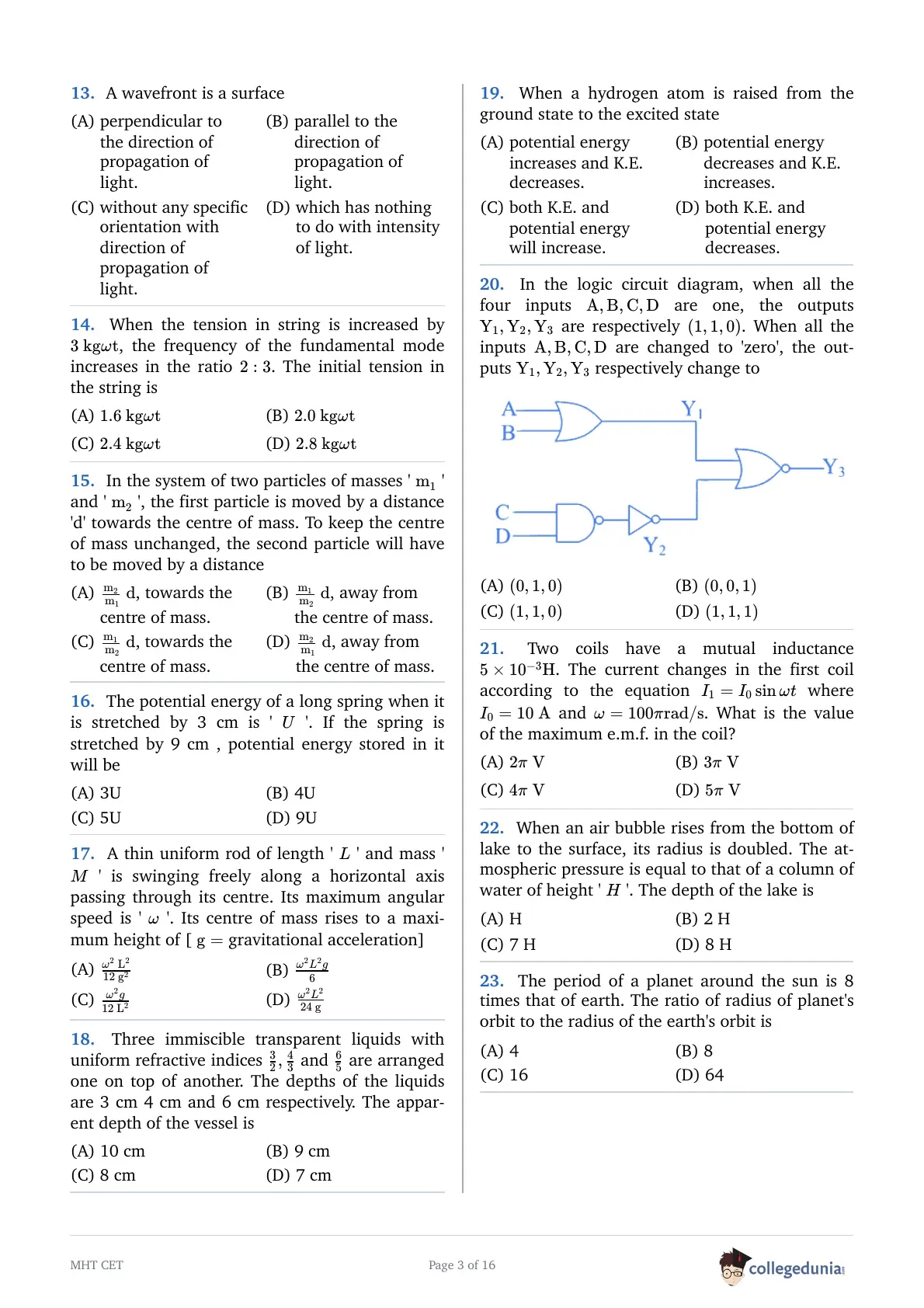
In the logic circuit diagram, when all the four inputs \(\mathrm{A}, \mathrm{B}, \mathrm{C}, \mathrm{D}\) are one, the outputs \(\mathrm{Y}_1, \mathrm{Y}_2, \mathrm{Y}_3\) are respectively \((1,1,0)\). When all the inputs \(\mathrm{A}, \mathrm{B}, \mathrm{C}, \mathrm{D}\) are changed to 'zero', the outputs \(\mathrm{Y}_1, \mathrm{Y}_2, \mathrm{Y}_3\) respectively change to

  • (A) \((0,1,0)\)
  • (B) \((0,0,1)\)
  • (C) \((1,1,0)\)
  • (D) \((1,1,1)\)

Question 21:

Two coils have a mutual inductance \(5 \times 10^{-3} \mathrm{H}\). The current changes in the first coil according to the equation \(I_1=I_0 \sin \omega t\) where \(I_0=10 \mathrm{~A}\) and \(\omega=100 \pi \mathrm{rad} / \mathrm{s}\). What is the value of the maximum e.m.f. in the coil?

  • (A) \(2\pi \text{ }\mathrm{V}\)
  • (B) \(3\pi \text{ }\mathrm{V}\)
  • (C) \(4\pi \text{ }\mathrm{V}\)
  • (D) \(5\pi \text{ }\mathrm{V}\)

Question 22:

When an air bubble rises from the bottom of lake to the surface, its radius is doubled. The atmospheric pressure is equal to that of a column of water of height ' \(H\) '. The depth of the lake is

  • (A) H
  • (B) 2 H
  • (C) 7 H
  • (D) 8 H

Question 23:

The period of a planet around the sun is 8 times that of earth. The ratio of radius of planet's orbit to the radius of the earth's orbit is

  • (A) 4
  • (B) 8
  • (C) 16
  • (D) 64

Question 24:

The magnetic induction due to an ideal solenoid is independent of

  • (A) total number of turns of the wire.
  • (B) length of the solenoid.
  • (C) radius of the wire.
  • (D) current carried by the wire.

Question 25:

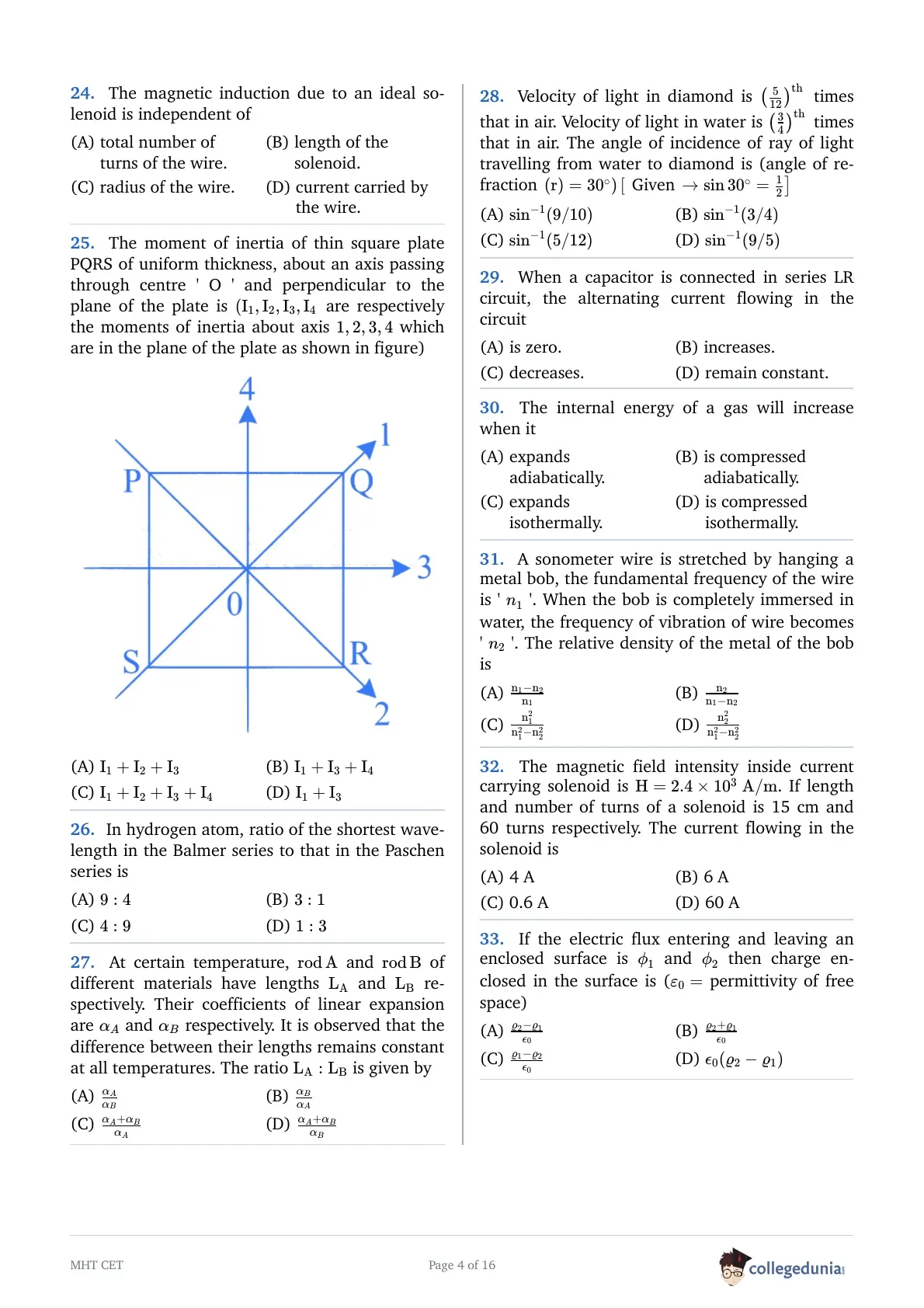
The moment of inertia of thin square plate PQRS of uniform thickness, about an axis passing through centre ' O ' and perpendicular to the plane of the plate is \(\left(\mathrm{I}_1, \mathrm{I}_2, \mathrm{I}_3, \mathrm{I}_4\right.\) are respectively the moments of inertia about axis \(1,2,3,4\) which are in the plane of the plate as shown in figure)

  • (A) \(\mathrm{I}_{1}+\mathrm{I}_{2}+\mathrm{I}_{3}\)
  • (B) \(\mathrm{I}_{1}+\mathrm{I}_{3}+\mathrm{I}_{4}\)
  • (C) \(\mathrm{I}_{1}+\mathrm{I}_{2}+\mathrm{I}_{3}+\mathrm{I}_{4}\)
  • (D) \(\mathrm{I}_{1}+\mathrm{I}_{3}\)

Question 26:

In hydrogen atom, ratio of the shortest wavelength in the Balmer series to that in the Paschen series is

  • (A) \(9:4\)
  • (B) \(3:1\)
  • (C) \(4:9\)
  • (D) \(1:3\)

Question 27:

At certain temperature, \(\operatorname{rod} \mathrm{A}\) and \(\operatorname{rod} \mathrm{B}\) of different materials have lengths \(\mathrm{L}_{\mathrm{A}}\) and \(\mathrm{L}_{\mathrm{B}}\) respectively. Their coefficients of linear expansion are \(\alpha_A\) and \(\alpha_B\) respectively. It is observed that the difference between their lengths remains constant at all temperatures. The ratio \(\mathrm{L}_{\mathrm{A}}: \mathrm{L}_{\mathrm{B}}\) is given by

  • (A) \(\frac{\alpha _{A}}{\alpha _{B}}\)
  • (B) \(\frac{\alpha _{B}}{\alpha _{A}}\)
  • (C) \(\frac{\alpha _{A}+\alpha _{B}}{\alpha _{A}}\)
  • (D) \(\frac{\alpha _{A}+\alpha _{B}}{\alpha _{B}}\)

Question 28:

Velocity of light in diamond is \(\left(\frac{5}{12}\right)^{\text {th }}\) times that in air. Velocity of light in water is \(\left(\frac{3}{4}\right)^{\text {th }}\) times that in air. The angle of incidence of ray of light travelling from water to diamond is (angle of refraction \(\left.(\mathrm{r})=30^{\circ}\right)\left[\right.\) Given \(\left.\rightarrow \sin 30^{\circ}=\frac{1}{2}\right]\)

  • (A) \(\mathrm{sin}^{-1}(9/10)\)
  • (B) \(\mathrm{sin}^{-1}(3/4)\)
  • (C) \(\mathrm{sin}^{-1}(5/12)\)
  • (D) \(\mathrm{sin}^{-1}(9/5)\)

Question 29:

When a capacitor is connected in series LR circuit, the alternating current flowing in the circuit

  • (A) is zero.
  • (B) increases.
  • (C) decreases.
  • (D) remain constant.

Question 30:

The internal energy of a gas will increase when it

  • (A) expands adiabatically.
  • (B) is compressed adiabatically.
  • (C) expands isothermally.
  • (D) is compressed isothermally.

Question 31:

A sonometer wire is stretched by hanging a metal bob, the fundamental frequency of the wire is ' \(n_1\) '. When the bob is completely immersed in water, the frequency of vibration of wire becomes ' \(n_2\) '. The relative density of the metal of the bob is

  • (A) \(\frac{\mathrm{n}_{1}-\mathrm{n}_{2}}{\mathrm{n}_{1}}\)
  • (B) \(\frac{\mathrm{n}_{2}}{\mathrm{n}_{1}-\mathrm{n}_{2}}\)
  • (C) \(\frac{\mathrm{n}_{1}^{2}}{\mathrm{n}_{1}^{2}-\mathrm{n}_{2}^{2}}\)
  • (D) \(\frac{\mathrm{n}_{2}^{2}}{\mathrm{n}_{1}^{2}-\mathrm{n}_{2}^{2}}\)

Question 32:

The magnetic field intensity inside current carrying solenoid is \(\mathrm{H}=2.4 \times 10^3 \mathrm{~A} / \mathrm{m}\). If length and number of turns of a solenoid is 15 cm and 60 turns respectively. The current flowing in the solenoid is

  • (A) 4 A
  • (B) 6 A
  • (C) 0.6 A
  • (D) 60 A

Question 33:

If the electric flux entering and leaving an enclosed surface is \(\phi_1\) and \(\phi_2\) then charge enclosed in the surface is (\(\varepsilon_0=\) permittivity of free space)

  • (A) \(\frac{\varrho _{2}-\varrho _{1}}{\epsilon _{0}}\)
  • (B) \(\frac{\varrho _{2}+\varrho _{1}}{\epsilon _{0}}\)
  • (C) \(\frac{\varrho _{1}-\varrho _{2}}{\epsilon _{0}}\)
  • (D) \(\epsilon _{0}(\varrho _{2}-\varrho _{1})\)

Question 35:

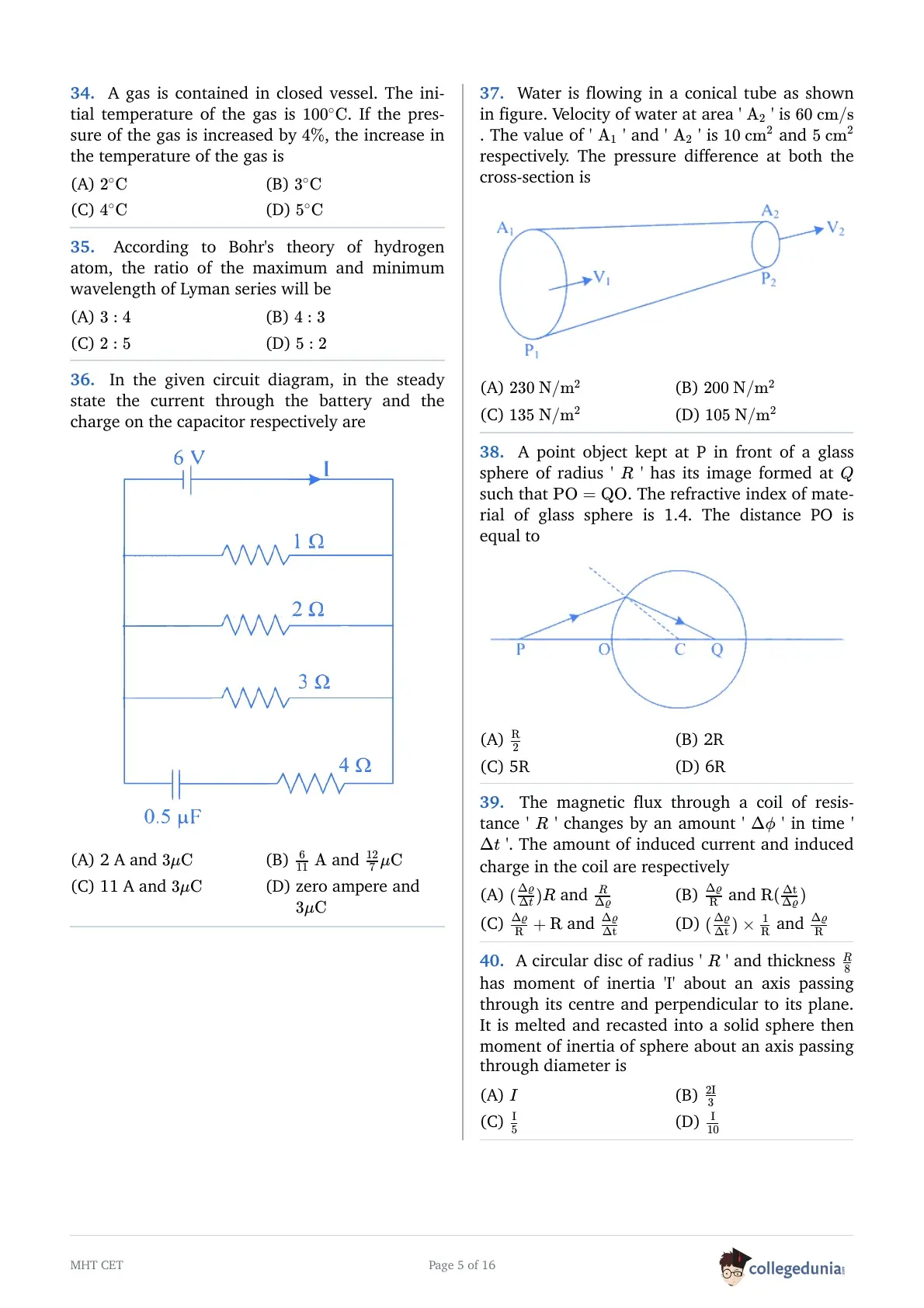
According to Bohr's theory of hydrogen atom, the ratio of the maximum and minimum wavelength of Lyman series will be

  • (A) \(3:4\)
  • (B) \(4:3\)
  • (C) \(2:5\)
  • (D) \(5:2\)

Question 36:

In the given circuit diagram, in the steady state the current through the battery and the charge on the capacitor respectively are

  • (A) 2 A and \(3\mu \mathrm{C}\)
  • (B) \(\frac{6}{11}\text{ }\mathrm{A}\) and \(\frac{12}{7}\mu \mathrm{C}\)
  • (C) 11 A and \(3\mu \mathrm{C}\)
  • (D) zero ampere and \(3\mu \mathrm{C}\)

Question 37:

Water is flowing in a conical tube as shown in figure. Velocity of water at area ' \(\mathrm{A}_2\) ' is \(60 \mathrm{~cm} / \mathrm{s}\). The value of ' \(\mathrm{A}_1\) ' and ' \(\mathrm{A}_2\) ' is \(10 \mathrm{~cm}^2\) and \(5 \mathrm{~cm}^2\) respectively. The pressure difference at both the cross-section is

  • (A) \(230\text{ }\mathrm{N}/\mathrm{m}^{2}\)
  • (B) \(200\text{ }\mathrm{N}/\mathrm{m}^{2}\)
  • (C) \(135\text{ }\mathrm{N}/\mathrm{m}^{2}\)
  • (D) \(105\text{ }\mathrm{N}/\mathrm{m}^{2}\)

Question 38:

A point object kept at P in front of a glass sphere of radius ' \(R\) ' has its image formed at \(Q\) such that \(\mathrm{PO}=\mathrm{QO}\). The refractive index of material of glass sphere is 1.4. The distance PO is equal to

  • (A) \(\frac{\mathrm{R}}{2}\)
  • (B) 2R
  • (C) 5R
  • (D) 6R

Question 39:

The magnetic flux through a coil of resistance ' \(R\) ' changes by an amount ' \(\Delta \phi\) ' in time ' \(\Delta t\) '. The amount of induced current and induced charge in the coil are respectively

  • (A) \((\frac{\Delta \varrho}{\Delta t})R\) and \(\frac{R}{\Delta \varrho}\)
  • (B) \(\frac{\Delta \varrho}{\mathrm{R}}\) and \(\mathrm{R}(\frac{\Delta \mathrm{t}}{\Delta \varrho})\)
  • (C) \(\frac{\Delta \varrho}{\mathrm{R}}+\mathrm{R}\) and \(\frac{\Delta \varrho}{\Delta \mathrm{t}}\)
  • (D) \((\frac{\Delta \varrho}{\Delta \mathrm{t}})\times \frac{1}{\mathrm{R}}\) and \(\frac{\Delta \varrho}{\mathrm{R}}\)

Question 42:

For an ideal gas, in an isobaric process, the ratio of heat supplied ' \(Q\) ' to the work done ' \(w\) ' by the system is ( \(\gamma=\) ratio of specific heat at constant pressure to that at constant volume)

  • (A) \(\frac{1}{\gamma}\)
  • (B) \(\frac{1}{\gamma -1}\)
  • (C) \(\frac{\gamma}{\gamma -1}\)
  • (D) \(\frac{\gamma -1}{\gamma}\)

Question 43:

A particle is performing S.H.M. with an amplitude 4 cm . At the mean position the velocity of the particle is \(12 \mathrm{~cm} / \mathrm{s}\). When the speed of the particle becomes \(6 \mathrm{~cm} / \mathrm{s}\), the distance of the particle from mean position is

  • (A) \(\sqrt{3}\text{ }\mathrm{cm}\)
  • (B) \(\sqrt{6}\text{ }\mathrm{cm}\)
  • (C) \(2\sqrt{3}\text{ }\mathrm{cm}\)
  • (D) \(2\sqrt{6}\text{ }\mathrm{cm}\)

Question 45:

Two identical photocathodes receive light of frequencies ' \(\mathrm{n}_1\) ' and ' \(\mathrm{n}_2\) '. If the velocities of the emitted photoelectrons of mass ' \(m\) ' are ' \(\mathrm{V}_1\) ' and ' V , respectively, then ( \(\mathrm{h}=\) Planck's constant )

  • (A) \(\mathrm{V}_{1}+\mathrm{V}_{2}=[\frac{2\text{ }\mathrm{h}}{\text{ }\mathrm{m}}(\mathrm{n}_{1}+\mathrm{n}_{2})]^{1/2}\)
  • (B) \(\mathrm{V}_{1}-\mathrm{V}_{2}=[\frac{2\text{ }\mathrm{h}}{\text{ }\mathrm{m}}(\mathrm{n}_{1}-\mathrm{n}_{2})]^{1/2}\)
  • (C) \(\mathrm{V}_{1}^{2}+\mathrm{V}_{2}^{2}=\frac{2\text{ }\mathrm{h}}{\text{ }\mathrm{m}}(\mathrm{n}_{1}+\mathrm{n}_{2})\)
  • (D) \(\mathrm{V}_{1}^{2}-\mathrm{V}_{2}^{2}=\frac{2\text{ }\mathrm{h}}{\text{ }\mathrm{m}}(\mathrm{n}_{1}-\mathrm{n}_{2})\)

Question 46:

The temperature of a gas is \(-80^{\circ} \mathrm{C}\). To what temperature the gas should be heated so that the r.m.s. speed is increased by 2 times?

  • (A) \(499^{\circ}\mathrm{C}\)
  • (B) \(772^{\circ}\mathrm{C}\)
  • (C) \(1464^{\circ}\mathrm{C}\)
  • (D) \(1737^{\circ}\mathrm{C}\)

Question 47:

Two wavelength 590 nm and 596 nm of sodium light are used one after other, to study the diffraction taking place at a single slit of aperture 2.4 mm . The distance between the slit and screen is 2 m . The separation between the positions of first secondary maximum of the diffraction pattern obtained in the two cases is

  • (A) \(7.5\times 10^{-6}\text{ }\mathrm{m}\)
  • (B) \(7.5\times 10^{-9}\text{ }\mathrm{m}\)
  • (C) \(2.5\times 10^{-6}\text{ }\mathrm{m}\)
  • (D) \(5.0\times 10^{-6}\text{ }\mathrm{m}\)

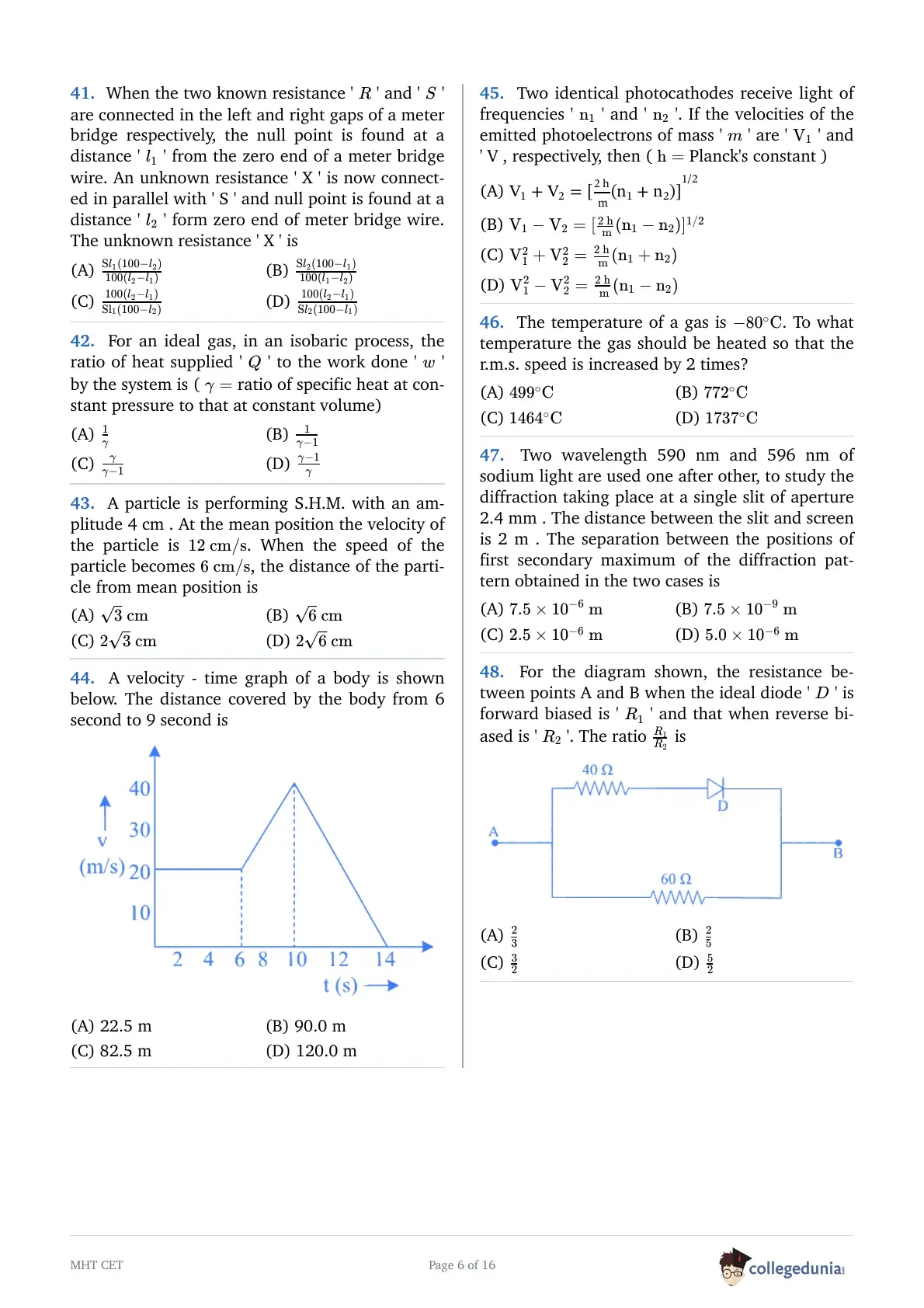
Question 48:

For the diagram shown, the resistance between points A and B when the ideal diode ' \(D\) ' is forward biased is ' \(R_1\) ' and that when reverse biased is ' \(R_2\) '. The ratio \(\frac{R_1}{R_2}\) is

  • (A) \(\frac{2}{3}\)
  • (B) \(\frac{2}{5}\)
  • (C) \(\frac{3}{2}\)
  • (D) \(\frac{5}{2}\)

Question 49:

A parallel plate capacitor of capacitance ' \(C\) ' is connected to a battery and charged to a potential difference ' \(V\) '. Another capacitor of capacitance 3 C is similarly charged to a potential difference 3 V . The charging battery is then disconnected and capacitors are connected in parallel to each other in such a way that positive terminal of one is connected to the negative terminal of the other. The final energy of the configuration is

  • (A) \(\frac{3}{2}\text{ }\mathrm{CV}^{2}\)
  • (B) \(8\text{ }\mathrm{CV}^{2}\)
  • (C) \(\frac{13}{2}\text{ }\mathrm{CV}^{2}\)
  • (D) \(18\text{ }\mathrm{CV}^{2}\)

Question 50:

A tuning fork of frequency 340 Hz is vibrated just above a tube of 120 cm height. Water is slowly poured in the tube. What is the minimum height of water necessary for resonance?

  • (A) 45 cm
  • (B) 30 cm
  • (C) 35 cm
  • (D) 25 cm

Chemistry (Q51 - Q100)

Question 51:

Identify fibrous protein from following.

  • (A) Legumelin
  • (B) Serum albumin
  • (C) Myosin
  • (D) Insulin

Question 52:

For the reaction,

\[\mathrm{C}_3 \mathrm{H}_{8(\mathrm{~g})}+5 \mathrm{O}_{2(\mathrm{~g})} \longrightarrow 3 \mathrm{CO}_{2(\mathrm{~g})}+4 \mathrm{H}_2 \mathrm{O}_{(\mathrm{l})}\]

at constant temperature, \(\Delta \mathrm{H}-\Delta \mathrm{U}\) is

  • (A) \(-\)2RT
  • (B) RT
  • (C) \(-\)3RT
  • (D) 3RT

Question 53:

Which from following reactions is not possible for benzene due to reversible nature?

  • (A) Hydrogenation
  • (B) Chlorination
  • (C) Bromination
  • (D) Iodination

Question 54:

Calculate the volume of unit cell when metal having density \(1 \mathrm{~g} \mathrm{~cm}^{-3}\) and molar mass \(23 \mathrm{~g} \mathrm{~mol}^{-1}\) crystallises to form bec structure.

  • (A) \(6.0\times 10^{-23}\text{ }\mathrm{cm}^{3}\)
  • (B) \(8.6\times 10^{-23}\text{ }\mathrm{cm}^{3}\)
  • (C) \(9.5\times 10^{-23}\text{ }\mathrm{cm}^{3}\)
  • (D) \(7.6\times 10^{-23}\text{ }\mathrm{cm}^{3}\)

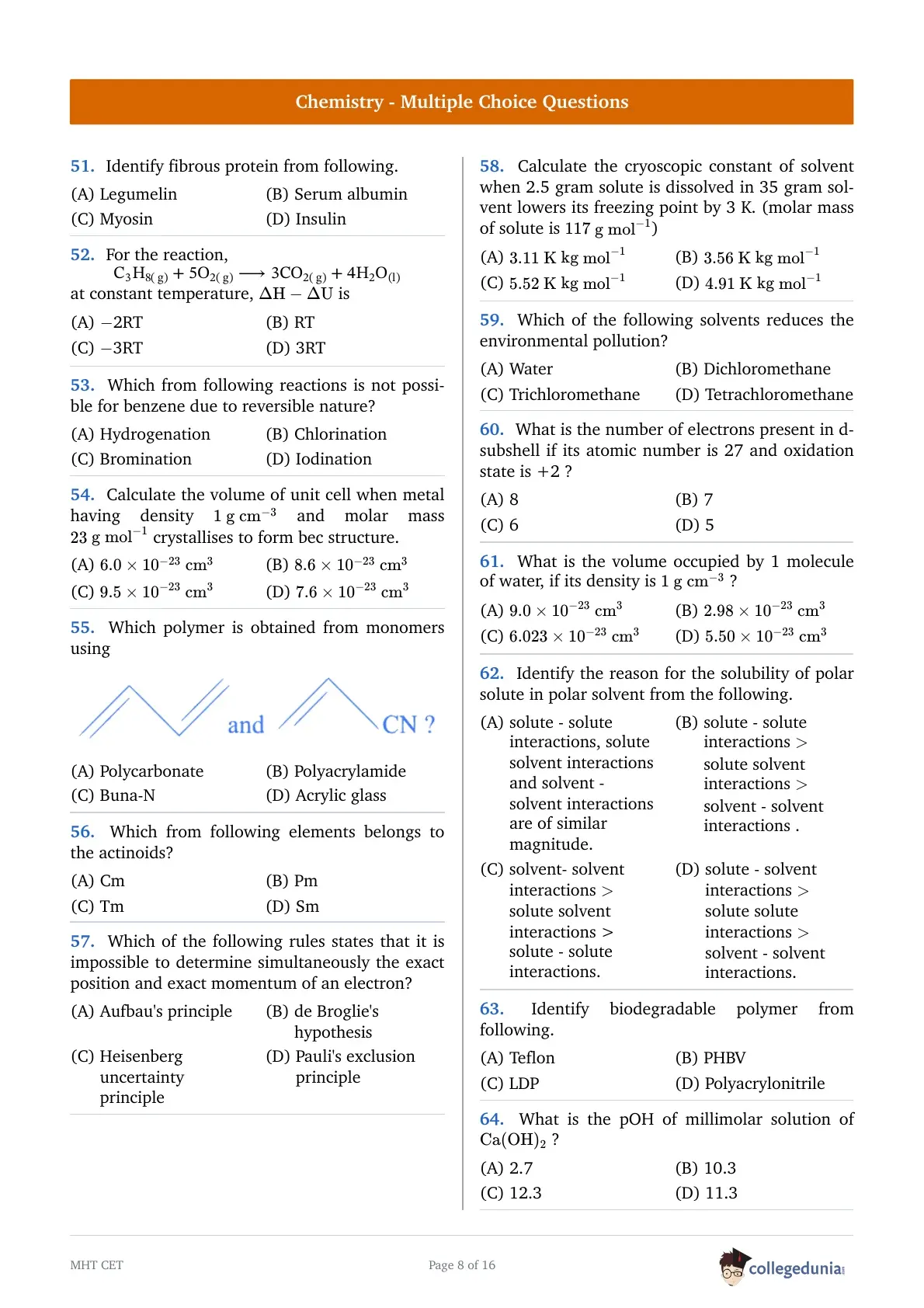
Question 55:

Which polymer is obtained from monomers using

  • (A) Polycarbonate
  • (B) Polyacrylamide
  • (C) Buna-N
  • (D) Acrylic glass

Question 56:

Which from following elements belongs to the actinoids?

  • (A) Cm
  • (B) Pm
  • (C) Tm
  • (D) Sm

Question 57:

Which of the following rules states that it is impossible to determine simultaneously the exact position and exact momentum of an electron?

  • (A) Aufbau's principle
  • (B) de Broglie's hypothesis
  • (C) Heisenberg uncertainty principle
  • (D) Pauli's exclusion principle

Question 58:

Calculate the cryoscopic constant of solvent when 2.5 gram solute is dissolved in 35 gram solvent lowers its freezing point by 3 K. (molar mass of solute is \(117 \mathrm{~g} \mathrm{~mol}^{-1}\))

  • (A) \(3.11\text{ }\mathrm{K}\text{ }\mathrm{kg}\text{ }\mathrm{mol}^{-1}\)
  • (B) \(3.56\text{ }\mathrm{K}\text{ }\mathrm{kg}\text{ }\mathrm{mol}^{-1}\)
  • (C) \(5.52\text{ }\mathrm{K}\text{ }\mathrm{kg}\text{ }\mathrm{mol}^{-1}\)
  • (D) \(4.91\text{ }\mathrm{K}\text{ }\mathrm{kg}\text{ }\mathrm{mol}^{-1}\)

Question 59:

Which of the following solvents reduces the environmental pollution?

  • (A) Water
  • (B) Dichloromethane
  • (C) Trichloromethane
  • (D) Tetrachloromethane

Question 60:

What is the number of electrons present in d-subshell if its atomic number is 27 and oxidation state is +2 ?

  • (A) 8
  • (B) 7
  • (C) 6
  • (D) 5

Question 61:

What is the volume occupied by 1 molecule of water, if its density is \(1 \mathrm{~g} \mathrm{~cm}^{-3}\) ?

  • (A) \(9.0\times 10^{-23}\text{ }\mathrm{cm}^{3}\)
  • (B) \(2.98\times 10^{-23}\text{ }\mathrm{cm}^{3}\)
  • (C) \(6.023\times 10^{-23}\text{ }\mathrm{cm}^{3}\)
  • (D) \(5.50\times 10^{-23}\text{ }\mathrm{cm}^{3}\)

Question 63:

Identify biodegradable polymer from following.

  • (A) Teflon
  • (B) PHBV
  • (C) LDP
  • (D) Polyacrylonitrile

Question 64:

What is the pOH of millimolar solution of \(\mathrm{Ca}(\mathrm{OH})_2\) ?

  • (A) 2.7
  • (B) 10.3
  • (C) 12.3
  • (D) 11.3

Question 65:

Which from following pairs is an example of isotones?

  • (A) \(_{6}^{12}\mathrm{C};_{6}^{14}\mathrm{C}\)
  • (B) \(_{6}^{12}\mathrm{C};_{5}^{11}\text{ }\mathrm{B}\)
  • (C) \(_{6}^{14}\mathrm{C};_{7}^{14}\text{ }\mathrm{N}\)
  • (D) \(_{6}^{13}\mathrm{C};_{5}^{11}\text{ }\mathrm{B}\)

Question 66:

What is change in internal energy of the system when work done by the system is 150 J and system release 300 J of heat?

  • (A) \(+450\) J
  • (B) \(-450\) J
  • (C) \(+300\) J
  • (D) \(-150\) J

Question 67:

Which from following coordinate complexes is a heteroleptic complex?

  • (A) Pentacarbonyliron(0)
  • (B) Triamminetrinitrocobalt(III)
  • (C) Tetraamminecopper(II) ion
  • (D) Tetracyanonickelate(II) ion

Question 68:

Identify glycosidic linkage present in maltose.

  • (A) \(\alpha ,\beta -1,2\) glycosidic
  • (B) \(\alpha -1,4\) glycosidic
  • (C) \(\beta -1,4\) glycosidic
  • (D) \(\alpha -1,6\) glycosidic

Question 69:

What is the number of moles of Cl atoms and N atoms respectively present in n moles of tear gas?

  • (A) 3 nCl and nN
  • (B) 2 nCl and 2 nN
  • (C) \(\mathrm{nCl}\) and nN
  • (D) nCl and 2 nN

Question 70:

What is bond angle \(\mathrm{F}-\mathrm{B}-\mathrm{F}\) in \(\mathrm{BF}_3\) ?

  • (A) \(107^{\circ}\)
  • (B) \(104.5^{\circ}\)
  • (C) \(120^{\circ}\)
  • (D) \(109.5^{\circ}\)

Question 71:

Which from the following statements about \(\left[\mathrm{Co}\left(\mathrm{NH}_3\right)_6\right]^{3+}\) complex is NOT correct?

  • (A) Prior to hybridization \(\mathrm{Co}^{3+}\) possesses four unpaired electrons.
  • (B) This complex has all electrons paired.
  • (C) It is a high spin complex.
  • (D) It is a diamagnetic complex.

Question 72:

What is the relation between edge length and total volume occupied by atoms in bec unit cell?

  • (A) \(\mathrm{V}=\frac{\pi \mathrm{a}^{3}}{6}\)
  • (B) \(\mathrm{V}=\frac{\sqrt{3}\pi \mathrm{a}^{3}}{8}\)
  • (C) \(\mathrm{V}=\frac{\pi \mathrm{a}^{3}}{3\sqrt{2}}\)
  • (D) \(\mathrm{V}=\frac{\pi \mathrm{a}^{3}}{16}\)

Question 74:

Molar conductivity of 0.02 M weak acid is \(7.92 \Omega^{-1} \mathrm{~cm}^2 \mathrm{~mol}^{-1}\) and its molar conductivity at infinite dilution is \(232.7 \Omega^{-1} \mathrm{~cm}^2 \mathrm{~mol}^{-1}\). Calculate degree of dissociation of weak acid.

  • (A) 0.0112
  • (B) 0.0341
  • (C) 0.0694
  • (D) 0.292

Question 75:

Which from following compounds is most covalent?

  • (A) \(\mathrm{SbCl}_{3}\)
  • (B) \(\mathrm{PbCl}_{2}\)
  • (C) \(\mathrm{SnCl}_{4}\)
  • (D) \(\mathrm{SnCl}_{2}\)

Question 76:

What is the total number of atoms present in fcc unit cell?

  • (A) 2
  • (B) 4
  • (C) 6
  • (D) 1

Question 77:

For which electrolyte the molar conductivity at infinite dilution can not be obtained graphically?

  • (A) \(\mathrm{HNO}_{3}\)
  • (B) \(\mathrm{H}_{2}\mathrm{SO}_{4}\)
  • (C) \(\mathrm{CH}_{3}\mathrm{COOH}\)
  • (D) \(\mathrm{KCl}\)

Question 78:

The major product formed in carbylamine reaction is

  • (A) Alkyl halide
  • (B) Alkyl cyanide
  • (C) Nitroalkane
  • (D) Alkyl isocyanide

Question 79:

Which among the following elements has highest electronegativity?

  • (A) K
  • (B) Na
  • (C) Li
  • (D) Cs

Question 80:

Consider the reaction \(3 \mathrm{I}^{-}+\mathrm{S}_2 \mathrm{O}_8^{2-} \longrightarrow \mathrm{I}_3^{-}+2 \mathrm{SO}_4^{2-}\), at a particular time t , \(\frac{\mathrm{d}\left[\mathrm{SO}_4^{2-}\right]}{\mathrm{dt}}\) is \(2.2 \times 10^{-2} \mathrm{~mol} \mathrm{dm}^{-3} \mathrm{~s}^{-1}\). What is the value of \(\frac{\mathrm{d}\left[\mathrm{S}_2 \mathrm{O}_8^{2-}\right]}{\mathrm{dt}}\) ?

  • (A) \(1.1\times 10^{-2}\text{ }\mathrm{mol}\text{ }\mathrm{dm}^{-3}\text{ }\mathrm{s}^{-1}\)
  • (B) \(2.2\times 10^{-2}\text{ }\mathrm{mol}\text{ }\mathrm{dm}^{-3}\text{ }\mathrm{s}^{-1}\)
  • (C) \(3.3\times 10^{-2}\text{ }\mathrm{mol}\text{ }\mathrm{dm}^{-3}\text{ }\mathrm{s}^{-1}\)
  • (D) \(6.6\times 10^{-2}\text{ }\mathrm{mol}\text{ }\mathrm{dm}^{-3}\text{ }\mathrm{s}^{-1}\)

Question 81:

For the reaction, \(\mathrm{NO}_{2(\mathrm{~g})}+\mathrm{CO}_{(\mathrm{g})} \longrightarrow \mathrm{NO}_{(\mathrm{g})}+\mathrm{CO}_{2(\mathrm{~g})}\) rate of reaction is proportional to square of \(\left[\mathrm{NO}_2\right]\) and independent of [CO]. What is the rate law equation?

  • (A) \(\mathrm{r}=\mathrm{k}\frac{[\mathrm{NO}_{2}]^{\frac{1}{2}}}{[\mathrm{CO}]}\)
  • (B) \(\mathrm{r}=\mathrm{k}[\mathrm{NO}_{2}]^{2}[\mathrm{CO}]^{0}\)
  • (C) \(\mathrm{r}=\frac{1}{2}\mathrm{k}[\mathrm{NO}_{2}][\mathrm{CO}]\)
  • (D) \(\mathrm{r}=\mathrm{k}[\mathrm{NO}_{2}]^{2}[\mathrm{CO}]\)

Question 82:

Which among the following compounds does not correctly match with its formula?

  • (A) Hydrazine: \(\mathrm{NH}_{2}-\mathrm{NH}_{2}\)
  • (B) Semicarbazide: \(\mathrm{NH}_{2}-\mathrm{NH}-\mathrm{CO}-\mathrm{NH}_{2}\)
  • (C) Phenylhydrazine: \(\mathrm{C}_{6}\mathrm{H}_{5}-\mathrm{NH}-\mathrm{NH}-\mathrm{C}_{6}\mathrm{H}_{5}\)
  • (D) Hydroxylamine: \(\mathrm{NH}_{2}-\mathrm{OH}\)

Question 83:

Which among the following forces of attraction is developed between polar and non polar molecules?

  • (A) Dipole-induced dipole interaction
  • (B) Ion-dipole interaction
  • (C) Dipole-dipole interaction
  • (D) van der Waals forces

Question 84:

Which among the following is correct conjugate acid base pair for the equation stated below?

\[\mathrm{HCl}+\mathrm{NH}_3 \rightleftharpoons \mathrm{NH}_4^{+}+\mathrm{Cl}^{-}\]

  • (A) \(\mathrm{Cl}^{-}\)and \(\mathrm{NH}_{4}^{+}\)
  • (B) \(\mathrm{HCl}\) and \(\mathrm{NH}_{3}\)
  • (C) \(\mathrm{NH}_{4}^{+}\)and \(\mathrm{NH}_{3}\)
  • (D) \(\mathrm{NH}_{4}^{+}\)and HCl

Question 85:

Which among the following compounds is NOT a tertiary amine?

  • (A) \(\mathrm{N},\mathrm{N}\)-Dimethyl aniline
  • (B) N-Methyl-N-Phenyl aniline
  • (C) Butan-1-amine
  • (D) N, N-Dimethyl-1-butanamine

Question 86:

Which among the following reactions is used for the preparation of alkyl fluorides?

  • (A) Finkelstein reaction
  • (B) Swartz reaction
  • (C) Fittig reaction
  • (D) Wurtz reaction

Question 87:

What type of colloid is milk?

  • (A) Solid in liquid
  • (B) Liquid in solid
  • (C) Liquid in Liquid
  • (D) Gas in liquid

Question 88:

What is the osmotic pressure of solution prepared by dissolving 3 gram solute in \(2 \mathrm{dm}^3\) water at 300 K . (Molar mass of solute \(=60 \mathrm{~g} \mathrm{~mol}^{-1}\), \(\mathrm{R}=0.0821 \mathrm{dm}^3 \mathrm{~atm} \mathrm{~K} \mathrm{~mol}^{-1})\)

  • (A) 0.76 atm
  • (B) 0.62 atm
  • (C) 0.51 atm
  • (D) 0.84 atm

Question 89:

Which among the following is the method for the preparation of ethers?

  • (A) By the action of moist \(\mathrm{Ag}_{2}\mathrm{O}\) an alkyl halide
  • (B) By the action of aq. KOH on alkyl halide.
  • (C) By the action of alc. Sodium hydroxide on alkyl halide.
  • (D) By the action of sodium alkoxide on alkyl halide.

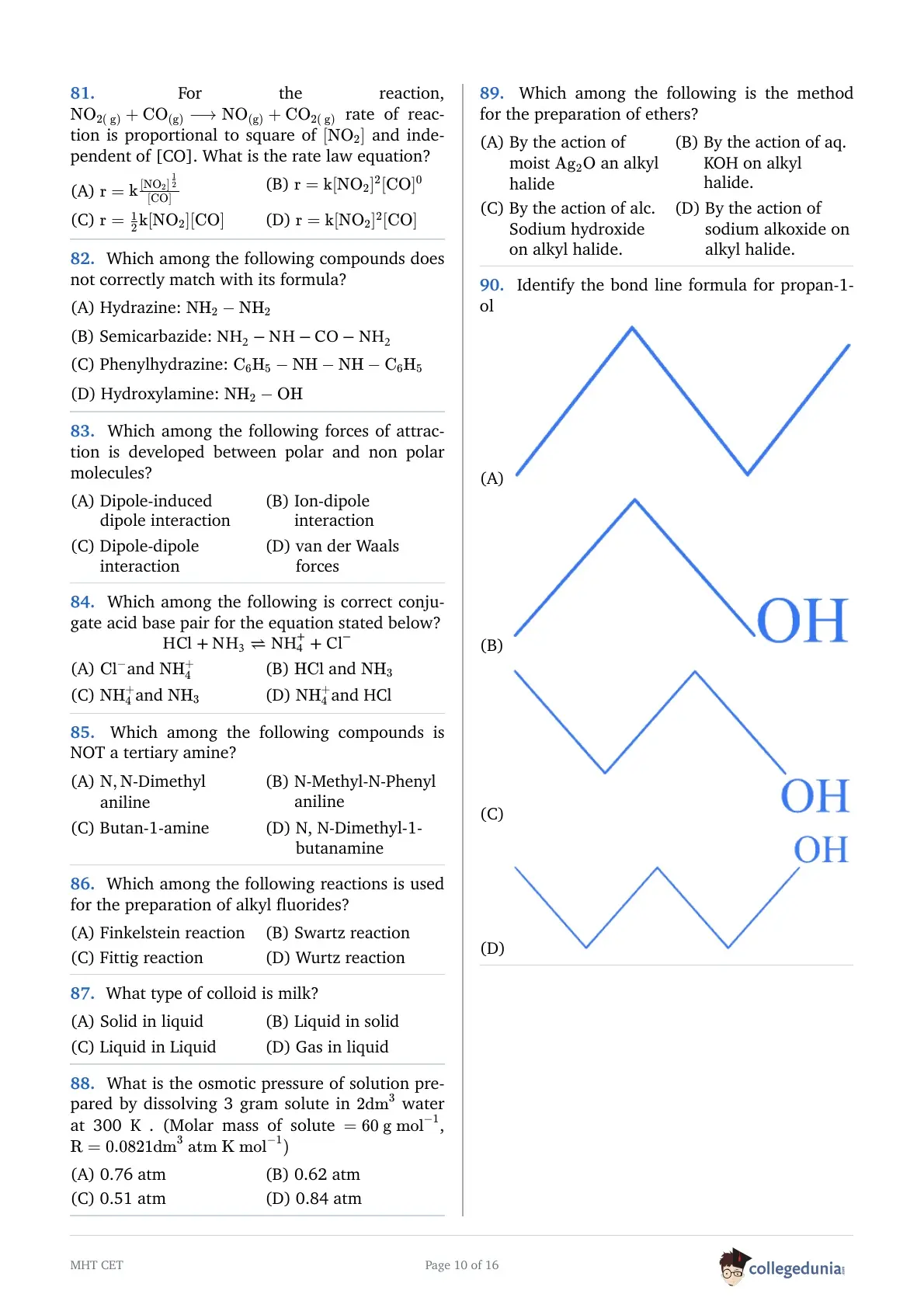
Question 91:

IUPAC name of the compound

  • (A) 1-Methoxy-3, 3-dimethylbutane
  • (B) 1-Methoxy-3, 3-dimethylcyclobutane
  • (C) 3-Methoxy-1,1-dimethylbutane
  • (D) 3-Methoxy-1, 1-dimethylcyclobutane

Question 92:

Dissociation constant and degree of dissociation of weak acid are \(1.8 \times 10^{-5}\) and 0.03 respectively. What will be the concentration of solution of weak acid?

  • (A) 0.2 M
  • (B) 0.02 M
  • (C) 0.5 M
  • (D) 0.05 M

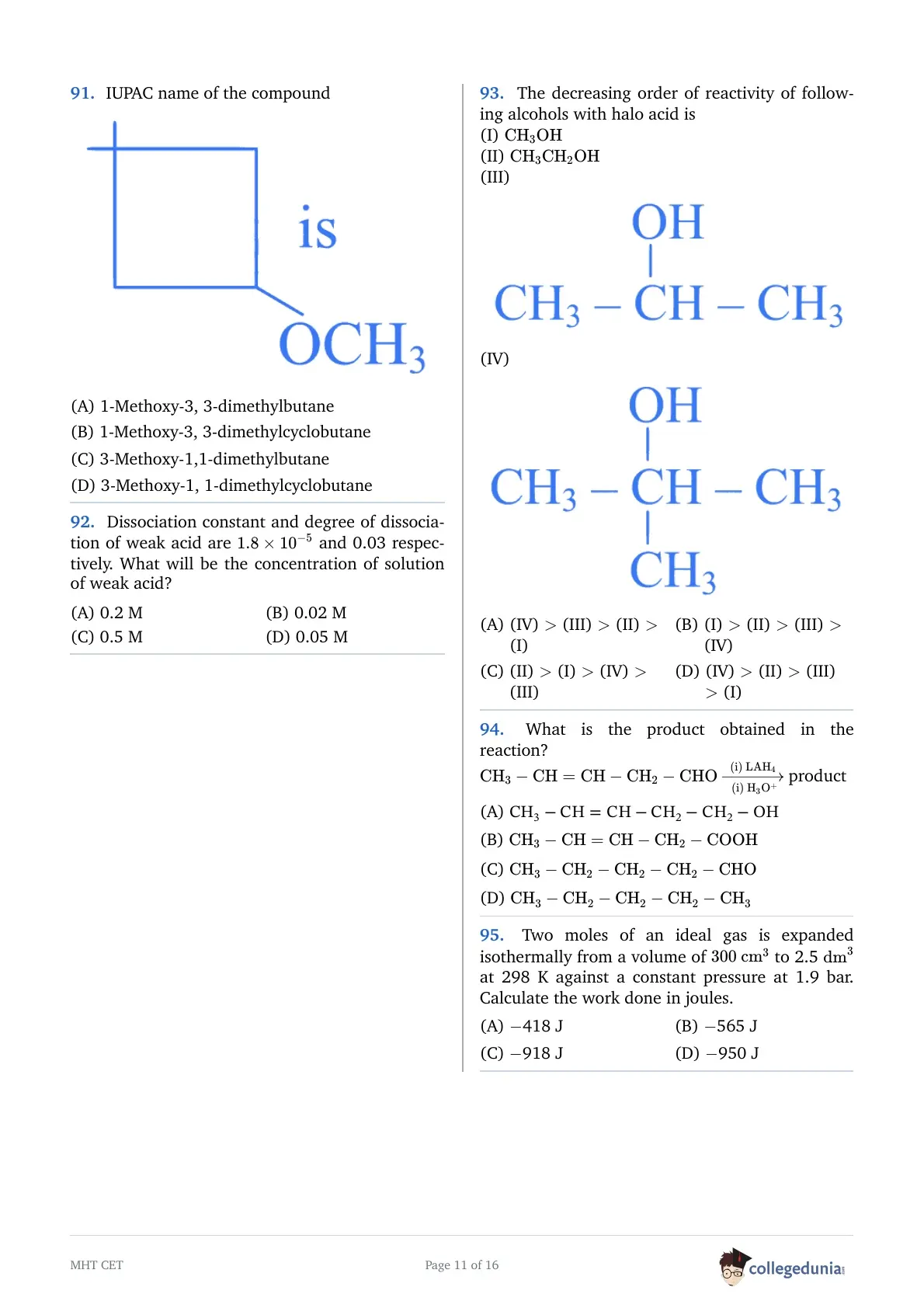
Question 93:

The decreasing order of reactivity of following alcohols with halo acid is

(I) \(\mathrm{CH}_3 \mathrm{OH}\)

(II) \(\mathrm{CH}_3 \mathrm{CH}_2 \mathrm{OH}\)

(III)

  • (A) (IV) \(>\) (III) \(>\) (II) \(>\) (I)
  • (B) (I) \(>\) (II) \(>\) (III) \(>\) (IV)
  • (C) (II) \(>\) (I) \(>\) (IV) \(>\) (III)
  • (D) (IV) \(>\) (II) \(>\) (III) \(>\) (I)

Question 94:

What is the product obtained in the reaction?

\(\mathrm{CH}_3-\mathrm{CH}=\mathrm{CH}-\mathrm{CH}_2-\mathrm{CHO} \xrightarrow[\text { (i) } \mathrm{H}_3 \mathrm{O}^{+}]{\text {(i) } \mathrm{LAH}_4}\) product

  • (A) \(\mathrm{CH}_{3}-\mathrm{CH}=\mathrm{CH}-\mathrm{CH}_{2}-\mathrm{CH}_{2}-\mathrm{OH}\)
  • (B) \(\mathrm{CH}_{3}-\mathrm{CH}=\mathrm{CH}-\mathrm{CH}_{2}-\mathrm{COOH}\)
  • (C) \(\mathrm{CH}_{3}-\mathrm{CH}_{2}-\mathrm{CH}_{2}-\mathrm{CH}_{2}-\mathrm{CHO}\)
  • (D) \(\mathrm{CH}_{3}-\mathrm{CH}_{2}-\mathrm{CH}_{2}-\mathrm{CH}_{2}-\mathrm{CH}_{3}\)

Question 95:

Two moles of an ideal gas is expanded isothermally from a volume of \(300 \mathrm{~cm}^3\) to 2.5 \(\mathrm{dm}^3\) at 298 K against a constant pressure at 1.9 bar. Calculate the work done in joules.

  • (A) \(-\)418 J
  • (B) \(-\)565 J
  • (C) \(-\)918 J
  • (D) \(-\)950 J

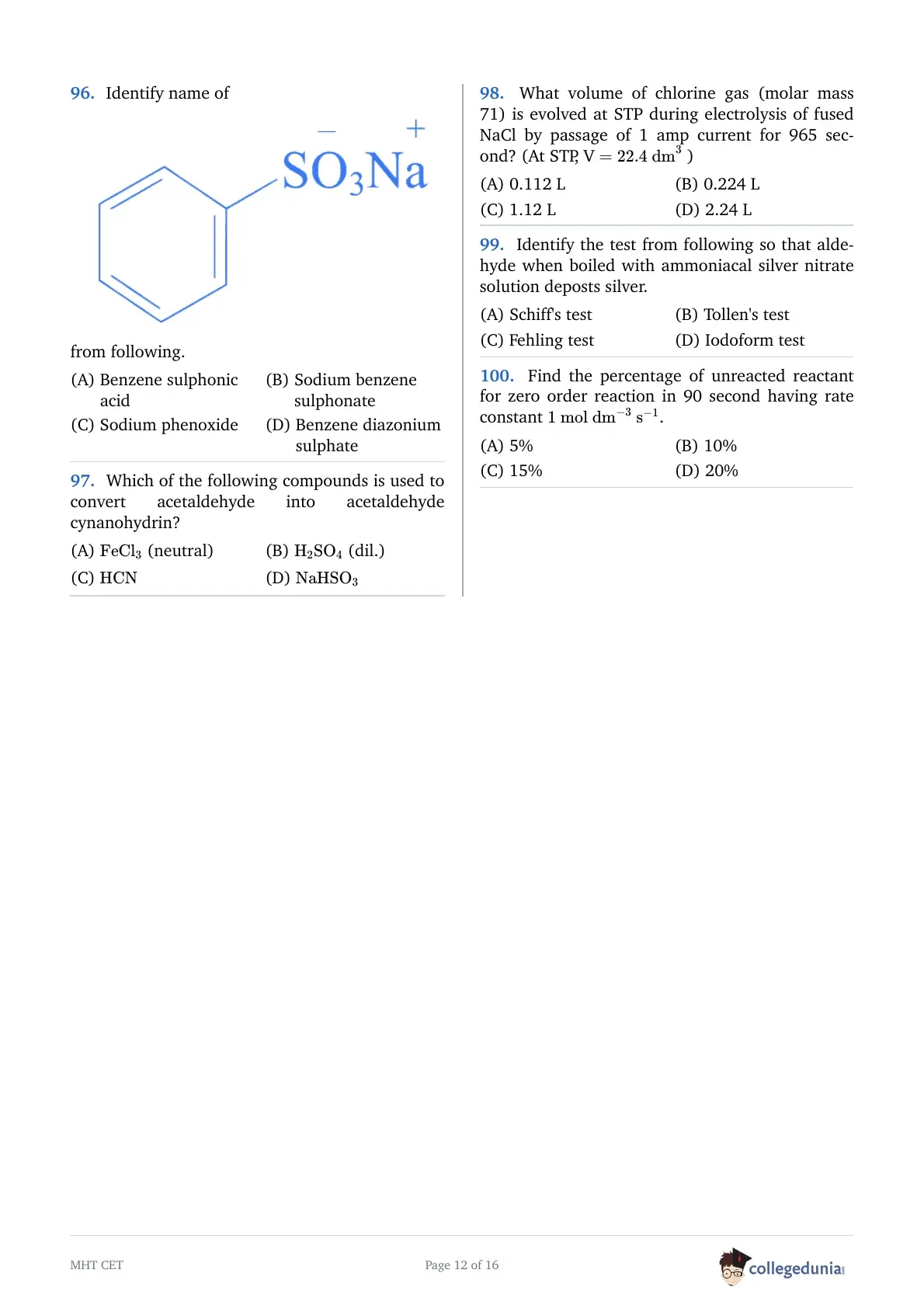
Question 96:

Identify name of

  • (A) Benzene sulphonic acid
  • (B) Sodium benzene sulphonate
  • (C) Sodium phenoxide
  • (D) Benzene diazonium sulphate

Question 97:

Which of the following compounds is used to convert acetaldehyde into acetaldehyde cynanohydrin?

  • (A) \(\mathrm{FeCl}_{3}\) (neutral)
  • (B) \(\mathrm{H}_{2}\mathrm{SO}_{4}\) (dil.)
  • (C) \(\mathrm{HCN}\)
  • (D) \(\mathrm{NaHSO}_{3}\)

Question 98:

What volume of chlorine gas (molar mass 71) is evolved at STP during electrolysis of fused NaCl by passage of 1 amp current for 965 second? (At STP, V \(=22.4 \mathrm{~dm}^3\) )

  • (A) 0.112 L
  • (B) 0.224 L
  • (C) 1.12 L
  • (D) 2.24 L

Question 99:

Identify the test from following so that aldehyde when boiled with ammoniacal silver nitrate solution deposts silver.

  • (A) Schiff's test
  • (B) Tollen's test
  • (C) Fehling test
  • (D) Iodoform test

Mathematics (Q101 - Q150)

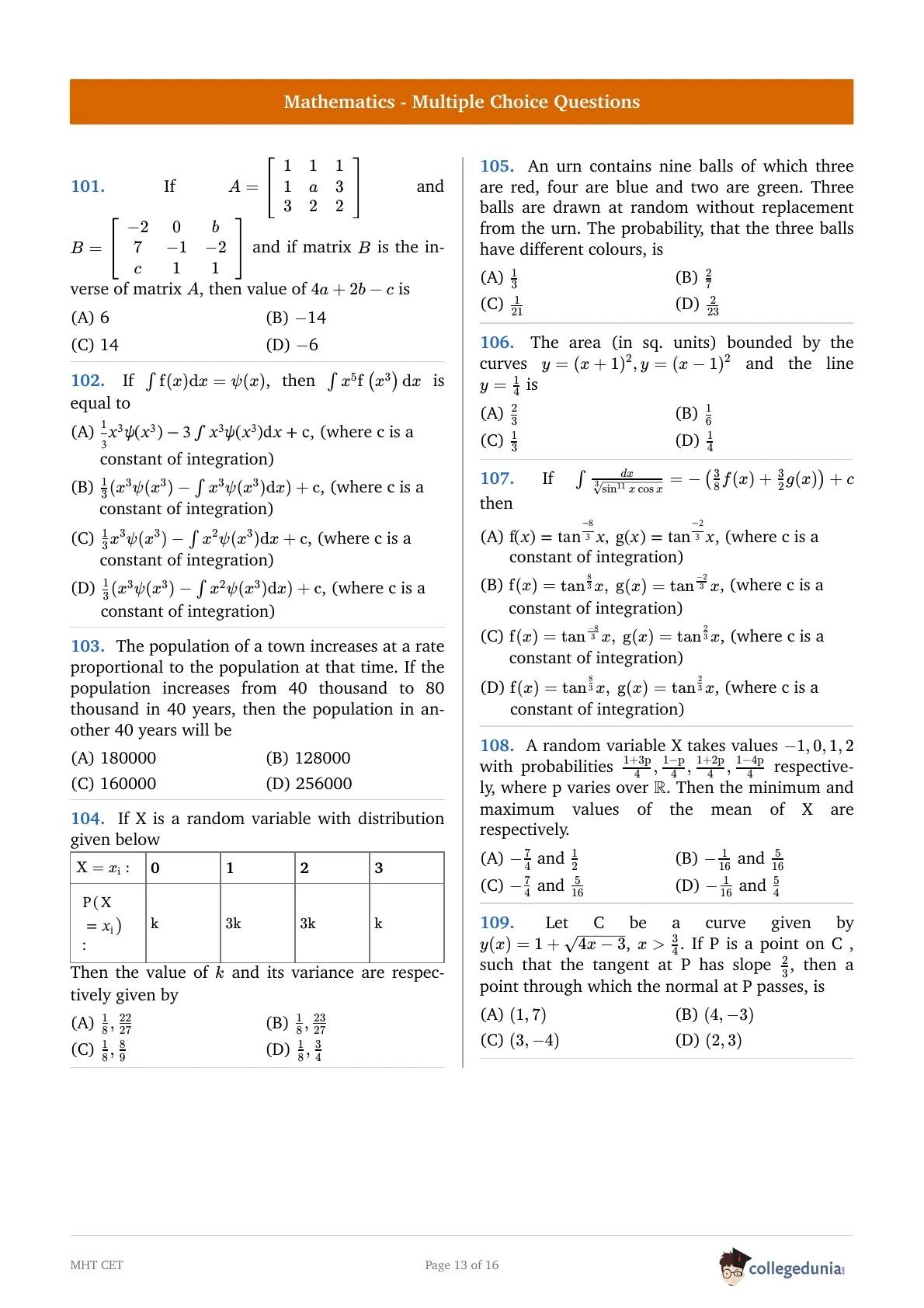
Question 101:

If \(A=\left[\begin{array}{lll}1 & 1 & 1 \\ 1 & a & 3 \\ 3 & 2 & 2\end{array}\right]\) and \(B=\left[\begin{array}{ccc}-2 & 0 & b \\ 7 & -1 & -2 \\ c & 1 & 1\end{array}\right]\) and if matrix \(B\) is the inverse of matrix \(A\), then value of \(4 a+2 b-c\) is

  • (A) 6
  • (B) \(-\)14
  • (C) 14
  • (D) \(-\)6

Question 102:

If \(\int \mathrm{f}(x) \mathrm{d} x=\psi(x)\), then \(\int x^5 \mathrm{f}\left(x^3\right) \mathrm{d} x\) is equal to

  • (A) \(\frac{1}{3}x^{3}\psi (x^{3})-3\int x^{3}\psi (x^{3})\mathrm{d}x+\mathrm{c}\), (where c is a constant of integration)
  • (B) \(\frac{1}{3}(x^{3}\psi (x^{3})-\int x^{3}\psi (x^{3})\mathrm{d}x)+\mathrm{c}\), (where c is a constant of integration)
  • (C) \(\frac{1}{3}x^{3}\psi (x^{3})-\int x^{2}\psi (x^{3})\mathrm{d}x+\mathrm{c}\), (where c is a constant of integration)
  • (D) \(\frac{1}{3}(x^{3}\psi (x^{3})-\int x^{2}\psi (x^{3})\mathrm{d}x)+\mathrm{c}\), (where c is a constant of integration)

Question 103:

The population of a town increases at a rate proportional to the population at that time. If the population increases from 40 thousand to 80 thousand in 40 years, then the population in another 40 years will be

  • (A) 180000
  • (B) 128000
  • (C) 160000
  • (D) 256000

Question 104:

If X is a random variable with distribution given below

\(\mathrm{X}=x_{\mathrm{i}}:\)0123
\(\mathrm{P}\left(\mathrm{X}=x_{\mathrm{i}}\right):\)\(\mathrm{k}\)\(\mathrm{3k}\)\(\mathrm{3k}\)\(\mathrm{k}\)
  • (A) \(\frac{1}{8},\frac{22}{27}\)
  • (B) \(\frac{1}{8},\frac{23}{27}\)
  • (C) \(\frac{1}{8},\frac{8}{9}\)
  • (D) \(\frac{1}{8},\frac{3}{4}\)

Question 105:

An urn contains nine balls of which three are red, four are blue and two are green. Three balls are drawn at random without replacement from the urn. The probability, that the three balls have different colours, is

  • (A) \(\frac{1}{3}\)
  • (B) \(\frac{2}{7}\)
  • (C) \(\frac{1}{21}\)
  • (D) \(\frac{2}{23}\)

Question 106:

The area (in sq. units) bounded by the curves \(y=(x+1)^2, y=(x-1)^2\) and the line \(y=\frac{1}{4}\) is

  • (A) \(\frac{2}{3}\)
  • (B) \(\frac{1}{6}\)
  • (C) \(\frac{1}{3}\)
  • (D) \(\frac{1}{4}\)

Question 107:

If \(\int \frac{d x}{\sqrt[3]{\sin ^{11} x \cos x}}=-\left(\frac{3}{8} f(x)+\frac{3}{2} g(x)\right)+c\) then

  • (A) \(\mathrm{f}(x)=\mathrm{tan}^{\frac{-8}{3}}x,\text{ }\mathrm{g}(x)=\mathrm{tan}^{\frac{-2}{3}}x\), (where c is a constant of integration)
  • (B) \(\mathrm{f}(x)=\mathrm{tan}^{\frac{8}{3}}x,\text{ }\mathrm{g}(x)=\mathrm{tan}^{\frac{-2}{3}}x\), (where c is a constant of integration)
  • (C) \(\mathrm{f}(x)=\mathrm{tan}^{\frac{-8}{3}}x,\text{ }\mathrm{g}(x)=\mathrm{tan}^{\frac{2}{3}}x\), (where c is a constant of integration)
  • (D) \(\mathrm{f}(x)=\mathrm{tan}^{\frac{8}{3}}x,\text{ }\mathrm{g}(x)=\mathrm{tan}^{\frac{2}{3}}x\), (where c is a constant of integration)

Question 108:

A random variable X takes values \(-1,0,1,2\) with probabilities \(\frac{1+3 \mathrm{p}}{4}, \frac{1-\mathrm{p}}{4}, \frac{1+2 \mathrm{p}}{4}, \frac{1-4 \mathrm{p}}{4}\) respectively, where p varies over \(\mathbb{R}\). Then the minimum and maximum values of the mean of X are respectively.

  • (A) \(-\frac{7}{4}\) and \(\frac{1}{2}\)
  • (B) \(-\frac{1}{16}\) and \(\frac{5}{16}\)
  • (C) \(-\frac{7}{4}\) and \(\frac{5}{16}\)
  • (D) \(-\frac{1}{16}\) and \(\frac{5}{4}\)

Question 109:

Let C be a curve given by \(y(x)=1+\sqrt{4 x-3}\), \(x>\frac{3}{4}\). If P is a point on C , such that the tangent at P has slope \(\frac{2}{3}\), then a point through which the normal at P passes, is

  • (A) \((1,7)\)
  • (B) \((4,-3)\)
  • (C) \((3,-4)\)
  • (D) \((2,3)\)

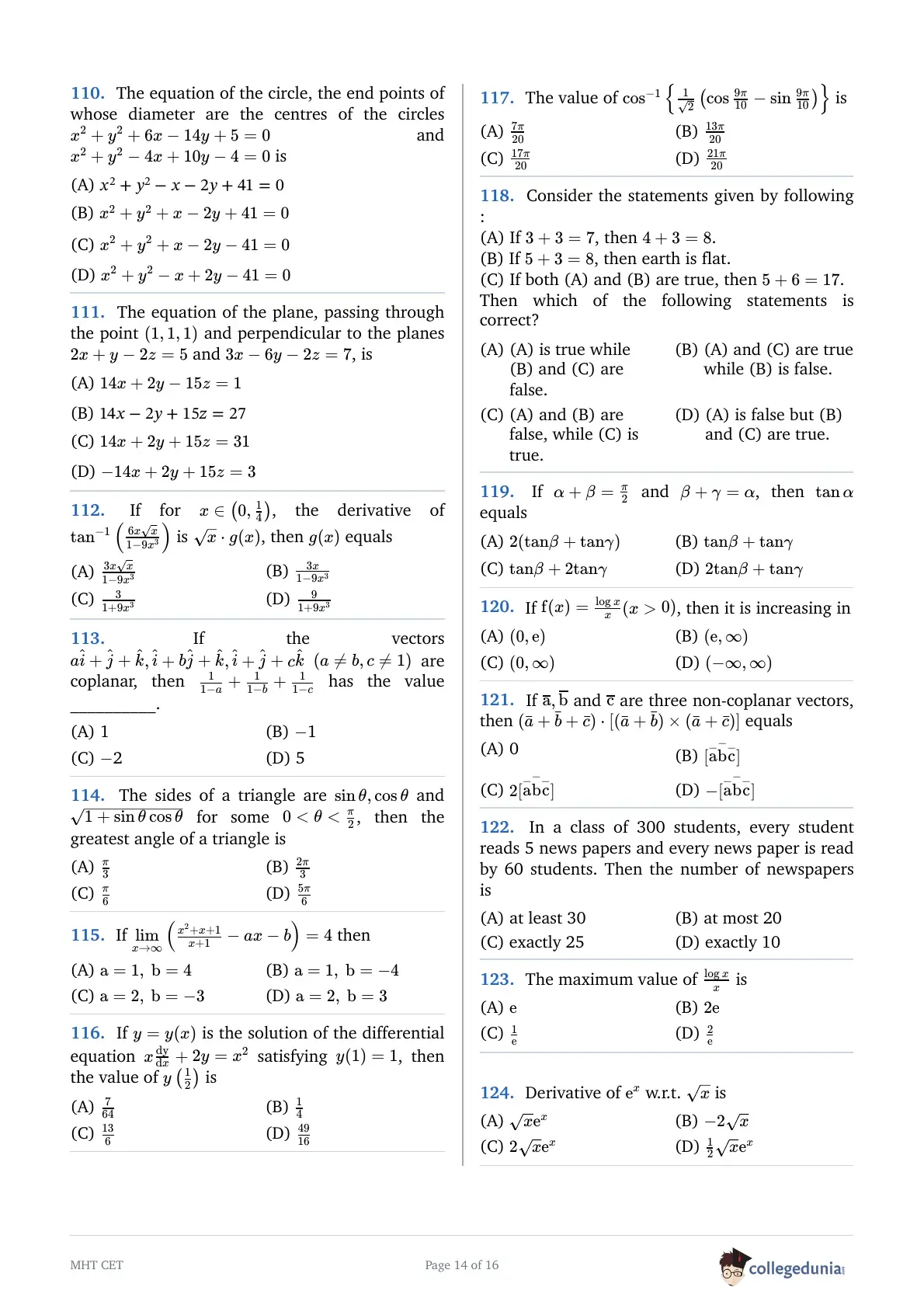
Question 110:

The equation of the circle, the end points of whose diameter are the centres of the circles \(x^2+y^2+6 x-14 y+5=0\) and \(x^2+y^2-4 x+10 y-4=0\) is

  • (A) \(x^{2}+y^{2}-x-2y+41=0\)
  • (B) \(x^{2}+y^{2}+x-2y+41=0\)
  • (C) \(x^{2}+y^{2}+x-2y-41=0\)
  • (D) \(x^{2}+y^{2}-x+2y-41=0\)

Question 111:

The equation of the plane, passing through the point \((1,1,1)\) and perpendicular to the planes \(2 x+y-2 z=5\) and \(3 x-6 y-2 z=7\), is

  • (A) \(14x+2y-15z=1\)
  • (B) \(14x-2y+15z=27\)
  • (C) \(14x+2y+15z=31\)
  • (D) \(-14x+2y+15z=3\)

Question 112:

If for \(x \in\left(0, \frac{1}{4}\right)\), the derivative of \(\tan ^{-1}\left(\frac{6 x \sqrt{x}}{1-9 x^3}\right)\) is \(\sqrt{x} \cdot g(x)\), then \(g(x)\) equals

  • (A) \(\frac{3x\sqrt{x}}{1-9x^{3}}\)
  • (B) \(\frac{3x}{1-9x^{3}}\)
  • (C) \(\frac{3}{1+9x^{3}}\)
  • (D) \(\frac{9}{1+9x^{3}}\)

Question 113:

If the vectors \(a \hat{i}+\hat{j}+\hat{k}, \hat{i}+b \hat{j}+\hat{k}, \hat{i}+\hat{j}+c \hat{k}\) \((a \neq b, c \neq 1)\) are coplanar, then \(\frac{1}{1-a}+\frac{1}{1-b}+\frac{1}{1-c}\) has the value __________.

  • (A) 1
  • (B) \(-\)1
  • (C) \(-\)2
  • (D) 5

Question 114:

The sides of a triangle are \(\sin \theta, \cos \theta\) and \(\sqrt{1+\sin \theta \cos \theta}\) for some \(0<\theta<\frac{\pi}{2}\), then the greatest angle of a triangle is

  • (A) \(\frac{\pi}{3}\)
  • (B) \(\frac{2\pi}{3}\)
  • (C) \(\frac{\pi}{6}\)
  • (D) \(\frac{5\pi}{6}\)

Question 115:

If \(\lim\limits_{x \rightarrow \infty}\left(\frac{x^2+x+1}{x+1}-a x-b\right)=4\) then

  • (A) \(\mathrm{a}=1,\text{ }\mathrm{b}=4\)
  • (B) \(\mathrm{a}=1,\text{ }\mathrm{b}=-4\)
  • (C) \(\mathrm{a}=2,\text{ }\mathrm{b}=-3\)
  • (D) \(\mathrm{a}=2,\text{ }\mathrm{b}=3\)

Question 116:

If \(y=y(x)\) is the solution of the differential equation \(x \frac{\mathrm{dy}}{\mathrm{d} x}+2 y=x^2\) satisfying \(y(1)=1\), then the value of \(y\left(\frac{1}{2}\right)\) is

  • (A) \(\frac{7}{64}\)
  • (B) \(\frac{1}{4}\)
  • (C) \(\frac{13}{6}\)
  • (D) \(\frac{49}{16}\)

Question 117:

The value of \(\cos ^{-1}\left\{\frac{1}{\sqrt{2}}\left(\cos \frac{9 \pi}{10}-\sin \frac{9 \pi}{10}\right)\right\}\) is

  • (A) \(\frac{7\pi}{20}\)
  • (B) \(\frac{13\pi}{20}\)
  • (C) \(\frac{17\pi}{20}\)
  • (D) \(\frac{21\pi}{20}\)

Question 118:

Consider the statements given by following :

(A) If \(3+3=7\), then \(4+3=8\).

(B) If \(5+3=8\), then earth is flat.

(C) If both (A) and (B) are true, then \(5+6=17\).

Then which of the following statements is correct?

  • (A) (A) is true while (B) and (C) are false.
  • (B) (A) and (C) are true while (B) is false.
  • (C) (A) and (B) are false, while (C) is true.
  • (D) (A) is false but (B) and (C) are true.

Question 119:

If \(\alpha+\beta=\frac{\pi}{2}\) and \(\beta+\gamma=\alpha\), then \(\tan \alpha\) equals

  • (A) \(2(\mathrm{tan}\beta +\mathrm{tan}\gamma )\)
  • (B) \(\mathrm{tan}\beta +\mathrm{tan}\gamma\)
  • (C) \(\mathrm{tan}\beta +2\mathrm{tan}\gamma\)
  • (D) \(2\mathrm{tan}\beta +\mathrm{tan}\gamma\)

Question 120:

If \(\mathrm{f}(x)=\frac{\log x}{x}(x>0)\), then it is increasing in

  • (A) \((0,\mathrm{e})\)
  • (B) \((\mathrm{e},\infty )\)
  • (C) \((0,\infty )\)
  • (D) \((-\infty ,\infty )\)

Question 121:

If \(\overline{\mathrm{a}}, \overline{\mathrm{b}}\) and \(\overline{\mathrm{c}}\) are three non-coplanar vectors, then \((\bar{a}+\bar{b}+\bar{c}) \cdot[(\bar{a}+\bar{b}) \times(\bar{a}+\bar{c})]\) equals

  • (A) 0
  • (B) \([\overset{-}{\mathrm{a}}\overset{-}{\mathrm{b}}\overset{-}{\mathrm{c}}]\)
  • (C) \(2[\overset{-}{\mathrm{a}}\overset{-}{\mathrm{b}}\overset{-}{\mathrm{c}}]\)
  • (D) \(-[\overset{-}{\mathrm{a}}\overset{-}{\mathrm{b}}\overset{-}{\mathrm{c}}]\)

Question 122:

In a class of 300 students, every student reads 5 news papers and every news paper is read by 60 students. Then the number of newspapers is

  • (A) at least 30
  • (B) at most 20
  • (C) exactly 25
  • (D) exactly 10

Question 123:

The maximum value of \(\frac{\log x}{x}\) is

  • (A) \(\mathrm{e}\)
  • (B) \(2\mathrm{e}\)
  • (C) \(\frac{1}{\mathrm{e}}\)
  • (D) \(\frac{2}{\mathrm{e}}\)

Question 124:

Derivative of \(\mathrm{e}^x\) w.r.t. \(\sqrt{x}\) is

  • (A) \(\sqrt{x}\mathrm{e}^{x}\)
  • (B) \(-2\sqrt{x}\)
  • (C) \(2\sqrt{x}\mathrm{e}^{x}\)
  • (D) \(\frac{1}{2}\sqrt{x}\mathrm{e}^{x}\)

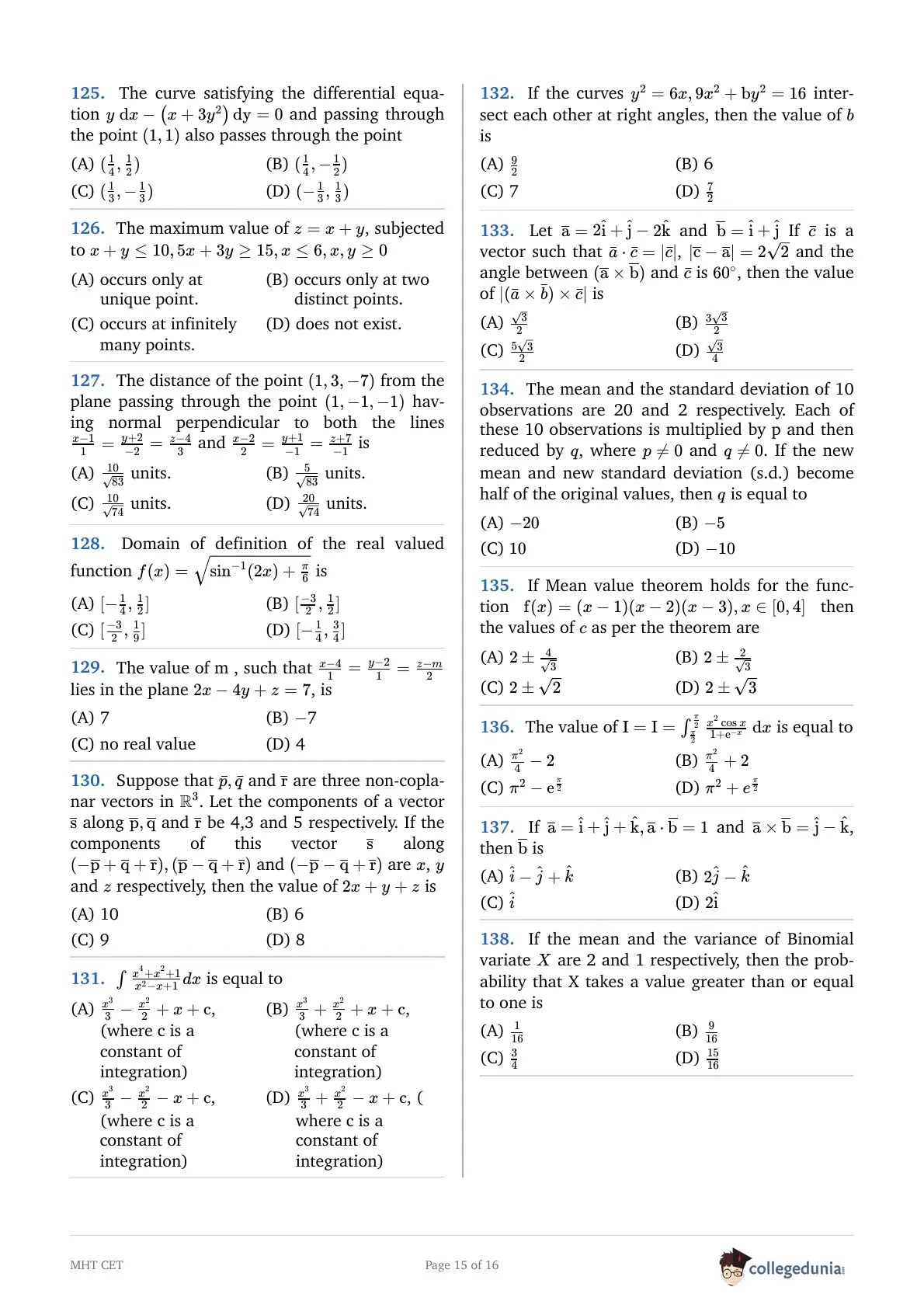
Question 125:

The curve satisfying the differential equation \(y \mathrm{~d} x-\left(x+3 y^2\right) \mathrm{dy}=0\) and passing through the point \((1,1)\) also passes through the point

  • (A) \((\frac{1}{4},\frac{1}{2})\)
  • (B) \((\frac{1}{4},-\frac{1}{2})\)
  • (C) \((\frac{1}{3},-\frac{1}{3})\)
  • (D) \((-\frac{1}{3},\frac{1}{3})\)

Question 126:

The maximum value of \(z=x+y\), subjected to \(x+y \leq 10,5 x+3 y \geq 15, x \leq 6, x, y \geq 0\)

  • (A) occurs only at unique point.
  • (B) occurs only at two distinct points.
  • (C) occurs at infinitely many points.
  • (D) does not exist.

Question 127:

The distance of the point \((1,3,-7)\) from the plane passing through the point \((1,-1,-1)\) having normal perpendicular to both the lines \(\frac{x-1}{1}=\frac{y+2}{-2}=\frac{z-4}{3}\) and \(\frac{x-2}{2}=\frac{y+1}{-1}=\frac{z+7}{-1}\) is

  • (A) \(\frac{10}{\sqrt{83}}\) units.
  • (B) \(\frac{5}{\sqrt{83}}\) units.
  • (C) \(\frac{10}{\sqrt{74}}\) units.
  • (D) \(\frac{20}{\sqrt{74}}\) units.

Question 128:

Domain of definition of the real valued function \(f(x)=\sqrt{\sin ^{-1}(2 x)+\frac{\pi}{6}}\) is

  • (A) \([-\frac{1}{4},\frac{1}{2}]\)
  • (B) \([\frac{-3}{2},\frac{1}{2}]\)
  • (C) \([\frac{-3}{2},\frac{1}{9}]\)
  • (D) \([-\frac{1}{4},\frac{3}{4}]\)

Question 129:

The value of m , such that \(\frac{x-4}{1}=\frac{y-2}{1}=\frac{z-m}{2}\) lies in the plane \(2 x-4 y+z=7\), is

  • (A) 7
  • (B) \(-\)7
  • (C) no real value
  • (D) 4

Question 130:

Suppose that \(\bar{p}, \bar{q}\) and \(\overline{\mathrm{r}}\) are three non-coplanar vectors in \(\mathbb{R}^3\). Let the components of a vector \(\overline{\mathrm{s}}\) along \(\overline{\mathrm{p}}, \overline{\mathrm{q}}\) and \(\overline{\mathrm{r}}\) be 4,3 and 5 respectively. If the components of this vector \(\overline{\mathrm{s}}\) along \((-\overline{\mathrm{p}}+\overline{\mathrm{q}}+\overline{\mathrm{r}}),(\overline{\mathrm{p}}-\overline{\mathrm{q}}+\overline{\mathrm{r}})\) and \((-\overline{\mathrm{p}}-\overline{\mathrm{q}}+\overline{\mathrm{r}})\) are \(x\), \(y\) and \(z\) respectively, then the value of \(2 x+y+z\) is

  • (A) 10
  • (B) 6
  • (C) 9
  • (D) 8

Question 131:

\(\int \frac{x^4+x^2+1}{x^2-x+1} d x\) is equal to

  • (A) \(\frac{x^{3}}{3}-\frac{x^{2}}{2}+x+\mathrm{c}\), (where c is a constant of integration)
  • (B) \(\frac{x^{3}}{3}+\frac{x^{2}}{2}+x+\mathrm{c}\), (where c is a constant of integration)
  • (C) \(\frac{x^{3}}{3}-\frac{x^{2}}{2}-x+\mathrm{c}\), (where c is a constant of integration)
  • (D) \(\frac{x^{3}}{3}+\frac{x^{2}}{2}-x+\mathrm{c}\), ( where c is a constant of integration)

Question 132:

If the curves \(y^2=6 x, 9 x^2+\mathrm{b} y^2=16\) intersect each other at right angles, then the value of \(b\) is

  • (A) \(\frac{9}{2}\)
  • (B) 6
  • (C) 7
  • (D) \(\frac{7}{2}\)

Question 133:

Let \(\overline{\mathrm{a}}=2 \hat{\mathrm{i}}+\hat{\mathrm{j}}-2 \hat{\mathrm{k}}\) and \(\overline{\mathrm{b}}=\hat{\mathrm{i}}+\hat{\mathrm{j}}\) If \(\bar{c}\) is a vector such that \(\bar{a} \cdot \bar{c}=|\bar{c}|\), \(|\overline{\mathrm{c}}-\overline{\mathrm{a}}|=2 \sqrt{2}\) and the angle between \((\overline{\mathrm{a}} \times \overline{\mathrm{b}})\) and \(\bar{c}\) is \(60^{\circ}\), then the value of \(|(\bar{a} \times \bar{b}) \times \bar{c}|\) is

  • (A) \(\frac{\sqrt{3}}{2}\)
  • (B) \(\frac{3\sqrt{3}}{2}\)
  • (C) \(\frac{5\sqrt{3}}{2}\)
  • (D) \(\frac{\sqrt{3}}{4}\)

Question 134:

The mean and the standard deviation of 10 observations are 20 and 2 respectively. Each of these 10 observations is multiplied by p and then reduced by \(q\), where \(p \neq 0\) and \(q \neq 0\). If the new mean and new standard deviation (s.d.) become half of the original values, then \(q\) is equal to

  • (A) \(-20\)
  • (B) \(-5\)
  • (C) \(10\)
  • (D) \(-10\)

Question 135:

If Mean value theorem holds for the function \(\mathrm{f}(x)=(x-1)(x-2)(x-3), x \in[0,4]\) then the values of \(c\) as per the theorem are

  • (A) \(2\pm \frac{4}{\sqrt{3}}\)
  • (B) \(2\pm \frac{2}{\sqrt{3}}\)
  • (C) \(2\pm \sqrt{2}\)
  • (D) \(2\pm \sqrt{3}\)

Question 137:

If \(\overline{\mathrm{a}}=\hat{\mathrm{i}}+\hat{\mathrm{j}}+\hat{\mathrm{k}}, \overline{\mathrm{a}} \cdot \overline{\mathrm{b}}=1\) and \(\overline{\mathrm{a}} \times \overline{\mathrm{b}}=\hat{\mathrm{j}}-\hat{\mathrm{k}}\), then \(\overline{\mathrm{b}}\) is

  • (A) \(\hat{i}-\hat{j}+\hat{k}\)
  • (B) \(2\hat{j}-\hat{k}\)
  • (C) \(\hat{i}\)
  • (D) \(2\hat{\mathrm{i}}\)

Question 138:

If the mean and the variance of Binomial variate \(X\) are 2 and 1 respectively, then the probability that X takes a value greater than or equal to one is

  • (A) \(\frac{1}{16}\)
  • (B) \(\frac{9}{16}\)
  • (C) \(\frac{3}{4}\)
  • (D) \(\frac{15}{16}\)

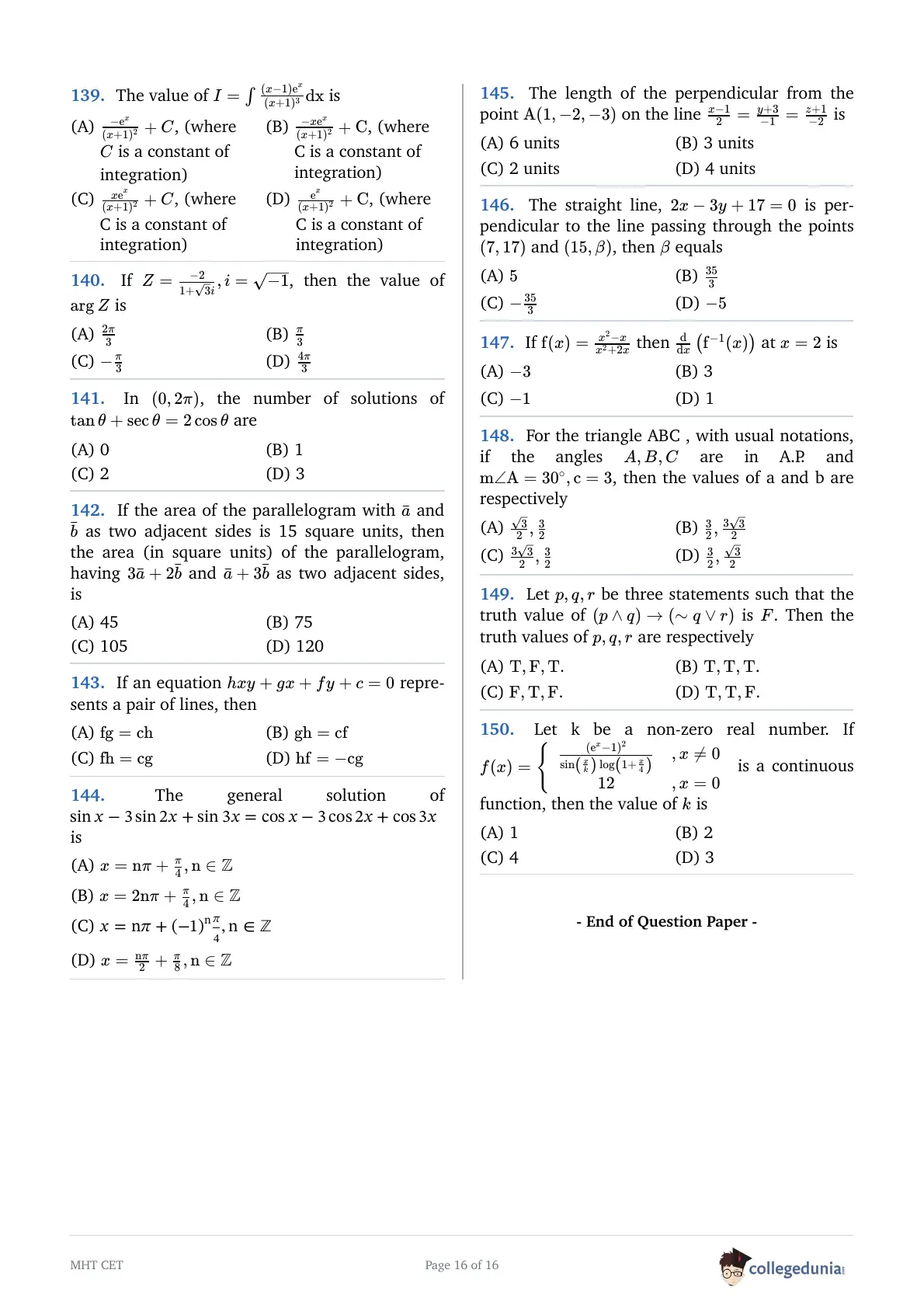
Question 139:

The value of \(I=\int \frac{(x-1) \mathrm{e}^x}{(x+1)^3} \mathrm{dx}\) is

  • (A) \(\frac{-\mathrm{e}^{x}}{(x+1)^{2}}+C\), (where \(C\) is a constant of integration)
  • (B) \(\frac{-x\mathrm{e}^{x}}{(x+1)^{2}}+\mathrm{C}\), (where C is a constant of integration)
  • (C) \(\frac{x\mathrm{e}^{x}}{(x+1)^{2}}+C\), (where C is a constant of integration)
  • (D) \(\frac{\mathrm{e}^{x}}{(x+1)^{2}}+\mathrm{C}\), (where C is a constant of integration)

Question 140:

If \(Z=\frac{-2}{1+\sqrt{3} i}, i=\sqrt{-1}\), then the value of \(\arg Z\) is

  • (A) \(\frac{2\pi}{3}\)
  • (B) \(\frac{\pi}{3}\)
  • (C) \(-\frac{\pi}{3}\)
  • (D) \(\frac{4\pi}{3}\)

Question 142:

If the area of the parallelogram with \(\bar{a}\) and \(\bar{b}\) as two adjacent sides is 15 square units, then the area (in square units) of the parallelogram, having \(3 \bar{a}+2 \bar{b}\) and \(\bar{a}+3 \bar{b}\) as two adjacent sides, is

  • (A) 45
  • (B) 75
  • (C) 105
  • (D) 120

Question 143:

If an equation \(h x y+g x+f y+c=0\) represents a pair of lines, then

  • (A) \(\mathrm{fg}=\mathrm{ch}\)
  • (B) \(\mathrm{gh}=\mathrm{cf}\)
  • (C) \(\mathrm{fh}=\mathrm{cg}\)
  • (D) \(\mathrm{hf}=-\mathrm{cg}\)

Question 144:

The general solution of \(\sin x-3 \sin 2 x+\sin 3 x=\cos x-3 \cos 2 x+\cos 3 x\) is

  • (A) \(x=\mathrm{n}\pi +\frac{\pi}{4},\mathrm{n}\in \mathbb{Z}\)
  • (B) \(x=2\mathrm{n}\pi +\frac{\pi}{4},\mathrm{n}\in \mathbb{Z}\)
  • (C) \(x=\mathrm{n}\pi +(-1)^{\mathrm{n}}\frac{\pi}{4},\mathrm{n}\in \mathbb{Z}\)
  • (D) \(x=\frac{\mathrm{n}\pi}{2}+\frac{\pi}{8},\mathrm{n}\in \mathbb{Z}\)

Question 145:

The length of the perpendicular from the point \(\mathrm{A}(1,-2,-3)\) on the line \(\frac{x-1}{2}=\frac{y+3}{-1}=\frac{z+1}{-2}\) is

  • (A) 6 units
  • (B) 3 units
  • (C) 2 units
  • (D) 4 units

Question 146:

The straight line, \(2 x-3 y+17=0\) is perpendicular to the line passing through the points \((7,17)\) and \((15, \beta)\), then \(\beta\) equals

  • (A) \(5\)
  • (B) \(\frac{35}{3}\)
  • (C) \(-\frac{35}{3}\)
  • (D) \(-5\)

Question 147:

If \(\mathrm{f}(x)=\frac{x^2-x}{x^2+2 x}\) then \(\frac{\mathrm{d}}{\mathrm{d} x}\left(\mathrm{f}^{-1}(x)\right)\) at \(x=2\) is

  • (A) \(-3\)
  • (B) 3
  • (C) \(-1\)
  • (D) 1

Question 148:

For the triangle ABC , with usual notations, if the angles \(A, B, C\) are in A.P. and \(\mathrm{m} \angle \mathrm{A}=30^{\circ}, \mathrm{c}=3\), then the values of a and b are respectively

  • (A) \(\frac{\sqrt{3}}{2},\frac{3}{2}\)
  • (B) \(\frac{3}{2},\frac{3\sqrt{3}}{2}\)
  • (C) \(\frac{3\sqrt{3}}{2},\frac{3}{2}\)
  • (D) \(\frac{3}{2},\frac{\sqrt{3}}{2}\)

Question 149:

Let \(p, q, r\) be three statements such that the truth value of \((p \wedge q) \rightarrow(\sim q \vee r)\) is \(F\). Then the truth values of \(p, q, r\) are respectively

  • (A) \(\mathrm{T},\mathrm{F},\mathrm{T}.\)
  • (B) \(\mathrm{T},\mathrm{T},\mathrm{T}\).
  • (C) \(\mathrm{F},\mathrm{T},\mathrm{F}.\)
  • (D) \(\mathrm{T},\mathrm{T},\mathrm{F}.\)

Question 150:

Let k be a non-zero real number. If \(f(x)=\left\{\begin{array}{cl}\frac{\left(\mathrm{e}^x-1\right)^2}{\sin \left(\frac{x}{k}\right) \log \left(1+\frac{x}{4}\right)} & , x \neq 0 \\ 12 & , x=0\end{array}\right.\) is a continuous function, then the value of \(k\) is

  • (A) 1
  • (B) 2
  • (C) 4
  • (D) 3

MHT CET 2024 PCM Exam Pattern and Marking Scheme

Parameter Details
Conducting Body Maharashtra Common Entrance Test Cell (Maharashtra CET Cell)
Exam Mode Online (Computer-Based Test)
Duration 180 minutes (3 hours)
Groups / Subjects PCM (Physics, Chemistry, Mathematics) for Engineering
Total Questions

150

Total Marks 200
Question Type Multiple Choice Questions (MCQs)
Marks Distribution
  • Mathematics – 2 marks/question
  • Physics and Chemistry – 1 mark/question
Negative Marking No
Syllabus Weightage
  • Class 12 – 80%
  • Class 11 – 20%