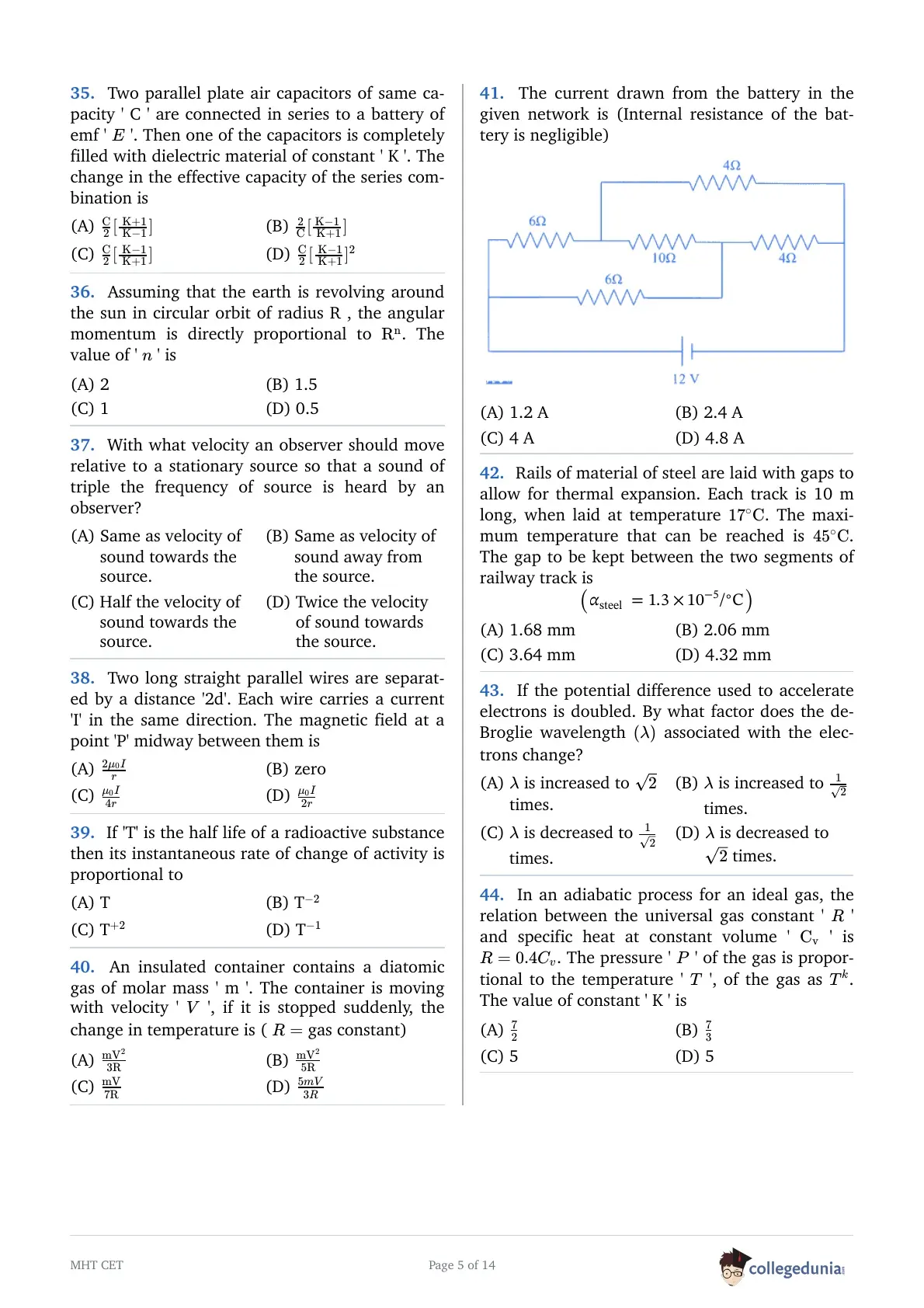
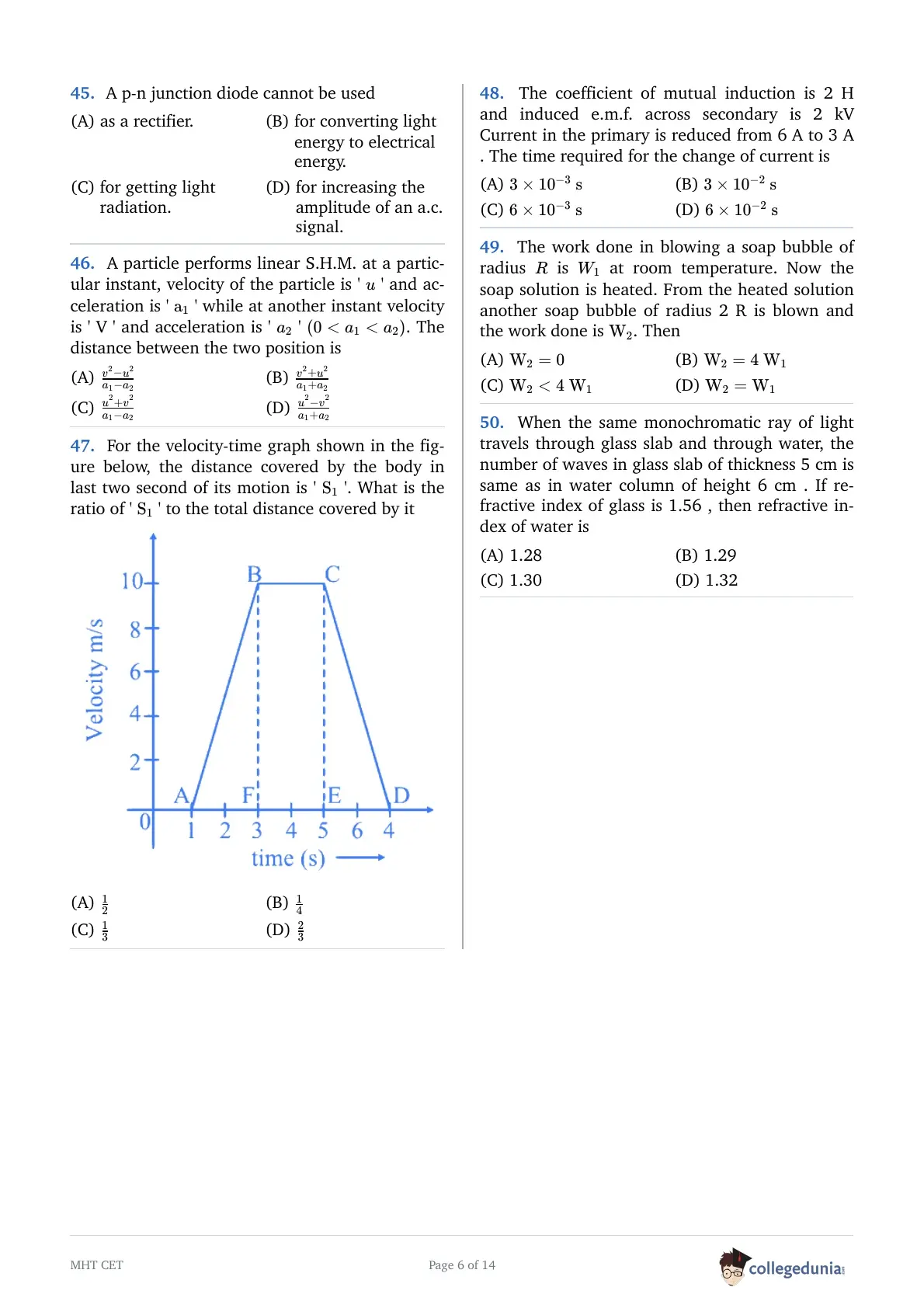
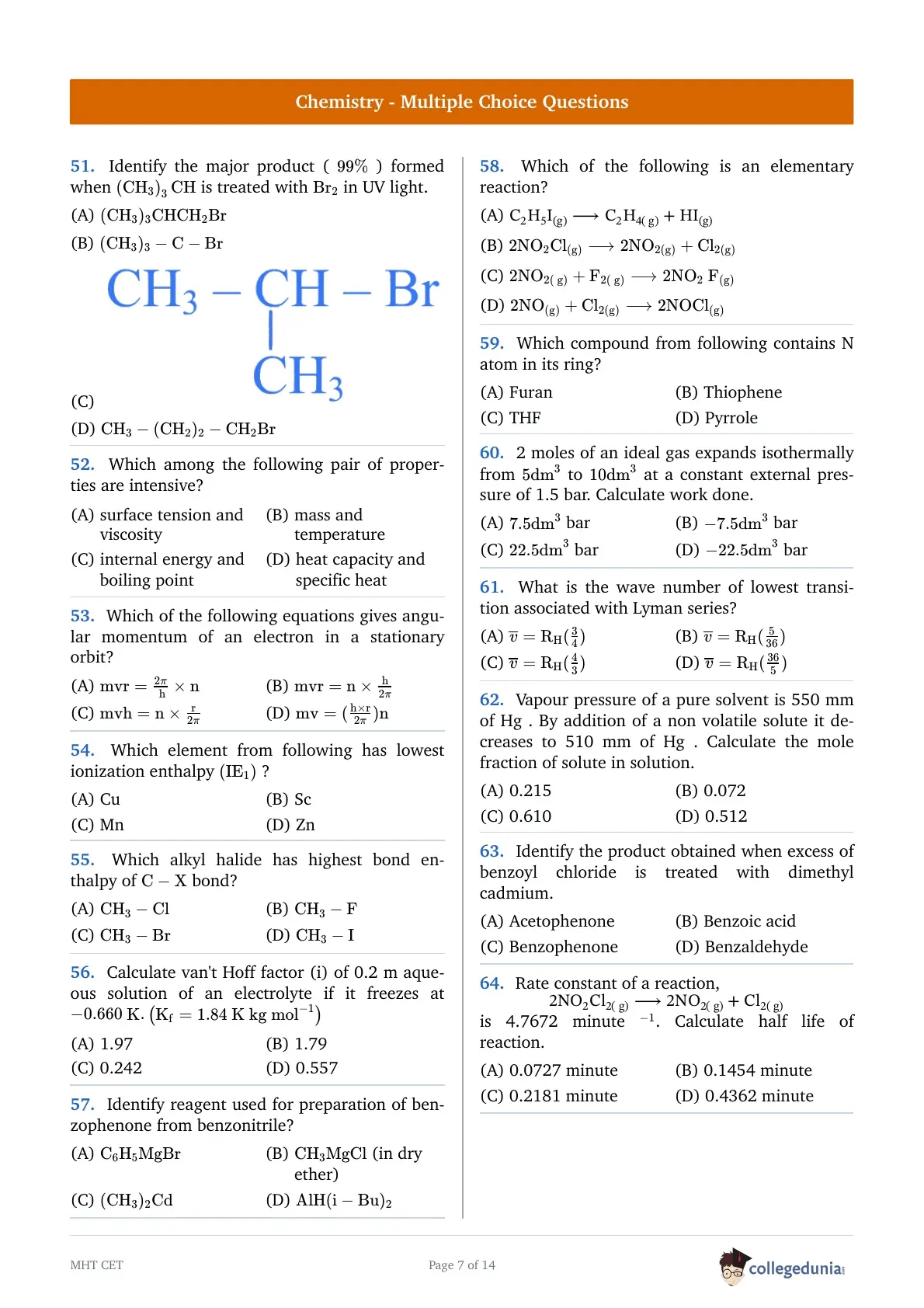
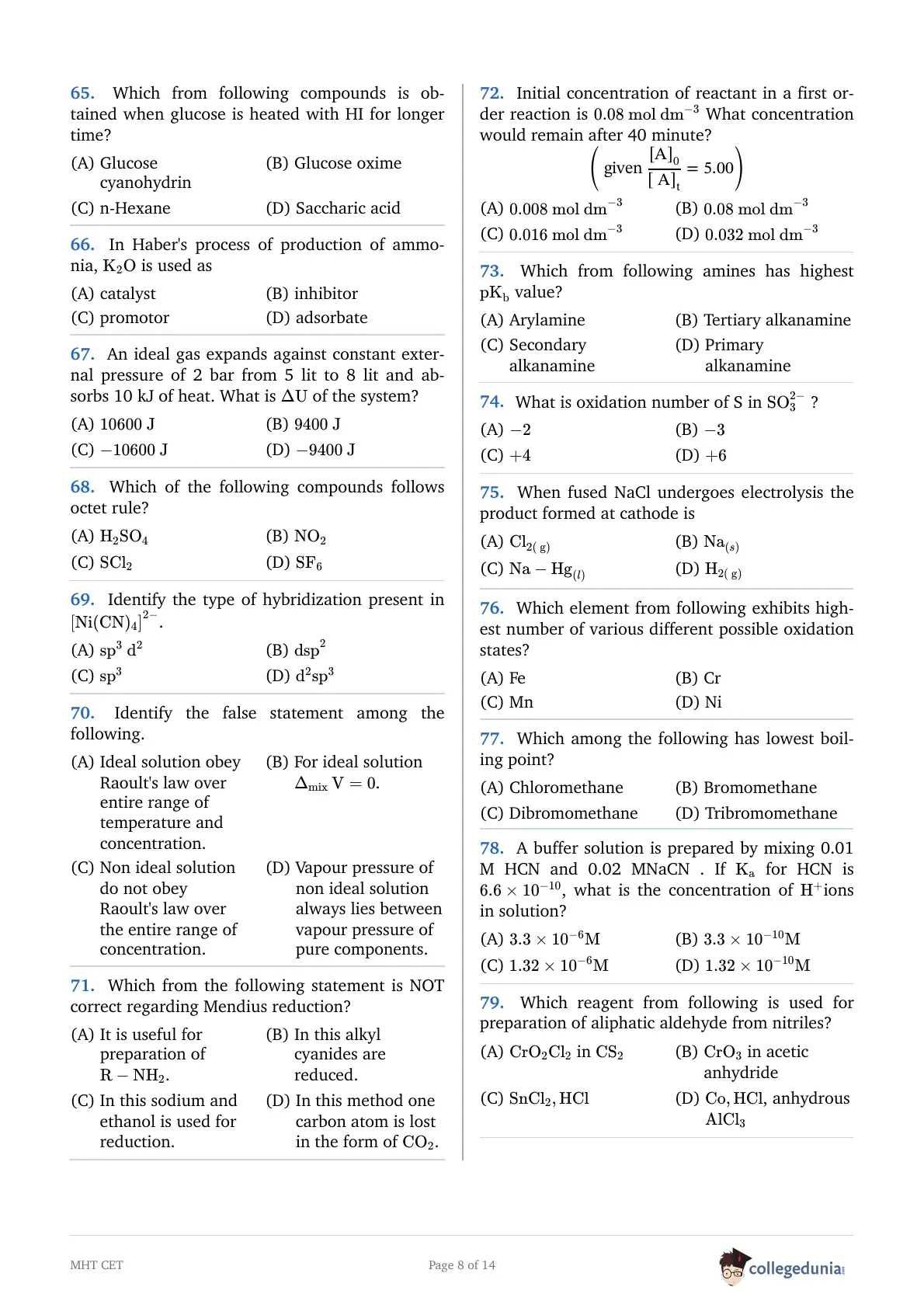
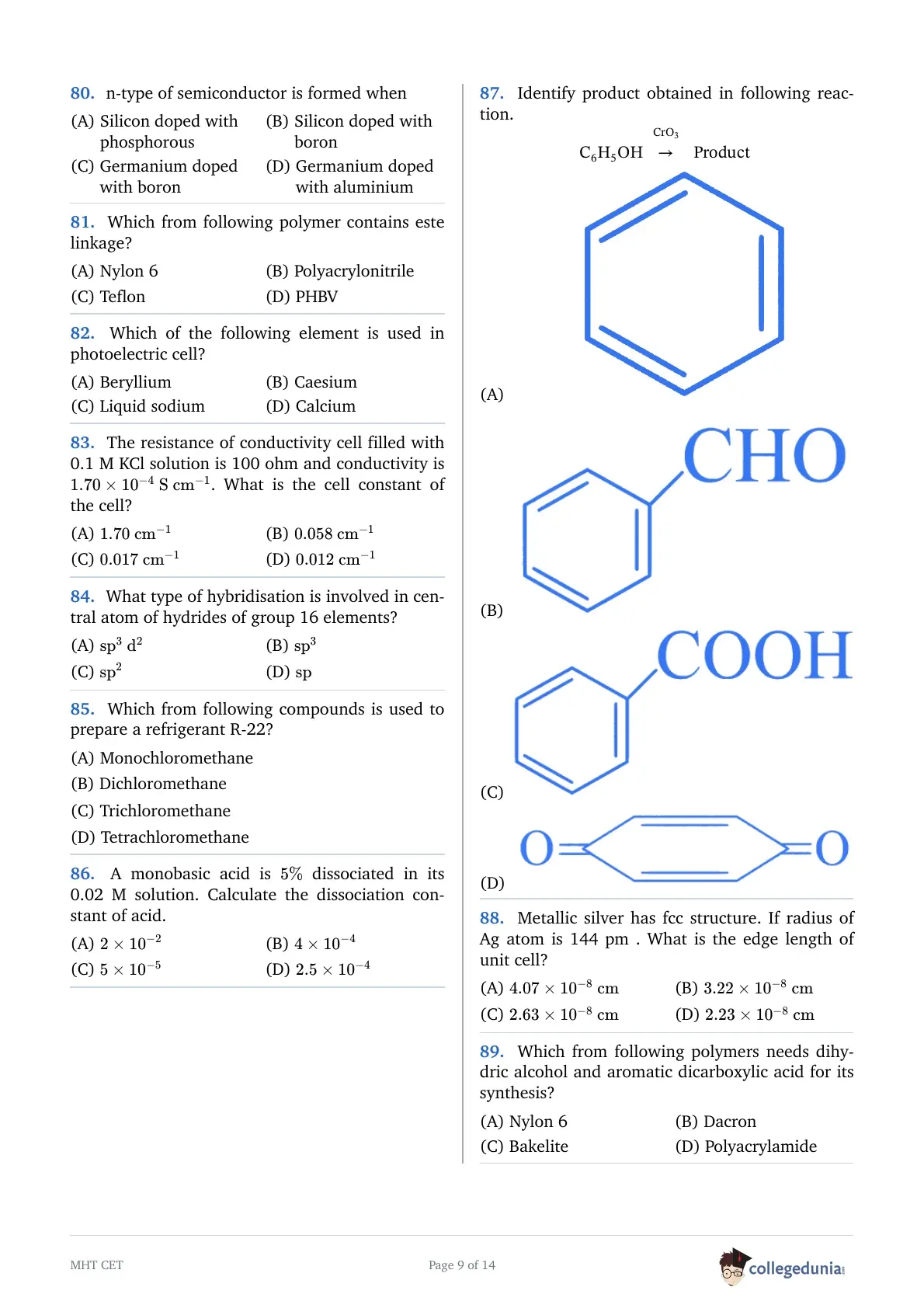
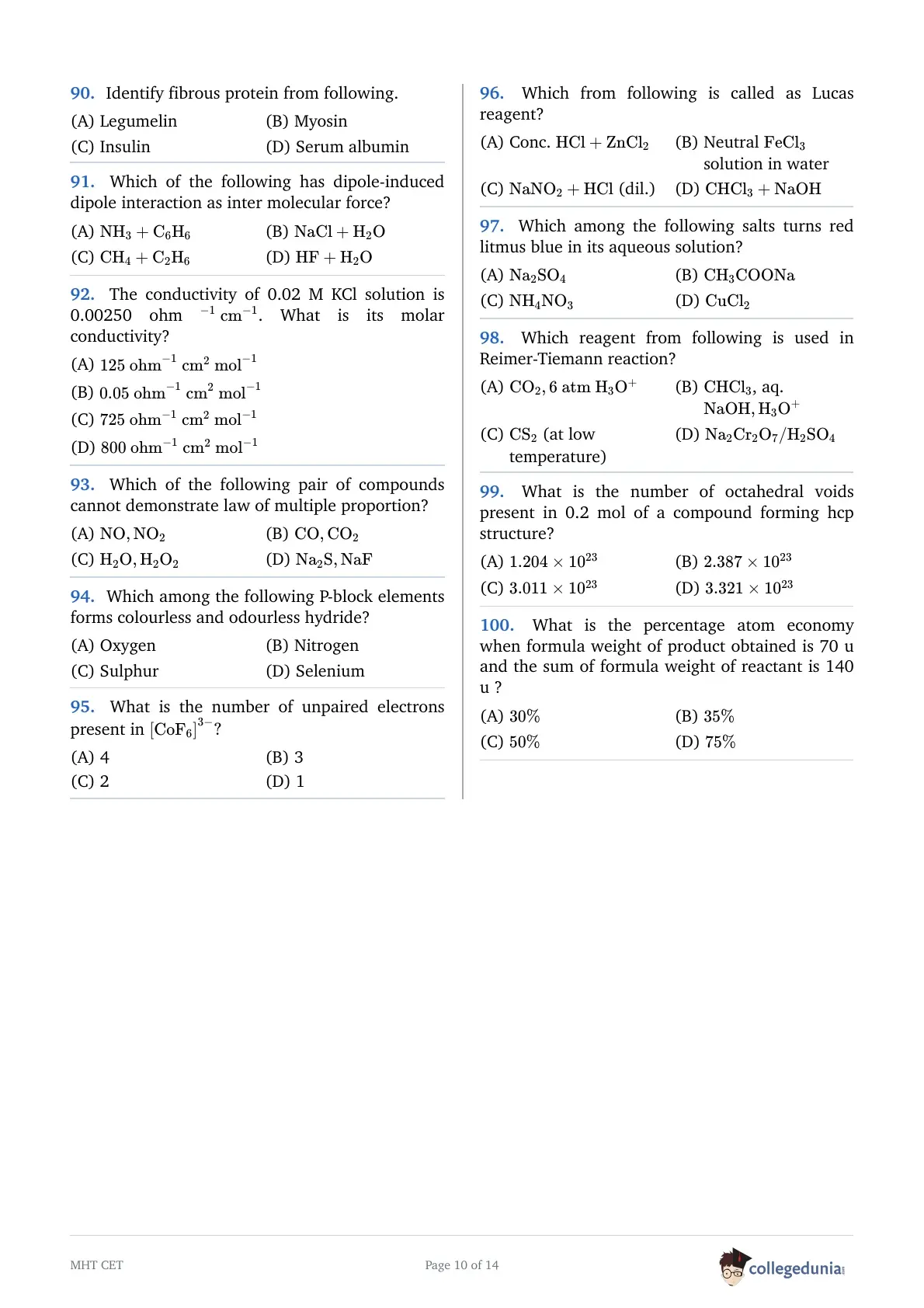
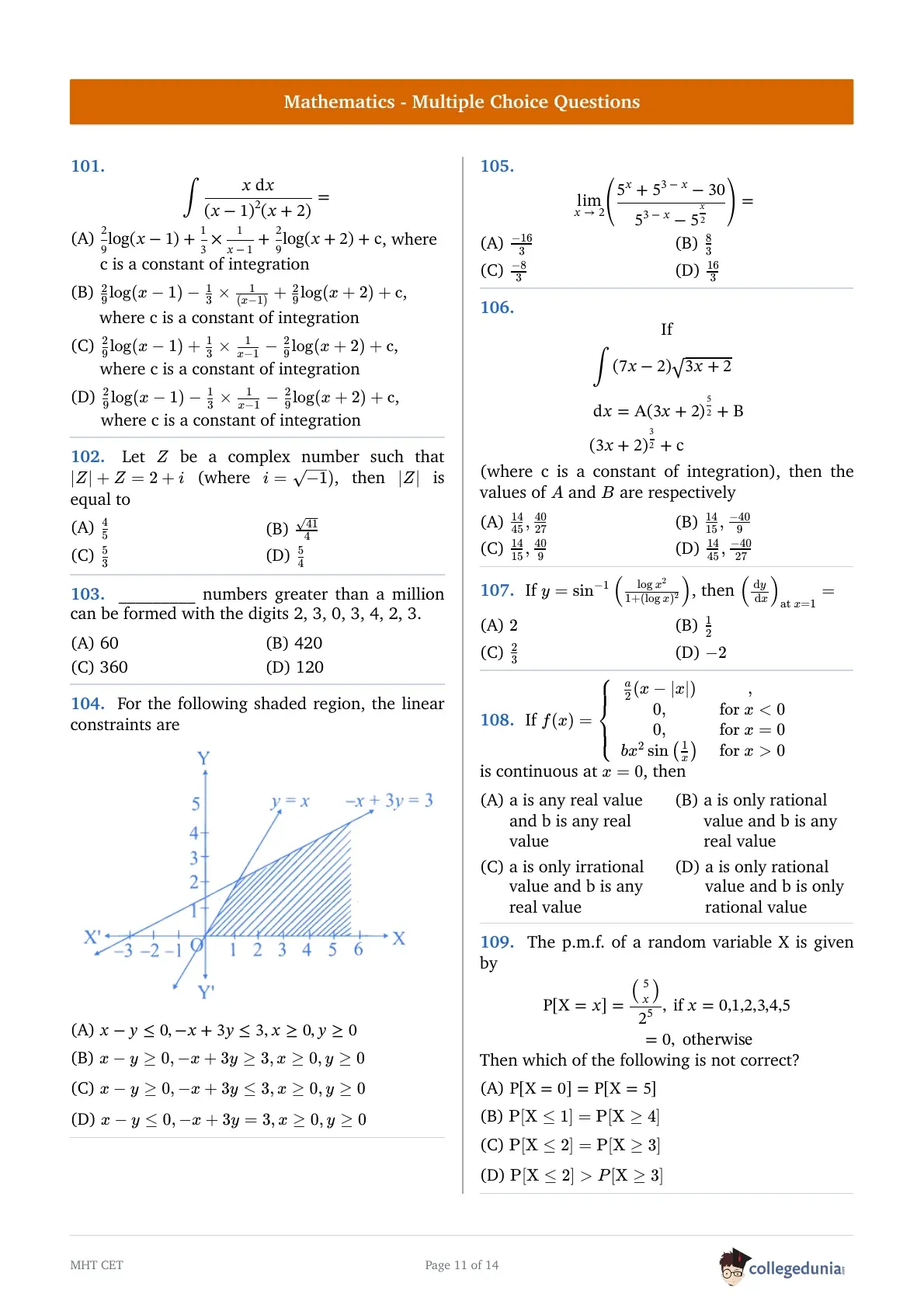
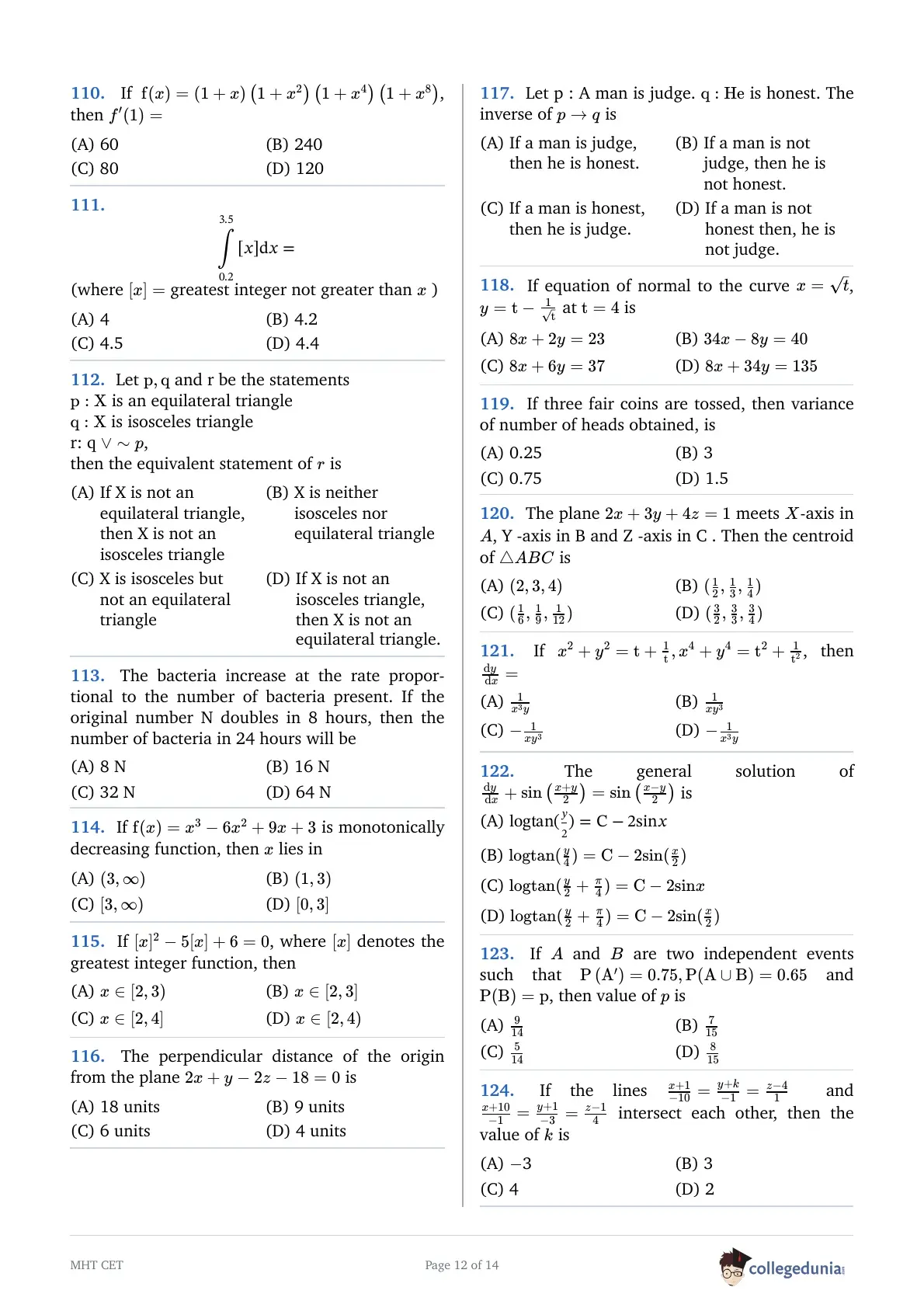
MHT CET 2024 May 11 Shift 1 PCM Question Paper is available for download here. Maharashtra State CET Cell conducted MHT CET 2024 PCM Exam on May 11 in Shift 1 from 9 AM to 12 PM in CBT mode.

The MHT CET 2024 PCM question paper includes the following:

  • The MHT CET 2024 PCM Question Paper consists of 150 multiple-choice questions (MCQs) totalling 200 marks divided into 3 sections: Physics, Chemistry, and Mathematics, with 50 questions in each subject.
  • Physics and Chemistry questions carry 1 mark each while Mathematics questions carry 2 marks each.
  • There is no negative marking for incorrect answers.

MHT CET 2024 May 11 Shift 1 PCM Question Paper with Solution PDF

CD PDF CD PDF with Solutions
Download Collegedunia PDF 0.85 MB -

Also Check:

MHT CET 2024 May 11 Shift 1 PCM Questions with Solutions


Physics (Q1 - Q50)

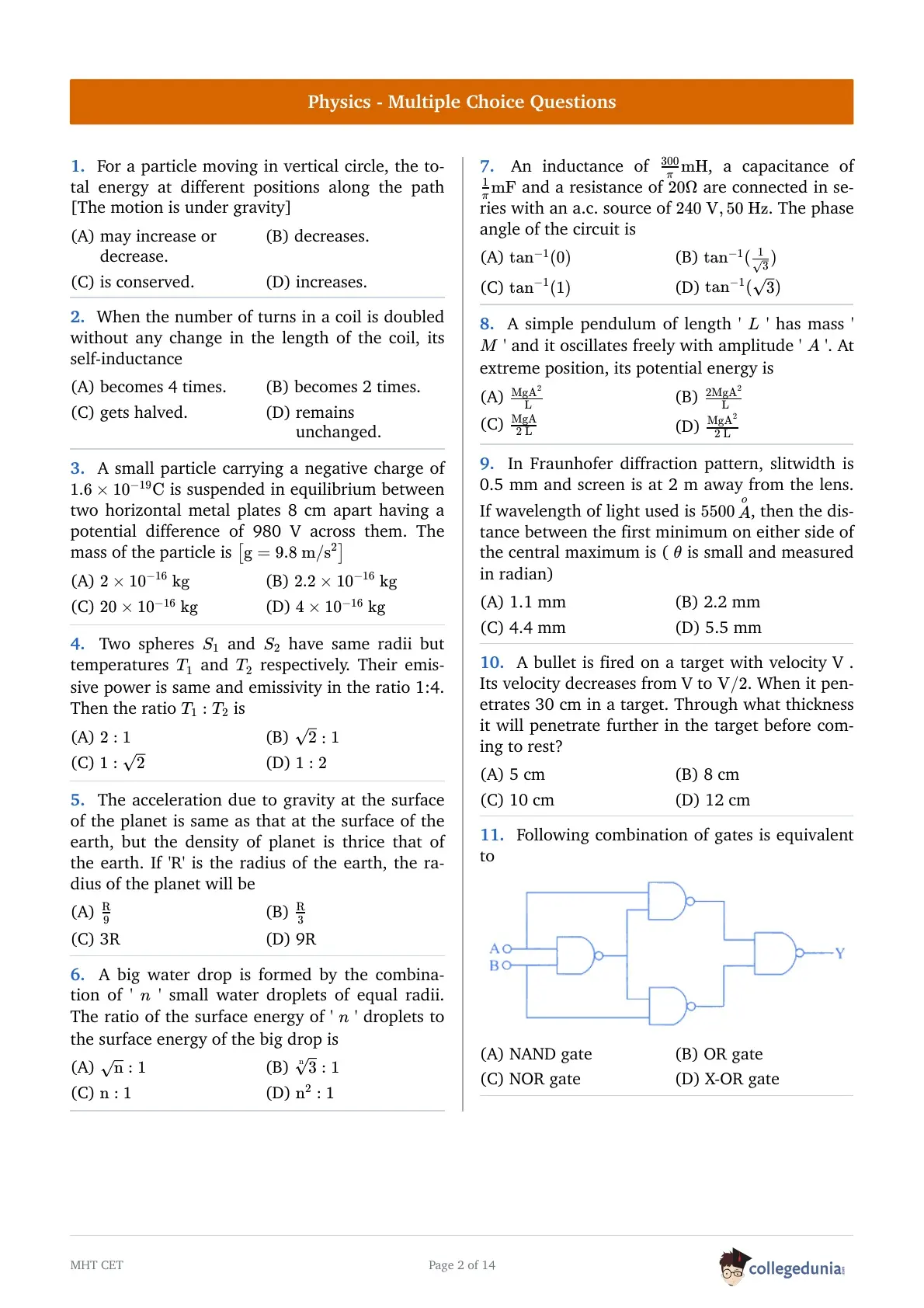
Question 1:

For a particle moving in vertical circle, the total energy at different positions along the path [The motion is under gravity]

  • (A) may increase or decrease.
  • (B) decreases.
  • (C) is conserved.
  • (D) increases.

Question 2:

When the number of turns in a coil is doubled without any change in the length of the coil, its self-inductance

  • (A) becomes 4 times.
  • (B) becomes 2 times.
  • (C) gets halved.
  • (D) remains unchanged.

Question 3:

A small particle carrying a negative charge of \(1.6 \times 10^{-19} \mathrm{C}\) is suspended in equilibrium between two horizontal metal plates 8 cm apart having a potential difference of 980 V across them. The mass of the particle is \(\left[\mathrm{g}=9.8 \mathrm{~m} / \mathrm{s}^2\right]\)

  • (A) \(2\times 10^{-16}\text{ }\mathrm{kg}\)
  • (B) \(2.2\times 10^{-16}\text{ }\mathrm{kg}\)
  • (C) \(20\times 10^{-16}\text{ }\mathrm{kg}\)
  • (D) \(4\times 10^{-16}\text{ }\mathrm{kg}\)

Question 4:

Two spheres \(S_1\) and \(S_2\) have same radii but temperatures \(T_1\) and \(T_2\) respectively. Their emissive power is same and emissivity in the ratio 1:4. Then the ratio \(T_1: T_2\) is

  • (A) \(2:1\)
  • (B) \(\sqrt{2}:1\)
  • (C) \(1:\sqrt{2}\)
  • (D) \(1:2\)

Question 5:

The acceleration due to gravity at the surface of the planet is same as that at the surface of the earth, but the density of planet is thrice that of the earth. If 'R' is the radius of the earth, the radius of the planet will be

  • (A) \(\frac{\mathrm{R}}{9}\)
  • (B) \(\frac{\mathrm{R}}{3}\)
  • (C) 3R
  • (D) 9R

Question 7:

An inductance of \(\frac{300}{\pi} \mathrm{mH}\), a capacitance of \(\frac{1}{\pi} \mathrm{mF}\) and a resistance of \(20 \Omega\) are connected in series with an a.c. source of \(240 \mathrm{~V}, 50 \mathrm{~Hz}\). The phase angle of the circuit is

  • (A) \(\mathrm{tan}^{-1}(0)\)
  • (B) \(\mathrm{tan}^{-1}(\frac{1}{\sqrt{3}})\)
  • (C) \(\mathrm{tan}^{-1}(1)\)
  • (D) \(\mathrm{tan}^{-1}(\sqrt{3})\)

Question 8:

A simple pendulum of length ' \(L\) ' has mass ' \(M\) ' and it oscillates freely with amplitude ' \(A\) '. At extreme position, its potential energy is

  • (A) \(\frac{\mathrm{MgA}^{2}}{\text{ }\mathrm{L}}\)
  • (B) \(\frac{2\mathrm{MgA}^{2}}{\text{ }\mathrm{L}}\)
  • (C) \(\frac{\mathrm{MgA}}{2\text{ }\mathrm{L}}\)
  • (D) \(\frac{\mathrm{MgA}^{2}}{2\text{ }\mathrm{L}}\)

Question 9:

In Fraunhofer diffraction pattern, slitwidth is 0.5 mm and screen is at 2 m away from the lens. If wavelength of light used is \(5500\mathop A\limits^o\), then the distance between the first minimum on either side of the central maximum is ( \(\theta\) is small and measured in radian)

  • (A) 1.1 mm
  • (B) 2.2 mm
  • (C) 4.4 mm
  • (D) 5.5 mm

Question 10:

A bullet is fired on a target with velocity V . Its velocity decreases from V to \(\mathrm{V} / 2\). When it penetrates 30 cm in a target. Through what thickness it will penetrate further in the target before coming to rest?

  • (A) 5 cm
  • (B) 8 cm
  • (C) 10 cm
  • (D) 12 cm

Question 11:

Following combination of gates is equivalent to

  • (A) NAND gate
  • (B) OR gate
  • (C) NOR gate
  • (D) X-OR gate

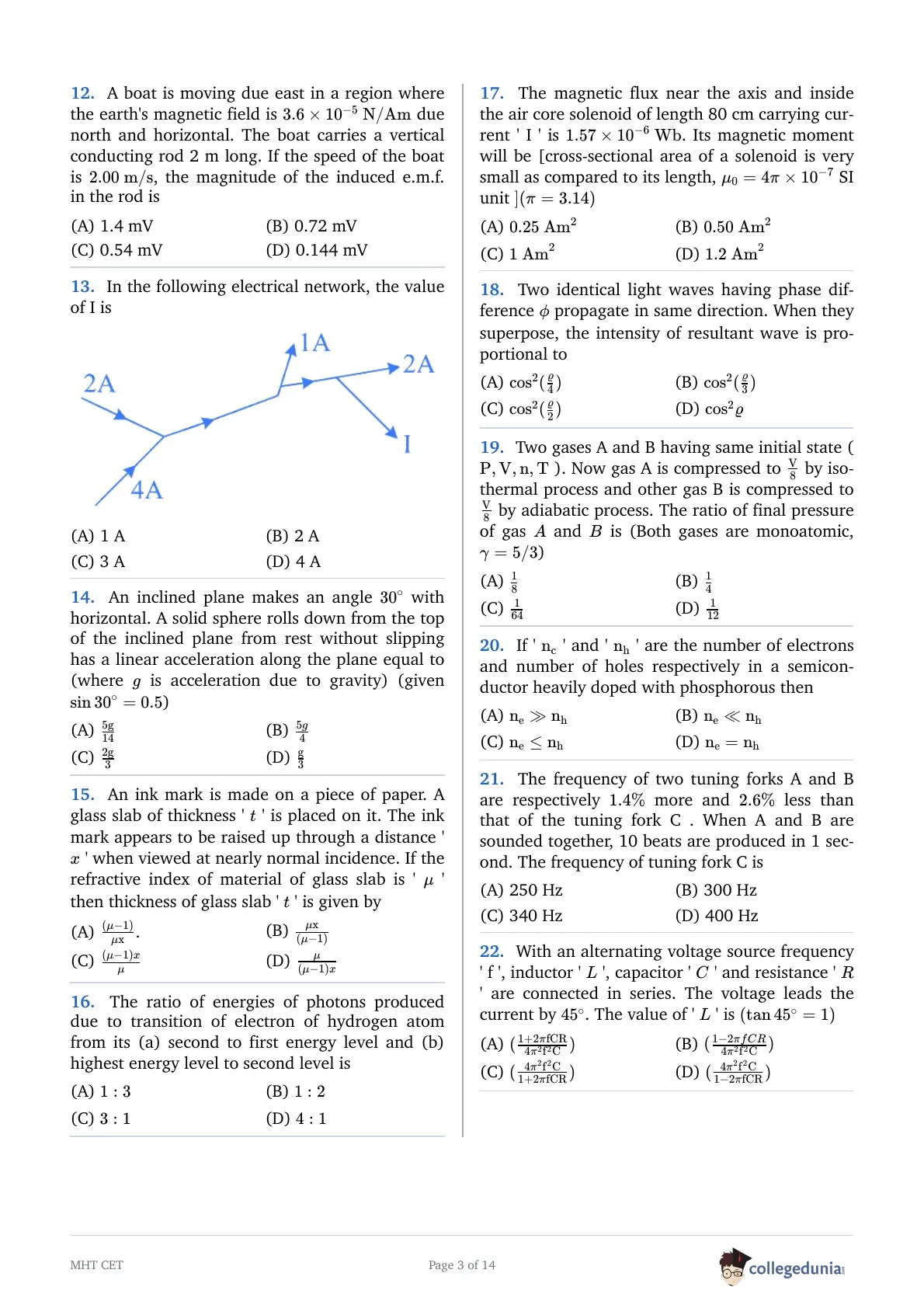
Question 12:

A boat is moving due east in a region where the earth's magnetic field is \(3.6 \times 10^{-5} \mathrm{~N} / \mathrm{Am}\) due north and horizontal. The boat carries a vertical conducting rod 2 m long. If the speed of the boat is \(2.00 \mathrm{~m} / \mathrm{s}\), the magnitude of the induced e.m.f. in the rod is

  • (A) 1.4 mV
  • (B) 0.72 mV
  • (C) 0.54 mV
  • (D) 0.144 mV

Question 13:

In the following electrical network, the value of I is

  • (A) 1 A
  • (B) 2 A
  • (C) 3 A
  • (D) 4 A

Question 14:

An inclined plane makes an angle \(30^{\circ}\) with horizontal. A solid sphere rolls down from the top of the inclined plane from rest without slipping has a linear acceleration along the plane equal to (where \(g\) is acceleration due to gravity) (given \(\sin 30^{\circ}=0.5\))

  • (A) \(\frac{5\mathrm{g}}{14}\)
  • (B) \(\frac{5g}{4}\)
  • (C) \(\frac{2\mathrm{g}}{3}\)
  • (D) \(\frac{\mathrm{g}}{3}\)

Question 15:

An ink mark is made on a piece of paper. A glass slab of thickness ' \(t\) ' is placed on it. The ink mark appears to be raised up through a distance ' \(x\) ' when viewed at nearly normal incidence. If the refractive index of material of glass slab is ' \(\mu\) ' then thickness of glass slab ' \(t\) ' is given by

  • (A) \(\frac{(\mu -1)}{\mu \mathrm{x}}\).
  • (B) \(\frac{\mu \mathrm{x}}{(\mu -1)}\)
  • (C) \(\frac{(\mu -1)x}{\mu}\)
  • (D) \(\frac{\mu}{(\mu -1)x}\)

Question 16:

The ratio of energies of photons produced due to transition of electron of hydrogen atom from its (a) second to first energy level and (b) highest energy level to second level is

  • (A) \(1:3\)
  • (B) \(1:2\)
  • (C) \(3:1\)
  • (D) \(4:1\)

Question 17:

The magnetic flux near the axis and inside the air core solenoid of length 80 cm carrying current ' I ' is \(1.57 \times 10^{-6} \mathrm{~Wb}\). Its magnetic moment will be [cross-sectional area of a solenoid is very small as compared to its length, \(\mu_0=4 \pi \times 10^{-7}\) SI unit \(](\pi=3.14)\)

  • (A) \(0.25\text{ }\mathrm{Am}^{2}\)
  • (B) \(0.50\text{ }\mathrm{Am}^{2}\)
  • (C) \(1\text{ }\mathrm{Am}^{2}\)
  • (D) \(1.2\text{ }\mathrm{Am}^{2}\)

Question 18:

Two identical light waves having phase difference \(\phi\) propagate in same direction. When they superpose, the intensity of resultant wave is proportional to

  • (A) \(\mathrm{cos}^{2}(\frac{\varrho}{4})\)
  • (B) \(\mathrm{cos}^{2}(\frac{\varrho}{3})\)
  • (C) \(\mathrm{cos}^{2}(\frac{\varrho}{2})\)
  • (D) \(\mathrm{cos}^{2}\varrho\)

Question 19:

Two gases A and B having same initial state ( \(\mathrm{P}, \mathrm{V}, \mathrm{n}, \mathrm{T}\) ). Now gas A is compressed to \(\frac{\mathrm{V}}{8}\) by isothermal process and other gas B is compressed to \(\frac{\mathrm{V}}{8}\) by adiabatic process. The ratio of final pressure of gas \(A\) and \(B\) is (Both gases are monoatomic, \(\gamma=5 / 3\))

  • (A) \(\frac{1}{8}\)
  • (B) \(\frac{1}{4}\)
  • (C) \(\frac{1}{64}\)
  • (D) \(\frac{1}{12}\)

Question 20:

If ' \(\mathrm{n}_{\mathrm{c}}\) ' and ' \(\mathrm{n}_{\mathrm{h}}\) ' are the number of electrons and number of holes respectively in a semiconductor heavily doped with phosphorous then

  • (A) \(\mathrm{n}_{\mathrm{e}}\gg \mathrm{n}_{\mathrm{h}}\)
  • (B) \(\mathrm{n}_{\mathrm{e}}\ll \mathrm{n}_{\mathrm{h}}\)
  • (C) \(\mathrm{n}_{\mathrm{e}}\leq \mathrm{n}_{\mathrm{h}}\)
  • (D) \(\mathrm{n}_{\mathrm{e}}=\mathrm{n}_{\mathrm{h}}\)

Question 21:

The frequency of two tuning forks A and B are respectively \(1.4 \%\) more and \(2.6 \%\) less than that of the tuning fork C . When A and B are sounded together, 10 beats are produced in 1 second. The frequency of tuning fork C is

  • (A) 250 Hz
  • (B) 300 Hz
  • (C) 340 Hz
  • (D) 400 Hz

Question 22:

With an alternating voltage source frequency ' f ', inductor ' \(L\) ', capacitor ' \(C\) ' and resistance ' \(R\) ' are connected in series. The voltage leads the current by \(45^{\circ}\). The value of ' \(L\) ' is \(\left(\tan 45^{\circ}=1\right)\)

  • (A) \((\frac{1+2\pi \mathrm{fCR}}{4\pi ^{2}\mathrm{f}^{2}\mathrm{C}})\)
  • (B) \((\frac{1-2\pi fCR}{4\pi ^{2}\mathrm{f}^{2}\mathrm{C}})\)
  • (C) \((\frac{4\pi ^{2}\mathrm{f}^{2}\mathrm{C}}{1+2\pi \mathrm{fCR}})\)
  • (D) \((\frac{4\pi ^{2}\mathrm{f}^{2}\mathrm{C}}{1-2\pi \mathrm{fCR}})\)

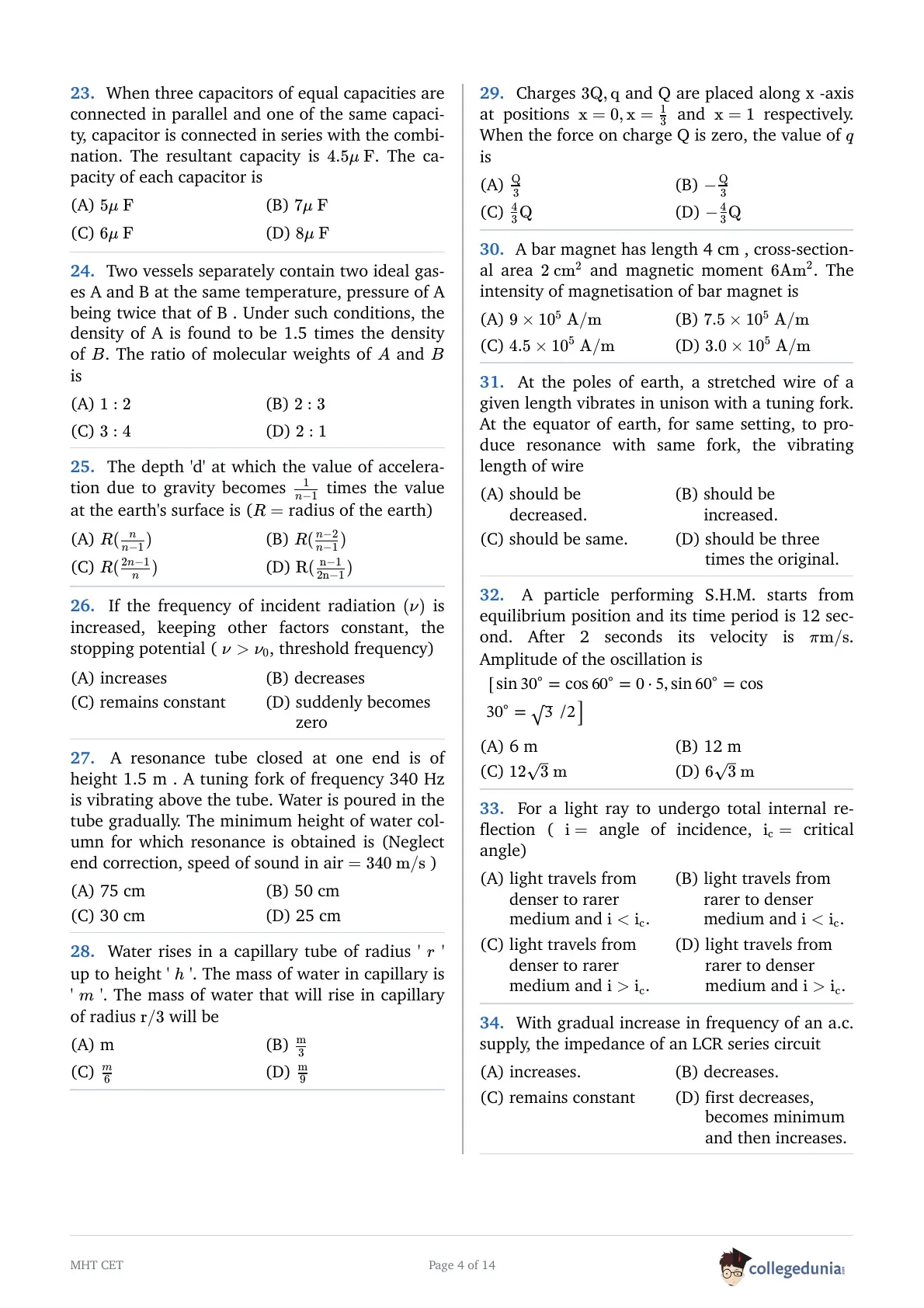
Question 23:

When three capacitors of equal capacities are connected in parallel and one of the same capacity, capacitor is connected in series with the combination. The resultant capacity is \(4.5 \mu \mathrm{~F}\). The capacity of each capacitor is

  • (A) \(5\mu \text{ }\mathrm{F}\)
  • (B) \(7\mu \text{ }\mathrm{F}\)
  • (C) \(6\mu \text{ }\mathrm{F}\)
  • (D) \(8\mu \text{ }\mathrm{F}\)

Question 24:

Two vessels separately contain two ideal gases A and B at the same temperature, pressure of A being twice that of B . Under such conditions, the density of A is found to be 1.5 times the density of \(B\). The ratio of molecular weights of \(A\) and \(B\) is

  • (A) \(1:2\)
  • (B) \(2:3\)
  • (C) \(3:4\)
  • (D) \(2:1\)

Question 25:

The depth 'd' at which the value of acceleration due to gravity becomes \(\frac{1}{n-1}\) times the value at the earth's surface is (\(R=\) radius of the earth)

  • (A) \(R(\frac{n}{n-1})\)
  • (B) \(R(\frac{n-2}{n-1})\)
  • (C) \(R(\frac{2n-1}{n})\)
  • (D) \(\mathrm{R}(\frac{\mathrm{n}-1}{2\mathrm{n}-1})\)

Question 26:

If the frequency of incident radiation \((\nu)\) is increased, keeping other factors constant, the stopping potential ( \(\nu>\nu_0\), threshold frequency)

  • (A) increases
  • (B) decreases
  • (C) remains constant
  • (D) suddenly becomes zero

Question 27:

A resonance tube closed at one end is of height 1.5 m . A tuning fork of frequency 340 Hz is vibrating above the tube. Water is poured in the tube gradually. The minimum height of water column for which resonance is obtained is (Neglect end correction, speed of sound in air \(=340 \mathrm{~m} / \mathrm{s}\) )

  • (A) 75 cm
  • (B) 50 cm
  • (C) 30 cm
  • (D) 25 cm

Question 28:

Water rises in a capillary tube of radius ' \(r\) ' up to height ' \(h\) '. The mass of water in capillary is ' \(m\) '. The mass of water that will rise in capillary of radius \(\mathrm{r} / 3\) will be

  • (A) m
  • (B) \(\frac{\mathrm{m}}{3}\)
  • (C) \(\frac{m}{6}\)
  • (D) \(\frac{\mathrm{m}}{9}\)

Question 29:

Charges \(3 \mathrm{Q}, \mathrm{q}\) and Q are placed along x -axis at positions \(\mathrm{x}=0, \mathrm{x}=\frac{1}{3}\) and \(\mathrm{x}=1\) respectively. When the force on charge Q is zero, the value of \(q\) is

  • (A) \(\frac{\mathrm{Q}}{3}\)
  • (B) \(-\frac{\mathrm{Q}}{3}\)
  • (C) \(\frac{4}{3}\mathrm{Q}\)
  • (D) \(-\frac{4}{3}\mathrm{Q}\)

Question 30:

A bar magnet has length 4 cm , cross-sectional area \(2 \mathrm{~cm}^2\) and magnetic moment \(6 \mathrm{Am}^2\). The intensity of magnetisation of bar magnet is

  • (A) \(9\times 10^{5}\text{ }\mathrm{A}/\mathrm{m}\)
  • (B) \(7.5\times 10^{5}\text{ }\mathrm{A}/\mathrm{m}\)
  • (C) \(4.5\times 10^{5}\text{ }\mathrm{A}/\mathrm{m}\)
  • (D) \(3.0\times 10^{5}\text{ }\mathrm{A}/\mathrm{m}\)

Question 31:

At the poles of earth, a stretched wire of a given length vibrates in unison with a tuning fork. At the equator of earth, for same setting, to produce resonance with same fork, the vibrating length of wire

  • (A) should be decreased.
  • (B) should be increased.
  • (C) should be same.
  • (D) should be three times the original.

Question 32:

A particle performing S.H.M. starts from equilibrium position and its time period is 12 second. After 2 seconds its velocity is \(\pi \mathrm{m} / \mathrm{s}\). Amplitude of the oscillation is \(\left[\sin 30^{\circ}=\cos 60^{\circ}=0 \cdot 5, \sin 60^{\circ}=\cos 30^{\circ}=\sqrt{3} / 2\right]\)

  • (A) 6 m
  • (B) 12 m
  • (C) \(12\sqrt{3}\text{ }\mathrm{m}\)
  • (D) \(6\sqrt{3}\text{ }\mathrm{m}\)

Question 33:

For a light ray to undergo total internal reflection ( \(\mathrm{i}=\) angle of incidence, \(\mathrm{i}_{\mathrm{c}}=\) critical angle)

  • (A) light travels from denser to rarer medium and \(\mathrm{i}<\mathrm{i}_{\mathrm{c}}\).
  • (B) light travels from rarer to denser medium and \(\mathrm{i}<\mathrm{i}_{\mathrm{c}}\).
  • (C) light travels from denser to rarer medium and \(\mathrm{i}>\mathrm{i}_{\mathrm{c}}\).
  • (D) light travels from rarer to denser medium and \(\mathrm{i}>\mathrm{i}_{\mathrm{c}}\).

Question 34:

With gradual increase in frequency of an a.c. supply, the impedance of an LCR series circuit

  • (A) increases.
  • (B) decreases.
  • (C) remains constant
  • (D) first decreases, becomes minimum and then increases.

Question 35:

Two parallel plate air capacitors of same capacity ' C ' are connected in series to a battery of emf ' \(E\) '. Then one of the capacitors is completely filled with dielectric material of constant ' K '. The change in the effective capacity of the series combination is

  • (A) \(\frac{\mathrm{C}}{2}[\frac{\text{ }\mathrm{K}+1}{\text{ }\mathrm{K}-1}]\)
  • (B) \(\frac{2}{\mathrm{C}}[\frac{\mathrm{K}-1}{\text{ }\mathrm{K}+1}]\)
  • (C) \(\frac{\mathrm{C}}{2}[\frac{\text{ }\mathrm{K}-1}{\text{ }\mathrm{K}+1}]\)
  • (D) \(\frac{\mathrm{C}}{2}[\frac{\text{ }\mathrm{K}-1}{\text{ }\mathrm{K}+1}]^{2}\)

Question 36:

Assuming that the earth is revolving around the sun in circular orbit of radius R , the angular momentum is directly proportional to \(\mathrm{R}^{\mathrm{n}}\). The value of ' \(n\) ' is

  • (A) 2
  • (B) 1.5
  • (C) 1
  • (D) 0.5

Question 37:

With what velocity an observer should move relative to a stationary source so that a sound of triple the frequency of source is heard by an observer?

  • (A) Same as velocity of sound towards the source.
  • (B) Same as velocity of sound away from the source.
  • (C) Half the velocity of sound towards the source.
  • (D) Twice the velocity of sound towards the source.

Question 38:

Two long straight parallel wires are separated by a distance '2d'. Each wire carries a current 'I' in the same direction. The magnetic field at a point 'P' midway between them is

  • (A) \(\frac{2\mu _{0}I}{r}\)
  • (B) zero
  • (C) \(\frac{\mu _{0}I}{4r}\)
  • (D) \(\frac{\mu _{0}I}{2r}\)

Question 39:

If 'T' is the half life of a radioactive substance then its instantaneous rate of change of activity is proportional to

  • (A) T
  • (B) T\({}^{-2}\)
  • (C) T\({}^{+2}\)
  • (D) T\({}^{-1}\)

Question 40:

An insulated container contains a diatomic gas of molar mass ' m '. The container is moving with velocity ' \(V\) ', if it is stopped suddenly, the change in temperature is ( \(R=\) gas constant)

  • (A) \(\frac{\mathrm{mV}^{2}}{3\mathrm{R}}\)
  • (B) \(\frac{\mathrm{mV}^{2}}{5\mathrm{R}}\)
  • (C) \(\frac{\mathrm{mV}}{7\mathrm{R}}\)
  • (D) \(\frac{5mV}{3R}\)

Question 41:

The current drawn from the battery in the given network is (Internal resistance of the battery is negligible)

  • (A) 1.2 A
  • (B) 2.4 A
  • (C) 4 A
  • (D) 4.8 A

Question 42:

Rails of material of steel are laid with gaps to allow for thermal expansion. Each track is 10 m long, when laid at temperature \(17^{\circ} \mathrm{C}\). The maximum temperature that can be reached is \(45^{\circ} \mathrm{C}\). The gap to be kept between the two segments of railway track is

\[\left(\alpha_{\text {steel }}=1.3 \times 10^{-5} /{ }^{\circ} \mathrm{C}\right)\]

  • (A) 1.68 mm
  • (B) 2.06 mm
  • (C) 3.64 mm
  • (D) 4.32 mm

Question 43:

If the potential difference used to accelerate electrons is doubled. By what factor does the deBroglie wavelength \((\lambda)\) associated with the electrons change?

  • (A) \(\lambda\) is increased to \(\sqrt{2}\) times.
  • (B) \(\lambda\) is increased to \(\frac{1}{\sqrt{2}}\) times.
  • (C) \(\lambda\) is decreased to \(\frac{1}{\sqrt{2}}\) times.
  • (D) \(\lambda\) is decreased to \(\sqrt{2}\) times.

Question 45:

A p-n junction diode cannot be used

  • (A) as a rectifier.
  • (B) for converting light energy to electrical energy.
  • (C) for getting light radiation.
  • (D) for increasing the amplitude of an a.c. signal.

Question 46:

A particle performs linear S.H.M. at a particular instant, velocity of the particle is ' \(u\) ' and acceleration is ' \(\mathrm{a}_1\) ' while at another instant velocity is ' V ' and acceleration is ' \(a_2\) ' \(0<a_1<a_2\). The distance between the two position is

  • (A) \(\frac{v^{2}-u^{2}}{a_{1}-a_{2}}\)
  • (B) \(\frac{v^{2}+u^{2}}{a_{1}+a_{2}}\)
  • (C) \(\frac{u^{2}+v^{2}}{a_{1}-a_{2}}\)
  • (D) \(\frac{u^{2}-v^{2}}{a_{1}+a_{2}}\)

Question 48:

The coefficient of mutual induction is 2 H and induced e.m.f. across secondary is 2 kV Current in the primary is reduced from 6 A to 3 A . The time required for the change of current is

  • (A) \(3\times 10^{-3}\text{ }\mathrm{s}\)
  • (B) \(3\times 10^{-2}\text{ }\mathrm{s}\)
  • (C) \(6\times 10^{-3}\text{ }\mathrm{s}\)
  • (D) \(6\times 10^{-2}\text{ }\mathrm{s}\)

Question 49:

The work done in blowing a soap bubble of radius \(R\) is \(W_1\) at room temperature. Now the soap solution is heated. From the heated solution another soap bubble of radius 2 R is blown and the work done is \(\mathrm{W}_2\). Then

  • (A) \(\mathrm{W}_{2}=0\)
  • (B) \(\mathrm{W}_{2}=4\text{ }\mathrm{W}_{1}\)
  • (C) \(\mathrm{W}_{2}<4\text{ }\mathrm{W}_{1}\)
  • (D) \(\mathrm{W}_{2}=\mathrm{W}_{1}\)

Question 50:

When the same monochromatic ray of light travels through glass slab and through water, the number of waves in glass slab of thickness 5 cm is same as in water column of height 6 cm . If refractive index of glass is 1.56 , then refractive index of water is

  • (A) 1.28
  • (B) 1.29
  • (C) 1.30
  • (D) 1.32

Chemistry (Q51 - Q100)

Question 51:

Identify the major product ( \(99 \%\) ) formed when \(\left(\mathrm{CH}_3\right)_3 \mathrm{CH}\) is treated with \(\mathrm{Br}_2\) in UV light.

  • (A) \((\mathrm{CH}_{3})_{3}\mathrm{CHCH}_{2}\mathrm{Br}\)
  • (B) \((\mathrm{CH}_{3})_{3}-\mathrm{C}-\mathrm{Br}\)
  • (C)
  • (D) \(\mathrm{CH}_{3}-(\mathrm{CH}_{2})_{2}-\mathrm{CH}_{2}\mathrm{Br}\)

Question 52:

Which among the following pair of properties are intensive?

  • (A) surface tension and viscosity
  • (B) mass and temperature
  • (C) internal energy and boiling point
  • (D) heat capacity and specific heat

Question 53:

Which of the following equations gives angular momentum of an electron in a stationary orbit?

  • (A) \(\mathrm{mvr}=\frac{2\pi}{\text{ }\mathrm{h}}\times \mathrm{n}\)
  • (B) \(\mathrm{mvr}=\mathrm{n}\times \frac{\mathrm{h}}{2\pi}\)
  • (C) \(\mathrm{mvh}=\mathrm{n}\times \frac{\mathrm{r}}{2\pi}\)
  • (D) \(\mathrm{mv}=(\frac{\mathrm{h}\times \mathrm{r}}{2\pi})\mathrm{n}\)

Question 54:

Which element from following has lowest ionization enthalpy \(\left(\mathrm{IE}_1\right)\) ?

  • (A) Cu
  • (B) Sc
  • (C) Mn
  • (D) Zn

Question 55:

Which alkyl halide has highest bond enthalpy of \(\mathrm{C}-\mathrm{X}\) bond?

  • (A) \(\mathrm{CH}_{3}-\mathrm{Cl}\)
  • (B) \(\mathrm{CH}_{3}-\mathrm{F}\)
  • (C) \(\mathrm{CH}_{3}-\mathrm{Br}\)
  • (D) \(\mathrm{CH}_{3}-\mathrm{I}\)

Question 56:

Calculate van't Hoff factor (i) of 0.2 m aqueous solution of an electrolyte if it freezes at \(-0.660 \mathrm{~K} .\left(\mathrm{K}_{\mathrm{f}}=1.84 \mathrm{~K} \mathrm{~kg} \mathrm{~mol}^{-1}\right)\)

  • (A) 1.97
  • (B) 1.79
  • (C) 0.242
  • (D) 0.557

Question 57:

Identify reagent used for preparation of benzophenone from benzonitrile?

  • (A) \(\mathrm{C}_{6}\mathrm{H}_{5}\mathrm{MgBr}\)
  • (B) \(\mathrm{CH}_{3}\mathrm{MgCl}\) (in dry ether)
  • (C) \((\mathrm{CH}_{3})_{2}\mathrm{Cd}\)
  • (D) \(\mathrm{AlH}(\mathrm{i}-\mathrm{Bu})_{2}\)

Question 58:

Which of the following is an elementary reaction?

  • (A) \(\mathrm{C}_{2}\mathrm{H}_{5}\mathrm{I}_{(\mathrm{g})}\longrightarrow \mathrm{C}_{2}\mathrm{H}_{4(\text{ }\mathrm{g})}+\mathrm{HI}_{(\mathrm{g})}\)
  • (B) \(2\mathrm{NO}_{2}\mathrm{Cl}_{(\mathrm{g})}\longrightarrow 2\mathrm{NO}_{2(\mathrm{g})}+\mathrm{Cl}_{2(\mathrm{g})}\)
  • (C) \(2\mathrm{NO}_{2(\text{ }\mathrm{g})}+\mathrm{F}_{2(\text{ }\mathrm{g})}\longrightarrow 2\mathrm{NO}_{2}\text{ }\mathrm{F}_{(\mathrm{g})}\)
  • (D) \(2\mathrm{NO}_{(\mathrm{g})}+\mathrm{Cl}_{2(\mathrm{g})}\longrightarrow 2\mathrm{NOCl}_{(\mathrm{g})}\)

Question 59:

Which compound from following contains N atom in its ring?

  • (A) Furan
  • (B) Thiophene
  • (C) THF
  • (D) Pyrrole

Question 60:

2 moles of an ideal gas expands isothermally from \(5 \mathrm{dm}^3\) to \(10 \mathrm{dm}^3\) at a constant external pressure of 1.5 bar. Calculate work done.

  • (A) \(7.5\mathrm{dm}^{3}\) bar
  • (B) \(-7.5\mathrm{dm}^{3}\) bar
  • (C) \(22.5\mathrm{dm}^{3}\) bar
  • (D) \(-22.5\mathrm{dm}^{3}\) bar

Question 61:

What is the wave number of lowest transition associated with Lyman series?

  • (A) \(\overline{v}=\mathrm{R}_{\mathrm{H}}(\frac{3}{4})\)
  • (B) \(\overline{v}=\mathrm{R}_{\mathrm{H}}(\frac{5}{36})\)
  • (C) \(\overline{v}=\mathrm{R}_{\mathrm{H}}(\frac{4}{3})\)
  • (D) \(\overline{v}=\mathrm{R}_{\mathrm{H}}(\frac{36}{5})\)

Question 62:

Vapour pressure of a pure solvent is 550 mm of Hg . By addition of a non volatile solute it decreases to 510 mm of Hg . Calculate the mole fraction of solute in solution.

  • (A) 0.215
  • (B) 0.072
  • (C) 0.610
  • (D) 0.512

Question 63:

Identify the product obtained when excess of benzoyl chloride is treated with dimethyl cadmium.

  • (A) Acetophenone
  • (B) Benzoic acid
  • (C) Benzophenone
  • (D) Benzaldehyde

Question 64:

Rate constant of a reaction, \[ 2 \mathrm{NO}_2 \mathrm{Cl}_{2(\mathrm{~g})} \longrightarrow 2 \mathrm{NO}_{2(\mathrm{~g})}+\mathrm{Cl}_{2(\mathrm{~g})}\]

is 4.7672 minute \(^{-1}\). Calculate half life of reaction.

  • (A) 0.0727 minute
  • (B) 0.1454 minute
  • (C) 0.2181 minute
  • (D) 0.4362 minute

Question 65:

Which from following compounds is obtained when glucose is heated with HI for longer time?

  • (A) Glucose cyanohydrin
  • (B) Glucose oxime
  • (C) n-Hexane
  • (D) Saccharic acid

Question 66:

In Haber's process of production of ammonia, \(\mathrm{K}_2 \mathrm{O}\) is used as

  • (A) catalyst
  • (B) inhibitor
  • (C) promotor
  • (D) adsorbate

Question 67:

An ideal gas expands against constant external pressure of 2 bar from 5 lit to 8 lit and absorbs 10 kJ of heat. What is \(\Delta \mathrm{U}\) of the system?

  • (A) \(10600\text{ }\mathrm{J}\)
  • (B) \(9400\text{ }\mathrm{J}\)
  • (C) \(-10600\text{ }\mathrm{J}\)
  • (D) \(-9400\text{ }\mathrm{J}\)

Question 68:

Which of the following compounds follows octet rule?

  • (A) \(\mathrm{H}_{2}\mathrm{SO}_{4}\)
  • (B) \(\mathrm{NO}_{2}\)
  • (C) \(\mathrm{SCl}_{2}\)
  • (D) \(\mathrm{SF}_{6}\)

Question 69:

Identify the type of hybridization present in \(\left[\mathrm{Ni}(\mathrm{CN})_4\right]^{2-}\).

  • (A) \(\mathrm{sp}^{3}\text{ }\mathrm{d}^{2}\)
  • (B) \(\mathrm{dsp}^{2}\)
  • (C) \(\mathrm{sp}^{3}\)
  • (D) \(\mathrm{d}^{2}\mathrm{sp}^{3}\)

Question 70:

Identify the false statement among the following.

  • (A) Ideal solution obey Raoult's law over entire range of temperature and concentration.
  • (B) For ideal solution \(\Delta _{\text{mix }}\mathrm{V}=0\).
  • (C) Non ideal solution do not obey Raoult's law over the entire range of concentration.
  • (D) Vapour pressure of non ideal solution always lies between vapour pressure of pure components.

Question 71:

Which from the following statement is NOT correct regarding Mendius reduction?

  • (A) It is useful for preparation of \(\mathrm{R}-\mathrm{NH}_{2}\).
  • (B) In this alkyl cyanides are reduced.
  • (C) In this sodium and ethanol is used for reduction.
  • (D) In this method one carbon atom is lost in the form of \(\mathrm{CO}_{2}\).

Question 72:

Initial concentration of reactant in a first order reaction is \(0.08 \mathrm{~mol} \mathrm{~dm}^{-3}\) What concentration would remain after 40 minute?

\[\left(\text { given } \frac{[\mathrm{A}]_0}{[\mathrm{~A}]_{\mathrm{t}}}=5.00\right)\]

  • (A) \(0.008\text{ }\mathrm{mol}\text{ }\mathrm{dm}^{-3}\)
  • (B) \(0.08\text{ }\mathrm{mol}\text{ }\mathrm{dm}^{-3}\)
  • (C) \(0.016\text{ }\mathrm{mol}\text{ }\mathrm{dm}^{-3}\)
  • (D) \(0.032\text{ }\mathrm{mol}\text{ }\mathrm{dm}^{-3}\)

Question 73:

Which from following amines has highest \(\mathrm{pK}_{\mathrm{b}}\) value?

  • (A) Arylamine
  • (B) Tertiary alkanamine
  • (C) Secondary alkanamine
  • (D) Primary alkanamine

Question 74:

What is oxidation number of S in \(\mathrm{SO}_3^{2-}\) ?

  • (A) \(-2\)
  • (B) \(-3\)
  • (C) \(+4\)
  • (D) \(+6\)

Question 75:

When fused NaCl undergoes electrolysis the product formed at cathode is

  • (A) \(\mathrm{Cl}_{2(\text{ }\mathrm{g})}\)
  • (B) \(\mathrm{Na}{}_{(s)}\)
  • (C) \(\mathrm{Na}-\mathrm{Hg}_{(l)}\)
  • (D) \(\mathrm{H}_{2(\text{ }\mathrm{g})}\)

Question 76:

Which element from following exhibits highest number of various different possible oxidation states?

  • (A) Fe
  • (B) Cr
  • (C) Mn
  • (D) Ni

Question 77:

Which among the following has lowest boiling point?

  • (A) Chloromethane
  • (B) Bromomethane
  • (C) Dibromomethane
  • (D) Tribromomethane

Question 78:

A buffer solution is prepared by mixing 0.01 M HCN and 0.02 MNaCN . If \(\mathrm{K}_{\mathrm{a}}\) for HCN is \(6.6 \times 10^{-10}\), what is the concentration of \(\mathrm{H}^{+}\)ions in solution?

  • (A) \(3.3\times 10^{-6}\mathrm{M}\)
  • (B) \(3.3\times 10^{-10}\mathrm{M}\)
  • (C) \(1.32\times 10^{-6}\mathrm{M}\)
  • (D) \(1.32\times 10^{-10}\mathrm{M}\)

Question 79:

Which reagent from following is used for preparation of aliphatic aldehyde from nitriles?

  • (A) \(\mathrm{CrO}_{2}\mathrm{Cl}_{2}\) in \(\mathrm{CS}_{2}\)
  • (B) \(\mathrm{CrO}_{3}\) in acetic anhydride
  • (C) \(\mathrm{SnCl}_{2},\mathrm{HCl}\)
  • (D) \(\mathrm{Co},\mathrm{HCl}\), anhydrous \(\mathrm{AlCl}_{3}\)

Question 80:

n-type of semiconductor is formed when

  • (A) Silicon doped with phosphorous
  • (B) Silicon doped with boron
  • (C) Germanium doped with boron
  • (D) Germanium doped with aluminium

Question 81:

Which from following polymer contains este linkage?

  • (A) Nylon 6
  • (B) Polyacrylonitrile
  • (C) Teflon
  • (D) PHBV

Question 82:

Which of the following element is used in photoelectric cell?

  • (A) Beryllium
  • (B) Caesium
  • (C) Liquid sodium
  • (D) Calcium

Question 83:

The resistance of conductivity cell filled with 0.1 M KCl solution is 100 ohm and conductivity is \(1.70 \times 10^{-4} \mathrm{~S} \mathrm{~cm}^{-1}\). What is the cell constant of the cell?

  • (A) \(1.70\text{ }\mathrm{cm}^{-1}\)
  • (B) \(0.058\text{ }\mathrm{cm}^{-1}\)
  • (C) \(0.017\text{ }\mathrm{cm}^{-1}\)
  • (D) \(0.012\text{ }\mathrm{cm}^{-1}\)

Question 84:

What type of hybridisation is involved in central atom of hydrides of group 16 elements?

  • (A) \(\mathrm{sp}^{3}\text{ }\mathrm{d}^{2}\)
  • (B) \(\mathrm{sp}^{3}\)
  • (C) \(\mathrm{sp}^{2}\)
  • (D) \(\mathrm{sp}\)

Question 85:

Which from following compounds is used to prepare a refrigerant R-22?

  • (A) Monochloromethane
  • (B) Dichloromethane
  • (C) Trichloromethane
  • (D) Tetrachloromethane

Question 86:

A monobasic acid is \(5 \%\) dissociated in its 0.02 M solution. Calculate the dissociation constant of acid.

  • (A) \(2\times 10^{-2}\)
  • (B) \(4\times 10^{-4}\)
  • (C) \(5\times 10^{-5}\)
  • (D) \(2.5\times 10^{-4}\)

Question 87:

Identify product obtained in following reaction. \[ \mathrm{C}_6 \mathrm{H}_5 \mathrm{OH} \xrightarrow{\mathrm{CrO}_3} \text { Product } \]

  • (A)
  • (B)
  • (C)
  • (D)

Question 88:

Metallic silver has fcc structure. If radius of Ag atom is 144 pm . What is the edge length of unit cell?

  • (A) \(4.07\times 10^{-8}\text{ }\mathrm{cm}\)
  • (B) \(3.22\times 10^{-8}\text{ }\mathrm{cm}\)
  • (C) \(2.63\times 10^{-8}\text{ }\mathrm{cm}\)
  • (D) \(2.23\times 10^{-8}\text{ }\mathrm{cm}\)

Question 89:

Which from following polymers needs dihydric alcohol and aromatic dicarboxylic acid for its synthesis?

  • (A) Nylon 6
  • (B) Dacron
  • (C) Bakelite
  • (D) Polyacrylamide

Question 90:

Identify fibrous protein from following.

  • (A) Legumelin
  • (B) Myosin
  • (C) Insulin
  • (D) Serum albumin

Question 91:

Which of the following has dipole-induced dipole interaction as inter molecular force?

  • (A) \(\mathrm{NH}_{3}+\mathrm{C}_{6}\mathrm{H}_{6}\)
  • (B) \(\mathrm{NaCl}+\mathrm{H}_{2}\mathrm{O}\)
  • (C) \(\mathrm{CH}_{4}+\mathrm{C}_{2}\mathrm{H}_{6}\)
  • (D) \(\mathrm{HF}+\mathrm{H}_{2}\mathrm{O}\)

Question 92:

The conductivity of 0.02 M KCl solution is 0.00250 ohm \(^{-1} \mathrm{~cm}^{-1}\). What is its molar conductivity?

  • (A) \(125\text{ }\mathrm{ohm}^{-1}\text{ }\mathrm{cm}^{2}\text{ }\mathrm{mol}^{-1}\)
  • (B) \(0.05\text{ }\mathrm{ohm}^{-1}\text{ }\mathrm{cm}^{2}\text{ }\mathrm{mol}^{-1}\)
  • (C) \(725\text{ }\mathrm{ohm}^{-1}\text{ }\mathrm{cm}^{2}\text{ }\mathrm{mol}^{-1}\)
  • (D) \(800\text{ }\mathrm{ohm}^{-1}\text{ }\mathrm{cm}^{2}\text{ }\mathrm{mol}^{-1}\)

Question 93:

Which of the following pair of compounds cannot demonstrate law of multiple proportion?

  • (A) \(\mathrm{NO},\mathrm{NO}_{2}\)
  • (B) \(\mathrm{CO},\mathrm{CO}_{2}\)
  • (C) \(\mathrm{H}_{2}\mathrm{O},\mathrm{H}_{2}\mathrm{O}_{2}\)
  • (D) \(\mathrm{Na}_{2}\mathrm{S},\mathrm{NaF}\)

Question 94:

Which among the following P-block elements forms colourless and odourless hydride?

  • (A) Oxygen
  • (B) Nitrogen
  • (C) Sulphur
  • (D) Selenium

Question 95:

What is the number of unpaired electrons present in \(\left[\mathrm{CoF}_6\right]^{3-} ?\)

  • (A) 4
  • (B) 3
  • (C) 2
  • (D) 1

Question 96:

Which from following is called as Lucas reagent?

  • (A) Conc. \(\mathrm{HCl}+\mathrm{ZnCl}_{2}\)
  • (B) Neutral \(\mathrm{FeCl}_{3}\) solution in water
  • (C) \(\mathrm{NaNO}_{2}+\mathrm{HCl}\) (dil.)
  • (D) \(\mathrm{CHCl}_{3}+\mathrm{NaOH}\)

Question 97:

Which among the following salts turns red litmus blue in its aqueous solution?

  • (A) \(\mathrm{Na}_{2}\mathrm{SO}_{4}\)
  • (B) \(\mathrm{CH}_{3}\mathrm{COONa}\)
  • (C) \(\mathrm{NH}_{4}\mathrm{NO}_{3}\)
  • (D) \(\mathrm{CuCl}_{2}\)

Question 98:

Which reagent from following is used in Reimer-Tiemann reaction?

  • (A) \(\mathrm{CO}_{2},6\text{ }\mathrm{atm}\text{ }\mathrm{H}_{3}\mathrm{O}^{+}\)
  • (B) \(\mathrm{CHCl}_{3}\), aq. \(\mathrm{NaOH},\mathrm{H}_{3}\mathrm{O}^{+}\)
  • (C) \(\mathrm{CS}_{2}\) (at low temperature)
  • (D) \(\mathrm{Na}_{2}\mathrm{Cr}_{2}\mathrm{O}_{7}/\mathrm{H}_{2}\mathrm{SO}_{4}\)

Question 99:

What is the number of octahedral voids present in 0.2 mol of a compound forming hcp structure?

  • (A) \(1.204\times 10^{23}\)
  • (B) \(2.387\times 10^{23}\)
  • (C) \(3.011\times 10^{23}\)
  • (D) \(3.321\times 10^{23}\)

Question 100:

What is the percentage atom economy when formula weight of product obtained is 70 u and the sum of formula weight of reactant is 140 u ?

  • (A) \(30\%\)
  • (B) \(35\%\)
  • (C) \(50\%\)
  • (D) \(75\%\)

Mathematics (Q101 - Q150)

Question 101:

\[\int \frac{x \mathrm{~d} x}{(x-1)^2(x+2)}=\]

  • (A) \(\frac{2}{9}\mathrm{log}(x-1)+\frac{1}{3}\times \frac{1}{x-1}+\frac{2}{9}\mathrm{log}(x+2)+\mathrm{c}\), where c is a constant of integration
  • (B) \(\frac{2}{9}\mathrm{log}(x-1)-\frac{1}{3}\times \frac{1}{(x-1)}+\frac{2}{9}\mathrm{log}(x+2)+\mathrm{c}\), where c is a constant of integration
  • (C) \(\frac{2}{9}\mathrm{log}(x-1)+\frac{1}{3}\times \frac{1}{x-1}-\frac{2}{9}\mathrm{log}(x+2)+\mathrm{c}\), where c is a constant of integration
  • (D) \(\frac{2}{9}\mathrm{log}(x-1)-\frac{1}{3}\times \frac{1}{x-1}-\frac{2}{9}\mathrm{log}(x+2)+\mathrm{c}\), where c is a constant of integration

Question 102:

Let \(Z\) be a complex number such that \(|Z|+Z=2+i\) (where \(i=\sqrt{-1})\), then \(|Z|\) is equal to

  • (A) \(\frac{4}{5}\)
  • (B) \(\frac{\sqrt{41}}{4}\)
  • (C) \(\frac{5}{3}\)
  • (D) \(\frac{5}{4}\)

Question 103:

_________ numbers greater than a million can be formed with the digits 2, 3, 0, 3, 4, 2, 3.

  • (A) 60
  • (B) 420
  • (C) 360
  • (D) 120

Question 104:

For the following shaded region, the linear constraints are

  • (A) \(x-y\leq 0,-x+3y\leq 3,x\geq 0,y\geq 0\)
  • (B) \(x-y\geq 0,-x+3y\geq 3,x\geq 0,y\geq 0\)
  • (C) \(x-y\geq 0,-x+3y\leq 3,x\geq 0,y\geq 0\)
  • (D) \(x-y\leq 0,-x+3y=3,x\geq 0,y\geq 0\)

Question 105:

\[\lim _\limits{x \rightarrow 2}\left(\frac{5^x+5^{3-x}-30}{5^{3-x}-5^{\frac{x}{2}}}\right)=\]

  • (A) \(\frac{-16}{3}\)
  • (B) \(\frac{8}{3}\)
  • (C) \(\frac{-8}{3}\)
  • (D) \(\frac{16}{3}\)

Question 106:

\[\begin{aligned} & \text { If } \\ & \int(7 x-2) \sqrt{3 x+2} \mathrm{~d} x=\mathrm{A}(3 x+2)^{\frac{5}{2}}+\mathrm{B}(3 x+2)^{\frac{3}{2}}+\mathrm{c} \end{aligned}\]

(where c is a constant of integration), then the values of \(A\) and \(B\) are respectively

  • (A) \(\frac{14}{45},\frac{40}{27}\)
  • (B) \(\frac{14}{15},\frac{-40}{9}\)
  • (C) \(\frac{14}{15},\frac{40}{9}\)
  • (D) \(\frac{14}{45},\frac{-40}{27}\)

Question 107:

If \(y=\sin ^{-1}\left(\frac{\log x^2}{1+(\log x)^2}\right)\), then \(\left(\frac{\mathrm{d} y}{\mathrm{~d} x}\right)_{\mathrm{at ~} x=1}=\)

  • (A) \(2\)
  • (B) \(\frac{1}{2}\)
  • (C) \(\frac{2}{3}\)
  • (D) \(-2\)

Question 108:

If \(f(x)=\left\{\begin{array}{cc}\frac{a}{2}(x-|x|) & , \\ 0, & \text { for } x<0 \\ 0, & \text { for } x=0 \\ b x^2 \sin \left(\frac{1}{x}\right) & \text { for } x>0\end{array}\right.\)

is continuous at \(x=0\), then

  • (A) a is any real value and b is any real value
  • (B) a is only rational value and b is any real value
  • (C) a is only irrational value and b is any real value
  • (D) a is only rational value and b is only rational value

Question 109:

The p.m.f. of a random variable X is given by

\[\begin{aligned} \mathrm{P}[\mathrm{X}=x] & =\frac{\binom{5}{x}}{2^5}, \text { if } x=0,1,2,3,4,5 \\ & =0, \text { otherwise } \end{aligned}\]

Then which of the following is not correct?

  • (A) \(\mathrm{P}[\mathrm{X}=0]=\mathrm{P}[\mathrm{X}=5]\)
  • (B) \(\mathrm{P}[\mathrm{X}\leq 1]=\mathrm{P}[\mathrm{X}\geq 4]\)
  • (C) \(\mathrm{P}[\mathrm{X}\leq 2]=\mathrm{P}[\mathrm{X}\geq 3]\)
  • (D) \(\mathrm{P}[\mathrm{X}\leq 2]>P[\mathrm{X}\geq 3]\)

Question 110:

If \(\mathrm{f}(x)=(1+x)\left(1+x^2\right)\left(1+x^4\right)\left(1+x^8\right)\), then \(f^{\prime}(1)=\)

  • (A) 60
  • (B) 240
  • (C) 80
  • (D) 120

Question 111:

\[\int_\limits{0.2}^{3.5}[x] \mathrm{d} x=\] (where \([x]=\) greatest integer not greater than \(x\) )

  • (A) 4
  • (B) 4.2
  • (C) 4.5
  • (D) 4.4

Question 112:

Let \(\mathrm{p}, \mathrm{q}\) and r be the statements

\(\mathrm{p}: \mathrm{X}\) is an equilateral triangle

\(\mathrm{q}: \mathrm{X}\) is isosceles triangle

r: q \(\vee \sim p\),

then the equivalent statement of \(r\) is

  • (A) If X is not an equilateral triangle, then X is not an isosceles triangle
  • (B) X is neither isosceles nor equilateral triangle
  • (C) X is isosceles but not an equilateral triangle
  • (D) If X is not an isosceles triangle, then X is not an equilateral triangle.

Question 113:

The bacteria increase at the rate proportional to the number of bacteria present. If the original number N doubles in 8 hours, then the number of bacteria in 24 hours will be

  • (A) 8 N
  • (B) 16 N
  • (C) 32 N
  • (D) 64 N

Question 114:

If \(\mathrm{f}(x)=x^3-6 x^2+9 x+3\) is monotonically decreasing function, then \(x\) lies in

  • (A) \((3,\infty )\)
  • (B) \((1,3)\)
  • (C) \([3,\infty )\)
  • (D) \([0,3]\)

Question 115:

If \([x]^2-5[x]+6=0\), where \([x]\) denotes the greatest integer function, then

  • (A) \(x\in [2,3)\)
  • (B) \(x\in [2,3]\)
  • (C) \(x\in [2,4]\)
  • (D) \(x\in [2,4)\)

Question 116:

The perpendicular distance of the origin from the plane \(2 x+y-2 z-18=0\) is

  • (A) 18 units
  • (B) 9 units
  • (C) 6 units
  • (D) 4 units

Question 117:

Let p : A man is judge. \(\mathrm{q}: \mathrm{He}\) is honest. The inverse of \(p \rightarrow q\) is

  • (A) If a man is judge, then he is honest.
  • (B) If a man is not judge, then he is not honest.
  • (C) If a man is honest, then he is judge.
  • (D) If a man is not honest then, he is not judge.

Question 118:

If equation of normal to the curve \(x=\sqrt{t}\), \(y=\mathrm{t}-\frac{1}{\sqrt{\mathrm{t}}}\) at \(\mathrm{t}=4\) is

  • (A) \(8x+2y=23\)
  • (B) \(34x-8y=40\)
  • (C) \(8x+6y=37\)
  • (D) \(8x+34y=135\)

Question 119:

If three fair coins are tossed, then variance of number of heads obtained, is

  • (A) 0.25
  • (B) 3
  • (C) 0.75
  • (D) 1.5

Question 120:

The plane \(2 x+3 y+4 z=1\) meets \(X\)-axis in \(A\), Y -axis in B and Z -axis in C . Then the centroid of \(\triangle A B C\) is

  • (A) \((2,3,4)\)
  • (B) \((\frac{1}{2},\frac{1}{3},\frac{1}{4})\)
  • (C) \((\frac{1}{6},\frac{1}{9},\frac{1}{12})\)
  • (D) \((\frac{3}{2},\frac{3}{3},\frac{3}{4})\)

Question 121:

If \(x^2+y^2=\mathrm{t}+\frac{1}{\mathrm{t}}, x^4+y^4=\mathrm{t}^2+\frac{1}{\mathrm{t}^2}\), then \(\frac{\mathrm{d} y}{\mathrm{~d} x}=\)

  • (A) \(\frac{1}{x^{3}y}\)
  • (B) \(\frac{1}{xy^{3}}\)
  • (C) \(-\frac{1}{xy^{3}}\)
  • (D) \(-\frac{1}{x^{3}y}\)

Question 122:

The general solution of \(\frac{\mathrm{d} y}{\mathrm{~d} x}+\sin \left(\frac{x+y}{2}\right)=\sin \left(\frac{x-y}{2}\right)\) is

  • (A) \(\mathrm{logtan}(\frac{y}{2})=\mathrm{C}-2\mathrm{sin}x\)
  • (B) \(\mathrm{logtan}(\frac{y}{4})=\mathrm{C}-2\mathrm{sin}(\frac{x}{2})\)
  • (C) \(\mathrm{logtan}(\frac{y}{2}+\frac{\pi}{4})=\mathrm{C}-2\mathrm{sin}x\)
  • (D) \(\mathrm{logtan}(\frac{y}{2}+\frac{\pi}{4})=\mathrm{C}-2\mathrm{sin}(\frac{x}{2})\)

Question 123:

If \(A\) and \(B\) are two independent events such that \(\mathrm{P}\left(\mathrm{A}^{\prime}\right)=0.75, \mathrm{P}(\mathrm{A} \cup \mathrm{B})=0.65\) and \(\mathrm{P}(\mathrm{B})=\mathrm{p}\), then value of \(p\) is

  • (A) \(\frac{9}{14}\)
  • (B) \(\frac{7}{15}\)
  • (C) \(\frac{5}{14}\)
  • (D) \(\frac{8}{15}\)

Question 124:

If the lines \(\frac{x+1}{-10}=\frac{y+k}{-1}=\frac{z-4}{1} \quad\) and \(\frac{x+10}{-1}=\frac{y+1}{-3}=\frac{z-1}{4}\) intersect each other, then the value of \(k\) is

  • (A) \(-\)3
  • (B) 3
  • (C) 4
  • (D) 2

Question 125:

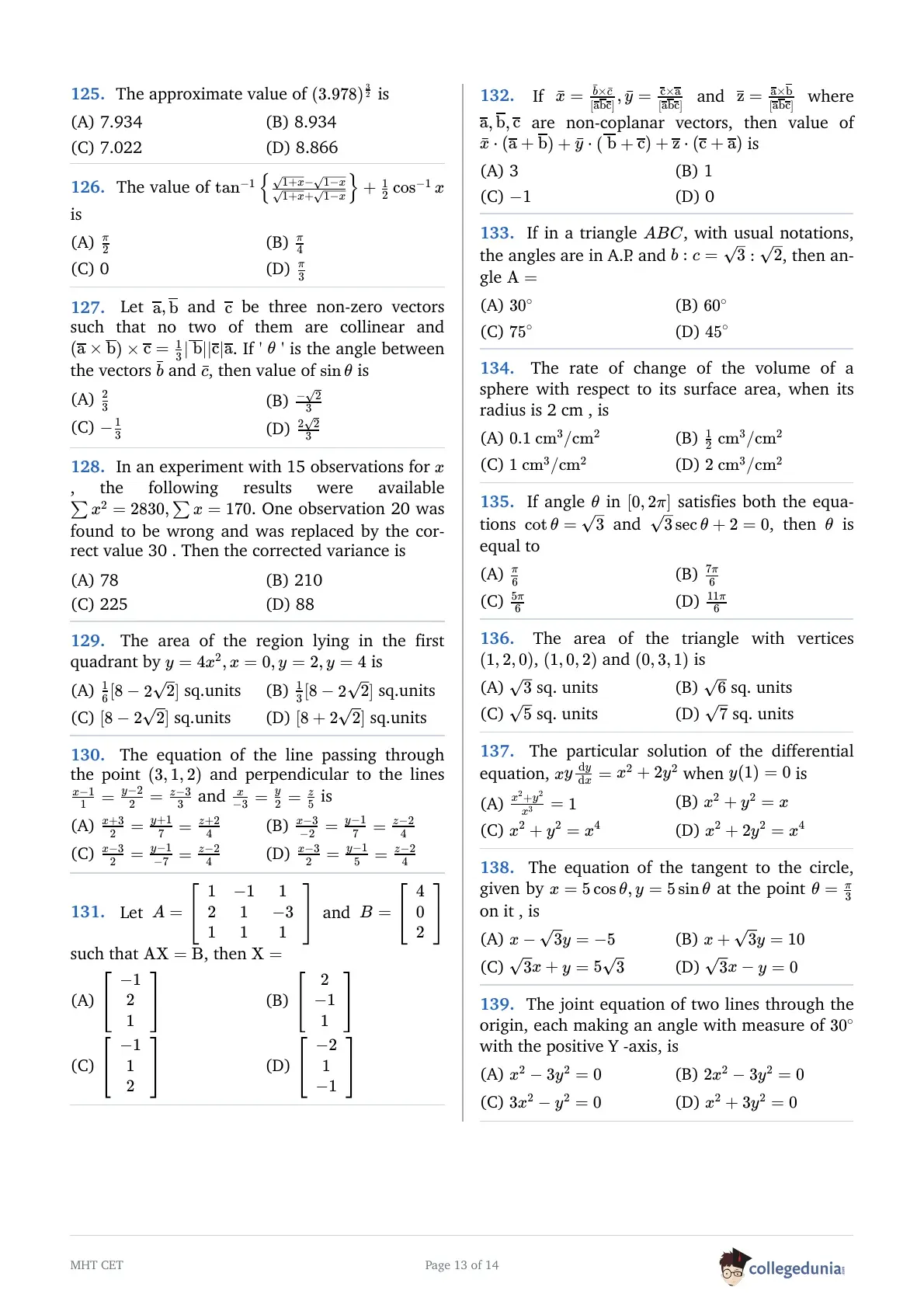
The approximate value of \((3.978)^{\frac{3}{2}}\) is

  • (A) 7.934
  • (B) 8.934
  • (C) 7.022
  • (D) 8.866

Question 126:

The value of \(\tan ^{-1}\left\{\frac{\sqrt{1+x}-\sqrt{1-x}}{\sqrt{1+x}+\sqrt{1-x}}\right\}+\frac{1}{2} \cos ^{-1} x\) is

  • (A) \(\frac{\pi}{2}\)
  • (B) \(\frac{\pi}{4}\)
  • (C) 0
  • (D) \(\frac{\pi}{3}\)

Question 127:

Let \(\overline{\mathrm{a}}, \overline{\mathrm{b}}\) and \(\overline{\mathrm{c}}\) be three non-zero vectors such that no two of them are collinear and \((\overline{\mathrm{a}} \times \overline{\mathrm{b}}) \times \overline{\mathrm{c}}=\frac{1}{3}|\overline{\mathrm{~b}}||\overline{\mathrm{c}}| \overline{\mathrm{a}}\). If ' \(\theta\) ' is the angle between the vectors \(\bar{b}\) and \(\bar{c}\), then value of \(\sin \theta\) is

  • (A) \(\frac{2}{3}\)
  • (B) \(\frac{-\sqrt{2}}{3}\)
  • (C) \(-\frac{1}{3}\)
  • (D) \(\frac{2\sqrt{2}}{3}\)

Question 128:

In an experiment with 15 observations for \(x\), the following results were available \(\sum x^2=2830, \sum x=170\). One observation 20 was found to be wrong and was replaced by the correct value 30 . Then the corrected variance is

  • (A) 78
  • (B) 210
  • (C) 225
  • (D) 88

Question 129:

The area of the region lying in the first quadrant by \(y=4 x^2, x=0, y=2, y=4\) is

  • (A) \(\frac{1}{6}[8-2\sqrt{2}]\) sq.units
  • (B) \(\frac{1}{3}[8-2\sqrt{2}]\) sq.units
  • (C) \([8-2\sqrt{2}]\) sq.units
  • (D) \([8+2\sqrt{2}]\) sq.units

Question 130:

The equation of the line passing through the point \((3,1,2)\) and perpendicular to the lines \(\frac{x-1}{1}=\frac{y-2}{2}=\frac{z-3}{3}\) and \(\frac{x}{-3}=\frac{y}{2}=\frac{z}{5}\) is

  • (A) \(\frac{x+3}{2}=\frac{y+1}{7}=\frac{z+2}{4}\)
  • (B) \(\frac{x-3}{-2}=\frac{y-1}{7}=\frac{z-2}{4}\)
  • (C) \(\frac{x-3}{2}=\frac{y-1}{-7}=\frac{z-2}{4}\)
  • (D) \(\frac{x-3}{2}=\frac{y-1}{5}=\frac{z-2}{4}\)

Question 131:

Let \(A=\left[\begin{array}{ccc}1 & -1 & 1 \\ 2 & 1 & -3 \\ 1 & 1 & 1\end{array}\right]\) and \(B=\left[\begin{array}{l}4 \\ 0 \\ 2\end{array}\right]\) such that \(\mathrm{AX}=\mathrm{B}\), then \(\mathrm{X}=\)

  • (A) \(\left[\begin{array}{c} -1 \\ 2 \\ 1 \end{array}\right]\)
  • (B) \(\left[\begin{array}{c} 2 \\ -1 \\ 1 \end{array}\right]\)
  • (C) \(\left[\begin{array}{c} -1 \\ 1 \\ 2 \end{array}\right]\)
  • (D) \(\left[\begin{array}{c} -2 \\ 1 \\ -1 \end{array}\right]\)

Question 132:

If \(\bar{x}=\frac{\bar{b} \times \bar{c}}{[\overline{\mathrm{a}} \overline{\mathrm{b}} \overline{\mathrm{c}}]}, \bar{y}=\frac{\overline{\mathrm{c}} \times \overline{\mathrm{a}}}{[\overline{\mathrm{a}} \overline{\mathrm{b}} \overline{\mathrm{c}}]}\) and \(\overline{\mathrm{z}}=\frac{\overline{\mathrm{a}} \times \overline{\mathrm{b}}}{[\overline{\mathrm{a}} \overline{\mathrm{b}} \overline{\mathrm{c}}]}\) where \(\overline{\mathrm{a}}, \overline{\mathrm{b}}, \overline{\mathrm{c}}\) are non-coplanar vectors, then value of \(\bar{x} \cdot(\overline{\mathrm{a}}+\overline{\mathrm{b}})+\bar{y} \cdot(\overline{\mathrm{~b}}+\overline{\mathrm{c}})+\overline{\mathrm{z}} \cdot(\overline{\mathrm{c}}+\overline{\mathrm{a}})\) is

  • (A) 3
  • (B) 1
  • (C) \(-\)1
  • (D) 0

Question 133:

If in a triangle \(A B C\), with usual notations, the angles are in A.P. and \(b: c=\sqrt{3}: \sqrt{2}\), then angle \(\mathrm{A}=\)

  • (A) \(30^{\circ}\)
  • (B) \(60^{\circ}\)
  • (C) \(75^{\circ}\)
  • (D) \(45^{\circ}\)

Question 134:

The rate of change of the volume of a sphere with respect to its surface area, when its radius is 2 cm , is

  • (A) \(0.1\text{ }\mathrm{cm}^{3}/\mathrm{cm}^{2}\)
  • (B) \(\frac{1}{2}\text{ }\mathrm{cm}^{3}/\mathrm{cm}^{2}\)
  • (C) \(1\text{ }\mathrm{cm}^{3}/\mathrm{cm}^{2}\)
  • (D) \(2\text{ }\mathrm{cm}^{3}/\mathrm{cm}^{2}\)

Question 135:

If angle \(\theta\) in \([0,2 \pi]\) satisfies both the equations \(\cot \theta=\sqrt{3}\) and \(\sqrt{3} \sec \theta+2=0\), then \(\theta\) is equal to

  • (A) \(\frac{\pi}{6}\)
  • (B) \(\frac{7\pi}{6}\)
  • (C) \(\frac{5\pi}{6}\)
  • (D) \(\frac{11\pi}{6}\)

Question 136:

The area of the triangle with vertices \((1,2,0)\), \((1,0,2)\) and \((0,3,1)\) is

  • (A) \(\sqrt{3}\) sq. units
  • (B) \(\sqrt{6}\) sq. units
  • (C) \(\sqrt{5}\) sq. units
  • (D) \(\sqrt{7}\) sq. units

Question 137:

The particular solution of the differential equation, \(x y \frac{\mathrm{~d} y}{\mathrm{~d} x}=x^2+2 y^2\) when \(y(1)=0\) is

  • (A) \(\frac{x^{2}+y^{2}}{x^{3}}=1\)
  • (B) \(x^{2}+y^{2}=x\)
  • (C) \(x^{2}+y^{2}=x^{4}\)
  • (D) \(x^{2}+2y^{2}=x^{4}\)

Question 138:

The equation of the tangent to the circle, given by \(x=5 \cos \theta, y=5 \sin \theta\) at the point \(\theta=\frac{\pi}{3}\) on it , is

  • (A) \(x-\sqrt{3}y=-5\)
  • (B) \(x+\sqrt{3}y=10\)
  • (C) \(\sqrt{3}x+y=5\sqrt{3}\)
  • (D) \(\sqrt{3}x-y=0\)

Question 139:

The joint equation of two lines through the origin, each making an angle with measure of \(30^{\circ}\) with the positive Y -axis, is

  • (A) \(x^{2}-3y^{2}=0\)
  • (B) \(2x^{2}-3y^{2}=0\)
  • (C) \(3x^{2}-y^{2}=0\)
  • (D) \(x^{2}+3y^{2}=0\)

Question 140:

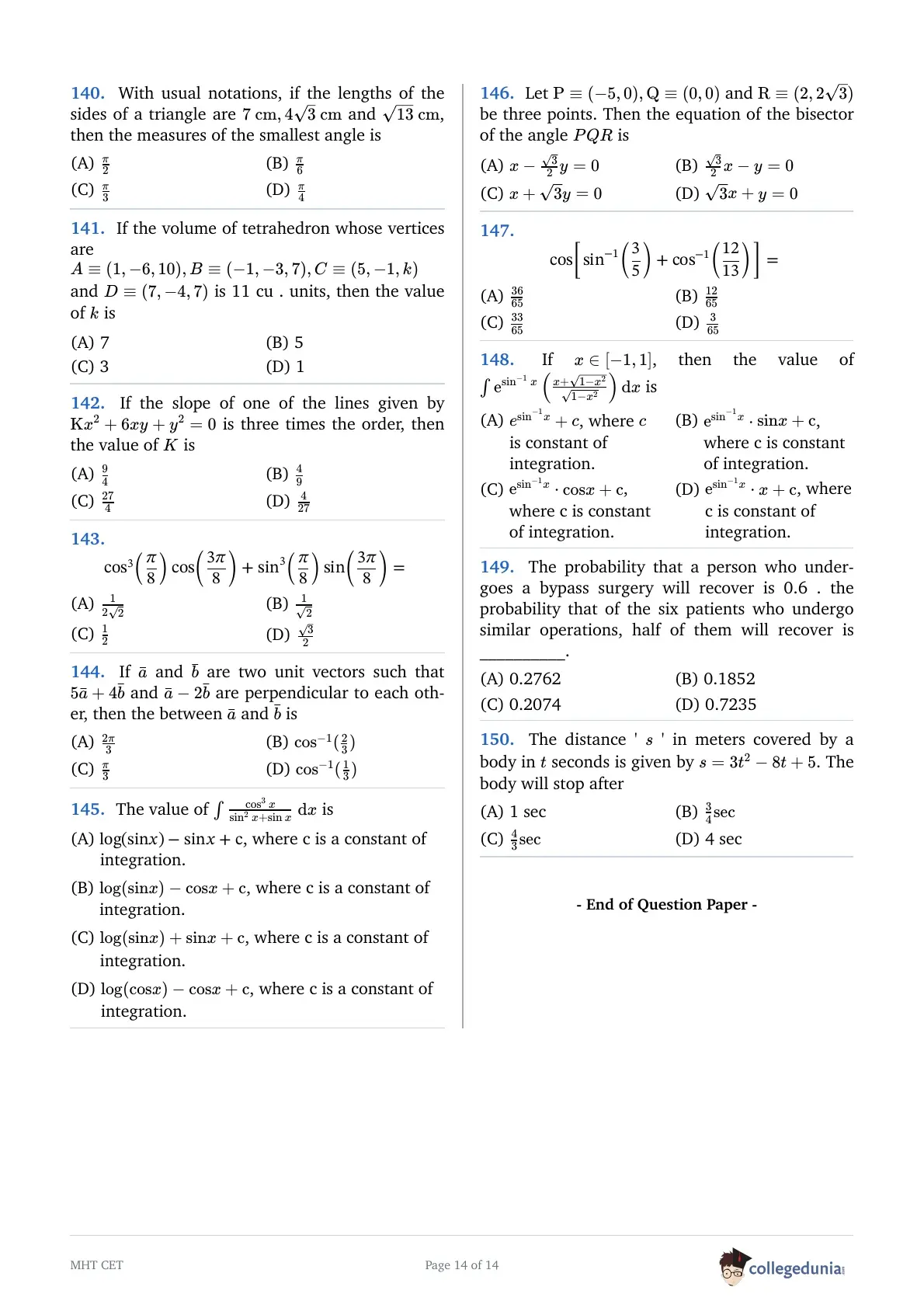
With usual notations, if the lengths of the sides of a triangle are \(7 \mathrm{~cm}, 4 \sqrt{3} \mathrm{~cm}\) and \(\sqrt{13} \mathrm{~cm}\), then the measures of the smallest angle is

  • (A) \(\frac{\pi}{2}\)
  • (B) \(\frac{\pi}{6}\)
  • (C) \(\frac{\pi}{3}\)
  • (D) \(\frac{\pi}{4}\)

Question 142:

If the slope of one of the lines given by \(\mathrm{K} x^2+6 x y+y^2=0\) is three times the order, then the value of \(K\) is

  • (A) \(\frac{9}{4}\)
  • (B) \(\frac{4}{9}\)
  • (C) \(\frac{27}{4}\)
  • (D) \(\frac{4}{27}\)

Question 143:

\[ \cos ^3\left(\frac{\pi}{8}\right) \cos \left(\frac{3 \pi}{8}\right)+\sin ^3\left(\frac{\pi}{8}\right) \sin \left(\frac{3 \pi}{8}\right)=\]

  • (A) \(\frac{1}{2\sqrt{2}}\)
  • (B) \(\frac{1}{\sqrt{2}}\)
  • (C) \(\frac{1}{2}\)
  • (D) \(\frac{\sqrt{3}}{2}\)

Question 144:

If \(\bar{a}\) and \(\bar{b}\) are two unit vectors such that \(5 \bar{a}+4 \bar{b}\) and \(\bar{a}-2 \bar{b}\) are perpendicular to each other, then the between \(\bar{a}\) and \(\bar{b}\) is

  • (A) \(\frac{2\pi}{3}\)
  • (B) \(\mathrm{cos}^{-1}(\frac{2}{3})\)
  • (C) \(\frac{\pi}{3}\)
  • (D) \(\mathrm{cos}^{-1}(\frac{1}{3})\)

Question 145:

The value of \(\int \frac{\cos ^3 x}{\sin ^2 x+\sin x} \mathrm{~d} x\) is

  • (A) \(\mathrm{log}(\mathrm{sin}x)-\mathrm{sin}x+\mathrm{c}\), where c is a constant of integration.
  • (B) \(\mathrm{log}(\mathrm{sin}x)-\mathrm{cos}x+\mathrm{c}\), where c is a constant of integration.
  • (C) \(\mathrm{log}(\mathrm{sin}x)+\mathrm{sin}x+\mathrm{c}\), where c is a constant of integration.
  • (D) \(\mathrm{log}(\mathrm{cos}x)-\mathrm{cos}x+\mathrm{c}\), where c is a constant of integration.

Question 146:

Let \(\mathrm{P} \equiv(-5,0), \mathrm{Q} \equiv(0,0)\) and \(\mathrm{R} \equiv(2,2 \sqrt{3})\) be three points. Then the equation of the bisector of the angle \(P Q R\) is

  • (A) \(x-\frac{\sqrt{3}}{2}y=0\)
  • (B) \(\frac{\sqrt{3}}{2}x-y=0\)
  • (C) \(x+\sqrt{3}y=0\)
  • (D) \(\sqrt{3}x+y=0\)

Question 147:

\[\cos \left[\sin ^{-1}\left(\frac{3}{5}\right)+\cos ^{-1}\left(\frac{12}{13}\right)\right]=\]

  • (A) \(\frac{36}{65}\)
  • (B) \(\frac{12}{65}\)
  • (C) \(\frac{33}{65}\)
  • (D) \(\frac{3}{65}\)

Question 148:

If \(x \in[-1,1]\), then the value of \(\int \mathrm{e}^{\sin ^{-1} x}\left(\frac{x+\sqrt{1-x^2}}{\sqrt{1-x^2}}\right) \mathrm{d} x\) is

  • (A) \(e^{\mathrm{sin}^{-1}x}+c\), where \(c\) is constant of integration.
  • (B) \(\mathrm{e}^{\mathrm{sin}^{-1}x}\cdot \mathrm{sin}x+\mathrm{c}\), where c is constant of integration.
  • (C) \(\mathrm{e}^{\mathrm{sin}^{-1}x}\cdot \mathrm{cos}x+\mathrm{c}\), where c is constant of integration.
  • (D) \(\mathrm{e}^{\mathrm{sin}^{-1}x}\cdot x+\mathrm{c}\), where c is constant of integration.

Question 149:

The probability that a person who undergoes a bypass surgery will recover is 0.6 . the probability that of the six patients who undergo similar operations, half of them will recover is __________.

  • (A) 0.2762
  • (B) 0.1852
  • (C) 0.2074
  • (D) 0.7235

Question 150:

The distance ' \(s\) ' in meters covered by a body in \(t\) seconds is given by \(s=3 t^2-8 t+5\). The body will stop after

  • (A) 1 sec
  • (B) \(\frac{3}{4}\mathrm{sec}\)
  • (C) \(\frac{4}{3}\mathrm{sec}\)
  • (D) 4 sec

MHT CET 2024 PCM Exam Pattern and Marking Scheme

Parameter Details
Conducting Body Maharashtra Common Entrance Test Cell (Maharashtra CET Cell)
Exam Mode Online (Computer-Based Test)
Duration 180 minutes (3 hours)
Groups / Subjects PCM (Physics, Chemistry, Mathematics) for Engineering
Total Questions

150

Total Marks 200
Question Type Multiple Choice Questions (MCQs)
Marks Distribution
  • Mathematics – 2 marks/question
  • Physics and Chemistry – 1 mark/question
Negative Marking No
Syllabus Weightage
  • Class 12 – 80%
  • Class 11 – 20%