




MHT CET Syllabus 2027 is expected to be released by the State Common Entrance Test Cell (CET Cell), Maharashtra, at cetcell.mahacet.org. The syllabus covers Physics, Chemistry, and Mathematics for the PCM group (Engineering) and Physics, Chemistry, and Biology for the PCB group (Pharmacy and Health Sciences).
- The syllabus is based on Maharashtra State Board (MSBSHSE) Class 11 and 12 textbooks.
- As per MHT CET Syllabus 2027, 20% of questions will come from Class 11 topics and 80% from Class 12 topics.
- MHT CET Physics Syllabus includes important topics such as Kinetic theory, oscillations, electrostatics, rotational motion, electric current and EMI.
- Kinetic Theory, Oscillations and Rotational Motion are the high weightage Physics topics, contributing nearly 30% of the paper.
- MHT CET Syllabus for Maths covers Calculus, Vector 3D, Probability, Matrices, Trigonometry and Limits.
- Integration, Probability and Three dimensional Geometry covers nearly 30% of MHT CET Maths section.
- MHT CET Chemistry syllabus comprises Chemical Kinetics, block elements, Coordination Compounds and Basic Principles of Organic Chemistry.
- Chemical Kinetics, p- block elements, Aldehydes, Ketones and Carboxylic Acids covers 28- 30% of MHT CET Chemistry.
MHT CET 2027 is expected in two attempts- the first attempt in March 2027 and the second in May 2027.
Related Links:
-
MHT CET 2027 Chapter-Wise Weightage: Important Topics, Weightage & Previous Year Question Papers
-
MHT CET Exam Pattern 2027: Marking Scheme, Subject Weightage and Difficulty Level
MHT CET Syllabus 2027: Overview
The State Common Entrance Test Cell, Maharashtra, conducts MHT CET for admissions to undergraduate Engineering and Pharmacy programmes. The exam follows the MSBSHSE Class 11 and 12 curriculum — not a centrally prescribed syllabus like JEE Main.
| Detail | Information |
|---|---|
| Full Exam Name | Maharashtra Common Entrance Test (MHT CET) |
| Conducting Body | State Common Entrance Test Cell, Maharashtra |
| Official Website | cetcell.mahacet.org |
| Exam Mode | Computer Based Test (CBT) |
| Exam Frequency | Twice a year (two attempts in one cycle) |
| Groups Covered | PCM — Physics, Chemistry, Mathematics (for Engineering) PCB — Physics, Chemistry, Biology (for Pharmacy and Health Sciences) |
| Syllabus Basis | Maharashtra State Board (MSBSHSE) Class 11 and Class 12 curriculum |
| Class 11 Weightage | ~20% of questions |
| Class 12 Weightage | ~80% of questions |
| PCM Paper Structure | Mathematics: 50 questions × 2 marks = 100 marks Physics: 50 questions × 1 mark = 50 marks Chemistry: 50 questions × 1 mark = 50 marks Total: 200 marks |
| Negative Marking | No |
| Admissions For | B.E., B.Tech, B.Pharm, B.Sc. Agriculture, and related UG programmes in Maharashtra |
Related Links:
- MHTCET Topic-Wise Previous Year Questions (PYQs) with Solutions
- MHT CET 2027 Both Attempts Rescheduled After Class 12 Board Exams
MHT CET Syllabus 2027: What’s New?
The official MHT CET 2027 syllabus PDF has not been published as of October 2026. The revisions below reflect changes introduced in the 2026 cycle. These are expected to continue for 2027. Confirm the final topic list at cetcell.mahacet.org once the official PDF is published.
| Subject | Topics Added / Included | Topics Removed / Excluded |
|---|---|---|
| Mathematics (Class 11) |
| No change |
| Physics (Class 11) |
| — |
| Chemistry |
| — |
| Physics (Class 12) | — | No change (20 chapters retained) |
| Chemistry (Class 12) | — | No change (15 chapters retained) |
Also Check:
- MHT CET Mock Test (Available), Free Mock Test for PCM and PCB
- List of top Questions asked in MHT CET
Ques. Is the MHT CET 2027 syllabus the same as the 2026 syllabus?
Ans. The official MHT CET 2027 syllabus PDF has not been released as of October 2026. The 2027 syllabus is expected to be largely similar to 2026. The 2026 cycle added Conic Sections to Class 11 Mathematics and removed Measures of Dispersion. Confirm the final topic list at cetcell.mahacet.org once the official PDF is published.
MHT CET 2027 Syllabus for Physics
The MHT CET Physics syllabus draws from the Maharashtra State Board Class 11 and 12 curriculum. Class 12 topics carry approximately 80% weightage.
Focus on Rotational Motion, Oscillations, and Kinetic Theory as these chapters appear in almost every MHT CET paper.
MHT CET Syllabus 2027: Class 11 Physics Topics
| Unit | Chapter | Key Sub-topics |
|---|---|---|
| 1 | Measurements | Fundamental and derived units, dimensional analysis, significant figures, error analysis, least count of measuring instruments. |
| 2 | Scalars and Vectors | Vector addition and subtraction, dot product, cross product, position vector, unit vector, resolution of vectors into components. |
| 3 | Projectile Motion | Equations of motion, projectile path and range, horizontal and vertical components of velocity, relative velocity. |
| 4 | Laws of Motion | Newton’s three laws, static and kinetic friction, banking of roads, connected body problems, equilibrium of concurrent forces. |
| 5 | Friction in Solids and Liquids | Types of friction, coefficient of friction, viscosity, Stokes’ law, terminal velocity, Bernoulli’s theorem and applications. |
| 6 | Sound Waves | Wave equation, speed of sound in various media, Doppler effect, resonance column experiment, vibrations in musical instruments. |
| 7 | Thermal Properties of Matter | Temperature and heat, specific heat capacity, calorimetry, thermal expansion of solids and liquids, heat transfer by conduction, convection, and radiation. |
| 8 | Optics | Reflection and refraction at plane and curved surfaces, mirrors and lenses (lens maker’s equation), optical instruments, total internal reflection, dispersion through a prism. |
| 9 | Electrostatics | Coulomb’s law, electric field and electric potential, Gauss’s theorem, capacitors, dielectrics, energy stored in a capacitor. |
MHT CET Syllabus 2027: Class 12 Physics Topics
| Unit | Chapter | Key Sub-topics |
|---|---|---|
| 1 | Circular Motion | Angular velocity and acceleration, centripetal and centrifugal force, banking of roads, conical pendulum, vertical circular motion. |
| 2 | Gravitation | Newton’s law of gravitation, gravitational potential energy, orbital and escape velocity, satellites, Kepler’s three laws of planetary motion. |
| 3 | Rotational Motion | Moment of inertia, parallel and perpendicular axes theorems, angular momentum, torque, conservation of angular momentum, rolling motion on an inclined plane. |
| 4 | Oscillations | Simple harmonic motion — equations and graphs, energy in SHM, simple pendulum, damped and forced oscillations, resonance condition. |
| 5 | Elasticity | Stress, strain, Young’s modulus, bulk modulus, modulus of rigidity, elastic potential energy, stress-strain graph interpretation. |
| 6 | Surface Tension | Surface tension, surface energy, angle of contact, capillarity, excess pressure inside a liquid bubble or drop. |
| 7 | Wave Motion | Transverse and longitudinal waves, wave speed, equation of a progressive wave, superposition principle, formation of beats. |
| 8 | Stationary Waves | Formation of stationary waves, nodes and antinodes, modes of vibration, sonometer experiment, open and closed organ pipes. |
| 9 | Kinetic Theory of Gases and Radiation | Postulates of kinetic theory, RMS speed, mean free path, degrees of freedom, gas laws, thermal radiation, Wien’s law, Stefan’s law, Newton’s law of cooling. |
| 10 | Wave Theory of Light | Huygens’ wave theory, reflection and refraction using wave theory, Brewster’s law, polarisation of light. |
| 11 | Interference and Diffraction | Young’s double slit experiment, coherent sources, fringe width formula, thin film interference, single slit diffraction, resolving power of optical instruments. |
| 12 | Electrostatics (Class 12) | Coulomb’s law, electric field intensity and potential, capacitors in series and parallel, Van de Graaff generator, dielectric behaviour in a capacitor. |
| 13 | Current Electricity | Ohm’s law, resistance combinations (series and parallel), Kirchhoff’s laws, Wheatstone bridge, potentiometer, EMF and internal resistance of a cell. |
| 14 | Magnetic Effects of Electric Current | Biot-Savart law, Ampere’s theorem, solenoid and toroid, torque on a current-carrying conductor, galvanometer conversion to ammeter or voltmeter. |
| 15 | Magnetism | Bar magnet properties, magnetic field lines, magnetic moment, Earth’s magnetic field components, paramagnetism, diamagnetism, ferromagnetism. |
| 16 | Electromagnetic Induction | Faraday’s laws of electromagnetic induction, Lenz’s law, self and mutual inductance, AC generator, transformer, LC oscillations. |
| 17 | Electrons and Photons | Photoelectric effect, Einstein’s photoelectric equation, work function, threshold frequency, de Broglie wavelength, types of electron emission. |
| 18 | Atoms, Molecules and Nuclei | Bohr model of hydrogen atom, spectral series, nuclear binding energy, radioactivity (alpha, beta, gamma), half-life, nuclear fission and fusion. |
| 19 | Semiconductors | p-n junction diode, I-V characteristics, half-wave and full-wave rectifiers, Zener diode, transistor (BJT), logic gates (AND, OR, NOT, NAND, NOR). |
| 20 | Communication Systems | Modulation (AM and FM), bandwidth of signals, antennas, satellite communication, optical fibre communication, internet and mobile telephony basics. |
MHT CET Physics Chapter-wise Weightage
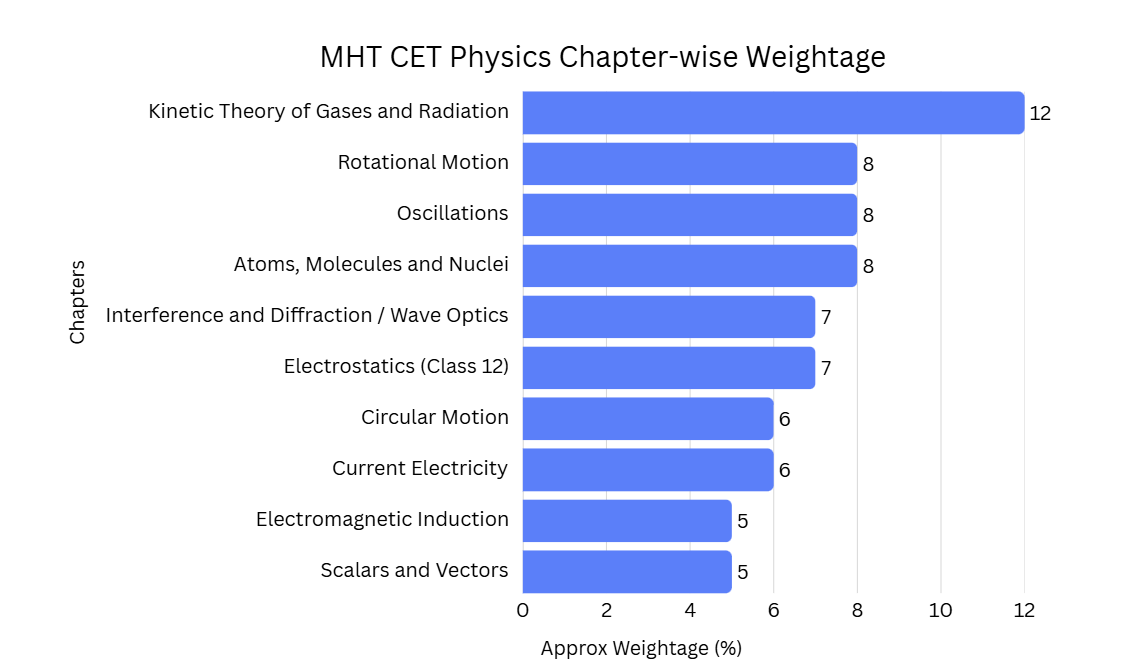
Based on past year trends, Kinetic Theory of Gases and Rotational Motion account for the highest share of Physics marks. The figures below are approximate estimates from previous paper analysis.
| Chapter | Class | Approx Weightage (%) |
|---|---|---|
| Kinetic Theory of Gases and Radiation | 12 | ~12% |
| Rotational Motion | 12 | ~8% |
| Oscillations | 12 | ~8% |
| Atoms, Molecules and Nuclei | 12 | ~8% |
| Interference and Diffraction / Wave Optics | 12 | ~7% |
| Electrostatics (Class 12) | 12 | ~7% |
| Circular Motion | 12 | ~6% |
| Current Electricity | 12 | ~6% |
| Electromagnetic Induction | 12 | ~5% |
| Scalars and Vectors | 11 | ~5% |
Related Article: MHT CET Physics Syllabus 2027: Check Physics Topic-wise Weightage, Recommended Physics Books, Preparation
Ques. Does MHT CET 2027 have negative marking?
Ans. No, MHT CET does not have negative marking. Attempt every question in both papers. For questions you are unsure about, use elimination to narrow the options before guessing. There is no penalty for a wrong answer, so leaving questions blank is never better than making an informed choice.
MHT CET 2027 Syllabus for Chemistry
The MHT CET Chemistry syllabus covers three broad areas: Physical Chemistry, Inorganic Chemistry, and Organic Chemistry.
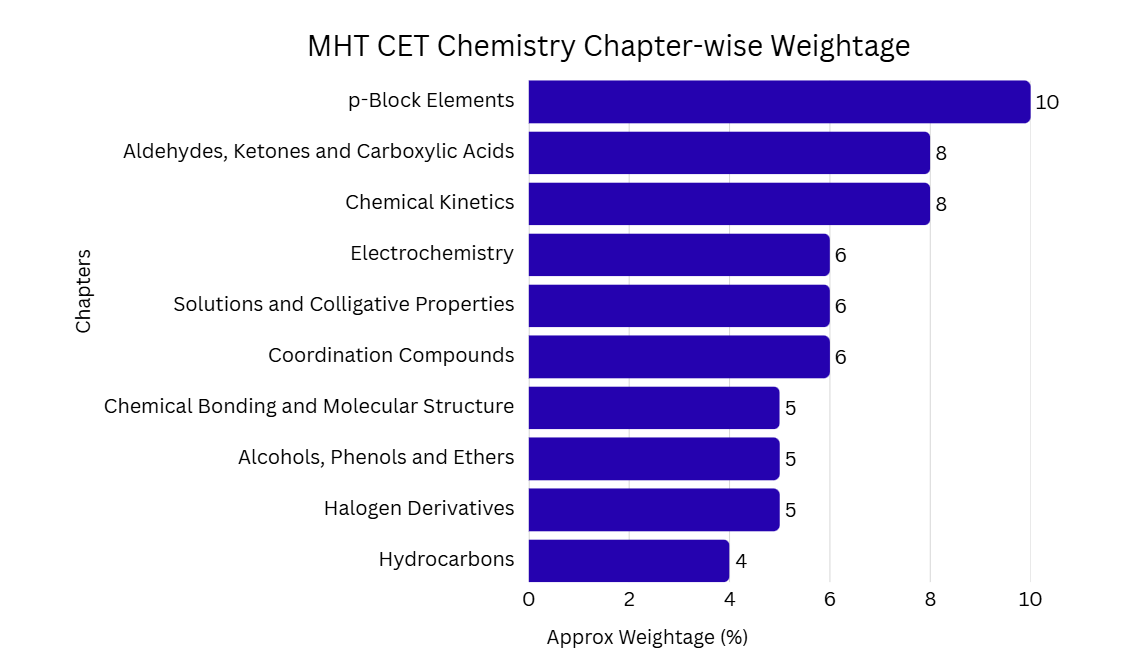
p-Block Elements, Chemical Kinetics, and Aldehydes & Ketones carry the highest weightage in MHT CET Chemistry.
MHT CET Syllabus 2027: Class 11 Chemistry Topics
| Unit | Chapter | Key Sub-topics |
|---|---|---|
| 1 | Some Basic Concepts of Chemistry | Mole concept, atomic and molecular mass, stoichiometry, percentage composition, empirical and molecular formula, limiting reagent. |
| 2 | Structure of Atom | Thomson and Bohr atomic models, quantum numbers, electronic configuration, aufbau principle, Pauli’s exclusion principle, Hund’s rule. |
| 3 | Chemical Bonding and Molecular Structure | Ionic bond, covalent bond, VSEPR theory, hybridisation (sp, sp2, sp3), molecular orbital theory, hydrogen bonding. |
| 4 | Redox Reactions | Oxidation state, balancing redox equations by half-reaction method, identifying oxidising and reducing agents. |
| 5 | States of Matter: Gaseous and Liquid | Boyle’s law, Charles’s law, Avogadro’s law, ideal gas equation, kinetic molecular theory, liquefaction of gases, surface tension, viscosity. |
| 6 | S-Block Elements | Properties of alkali metals (Group 1) and alkaline earth metals (Group 2), anomalous behaviour of lithium and beryllium, important compounds and industrial uses. |
| 7 | Basic Principles of Organic Chemistry | IUPAC nomenclature, classification of organic compounds, electronic effects (inductive, resonance, hyperconjugation), reaction intermediates (carbocation, carbanion, free radical). |
| 8 | Hydrocarbons | Alkanes (free radical halogenation), alkenes (addition reactions, Markovnikov’s rule), alkynes, benzene (electrophilic aromatic substitution reactions). |
| 9 | Environmental Chemistry | Air pollution, water pollution, soil pollution, greenhouse effect, ozone layer depletion, green chemistry principles. |
MHT CET Syllabus 2027: Class 12 Chemistry Topics
| Unit | Chapter | Key Sub-topics |
|---|---|---|
| 1 | Solid State | Crystal systems, unit cells, packing efficiency, tetrahedral and octahedral voids, types of defects in crystals. |
| 2 | Solutions and Colligative Properties | Types of solutions, Raoult’s law, elevation of boiling point, depression of freezing point, osmotic pressure, van’t Hoff factor. |
| 3 | Electrochemistry | Galvanic cells, standard electrode potential, Nernst equation, conductance, electrolytic cells, Faraday’s laws of electrolysis, batteries and fuel cells. |
| 4 | Chemical Kinetics | Rate of reaction, order and molecularity, rate law expression, integrated rate equations (zero, first, second order), Arrhenius equation, activation energy. |
| 5 | General Principles of Isolation of Elements | Occurrence of metals, concentration methods (froth flotation, magnetic separation), reduction methods (thermite, electrolytic), refining techniques. |
| 6 | p-Block Elements | Groups 15, 16, 17, 18: nitrogen, phosphorus, oxygen, sulphur, halogens, and noble gases — properties, important compounds, and industrial uses. |
| 7 | d and f Block Elements | Transition metals: general properties, variable valency, coloured compounds, catalytic behaviour; lanthanides and actinides (introductory overview). |
| 8 | Coordination Compounds | IUPAC nomenclature, types of ligands, coordination number, Werner’s theory, isomerism, bonding using VBT and Crystal Field Theory. |
| 9 | Halogen Derivatives | Nomenclature, SN1 and SN2 reaction mechanisms, elimination reactions (E1 and E2), polyhalogen compounds and their uses. |
| 10 | Alcohols, Phenols and Ethers | Nomenclature, reactions of primary, secondary, and tertiary alcohols; acidity of phenol; ether synthesis and cleavage reactions. |
| 11 | Aldehydes, Ketones and Carboxylic Acids | Nucleophilic addition reactions, Cannizzaro reaction, aldol condensation, oxidation of aldehydes, preparation of carboxylic acid derivatives. |
| 12 | Organic Compounds Containing Nitrogen | Classification of amines, preparation and chemical reactions, diazonium salts and their synthetic applications, cyanides and isocyanides. |
| 13 | Biomolecules | Carbohydrates (monosaccharides, disaccharides, polysaccharides), proteins (amino acids, peptide bond, structure levels), enzymes, nucleic acids (DNA and RNA). |
| 14 | Polymers | Classification (natural and synthetic), addition and condensation polymerisation, rubber, nylon, polyesters, Bakelite, biodegradable polymers. |
| 15 | Chemistry in Everyday Life | Medicines (analgesics, antiseptics, antacids, antibiotics), dyes, soaps and detergents, food preservatives and additives. |
MHT CET Chemistry Chapter-wise Weightage
| Chapter | Class | Approx Weightage (%) |
|---|---|---|
| p-Block Elements | 12 | ~10% |
| Aldehydes, Ketones and Carboxylic Acids | 12 | ~8% |
| Chemical Kinetics | 12 | ~8% |
| Electrochemistry | 12 | ~6% |
| Solutions and Colligative Properties | 12 | ~6% |
| Coordination Compounds | 12 | ~6% |
| Chemical Bonding and Molecular Structure | 11 | ~5% |
| Alcohols, Phenols and Ethers | 12 | ~5% |
| Halogen Derivatives | 12 | ~5% |
| Hydrocarbons | 11 | ~4% |
Related Article: MHT CET Chemistry Syllabus 2027: Check Topic-Wise Weightage, Important Topics, & Best Books
Ques. When will the MHT CET 2027 first attempt be held?
Ans. The MHT CET 2027 first attempt is expected in March 2027. The second attempt is expected in May 2027. Check cetcell.mahacet.org for the official schedule once the 2027 notification is published.
MHT CET 2027 Syllabus for Mathematics
Each Mathematics question carries 2 marks; double the value of a Physics or Chemistry question.
Integration, Calculus,Three-Dimensional Geometry, and Trigonometry are frequently asked topics in MHT CET Maths.
MHT CET Syllabus 2027: Class 11 Mathematics Topics
| Unit | Chapter | Key Sub-topics |
|---|---|---|
| 1 | Trigonometric Functions | Angle measurement (degrees and radians), trigonometric ratios and identities, compound angles, multiple and sub-multiple angles, general solutions of trigonometric equations. |
| 2 | Straight Lines | Locus of a point, slope, equations of a line (slope-intercept, intercept, normal forms), angle between two lines, perpendicular distance from a point to a line. |
| 3 | Circles | Standard and general equations of a circle, finding centre and radius, chord of contact, tangent from an external point. |
| 4 | Conic Sections | Parabola, ellipse, hyperbola — standard equations, focus, directrix, eccentricity, tangents and normals at a point on the curve. (Added in 2026 revision.) |
| 5 | Sets, Relations and Functions | Types of sets, Cartesian product, relations (domain and range), types of functions, composition of functions, inverse functions. |
| 6 | Complex Numbers | Algebra of complex numbers, modulus and argument, polar form, De Moivre’s theorem, square root of a complex number. |
| 7 | Permutations and Combinations | Factorial notation, fundamental counting principle, nPr and nCr formulas, circular permutations, applications in selection and arrangement problems. |
| 8 | Sequences and Series | Arithmetic progression (AP), geometric progression (GP), sum of AP and GP, sum of infinite GP, harmonic progression. |
| 9 | Limits and Derivatives | Evaluation of limits using standard results, continuity at a point, differentiation by first principles, standard differentiation rules (chain, product, quotient). |
MHT CET Syllabus 2027: Class 12 Mathematics Topics
| Unit | Chapter | Key Sub-topics |
|---|---|---|
| 1 | Mathematical Logic | Statements, logical connectives (conjunction, disjunction, negation, implication, biconditional), truth tables, tautology, logical equivalence, switching circuits. |
| 2 | Matrices | Types of matrices, matrix operations (addition and multiplication), transpose, inverse, solving systems of linear equations using Cramer’s rule and matrix method. |
| 3 | Trigonometric Functions (Inverse) | Domain and range of inverse trigonometric functions, principal value, properties and identities, simplification of expressions involving inverse trig functions. |
| 4 | Pair of Straight Lines | Combined equation of a pair of lines, angle between them, conditions for perpendicularity and coincidence, homogeneous equations of second degree. |
| 5 | Circle | Tangent to a circle, condition of tangency, chord of contact, length of common chord of two intersecting circles, angle of intersection of two circles. |
| 6 | Conics | Parabola, ellipse, and hyperbola at Class 12 level — tangents, normals, chord of contact, pole and polar, equation of chord with given midpoint. |
| 7 | Vectors | Representation of vectors, dot product, cross product, scalar triple product, vector triple product, applications in geometry (collinearity, coplanarity, area of triangle). |
| 8 | Three Dimensional Geometry | Direction cosines and ratios, equation of a line in 3D (Cartesian and vector forms), shortest distance between skew lines, equation of a plane, angle between a line and a plane. |
| 9 | Linear Programming | Formulation of LPP, graphical method, feasible region, corner point method, finding maximum and minimum values of the objective function. |
| 10 | Continuity and Differentiability | Continuity at a point and on an interval, differentiability, chain rule, implicit differentiation, parametric differentiation, higher order derivatives. |
| 11 | Applications of Derivatives | Rate of change, tangent and normal to a curve, increasing and decreasing functions, maxima and minima (first and second derivative tests), approximations using differentials. |
| 12 | Integration | Methods of integration (substitution, partial fractions, integration by parts), integrals of standard functions, definite integrals, properties of definite integrals, fundamental theorem of calculus. |
| 13 | Applications of Integrals | Area under a curve, area between two curves, areas bounded by standard curves (parabola, ellipse, circle) using definite integrals. |
| 14 | Differential Equations | Order and degree, variable separable method, homogeneous differential equations, linear first-order differential equations (integrating factor method). |
| 15 | Probability Distribution | Random variable, probability distribution table, expected value (mean), variance, standard deviation of a discrete random variable. |
| 16 | Binomial Distribution | Bernoulli trials, binomial distribution formula, mean and variance of a binomial distribution, practical applications in probability problems. |
MHT CET Mathematics Chapter-wise Weightage
| Chapter | Class | Approx Weightage (%) |
|---|---|---|
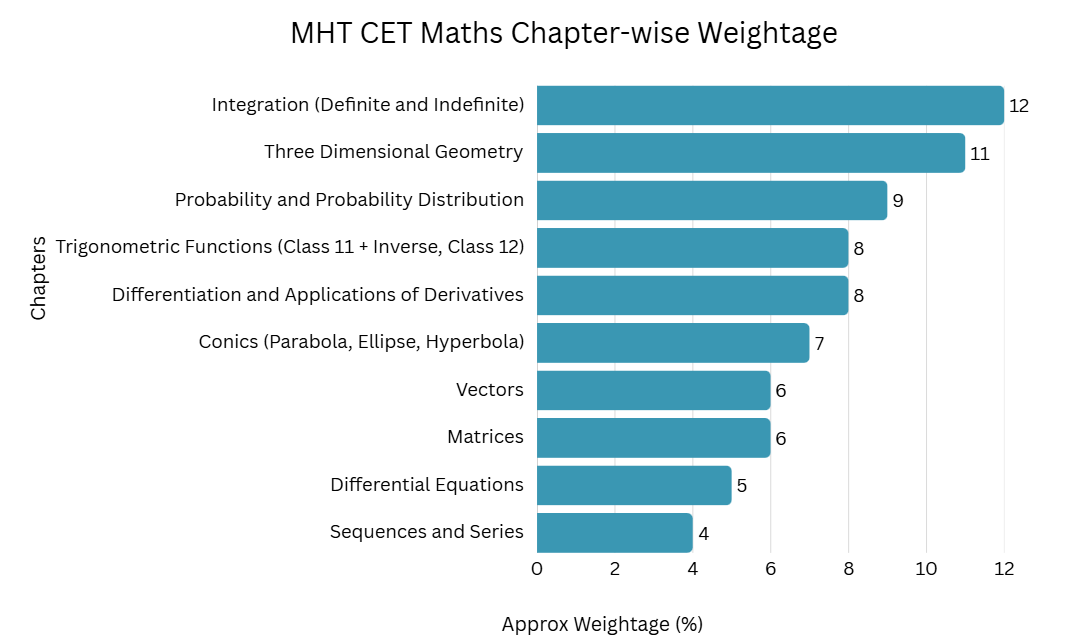
| Integration (Definite and Indefinite) | 12 | ~12% |
| Three Dimensional Geometry | 12 | ~11% |
| Probability and Probability Distribution | 12 | ~9% |
| Trigonometric Functions (Class 11 + Inverse, Class 12) | 11 & 12 | ~8% |
| Differentiation and Applications of Derivatives | 12 | ~8% |
| Conics (Parabola, Ellipse, Hyperbola) | 11 & 12 | ~7% |
| Vectors | 12 | ~6% |
| Matrices | 12 | ~6% |
| Differential Equations | 12 | ~5% |
| Sequences and Series | 11 | ~4% |
Ques. How should I cover the full MHT CET syllabus in two months?
Ans. Spend Month 1 entirely on Class 12 chapters as they carry 80% of the exam. Focus on Mathematics first: Integration, 3D Geometry, and Trigonometry. Then cover Physics: Kinetic Theory, Rotational Motion, and Oscillations. For Chemistry, target p-Block, Chemical Kinetics, and Organic chapters. Use Month 2 for Class 11 revision and full-length CBT mock tests. Solving the last three years’ MHT CET papers in CBT mode is essential before the exam day.
MHT CET 2027 Syllabus for Biology (PCB Group)
The Biology syllabus applies to PCB group students seeking admission to Pharmacy, Agriculture, and Health Sciences programmes. The paper covers Botany and Zoology equally — 50 questions each for a total of 100 marks.
MHT CET Syllabus 2027 for Biology: Botany (Class 11 + 12)
| Unit | Chapter | Key Sub-topics |
|---|---|---|
| 1 | Diversity in Living World | Classification systems, five-kingdom classification, binomial nomenclature, ICBN rules, taxonomic hierarchy. |
| 2 | Cell Biology and Cell Division | Cell theory, prokaryotic and eukaryotic cells, cell organelles and functions, mitosis, meiosis, significance of cell division. |
| 3 | Structural Organisation in Plants | Root, stem, and leaf anatomy; meristematic and permanent tissues; modifications of root, stem, and leaf; anatomy of dicot and monocot. |
| 4 | Plant Physiology | Photosynthesis (light and dark reactions), respiration (glycolysis, Krebs cycle), mineral nutrition, water transport, plant hormones (auxins, gibberellins, cytokinins). |
| 5 | Reproduction in Plants | Vegetative, asexual, and sexual reproduction; flower structure; pollination mechanisms; double fertilisation; seed and fruit development. |
| 6 | Genetics and Molecular Biology | Mendel’s laws, chromosomal theory of inheritance, sex determination, linkage and crossing over, mutations, DNA and RNA structure, protein synthesis. |
MHT CET Syllabus 2027 for Biology: Zoology (Class 11 + 12)
| Unit | Chapter | Key Sub-topics |
|---|---|---|
| 1 | Animal Kingdom | Classification and characteristics of animal phyla, comparative anatomy, levels of organisation (cellular to organ system level). |
| 2 | Structural Organisation in Animals | Animal tissues (epithelial, connective, muscular, nervous), morphology and anatomy of earthworm and cockroach. |
| 3 | Human Physiology | Digestion and absorption, breathing and gas exchange, blood composition and circulation, excretion (kidney function), neural and hormonal coordination. |
| 4 | Reproduction in Animals | Human reproductive system (male and female), gametogenesis (spermatogenesis and oogenesis), fertilisation, embryo development, placentation. |
| 5 | Human Health and Disease | Pathogens and types, innate and adaptive immunity, vaccines and immunisation, common diseases (typhoid, malaria, dengue, AIDS), drugs and alcohol abuse. |
| 6 | Biotechnology and Applications | Recombinant DNA technology, PCR, gene cloning, transgenic organisms, bioreactors, applications in medicine (insulin, vaccines) and agriculture (Bt crops). |
Ques. Is Rotational Motion important for MHT CET Physics?
Ans. Yes, Rotational Motion is one of the highest-weightage chapters in MHT CET Physics (~7–8%). Focus on moment of inertia, parallel and perpendicular axes theorems, angular momentum, torque, and rolling motion. Combined with Circular Motion, these two chapters account for roughly 14% of Physics questions.
MHT CET Syllabus 2027: Chapter-Wise Weightage Summary
The table below consolidates the most important chapters across PCM subjects. The CET Cell does not publish an official chapter-wise weightage list. These estimates come from analysis of past MHT CET papers.
| Subject | High-Weightage Chapters | Approx Questions | Approx Marks |
|---|---|---|---|
| Mathematics | Integration, Three Dimensional Geometry, Probability Distribution, Trigonometry | 20–22 out of 50 | 40–44 marks (at 2 marks each) |
| Physics | Kinetic Theory of Gases, Rotational Motion, Oscillations, Atoms and Nuclei | 16–18 out of 50 | 16–18 marks (at 1 mark each) |
| Chemistry | p-Block Elements, Chemical Kinetics, Aldehydes & Ketones, Electrochemistry | 16–18 out of 50 | 16–18 marks (at 1 mark each) |
Mathematics questions carry 2 marks each. Scoring well in Integration and Three Dimensional Geometry alone can add 20–24 marks to your total PCM score.
Also Read:
- MHT CET Chapter Wise Weightage: Chemistry
- MHT CET: Physics Chapters That Carry the Most Weight
-
MHT CET Maths Strategy: High-Scoring Topics You Shouldn’t Skip
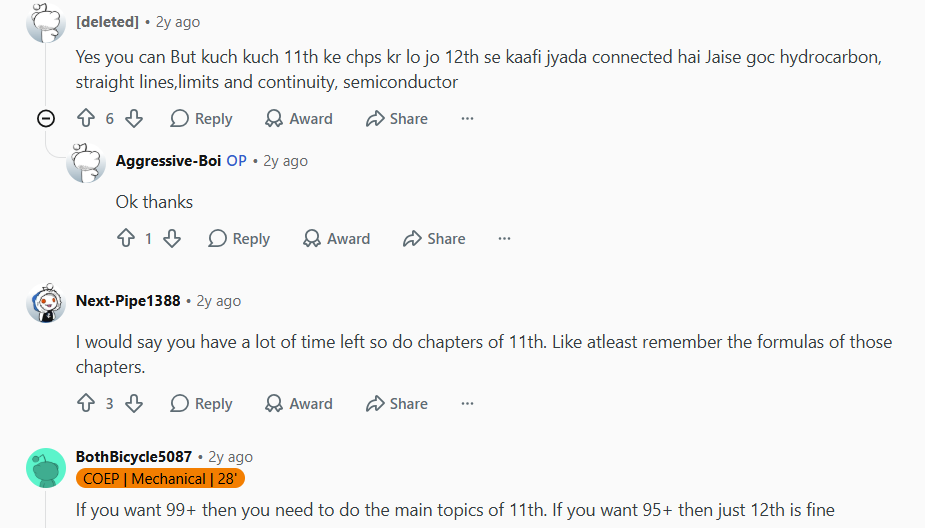
In discussion forum such as Reddit, a user asked “as only 20% of the weightage is there for 11th can i only rely on 12th syllabus for MHT CET ?” So based on this, a user said that yes you can skip 11 chapters to score around 95+ percentile in MHT CET. But to score 99+ percentile do not avoid Class 11 topics for MHT CET. Focus on GOC, Hydrocarbon, Straight Lines, Limits and Continuity, and Semiconductor as they are related to 12 topics as well and will help you to cover MHT CET Syllabus.
Source: Reddit
Ques. Has the MHT CET syllabus been revised for 2027?
Ans. The official 2027 revision has not been announced as of October 2026. The 2026 cycle added Conic Sections to Class 11 Mathematics and removed Measures of Dispersion. If a 2027 revision is announced, the CET Cell will publish an updated syllabus PDF at cetcell.mahacet.org.
MHT CET Syllabus 2027 vs Previous Year
The MHT CET syllabus has stayed largely stable over recent years. The comparison below uses the 2026 cycle as reference. Confirm the final 2027 topic list from the official PDF at cetcell.mahacet.org once it is published.
| Subject | MHT CET 2026 Syllabus | MHT CET 2027 Syllabus (Expected) | Change |
|---|---|---|---|
| Mathematics (Class 11) | Measures of Dispersion included; Conic Sections not at Class 11 | Conic Sections added | Revised |
| Mathematics (Class 11) | Vectors not covered at Class 11 level | Basic Vectors introduced at Class 11 | Addition |
| Physics (Class 11) | Basic error analysis within Measurements | Strengthened Error Analysis coverage | Minor revision |
| Chemistry | Chemistry in Everyday Life at Class 12 only | Extended coverage to Class 11 level (expected) | Minor addition |
| Physics (Class 12) | 20 chapters | 20 chapters- unchanged expected | No change |
| Chemistry (Class 12) | 15 chapters | 15 chapters- unchanged expected | No change |
Download the official MHT CET 2027 syllabus PDF from cetcell.mahacet.org and verify the final topic list before finalising your study plan.
Related Articles:-
How to Attempt 150 MHT CET Questions Without Losing Accuracy
-
MHT CET Paper Analysis: PCM Exam, Shift-wise Analysis, Difficulty Level, & Subject-wise Weightage
Ques. Which are the most important chapters in Mathematics for MHT CET?
Ans. The most important Mathematics chapters are Integration (~12% weightage), Three Dimensional Geometry (~11%), and Probability Distribution (~9%). Trigonometric Functions contribute another ~8%. Each Mathematics question is worth 2 marks. Mastering these chapters directly raises your final score.
Best Books for MHT CET 2027
Prioritise the Maharashtra State Board textbooks above all else. Direct theory questions in MHT CET regularly come from these books. Use reference titles for additional numerical practice and MCQ exposure.
| Subject | Book Name | Author / Publisher | Why This Book |
|---|---|---|---|
| Physics | Concepts of Physics (Vol. 1 & 2) | H.C. Verma | Builds strong conceptual foundation; numerical exercises closely match MHT CET question style |
| Physics | Target MHT CET Physics | Marvel Publication | Aligned with Maharashtra State Board curriculum; MCQ bank covers past year question patterns |
| Chemistry | Physical Chemistry (Numerical Problems) | P. Bahadur | Extensive numerical practice for Physical Chemistry — ideal for Electrochemistry and Chemical Kinetics |
| Chemistry | Target MHT CET Chemistry | Marvel Publication | State-board aligned; covers Organic and Inorganic Chemistry at the right exam depth |
| Mathematics | MCQ Mathematics for MHT CET | Hemant G. Ainapure / Marvel Publication | Most widely used MHT CET Mathematics guide; full Class 11 + 12 coverage with MCQ practice sets |
| Mathematics | Objective Mathematics | R.D. Sharma | Comprehensive topic coverage across all chapters; builds speed for competitive MCQ-format exams |
| All Subjects | Maharashtra State Board Textbooks (Class 11 & 12) | MSBSHSE / Balbharati | Primary exam source — direct questions come from these books; non-negotiable for MHT CET preparation |
Also Read: MHT CET Books 2027: Best Books for Physics, Chemistry, Maths and Biology
How to Download MHT CET Syllabus 2027 PDF
Follow these steps to download the official MHT CET 2027 syllabus PDF from the CET Cell’s website.
- Visit the official website at cetcell.mahacet.org.
- Look for the "MHT CET 2027" section or the "Syllabus / Information Brochure" link on the homepage.
- Click the syllabus link — a PDF will open in a new browser tab.
- Press Ctrl + S (Windows) or Cmd + S (Mac) to save the PDF to your device.
- Alternatively, click the download icon in your PDF viewer to save the file directly.
Note: The MHT CET 2027 syllabus PDF has not been released as of October 2026. Bookmark cetcell.mahacet.org and check the Notifications section regularly for the official release.
MHT CET 2027 Preparation Tips
The first attempt is expected in December 2026. Mathematics carries double marks per question — a small gain in Mathematics has a bigger percentile impact than the same effort in Physics or Chemistry.
Mathematics Preparation Tips
- Start with Integration — it has the highest weightage (~12%) and rewards consistent daily practice.
- Cover Three Dimensional Geometry next; it appears predictably in every MHT CET paper.
- Practise inverse trigonometric functions alongside direct trigonometry — both appear frequently in MHT CET.
- Solve at least 50 Probability Distribution problems; question types repeat and are easy to score once you recognise the patterns.
- Each Mathematics question carries 2 marks — scoring well in Integration and 3D Geometry alone can significantly raise your percentile.
Also Check: MHT CET Mathematics Mock Test (Available), Free Mock Test for MHT CET
Physics Preparation Tips
- Master Kinetic Theory of Gases first — it appears in nearly every MHT CET Physics paper (~12% weightage).
- Rotational Motion and Oscillations together contribute roughly 16% of Physics marks — cover them early in your schedule.
- Use H.C. Verma for concept building, then switch to MHT CET-specific MCQ banks for speed practice.
- Revisit your Maharashtra State Board Class 12 Physics textbook derivations — the CET Cell frequently frames questions around them.
- Don’t skip Wave Optics — past paper analysis shows it contributes more questions than most students expect.
Also Check: MHT CET Physics Mock Test (Available), Free Mock Test for MHT CET
Chemistry Preparation Tips
- Finish p-Block Elements early; its ~10% weightage makes it the single most important Chemistry chapter.
- Chemical Kinetics and Electrochemistry are formula-heavy — maintain a dedicated formula sheet for each.
- Organic Chemistry questions (Aldehydes, Ketones, Halogen Derivatives) test reaction mechanisms; practise MCQs on reaction equations.
- Revisit Class 11 chapters — Hydrocarbons and Chemical Bonding together appear in 8–10% of Chemistry questions.
- Solve all in-text and end-of-chapter questions from your State Board Chemistry textbook before any reference book.
Also Check: MHT CET Chemistry Mock Test 2026 (Available), Free Mock Test for MHT CET
General Strategy
- MHT CET has no negative marking — attempt every question in both papers.
- Class 12 topics account for ~80% of the paper; prioritise them over Class 11 topics in your schedule.
- If you appear in both attempts, use the first attempt as a diagnostic to identify weak chapters for the second.
- Solve at least five full-length mock tests in CBT mode before the exam to build time management habits.
Related Links:
- MHT CET PCM Question Paper (Available)- Download Previous Years MHT CET Papers
- MHT CET PCB Question Paper (Available)- Download Previous Years MHT CET Papers [2024-2015]
Download MHT CET Previous Year Question Paper PDFs
MHT CET Syllabus 2027 FAQs
Ques. Which subject has the highest weightage in MHT CET?
Ans. Mathematics has the highest effective weightage in MHT CET. Each Mathematics question carries 2 marks. Physics and Chemistry questions carry 1 mark each. The 50-question Mathematics paper is worth 100 marks — equal to the combined total of Physics and Chemistry together.
Ques. Is NCERT enough for MHT CET 2027 preparation?
Ans. NCERT alone is not sufficient for MHT CET. The exam is based on the Maharashtra State Board (MSBSHSE) curriculum. This differs from NCERT in several topics. Key differences appear in Physics (Kinetic Theory structure, radiation topics) and Mathematics (Mathematical Logic, specific Trigonometry chapters). Prioritise Maharashtra State Board textbooks first. Use NCERT only as a supplementary resource.
Ques. Where can I download the MHT CET 2027 official syllabus PDF?
Ans. The official MHT CET 2027 syllabus PDF will be available at cetcell.mahacet.org. As of October 2026, the PDF has not been released. The CET Cell is expected to publish it in October 2026. Bookmark the official website and check the Notifications section regularly for updates.
Ques. How many chapters are in the MHT CET 2027 PCM syllabus?
Ans. Physics has 9 Class 11 chapters and 20 Class 12 chapters. Chemistry has 9 Class 11 chapters and 15 Class 12 chapters. Mathematics has 9 Class 11 chapters and 16 Class 12 chapters. The PCB group additionally covers approximately 6 chapters each in Botany and Zoology — drawn from Class 11 and 12 combined.
Ques. What books should I follow for Chemistry in MHT CET?
Ans. Start with the Maharashtra State Board Class 11 and 12 Chemistry textbooks. For Physical Chemistry numericals, use P. Bahadur’s guide. For Organic Chemistry reactions, O.P. Tandon is widely recommended. The Marvel Target MHT CET Chemistry book is closely aligned with the state-board curriculum and includes past-year MCQs.



Comments
Found 3 Comments
The important topics for biology in MHT CET are human physiology, human reproduction & reproductive health, origin & evolution, animal husbandry, and many more with good weightage.
The syllabus of MHT CET is based on the 12th class topics of the Maharashtra State board and a few topics from 11 class books. 12th class has 80% weightage in the exam and class 11 has 20%.