




MHT CET syllabus is based on the Maharashtra State Board Class 11 and Class 12 curriculum. As per MHT CET Chemistry Syllabus 2027, 80% weightage is given to Class 12 topics and 20% weightage to Class 11. Your primary focus of preparation should be on the Class 12 syllabus.
- Candidates appearing for PCM should know that 25% weightage is assigned to MHT CET Chemistry Syllabus.
- MHT CET Chemistry syllabus for Class 12 includes Chemical Thermodynamics, Coordination Compounds, Chemical Kinetics, Inorganic and Organic Chemistry.
- Important topics of MHT CET Class 11 Chemistry include Chemical Bonding, Basic Concepts of Chemistry, Hydrocarbons, and Molecular Structure.
- Chemical Thermodynamics, p-Block Elements, and Coordination Compounds together account for close to 32% of MHT CET Chemistry chapter wise weightage.
- According to MHT CET exam pattern, Chemistry section has 50 MCQs worth 1 mark; no negative marking for incorrect answers.
Related Articles:
- MHT CET Syllabus 2027: Subject-Wise Topics, Weightage and PDF
- MHT CET Chapterwise Weightage 2027: 50% Maths and Biology Weightage, Important Chapters
Key Summary
- The difficulty level of MHT CET Chemistry is easy to moderate based on students' reviews and past years' paper analysis.
- Preparation should be strictly on Maharashtra State Board textbooks for Classes 11 and 12 Chemistry for MHT CET 2027.
- MHT CET Chemistry is scoring and more straightforward than Physics and Maths sections.
- The MHT CET Chemistry question pattern is theoretical, conceptual and simple calculation-based.
- The question split is around 40% Organic Chemistry and 30% each from Physical and Inorganic Chemistry.
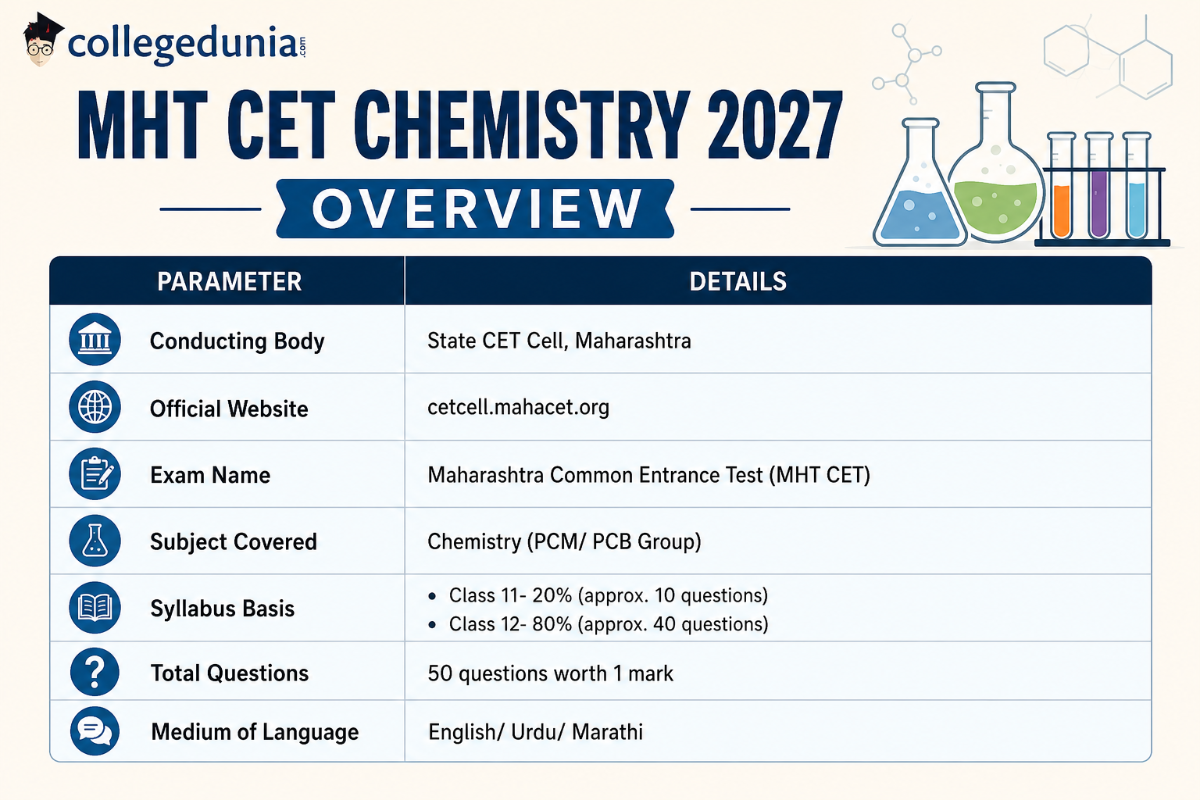
MHT CET Chemistry Overview 2027
The MHT CET Chemistry Syllabus 2027 is prescribed by the State Common Entrance Test Cell, Maharashtra.
| Parameter | Details |
|---|---|
| Conducting Body | State CET Cell, Maharashtra |
| Official Website | cetcell.mahacet.org |
| Exam Name | Maharashtra Common Entrance Test (MHT CET) |
| Subject Covered | Chemistry (PCM/ PCB Group) |
| Syllabus Basis |
|
| Total Questions | 50 questions worth 1 mark |
| Medium of Language | English/ Urdu/ Marathi |
Related Articles:
- Courses Offered under MHT CET- Colleges, Eligibility, and Future Career Options
- High Weightage Topics in MHT CET- Check 15 Most Repeated Chapters
Ques. What is the difficulty level of MHT CET Chemistry 2027?
Ans. As specified by the State CET Cell, the difficulty level of MHT CET Chemistry is at par with JEE Main. Questions are application-based and direct tests, so speed and accuracy are crucial since you must attempt 50 questions in 90 minutes.
MHT CET Chemistry Syllabus 2027
The table below details the chapter list of MHT CET Chemistry Syllabus for Classes 11 and 12. Candidates are advised to complete the MHT CET Chemistry Syllabus of Class 12 first as it has 80% weightage.
MHT CET Chemistry Syllabus Class 11 Topics
Only select chapters from Class 11 are part of the MHT CET Chemistry syllabus. These chapters have 20% weightage and can significantly affect your percentile, so do not skip them.
| Chapters/ Units of MHT CET Chemistry Class 11 Syllabus | |||
|---|---|---|---|
| Basic Concept of Chemistry | Structure of Atom | Chemical Bonding | Redox Reaction |
| Elements of Group 1 and 2 | States of Matter (Gaseous and Liquids) | Adsorption and Colloids (Surface Chemistry) | Hydrocarbons |
| Basic Principles of Organic Chemistry | Chemistry in Everyday Life | ||
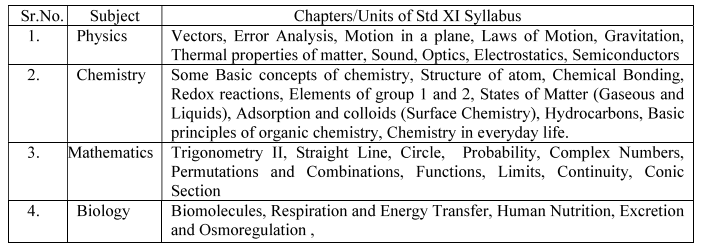
Source: cetcell.mahacet.org
MHT CET Chemistry Syllabus Class 12 Topics
MHT CET Chemistry syllabus is common to both PCM and PCB groups. You should treat it as your scoring subject, since most questions come directly from the state board textbook.
- Physical Chemistry needs numerical practice, while Inorganic and Organic Chemistry require revising definitions and reactions word for word.
- According to the MHT CET syllabus, do not skip p-Block Elements and Coordination Compounds, since these two units together carry close to 17% weightage every year.
| Area | Unit/Chapter |
|---|---|
| Physical Chemistry |
|
| Inorganic Chemistry |
|
| Organic Chemistry |
|
| Applied Chemistry |
|
Watch the video to know the complete list of the syllabus for MHT CET 2027 by Pradeep Giri Sir for PCM and PCB students;
Related Article: MHT CET Chapter Wise Weightage: Most Important Chapters & High Scoring Topics
Ques. Can I get VJTI with 93 percentile in MHT CET?
Ans. Getting admission to VJTI Mumbai with a 93 percentile in MHT CET is extremely difficult for general category students. You may get low-demand or specialized branches if you belong to specific reserved categories.
Important Topics of MHT CET Chemistry to Score 99 Percentile
The MHT CET Chemistry important topics to score 99 percentile in this section are listed below:
| Important Chapters of MHT CET Chemistry 2027 | Expected Number of Questions |
|---|---|
| Aldehydes and Ketones | 5 Questions (Highly Predictable) |
| Alcohols, Phenols and Ethers | 4 Questions (Formula Driven) |
| Coordination Compound | 4 Questions (Named Reaction) |
| P- Block Elements | 4 Questions (Direct) |
| Biomolecules | 3 Questions (Pure memory) |
Watch the YouTube video to know how to score 45+ marks out of 50 asked in Vedantu Maharashtra 11th and 12th Academy.
Related Articles:
- MHT CET PCM Question Paper- Download Previous Years MHT CET Papers
- MHT CET PCB Question Paper- Download Previous Years MHT CET Papers
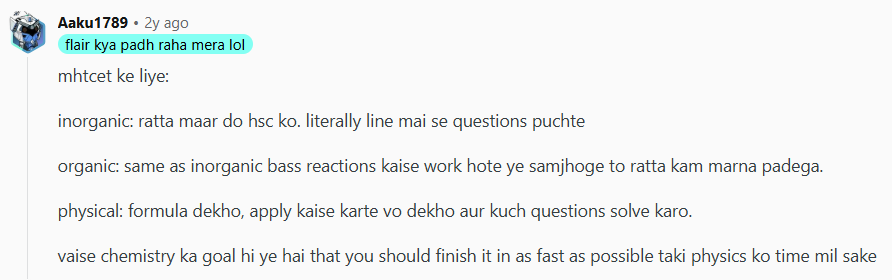
According to a Reddit post, a user wanted to know what strategy to follow to score 99.5 to secure admission at VJTI.
So a user commented that for Physical Chemistry, read line by line from the state textbook, as direct questions are asked.
Organic Chemistry: Same as inorganic; just understand how reactions work
Physics Chemistry: Learn how to apply formulas
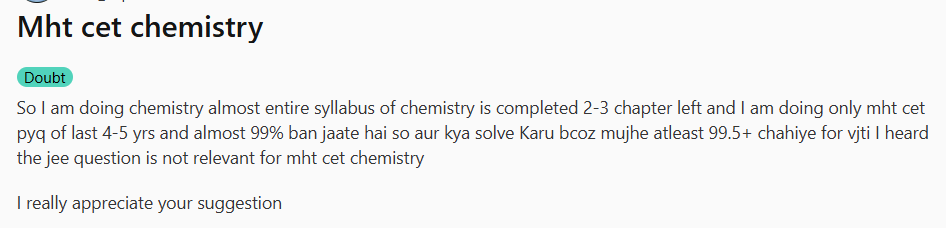
Source: Reddit
Ques. Can I get COEP with 99.5 percentile in MHT CET?
Ans. Yes, with 99.5 percentile in MHT CET you will get admission to COEP college in core engineering or allied courses. CSE will be available for reserved category candidates.
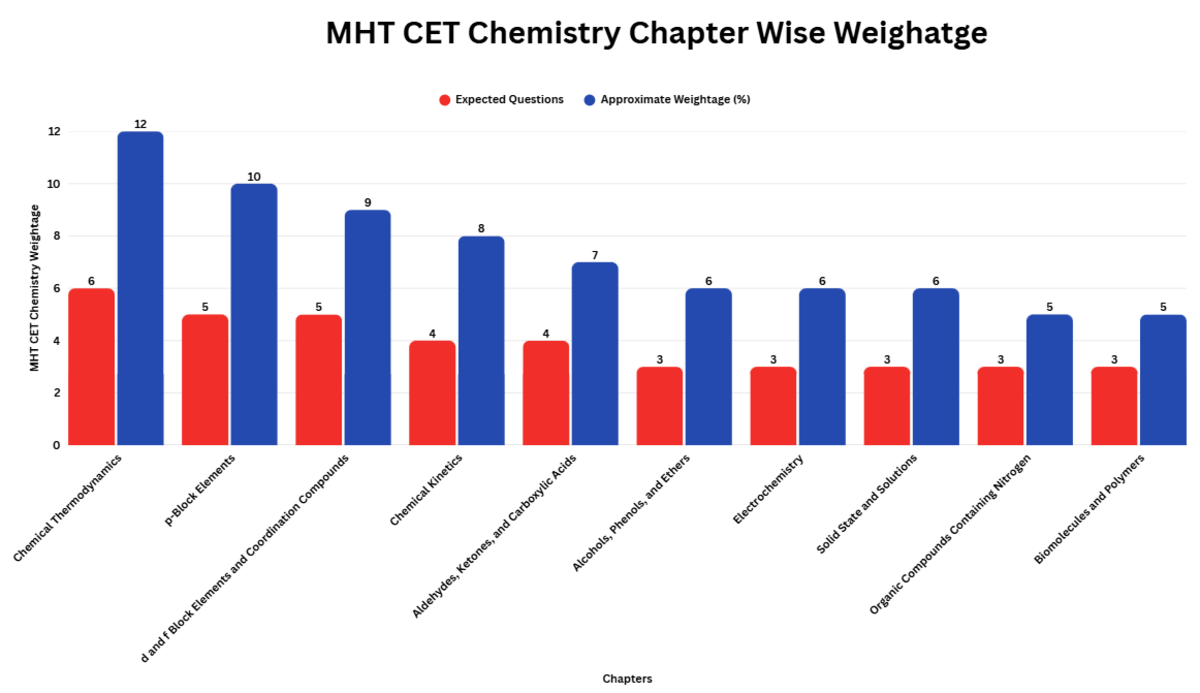
MHT CET Chemistry Chapter Wise Weightage 2027
Chemistry rewards students who revise reactions and definitions closely to the textbook. The Chemistry Chapter wise weightage below have been observed across recent MHT CET papers.
Chemical Thermodynamics, p-Block Elements and Coordination Compounds together carry close to 30% weightage.
| Chapter | Approximate Weightage (%) | Expected Questions | Priority |
|---|---|---|---|
| Chemical Thermodynamics | 12% | 6 | Very High |
| p-Block Elements | 10% | 5 | Very High |
| d and f Block Elements and Coordination Compounds | 9% | 4-5 | Very High |
| Chemical Kinetics | 8% | 4 | Very High |
| Aldehydes, Ketones, and Carboxylic Acids | 7% | 3-4 | Very High |
| Alcohols, Phenols, and Ethers | 6% | 3 | Very High |
| Electrochemistry | 6% | 3 | High |
| Solid State and Solutions | 6% | 3 | Moderate to High |
| Organic Compounds Containing Nitrogen | 5% | 2-3 | Moderate |
| Biomolecules and Polymers | 5% | 2-3 | Moderate |
Watch the video to know about MHT CET Chemistry chapter wise weightage 2027
- The video covers the MHT CET Exam Pattern and Marking Scheme
- It describes the subject-wise important chapters along with weightages for your MHT CET 2027.
Also Read: MHT CET Chapter Wise Weightage: Chemistry
Ques. Can non-Maharashtra board students appear for MHT CET Chemistry?
Ans. Yes, students from other boards, such as CBSE or ICSE, are eligible to appear for MHT CET. They should align their preparation with the Maharashtra HSC syllabus, as the MHT CET strictly follows it.
Most Repetitive Topics in MHT CET Chemistry 2027
The table below lists the most repetitive topics from which questions are asked in MHT CET Chemistry:
| Chapters | Repetitive Topics |
|---|---|
| Solid State | Numerical on Density and Frenkel Defects |
| Solutions and Colligative Properties | Colligative Properties, Van't Hoff Factor and Henry's Law |
| Ionic Equilibrium | Conjugate Acid-Base Pair, Ksp and Solubility, Buffer Solution (Numerical) |
| Chemical Thermodynamics | Thermochemistry (Numerical), Work Done and FLOAT |
| Electrochemistry | Conductivity, Molar Conductivity, Use of Electrochemical Series, Calculation of Ecell |
| Chemical Kinetics | Rate Law, Integrated Rate Law and Arrhenius Equation |
| Halogen Derivatives | Chemical Properties of R- X |
| Alcohol/ Phenol/ Ether | Preparation of Alcohol/ Phenol, Physical Properties and Acid Nature |
| Aldehyde, Ketone and Acid | Cannizzaro Rxn, Aldol Condensation, Reagents, Clemenson’s Rxn and Wolf-Kishner Rxn |
| Amines | Diazo Salt Rxn, Hinsberg Reagent, Carbylamine Test |
| Biomolecules | Amino Acid, N- bases in DNA |
| Polymers | Classification of Polymers and their Uses |
| Elements of Group 16, 17, 18 | Periodic Properties 16, 17 and 18, Anomalous Nature and Important Compounds |
| Transition and Inner Transition | Magnetic Moment, EC, Important Compounds |
Watch the YouTube video by PW MHT CET to know repetitive topics of MHT CET Chemistry 2027 in detail:
Related Articles:
- How to Attempt 150 MHT CET Questions Without Losing Accuracy
- MHT CET Paper Analysis: PCM Exam, Shift-wise Analysis, Difficulty Level, & Subject-wise Weightage
Ques. Is MHT-CET easier than NEET?
Yes. MHT CET is generally considered easier than NEET. The questions in MHT CET are more direct and formula-based, whereas NEET requires deep conceptual understanding and a wider syllabus.
Best Books for MHT CET Chemistry 2027
The best book for MHT CET Chemistry chapter wise weightage is tabulated below.
- You should treat this as your most scoring subject with the right book combination.
- Give extra revision time on p-Block Elements and Coordination Compounds, since these chapters carry a large share of Chemistry marks every year.
| Book Name | Author/Publisher | Why This Book |
|---|---|---|
| Maharashtra State Board Chemistry Textbook (Class 11 and 12) | MSBSHSE | Covers most Inorganic and Organic Chemistry questions directly |
| Chemistry for MHT CET | Target Publications | Chapter-wise MCQs with named reactions and mechanisms |
| MHT CET Triumph Chemistry | Target Publications | Strong for Physical Chemistry numerical practice |
| Numerical Chemistry | P. Bahadur | Useful for extra practice in Thermodynamics and Electrochemistry |
Related Articles: MHT CET Books 2027: Best Books for Physics, Chemistry, Maths and Biology
How to Download MHT CET Chemistry Syllabus 2027 PDF
Follow these steps to download the official MHT CET Chemistry syllabus PDF from the State CET Cell's website.
- Step 1: Visit the official website at cetcell.mahacet.org.
- Step 2: Look for the "MHT CET 2027" section or the "Syllabus" link on the homepage or under the latest notifications tab.
- Step 3: Click on the syllabus link. A PDF file will open in a new browser tab.
- Step 4: Press Ctrl + S (Windows) or Cmd + S (Mac) to save the file to your device.
- Step 5: Alternatively, click the download icon in your PDF viewer to save the file locally.
Note: The official MHT CET 2027 syllabus PDF is not yet released.

Related Article: MHT CET Exam Pattern 2027: Marking Scheme, Subject Weightage and Difficulty Level
Ques. Is 20,000 a good rank in MHT CET?
Ans. A rank of 20,000 in MHT CET is decent and can secure admission to good mid-tier private colleges. It typically corresponds to roughly a 90 to 95 percentile, depending on the year's competition.
Preparation Tips for MHT CET Chemistry Syllabus Wise 2027
Candidates preparing for MHT CET Chemistry should understand the 80/20 golden rule. Chemistry is direct and scoring only when you plan strategically.
- Complete the syllabus thoroughly from your Maharashtra State Board textbooks of Class 11 and 12.
- Practice 50 PYQs per chapter.
- Take full-length mock tests with complete error analysis
- Prepare the high-weightage chapters of MHT CET Chemistry to score maximum marks.
Follow these to score 45+ out of 50 in MHT CET Chemistry:
| Priority Order | Unit/ Chapter | Subject Wise Mastery Methods | Focus |
|---|---|---|---|
| Priority 1 | Organic Chemistry |
| Named Reactions, Conversions, Reagent-Based Questions as high frequency in paper |
| Priority 2 | Inorganic Chemistry |
| p-Block, d-Block, Coordination Compounds- Read thoroughly through textbook |
| Priority 3 | Physical Chemistry |
| Electrochemistry, Kinetics and Solution- Learn Key formulas and practice 20 numericals each |
Watch the YouTube video to know how to score 45+ marks out of 50 asked in Vedantu Maharashtra 11th and 12th Academy.
Related Articles:
- MHT CET Preparation: Check Strategy, Resources, Time Management, Mock Tests
- MHT CET Chemistry Mock Test Free Mock Test for MHT CET
Ques. Is MHT CET very tough?
Ans. No, MHT-CET is generally not considered very tough conceptually, but it is competitive, fast and demanding on time management.
Common Mistakes to Avoid While Preparing for MHT CET Chemistry 2027
Common Mistakes you should avoid while preparing for MHT CET Chemistry 2027 are:
- No revision cycle, which means you will forget the concepts without revision
- Ignoring Theory- focusing only on numericals while 60% of your questions are theory-based
- No PYQ practice- previous year paper pattern helps you understand the high-frequency topics.
- Random Study Routine- This is the most common mistake students make. You should always study strategically by focusing on Chemistry chapter wise weightage.
Also Read: MHT CET Sample Paper
MHT CET Chemistry Syllabus 2027 FAQs
Ques. How many chapters are there in MHT CET Syllabus?
Ans. The MHT CET syllabus includes the entire Class 12 curriculum (80% weightage) and selected topics from Class 11 (20% weightage). Across the core subjects, there are roughly 70 to 80 combined main chapters/units specified by the State CET Cell Maharashtra.
Ques. Is 70 a good score in MHT CET?
Ans. No, a score of 70 is not considered a good score in MHT CET. With 70 marks, you can expect your percentile to be around 70 to 82, making you eligible for private colleges across Maharashtra.
Ques. Can I crack MHT CET in 40 days?
Ans. Yes, you can crack MHT CET in 40 days by focusing on high-weightage topics. You need to follow smart study routines and focus on giving regular mock tests. After every mock test analyze it to understand your strengths and weaknesses. Regularly revise topics, formulas and practice timed tests.
Ques. Is 40,000 a good rank in MHT CET?
Ans. No, 40000 is not a good rank in MHT CET. You will not get CSE specializations at any top colleges. You have a strong chance of securing mid-tier private colleges in core and allied engineering courses.



Comments