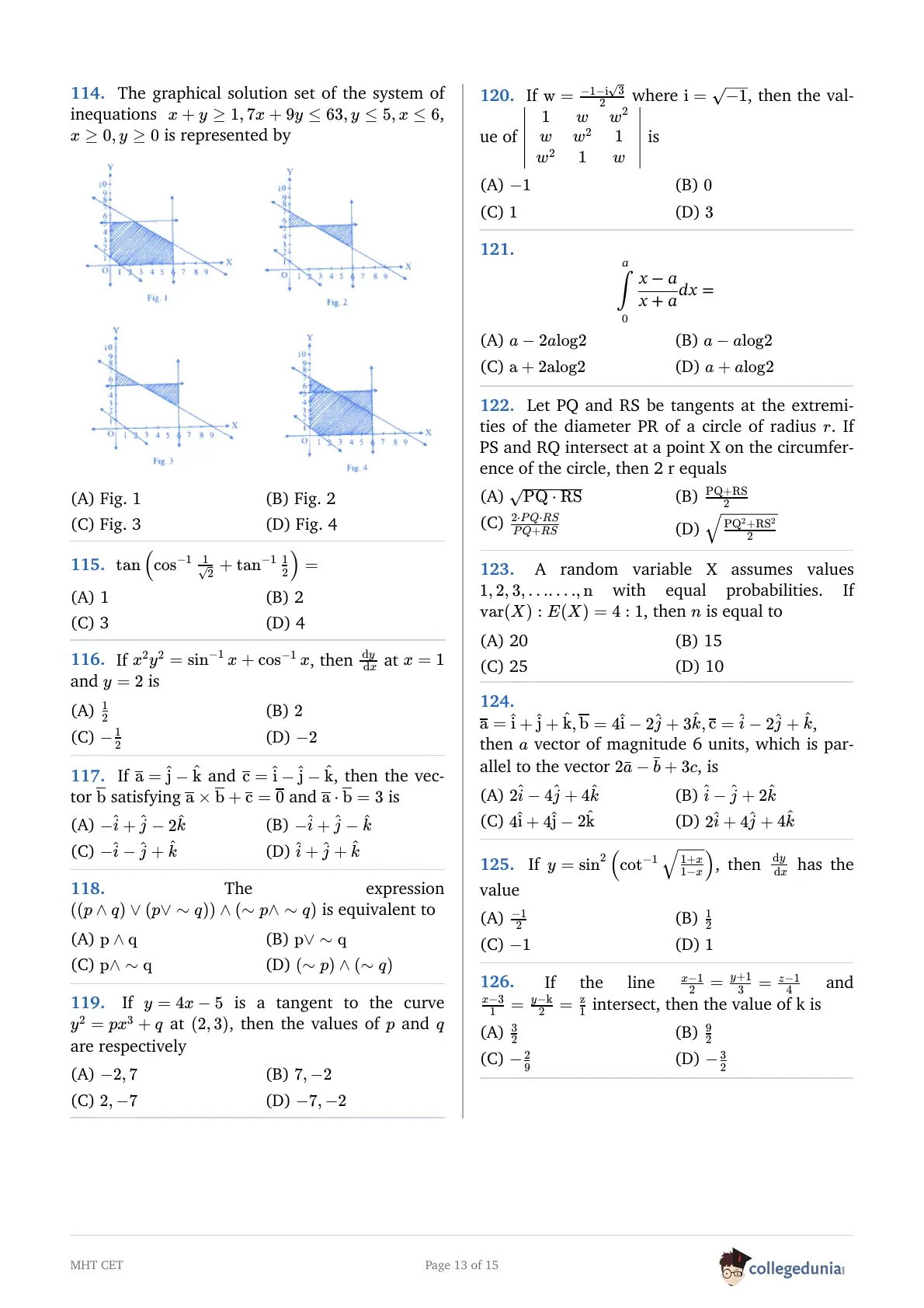
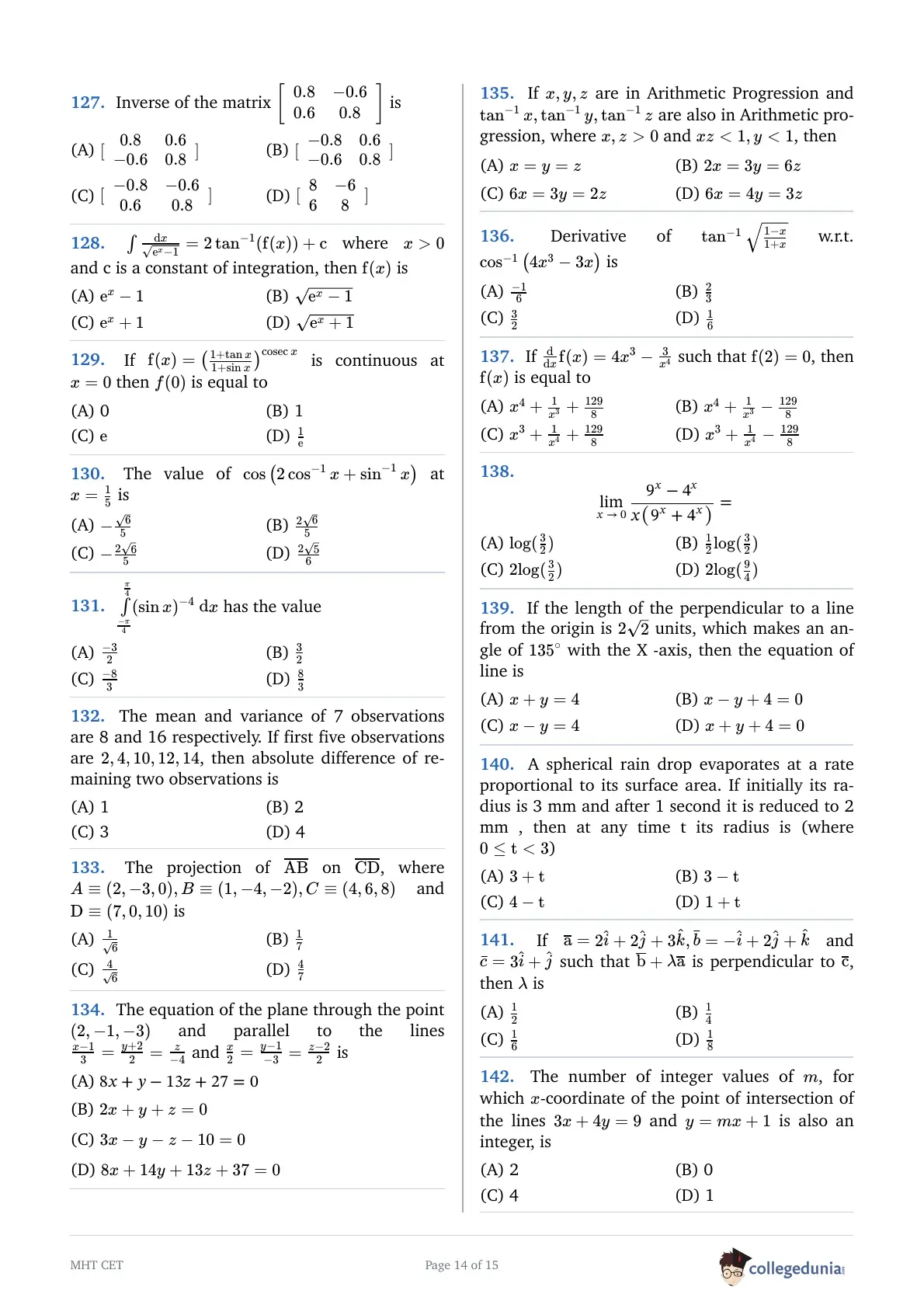
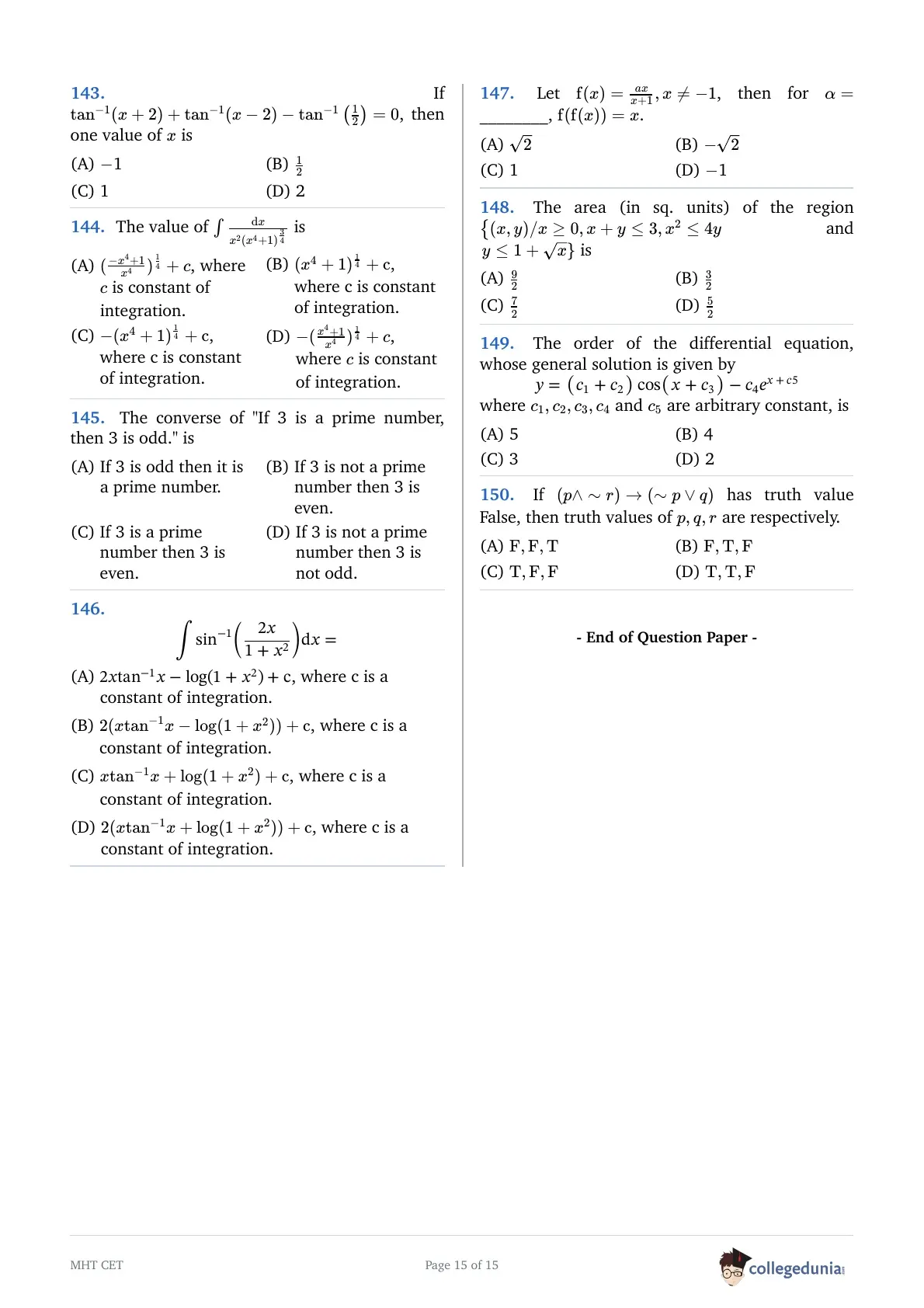
MHT CET 2024 May 10 Shift 2 PCM Question Paper is available for download here. Maharashtra State CET Cell conducted MHT CET 2024 PCM Exam on May 10 in Shift 2 from 2 PM to 5 PM in CBT mode.

The MHT CET 2024 PCM question paper includes the following:

  • The MHT CET 2024 PCM Question Paper consists of 150 multiple-choice questions (MCQs) totalling 200 marks divided into 3 sections: Physics, Chemistry, and Mathematics, with 50 questions in each subject.
  • Physics and Chemistry questions carry 1 mark each while Mathematics questions carry 2 marks each.
  • There is no negative marking for incorrect answers.

MHT CET 2024 May 10 Shift 2 PCM Question Paper with Solution PDF

CD PDF CD PDF with Solutions
Download Collegedunia PDF 0.87 MB -

Also Check:

MHT CET 2024 May 10 Shift 2 PCM Questions with Solutions


Physics (Q1 - Q50)

Question 1:

In semiconductors at room temperature,

  • (A) the valence band is completely filled and the conduction band partially filled.
  • (B) the valence band is completely filled.
  • (C) the conduction band is completely filled.
  • (D) the valence band is partially empty and the conduction band partially filled.

Question 2:

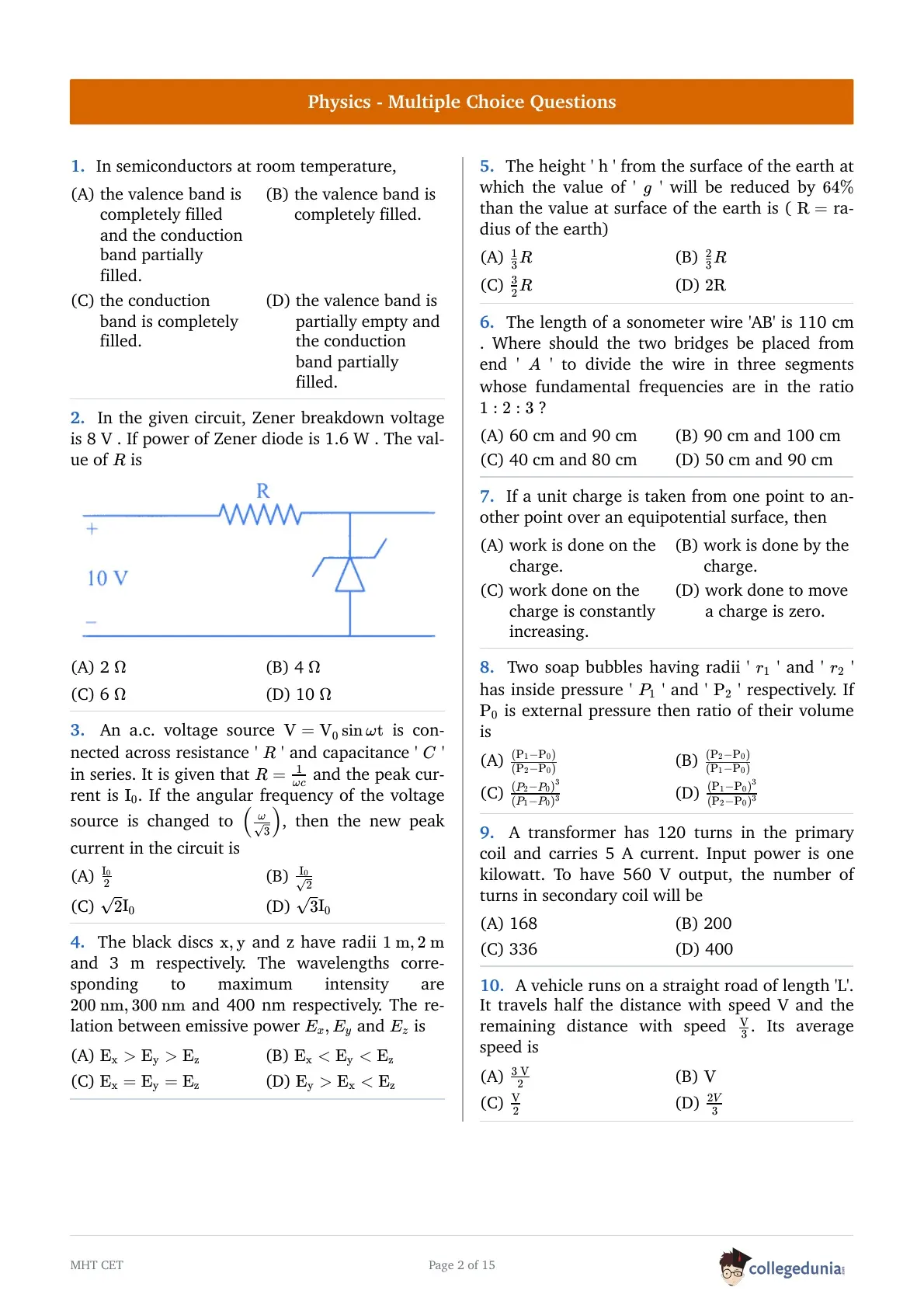
In the given circuit, Zener breakdown voltage is 8 V . If power of Zener diode is 1.6 W . The value of \(R\) is

  • (A) 2 \(\Omega\)
  • (B) 4 \(\Omega\)
  • (C) 6 \(\Omega\)
  • (D) 10 \(\Omega\)

Question 3:

An a.c. voltage source \(\mathrm{V}=\mathrm{V}_0 \sin \omega \mathrm{t}\) is connected across resistance ' \(R\) ' and capacitance ' \(C\) ' in series. It is given that \(R=\frac{1}{\omega c}\) and the peak current is \(\mathrm{I}_0\). If the angular frequency of the voltage source is changed to \(\left(\frac{\omega}{\sqrt{3}}\right)\), then the new peak current in the circuit is

  • (A) \(\frac{\mathrm{I}_{0}}{2}\)
  • (B) \(\frac{\mathrm{I}_{0}}{\sqrt{2}}\)
  • (C) \(\sqrt{2}\mathrm{I}_{0}\)
  • (D) \(\sqrt{3}\mathrm{I}_{0}\)

Question 4:

The black discs \(\mathrm{x}, \mathrm{y}\) and z have radii \(1 \mathrm{~m}, 2 \mathrm{~m}\) and 3 m respectively. The wavelengths corresponding to maximum intensity are \(200 \mathrm{~nm}, 300 \mathrm{~nm}\) and 400 nm respectively. The relation between emissive power \(E_x, E_y\) and \(E_z\) is

  • (A) \(\mathrm{E}_{\mathrm{x}}>\mathrm{E}_{\mathrm{y}}>\mathrm{E}_{\mathrm{z}}\)
  • (B) \(\mathrm{E}_{\mathrm{x}}<\mathrm{E}_{\mathrm{y}}<\mathrm{E}_{\mathrm{z}}\)
  • (C) \(\mathrm{E}_{\mathrm{x}}=\mathrm{E}_{\mathrm{y}}=\mathrm{E}_{\mathrm{z}}\)
  • (D) \(\mathrm{E}_{\mathrm{y}}>\mathrm{E}_{\mathrm{x}}<\mathrm{E}_{\mathrm{z}}\)

Question 5:

The height ' h ' from the surface of the earth at which the value of ' \(g\) ' will be reduced by \(64 \%\) than the value at surface of the earth is ( \(\mathrm{R}=\) radius of the earth)

  • (A) \(\frac{1}{3}R\)
  • (B) \(\frac{2}{3}R\)
  • (C) \(\frac{3}{2}R\)
  • (D) \(2\mathrm{R}\)

Question 6:

The length of a sonometer wire 'AB' is 110 cm . Where should the two bridges be placed from end ' \(A\) ' to divide the wire in three segments whose fundamental frequencies are in the ratio \(1: 2: 3\) ?

  • (A) 60 cm and 90 cm
  • (B) 90 cm and 100 cm
  • (C) 40 cm and 80 cm
  • (D) 50 cm and 90 cm

Question 7:

If a unit charge is taken from one point to another point over an equipotential surface, then

  • (A) work is done on the charge.
  • (B) work is done by the charge.
  • (C) work done on the charge is constantly increasing.
  • (D) work done to move a charge is zero.

Question 8:

Two soap bubbles having radii ' \(r_1\) ' and ' \(r_2\) ' has inside pressure ' \(P_1\) ' and ' \(\mathrm{P}_2\) ' respectively. If \(\mathrm{P}_0\) is external pressure then ratio of their volume is

  • (A) \(\frac{(\mathrm{P}_{1}-\mathrm{P}_{0})}{(\mathrm{P}_{2}-\mathrm{P}_{0})}\)
  • (B) \(\frac{(\mathrm{P}_{2}-\mathrm{P}_{0})}{(\mathrm{P}_{1}-\mathrm{P}_{0})}\)
  • (C) \(\frac{(P_{2}-P_{0})^{3}}{(P_{1}-P_{0})^{3}}\)
  • (D) \(\frac{(\mathrm{P}_{1}-\mathrm{P}_{0})^{3}}{(\mathrm{P}_{2}-\mathrm{P}_{0})^{3}}\)

Question 9:

A transformer has 120 turns in the primary coil and carries 5 A current. Input power is one kilowatt. To have 560 V output, the number of turns in secondary coil will be

  • (A) 168
  • (B) 200
  • (C) 336
  • (D) 400

Question 10:

A vehicle runs on a straight road of length 'L'. It travels half the distance with speed V and the remaining distance with speed \(\frac{\mathrm{V}}{3}\). Its average speed is

  • (A) \(\frac{3\text{ }\mathrm{V}}{2}\)
  • (B) \(\mathrm{V}\)
  • (C) \(\frac{\mathrm{V}}{2}\)
  • (D) \(\frac{2V}{3}\)

Question 11:

A particle of mass ' \(m\) ' performs uniform circular motion of radius ' \(r\) ' with linear speed ' \(v\) ' under the application of force ' \(F\) '. If ' \(m\) ', ' \(v\) ' and \(' \mathrm{r}\) ' are all increased by \(20 \%\) the necessary change in force required to maintain the particle in uniform circular motion, is

  • (A) \(12\%\)
  • (B) \(44\%\)
  • (C) \(14\%\)
  • (D) \(144\%\)

Question 12:

In Young's double slit experiment, the distance between the two coherent sources is ' d ' and the distance between the source and screen is ' D '. When the wavelength \((\lambda)\) of light source used is \(\frac{d^2}{3 D}\), then \(n^{\text {th }}\) dark fringe is observed on the screen, exactly in front of one of the slits. The value of ' \(n\) ' is

  • (A) 1
  • (B) 2
  • (C) 3
  • (D) 4

Question 13:

A particle starts oscillating simple harmonically from its equilibrium position with time period ' T '. What is the ratio of potential energy to kinetic energy of the particle at time \(t=\frac{T}{12}\) ? \[\left(\sin \left(\frac{\pi}{6}\right)=\frac{1}{2}\right)\]

  • (A) \(1:2\)
  • (B) \(2:1\)
  • (C) \(1:3\)
  • (D) \(3:1\)

Question 14:

A convex lens of focal length 40 cm is in contact with a concave lens of focal length 25 cm. The power of combination is

  • (A) \(-1.5\mathrm{D}\)
  • (B) \(-6.5\mathrm{D}\)
  • (C) \(+6.5\mathrm{D}\)
  • (D) \(+1.5\mathrm{D}\)

Question 15:

A particle performs linear S.H.M. When the displacement of the particle from mean position is 3 cm and 4 cm , corresponding velocities are \(8 \mathrm{~cm} / \mathrm{s}\) and \(6 \mathrm{~cm} / \mathrm{s}\) respectively. Its periodic time is

  • (A) \(2\pi \text{ }\mathrm{s}\)
  • (B) \(\pi \mathrm{s}\)
  • (C) \(3\pi \text{ }\mathrm{s}\)
  • (D) \(4\pi \text{ }\mathrm{s}\)

Question 16:

A photoelectric surface is illuminated successively by monochromatic light of wavelength ' \(\lambda\) ' and \(\left(\frac{\lambda}{2}\right)\). If the maximum kinetic energy of the emitted photoelectrons in the first case is one-fourth that in the second case, the work function of the surface of the material is ( \(\mathrm{c}=\) speed of light, \(\mathrm{h}=\) Planck's constant\()\)

  • (A) \(\frac{2\mathrm{hc}}{\lambda}\)
  • (B) \(\frac{\mathrm{hc}}{\lambda}\)
  • (C) \(\frac{2h\mathrm{c}}{3\lambda}\)
  • (D) \(\frac{\mathrm{hc}}{3\lambda}\)

Question 17:

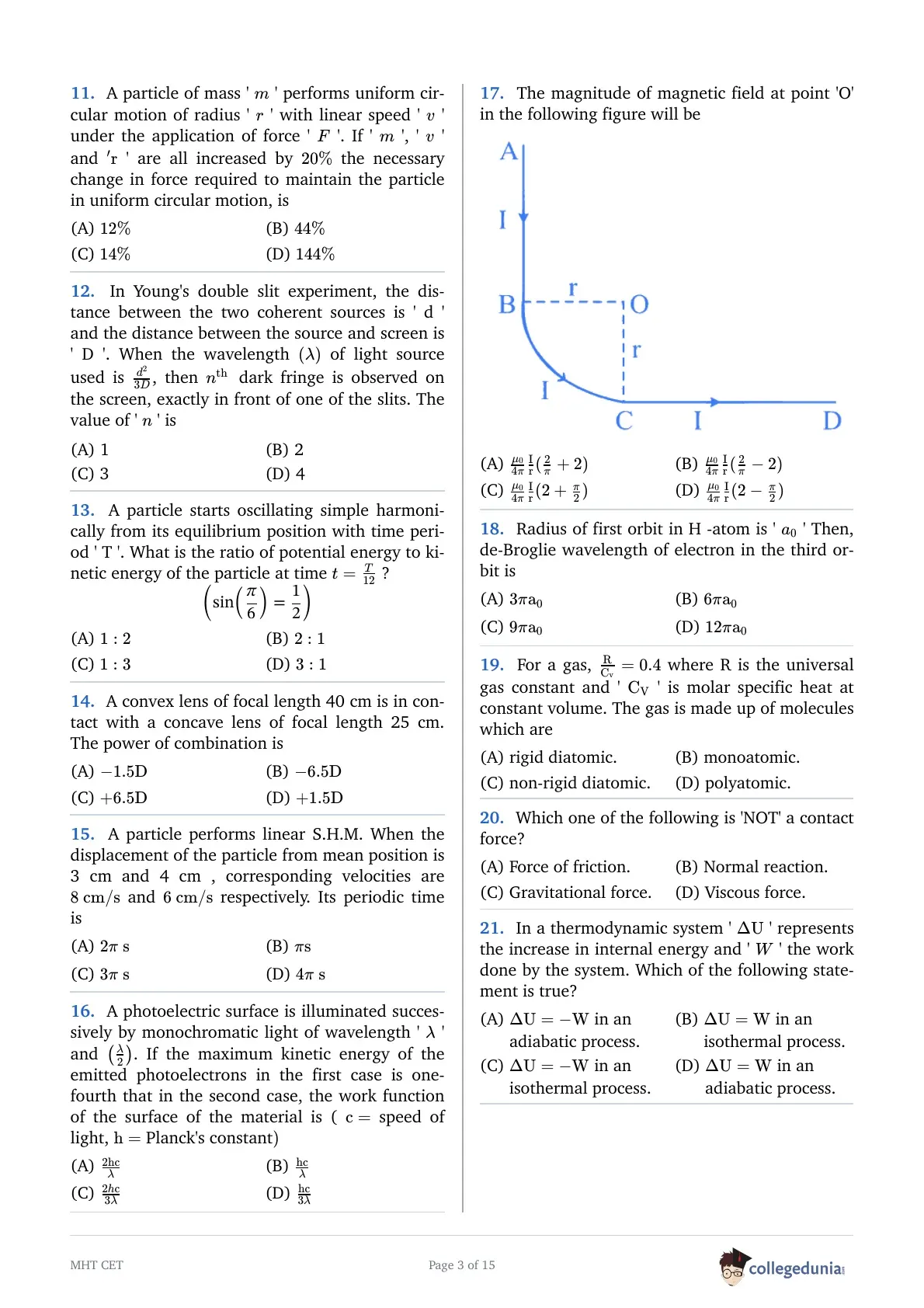
The magnitude of magnetic field at point 'O' in the following figure will be

  • (A) \(\frac{\mu _{0}}{4\pi}\frac{\mathrm{I}}{\mathrm{r}}(\frac{2}{\pi}+2)\)
  • (B) \(\frac{\mu _{0}}{4\pi}\frac{\mathrm{I}}{\mathrm{r}}(\frac{2}{\pi}-2)\)
  • (C) \(\frac{\mu _{0}}{4\pi}\frac{\mathrm{I}}{\mathrm{r}}(2+\frac{\pi}{2})\)
  • (D) \(\frac{\mu _{0}}{4\pi}\frac{\mathrm{I}}{\mathrm{r}}(2-\frac{\pi}{2})\)

Question 18:

Radius of first orbit in H -atom is ' \(a_0\) ' Then, de-Broglie wavelength of electron in the third orbit is

  • (A) \(3\pi \mathrm{a}_{0}\)
  • (B) \(6\pi \mathrm{a}_{0}\)
  • (C) \(9\pi \mathrm{a}_{0}\)
  • (D) \(12\pi \mathrm{a}_{0}\)

Question 19:

For a gas, \(\frac{\mathrm{R}}{\mathrm{C}_{\mathrm{v}}}=0.4\) where R is the universal gas constant and ' \(\mathrm{C}_{\mathrm{V}}\) ' is molar specific heat at constant volume. The gas is made up of molecules which are

  • (A) rigid diatomic.
  • (B) monoatomic.
  • (C) non-rigid diatomic.
  • (D) polyatomic.

Question 20:

Which one of the following is 'NOT' a contact force?

  • (A) Force of friction.
  • (B) Normal reaction.
  • (C) Gravitational force.
  • (D) Viscous force.

Question 21:

In a thermodynamic system ' \(\Delta \mathrm{U}\) ' represents the increase in internal energy and ' \(W\) ' the work done by the system. Which of the following statement is true?

  • (A) \(\Delta \mathrm{U}=-\mathrm{W}\) in an adiabatic process.
  • (B) \(\Delta \mathrm{U}=\mathrm{W}\) in an isothermal process.
  • (C) \(\Delta \mathrm{U}=-\mathrm{W}\) in an isothermal process.
  • (D) \(\Delta \mathrm{U}=\mathrm{W}\) in an adiabatic process.

Question 22:

If current of 4 A produces magnetic flux of \(3 \times 10^{-3} \mathrm{~Wb}\) through a coil of 400 turns, the energy stored in the coil will be

  • (A) 1.2 J
  • (B) 2.4 J
  • (C) 24 J
  • (D) 240 J

Question 23:

Two bodies A and B have their moments of inertia \(I_1\) and \(I_2\) respectively about their axis of rotation. If their kinetic energies of rotation are equal and their angular momenta \(\mathrm{L}_1\) and \(\mathrm{L}_2\) respectively are in the ratio \(1: \sqrt{3}\), then \(I_2\) will be

  • (A) \(\frac{1}{3}\mathrm{I}_{1}\)
  • (B) \(\sqrt{3}I_{1}\)
  • (C) \(2\mathrm{I}_{1}\)
  • (D) \(3\mathrm{I}_{1}\)

Question 24:

A body starts from rest from a distance \(\mathrm{R}_0\) from the centre of the earth. The velocity acquired by the body when it reaches the surface of the earth will be ( \(R=\) radius of earth, \(M=\) mass of earth)

  • (A) \(2\mathrm{GM}(\frac{1}{\mathrm{R}}-\frac{1}{\mathrm{R}_{0}})\)
  • (B) \(\sqrt{2\mathrm{GM}(\frac{1}{\mathrm{R}}-\frac{1}{\mathrm{R}_{0}})}\)
  • (C) \(\mathrm{GM}(\frac{1}{\mathrm{R}}-\frac{1}{\mathrm{R}_{0}})\)
  • (D) \(2\mathrm{GM}\sqrt{(\frac{1}{\mathrm{R}}-\frac{1}{\mathrm{R}_{0}})}\)

Question 25:

Two metal spheres are falling through a liquid of density \(2.5 \times 10^3 \mathrm{~kg} / \mathrm{m}^3\) with the same uniform speed. The density of material of first sphere and second sphere is \(11.5 \times 10^3 \mathrm{~kg} / \mathrm{m}^3\) and \(8.5 \times 10^3 \mathrm{~kg} / \mathrm{m}^3\) respectively. The ratio of the radius of first sphere to that of second sphere is

  • (A) \(\frac{2}{3}\)
  • (B) \(\sqrt{\frac{2}{3}}\)
  • (C) \(\frac{3}{2}\)
  • (D) \(\sqrt{\frac{3}{2}}\)

Question 26:

In series LCR circuit, 'R' represents resistance of electric bulb. If the frequency of a.c. supply is doubled, the value of inductance ' \(L\) ' and capacitance 'C' should be

  • (A) both doubled.
  • (B) made four times.
  • (C) made eight times.
  • (D) both halved simultaneously.

Question 27:

Two point charges \(\mathrm{q}_1=6 \mu \mathrm{C}\) and \(\mathrm{q}_2=4 \mu \mathrm{C}\) are kept at points \(A\) and \(B\) in air where \(A B=10 \mathrm{~cm}\). What is the increase in potential energy of the system when \(\mathrm{q}_2\) is moved towards \(\mathrm{q}_1\) by 2 cm ?

\[\left(\frac{1}{4 \pi \varepsilon_0}=9 \times 10^9 \text { SI units }\right)\]

  • (A) 0.27 J
  • (B) 0.54 J
  • (C) 0.81 J
  • (D) 54 J

Question 28:

Two light rays having the same wavelength ' \(\lambda\) ' in vacuum are in phase initially. Then, the first ray travels a path ' \(\mathrm{L}_1\) ' through a medium of refractive index ' \(\mu_1\) ' while the second ray travels a path of length ' \(L_2\) ' through a medium of refractive index ' \(\mu_2\) '. The two waves are then combined to observe interference. The phase difference between the two waves is

  • (A) \(\frac{2\pi}{\lambda}(\mu _{1}L_{1}-\mu _{2}L_{2})\)
  • (B) \(\frac{2\pi}{\lambda}(L_{2}-L_{1})\)
  • (C) \(\frac{2\pi}{\lambda}(\frac{\text{ }\mathrm{L}_{1}}{\mu _{1}}-\frac{\mathrm{L}_{2}}{\mu _{2}})\)
  • (D) \(\frac{2\pi}{\lambda}(\mu _{2}\text{ }\mathrm{L}_{1}-\mu _{1}\text{ }\mathrm{L}_{2})\)

Question 29:

Prong of a vibrating tuning fork is in contact with water surface. It produces concentric circular waves on the surface of water. The distance between five consecutive crests is 0.8 m and the velocity of wave on the water surface is \(56 \mathrm{~m} / \mathrm{s}\). The frequency of tuning fork is

  • (A) 256 Hz
  • (B) 280 Hz
  • (C) 341 Hz
  • (D) 512 Hz

Question 30:

Rate of radiation by a black body is ' R ' at temperature 'T'. Another body has same area but emissivity is 0.2 and temperature 3T. Its rate of radiation is

  • (A) \((162)R\)
  • (B) \((81)\mathrm{R}\)
  • (C) \((16.2)R\)
  • (D) \((8.1)\mathrm{R}\)

Question 31:

The end correction for the vibrations of air column in a tube of circular cross-section will be more if the tube is

  • (A) reduced in length.
  • (B) increased in length.
  • (C) made thinner.
  • (D) widened.

Question 32:

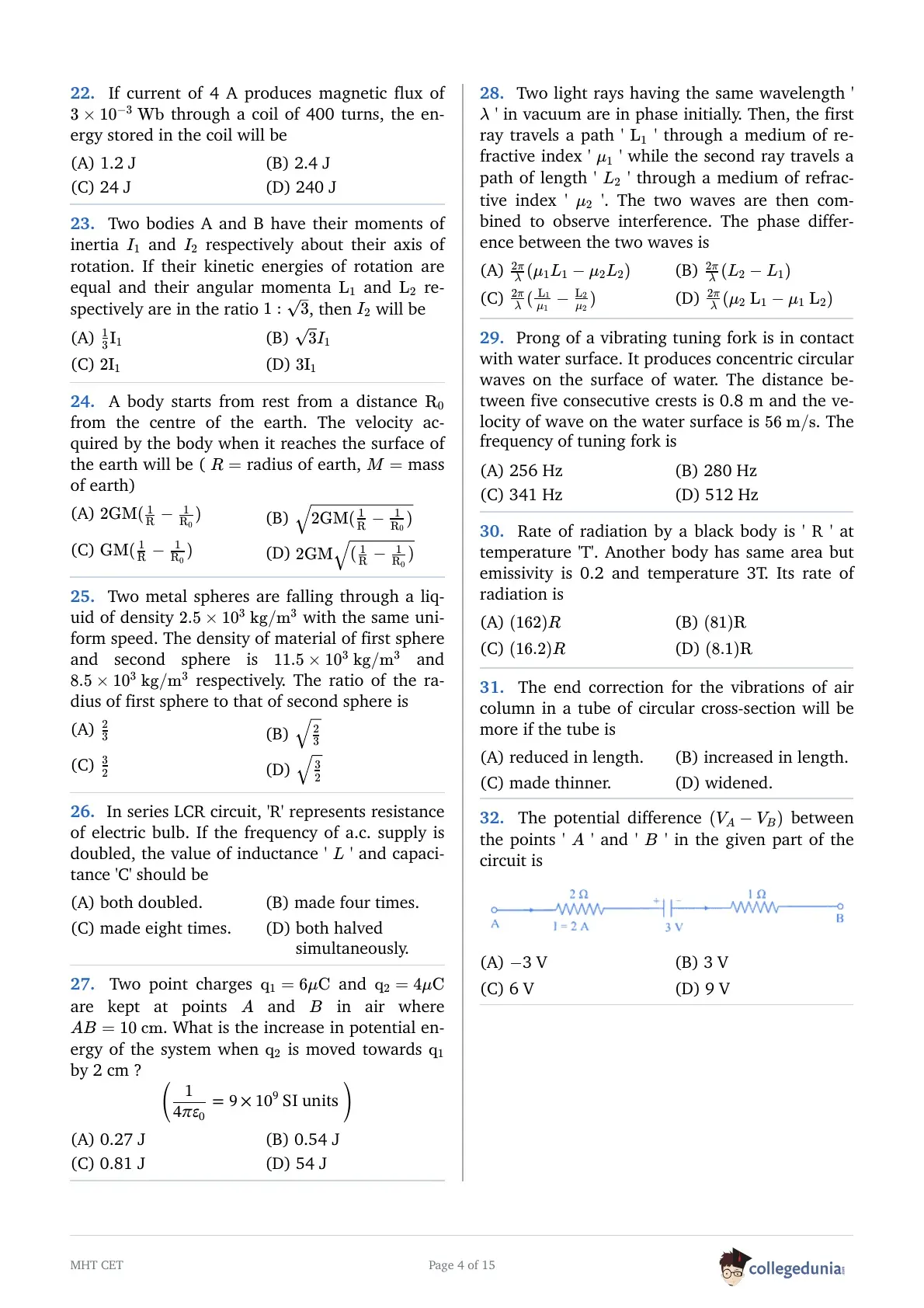
The potential difference \(\left(V_A-V_B\right)\) between the points ' \(A\) ' and ' \(B\) ' in the given part of the circuit is

  • (A) \(-\)3 V
  • (B) 3 V
  • (C) 6 V
  • (D) 9 V

Question 33:

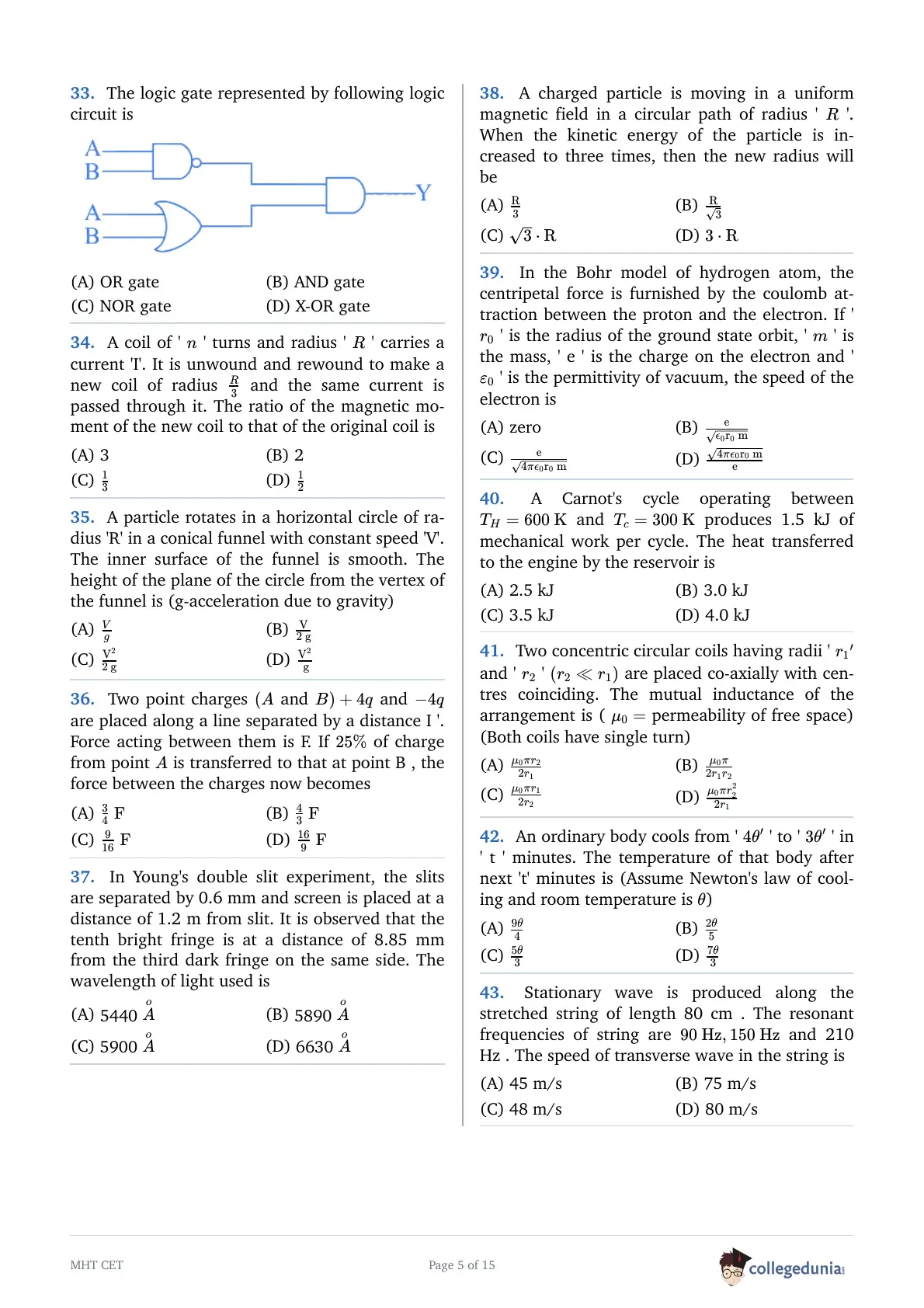
The logic gate represented by following logic circuit is

  • (A) OR gate
  • (B) AND gate
  • (C) NOR gate
  • (D) X-OR gate

Question 34:

A coil of ' \(n\) ' turns and radius ' \(R\) ' carries a current 'I'. It is unwound and rewound to make a new coil of radius \(\frac{R}{3}\) and the same current is passed through it. The ratio of the magnetic moment of the new coil to that of the original coil is

  • (A) 3
  • (B) 2
  • (C) \(\frac{1}{3}\)
  • (D) \(\frac{1}{2}\)

Question 35:

A particle rotates in a horizontal circle of radius 'R' in a conical funnel with constant speed 'V'. The inner surface of the funnel is smooth. The height of the plane of the circle from the vertex of the funnel is (g-acceleration due to gravity)

  • (A) \(\frac{V}{g}\)
  • (B) \(\frac{\mathrm{V}}{2\text{ }\mathrm{g}}\)
  • (C) \(\frac{\mathrm{V}^{2}}{2\text{ }\mathrm{g}}\)
  • (D) \(\frac{\mathrm{V}^{2}}{\text{ }\mathrm{g}}\)

Question 36:

Two point charges \((A\) and \(B)+4 q\) and \(-4 q\) are placed along a line separated by a distance I '. Force acting between them is F. If \(25 \%\) of charge from point \(A\) is transferred to that at point B , the force between the charges now becomes

  • (A) \(\frac{3}{4}\text{ }\mathrm{F}\)
  • (B) \(\frac{4}{3}\text{ }\mathrm{F}\)
  • (C) \(\frac{9}{16}\text{ }\mathrm{F}\)
  • (D) \(\frac{16}{9}\text{ }\mathrm{F}\)

Question 37:

In Young's double slit experiment, the slits are separated by 0.6 mm and screen is placed at a distance of 1.2 m from slit. It is observed that the tenth bright fringe is at a distance of 8.85 mm from the third dark fringe on the same side. The wavelength of light used is

  • (A) 5440 \(\overset{o}{A}\)
  • (B) 5890 \(\overset{o}{A}\)
  • (C) 5900 \(\overset{o}{A}\)
  • (D) 6630 \(\overset{o}{A}\)

Question 38:

A charged particle is moving in a uniform magnetic field in a circular path of radius ' \(R\) '. When the kinetic energy of the particle is increased to three times, then the new radius will be

  • (A) \(\frac{\mathrm{R}}{3}\)
  • (B) \(\frac{\mathrm{R}}{\sqrt{3}}\)
  • (C) \(\sqrt{3}\cdot \mathrm{R}\)
  • (D) \(3\cdot \mathrm{R}\)

Question 39:

In the Bohr model of hydrogen atom, the centripetal force is furnished by the coulomb attraction between the proton and the electron. If ' \(r_0\) ' is the radius of the ground state orbit, ' \(m\) ' is the mass, ' e ' is the charge on the electron and ' \(\varepsilon_0\) ' is the permittivity of vacuum, the speed of the electron is

  • (A) zero
  • (B) \(\frac{\mathrm{e}}{\sqrt{\epsilon _{0}\mathrm{r}_{0}\text{ }\mathrm{m}}}\)
  • (C) \(\frac{\mathrm{e}}{\sqrt{4\pi \epsilon _{0}\mathrm{r}_{0}\text{ }\mathrm{m}}}\)
  • (D) \(\frac{\sqrt{4\pi \epsilon _{0}\mathrm{r}_{0}\text{ }\mathrm{m}}}{\mathrm{e}}\)

Question 40:

A Carnot's cycle operating between \(T_H=600 \mathrm{~K}\) and \(T_c=300 \mathrm{~K}\) produces 1.5 kJ of mechanical work per cycle. The heat transferred to the engine by the reservoir is

  • (A) 2.5 kJ
  • (B) 3.0 kJ
  • (C) 3.5 kJ
  • (D) 4.0 kJ

Question 41:

Two concentric circular coils having radii ' \(r_1{ }^{\prime}\) and ' \(r_2\) ' \(\left(r_2 \ll r_1\right)\) are placed co-axially with centres coinciding. The mutual inductance of the arrangement is ( \(\mu_0=\) permeability of free space) (Both coils have single turn)

  • (A) \(\frac{\mu _{0}\pi r_{2}}{2r_{1}}\)
  • (B) \(\frac{\mu _{0}\pi}{2r_{1}r_{2}}\)
  • (C) \(\frac{\mu _{0}\pi r_{1}}{2r_{2}}\)
  • (D) \(\frac{\mu _{0}\pi r_{2}^{2}}{2r_{1}}\)

Question 42:

An ordinary body cools from ' \(4 \theta^{\prime}\) ' to ' \(3 \theta^{\prime}\) ' in ' t ' minutes. The temperature of that body after next 't' minutes is (Assume Newton's law of cooling and room temperature is \(\theta\))

  • (A) \(\frac{9\theta}{4}\)
  • (B) \(\frac{2\theta}{5}\)
  • (C) \(\frac{5\theta}{3}\)
  • (D) \(\frac{7\theta}{3}\)

Question 44:

For the series \(L C R\) circuit, \(R=\frac{X_L}{2}=2 \mathrm{X}_{\mathrm{c}}\). The impedance of the circuit and the phase difference between V and I will be

  • (A) \(\frac{\sqrt{5}}{2}\mathrm{R},\mathrm{tan}^{-1}(\frac{1}{2})\)
  • (B) \(\frac{\sqrt{13}}{2}R,\mathrm{tan}^{-1}(\frac{3}{2})\)
  • (C) \(\sqrt{5}R,\mathrm{tan}^{-1}(1)\)
  • (D) \(\sqrt{13}\mathrm{R},\mathrm{tan}^{-1}(2)\)

Question 46:

A glass capillary of radius 0.35 mm is inclined at \(60^{\circ}\) with the vertical in water. The height of the water column in the capillary is (surface tension of water \(=7 \times 10^{-2} \mathrm{~N} / \mathrm{m}\), acceleration due to gravity, \(g=10 \mathrm{~m} / \mathrm{s}^2, \cos 0^{\circ}=1, \cos 60^{\circ}=0.5\) )

  • (A) 6 cm
  • (B) 8 cm
  • (C) 10 cm
  • (D) 12 cm

Question 47:

When a photosensitive surface is irradiated by lights of wavelengths ' \(\lambda_1\) ' and ' \(\lambda_2\) ', kinetic energies of the emitted photoelectrons is ' \(E_1\) ' and ' \(E_2\) ' respectively. The work function of the photosensitive surface is

  • (A) \(\frac{(E_{2}\lambda _{2}-E_{1}\lambda _{1})}{(\lambda _{2}-\lambda _{1})}\)
  • (B) \(\frac{(E_{1}\lambda _{1}+E_{2}\lambda _{2})}{(\lambda _{2}-\lambda _{1})}\)
  • (C) \(\frac{(E_{1}\lambda _{1}-E_{2}\lambda _{2})}{(\lambda _{2}-\lambda _{1})}\)
  • (D) \(\frac{(E_{2}\lambda _{2}+E_{1}\lambda _{1})}{(\lambda _{1}-\lambda _{2})}\)

Question 48:

In an ammeter, \(0.25 \%\) of main current passes through the galvanometer. If the resistance of the galvanometer is ' G ', the resistance of ammeter will be

  • (A) \(\frac{399}{400}\mathrm{G}\)
  • (B) \(\frac{1}{400}\mathrm{G}\)
  • (C) \(\frac{499}{500}\mathrm{G}\)
  • (D) \(\frac{1}{500}\mathrm{G}\)

Question 49:

A simple pendulum of length ' \(l\) ' has a brass bob attached at its lower end. It's period is ' T '. A steel bob of the same size, having density ' \(x\) ' times that of brass, replaces the brass bob. Its length is then so changed that the period becomes ' 2 T '. What is the new length?

  • (A) \(4lx\)
  • (B) \(\frac{4l}{\mathrm{x}}\)
  • (C) \(4l\)
  • (D) \(2l\)

Question 50:

The electric potential at a point on the axis of an electric dipole is proportional to [r = distance between centre of the electric dipole and the point]

  • (A) \(\frac{1}{\mathrm{r}}\)
  • (B) \(\frac{1}{r^{2}}\)
  • (C) \(r\)
  • (D) \(\frac{1}{\mathrm{r}^{3}}\)

Chemistry (Q51 - Q100)

Question 51:

Calculate dissociation constant of a weak monobasic acid if it is \(0.05 \%\) dissociated in 0.02 M solution.

  • (A) \(2.0\times 10^{-9}\)
  • (B) \(3.0\times 10^{-9}\)
  • (C) \(4.0\times 10^{-9}\)
  • (D) \(5.0\times 10^{-9}\)

Question 52:

Select the correct increasing order of boiling points of alcohols, amines and carboxylic acids of comparable molar mass from the following.

  • (A) Alcohols < Amines < Carboxylic acids
  • (B) Amines < Carboxylic acids < Alcohols
  • (C) Amines \(<\) Alcohols \(<\) Carboxylic acid
  • (D) Carboxylic acids \(<\) Alcohols \(<\) Amines

Question 53:

Which of the following orbitals is represented by \(\mathrm{n}=3\) and \(l=2\) ?

  • (A) 3s
  • (B) 3p
  • (C) 3d
  • (D) 3f

Question 54:

Which of the following is not a property of hydrogen peroxide?

  • (A) It is immiscible in water.
  • (B) It is pale blue coloured liquid in pure state.
  • (C) Its strength is explained in volume unit.
  • (D) It is mild oxidising as well as reducing agent.

Question 55:

The molar conductivity of 0.01 M acetic acid at \(25^{\circ} \mathrm{C}\) is \(16.5 \Omega^{-1} \mathrm{~cm}^2 \mathrm{~mol}^{-1}\) and its molar conductivity at zero concentration is \(390.7 \Omega^{-1} \mathrm{~cm}^2 \mathrm{~mol}^{-1}\). What is its degree of dissociation?

  • (A) 0.0223
  • (B) 0.0422
  • (C) 0.0642
  • (D) 0.0821

Question 56:

Which from following reactions exhibits good atom economy according to the principles of green chemistry?

  • (A) \(\mathrm{C}_{4}\mathrm{H}_{9}\mathrm{OH}+\mathrm{NaBr}+\mathrm{H}_{2}\mathrm{SO}_{4}\longrightarrow \mathrm{C}_{4}\mathrm{H}_{9}\mathrm{Br}+\mathrm{NaHSO}_{4}+\mathrm{H}_{2}\mathrm{O}\)
  • (B) \(\mathrm{C}_{2}\mathrm{H}_{4}+\mathrm{H}_{2}\xrightarrow{\mathrm{Ni}}\mathrm{C}_{2}\mathrm{H}_{6}\)
  • (C) \(\mathrm{C}_{2}\mathrm{H}_{5}\mathrm{OH}+\mathrm{C}_{2}\mathrm{H}_{5}\mathrm{COOH}\longrightarrow \mathrm{C}_{2}\mathrm{H}_{5}\mathrm{COOC}_{2}\mathrm{H}_{5}+\mathrm{H}_{2}\mathrm{O}\)
  • (D) \(\mathrm{C}_{4}\mathrm{H}_{9}\mathrm{OH}+\mathrm{SOCl}_{2}\xrightarrow{\Delta}\mathrm{C}_{4}\mathrm{H}_{9}\mathrm{Cl}+\mathrm{HCl}+\mathrm{SO}_{2}\)

Question 57:

Which from following statements is NOT true about absorption?

  • (A) Concentration of absorbate is uniform throughout the bulk of the absorbent.
  • (B) It is independent of temperature and pressure.
  • (C) It is not accompanied by evolution or absorption of heat.
  • (D) It depends on surface area.

Question 58:

Identify the source of linen from following:

  • (A) Flax plant
  • (B) Cotton plant
  • (C) Cane plant
  • (D) Rubber plant

Question 59:

Identify acidic amino acid from following (represented by using three letter symbols).

  • (A) Arg
  • (B) Asp
  • (C) Asn
  • (D) Ala

Question 60:

What is the number of moles of ionisable \(\mathrm{Cl^-}\) ions in a coordinate complex if it forms two moles of \(\mathrm{AgCl}\) when treated with silver nitrate solution in excess?

  • (A) 1
  • (B) 2
  • (C) 3
  • (D) 4

Question 61:

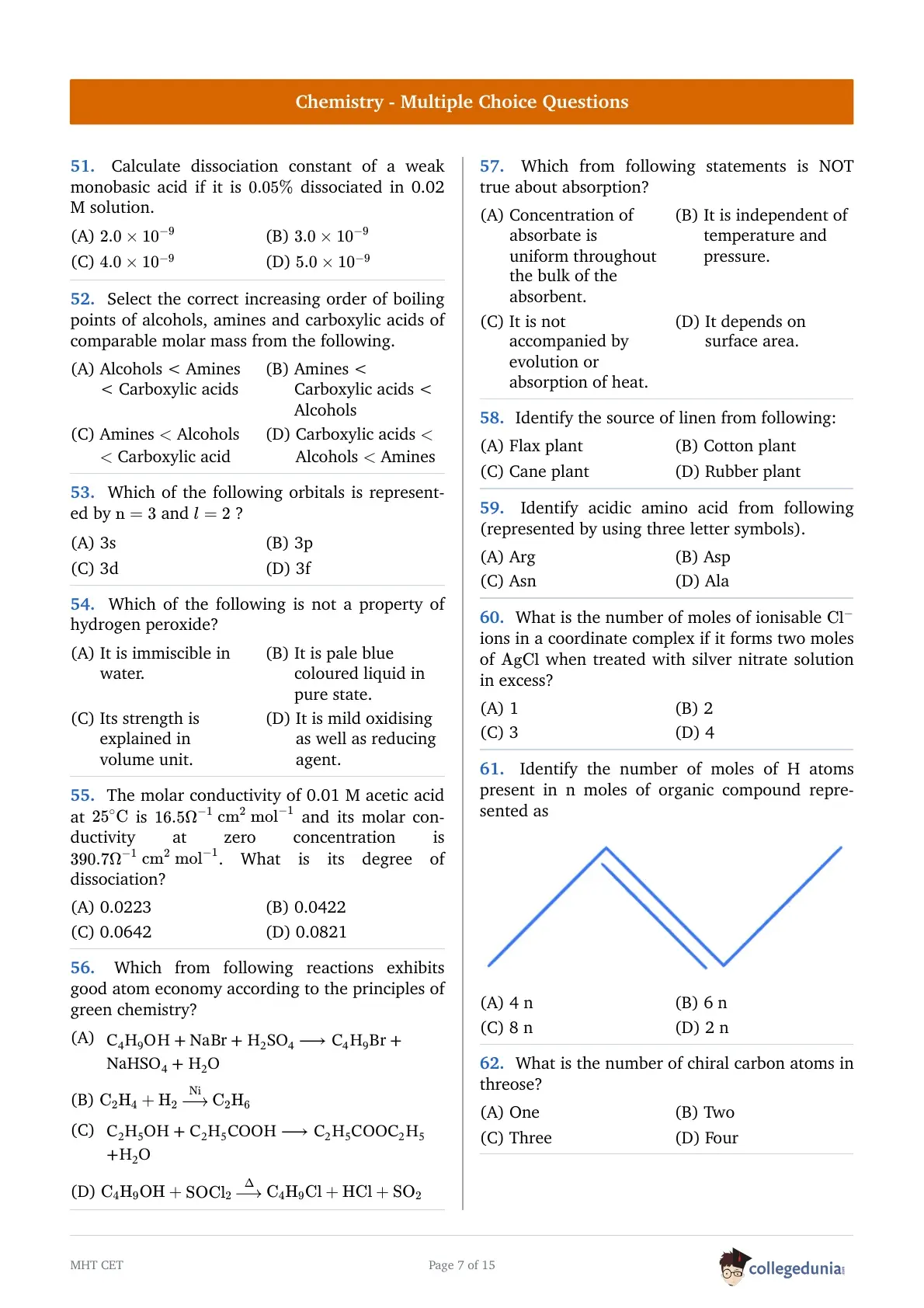
Identify the number of moles of H atoms present in n moles of organic compound represented as

  • (A) 4 n
  • (B) 6 n
  • (C) 8 n
  • (D) 2 n

Question 62:

What is the number of chiral carbon atoms in threose?

  • (A) One
  • (B) Two
  • (C) Three
  • (D) Four

Question 63:

Identify a complex having monodentate ligand from following :

  • (A) Tetracyanonickelate(II) ion
  • (B) Potassium trioxalatoaluminate(III)
  • (C) Trioxalatocobaltate(III) ion
  • (D) bis(ethylenediamine)dithiocyanato platinum(IV)

Question 64:

Which element from following does NOT exhibit magnetic moment in +2 state?

  • (A) Mn
  • (B) Co
  • (C) Fe
  • (D) Zn

Question 65:

Which from following statements is NOT correct about thermoplastic polymers?

  • (A) These are softened on heating.
  • (B) Intermolecular forces involved in these are moderately strong intermediate between elastomers and fibres.
  • (C) These possess extensive cross linking by covalent bonds.
  • (D) These are easily moulded.

Question 66:

Which from following elements is NOT a member of group 16 from periodic table?

  • (A) Tellurium
  • (B) Selenium
  • (C) Polonium
  • (D) Astatine

Question 67:

Identify false statement about transition elements.

  • (A) These exhibit properties between those of s and p block elements.
  • (B) All these elements are grouped as 3 d to 6 d series.
  • (C) 5 d series is comprised of all elements from \(\mathrm{La}(\mathrm{Z}=57)\) to \(\mathrm{Hg}(\mathrm{Z}=80)\).
  • (D) Elements of 6 d series belongs to \(7^{\text{th }}\) period of periodic table.

Question 68:

Which among the following is not haloalkyne?

  • (A) \(\mathrm{CH}_{3}-\mathrm{CH}_{2}-\mathrm{CH}=\mathrm{CH}-\mathrm{X}\)
  • (B) \(\mathrm{CH}_{3}-\mathrm{C}\equiv \mathrm{C}-\mathrm{CH}_{2}-\mathrm{X}\)
  • (C) \(\mathrm{CH}\equiv \mathrm{C}-\mathrm{CH}_{2}-\mathrm{CH}_{2}-\mathrm{X}\)
  • (D) \(\mathrm{CH}_{3}-\mathrm{CH}_{2}-\mathrm{C}\equiv \mathrm{C}-\mathrm{X}\)

Question 69:

Which isomer of \(\mathrm{C}_4 \mathrm{H}_9 \mathrm{OH}\) has highest boiling point?

  • (A) n-Butyl alcohol
  • (B) Isobutyl alcohol
  • (C) sec-Butyl alcohol
  • (D) tert-Butyl alcohol

Question 70:

A buffer solution contains equal concentrations of weak acid and its salt with strong base. Calculate pH of buffer solution if dissociation constant of weak acid is \(1.8 \times 10^{-5}\).

  • (A) 4.7447
  • (B) 5.1420
  • (C) 5.8496
  • (D) 4.0128

Question 71:

If four different elements A, B, C and D having electronic configuration as \(\mathrm{A}=[\mathrm{Ne}] 3 \mathrm{~s}^2 3 \mathrm{p}^4\), \(B=[\mathrm{Ne}] 3 \mathrm{~s}^2 3 \mathrm{p}^5, \mathrm{C}=[\mathrm{Ar}] 3 \mathrm{~d}^{10} 4 \mathrm{~s}^2 4 \mathrm{p}^4\) and \(\mathrm{D}=[\mathrm{Ar}] 3 \mathrm{~d}^{10} 4 \mathrm{~s}^2 4 \mathrm{p}^5\).

Identify the element with largest atomic radius.

  • (A) A
  • (B) B
  • (C) C
  • (D) D

Question 72:

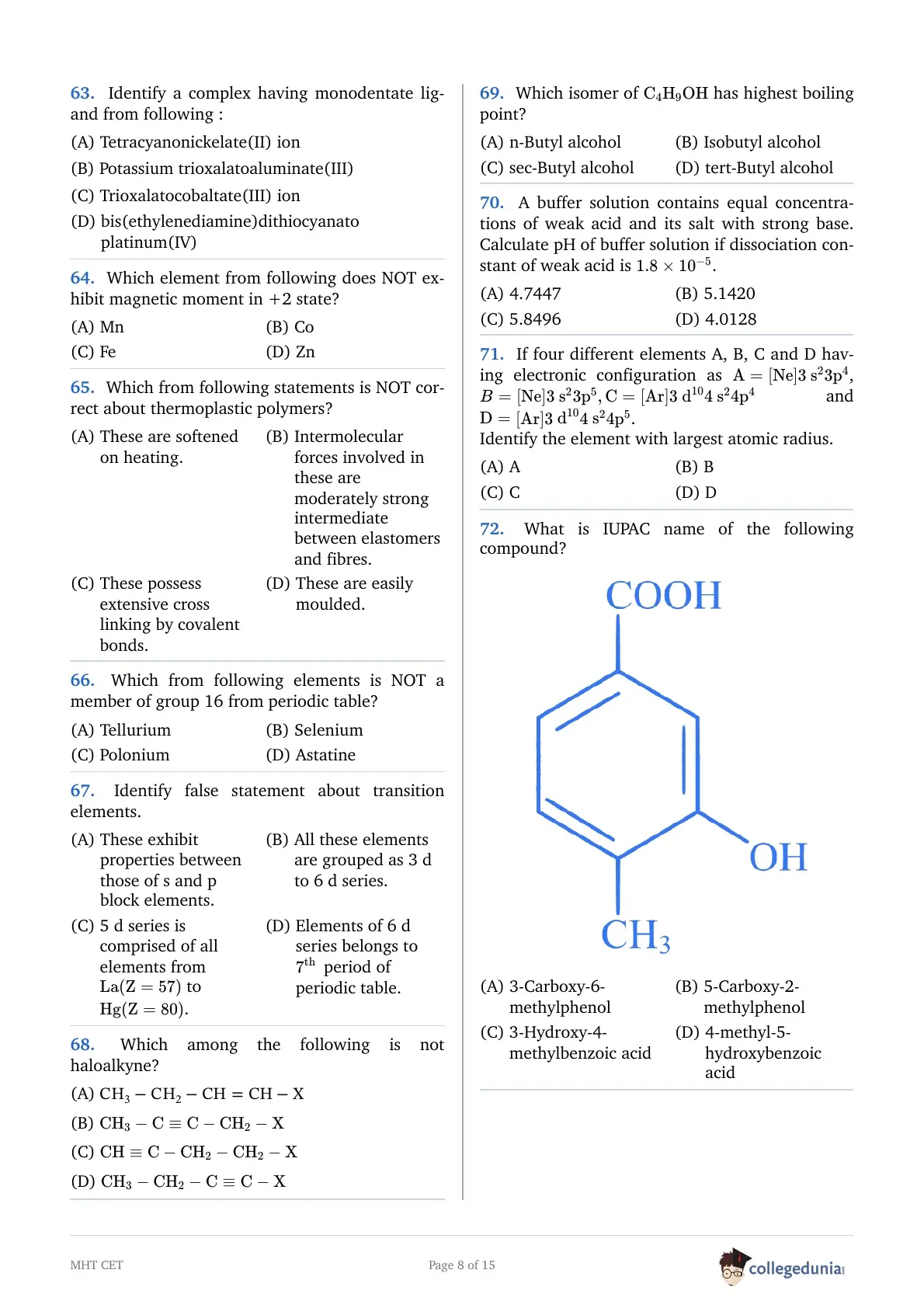
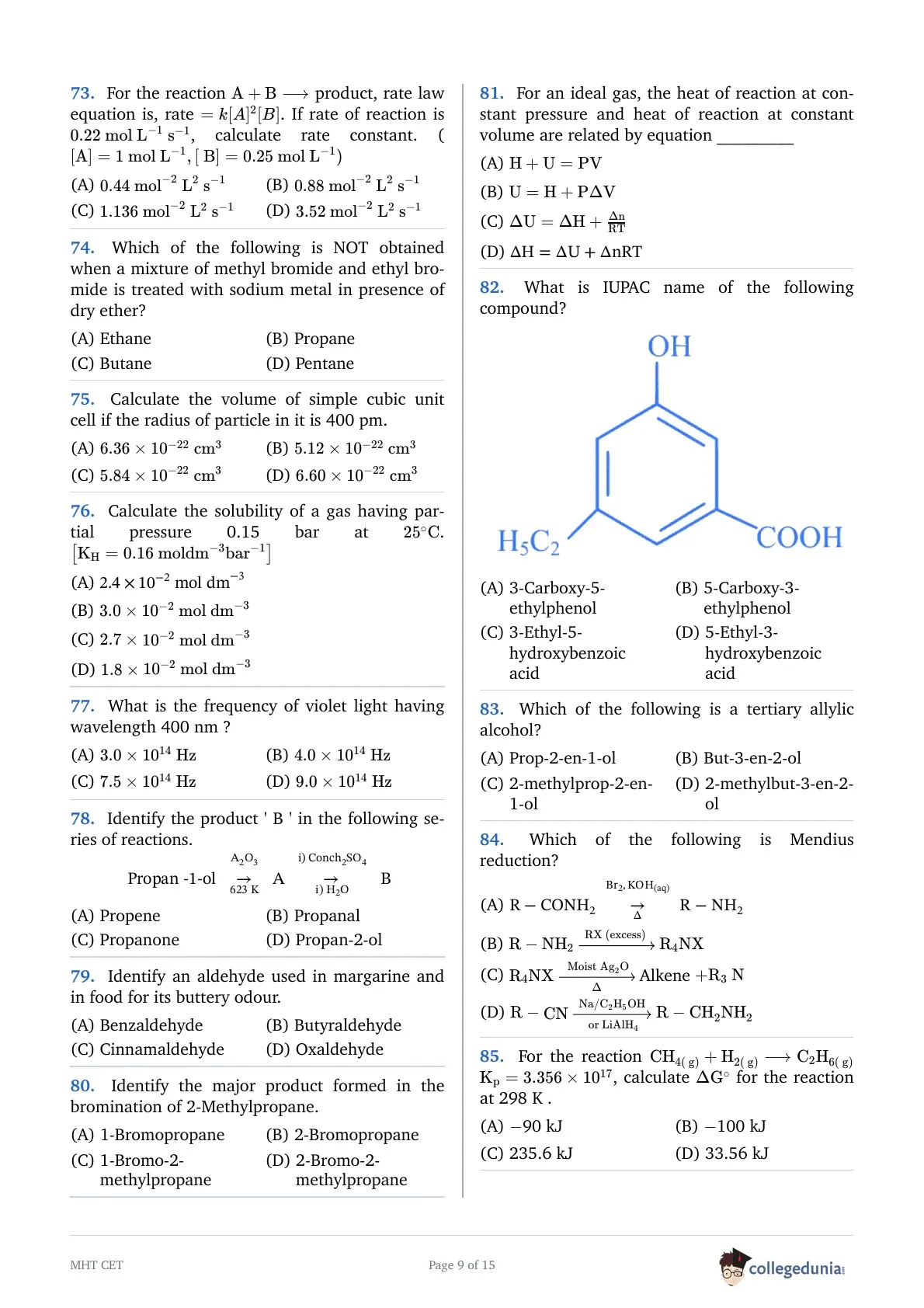
What is IUPAC name of the following compound?

  • (A) 3-Carboxy-6-methylphenol
  • (B) 5-Carboxy-2-methylphenol
  • (C) 3-Hydroxy-4-methylbenzoic acid
  • (D) 4-methyl-5-hydroxybenzoic acid

Question 73:

For the reaction \(\mathrm{A}+\mathrm{B} \longrightarrow\) product, rate law equation is, rate \(=k[A]^2[B]\). If rate of reaction is \(0.22 \mathrm{~mol} \mathrm{~L}^{-1} \mathrm{~s}^{-1}\), calculate rate constant. (\(\mathrm{[A}]=1 \mathrm{~mol} \mathrm{~L}^{-1},[\mathrm{~B}]=0.25 \mathrm{~mol} \mathrm{~L}^{-1})\)

  • (A) \(0.44\text{ }\mathrm{mol}^{-2}\text{ }\mathrm{L}^{2}\text{ }\mathrm{s}^{-1}\)
  • (B) \(0.88\text{ }\mathrm{mol}^{-2}\text{ }\mathrm{L}^{2}\text{ }\mathrm{s}^{-1}\)
  • (C) \(1.136\text{ }\mathrm{mol}^{-2}\text{ }\mathrm{L}^{2}\text{ }\mathrm{s}^{-1}\)
  • (D) \(3.52\text{ }\mathrm{mol}^{-2}\text{ }\mathrm{L}^{2}\text{ }\mathrm{s}^{-1}\)

Question 74:

Which of the following is NOT obtained when a mixture of methyl bromide and ethyl bromide is treated with sodium metal in presence of dry ether?

  • (A) Ethane
  • (B) Propane
  • (C) Butane
  • (D) Pentane

Question 75:

Calculate the volume of simple cubic unit cell if the radius of particle in it is 400 pm.

  • (A) \(6.36\times 10^{-22}\text{ }\mathrm{cm}^{3}\)
  • (B) \(5.12\times 10^{-22}\text{ }\mathrm{cm}^{3}\)
  • (C) \(5.84\times 10^{-22}\text{ }\mathrm{cm}^{3}\)
  • (D) \(6.60\times 10^{-22}\text{ }\mathrm{cm}^{3}\)

Question 76:

Calculate the solubility of a gas having partial pressure 0.15 bar at \(25^{\circ} \mathrm{C}\). \(\left[\mathrm{K}_{\mathrm{H}}=0.16 \mathrm{~mol} \mathrm{dm}^{-3} \mathrm{bar}^{-1}\right]\)

  • (A) \(2.4\times 10^{-2}\text{ }\mathrm{mol}\text{ }\mathrm{dm}^{-3}\)
  • (B) \(3.0\times 10^{-2}\text{ }\mathrm{mol}\text{ }\mathrm{dm}^{-3}\)
  • (C) \(2.7\times 10^{-2}\text{ }\mathrm{mol}\text{ }\mathrm{dm}^{-3}\)
  • (D) \(1.8\times 10^{-2}\text{ }\mathrm{mol}\text{ }\mathrm{dm}^{-3}\)

Question 77:

What is the frequency of violet light having wavelength 400 nm ?

  • (A) \(3.0\times 10^{14}\text{ }\mathrm{Hz}\)
  • (B) \(4.0\times 10^{14}\text{ }\mathrm{Hz}\)
  • (C) \(7.5\times 10^{14}\text{ }\mathrm{Hz}\)
  • (D) \(9.0\times 10^{14}\text{ }\mathrm{Hz}\)

Question 78:

Identify the product ' B ' in the following series of reactions.

\[\text { Propan -1-ol } \xrightarrow[623 \mathrm{~K}]{\mathrm{A}_2 \mathrm{O}_3} \mathrm{~A} \xrightarrow[\text { i) } \mathrm{H}_2 \mathrm{O}]{\text { i) } \mathrm{Conch}_2 \mathrm{SO}_4} \mathrm{~B}\]

  • (A) Propene
  • (B) Propanal
  • (C) Propanone
  • (D) Propan-2-ol

Question 79:

Identify an aldehyde used in margarine and in food for its buttery odour.

  • (A) Benzaldehyde
  • (B) Butyraldehyde
  • (C) Cinnamaldehyde
  • (D) Oxaldehyde

Question 80:

Identify the major product formed in the bromination of 2-Methylpropane.

  • (A) 1-Bromopropane
  • (B) 2-Bromopropane
  • (C) 1-Bromo-2-methylpropane
  • (D) 2-Bromo-2-methylpropane

Question 81:

For an ideal gas, the heat of reaction at constant pressure and heat of reaction at constant volume are related by equation _________

  • (A) \(\mathrm{H}+\mathrm{U}=\mathrm{PV}\)
  • (B) \(\mathrm{U}=\mathrm{H}+\mathrm{P}\Delta \mathrm{V}\)
  • (C) \(\Delta \mathrm{U}=\Delta \mathrm{H}+\frac{\Delta \mathrm{n}}{\mathrm{RT}}\)
  • (D) \(\Delta \mathrm{H}=\Delta \mathrm{U}+\Delta \mathrm{nRT}\)

Question 83:

Which of the following is a tertiary allylic alcohol?

  • (A) Prop-2-en-1-ol
  • (B) But-3-en-2-ol
  • (C) 2-methylprop-2-en-1-ol
  • (D) 2-methylbut-3-en-2-ol

Question 84:

Which of the following is Mendius reduction?

  • (A) \(\mathrm{R}-\mathrm{CONH}_{2}\xrightarrow[\Delta]{\mathrm{Br}_{2},\mathrm{KOH}_{(\mathrm{aq})}}\mathrm{R}-\mathrm{NH}_{2}\)
  • (B) \(\mathrm{R}-\mathrm{NH}_{2}\xrightarrow{\mathrm{RX}\text{ (excess) }}\mathrm{R}_{4}\mathrm{NX}\)
  • (C) \(\mathrm{R}_{4}\mathrm{NX}\xrightarrow[\Delta]{\text{ Moist }\mathrm{Ag}_{2}\mathrm{O}}\) Alkene \(+\mathrm{R}_{3}\text{ }\mathrm{N}\)
  • (D) \(\mathrm{R}-\mathrm{CN}\xrightarrow[\text{ or }\mathrm{LiAlH}_{4}]{\mathrm{Na}/\mathrm{C}_{2}\mathrm{H}_{5}\mathrm{OH}}\mathrm{R}-\mathrm{CH}_{2}\mathrm{NH}_{2}\)

Question 85:

For the reaction \(\mathrm{CH}_{4(\mathrm{~g})}+\mathrm{H}_{2(\mathrm{~g})} \longrightarrow \mathrm{C}_2 \mathrm{H}_{6(\mathrm{~g})}\) \(\mathrm{K}_{\mathrm{p}}=3.356 \times 10^{17}\), calculate \(\Delta \mathrm{G}^{\circ}\) for the reaction at 298 K .

  • (A) \(-\)90 kJ
  • (B) \(-\)100 kJ
  • (C) 235.6 kJ
  • (D) 33.56 kJ

Question 86:

Rate of a first order reaction is \(1.5 \times 10^{-2} \mathrm{~mol} \mathrm{~L}^{-1}\) minute \({ }^{-1}\) at 0.5 M concentration of reactant, calculate half life of reaction.

  • (A) 0.383 minute
  • (B) 7.53 minute
  • (C) 8.73 minute
  • (D) 23.1 minute

Question 87:

Calculate the density of a metal molar mass \(197 \mathrm{~g} \mathrm{~mol}^{-1}\) if it forms fcc structure. \(\left[\mathrm{a}^3 \times \mathrm{N}_{\mathrm{A}}=40 \mathrm{~cm}^3 \mathrm{~mol}^{-1}\right]\)

  • (A) \(23.5\text{ }\mathrm{g}\text{ }\mathrm{cm}^{-3}\)
  • (B) \(21.2\text{ }\mathrm{g}\text{ }\mathrm{cm}^{-3}\)
  • (C) \(17.5\text{ }\mathrm{g}\text{ }\mathrm{cm}^{-3}\)
  • (D) \(19.7\text{ }\mathrm{g}\text{ }\mathrm{cm}^{-3}\)

Question 88:

A gas expands isothermally against a constant external pressure of 1 bar from 10 dm\(^3\) to 20 dm\(^3\) by absorbing 800 J of heat from surrounding. Calculate value of \(\Delta\)U.

  • (A) 100 J
  • (B) \(-\)200 J
  • (C) 200 J
  • (D) \(-\)300 J

Question 89:

Which from following decides the rate of multistep reaction?

  • (A) rate of slowest step.
  • (B) rate of fastest step.
  • (C) average rate of various steps.
  • (D) instantaneous rate of fast step.

Question 90:

What is minimum number of spheres required of develop a tetrahedral void?

  • (A) 2
  • (B) 4
  • (C) 6
  • (D) 3

Question 91:

Which from following ionic solids exhibits decrease in its solubility in water with increase of temperature?

  • (A) \(\mathrm{NaCl}\)
  • (B) \(\mathrm{KNO}_{3}\)
  • (C) \(\mathrm{NaNO}_{3}\)
  • (D) \(\mathrm{Na}_{2}\mathrm{SO}_{4}\)

Question 92:

Which from the following equations represents the relation between solubility ( \(\mathrm{mol} \mathrm{~L}^{-1}\) ) and solubility product for a salt \(\mathrm{B}_3 \mathrm{A}_2\) ?

  • (A) \(\mathrm{S}=(\frac{\mathrm{K}_{\mathrm{sp}}}{108})^{\frac{1}{5}}\)
  • (B) \(\mathrm{S}=(108\times \mathrm{K}_{\mathrm{sp}})^{1/5}\)
  • (C) \(\mathrm{S}=(\frac{\mathrm{K}_{\mathrm{sp}}}{27})^{\frac{1}{5}}\)
  • (D) \(\mathrm{S}=(27\times \mathrm{K}_{\mathrm{sp}})^{1/5}\)

Question 93:

Which of the following is released at cathode during electrolysis of aqueous sodium chloride?

  • (A) \(\mathrm{Cl}_{2(\mathrm{g})}\)
  • (B) \(\mathrm{Na}_{\text{(s) }}\)
  • (C) \(\mathrm{O}_{2(\mathrm{g})}\)
  • (D) \(\mathrm{H}_{2(\mathrm{g})}\)

Question 94:

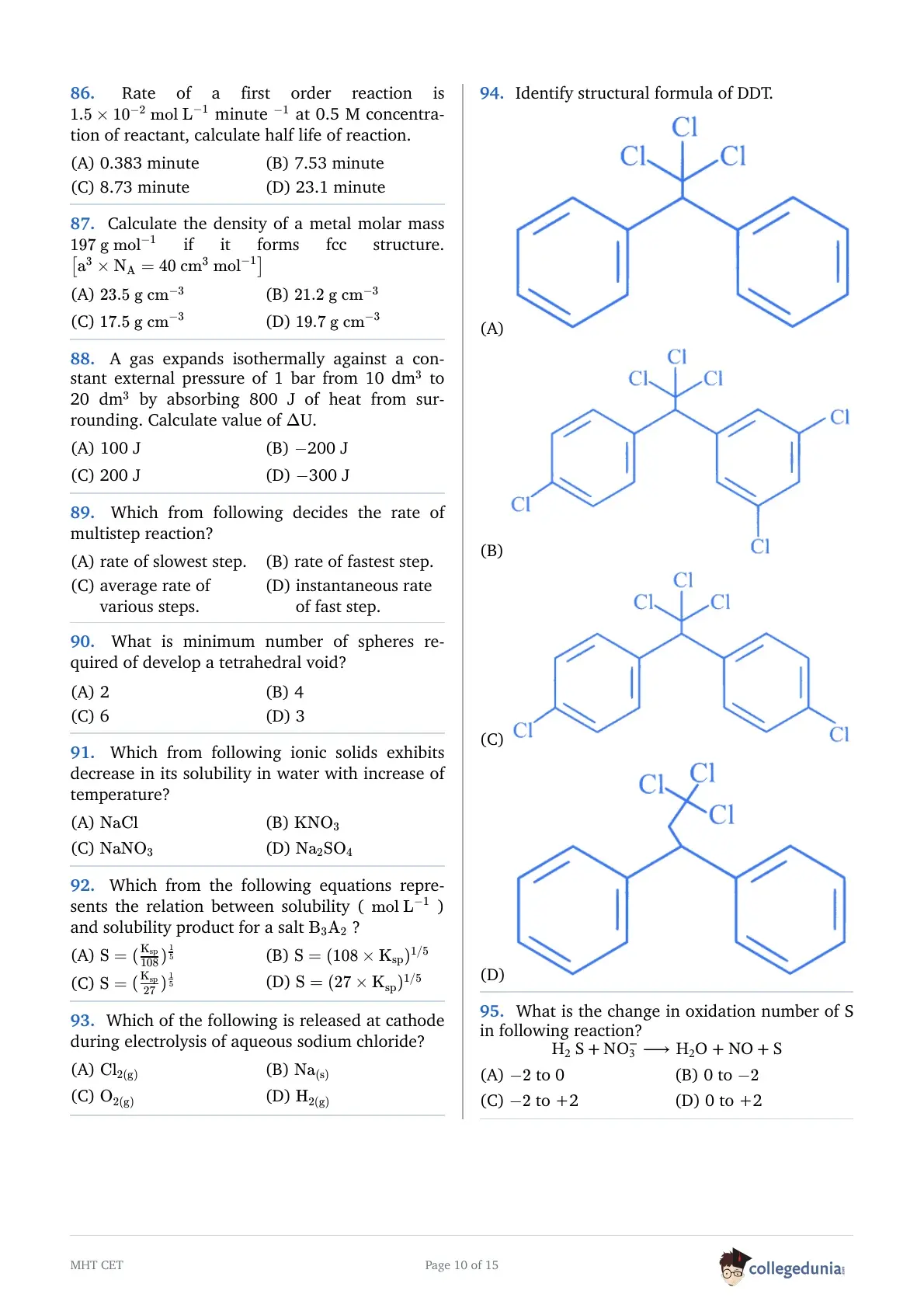
Identify structural formula of DDT.

  • (A)
  • (B)
  • (C)
  • (D)

Question 95:

What is the change in oxidation number of S in following reaction?

\[\mathrm{H}_2 \mathrm{~S}+\mathrm{NO}_3^{-} \longrightarrow \mathrm{H}_2 \mathrm{O}+\mathrm{NO}+\mathrm{S}\]

  • (A) \(-2\) to 0
  • (B) 0 to \(-2\)
  • (C) \(-2\) to +2
  • (D) 0 to +2

Question 96:

Which law is illustrated by compounds \(\mathrm{H}_2 \mathrm{O}\) and \(\mathrm{H}_2 \mathrm{O}_2\) formed from two different elements, H and O ?

  • (A) Law of Constant proportion.
  • (B) Law of Conservation of mass.
  • (C) Law of Multiple proportion.
  • (D) Avogadro's law.

Question 97:

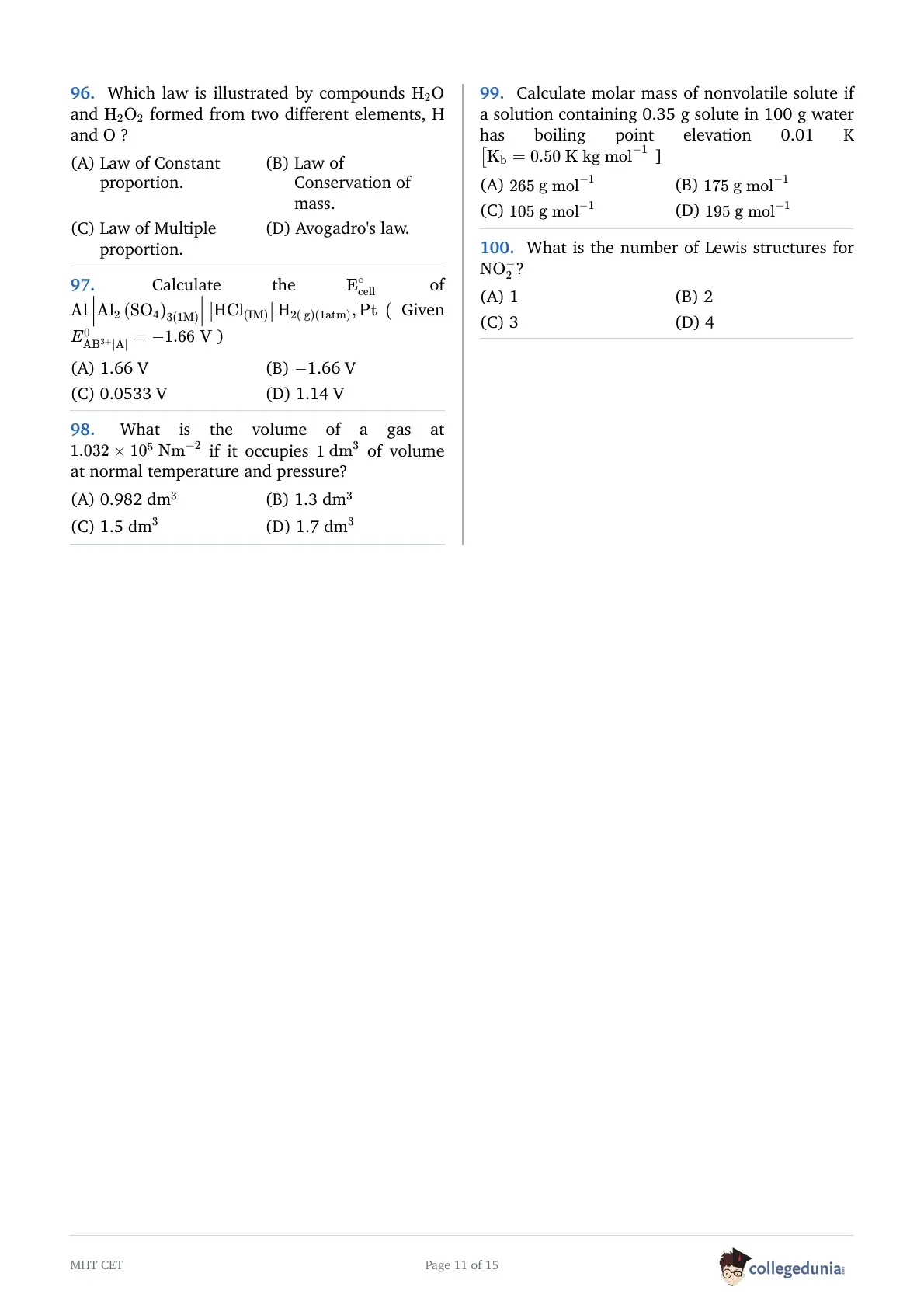
Calculate the \(\mathrm{E}_{\text {cell }}^{\circ}\) of \(\mathrm{Al}\left|\mathrm{Al}_2\left(\mathrm{SO}_4\right)_{3(\mathrm{1M})}\right|\left|\mathrm{HCl}_{(\mathrm{IM})}\right| \mathrm{H}_{2(\mathrm{~g})(\mathrm{1atm})}, \mathrm{Pt}\) \(\left(\right.\) Given \(E_{\mathrm{AB}^{3+}|\mathrm{A}|}^0=-1.66 \mathrm{~V}\) )

  • (A) 1.66 V
  • (B) \(-\)1.66 V
  • (C) 0.0533 V
  • (D) 1.14 V

Question 98:

What is the volume of a gas at \(1.032 \times 10^5 \mathrm{~Nm}^{-2}\) if it occupies \(1 \mathrm{~dm}^3\) of volume at normal temperature and pressure?

  • (A) 0.982 dm\({}^{3}\)
  • (B) 1.3 dm\({}^{3}\)
  • (C) 1.5 dm\({}^{3}\)
  • (D) 1.7 dm\({}^{3}\)

Question 99:

Calculate molar mass of nonvolatile solute if a solution containing 0.35 g solute in 100 g water has boiling point elevation 0.01 K \(\left[\mathrm{K}_{\mathrm{b}}=0.50 \mathrm{~K} \mathrm{~kg} \mathrm{~mol}^{-1}\right.\) ]

  • (A) \(265\text{ }\mathrm{g}\text{ }\mathrm{mol}^{-1}\)
  • (B) \(175\text{ }\mathrm{g}\text{ }\mathrm{mol}^{-1}\)
  • (C) \(105\text{ }\mathrm{g}\text{ }\mathrm{mol}^{-1}\)
  • (D) \(195\text{ }\mathrm{g}\text{ }\mathrm{mol}^{-1}\)

Question 100:

What is the number of Lewis structures for \(\mathrm{NO}_2^{-}\)?

  • (A) 1
  • (B) 2
  • (C) 3
  • (D) 4

Mathematics (Q101 - Q150)

Question 101:

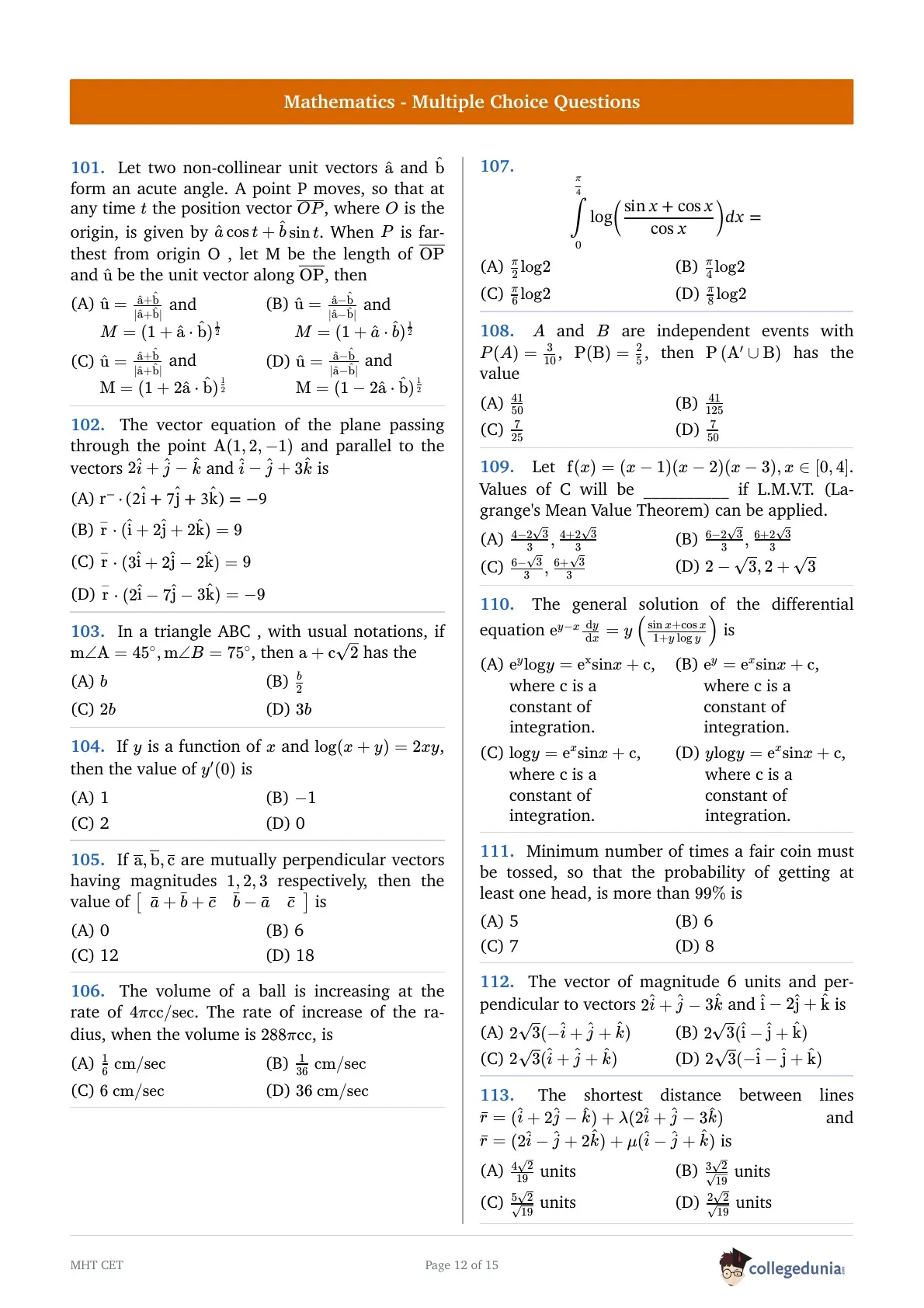
Let two non-collinear unit vectors \(\hat{\mathrm{a}}\) and \(\hat{\mathrm{b}}\) form an acute angle. A point P moves, so that at any time \(t\) the position vector \(\overline{O P}\), where \(O\) is the origin, is given by \(\hat{a} \cos t+\hat{b} \sin t\). When \(P\) is farthest from origin O , let M be the length of \(\overline{\mathrm{OP}}\) and \(\hat{\mathrm{u}}\) be the unit vector along \(\overline{\mathrm{OP}}\), then

  • (A) \(\hat{\mathrm{u}}=\frac{\hat{\mathrm{a}}+\hat{\mathrm{b}}}{|\hat{\mathrm{a}}+\hat{\mathrm{b}}|}\) and \(M=(1+\hat{\mathrm{a}}\cdot \hat{\mathrm{b}})^{\frac{1}{2}}\)
  • (B) \(\hat{\mathrm{u}}=\frac{\hat{\mathrm{a}}-\hat{\mathrm{b}}}{|\hat{\mathrm{a}}-\hat{\mathrm{b}}|}\) and \(M=(1+\hat{a}\cdot \hat{b})^{\frac{1}{2}}\)
  • (C) \(\hat{\mathrm{u}}=\frac{\hat{\mathrm{a}}+\hat{\mathrm{b}}}{|\hat{\mathrm{a}}+\hat{\mathrm{b}}|}\) and \(\mathrm{M}=(1+2\hat{\mathrm{a}}\cdot \hat{\mathrm{b}})^{\frac{1}{2}}\)
  • (D) \(\hat{\mathrm{u}}=\frac{\hat{\mathrm{a}}-\hat{\mathrm{b}}}{|\hat{\mathrm{a}}-\hat{\mathrm{b}}|}\) and \(\mathrm{M}=(1-2\hat{\mathrm{a}}\cdot \hat{\mathrm{b}})^{\frac{1}{2}}\)

Question 102:

The vector equation of the plane passing through the point \(\mathrm{A}(1,2,-1)\) and parallel to the vectors \(2 \hat{i}+\hat{j}-\hat{k}\) and \(\hat{i}-\hat{j}+3 \hat{k}\) is

  • (A) \(\overset{-}{\mathrm{r}}\cdot (2\hat{\mathrm{i}}+7\hat{\mathrm{j}}+3\hat{\mathrm{k}})=-9\)
  • (B) \(\overset{-}{\mathrm{r}}\cdot (\hat{\mathrm{i}}+2\hat{\mathrm{j}}+2\hat{\mathrm{k}})=9\)
  • (C) \(\overset{-}{\mathrm{r}}\cdot (3\hat{\mathrm{i}}+2\hat{\mathrm{j}}-2\hat{\mathrm{k}})=9\)
  • (D) \(\overset{-}{\mathrm{r}}\cdot (2\hat{\mathrm{i}}-7\hat{\mathrm{j}}-3\hat{\mathrm{k}})=-9\)

Question 103:

In a triangle ABC , with usual notations, if \(\mathrm{m} \angle \mathrm{A}=45^{\circ}, \mathrm{m} \angle B=75^{\circ}\), then \(\mathrm{a}+\mathrm{c} \sqrt{2}\) has the

  • (A) \(b\)
  • (B) \(\frac{b}{2}\)
  • (C) \(2b\)
  • (D) \(3b\)

Question 104:

If \(y\) is a function of \(x\) and \(\log (x+y)=2 x y\), then the value of \(y^{\prime}(0)\) is

  • (A) 1
  • (B) \(-\)1
  • (C) 2
  • (D) 0

Question 105:

If \(\overline{\mathrm{a}}, \overline{\mathrm{b}}, \overline{\mathrm{c}}\) are mutually perpendicular vectors having magnitudes \(1,2,3\) respectively, then the value of \(\left[\begin{array}{lll}\bar{a}+\bar{b}+\bar{c} & \bar{b}-\bar{a} & \bar{c}\end{array}\right]\) is

  • (A) 0
  • (B) 6
  • (C) 12
  • (D) 18

Question 106:

The volume of a ball is increasing at the rate of \(4 \pi \mathrm{cc} / \mathrm{sec}\). The rate of increase of the radius, when the volume is \(288 \pi \mathrm{cc}\), is

  • (A) \(\frac{1}{6}\text{ }\mathrm{cm}/\mathrm{sec}\)
  • (B) \(\frac{1}{36}\text{ }\mathrm{cm}/\mathrm{sec}\)
  • (C) \(6\text{ }\mathrm{cm}/\mathrm{sec}\)
  • (D) \(36\text{ }\mathrm{cm}/\mathrm{sec}\)

Question 107:

\[\int_\limits0^{\frac{\pi}{4}} \log \left(\frac{\sin x+\cos x}{\cos x}\right) d x=\]

  • (A) \(\frac{\pi}{2}\mathrm{log}2\)
  • (B) \(\frac{\pi}{4}\mathrm{log}2\)
  • (C) \(\frac{\pi}{6}\mathrm{log}2\)
  • (D) \(\frac{\pi}{8}\mathrm{log}2\)

Question 108:

\(A\) and \(B\) are independent events with \(P(A)=\frac{3}{10}\), \(\mathrm{P}(\mathrm{B})=\frac{2}{5}\), then \(\mathrm{P}\left(\mathrm{A}^{\prime} \cup \mathrm{B}\right)\) has the value

  • (A) \(\frac{41}{50}\)
  • (B) \(\frac{41}{125}\)
  • (C) \(\frac{7}{25}\)
  • (D) \(\frac{7}{50}\)

Question 109:

Let \(\mathrm{f}(x)=(x-1)(x-2)(x-3), x \in[0,4]\). Values of C will be __________ if L.M.V.T. (Lagrange's Mean Value Theorem) can be applied.

  • (A) \(\frac{4-2\sqrt{3}}{3},\frac{4+2\sqrt{3}}{3}\)
  • (B) \(\frac{6-2\sqrt{3}}{3},\frac{6+2\sqrt{3}}{3}\)
  • (C) \(\frac{6-\sqrt{3}}{3},\frac{6+\sqrt{3}}{3}\)
  • (D) \(2-\sqrt{3},2+\sqrt{3}\)

Question 110:

The general solution of the differential equation \(\mathrm{e}^{y-x} \frac{\mathrm{~d} y}{\mathrm{~d} x}=y\left(\frac{\sin x+\cos x}{1+y \log y}\right)\) is

  • (A) \(\mathrm{e}^{y}\mathrm{log}y=\mathrm{e}^{\mathrm{x}}\mathrm{sin}x+\mathrm{c}\), where c is a constant of integration.
  • (B) \(\mathrm{e}^{y}=\mathrm{e}^{x}\mathrm{sin}x+\mathrm{c}\), where c is a constant of integration.
  • (C) \(\mathrm{log}y=\mathrm{e}^{x}\mathrm{sin}x+\mathrm{c}\), where c is a constant of integration.
  • (D) \(y\mathrm{log}y=\mathrm{e}^{x}\mathrm{sin}x+\mathrm{c}\), where c is a constant of integration.

Question 111:

Minimum number of times a fair coin must be tossed, so that the probability of getting at least one head, is more than \(99 \%\) is

  • (A) 5
  • (B) 6
  • (C) 7
  • (D) 8

Question 112:

The vector of magnitude 6 units and perpendicular to vectors \(2 \hat{i}+\hat{j}-3 \hat{k}\) and \(\hat{\mathrm{i}}-2 \hat{\mathrm{j}}+\hat{\mathrm{k}}\) is

  • (A) \(2\sqrt{3}(-\hat{i}+\hat{j}+\hat{k})\)
  • (B) \(2\sqrt{3}(\hat{\mathrm{i}}-\hat{\mathrm{j}}+\hat{\mathrm{k}})\)
  • (C) \(2\sqrt{3}(\hat{i}+\hat{j}+\hat{k})\)
  • (D) \(2\sqrt{3}(-\hat{\mathrm{i}}-\hat{\mathrm{j}}+\hat{\mathrm{k}})\)

Question 113:

The shortest distance between lines \(\bar{r}=(\hat{i}+2 \hat{j}-\hat{k})+\lambda(2 \hat{i}+\hat{j}-3 \hat{k})\) and \(\bar{r}=(2 \hat{i}-\hat{j}+2 \hat{k})+\mu(\hat{i}-\hat{j}+\hat{k})\) is

  • (A) \(\frac{4\sqrt{2}}{19}\) units
  • (B) \(\frac{3\sqrt{2}}{\sqrt{19}}\) units
  • (C) \(\frac{5\sqrt{2}}{\sqrt{19}}\) units
  • (D) \(\frac{2\sqrt{2}}{\sqrt{19}}\) units

Question 114:

The graphical solution set of the system of inequations \(x+y \geq 1,7 x+9 y \leq 63, y \leq 5, x \leq 6\), \(x \geq 0, y \geq 0\) is represented by

  • (A) Fig. 1
  • (B) Fig. 2
  • (C) Fig. 3
  • (D) Fig. 4

Question 115:

\(\tan \left(\cos ^{-1} \frac{1}{\sqrt{2}}+\tan ^{-1} \frac{1}{2}\right)=\)

  • (A) 1
  • (B) 2
  • (C) 3
  • (D) 4

Question 116:

If \(x^2 y^2=\sin ^{-1} x+\cos ^{-1} x\), then \(\frac{\mathrm{d} y}{\mathrm{~d} x}\) at \(x=1\) and \(y=2\) is

  • (A) \(\frac{1}{2}\)
  • (B) \(2\)
  • (C) \(-\frac{1}{2}\)
  • (D) \(-2\)

Question 117:

If \(\overline{\mathrm{a}}=\hat{\mathrm{j}}-\hat{\mathrm{k}}\) and \(\overline{\mathrm{c}}=\hat{\mathrm{i}}-\hat{\mathrm{j}}-\hat{\mathrm{k}}\), then the vector \(\overline{\mathrm{b}}\) satisfying \(\overline{\mathrm{a}} \times \overline{\mathrm{b}}+\overline{\mathrm{c}}=\overline{0}\) and \(\overline{\mathrm{a}} \cdot \overline{\mathrm{b}}=3\) is

  • (A) \(-\hat{i}+\hat{j}-2\hat{k}\)
  • (B) \(-\hat{i}+\hat{j}-\hat{k}\)
  • (C) \(-\hat{i}-\hat{j}+\hat{k}\)
  • (D) \(\hat{i}+\hat{j}+\hat{k}\)

Question 118:

The expression \(((p \wedge q) \vee(p \vee \sim q)) \wedge(\sim p \wedge \sim q)\) is equivalent to

  • (A) \(\mathrm{p}\wedge \mathrm{q}\)
  • (B) \(\mathrm{p}\vee \sim \mathrm{q}\)
  • (C) \(\mathrm{p}\wedge \sim \mathrm{q}\)
  • (D) \((\sim p)\wedge (\sim q)\)

Question 119:

If \(y=4 x-5\) is a tangent to the curve \(y^2=p x^3+q\) at \((2,3)\), then the values of \(p\) and \(q\) are respectively

  • (A) \(-2,7\)
  • (B) \(7,-2\)
  • (C) \(2,-7\)
  • (D) \(-7,-2\)

Question 120:

If \(\mathrm{w}=\frac{-1-\mathrm{i} \sqrt{3}}{2}\) where \(\mathrm{i}=\sqrt{-1}\), then the value of \(\left|\begin{array}{ccc}1 & w & w^2 \\ w & w^2 & 1 \\ w^2 & 1 & w\end{array}\right|\) is

  • (A) \(-1\)
  • (B) \(0\)
  • (C) \(1\)
  • (D) \(3\)

Question 121:

\[\int_\limits0^a \frac{x-a}{x+a} d x=\]

  • (A) \(a-2a\mathrm{log}2\)
  • (B) \(a-a\mathrm{log}2\)
  • (C) \(\mathrm{a}+2\mathrm{alog}2\)
  • (D) \(a+a\mathrm{log}2\)

Question 122:

Let PQ and RS be tangents at the extremities of the diameter PR of a circle of radius \(r\). If PS and RQ intersect at a point X on the circumference of the circle, then 2 r equals

  • (A) \(\sqrt{\mathrm{PQ}\cdot \mathrm{RS}}\)
  • (B) \(\frac{\mathrm{PQ}+\mathrm{RS}}{2}\)
  • (C) \(\frac{2\cdot PQ\cdot RS}{PQ+RS}\)
  • (D) \(\sqrt{\frac{\mathrm{PQ}^{2}+\mathrm{RS}^{2}}{2}}\)

Question 123:

A random variable X assumes values \(1,2,3, \ldots \ldots ., \mathrm{n}\) with equal probabilities. If \(\operatorname{var}(X): E(X)=4: 1\), then \(n\) is equal to

  • (A) 20
  • (B) 15
  • (C) 25
  • (D) 10

Question 124:

\(\overline{\mathrm{a}}=\hat{\mathrm{i}}+\hat{\mathrm{j}}+\hat{\mathrm{k}}, \overline{\mathrm{b}}=4 \hat{\mathrm{i}}-2 \hat{j}+3 \hat{k}, \overline{\mathrm{c}}=\hat{i}-2 \hat{j}+\hat{k}\), then \(a\) vector of magnitude 6 units, which is parallel to the vector \(2 \bar{a}-\bar{b}+3 c\), is

  • (A) \(2\hat{i}-4\hat{j}+4\hat{k}\)
  • (B) \(\hat{i}-\hat{j}+2\hat{k}\)
  • (C) \(4\hat{\mathrm{i}}+4\hat{\mathrm{j}}-2\hat{\mathrm{k}}\)
  • (D) \(2\hat{i}+4\hat{j}+4\hat{k}\)

Question 125:

If \(y=\sin ^2\left(\cot ^{-1} \sqrt{\frac{1+x}{1-x}}\right)\), then \(\frac{\mathrm{d} y}{\mathrm{~d} x}\) has the value

  • (A) \(\frac{-1}{2}\)
  • (B) \(\frac{1}{2}\)
  • (C) \(-1\)
  • (D) \(1\)

Question 126:

If the line \(\frac{x-1}{2}=\frac{y+1}{3}=\frac{z-1}{4}\) and \(\frac{x-3}{1}=\frac{y-\mathrm{k}}{2}=\frac{\mathrm{z}}{1}\) intersect, then the value of k is

  • (A) \(\frac{3}{2}\)
  • (B) \(\frac{9}{2}\)
  • (C) \(-\frac{2}{9}\)
  • (D) \(-\frac{3}{2}\)

Question 127:

Inverse of the matrix \(\left[\begin{array}{cc}0.8 & -0.6 \\ 0.6 & 0.8\end{array}\right]\) is

  • (A) \([\begin{array}{cc} 0.8 & 0.6 \\ -0.6 & 0.8 \end{array}]\)
  • (B) \([\begin{array}{cc} -0.8 & 0.6 \\ -0.6 & 0.8 \end{array}]\)
  • (C) \([\begin{array}{cc} -0.8 & -0.6 \\ 0.6 & 0.8 \end{array}]\)
  • (D) \([\begin{array}{cc} 8 & -6 \\ 6 & 8 \end{array}]\)

Question 128:

\(\int \frac{\mathrm{d} x}{\sqrt{\mathrm{e}^x-1}}=2 \tan ^{-1}(\mathrm{f}(x))+\mathrm{c}\) where \(x>0\) and c is a constant of integration, then \(\mathrm{f}(x)\) is

  • (A) \(\mathrm{e}^{x}-1\)
  • (B) \(\sqrt{\mathrm{e}^{x}-1}\)
  • (C) \(\mathrm{e}^{x}+1\)
  • (D) \(\sqrt{\mathrm{e}^{x}+1}\)

Question 129:

If \(\mathrm{f}(x)=\left(\frac{1+\tan x}{1+\sin x}\right)^{\operatorname{cosec} x}\) is continuous at \(x=0\) then \(f(0)\) is equal to

  • (A) 0
  • (B) 1
  • (C) \(\mathrm{e}\)
  • (D) \(\frac{1}{\mathrm{e}}\)

Question 130:

The value of \(\cos \left(2 \cos ^{-1} x+\sin ^{-1} x\right)\) at \(x=\frac{1}{5}\) is

  • (A) \(-\frac{\sqrt{6}}{5}\)
  • (B) \(\frac{2\sqrt{6}}{5}\)
  • (C) \(-\frac{2\sqrt{6}}{5}\)
  • (D) \(\frac{2\sqrt{5}}{6}\)

Question 132:

The mean and variance of 7 observations are 8 and 16 respectively. If first five observations are \(2,4,10,12,14\), then absolute difference of remaining two observations is

  • (A) 1
  • (B) 2
  • (C) 3
  • (D) 4

Question 134:

The equation of the plane through the point \((2,-1,-3)\) and parallel to the lines \(\frac{x-1}{3}=\frac{y+2}{2}=\frac{z}{-4}\) and \(\frac{x}{2}=\frac{y-1}{-3}=\frac{z-2}{2}\) is

  • (A) \(8x+y-13z+27=0\)
  • (B) \(2x+y+z=0\)
  • (C) \(3x-y-z-10=0\)
  • (D) \(8x+14y+13z+37=0\)

Question 135:

If \(x, y, z\) are in Arithmetic Progression and \(\tan ^{-1} x, \tan ^{-1} y, \tan ^{-1} z\) are also in Arithmetic progression, where \(x, z>0\) and \(x z<1, y<1\), then

  • (A) \(x=y=z\)
  • (B) \(2x=3y=6z\)
  • (C) \(6x=3y=2z\)
  • (D) \(6x=4y=3z\)

Question 136:

Derivative of \(\tan ^{-1} \sqrt{\frac{1-x}{1+x}}\) w.r.t. \(\cos ^{-1}\left(4 x^3-3 x\right)\) is

  • (A) \(\frac{-1}{6}\)
  • (B) \(\frac{2}{3}\)
  • (C) \(\frac{3}{2}\)
  • (D) \(\frac{1}{6}\)

Question 137:

If \(\frac{\mathrm{d}}{\mathrm{d} x} \mathrm{f}(x)=4 x^3-\frac{3}{x^4}\) such that \(\mathrm{f}(2)=0\), then \(\mathrm{f}(x)\) is equal to

  • (A) \(x^{4}+\frac{1}{x^{3}}+\frac{129}{8}\)
  • (B) \(x^{4}+\frac{1}{x^{3}}-\frac{129}{8}\)
  • (C) \(x^{3}+\frac{1}{x^{4}}+\frac{129}{8}\)
  • (D) \(x^{3}+\frac{1}{x^{4}}-\frac{129}{8}\)

Question 138:

\[\lim _\limits{x \rightarrow 0} \frac{9^x-4^x}{x\left(9^x+4^x\right)}=\]

  • (A) \(\mathrm{log}(\frac{3}{2})\)
  • (B) \(\frac{1}{2}\mathrm{log}(\frac{3}{2})\)
  • (C) \(2\mathrm{log}(\frac{3}{2})\)
  • (D) \(2\mathrm{log}(\frac{9}{4})\)

Question 139:

If the length of the perpendicular to a line from the origin is \(2 \sqrt{2}\) units, which makes an angle of \(135^{\circ}\) with the X -axis, then the equation of line is

  • (A) \(x+y=4\)
  • (B) \(x-y+4=0\)
  • (C) \(x-y=4\)
  • (D) \(x+y+4=0\)

Question 140:

A spherical rain drop evaporates at a rate proportional to its surface area. If initially its radius is 3 mm and after 1 second it is reduced to 2 mm , then at any time t its radius is (where \(0 \leq \mathrm{t}<3\))

  • (A) \(3+\mathrm{t}\)
  • (B) \(3-\mathrm{t}\)
  • (C) \(4-\mathrm{t}\)
  • (D) \(1+\mathrm{t}\)

Question 141:

If \(\overline{\mathrm{a}}=2 \hat{i}+2 \hat{j}+3 \hat{k}, \bar{b}=-\hat{i}+2 \hat{j}+\hat{k}\) and \(\bar{c}=3 \hat{i}+\hat{j}\) such that \(\overline{\mathrm{b}}+\lambda \overline{\mathrm{a}}\) is perpendicular to \(\overline{\mathrm{c}}\), then \(\lambda\) is

  • (A) \(\frac{1}{2}\)
  • (B) \(\frac{1}{4}\)
  • (C) \(\frac{1}{6}\)
  • (D) \(\frac{1}{8}\)

Question 142:

The number of integer values of \(m\), for which \(x\)-coordinate of the point of intersection of the lines \(3 x+4 y=9\) and \(y=m x+1\) is also an integer, is

  • (A) 2
  • (B) 0
  • (C) 4
  • (D) 1

Question 143:

If \(\tan ^{-1}(x+2)+\tan ^{-1}(x-2)-\tan ^{-1}\left(\frac{1}{2}\right)=0\), then one value of \(x\) is

  • (A) \(-\)1
  • (B) \(\frac{1}{2}\)
  • (C) 1
  • (D) 2

Question 144:

The value of \(\int \frac{\mathrm{d} x}{x^2\left(x^4+1\right)^{\frac{3}{4}}}\) is

  • (A) \((\frac{-x^{4}+1}{x^{4}})^{\frac{1}{4}}+c\), where \(c\) is constant of integration.
  • (B) \((x^{4}+1)^{\frac{1}{4}}+\mathrm{c}\), where c is constant of integration.
  • (C) \(-(x^{4}+1)^{\frac{1}{4}}+\mathrm{c}\), where c is constant of integration.
  • (D) \(-(\frac{x^{4}+1}{x^{4}})^{\frac{1}{4}}+c\), where \(c\) is constant of integration.

Question 145:

The converse of "If 3 is a prime number, then 3 is odd." is

  • (A) If 3 is odd then it is a prime number.
  • (B) If 3 is not a prime number then 3 is even.
  • (C) If 3 is a prime number then 3 is even.
  • (D) If 3 is not a prime number then 3 is not odd.

Question 146:

\[\int \sin ^{-1}\left(\frac{2 x}{1+x^2}\right) \mathrm{d} x=\]

  • (A) \(2x\mathrm{tan}^{-1}x-\mathrm{log}(1+x^{2})+\mathrm{c}\), where c is a constant of integration.
  • (B) \(2(x\mathrm{tan}^{-1}x-\mathrm{log}(1+x^{2}))+\mathrm{c}\), where c is a constant of integration.
  • (C) \(x\mathrm{tan}^{-1}x+\mathrm{log}(1+x^{2})+\mathrm{c}\), where c is a constant of integration.
  • (D) \(2(x\mathrm{tan}^{-1}x+\mathrm{log}(1+x^{2}))+\mathrm{c}\), where c is a constant of integration.

Question 147:

Let \(\mathrm{f}(x)=\frac{a x}{x+1}, x \neq-1\), then for \(\alpha=\) ________, \(\mathrm{f}(\mathrm{f}(x))=x\).

  • (A) \(\sqrt{2}\)
  • (B) \(-\sqrt{2}\)
  • (C) 1
  • (D) \(-\)1

Question 148:

The area (in sq. units) of the region \(\left\{(x, y) / x \geq 0, x+y \leq 3, x^2 \leq 4 y\right.\) and \(\left.y \leq 1+\sqrt{x}\right\}\) is

  • (A) \(\frac{9}{2}\)
  • (B) \(\frac{3}{2}\)
  • (C) \(\frac{7}{2}\)
  • (D) \(\frac{5}{2}\)

Question 149:

The order of the differential equation, whose general solution is given by

\[y=\left(c_1+c_2\right) \cos \left(x+c_3\right)-c_4 e^{x+c 5}\]

where \(c_1, c_2, c_3, c_4\) and \(c_5\) are arbitrary constant, is

  • (A) 5
  • (B) 4
  • (C) 3
  • (D) 2

Question 150:

If \((p \wedge \sim r) \rightarrow(\sim p \vee q)\) has truth value False, then truth values of \(p, q, r\) are respectively.

  • (A) \(\mathrm{F},\mathrm{F},\mathrm{T}\)
  • (B) \(\mathrm{F},\mathrm{T},\mathrm{F}\)
  • (C) \(\mathrm{T},\mathrm{F},\mathrm{F}\)
  • (D) \(\mathrm{T},\mathrm{T},\mathrm{F}\)

MHT CET 2024 PCM Exam Pattern and Marking Scheme

Parameter Details
Conducting Body Maharashtra Common Entrance Test Cell (Maharashtra CET Cell)
Exam Mode Online (Computer-Based Test)
Duration 180 minutes (3 hours)
Groups / Subjects PCM (Physics, Chemistry, Mathematics) for Engineering
Total Questions

150

Total Marks 200
Question Type Multiple Choice Questions (MCQs)
Marks Distribution
  • Mathematics – 2 marks/question
  • Physics and Chemistry – 1 mark/question
Negative Marking No
Syllabus Weightage
  • Class 12 – 80%
  • Class 11 – 20%