




MHT CET 2024 May 10 Shift 1 PCM Question Paper is available for download here. Maharashtra State CET Cell conducted MHT CET 2024 PCM Exam on May 10 in Shift 1 from 9 AM to 12 PM in CBT mode.
The MHT CET 2024 PCM question paper includes the following:
- The MHT CET 2024 PCM Question Paper consists of 150 multiple-choice questions (MCQs) totalling 200 marks divided into 3 sections: Physics, Chemistry, and Mathematics, with 50 questions in each subject.
- Physics and Chemistry questions carry 1 mark each while Mathematics questions carry 2 marks each.
- There is no negative marking for incorrect answers.
MHT CET 2024 May 10 Shift 1 PCM Question Paper with Solution PDF
| CD PDF | CD PDF with Solutions |
|---|---|
| Download Collegedunia PDF 0.85 MB | - |
Also Check:
MHT CET 2024 May 10 Shift 1 PCM Questions with Solutions
Physics (Q1 - Q50)
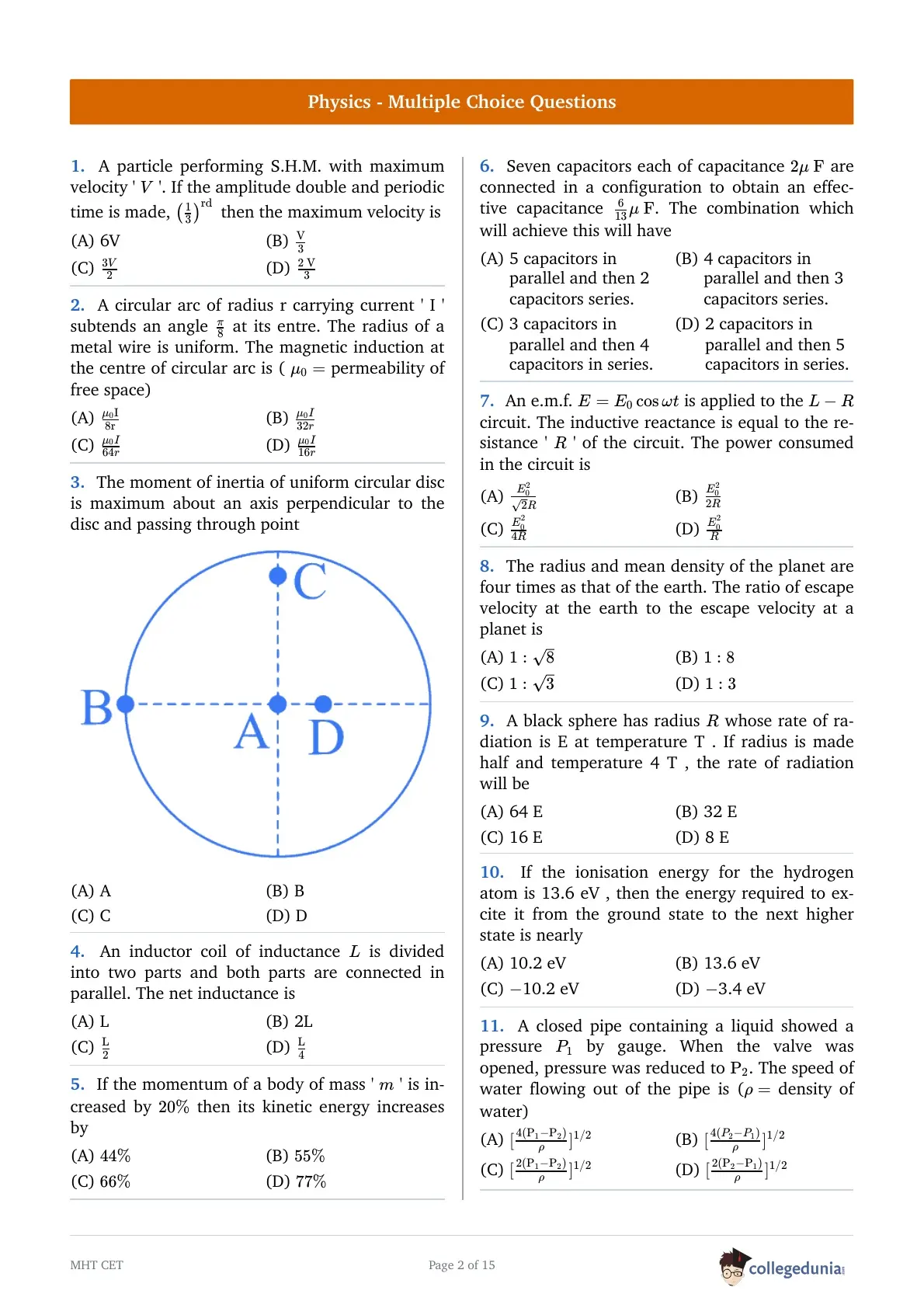
A particle performing S.H.M. with maximum velocity ' \(V\) '. If the amplitude double and periodic time is made, \(\left(\frac{1}{3}\right)^{\text {rd }}\) then the maximum velocity is
A circular arc of radius r carrying current ' I ' subtends an angle \(\frac{\pi}{8}\) at its entre. The radius of a metal wire is uniform. The magnetic induction at the centre of circular arc is ( \(\mu_0=\) permeability of free space)
The moment of inertia of uniform circular disc is maximum about an axis perpendicular to the disc and passing through point

An inductor coil of inductance \(L\) is divided into two parts and both parts are connected in parallel. The net inductance is
If the momentum of a body of mass ' \(m\) ' is increased by \(20 \%\) then its kinetic energy increases by
Seven capacitors each of capacitance \(2 \mu \mathrm{~F}\) are connected in a configuration to obtain an effective capacitance \(\frac{6}{13} \mu \mathrm{~F}\). The combination which will achieve this will have
An e.m.f. \(E=E_0 \cos \omega t\) is applied to the \(L-R\) circuit. The inductive reactance is equal to the resistance ' \(R\) ' of the circuit. The power consumed in the circuit is
The radius and mean density of the planet are four times as that of the earth. The ratio of escape velocity at the earth to the escape velocity at a planet is
A black sphere has radius \(R\) whose rate of radiation is E at temperature T . If radius is made half and temperature 4 T , the rate of radiation will be
If the ionisation energy for the hydrogen atom is 13.6 eV , then the energy required to excite it from the ground state to the next higher state is nearly
A closed pipe containing a liquid showed a pressure \(P_1\) by gauge. When the valve was opened, pressure was reduced to \(\mathrm{P}_2\). The speed of water flowing out of the pipe is (\(\rho=\) density of water)
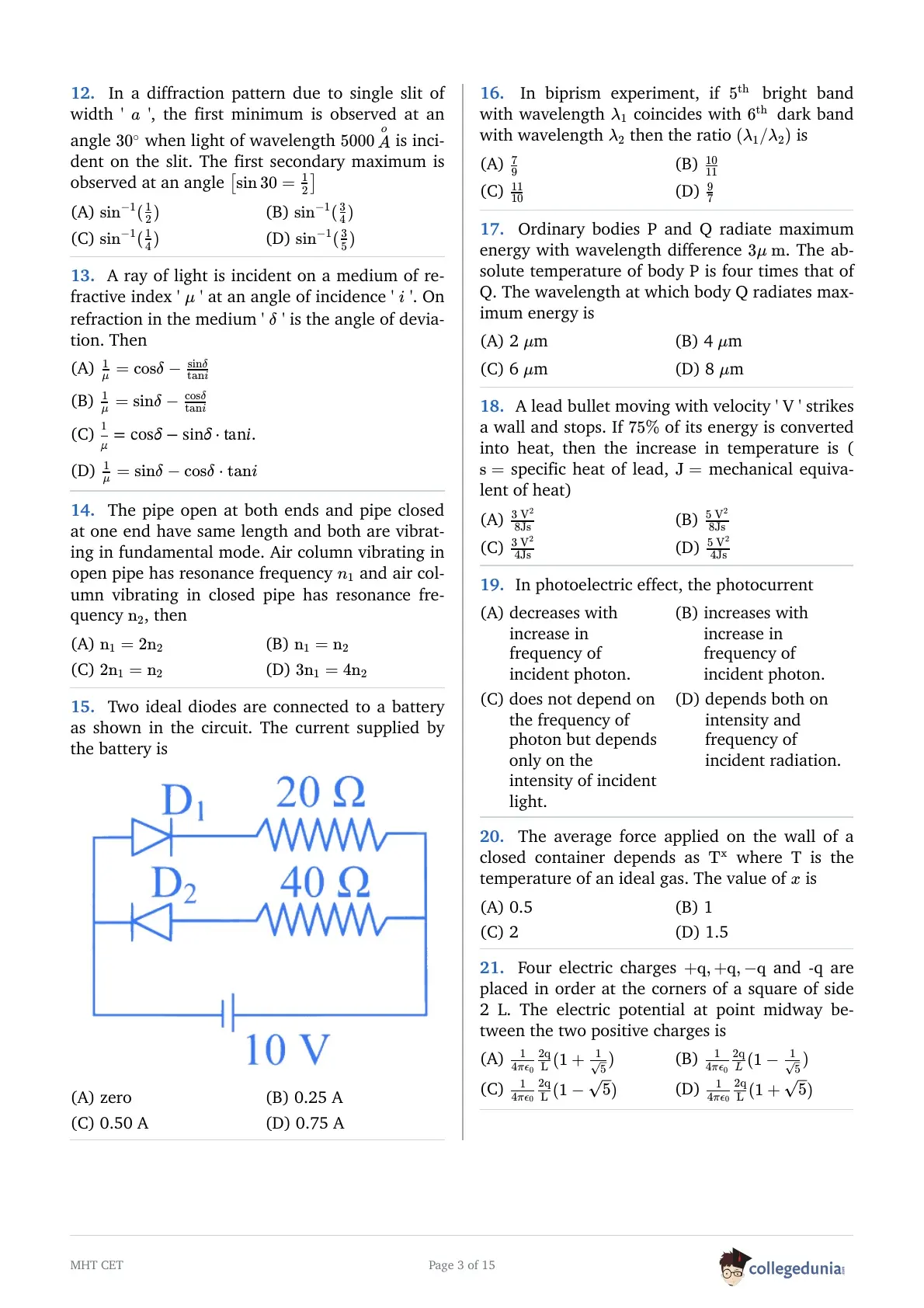
In a diffraction pattern due to single slit of width ' \(a\) ', the first minimum is observed at an angle \(30^{\circ}\) when light of wavelength \(5000 \mathop A\limits^o\) is incident on the slit. The first secondary maximum is observed at an angle \(\left[\sin 30=\frac{1}{2}\right]\)
A ray of light is incident on a medium of refractive index ' \(\mu\) ' at an angle of incidence ' \(i\) '. On refraction in the medium ' \(\delta\) ' is the angle of deviation. Then
The pipe open at both ends and pipe closed at one end have same length and both are vibrating in fundamental mode. Air column vibrating in open pipe has resonance frequency \(n_1\) and air column vibrating in closed pipe has resonance frequency \(\mathrm{n}_2\), then
Two ideal diodes are connected to a battery as shown in the circuit. The current supplied by the battery is

In biprism experiment, if \(5^{\text {th }}\) bright band with wavelength \(\lambda_1\) coincides with \(6^{\text {th }}\) dark band with wavelength \(\lambda_2\) then the ratio \(\left(\lambda_1 / \lambda_2\right)\) is
Ordinary bodies P and Q radiate maximum energy with wavelength difference \(3 \mu \mathrm{~m}\). The absolute temperature of body P is four times that of Q. The wavelength at which body Q radiates maximum energy is
A lead bullet moving with velocity ' V ' strikes a wall and stops. If \(75 \%\) of its energy is converted into heat, then the increase in temperature is ( \(\mathrm{s}=\) specific heat of lead, \(\mathrm{J}=\) mechanical equivalent of heat)
The average force applied on the wall of a closed container depends as \(\mathrm{T}^{\mathrm{x}}\) where T is the temperature of an ideal gas. The value of \(x\) is
Four electric charges \(+\mathrm{q},+\mathrm{q},-\mathrm{q}\) and -q are placed in order at the corners of a square of side 2 L. The electric potential at point midway between the two positive charges is
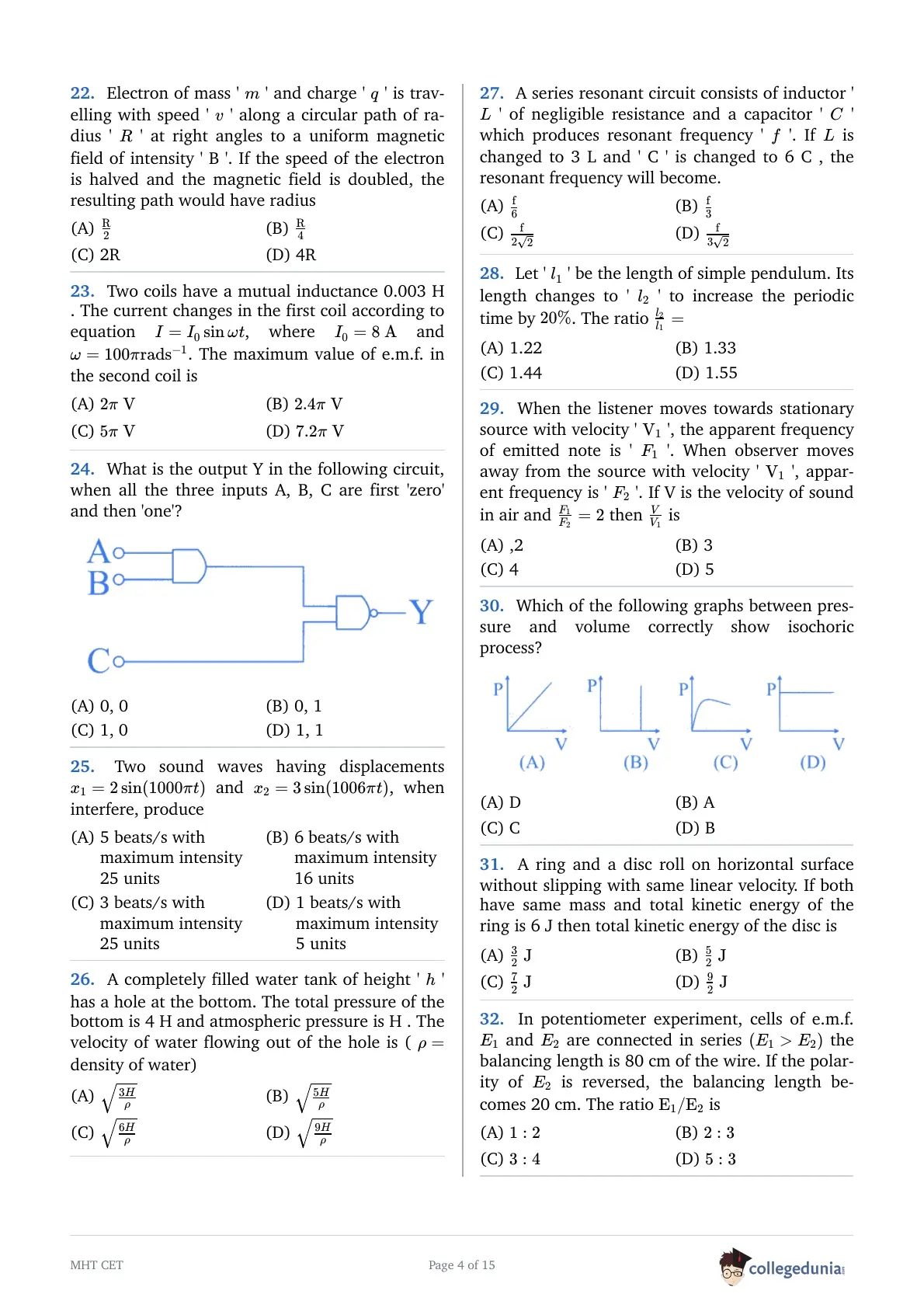
Electron of mass ' \(m\) ' and charge ' \(q\) ' is travelling with speed ' \(v\) ' along a circular path of radius ' \(R\) ' at right angles to a uniform magnetic field of intensity ' B '. If the speed of the electron is halved and the magnetic field is doubled, the resulting path would have radius
Two coils have a mutual inductance 0.003 H . The current changes in the first coil according to equation \(I=I_0 \sin \omega t\), where \(I_0=8 \mathrm{~A}\) and \(\omega=100 \pi \mathrm{rad} \mathrm{s}^{-1}\). The maximum value of e.m.f. in the second coil is
What is the output Y in the following circuit, when all the three inputs A, B, C are first 'zero' and then 'one'?

Two sound waves having displacements \(x_1=2 \sin (1000 \pi t)\) and \(x_2=3 \sin (1006 \pi t)\), when interfere, produce
A completely filled water tank of height ' \(h\) ' has a hole at the bottom. The total pressure of the bottom is 4 H and atmospheric pressure is H . The velocity of water flowing out of the hole is ( \(\rho=\) density of water)
A series resonant circuit consists of inductor ' \(L\) ' of negligible resistance and a capacitor ' \(C\) ' which produces resonant frequency ' \(f\) '. If \(L\) is changed to 3 L and ' C ' is changed to 6 C , the resonant frequency will become.
Let ' \(l_1\) ' be the length of simple pendulum. Its length changes to ' \(l_2\) ' to increase the periodic time by \(20 \%\). The ratio \(\frac{l_2}{l_1}=\)
Which of the following graphs between pressure and volume correctly show isochoric process?

A ring and a disc roll on horizontal surface without slipping with same linear velocity. If both have same mass and total kinetic energy of the ring is 6 J then total kinetic energy of the disc is
In potentiometer experiment, cells of e.m.f. \(E_1\) and \(E_2\) are connected in series \(\left(E_1>E_2\right)\) the balancing length is 80 cm of the wire. If the polarity of \(E_2\) is reversed, the balancing length becomes 20 cm. The ratio \(\mathrm{E}_1 / \mathrm{E}_2\) is
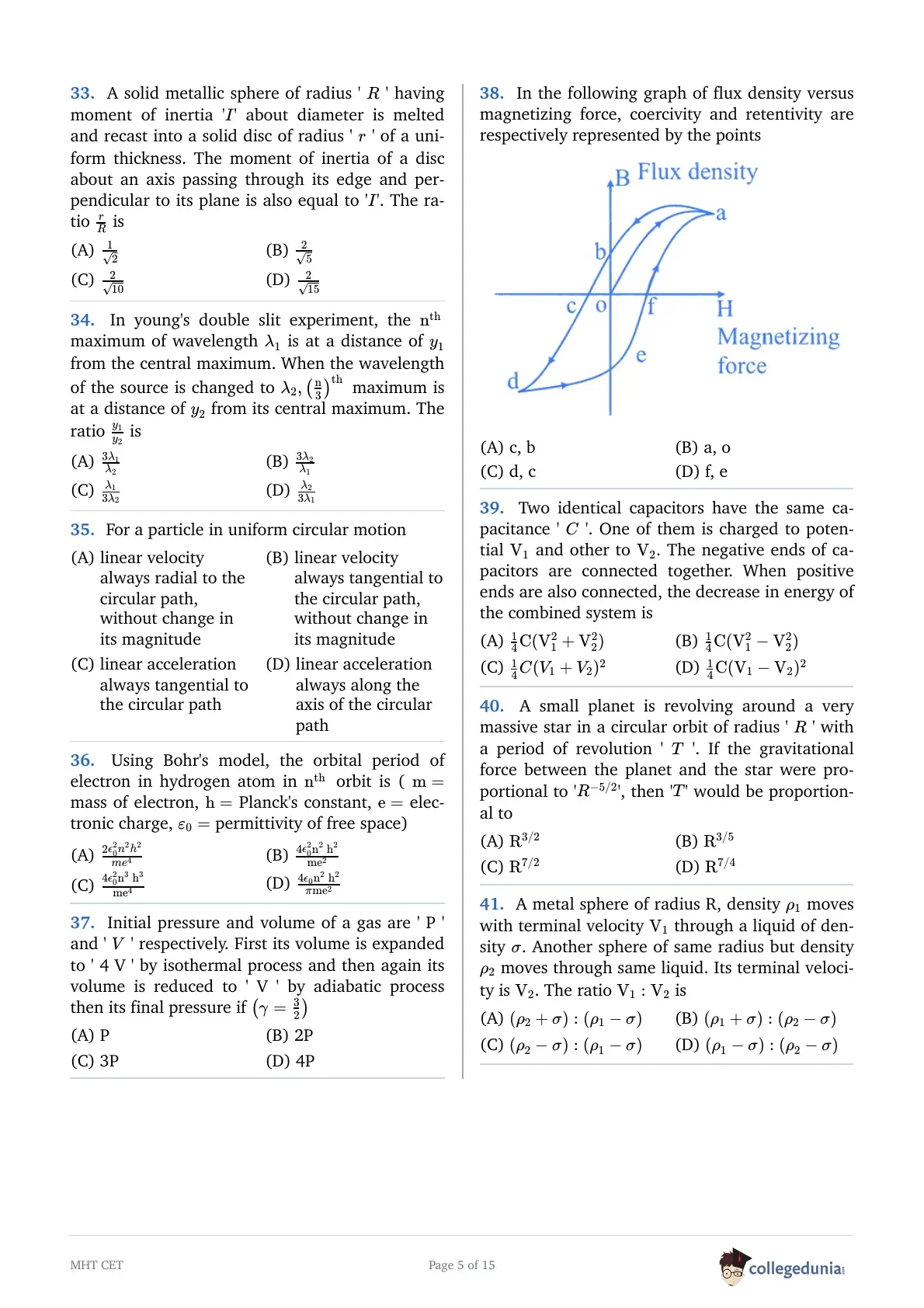
A solid metallic sphere of radius ' \(R\) ' having moment of inertia '\(I\)' about diameter is melted and recast into a solid disc of radius ' \(r\) ' of a uniform thickness. The moment of inertia of a disc about an axis passing through its edge and perpendicular to its plane is also equal to '\(I\)'. The ratio \(\frac{r}{R}\) is
In young's double slit experiment, the \(\mathrm{n}^{\text {th }}\) maximum of wavelength \(\lambda_1\) is at a distance of \(y_1\) from the central maximum. When the wavelength of the source is changed to \(\lambda_2,\left(\frac{\mathrm{n}}{3}\right)^{\text {th }}\) maximum is at a distance of \(y_2\) from its central maximum. The ratio \(\frac{y_1}{y_2}\) is
Using Bohr's model, the orbital period of electron in hydrogen atom in \(\mathrm{n}^{\text {th }}\) orbit is ( \(\mathrm{m}=\) mass of electron, \(\mathrm{h}=\) Planck's constant, \(\mathrm{e}=\) electronic charge, \(\varepsilon_0=\) permittivity of free space)
Initial pressure and volume of a gas are ' P ' and ' \(V\) ' respectively. First its volume is expanded to ' 4 V ' by isothermal process and then again its volume is reduced to ' V ' by adiabatic process then its final pressure if \(\left(\gamma=\frac{3}{2}\right)\)
In the following graph of flux density versus magnetizing force, coercivity and retentivity are respectively represented by the points

Two identical capacitors have the same capacitance ' \(C\) '. One of them is charged to potential \(\mathrm{V}_1\) and other to \(\mathrm{V}_2\). The negative ends of capacitors are connected together. When positive ends are also connected, the decrease in energy of the combined system is
A small planet is revolving around a very massive star in a circular orbit of radius ' \(R\) ' with a period of revolution ' \(T\) '. If the gravitational force between the planet and the star were proportional to '\(R^{-5 / 2}\)', then '\(T\)' would be proportional to
A metal sphere of radius R, density \(\rho_1\) moves with terminal velocity \(\mathrm{V}_1\) through a liquid of density \(\sigma\). Another sphere of same radius but density \(\rho_2\) moves through same liquid. Its terminal velocity is \(\mathrm{V}_2\). The ratio \(\mathrm{V}_1: \mathrm{V}_2\) is

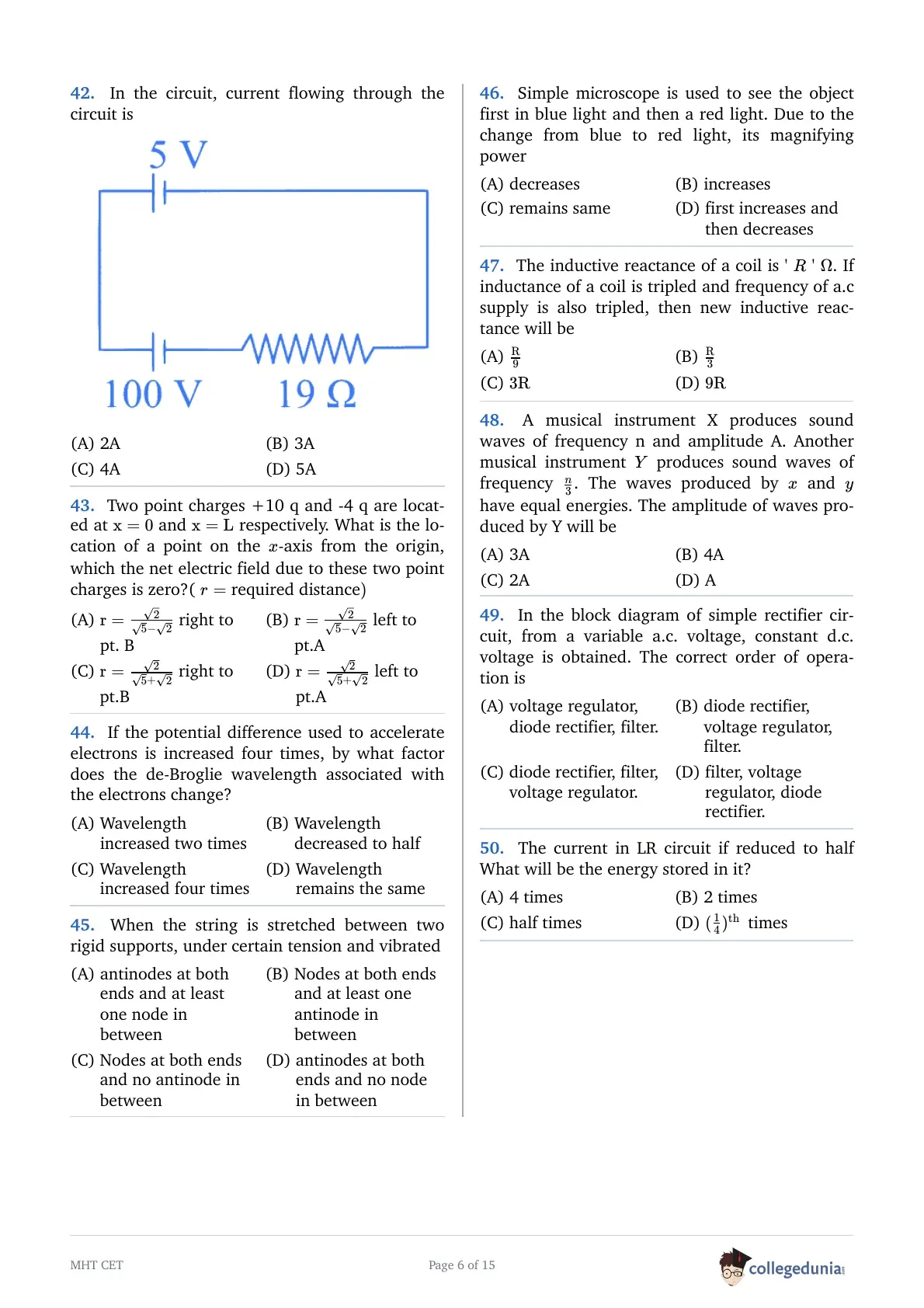
Two point charges +10 q and -4 q are located at \(\mathrm{x}=0\) and \(\mathrm{x}=\mathrm{L}\) respectively. What is the location of a point on the \(x\)-axis from the origin, which the net electric field due to these two point charges is zero?( \(r=\) required distance\()\)
If the potential difference used to accelerate electrons is increased four times, by what factor does the de-Broglie wavelength associated with the electrons change?
When the string is stretched between two rigid supports, under certain tension and vibrated
Simple microscope is used to see the object first in blue light and then a red light. Due to the change from blue to red light, its magnifying power
The inductive reactance of a coil is ' \(R\) ' \(\Omega\). If inductance of a coil is tripled and frequency of a.c supply is also tripled, then new inductive reactance will be
A musical instrument X produces sound waves of frequency n and amplitude A. Another musical instrument \(Y\) produces sound waves of frequency \(\frac{n}{3}\). The waves produced by \(x\) and \(y\) have equal energies. The amplitude of waves produced by Y will be
In the block diagram of simple rectifier circuit, from a variable a.c. voltage, constant d.c. voltage is obtained. The correct order of operation is
The current in LR circuit if reduced to half What will be the energy stored in it?
Chemistry (Q51 - Q100)
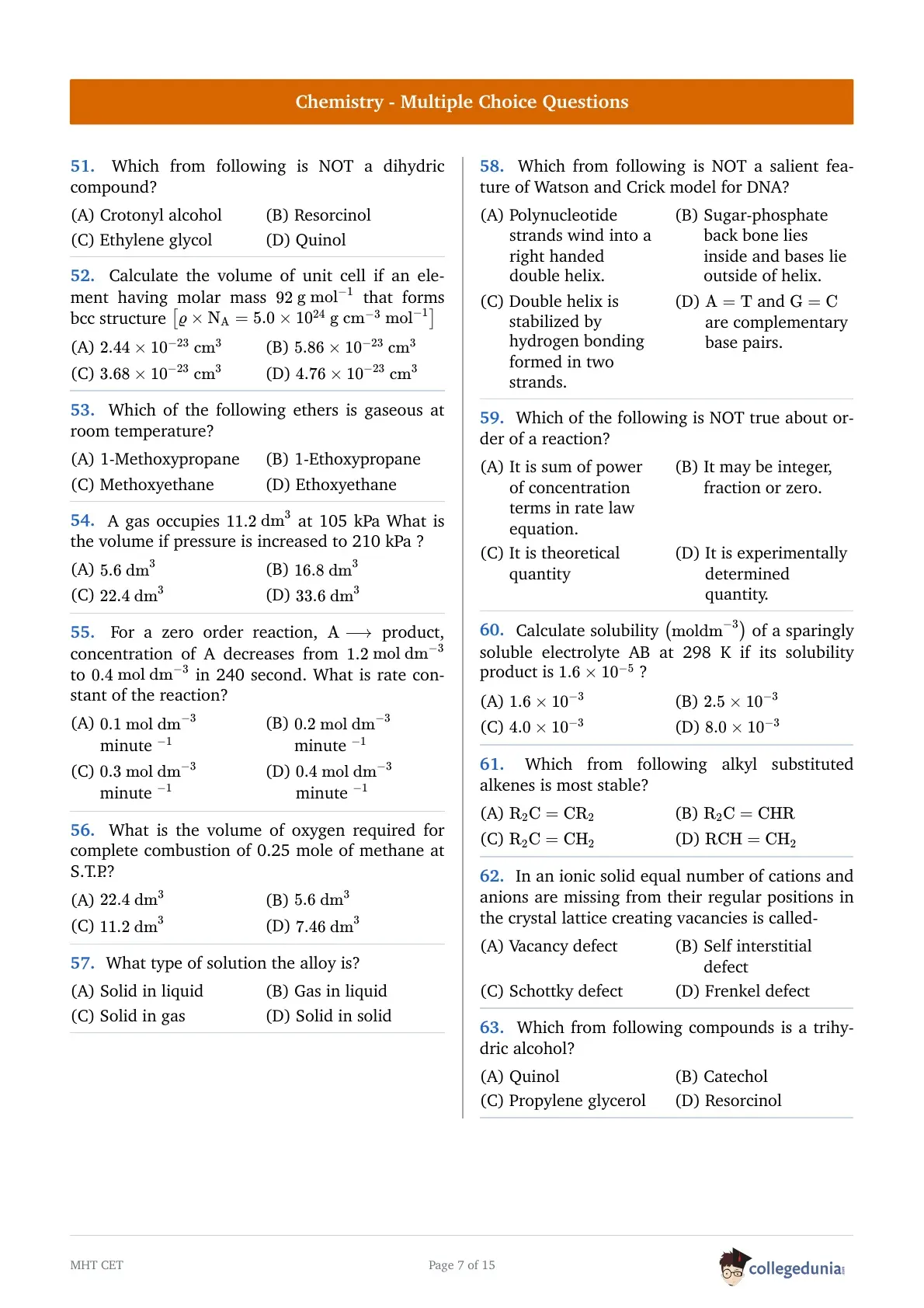
Calculate the volume of unit cell if an element having molar mass \(92 \mathrm{~g} \mathrm{~mol}^{-1}\) that forms bcc structure \(\left[\varrho \times \mathrm{N}_{\mathrm{A}}=5.0 \times 10^{24} \mathrm{~g} \mathrm{~cm}^{-3} \mathrm{~mol}^{-1}\right]\)
A gas occupies \(11.2 \mathrm{~dm}^3\) at 105 kPa What is the volume if pressure is increased to 210 kPa ?
For a zero order reaction, \(\mathrm{A} \longrightarrow\) product, concentration of A decreases from \(1.2 \mathrm{~mol~dm}^{-3}\) to \(0.4 \mathrm{~mol~dm}^{-3}\) in 240 second. What is rate constant of the reaction?
What is the volume of oxygen required for complete combustion of 0.25 mole of methane at S.T.P.?
Which from following is NOT a salient feature of Watson and Crick model for DNA?
Calculate solubility \(\left(\mathrm{moldm}^{-3}\right)\) of a sparingly soluble electrolyte AB at 298 K if its solubility product is \(1.6 \times 10^{-5}\) ?
In an ionic solid equal number of cations and anions are missing from their regular positions in the crystal lattice creating vacancies is called-
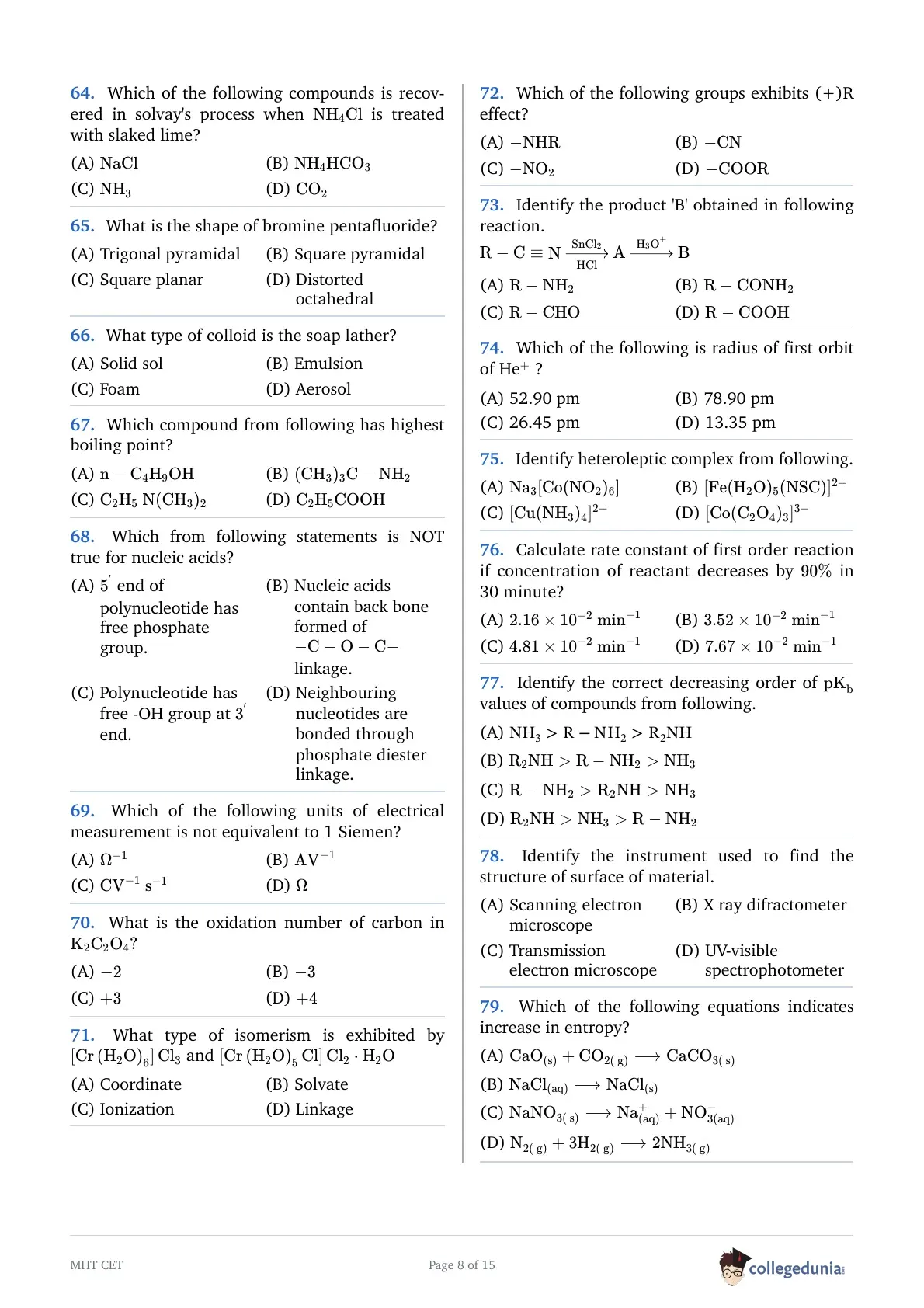
Which of the following compounds is recovered in solvay's process when \(\mathrm{NH}_4 \mathrm{Cl}\) is treated with slaked lime?
Which of the following units of electrical measurement is not equivalent to 1 Siemen?
What is the oxidation number of carbon in \(\mathrm{K}_2 \mathrm{C}_2 \mathrm{O}_4 ?\)
What type of isomerism is exhibited by \(\left[\mathrm{Cr}\left(\mathrm{H}_2 \mathrm{O}\right)_6\right] \mathrm{Cl}_3\) and \(\left[\mathrm{Cr}\left(\mathrm{H}_2 \mathrm{O}\right)_5 \mathrm{Cl}\right] \mathrm{Cl}_2 \cdot \mathrm{H}_2 \mathrm{O}\)
Identify the product 'B' obtained in following reaction.
\(\mathrm{R}-\mathrm{C} \equiv \mathrm{N} \xrightarrow[\mathrm{HCl}]{\mathrm{SnCl}_2}\mathrm{A} \xrightarrow{\mathrm{H}_3 \mathrm{O}^{+}} \mathrm{B}\)
Calculate rate constant of first order reaction if concentration of reactant decreases by \(90 \%\) in 30 minute?
Identify the correct decreasing order of \(\mathrm{pK}_{\mathrm{b}}\) values of compounds from following.
Identify the instrument used to find the structure of surface of material.
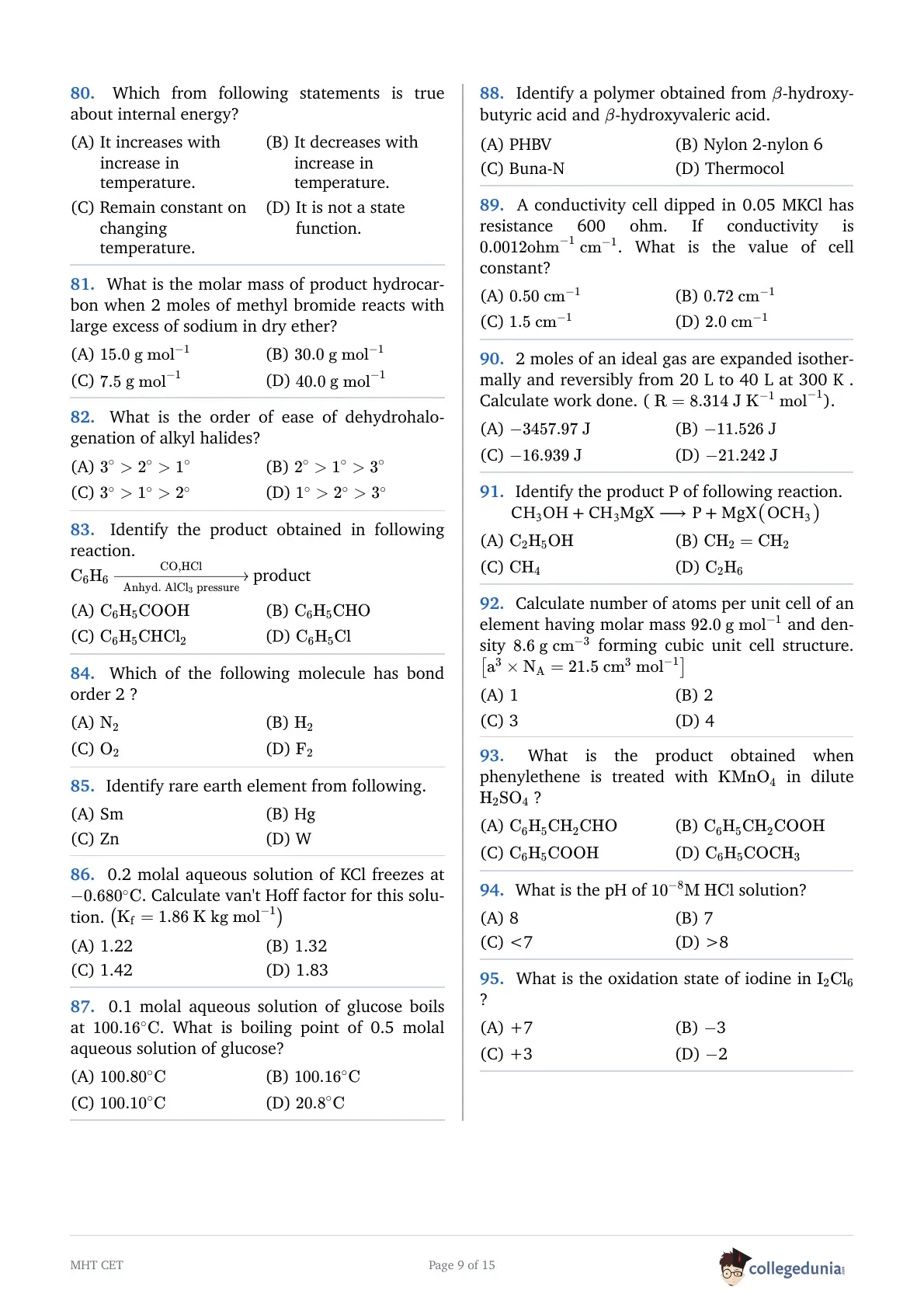
What is the molar mass of product hydrocarbon when 2 moles of methyl bromide reacts with large excess of sodium in dry ether?
Identify the product obtained in following reaction.
\(\mathrm{C}_6 \mathrm{H}_6 \xrightarrow[\text { Anhyd. } \mathrm{Al} \mathrm{Cl}_3 \text { pressure }]{\mathrm{CO, HCl}}\) product0.2 molal aqueous solution of KCl freezes at \(-0.680^{\circ} \mathrm{C}\). Calculate van't Hoff factor for this solution. \(\left(\mathrm{K}_{\mathrm{f}}=1.86 \mathrm{~K} \mathrm{~kg} \mathrm{~mol}^{-1}\right)\)
0.1 molal aqueous solution of glucose boils at \(100.16^{\circ} \mathrm{C}\). What is boiling point of 0.5 molal aqueous solution of glucose?
Identify a polymer obtained from \(\beta\)-hydroxybutyric acid and \(\beta\)-hydroxyvaleric acid.
A conductivity cell dipped in 0.05 MKCl has resistance 600 ohm. If conductivity is \(0.0012 \mathrm{ohm}^{-1} \mathrm{~cm}^{-1}\). What is the value of cell constant?
2 moles of an ideal gas are expanded isothermally and reversibly from 20 L to 40 L at 300 K . Calculate work done. ( \(\mathrm{R}=8.314 \mathrm{~J} \mathrm{~K}^{-1} \mathrm{~mol}^{-1}\)).
Identify the product P of following reaction.
\[\mathrm{CH}_3 \mathrm{OH}+\mathrm{CH}_3 \mathrm{MgX} \longrightarrow \mathrm{P}+\mathrm{MgX}\left(\mathrm{OCH}_3\right)\]
Calculate number of atoms per unit cell of an element having molar mass \(92.0 \mathrm{~g} \mathrm{~mol}^{-1}\) and density \(8.6 \mathrm{~g} \mathrm{~cm}^{-3}\) forming cubic unit cell structure. \(\left[\mathrm{a}^3 \times \mathrm{N}_{\mathrm{A}}=21.5 \mathrm{~cm}^3 \mathrm{~mol}^{-1}\right]\)
What is the product obtained when phenylethene is treated with \(\mathrm{KMnO}_4\) in dilute \(\mathrm{H}_2 \mathrm{SO}_4\) ?
What is the oxidation state of iodine in \(\mathrm{I}_2 \mathrm{Cl}_6\) ?
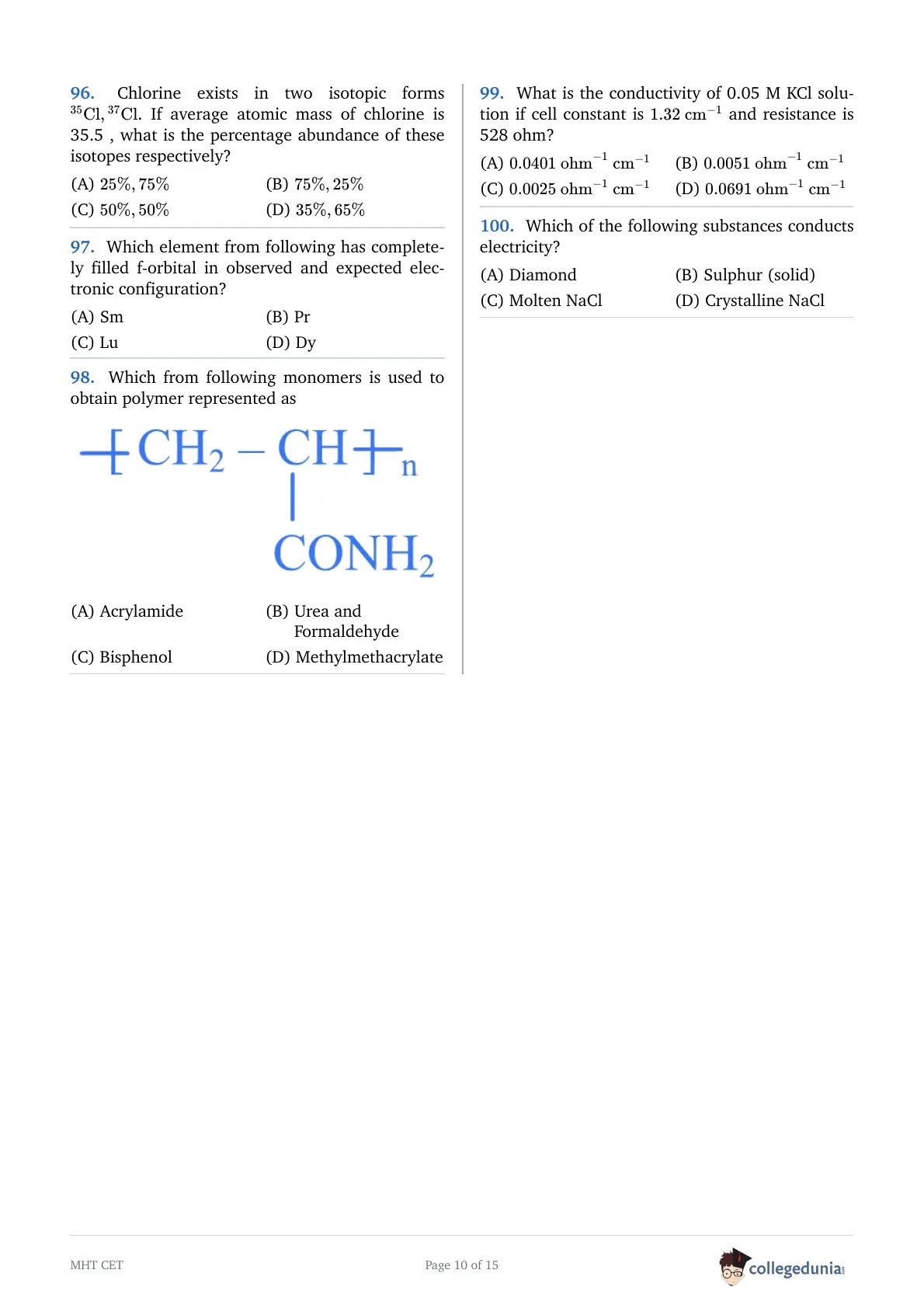
Chlorine exists in two isotopic forms \({ }^{35} \mathrm{Cl},{ }^{37} \mathrm{Cl}\). If average atomic mass of chlorine is 35.5 , what is the percentage abundance of these isotopes respectively?
Which element from following has completely filled f-orbital in observed and expected electronic configuration?
Which from following monomers is used to obtain polymer represented as

What is the conductivity of 0.05 M KCl solution if cell constant is \(1.32 \mathrm{~cm}^{-1}\) and resistance is 528 ohm?
Mathematics (Q101 - Q150)
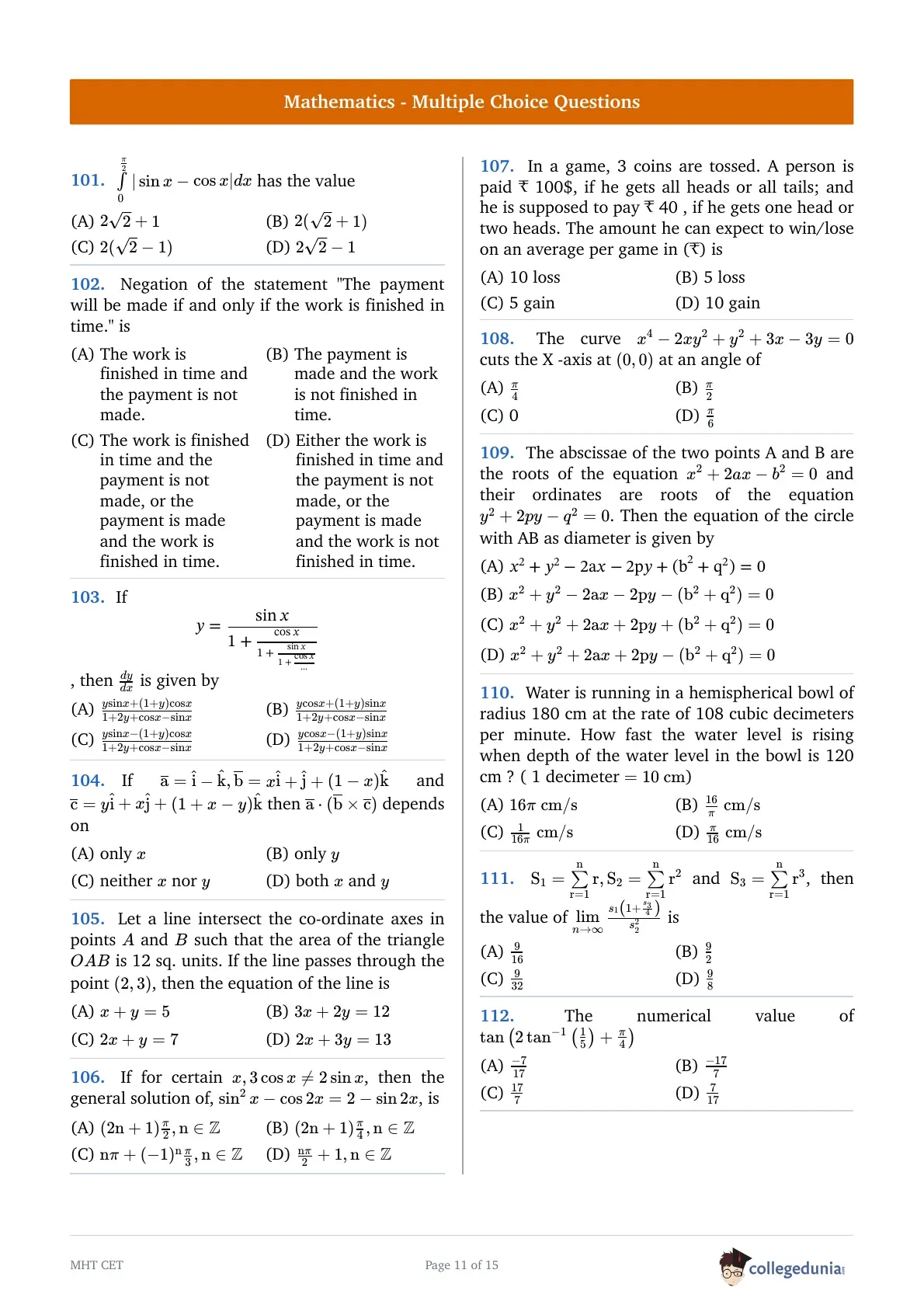
Negation of the statement "The payment will be made if and only if the work is finished in time." is
If \[y = {{\sin x} \over {1 + {{\cos x} \over {1 + {{\sin x} \over {1 + {{\cos x} \over {...}}}}}}}}\], then \(\frac{dy}{dx}\) is given by
If \(\quad \overline{\mathrm{a}}=\hat{\mathrm{i}}-\hat{\mathrm{k}}, \overline{\mathrm{b}}=x \hat{\mathrm{i}}+\hat{\mathrm{j}}+(1-x) \hat{\mathrm{k}} \quad\) and \(\overline{\mathrm{c}}=y \hat{\mathrm{i}}+x \hat{\mathrm{j}}+(1+x-y) \hat{\mathrm{k}}\) then \(\overline{\mathrm{a}} \cdot(\overline{\mathrm{b}} \times \overline{\mathrm{c}})\) depends on
Let a line intersect the co-ordinate axes in points \(A\) and \(B\) such that the area of the triangle \(O A B\) is 12 sq. units. If the line passes through the point \((2,3)\), then the equation of the line is
If for certain \(x, 3 \cos x \neq 2 \sin x\), then the general solution of, \(\sin ^2 x-\cos 2 x=2-\sin 2 x\), is
In a game, 3 coins are tossed. A person is paid ₹ 100, if he gets all heads or all tails; and he is supposed to pay ₹ 40 , if he gets one head or two heads. The amount he can expect to win/lose on an average per game in (₹) is
The curve \(x^4-2 x y^2+y^2+3 x-3 y=0\) cuts the X -axis at \((0,0)\) at an angle of
The abscissae of the two points A and B are the roots of the equation \(x^2+2 a x-b^2=0\) and their ordinates are roots of the equation \(y^2+2 p y-q^2=0\). Then the equation of the circle with AB as diameter is given by
Water is running in a hemispherical bowl of radius 180 cm at the rate of 108 cubic decimeters per minute. How fast the water level is rising when depth of the water level in the bowl is 120 cm ? ( 1 decimeter \(=10 \mathrm{~cm}\))
\(\mathrm{S}_1=\sum_\limits{\mathrm{r}=1}^{\mathrm{n}} \mathrm{r}, \mathrm{S}_2=\sum_\limits{\mathrm{r}=1}^{\mathrm{n}} \mathrm{r}^2\) and \(\mathrm{S}_3=\sum_\limits{\mathrm{r}=1}^{\mathrm{n}} \mathrm{r}^3\), then the value of \(\lim _\limits{n \rightarrow \infty} \frac{s_1\left(1+\frac{s_3}{4}\right)}{s_2^2}\) is
The numerical value of \(\tan \left(2 \tan ^{-1}\left(\frac{1}{5}\right)+\frac{\pi}{4}\right)\)
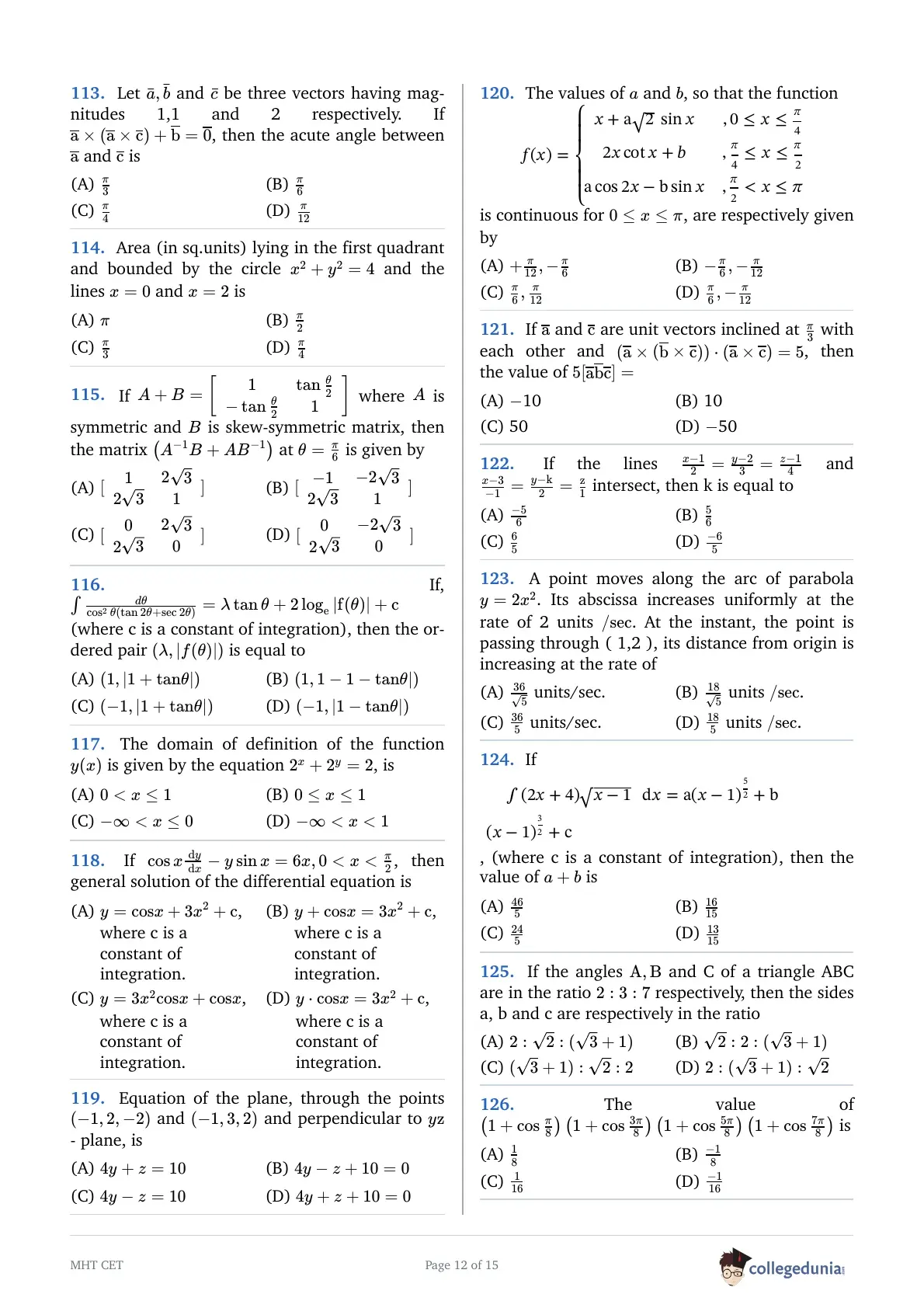
Let \(\bar{a}, \bar{b}\) and \(\bar{c}\) be three vectors having magnitudes 1,1 and 2 respectively. If \(\overline{\mathrm{a}} \times(\overline{\mathrm{a}} \times \overline{\mathrm{c}})+\overline{\mathrm{b}}=\overline{0}\), then the acute angle between \(\overline{\mathrm{a}}\) and \(\overline{\mathrm{c}}\) is
Area (in sq.units) lying in the first quadrant and bounded by the circle \(x^2+y^2=4\) and the lines \(x=0\) and \(x=2\) is
If \(A+B=\left[\begin{array}{cc}1 & \tan \frac{\theta}{2} \\ -\tan \frac{\theta}{2} & 1\end{array}\right]\) where \(A\) is symmetric and \(B\) is skew-symmetric matrix, then the matrix \(\left(A^{-1} B+A B^{-1}\right)\) at \(\theta=\frac{\pi}{6}\) is given by
The domain of definition of the function \(y(x)\) is given by the equation \(2^x+2^y=2\), is
If \(\cos x \frac{\mathrm{~d} y}{\mathrm{~d} x}-y \sin x=6 x, 0 < x < \frac{\pi}{2}\), then general solution of the differential equation is
Equation of the plane, through the points \((-1,2,-2)\) and \((-1,3,2)\) and perpendicular to \(y \mathrm{z}\) - plane, is
The values of \(a\) and \(b\), so that the function
\(f(x)= \begin{cases}x+\mathrm{a} \sqrt{2} \sin x & , 0 \leq x \leq \frac{\pi}{4} \\ 2 x \cot x+b & , \frac{\pi}{4} \leq x \leq \frac{\pi}{2} \\ \mathrm{a} \cos 2 x-\mathrm{b} \sin x & , \frac{\pi}{2}< x \leq \pi\end{cases}\)
is continuous for \(0 \leq x \leq \pi\), are respectively given by
If \(\overline{\mathrm{a}}\) and \(\overline{\mathrm{c}}\) are unit vectors inclined at \(\frac{\pi}{3}\) with each other and \((\overline{\mathrm{a}} \times(\overline{\mathrm{b}} \times \overline{\mathrm{c}})) \cdot(\overline{\mathrm{a}} \times \overline{\mathrm{c}})=5\), then the value of \(5[\overline{\mathrm{a}} \overline{\mathrm{b}} \overline{\mathrm{c}}]=\)
If the lines \(\frac{x-1}{2}=\frac{y-2}{3}=\frac{z-1}{4}\) and \(\frac{x-3}{-1}=\frac{y-\mathrm{k}}{2}=\frac{\mathrm{z}}{1}\) intersect, then k is equal to
A point moves along the arc of parabola \(y=2 x^2\). Its abscissa increases uniformly at the rate of 2 units \(/ \mathrm{sec}\). At the instant, the point is passing through ( 1,2 ), its distance from origin is increasing at the rate of
If \(\quad \int(2 x+4) \sqrt{x-1} \mathrm{~d} x=\mathrm{a}(x-1)^{\frac{5}{2}}+\mathrm{b}(x-1)^{\frac{3}{2}}+\mathrm{c}\), (where c is a constant of integration), then the value of \(a+b\) is
If the angles \(\mathrm{A}, \mathrm{B}\) and C of a triangle ABC are in the ratio \(2: 3: 7\) respectively, then the sides a, b and c are respectively in the ratio
The value of \(\left(1+\cos \frac{\pi}{8}\right)\left(1+\cos \frac{3 \pi}{8}\right)\left(1+\cos \frac{5 \pi}{8}\right)\left(1+\cos \frac{7 \pi}{8}\right)\) is
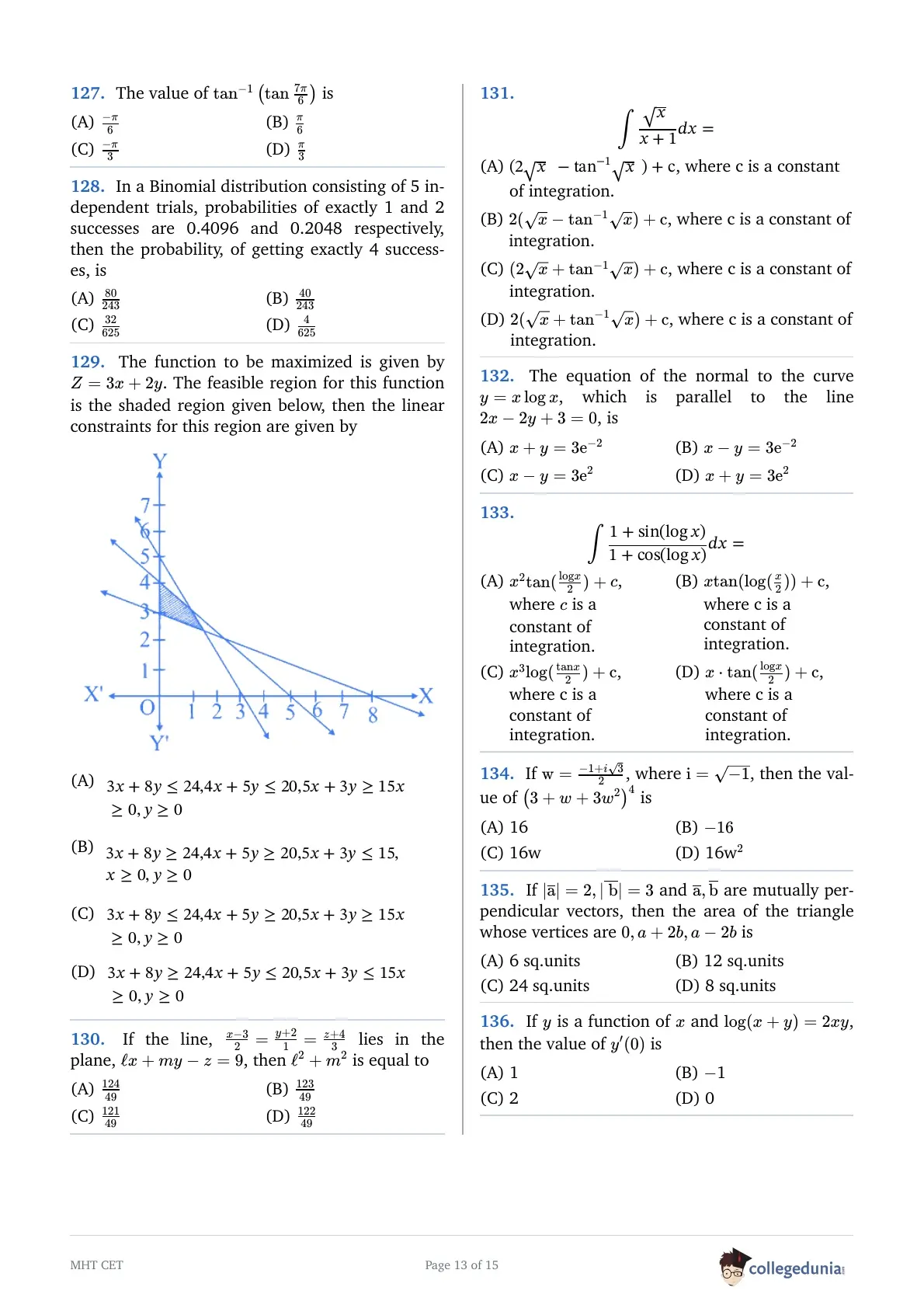
In a Binomial distribution consisting of 5 independent trials, probabilities of exactly 1 and 2 successes are 0.4096 and 0.2048 respectively, then the probability, of getting exactly 4 successes, is
The function to be maximized is given by \(Z=3 x+2 y\). The feasible region for this function is the shaded region given below, then the linear constraints for this region are given by

If the line, \(\frac{x-3}{2}=\frac{y+2}{1}=\frac{z+4}{3}\) lies in the plane, \(\ell x+m y-z=9\), then \(\ell^2+m^2\) is equal to
The equation of the normal to the curve \(y=x \log x\), which is parallel to the line \(2 x-2 y+3=0\), is
If \(\mathrm{w}=\frac{-1+i \sqrt{3}}{2}\), where \(\mathrm{i}=\sqrt{-1}\), then the value of \(\left(3+w+3 w^2\right)^4\) is
If \(|\overline{\mathrm{a}}|=2,|\overline{\mathrm{~b}}|=3\) and \(\overline{\mathrm{a}}, \overline{\mathrm{b}}\) are mutually perpendicular vectors, then the area of the triangle whose vertices are \(0, a+2 b, a-2 b\) is
If \(y\) is a function of \(x\) and \(\log (x+y)=2 x y\), then the value of \(y^{\prime}(0)\) is
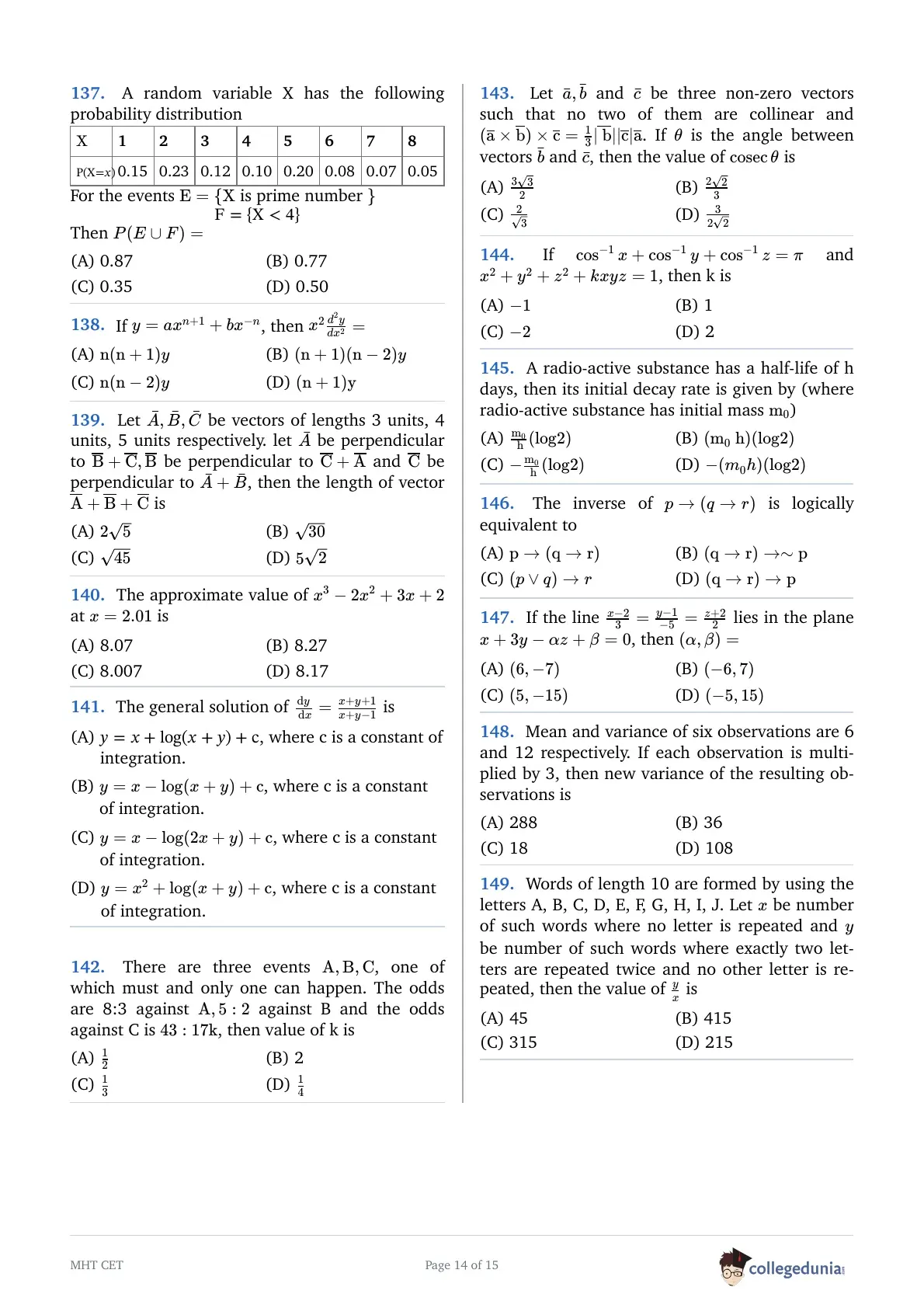
A random variable X has the following probability distribution
| \(\mathrm{X}\) | 1 | 2 | 3 | 4 | 5 | 6 | 7 | 8 |
|---|---|---|---|---|---|---|---|---|
| \(\mathrm{P(X=}x)\) | 0.15 | 0.23 | 0.12 | 0.10 | 0.20 | 0.08 | 0.07 | 0.05 |
Let \(\bar{A}, \bar{B}, \bar{C}\) be vectors of lengths 3 units, 4 units, 5 units respectively. let \(\bar{A}\) be perpendicular to \(\overline{\mathrm{B}}+\overline{\mathrm{C}}, \overline{\mathrm{B}}\) be perpendicular to \(\overline{\mathrm{C}}+\overline{\mathrm{A}}\) and \(\overline{\mathrm{C}}\) be perpendicular to \(\bar{A}+\bar{B}\), then the length of vector \(\overline{\mathrm{A}}+\overline{\mathrm{B}}+\overline{\mathrm{C}}\) is
The general solution of \(\frac{\mathrm{d} y}{\mathrm{~d} x}=\frac{x+y+1}{x+y-1}\) is
There are three events \(\mathrm{A}, \mathrm{B}, \mathrm{C}\), one of which must and only one can happen. The odds are 8:3 against \(\mathrm{A}, 5: 2\) against B and the odds against C is \(43: 17 \mathrm{k}\), then value of k is
Let \(\bar{a}, \bar{b}\) and \(\bar{c}\) be three non-zero vectors such that no two of them are collinear and \((\overline{\mathrm{a}} \times \overline{\mathrm{b}}) \times \overline{\mathrm{c}}=\frac{1}{3}|\overline{\mathrm{~b}}||\overline{\mathrm{c}}| \overline{\mathrm{a}}\). If \(\theta\) is the angle between vectors \(\bar{b}\) and \(\bar{c}\), then the value of \(\operatorname{cosec} \theta\) is
If \(\cos ^{-1} x+\cos ^{-1} y+\cos ^{-1} z=\pi\) and \(x^2+y^2+z^2+k x y z=1\), then k is
A radio-active substance has a half-life of h days, then its initial decay rate is given by (where radio-active substance has initial mass \(\mathrm{m}_0\))
The inverse of \(p \rightarrow(q \rightarrow r)\) is logically equivalent to
If the line \(\frac{x-2}{3}=\frac{y-1}{-5}=\frac{z+2}{2}\) lies in the plane \(x+3 y-\alpha z+\beta=0\), then \((\alpha, \beta)=\)
Mean and variance of six observations are 6 and 12 respectively. If each observation is multiplied by 3, then new variance of the resulting observations is
Words of length 10 are formed by using the letters A, B, C, D, E, F, G, H, I, J. Let \(x\) be number of such words where no letter is repeated and \(y\) be number of such words where exactly two letters are repeated twice and no other letter is repeated, then the value of \(\frac{y}{x}\) is
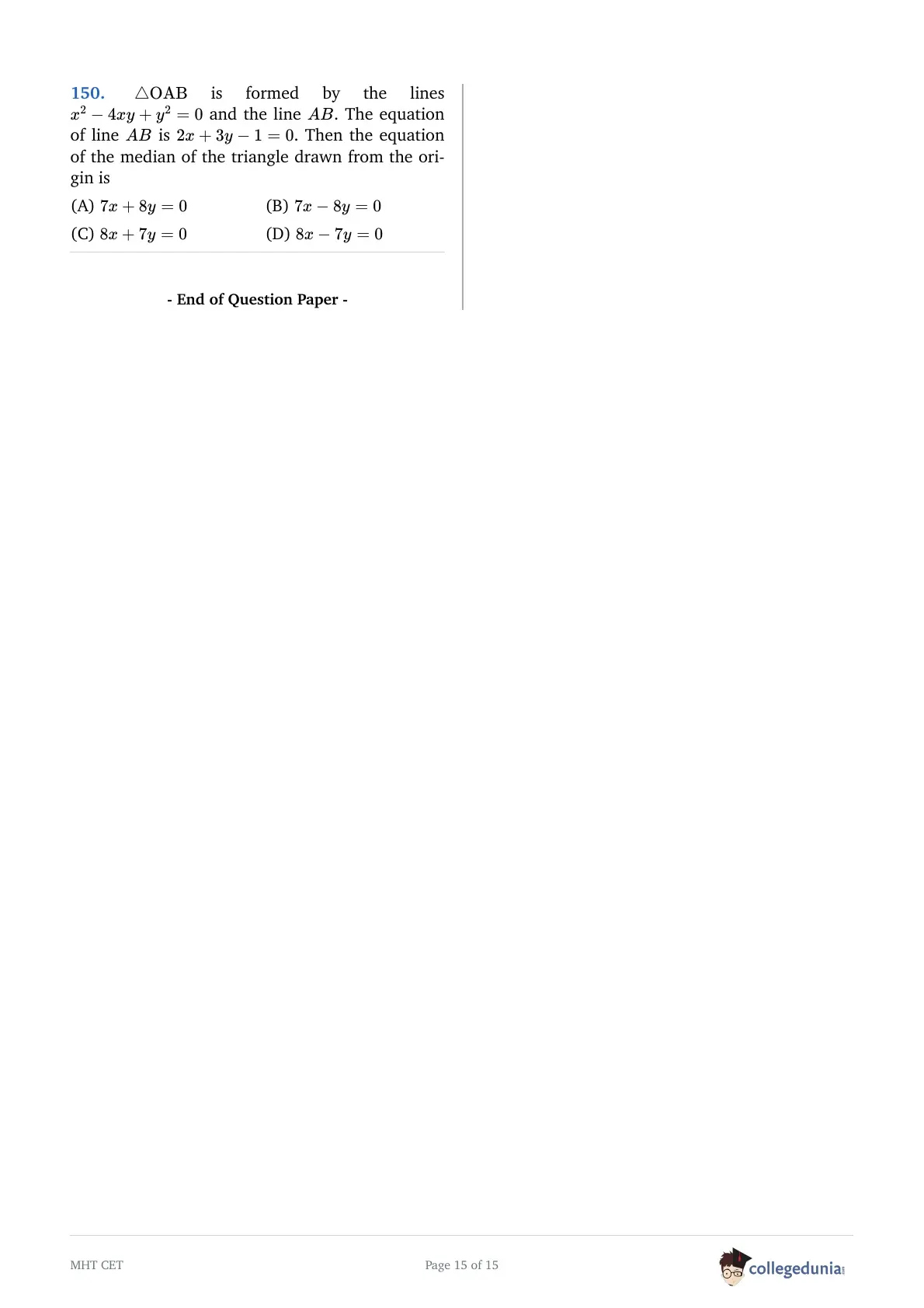
\(\triangle \mathrm{OAB}\) is formed by the lines \(x^2-4 x y+y^2=0\) and the line \(A B\). The equation of line \(A B\) is \(2 x+3 y-1=0\). Then the equation of the median of the triangle drawn from the origin is
MHT CET 2024 PCM Exam Pattern and Marking Scheme
| Parameter | Details |
|---|---|
| Conducting Body | Maharashtra Common Entrance Test Cell (Maharashtra CET Cell) |
| Exam Mode | Online (Computer-Based Test) |
| Duration | 180 minutes (3 hours) |
| Groups / Subjects | PCM (Physics, Chemistry, Mathematics) for Engineering |
| Total Questions |
150 |
| Total Marks | 200 |
| Question Type | Multiple Choice Questions (MCQs) |
| Marks Distribution |
|
| Negative Marking | No |
| Syllabus Weightage |
|



Comments