




MHT CET 2024 May 11 Shift 2 PCM Question Paper is available for download here. Maharashtra State CET Cell conducted MHT CET 2024 PCM Exam on May 11 in Shift 2 from 2 PM to 5 PM in CBT mode.
The MHT CET 2024 PCM question paper includes the following:
- The MHT CET 2024 PCM Question Paper consists of 150 multiple-choice questions (MCQs) totalling 200 marks divided into 3 sections: Physics, Chemistry, and Mathematics, with 50 questions in each subject.
- Physics and Chemistry questions carry 1 mark each while Mathematics questions carry 2 marks each.
- There is no negative marking for incorrect answers.
MHT CET 2024 May 11 Shift 2 PCM Question Paper with Solution PDF
| CD PDF | CD PDF with Solutions |
|---|---|
| Download Collegedunia PDF 0.89 MB | - |
Also Check:
MHT CET 2024 May 11 Shift 2 PCM Questions with Solutions
Physics (Q1 - Q50)
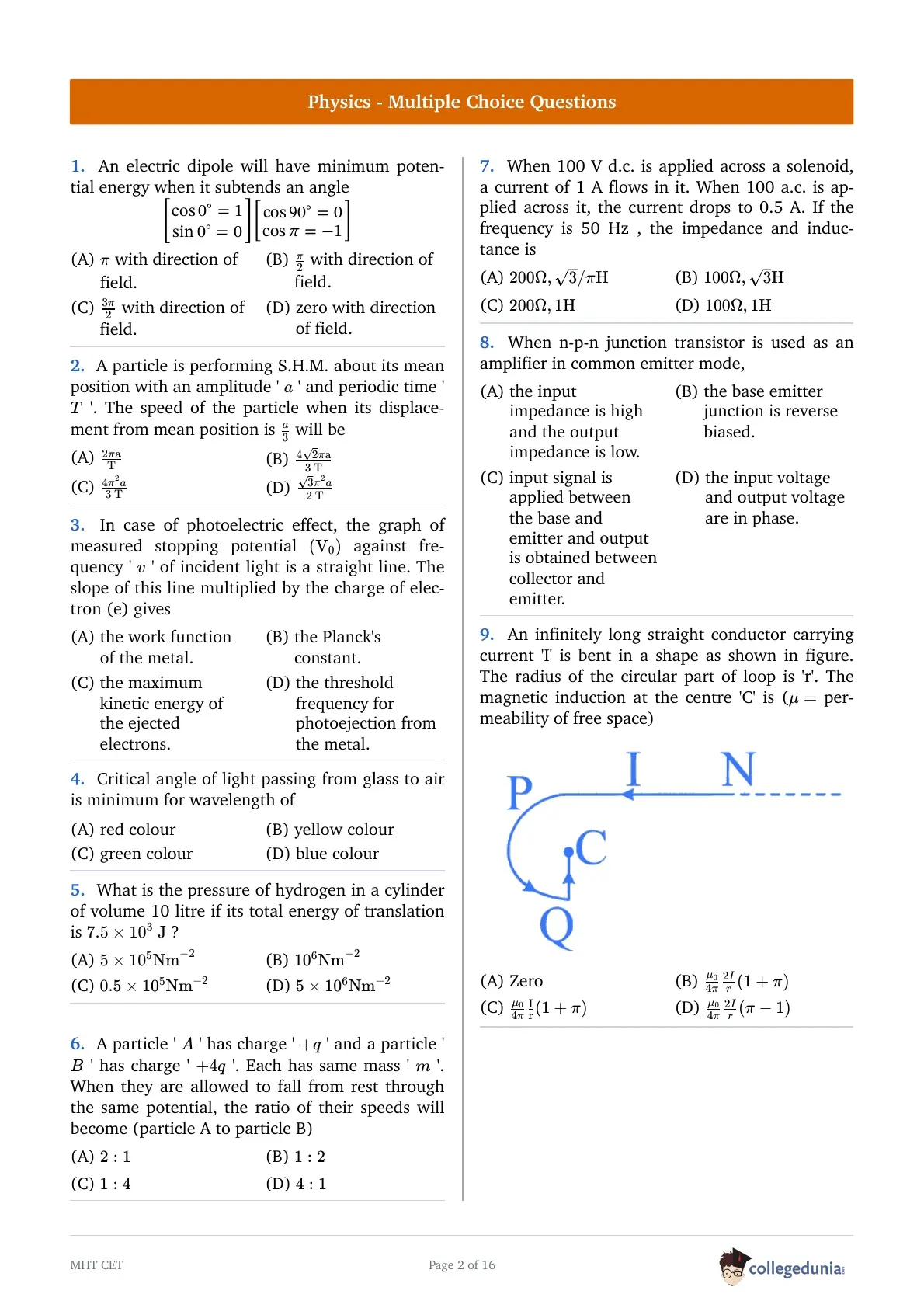
An electric dipole will have minimum potential energy when it subtends an angle
\[\left[\begin{array}{l} \cos 0^{\circ}=1 \\ \sin 0^{\circ}=0 \end{array}\right]\left[\begin{array}{l} \cos 90^{\circ}=0 \\ \cos \pi=-1 \end{array}\right]\]
A particle is performing S.H.M. about its mean position with an amplitude ' \(a\) ' and periodic time ' \(T\) '. The speed of the particle when its displacement from mean position is \(\frac{a}{3}\) will be
In case of photoelectric effect, the graph of measured stopping potential \(\left(\mathrm{V}_0\right)\) against frequency ' \(v\) ' of incident light is a straight line. The slope of this line multiplied by the charge of electron (e) gives
Critical angle of light passing from glass to air is minimum for wavelength of
What is the pressure of hydrogen in a cylinder of volume 10 litre if its total energy of translation is \(7.5 \times 10^3 \mathrm{~J}\) ?
A particle ' \(A\) ' has charge ' \(+q\) ' and a particle ' \(B\) ' has charge ' \(+4 q\) '. Each has same mass ' \(m\) '. When they are allowed to fall from rest through the same potential, the ratio of their speeds will become (particle A to particle B)
When 100 V d.c. is applied across a solenoid, a current of 1 A flows in it. When 100 a.c. is applied across it, the current drops to 0.5 A. If the frequency is 50 Hz , the impedance and inductance is
When n-p-n junction transistor is used as an amplifier in common emitter mode,
An infinitely long straight conductor carrying current 'I' is bent in a shape as shown in figure. The radius of the circular part of loop is 'r'. The magnetic induction at the centre 'C' is (\(\mu=\) permeability of free space)

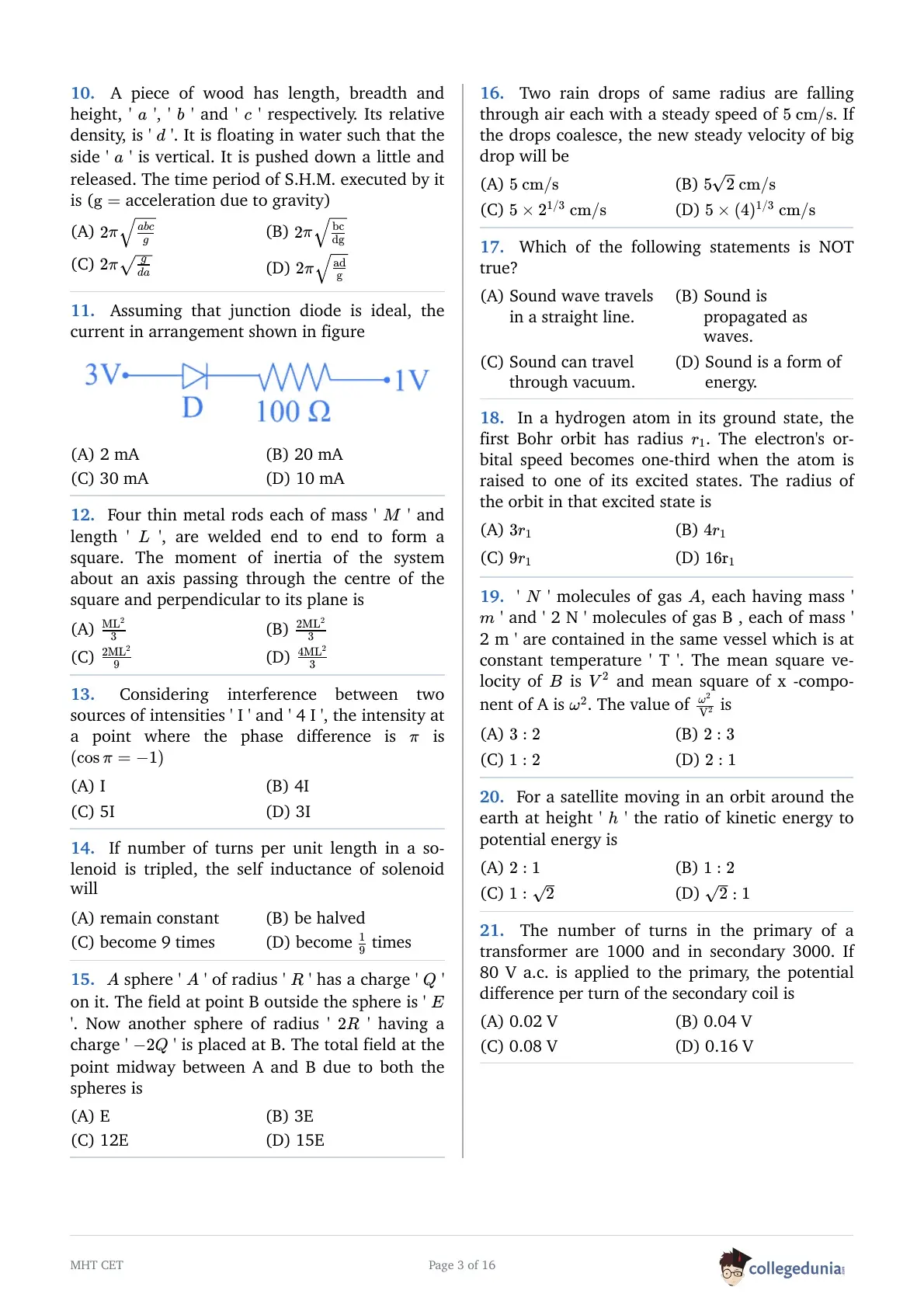
A piece of wood has length, breadth and height, ' \(a\) ', ' \(b\) ' and ' \(c\) ' respectively. Its relative density, is ' \(d\) '. It is floating in water such that the side ' \(a\) ' is vertical. It is pushed down a little and released. The time period of S.H.M. executed by it is (\(\mathrm{g}=\) acceleration due to gravity)
Assuming that junction diode is ideal, the current in arrangement shown in figure

Four thin metal rods each of mass ' \(M\) ' and length ' \(L\) ', are welded end to end to form a square. The moment of inertia of the system about an axis passing through the centre of the square and perpendicular to its plane is
Considering interference between two sources of intensities ' I ' and ' 4 I ', the intensity at a point where the phase difference is \(\pi\) is \((\cos \pi=-1)\)
If number of turns per unit length in a solenoid is tripled, the self inductance of solenoid will
\(A\) sphere ' \(A\) ' of radius ' \(R\) ' has a charge ' \(Q\) ' on it. The field at point B outside the sphere is ' \(E\) '. Now another sphere of radius ' \(2 R\) ' having a charge ' \(-2 Q\) ' is placed at B. The total field at the point midway between A and B due to both the spheres is
Two rain drops of same radius are falling through air each with a steady speed of \(5 \mathrm{~cm} / \mathrm{s}\). If the drops coalesce, the new steady velocity of big drop will be
In a hydrogen atom in its ground state, the first Bohr orbit has radius \(r_1\). The electron's orbital speed becomes one-third when the atom is raised to one of its excited states. The radius of the orbit in that excited state is
' \(N\) ' molecules of gas \(A\), each having mass ' \(m\) ' and ' 2 N ' molecules of gas B , each of mass ' 2 m ' are contained in the same vessel which is at constant temperature ' T '. The mean square velocity of \(B\) is \(V^2\) and mean square of x -component of A is \(\omega^2\). The value of \(\frac{\omega^2}{\mathrm{~V}^2}\) is
For a satellite moving in an orbit around the earth at height ' \(h\) ' the ratio of kinetic energy to potential energy is
The number of turns in the primary of a transformer are 1000 and in secondary 3000. If 80 V a.c. is applied to the primary, the potential difference per turn of the secondary coil is
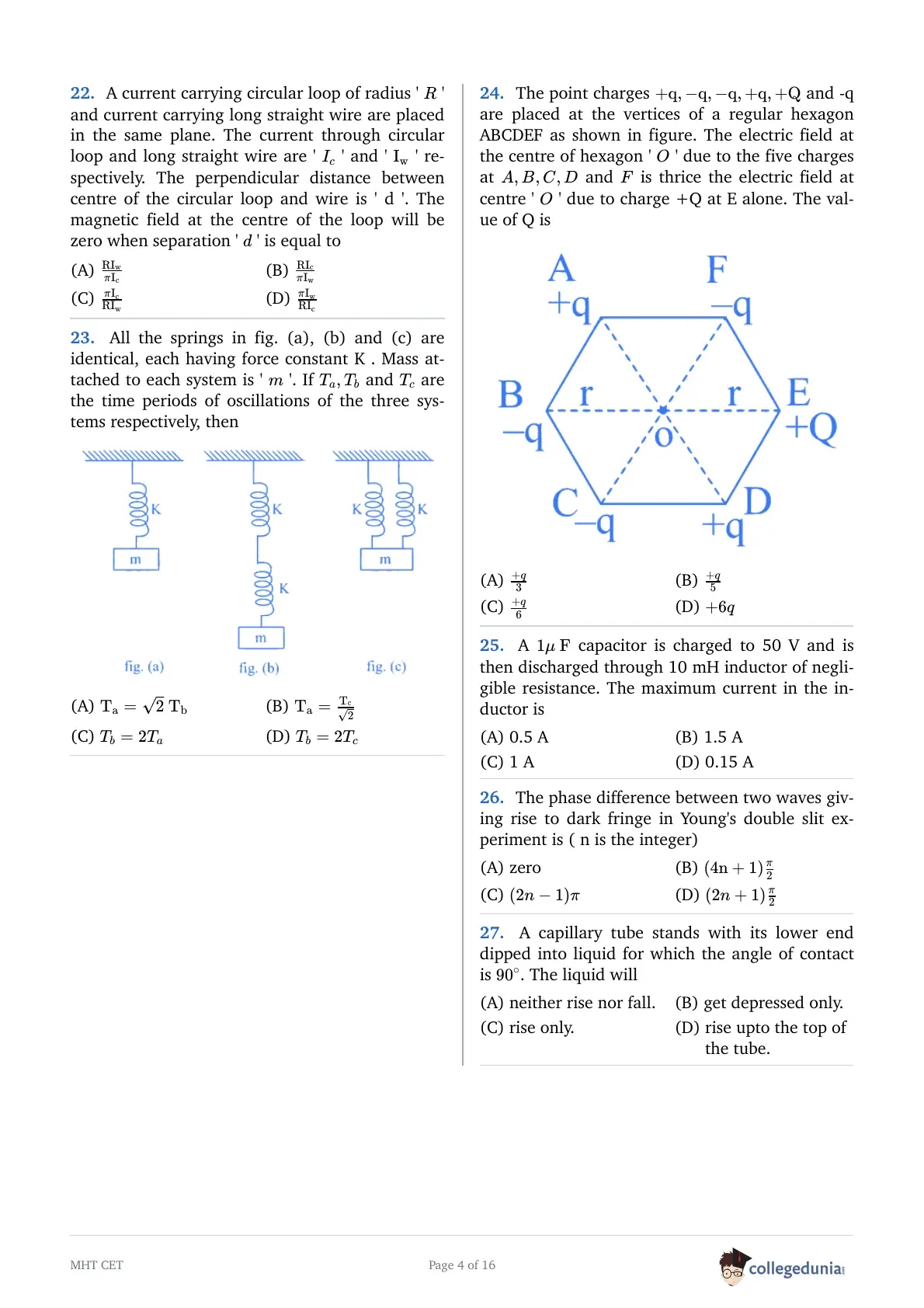
A current carrying circular loop of radius ' \(R\) ' and current carrying long straight wire are placed in the same plane. The current through circular loop and long straight wire are ' \(I_c\) ' and ' \(\mathrm{I}_{\mathrm{w}}\) ' respectively. The perpendicular distance between centre of the circular loop and wire is ' d '. The magnetic field at the centre of the loop will be zero when separation ' \(d\) ' is equal to
All the springs in fig. (a), (b) and (c) are identical, each having force constant K . Mass attached to each system is ' \(m\) '. If \(T_a, T_b\) and \(T_c\) are the time periods of oscillations of the three systems respectively, then

The point charges \(+\mathrm{q},-\mathrm{q},-\mathrm{q},+\mathrm{q},+\mathrm{Q}\) and -q are placed at the vertices of a regular hexagon ABCDEF as shown in figure. The electric field at the centre of hexagon ' \(O\) ' due to the five charges at \(A, B, C, D\) and \(F\) is thrice the electric field at centre ' \(O\) ' due to charge +Q at E alone. The value of Q is

A \(1 \mu \mathrm{~F}\) capacitor is charged to 50 V and is then discharged through 10 mH inductor of negligible resistance. The maximum current in the inductor is
The phase difference between two waves giving rise to dark fringe in Young's double slit experiment is ( n is the integer)
A capillary tube stands with its lower end dipped into liquid for which the angle of contact is \(90^{\circ}\). The liquid will
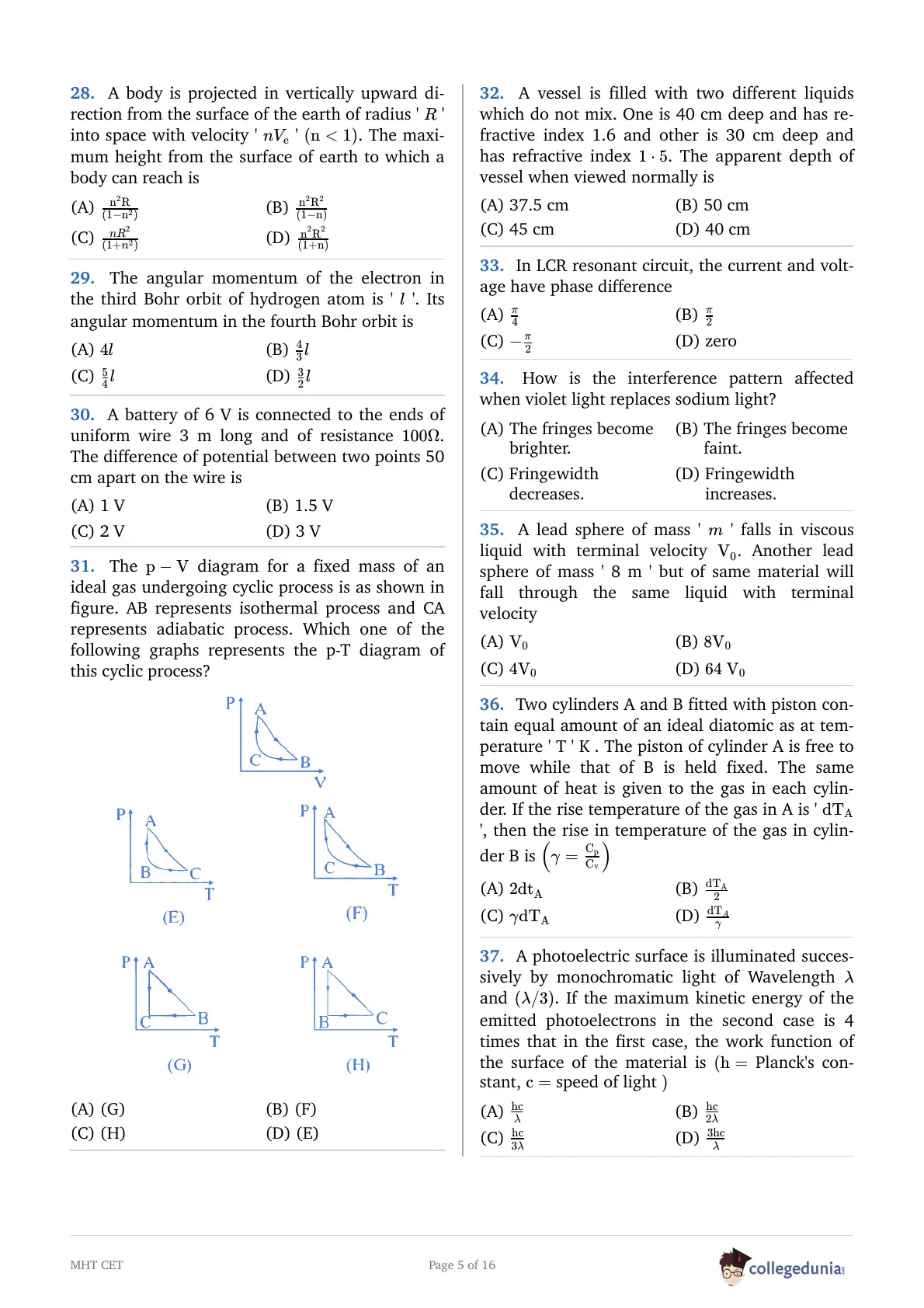
A body is projected in vertically upward direction from the surface of the earth of radius ' \(R\) ' into space with velocity ' \(n V_{\mathrm{e}}\) ' \(\mathrm{n}<1\). The maximum height from the surface of earth to which a body can reach is
The angular momentum of the electron in the third Bohr orbit of hydrogen atom is ' \(l\) '. Its angular momentum in the fourth Bohr orbit is
A battery of 6 V is connected to the ends of uniform wire 3 m long and of resistance \(100 \Omega\). The difference of potential between two points 50 cm apart on the wire is
A vessel is filled with two different liquids which do not mix. One is 40 cm deep and has refractive index 1.6 and other is 30 cm deep and has refractive index \(1 \cdot 5\). The apparent depth of vessel when viewed normally is
In LCR resonant circuit, the current and voltage have phase difference
How is the interference pattern affected when violet light replaces sodium light?
A lead sphere of mass ' \(m\) ' falls in viscous liquid with terminal velocity \(\mathrm{V}_0\). Another lead sphere of mass ' 8 m ' but of same material will fall through the same liquid with terminal velocity
Two cylinders A and B fitted with piston contain equal amount of an ideal diatomic as at temperature ' T ' K . The piston of cylinder A is free to move while that of B is held fixed. The same amount of heat is given to the gas in each cylinder. If the rise temperature of the gas in A is ' \(\mathrm{dT}_{\mathrm{A}}\) ', then the rise in temperature of the gas in cylinder B is \(\left(\gamma=\frac{\mathrm{C}_{\mathrm{p}}}{\mathrm{C}_{\mathrm{v}}}\right)\)
A photoelectric surface is illuminated successively by monochromatic light of Wavelength \(\lambda\) and \((\lambda / 3)\). If the maximum kinetic energy of the emitted photoelectrons in the second case is 4 times that in the first case, the work function of the surface of the material is \((\mathrm{h}=\) Planck's constant, \(\mathrm{c}=\) speed of light \()\)
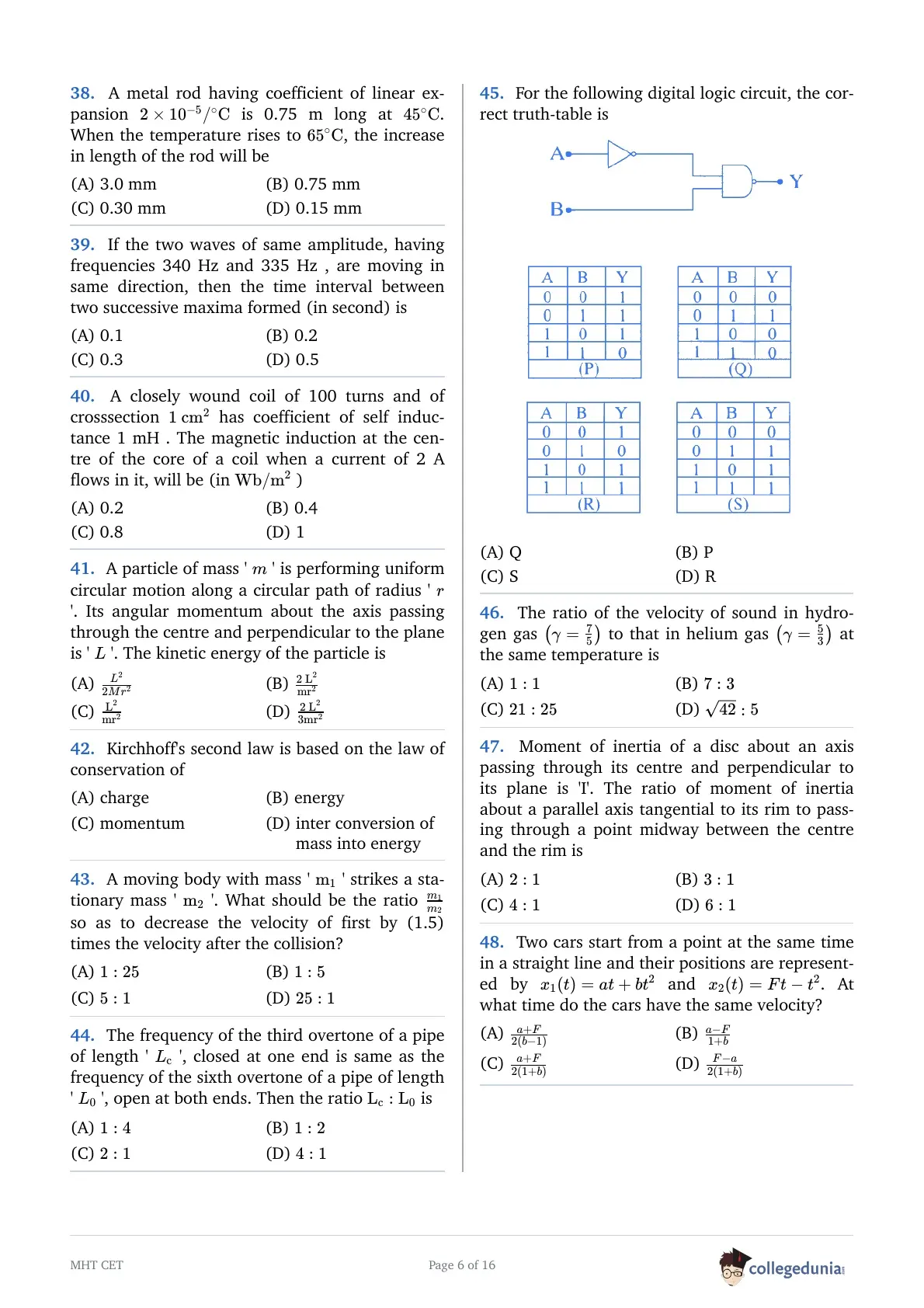
A metal rod having coefficient of linear expansion \(2 \times 10^{-5} /^{\circ} \mathrm{C}\) is 0.75 m long at \(45^{\circ} \mathrm{C}\). When the temperature rises to \(65^{\circ} \mathrm{C}\), the increase in length of the rod will be
If the two waves of same amplitude, having frequencies 340 Hz and 335 Hz , are moving in same direction, then the time interval between two successive maxima formed (in second) is
A closely wound coil of 100 turns and of crosssection \(1 \mathrm{~cm}^2\) has coefficient of self inductance 1 mH . The magnetic induction at the centre of the core of a coil when a current of 2 A flows in it, will be (in \(\mathrm{Wb} / \mathrm{m}^2\) )
A particle of mass ' \(m\) ' is performing uniform circular motion along a circular path of radius ' \(r\) '. Its angular momentum about the axis passing through the centre and perpendicular to the plane is ' \(L\) '. The kinetic energy of the particle is
A moving body with mass ' \(\mathrm{m}_1\) ' strikes a stationary mass ' \(\mathrm{m}_2\) '. What should be the ratio \(\frac{m_1}{m_2}\) so as to decrease the velocity of first by (1.5) times the velocity after the collision?
The frequency of the third overtone of a pipe of length ' \(L_{\mathrm{c}}\) ', closed at one end is same as the frequency of the sixth overtone of a pipe of length ' \(L_0\) ', open at both ends. Then the ratio \(\mathrm{L}_{\mathrm{c}}: \mathrm{L}_0\) is

The ratio of the velocity of sound in hydrogen gas \(\left(\gamma=\frac{7}{5}\right)\) to that in helium gas \(\left(\gamma=\frac{5}{3}\right)\) at the same temperature is
Moment of inertia of a disc about an axis passing through its centre and perpendicular to its plane is 'I'. The ratio of moment of inertia about a parallel axis tangential to its rim to passing through a point midway between the centre and the rim is
Two cars start from a point at the same time in a straight line and their positions are represented by \(x_1(t)=a t+b t^2\) and \(x_2(t)=F t-t^2\). At what time do the cars have the same velocity?
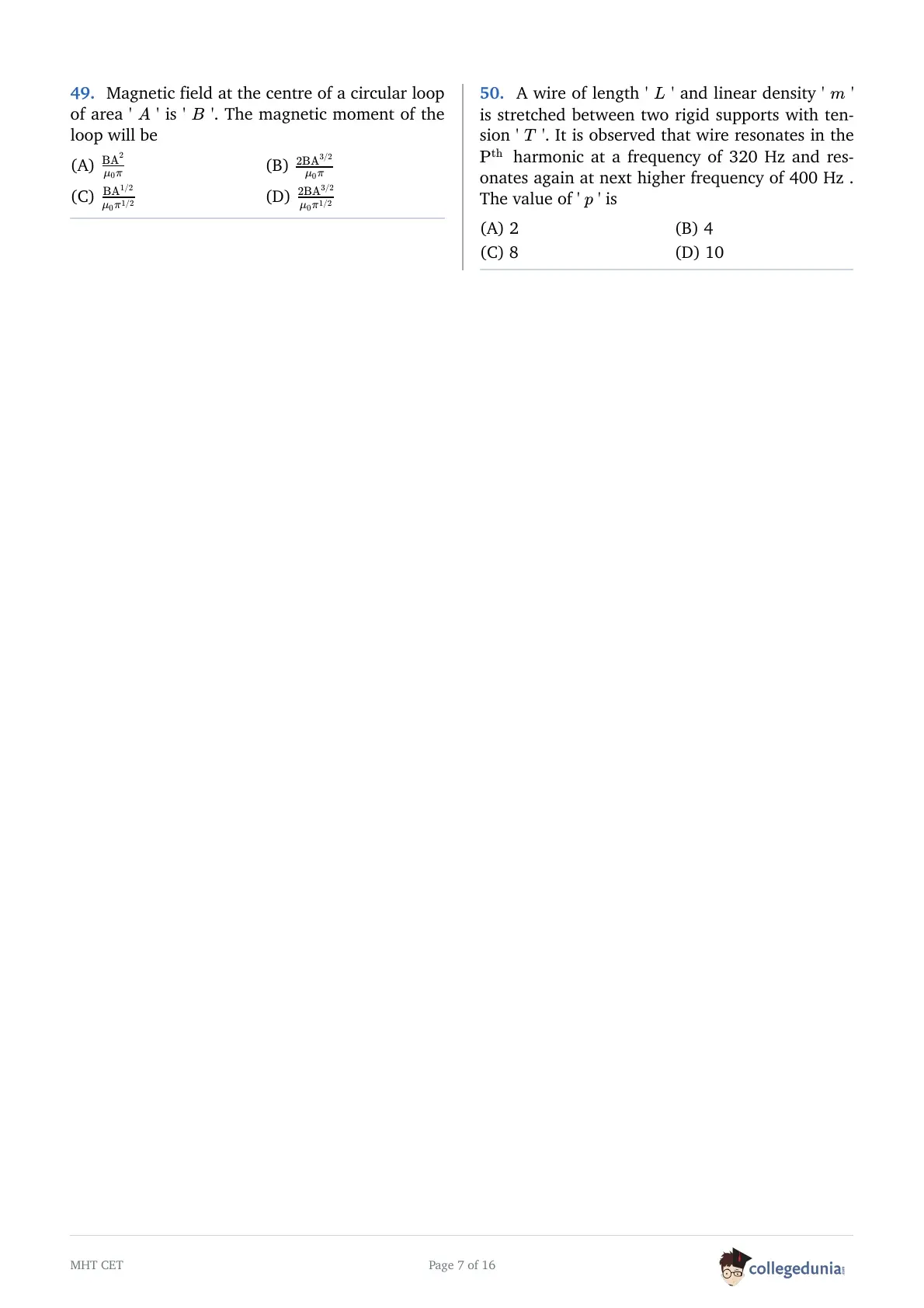
Magnetic field at the centre of a circular loop of area ' \(A\) ' is ' \(B\) '. The magnetic moment of the loop will be
A wire of length ' \(L\) ' and linear density ' \(m\) ' is stretched between two rigid supports with tension ' \(T\) '. It is observed that wire resonates in the \(\mathrm{P}^{\text {th }}\) harmonic at a frequency of 320 Hz and resonates again at next higher frequency of 400 Hz . The value of ' \(p\) ' is
Chemistry (Q51 - Q100)
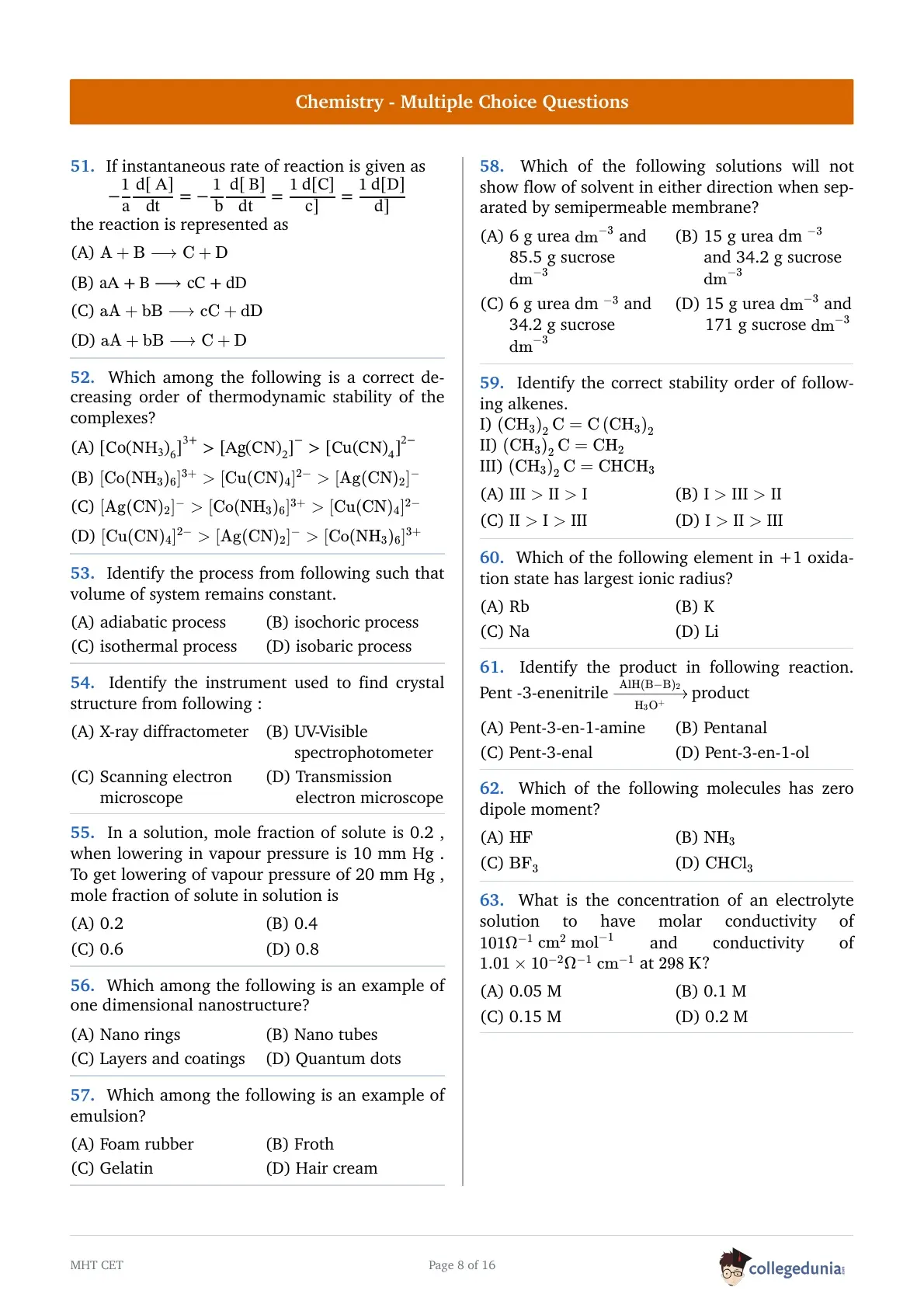
If instantaneous rate of reaction is given as \[ -\frac{1}{\mathrm{a}} \frac{\mathrm{~d}[\mathrm{~A}]}{\mathrm{dt}}=-\frac{1}{\mathrm{~b}} \frac{\mathrm{~d}[\mathrm{~B}]}{\mathrm{dt}}=\frac{1 \mathrm{~d}[\mathrm{C}]}{\mathrm{c}]}=\frac{1 \mathrm{~d}[\mathrm{D}]}{\mathrm{d}]}\]
the reaction is represented as
Which among the following is a correct decreasing order of thermodynamic stability of the complexes?
Identify the process from following such that volume of system remains constant.
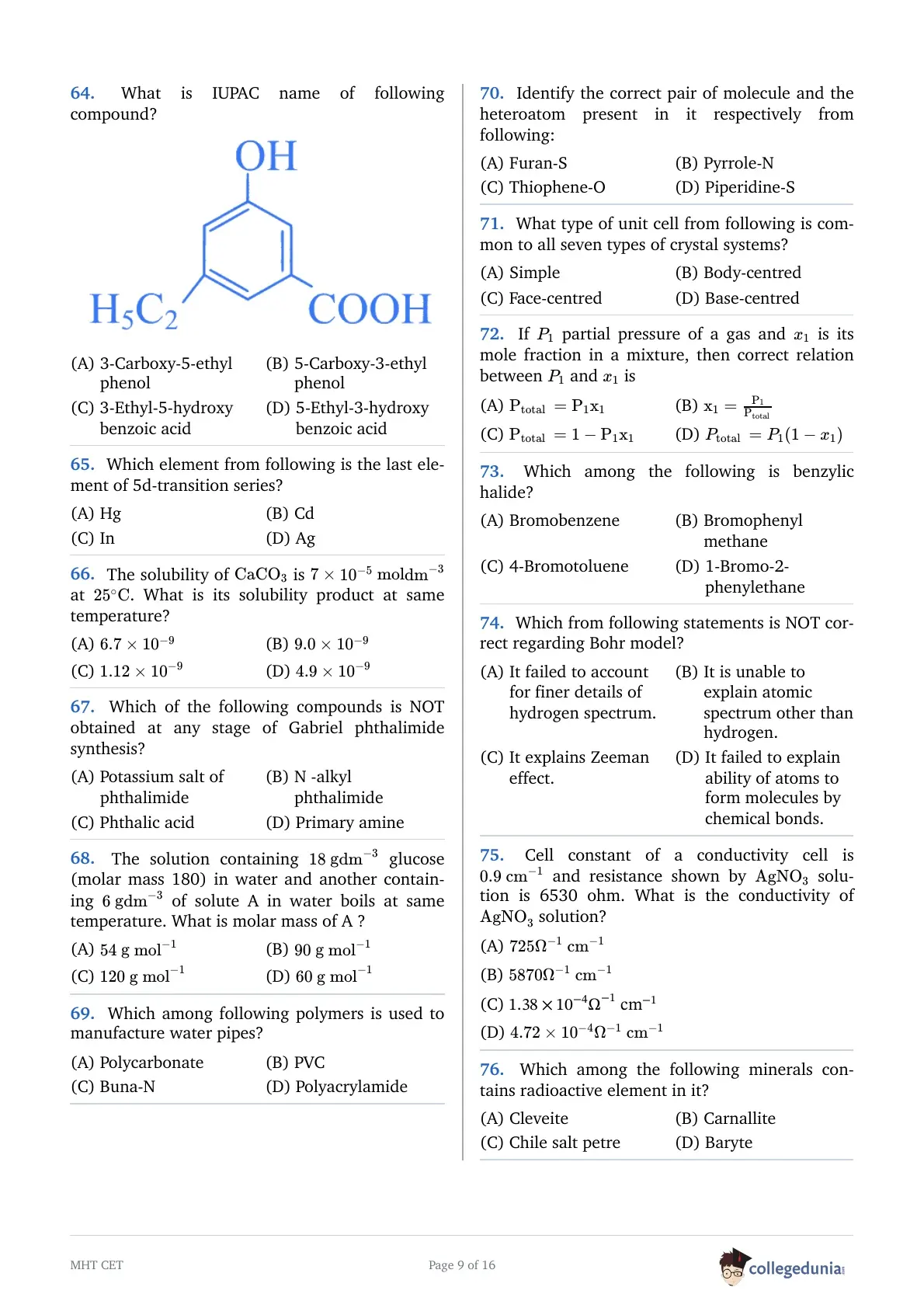
Identify the instrument used to find crystal structure from following :
In a solution, mole fraction of solute is 0.2 , when lowering in vapour pressure is 10 mm Hg . To get lowering of vapour pressure of 20 mm Hg , mole fraction of solute in solution is
Which among the following is an example of one dimensional nanostructure?
Which of the following solutions will not show flow of solvent in either direction when separated by semipermeable membrane?
Identify the correct stability order of following alkenes.
I) \(\left(\mathrm{CH}_3\right)_2 \mathrm{C}=\mathrm{C}\left(\mathrm{CH}_3\right)_2\)
II) \(\left(\mathrm{CH}_3\right)_2 \mathrm{C}=\mathrm{CH}_2\)
III) \(\left(\mathrm{CH}_3\right)_2 \mathrm{C}=\mathrm{CHCH}_3\)
Which of the following element in +1 oxidation state has largest ionic radius?
Identify the product in following reaction. Pent -3-enenitrile \(\xrightarrow[\mathrm{H}_3 \mathrm{O}^{+}]{\mathrm{AlH}(\mathrm{B}-\mathrm{B})_2}\) product
What is the concentration of an electrolyte solution to have molar conductivity of \(101 \Omega^{-1} \mathrm{~cm}^2 \mathrm{~mol}^{-1}\) and conductivity of \(1.01 \times 10^{-2} \Omega^{-1} \mathrm{~cm}^{-1}\) at \(298 \mathrm{~K} ?\)
Which element from following is the last element of 5d-transition series?
The solubility of \(\mathrm{CaCO}_3\) is \(7 \times 10^{-5} \mathrm{~mol} \mathrm{dm}^{-3}\) at \(25^{\circ} \mathrm{C}\). What is its solubility product at same temperature?
Which of the following compounds is NOT obtained at any stage of Gabriel phthalimide synthesis?
The solution containing \(18 \mathrm{~g} \mathrm{dm}^{-3}\) glucose (molar mass 180) in water and another containing \(6 \mathrm{~g} \mathrm{dm}^{-3}\) of solute A in water boils at same temperature. What is molar mass of A ?
Identify the correct pair of molecule and the heteroatom present in it respectively from following:
What type of unit cell from following is common to all seven types of crystal systems?
If \(P_1\) partial pressure of a gas and \(x_1\) is its mole fraction in a mixture, then correct relation between \(P_1\) and \(x_1\) is
Cell constant of a conductivity cell is \(0.9 \mathrm{~cm}^{-1}\) and resistance shown by \(\mathrm{AgNO}_3\) solution is 6530 ohm. What is the conductivity of \(\mathrm{AgNO}_3\) solution?
Which among the following minerals contains radioactive element in it?
Rate law for a reaction is \(r=k[A]^2[B]\). If rate constant is \(6.25 \mathrm{~mol}^{-2} \mathrm{dm}^6 \mathrm{~s}^{-1}\), what is the rate of reaction when \([\mathrm{A}]=1 \mathrm{~mol} \mathrm{dm}^{-3}\) and \([\mathrm{B}]=0.2 \mathrm{~mol} \mathrm{dm}^{-3}\) ?
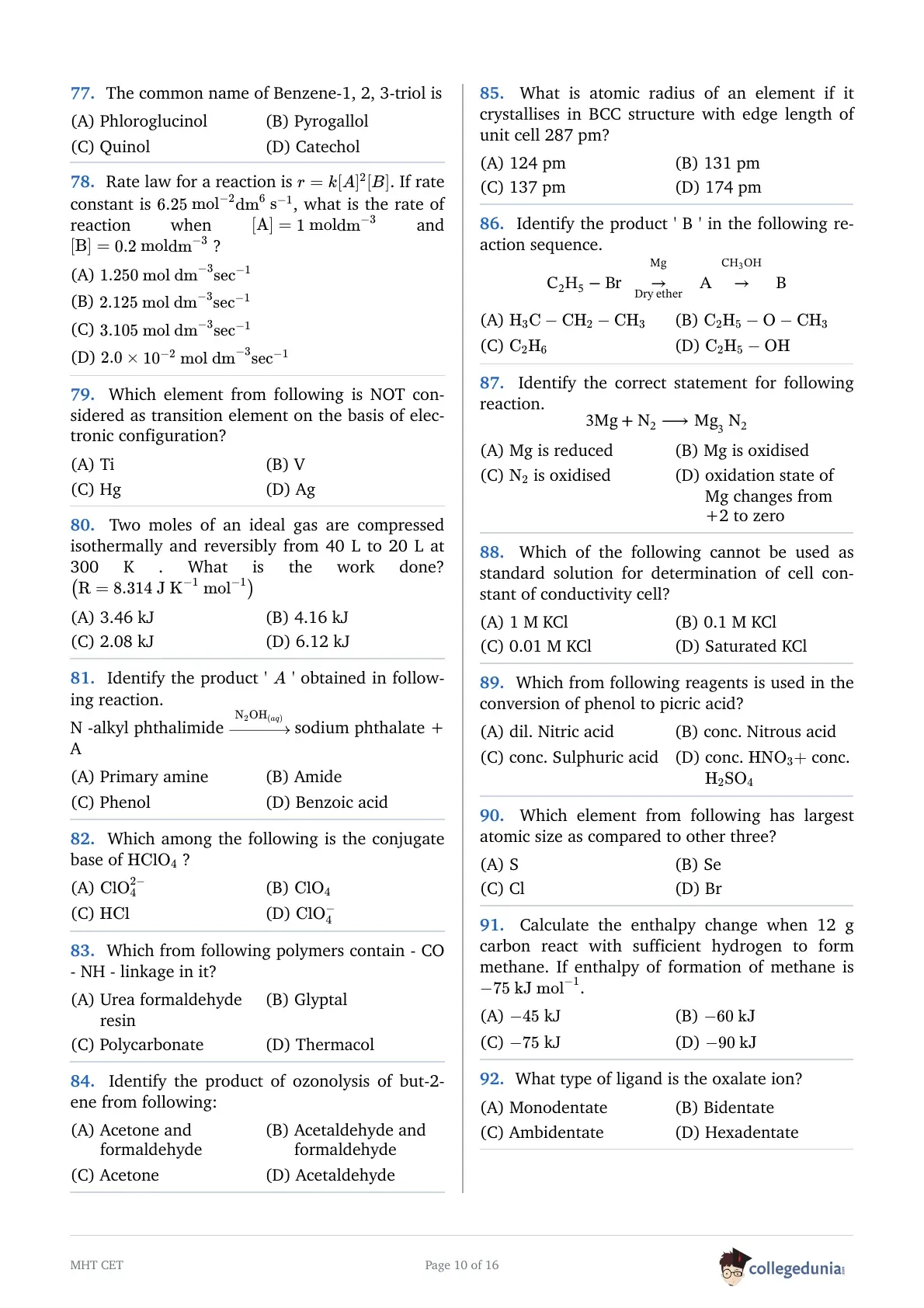
Which element from following is NOT considered as transition element on the basis of electronic configuration?
Two moles of an ideal gas are compressed isothermally and reversibly from 40 L to 20 L at 300 K . What is the work done? \(\left(\mathrm{R}=8.314 \mathrm{~J} \mathrm{~K}^{-1} \mathrm{~mol}^{-1}\right)\)
Identify the product ' \(A\) ' obtained in following reaction.
N -alkyl phthalimide \(\xrightarrow{\mathrm{N}_2 \mathrm{OH}_{(a q)}}\) sodium phthalate + A
Which among the following is the conjugate base of \(\mathrm{HClO}_4\) ?
What is atomic radius of an element if it crystallises in BCC structure with edge length of unit cell 287 pm?
Identify the product ' B ' in the following reaction sequence.
\[\mathrm{C}_2 \mathrm{H}_5-\mathrm{Br} \xrightarrow[\text { Dry ether }]{\mathrm{Mg}} \mathrm{~A} \xrightarrow{\mathrm{CH}_3 \mathrm{OH}} \mathrm{~B}\]
Identify the correct statement for following reaction.
\[3 \mathrm{Mg}+\mathrm{N}_2 \longrightarrow \mathrm{Mg}_3 \mathrm{~N}_2\]
Which of the following cannot be used as standard solution for determination of cell constant of conductivity cell?
Which from following reagents is used in the conversion of phenol to picric acid?
Which element from following has largest atomic size as compared to other three?
Calculate the enthalpy change when 12 g carbon react with sufficient hydrogen to form methane. If enthalpy of formation of methane is \(-75 \mathrm{~kJ} \mathrm{~mol}^{-1}\).
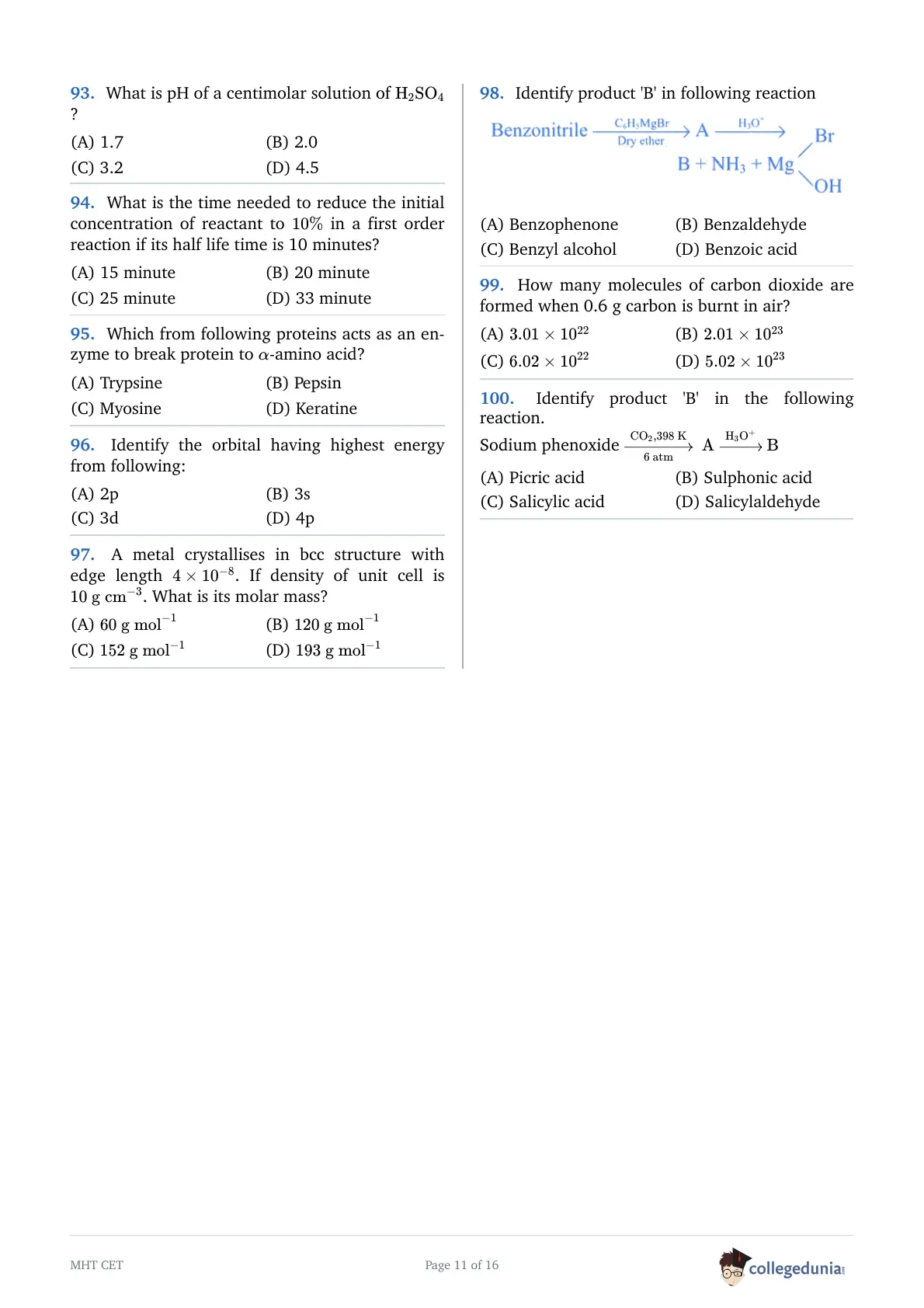
What is pH of a centimolar solution of \(\mathrm{H}_2 \mathrm{SO}_4\) ?
What is the time needed to reduce the initial concentration of reactant to \(10 \%\) in a first order reaction if its half life time is 10 minutes?

How many molecules of carbon dioxide are formed when 0.6 g carbon is burnt in air?
Identify product 'B' in the following reaction.
Sodium phenoxide \(\xrightarrow[6 \mathrm{~atm}]{\mathrm{CO}_2, 398 \mathrm{~K}} \mathrm{~A} \xrightarrow{\mathrm{H}_3 \mathrm{O}^{+}} \mathrm{B}\)
Mathematics (Q101 - Q150)
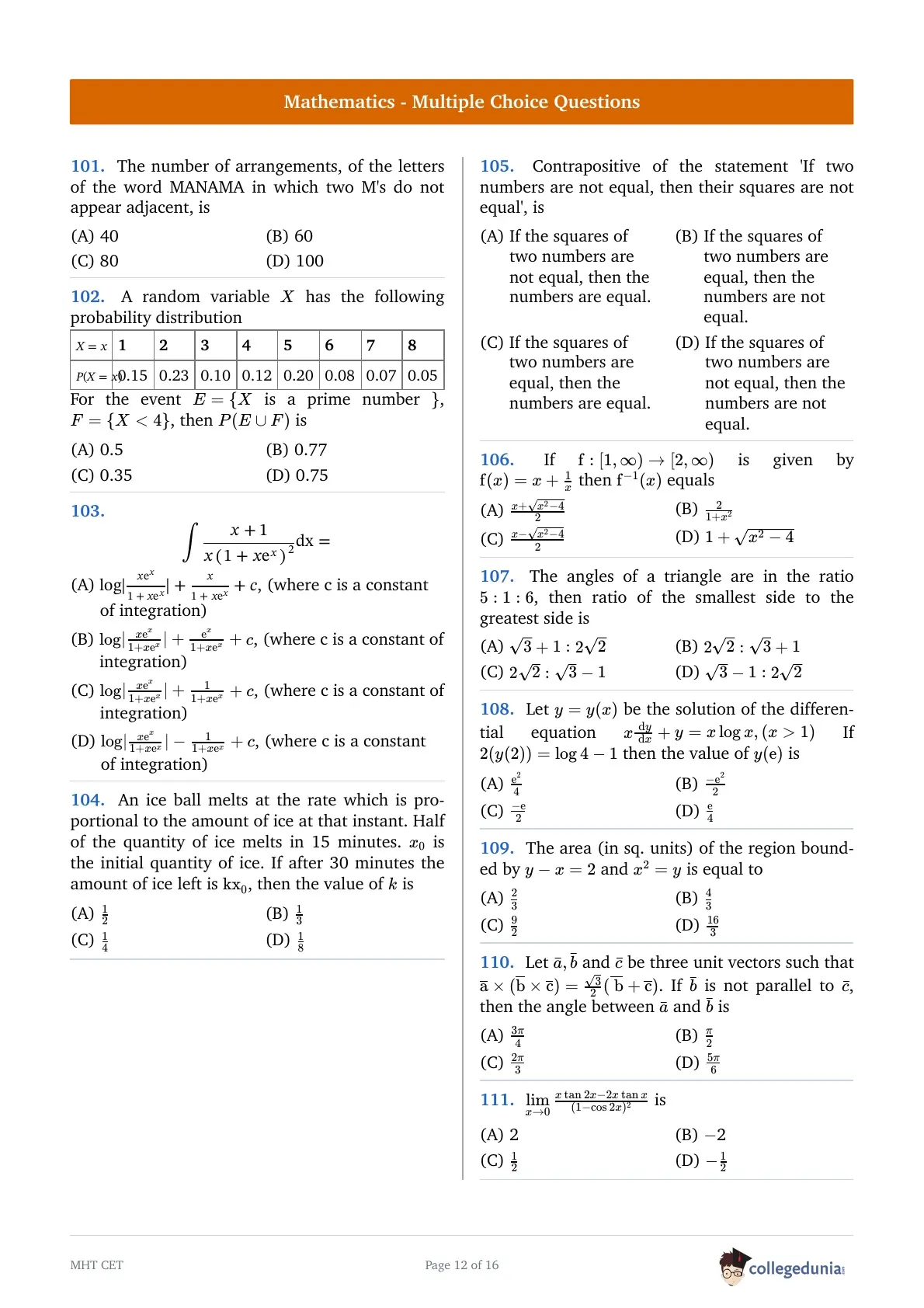
The number of arrangements, of the letters of the word MANAMA in which two M's do not appear adjacent, is
A random variable \(X\) has the following probability distribution
| \(X=x\) | 1 | 2 | 3 | 4 | 5 | 6 | 7 | 8 |
|---|---|---|---|---|---|---|---|---|
| \(P(X=x)\) | 0.15 | 0.23 | 0.10 | 0.12 | 0.20 | 0.08 | 0.07 | 0.05 |
An ice ball melts at the rate which is proportional to the amount of ice at that instant. Half of the quantity of ice melts in 15 minutes. \(x_0\) is the initial quantity of ice. If after 30 minutes the amount of ice left is \(\mathrm{kx}_0\), then the value of \(k\) is
Contrapositive of the statement 'If two numbers are not equal, then their squares are not equal', is
If \(\mathrm{f}:[1, \infty) \rightarrow[2, \infty)\) is given by \(\mathrm{f}(x)=x+\frac{1}{x}\) then \(\mathrm{f}^{-1}(x)\) equals
The angles of a triangle are in the ratio \(5: 1: 6\), then ratio of the smallest side to the greatest side is
Let \(y=y(x)\) be the solution of the differential equation \(x \frac{\mathrm{~d} y}{\mathrm{~d} x}+y=x \log x,(x>1)\) If \(2(y(2))=\log 4-1\) then the value of \(y(\mathrm{e})\) is
The area (in sq. units) of the region bounded by \(y-x=2\) and \(x^2=y\) is equal to
Let \(\bar{a}, \bar{b}\) and \(\bar{c}\) be three unit vectors such that \(\overline{\mathrm{a}} \times(\overline{\mathrm{b}} \times \overline{\mathrm{c}})=\frac{\sqrt{3}}{2}(\overline{\mathrm{~b}}+\overline{\mathrm{c}})\). If \(\bar{b}\) is not parallel to \(\bar{c}\), then the angle between \(\bar{a}\) and \(\bar{b}\) is
\(\lim _\limits{x \rightarrow 0} \frac{x \tan 2 x-2 x \tan x}{(1-\cos 2 x)^2}\) is
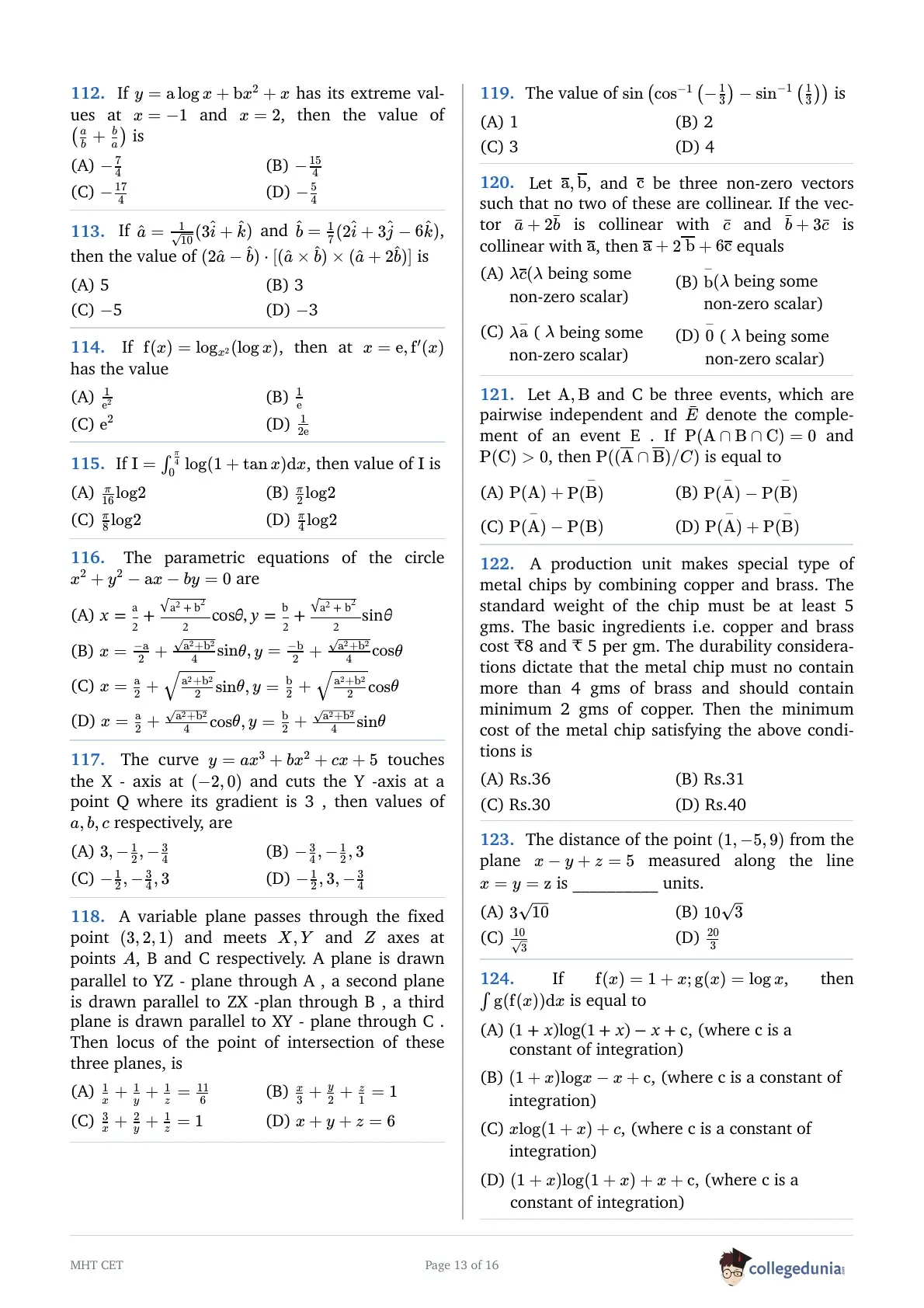
If \(y=\mathrm{a} \log x+\mathrm{b} x^2+x\) has its extreme values at \(x=-1\) and \(x=2\), then the value of \(\left(\frac{a}{b}+\frac{b}{a}\right)\) is
If \(\hat{a}=\frac{1}{\sqrt{10}}(3 \hat{i}+\hat{k})\) and \(\hat{b}=\frac{1}{7}(2 \hat{i}+3 \hat{j}-6 \hat{k})\), then the value of \((2 \hat{a}-\hat{b}) \cdot[(\hat{a} \times \hat{b}) \times(\hat{a}+2 \hat{b})]\) is
If \(\mathrm{f}(x)=\log _{x^2}(\log x)\), then at \(x=\mathrm{e}, \mathrm{f}^{\prime}(x)\) has the value
If \(\mathrm{I}=\int_0^{\frac{\pi}{4}} \log (1+\tan x) \mathrm{d} x\), then value of \(\mathrm{I}\) is
The parametric equations of the circle \(x^2+y^2-\mathrm{a} x-b y=0\) are
The curve \(y=a x^3+b x^2+c x+5\) touches the X - axis at \((-2,0)\) and cuts the Y -axis at a point Q where its gradient is 3 , then values of \(a, b, c\) respectively, are
A variable plane passes through the fixed point \((3,2,1)\) and meets \(X, Y\) and \(Z\) axes at points \(A\), B and C respectively. A plane is drawn parallel to YZ - plane through A , a second plane is drawn parallel to ZX -plan through B , a third plane is drawn parallel to XY - plane through C . Then locus of the point of intersection of these three planes, is
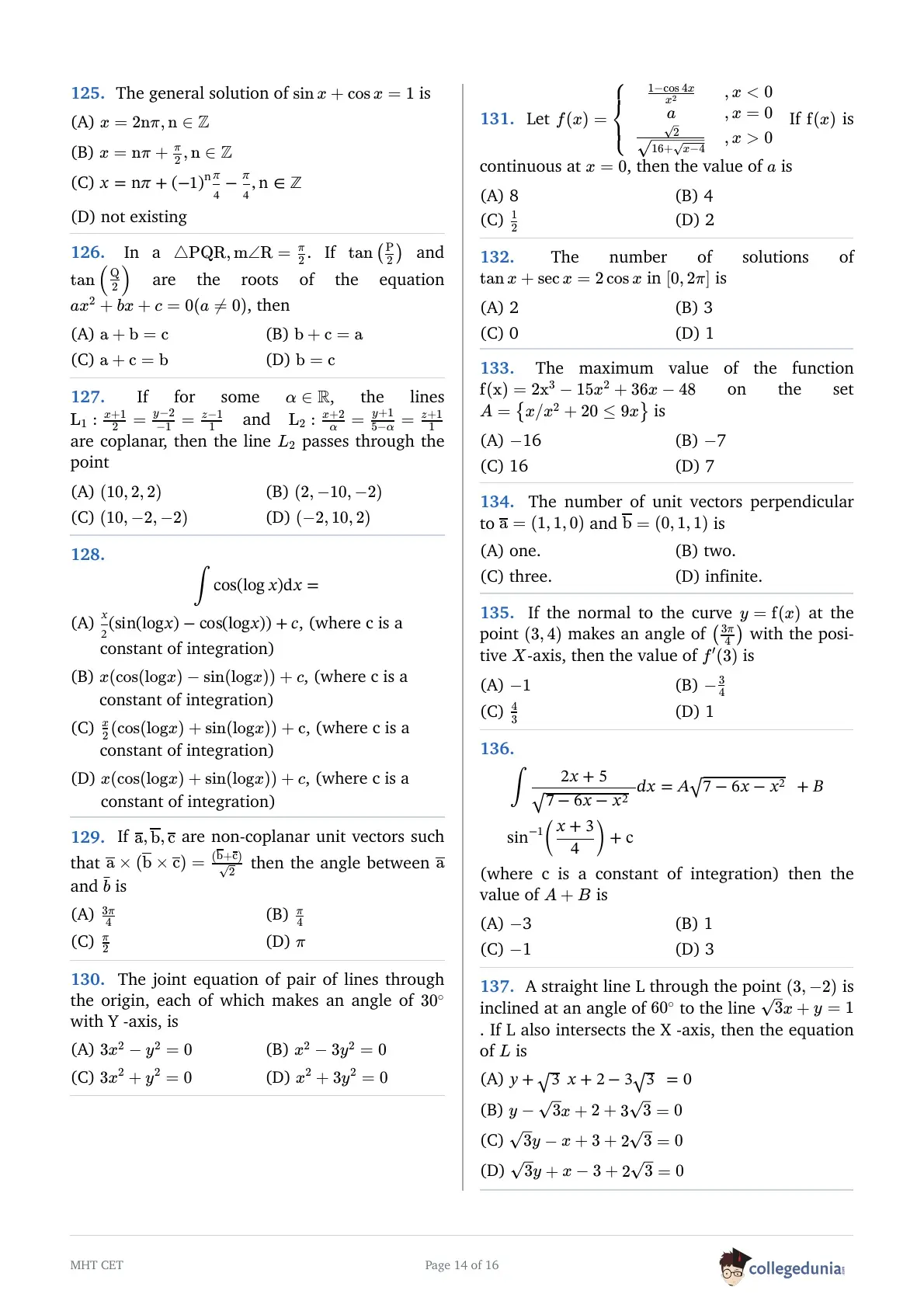
The value of \(\sin \left(\cos ^{-1}\left(-\frac{1}{3}\right)-\sin ^{-1}\left(\frac{1}{3}\right)\right)\) is
Let \(\overline{\mathrm{a}}, \overline{\mathrm{b}}\), and \(\overline{\mathrm{c}}\) be three non-zero vectors such that no two of these are collinear. If the vector \(\bar{a}+2 \bar{b}\) is collinear with \(\bar{c}\) and \(\bar{b}+3 \bar{c}\) is collinear with \(\overline{\mathrm{a}}\), then \(\overline{\mathrm{a}}+2 \overline{\mathrm{~b}}+6 \overline{\mathrm{c}}\) equals
Let \(\mathrm{A}, \mathrm{B}\) and C be three events, which are pairwise independent and \(\bar{E}\) denote the complement of an event E . If \(\mathrm{P}(\mathrm{A} \cap \mathrm{B} \cap \mathrm{C})=0\) and \(\mathrm{P}(\mathrm{C})>0\), then \(\mathrm{P}((\overline{\mathrm{A}} \cap \overline{\mathrm{B}}) / C)\) is equal to
A production unit makes special type of metal chips by combining copper and brass. The standard weight of the chip must be at least 5 gms. The basic ingredients i.e. copper and brass cost ₹8 and ₹ 5 per gm. The durability considerations dictate that the metal chip must no contain more than 4 gms of brass and should contain minimum 2 gms of copper. Then the minimum cost of the metal chip satisfying the above conditions is
The distance of the point \((1,-5,9)\) from the plane \(x-y+z=5\) measured along the line \(x=y=\mathrm{z}\) is __________ units.
If \(\mathrm{f}(x)=1+x ; \mathrm{g}(x)=\log x\), then \(\int \mathrm{g}(\mathrm{f}(x)) \mathrm{d} x\) is equal to
In a \(\triangle \mathrm{PQR}, \mathrm{m} \angle \mathrm{R}=\frac{\pi}{2}\). If \(\tan \left(\frac{\mathrm{P}}{2}\right)\) and \(\tan \left(\frac{\mathrm{Q}}{2}\right)\) are the roots of the equation \(a x^2+b x+c=0(a \neq 0)\), then
If for some \(\alpha \in \mathbb{R}\), the lines \(\mathrm{L}_1: \frac{x+1}{2}=\frac{y-2}{-1}=\frac{z-1}{1}\) and \(\mathrm{L}_2: \frac{x+2}{\alpha}=\frac{y+1}{5-\alpha}=\frac{z+1}{1}\) are coplanar, then the line \(L_2\) passes through the point
If \(\overline{\mathrm{a}}, \overline{\mathrm{b}}, \overline{\mathrm{c}}\) are non-coplanar unit vectors such that \(\overline{\mathrm{a}} \times(\overline{\mathrm{b}} \times \overline{\mathrm{c}})=\frac{(\overline{\mathrm{b}}+\overline{\mathrm{c}})}{\sqrt{2}}\) then the angle between \(\overline{\mathrm{a}}\) and \(\bar{b}\) is
The joint equation of pair of lines through the origin, each of which makes an angle of \(30^{\circ}\) with Y -axis, is
The number of solutions of \(\tan x+\sec x=2 \cos x\) in \([0,2 \pi]\) is
The maximum value of the function \(\mathrm{f}(\mathrm{x})=2 \mathrm{x}^3-15 x^2+36 x-48\) on the set \(A=\left\{x / x^2+20 \leq 9 x\right\}\) is
The number of unit vectors perpendicular to \(\overline{\mathrm{a}}=(1,1,0)\) and \(\overline{\mathrm{b}}=(0,1,1)\) is
If the normal to the curve \(y=\mathrm{f}(x)\) at the point \((3,4)\) makes an angle of \(\left(\frac{3 \pi}{4}\right)\) with the positive \(X\)-axis, then the value of \(f^{\prime}(3)\) is
\[ \int \frac{2 x+5}{\sqrt{7-6 x-x^2}} d x=A \sqrt{7-6 x-x^2}+B \sin ^{-1}\left(\frac{x+3}{4}\right)+\mathrm{c} \] (where c is a constant of integration) then the value of \(A+B\) is
A straight line L through the point \((3,-2)\) is inclined at an angle of \(60^{\circ}\) to the line \(\sqrt{3} x+y=1\). If L also intersects the X -axis, then the equation of \(L\) is
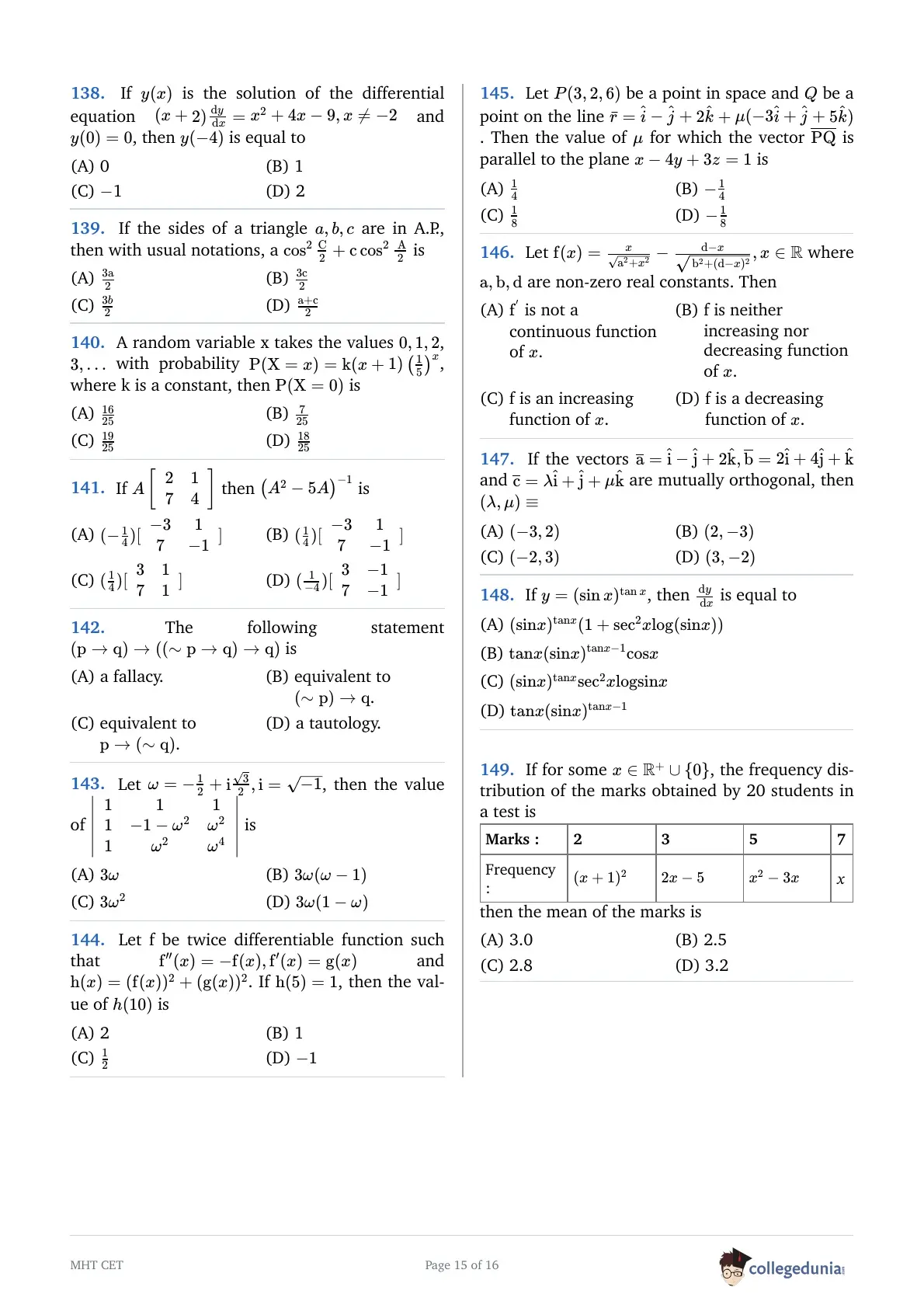
If \(y(x)\) is the solution of the differential equation \((x+2) \frac{\mathrm{d} y}{\mathrm{~d} x}=x^2+4 x-9, x \neq-2\) and \(y(0)=0\), then \(y(-4)\) is equal to
If the sides of a triangle \(a, b, c\) are in A.P., then with usual notations, a \(\cos ^2 \frac{\mathrm{C}}{2}+\mathrm{c} \cos ^2 \frac{\mathrm{~A}}{2}\) is
A random variable x takes the values \(0,1,2\), \(3, \ldots\) with probability \(\mathrm{P}(\mathrm{X}=x)=\mathrm{k}(x+1)\left(\frac{1}{5}\right)^x\), where k is a constant, then \(\mathrm{P}(\mathrm{X}=0)\) is
If \(A\left[\begin{array}{ll}2 & 1 \\ 7 & 4\end{array}\right]\) then \(\left(A^2-5 A\right)^{-1}\) is
The following statement \((\mathrm{p} \rightarrow \mathrm{q}) \rightarrow((\sim \mathrm{p} \rightarrow \mathrm{q}) \rightarrow \mathrm{q})\) is
Let \(\omega=-\frac{1}{2}+\mathrm{i} \frac{\sqrt{3}}{2}, \mathrm{i}=\sqrt{-1}\), then the value of \(\left|\begin{array}{ccc}1 & 1 & 1 \\ 1 & -1-\omega^2 & \omega^2 \\ 1 & \omega^2 & \omega^4\end{array}\right|\) is
Let f be twice differentiable function such that \(\mathrm{f}^{\prime \prime}(x)=-\mathrm{f}(x), \mathrm{f}^{\prime}(x)=\mathrm{g}(x)\) and \(\mathrm{h}(x)=(\mathrm{f}(x))^2+(\mathrm{g}(x))^2\). If \(\mathrm{h}(5)=1\), then the value of \(h(10)\) is
Let \(P(3,2,6)\) be a point in space and \(Q\) be a point on the line \(\bar{r}=\hat{i}-\hat{j}+2 \hat{k}+\mu(-3 \hat{i}+\hat{j}+5 \hat{k})\). Then the value of \(\mu\) for which the vector \(\overline{\mathrm{PQ}}\) is parallel to the plane \(x-4 y+3 z=1\) is
Let \(\mathrm{f}(x)=\frac{x}{\sqrt{\mathrm{a}^2+x^2}}-\frac{\mathrm{d}-x}{\sqrt{\mathrm{~b}^2+(\mathrm{d}-x)^2}}, x \in \mathbb{R}\) where \(\mathrm{a}, \mathrm{b}, \mathrm{d}\) are non-zero real constants. Then
If the vectors \(\overline{\mathrm{a}}=\hat{\mathrm{i}}-\hat{\mathrm{j}}+2 \hat{\mathrm{k}}, \overline{\mathrm{b}}=2 \hat{\mathrm{i}}+4 \hat{\mathrm{j}}+\hat{\mathrm{k}}\) and \(\overline{\mathrm{c}}=\lambda \hat{\mathrm{i}}+\hat{\mathrm{j}}+\mu \hat{\mathrm{k}}\) are mutually orthogonal, then \((\lambda, \mu) \equiv\)
If \(y=(\sin x)^{\tan x}\), then \(\frac{\mathrm{d} y}{\mathrm{~d} x}\) is equal to
If for some \(x \in \mathbb{R}^{+} \cup\{0\}\), the frequency distribution of the marks obtained by 20 students in a test is
| Marks : | 2 | 3 | 5 | 7 |
|---|---|---|---|---|
| Frequency : | \((x+1)^2\) | \(2x-5\) | \(x^2-3x\) | \(x\) |
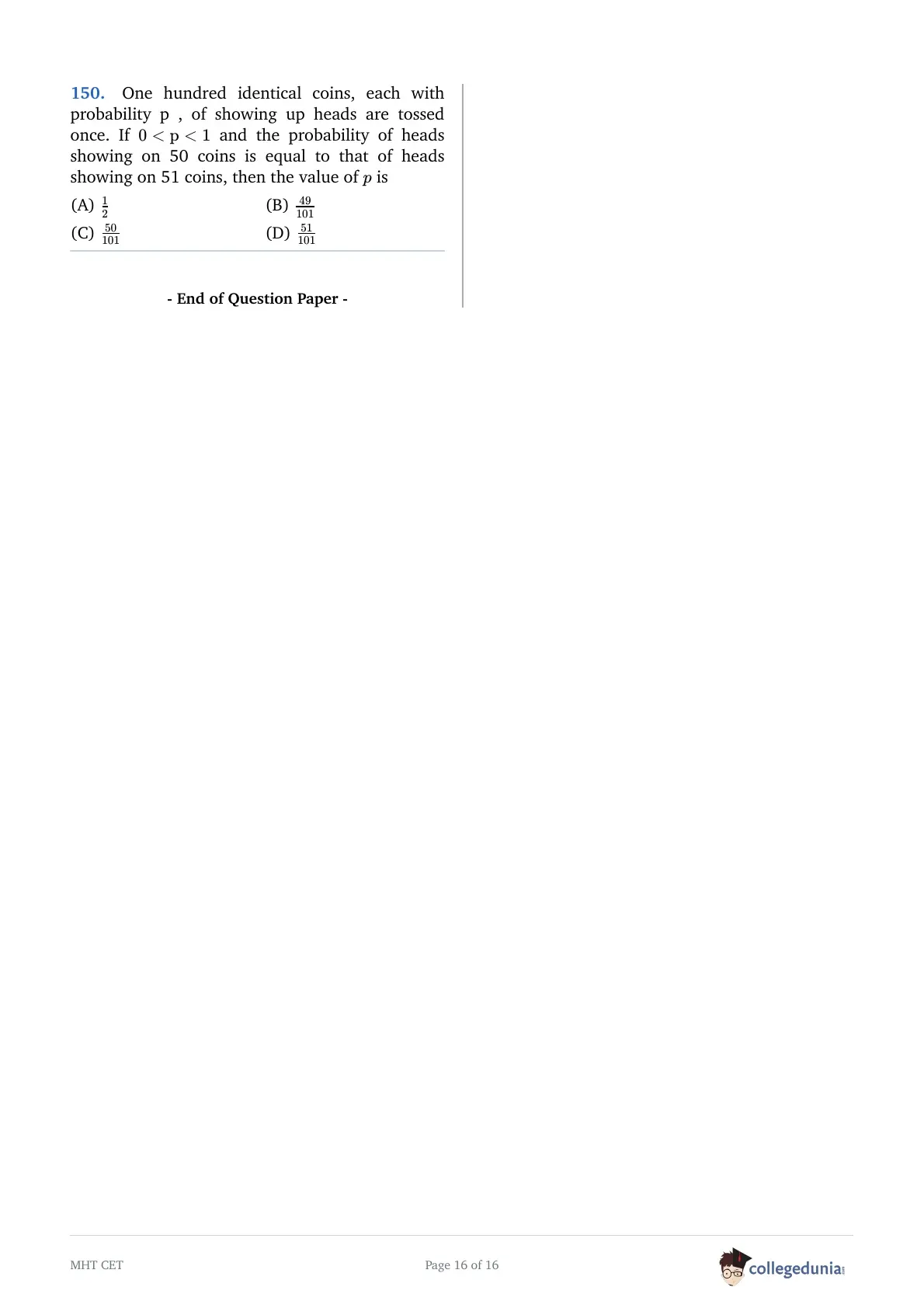
One hundred identical coins, each with probability p , of showing up heads are tossed once. If \(0<\mathrm{p}<1\) and the probability of heads showing on 50 coins is equal to that of heads showing on 51 coins, then the value of \(p\) is
MHT CET 2024 PCM Exam Pattern and Marking Scheme
| Parameter | Details |
|---|---|
| Conducting Body | Maharashtra Common Entrance Test Cell (Maharashtra CET Cell) |
| Exam Mode | Online (Computer-Based Test) |
| Duration | 180 minutes (3 hours) |
| Groups / Subjects | PCM (Physics, Chemistry, Mathematics) for Engineering |
| Total Questions |
150 |
| Total Marks | 200 |
| Question Type | Multiple Choice Questions (MCQs) |
| Marks Distribution |
|
| Negative Marking | No |
| Syllabus Weightage |
|



Comments