




Arithmetic is expected to be around 35–40% of the CAT 2026 Quantitative Aptitude section, making it the highest weightage area.
- Algebra is expected to account for nearly 25–32% of the questions in CAT 2026 Quantitative Aptitude.
- Time, Speed and Distance, Time and Work, Percentages, Profit and Loss, Mixtures, Averages and Ratio are expected to carry the maximum weightage.
- Quadratic Equations, Progressions, Functions, Inequalities, and Logarithms are expected to appear regularly in the examination.
- Triangles, Circles, Coordinate Geometry, and Mensuration are expected to contribute around 13–18% of the questions.
- Remainders, Factors, Divisibility, and Surds and Indices are expected to account for around 8–14% of the section.
- Permutation and Combination and Probability are expected to contribute 1–2 questions in CAT 2026.
Related Links:
- CAT Preparation 2026: 6 Month Strategy, Self-Preparation, Books, Mock Tests & Online Coachings
- CAT Topic Wise Weightage for QA, VARC and DILR, Check Previous Years’ Question
- CAT Cutoff 2026: Check Category-wise Cutoff for IIMs and Top MBA Colleges, Marks vs Percentile, Good Score

Key Summary
- The CAT 2026 Quantitative Aptitude section is expected to have 22 questions to be solved in 40 minutes.
- The expected weightage is based on the question pattern observed between CAT 2021 and CAT 2025.
- TITA questions do not have negative marking, making them important scoring opportunities in the CAT 2026 Quantitative Aptitude section.
- The CAT 2026 Quantitative Aptitude section is expected to include 22 questions carrying a total of 66 marks, with 40 minutes allotted for completion.
- Candidates should target 14–16 questions with an accuracy of 80% or above to improve their performance in the CAT 2026 Quantitative Aptitude section.
CAT 2026 QA Section Overview
The CAT 2026 Quantitative Aptitude section is expected to cover five major topic areas based on previous years' question pattern.
- TITA (Type In The Answer) questions do not carry negative marking, making them important for score improvement.
- The CAT 2026 question pattern is expected to remain similar to the trend followed from CAT 2021 to CAT 2025.
- The expected structure of the CAT 2026 Quantitative Aptitude section is based on the analysis of CAT 2021–2025 papers.
| Parameter | Details |
|---|---|
| Total Questions | 22 |
| MCQ Questions | 14–16 |
| TITA Questions | 6–8 |
| Total Marks | 66 |
| Marks Per Correct Answer | +3 |
| Negative Marking (MCQ) | -1 per wrong answer |
| Negative Marking (TITA) | None |
| Time Allotted | 40 minutes |
Also Read
CAT QA Syllabus 2026: Topic-Wise List, Weightage and Important ChaptersCAT QA Chapter-Wise Weightage: Trends from 2021–2024
Arithmetic and Algebra together are expected to contribute around 60–70% of the CAT 2026 Quantitative Aptitude section.
- Candidates should allocate more preparation time to Arithmetic and Algebra because these topics are expected to carry the highest number of questions.
- The table below presents the expected topic-wise distribution of questions in CAT 2026 Quantitative Aptitude based on the analysis of CAT 2021 to CAT 2025.
- The expected distribution can help candidates identify the topics carrying higher weightage in CAT 2026.
| Topic Area | Approx. Questions (per year) | Weightage (%) | Priority Level |
|---|---|---|---|
| Arithmetic | 7–9 | 35–40% | Very High |
| Algebra | 5–8 | 25–32% | High |
| Geometry and Mensuration | 3–5 | 13–18% | High |
| Number System | 2–4 | 8–14% | Medium |
| Modern Math (PnC and Probability) | 1–2 | 5–9% | Low–Medium |

Also Read
CAT QA Paper Analysis: Difficulty Level, Topic Distribution, and Good AttemptsQues. Are CAT QA chapter-wise weightage trends the same every year?
Ans. No. The exact CAT QA chapter-wise weightage changes slightly every year. However, Arithmetic and Algebra have consistently contributed the highest number of questions in recent CAT exams, making them the most important topics for CAT 2026 preparation.
Ques. How should I divide my CAT 2026 QA preparation based on chapter-wise weightage?
Ans. Candidates should spend around 60–70% of their preparation time on Arithmetic and Algebra, as these topics contribute the majority of CAT QA questions. The remaining time should be allocated to Geometry, Number System, and Modern Math, depending on individual strengths and weaknesses.
High-Priority Topics: Sub-Chapter Breakdown
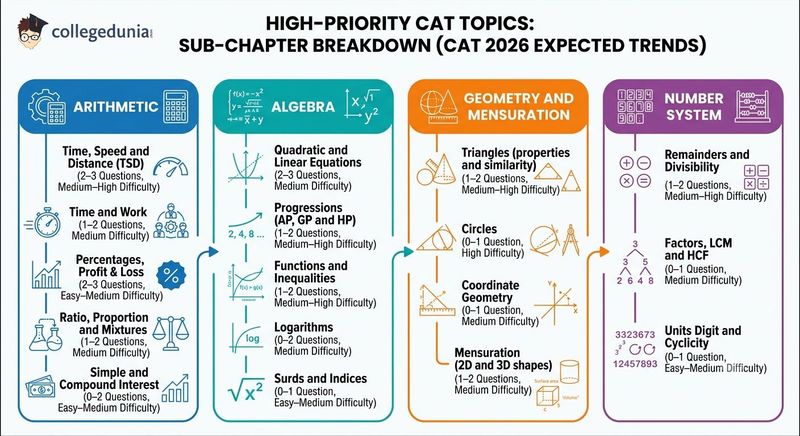
Within each broad topic area, certain sub-chapters appear more consistently than others. The breakdown below is based on CAT 2021–2025 trends and is expected to hold for CAT 2026.
Arithmetic: Key Sub-Topics
| Sub-Topic | Typical Questions | Difficulty Level |
|---|---|---|
| Time, Speed and Distance (TSD) | 2–3 | Medium–High |
| Time and Work | 1–2 | Medium |
|
Percentages, Profit & Loss |
2–3 | Easy–Medium |
| Ratio, Proportion and Mixtures | 1–2 | Medium |
| Simple and Compound Interest | 0–2 | Easy–Medium |
Algebra: Key Sub-Topics
| Sub-Topic | Typical Questions | Difficulty Level |
|---|---|---|
| Quadratic and Linear Equations |
2–3 |
Medium |
| Progressions (AP, GP and HP) | 1–2 | Medium–High |
| Functions and Inequalities | 1–2 |
Medium–High |
| Logarithms |
0–2 |
Medium |
| Surds and Indices | 0–1 | Easy–Medium |
Geometry and Mensuration: Key Sub-Topics
| Sub-Topic | Typical Questions | Difficulty Level |
|---|---|---|
| Triangles (properties and similarity) | 1–2 | Medium–High |
| Circles | 0–1 | High |
| Coordinate Geometry | 0–1 | Medium |
| Mensuration (2D and 3D shapes) | 1–2 | Medium |
Number System: Key Sub-Topics
| Sub-Topic | Typical Questions | Difficulty Level |
|---|---|---|
| Remainders and Divisibility | 1–2 |
Medium–High |
| Factors, LCM and HCF | 0–1 | Medium |
| Units Digit and Cyclicity | 0–1 | Easy–Medium |
Also Read
IIM Ahmedabad CAT 2026 Expected Cutoff: Percentile, Academic Profile and Shortlist CriteriaQues. Which CAT QA topics are considered the easiest to score in?
Ans. Many candidates find Percentages, Profit & Loss, Simple and Compound Interest, Surds & Indices, and Unit Digit/Cyclicity comparatively easier because they are based on fundamental concepts and regular practice. However, the difficulty level of CAT questions varies every year, so conceptual clarity is more important than memorising formulas.
Ques. Which Algebra topics should I prepare first for CAT 2026 QA?
Ans. Candidates should begin with Quadratic and Linear Equations, followed by Progressions (AP, GP, HP), Functions, and Inequalities, as these topics are expected to carry the highest weightage within Algebra. After building a strong foundation, candidates can move on to Logarithms and Surds & Indices for complete preparation.
Topic-Wise Preparation Tips for CAT 2026 QA
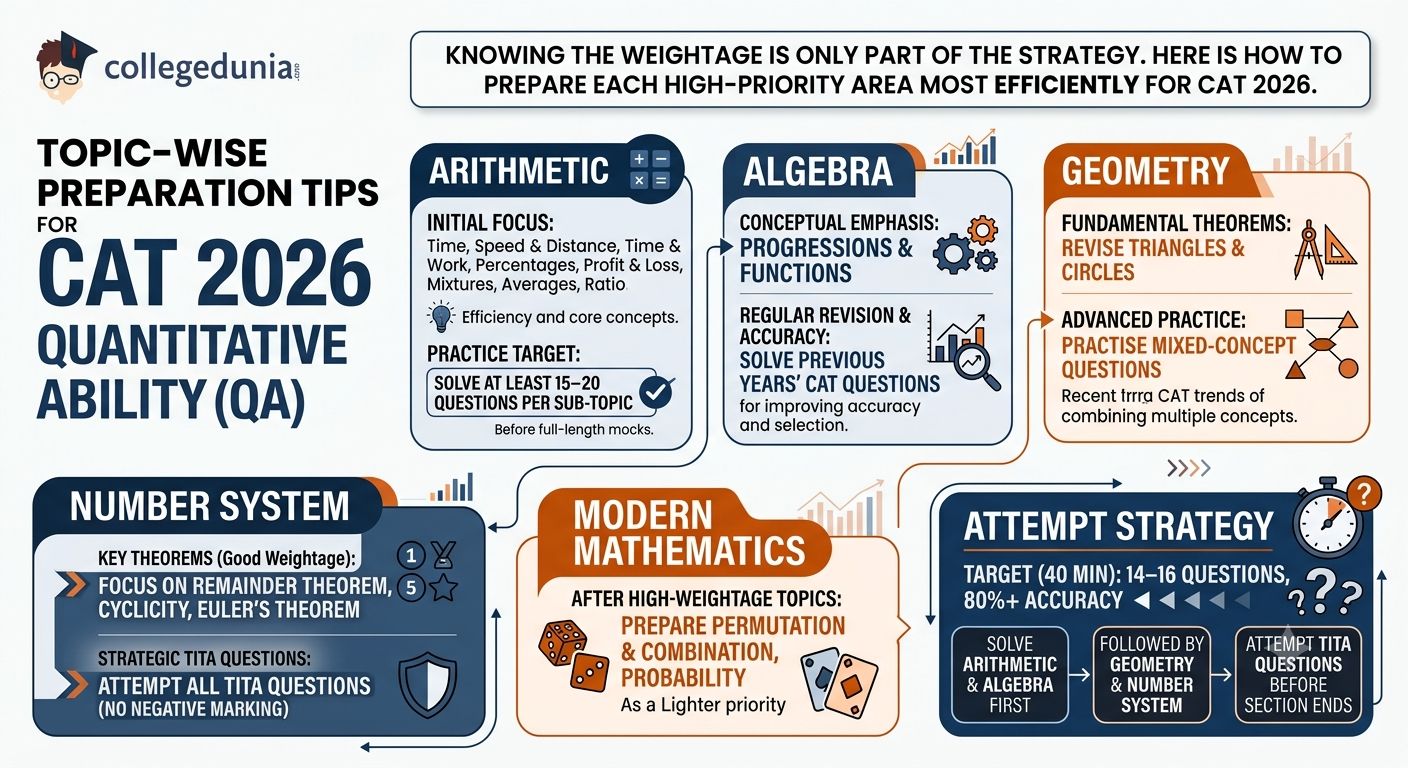
Knowing the weightage is only part of the strategy. Here is how to prepare each high-priority area most efficiently for CAT 2026.
- Arithmetic: Focus on Time, Speed and Distance, Time and Work, Percentages, Profit and Loss, Mixtures, Averages, and Ratio during the initial phase of preparation.
- Arithmetic: Solve at least 15–20 questions from each sub-topic before moving to full-length mock tests.
- Algebra: Give more attention to Progressions and Functions, as these topics are expected to test conceptual understanding.
- Algebra: Solve previous years' CAT questions regularly to improve accuracy and question selection.
- Geometry: Revise the important theorems related to Triangles and Circles before attempting advanced questions.
- Geometry: Practise mixed-concept questions as recent CAT papers combine multiple concepts in a single problem.
- Number System: Focus on Remainder Theorem, Cyclicity, and Euler's Theorem, which are expected to carry good weightage.
- Number System: Attempt all TITA questions from this topic because they do not have negative marking.
- Modern Mathematics: Prepare Permutation and Combination and Probability after completing the high-weightage topics.
Attempt strategy:
- Candidates should target 14–16 questions in the 40-minute QA section with an accuracy of 80% or above.
- Solve Arithmetic and Algebra questions first, followed by Geometry and Number System, and attempt TITA questions before the section ends.
Also Read
CAT 2026 vs XAT 2026: Accepted Colleges, Score Validity and Which to PrioritiseQues. Should I solve previous years' CAT QA questions or focus only on mock tests?
Ans. Candidates should prioritise previous years' CAT QA questions before relying heavily on mock tests. Previous papers help in understanding the actual question pattern, difficulty level, and topic-wise trends, while mock tests are useful for improving time management, accuracy, and question selection closer to the exam.
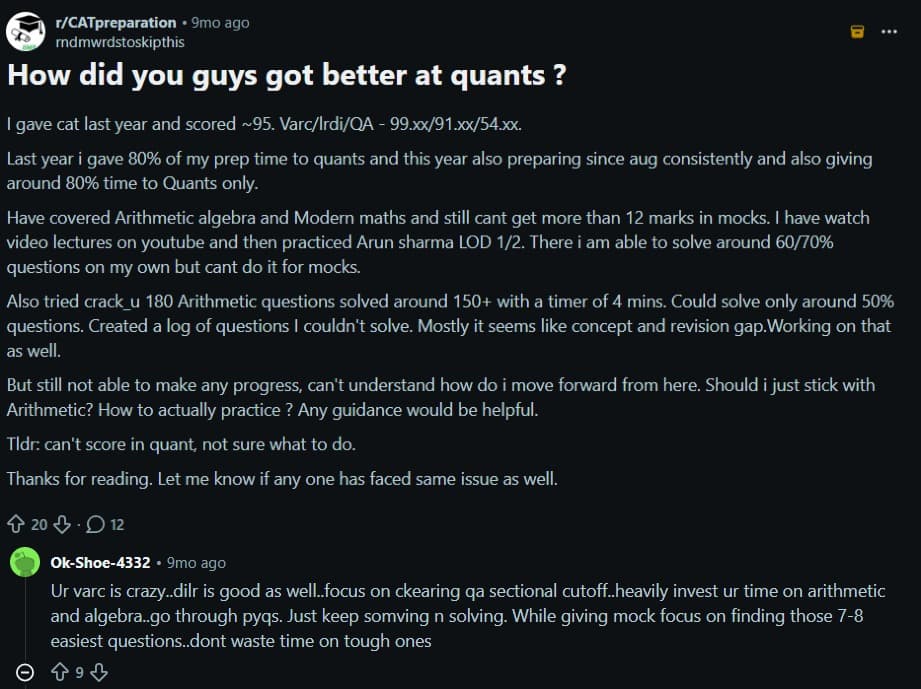
CAT 2026 QA Chapter-Wise Weightage: Reddit Discussion
- The discussion focused on improving Quantitative Aptitude for CAT, with a candidate seeking advice after consistently struggling to improve QA mock scores despite extensive preparation, concept revision, and practice.
- Another Reddit user advised focusing primarily on Arithmetic and Algebra, solving previous years' CAT questions regularly, and identifying the easiest 7–8 questions during the actual exam instead of attempting difficult ones. The response emphasized that consistent practice and smart question selection are key to clearing the QA sectional cutoff.
CAT 2026 QA Chapter-Wise Weightage FAQs
Ques. Which topic has the highest weightage in the CAT QA section?
Ans. Arithmetic has the highest weightage in CAT QA, contributing approximately 35–40% of questions each year based on 2021–2025 trends. TSD, Time and Work, Percentages, Profit & Loss, and Mixtures are the most consistently tested Arithmetic sub-topics.
Ques. How many questions come from Algebra in CAT QA?
Ans. Algebra typically contributes 5–8 questions out of 22 in the QA section, accounting for roughly 25–32% weightage based on CAT 2021–2025 trends. Quadratic Equations, Progressions, and Functions are the highest-priority sub-topics within Algebra.
Ques. Is Number System important for CAT 2026 QA?
Ans. Number System carries medium priority with 2–4 questions per paper. These questions frequently appear as TITA questions (no negative marking), making them a strategically good bet even when you are partially confident about the answer.
Ques. How many total marks does the CAT QA section carry?
Ans. The CAT QA section has 22 questions at 3 marks each, for a total of 66 marks. MCQ questions carry a -1 negative mark for wrong answers. TITA (Type In The Answer) questions carry no negative marking.
Ques. Should I focus more on Geometry or Modern Math for CAT 2026?
Ans. Geometry is the higher priority of the two. It contributes 3–5 questions (13–18% weightage) versus Modern Math’s 1–2 questions (5–9%). Prepare Triangles, Circles, and Mensuration thoroughly. Spend only about one focused week on PnC and Probability before redirecting time to higher-yield areas.
Ques. How many questions should I attempt in CAT QA to score well?
Ans. Based on score-percentile patterns from recent CAT cycles, attempting 14–16 questions with 80%+ accuracy in QA is considered a strong performance. Accuracy matters more than raw attempt count — attempting all 22 questions with poor accuracy can significantly hurt your score due to negative marking on MCQs.



Comments