




The CAT 2026 notification was released on July 25 2026 while the examination is scheduled for November 29 2026 which gives around four months to prepare for CAT 2026.
- A month wise study plan helps candidates complete VARC, DILR and QA in a structured manner.
- In August, candidates should focus on core concepts, 2–3 mock tests and an error notebook.
- Candidates should complete the syllabus with sectional tests and timed practice in September 2026.
- Candidates should include 2 full length mocks every week in October 2026 with detailed performance analysis.
- Candidates in November should focus on revision, accuracy and exam readiness before the CAT 2026 exam.
- Regular mock analysis and error tracking remain critical throughout the preparation period.
- Daily newspaper reading, regular mock tests and maintaining an error log remain essential for CAT 2026 preparation.
Related Articles:
- CAT Syllabus 2026- Download Syllabus PDF, Section-wise Weightage and Preparation Tips
- CAT Topic Wise Weightage for QA, VARC and DILR, Check Previous Years’ Question
- CAT Topic-Wise Previous Year Questions (PYQs) with Solutions [1990–2024] – QA, VARC & DILR
- Best CAT Mock Test Series 2026: Free PDF Download, Solutions and Performance Analysis

Key Summary
- TITA questions in CAT 2026 carry no negative marking, making them safer to attempt than MCQs.
- Candidates should spend at least 2 hours analysing every CAT 2026 mock test to improve performance.
- Candidates should use the same time slot for mock tests as the actual CAT 2026 examination whenever possible.
- Candidates should avoid questions taking more than 3 minutes and focus on maximising overall attempts and accuracy.
- CAT previous-year papers (2017–2025) remain valuable resources for VARC, DILR, and QA preparation.
CAT 2026 Exam Pattern at a Glance
Candidates should understand the CAT 2026 exam pattern before preparing a study plan.
- CAT 2026 is a computer-based test conducted for a duration of 2 hours.
- The question paper is divided into three sections with equal time allotted to each section.
- Candidates cannot switch between sections due to the sectional time limit.
| Feature | Details |
|---|---|
| Mode | Computer Based Test (CBT) |
| Duration | 2 hours (120 minutes total) |
| Sections | Verbal Ability and RC (VARC), DILR, Quantitative Ability (QA) |
| Time per Section | 40 minutes each — you cannot switch between sections mid-exam |
| Question Types | MCQs and TITA (Type in the Answer, non-MCQ) |
| Marking Scheme | +3 for correct MCQ, −1 for wrong MCQ; TITA has no negative marking |
| Score Reporting | Percentile score (not absolute marks) |
Also Read:
CAT 2026 Month By Month Study Plan: August to November
Candidates have around four months left to prepare for CAT 2026 and they should begin with concept building, then move to question practice.
- Mock tests should become the main focus as the examination date approaches.
- Candidates should attempt full length mock tests under actual exam conditions before CAT 2026.
August 2026: Build Concepts and Create a Strong Foundation
Goal: Understand the syllabus, strengthen fundamentals and develop a consistent study routine.
- Diagnostic Mock Test: Start the CAT 2026 preparation with a full length mock test to identify strengths and weak areas.
- Quantitative Aptitude: Begin with Arithmetic topics such as Percentages, Profit and Loss, Averages, Ratio and Proportion, Time Speed Distance and Time and Work.
- Quantitative Aptitude: Cover Algebra and Number Systems after completing the important Arithmetic topics.
- VARC Preparation: Read editorials and long-form articles on economics, science, history and philosophy every day.
- LRDI Preparation: Start with tables, charts, Data Interpretation sets, arrangements and logical reasoning puzzles before solving complex caselets.
- Error Notebook: Maintain a notebook to record mistakes, formulas, shortcuts and difficult concepts for regular revision.
- Mock Tests: Take 2–3 full-length mock tests during the month and analyse every mistake instead of focusing only on the score.
September 2026: Strengthen Concepts and Improve Speed
Goal: Complete the syllabus while increasing question-solving speed and accuracy.
- Quantitative Aptitude: Cover advanced topics such as Geometry, Functions, Permutation & Combination, Probability and Modern Mathematics.
- VARC Preparation: Solve 3–4 timed Reading Comprehension passages regularly to improve speed and accuracy.
- VARC Preparation: Begin focused practice for Para Summary, Para Completion, and Para Jumbles.
- LRDI Preparation: Practise advanced caselets, scheduling, games and tournaments, and multi-condition reasoning sets.
- Sectional Tests: Attempt weekly sectional tests to improve speed and identify section-wise weak areas.
- Mock Test Analysis: Analyse every mock test to identify errors caused by concept gaps, lack of practice or poor time management.
October 2026: Mock Tests and Performance Analysis
Goal: Simulate the actual CAT exam and refine exam strategy.
- Mock Tests: Attempt 2 full-length mock tests every week under actual CAT 2026 exam conditions.
- Take the mock tests in the same time slot as the CAT 2026 examination whenever possible.
- Mock Test Analysis: Review skipped questions, incorrect attempts, and the time spent in each section after every mock.
- Sectional Performance: Track section-wise scores regularly and practise topics where performance remains inconsistent.
- Revision: Revise previously covered topics instead of starting completely new chapters.
- Practice: Continue solving sectional tests and topic-wise questions to improve accuracy and question selection.
November 2026: Final Revision and Exam Readiness
Goal: Consolidate preparation and enter the exam with confidence.
- Mock Tests: Attempt one full-length mock test every 4–5 days during the first half of the month.
- Mock Test Analysis: Analyse the performance after every mock to identify weak areas and improve the test strategy.
- Revision: Revise formulas, shortcuts, common mistakes and notes prepared during the entire preparation period.
- Accuracy & Time Management: Focus on improving accuracy and time management instead of increasing study hours.
- Final Week Preparation: Reduce the number of mock tests and focus on sectional practice and revision.
- Last 48 Hours:
- Avoid starting new topics before CAT 2026.
- Get adequate sleep, verify the exam centre details and keep the CAT 2026 Admit Card and original photo ID ready.

Source: Youtube
Also Read:
Ques. What is the biggest mistake candidates make during CAT 2026 preparation?
Ans. One of the most common mistakes is taking mock tests without analysing them. CAT experts recommend spending at least as much time analysing a mock as attempting it to identify weak areas and improve question selection.
Ques. How many hours should I study daily for CAT 2026 preparation?
Ans. Candidates preparing over four months generally study 3–4 hours daily. During the final 6–8 weeks, many aspirants increase preparation time to 5–6 hours, focusing mainly on mocks, sectional tests, and revision.
Section-wise Preparation Tips
Selecting the right questions plays an important role in achieving a 95+ to 99+ percentile in CAT 2026.
- Attempting around 60% of the questions with nearly 90% accuracy is often more effective than attempting every question.
- Candidates should assess a question within 30 seconds and move ahead if it appears lengthy or difficult.
| Section | Key Topics | Daily Target | Critical Tip |
|---|---|---|---|
| VARC |
RC passages, Para Jumble, Para Summary, Odd Sentence Out |
3 to 5 RC passages and 10 verbal questions |
Prioritise RC accuracy over verbal attempts (RC has more questions & higher percentile payoff) |
| DILR | Caselets, Arrangements, Networks, DI sets | 2 complete DILR sets in 40 minutes |
Select and fully complete 2 sets rather than touching all 4–5 and finishing none |
| QA |
Arithmetic, Algebra, Geometry, Number Systems, Modern Math |
20 to 30 questions across topics |
Skip any question that takes more than 3 minutes |
Also Read:
Ques. How many questions should I attempt in CAT 2026 to score a 95+ percentile?
Ans. There is no fixed number of attempts for a 95+ percentile in CAT 2026. Experts generally recommend attempting around 60% of the paper with nearly 90% accuracy, as high accuracy and smart question selection usually contribute more to the final percentile than attempting every question.
Ques. How much time should I spend on one question in CAT 2026?
Ans. CAT experts recommend assessing each question within 30 seconds. If a question appears lengthy or difficult, candidates should skip it and return later. In the QA section, spending more than three minutes on a single question is generally considered inefficient during the exam.
Best Books and Resources for CAT 2026
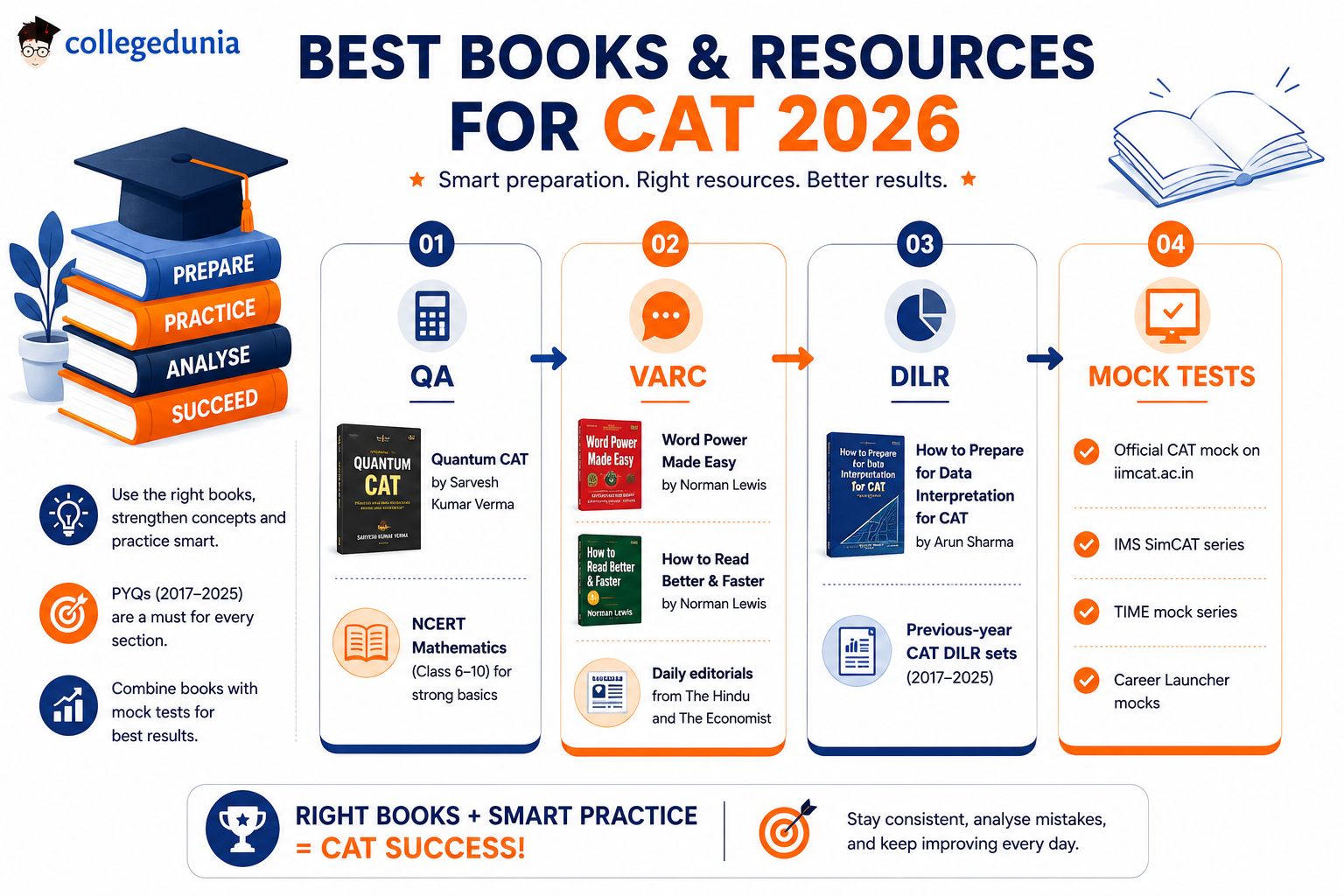
Many CAT 2026 candidates use Arun Sharma's Quantitative Aptitude book along with or instead of Quantum CAT.
- Candidates use Nishit K. Sinha's DILR book with Arun Sharma for complete LRDI preparation.
- CAT previous-year papers (2017–2025) remain valuable practice material for candidates across VARC, DILR, and QA.
| Section | Recommended Books and Resources |
|---|---|
| QA |
|
| VARC |
|
| DILR |
|
| Mock Tests |
|
Also Read:
- CAT 2026 VARC Weightage: Reading Comprehension vs Verbal Ability
- CAT 2026 QA Chapter-Wise Weightage: Most Important Topics from Arithmetic, Algebra and Number System
Ques. Are CAT previous-year question papers enough for CAT 2026 preparation?
Ans. CAT previous-year papers (2017–2025) are among the most recommended resources for CAT 2026 because they reflect the latest exam pattern and difficulty level. However, experts recommend combining them with full-length mock tests and sectional practice for comprehensive preparation.
Mock Test Strategy for CAT 2026
CAT 2026 candidates most common mistakes is skipping mock test analysis. Every CAT 2026 mock test helps candidates identify weak areas and improve the preparation strategy.
- Candidates should spend at least 2 hours analysing every mock test after completion.
- Candidates should review every question including the correctly answered ones after each mock.
- Candidates should identify whether mistakes were caused by concept gaps, calculation errors or misreading.
- Mock tests, performance analysis, improvement and regular practice should remain the core of CAT 2026 preparation.
| Month | Number of Mocks | Type |
|---|---|---|
| August 2026 |
|
1 diagnostic full-length mock at the beginning, followed by 1–2 full-length mocks with detailed analysis |
| September 2026 | 3–4 |
|
| October 2026 | 6–8 |
|
| November 2026 | 4–6 | 1 full-length mock every 4–5 days during the first half of the month, followed by sectional tests and revision in the final week |
Also Read:
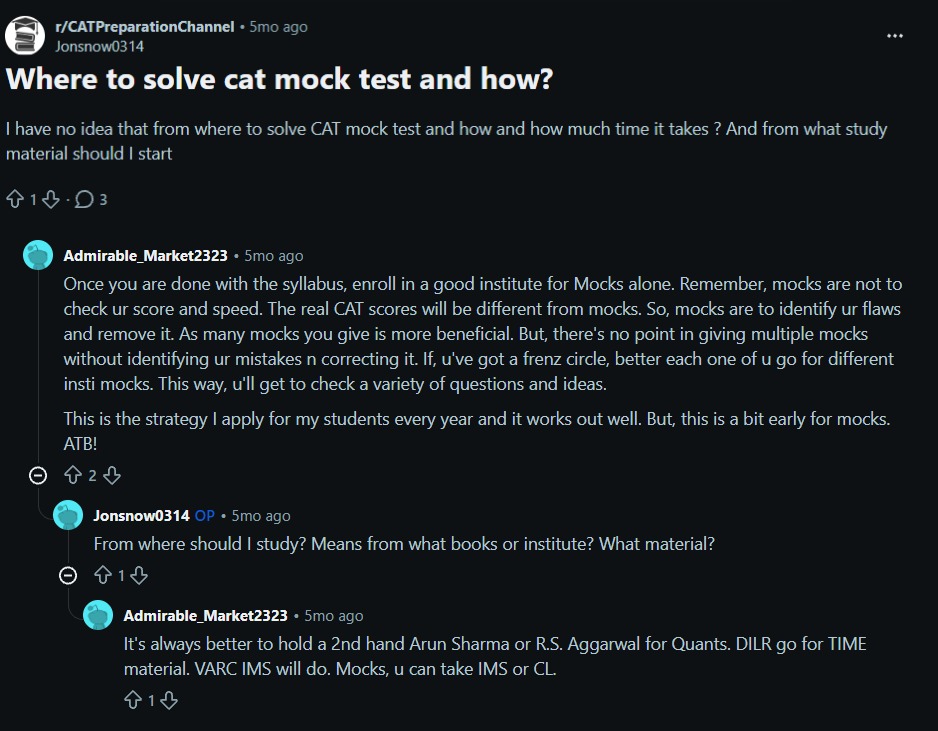
- According to a Reddit discussion, candidates recommended starting mock tests only after completing the CAT syllabus and using them to identify mistakes rather than measure scores. The discussion also suggested Arun Sharma/R.S. Aggarwal for Quant, TIME material for DILR, IMS for VARC, and IMS or Career Launcher mock test series.
CAT 2026 Preparation FAQs
Ques. When should I start preparing for CAT 2026?
Ans. Candidates should ideally begin preparing after the CAT 2026 notification, expected in late July 2026. With the exam scheduled on November 29, 2026, candidates get nearly four months for syllabus completion, mock tests, and revision. Starting earlier provides additional practice time.
Ques. Is 4 months enough to crack CAT 2026?
Ans. Yes. Four months is considered sufficient if candidates study 3–4 hours daily, complete the syllabus within two months, and attempt 20–30 full-length mock tests with detailed analysis. Many previous 99+ percentile scorers have followed a similar preparation timeline.
Ques. How many mock tests should I take before CAT 2026?
Ans. Experts recommend attempting 20–30 full-length mock tests before CAT 2026. Candidates should spend 2–3 hours analysing each mock, as mock analysis plays a crucial role in improving accuracy, speed, and overall percentile.
Ques. Which is the hardest section in CAT?
Ans. Based on CAT 2021–2025 trends, DILR has remained the most unpredictable section due to varying difficulty levels. However, the toughest section differs across candidates depending on their preparation and sectional strengths.
Ques. Can I crack CAT 2026 without coaching?
Ans. Yes. Every year, many candidates secure 95–99+ percentile through self-study. A preparation plan including standard books, previous-year papers, and 20–30 mock tests is considered sufficient for competitive performance.
Ques. What percentile is needed for IIM Ahmedabad, Bangalore, and Calcutta?
Ans. Based on previous admission trends, IIM Ahmedabad, IIM Bangalore, and IIM Calcutta generally shortlist General category candidates with around 99+ percentile. Final selection also considers sectional scores, academics, work experience, and interview performance.



Comments