




A 99 percentile in CAT 2026 is expected to require a raw score of around 85–100+ marks out of 204, based on recent trends.
- Candidates should to focus on attempting 35-40 questions in CAT 2026 with 90-100% accuracy to get 99 percentile.
- Candidates need to study daily for 6-8 hours which should be equally distributed among VARC, DILR and Quant.
- Candidates starting CAT 2026 preparation in July 2026 will have around five months before the expected examination.
- CAT 2026 is expected to be conducted by the IIMs for admission to 1200+ management institutes across India.
- Regular mock test analysis is expected to play an important role in improving performance for candidates targeting the 99 percentile.
Related Links:
- CAT Preparation 2026: 6 Month Strategy, Self-Preparation, Books, Mock Tests & Online Coachings
- CAT Topic Wise Weightage for QA, VARC and DILR, Check Previous Years’ Question
- CAT Cutoff 2026: Check Category-wise Cutoff for IIMs and Top MBA Colleges, Marks vs Percentile, Good Score

Key Summary
- CAT 2026 registration is expected to begin in August 2026 on the official website.
- The examination will have a total duration of 120 minutes with separate sectional time limits and no option to carry forward unused time.
- The examination is expected to include VARC, DILR and QA with 40 minutes allotted to each section.
- CAT 2026 is expected to be held on 29 November 2026 following the recent examination schedule.
CAT 2026 Exam Pattern
CAT 2026 is expected to follow the same examination pattern as CAT 2024 and CAT 2025.
- MCQ questions carry +3 marks for every correct answer and -1 mark for every incorrect answer.
- TITA (Type In The Answer) questions carry +3 marks for every correct answer and no negative marking for incorrect answers.
- A raw score of around 85–100+ marks out of 204 is expected to correspond to the 99 percentile, based on CAT 2023–2025 trends.
- The expected score required for the 99 percentile may vary depending on the difficulty level and normalisation across different examination slots.
| Section | Questions | Maximum Marks | Time Limit |
|---|---|---|---|
| Verbal Ability and Reading Comprehension (VARC) | 24 | 72 | 40 minutes |
| Data Interpretation and Logical Reasoning (DILR) | 22 | 66 | 40 minutes |
| Quantitative Aptitude (QA) | 22 | 66 | 40 minutes |
| Total | 68 | 204 | 120 minutes |
Also Read
CAT Exam Pattern 2026: Section-wise Pattern, Marking Scheme, Syllabus, Question PaperMonth-by-Month Preparation Plan: July to November 2026
July 2026: Foundation and Diagnostics
- July should be dedicated to assessing the current preparation level before beginning intensive study.
- Candidates should attempt one or two full-length mock tests to evaluate performance in VARC, DILR, and QA.
- Candidates should analyse mock test performance to identify strengths, weak areas, and common mistakes.
- Complete the QA syllabus mapping by covering Arithmetic, Algebra, Geometry, and Number System topics.
- Read editorials and analytical articles for 30–45 minutes every day to improve reading speed and comprehension.
- Solve 8–12 DILR sets from previous years' CAT papers to understand different question patterns.
- Begin QA preparation with Percentages, Ratio, Time, Speed and Distance, Profit and Loss, and Averages, as these topics carry higher weightage in recent CAT papers.
August 2026: Concept Building
- August should focus on strengthening concepts across all three sections of CAT 2026.
- CAT 2026 registration is expected to begin in the first week of August on the official website.
- Candidates should complete the registration process soon after the application window opens to get a preferred examination city and slot.
- Complete Algebra, Geometry, and Modern Mathematics during August.
- Candidates should spend around 2–2.5 hours every day on Quantitative Aptitude with timed practice.
- Practice 3–4 Reading Comprehension passages daily by identifying the main idea, author's tone, and inference-based questions.
- Solve 3–5 DILR sets every day from tables, caselets, bar graphs, line graphs, logical reasoning puzzles, and seating arrangement questions.
- Attempt two sectional mock tests every week along with one full-length mock test to improve speed and accuracy under exam conditions.
September 2026: Full Mocks Begin
- September should focus on converting concept-based preparation into exam-oriented practice.
- Candidates should attempt two full-length CAT mock tests every week during this phase.
- Spend 90–120 minutes analysing each mock test to review incorrect answers, skipped questions, and time management.
- Track section-wise percentile, accuracy, and attempts after every mock test to identify weak areas.
- In DILR, practise selecting the most scoring sets within the first 3–4 minutes of the section.
- In QA, prepare a personal list of shortcuts, approximation techniques, multiplication tricks, and percentage conversions to improve speed.
October 2026: Intensive Mock Practice
- October should focus on full-length exam practice and revision.
- Candidates should attempt three full-length CAT mock tests every week.
- Attempt every mock test under actual examination conditions to improve time management and consistency.
- Candidates should finalise their section-wise attempt strategy before the final month of preparation.
- A target of around 20–22 questions in VARC, 17–18 questions in QA, and 4 DILR sets is expected to be competitive for a high percentile.
- In DILR, solving four sets accurately is expected to give better results than attempting more sets with errors.
- Review the error log every week and revise weak topics through focused practice.
November 2026: Final Sprint
- November should focus on revision, consistency, and maintaining exam readiness.
- Candidates should reduce the number of full-length mock tests to one or two per week during the early weeks of November.
- Revise the formula sheet, shortcut notes, error log, and VARC strategy regularly.
- Solve 10–15 questions from each section every day to maintain speed and accuracy.
- Avoid starting any new topic during the final three days before the examination.
- Limit preparation to light revision during the last three days before CAT 2026.
- Visit the allotted examination centre, if possible, before the examination day.
- Keep the CAT 2026 admit card and valid photo ID proof ready before the examination day.

Also Read
CAT 2026 90 Percentile: IIM New-Gen Colleges and Score BreakdownQues. When should I start taking full-length CAT 2026 mock tests regularly?
Ans. Candidates should begin taking regular full-length CAT 2026 mock tests from September 2026 after building a strong conceptual foundation in July and August. Mock frequency can then be increased to three per week in October, followed by fewer mocks and more revision during November.
Ques. What should I focus on during the last week before CAT 2026?
Ans. During the final week before CAT 2026, candidates should avoid learning new topics and instead revise formula sheets, shortcut notes, error logs, and previous mock mistakes. It is also advisable to keep the CAT admit card and photo ID ready, visit the exam centre if possible, and focus on light practice to maintain confidence and accuracy.
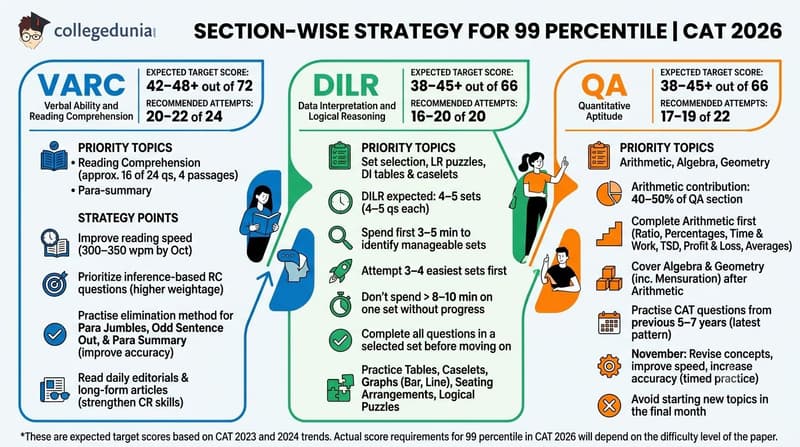
Section-wise Strategy for 99 Percentile
| Section | Expected Target Score | Recommended Attempts | Priority Topics |
|---|---|---|---|
| VARC |
42–48+ out of 72 |
20-22 of 24 | Reading Comprehension, Para-summary |
| DILR |
38–45+ out of 66 |
16-20 of 20 | Set selection, LR puzzles,
DI tables & caselets |
| QA |
38–45+ out of 66 |
17-19 of 22 | Arithmetic, Algebra, Geometry |
These are expected target scores based on CAT 2023 and 2024 trends. Actual score requirements for 99 percentile in CAT 2026 will depend on the difficulty level of the paper.
VARC: Verbal Ability and Reading Comprehension
Reading Comprehension is expected to contribute around 16 of the 24 questions in the VARC section through four passages.
- Candidates should improve their reading speed to around 300–350 words per minute before October.
- Inference-based questions should receive more attention as they are expected to carry higher weightage in Reading Comprehension.
- Practise the elimination method for Para Jumbles, Odd Sentence Out, and Para Summary questions to improve accuracy.
- Read editorials and long-form analytical articles every day to strengthen reading comprehension and critical reasoning skills.
DILR: Data Interpretation and Logical Reasoning
DILR is expected to include 4–5 sets, with 4–5 questions in each set.
- Candidates should spend the first 3–5 minutes identifying the most manageable DILR sets.
- Attempt the 3–4 easiest sets before moving to more difficult ones.
- Do not spend more than 8–10 minutes on a single set if no clear progress is being made.
- Complete all questions from a selected set before moving to the next one to maintain accuracy.
- Give more practice to Tables, Caselets, Bar Graphs, Line Graphs, Seating Arrangements, and Logical Puzzles, as these are frequently asked in CAT.
QA: Quantitative Aptitude
Arithmetic is expected to contribute around 40–50% of the CAT 2026 Quantitative Aptitude section in recent years.
- Ratio, Percentages, Time and Work, Time, Speed and Distance, Profit and Loss, and Averages should be completed before moving to other topics.
- Algebra and Geometry, including Mensuration, should be covered after completing Arithmetic.
- Candidates should practise CAT questions from the previous 5–7 years to understand the latest question pattern.
- November should be reserved for revising important concepts, improving calculation speed, and increasing accuracy through timed practice.
- Avoid starting new topics during the final month before CAT 2026.
Also Read
CAT 2026 85 Percentile: B-Schools Accepting You and Alternative MBA ExamsQues. What should be my section-wise target score to get 99 percentile in CAT 2026?
Ans. Based on recent CAT trends, candidates targeting 99 percentile should aim for approximately 42–48+ marks in VARC, 38–45+ marks in DILR, and 38–45+ marks in QA. These are expected target scores and may vary depending on the difficulty level and slot-wise normalisation in CAT 2026.
Ques. Should I start new topics in the last month before CAT 2026?
Ans. No. The final month before CAT 2026 should be dedicated to revision, mock test analysis, and improving speed and accuracy. Starting completely new topics in November is generally not recommended, as it may affect revision of high-weightage areas and reduce overall confidence before the exam.
Mock Test Strategy: The Real Differentiator
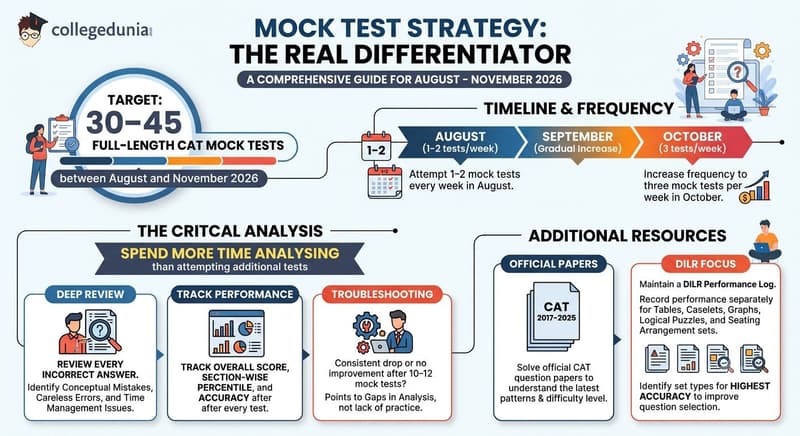
Candidates should target around 30–45 full-length CAT mock tests between August and November 2026.
- Attempt 1–2 mock tests every week during August and gradually increase the frequency to three mock tests per week in October.
- Spend more time analysing each mock test than attempting additional mock tests.
- Review every incorrect answer after each mock test to identify conceptual mistakes, careless errors, and time management issues.
- Track the overall score, section-wise percentile, and accuracy after every mock test.
- A consistent drop or no improvement in scores after 10–12 mock tests may indicate gaps in the analysis process rather than a lack of practice.
- Solve the official CAT question papers from 2017 to 2025 to understand the latest examination pattern and difficulty level.
- Maintain a DILR performance log to identify the set types that produce the highest accuracy during mock tests.
- Record performance separately for Tables, Caselets, Graphs, Logical Puzzles, and Seating Arrangement sets to improve question selection in the examination.
Also Read
CAT 2026 95 Percentile: IIM Shortlist Chances and Top MBA CollegesQues. How much time should I spend analysing a CAT 2026 mock test?
Ans. Candidates should spend at least as much time analysing a CAT 2026 mock test as they spend attempting it. Review every incorrect, guessed, and skipped question to identify conceptual gaps, careless mistakes, and time-management issues. Detailed mock analysis is one of the most effective ways to improve percentile.
Ques. Why are my CAT mock scores not improving despite taking many mock tests?
Ans. If your CAT mock scores remain unchanged after 10–12 mock tests, the issue is often with the analysis rather than the number of mocks attempted. Candidates should track section-wise accuracy, review recurring mistakes, analyse DILR set selection, and revisit weak concepts before taking the next mock instead of focusing only on increasing the mock count.
CAT 2026 Preparation: Reddit Discussion
- The discussion focused on the minimum score candidates should target to achieve a 99 percentile in CAT 2026, based on trends observed in previous CAT examinations.
- Another Reddit user suggested that a score of around 90 marks could be considered a safe target for 99 percentile, recommending candidates aim for 25+ marks in each section and 35+ marks in their strongest section to maximize their overall percentile.

CAT 2026 Preparation FAQs
Ques. Is 5 months enough to score 99 percentile in CAT 2026?
Ans. Yes, 5 months (July to November) is sufficient with a highly structured and consistent plan. Students with a strong quantitative, engineering, or commerce background often achieve 99 percentile with 4–5 months of focused preparation. The key factors are daily study of 4–6 hours, strong concept clarity and rigorous mock analysis starting from August/September onwards.
Ques. What raw score is needed for 99 percentile in CAT 2026?
Ans. Based on CAT 2023–2025 trends, a raw score of approximately 85-100+ out of 204 is expected to correspond to 99 percentile overall. The exact score varies significantly depending on the difficulty level of the paper and slot normalization. Sectional cutoffs must also be cleared.
Ques. How many mock tests should I attempt for CAT 2026?
Ans. Aim for 30–45 full-length mocks between August and November 2026. More importantly, spend at least as much time analysing each mock as you spend taking it. Quality of analysis is far more important than the sheer number of mocks.
Ques. Which section is hardest to improve for 99 percentile in CAT?
Ans. DILR is widely considered the most difficult section to improve quickly. It demands strong pattern recognition and adaptability across diverse, unpredictable set types. Start early with official CAT papers (2017 onwards), focus heavily on set-selection strategy, and maintain a performance log of different set types.
Ques. When does CAT 2026 registration open?
Ans. CAT 2026 registration is expected to open in the first week of August 2026 on the official website iimcat.ac.in. The exam is scheduled for late November 2026 (likely 29th November). Register as early as possible after the notification to secure your preferred exam slot and city.
Ques. What QA topics should I prioritise for CAT 2026?
Ans. Prioritise Arithmetic first which are Percentages, Ratios, Time-Speed-Distance, Time & Work, Profit & Loss, and Averages. These topics carry the highest weightage. After Arithmetic, focus on Algebra and Geometry. Number Systems and Modern Math (Permutation-Combination, Probability) appear less frequently but are high-value if solved accurately.



Comments