




The CAT 1990 Question Paper (CAT 1990) is available here as a free PDF download.
The CAT 1990 question paper includes the following:
- 174 questions (single sitting), in 5 question groups: Quantitative Ability (50); Data Interpretation (25); Verbal Ability (50); Reading Comprehension (38); Critical Reasoning (11)
- Choices: every question has four answer choices
CAT 1990 Question Paper PDF
| CD PDF | CD PDF with Solutions |
|---|---|
| Download Collegedunia PDF 0.87 MB | - |
Also Check:

CAT 1990 Questions with Solutions
Quantitative Ability (Q1 - Q50)
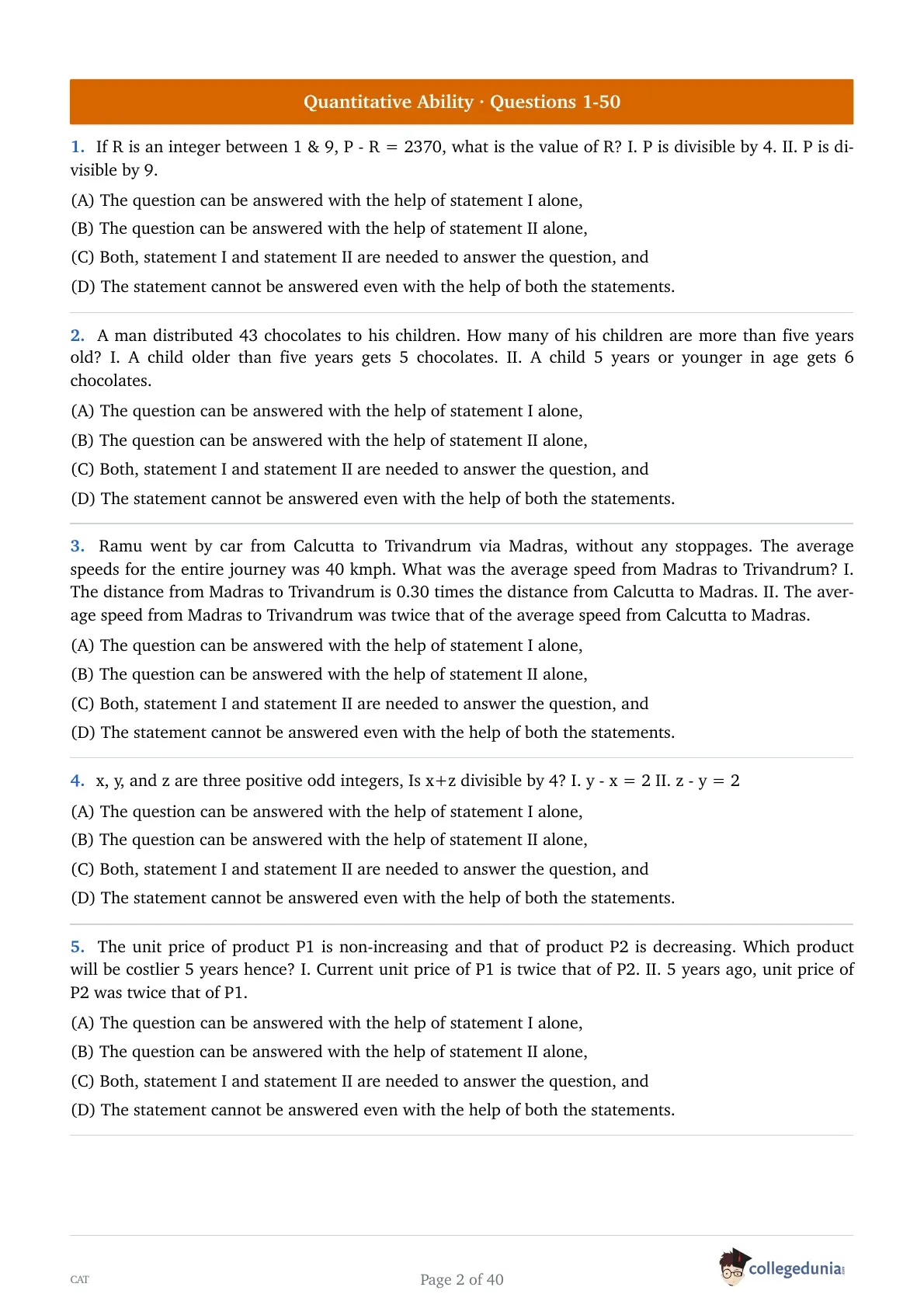
If R is an integer between 1 & 9, \( P - R = 2370 \), what is the value of R?
I. P is divisible by 4.
II. P is divisible by 9.
A man distributed 43 chocolates to his children. How many of his children are more than five years old?
I. A child older than five years gets 5 chocolates.
II. A child 5 years or younger in age gets 6 chocolates.
Ramu went by car from Calcutta to Trivandrum via Madras, without any stoppages. The average speed for the entire journey was 40 kmph. What was the average speed from Madras to Trivandrum?
I. The distance from Madras to Trivandrum is 0.30 times the distance from Calcutta to Madras.
II. The average speed from Madras to Trivandrum was twice that of the average speed from Calcutta to Madras.
\(x\), \(y\), and \(z\) are three positive odd integers. Is \(x + z\) divisible by 4?
I. \(y - x = 2\)
II. \(z - y = 2\)
The unit price of product P1 is non-increasing and that of product P2 is decreasing. Which product will be costlier 5 years hence?
I. Current unit price of P1 is twice that of P2.
II. 5 years ago, unit price of P2 was twice that of P1.
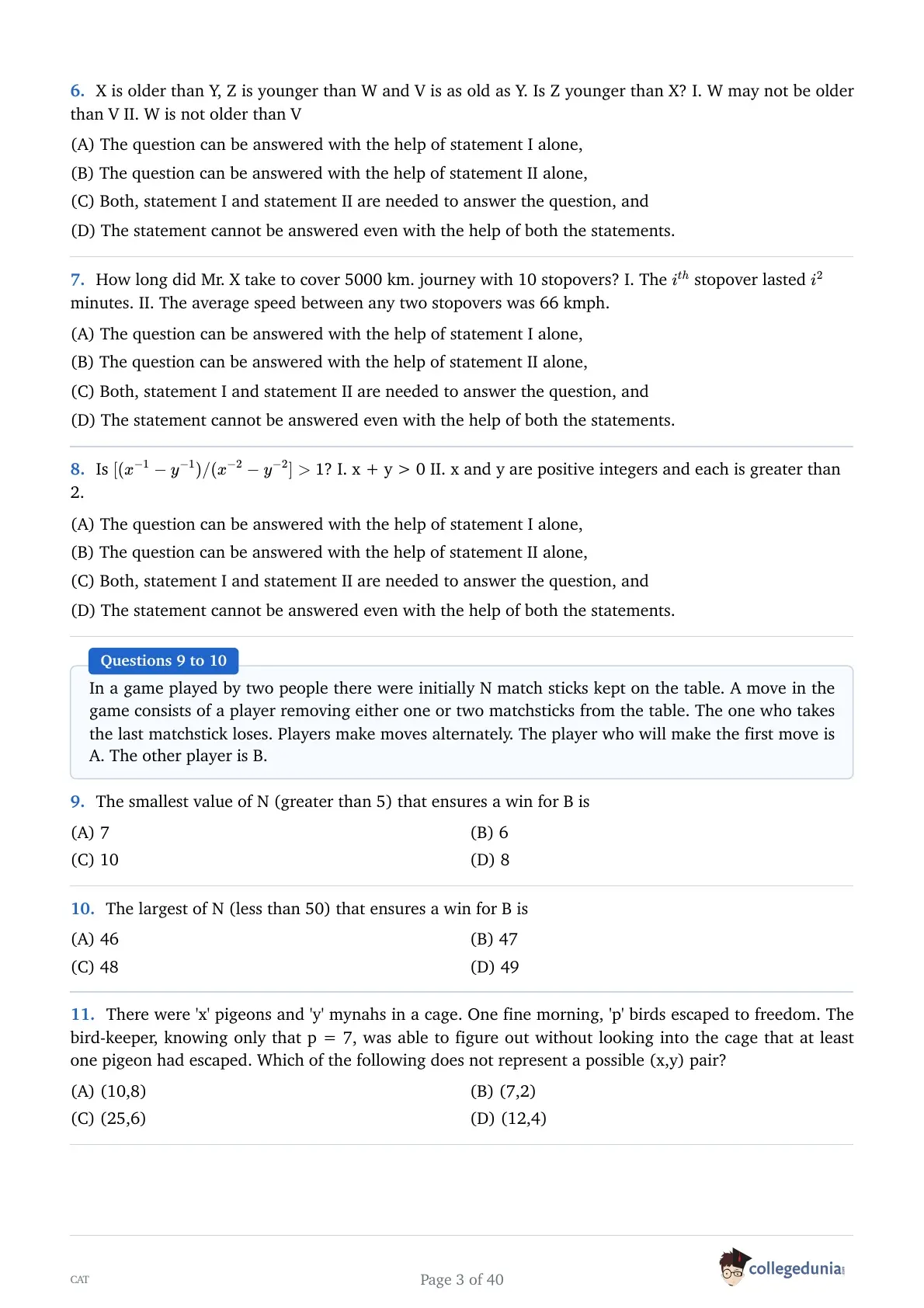
X is older than Y, Z is younger than W and V is as old as Y. Is Z younger than X?
I. W may not be older than V
II. W is not older than V
How long did Mr. X take to cover 5000 km journey with 10 stopovers?
I. The \(i^{th}\) stopover lasted \(i^2\) minutes.
II. The average speed between any two stopovers was 66 kmph.
\(\left[ \frac{x^{-1} - y^{-1}}{x^2 - y^2} \right]>1\)?
I. \(x + y>0\)
II. \(x\) and \(y\) are positive integers and each is greater than 2.
Comprehension:
In a game played by two people there were initially N match sticks kept on the table. A move in the game consists of a player removing either one or two matchsticks from the table. The one who takes the last matchstick loses. Players make moves alternately. The player who will make the first move is A. The other player is B.
The smallest value of N (greater than 5) that ensures a win for B is
The largest of N (less than 50) that ensures a win for B is
There were 'x' pigeons and 'y' mynahs in a cage. One fine morning, 'p' birds escaped to freedom. The bird-keeper, knowing only that p = 7, was able to figure out without looking into the cage that at least one pigeon had escaped. Which of the following does not represent a possible (x,y) pair?
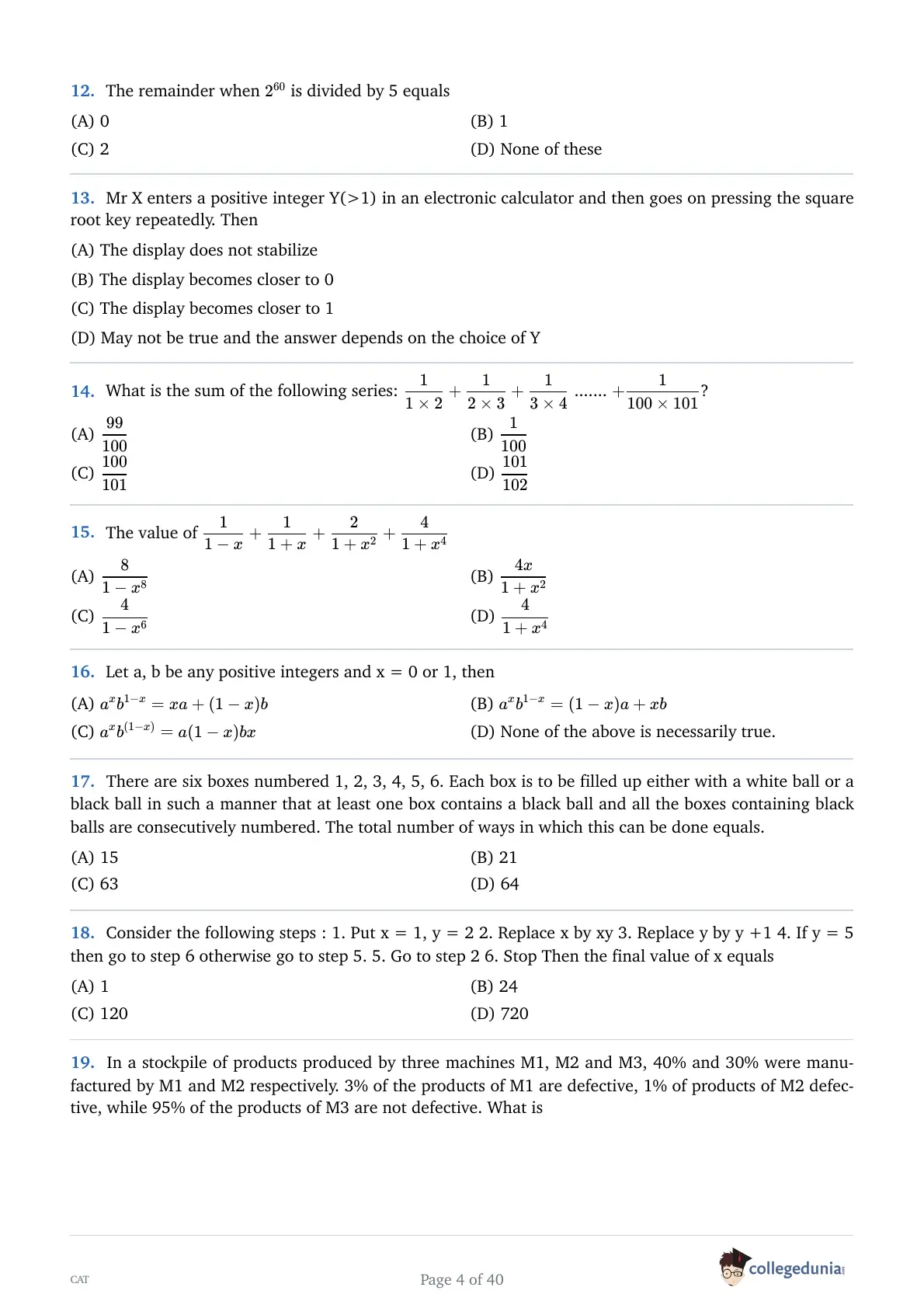
The remainder when \(26^{60}\) is divided by 5 equals:
Mr X enters a positive integer Y(>1) in an electronic calculator and then goes on pressing the square root key repeatedly. Then
What is the sum of the following series:
\(\frac{1}{1 \times 2} + \frac{1}{2 \times 3} + \frac{1}{3 \times 4} + + \frac{1}{100 \times 101}\)
The value of \( \dfrac{1}{1-x} + \dfrac{1}{1+x} + \dfrac{2}{1+x^2} + \dfrac{4}{1+x^4} \)
Let a, b be any positive integers and x = 0 or 1, then
There are six boxes numbered 1, 2, 3, 4, 5, 6. Each box is to be filled up either with a white ball or a black ball in such a manner that at least one box contains a black ball and all the boxes containing black balls are consecutively numbered. The total number of ways in which this can be done equals.
Consider the following steps:
1. Put \(x = 1\), \(y = 2\)
2. Replace \(x\) by \(xy\)
3. Replace \(y\) by \(y + 1\)
4. If \(y = 5\) then go to step 6 otherwise go to step 5
5. Go to step 2
6. Stop
Then the final value of \(x\) equals:
In a stockpile of products produced by three machines M1, M2 and M3, 40% and 30% were manufactured by M1 and M2 respectively. 3% of the products of M1 are defective, 1% of products of M2 defective, while 95% of the products of M3 are not defective. What is the percentage of defective in the stockpile?
From any two numbers \( x \) and \( y \), we define \( x * y = x + 0.5y - xy \). Suppose that both \( x \) and \( y \) are greater than 0.5. Then \( x * x < y * y \) if
Consider a function \( f(k) \) defined for positive integers \( k = 1, 2, .. \); the function satisfies the condition \( f(1) + f(2) + .. = \dfrac{p}{p-1} \). Where \( p \) is fraction i.e. \( 0 < p < 1 \). Then \( f(k) \) is given by
116 people participated in a singles tennis tournament of knockout format. The players are paired up in the first round, winners of the first round are paired in the second round, and so on till the final is played between two players. If after any round, the number of players is odd, one player is given a bye (he skips that round and plays the next round with the winners). Find the total number of matches played in the tournament.
If n is any positive integer, then \( n^3 - n \) is divisible
The value of \(\frac{(1 - d^3)}{(1 - d)}\) is:
Gopal went to a fruit market with certain amount of money. With this money he can buy either 50 oranges or 40 mangoes. He retains 10% of the money for taxi fare. If he buys 20 mangoes, then the number of oranges he can buy is
Comprehension:
A dealer deals only in colour TVs and VCRs. He wants to spend up to Rs.12 lakhs to buy 100 pieces. He can purchase a colour TV at Rs.10,000 and a VCR at Rs.15,000. He can sell a colour TV at Rs.12,000 and a VCR at Rs.17,500. His objective is to maximize profits. Assume that he can sell all the items that he stocks
For the maximum profit, the number of colour TVs and VCRs that he should respectively stock are
If the dealer would have managed to get an additional space to stock 20 more items, then for maximizing profit, the ratio of number of VCRs and number of TVs that he should stock is
The maximum profit, in rupees lakh, the dealer can earn from his original stock if he can sell a colour TV at Rs. 12200 and VCR at Rs.18300 is
Comprehension:
Ghosh Babu has a certain amount of property consisting of cash, gold coins and silver bars. The cost of a gold coin is Rs. 4000 and the cost of a silver bar is Rs. 1000. Ghosh Babu distributed his property among his daughters equally. He gave to his eldest daughter gold coins worth 20% of the total property and Rs. 25000 in cash. The second daughter was given silver bars worth 20% of the remaining property and Rs. 50000 cash. Among the third and fourth daughters, he distributed the remaining gold and silver bars equally both together accounting each for 20% of the property remaining after the previous distribution. He also gave the third and fourth daughters Rs. 25000 more than what the second daughter had received in cash.
The amount of property in gold and silver possessed by Ghosh Babu is
Total property of Ghosh Babu (in Rs.lakh) is
If the ratio of the gold to silver bars that Ghosh Babu had is 7:27, the number of silver bars he has is
Comprehension:
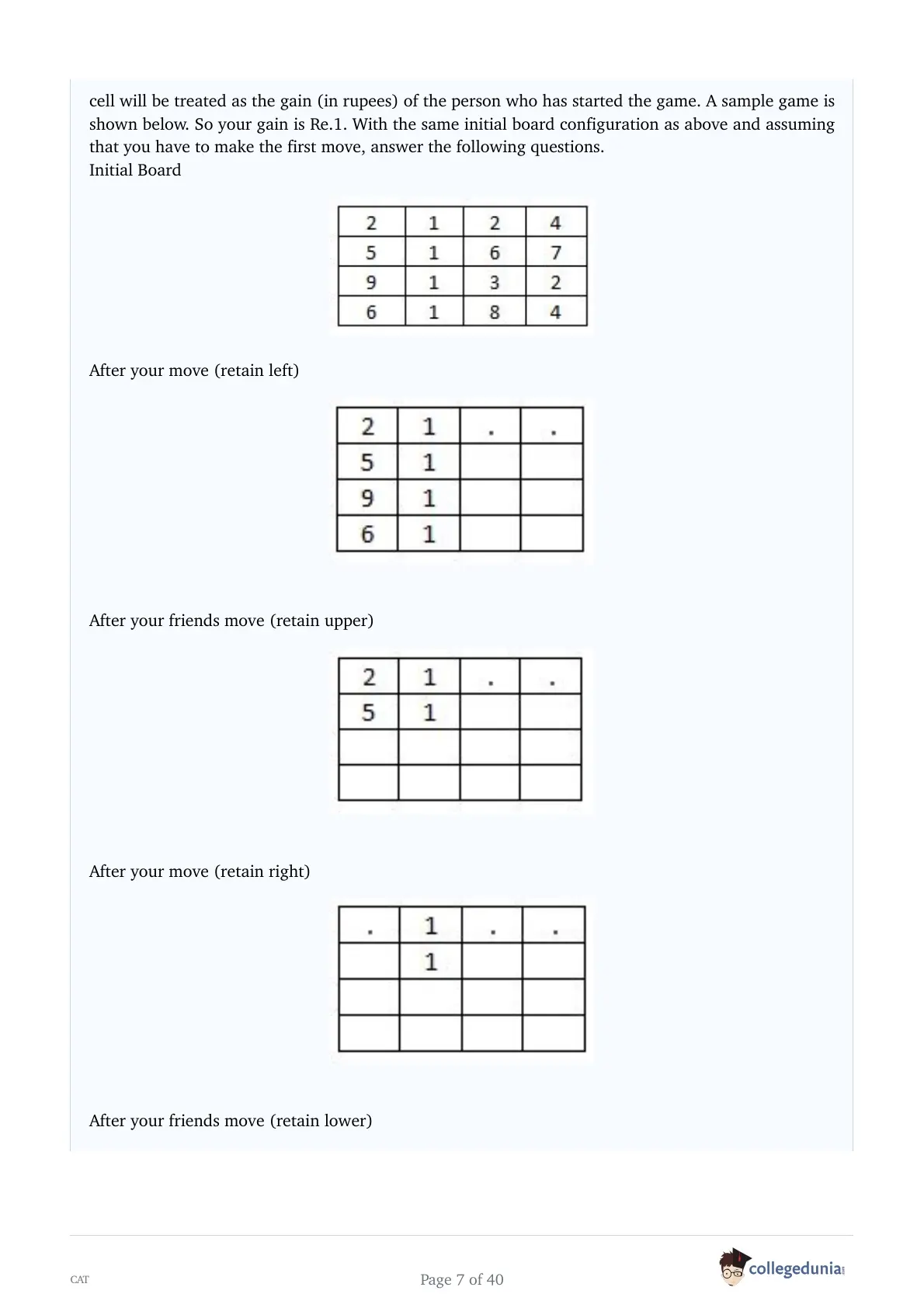
The following questions relate to a game to be played by you and your friend. The game consists of a 4 x 4 board (see below) where each cell contains a positive integer. You and your friend make moves alternately. A move by any of the players consists of splitting the current board configuration into two equal halves and retaining one of them. In your moves you are allowed to split the board only vertically and to decide to retain either the left or the right half. Your friend, in his/her moves, can split the board only horizontally and can retain either the lower or the upper half. After two moves by each player a single cell will remain which can no longer be split and the number in that cell will be treated as the gain (in rupees) of the person who has started the game. A sample game is shown below.
Initial Board
Read More
| 2 | 1 | 2 | 4 |
| 5 | 1 | 6 | 7 |
| 9 | 1 | 3 | 2 |
| 6 | 1 | 8 | 4 |
After your move (retain left)
| 2 | 1 |
| 5 | 1 |
| 9 | 1 |
| 6 | 1 |
After your friend's move (retain upper)
| 2 | 1 |
| 5 | 1 |
After your move (retain right)
| 1 |
| 1 |
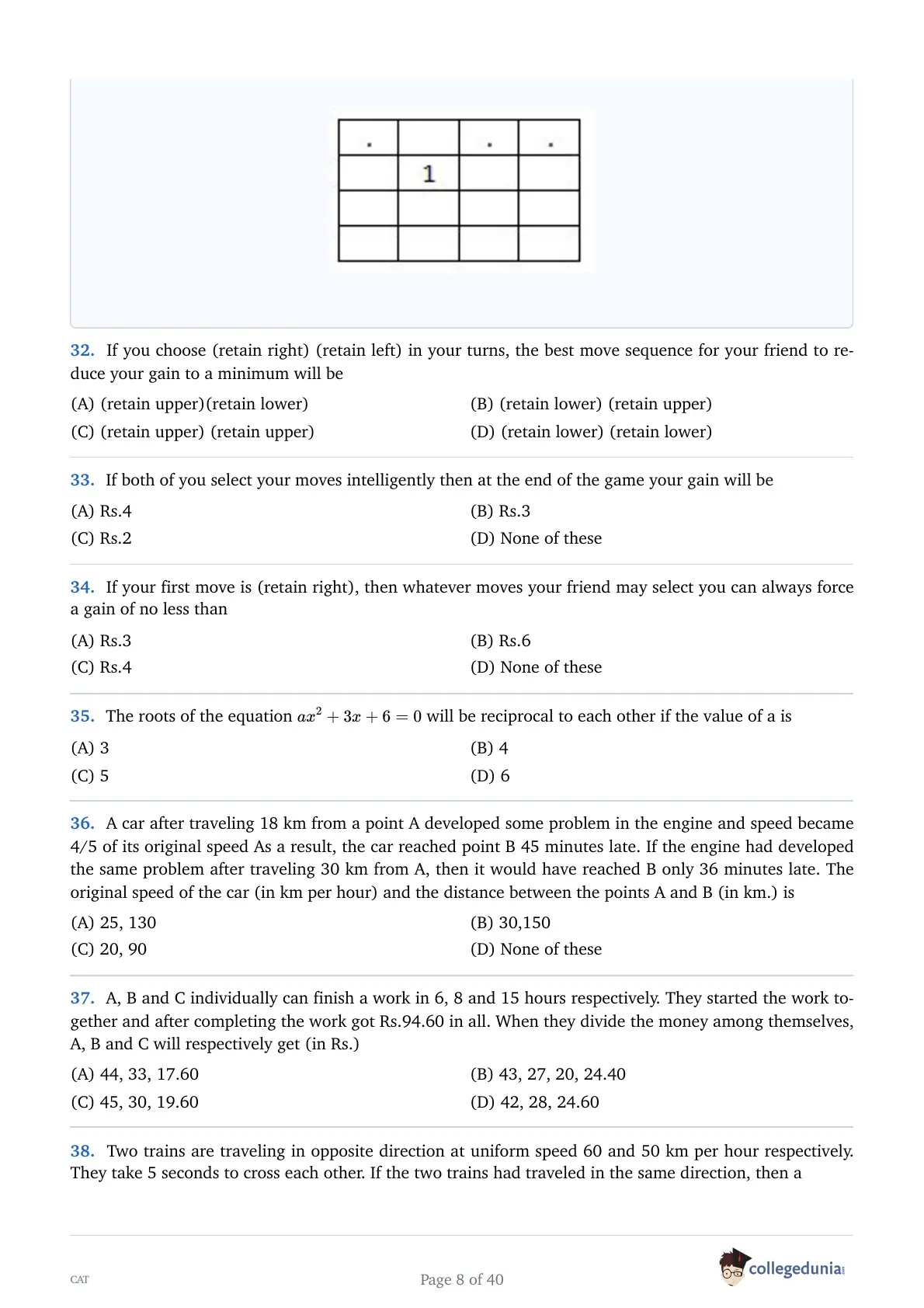
After your friend's move (retain lower)
| 1 |
So your gain is Re.1. With the same initial board configuration as above and assuming that you have to make the first move, answer the following questions.
In the board game described, the initial board (rows from top to bottom) is: 2 1 2 4 / 5 1 6 7 / 9 1 3 2 / 6 1 8 4, and you make the first move. If you choose (retain right) (retain left) in your turns, the best move sequence for your friend to reduce your gain to a minimum will be
If both of you select your moves intelligently, then at the end of the game your gain will be:
If your first move is (retain right), then whatever moves your friend may select, you can always force a gain of no less than:
The roots of the equation \(ax^{2}+3x+6=0\) will be reciprocal to each other if the value of \(a\) is
A car after traveling 18 km from a point A developed some problem in the engine and speed became 4/5 of its original speed. As a result, the car reached point B 45 minutes late. If the engine had developed the same problem after traveling 30 km from A, then it would have reached B only 36 minutes late. The original speed of the car (in km per hour) and the distance between the points A and B (in km.) is
A, B and C individually can finish a work in 6, 8 and 15 hours respectively. They started the work together and after completing the work got Rs. 94.60 in all. When they divide the money among themselves, A, B and C will respectively get (in Rs.):
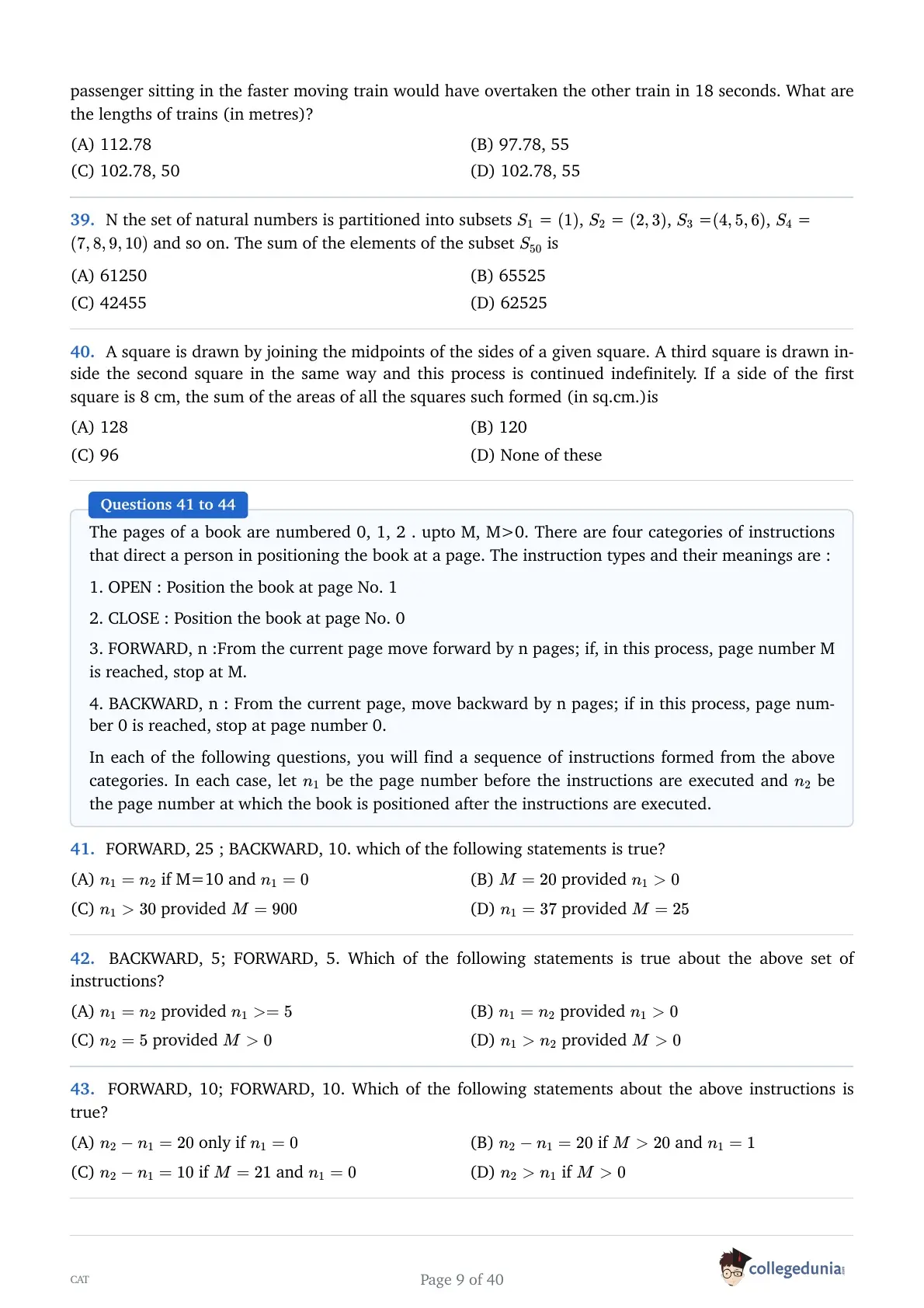
Two trains are traveling in opposite direction at uniform speed 60 and 50 km per hour respectively. They take 5 seconds to cross each other. If the two trains had traveled in the same direction, then a passenger sitting in the faster moving train would have overtaken the other train in 18 seconds. What are the lengths of trains (in metres)?
N the set of natural numbers is partitioned into subsets \(S_1=(1)\), \(S_2=(2,3)\), \(S_3=(4,5,6)\), \(S_4=(7,8,9,10)\) and so on. The sum of the elements of the subset \(S_{50}\) is
A square is drawn by joining the midpoints of the sides of a given square. A third square is drawn inside the second square in the same way and this process is continued indefinitely. If a side of the first square is 8 cm, the sum of the areas of all the squares thus formed (in sq.cm) is:
Comprehension:
The pages of a book are numbered 0, 1, 2 … upto M, M > 0. There
are four categories of instructions that direct a person in positioning the book at a page. The instruction types
and their meanings are :
1. OPEN : Position the book at page No. 1
Read More
2. CLOSE : Position the book at page No. 03. FORWARD, n :From the current page move forward by n pages; if, in this process, page number M is reached, stop at M.
4. BACKWARD, n : From the current page, move backward by n pages; if in this process, page number 0 is reached, stop at page number 0.
In each of the following questions, you will find a sequence of instructions formed from the above categories.
In each case, let n1 be the page number before the instructions are executed and n2 be the page number at which the book is positioned after the instructions are executed
FORWARD, 25 ; BACKWARD, 10. which of the following statements is true?
BACKWARD, 5 ; FORWARD, 5 — Which of the following statements is true?
FORWARD, 10; FORWARD, 10. Which of the following statements about the above instructions is true?
FORWARD, 5; BACKWARD, 4. Which of the following statements about the above instructions is true?
Comprehension:
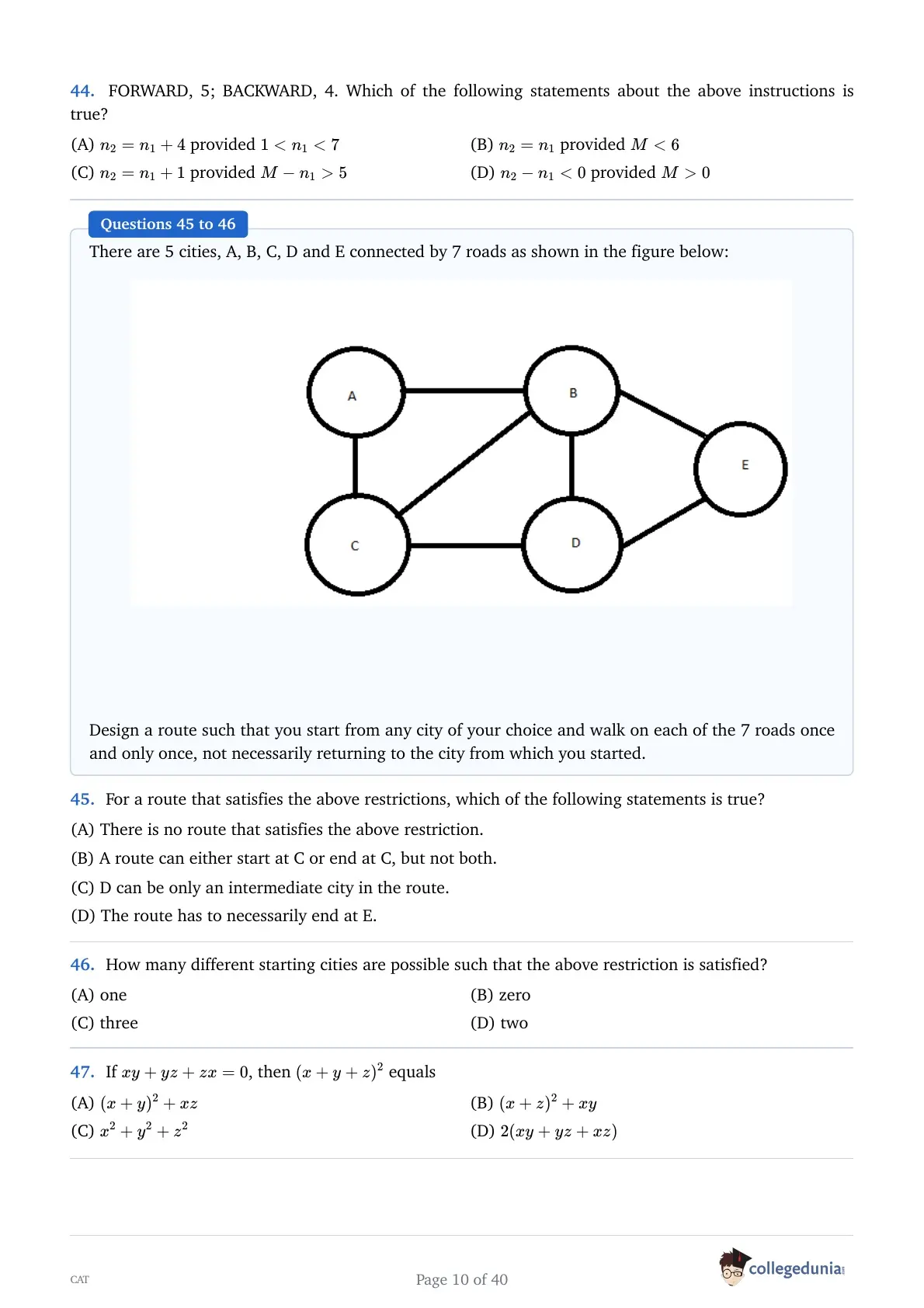
There are 5 cities, A, B, C, D and E connected by 7 roads as shown in the figure below:
[Figure: the five cities are drawn as circles - A (top left), B (top middle), E (right), C (bottom left) and D (bottom middle). The 7 roads, each a straight line joining two cities, are listed below.]
Read More
| Road | From city | To city |
|---|---|---|
| 1 | A | B |
| 2 | A | C |
| 3 | B | C |
| 4 | B | D |
| 5 | B | E |
| 6 | C | D |
| 7 | D | E |
Design a route such that you start from any city of your choice and walk on each of the 7 roads once and only once, not necessarily returning to the city from which you started.
For a route that satisfies the above restrictions, which of the following statements is true?
How many different starting cities are possible such that the above restriction is satisfied?
If \( xy + yz + zx = 0 \), then \( (x + y + z)^2 \) equals
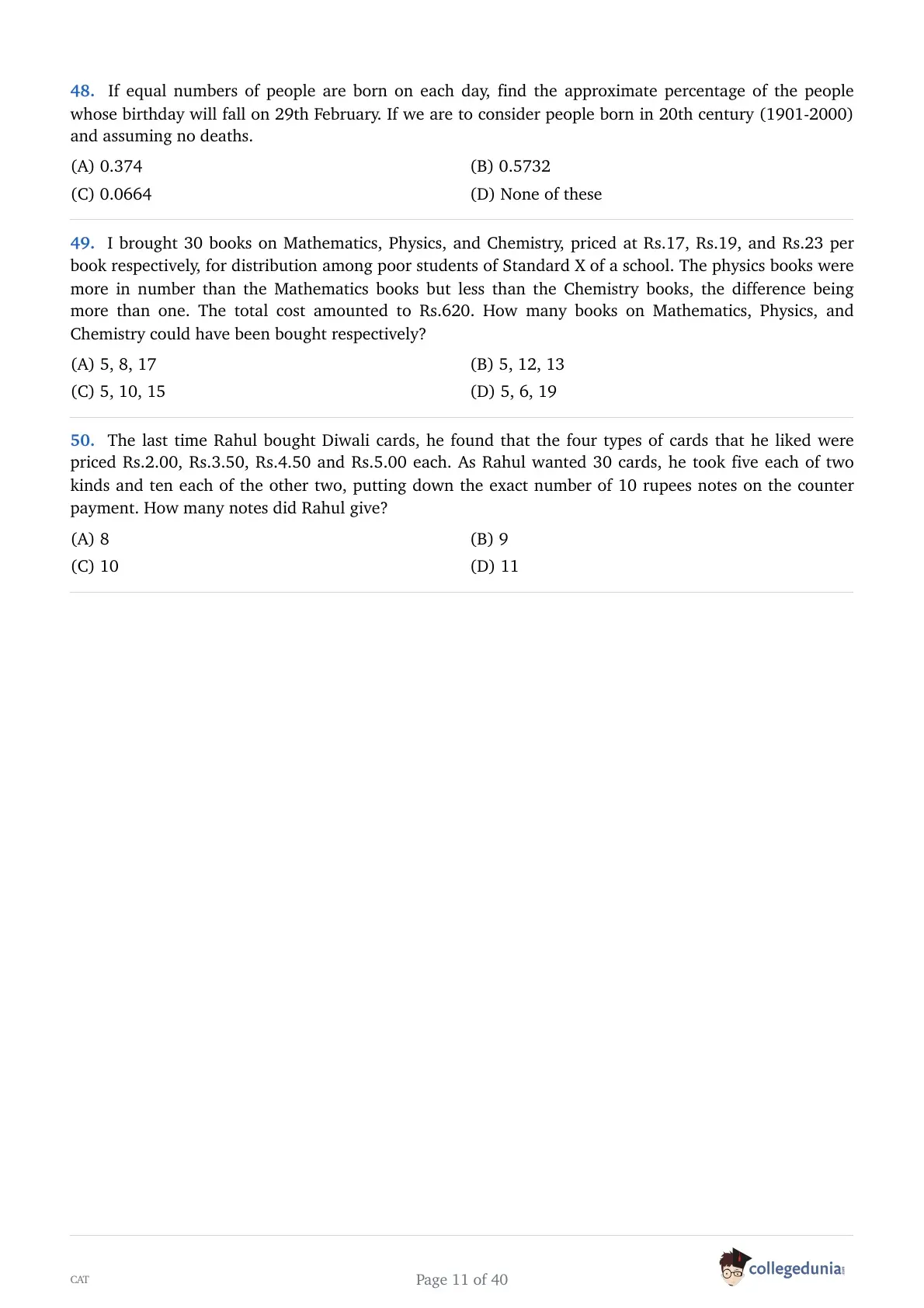
If equal numbers of people are born on each day, find the approximate percentage of the people whose birthday will fall on 29th February. If we are to consider people born in the 20th century (1901-2000) and assuming no deaths.
I brought 30 books on Mathematics, Physics, and Chemistry, priced at Rs.17, Rs.19, and Rs.23 per book respectively, for distribution among poor students of Standard X of a school. The physics books were more in number than the Mathematics books but less than the Chemistry books, the difference being more than one. The total cost amounted to Rs.620. How many books on Mathematics, Physics, and Chemistry could have been bought respectively?
The last time Rahul bought Diwali cards, he found that the four types of cards that he liked were priced Rs.2.00, Rs.3.50, Rs.4.50 and Rs.5.00 each. As Rahul wanted 30 cards, he took five each of two kinds and ten each of the other two, putting down the exact number of 10 rupees notes on the counter payment. How many notes did Rahul give?
Data Interpretation (Q51 - Q75)
Comprehension:
In these questions, you are provided data in the form of charts and/or tables. Study the data carefully and answer the questions following them.
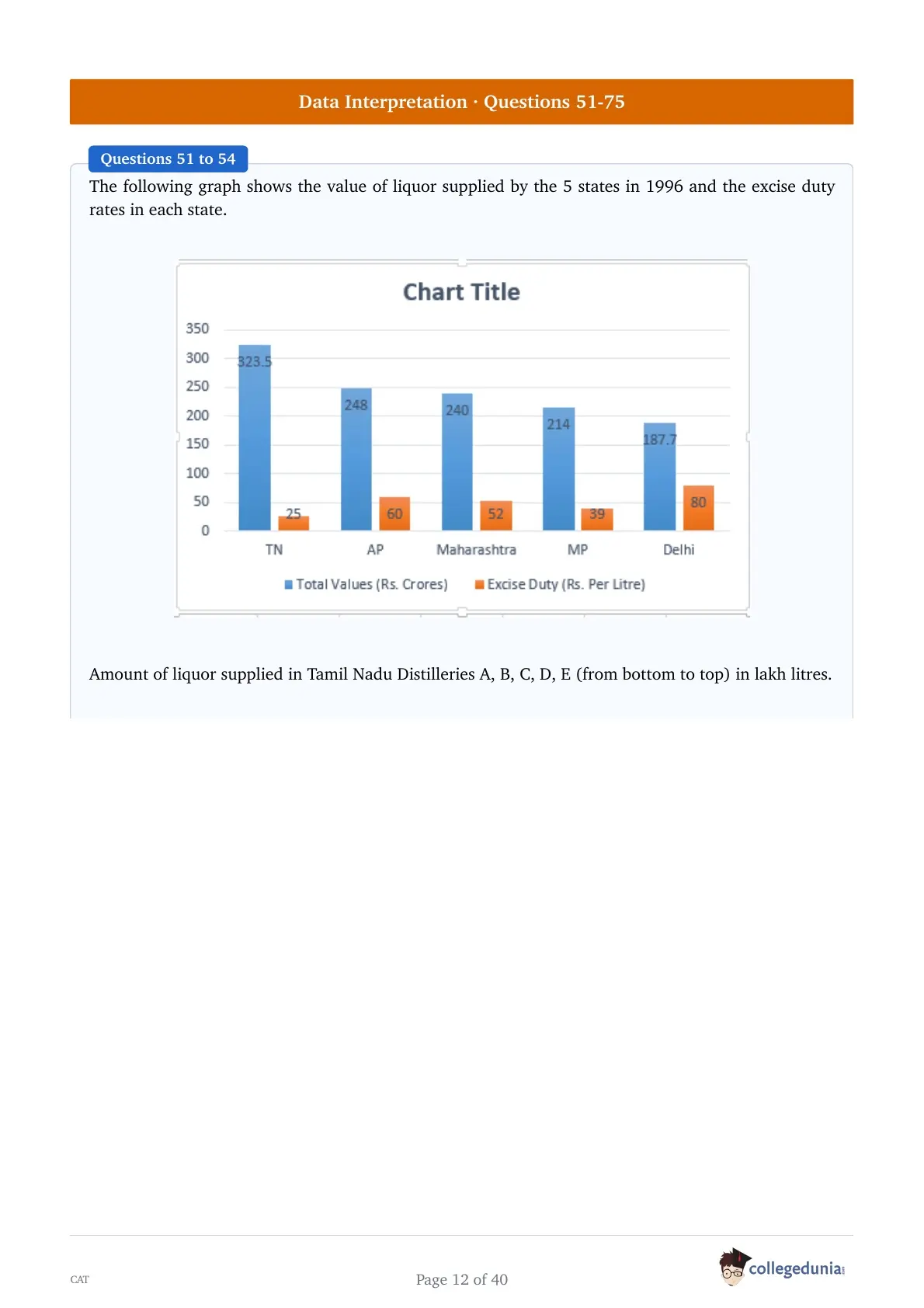
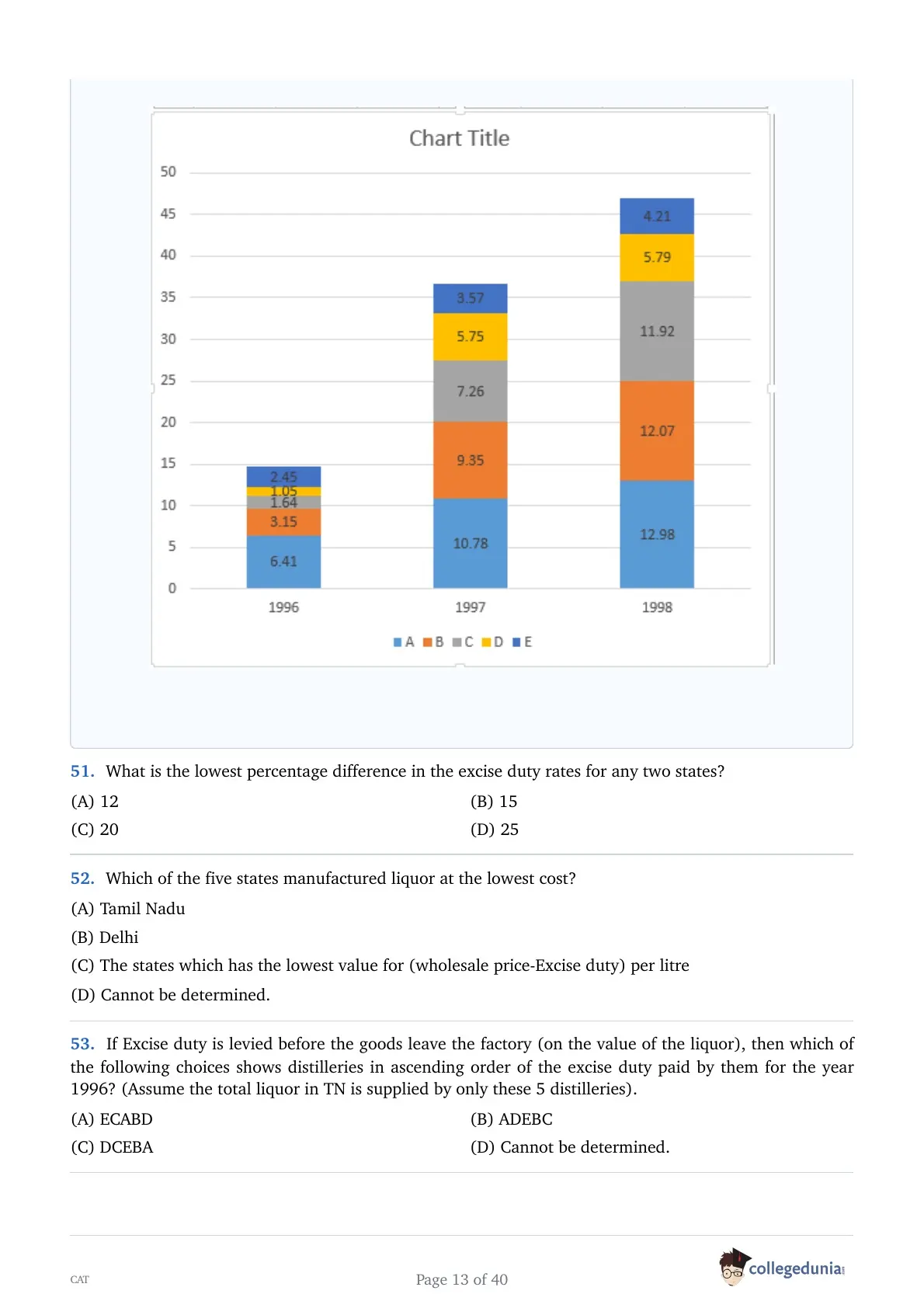
101-104: The following graph shows the value of liquor supplied by the 5 states in 1996 and the excise duty rates in each state.
Read More

What is the lowest percentage difference in the excise duty rates for any two states?
Which of the five states manufactured liquor at the lowest cost?
If Excise duty is levied before the goods leave the factory (on the value of the liquor), then which of the following choices shows distilleries in ascending order of the excise duty paid by them for the year 1996? (Assume the total liquor in TN is supplied by only these 5 distilleries).
If the Tamil Nadu distillery, with the least average simple annual growth in amount of liquor supplied in the given period, had shown the same rate of growth as the one which grew fastest, what would that company's supply have been in 1998, in lakh litres?
Saira, Mumtaz and Zeenat have a ball, a pen and a pencil, and each girl has just one object in hand. Among the following statements, only one is true and the other two are false.
I. Saira has a ball.
II. Mumtaz does not have the ball.
III. Zeenat does not have the pen.
Who has the ball?
Albert, David, Jerome and Tommy were plucking mangoes in a grove to earn some pocket money during the summer holidays. Their earnings were directly related to the number of mangoes plucked and had the following relationship: Jerome got less money than Tommy. Jerome and Tommy together got the same amount as Albert and David taken together. Albert and Tommy together got less than David and Jerome taken together. Who earned the most pocket money? Who plucked the least number of mangoes?
I happened to be the judge in the all India Essay Competition on Nylon Dying, organized some time back by a dyestuff firm. Mill technicians were eligible to enter the competition. My work was simplified in assessing the essays, which had to be done under five heads - Language, Coherence, Subject Matter, Machinery and Recent Developments. Integral marks were to be given out of a maximum of 20 under each head. There were only five entries. The winner got 90 marks. Only a single person can be made the winner. Akhila got 13 in Coherence and Divya 10 in Machinery. Bhanu's total was less than Akhila's. Charulata has sent an entry. Ela had got as many marks as Divya. None got 20 under any head. Who was the winner?
Comprehension:
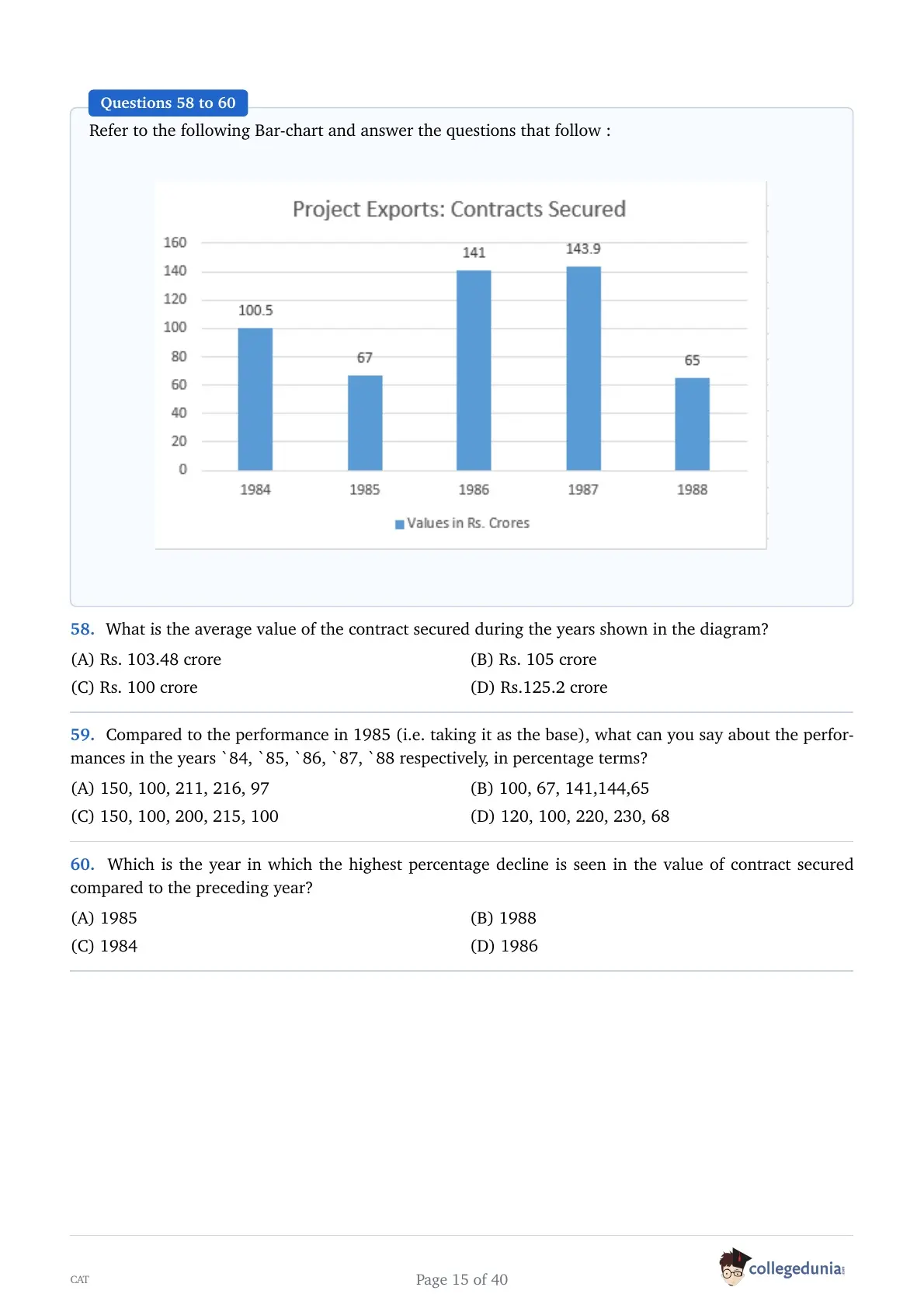
Refer to the following Bar-chart and answer the questions that follow
What is the average value of the contract secured during the years shown in the diagram?
Compared to the performance in 1985 (i.e. taking it as the base), what can you say about the performances in the years ’84, ’85, ’86, ’87, ’88 respectively, in percentage terms?
Which is the year in which the highest percentage decline is seen in the value of contract secured compared to the preceding year?
Comprehension:
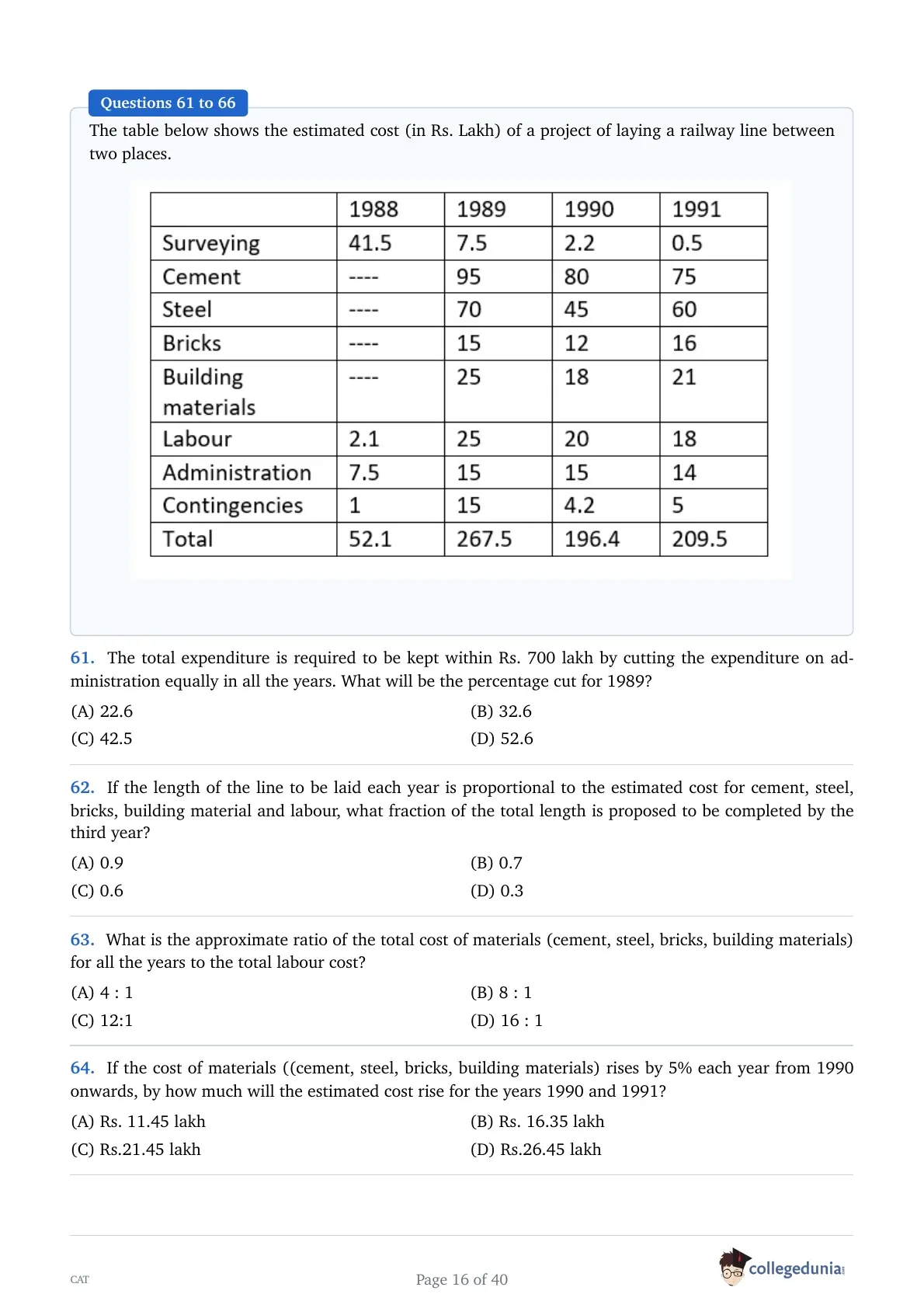
The table below shows the estimated cost (in Rs. Lakh) of a project of laying a railway line between two places.
The total expenditure is required to be kept within Rs. 700 lakh by cutting the expenditure on administration equally in all the years. What will be the percentage cut for 1989?
If the length of the line to be laid each year is proportional to the estimated cost for cement, steel, bricks, building material and labour, what fraction of the total length is proposed to be completed by the third year?
What is the approximate ratio of the total cost of materials (cement, steel, bricks, building materials) for all the years to the total labour cost?
If the cost of materials (cement, steel, bricks, building materials) rises by 5% each year from 1990 onwards, by how much will the estimated cost rise for the years 1990 and 1991?
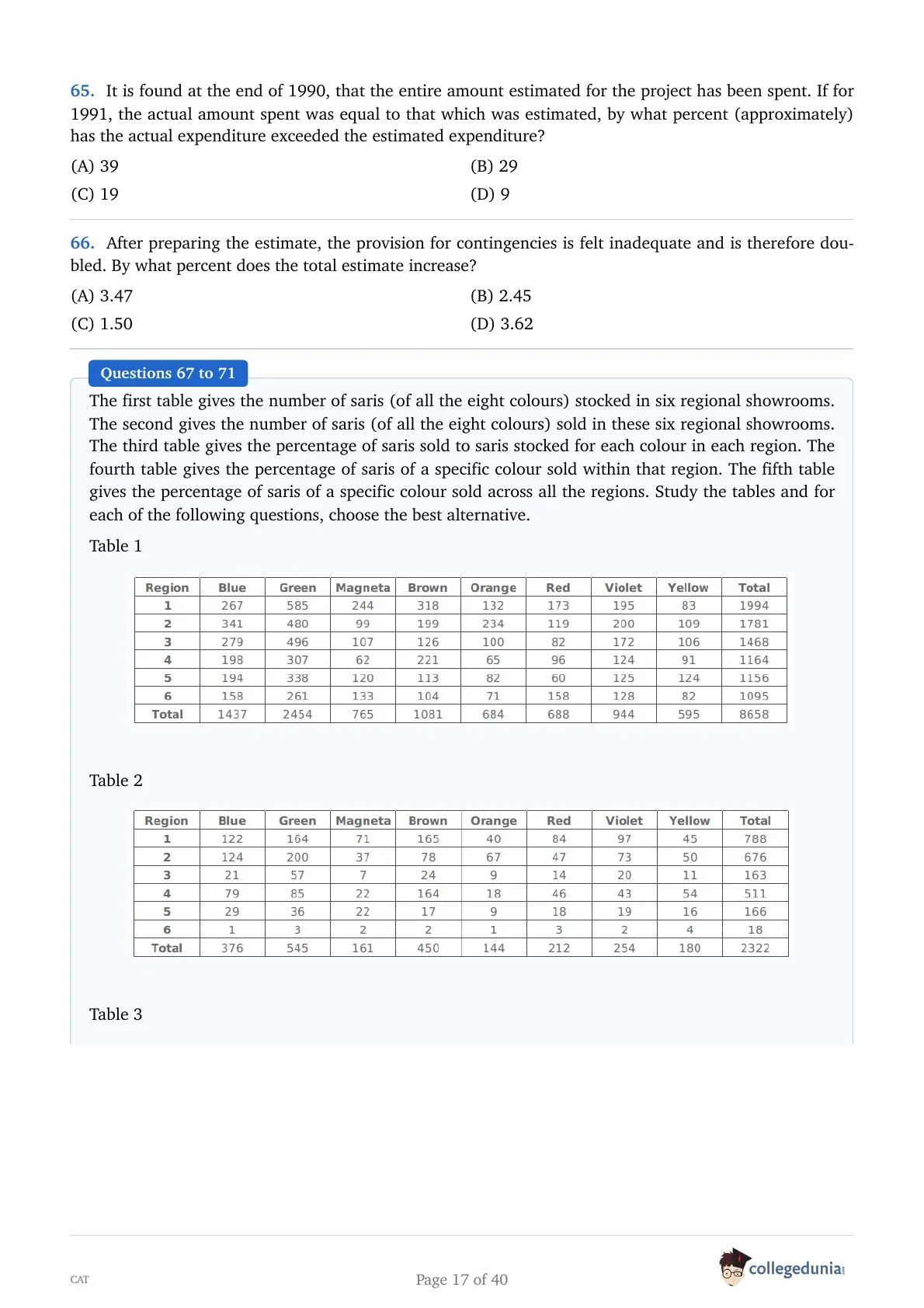
It is found at the end of 1990, that the entire amount estimated for the project has been spent. If for 1991, the actual amount spent was equal to that which was estimated, by what percent (approximately) has the actual expenditure exceeded the estimated expenditure?
After preparing the estimate, the provision for contingencies is felt inadequate and is therefore doubled. By what percent does the total estimate increase?
Comprehension:
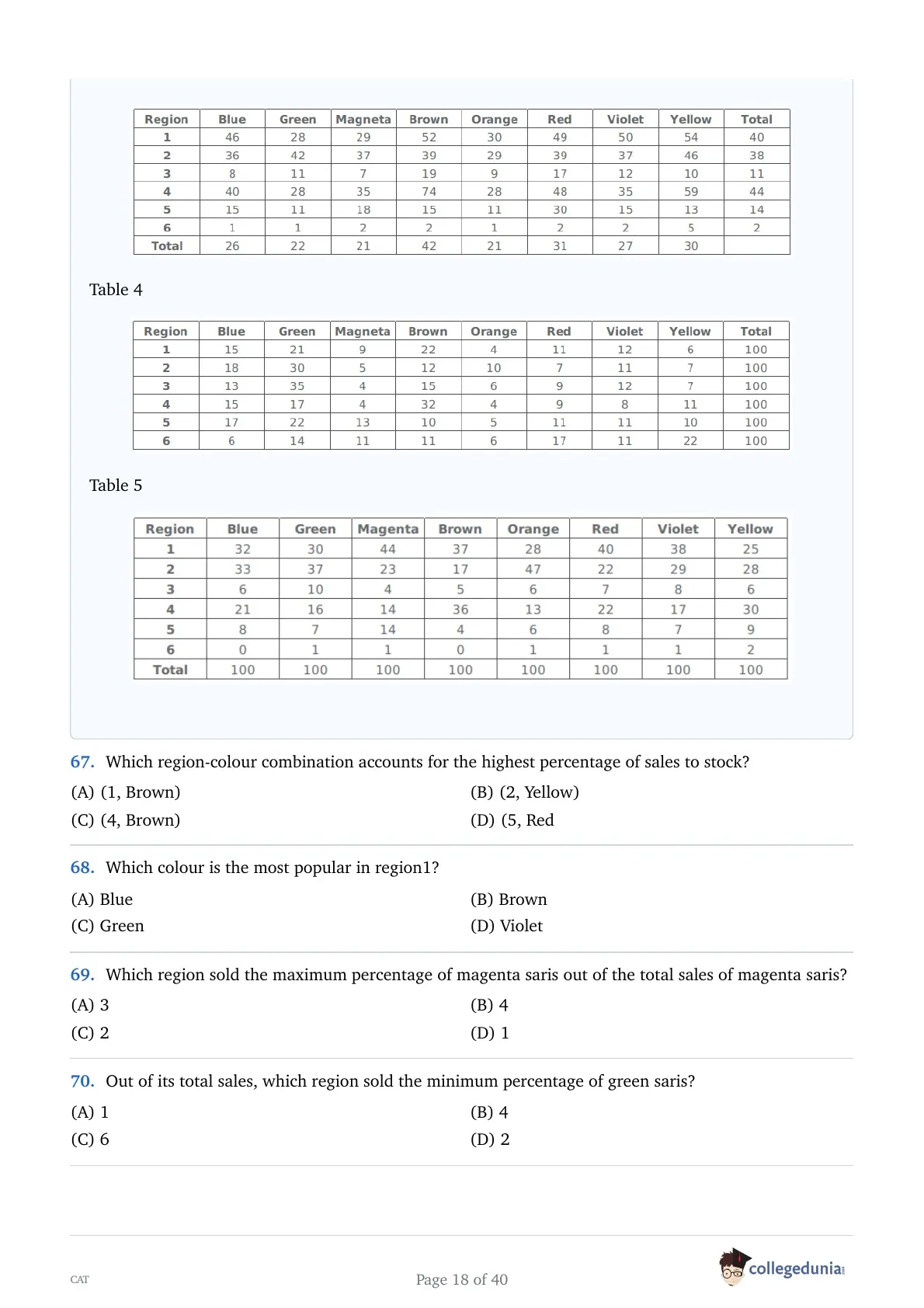
The first table gives the number of saris (of all the eight colours) stocked in six regional showrooms. The second gives the number of saris (of all the eight colours) sold in these six regional showrooms. The third table gives the percentage of saris sold to saris stocked for each colour in each region. The fourth table gives the percentage of saris of a specific colour sold within that region. The fifth table gives the percentage of saris of a specific colour sold across all the regions. Study the tables and for each of the following questions, choose the best alternative.

Which region-colour combination accounts for the highest percentage of sales to stock?
Which colour is the most popular in region 1?
Which region sold the maximum percentage of magenta saris out of the total sales of magenta saris?
Out of its total sales, which region sold the minimum percentage of green saris?
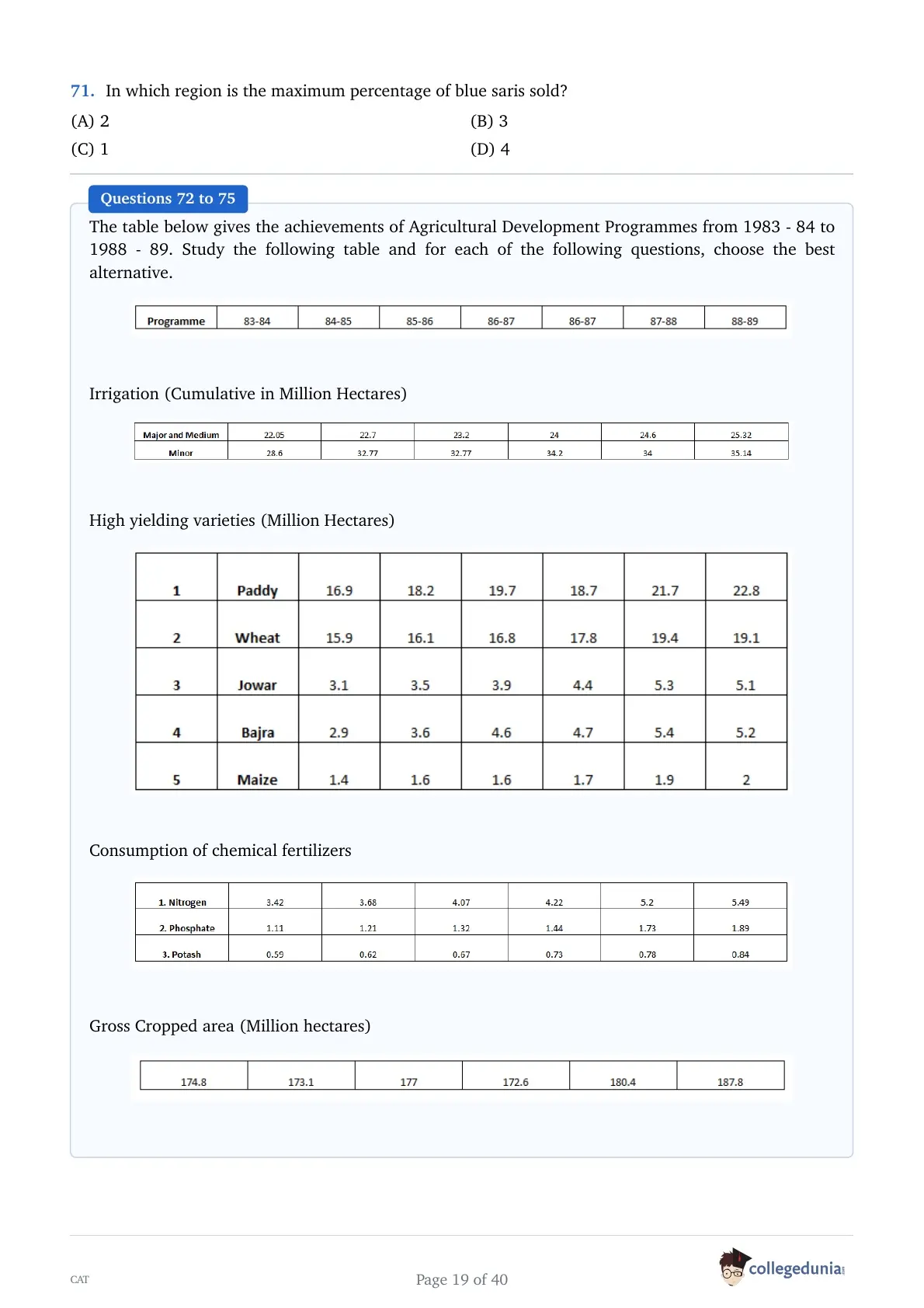
In which region is the maximum percentage of blue saris sold?
Comprehension:
The table below gives the achievements of Agricultural Development Programmes from 1983 - 84 to 1988 - 89. Study the following table and for each of the following questions, choose the best alternative.
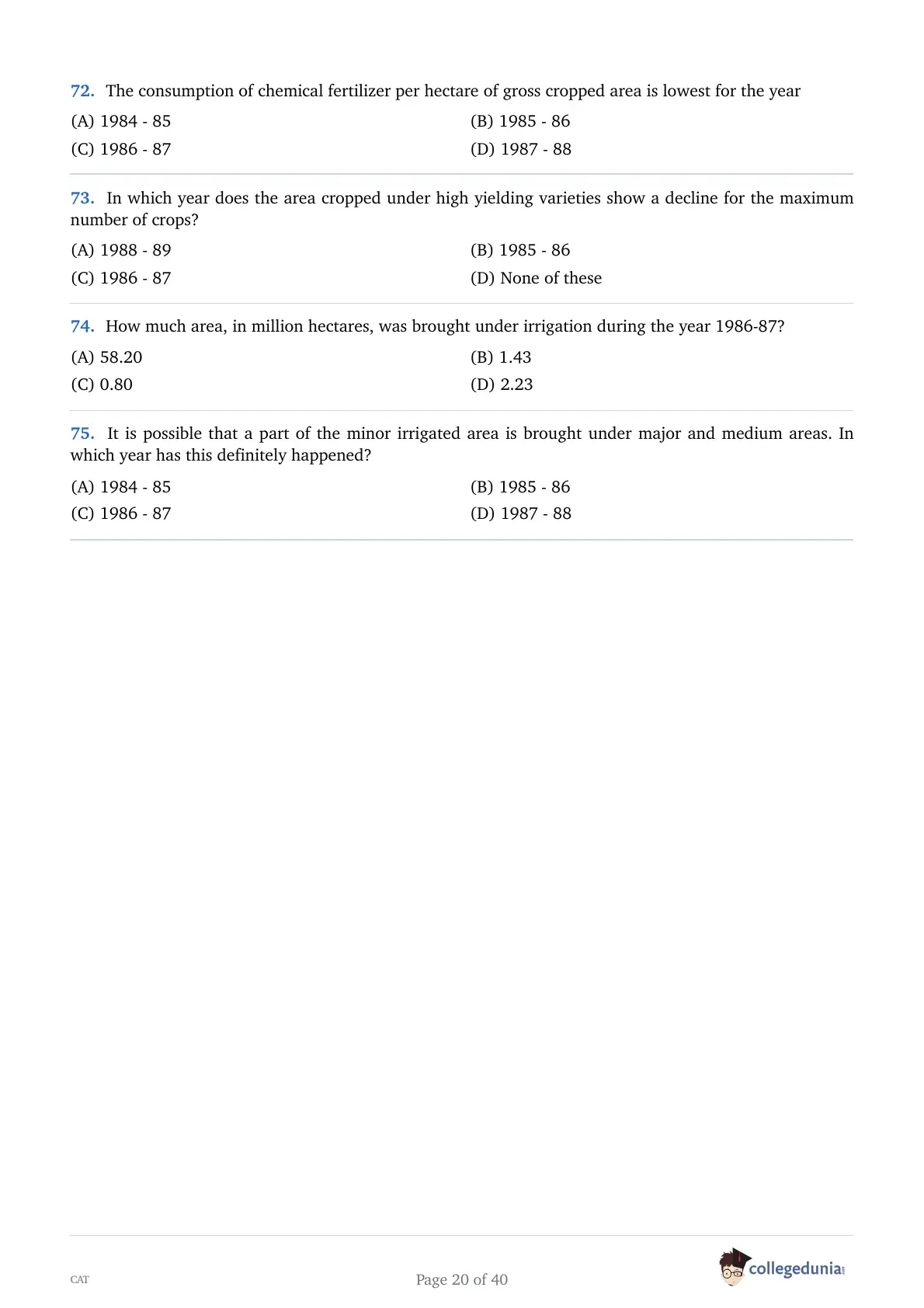
The consumption of chemical fertilizer per hectare of gross cropped area is lowest for the year
In which year does the area cropped under high yielding varieties show a decline for the maximum number of crops?
How much area, in million hectares, was brought under irrigation during the year 1986 - 87?
It is possible that a part of the minor irrigated area is brought under major and medium areas. In which year has this definitely happened?
Verbal Ability (Q76 - Q125)
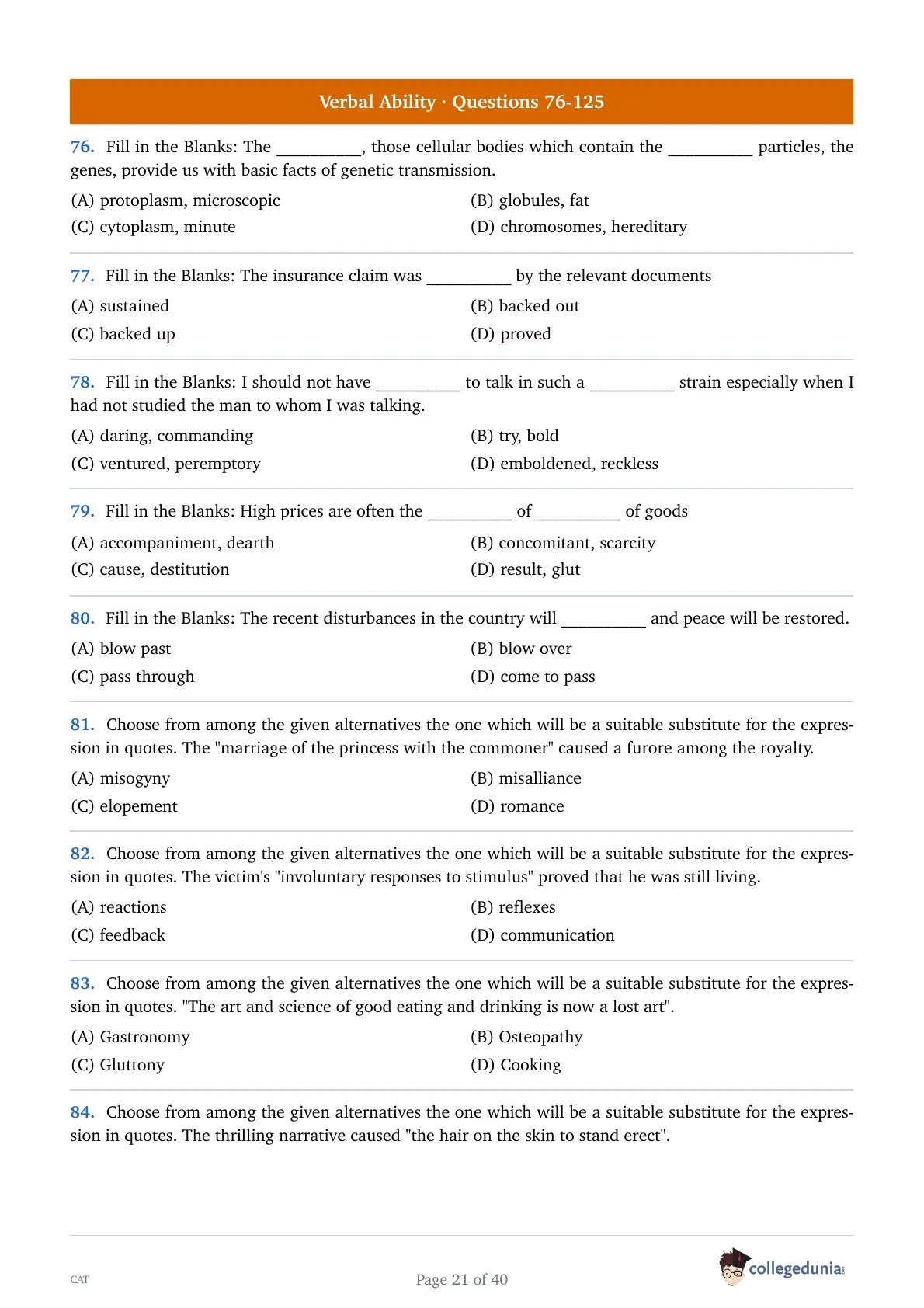
The .............., those cellular bodies which contain the .............. particles, the genes, provide us with basic facts of genetic transmission.
The insurance claim was .............. by the relevant documents.
I should not have .............. to talk in such a .............. strain especially when I had not studied the man to whom I was talking.
Fill in the Blanks: High prices are often the __________ of __________ of goods
The recent disturbances in the country will .............. and peace will be restored.
Choose from among the given alternatives the one which will be a suitable substitute for the expression in quotes. The "marriage of the princess with the commoner" caused a furore among the royalty.
Choose from among the given alternatives the one which will be a suitable substitute for the expression in quotes. The victim's "involuntary responses to stimulus" proved that he was still living.
Choose from among the given alternatives the one which will be a suitable substitute for the expression in quotes. "The art and science of good eating and drinking is now a lost art".
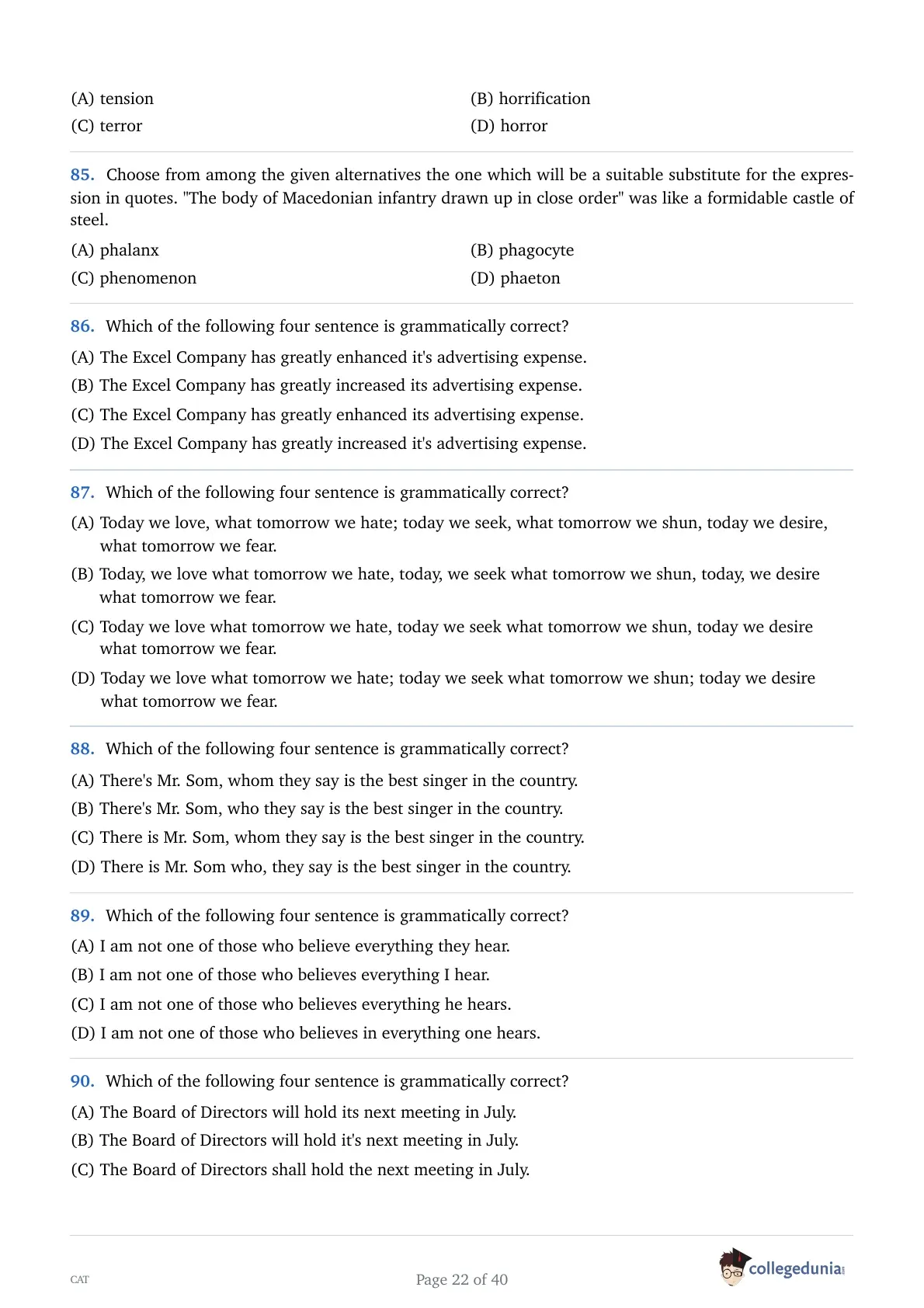
Choose from among the given alternatives the one which will be a suitable substitute for the expression in quotes. The thrilling narrative caused "the hair on the skin to stand erect".
Choose from among the given alternatives the one which will be a suitable substitute for the expression in quotes. "The body of Macedonian infantry drawn up in close order" was like a formidable castle of steel.
Choose the grammatically correct sentence from the following:
Choose the grammatically correct sentence from the following:
Choose the grammatically correct sentence from the following:
Choose the grammatically correct sentence from the following:
Choose the grammatically correct sentence from the following:
Choose the grammatically correct sentence from the following:
Choose the grammatically correct sentence from the following:
Choose the grammatically correct sentence from the following:
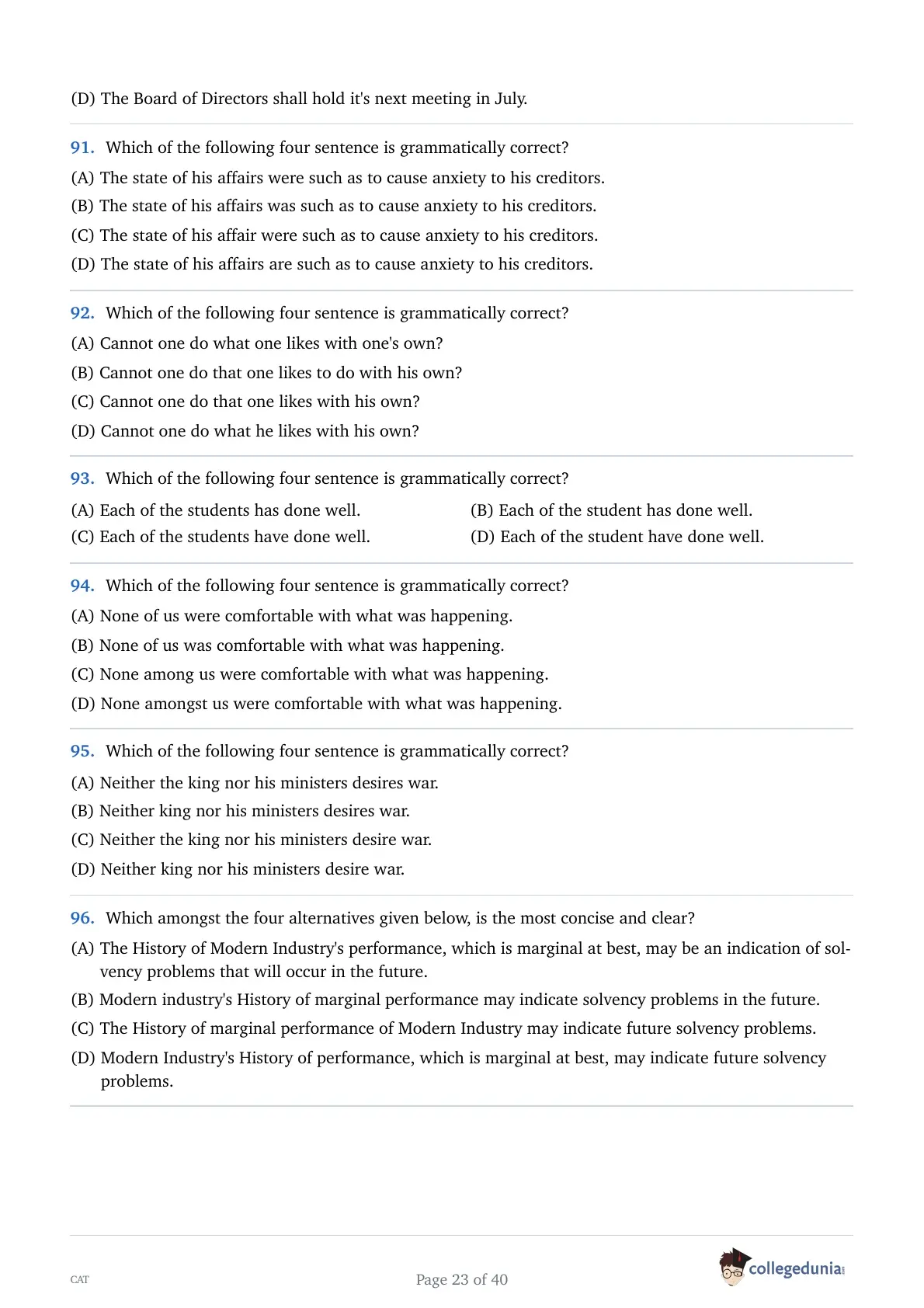
Choose the grammatically correct sentence from the following:
Choose the grammatically correct sentence from the following:
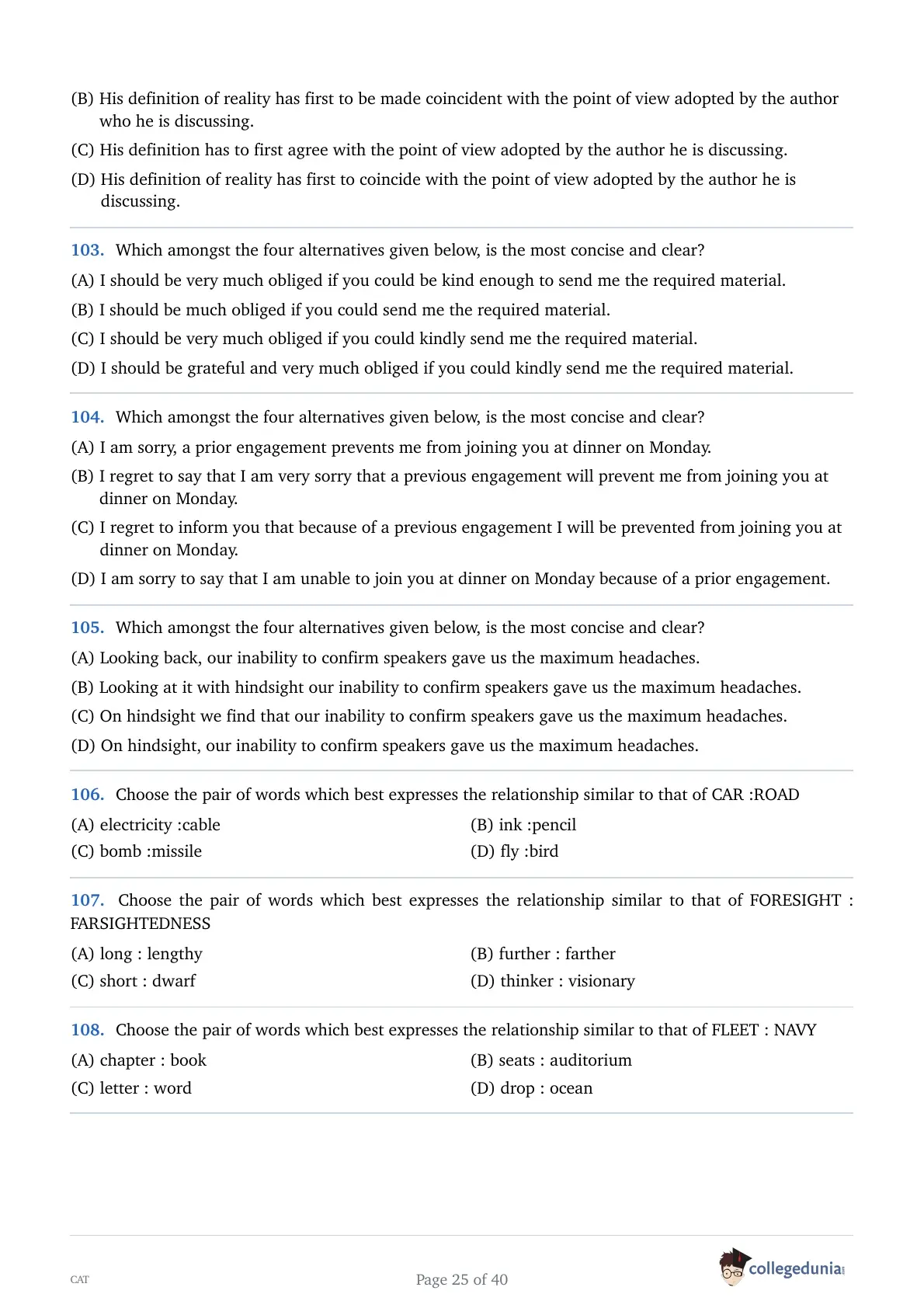
Choose the most concise and clear statement from the following that conveys the same idea:
Which amongst the four alternatives given below, is the most concise and clear?
Choose the most concise and clear statement from the following that conveys the same idea:
Choose the most concise and clear statement from the following that conveys the same request:
Choose the most concise and clear statement from the following that conveys the same idea:
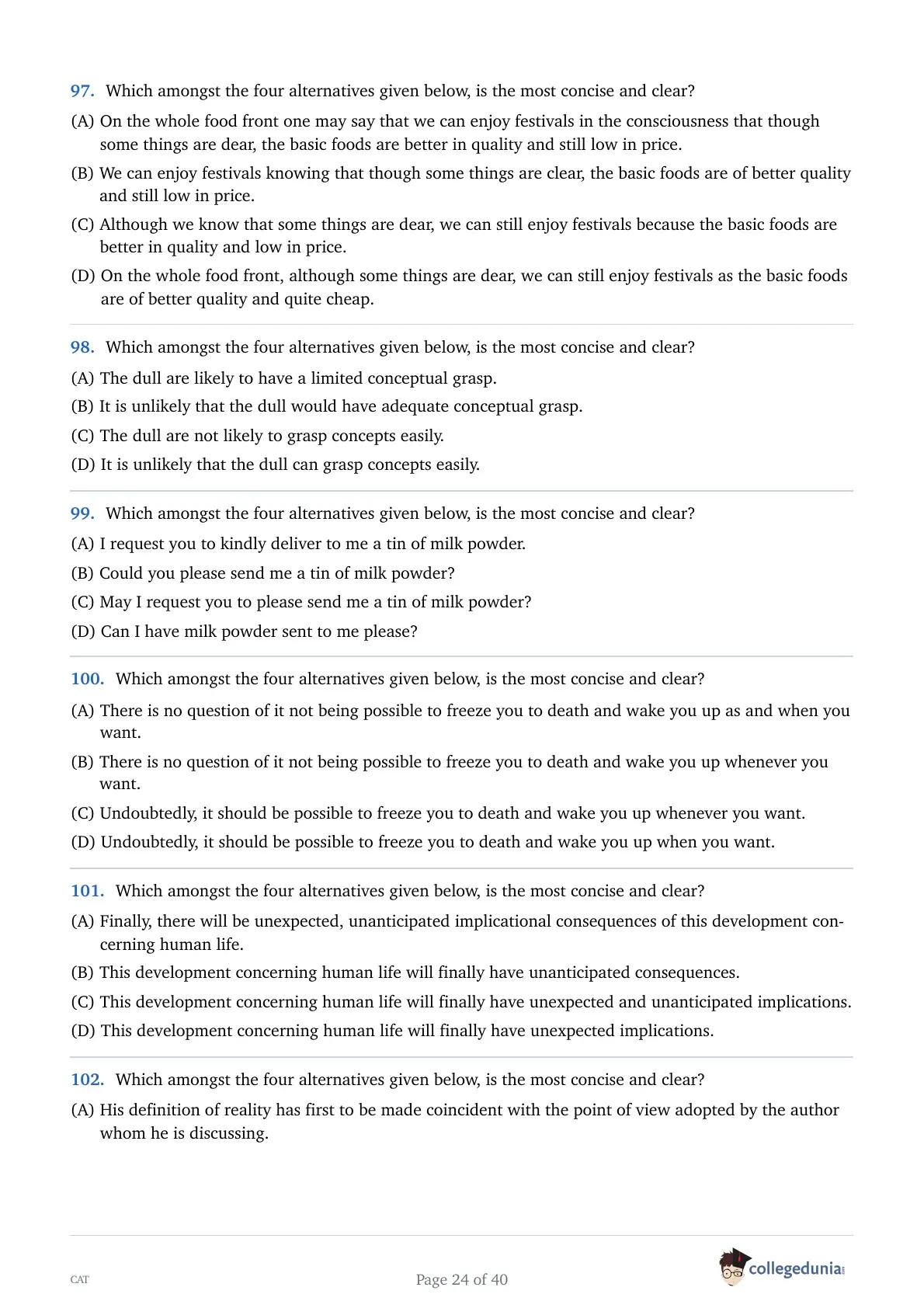
Which amongst the four alternatives given below, is the most concise and clear?
Which amongst the four alternatives given below, is the most concise and clear?
Choose the most concise and clear statement from the following that conveys the same request:
Choose the most concise and clear statement from the following that conveys the same idea:
Choose the most concise and clear statement from the following that conveys the same idea:
CAR : ROAD
Choose the pair of words that best expresses the relationship similar to the one above:
FORESIGHT : FARSIGHTEDNESS
Choose the pair of words that best expresses the relationship similar to the one above:
FLEET : NAVY
Choose the pair of words that best expresses the relationship similar to the one above:
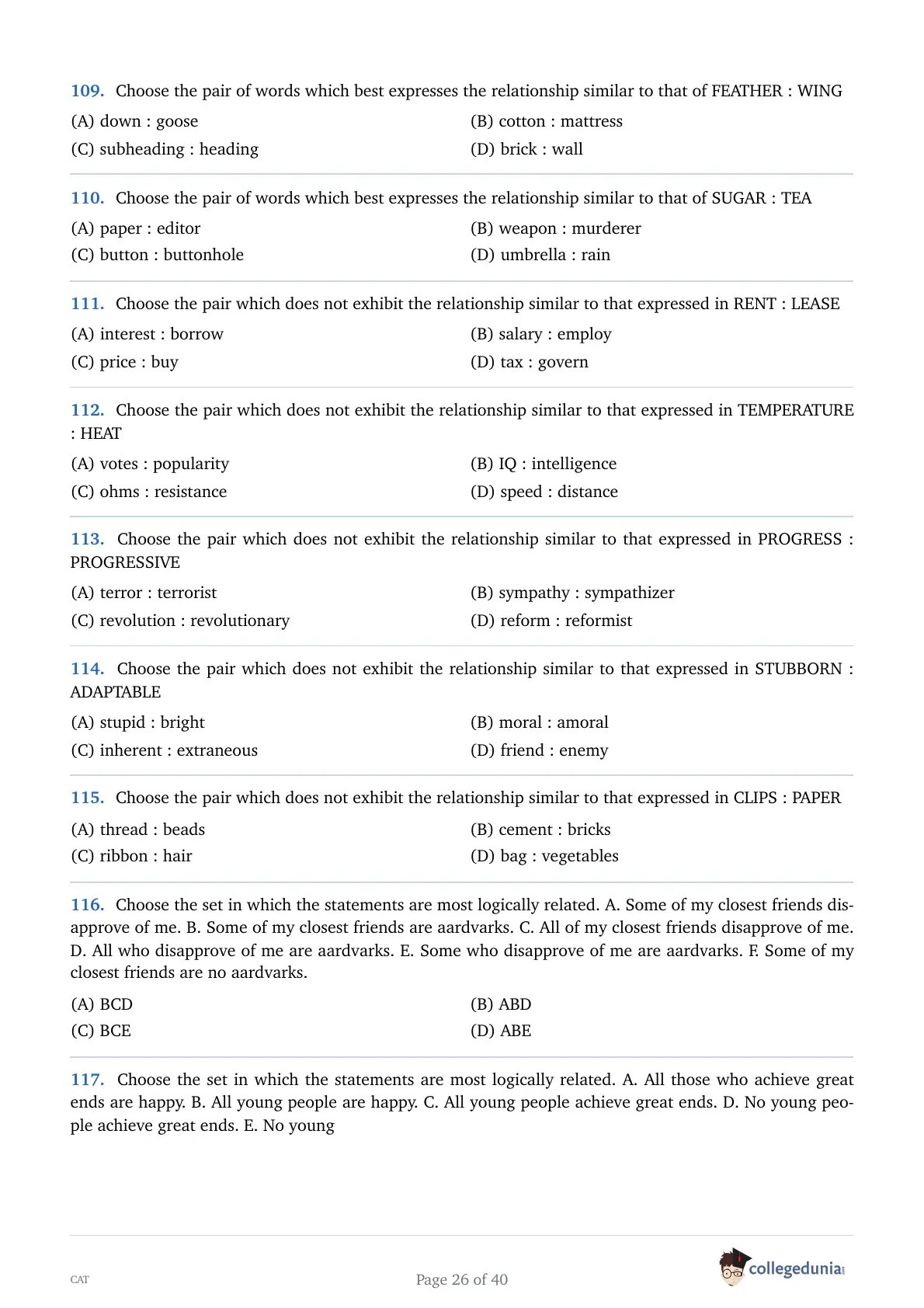
FEATHER : WING
Choose the pair of words that best expresses the relationship similar to the one above:
Choose the pair of words which best expresses the relationship similar to that of SUGAR : TEA
Choose the pair which does not exhibit the relationship similar to that expressed in RENT : LEASE
TEMPERATURE : HEAT — Choose the pair that does not exhibit the same relationship:
Choose the pair which does not exhibit the relationship similar to that expressed in PROGRESS : PROGRESSIVE
STUBBORN : ADAPTABLE — Choose the pair that does not exhibit the same relationship:
CLIPS : PAPER — Choose the pair that does not exhibit the same relationship:
Choose the set in which the statements are most logically related.
A. Some of my closest friends disapprove of me.
B. Some of my closest friends are aardvarks.
C. All of my closest friends disapprove of me.
D. All who disapprove of me are aardvarks.
E. Some who disapprove of me are aardvarks.
F. Some of my closest friends are no aardvarks.
Choose the set in which the statements are most logically related.
A. All those who achieve great ends are happy.
B. All young people are happy.
C. All young people achieve great ends.
D. No young people achieve great ends.
E. No young people are happy.
F. Some young people are happy.
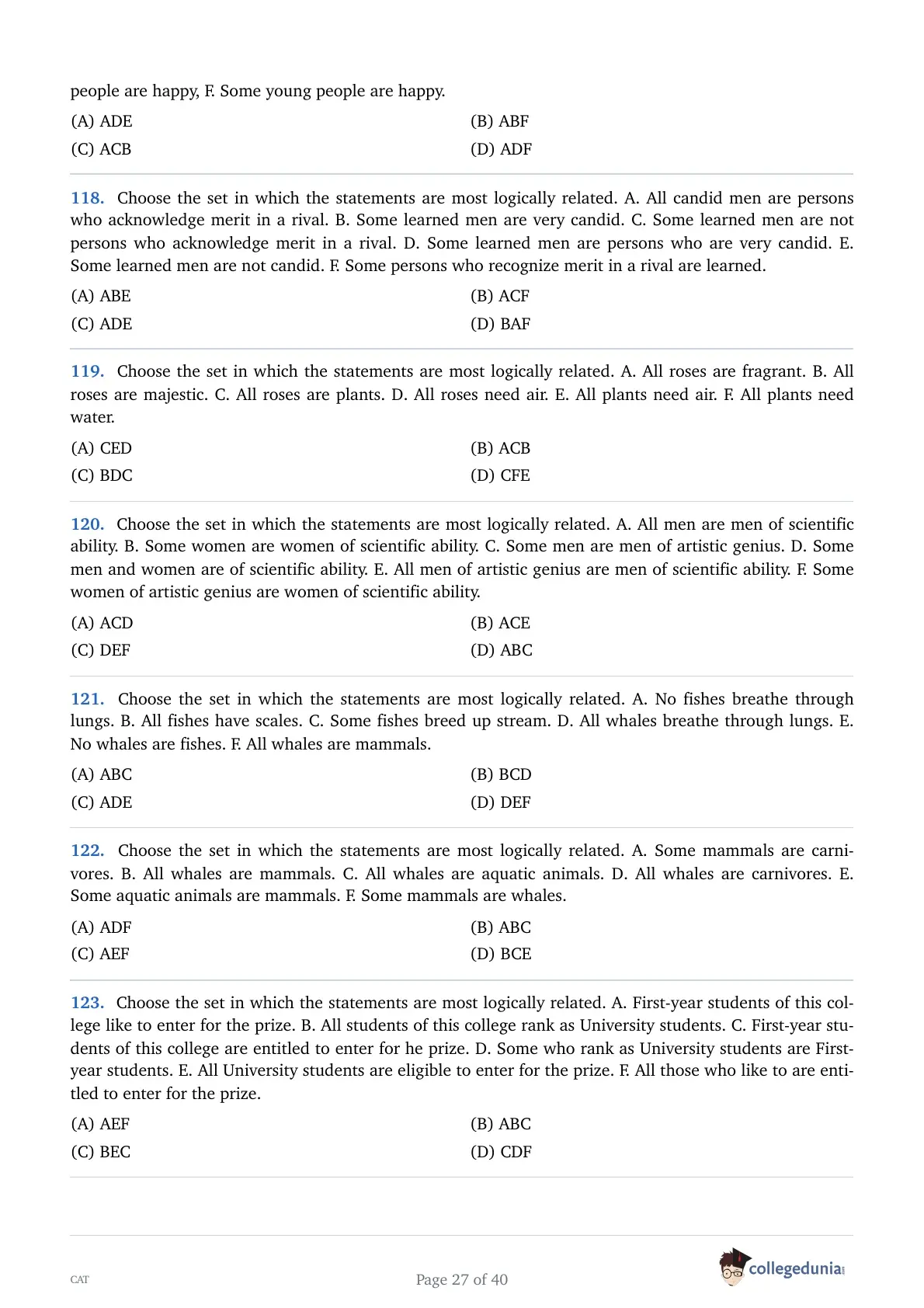
Choose the set in which the statements are most logically related.
A. All candid men are persons who acknowledge merit in a rival.
B. Some learned men are very candid.
C. Some learned men are not persons who acknowledge merit in a rival.
D. Some learned men are persons who are very candid.
E. Some learned men are not candid.
F. Some persons who recognize merit in a rival are learned.
Choose the set in which the statements are most logically related.
A. All roses are fragrant.
B. All roses are majestic.
C. All roses are plants.
D. All roses need air.
E. All plants need air.
F. All plants need water.
Choose the set in which the statements are most logically related.
A. All men are men of scientific ability.
B. Some women are women of scientific ability.
C. Some men are men of artistic genius.
D. Some men and women are of scientific ability.
E. All men of artistic genius are men of scientific ability.
F. Some women of artistic genius are women of scientific ability.
Choose the set in which the statements are most logically related.
A. No fishes breathe through lungs.
B. All fishes have scales.
C. Some fishes breed up stream.
D. All whales breathe through lungs.
E. No whales are fishes.
F. All whales are mammals.
Choose the set in which the statements are most logically related.
A. Some mammals are carnivores.
B. All whales are mammals.
C. All whales are aquatic animals.
D. All whales are carnivores.
E. Some aquatic animals are mammals.
F. Some mammals are whales.
Choose the set in which the statements are most logically related.
A. First-year students of this college like to enter for the prize.
B. All students of this college rank as University students.
C. First-year students of this college are entitled to enter for the prize.
D. Some who rank as University students are First-year students.
E. All University students are eligible to enter for the prize.
F. All those who like to are entitled to enter for the prize.
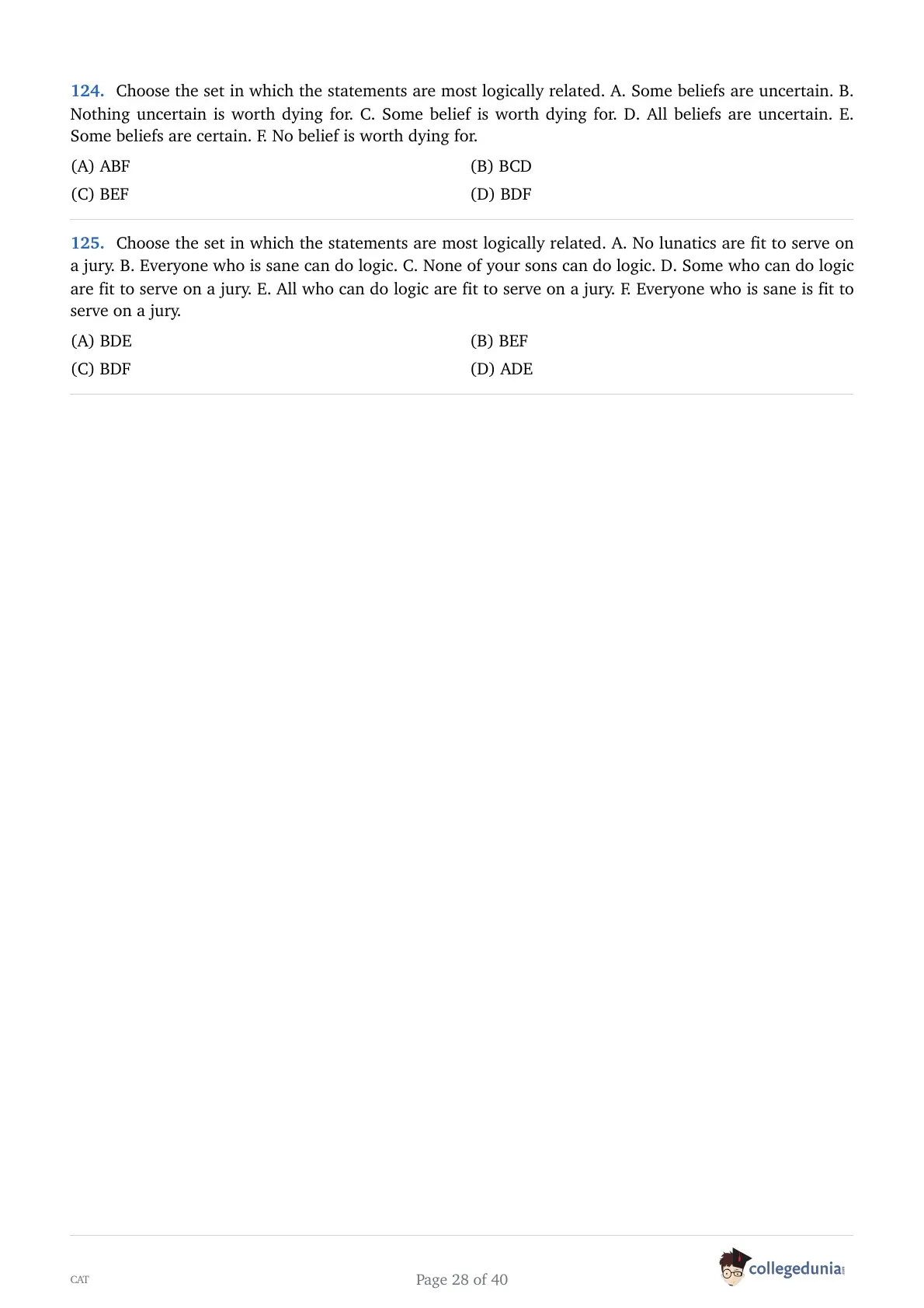
Choose the set in which the statements are most logically related.
A. Some beliefs are uncertain.
B. Nothing uncertain is worth dying for.
C. Some belief is worth dying for.
D. All beliefs are uncertain.
E. Some beliefs are certain.
F. No belief is worth dying for.
Choose the set in which the statements are most logically related.
A. No lunatics are fit to serve on a jury.
B. Everyone who is sane can do logic.
C. None of your sons can do logic.
D. Some who can do logic are fit to serve on a jury.
E. All who can do logic are fit to serve on a jury.
F. Everyone who is sane is fit to serve on a jury.
Reading Comprehension (Q126 - Q163)
Comprehension:
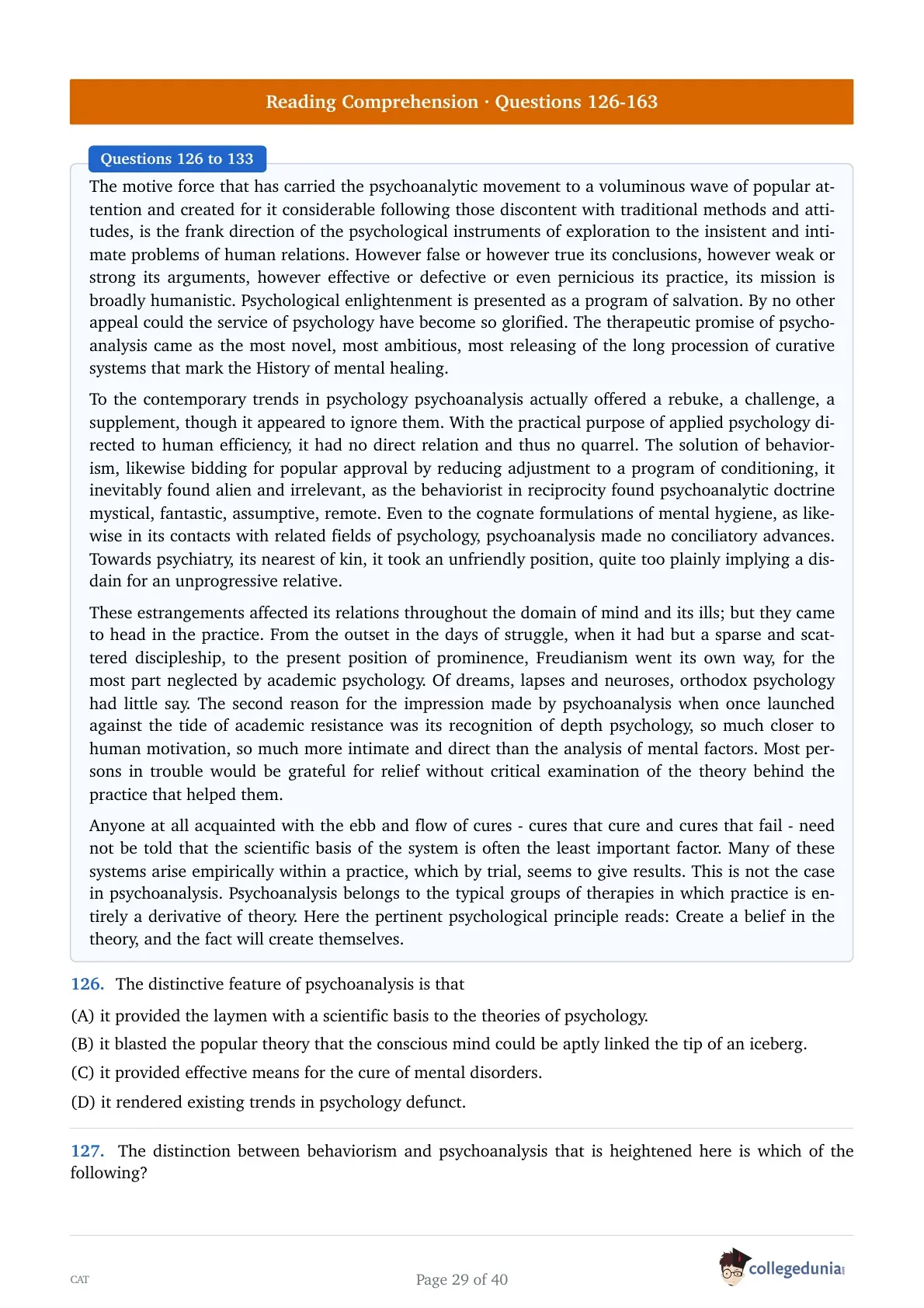
The motive force that has carried the psychoanalytic movement to a voluminous wave of popular attention and created for it considerable following those discontent with traditional methods and attitudes, is the frank direction of the psychological instruments of exploration to the insistent and intimate problems of human relations. However false or however true its conclusions, however weak or strong its arguments, however effective or defective or even pernicious its practice, its mission is broadly humanistic. Psychological enlightenment is presented as a program of salvation. By no other appeal could the service of psychology have become so glorified. The therapeutic promise of psychoanalysis came as the most novel, most ambitious, most releasing of the long procession of curative systems that mark the history of mental healing.
To the contemporary trends in psychology psychoanalysis actually offered a rebuke, a challenge, a supplement, though it appeared to ignore them. With the practical purpose of applied psychology directed to human efficiency, it had no direct relation and thus no quarrel. The solution of behaviorism, likewise bidding for popular approval by reducing adjustment to a program of conditioning, it inevitably found alien and irrelevant, as the behaviorist in reciprocity found psychoanalytic doctrine mystical, fantastic, assumptive, remote. Even to the cognate formulations of mental hygiene, as likewise in its contacts with related fields of psychology, psychoanalysis made no conciliatory advances. Towards psychiatry, its nearest of kin, it took an unfriendly position, quite too plainly implying a disdain for an unprogressive relative.
Read More
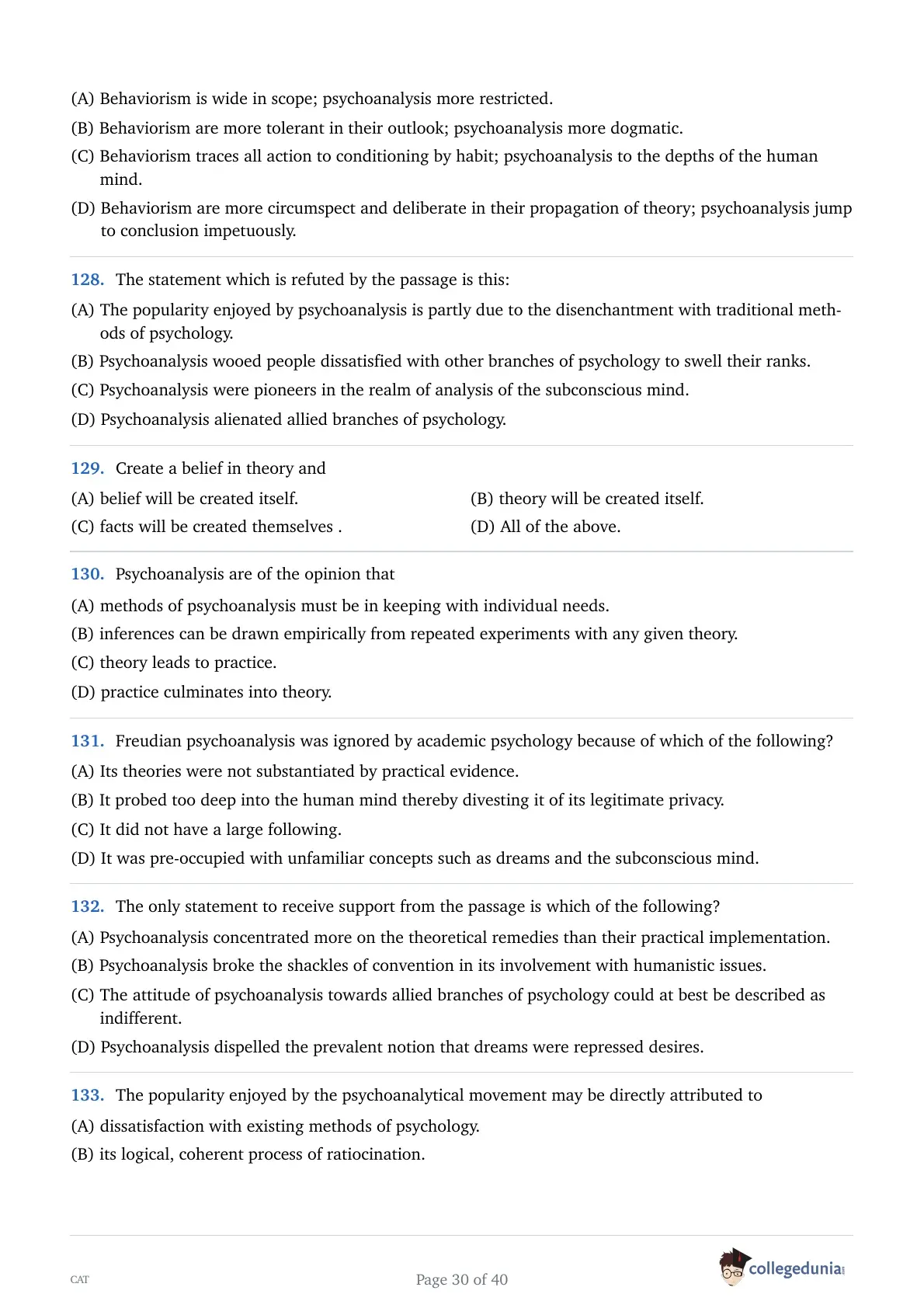
These estrangements affected its relations throughout the domain of mind and its ills; but they came to head in the practice. From the outset in the days of struggle, when it had but a sparse and scattered discipleship, to the present position of prominence, Freudianism went its own way, for the most part neglected by academic psychology. Of dreams, lapses and neuroses, orthodox psychology had little say. The second reason for the impression made by psychoanalysis when once launched against the tide of academic resistance was its recognition of depth psychology, so much closer to human motivation, so much more intimate and direct than the analysis of mental factors. Most persons in trouble would be grateful for relief without critical examination of the theory behind the practice that helped them.
Anyone at all acquainted with the ebb and flow of cures - cures that cure and cures that fail - need not be told that the scientific basis of the system is often the least important factor. Many of these systems arise empirically within a practice, which by trial, seems to give results. This is not the case in psychoanalysis. Psychoanalysis belongs to the typical groups of therapies in which practice is entirely a derivative of theory. Here the pertinent psychological principle reads: “Create a belief in the theory, and the fact will create themselves”.
The distinctive feature of psychoanalysis is that
The distinction between behaviorism and psychoanalysis that is heightened here is which of the following?
The statement which is refuted by the passage is this:
Create a belief in theory and
Psychoanalysis are of the opinion that
Freudian psychoanalysis was ignored by academic psychology because of which of the following?
The only statement to receive support from the passage is which of the following?
The popularity enjoyed by the psychoanalytical movement may be directly attributed to
Comprehension:
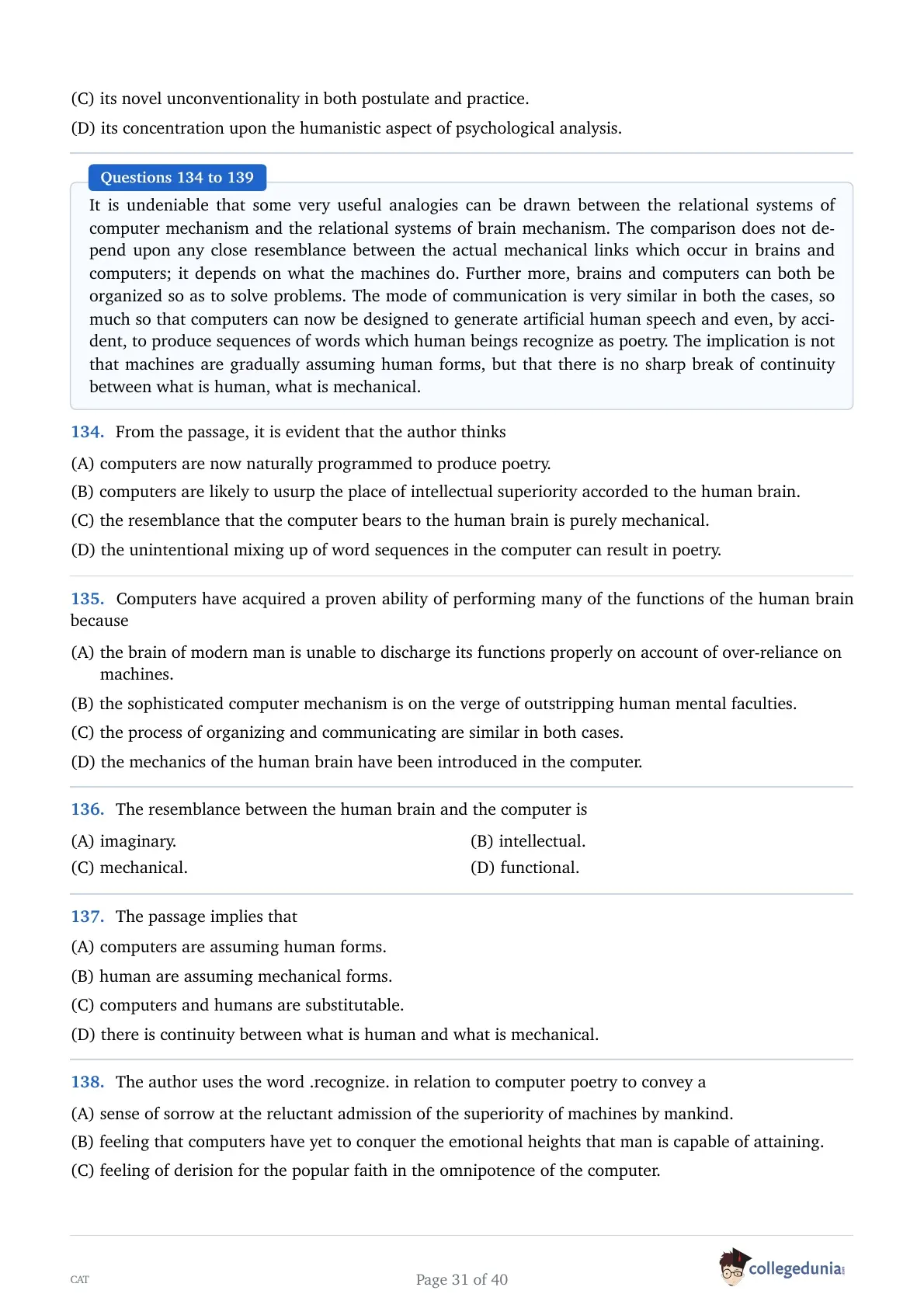
It is undeniable that some very useful analogies can be drawn between the relational systems of computer mechanism and the relational systems of brain mechanism. The comparison does not depend upon any close resemblance between the actual mechanical links which occur in brains and computers; it depends on what the machines do. Further more, brains and computers can both be organized so as to solve problems. The mode of communication is very similar in both the cases, so much so that computers can now be designed to generate artificial human speech and even, by accident, to produce sequences of words which human beings recognize as poetry. The implication is not that machines are gradually assuming human forms, but that there is no sharp break of continuity between what is human, what is mechanical.
From the passage, it is evident that the author thinks
Computers have acquired a proven ability of performing many of the functions of the human brain because
The resemblance between the human brain and the computer is
The passage implies that
The author uses the word ‘recognize’ in relation to computer poetry to convey a
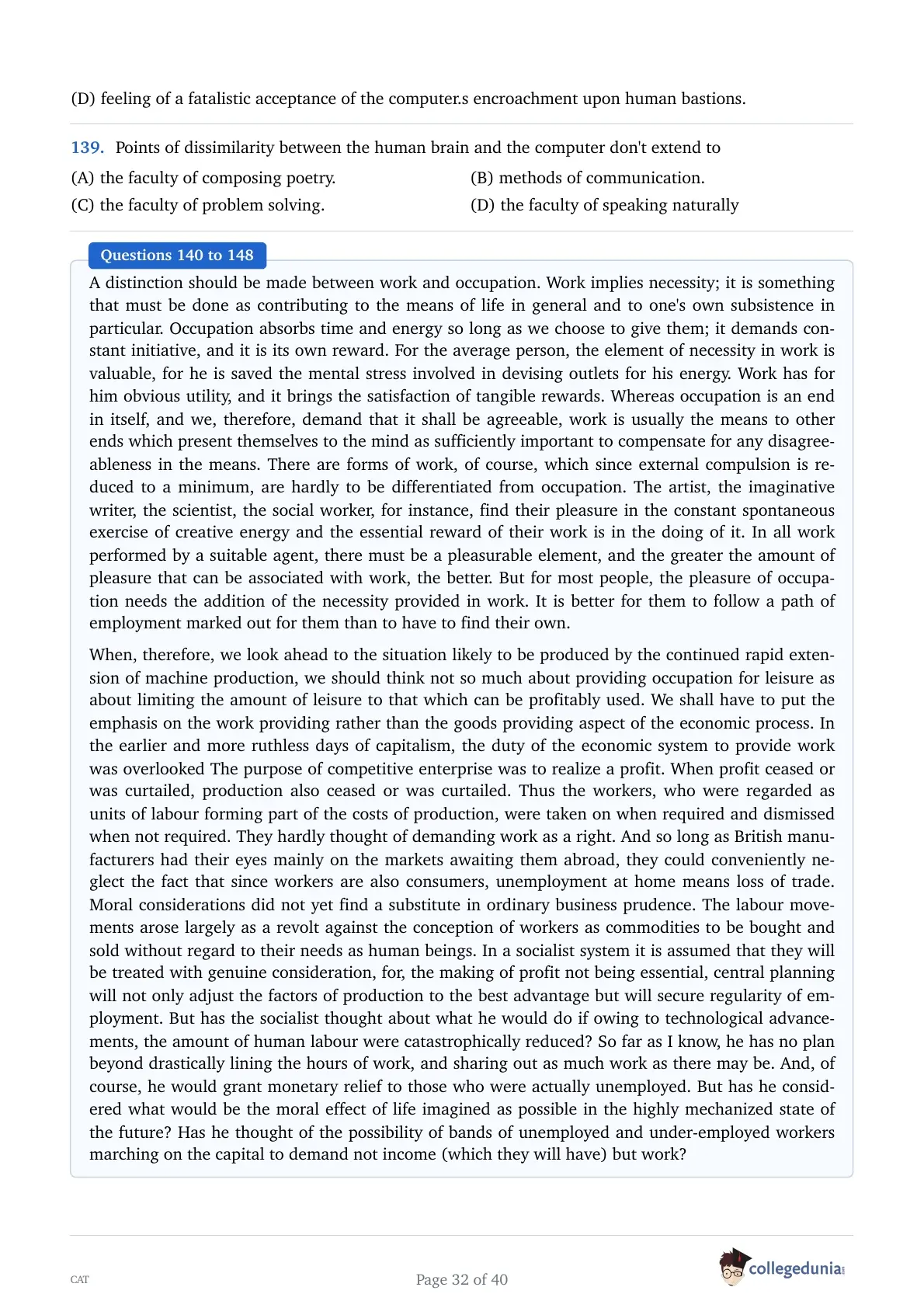
Points of dissimilarity between the human brain and the computer don’t extend to
Comprehension:
A distinction should be made between work and occupation. Work implies necessity; it is something that must be done as contributing to the means of life in general and to one’s own subsistence in particular. Occupation absorbs time and energy so long as we choose to give them; it demands constant initiative, and it is its own reward. For the average person, the element of necessity in work is valuable, for he is saved the mental stress involved in devising outlets for his energy. Work has for him obvious utility, and it brings the satisfaction of tangible rewards. Whereas occupation is an end in itself, and we, therefore, demand that it shall be agreeable, work is usually the means to other ends - ends which present themselves to the mind as sufficiently important to compensate for any disagreeableness in the means. There are forms of work, of course, which since external compulsion is reduced to a minimum, are hardly to be differentiated from occupation. The artist, the imaginative writer, the scientist, the social worker, for instance, find their pleasure in the constant spontaneous exercise of creative energy and the essential reward of their work is in the doing of it. In all work performed by a suitable agent, there must be a pleasurable element, and the greater the amount of pleasure that can be associated with work, the better. But for most people, the pleasure of occupation needs the addition of the necessity provided in work. It is better for them to follow a path of employment marked out for them than to have to find their own.
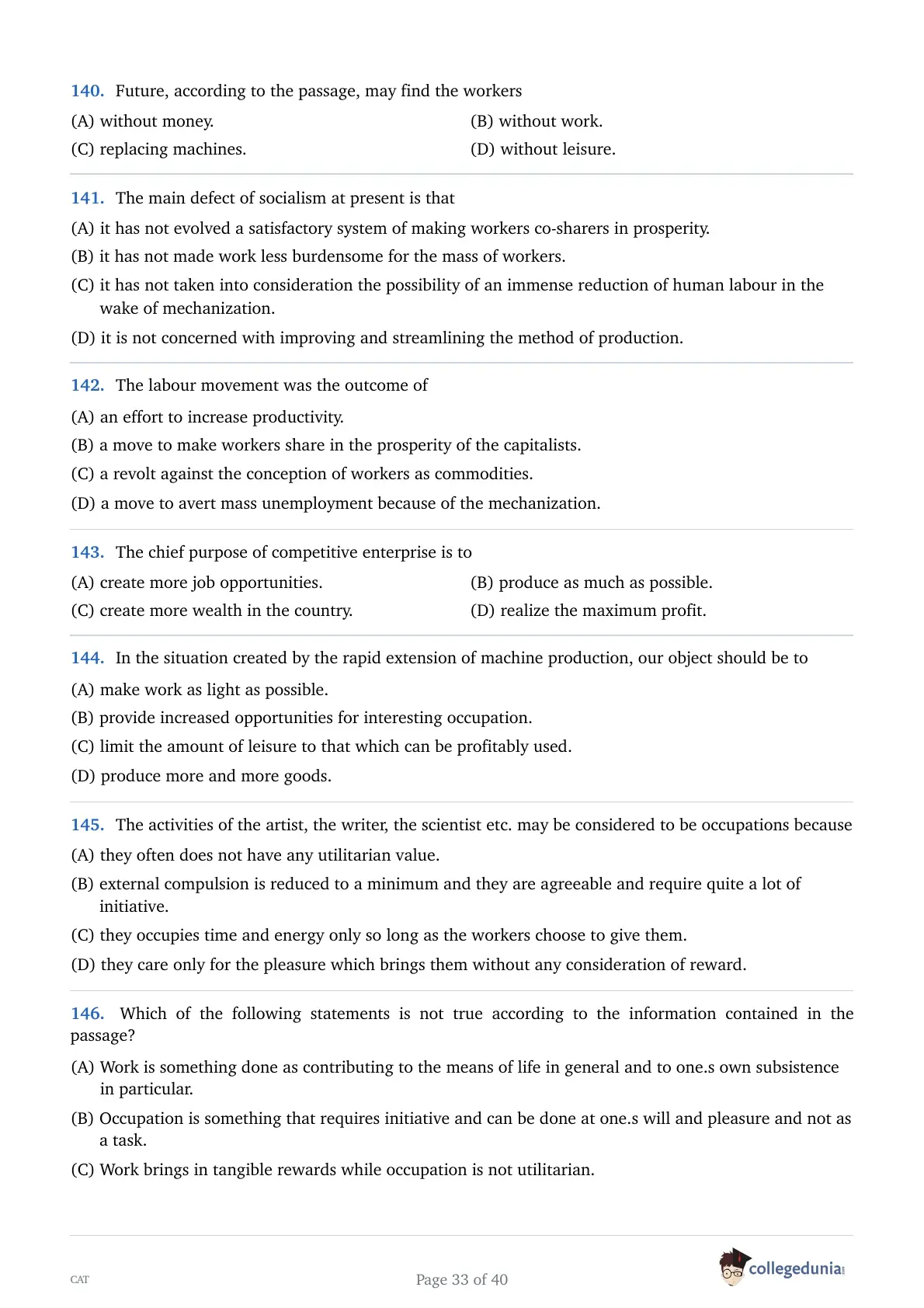
When, therefore, we look ahead to the situation likely to be produced by the continued rapid extension of machine production, we should think not so much about providing occupation for leisure as about limiting the amount of leisure to that which can be profitably used. We shall have to put the emphasis on the work-providing rather than the goods-providing aspect of the economic process. In the earlier and more ruthless days of capitalism, the duty of the economic system to provide work was overlooked. The purpose of competitive enterprise was to realize a profit. When profit ceased or was curtailed, production also ceased or was curtailed. Thus the workers, who were regarded as units of labour forming part of the costs of production, were taken on when required and dismissed when not required. They hardly thought of demanding work as a right. And so long as British manufacturers had their eyes mainly on the markets awaiting them abroad, they could conveniently neglect the fact that since workers are also consumers, unemployment at home means loss of trade. Moral considerations did not yet find a substitute in ordinary business prudence. The labour movements arose largely as a revolt against the conception of workers as commodities to be bought and sold without regard to their needs as human beings. In a socialist system it is assumed that they will be treated with genuine consideration, for, the making of profit not being essential, central planning will not only adjust the factors of production to the best advantage but will secure regularity of employment. But has the socialist thought about what he would do if owing to technological advancements, the amount of human labour were catastrophically reduced? So far as I know, he has no plan beyond drastically lining the hours of work, and sharing out as much work as there may be. And, of course, he would grant monetary relief to those who were actually unemployed. But has he considered what would be the moral effect of life imagined as possible in the highly mechanized state of the future? Has he thought of the possibility of bands of unemployed and under-employed workers marching on the capital to demand not income (which they will have) but work?
Future, according to the passage, may find the workers
The main defect of socialism at present is that
The labour movement was the outcome of
The chief purpose of competitive enterprise is to
In the situation created by the rapid extension of machine production, our object should be to
The activities of the artist, the writer, the scientist etc. may be considered to be occupations because
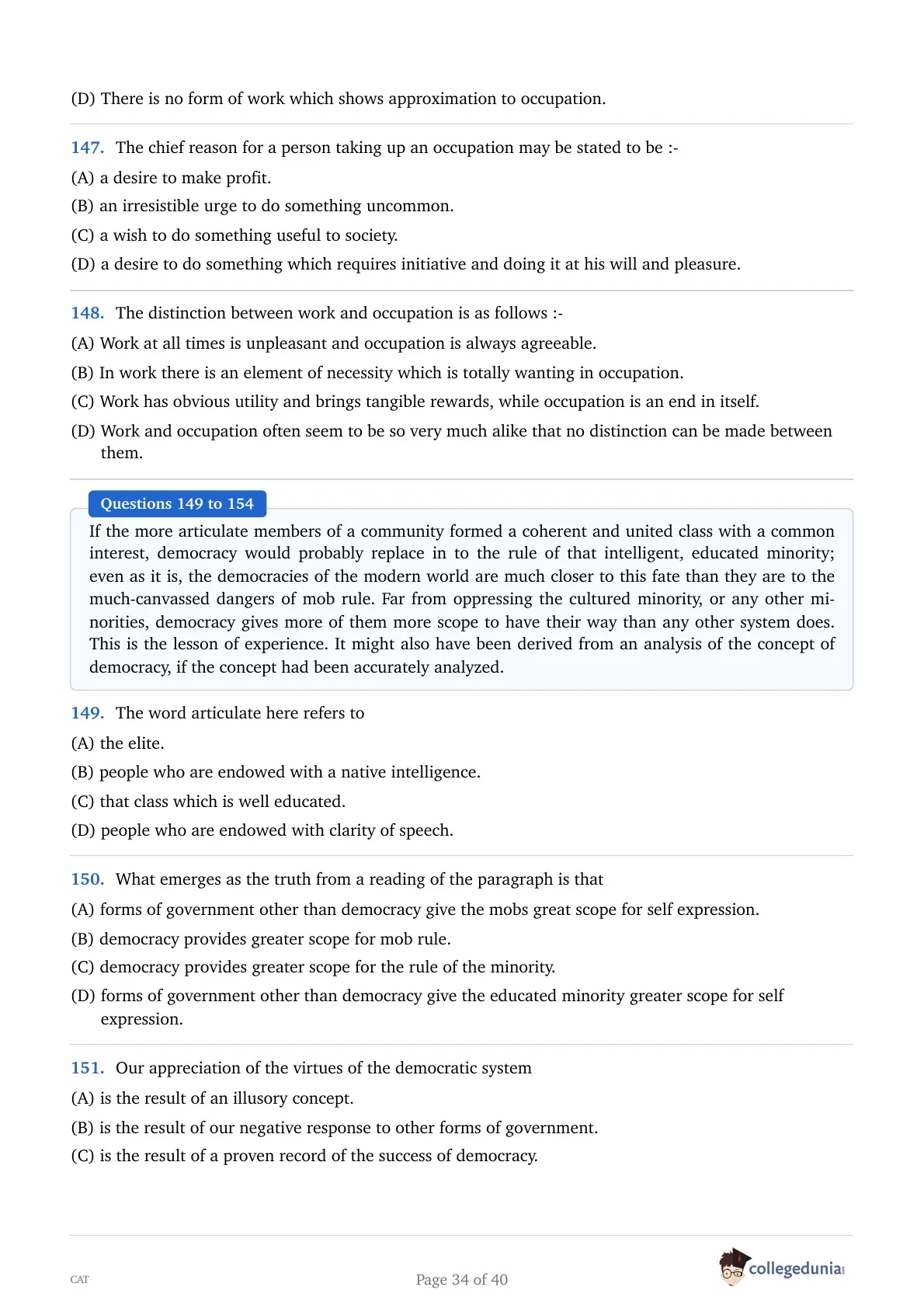
Which of the following statements is not true according to the information contained in the passage?
The chief reason for a person taking up an occupation may be stated to be :-
The distinction between work and occupation is as follows :-
Comprehension:
If the more articulate members of a community formed a coherent and united class with a common interest, democracy would probably replace in to the rule of that intelligent, educated minority; even as it is, the democracies of the modern world are much closer to this fate than they are to the much-canvassed dangers of mob rule. Far from oppressing the cultured minority, or any other minorities, democracy gives more of them more scope to have their way than any other system does. This is the lesson of experience. It might also have been derived from an analysis of the concept of democracy, if the concept had been accurately analyzed
The word articulate here refers to
What emerges as the truth from a reading of the paragraph is that
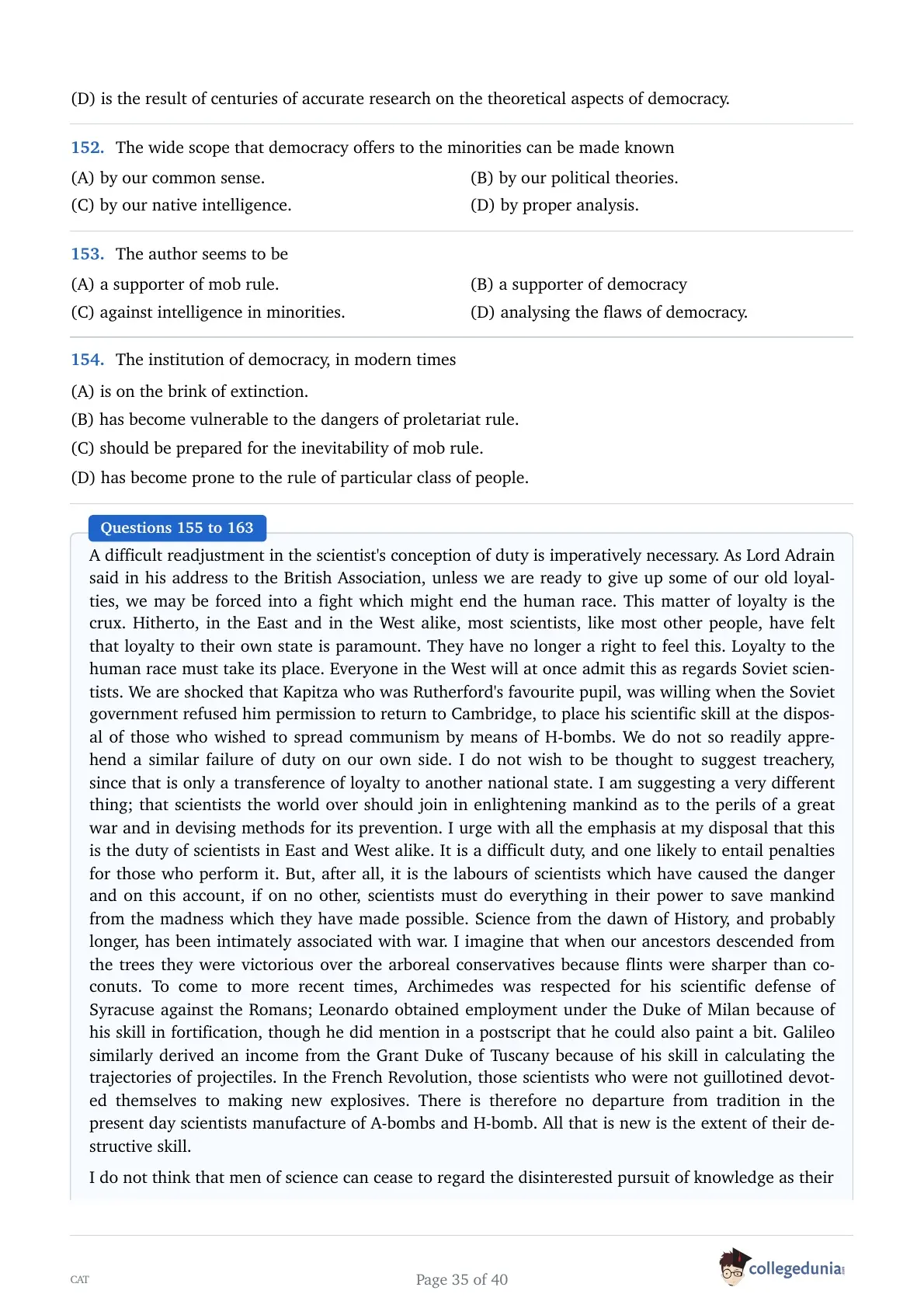
Our appreciation of the virtues of the democratic system
The wide scope that democracy offers to the minorities can be made known
The author seems to be
The institution of democracy, in modern times
Comprehension:
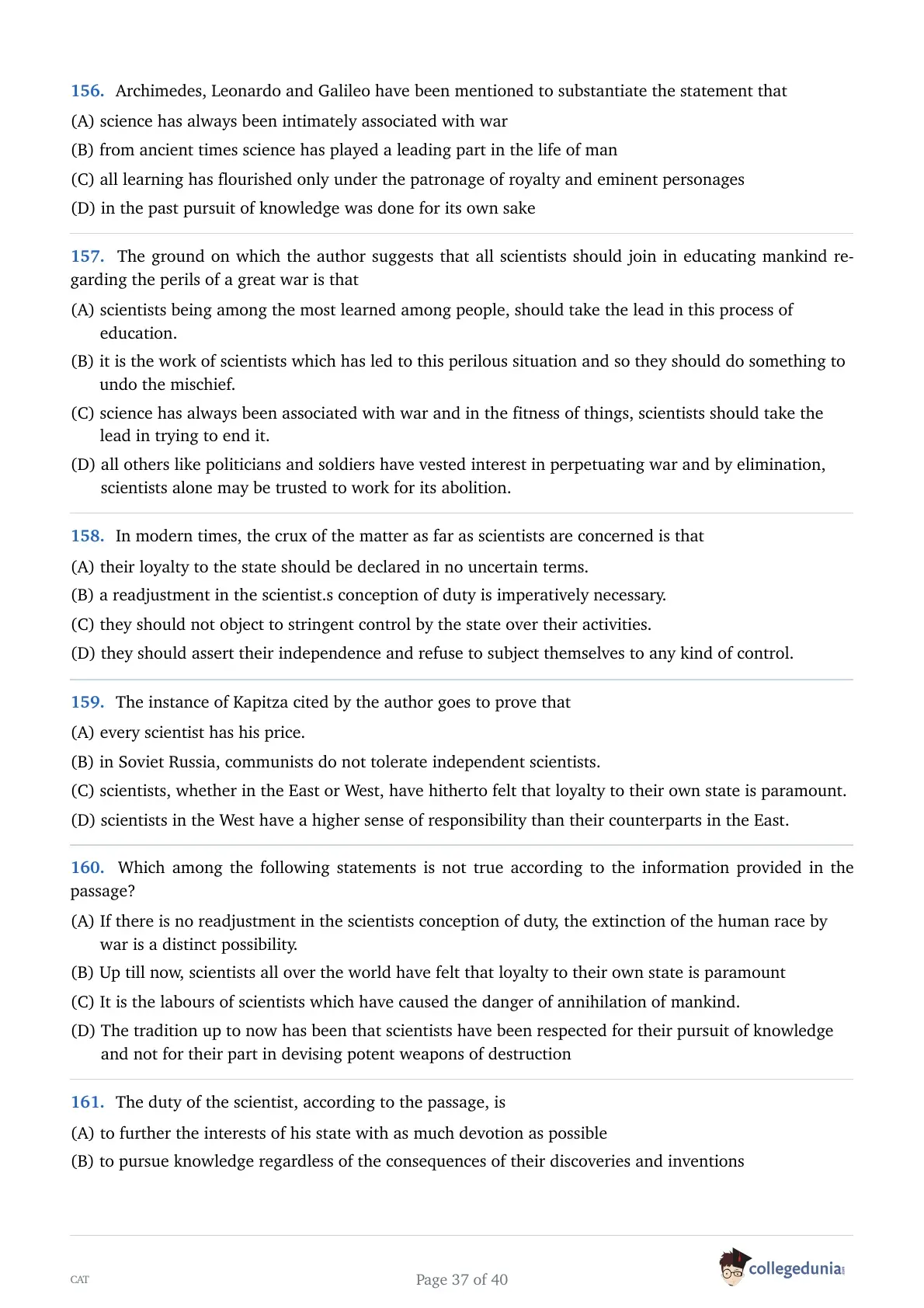
A difficult readjustment in the scientist’s conception of duty is imperatively necessary. As Lord Adrain said in his address to the British Association, “unless we are ready to give up some of our old loyalties, we may be forced into a fight which might end the human race”. This matter of loyalty is the crux. Hitherto, in the East and in the West alike, most scientists, like most other people, have felt that loyalty to their own state is paramount. They have no longer a right to feel this. Loyalty to the human race must take its place. Everyone in the West will at once admit this as regards Soviet scientists. We are shocked that Kapitza who was Rutherford’s favourite pupil, was willing when the Soviet government refused him permission to return to Cambridge, to place his scientific skill at the disposal of those who wished to spread communism by means of H-bombs. We do not so readily apprehend a similar failure of duty on our own side. I do not wish to be thought to suggest treachery, since that is only a transference of loyalty to another national state. I am suggesting a very different thing; that scientists the world over should join in enlightening mankind as to the perils of a great war and in devising methods for its prevention. I urge with all the emphasis at my disposal that this is the duty of scientists in East and West alike. It is a difficult duty, and one likely to entail penalties for those who perform it. But, after all, it is the labours of scientists which have caused the danger and on this account, if on no other, scientists must do everything in their power to save mankind from the madness which they have made possible. Science from the dawn of history, and probably longer, has been intimately associated with war. I imagine that when our ancestors descended from the trees they were victorious over the arboreal conservatives because flints were sharper than coconuts. To come to more recent times, Archimedes was respected for his scientific defense of Syracuse against the Romans; Leonardo obtained employment under the Duke of Milan because of his skill in fortification, though he did mention in a postscript that he could also paint a bit. Galileo similarly derived an income from the Grant Duke of Tuscany because of his skill in calculating the trajectories of projectiles. In the French Revolution, those scientists who were not guillotined devoted themselves to making new explosives. There is therefore no departure from tradition in the present day scientist’s manufacture of A-bombs and H-bomb. All that is new is the extent of their destructive skill.
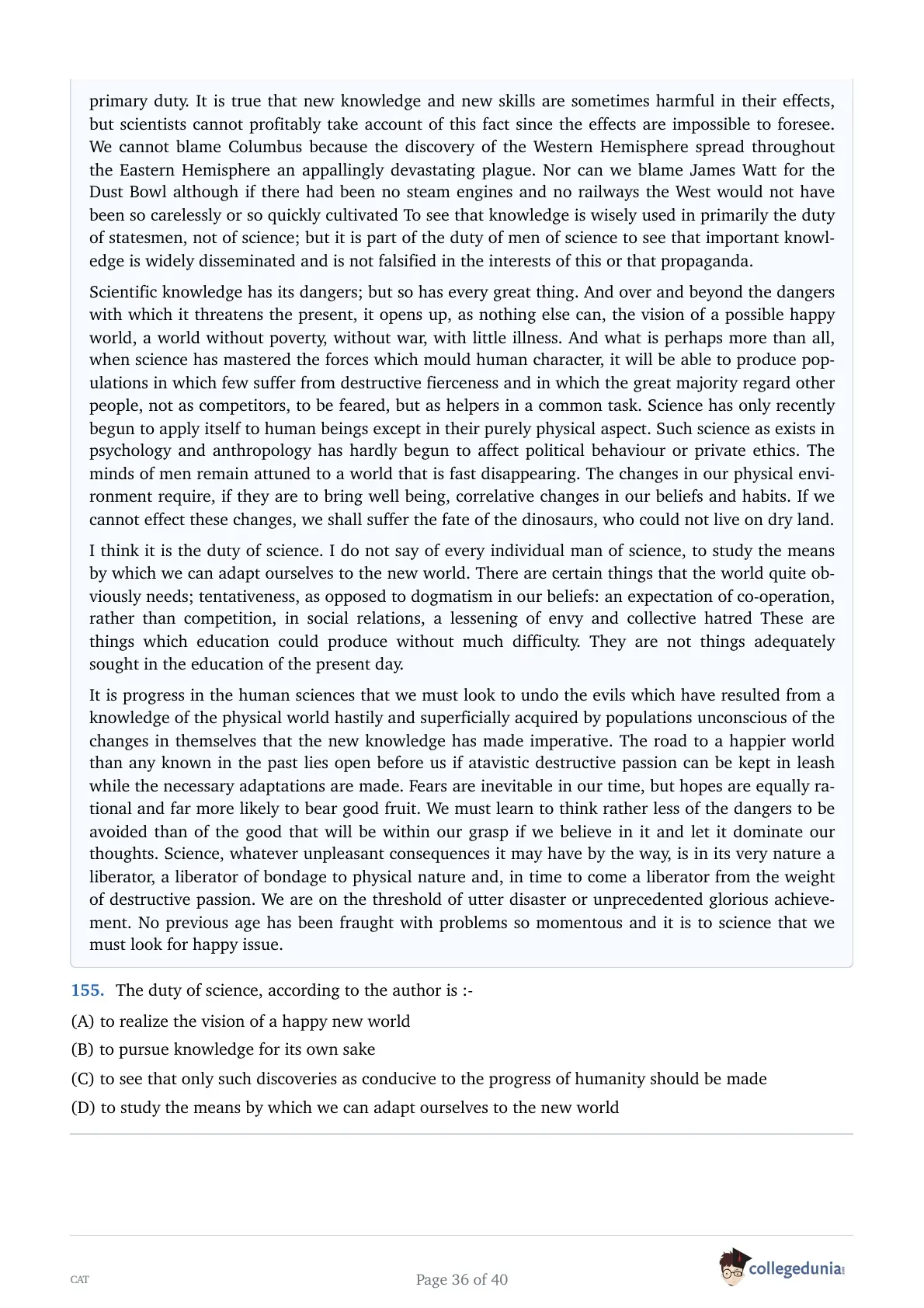
I do not think that men of science can cease to regard the disinterested pursuit of knowledge as their primary duty. It is true that new knowledge and new skills are sometimes harmful in their effects, but scientists cannot profitably take account of this fact since the effects are impossible to foresee. We cannot blame Columbus because the discovery of the Western Hemisphere spread throughout the Eastern Hemisphere an appallingly devastating plague. Nor can we blame James Watt for the Dust Bowl although if there had been no steam engines and no railways the West would not have been so carelessly or so quickly cultivated. To see that knowledge is wisely used in primarily the duty of statesmen, not of science; but it is part of the duty of men of science to see that important knowledge is widely disseminated and is not falsified in the interests of this or that propaganda.
Read More
Scientific knowledge has its dangers; but so has every great thing. And over and beyond the dangers with which it threatens the present, it opens up, as nothing else can, the vision of a possible happy world, a world without poverty, without war, with little illness. And what is perhaps more than all, when science has mastered the forces which mould human character, it will be able to produce populations in which few suffer from destructive fierceness and in which the great majority regard other people, not as competitors, to be feared, but as helpers in a common task. Science has only recently begun to apply itself to human beings except in their purely physical aspect. Such science as exists in psychology and anthropology has hardly begun to affect political behaviour or private ethics. The minds of men remain attuned to a world that is fast disappearing. The changes in our physical environment require, if they are to bring well being, correlative changes in our beliefs and habits. If we cannot effect these changes, we shall suffer the fate of the dinosaurs, who could not live on dry land.
I think it is the duty of science - I do not say of every individual man of science - to study the means by which we can adapt ourselves to the new world. There are certain things that the world quite obviously needs; tentativeness, as opposed to dogmatism in our beliefs: an expectation of co-operation, rather than competition, in social relations, a lessening of envy and collective hatred. These are things which education could produce without much difficulty. They are not things adequately sought in the education of the present day.
It is progress in the human sciences that we must look to undo the evils which have resulted from a knowledge of the physical world hastily and superficially acquired by populations unconscious of the changes in themselves that the new knowledge has made imperative. The road to a happier world than any known in the past lies open before us if atavistic destructive passion can be kept in leash while the necessary adaptations are made. Fears are inevitable in our time, but hopes are equally rational and far more likely to bear good fruit. We must learn to think rather less of the dangers to be avoided than of the good that will be within our grasp if we believe in it and let it dominate our thoughts. Science, whatever unpleasant consequences it may have by the way, is in its very nature a liberator, a liberator of bondage to physical nature and, in time to come a liberator from the weight of destructive passion. We are on the threshold of utter disaster or unprecedented glorious achievement. No previous age has been fraught with problems so momentous and it is to science that we must look for happy issue.
The duty of science, according to the author, is :-
Archimedes, Leonardo and Galileo have been mentioned to substantiate the statement that
The ground on which the author suggests that all scientists should join in educating mankind regarding the perils of a great war is that
In modern times, the crux of the matter as far as scientists are concerned is that
The instance of Kapitza cited by the author goes to prove that
Which among the following statements is not true according to the information provided in the passage?
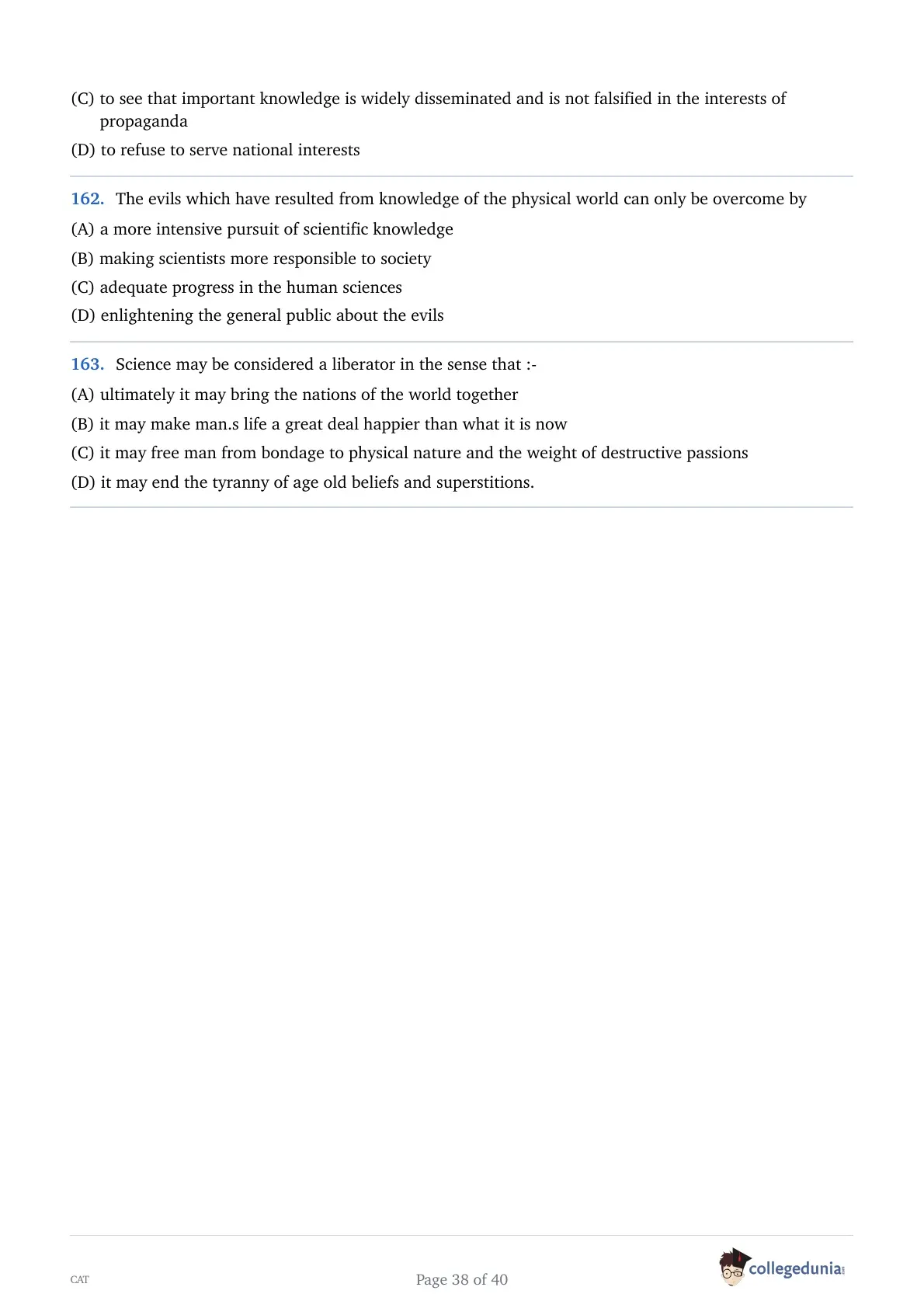
The duty of the scientist, according to the passage, is
The evils which have resulted from knowledge of the physical world can only be overcome by
Science may be considered a liberator in the sense that :-
Critical Reasoning (Q164 - Q174)
Comprehension:
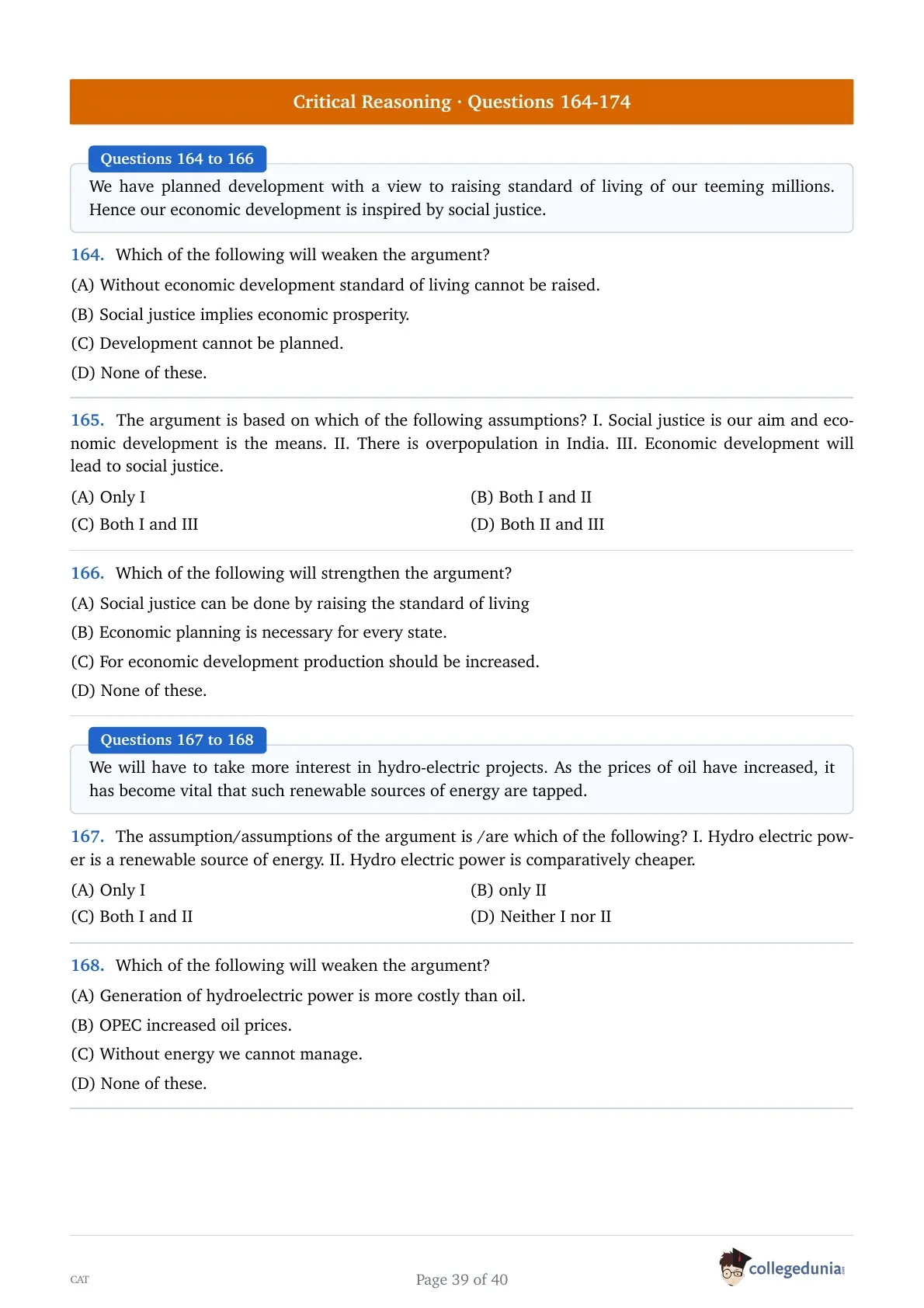
We have planned development with a view to raising standard of living of our teeming millions. Hence our economic development is inspired by social justice
Which of the following will weaken the argument?
The argument is based on which of the following assumptions?
I. Social justice is our aim and economic development is the means.
II. There is overpopulation in India.
III. Economic development will lead to social justice.
Which of the following will strengthen the argument?
Comprehension:
We will have to take more interest in hydro-electric projects. As the prices of oil have increased, it has become vital that such renewable sources of energy are tapped.
The assumption/assumptions of the argument is /are which of the following?
I. Hydro electric power is a renewable source of energy.
II. Hydro electric power is comparatively cheaper.
Which of the following will weaken the argument?
Comprehension:
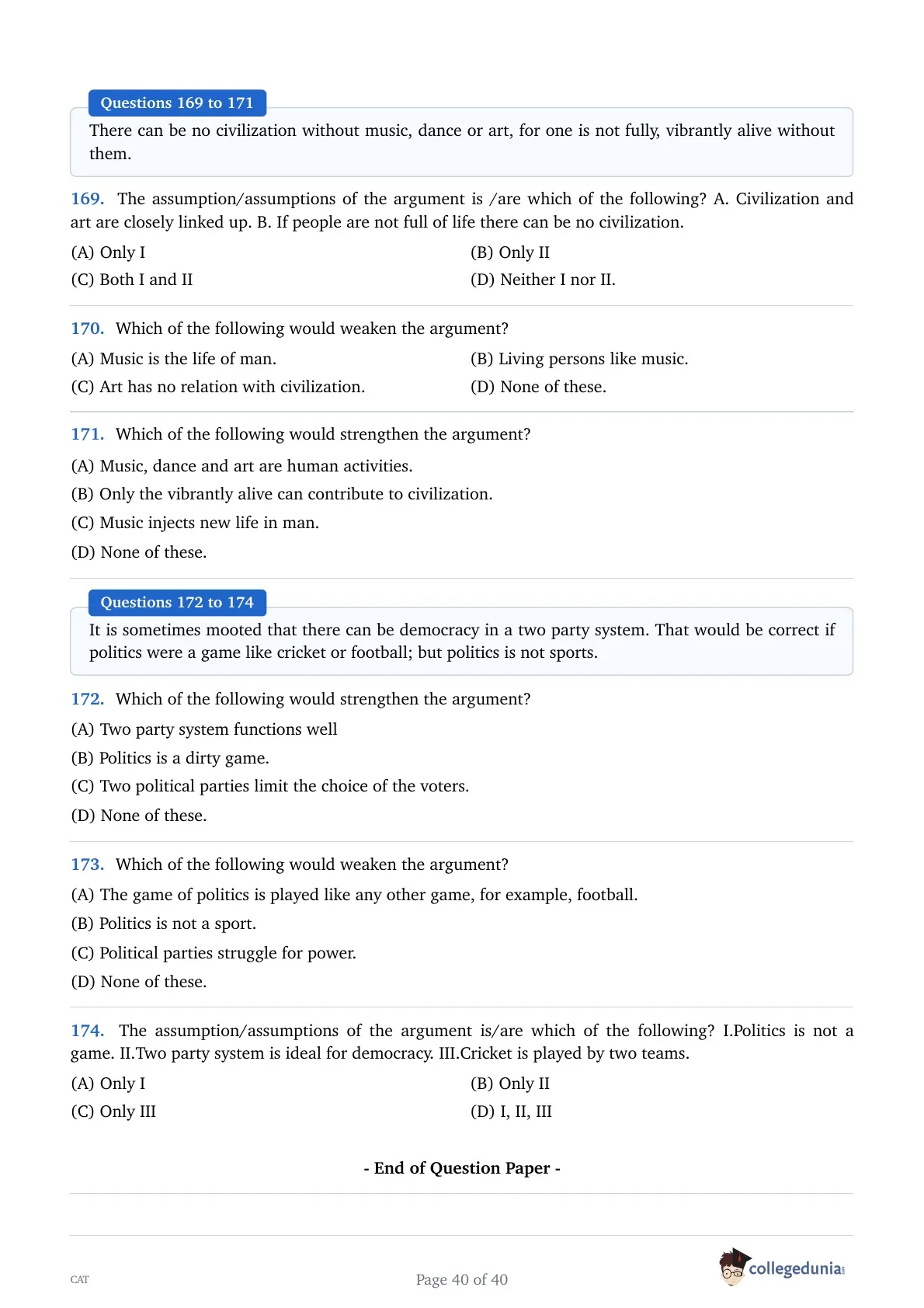
There can be no civilization without music, dance or art, for one is not fully, vibrantly alive without them
The assumption/assumptions of the argument is/are which of the following?
I. Civilization and art are closely linked up.
II. If people are not full of life there can be no civilization.
Which of the following would weaken the argument?
Which of the following would strengthen the argument?
Comprehension:
It is sometimes mooted that there can be democracy in a two party system. That would be correct if politics were a game like cricket or football; but politics is not sports.
Which of the following would strengthen the argument?
Which of the following would weaken the argument?
The assumption/assumptions of the argument is/are which of the following?
I. Politics is not a game.
II. Two party system is ideal for democracy.
III. Cricket is played by two teams.
CAT 1990 Exam Pattern
Section-wise Question Distribution
| Section | Questions | Question numbers |
|---|---|---|
| Quantitative Ability | 50 | 1 - 50 |
| Data Interpretation | 25 | 51 - 75 |
| Verbal Ability | 50 | 76 - 125 |
| Reading Comprehension | 38 | 126 - 163 |
| Critical Reasoning | 11 | 164 - 174 |
| Total | 174 | 1 - 174 |



Comments