




CAT 2015 Question Paper for DILR was rated moderate. The question paper had 32 questions divided into 8 sets. In Data Interpretation, three sets were easy but the one which was based on set theory was difficult. Two sets of LR sections were doable while the other two were of moderate level. A good attempt to get a call from IIM was 20-25 questions with 95% accuracy.
Students preparing for CAT 2025 can download CAT 2015 Question Paper (DILR) with Answer Key PDFs from below:
Also Check: CAT Question Paper With Solution Pdf
CAT 2015 Question Paper with Solution PDF – DILR Slot 1
| CAT 2015 Question Paper With Answer Key – DILR Slot 1 | Check Solutions |
The table below shows the sales (in Rs. lakh) of four products A, B, C, and D across four quarters of 2015. What is the total sales of product A across all quarters?
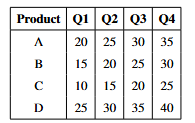
Using the same table, which product has the highest average sales per quarter?
Using the same table, in which quarter is the total sales across all products the highest?
Using the same table, what is the percentage increase in sales of product C from Q1 to Q4?

A company’s 2015 expenses are: Salaries 40%, Rent 20%, Utilities 15%, Marketing 15%, Miscellaneous 10%. If total expenses are Rs. 50 lakh, how much is spent on Salaries?
Using the same pie chart, what is the ratio of expenses on Rent to Miscellaneous?
Using the same pie chart, if Marketing expenses are reduced by 20%, how much is spent on Marketing?
Using the same pie chart, what is the combined expense of Utilities and Miscellaneous?
Five friends A, B, C, D, E sit in a row facing north. A is to the left of B, C is between A and B, D is not at an end, E is to the right of B. Who is in the middle?
Using the same seating arrangement, who is at the rightmost position?
Using the same seating arrangement, who is to the immediate left of B?
Using the same seating arrangement, who is to the immediate right of A?
The bar graph shows production (in thousand units) of products P, Q, R over 2013-2015. What is the total production of product P?
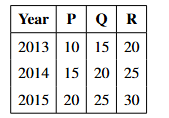
Using the same bar graph, which product has the highest total production over 2013-2015?
Using the same bar graph, what is the percentage increase in production of product Q from 2013 to 2015?
Using the same bar graph, what is the average production of product R over the three years?
Four people A, B, C, D form two teams of two. A and B cannot be together, C and D cannot be together. Who is in the same team as A?
Using the same team formation, who cannot be in the same team as B?
Using the same team formation, if C is with A, who is in the other team?
Using the same team formation, how many valid team arrangements are possible?
The line graph shows monthly closing stock prices (in Rs.) of Company X for Jan-Apr 2015: Jan = 100, Feb = 120, Mar = 110, Apr = 130. What is the percentage increase from Jan to Apr?
Using the same line graph, in which month was the stock price the lowest?
Using the same line graph, what is the average stock price over the four months?
Using the same line graph, what is the absolute difference between the highest and lowest stock prices?
Four tasks T1, T2, T3, T4 are scheduled in slots 1-4. T1 is before T3, T2 is not last, T4 is after T2. Which task is in slot 3?
Using the same scheduling puzzle, which task is in slot 4?
Using the same scheduling puzzle, which task is immediately before T3?
Using the same scheduling puzzle, which task cannot be in slot 4?
A shop sells items A and B. Item A: cost price Rs. 100, sold at 20% profit. Item B: cost price Rs. 200, sold at 25% profit. Total profit from 10 items is Rs. 250. How many of item A were sold?
Using the same caselet, what is the total selling price of all 10 items?
Using the same caselet, what is the total cost price of all 10 items?
Using the same caselet, what is the average profit per item?
Using the same caselet from questions 29-32 (A shop sells items A and B. Item A: cost price Rs. 100, sold at 20% profit. Item B: cost price Rs. 200, sold at 25% profit. Total profit from 10 items is Rs. 350, with 5 items of A and 5 items of B sold), what is the percentage contribution of item A’s profit to the total profit?
Using the same caselet, if the shop sells 10 more items (5 additional A and 5 additional B) under the same profit conditions, what will be the total profit from all 20 items?


CAT 2015 DILR Paper Analysis:
CAT 2015 Question Paper was conducted by IIM Ahmedabad on November 29, 2015. This examination had two sessions: Forenoon and Afternoon.
- The DILR section of CAT 2015 Question Paper had 4 sets of questions from Data Interpretation and Logical Reasoning.
- Three sets from the DI section were very easy but one based on set theory was difficult.
- The candidates had to select the right sets to give a good performance.
Follow the table below to understand the complete CAT 2015 DILR Question Paper analysis- distribution of questions:
| Topic | Number of Questions |
|---|---|
| Line Chart - Easy | 4 |
| Table Chart (Plants Industry) - Easy | 4 |
| Table Chart (Time and Work) - Easy | 4 |
| Set Theory - Moderate | 4 |
| Arrangement - Sudoku Set - Moderate | 4 |
| Cube-Based Set - Moderate | 4 |
| Arrangement - 9 Children - Difficult | 4 |
| Arrangement - 5 Children - Moderate | 4 |
CAT Previous Year Question Paper
| CAT 2024 Question Papers | CAT 2023 Question Papers | CAT 2022 Question Papers | CAT 2021 Question Papers |
| CAT 2020 Question Papers | CAT 2019 Question Papers | CAT 2018 Question Papers | CAT 2017 Question Papers |



Comments