




CAT 2013 Question Paper had two sections- Verbal Ability & Logical Reasoning and Quantitative Ability & Data Interpretation. CAT 2013 was conducted by IIM Indore from October 16, 2013 to November 11, 2013. The question paper had 30 questions in each section and the candidates had 70 minutes for each section. An attempt of 35-40 questions was sufficient to score above 90%ile.
Candidates preparing for CAT 2025 can download the CAT QA question paper with the solution PDF for the Slot 1 exam to get a better idea about the type of questions asked in the paper and their difficulty level.
Also Check:
CAT 2013 QA Slot 1 Question Paper with Solution PDF
| CAT 2013 QA Slot 1 Question Paper with Answer Key | Download PDF | Check Solutions |

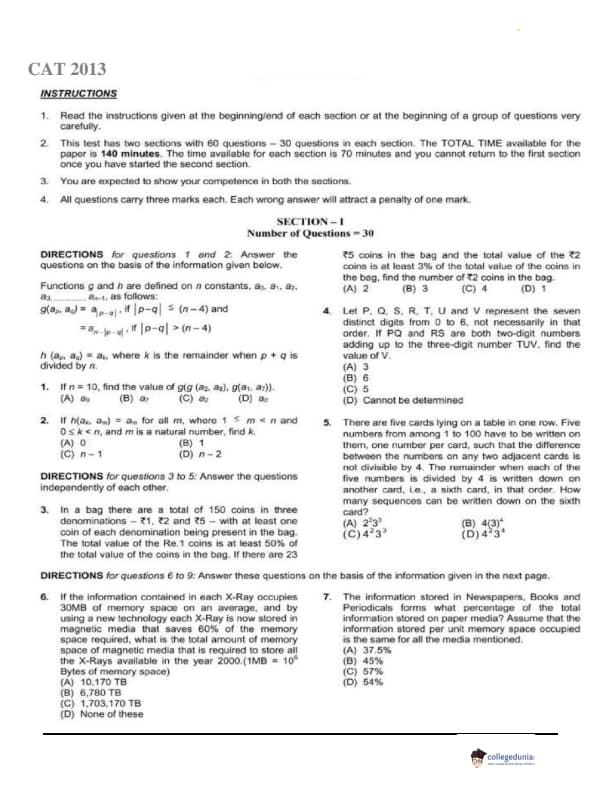
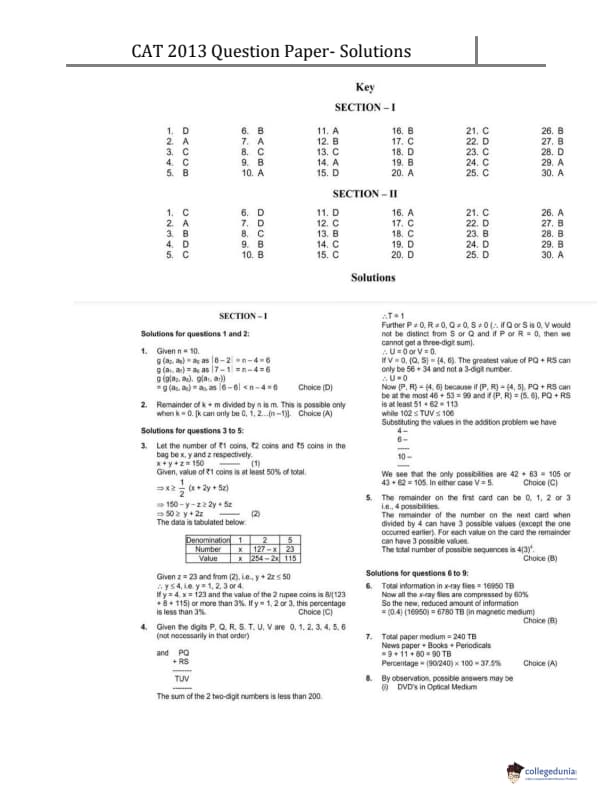
If \( n = 10 \), find the value of \( g(g(a_2, a_8), g(a_1, a_7)) \).
View Solution
If \( h(a_k, a_m) = a_m \) for all \( m \), where \( 1 \leq m < n \) and \( 0 \leq k < n \), and \( m \) is a natural number, find \( k \).
View Solution
In a bag there are a total of 150 coins in three denominations – Re.1, Rs.2 and Rs.5 – with at least one coin of each denomination. The total value of Re.1 coins is at least 50% of the total value of the coins. There are 23 Rs.5 coins and the total value of Rs.2 coins is at least 3% of the total value of coins. Find the number of Rs.2 coins in the bag.
View Solution
Let P, Q, S, R, T, U and V represent the seven distinct digits from 0 to 6, not necessarily in that order. If PQ and RS are both two-digit numbers adding up to the three-digit number TUV, find the value of V.
View Solution

There are five cards in a row with numbers from 1 to 100. Each adjacent pair must not differ by a multiple of 4. The remainder when each number is divided by 4 is written on a sixth card, in that order. How many different sequences can be written on the sixth card?
View Solution
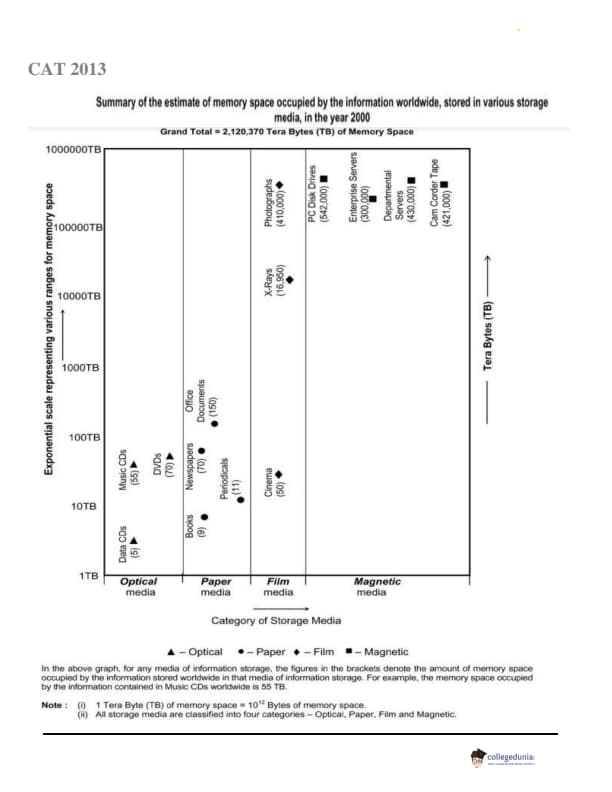
If each X-Ray occupies 30MB and a new technology reduces space by 60%, what is the total magnetic media memory required to store all the X-Rays in the year 2000? (1MB = \(10^6\) Bytes)
View Solution
What percentage of the total information stored on paper media is taken up by Newspapers, Books, and Periodicals? Assume equal space per unit of information.
View Solution
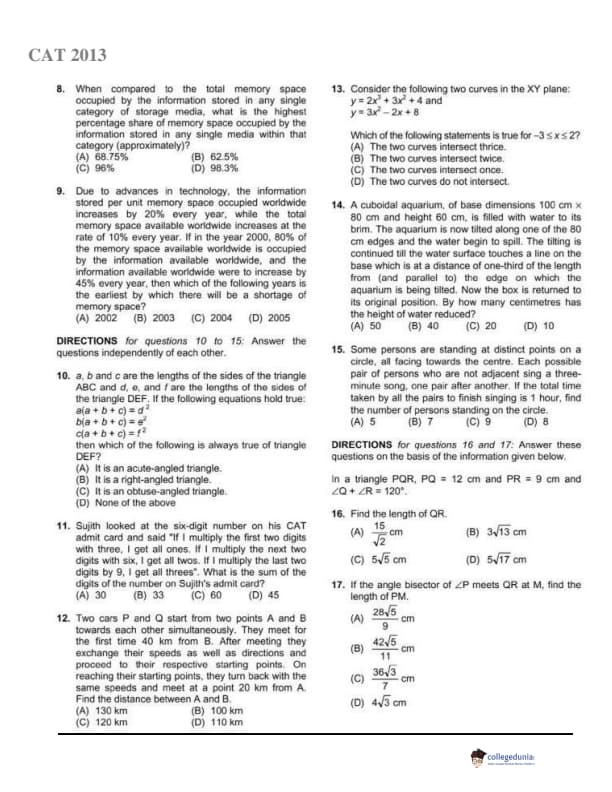
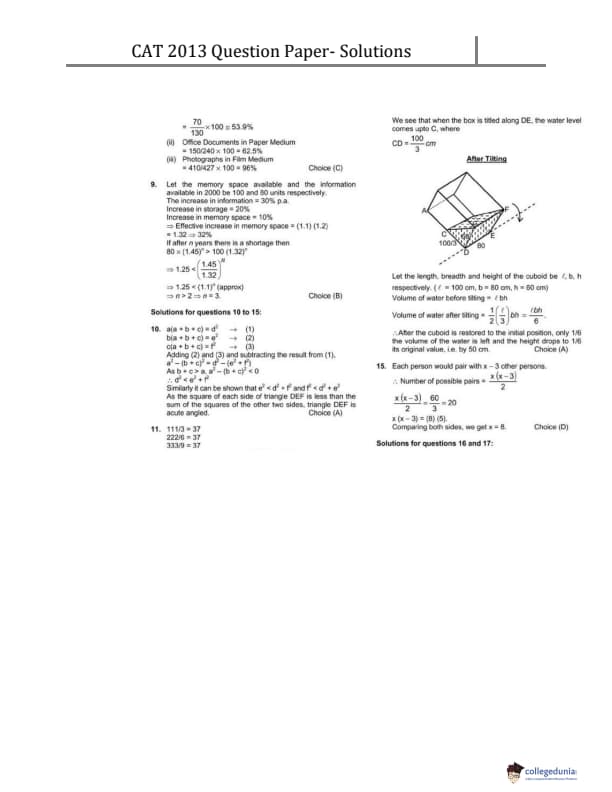
When compared to the total memory space occupied by the information stored in any single category of storage media, what is the highest percentage share of memory space occupied by the information stored in any single media within that category (approximately)?
View Solution
If information increases 20% per year, and memory space increases 10% per year from 2000 onwards (where 80% of total memory is already used), and usage grows at 45% more than current rate, when will there be shortage of memory?
View Solution
If the equations below hold true for triangles ABC and DEF: \[ a(a + b + c) = d^2,\quad b(a + b + c) = e^2,\quad c(a + b + c) = f^2 \]
Then which of the following is always true of triangle DEF?
View Solution
Sujith says:
- Multiplying first two digits by 3 gives all ones.
- Multiplying next two digits by 6 gives all twos.
- Multiplying last two digits by 9 gives all threes.
What is the sum of digits in the number?
View Solution
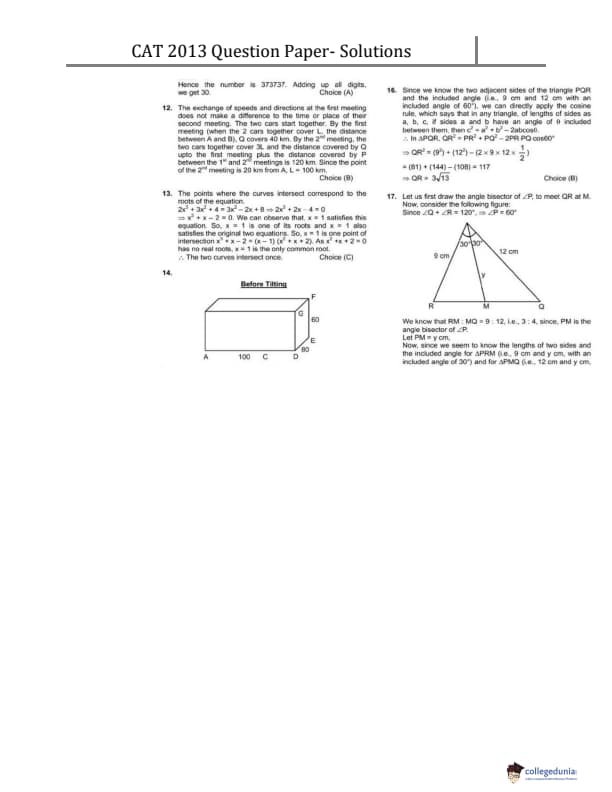
Two cars P and Q start from points A and B simultaneously. They meet 40 km from B. After meeting, they exchange speeds and return. They meet again 20 km from A. Find distance AB.
View Solution
Consider the curves: \[ y = 2x^3 + 3x^2 + 4,\quad y = 3x^2 - 2x + 8 \]
How many times do they intersect for \( -3 \leq x \leq 2 \)?
View Solution
An aquarium of size 100 cm × 80 cm × 60 cm is tilted along the 80 cm edge. Water spills until the water line reaches 1/3 of the base width. Find the height of water reduced when box is restored.
View Solution
Some persons are standing in a circle, all facing the center. Each pair not adjacent sings a 3-minute song, one after another. Total time = 1 hour. How many persons are there?
View Solution
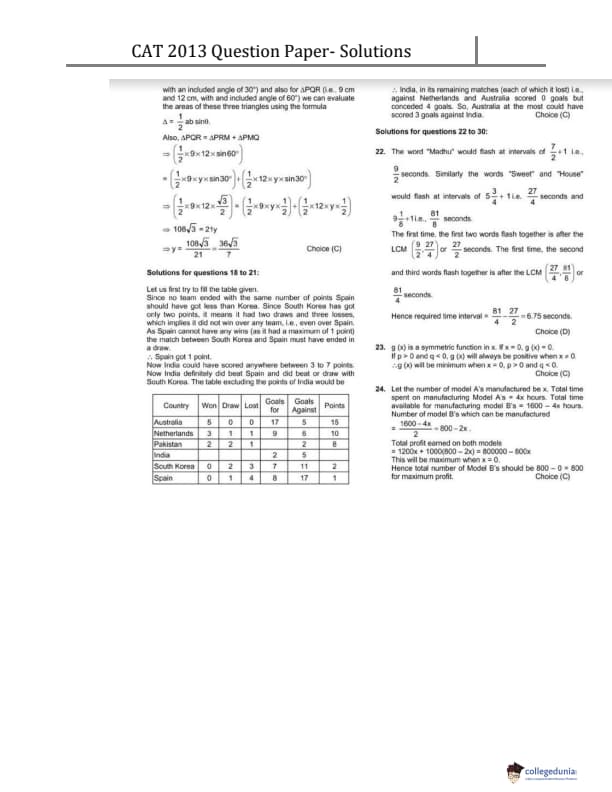
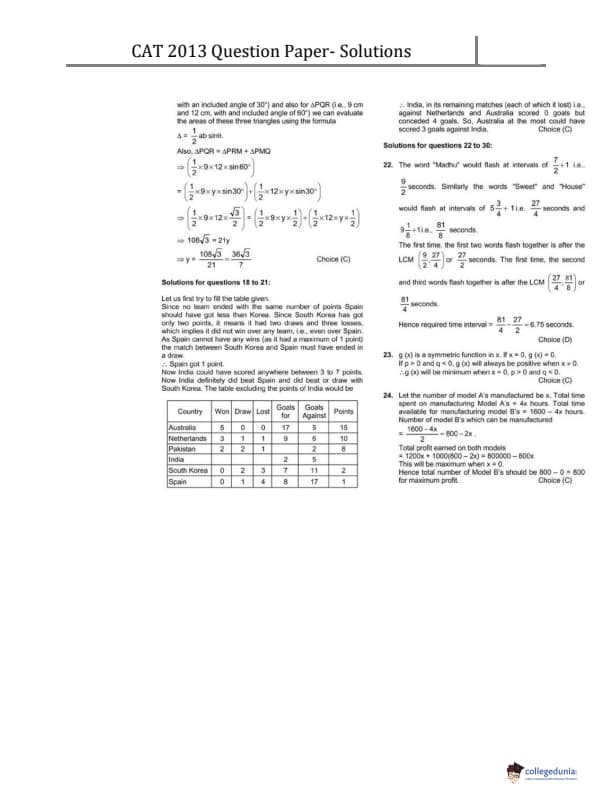
In triangle PQR, \( PQ = 12 \) cm, \( PR = 9 \) cm, and \( \angle Q + \angle R = 120^\circ \). Find the length of QR.
- \( PR = 9 \) cm
- \( \angle Q + \angle R = 120^\circ \Rightarrow \angle P = 60^\circ \)
\textbf{We will apply the Cosine Rule:} \[ QR^2 = PQ^2 + PR^2 - 2 \cdot PQ \cdot PR \cdot \cos(\angle P) \] Substitute the values: \[ QR^2 = 12^2 + 9^2 - 2 \cdot 12 \cdot 9 \cdot \cos(60^\circ) = 144 + 81 - 216 \cdot \frac{1}{2} = 225 - 108 = 117 \Rightarrow QR = \sqrt{117} = \sqrt{9 \cdot 13} = 3\sqrt{13} \] \textbf{Final Answer:} \( \boxed{3\sqrt{13} \text{ cm}} \)
View Solution
If the angle bisector of \( \angle P \) meets \( QR \) at point \( M \), find the length of \( PM \).
View Solution
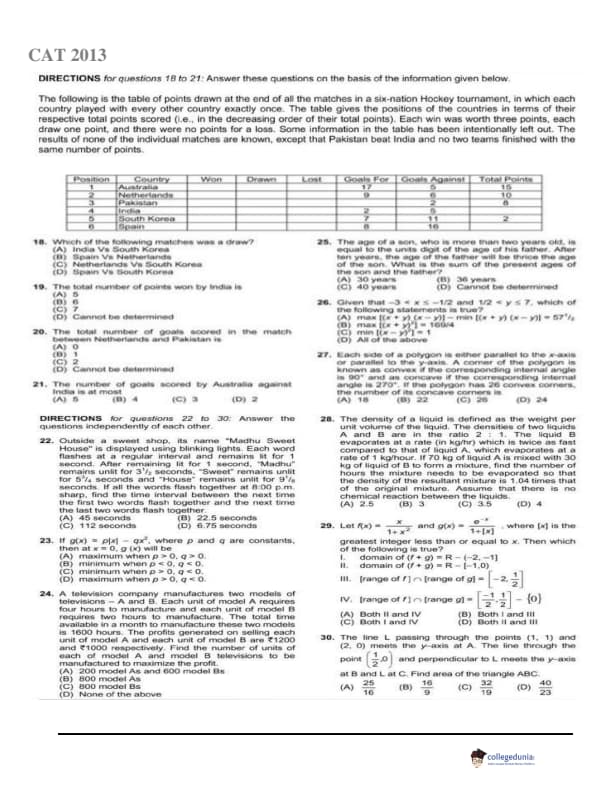
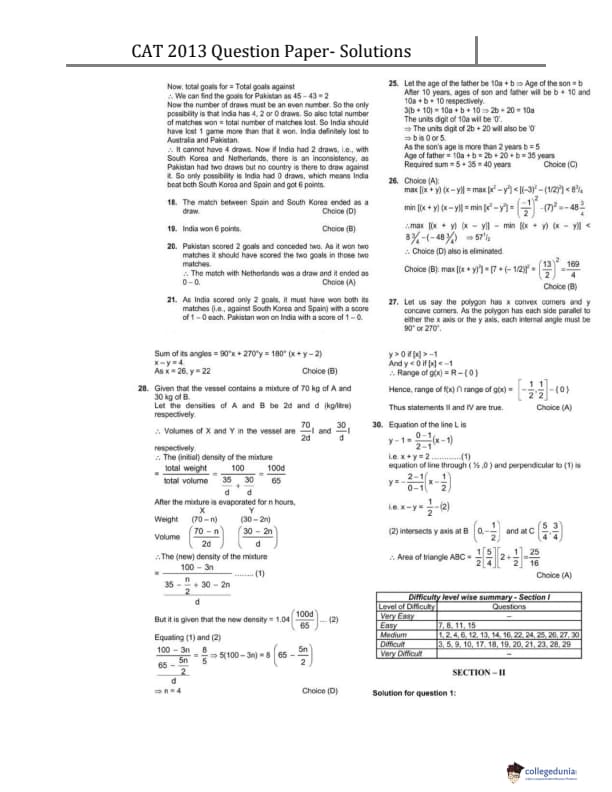
Which of the following matches was a draw?
View Solution
The total number of points won by India is:
View Solution
Total number of goals scored in Netherlands vs Pakistan match is:
View Solution
The number of goals scored by Australia against India is at most:
View Solution
Three words “Madhu”, “Sweet”, and “House” blink as follows:
- Each word flashes at regular interval and stays ON for 1 second.
- "Madhu" every 3.5 s, "Sweet" every 5.25 s, "House" every 6.75 s.
All three flash together at 8:00 a.m. Find time until next flash where last two words ("Sweet" and "House") flash together.
View Solution
If \( g(x) = p(x) = qx^n \), and \( p \) and \( q \) are constants, then at \( x = 0 \), \( g(x) \) will be:
View Solution
TV company makes 2 models A and B.
- A takes 4 hrs to make, B takes 2 hrs
- Max 1000 hrs available
- Profit per unit: A → ₹1200, B → ₹800
- Want to maximize profit under constraints
View Solution
In a college election, 5 candidates contested and 100 students voted. If each student voted for 2 candidates, and each pair of candidates received the same number of votes, how many votes did each candidate get?
View Solution
If \( x + \frac{1}{x} = 2 \), find the value of \( x^{10} + \frac{1}{x^{10}} \).
View Solution
What is the number of positive integers less than or equal to 1000 that are divisible by neither 2 nor 5?
View Solution
A number when divided by 4, 5 and 6 leaves remainders 2, 3 and 4 respectively. What is the smallest such number?
View Solution
What is the maximum possible number of intersection points of 15 lines in a plane, assuming no two lines are parallel and no three are concurrent?
View Solution
There are 4 roads between towns A and B, and 3 roads between towns B and C. How many different ways can a person travel from A to C via B and return to A without using the same road more than once in each direction?
View Solution
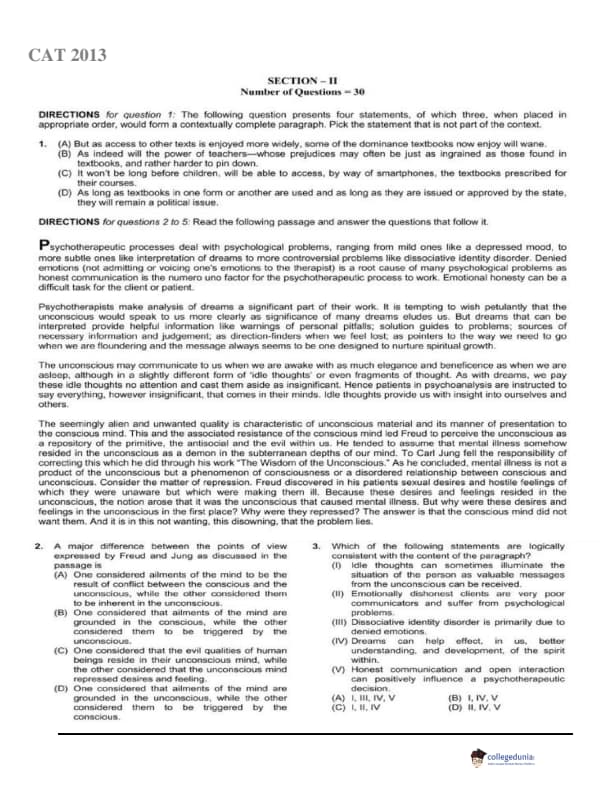
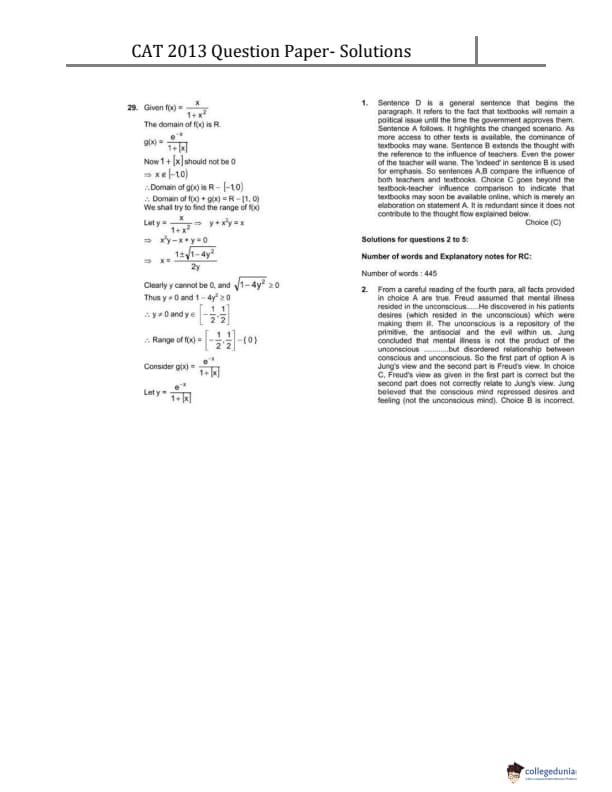
(A) But as access to other texts is enjoyed more widely, some of the dominance textbooks now enjoy will wane.
(B) As indeed will the power of teachers—whose prejudices may often be just as ingrained as those found in textbooks, and rather harder to pin down.
(C) It won’t be long before children, will be able to access, by way of smartphones, the textbooks prescribed for their courses.
(D) As long as textbooks in one form or another are used and as long as they are issued or approved by the state, they will remain a political issue.
View Solution
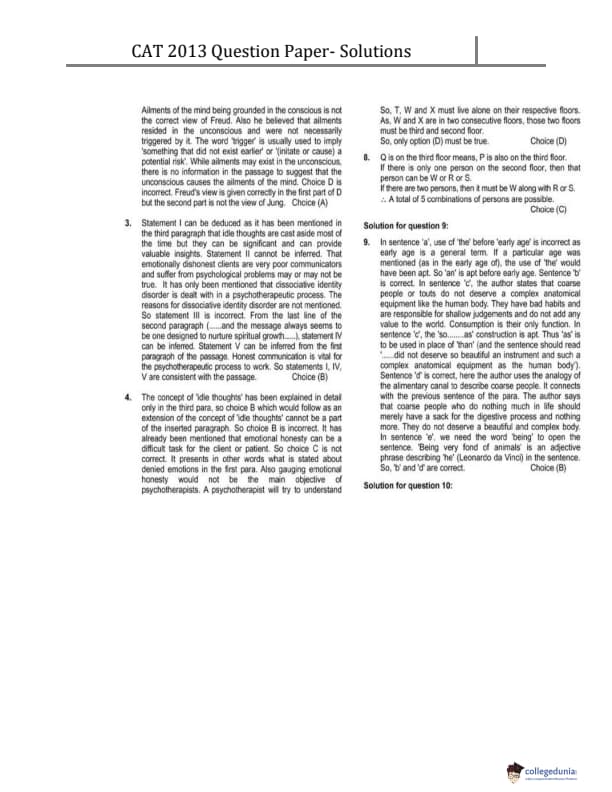
A major difference between the points of view expressed by Freud and Jung as discussed in the passage is:
View Solution
Which of the following statements are logically consistent with the paragraph?
(I) Idle thoughts can sometimes illuminate the situation of the person as valuable messages from the unconscious.
(II) Emotionally dishonest clients are very poor communicators and suffer from psychological problems.
(III) Dissociative identity disorder is primarily due to denied emotions.
(IV) Dreams can help effect, in us, better understanding and development of the spirit.
(V) Honest communication and open interaction can positively influence a psychotherapeutic process.
View Solution
If a paragraph were to be inserted between the first and second paragraphs, it would most likely deal with which of the following?
View Solution
In saying "It is tempting to wish petulantly that the unconscious would speak to us more clearly..." the author intends to suggest:
View Solution
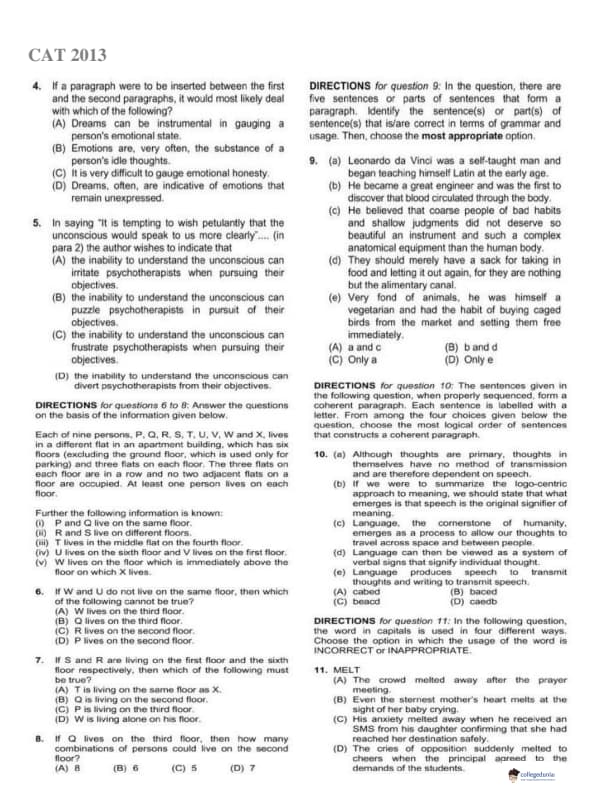
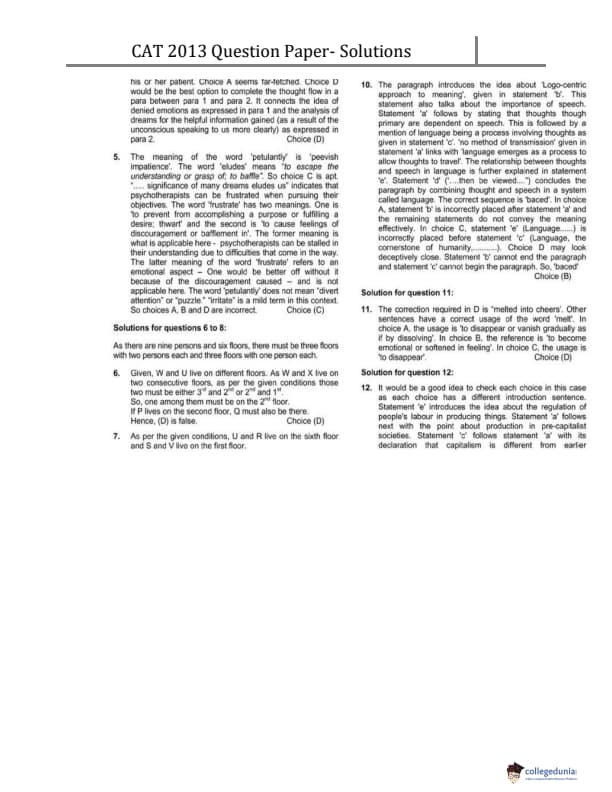
If W and U do not live on the same floor, then which of the following cannot be true?
View Solution
If S and R are living on the first and sixth floor respectively, which of the following must be true?
View Solution
If Q lives on the third floor, then how many combinations of persons could live on the second floor?
View Solution
(a) Leonardo da Vinci was a self-taught man and began teaching himself Latin at the early age.
(b) He became a great engineer and was the first to discover that blood circulated through the body.
(c) He believed that coarse people of bad habits and shallow judgments did not deserve so beautiful an instrument and such a complex anatomical equipment than the human body.
(d) They should merely have a sack for taking in food and letting it out again, for they are nothing but the alimentary canal.
(e) Very fond of animals, he was himself a vegetarian and had the habit of buying caged birds from the market and setting them free immediately.
View Solution
[(a)] Although thoughts are primary, thoughts in themselves have no method of transmission and are therefore dependent on speech.
[(b)] If we were to summarize the logo-centric approach to meaning, we should state that what emerges is that speech is the original signifier of meaning.
[(c)] Language, the cornerstone of humanity, emerges as a process to allow our thoughts to travel across space and between people.
[(d)] Language can then be viewed as a system of verbal signs that signify individual thought.
[(e)] Language produces speech to transmit thoughts and writing to transmit speech.
View Solution
MELT
View Solution
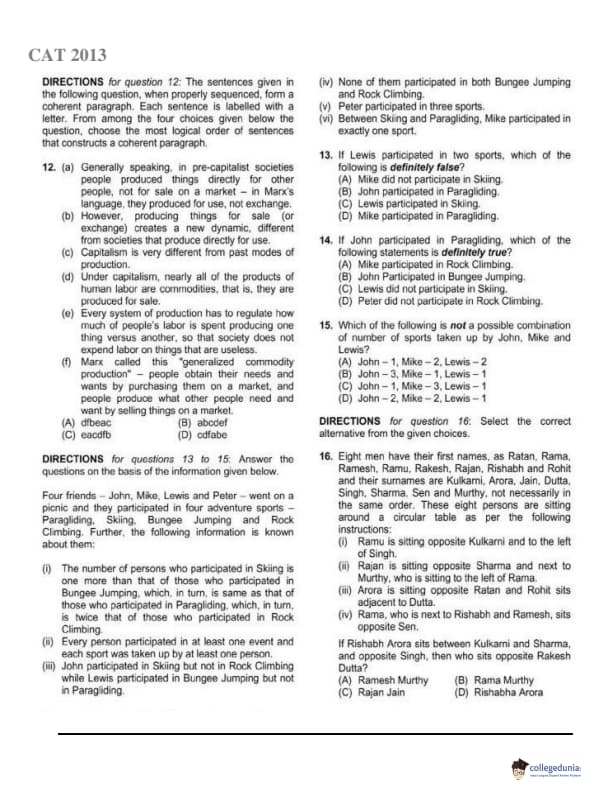
[(a)] Generally speaking, in pre-capitalist societies people produced things directly for other people, not for sale on a market – in Marx’s language, they produced for use, not exchange.
[(b)] However, producing things for sale (or exchange) creates a new dynamic, different from societies that produce directly for use.
[(c)] Capitalism is very different from past modes of production.
[(d)] Under capitalism, nearly all of the products of human labor are commodities, that is, they are produced for sale.
[(e)] Every system of production has to regulate how much of people’s labor is spent producing one thing versus another, so that the society does not end up using labor on things that are useless.
[(f)] Marx called this “generalized commodity production”—people obtain their needs not by producing what they need, but by purchasing them on a market, and people produce what other people need and want by selling things on a market.
View Solution
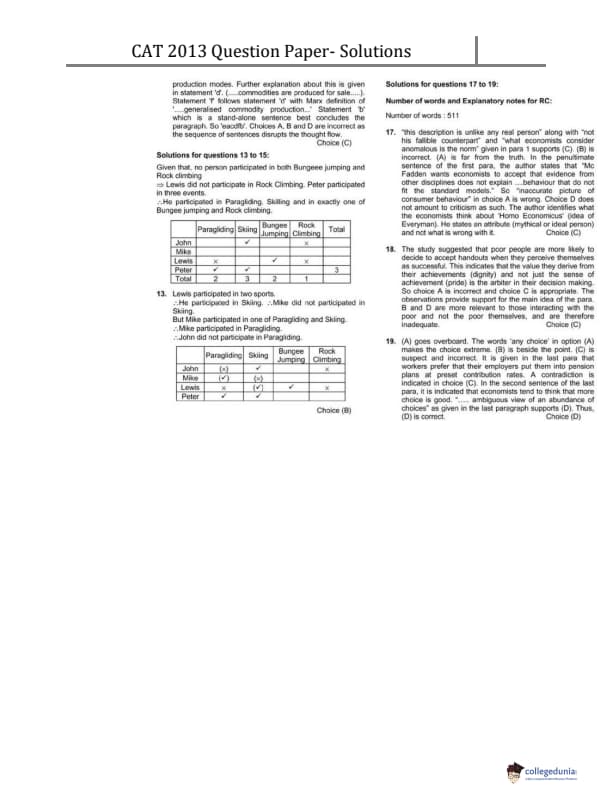
If Lewis participated in two sports, which of the following is definitely false?
View Solution
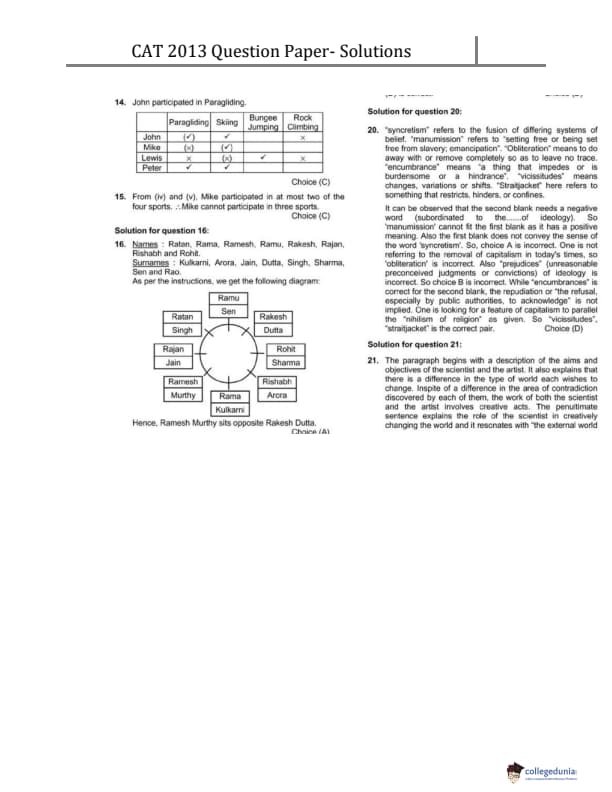
If John participated in Paragliding, which of the following statements is definitely true?
View Solution
Which of the following is not a possible combination of number of sports taken up by John, Mike, and Lewis?
View Solution
Eight men have their first names, as Ratan, Rama, Ramesh, Ramu, Rakesh, Rajan, Rishabh and Rohit and their surnames are Kulkarni, Arora, Jain, Dutta, Singh, Sharma, Sen and Murthy, not necessarily in the same order. These eight persons are sitting around a circular table as per the following instructions:
[(i)] Ramu is sitting opposite Kulkarni and to the left of Singh.
[(ii)] Rajan is sitting opposite Sharma and next to Murthy, who is sitting to the left of Rama.
[(iii)] Arora is sitting opposite Ratan and Rohit sits adjacent to Dutta.
[(iv)] Rama, who is next to Rishabh and Ramesh, sits opposite Sen.
If Rishabh Arora sits between Kulkarni and Sharma, and opposite Singh, then who sits opposite Rakesh Dutta?
View Solution
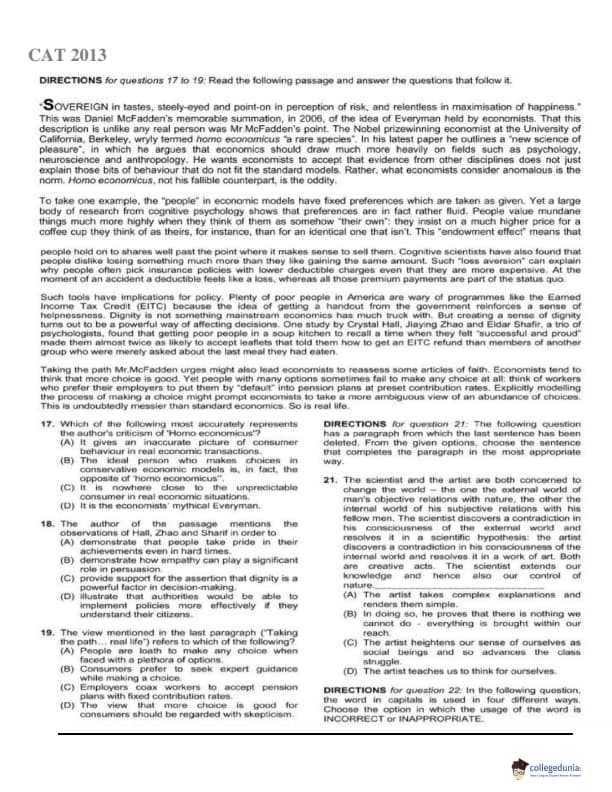
Which of the following most accurately represents the author's criticism of 'Homo economicus'?
View Solution
The author of the passage mentions the observations of Hall, Zhao and Sharif in order to:
View Solution
The view mentioned in the last paragraph (“Taking the path… real life”) refers to which of the following?
View Solution
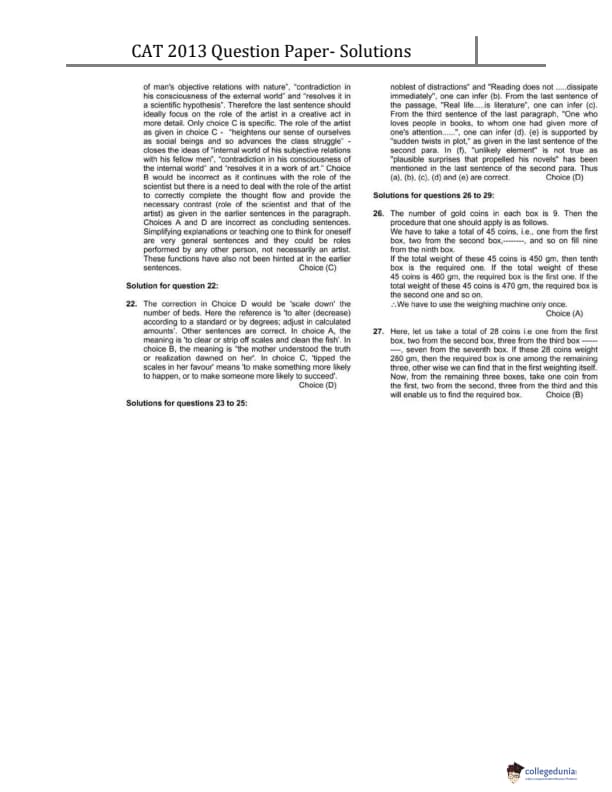
The scientist and the artist are both concerned to change the world — the one the external world of man's objective relations with nature, the other the internal world of his subjective relations with his fellow men. The scientist discovers a contradiction in his consciousness of the external world and resolves it in a scientific hypothesis; the artist discovers a contradiction in his consciousness of the internal world and resolves it in a work of art. Both are creative acts. The scientist extends our knowledge and hence also our control of nature —
View Solution
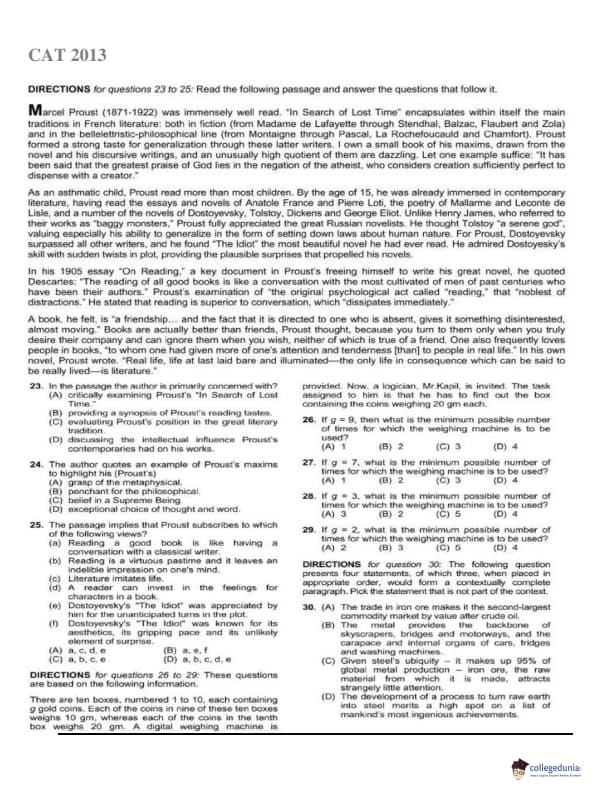
In the passage the author is primarily concerned with?
View Solution
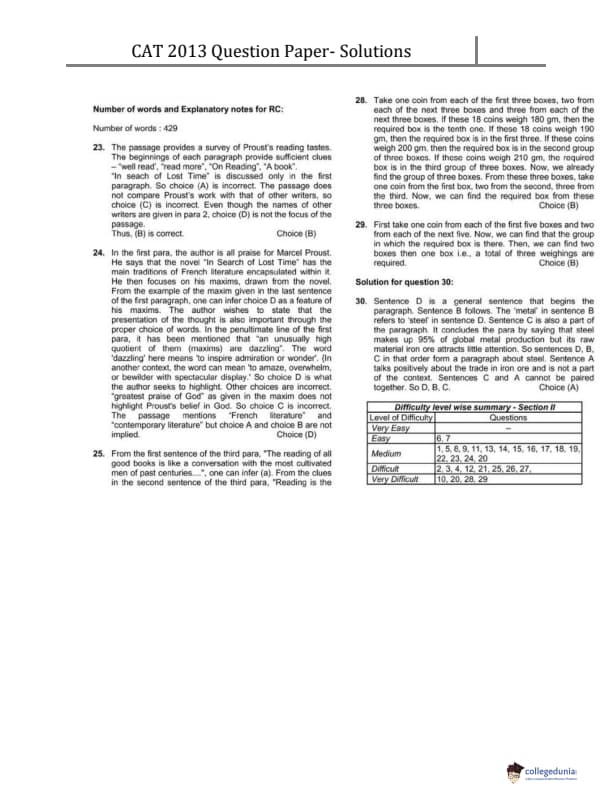
The author quotes an example of Proust’s maxims to highlight his (Proust’s):
View Solution
The passage implies that Proust subscribes to which of the following views?
(a) Reading a good book is like having a conversation with a classical writer.
(b) Reading is a virtuous pastime and it leaves an indelible impression on one’s mind.
(c) Literature imitates life.
(d) A reader can invest in the feelings for characters in a book.
(e) Dostoyevsky’s “The Idiot” was appreciated by him for the unanticipated turns in the plot.
(f) Dostoyevsky’s “The Idiot” was known for its aesthetics, its gripping pace and its unlikely element of surprise.
View Solution
If \( g = 9 \), then what is the minimum possible number of times for which the weighing machine is to be used?
View Solution
If \( g = 7 \), what is the minimum possible number of times for which the weighing machine is to be used?
View Solution
If \( g = 3 \), what is the minimum possible number of times for which the weighing machine is to be used?
View Solution
If \( g = 2 \), what is the minimum possible number of times for which the weighing machine is to be used?
View Solution
(A) The trade in iron ore makes it the second-largest commodity market by value after crude oil.
(B) The metal provides the backbone of skyscrapers, bridges and motorways, and the carapace and internal organs of cars, fridges and washing machines.
(C) Given steel’s ubiquity — it makes up 95% of global metal production — iron ore, the raw material from which it is made, attracts strangely little attention.
(D) The development of a process to turn raw earth into steel merits a high spot on a list of mankind’s most ingenious achievements.
View Solution
CAT 2013 Question Paper Analysis
In CAT 2013, the candidates were awarded 7.5 marks for each correct answer and 2.5 marks were deducted for each wrong answer.
CAT 2013 Verbal Ability and Logical Reasoning Paper Analysis
CAT 2013 Question Paper had 30 questions from the Verbal Ability and Logical Reasoning Section.
- This section of CAT 2013 Question Paper had 3 passages.
- The candidates were asked for sentence correction, para-jumble, para completion, fill in the blanks, word usage.
- The question paper had questions of Data Arrangement, Seating Arrangement, and logic-based.
CAT 2013 Quantitative Ability & Data Interpretation Paper Analysis
CAT 2013 Question Paper had 30 questions from the Quantitative Ability and Data Interpretation section.
- CAT 2013 question paper had questions from Number System, Arithmetic, Algebra, Geometry, Mensuration.
- The candidates had questions from Graphs, Pie charts, Table.
Candidates can find the marks distribution in CAT 2014 Question Paper from the below table:
| Topics | Number of Questions | Difficulty Level |
|---|---|---|
| Reading Comprehension | 10 (4+3+3) | Moderate |
| Verbal Ability | 11-14 | Moderate |
| Logical Reasoning | 6-9 | Moderate |
| Data interpretation | 6-10 | Moderate-Difficult |
| Quantitative Ability | 20-24 | Moderate |
CAT Question Papers of Other Years
| CAT 2024 Question Papers | CAT 2023 Question Papers |
| CAT 2022 Question Papers | CAT 2020 Question Papers |
| CAT 2019 Question Papers | CAT 2018 Question Papers |
| CAT 2017 Question Papers | CAT 2016 Question Papers |



Comments