CAT 1990 Question Paper with Answer Key PDF is available for download. CAT 1990 Question Paper was a set of 174 questions. A total of 120 minutes or 2 hours were allotted to complete the 174 questions. All the questions were distributed across 4 sections I e. Verbal Ability, Data Interpretation, Problem Solving/ Quant, and Reading Comprehension.
Candidates preparing for CAT 2025 can download the CAT 1990 question paper with the solution PDF to get a better idea about the type of questions asked in the paper and their difficulty level
Also Check:
CAT 1990 Question Paper with Solution PDF
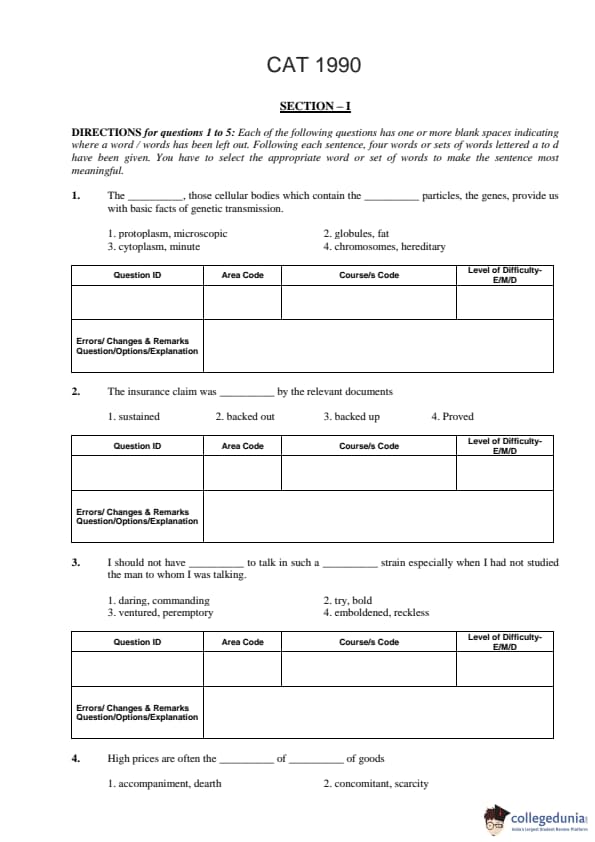
Question 1:
The .............., those cellular bodies which contain the .............. particles, the genes, provide us with basic facts of genetic transmission.
- (A) protoplasm, microscopic
- (B) globules, fat
- (C) cytoplasm, minute
- (D) chromosomes, hereditary
Question 2:
The insurance claim was .............. by the relevant documents.
- (A) sustained
- (B) backed out
- (C) backed up
- (D) proved
Question 3:
I should not have .............. to talk in such a .............. strain especially when I had not studied the man to whom I was talking.
- (A) daring, commanding
- (B) try, bold
- (C) ventured, peremptory
- (D) emboldened, reckless
Question 4:
High prices are often the .............. of .............. of goods.
- (A) accompaniment, dearth
- (B) concomitant, scarcity
- (C) cause, destitution
- (D) result, glut
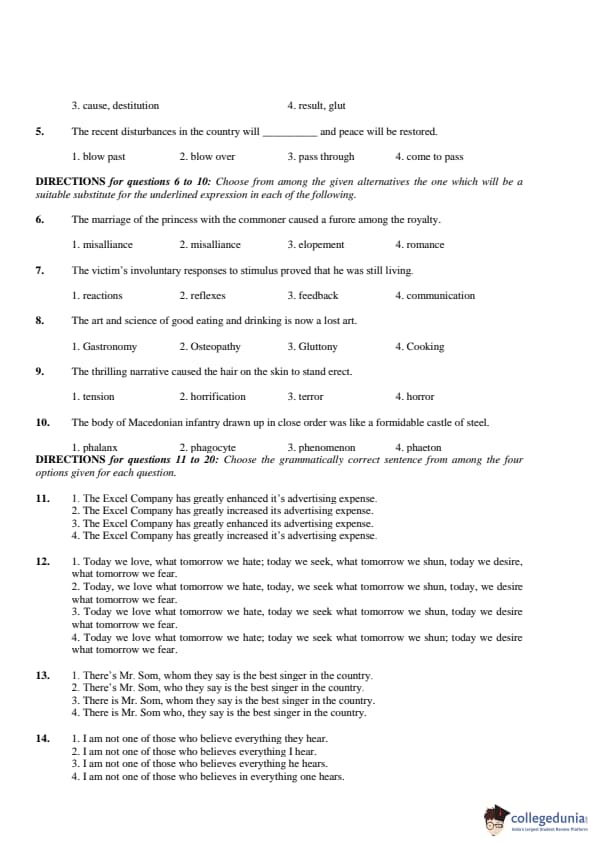
Question 5:
The recent disturbances in the country will .............. and peace will be restored.
- (A) blow past
- (B) blow over
- (C) pass through
- (D) come to pass
Question 6:
The marriage of the princess with the commoner caused a .............. among the royalty.
- (A) missalliance
- (B) misalliance
- (C) elopement
- (D) romance
Question 7:
The victim’s involuntary responses to stimulus proved that he was still living. These responses are known as ..............
- (A) reactions
- (B) reflexes
- (C) feedback
- (D) communication
Question 8:
The art and science of good eating and drinking is now a lost art. This is called ..............
- (A) Gastronomy
- (B) Osteopathy
- (C) Gluttony
- (D) Cooking
Question 9:
The thrilling narrative caused the hair on the skin to stand erect. This is called ..............
- (A) tension
- (B) horrification
- (C) terror
- (D) horror
Question 10:
The body of Macedonian infantry drawn up in close order was like a formidable castle of steel. This formation is called ..............
- (A) phalanx
- (B) phagocyte
- (C) phenomenon
- (D) phaeton
Question 11:
Choose the grammatically correct sentence from the following:
- (A) The Excel Company has greatly enhanced it’s advertising expense.
- (B) The Excel Company has greatly increased its advertising expense.
- (C) The Excel Company has greatly enhanced its advertising expense.
- (D) The Excel Company has greatly increased it’s advertising expense.
Correct Answer: (B) The Excel Company has greatly increased its advertising expense.
View Solution
Question 12:
Choose the grammatically correct sentence from the following:
- (A) Today we love, what tomorrow we hate; today we seek, what tomorrow we shun, today we desire, what tomorrow we fear.
- (B) Today, we love what tomorrow we hate, today, we seek what tomorrow we shun, today, we desire what tomorrow we fear.
- (C) Today we love what tomorrow we hate, today we seek what tomorrow we shun, today we desire what tomorrow we fear.
- (D) Today we love what tomorrow we hate; today we seek what tomorrow we shun; today we desire what tomorrow we fear.
Correct Answer: (D) Today we love what tomorrow we hate; today we seek what tomorrow we shun; today we desire what tomorrow we fear.
View Solution
Question 13:
Choose the grammatically correct sentence from the following:
- (A) There’s Mr. Som, whom they say is the best singer in the country.
- (B) There’s Mr. Som, who they say is the best singer in the country.
- (C) There is Mr. Som, whom they say is the best singer in the country.
- (D) There is Mr. Som who, they say is the best singer in the country.
Correct Answer: (B) There’s Mr. Som, who they say is the best singer in the country.
View Solution
Question 14:
Choose the grammatically correct sentence from the following:
- (A) I am not one of those who believe everything they hear.
- (B) I am not one of those who believes everything I hear.
- (C) I am not one of those who believes everything he hears.
- (D) I am not one of those who believes in everything one hears.
Correct Answer: (A) I am not one of those who believe everything they hear.
View Solution
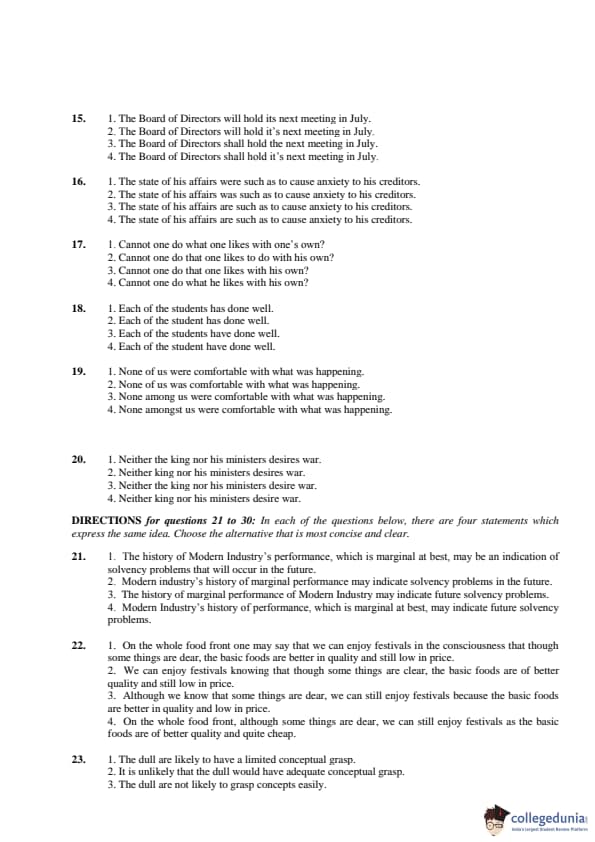
Question 15:
Choose the grammatically correct sentence from the following:
- (A) The Board of Directors will hold its next meeting in July.
- (B) The Board of Directors will hold it’s next meeting in July.
- (C) The Board of Directors shall hold the next meeting in July.
- (D) The Board of Directors shall hold it’s next meeting in July.
Correct Answer: (A) The Board of Directors will hold its next meeting in July.
View Solution
Question 16:
Choose the grammatically correct sentence from the following:
- (A) The state of his affairs were such as to cause anxiety to his creditors.
- (B) The state of his affairs was such as to cause anxiety to his creditors.
- (C) The state of his affairs are such as to cause anxiety to his creditors.
- (D) The state of his affairs are such as to cause anxiety to his creditors.
Correct Answer: (B) The state of his affairs was such as to cause anxiety to his creditors.
View Solution
Question 17:
Choose the grammatically correct sentence from the following:
- (A) Cannot one do what one likes with one’s own?
- (B) Cannot one do that one likes to do with his own?
- (C) Cannot one do that one likes with his own?
- (D) Cannot one do what he likes with his own?
Correct Answer: (A) Cannot one do what one likes with one’s own?
View Solution
Question 18:
Choose the grammatically correct sentence from the following:
- (A) Each of the students has done well.
- (B) Each of the student has done well.
- (C) Each of the students have done well.
- (D) Each of the student have done well.
Correct Answer: (A) Each of the students has done well.
View Solution
Question 19:
Choose the grammatically correct sentence from the following:
- (A) None of us were comfortable with what was happening.
- (B) None of us was comfortable with what was happening.
- (C) None among us were comfortable with what was happening.
- (D) None amongst us were comfortable with what was happening.
Correct Answer: (B) None of us was comfortable with what was happening.
View Solution
Question 20:
Choose the grammatically correct sentence from the following:
- (A) Neither the king nor his ministers desires war.
- (B) Neither king nor his ministers desires war.
- (C) Neither the king nor his ministers desire war.
- (D) Neither king nor his ministers desire war.
Correct Answer: (C) Neither the king nor his ministers desire war.
View Solution
Question 21:
Choose the most concise and clear statement from the following that conveys the same idea:
- (A) The history of Modern Industry’s performance, which is marginal at best, may be an indication of solvency problems that will occur in the future.
- (B) Modern industry’s history of marginal performance may indicate solvency problems in the future.
- (C) The history of marginal performance of Modern Industry may indicate future solvency problems.
- (D) Modern Industry’s history of performance, which is marginal at best, may indicate future solvency problems.
Correct Answer: (C) The history of marginal performance of Modern Industry may indicate future solvency problems.
View Solution
Question 22:
Choose the most concise and clear statement from the following that conveys the same idea:
- (A) On the whole food front one may say that we can enjoy festivals in the consciousness that though some things are dear, the basic foods are better in quality and still low in price.
- (B) We can enjoy festivals knowing that though some things are dear, the basic foods are of better quality and still low in price.
- (C) Although we know that some things are dear, we can still enjoy festivals because the basic foods are better in quality and low in price.
- (D) On the whole food front, although some things are dear, we can still enjoy festivals as the basic foods are of better quality and quite cheap.
Correct Answer: (B) We can enjoy festivals knowing that though some things are dear, the basic foods are of better quality and still low in price.
View Solution
Question 23:
Choose the most concise and clear statement from the following that conveys the same idea:
- (A) The dull are likely to have a limited conceptual grasp.
- (B) It is unlikely that the dull would have adequate conceptual grasp.
- (C) The dull are not likely to grasp concepts easily.
- (D) It is unlikely that the dull can grasp concepts easily.
Correct Answer: (C) The dull are not likely to grasp concepts easily.
View Solution
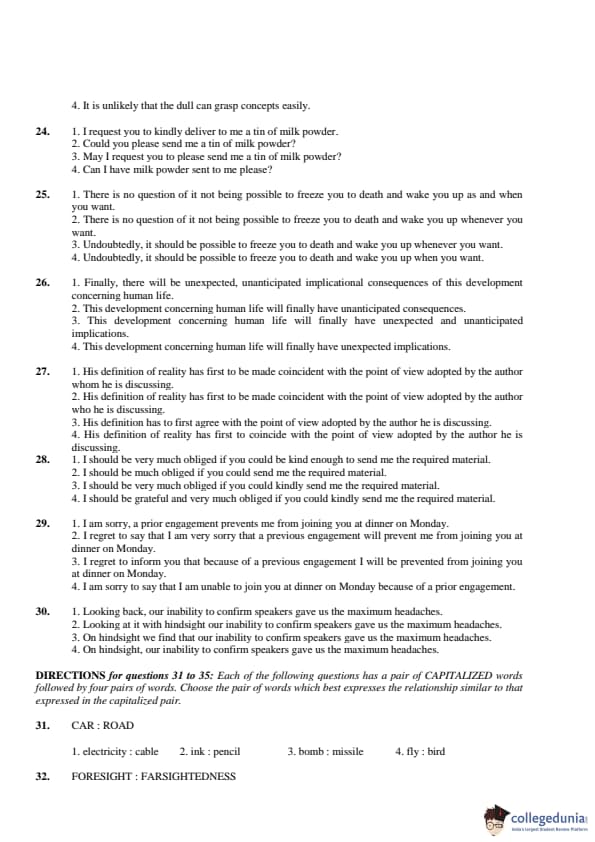
Question 24:
Choose the most concise and clear statement from the following that conveys the same request:
- (A) I request you to kindly deliver to me a tin of milk powder.
- (B) Could you please send me a tin of milk powder?
- (C) May I request you to please send me a tin of milk powder?
- (D) Can I have milk powder sent to me please?
Correct Answer: (B) Could you please send me a tin of milk powder?
View Solution
Question 25:
Choose the most concise and clear statement from the following that conveys the same idea:
- (A) There is no question of it not being possible to freeze you to death and wake you up as and when you want.
- (B) There is no question of it not being possible to freeze you to death and wake you up whenever you want.
- (C) Undoubtedly, it should be possible to freeze you to death and wake you up whenever you want.
- (D) Undoubtedly, it should be possible to freeze you to death and wake you up when you want.
Correct Answer: (C) Undoubtedly, it should be possible to freeze you to death and wake you up whenever you want.
View Solution
Question 26:
Choose the most concise and clear statement from the following that conveys the same idea:
- (A) Finally, there will be unexpected, unanticipated implicational consequences of this development concerning human life.
- (B) This development concerning human life will finally have unanticipated consequences.
- (C) This development concerning human life will finally have unexpected and unanticipated implications.
- (D) This development concerning human life will finally have unexpected implications.
Correct Answer: (D) This development concerning human life will finally have unexpected implications.
View Solution
Question 27:
Choose the most concise and clear statement from the following that conveys the same idea:
- (A) His definition of reality has first to be made coincident with the point of view adopted by the author whom he is discussing.
- (B) His definition of reality has first to be made coincident with the point of view adopted by the author who he is discussing.
- (C) His definition has to first agree with the point of view adopted by the author he is discussing.
- (D) His definition of reality has first to coincide with the point of view adopted by the author he is discussing.
Correct Answer: (D) His definition of reality has first to coincide with the point of view adopted by the author he is discussing.
View Solution
Question 28:
Choose the most concise and clear statement from the following that conveys the same request:
- (A) I should be very much obliged if you could be kind enough to send me the required material.
- (B) I should be much obliged if you could send me the required material.
- (C) I should be very much obliged if you could kindly send me the required material.
- (D) I should be grateful and very much obliged if you could kindly send me the required material.
Correct Answer: (B) I should be much obliged if you could send me the required material.
View Solution
Question 29:
Choose the most concise and clear statement from the following that conveys the same idea:
- (A) I am sorry, a prior engagement prevents me from joining you at dinner on Monday.
- (B) I regret to say that I am very sorry that a previous engagement will prevent me from joining you at dinner on Monday.
- (C) I regret to inform you that because of a previous engagement I will be prevented from joining you at dinner on Monday.
- (D) I am sorry to say that I am unable to join you at dinner on Monday because of a prior engagement.
Correct Answer: (A) I am sorry, a prior engagement prevents me from joining you at dinner on Monday.
View Solution
Question 30:
Choose the most concise and clear statement from the following that conveys the same idea:
- (A) Looking back, our inability to confirm speakers gave us the maximum headaches.
- (B) Looking at it with hindsight our inability to confirm speakers gave us the maximum headaches.
- (C) On hindsight we find that our inability to confirm speakers gave us the maximum headaches.
- (D) On hindsight, our inability to confirm speakers gave us the maximum headaches.
Correct Answer: (A) Looking back, our inability to confirm speakers gave us the maximum headaches.
View Solution
Question 31:
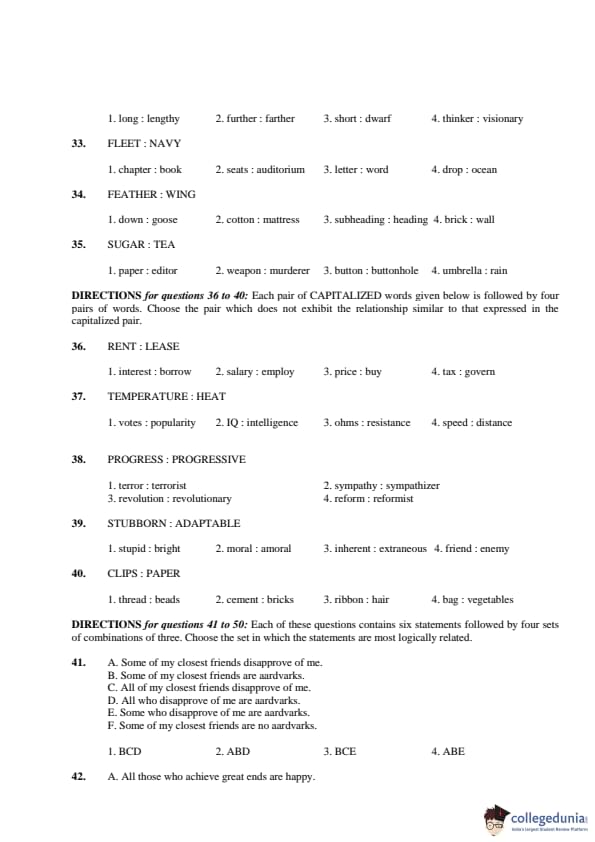
CAR : ROAD
Choose the pair of words that best expresses the relationship similar to the one above:
- (A) electricity : cable
- (B) ink : pencil
- (C) bomb : missile
- (D) fly : bird
Question 32:
FORESIGHT : FARSIGHTEDNESS
Choose the pair of words that best expresses the relationship similar to the one above:
- (A) long : lengthy
- (B) further : farther
- (C) short : dwarf
- (D) thinker : visionary
Question 33:
FLEET : NAVY
Choose the pair of words that best expresses the relationship similar to the one above:
- (A) chapter : book
- (B) seats : auditorium
- (C) letter : word
- (D) drop : ocean
Question 34:
FEATHER : WING
Choose the pair of words that best expresses the relationship similar to the one above:
- (A) down : goose
- (B) cotton : mattress
- (C) subheading : heading
- (D) brick : wall
Question 35:
SUGAR : TEA
Choose the pair of words that best expresses the relationship similar to the one above:
- (A) paper : editor
- (B) weapon : murderer
- (C) button : buttonhole
- (D) umbrella : rain
Question 36:
RENT : LEASE — Choose the pair that does not exhibit the same relationship:
- (A) interest : borrow
- (B) salary : employ
- (C) price : buy
- (D) tax : govern
Question 37:
TEMPERATURE : HEAT — Choose the pair that does not exhibit the same relationship:
- (A) votes : popularity
- (B) IQ : intelligence
- (C) ohms : resistance
- (D) speed : distance
Question 38:
PROGRESS : PROGRESSIVE — Choose the pair that does not exhibit the same relationship:
- (A) terror : terrorist
- (B) sympathy : sympathizer
- (C) revolution : revolutionary
- (D) reform : reformist
Question 39:
STUBBORN : ADAPTABLE — Choose the pair that does not exhibit the same relationship:
- (A) stupid : bright
- (B) moral : amoral
- (C) inherent : extraneous
- (D) friend : enemy
Question 40:
CLIPS : PAPER — Choose the pair that does not exhibit the same relationship:
- (A) thread : beads
- (B) cement : bricks
- (C) ribbon : hair
- (D) bag : vegetables
Question 41:
Choose the set of three statements which are most logically related:
Statements:
A. Some of my closest friends disapprove of me.
B. Some of my closest friends are aardvarks.
C. All of my closest friends disapprove of me.
D. All who disapprove of me are aardvarks.
E. Some who disapprove of me are aardvarks.
F. Some of my closest friends are no aardvarks.
- (1) BCD
- (2) ABD
- (3) BCE
- (4) ABE
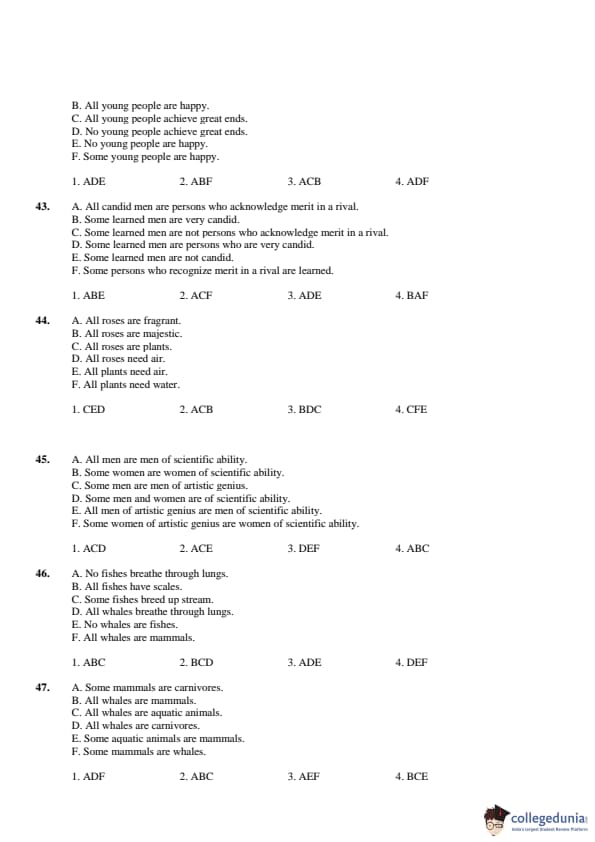
Question 42:
Choose the set of three statements which are most logically related:
Statements:
A. All those who achieve great ends are happy.
B. All young people are happy.
C. All young people achieve great ends.
D. No young people achieve great ends.
E. No young people are happy.
F. Some young people are happy.
- (1) ADE
- (2) ABF
- (3) ACB
- (4) ADF
Question 43:
Choose the set of three statements which are most logically related:
Statements:
A. All candid men are persons who acknowledge merit in a rival.
B. Some learned men are very candid.
C. Some learned men are not persons who acknowledge merit in a rival.
D. Some learned men are persons who are very candid.
E. Some learned men are not candid.
F. Some persons who recognize merit in a rival are learned.
- (1) ABE
- (2) ACF
- (3) ADE
- (4) BAF
Question 44:
Choose the set of three statements which are most logically related:
Statements:
A. All roses are fragrant.
B. All roses are majestic.
C. All roses are plants.
D. All roses need air.
E. All plants need air.
F. All plants need water.
- (1) CED
- (2) ACB
- (3) BDC
- (4) CFE
Question 45:
Choose the set of three statements which are most logically related:
Statements:
A. All men are men of scientific ability.
B. Some women are women of scientific ability.
C. Some men are men of artistic genius.
D. Some men and women are of scientific ability.
E. All men of artistic genius are men of scientific ability.
F. Some women of artistic genius are women of scientific ability.
- (1) ACD
- (2) ACE
- (3) DEF
- (4) ABC
Question 46:
Choose the set of three statements which are most logically related:
Statements:
A. No fishes breathe through lungs.
B. All fishes have scales.
C. Some fishes breed upstream.
D. All whales breathe through lungs.
E. No whales are fishes.
F. All whales are mammals.
- (1) ABC
- (2) BCD
- (3) ADE
- (4) DEF
Question 47:
Choose the set of three statements which are most logically related:
Statements:
A. Some mammals are carnivores.
B. All whales are mammals.
C. All whales are aquatic animals.
D. All whales are carnivores.
E. Some aquatic animals are mammals.
F. Some mammals are whales.
- (1) ADF
- (2) ABC
- (3) AEF
- (4) BCE
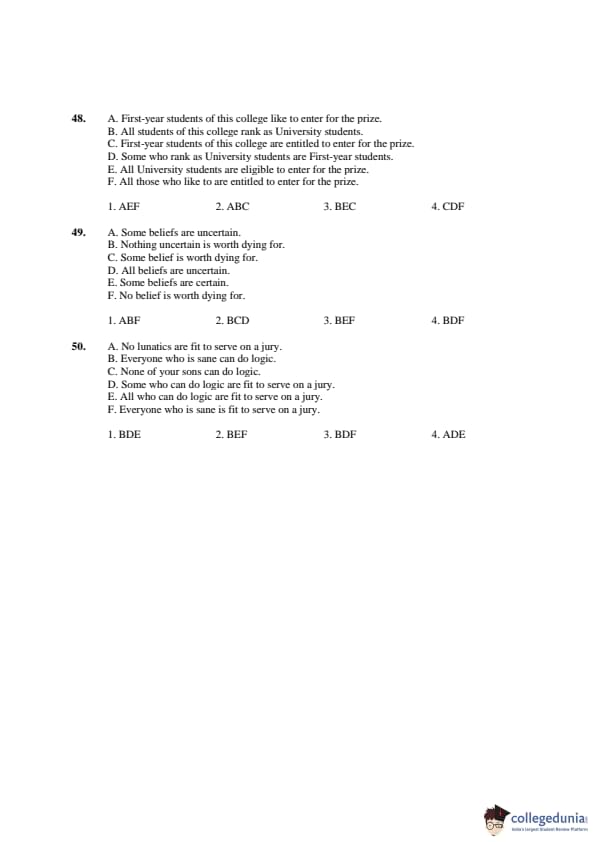
Question 48:
Choose the set of three statements which are most logically related:
Statements:
A. First-year students of this college like to enter for the prize.
B. All students of this college rank as University students.
C. First-year students of this college are entitled to enter for the prize.
D. Some who rank as University students are First-year students.
E. All University students are eligible to enter for the prize.
F. All those who like to are entitled to enter for the prize.
- (1) AEF
- (2) ABC
- (3) BEC
- (4) CDF
Question 49:
Choose the set of three statements which are most logically related:
Statements:
A. Some beliefs are uncertain.
B. Nothing uncertain is worth dying for.
C. Some belief is worth dying for.
D. All beliefs are uncertain.
E. Some beliefs are certain.
F. No belief is worth dying for.
- (1) ABF
- (2) BCD
- (3) BEF
- (4) BDF
Question 50:
Choose the set of three statements which are most logically related:
Statements:
A. No lunatics are fit to serve on a jury.
B. Everyone who is sane can do logic.
C. None of your sons can do logic.
D. Some who can do logic are fit to serve on a jury.
E. All who can do logic are fit to serve on a jury.
F. Everyone who is sane is fit to serve on a jury.
- (1) BDE
- (2) BEF
- (3) BDF
- (4) ADE
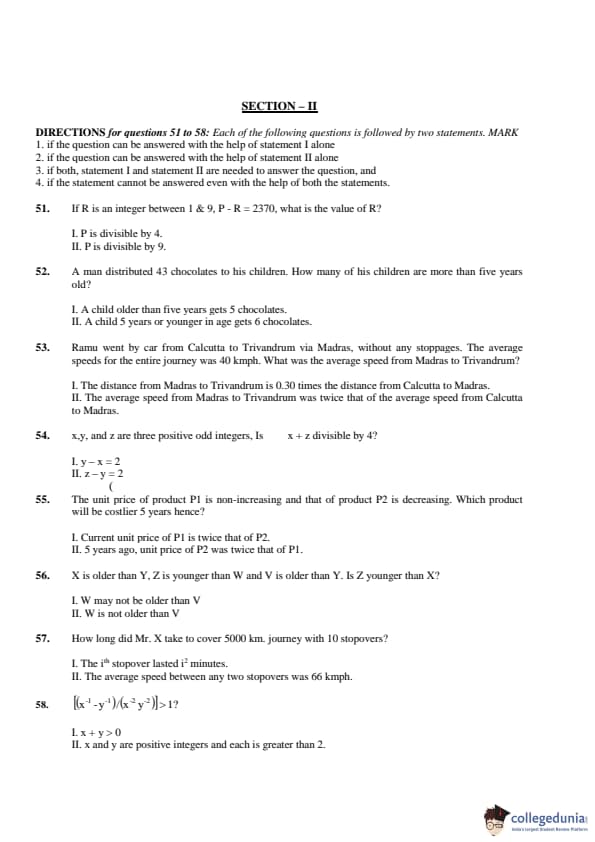
Question 51:
If R is an integer between 1 \& 9, P - R = 2370, what is the value of R?
I. P is divisible by (4)
II. P is divisible by 9.
- (1) if the question can be answered with the help of statement I alone
- (2) if the question can be answered with the help of statement II alone
- (3) if both statement I and statement II are needed to answer the question
- (4) if the statement cannot be answered even with the help of both the statements
Correct Answer: (3) if both statement I and statement II are needed to answer the question
View Solution
Question 52:
A man distributed 43 chocolates to his children. How many of his children are more than five years old?
I. A child older than five years gets 5 chocolates.
II. A child 5 years or younger in age gets 6 chocolates.
- (1) if the question can be answered with the help of statement I alone
- (2) if the question can be answered with the help of statement II alone
- (3) if both statement I and statement II are needed to answer the question
- (4) if the statement cannot be answered even with the help of both the statements
Correct Answer: (3) if both statement I and statement II are needed to answer the question
View Solution
Question 53:
Ramu went by car from Calcutta to Trivandrum via Madras, without any stoppages. The average speed for the entire journey was 40 kmph. What was the average speed from Madras to Trivandrum?
I. The distance from Madras to Trivandrum is 0.30 times the distance from Calcutta to Madras.
II. The average speed from Madras to Trivandrum was twice that of the average speed from Calcutta to Madras.
- (1) if the question can be answered with the help of statement I alone
- (2) if the question can be answered with the help of statement II alone
- (3) if both statement I and statement II are needed to answer the question
- (4) if the statement cannot be answered even with the help of both the statements
Correct Answer: (3) if both statement I and statement II are needed to answer the question
View Solution
Question 54:
\(x\), \(y\), and \(z\) are three positive odd integers. Is \(x + z\) divisible by 4?
I. \(y - x = 2\)
II. \(z - y = 2\)
- (1) if the question can be answered with the help of statement I alone
- (2) if the question can be answered with the help of statement II alone
- (3) if both statement I and statement II are needed to answer the question
- (4) if the statement cannot be answered even with the help of both the statements
Correct Answer: (3) if both statement I and statement II are needed to answer the question
View Solution
Question 55:
The unit price of product P1 is non-increasing and that of product P2 is decreasing. Which product will be costlier 5 years hence?
I. Current unit price of P1 is twice that of P(2)
II. 5 years ago, unit price of P2 was twice that of P(1)
- (1) if the question can be answered with the help of statement I alone
- (2) if the question can be answered with the help of statement II alone
- (3) if both statement I and statement II are needed to answer the question
- (4) if the statement cannot be answered even with the help of both the statements
Correct Answer: (4) if the statement cannot be answered even with the help of both the statements
View Solution
Question 56:
X is older than Y, Z is younger than W, and V is older than Y. Is Z younger than X?
I. W may not be older than V.
II. W is not older than V.
- (1) if the question can be answered with the help of statement I alone
- (2) if the question can be answered with the help of statement II alone
- (3) if both statement I and statement II are needed to answer the question
- (4) if the statement cannot be answered even with the help of both the statements
Correct Answer: (4) if the statement cannot be answered even with the help of both the statements
View Solution
Question 57:
How long did Mr. X take to cover 5000 km journey with 10 stopovers?
I. The \(i^{th}\) stopover lasted \(i^2\) minutes.
II. The average speed between any two stopovers was 66 kmph.
- (1) if the question can be answered with the help of statement I alone
- (2) if the question can be answered with the help of statement II alone
- (3) if both statement I and statement II are needed to answer the question
- (4) if the statement cannot be answered even with the help of both the statements
Correct Answer: (3) if both statement I and statement II are needed to answer the question
View Solution
Question 58:
\(\left[ \frac{x^{-1} - y^{-1}}{x^2 - y^2} \right] > 1\)?
I. \(x + y > 0\)
II. \(x\) and \(y\) are positive integers and each is greater than (2)
- (1) if the question can be answered with the help of statement I alone
- (2) if the question can be answered with the help of statement II alone
- (3) if both statement I and statement II are needed to answer the question
- (4) if the statement cannot be answered even with the help of both the statements
Correct Answer: (2) if the question can be answered with the help of statement II alone
View Solution
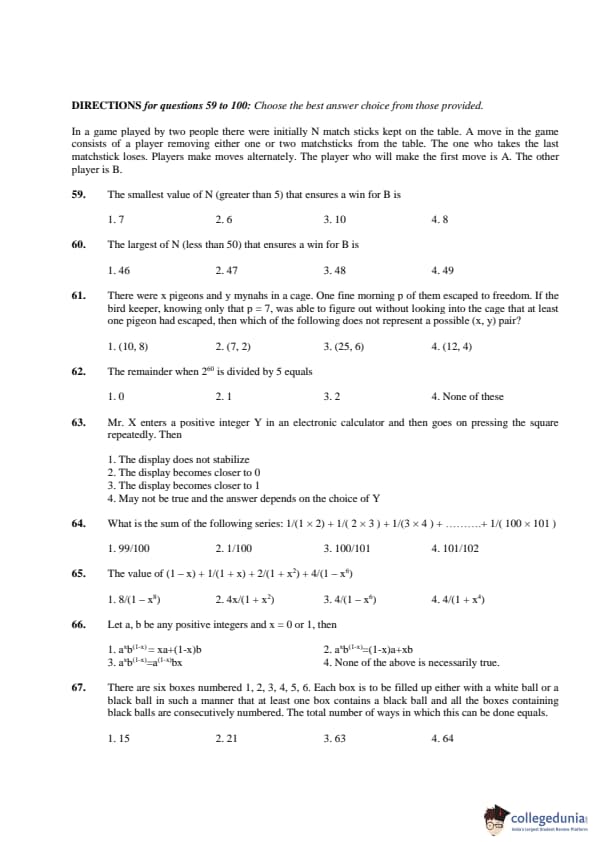
Question 59:
The smallest value of N (greater than 5) that ensures a win for B is:
Question 60:
The largest value of N (less than 50) that ensures a win for B is:
- (A) 46
- (B) 47
- (C) 48
- (D) 49
Question 61:
There were \(x\) pigeons and \(y\) mynahs in a cage. One fine morning \(p\) of them escaped to freedom. If the bird keeper, knowing only that \(p = 7\), was able to figure out without looking into the cage that at least one pigeon had escaped, then which of the following does not represent a possible \((x, y)\) pair?
- (A) (10, 8)
- (B) (7, 2)
- (C) (25, 6)
- (D) (12, 4)
Question 62:
The remainder when \(26^{60}\) is divided by 5 equals:
- (A) 0
- (B) 1
- (C) 2
- (D) None of these
Question 63:
Mr. X enters a positive integer Y in an electronic calculator and then goes on pressing the square repeatedly. Then:
- (A) The display does not stabilize
- (B) The display becomes closer to 0
- (C) The display becomes closer to 1
- (D) May not be true and the answer depends on the choice of Y
Correct Answer: (D) May not be true and the answer depends on the choice of Y
View Solution
Question 64:
What is the sum of the following series:
\(\frac{1}{1 \times 2} + \frac{1}{2 \times 3} + \frac{1}{3 \times 4} + \dots + \frac{1}{100 \times 101}\)
- (A) \(\frac{99}{100}\)
- (B) \(\frac{1}{100}\)
- (C) \(\frac{100}{101}\)
- (D) \(\frac{101}{102}\)
Question 65:
The value of \((1 - x) + \frac{1}{1 + x} + \frac{2}{1 + x^2} + \frac{4}{1 - x^6}\)
- (A) \(\frac{8}{1 - x^5}\)
- (B) \(\frac{4x}{1 + x^2}\)
- (C) \(\frac{4}{1 - x^6}\)
- (D) \(\frac{4}{1 + x^4}\)
Question 66:
Let \(a, b\) be any positive integers and \(x = 0\) or \(1\), then:
- (A) \(a^{x} b^{(1-x)} = x a + (1-x) b\)
- (B) \(a^{x} b^{(1-x)} = (1-x) a + x b\)
- (C) \(a^{x} b^{(1-x)} = a^{(1-x)} b^{x}\)
- (D) None of the above is necessarily true
Correct Answer: (C) \(a^{x} b^{(1-x)} = a^{(1-x)} b^{x}\)
View Solution
Question 67:
There are six boxes numbered 1, 2, 3, 4, 5, 6. Each box is to be filled up either with a white ball or a black ball in such a manner that at least one box contains a black ball and all the boxes containing black balls are consecutively numbered. The total number of ways in which this can be done equals:
- (A) 15
- (B) 21
- (C) 63
- (D) 64
Question 68:
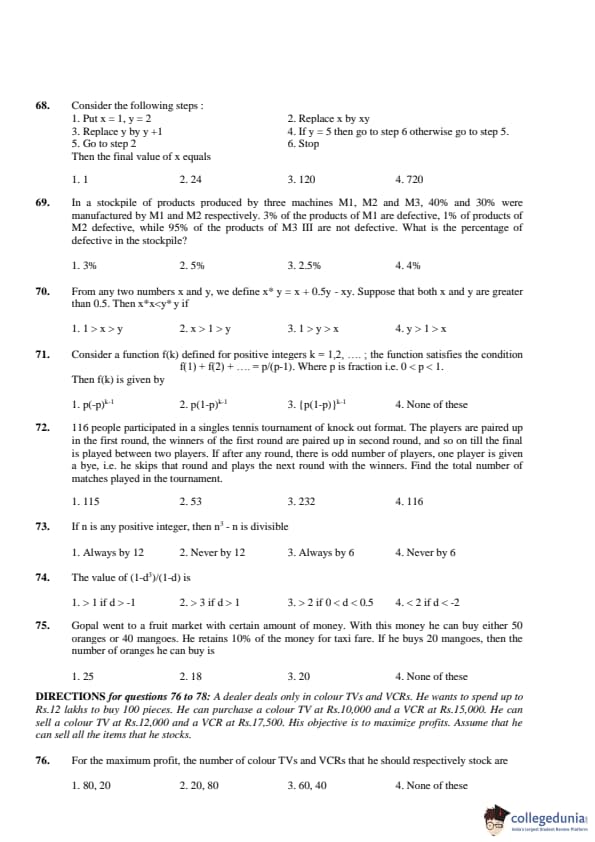
Consider the following steps:
(1)Put \(x = 1\), \(y = 2\)
(2)Replace \(x\) by \(xy\)
(3)Replace \(y\) by \(y + 1\)
(4)If \(y = 5\) then go to step 6 otherwise go to step 5
5. Go to step 2
6. Stop
Then the final value of \(x\) equals:
- (A) 1
- (B) 24
- (C) 120
- (D) 720
Question 69:
In a stockpile of products produced by three machines M1, M2 and M3, 40% and 30% were manufactured by M1 and M2 respectively. 3% of the products of M1 are defective, 1% of products of M2 defective, while 95% of the products of M3 are not defective. What is the percentage of defective products in the stockpile?
- (A) 3%
- (B) 5%
- (C) 2.5%
- (D) 4%
Question 70:
From any two numbers \(x\) and \(y\), we define \(x * y = x + 0.5y - xy\). Suppose that both \(x\) and \(y\) are greater than 0.5. Then \(x * x > y\) if:
- (A) \(x > y\)
- (B) \(x \ge 1 > y\)
- (C) \(1 > y > x\)
- (D) \(y > 1 > x\)
Question 71:
Consider a function \(f(k)\) defined for positive integers \(k = 1, 2, \dots\); the function satisfies the condition
\(f(1) + f(2) + \dots + f(k) = p( p^{k-1} )\) Where \(p\) is a fraction i.e. \(0 < p < 1\). Then \(f(k)\) is given by:
- (A) \(p(p)^{k-1}\)
- (B) \(p(1-p)^{k-1}\)
- (C) \(\{ p(1-p) \}^{k-1}\)
- (D) None of these
Question 72:
116 people participated in a singles tennis tournament of knockout format. The players are paired up in the first round, winners of the first round are paired in the second round, and so on till the final is played between two players. If after any round, the number of players is odd, one player is given a bye (he skips that round and plays the next round with the winners). Find the total number of matches played in the tournament.
- (A) 115
- (B) 53
- (C) 232
- (D) 116
Question 73:
If \(n\) is any positive integer, then \(n^3 - n\) is divisible:
- (A) Always by 12
- (B) Never by 12
- (C) Always by 6
- (D) Never by 6
Question 74:
The value of \(\frac{(1 - d^3)}{(1 - d)}\) is:
- (A) \(> 1\) if \(d > -1\)
- (B) \(> 3\) if \(d > 1\)
- (C) \(> 2\) if \(0 < d < 0.5\)
- (D) \(< 2\) if \(d < -2\)
Question 75:
Gopal went to a fruit market with a certain amount of money. With this money he can buy either 50 oranges or 40 mangoes. He retains 10% of the money for taxi fare. If he buys 20 mangoes, then the number of oranges he can buy is:
- (A) 25
- (B) 18
- (C) 20
- (D) None of these
Question 76:
A dealer deals only in colour TVs and VCRs. He wants to spend up to Rs. 12 lakhs to buy 100 pieces. He can purchase a colour TV at Rs. 10,000 and a VCR at Rs. 15,000. He can sell a colour TV at Rs. 12,000 and a VCR at Rs. 17,500. His objective is to maximize profits. Assume that he can sell all the items that he stocks. For the maximum profit, the number of colour TVs and VCRs that he should respectively stock are:
- (A) 80, 20
- (B) 20, 80
- (C) 60, 40
- (D) None of these
Question 77:
If the dealer could get additional space to stock 20 more items, then for maximizing profit, the ratio of number of VCRs to number of TVs that he should stock is:
- (A) 7 : 3
- (B) 2 : 0
- (C) 1 : 2
- (D) None of these
Question 78:
The maximum profit, in lakh rupees, the dealer can earn from his original stock if he can sell a colour TV at Rs. 12,200 and a VCR at Rs. 18,300 is:
- (A) 1.64
- (B) 2.49
- (C) 2.72
- (D) 2.87
Question 79:
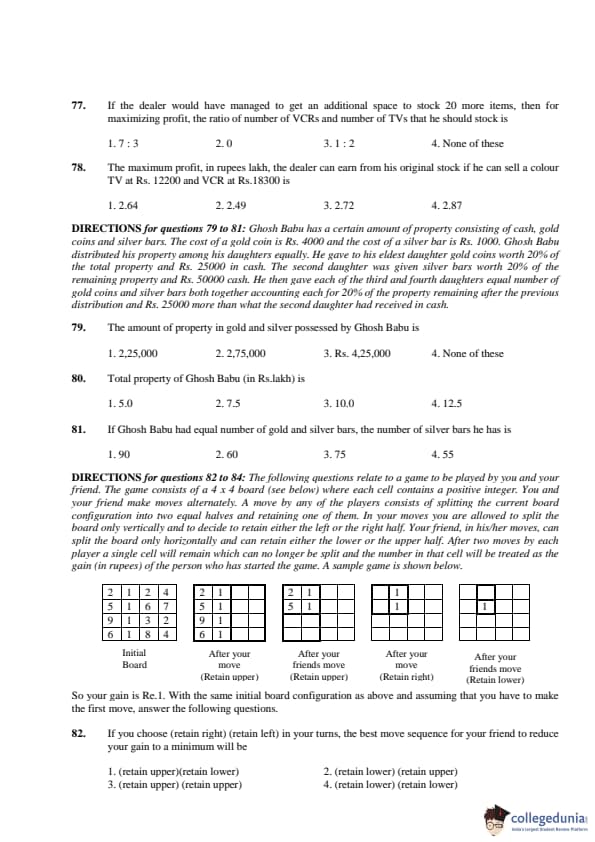
The amount of property in gold and silver possessed by Ghosh Babu is:
- (A) Rs. 2,25,000
- (B) Rs. 2,75,000
- (C) Rs. 4,25,000
- (D) None of these
Question 80:
Total property of Ghosh Babu (in Rs. lakh) is:
- (A) 5.0
- (B) 7.5
- (C) 10.0
- (D) 12.5
Question 81:
If Ghosh Babu had equal number of gold coins and silver bars, the number of silver bars he has is:
- (A) 90
- (B) 60
- (C) 75
- (D) 55
Question 82:
If you choose (retain right) (retain left) in your turns, the best move sequence for your friend to reduce your gain to a minimum will be:
- (A) (retain upper) (retain lower)
- (B) (retain lower) (retain upper)
- (C) (retain upper) (retain upper)
- (D) (retain lower) (retain lower)
Question 83:
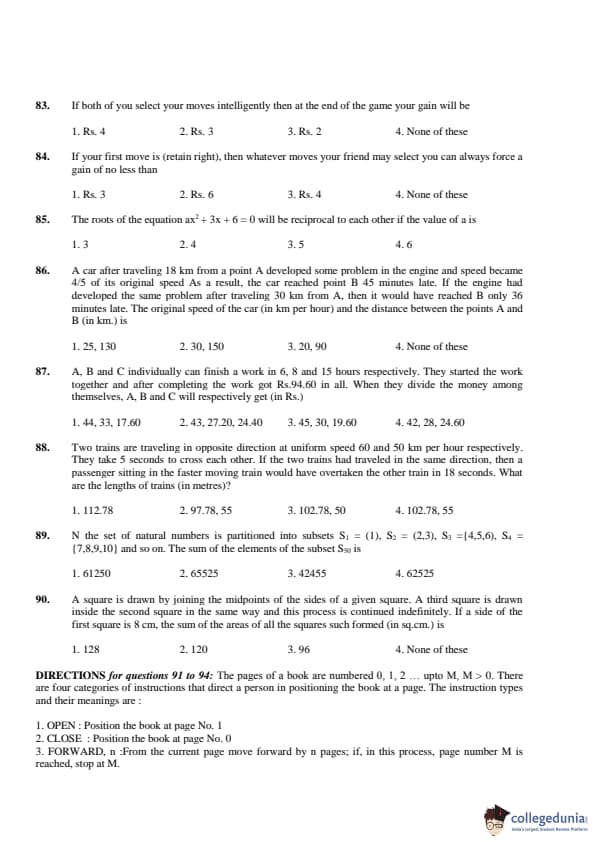
If both of you select your moves intelligently, then at the end of the game your gain will be:
- (A) Rs. 4
- (B) Rs. 3
- (C) Rs. 2
- (D) None of these
Question 84:
If your first move is (retain right), then whatever moves your friend may select, you can always force a gain of no less than:
- (A) Rs. 3
- (B) Rs. 6
- (C) Rs. 4
- (D) None of these
Question 85:
The roots of the equation \(a x^2 + 3x + 6 = 0\) will be reciprocal to each other if the value of \(a\) is:
Question 86:
A car after traveling 18 km from a point A developed some problem in the engine and speed became \(\frac{4}{5}\) of its original speed. As a result, the car reached point B 45 minutes late. If the engine had developed the same problem after traveling 30 km from A, then it would have reached B only 36 minutes late. The original speed of the car (in km/h) and the distance between points A and B (in km) is:
- (A) 25, 130
- (B) 30, 150
- (C) 20, 90
- (D) None of these
Question 87:
A, B and C individually can finish a work in 6, 8 and 15 hours respectively. They started the work together and after completing the work got Rs. 94.60 in all. When they divide the money among themselves, A, B and C will respectively get (in Rs.):
- (A) 44, 33, 17.60
- (B) 43, 27.20, 24.40
- (C) 45, 30, 19.60
- (D) 42, 28, 24.60
Question 88:
Two trains are traveling in opposite directions at uniform speeds of 60 km/h and 50 km/h respectively. They take 5 seconds to cross each other. If the two trains had traveled in the same direction, then a passenger sitting in the faster moving train would have overtaken the other train in 18 seconds. What are the lengths of the trains (in metres)?
- (A) 112.78, 55
- (B) 97.78, 55
- (C) 102.78, 50
- (D) 102.78, 55
Question 89:
The set of natural numbers is partitioned into subsets \(S_1 = \{1\}\), \(S_2 = \{2, 3\}\), \(S_3 = \{4, 5, 6\}\), \(S_4 = \{7, 8, 9, 10\}\) and so on. The sum of the elements of subset \(S_{50}\) is:
- (A) 61250
- (B) 65525
- (C) 42455
- (D) 62525
Question 90:
A square is drawn by joining the midpoints of the sides of a given square. A third square is drawn inside the second square in the same way and this process is continued indefinitely. If a side of the first square is 8 cm, the sum of the areas of all the squares thus formed (in sq.cm) is:
- (A) 128
- (B) 120
- (C) 96
- (D) None of these
Question 91:
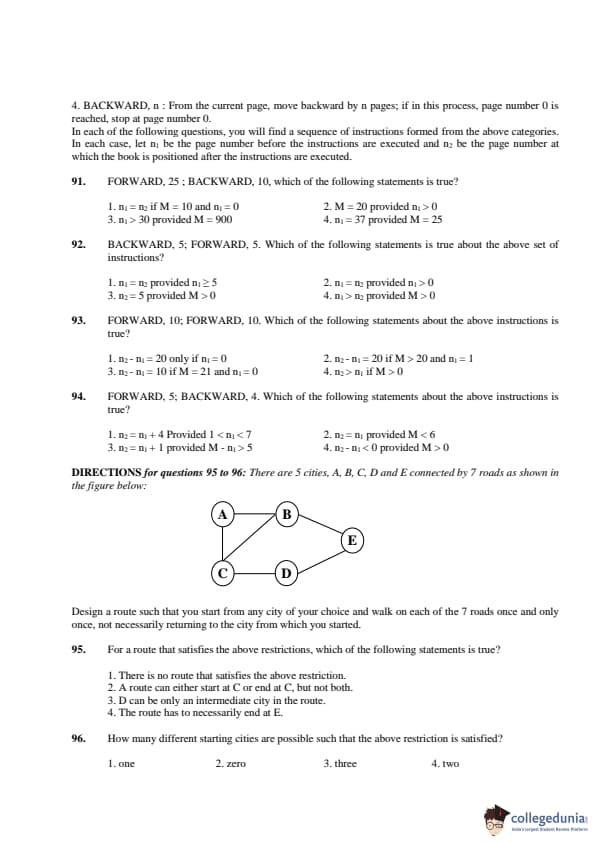
FORWARD, 25 ; BACKWARD, 10 — Which of the following statements is true?
- (A) \(n_1 = n_2\) if \(M = 10\) and \(n_1 = 0\)
- (B) \(M = 20\) provided \(n_1 > 0\)
- (C) \(n_1 > 30\) provided \(M = 900\)
- (D) \(n_1 = 37\) provided \(M = 25\)
Correct Answer: (D) \(n_1 = 37\) provided \(M = 25\)
View Solution
Question 92:
BACKWARD, 5 ; FORWARD, 5 — Which of the following statements is true?
- (A) \(n_1 = n_2\) provided \(n_1 \ge 5\)
- (B) \(n_1 = n_2\) provided \(n_1 > 0\)
- (C) \(n_2 = 5\) provided \(M > 0\)
- (D) \(n_1 > n_2\) provided \(M > 0\)
Correct Answer: (A) \(n_1 = n_2\) provided \(n_1 \ge 5\)
View Solution
Question 93:
FORWARD, 10 ; FORWARD, 10 — Which of the following statements is true?
- (A) \(n_2 = n_1 = 20\) only if \(n_1 = 0\)
- (B) \(n_2 - n_1 = 20\) if \(M > 20\) and \(n_1 = 1\)
- (C) \(n_2 - n_1 = 10\) if \(M = 21\) and \(n_1 = 0\)
- (D) \(n_2 > n_1\) if \(M > 0\)
Question 94:
FORWARD, 5 ; BACKWARD, 4 — Which of the following statements is true?
- (A) \(n_2 = n_1 + 4\) provided \(1 < n_1 < 7\)
- (B) \(n_2 = n_1\) provided \(M < 6\)
- (C) \(n_2 = n_1 + M - n_1 - 5\)
- (D) \(n_2 = n_1 < 0\) provided \(M > 0\)
Correct Answer: (A) \(n_2 = n_1 + 4\) provided \(1 < n_1 < 7\)
View Solution
Question 95:
For a route that satisfies the above restrictions, which of the following statements is true?
- (A) There is no route that satisfies the above restriction.
- (B) A route can either start at C or end at C, but not both.
- (C) D can be only an intermediate city in the route.
- (D) The route has to necessarily end at E.
Correct Answer: (C) D can be only an intermediate city in the route.
View Solution
Question 96:
How many different starting cities are possible such that the above restriction is satisfied?
- (A) One
- (B) Zero
- (C) Three
- (D) Two
Question 97:
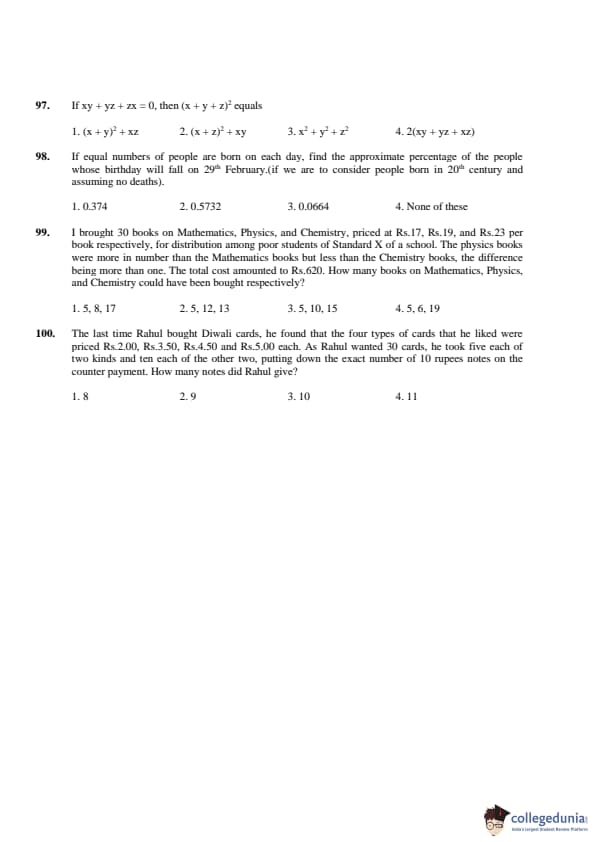
If \( xy + yz + zx = 0 \), then \( (x + y + z)^2 \) equals
- (A) \( (x + y)^2 + xz \)
- (B) \( (x + z)^2 + xy \)
- (C) \( x^2 + y^2 + z^2 \)
- (D) \( 2(xy + yz + xz) \)
Question 98:
If equal numbers of people are born on each day, find the approximate percentage of the people whose birthday will fall on 29\(^th\) February (if we are to consider people born in the 20\(^th\) century and assuming no deaths).
- (A) 0.374
- (B) 0.5732
- (C) 0.0664
- (D) None of these
Question 99:
I brought 30 books on Mathematics, Physics, and Chemistry, priced at Rs.17, Rs.19, and Rs.23 per book respectively, for distribution among poor students of Standard X of a school. The physics books were more in number than the Mathematics books but less than the Chemistry books, the difference being more than one. The total cost amounted to Rs.620. How many books on Mathematics, Physics, and Chemistry could have been bought respectively?
- (A) 5, 8, 17
- (B) 5, 12, 13
- (C) 3, 5, 10, 15
- (D) 4, 5, 6, 19
Question 100:
The last time Rahul bought Diwali cards, he found that the four types of cards that he liked were priced Rs.2.00, Rs.3.50, Rs.4.50, and Rs.5.00 each. As Rahul wanted 30 cards, he took five each of two kinds and ten each of the other two, putting down the exact number of 10 rupee notes on the counter payment. How many notes did Rahul give?
- (A) 8
- (B) 9
- (C) 10
- (D) 11
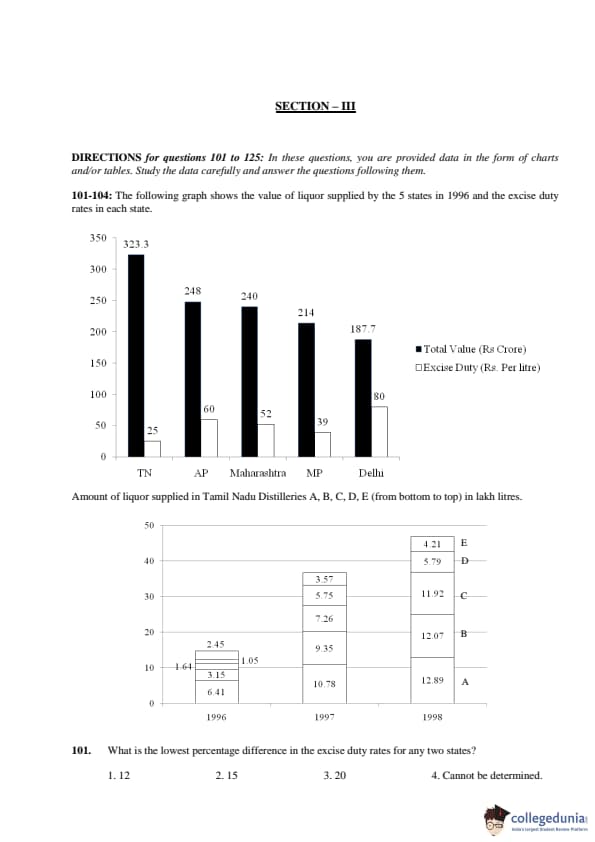
Question 101:
What is the lowest percentage difference in the excise duty rates for any two states?
- (A) 12
- (B) 15
- (C) 20
- (D) Cannot be determined
Question 102:
Which of the five states manufactured liquor at the lowest cost?
- (A) Tamil Nadu
- (B) Delhi
- (C) The states which has the lowest value for (wholesale price - Excise duty) per litre
- (D) Cannot be determined
Correct Answer: (C) The states which has the lowest value for (wholesale price - Excise duty) per litre
View Solution
Question 103:
If Excise duty is levied before the goods leave the factory (on the value of the liquor), then which of the following choices shows distilleries in ascending order of the excise duty paid by them for the year 1996? (Assume the total liquor in TN is supplied by only these 5 distilleries).
- (A) ECABD
- (B) ADEBC
- (C) DCEBA
- (D) Cannot be determined
Question 104:
If the Tamil Nadu distillery, with the least average simple annual growth in amount of liquor supplied in the given period, had shown the same rate of growth as the one which grew fastest, what would that company’s supply have been in 1998, in lakh litres?
- (A) 13
- (B) 15.11
- (C) 130
- (D) Cannot be determined
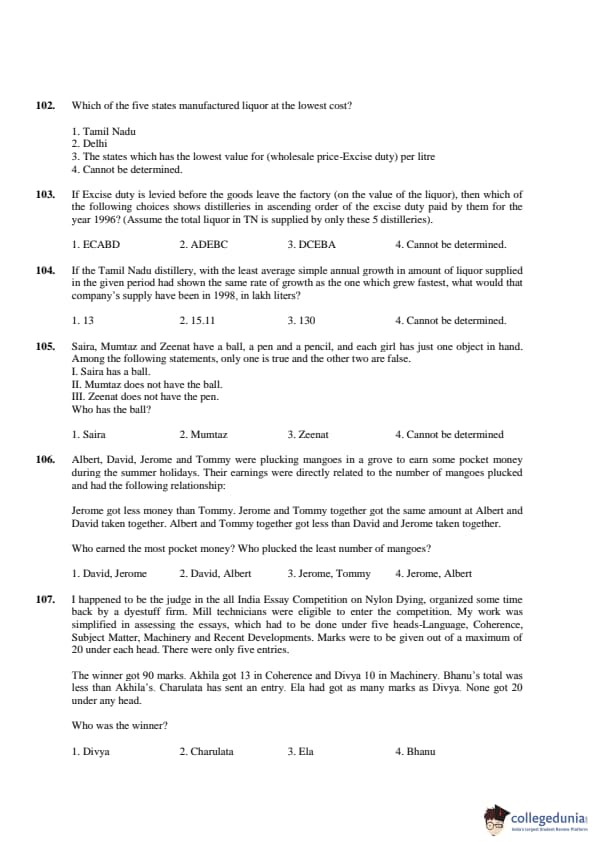
Question 105:
Saira, Mumtaz, and Zeenat have a ball, a pen and a pencil, and each girl has just one object in hand. Among the following statements, only one is true and the other two are false.
I. Saira has a ball.
II. Mumtaz does not have the ball.
III. Zeenat does not have the pen.
Who has the ball?
- (A) Saira
- (B) Mumtaz
- (C) Zeenat
- (D) Cannot be determined
Question 106:
Albert, David, Jerome and Tommy were plucking mangoes in a grove to earn some pocket money during the summer holidays. Their earnings were directly related to the number of mangoes plucked and had the following relationship:
Jerome got less money than Tommy. Jerome and Tommy together got the same amount as Albert and David taken together. Albert and Tommy together got less than David and Jerome taken together.
Who earned the most pocket money? Who plucked the least number of mangoes?
- (A) David, Jerome
- (B) David, Albert
- (C) Jerome, Tommy
- (D) Albert, Tommy
Question 107:
I happened to be the judge in the all India Essay Competition on Nylon Dying, organized some time back by a dyestuff firm. Mill technicians were eligible to enter the competition. My work was simplified in assessing the essays, which had to be done under five heads—Language, Coherence, Subject Matter, Machinery and Recent Developments. Marks were to be given out of a maximum of 20 under each head. There were only five entries.
The winner got 90 marks. Akhila got 13 in Coherence and Divya 10 in Machinery. Bhanu’s total was less than Akhila’s. Charulata has sent an entry. Ela had got as many marks as Divya. None got 20 under any head.
Who was the winner?
- (A) Divya
- (B) Charulata
- (C) Ela
- (D) Bhanu
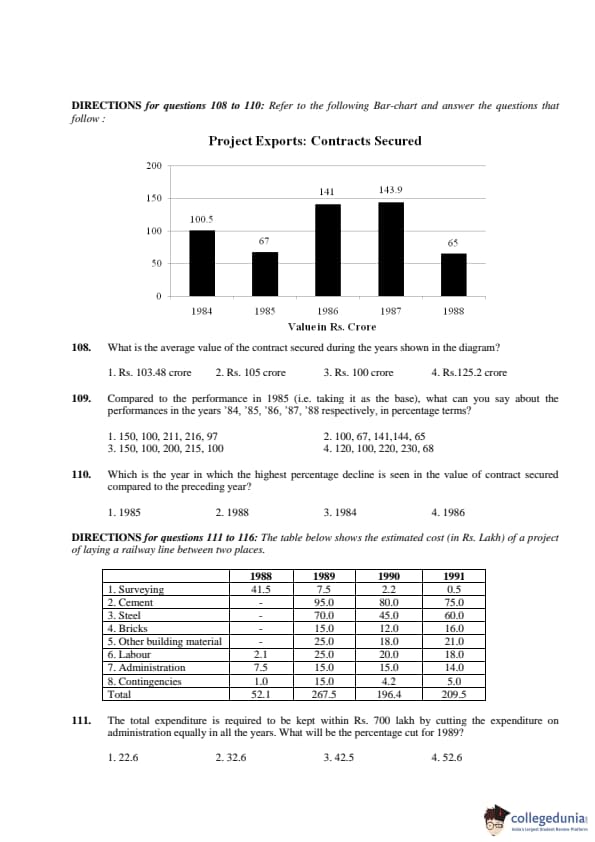
Question 108:
What is the average value of the contract secured during the years shown in the diagram?
- (A) Rs. 103.48 crore
- (B) Rs. 105 crore
- (C) Rs. 100 crore
- (D) Rs. 125.2 crore
Question 109:
Compared to the performance in 1985 (i.e. taking it as the base), what can you say about the performances in the years ’84, ’85, ’86, ’87, ’88 respectively, in percentage terms?
- (A) 150, 100, 211, 216, 97
- (B) 100, 67, 141, 144, 65
- (C) 150, 100, 200, 215, 100
- (D) 120, 100, 220, 230, 68
Question 110:
Which is the year in which the highest percentage decline is seen in the value of contract secured compared to the preceding year?
- (A) 1985
- (B) 1988
- (C) 1984
- (D) 1986
Question 111:
The total expenditure is required to be kept within Rs. 700 lakh by cutting the expenditure on administration equally in all the years. What will be the percentage cut for 1989?
- (A) 22.6
- (B) 32.6
- (C) 42.5
- (D) 52.6
Question 112:
If the length of line to be laid each year is in proportion to the estimated cost for material and labour, what fraction of the total length is proposed to be completed by the third year?
- (A) 0.9
- (B) 0.7
- (C) 0.6
- (D) 0.3
Question 113:
What is the approximate ratio of the total cost of materials for all the years bear to the total labour cost?
- (A) 1 : 4
- (B) 2.8 : 1
- (C) 3 : 12 : 1
- (D) 4 : 16 : 1
Question 114:
If the cost of materials rises by 5% each year from 1990 onwards, by how much will the estimated cost rise?
- (A) Rs. 11.4 lakh
- (B) Rs. 16.4 lakh
- (C) Rs. 21.4 lakh
- (D) Rs. 26.4 lakh
Question 115:
It is found at the end of 1990, that the entire amount estimated for the project has been spent. If for 1991, the actual amount spent was equal to that which was estimated, by what percent (approximately) has the actual expenditure exceeded the estimated expenditure?
- (A) 39
- (B) 29
- (C) 19
- (D) 9
Question 116:
After preparing the estimate, the provision for contingencies is felt inadequate and is therefore doubled. By what percent does the total estimate increase?
- (A) 1.37
- (B) 2.45
- (C) 3.50
- (D) 4.62
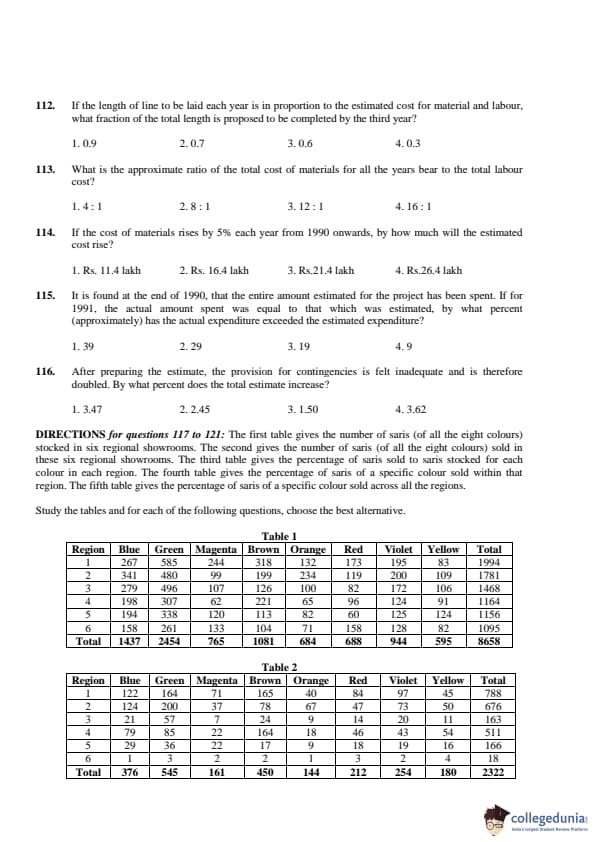
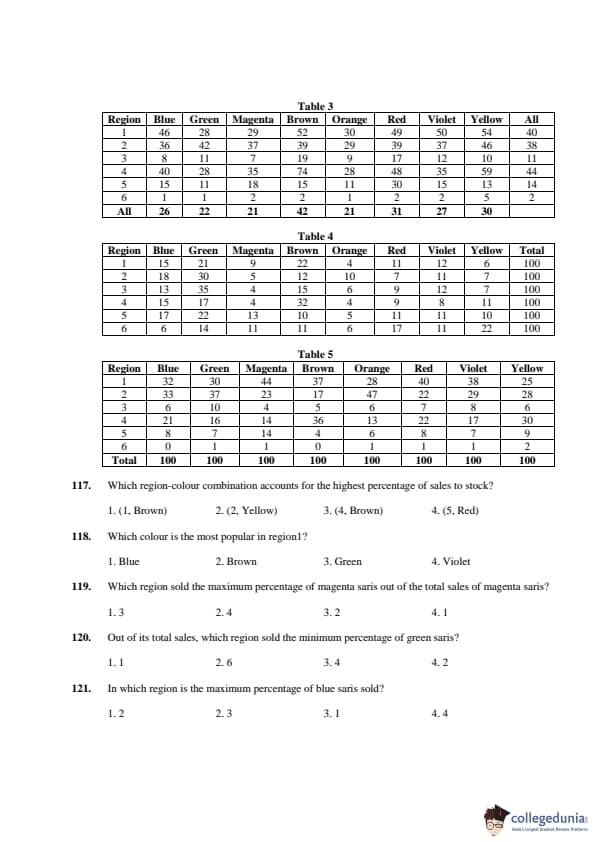
Question 117:
Which region-colour combination accounts for the highest percentage of sales to stock?
- (A) (1, Brown)
- (B) (2, Yellow)
- (C) (4, Brown)
- (D) (5, Red)
Question 118:
Which colour is the most popular in region 1?
- (A) Blue
- (B) Brown
- (C) Green
- (D) Violet
Question 119:
Which region sold the maximum percentage of magenta saris out of the total sales of magenta saris?
Question 120:
Out of its total sales, which region sold the minimum percentage of green saris?
Question 121:
In which region is the maximum percentage of blue saris sold?
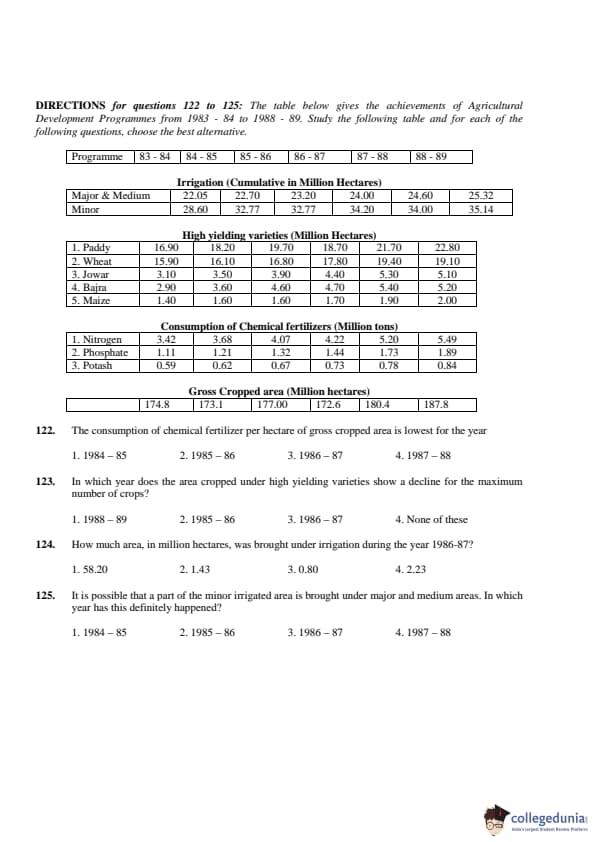
Question 122:
The consumption of chemical fertilizer per hectare of gross cropped area is lowest for the year
- (1) 1984 – 85
- (2) 1985 – 86
- (3) 1986 – 87
- (4) 1987 – 88
Question 123:
In which year does the area cropped under high yielding varieties show a decline for the maximum number of crops?
- (1) 1988 – 89
- (2) 1985 – 86
- (3) 1986 – 87
- (4) None of these
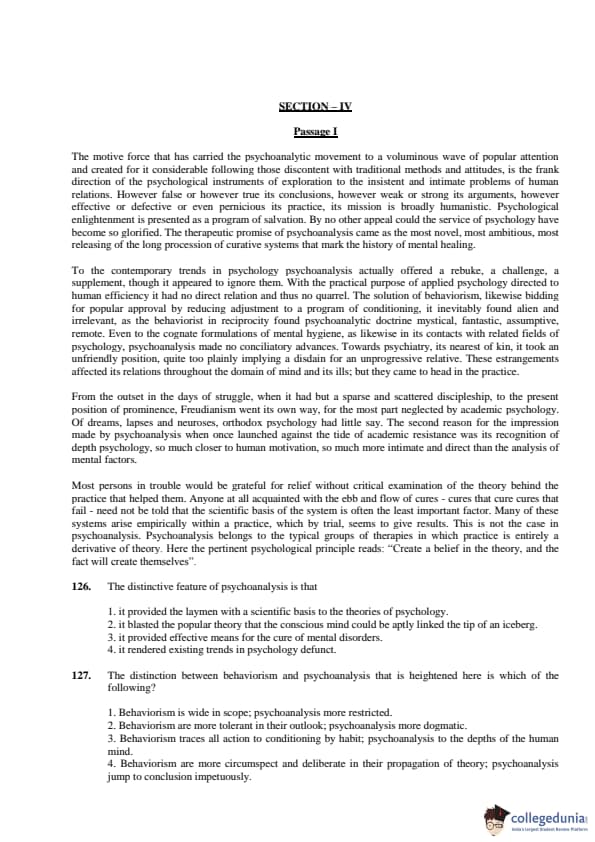
Question 124:
The distinctive feature of psychoanalysis is that
- (1) it provided the laymen with a scientific basis to the theories of psychology.
- (2) it blasted the popular theory that the conscious mind could be aptly linked the tip of an iceberg.
- (3) it provided effective means for the cure of mental disorders.
- (4) it rendered existing trends in psychology defunct.
Correct Answer: (3)it provided effective means for the cure of mental disorders.
View Solution
Question 125:
The distinction between behaviorism and psychoanalysis that is heightened here is which of the following?
- (1) Behaviorism is wide in scope; psychoanalysis more restricted.
- (2) Behaviorism are more tolerant in their outlook; psychoanalysis more dogmatic.
- (3) Behaviorism traces all action to conditioning by habit; psychoanalysis to the depths of the human mind.
- (4) Behaviorism are more circumspect and deliberate in their propagation of theory; psychoanalysis jump to conclusion impetuously.
Correct Answer: (3)Behaviorism traces all action to conditioning by habit; psychoanalysis to the depths of the human mind.
View Solution
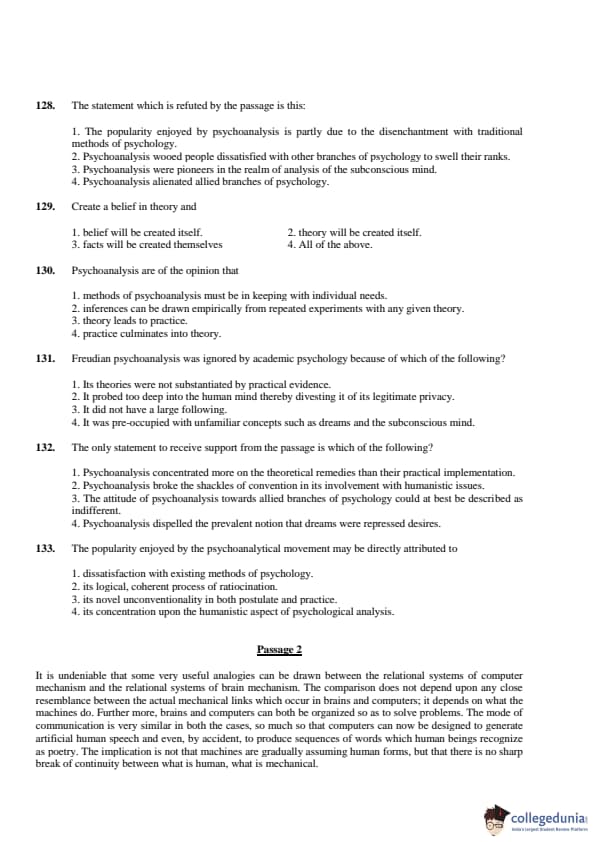
Question 126:
The statement which is refuted by the passage is this:
- (1) The popularity enjoyed by psychoanalysis is partly due to the disenchantment with traditional methods of psychology.
- (2) Psychoanalysis wooed people dissatisfied with other branches of psychology to swell their ranks.
- (3) Psychoanalysis were pioneers in the realm of analysis of the subconscious mind.
- (4) Psychoanalysis alienated allied branches of psychology.
Correct Answer: (2)Psychoanalysis wooed people dissatisfied with other branches of psychology to swell their ranks.
View Solution
Question 127:
Create a belief in theory and
- (1) belief will be created itself.
- (2) theory will be created itself.
- (3) facts will be created themselves
- (4) All of the above.
Correct Answer: (3)facts will be created themselves
View Solution
Question 128:
Psychoanalysis are of the opinion that
- (1) methods of psychoanalysis must be in keeping with individual needs.
- (2) inferences can be drawn empirically from repeated experiments with any given theory.
- (3) theory leads to practice.
- (4) practice culminates into theory.
Correct Answer: (4)practice culminates into theory.
View Solution
Question 129:
Freudian psychoanalysis was ignored by academic psychology because of which of the following?
- (1) Its theories were not substantiated by practical evidence.
- (2) It probed too deep into the human mind thereby divesting it of its legitimate privacy.
- (3) It did not have a large following.
- (4) It was pre-occupied with unfamiliar concepts such as dreams and the subconscious mind.
Correct Answer: (4)It was pre-occupied with unfamiliar concepts such as dreams and the subconscious mind.
View Solution
Question 130:
The only statement to receive support from the passage is which of the following?
- (1) Psychoanalysis concentrated more on the theoretical remedies than their practical implementation.
- (2) Psychoanalysis broke the shackles of convention in its involvement with humanistic issues.
- (3) The attitude of psychoanalysis towards allied branches of psychology could at best be described as indifferent.
- (4) Psychoanalysis dispelled the prevalent notion that dreams were repressed desires.
Correct Answer: (2)Psychoanalysis broke the shackles of convention in its involvement with humanistic issues.
View Solution
Question 131:
The popularity enjoyed by the psychoanalytical movement may be directly attributed to
- (1) dissatisfaction with existing methods of psychology.
- (2) its logical, coherent process of ratiocination.
- (3) its novel unconventionality in both postulate and practice.
- (4) its concentration upon the humanistic aspect of psychological analysis.
Correct Answer: (1)dissatisfaction with existing methods of psychology.
View Solution
Question 132:
From the passage, it is evident that the author thinks
- (1) computers are now naturally programmed to produce poetry.
- (2) computers are likely to usurp the place of intellectual superiority accorded to the human brain.
- (3) the resemblance that the computer bears to the human brain is purely mechanical.
- (4) the unintentional mixing up of word sequences in the computer can result in poetry.
Correct Answer: (4)the unintentional mixing up of word sequences in the computer can result in poetry.
View Solution
Question 133:
Computers have acquired a proven ability of performing many of the functions of the human brain because
- (1) the brain of modern man is unable to discharge its functions properly on account of over-reliance on machines.
- (2) the sophisticated computer mechanism is on the verge of outstripping human mental faculties.
- (3) the process of organizing and communicating are similar in both cases.
- (4) the mechanics of the human brain have been introduced in the computer.
Correct Answer: (3)the process of organizing and communicating are similar in both cases.
View Solution
Question 134:
The resemblance between the human brain and the computer is
- (1) imaginary.
- (2) intellectual.
- (3) mechanical.
- (4) functional.
Question 135:
The passage implies that
- (1) computers are assuming human forms.
- (2) human are assuming mechanical forms.
- (3) computers and humans are substitutable.
- (4) there is continuity between what is human and what is mechanical.
Correct Answer: (4)there is continuity between what is human and what is mechanical.
View Solution
Question 136:
The author uses the word ‘recognize’ in relation to computer poetry to convey a
- (1) sense of sorrow at the reluctant admission of the superiority of machines by mankind.
- (2) feeling that computers have yet to conquer the emotional heights that man is capable of attaining.
- (3) feeling of derision for the popular faith in the omnipotence of the computer.
- (4) feeling of a fatalistic acceptance of the computer’s encroachment upon human bastions.
Correct Answer: (4)feeling of a fatalistic acceptance of the computer’s encroachment upon human bastions.
View Solution
Question 137:
Points of dissimilarity between the human brain and the computer don’t extend to
- (1) the faculty of composing poetry.
- (2) methods of communication.
- (3) the faculty of composing poetry.
- (4) the faculty of speaking naturally
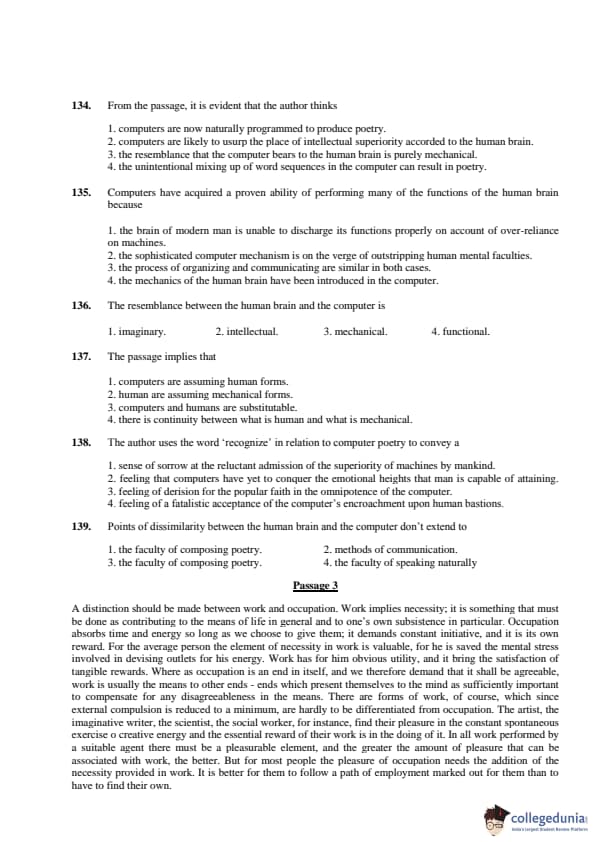
Question 138:
Future, according to the passage, may find the workers
- (1) without money.
- (2) without work.
- (3) replacing machines.
- (4) without leisure.
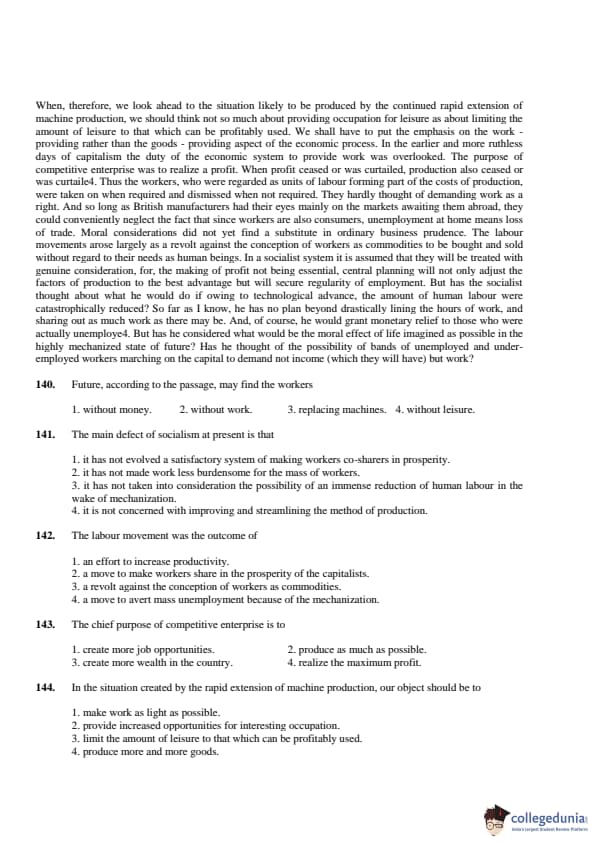
Question 139:
The main defect of socialism at present is that
- (1) it has not evolved a satisfactory system of making workers co-sharers in prosperity.
- (2) it has not made work less burdensome for the mass of workers.
- (3) it has not taken into consideration the possibility of an immense reduction of human labour in the wake of mechanization.
- (4) it is not concerned with improving and streamlining the method of production.
Correct Answer: (3)it has not taken into consideration the possibility of an immense reduction of human labour in the wake of mechanization.
View Solution
Question 140:
The labour movement was the outcome of
- (1) an effort to increase productivity.
- (2) a move to make workers share in the prosperity of the capitalists.
- (3) a revolt against the conception of workers as commodities.
- (4) a move to avert mass unemployment because of the mechanization.
Correct Answer: (3)a revolt against the conception of workers as commodities.
View Solution
Question 141:
The chief purpose of competitive enterprise is to
- (1) create more job opportunities.
- (2) produce as much as possible.
- (3) create more wealth in the country.
- (4) realize the maximum profit.
Question 142:
In the situation created by the rapid extension of machine production, our object should be to
- (1) make work as light as possible.
- (2) provide increased opportunities for interesting occupation.
- (3) limit the amount of leisure to that which can be profitably used.
- (4) produce more and more goods.
Correct Answer: (3)limit the amount of leisure to that which can be profitably used.
View Solution
Question 143:
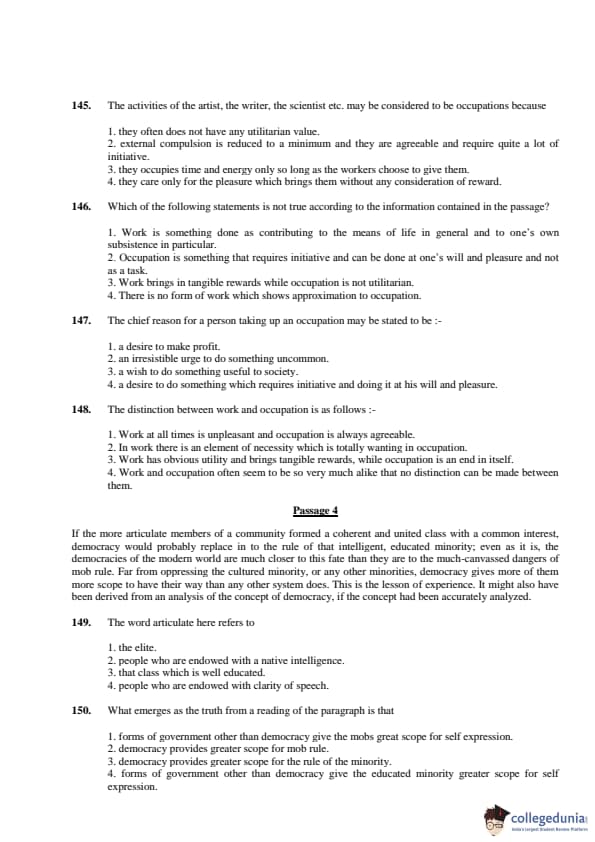
The activities of the artist, the writer, the scientist etc. may be considered to be occupations because
- (1) they often does not have any utilitarian value.
- (2) external compulsion is reduced to a minimum and they are agreeable and require quite a lot of initiative.
- (3) they occupies time and energy only so long as the workers choose to give them.
- (4) they care only for the pleasure which brings them without any consideration of reward.
Correct Answer: (2)external compulsion is reduced to a minimum and they are agreeable and require quite a lot of initiative.
View Solution
Question 144:
Which of the following statements is not true according to the information contained in the passage?
- (1) Work is something done as contributing to the means of life in general and to one’s own subsistence in particular.
- (2) Occupation is something that requires initiative and can be done at one’s will and pleasure and not as a task.
- (3) Work brings in tangible rewards while occupation is not utilitarian.
- (4) There is no form of work which shows approximation to occupation.
Correct Answer: (4)There is no form of work which shows approximation to occupation.
View Solution
Question 145:
The chief reason for a person taking up an occupation may be stated to be :-
- (1) a desire to make profit.
- (2) an irresistible urge to do something uncommon.
- (3) a wish to do something useful to society.
- (4) a desire to do something which requires initiative and doing it at his will and pleasure.
Correct Answer: (4)a desire to do something which requires initiative and doing it at his will and pleasure.
View Solution
Question 146:
The distinction between work and occupation is as follows :-
- (1) Work at all times is unpleasant and occupation is always agreeable.
- (2) In work there is an element of necessity which is totally wanting in occupation.
- (3) Work has obvious utility and brings tangible rewards, while occupation is an end in itself.
- (4) Work and occupation often seem to be so very much alike that no distinction can be made between them.
Correct Answer: (2)In work there is an element of necessity which is totally wanting in occupation.
View Solution
Question 147:
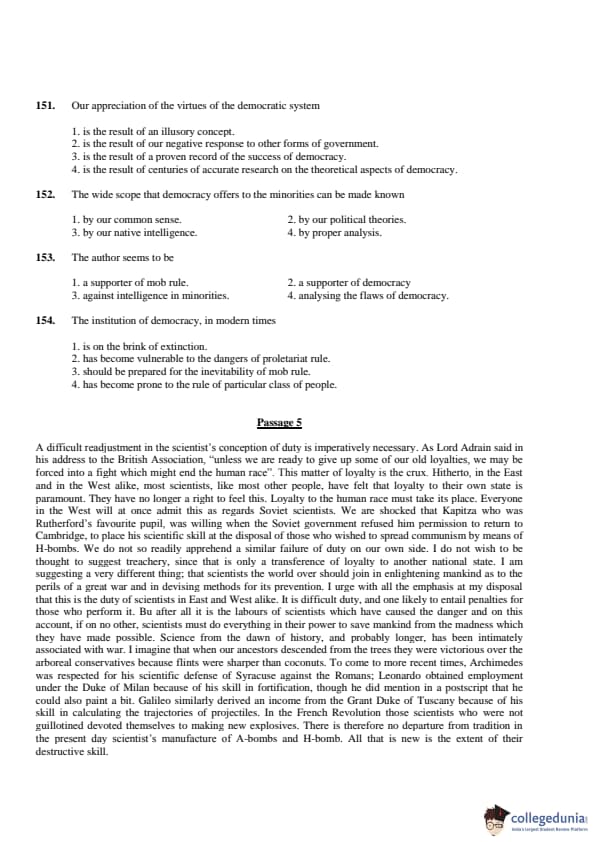
The word articulate here refers to
- (1) the elite.
- (2) people who are endowed with a native intelligence.
- (3) that class which is well educated.
- (4) people who are endowed with clarity of speech.
Correct Answer: (3)that class which is well educated.
View Solution
Question 148:
What emerges as the truth from a reading of the paragraph is that
- (1) forms of government other than democracy give the mobs great scope for self-expression.
- (2) democracy provides greater scope for mob rule.
- (3) democracy provides greater scope for the rule of the minority.
- (4) forms of government other than democracy give the educated minority greater scope for self-expression.
Correct Answer: (2)democracy provides greater scope for mob rule.
View Solution
Question 149:
Our appreciation of the virtues of the democratic system
- (1) is the result of an illusory concept.
- (2) is the result of our negative response to other forms of government.
- (3) is the result of a proven record of the success of democracy.
- (4) is the result of centuries of accurate research on the theoretical aspects of democracy.
Correct Answer: (1)is the result of an illusory concept.
View Solution
Question 150:
The wide scope that democracy offers to the minorities can be made known
- (1) by our common sense.
- (2) by our political theories.
- (3) by our native intelligence.
- (4) by proper analysis.
Question 151:
The author seems to be
- (1) a supporter of mob rule.
- (2) a supporter of democracy.
- (3) against intelligence in minorities.
- (4) analysing the flaws of democracy.
Correct Answer: (4)analysing the flaws of democracy.
View Solution
Question 152:
The institution of democracy, in modern times
- (1) is on the brink of extinction.
- (2) has become vulnerable to the dangers of proletariat rule.
- (3) should be prepared for the inevitability of mob rule.
- (4) has become prone to the rule of particular class of people.
Correct Answer: (2)has become vulnerable to the dangers of proletariat rule.
View Solution
Question 153:
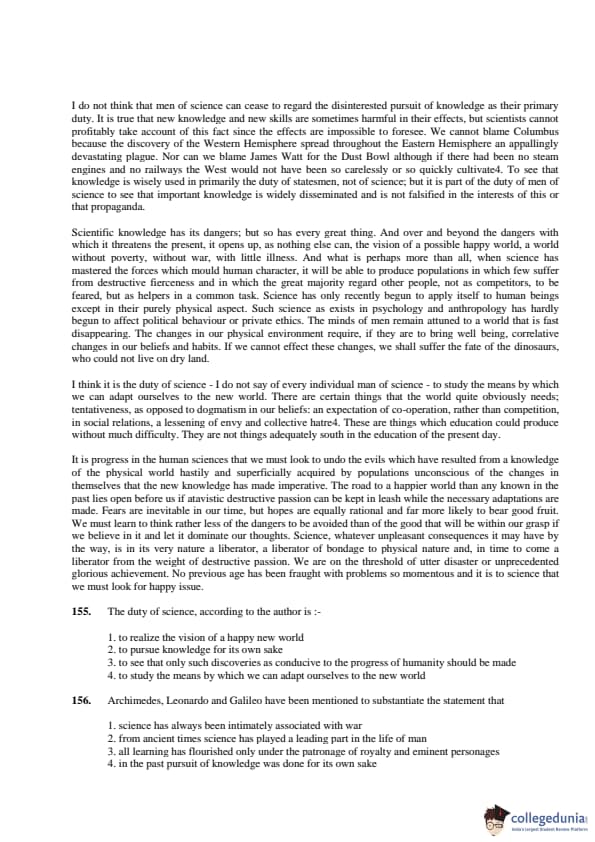
The duty of science, according to the author, is :-
- (1) to realize the vision of a happy new world
- (2) to pursue knowledge for its own sake
- (3) to see that only such discoveries as conducive to the progress of humanity should be made
- (4) to study the means by which we can adapt ourselves to the new world
Correct Answer: (4)to study the means by which we can adapt ourselves to the new world
View Solution
Question 154:
Archimedes, Leonardo and Galileo have been mentioned to substantiate the statement that
- (1) science has always been intimately associated with war
- (2) from ancient times science has played a leading part in the life of man
- (3) all learning has flourished only under the patronage of royalty and eminent personages
- (4) in the past pursuit of knowledge was done for its own sake
Correct Answer: (1)science has always been intimately associated with war
View Solution
Question 155:
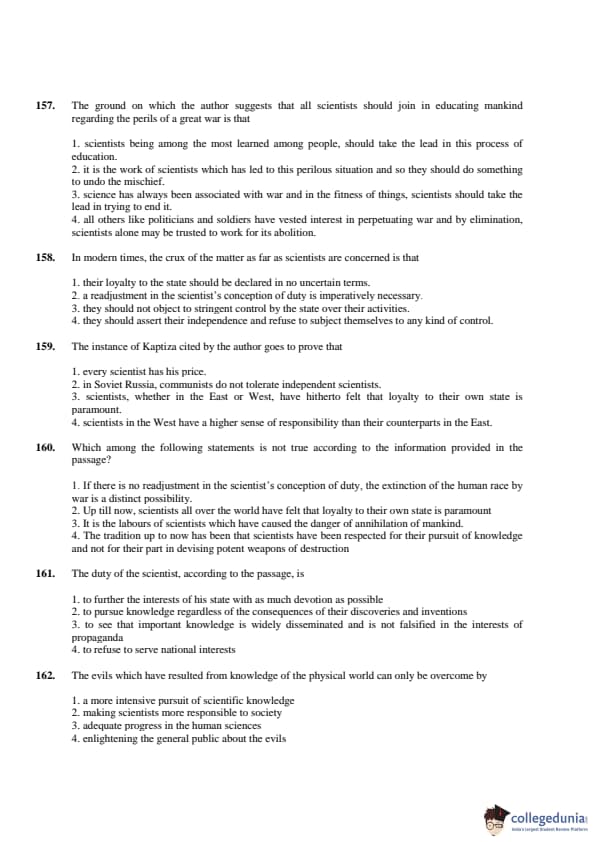
The ground on which the author suggests that all scientists should join in educating mankind regarding the perils of a great war is that
- (1) scientists being among the most learned among people, should take the lead in this process of education.
- (2) it is the work of scientists which has led to this perilous situation and so they should do something to undo the mischief.
- (3) science has always been associated with war and in the fitness of things, scientists should take the lead in trying to end it.
- (4) all others like politicians and soldiers have vested interest in perpetuating war and by elimination, scientists alone may be trusted to work for its abolition.
Correct Answer: (2)it is the work of scientists which has led to this perilous situation and so they should do something to undo the mischief.
View Solution
Question 156:
In modern times, the crux of the matter as far as scientists are concerned is that
- (1) their loyalty to the state should be declared in no uncertain terms.
- (2) a readjustment in the scientist’s conception of duty is imperatively necessary.
- (3) they should not object to stringent control by the state over their activities.
- (4) they should assert their independence and refuse to subject themselves to any kind of control.
Correct Answer: (2)a readjustment in the scientist’s conception of duty is imperatively necessary.
View Solution
Question 157:
The instance of Kapitza cited by the author goes to prove that:
- (1) every scientist has his price.
- (2) in Soviet Russia, communists do not tolerate independent scientists.
- (3) scientists, whether in the East or West, have hitherto felt that loyalty to their own state is paramount.
- (4) scientists in the West have a higher sense of responsibility than their counterparts in the East.
Correct Answer: (3)scientists, whether in the East or West, have hitherto felt that loyalty to their own state is paramount.
View Solution
Question 158:
Which among the following statements is \textit{not true according to the information provided in the passage?
- (1) If there is no readjustment in the scientist’s conception of duty, the extinction of the human race by war is a distinct possibility.
- (2) Up till now, scientists all over the world have felt that loyalty to their own state is paramount.
- (3) It is the labours of scientists which have caused the danger of annihilation of mankind.
- (4) The tradition up to now has been that scientists have been respected for their pursuit of knowledge and not for their part in devising potent weapons of destruction.
Correct Answer: (4)The tradition up to now has been that scientists have been respected for their pursuit of knowledge and not for their part in devising potent weapons of destruction.
View Solution
Question 159:
The duty of the scientist, according to the passage, is:
- (1) to further the interests of his state with as much devotion as possible
- (2) to pursue knowledge regardless of the consequences of their discoveries and inventions
- (3) to see that important knowledge is widely disseminated and is not falsified in the interests of propaganda
- (4) to refuse to serve national interests
Correct Answer: (3)to see that important knowledge is widely disseminated and is not falsified in the interests of propaganda
View Solution
Question 160:
The evils which have resulted from knowledge of the physical world can only be overcome by:
- (1) a more intensive pursuit of scientific knowledge
- (2) making scientists more responsible to society
- (3) adequate progress in the human sciences
- (4) enlightening the general public about the evils
Correct Answer: (3)adequate progress in the human sciences
View Solution
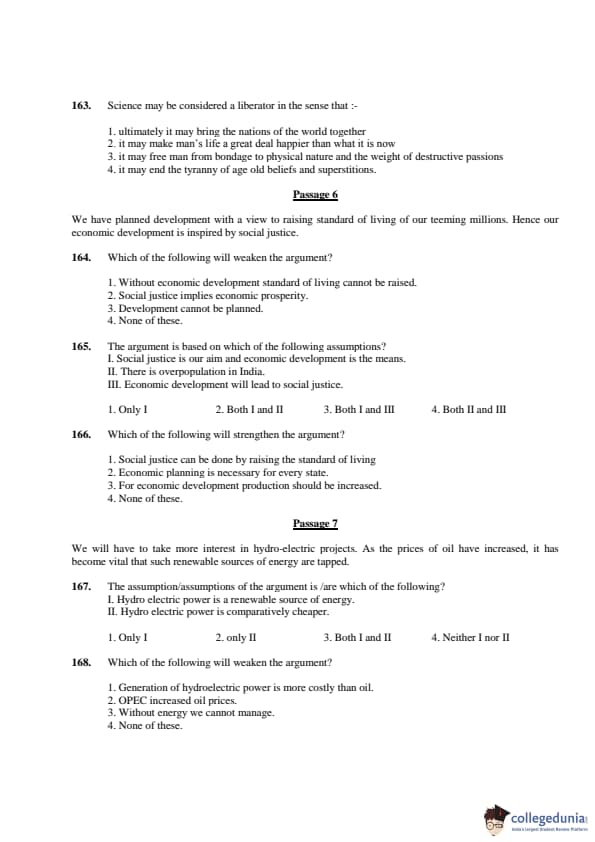
Question 161:
Science may be considered a liberator in the sense that:
- (1) ultimately it may bring the nations of the world together
- (2) it may make man’s life a great deal happier than what it is now
- (3) it may free man from bondage to physical nature and the weight of destructive passions
- (4) it may end the tyranny of age old beliefs and superstitions
Correct Answer: (3)it may free man from bondage to physical nature and the weight of destructive passions
View Solution
Question 162:
Which of the following will weaken the argument?
- (1) Without economic development standard of living cannot be raised.
- (2) Social justice implies economic prosperity.
- (3) Development cannot be planned.
- (4) None of these.
Question 163:
The argument is based on which of the following assumptions?
- (1) Only I
- (2) Both I and II
- (3) Both I and III
- (4) Both II and III
Question 164:
Which of the following will strengthen the argument?
- (1) Social justice can be done by raising the standard of living
- (2) Economic planning is necessary for every state
- (3) For economic development production should be increased
- (4) None of these
Correct Answer: (1)Social justice can be done by raising the standard of living
View Solution
Question 165:
The assumption/assumptions of the argument is/are which of the following?
Statement I: Hydro electric power is a renewable source of energy.
Statement II: Hydro electric power is comparatively cheaper.
- (1) Only I
- (2) Only II
- (3) Both I and II
- (4) Neither I nor II
Question 166:
Which of the following will weaken the argument?
- (1) Generation of hydroelectric power is more costly than oil.
- (2) OPEC increased oil prices.
- (3) Without energy we cannot manage.
- (4) None of these.
Correct Answer: (1)Generation of hydroelectric power is more costly than oil.
View Solution
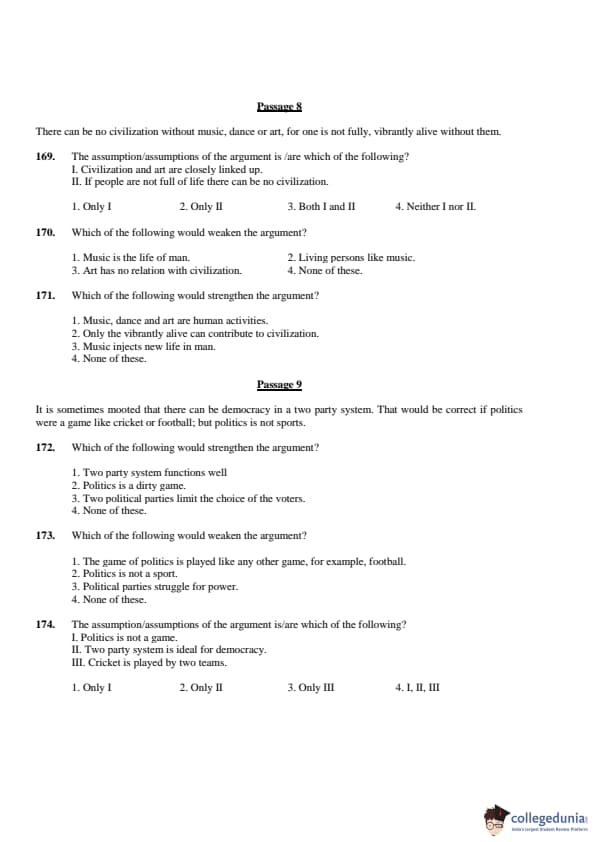
Question 167:
The assumption/assumptions of the argument is/are which of the following?
Statement I: Civilization and art are closely linked up.
Statement II: If people are not full of life there can be no civilization.
- (1) Only I
- (2) Only II
- (3) Both I and II
- (4) Neither I nor II
Question 168:
Which of the following would weaken the argument?
- (1) Music is the life of man.
- (2) Living persons like music.
- (3) Art has no relation with civilization.
- (4) None of these.
Correct Answer: (3)Art has no relation with civilization.
View Solution
Question 169:
Which of the following would strengthen the argument?
- (1) Music, dance and art are human activities.
- (2) Only the vibrantly alive can contribute to civilization.
- (3) Music injects new life in man.
- (4) None of these.
Correct Answer: (2)Only the vibrantly alive can contribute to civilization.
View Solution
Question 170:
Which of the following would strengthen the argument?
- (1) Two party system functions well
- (2) Politics is a dirty game
- (3) Two political parties limit the choice of the voters
- (4) None of these
Correct Answer: (3)Two political parties limit the choice of the voters
View Solution
Question 171:
Which of the following would weaken the argument?
- (1) The game of politics is played like any other game, for example, football.
- (2) Politics is not a sport.
- (3) Political parties struggle for power.
- (4) None of these
Correct Answer: (1)The game of politics is played like any other game, for example, football.
View Solution
Question 172:
The assumption/assumptions of the argument is/are which of the following?
Statement I: Politics is not a game.
Statement II: Two party system is ideal for democracy.
Statement III: Cricket is played by two teams.
- (1) Only I
- (2) Only II
- (3) Only III
- (4) I, II, III
CAT Previous Year Question Papers
Candidates preparing for CAT exam are recommended to solve CAT previous year question papers to improve their time management and problem-solving skills.
Other MBA Exam Question Papers









Comments