



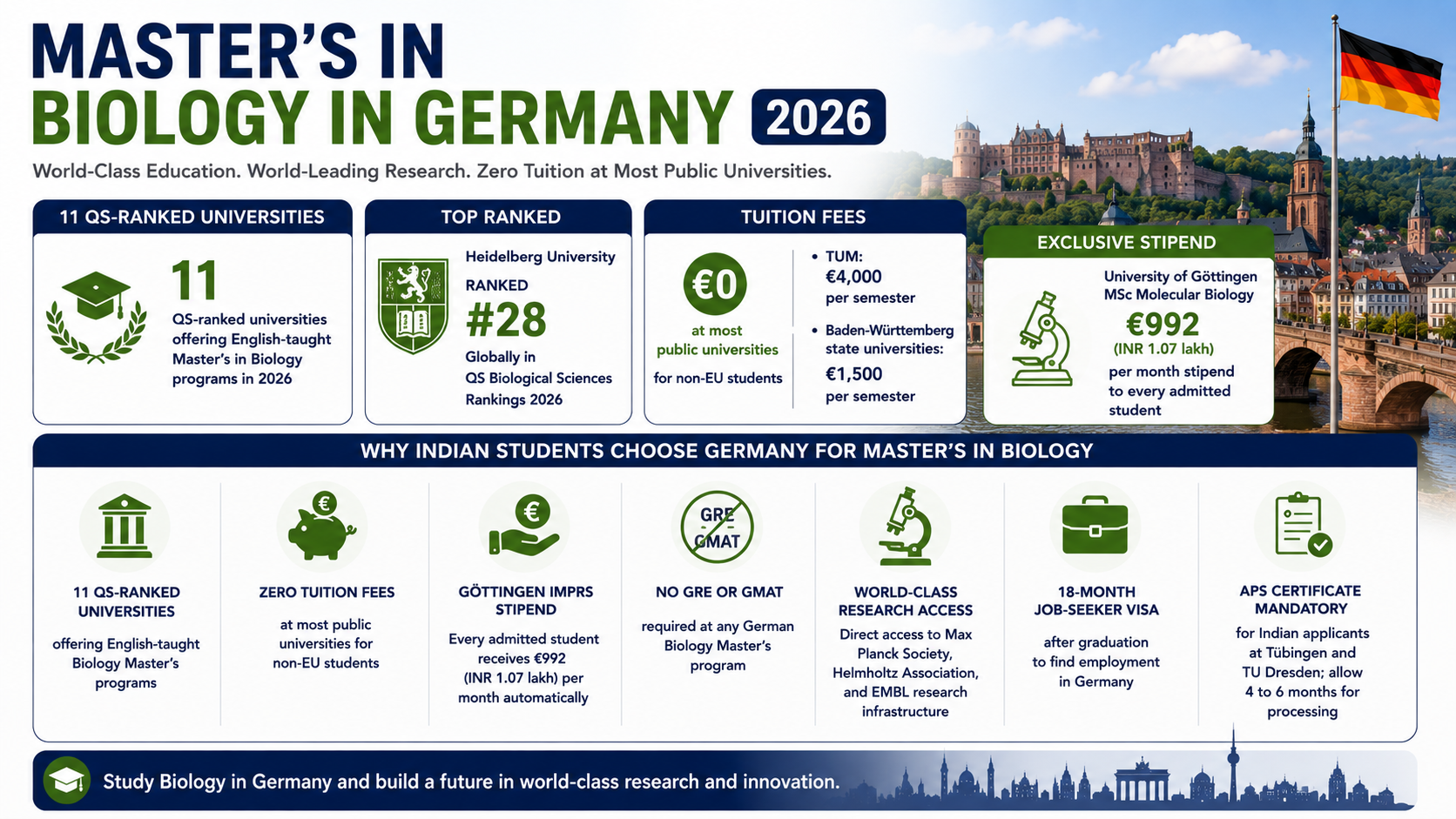
Germany has 11 QS-ranked universities offering English-taught Master's in Biology programs in 2026, led by Heidelberg University at rank #28 globally in QS Biological Sciences Rankings. Tuition fees are €0 at most public universities, with the exception of TUM (€4,000 per semester) and Baden-Württemberg state universities (€1,500 per semester). The University of Göttingen's MSc Molecular Biology is one of the only Master's programs in the world that provides a full €992 (INR 1.07 lakh) per month stipend to every admitted student.
Here is why Indian students choose Germany for Master's in Biology:
- 11 QS-ranked universities offering English-taught Biology Master's programs
- Zero tuition fees at most public universities for non-EU students
- Göttingen IMPRS stipend: Every admitted student receives €992 (INR 1.07 lakh) per month automatically
- No GRE or GMAT required at any German Biology Master's program
- Direct access to Max Planck Society, Helmholtz Association, and EMBL research infrastructure
- 18-month job-seeker visa after graduation to find employment in Germany
- APS Certificate mandatory for Indian applicants at Tübingen and TU Dresden; allow 4 to 6 months for processing
Latest Updates (August 2026)
APS Certificate processing time — allow 4 to 6 months. Required at Tübingen and TU Dresden for Indian applicants. Apply at the German Embassy in New Delhi immediately if targeting these universities. Tübingen deadline: 31 March 2027. TU Dresden deadline: 31 May 2027.
Göttingen IMPRS stipend confirmed at €992/month (INR 1.07 lakh/month) for all admitted students for the 2027 intake. No separate application required. Application window: 15 September 2026 to 15 January 2027.
TUM fee increase for 2027/28. TUM currently charges €4,000/semester (INR 43,128/semester) for non-EU students. A fee increase for 2027/28 has not been confirmed — verify at tum.de before applying. TUM application window: 1 February to 31 May 2027.
DAAD Study Scholarship 2027 applications open August 2026. Award: €992/month plus travel allowance and health insurance. Deadline for Indian students: October to November 2026. Apply at daad.de.
EU Blue Card salary threshold — 2026 update. The minimum gross salary for an EU Blue Card in Germany is €45,300/year (INR 48.83 lakh/year). Entry-level Biology research roles typically meet this threshold at mid-level. Verify the current threshold at bamf.de before applying.
All EUR to INR conversions use 1 EUR = INR 107.82 (June 2026).
- Top Universities for Master's in Biology in Germany
- Specialisations in Master's in Biology in Germany
- Eligibility and Requirements for Master's in Biology in Germany for Indian Students
- Tuition Fees for Master's in Biology in Germany for Indian Students
- Cost of Living in Germany for Biology Master's Students
- Scholarships for Master's in Biology in Germany for Indian Students
- Job Opportunities After Master's in Biology in Germany
- Germany vs Other Countries for Master's in Biology
- FAQs
Top Universities for Master's in Biology in Germany
Germany has 11 universities in the QS Biological Sciences Rankings 2026 that offer fully or primarily English-taught Biology Master's programs suitable for Indian students. Heidelberg University leads at rank #28 globally, followed by LMU Munich at rank #29. All programs are taught in English, with the exception of Freiburg's MSc Biology which requires both English B2 and German B2 proficiency.
| University | Location | QS Biological Sciences Rank 2026 | Program |
|---|---|---|---|
| Heidelberg University | Heidelberg | #28 | MSc Molecular Biosciences (7 majors, fully English) |
| LMU Munich | Munich | #29 | MSc Molecular and Cellular Biology; MSc Evolution, Ecology and Systematics; MSc Plant Science |
| Technical University of Munich (TUM) | Munich | #55 | MSc Biology (bilingual; English modules available) |
| Charité Berlin | Berlin | #71 | MSc Medical Neurosciences; MSc Molecular Medicine (both fully English) |
| University of Tübingen | Tübingen | #76 | MSc Cellular and Molecular Neuroscience (fully English; 15 places/year) |
| University of Göttingen | Göttingen | #81 | MSc/PhD Molecular Biology (fully English; IMPRS stipend for all students) |
| Free University of Berlin | Berlin | #89 | MSc Biology; MSc Biodiversity, Evolution and Ecology (both fully English) |
| University of Bonn | Bonn | #103 | MSc Molecular Cell Biology (fully English) |
| Albert-Ludwigs-Universität Freiburg | Freiburg | #113 | MSc Biology (English B2 + German B2 required; 7 majors) |
| University of Hamburg | Hamburg | #167 | MSc Marine Ecosystem and Fisheries Sciences (fully English) |
| TU Dresden | Dresden | #195 | MSc Regenerative Biology and Medicine; MSc Molecular Bioengineering (both fully English) |
Specialisations in Master's in Biology in Germany
Germany's Biology Master's programs offer specialisations that align with the country's strongest research and industry sectors. Indian students should choose based on their undergraduate background and target career. Neuroscience and Molecular Biology are the most in-demand specialisations in Germany's life sciences job market.
- Neuroscience and Cellular and Molecular Neuroscience (Best at Tübingen MSc Cellular and Molecular Neuroscience, Charité Berlin MSc Medical Neurosciences): Germany is a global leader in neuroscience research. Tübingen's Werner Reichardt Centre for Integrative Neuroscience and Charité Berlin's Medical Neurosciences program are world-renowned. Salaries for Neuroscientists range from €40,000 to €65,000 (INR 43.13 lakh to INR 70.08 lakh) per year.
- Molecular and Cellular Biology (Best at Heidelberg MSc Molecular Biosciences, LMU MSc Molecular and Cellular Biology, Bonn MSc Molecular Cell Biology, Göttingen MSc Molecular Biology): The most widely available English-taught Biology specialisation in Germany. The Max Planck Society has dozens of institutes focused on molecular biology, providing direct PhD pipeline opportunities.
- Ecology, Evolution and Biodiversity (Best at LMU MSc Evolution, Ecology and Systematics, FU Berlin MSc Biodiversity, Evolution and Ecology): Germany's commitment to the EU Biodiversity Strategy 2030 is creating new career pathways in environmental consulting, conservation NGOs, and EU environmental policy bodies.
- Regenerative Medicine and Stem Cell Biology (Best at TU Dresden MSc Regenerative Biology and Medicine): One of Europe's most specialised programs in this field, with direct links to the Center for Regenerative Therapies Dresden (CRTD) and the Max Planck Institute of Molecular Cell Biology and Genetics. Strong PhD Early Admission pathway built into the program.
- Marine Biology and Marine Ecosystem Sciences (Best at Hamburg MSc Marine Ecosystem and Fisheries Sciences): Germany's North Sea and Baltic Sea research infrastructure (Alfred Wegener Institute, GEOMAR Helmholtz Centre for Ocean Research Kiel) provides exceptional research opportunities. Growing global demand for marine scientists in fisheries management and climate change research.
- Plant Sciences (Best at LMU MSc Plant Science, Heidelberg Molecular Plant Sciences major): Germany is a global leader in agricultural biotechnology and plant genomics. Strong industry opportunities at BASF Plant Science, Bayer CropScience, and KWS Seeds.
- Molecular Medicine and Biomedical Sciences (Best at Charité Berlin MSc Molecular Medicine, Göttingen MSc Molecular Medicine): Direct bridges between basic biology and clinical applications. Strong pathway to clinical research, pharmaceutical R&D, and regulatory affairs careers at Germany's largest pharmaceutical companies.
Eligibility and Requirements for Master's in Biology in Germany for Indian Students
All 11 programs require a bachelor's degree in Biology or a related life science field. No GRE or GMAT is required at any German Biology Master's program. The APS Certificate is explicitly required at Tübingen and TU Dresden for Indian applicants and takes 4 to 6 months to process. Most other universities require a Uni-Assist evaluation instead.
Key notes for Indian applicants:
- No GRE or GMAT required at any German Biology Master's program
- APS Certificate is explicitly required at Tübingen and TU Dresden; allow 4 to 6 months
- Uni-Assist evaluation is required at most other universities instead of APS
- English-medium bachelor's degree is accepted as proof of English proficiency at Göttingen
- TUM Biology Test is required for applicants from non-Lisbon Convention countries, including India
- Göttingen accepts applications with a minimum of 120 ECTS completed at time of application (final degree not required)
| University | Program | Academic Eligibility | English Proficiency | APS/Uni-Assist | Application Deadline |
|---|---|---|---|---|---|
| Heidelberg University | MSc Molecular Biosciences | Bachelor's in Biology/Biosciences/Biochemistry (min. 180 ECTS); strong academic record | IELTS 6.5 / TOEFL iBT 90 | Uni-Assist | January to May (for October start) |
| LMU Munich | MSc Molecular and Cellular Biology / MSc Evolution, Ecology and Systematics | Bachelor's in Biology or related life science; subject-specific prerequisites | IELTS 6.5 / TOEFL iBT 88 | Uni-Assist | Varies by program |
| TUM | MSc Biology | Bachelor's in Biology or related field; TUM Biology Test required for Indian applicants | IELTS 6.5 / TOEFL iBT 88 | Uni-Assist | February 1 to May 31 (Winter semester) |
| Charité Berlin | MSc Medical Neurosciences / MSc Molecular Medicine | Bachelor's in Biology, Medicine, Biochemistry or related; relevant lab experience preferred | IELTS 6.5 / TOEFL iBT 92 | Uni-Assist | Varies by program |
| University of Tübingen | MSc Cellular and Molecular Neuroscience | Bachelor's in Biology, Biochemistry, Biomedical Science or related; GPA min. 2.5 (German scale) | IELTS 6.5 / TOEFL iBT 79 | APS Certificate required | February 1 to March 31 (for October start) |
| University of Göttingen | MSc/PhD Molecular Biology | Bachelor's in Molecular Biosciences, Cell Biology, Biochemistry, Biophysics or related (min. 120 ECTS at time of application) | Very good English; IELTS/TOEFL or English-medium bachelor's accepted | Uni-Assist | September 15 to January 15 (for October start) |
| Free University of Berlin | MSc Biology / MSc Biodiversity, Evolution and Ecology | Bachelor's in Biology or equivalent; B2 English; A1 German also required | IELTS/TOEFL B2 level | Uni-Assist | June 1 to July 15 (for October start) |
| University of Bonn | MSc Molecular Cell Biology | Bachelor's in Life Sciences or related; min. grade 2.7 (German scale); 20 ECTS in biochemistry, molecular biology, microbiology and cell biology | IELTS/TOEFL B2 level | Uni-Assist | Varies by program |
| University of Hamburg | MSc Marine Ecosystem and Fisheries Sciences | Bachelor's with 50 ECTS Biology + 10 ECTS Marine Biology + 6 ECTS Chemistry + 6 ECTS Data Science | IELTS 5.0 / TOEFL iBT 72 | Uni-Assist | Varies by program |
| TU Dresden | MSc Regenerative Biology and Medicine | Bachelor's in Biology, Medicine or related; relevant wet lab experience | IELTS 6.5 / TOEFL iBT 92 | APS Certificate required | April 1 to May 31 (for October start) |
All universities also require:
- Statement of Purpose (SOP): required by all universities
- Letters of Recommendation (LOR): 2 to 3 letters required
- CV or Resume
- Official Transcripts and Degree Certificates
- Application Fee: €0 at most German public universities
Tuition Fees for Master's in Biology in Germany for Indian Students
Tuition fees are €0 at most German public universities for Biology Master's programs, including at Heidelberg, LMU Munich, Charité Berlin, Göttingen, FU Berlin, Bonn, Hamburg, and TU Dresden. TUM charges €4,000 (INR 43,128) per semester for non-EU students, making it the most expensive option. Baden-Württemberg state universities (Heidelberg, Tübingen, Freiburg) charge €1,500 (INR 1.62 lakh) per semester for non-EU students. The University of Göttingen's MSc Molecular Biology is fully funded, with every admitted student receiving a €992 (INR 1.07 lakh) per month IMPRS stipend automatically.
| University | Program | Duration | Tuition Fee (Non-EU) | Semester Fee | Annual Cost (INR) |
|---|---|---|---|---|---|
| Heidelberg University | MSc Molecular Biosciences | 2 years | €1,500/semester (BW state) | €189.80/semester | INR 3.34 lakh/year |
| LMU Munich | MSc Molecular and Cellular Biology | 2 years | €0 | ~€142/semester | INR 30,616/year (semester fee only) |
| TUM | MSc Biology | 2 years | €4,000/semester | €97/semester | INR 8.81 lakh/year |
| Charité Berlin | MSc Medical Neurosciences | 2 years | €0 | ~€310/semester | INR 66,848/year (semester fee only) |
| University of Tübingen | MSc Cellular and Molecular Neuroscience | 2 years | €1,500/semester (BW state) | ~€200/semester | INR 3.67 lakh/year |
| University of Göttingen | MSc/PhD Molecular Biology | 18 months MSc | €0 (+ €992/month IMPRS stipend for ALL students) | ~€250/semester | Fully Funded |
| Free University of Berlin | MSc Biology | 2 years | €0 | ~€304/semester | INR 65,522/year (semester fee only) |
| University of Bonn | MSc Molecular Cell Biology | 2 years | €0 | ~€300/semester | INR 64,692/year (semester fee only) |
| University of Hamburg | MSc Marine Ecosystem and Fisheries Sciences | 2 years | €0 | ~€350/semester | INR 75,474/year (semester fee only) |
| TU Dresden | MSc Regenerative Biology and Medicine | 2 years | €0 | ~€250/semester | INR 53,910/year (semester fee only) |
Cost of Living in Germany for Biology Master's Students
Monthly living costs for a single international student in Germany range from €750 (INR 80,865) in Dresden to €1,300 (INR 1.40 lakh) in Munich. The University of Göttingen's IMPRS stipend of €992 (INR 1.07 lakh) per month covers all living costs in Göttingen, where monthly expenses range from €800 to €1,000 (INR 86,256 to INR 1.08 lakh). The semester fee at all German public universities includes the Deutschlandticket, saving students €50 to €100 (INR 5,391 to INR 10,782) per month on public transport.
| Expense | Monthly Cost (EUR) | Monthly Cost (INR) |
|---|---|---|
| Rent (student housing or shared flat) | €350 to €800 | INR 37,737 to INR 86,256 |
| Food and groceries | €200 to €300 | INR 21,564 to INR 32,346 |
| Health insurance (mandatory) | €120 to €130 | INR 12,938 to INR 14,017 |
| Public transport | €0 (covered by semester fee Deutschlandticket) | INR 0 |
| Phone, internet, and personal expenses | €100 to €150 | INR 10,782 to INR 16,173 |
| Total | €770 to €1,380 | INR 83,021 to INR 1.49 lakh |
City-wise estimated monthly living costs:
- Munich (LMU, TUM): €1,100 to €1,300 (INR 1.19 lakh to INR 1.40 lakh) per month
- Berlin (Charité, FU Berlin): €950 to €1,150 (INR 1.02 lakh to INR 1.24 lakh) per month
- Heidelberg: €900 to €1,100 (INR 97,038 to INR 1.19 lakh) per month
- Hamburg: €950 to €1,150 (INR 1.02 lakh to INR 1.24 lakh) per month
- Tübingen: €850 to €1,050 (INR 91,647 to INR 1.13 lakh) per month
- Bonn: €850 to €1,050 (INR 91,647 to INR 1.13 lakh) per month
- Freiburg: €850 to €1,050 (INR 91,647 to INR 1.13 lakh) per month
- Göttingen: €800 to €1,000 (INR 86,256 to INR 1.08 lakh) per month
- Dresden: €750 to €950 (INR 80,865 to INR 1.02 lakh) per month
Scholarships for Master's in Biology in Germany for Indian Students
Indian students can apply for several scholarships to reduce the cost of studying Biology in Germany. The University of Göttingen IMPRS stipend is the most exceptional option, providing €992 (INR 1.07 lakh) per month plus a health insurance subsidy to every admitted student automatically, with no separate application required. The DAAD Study Scholarship is the most prestigious external option, offering €992 (INR 1.07 lakh) per month plus travel allowance, health insurance, and a €460 (INR 49,597) annual study allowance.
| Scholarship | Offered By | Award | Award (INR) | Eligibility |
|---|---|---|---|---|
| IMPRS Molecular Biology Stipend | University of Göttingen / Max Planck Society | €992/month + up to €100/month health insurance subsidy | INR 1.07 lakh/month | All admitted students to Göttingen MSc Molecular Biology; no separate application needed |
| DAAD Study Scholarship (Master's) | DAAD | €992/month + travel allowance + health insurance + €460 annual study allowance | INR 1.07 lakh/month | Indian graduates applying for full Master's in Germany; merit-based |
| DAAD Study Scholarships for STEM Disciplines | DAAD | €992/month + insurance + travel allowance | INR 1.07 lakh/month | Indian students in STEM (Biology qualifies); 10 to 24 months |
| Deutschlandstipendium | Federal Government and Private Sponsors | €300/month for min. 2 semesters | INR 32,346/month | High-achieving students at German universities; available at Heidelberg, LMU, FU Berlin, Bonn |
| Heinrich Böll Foundation Scholarship | Heinrich Böll Foundation | €850/month + €300 book allowance | INR 91,647/month | Politically engaged, socially committed students; open to international students |
| Friedrich Ebert Foundation Scholarship | Friedrich Ebert Foundation | €850/month + €300 book allowance | INR 91,647/month | Socially committed students with strong academic record |
| Konrad Adenauer Foundation Scholarship | Konrad Adenauer Foundation | €850/month + €300 book allowance | INR 91,647/month | Students with strong academic record and social engagement |
| Charité Excellence Scholarship | Charité Berlin | Partial support; varies | Varies | High-achieving international applicants to Charité MSc programs |
| Inlaks Shivdasani Foundation Scholarship | Inlaks Foundation | Up to USD 85,000 | INR 80.21 lakh | Indian students studying abroad; apply before March each year |
| J.N. Tata Endowment Loan Scholarship | J.N. Tata Endowment | Up to INR 10 lakh | INR 10 lakh | Indian students pursuing postgraduate studies abroad |
Also Read: Scholarships in Germany for International Students
Job Opportunities After Master's in Biology in Germany
Germany is home to global pharmaceutical giants (Bayer, BASF, Merck KGaA, Boehringer Ingelheim), the Max Planck Society with 86 research institutes, the Helmholtz Association with 19 research centres, and a rapidly growing biotech startup scene in Berlin, Munich, and Heidelberg. Entry-level salaries for Biology graduates range from €32,000 (INR 34.50 lakh) for general Biologists to €80,000 (INR 86.26 lakh) for Biomedical Research Scientists. Indian graduates receive an 18-month job-seeker visa after graduation to find employment in Germany.
| Job Role | Average Annual Salary (EUR) | Average Annual Salary (INR) |
|---|---|---|
| Molecular Biologist | €27,000 to €100,000 (avg. €46,000) | INR 29.11 lakh to INR 1.08 crore |
| Biologist (General) | €32,000 to €48,000 (avg. €40,000) | INR 34.50 lakh to INR 51.75 lakh |
| Research Scientist (Life Sciences) | €45,000 to €72,000 | INR 48.52 lakh to INR 77.63 lakh |
| Biomedical Research Scientist | €60,000 to €80,000 (avg. €78,000) | INR 64.69 lakh to INR 86.26 lakh |
| Pharmaceutical Scientist / R&D | €45,000 to €70,000 | INR 48.52 lakh to INR 75.47 lakh |
| Neuroscientist / Neurobiologist | €40,000 to €65,000 | INR 43.13 lakh to INR 70.08 lakh |
| Regulatory Affairs Specialist | €45,000 to €68,000 | INR 48.52 lakh to INR 73.32 lakh |
| PhD Researcher (funded position, TV-L E13 scale) | €28,000 to €40,000 | INR 30.19 lakh to INR 43.13 lakh |
Post-study work and PR pathway:
- 18-month Job-Seeker Visa: Stay in Germany for up to 18 months after completing your Master's to find a relevant job
- EU Blue Card: Once employed with a minimum gross salary of €45,300 (INR 48.83 lakh) per year, apply for the EU Blue Card
- Permanent Residency: After 21 months with an EU Blue Card (or 33 months on a standard work permit), apply for German PR
Important note for Indian Biology graduates: German language skills (B1/B2) significantly improve employability outside academia. Most German pharmaceutical companies (Bayer, Merck, Boehringer Ingelheim) prefer candidates with German language ability for non-research roles. Free German language courses are offered at all German universities.
Germany vs Other Countries for Master's in Biology
Germany offers zero tuition fees at most public universities for Biology Master's programs, compared to GBP 15,000 to GBP 25,000 (INR 16.17 lakh to INR 26.96 lakh) per year in the UK or USD 25,000 to USD 55,000 (INR 23.59 lakh to INR 51.90 lakh) per year in the USA. The University of Göttingen's fully funded MSc Molecular Biology, with a €992 (INR 1.07 lakh) per month stipend for every admitted student, is unique globally. No other country offers a comparable combination of QS-ranked programs, zero tuition fees, and mandatory lab rotations at the Master's level.
| Factor | Germany | UK | USA | Australia |
|---|---|---|---|---|
| Annual Tuition | €0 (most programs) to €8,000 (TUM) | GBP 15,000 to GBP 25,000/year | USD 25,000 to USD 55,000/year | AUD 30,000 to AUD 40,000/year |
| Fully Funded Option | Yes (Göttingen, €992/month for all) | Rare | PhD only | Rare |
| Lab Rotation Requirement | Yes (2 to 3 rotations at most programs) | Minimal | PhD only | Minimal |
| PhD Pipeline | Structured fast-track options | Separate application | Integrated | Separate application |
| Post-Study Work Rights | 18-month job-seeker visa | 2-year Graduate Route | 12-month OPT | 2 to 4 year PSW visa |
| PR Pathway | EU Blue Card, 21 months | Skilled Worker visa, complex | Green Card, 10 to 15 years | Skilled Independent, 3 to 5 years |
| GRE/GMAT Required | No | No | Sometimes | No |
| APS Certificate Required | Yes (Tübingen, TU Dresden) | No | No | No |
Also Read: Public Universities in Germany
For Indian students who want a globally recognised Master's in Biology at the lowest possible cost with direct access to world-class research infrastructure, Germany offers an unmatched combination of QS-ranked programs, zero tuition fees, and a clear PR pathway. Students targeting a fully funded option should apply to the University of Göttingen's MSc Molecular Biology, where every admitted student receives a €992 (INR 1.07 lakh) per month stipend. Students targeting neuroscience should prioritise Tübingen or Charité Berlin. Students targeting molecular biology should consider Heidelberg, LMU Munich, or Bonn. Begin the APS Certificate process at least 4 to 6 months before your target application date if applying to Tübingen or TU Dresden.
FAQs
Ques: Which are the best universities for Master's in Biology in Germany for Indian students?
Ans: The best universities include Heidelberg University (QS Biological Sciences rank #28), LMU Munich (rank #29), TUM (rank #55), and University of Tübingen (rank #76). The University of Göttingen is the strongest option for fully funded study, with every admitted student receiving a €992 (INR 1.07 lakh) per month IMPRS stipend. All 11 programs are fully or primarily English-taught.
Ques: What are the fees for Master's in Biology in Germany for Indian students?
Ans: Tuition fees are €0 at most public universities, including LMU Munich, Charité Berlin, Göttingen, FU Berlin, Bonn, Hamburg, and TU Dresden. TUM charges €4,000 (INR 43,128) per semester for non-EU students. Heidelberg University and University of Tübingen, both in Baden-Württemberg state, charge €1,500 (INR 1.62 lakh) per semester for non-EU students.
Ques: What are the eligibility requirements for Master's in Biology in Germany for Indian students?
Ans: Indian students need a bachelor's degree in Biology or a related life science field. English proficiency of IELTS 6.5 or TOEFL iBT 88 to 92 is required at most universities. No GRE or GMAT is required at any German Biology Master's program. The APS Certificate is required at Tübingen and TU Dresden for Indian applicants and takes 4 to 6 months to process.
Ques: Is there a fully funded Master's in Biology in Germany?
Ans: Yes. The University of Göttingen's MSc Molecular Biology provides a full €992 (INR 1.07 lakh) per month IMPRS stipend plus a health insurance subsidy to every admitted student automatically, with no separate scholarship application required. This is one of the only fully funded Master's programs in Biology in the world. Students pay €0 in tuition fees and receive a monthly stipend that covers all living costs in Göttingen.
Ques: Is the APS Certificate mandatory for Master's in Biology in Germany?
Ans: The APS Certificate is explicitly required at Tübingen and TU Dresden for Indian applicants. Most other universities require a Uni-Assist evaluation instead. The APS Certificate is issued by the German Embassy in New Delhi and takes 4 to 6 months to process. Indian students should apply for the APS Certificate immediately after deciding to apply to Tübingen or TU Dresden.
Ques: Are there scholarships for Indian students for Master's in Biology in Germany?
Ans: Yes. The DAAD Study Scholarship offers €992 (INR 1.07 lakh) per month plus travel allowance and health insurance. The Deutschlandstipendium offers €300 (INR 32,346) per month and is available at all German universities. The Heinrich Böll, Friedrich Ebert, and Konrad Adenauer Foundation scholarships each offer €850 (INR 91,647) per month for highly competitive applicants.
Ques: What jobs can I get after Master's in Biology in Germany?
Ans: Graduates can work as Molecular Biologists, Research Scientists, Pharmaceutical Scientists, Neuroscientists, Regulatory Affairs Specialists, and Biomedical Research Scientists. Salaries range from €32,000 (INR 34.50 lakh) to €80,000 (INR 86.26 lakh) per year. Many Indian graduates also use the German Master's as a springboard to funded PhD positions at Max Planck, Helmholtz, or university institutes.
Ques: What is the post-study work visa for Biology graduates in Germany?
Ans: Biology Master's graduates receive an 18-month job-seeker visa after completing their degree. Once employed with a salary above €45,300 (INR 48.83 lakh) per year, graduates can apply for the EU Blue Card. With B1 German language proficiency, Permanent Residency is achievable in 21 months with an EU Blue Card.
Ques: Is Master's in Biology in Germany worth it for Indian students?
Ans: Yes. Germany offers 11 QS-ranked Biology Master's programs with zero tuition fees at most universities, mandatory lab rotations, and direct access to Max Planck and Helmholtz research infrastructure. The total annual cost at Göttingen, including the IMPRS stipend, is effectively €0, compared to INR 25 lakh or more per year in the UK or USA. The 18-month job-seeker visa and EU Blue Card provide a clear pathway to German PR in 21 months.
Found 39 universities
| Ranking | College Info | Top Courses | Fees & Cost of Living | ||||||||||||||||||||||||||||||||||||||||||||||||||||||||||||||||||||||||||||||||||||||||||||||||
|---|---|---|---|---|---|---|---|---|---|---|---|---|---|---|---|---|---|---|---|---|---|---|---|---|---|---|---|---|---|---|---|---|---|---|---|---|---|---|---|---|---|---|---|---|---|---|---|---|---|---|---|---|---|---|---|---|---|---|---|---|---|---|---|---|---|---|---|---|---|---|---|---|---|---|---|---|---|---|---|---|---|---|---|---|---|---|---|---|---|---|---|---|---|---|---|---|---|---|---|
 #52/700 QS Ranking 2025(Biology) |  Technical University Munich, MunichBavaria, Germany8%Acceptance Rate | MS Biology Course duration: 2 years Exams Accepted: TOEFL4.5 | Tuition: (€10,000/Yr)$11.2K/Yr Living: (€1,300/Yr)$1.5K/Yr | ||||||||||||||||||||||||||||||||||||||||||||||||||||||||||||||||||||||||||||||||||||||||||||||||
#38/700 QS Ranking 2025(Biology) |  Ludwig Maximilian University of Munich, MunichBavaria, Germany10%Acceptance Rate | MSc Molecular and Cellular Biology Course duration: 2 years | -- | ||||||||||||||||||||||||||||||||||||||||||||||||||||||||||||||||||||||||||||||||||||||||||||||||
#32/700 QS Ranking 2025(Biology) |  Heidelberg University, HeidelbergBaden-Wurttemberg, Germany45%Acceptance Rate | MEd Biology Course duration: 2 years | Tuition: (€3,000/Yr)$3.4K/Yr Living: (€7,978/Yr)$8.9K/Yr | ||||||||||||||||||||||||||||||||||||||||||||||||||||||||||||||||||||||||||||||||||||||||||||||||
#80/700 QS Ranking 2025(Biology) |  Free University of Berlin, BerlinBerlin, Germany | MS Biodiversity, Evolution, Ecology Course duration: 2 years | Tuition: (€718/Yr)$804.16/Yr | ||||||||||||||||||||||||||||||||||||||||||||||||||||||||||||||||||||||||||||||||||||||||||||||||
#145/700 QS Ranking 2025(Biology) |  Humboldt University of Berlin, BerlinBerlin, Germany18%Acceptance Rate | MS Quantitative Molecular Biology Course duration: 2 years Exams Accepted: IELTS6.5PTE53 | -- | ||||||||||||||||||||||||||||||||||||||||||||||||||||||||||||||||||||||||||||||||||||||||||||||||
#185/700 QS Ranking 2025(Biology) |  RWTH Aachen University, AachenNorth Rhine-Westphalia, Germany | MS Molecular and Applied Biotechnology Course duration: 2 years Exams Accepted: IELTS6PTE60 | -- | ||||||||||||||||||||||||||||||||||||||||||||||||||||||||||||||||||||||||||||||||||||||||||||||||
#251/700 QS Ranking 2025(Biology) |  Karlsruhe Institute of Technology, KarlsruheBaden-Wurttemberg, Germany25%Acceptance Rate | MS Chemical Biology Course duration: 2 years Exams Accepted: TOEFL4.5 | Tuition: (€3,000/Yr)$3.4K/Yr | ||||||||||||||||||||||||||||||||||||||||||||||||||||||||||||||||||||||||||||||||||||||||||||||||
#99/700 QS Ranking 2025(Biology) | .png) University of Bonn, BonnNorth Rhine-Westphalia, Germany | MS Immunobiology Course duration: 2 years Exams Accepted: TOEFL4 | -- | ||||||||||||||||||||||||||||||||||||||||||||||||||||||||||||||||||||||||||||||||||||||||||||||||
#115/700 QS Ranking 2025(Biology) |  University of Freiburg, FreiburgBaden-Wurttemberg, Germany33%Acceptance Rate | MSc Biology Course duration: 2 years Exams Accepted: TOEFL5PTE76 | Tuition: (€3,000/Yr)$3.4K/Yr | ||||||||||||||||||||||||||||||||||||||||||||||||||||||||||||||||||||||||||||||||||||||||||||||||
#155/700 QS Ranking 2025(Biology) |  University of Hamburg, HamburgHamburg, Germany | MS Biology Course duration: 2 years Exams Accepted: TOEFL3.5 | -- | ||||||||||||||||||||||||||||||||||||||||||||||||||||||||||||||||||||||||||||||||||||||||||||||||
 | |||||||||||||||||||||||||||||||||||||||||||||||||||||||||||||||||||||||||||||||||||||||||||||||||||
#201/700 QS Ranking 2025(Biology) |  Technical University Berlin, BerlinBerlin, Germany | MS Biological Chemistry Course duration: 2 years | Tuition: (€721/Yr)$807.52/Yr | ||||||||||||||||||||||||||||||||||||||||||||||||||||||||||||||||||||||||||||||||||||||||||||||||
#91/700 QS Ranking 2025(Biology) |  University of Goettingen, GottingenLower Saxony, Germany32%Acceptance Rate | MSc Neurosciences Course duration: 18 months | Tuition: (€218/Yr)$244.16/Yr | ||||||||||||||||||||||||||||||||||||||||||||||||||||||||||||||||||||||||||||||||||||||||||||||||
#191/700 QS Ranking 2025(Biology) |  Technical University Dresden, DresdenSaxony, Germany22%Acceptance Rate | MS Regenerative Biology and Medicine Course duration: 2 years Exams Accepted: TOEFL4.5 | Tuition: (€676/Yr)$757.12/Yr Living: (€5,997/Yr)$6.7K/Yr | ||||||||||||||||||||||||||||||||||||||||||||||||||||||||||||||||||||||||||||||||||||||||||||||||
#301/700 QS Ranking 2025(Biology) |  Martin Luther University Halle-Wittenberg, HalleSaxony, Germany56%Acceptance Rate | M.S Biology Course duration: 2 years | Tuition: (€105/Yr)$117.6/Yr Living: (€2,597/Yr)$2.9K/Yr | ||||||||||||||||||||||||||||||||||||||||||||||||||||||||||||||||||||||||||||||||||||||||||||||||
#251/700 QS Ranking 2025(Biology) |  University of Erlangen-Nuremberg, ErlangenBavaria, Germany46%Acceptance Rate | M.S Integrated Life Sciences - Biology, Biomathematics and Biophysics Course duration: 2 years | Tuition: (€288/Yr)$322.56/Yr Living: (€608/Yr)$680.96/Yr | ||||||||||||||||||||||||||||||||||||||||||||||||||||||||||||||||||||||||||||||||||||||||||||||||
#157/700 QS Ranking 2025(Biology) |  University of Cologne, CologneNorth Rhine-Westphalia, Germany20%Acceptance Rate | MS Neurosciences, Experimental and Clinical Course duration: 2 years Exams Accepted: TOEFL4 | Tuition: (€671/Yr)$751.52/Yr | ||||||||||||||||||||||||||||||||||||||||||||||||||||||||||||||||||||||||||||||||||||||||||||||||
#187/700 QS Ranking 2025(Biology) |  Goethe University Frankfurt, Frankfurt am MainHesse, Germany77%Acceptance Rate | MS Physical Biology of Cells and Cell Interactions Course duration: 2 years Exams Accepted: TOEFL4 | Tuition: (€763/Yr)$854.56/Yr Living: (€7,752/Yr)$8.7K/Yr | ||||||||||||||||||||||||||||||||||||||||||||||||||||||||||||||||||||||||||||||||||||||||||||||||
#251/700 QS Ranking 2025(Biology) |  University of Muenster, MunsterNorth Rhine-Westphalia, Germany15%Acceptance Rate | MEd Biology (Teaching at vocational Colleges) Course duration: 2 years Exams Accepted: TOEFL80 | Tuition: (€700/Yr)$784/Yr | ||||||||||||||||||||||||||||||||||||||||||||||||||||||||||||||||||||||||||||||||||||||||||||||||
#201/700 QS Ranking 2025(Biology) |  University of Wuerzburg, WurzburgBavaria, Germany28%Acceptance Rate | MSc Behavioural Neurobiology Course duration: 2 years Exams Accepted: IELTS6 | -- | ||||||||||||||||||||||||||||||||||||||||||||||||||||||||||||||||||||||||||||||||||||||||||||||||
#401/700 QS Ranking 2025(Biology) |  University of Duisburg-Essen, DuisburgNorth Rhine-Westphalia, Germany50%Acceptance Rate | MS Biology Course duration: 2 years | -- | ||||||||||||||||||||||||||||||||||||||||||||||||||||||||||||||||||||||||||||||||||||||||||||||||
SUBSCRIBE TO OUR NEWS LETTER


