



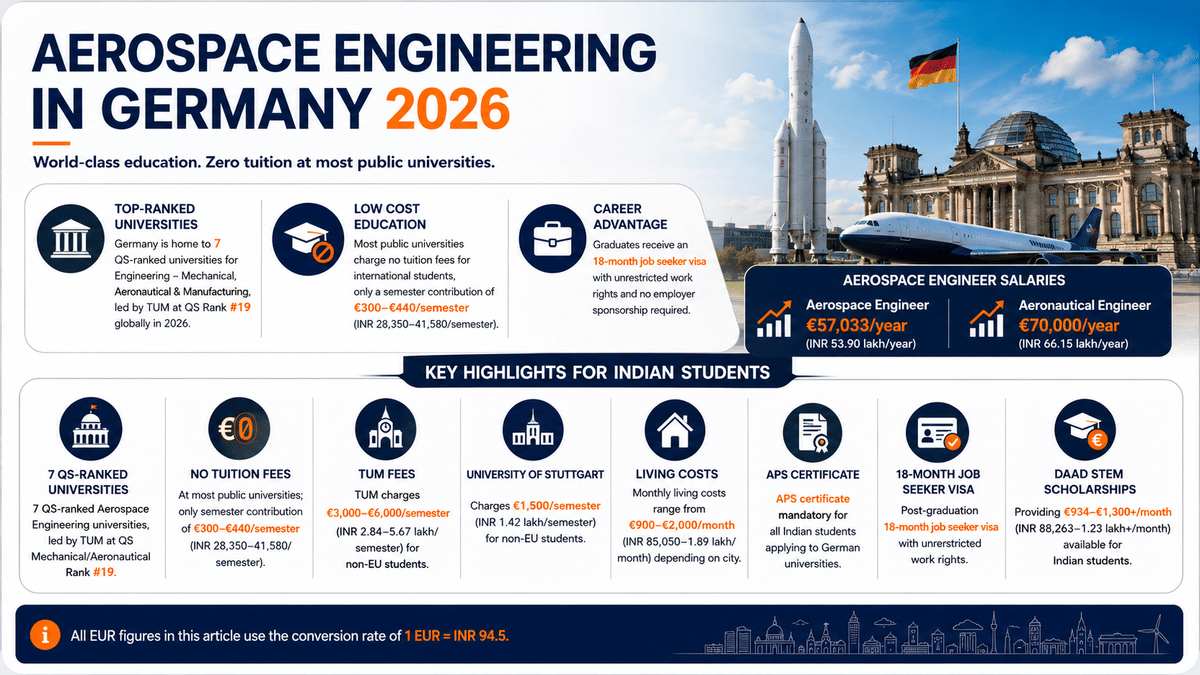
Germany is home to 7 QS-ranked universities for Engineering – Mechanical, Aeronautical and Manufacturing, led by Technical University of Munich at QS Rank #19 globally in 2026. Most public universities charge no tuition fees for international students, with only a semester contribution of €300–€440/semester (INR 28,350–41,580/semester). Graduates receive an 18-month job seeker visa with unrestricted work rights and no employer sponsorship required. Average Aerospace Engineer salaries in Germany are €57,033/year (INR 53.90 lakh/year), rising to €70,000/year (INR 66.15 lakh/year) for Aeronautical Engineers.
Key highlights for Indian students:
- 7 QS-ranked Aerospace Engineering universities, led by TUM at QS Mechanical/Aeronautical Rank #19
- No tuition fees at most public universities; only semester contribution of €300–€440/semester (INR 28,350–41,580/semester)
- TUM charges €3,000–€6,000/semester (INR 2.84–5.67 lakh/semester) for non-EU students
- University of Stuttgart charges €1,500/semester (INR 1.42 lakh/semester) for non-EU students
- Monthly living costs range from €900–€2,000/month (INR 85,050–1.89 lakh/month) depending on city
- APS certificate mandatory for all Indian students applying to German universities
- 18-month job seeker visa post-graduation with unrestricted work rights
- DAAD STEM scholarships providing €934–€1,300+/month (INR 88,263–1.23 lakh+/month) available for Indian students
Latest Updates — September 2026
- Winter 2027 deadlines have passed for most programs. KIT and TU Darmstadt close by July 15, Stuttgart by September 15. Begin preparing now for Winter 2027/28.
- TUM MSc Mechatronics application for Winter 2027/28 typically opens in December 2026 — begin preparing your aptitude assessment documents now.
- APS Certificate requires minimum 70% in Class XII from Winter 2026/27. Processing takes 3 to 4 weeks — apply immediately.
- EU Blue Card standard threshold updated to €50,700/year from January 2026. Engineering and MINT graduates qualify at the reduced threshold of €45,934.20/year — most Mechatronics roles in Germany meet this.
- Blocked account requirement remains €11,904/year (INR 11.25 lakh/year) for 2026 — unchanged. Open it at least 6 to 8 weeks before your visa appointment.
All EUR figures in this article use the conversion rate of 1 EUR = INR 94.5 (September 2026)
- Why Choose Germany for Aerospace Engineering?
- Top Universities for Aerospace Engineering in Germany
- Best Specializations for Aerospace Engineering in Germany
- Eligibility and Requirements for Aerospace Engineering in Germany
- Aerospace Engineering in Germany Fees
- Aerospace Engineering in Germany for Free
- Cost of Living in Germany for Aerospace Engineering Students
- Scholarships for Aerospace Engineering Students in Germany
- Job Opportunities After Aerospace Engineering in Germany
- FAQs
Why Choose Germany for Aerospace Engineering?
Germany offers no tuition fees at most public Aerospace Engineering universities, an 18-month job seeker visa, and direct industry ties with Airbus, DLR, MTU Aero Engines, and Rolls-Royce Deutschland. It is one of the most cost-effective and industry-connected study destinations globally for Indian students targeting European Aerospace careers.
- No tuition fees at most public universities; only semester contribution of €300–€440/semester (INR 28,350–41,580/semester)
- QS #19 globally for Mechanical/Aeronautical Engineering at TUM, Germany's highest-ranked Aerospace university
- 18-month job seeker visa with unrestricted work rights and no employer sponsorship required
- Direct industry ties with Airbus, DLR, MTU Aero Engines, Rolls-Royce Deutschland, and Isar Aerospace for internships and thesis projects
- EU Blue Card available for graduates earning above €45,300/year (INR 42.81 lakh/year)
- English-taught M.Sc. programs at TU Berlin, University of Stuttgart, and TUHH Hamburg accessible without German language proficiency
- DAAD STEM scholarships providing €934–€1,300+/month (INR 88,263–1.23 lakh+/month) available for Indian students
- Strong alignment with India's aerospace sector (ISRO, HAL, Skyroot, Agnikul) for students planning to return after European experience
Top Universities for Aerospace Engineering in Germany
The best universities for Aerospace Engineering in Germany include Technical University of Munich at QS Mechanical/Aeronautical Rank #19, RWTH Aachen University at #25, and TU Berlin at #42. All universities listed below are public institutions with no tuition fees except TUM and University of Stuttgart.
| University | Location | QS Engineering – Mechanical, Aeronautical & Manufacturing Rank 2026 |
|---|---|---|
| Technical University of Munich (TUM) | Munich | #19 |
| RWTH Aachen University | Aachen | #25 |
| Technische Universität Berlin (TU Berlin) | Berlin | #42 |
| University of Stuttgart | Stuttgart | #68 |
| Technical University of Darmstadt | Darmstadt | #51–100 |
| Technische Universität Braunschweig | Braunschweig | #251–300 |
| TUHH Hamburg University of Technology | Hamburg | #201–250 |
Key Notes:
- TUM is ranked #2 in Germany and #21 globally for Aerospace Engineering specifically, making it the strongest option for Indian students targeting top-tier Aerospace education.
- TU Berlin offers the M.Sc. Space Engineering program taught entirely in English, making it the most accessible option for Indian students without German language proficiency targeting Space Systems.
- University of Stuttgart is located near DLR (German Aerospace Center) headquarters and offers the strongest industry ties for Aerospace internships and thesis projects.
- Indian students must obtain an APS certificate before applying. The APS process takes 4–8 weeks and must be completed in India.
Best Specializations for Aerospace Engineering in Germany
Propulsion Systems, Space Systems/Astronautics, and Aerodynamics/CFD are the strongest specializations for Indian students pursuing Aerospace Engineering in Germany. All three align with Germany's strengths in sustainable aviation, New Space, and automotive-aerospace crossover sectors.
| Specialization | Best Universities | Career Outcomes | Why Strong for Indians |
|---|---|---|---|
| Propulsion Systems | TUM, RWTH Aachen, University of Stuttgart | Propulsion Engineer, R&D Engineer at MTU/Rolls-Royce | Aligns with ISRO, HAL, and India's engine programs |
| Aerodynamics / CFD | TUM, University of Stuttgart, RWTH Aachen | CFD Engineer, Aerodynamics Specialist at Airbus/DLR | Transferable simulation skills; high demand at Airbus |
| Space Systems / Astronautics | TU Berlin, University of Stuttgart, TUM | Satellite Engineer, Mission Designer, Space Systems Engineer | Aligns with ISRO boom; English-taught programs available |
| Aircraft Structures / Lightweight Materials | University of Stuttgart, RWTH Aachen, TU Darmstadt | Structural Engineer, Composites Engineer at Airbus/DLR | Strong demand in manufacturing and R&D |
| Avionics / Systems / Control | University of Stuttgart, TU Berlin, TUM | Avionics Engineer, Systems Engineer, Autonomous Systems Lead | Growing with AI and autonomous systems demand |
Key Notes:
- Space Systems/Astronautics is the most accessible specialization for Indian students without German language proficiency, with English-taught programs at TU Berlin and University of Stuttgart.
- Propulsion Systems offers the strongest alignment with India's aerospace sector (ISRO, HAL, Skyroot, Agnikul) for students planning to return to India after gaining European experience.
- German language proficiency (B1–B2) significantly boosts internship and full-time job opportunities at Airbus, DLR, and MTU Aero Engines outside multinational R&D teams.
Eligibility and Requirements for Aerospace Engineering in Germany
Most M.Sc. Aerospace Engineering programs in Germany require a relevant Bachelor's degree in Aerospace, Mechanical, or related Engineering with strong Math and Physics fundamentals. German C1 proficiency is required for most undergraduate programs. Many M.Sc. programs offer English-taught options requiring IELTS 6.5 or TOEFL iBT 90+. Indian students must obtain an APS certificate before applying.
UG (B.Sc.) Requirements
- A recognised secondary school qualification equivalent to the German Abitur is required at all universities.
- Strong grades in Mathematics and Physics are essential. RWTH Aachen requires a minimum German grade equivalent of ~2.5 (65–75% in Indian marking systems).
- German C1 proficiency (DSH-2 or TestDaF 4x4) is required at all universities for undergraduate programs. No English-taught B.Sc. Aerospace Engineering programs are available at public universities.
- A pre-university internship (typically 8 weeks) in a relevant engineering field is required at TUM and recommended at RWTH Aachen.
- APS certificate is mandatory for all Indian students. The process takes 4–8 weeks and must be completed in India before applying.
PG (M.Sc.) Requirements
- A relevant Bachelor's degree in Aerospace Engineering, Mechanical Engineering, or a closely related field is required at all universities.
- Competitive GPA equivalent to German grade ~2.5 or better (65–75% in Indian marking systems). TUM is the most selective, favoring grades of 2.0 or better.
- English-taught M.Sc. programs are available at TU Berlin (Space Engineering), University of Stuttgart (Aerospace Engineering – FAME track), and TUHH Hamburg (Mechanical Engineering and Management), requiring IELTS 6.5+ or TOEFL iBT 90+.
- GRE or GATE scores are sometimes required or considered for Indian applicants at TUM and KIT for M.Sc. admissions. Verify the specific program requirement on the official university website.
- Application deadline for the Winter semester (main intake) is typically 15 July. Apply early as competitive programs fill quickly.
Key Notes:
- APS certificate is mandatory for all Indian students. Start the APS process at least 3–4 months before your target application deadline.
- Indian students with a 3-year Bachelor's degree should verify equivalence with the specific university's international admissions office before applying.
- Always verify the latest requirements on the official university admissions page before applying.
Student Insights:
- Indian students on Quora note that a strong academic record in Mathematics, Physics, and core Engineering subjects carries more weight than GMAT or GRE scores at most German Aerospace programs.
- Students recommend applying to multiple universities simultaneously via uni-assist, as acceptance rates at top programs like TUM and RWTH Aachen are highly competitive.
Aerospace Engineering in Germany Fees
Most public Aerospace Engineering universities in Germany charge no tuition fees for international students. Students pay only a semester contribution of €300–€440/semester (INR 28,350–41,580/semester). TUM and University of Stuttgart are exceptions, charging additional non-EU tuition fees.
| University | Program | Duration | Fees/Semester | INR Equivalent |
|---|---|---|---|---|
| TUM | B.Sc. Mechanical Engineering | 3 years | €3,000 non-EU tuition + €150–€300 semester contribution | INR 3.00–3.14 lakh/semester |
| TUM | M.Sc. Aerospace Engineering | 2 years | €6,000 non-EU tuition + €150–€300 semester contribution | INR 5.83–5.97 lakh/semester |
| TUM | M.Sc. Mechanical Engineering | 2 years | €6,000 non-EU tuition + €150–€300 semester contribution | INR 5.83–5.97 lakh/semester |
| RWTH Aachen | B.Sc. Mechanical Engineering | 3–3.5 years | No tuition; semester contribution €300–€350 | INR 28,350–33,075/semester |
| RWTH Aachen | M.Sc. General Mechanical Engineering | 1.5–2 years | No tuition; semester contribution €300–€350 | INR 28,350–33,075/semester |
| TU Berlin | B.Sc. Mechanical Engineering | 3 years | No tuition; semester fee €379 | INR 35,816/semester |
| TU Berlin | M.Sc. Mechanical Engineering | 2 years | No tuition; semester fee €379 | INR 35,816/semester |
| University of Stuttgart | M.Sc. Aerospace Engineering | 2 years | €1,500 non-EU tuition + €184 semester fee | INR 1.59 lakh/semester |
| University of Stuttgart | M.Sc. Mechanical Engineering | 2 years | €1,500 non-EU tuition + €184 semester fee | INR 1.59 lakh/semester |
| TU Darmstadt | M.Sc. Mechanical Engineering | 2 years | No tuition; semester contribution €385 | INR 36,383/semester |
| TUHH Hamburg | M.Sc. Mechanical Engineering and Management | 2 years | No tuition; semester contribution €384 | INR 36,288/semester |
Key Notes:
- TUM charges tuition for non-EU students across most programs. Verify the specific program fee on the official TUM website before applying.
- The semester contribution at most universities includes a Semesterticket (public transport pass), reducing monthly transport costs significantly.
Aerospace Engineering in Germany for Free
Most public Aerospace Engineering universities in Germany charge no tuition fees for international students, including Indians. Students pay only a semester contribution of €300–€440/semester (INR 28,350–41,580/semester) covering administration, student services, and often a public transport pass. This makes Germany one of the most affordable destinations globally for Aerospace Engineering education.
The following universities offer Aerospace and Mechanical Engineering programs with no tuition fees for international students:
- RWTH Aachen University — Semester contribution ~€300–€350 (INR 28,350–33,075); ranked QS #25 for Mechanical/Aeronautical Engineering
- TU Berlin — Semester fee ~€379 (INR 35,816); offers English-taught M.Sc. Space Engineering
- Technical University of Darmstadt — Semester contribution ~€385 (INR 36,383); strong in Propulsion and Structures
- TUHH Hamburg University of Technology — Semester contribution ~€384 (INR 36,288); English-taught M.Sc. Mechanical Engineering and Management
- Technische Universität Braunschweig — Semester contribution ~€440 (INR 41,580); strong in Aerospace Structures and Systems
Key Notes:
- The mandatory blocked account requirement for Indian students is €11,904/year (INR 11.25 lakh/year) as proof of funds for the student visa.
- Students can work up to 20 hours/week during term time to offset living costs.
- University of Stuttgart charges €1,500/semester (INR 1.42 lakh/semester) for non-EU students as it is located in Baden-Württemberg state.
- Conversion rate used: 1 EUR = INR 94.5.
Cost of Living in Germany for Aerospace Engineering Students
Monthly living costs for Aerospace Engineering students in Germany range from €900–€1,100/month (INR 85,050–1.04 lakh/month) in Braunschweig and Darmstadt to €1,300–€2,000/month (INR 1.23–1.89 lakh/month) in Munich. The mandatory blocked account for Indian students is €11,904/year (INR 11.25 lakh/year).
| University | City | Monthly Cost of Living (EUR) | INR Equivalent |
|---|---|---|---|
| TUM | Munich | €1,300–€2,000 | INR 1.23–1.89 lakh |
| RWTH Aachen | Aachen | €1,100+ | INR 1.04 lakh+ |
| TU Berlin | Berlin | €1,000–€1,200 | INR 94,500–1.13 lakh |
| University of Stuttgart | Stuttgart | €992–€1,200+ | INR 93,744–1.13 lakh+ |
| TU Darmstadt | Darmstadt | €900–€1,300 | INR 85,050–1.23 lakh |
| Technische Universität Braunschweig | Braunschweig | €900–€1,100 | INR 85,050–1.04 lakh |
| TUHH Hamburg | Hamburg | €800–€1,200+ | INR 75,600–1.13 lakh+ |
Key Notes:
- Munich is the most expensive city. Braunschweig, Darmstadt, and Aachen are significantly more affordable for Indian students on a budget.
- The mandatory blocked account requirement is €11,904/year (INR 11.25 lakh/year) as proof of funds for the student visa.
- Eating at the university Mensa (cafeteria) for €2–€4/meal (INR 189–378/meal) and using the Semesterticket for free public transport can bring monthly costs closer to €900–€1,000/month (INR 85,050–94,500/month) even in Berlin.
Student Insights:
- Indian students on Reddit consistently recommend Braunschweig and Darmstadt for the lowest overall cost of living, with monthly expenses often staying below €1,000/month (INR 94,500/month) with careful budgeting.
- Students note that securing a student dormitory (Studentenwohnheim) through the Studentenwerk is the single most effective way to reduce rent costs, with rooms available from €300–€450/month (INR 28,350–42,525/month).
Scholarships for Aerospace Engineering Students in Germany
Indian students can apply for merit-based and need-based scholarships at all universities. The most valuable award is the DAAD Study Scholarship for STEM Disciplines, providing a monthly stipend of €934–€1,300+/month (INR 88,263–1.23 lakh+/month) plus insurance, travel, and study allowances.
| University | Scholarship | Award (EUR) | INR Equivalent |
|---|---|---|---|
| TUM | TUM Scholarship for International Students | €500–€1,500/semester (renewable; merit + need) | INR 47,250–1.42 lakh/semester |
| TUM | Deutschlandstipendium | €300/month for 1 year | INR 28,350/month |
| TUM | Munich Aerospace / DAAD-related (PG/PhD) | Full funding (stipend + support) for Aerospace | Varies |
| RWTH Aachen | Deutschlandstipendium | €300/month for 1 year | INR 28,350/month |
| RWTH Aachen | DAAD STIBET / Scholarship for Involved International Students | Varies (merit + involvement) | Varies |
| TU Berlin | DAAD Scholarships | €850–€1,300+/month + allowances | INR 80,325–1.23 lakh+/month |
| University of Stuttgart | Deutschlandstipendium | €300/month for 1 year | INR 28,350/month |
| University of Stuttgart | Hermann-Reissner-Stiftung (Aerospace-specific) | Varies (targeted support for Aerospace students) | Varies |
| TU Darmstadt | DAAD STIBET / Scholarship for Equal Opportunities | €500/month for up to 6 months | INR 47,250/month |
| TUHH Hamburg | Deutschlandstipendium | €300/month for 1 year | INR 28,350/month |
| All Universities | DAAD Study Scholarship for STEM Disciplines | €934–€1,300+/month + travel + insurance + study allowance | INR 88,263–1.23 lakh+/month |
Key Notes:
- DAAD scholarships are the most valuable external funding option for Indian Aerospace Engineering students. Apply via daad.de or daad.in. Deadlines are typically October–December for the following winter intake.
- The Deutschlandstipendium (€300/month) is available at most public universities and is funded jointly by the university and private sponsors. Apply directly via the target university after receiving admission.
- The Hermann-Reissner-Stiftung at University of Stuttgart is one of the few Aerospace-specific scholarships in Germany and is highly recommended for students targeting Propulsion and Aerodynamics specializations.
Job Opportunities After Aerospace Engineering in Germany
Graduates receive an 18-month job seeker visa with unrestricted work rights and no employer sponsorship required. Average starting salaries range from €52,443/year (INR 49.56 lakh/year) for Mechanical Engineers to €70,000/year (INR 66.15 lakh/year) for Aeronautical Engineers.
| Job Role | Average Annual Salary (EUR) | INR Equivalent |
|---|---|---|
| Mechanical Engineer (Aerospace-related) | €52,443 | INR 49.56 lakh |
| Project Engineer | €53,022 | INR 50.11 lakh |
| Manufacturing Engineer | €53,738 | INR 50.78 lakh |
| Aerospace Engineer | €57,033 | INR 53.90 lakh |
| Aerospace Systems Engineer | €60,329 | INR 57.01 lakh |
| Stress Engineer | €61,042 | INR 57.68 lakh |
| Aeronautical Engineer | €70,000 | INR 66.15 lakh |
Key Notes:
- Salaries are average annual gross figures for Germany and vary by city, industry, and years of experience.
- Munich and Hamburg typically offer 15–20% higher salaries than the national average for Aerospace roles due to proximity to Airbus and MTU Aero Engines headquarters.
- The EU Blue Card is available for graduates earning above €45,300/year (INR 42.81 lakh/year), providing a faster pathway to permanent residency.
- German language proficiency (B1–C1) significantly increases salary potential and job placement rates outside multinational R&D roles.
Student Insights:
- Indian students on Reddit note that Airbus (Hamburg/Munich), DLR, MTU Aero Engines, and Rolls-Royce Deutschland are the most common employers for Aerospace Engineering graduates from TUM, Stuttgart, and RWTH Aachen.
- Students recommend starting the German job search at least 6 months before graduation and building a strong XING profile alongside LinkedIn for the German job market.
Also Read: Mechanical Engineering Jobs in Germany
TUM (QS #19) is the strongest option for rankings and industry connections, while TU Berlin and University of Stuttgart offer the best English-taught M.Sc. options for Indian students without German language proficiency. RWTH Aachen and TU Darmstadt offer the lowest cost of living at €900–€1,100/month (INR 85,050–1.04 lakh/month). Start by obtaining the APS certificate at least 3–4 months before your target application deadline, shortlist programs based on your German language level and specialization, and apply for the Winter semester intake by 15 July.
FAQs
Ques: Which is the best university for Aerospace Engineering in Germany?
Ans: Technical University of Munich (TUM) is ranked QS #19 globally for Mechanical, Aeronautical and Manufacturing Engineering in 2026 and #21 globally specifically for Aerospace Engineering, making it Germany's strongest option. RWTH Aachen University at QS #25 and TU Berlin at QS #42 are the strongest alternatives. TU Berlin is the best option for Indian students targeting Space Systems through an English-taught program.
Ques: Is Aerospace Engineering in Germany free for Indian students?
Ans: Most public Aerospace Engineering universities in Germany charge no tuition fees for international students, including Indians. Students pay only a semester contribution of €300–€440/semester (INR 28,350–41,580/semester) covering administration and often a public transport pass. TUM charges €3,000–€6,000/semester (INR 2.84–5.67 lakh/semester) and University of Stuttgart charges €1,500/semester (INR 1.42 lakh/semester) for non-EU students.
Ques: What are the fees for Aerospace Engineering in Germany for Indian students?
Ans: Most public universities charge only a semester contribution of €300–€440/semester (INR 28,350–41,580/semester) with no tuition. TUM charges €6,000/semester (INR 5.67 lakh/semester) for its M.Sc. Aerospace Engineering program. University of Stuttgart charges €1,500/semester (INR 1.42 lakh/semester) for non-EU students.
Conversion rate used: 1 EUR = INR 94.5
Ques: What is the APS certificate and is it required for Indian students?
Ans: The APS (Academic Evaluation Centre) certificate is a mandatory document for Indian students applying to German universities. It verifies the authenticity of Indian academic qualifications and is required by all German universities for admission. The APS process takes 4–8 weeks and must be completed in India before submitting university applications. Start the APS process at least 3–4 months before your target application deadline.
Ques: What is the salary after Aerospace Engineering in Germany?
Ans: Average starting salaries for Aerospace Engineering graduates in Germany range from €52,443/year (INR 49.56 lakh/year) for Mechanical Engineers to €70,000/year (INR 66.15 lakh/year) for Aeronautical Engineers. Aerospace Systems Engineers earn an average of €60,329/year (INR 57.01 lakh/year). Munich and Hamburg roles typically offer 15–20% higher salaries than the national average.
Ques: What scholarships are available for Aerospace Engineering students in Germany?
Ans: The most valuable scholarship is the DAAD Study Scholarship for STEM Disciplines, providing €934–€1,300+/month (INR 88,263–1.23 lakh+/month) plus insurance, travel, and study allowances. The Deutschlandstipendium (€300/month, INR 28,350/month) is available at most public universities including TUM, RWTH Aachen, and University of Stuttgart. The Hermann-Reissner-Stiftung at University of Stuttgart is the only Aerospace-specific scholarship in Germany.
Ques: Which Aerospace Engineering specialization is best for Indian students in Germany?
Ans: Space Systems/Astronautics is the most accessible specialization for Indian students without German language proficiency, with English-taught programs at TU Berlin and University of Stuttgart. Propulsion Systems is the strongest option for students planning to return to India, aligning with ISRO, HAL, Skyroot, and Agnikul. Aerodynamics/CFD offers the highest demand at Airbus and DLR for students targeting long-term European careers.
Ques: Is German language required for Aerospace Engineering in Germany?
Ans: German language at C1 level (DSH-2 or TestDaF 4x4) is required for all undergraduate Aerospace and Mechanical Engineering programs at public universities. Many M.Sc. programs are fully English-taught, including Space Engineering at TU Berlin, Aerospace Engineering at University of Stuttgart, and Mechanical Engineering and Management at TUHH Hamburg. German language proficiency (B1–B2) significantly boosts internship and full-time job opportunities at Airbus, DLR, and MTU Aero Engines.




Found 6 universities
| Ranking | College Info | Top Courses | Fees & Cost of Living | ||||||||||||||||||||||||||||||||||||||||||||||||||||||||||||||||||||||||||||||||||||||||||||||||
|---|---|---|---|---|---|---|---|---|---|---|---|---|---|---|---|---|---|---|---|---|---|---|---|---|---|---|---|---|---|---|---|---|---|---|---|---|---|---|---|---|---|---|---|---|---|---|---|---|---|---|---|---|---|---|---|---|---|---|---|---|---|---|---|---|---|---|---|---|---|---|---|---|---|---|---|---|---|---|---|---|---|---|---|---|---|---|---|---|---|---|---|---|---|---|---|---|---|---|---|
 #21/532 QS Ranking 2024(Aerospace Engineering) |  Technical University Munich, MunichBavaria, Germany8%Acceptance Rate | MS Aerospace Engineering Course duration: 2 years Exams Accepted: TOEFL4.5 | Tuition: (€12,000/Yr)$13.4K/Yr Living: (€1,300/Yr)$1.5K/Yr | ||||||||||||||||||||||||||||||||||||||||||||||||||||||||||||||||||||||||||||||||||||||||||||||||
 #139/1502 THE Ranking 2023(Aerospace Engineering) |  University of Wuerzburg, WurzburgBavaria, Germany28%Acceptance Rate | BSc Aerospace Informatics Course duration: 3 years Exams Accepted: IELTS6 | -- | ||||||||||||||||||||||||||||||||||||||||||||||||||||||||||||||||||||||||||||||||||||||||||||||||
#48/532 QS Ranking 2024(Aerospace Engineering) |  University of Stuttgart, StuttgartBaden-Wurttemberg, Germany53%Acceptance Rate | MS Aerospace Engineering Course duration: 2 years | Tuition: (€3,000/Yr)$3.4K/Yr Living: (€24,242/Yr)$27.2K/Yr | ||||||||||||||||||||||||||||||||||||||||||||||||||||||||||||||||||||||||||||||||||||||||||||||||
#151/532 QS Ranking 2024(Aerospace Engineering) |  Technical University of Braunschweig, BraunschweigLower Saxony, Germany51%Acceptance Rate | M.S Aerospace Engineering Course duration: 2 years | Tuition: (€440/Yr)$492.8/Yr Living: (€5,328/Yr)$6K/Yr | ||||||||||||||||||||||||||||||||||||||||||||||||||||||||||||||||||||||||||||||||||||||||||||||||
| -- |  FH Aachen - University of Applied Sciences, AachenNorth Rhine-Westphalia, Germany45%Acceptance Rate | M.S Aerospace Engineering Course duration: 18 months Exams Accepted: TOEFL92 | Tuition: (€156/Yr)$174.72/Yr | ||||||||||||||||||||||||||||||||||||||||||||||||||||||||||||||||||||||||||||||||||||||||||||||||
| -- |  City University of Applied Sciences, BremenBremen, Germany65%Acceptance Rate | M.S Aerospace Technologies Course duration: 1 year Exams Accepted: TOEFL57 | Tuition: (€380/Yr)$425.6/Yr Living: (€4,662/Yr)$5.2K/Yr | ||||||||||||||||||||||||||||||||||||||||||||||||||||||||||||||||||||||||||||||||||||||||||||||||
SUBSCRIBE TO OUR NEWS LETTER


