



Content Curator
What would the world be without heat and fire? Can you imagine it? Can you live without baking hot food? Imagining a world without fire is devastating. The undeniable truth is that heat and fire are crucial for your life. Combustion is the process which gives you heat and fire, and so, let's learn about it.
| Table of Content |
Combustion
[Click Here for Sample Questions]
What happens when a gas stove is lit? The fuel LPG in a gas cylinder is exposed to a temperature higher than its ignition temperature meaning which results in its oxidation with the oxygen in air and consequently produces heat and light. This oxidation of fuel is called combustion. In other words combustion is the scientific term for burning.
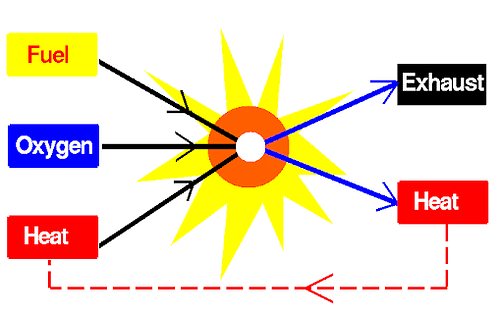
The burning of charcoal undergo the following reaction:
Charcoal + oxygen → carbon dioxide +water
Chemical equation for combustion of methane:
CH4 + 2O2 → CO2 + 2H2O
Every substance can be divided into two types in respect to its combustibility. Substances that can undergo combustion (burn) in the presence of fuel and oxidants are called combustible substances.
Read more : Groundwater
Examples for combustible substances are paper, dung, peat, cloth, natural biomass etc. Substances that cannot burn even in presence of fuel and oxidant are called noncombustible substances. Examples for noncombustible substances are granite, iron, marble etc.

Examples of Combustion
[Click Here for Sample Questions]
- Combustion of diesel in generator.
- Combustion of charcoal for barbecue.
- Combustion of aviation kerosene in airplanes.
- Combustion in explosives ( fuel used in explosives is ammonium nitrate – fuel oil)
- Combustion of trees and plants in forest fires.
Types of Combustion
[Click Here for Sample Questions]
Combustion or burning can be divided into two types based on the presence or absence of adequate oxidant during the process.
- Complete combustion
- Incomplete combustion
Complete Combustion
Combustion that takes place when the fuel is provided with adequate oxidant (usually atmospheric air) is called complete combustion. This combustion results in the formation of elemental oxides and water. For example carbon dioxide and water will be produced when hydrocarbon is a fuel. Similarly when other elements take part in combustion their elemental oxides along with water will be produced.

Incomplete Combustion
Incomplete combustion takes place when the fuel lacks the supply of adequate oxides. Incomplete combustion of hydrocarbons results in formation of carbon monoxide, carbon and water. The energy produced in incomplete combustion is lesser than the energy produced by complete combustion. Carbon monoxide, the byproduct of incomplete combustion, is harmful to human health. When inhaled in large amounts carbon monoxide causes death. Incomplete combustion of methane:
4CH4 + 7O2 → 2CO + 2C + 8H2O
Difference between Complete and Incomplete combustion
[Click Here for Sample Questions]

Based on the rapidity of combustion, they can be classified as:
- Spontaneous combustion
- Rapid combustion
- Explosive combustion
Spontaneous Combustion
If a substance with low ignition temperature, like peat and straw, undergoes oxidation or fermentation, heat is emitted. This heat is contained within the substance. When this heat exceeds the substance's ignition temperature, spontaneous combustion occurs.

Rapid Combustion
Rapid combustion is combustion that takes place in a short span of time with release of heat and light. When a gas stove is lit, the fuel LPG undergoes combustion in a short span of time. Similarly a matchstick ignites rapidly. These are examples for rapid combustion.

Explosive Combustion
Explosive combustion takes place as an explosion! It is a violent release of heat and light in a fraction of second. Grenade bursts in an instance, releasing a profusion of energy. Crackers crack in a span of an eyeblink. These are examples for explosive combustion.

Flame
[Click Here for Sample Questions]
Flames are visible indicators of combustion taking place. When the vapour of the hydrocarbon undergoes combustion, flame is produced. substances that cannot vapourise will not produce flame. When you look at the flame closely, you can see they have different colours. These colors in the flame indicate if they receive adequate oxygen or not.

Yellow flame is the result of inadequate oxygen supply. It is an impure flame. Blue flame is the result of adequate oxygen supply; this is pure flame.
Zones of flame
[Click Here for Sample Questions]

A Flame has three zones. They are the inner zone, the middle zone and the outer zone.
- Inner zone is the darkest and also the least hot zone of a flame. This is because oxygen supply is very low in this part of the flame.
- The colour of the middle zone ranges from yellow to orange. This part of the flame is slightly hotter than the inner zone.
- Outer zone of any flame is blue in colour. This is the hottest zone because it receives ample oxygen supply.

Fuel
[Click Here for Sample Questions]
Fuel is any substance that can be used to produce energy. This energy can be nuclear energy, thermal energy etc. When fuel is induced with an oxidant heat is produced as a byproduct. Fuel can be in any state. They can be solid, liquid or gaseous in state.

Examples of solid fuels are wood paper, peat, dung. Liquid fuels are petroleum, diesel, kerosene etc. Gaseous fuels include natural gas, methan, hydro propane.

Fuel Efficiency
[Click Here for Sample Questions]
Fuel efficiency is the amount of energy that can be extracted from a fuel. The larger the amount of energy a machine extracts, the larger its fuel efficiency. A vehicle which extracts large amounts of energy from fuel is said to be highly fuel efficient, and the one which extracts a lesser amount of energy is not fuel efficient.
Sample Questions
Ques. Choose the by-product of complete combustion of hydrocarbons?
(a) Carbon dioxide
(b) Carbon monoxide and carbon
(c) Carbon dioxide and water
(d) Carbon monoxide, carbon and water (1 mark)
Ans. c. Carbon monoxide and water
When hydrocarbons undergoes complete combustion carbon dioxide and water are the by-products formed.
Ques. Which zone of the flame is hottest?
(a) Inner zone
(b) Middle zone
(c) Outer zone
(d) All the above(1 mark)
Ans. c. Outer zone
Outer zone of the flame is the hottest because of ample oxygen supply. It is blue in colour.



Comments