



Education Journalist | Study Abroad Lead
Recycling generally refers to the process of transforming the non-useful waste products into something useful that can be used by humans again. As recycling uses much lesser resources than are required in the production of new goods, it is an ideal option for saving energy and thus in term contributes to conserving our environment. Hence, we can say that recycling is an eco-friendly and cost-efficient system alternative. Paper is a material that is widely used in today's world across all dimensions. Hence, there is a need to recycle paper so that a constant supply of paper can be generated while also treating the used paper and turning them into something useful. In this article, we will have a look at the recycling of paper and its processes.
Recycling of paper
Even after the invention of the latest digital technologies, the demand for paper is seeing a constant rise. The production of paper and related products all over the globe has touched a mark of approximately 400 million metric tons. 50% of the waste in our landfills constitutes majorly of paper and its related products.
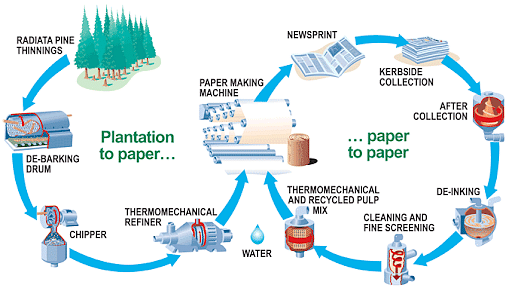
Recycling of paper
As the paper is produced from trees and a single tree helps in producing over eight thousand sheets of paper, there is an immediate need to keep a check on the demand for paper and its production to keep a check on pollution and our environment while also fulfilling our paper demands. This can be done through reusing the already used paper by the process of recycling.
Recycling of paper is a process through which used and waste paper is turned into productive paper and related paper products for use again.
The recycling of paper is an easy task to render the paper useful for use again after going through some processes.
Steps Involved in Recycling of Paper
The process of recycling paper basically involves sorting waste papers and then cleaning them with soap to break them down further. After breaking the paper down, the mixture is exposed to heat. After a while, this paper is decomposed into cellulose through the processes.
The various steps used in the process of recycling paper are as follows:
Step 1: After being collected from bins and garbage, the already used papers are stored in a large container for the purpose of recycling.
Step 2: The large recycling containers are then shifted to a recycling plant for further processing such as the segregation of waste papers into various grades and types.
Step 3: The waste papers which are segregated are then shredded into multiple small pieces. These are then washed with soapy water. The purpose of washing is to remove any stains of staples, ink, plastic film, or glue on the used paper.
Step 4: The papers that are washed are stored in a large container that contains water. The papers here get mixed with water and are heated to form a slurry as a product.
Step 5: Different materials are added to this slurry of paper to form various paper products such as cardboard, newsprint, or plain white papers.
Step 6: The slurry which is prepared is then moved and spread over a screen to remove any contaminants or remaining adhesives.
Step 7: The slurry is then spread on large rollers in order to produce thin and large paper sheets by transferring the slurry on a conveyor belt where water helps in binding the fibers of the paper again.
Step 8: These sheets of paper are then separated to dry on heated metal rollers.
Step 9: After getting dried, these sheets are rolled.
Step 10: They are then packed up new and fresh for use again.
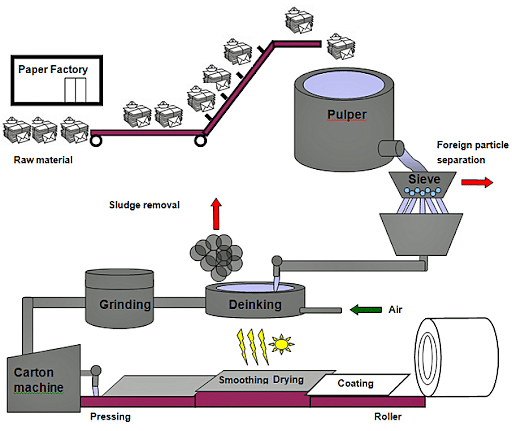
Process of Recycling of Paper
Importance of recycling of paper
- Recycling helps in the conservation of energy and is a cost-efficient process.
- It helps in saving our natural resources such as water, trees, and forests as a whole thereby contributing to the protection of our environment by keeping a check on air, water, land, and soil pollution.
- Recycling processes save our environment from the harmful industrial emissions of methane gases that are released in the atmosphere of the Earth as a result of the decomposition of hazardous and biodegradable wastes.
- It prevents the waste from being piled up.
- Recycling is important as a lot of waste is generated every day by humans and our daily processes. Some of this waste can't be degraded further and hence turning them into something useful is an ideal option.
Recycling, therefore, helps to get rid of non-useful waste materials while also keeping a check on air, land, and water pollution as the waste gets changed into something useful rather than being piled up and contributing to the pollution of the environment.
Just like recycling paper, recycling of various other materials like plastic, glass, wood, electric equipment, metals, etc also takes place. These materials through the process of recycling are changed into new raw materials for our use.
Limitations
Despite its numerous advantages the process of recycling paper also has certain limitations or shortcomings which are as stated below:
- Paper contains many organic and inorganic constituents along with fiber. The variety of chemicals present in the paper has the potential to contaminate the same.
For instance, bisphenol A, which is a type of chemical that is found in thermal paper has been proven to be a contaminant present in the recycled paper
- Papers and it's material contain many groups of toxic metals and chemicals such as phenols, phthalates, mineral oils, etc.
- Although practices such as optimizing paper collection for the purpose of recycling and improving the process of the contamination reduce the chemical load on papers during the process of recycling, there still remains a circulation of the harmful contaminants in the paper cycle for many decades to come.
The 3 R's
We can save our environment by following the three R's which are as follows:
- Reuse
- Recycle
- Reuse

3 R’s to save the environment and prevent the accumulation of waste
Recycling is an important part of this practice. It promotes long-term sustenance and growth of the resources in order to ensure that our natural resources are available for all our future generations too as they are available for us now.
Things to Remember
- Recycling generally refers to the process of transforming the non-useful waste products into something useful that can be used by humans again.
- As the paper is produced from trees and a single tree helps in producing over eight thousand sheets of paper, there is an immediate need to keep a check on the demand for paper and its production.
- As recycling uses much lesser resources than are required in the production of new goods, it is an ideal option for saving energy and thus in term contributes to conserving our environment.
- The process of recycling paper basically involves sorting waste papers and then cleaning them with soap to break them down further.
- After breaking the paper down, the mixture is exposed to heat.
- After a while, this paper is decomposed into cellulose through the processes.
- Despite its numerous advantages the process of recycling paper also has certain limitations.
Sample Questions
Ques. What is recycling? Why is it important? (5 marks)
Ans. Recycling generally refers to the process of transforming the non-useful waste products into something useful that can be used by humans again. It is an ideal option for saving energy and thus in time contributes to conserving our environment. Recycling is important as:
- Recycling helps in the conservation of energy and is a cost-efficient process.
- It helps in saving our natural resources such as water, trees, and forests and is an eco-friendly process.
- Recycling processes save our environment from the harmful industrial emissions of methane gases that are released into the atmosphere.
- It prevents the waste from being piled up.
- Recycling is important to turn the waste that can’t be degraded into something useful.
Ques. Why is the recycling of paper highly important for us? (5 marks)
Ans. Recycling of paper is a process through which used and waste paper is turned into productive paper and related paper products for use again. The recycling of paper is an easy task to render the paper useful for use again after going through some processes. It is critically important as:
- Paper is a material that is widely used in today's world across all dimensions. Hence, there is a need to recycle paper so that sustainable use of resources takes place meeting the present needs while also ensuring their availability for future generations.
- The production of paper and related products all over the globe has touched a mark of approximately 400 million metric tons and paper comprises 50% of the waste in our landfills.
- The paper is produced from trees and a single tree helps in producing over eight thousand sheets of paper, there is an immediate need to keep a check on the demand for paper and its production to keep a check on pollution and our environment while also fulfilling our paper demands.
Ques. What is the process of recycling paper? (5 marks)
Ans. The process of recycling paper can mainly be divided into 4 phases which are as follows:
- Collection
The very first step of the process is the collection of the waste paper. The waste papers that are not useful are collected in a large container.
- Recycling
In this process, papers are separated and graded. After that, the paper is washed with soap, and water is mixed into washed papers to form a pulp.
- Rolling
The pulp of the paper formed is then rolled to form thin sheets of paper which are recycled.
- Packaging
These sheets are then separated to dry them out after which they are cut and packed to be sold for further use.
Ques. Can a paper be recycled indefinite times? (3 marks)
Ans. No, there's a restriction as to how many times a sheet of paper can be recycled. This is due to the fact that after each process of recycling, the fibers of the paper are shortened. After the recycling of paper about 5-6 times, the paper fibers become so short that they can't be bonded further for the recycling process. Hence, to replace the washed-down fibers that become unusable, new fibers are added to the slurry. Therefore, the new sheet formed after recycling will contain the fibers that were subjected to the recycling process multiple times as well as some new fibers.
Ques. Can all types of paper be recycled? (2 marks)
Ans. No, only papers that have not been contaminated with oil or food can be recycled. Certain paper types such as napkins and paper towels can not be recycled easily and therefore they are decomposed by nature by putting them in compost.
Ques. What are the 3Rs? How are they important for the conservation of the environment? (3 marks)
Ans. The three R's helps in reducing the waste in the environment. These 3 R's are:
- Reduce: The best way to reduce the waste in our atmosphere is to use fewer products and resources. Using them wisely and judiciously is the best way to go.
- Reuse: It is best to reuse products for the same purpose whenever you can. Repair appliances that are broken and reusing cloth bags can be really helpful.
- Recycle: Recycling is the process of remanufacturing material from used products in order to render them ideal for use again.
Ques. What are the limitations of recycling paper? (3 marks)
Ans. Though recycling of paper is beneficial in the conservation of the environment and to ensure a steady supply of resources in the future while fulfilling the needs of today, there are still certain limitations of the process which are stated below:
- Paper contains many organic and inorganic constituents along with fiber that has the potential to contaminate the recycled paper.
For instance, bisphenol A is one such toxic component.
- Papers and their material contain many groups of toxic metals and chemicals, there still remains a circulation of the harmful contaminants in the paper cycle for many decades to come.



Comments