



Education Journalist | Study Abroad Lead
Asteroids and comets are the celestial bodies that are also known as time capsules. They are referred to as such as they contain history and information about our solar system. One of the most prominent and significant differences between asteroids and comets is in terms of their composition. While comets and asteroids both are formed from the debris that is left behind since the formation of planets and the moon, comets are located in the outer regions of the solar system whereas asteroids are found in a belt between the planets Mars and Jupiter. Asteroids and comets often change the path of their orbits due to gravitational changes. These disturbances at times bring these celestial bodies closer to planets in the solar system. In this article, we will have a look at comets, asteroids, and the differences between the two.
Read More: Single Slit Diffraction
| Table of Content |
Read More: Derivation of Drift Velocity
Asteroids and Comets
Asteroids and Comets are the celestial bodies that were formed over 4.6 billion years ago. The impact of collisions of these asteroids and comets can be seen in the craters on the planets and moon. While asteroids are formed of metals and rocky materials, the comets are formed of ice, dust, and rock materials. As the asteroid formation took place closer to the sun, it was impossible for the ice present in them to stay in the solid form while as the formation of comets took place farther away, the ice in them maintain their solid forms. When the comets orbit around the sun and come closer to it, it loses their ice material as it melts due to the heat and then vaporize in order to form the tail of a comet known as the coma.

Asteroids and Comets
What are Comets?
Comets are relatively smaller bodies in the solar system which orbit around the sun. When they come closer to the sun, a part of them melts and vaporizes to form a tail due to the sun's heat. The tail is a form of a halo that's glowing extending out as the comets go sailing in space. The melted ice and other compounds such as methane and ammonia form a fuzzy cloud-like shell that is popularly known as the coma. This tail is a notable distinction between the asteroids and the comets. The tail of the comets generally points away from the sun.
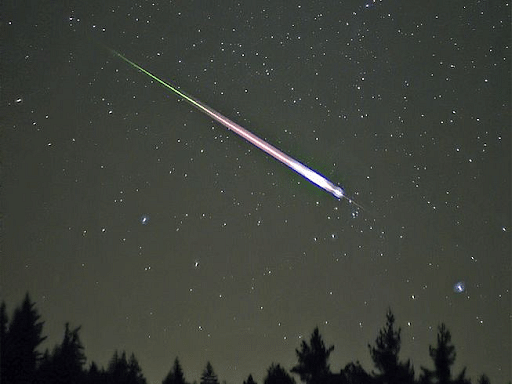
Comet with a tail
Comets are similar to a dusty snowball. Their center is made of ice and is covered with large clouds of dust and gas. It is widely believed that the water and other organic compounds which served as a building block of life on Earth were brought by these comets.
Read More:
In our solar system, we have a special belt where the comets exist. This belt is referred to as Oort Cloud. It has a distance that is approximately equal to 1,00,000 times the distance that exists between the Earth and the sun. In this belt, there are many comets that take up to 30 million years in their orbit to complete a single rotation around the sun.
Many of the comets in the solar system are also found in the regions of the Kuiper Belt which is the region that exists just outside Pluto's orbit. It may have millions of icy comets in addition to the icy dwarf planets such as Eris and Pluto.
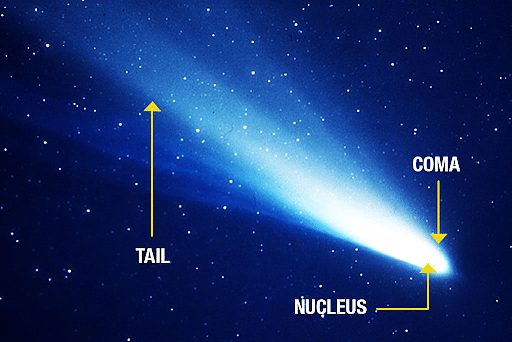
Structure of a Comet
At the center of each comet, there is a nucleus which is formed of frozen gases and big icy rocks. The nucleus of the comets also has some dust particles.
When the comet moves in its orbit and comes near the sun, the water and gases in its core start to melt due to the pressure and heat of the sun. As a result of this vaporization, a long bright tail is developed. A single comet is known to have two tails, one of which is a dust tail while the other one is the ion tail. This tail develops as a result of the ions present inside the nucleus of the comet.
Read More: Applications of Thermodynamics
The orbit of the comets is highly elliptical. As of September 2021, as per NASA scientist, the current number of comets that are known and recognized in our solar system are 3743. Though there are believed to be many more comets existing beyond Neptune present in the Kuiper Belt and the Oort Cloud that exists farther beyond pluto.

Location of Comets in the Solar System
As the comets move around in their orbit around the sun and pass the Earth on its way back, the debris that they leave behind also leads to meteor showers on the surface of the Earth.
Read More:
What are Asteroids?
Asteroids are small bodies that orbit the Sun in the solar system. They are composed of rocks and metals along with organic compounds. They are referred to as small to long formations of rock that orbit around massive celestial bodies like our sun. They also revolve around the stars in a similar way as a planet but are very small in size from them.

Asteroid Belt in the Solar System
Mostly, they are similar to comets however one prominent distinction between them is that they don't have a tail that's also known as a coma as the comets have. They have elliptical and shorter orbits.
Our solar system was formed over 4.6 billion years ago when big clouds of dust and gas started collapsing inwards. During this phase, most of the gases and the dust particles reached towards the cloud's center in order to form a star that is our sun. The other left-behind particles joined in the later years to form planets. The left-behind debris in the space formed into smaller rocks which are known as asteroids.

Asteroids
Similarities between asteroids and comets
- They are both celestial bodies that orbit around the sun.
- They are both formed from the leftover material from 4.5 billion years ago that is from the formation of our solar system
- Both asteroids and comets have unusual orbits which means they sometimes come too close to the sun or the planets of the solar system.
- Comets and asteroids are both impacted by the gravitational disturbances which set them on an orbit that is closer to the Earth as well as the sun.
Read More:
Differences between asteroids and comets
The differences between asteroids and comets are as tabulated below:
| Asteroids | Comets |
|---|---|
| Asteroids move in an elliptical orbit. | Comets move in an eccentric orbit, unlike asteroids. |
| They are formed of rocks and metals. | They are formed of hydrocarbons, ice, and rocks. |
| Generally, asteroids remain solid even when they are close to the sun | The ice at the center of the comets typically melts when they are closer to the sun and hence gets vaporized. |
| The orbital period for asteroids ranges from 1 to 100 years. | Comets have an orbital period that ranges from 75 to 1,00,000 years. |
| They do not have a tail or a coma. | Comets develop a thin tail when the ice in them melts when they are closer to the sun. This tail is widely known as a coma. |
| Their size ranges from 1 to 100 kilometers. | The nucleus of the comets ranges in size from 1 to over 10 kilometers. |
| The majority of the asteroids of varying sizes in our solar system reside in the asteroid belt existing between Jupiter and Mars. | The majority of the comets exist in the farther end of the solar system that is they exist either in the Oort Cloud or in the Kuiper belt. |
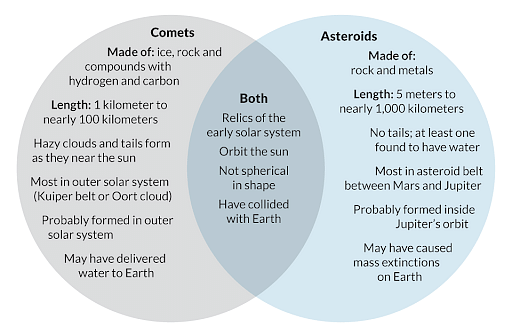
Asteroids Vs Comets
Things to Remember
- Comets are relatively smaller bodies in the solar system which orbit around the sun.
- Asteroids are composed of rocks and metals along with organic compounds.
- In our solar system, we have a special belt where the comets exist. This belt is referred to as Oort Cloud or the Kuiper Belt.
- The left-behind debris in the space after the formation of planets formed into smaller rocks which are known as asteroids.
- Generally, asteroids remain solid even when they are close to the sun.
- The ice in the comets melts as they approach the sun and vaporizes in the form of a tail of the comet which is known as a coma.
- Asteroids move in an elliptical orbit while comets move in an eccentric orbit.
Also Read:
Sample Questions
Ques. Explain the formation of comets. Name a commonly known comet. (5 marks)
Ans. Comets are formed of dust particles, gas, and ice. The center of the comets which is its nucleus is formed entirely of ice.
We have two kinds of comets in our solar system:
- Some of the comets in our solar system safely orbit around the sun. They don't come very close to the sun.
- On the other hand, there are some comets which are referred to as sungrazers which directly crash into the sun if they are big enough or either disintegrate and then evaporate from the heat of the sun as they come close to it.
The most common comet of our solar system which is widely known is the Halley's Comet. It is visible from the surface of the Earth. The last time, it was visible from Earth was in the year 1986. It is now expected to complete a circle in its orbit and come closer to Earth again in 2061 that is 75 years apart from the previous time.
Read More: Helmholtz Free Energy
Ques. What kind of tails does the comet have? (5 marks)
Ans. Mainly there are two types of tails a comet has. One is the dust tail while another one is the gas tail. The shape of these tails is determined by the solar wind and the light of the sun. They always point away from the sun. As per NASA reports, the tails of the comets start to get longer as the comet comes near the sun, and eventually, they can go up to millions of miles long.
- The dust tail of the comet is formed as a result of the push of solar wind towards the smaller particles present in the coma of the comet around an elongated curve path.
- However the ion tail of the comet of formed from the molecules of gas that are electrically charged.
We can observe many comets from the surface of the Earth with our naked eyes. This is because when comets are near to the sun, their tails reflect the light of the sun and even appear to glow due to the absorbed energy by the heat of the sun.
Ques. Do asteroids have tails? (3 marks)
Ans. Typically, asteroids do not have any tails even when they get closer to the sun. However, recently it has been observed that some asteroids display sprouted tails. One such asteroid that was observed with a tail is the P/2010 A2. The reason behind this is that the tail might appear when the asteroids have been pummelled or hit by other asteroids, as a result of which gas and dust are ejected from the surface of these asteroids forming a tail. This newly recognized phenomenon is referred to as the sporadic tail effect and these asteroids are called active asteroids. However, it must be noted that this is a recently observed phenomenon and active asteroids are very rare in nature.
Read More:
Ques. Where do comets come from? (3 marks)
Ans. Most of the comets are located in the Kuiper Belt which refers to a region of space that exists beyond the Neptune plan. In this region, the comets generally take around 200 years or less than that to complete a revolution around the sun in their orbit. These comets are known as short-period comets.
Other than the Kuiper belt, comets also come from the Oort Cloud which refers to a region that is at the farther end of the solar system. Comets in this region take about 30 million years to orbit around the sun. These are therefore known as the long-period comets.
Ques. What are near-Earth Asteroids, also known as NEA? (5 marks)
Ans. Near-Earth Asteroids are the asteroids that circle around the sun at the same distance at which the Earth is. These NEAs are further classified into various sub-categories which are as follows:
- There are asteroids that have their orbits in the path of the Earth but they exclusively exist between Mars and Earth. These asteroids are known as Amor Asteroids.
- Apollo asteroids are known as the asteroids that cross the orbits of the sun but most of the time they exist outside the path of the planet.
- Aten asteroids are the ones that cross the orbit of the Earth but majorly remain inside the orbit.
- Atira asteroids on the other hand are the asteroids that have their orbits within the orbit of the Earth.
These near-Earth Asteroids are also referred to by many astronomers and scientists as 'Potentially Hazardous Asteroids'. This is because these rocks exist within a distance of 4.64 million miles from the orbit of the Earth and these are larger in size about 500 feet or 140 meters
Ques. Why do comets appear fuzzy in appearance? (3 marks)
Ans. When comets are in their own region of the Kuiper Belt or in the Oort Cloud, they appear as dark and dull chunks of rock, ice, and dust. In this form, the comets are not much different from the asteroids. As the comets are in their orbit, they get closer to the sun and start to get warm. The comets then start to lose their materials that form a kind of cloud around their nucleus. This cloud around the comet is known as a coma and it may be around hundreds or thousands of miles across.
Read More: Mass-Energy and Nuclear Binding Energy
Ques. How do asteroids differ from each other? (3 marks)
Ans. As the asteroids are formed in different regions of space and are at varying distances from the sun, no two asteroids are similar. The ways in which they differ are:
- All asteroids are not round as the planets are. Instead, they have irregular and jagged shapes.
- Most of the asteroids are formed from different kinds of rocks. Some of them are composed of metals and clays such as iron and nickel.
- Some of the asteroids are over hundreds of miles in their diameter while many of them are as small as the pebbles are.
Ques. Why do comets come closer to Earth? (3 marks)
Ans. The comets are pulled closer by the gravitational pull of any passing star. This gravitational pull shakes up comets that are present in the Oort Cloud. Some of the comets then get sent flying around into the inner part of the solar system. The gravitational pull of the planet can also sometimes disturb the comets present in the Kuiper belt. The gravitational pull of the sun also pulls the comets towards them into a lopsided orbit. The comets go around the sun in their orbit and then go back to their position. However, some comets go straight into the sun and are never seen again.
Also Read:



Comments