



Content Curator
Sound is a form of vibrating energy that travels through a medium in the form of waves. Noise and music are different forms of sound, noise is unpleasant, irritating, and undesired, whereas music is harmonious, pleasant, and soothing. Sound requires a medium for propagation. This is why sound does not travel in a vacuum. Conversely, sound travels the fastest in solids and slowest in gas.
| Table of Content |
Key takeaways: Infrasonic, ultrasonic, Longitudinal waves, Oscillatory motion, Noise, Music
Sound
[Click Here for Sample Questions]
Sound is a type of energy that is produced by vibrations. Sound travels through a medium, these mediums can be solids, liquids, or gases. Thus, sound can also be considered a vibration. These vibrations travel through the medium in the form of waves. These waves are called acoustic waves. The acoustic waves travel through any medium via compressions and decompressions alternatively. The acoustic waves possess a few characteristics, pressure, velocity, intensity, and a fixed displacement.
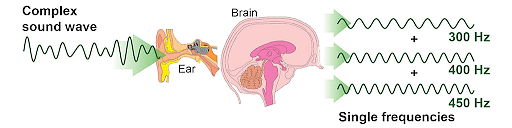
Interpretation of Sound in Humans
Sound forms the basis of communication in human life. In the human body, the vocal cords in the body vibrate to produce sound vibrations. These vibrations travel as longitudinal and transverse waves. The ears receive these vibrations and then the brain interprets them. These vibrations range from 20 Hz to 20 kHz which are audible to the ears.
Read More:
| Related Articles | ||
|---|---|---|
| Unit of Sound | Loudness of Sound | |
Types of Sounds
[Click Here for Sample Questions]
Sound can be divided into two types depending on its frequency. Sound waves having a frequency lesser than 20 Hz are called infrasonic waves, and waves having a frequency higher than 20 kHz are called ultrasonic waves. Thus, the sound is of two types:
Infrasonic Waves
Infrasonic waves have a frequency lower than 20 Hz. Since it is below the human hearing range, it is inaudible to humans. However, several other living organisms use these waves to communicate, whales, sharks, elephants, hippopotamus, etc. these waves are also used in the scientific field, it is used to study upcoming earthquakes, volcanic eruptions, human heart rates, rock formation stages, etc.

Types of Sound
Ultrasonic waves
Ultrasonic waves have a frequency higher than 20 kHz. Since it is above the human hearing range, it is inaudible to humans. These waves are used in the scientific field, it is used to study human heart rates, to take sonograms, navigation of directions, imaging things, uniform sample mixing, communication, testing of samples, etc.
Read Also:
| Related Topics | ||
|---|---|---|
| Coherent and Incoherent addition of waves | Interference of light waves and young's experiment | Total Internal Reflection |
Music
[Click Here for Sample Questions]
Music is also a type of sound. Music is harmonious, ordered, and organized set of vibrations and frequencies which make up these pleasant and audible sound waves. The frequency of musical waves is discrete and separable. Musical waves are characterized by controlled pitch and timbre. Music is generated by several musical instruments; these musical waves are controlled periodically by sequenced vibrations.
Read More:
| Relevant Articles | ||
|---|---|---|
| Difference between Transverse and Longitudinal Waves | Longitudinal Waves | Oscillatory Motion |
Noise
[Click Here for Sample Questions]
Noise is also a type of sound wave but unlike musical waves, it is unordered, unorganized, irrational, and non-harmonious. Noise is a set of randomized wave frequencies coming out of a source which makes it unpleasant.
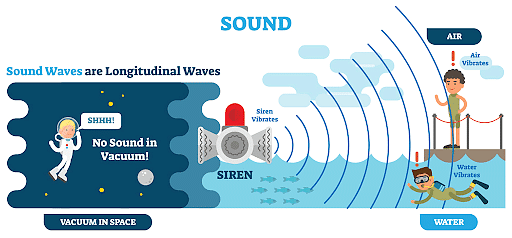
Sound Needs a Medium to Propagate
Noise does not have a single dominant frequency. Noise can be further classified into four different types, they are:
- Continuous Noise: As the name suggests, in such a scenario, the noise from the source of the sound is continuous. For example, constant drilling noise.
- Intermittent Noise: Here, the noise is not constant, but it often continues for some time and then discontinues for some time. For example, running of trains on railway tracks
- Impulsive noise: It consists of sudden packets of loud unpleasant noise. For example, cracking of rocks, bomb blasts, etc.
- Low-frequency noise: They have a low frequency; they may be heard in the background as a continuous hum. For example, the hum of a generator running.
Read Also:
| Relevant Topics | ||
|---|---|---|
| polarisation of light | transverse | oscillation |
Difference Between Sound, Noise, And Music
[Click Here for Sample Questions]
The differences between sound, noise, and music are listed below:
| Sound | Noise | Music |
|---|---|---|
| Sound is a type of energy that is produced by vibrating objects. The sound travels through a medium, these mediums can be solids, liquids (water), or gases (air). Thus, sound can also be considered a vibration. | Noise is also a type of sound wave but unlike musical waves, it is unordered, unorganized, irrational, and non-harmonious. | Music is also a type of sound. Music is harmonious, ordered, and organized set of vibrations and frequencies which make up these pleasant and audible sound waves. |
| Sound can be divided into two types depending on its frequency. Sound waves having a frequency lesser than 20 Hz are called infrasonic waves, and waves having a frequency higher than 20 kHz are called ultrasonic waves. | Noise can be classified into 4 categories, continuous, intermittent, impulsive, and low cracking. | Music has no subtypes. |
| Has regular, uniform, rational waves and motion. | Noise is a set of randomized wave frequencies coming out of a source which makes it unpleasant. | The frequency of musical waves is discrete and separable. Musical waves are characterized by controlled pitch and timbre. |
Read Also: Electromagnetic Spectrum
Things to Remember
- Sound is a type of energy that is produced by vibrating objects. The sound travels through a medium, these mediums can be solids, liquids (water), or gases (air). Thus, sound can also be considered a vibration.
- Sound can be divided into two types depending on its frequency. Sound waves having a frequency lesser than 20 Hz are called infrasonic waves, and waves having a frequency higher than 20 kHz are called ultrasonic waves.
- Noise is also a type of sound wave but unlike musical waves, it is unordered, unorganized, irrational, and non-harmonious. Noise can be classified into 4 categories, continuous, intermittent, impulsive, and low cracking.
- Music is also a type of sound. Music is harmonious, ordered, and organized set of vibrations and frequencies which make up these pleasant and audible sound waves.
- Sound is measured in hertz Hz, noise and music are measured in decibels, dB.
Sample Questions
Ques: What is sound, noise, and music? [3 marks]
Ans: Sound is a type of energy that is produced by vibrating objects. The sound travels through a medium, these mediums can be solids, liquids, or gases. Thus, sound can also be considered a vibration.
Music is a type of sound. Music is harmonious, ordered, and organized set of vibrations and frequencies which make up these pleasant and audible sound waves.
Noise is also a type of sound wave but unlike musical waves, it is unordered, unorganized, irrational, and non-harmonious.
Ques: What do you mean by audible and inaudible sound? [3 marks]
Ans: The sound that lies in the hearing range is called audible sound range. These vibrations range from 20 Hz to 20 kHz which are audible to the ears. Sound waves having a frequency lesser than 20 Hz and higher than 20 kHz are inaudible to human ears. These are inaudible sound waves
Ques: What are the different types of inaudible sound? [3 marks]
Ans: Inaudible sound can be divided into two types depending on its frequency. Sound waves having a frequency lesser than 20 Hz are called infrasonic waves, and waves having a frequency higher than 20 kHz are called ultrasonic waves. They are used widely in communications and several scientific procedures.
Ques: Define oscillations, frequency, and amplitude of sound waves. [3 marks]
Ans: Oscillations define the to and fro motion of the sound waves.
The number of oscillations per second defines the frequency. A high-frequency sound wave has high pitched sound
Amplitude measures the height of the sound waves.
Ques: What are the longitudinal and transverse motions of sound waves? [2 marks]
Ans: Sound waves travel via longitudinal transmission in liquids. In longitudinal transmission, there are regions having compressions, and rarefactions. Whereas, in solids, the soundwave travels via transverse motion in solid media.
Ques: How is the sound produced? [2 marks]
Ans: A vibrating object produces sound. Whenever an object is vibrating, it creates a pressure wave. This pressure wave results in particles in the surroundings vibrating. As the particles vibrate, they vibrate the neighboring particles, thus transmitting the sound further through the medium.
Ques: How is sound measured? [2 marks]
Ans: The intensity of sound is measured using the sound level meter. The units to measure the intensity of sound waves is decibels, expressed as dB. The most common instrument used for measuring noise levels is a Noise Level Meter (also known as a sound level meter).
Ques: What are compression and rarefaction in sound? [3 marks]
Ans: Sound waves are composed of two types of patterns; they are compression and rarefaction patterns. Compression patterns take place when molecules are densely packed together. Rarefaction takes place when molecules are placed at a distance from one another. As sound travels through any medium, thus creating an alternating compression and rarefaction pattern.
Check Out:



Comments