




The UP Board Class 12 Physics 2026 (Set 346 DY) question paper is now available with detailed solutions for free download. UP Board Class 12 Physics 2026 was conducted by the Uttar Pradesh Madhyamik Shiksha Parishad (UPMSP) on February 27, 2026, in the afternoon shift, and the theory paper carried 30 compulsory questions across Sections A to E for 70 marks in 3 hours 15 minutes.
| UP Board Class 12 Physics 2026 (Set 346 DY) Question Paper with Solutions | Download PDF | Check Solutions |
UP Board Class 12 Physics 2026 Set 346 DY Questions with Solutions
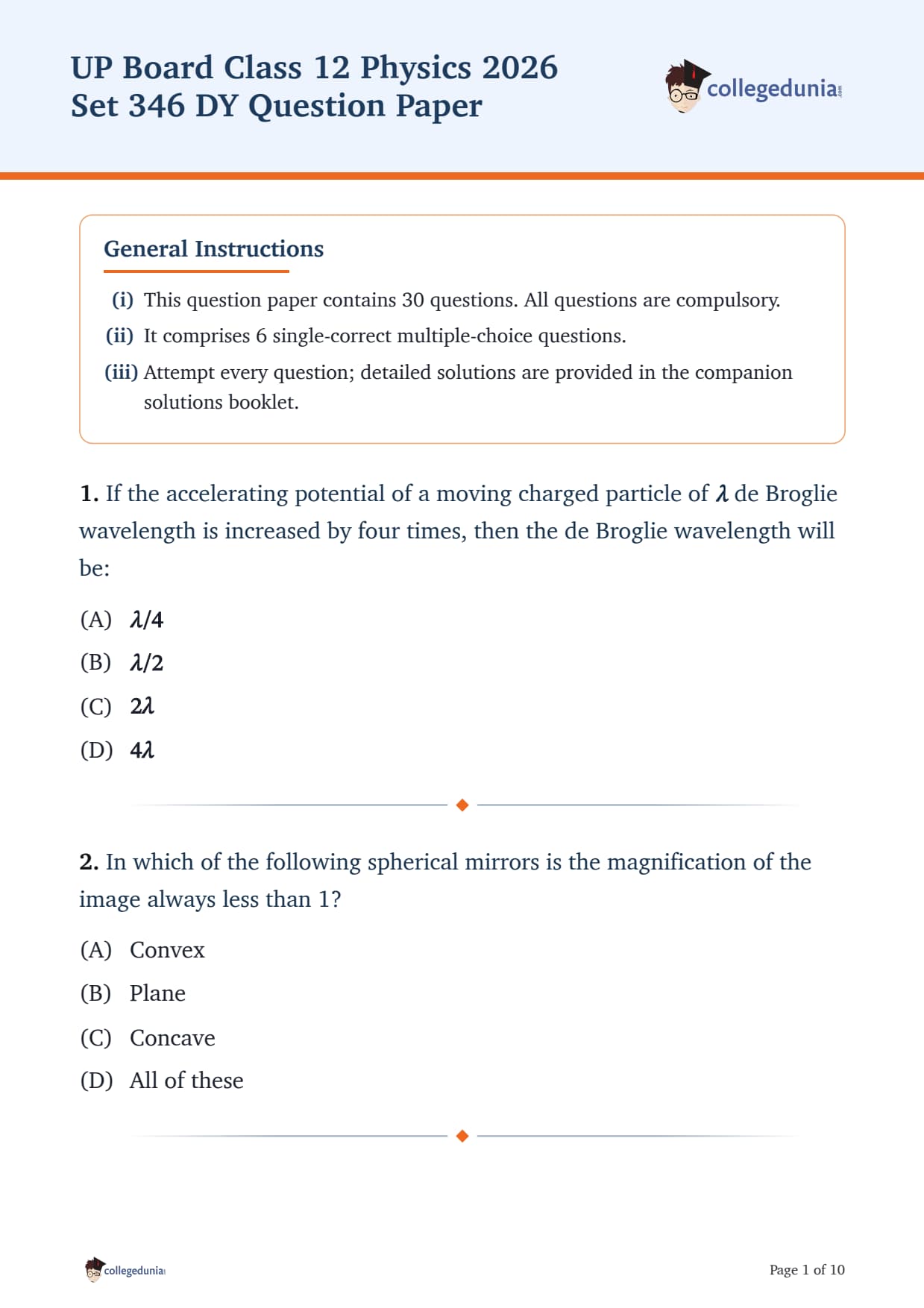
If the accelerating potential of a moving charged particle of \( \lambda \) de Broglie wavelength is increased by four times, then the de Broglie wavelength will be:
In which of the following spherical mirrors is the magnification of the image always less than 1?
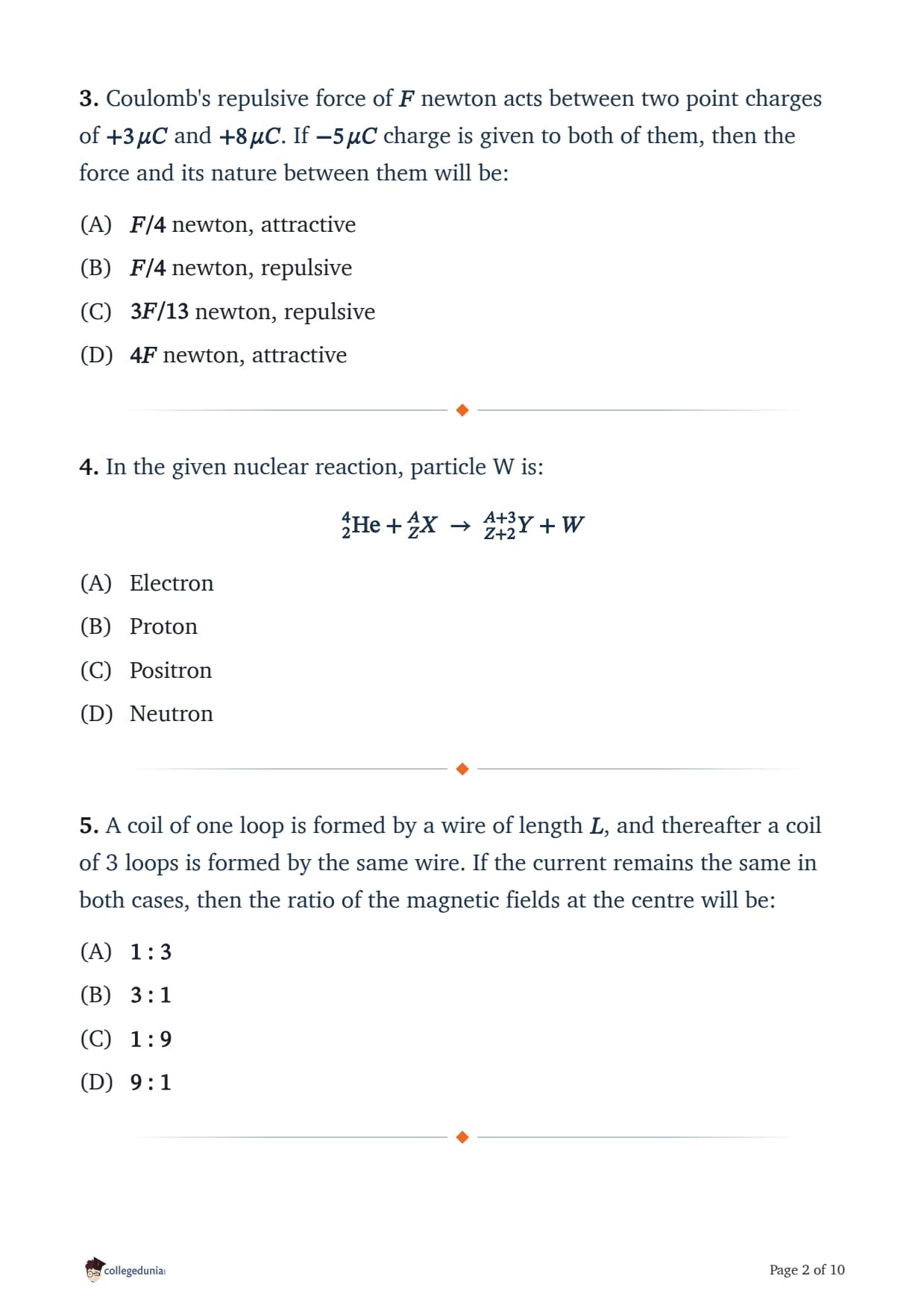
Coulomb's repulsive force of \( F \) newton acts between two point charges of \( +3\,\mu C \) and \( +8\,\mu C \). If \( -5\,\mu C \) charge is given to both of them, then the force and its nature between them will be:
In the given nuclear reaction, particle W is: \[ {}_{2}^{4}\text{He} + {}_{Z}^{A}X \ \rightarrow\ {}_{Z+2}^{A+3}Y + W \]
A coil of one loop is formed by a wire of length \( L \), and thereafter a coil of 3 loops is formed by the same wire. If the current remains the same in both cases, then the ratio of the magnetic fields at the centre will be:
Equivalent resistance \( R \) is obtained when \( n \) wires having the same length and same thickness of the same material are joined in parallel. The equivalent resistance on joining them in series will be:
Define and write the formula of mobility.
What are the uses of microwaves?
What is the difference between paramagnetic and diamagnetic substances?
What is meant by the optical center of a lens?
What are the charge carriers in p-type of semiconductors?
What is an equipotential surface?
Work function of a metal surface is 3.2 eV. Find out the kinetic energy of the emitted photoelectrons in Joule, when a photon of 4.0 eV energy is incident on its surface.
What will be the effect on the drift velocity of electrons, when the current in a copper wire is passed in a wire, twice of its radius (the same current being maintained)?
What is the phenomenon of radioactivity? How many types are there of radioactive decay?
Explain the difference between conductors and semiconductors on the basis of energy bands in solids.

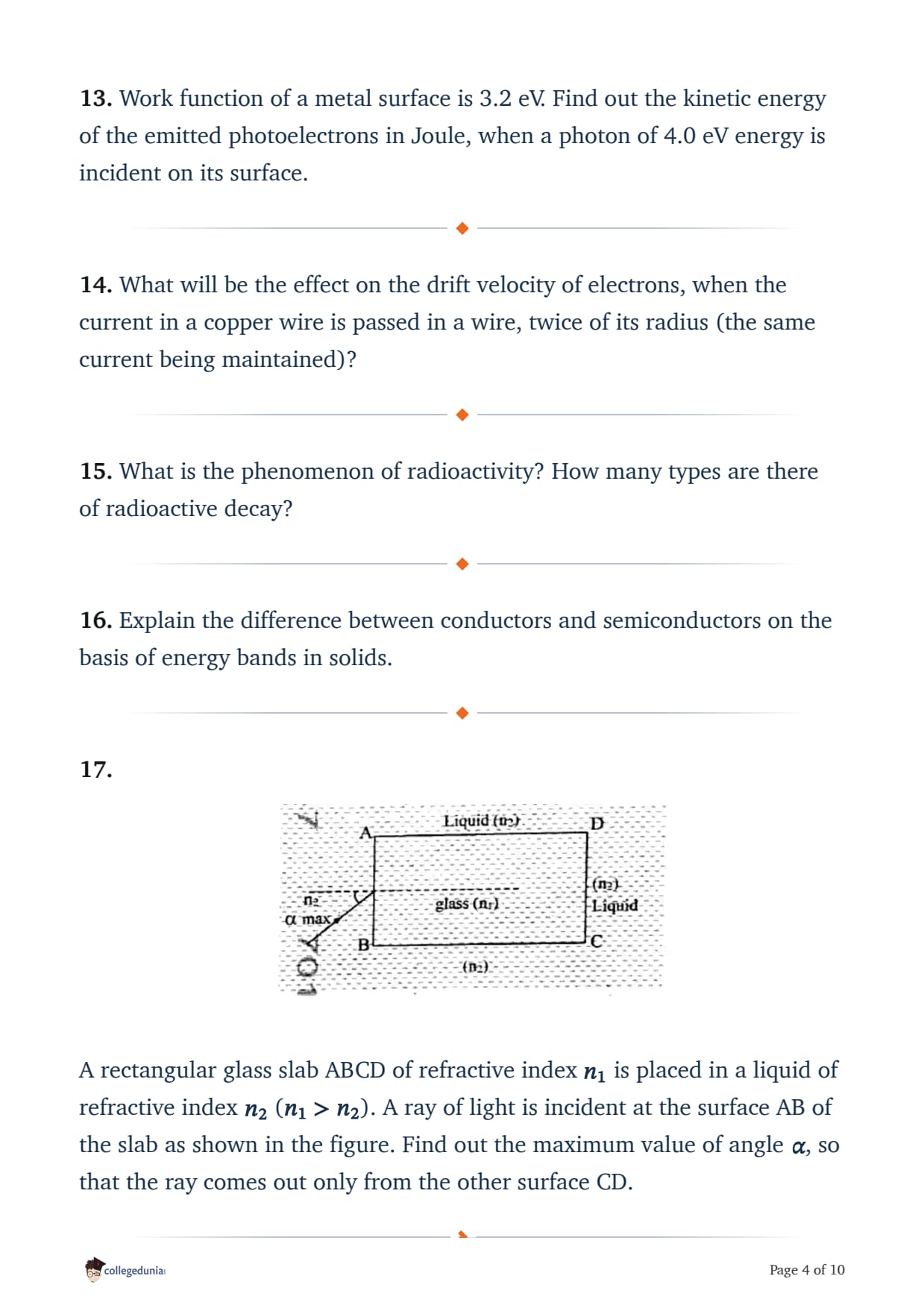
A rectangular glass slab ABCD of refractive index \(n_1\) is placed in a liquid of refractive index \(n_2\) (\(n_1 > n_2\)). A ray of light is incident at the surface AB of the slab as shown in the figure. Find out the maximum value of angle \(\alpha\), so that the ray comes out only from the other surface CD.
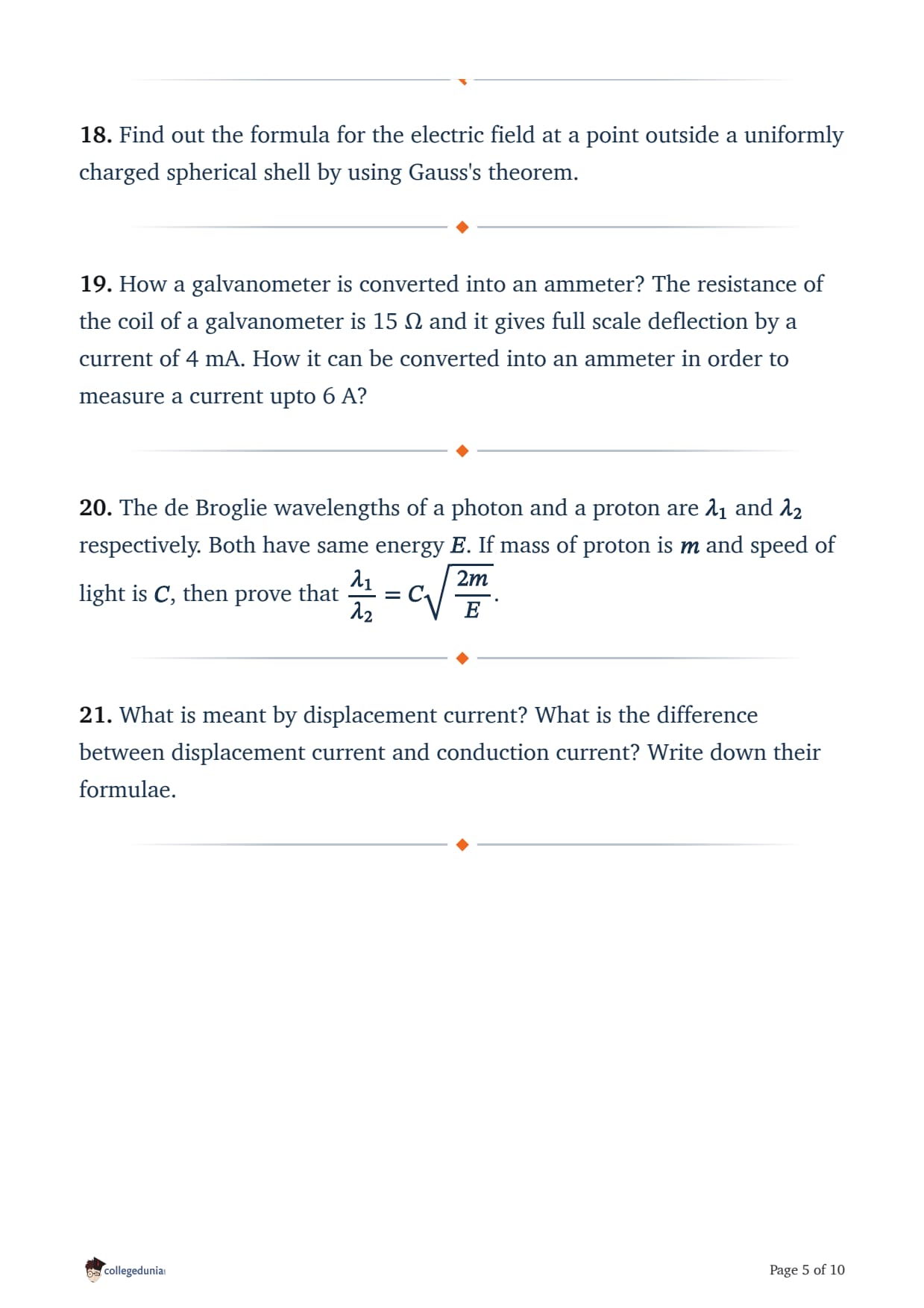
Find out the formula for the electric field at a point outside a uniformly charged spherical shell by using Gauss's theorem.
How a galvanometer is converted into an ammeter? The resistance of the coil of a galvanometer is 15 Ω and it gives full scale deflection by a current of 4 mA. How it can be converted into an ammeter in order to measure a current upto 6 A?
The de Broglie wavelengths of a photon and a proton are \(\lambda_1\) and \(\lambda_2\) respectively. Both have same energy \(E\). If mass of proton is \(m\) and speed of light is \(C\), then prove that \(\dfrac{\lambda_1}{\lambda_2} = C\sqrt{\dfrac{2m}{E}}\).
What is meant by displacement current? What is the difference between displacement current and conduction current? Write down their formulae.

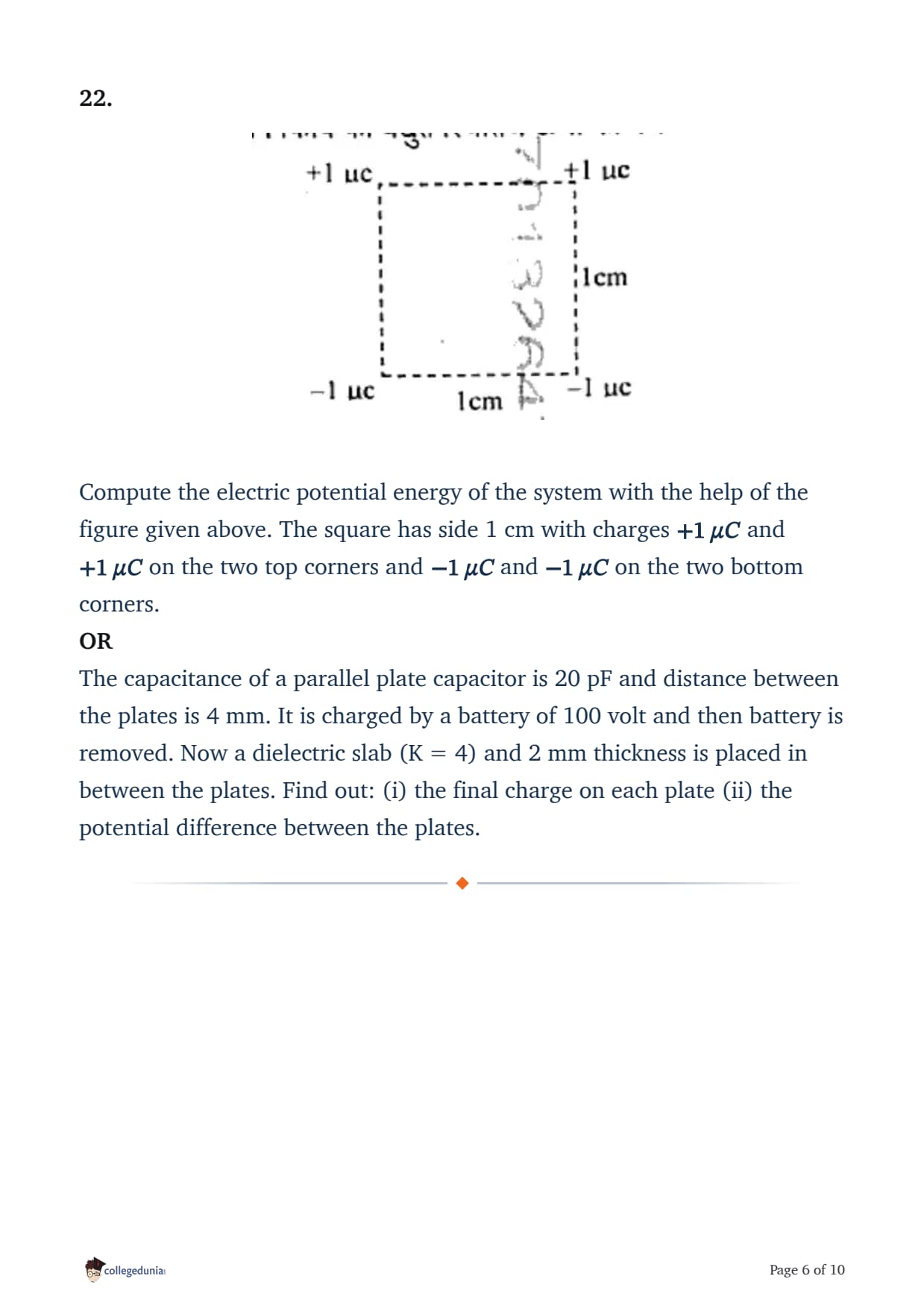
Compute the electric potential energy of the system with the help of the figure given above. The square has side 1 cm with charges \(+1\ \mu C\) and \(+1\ \mu C\) on the two top corners and \(-1\ \mu C\) and \(-1\ \mu C\) on the two bottom corners.
OR
The capacitance of a parallel plate capacitor is 20 pF and distance between the plates is 4 mm. It is charged by a battery of 100 volt and then battery is removed. Now a dielectric slab (K = 4) and 2 mm thickness is placed in between the plates. Find out: (i) the final charge on each plate (ii) the potential difference between the plates.

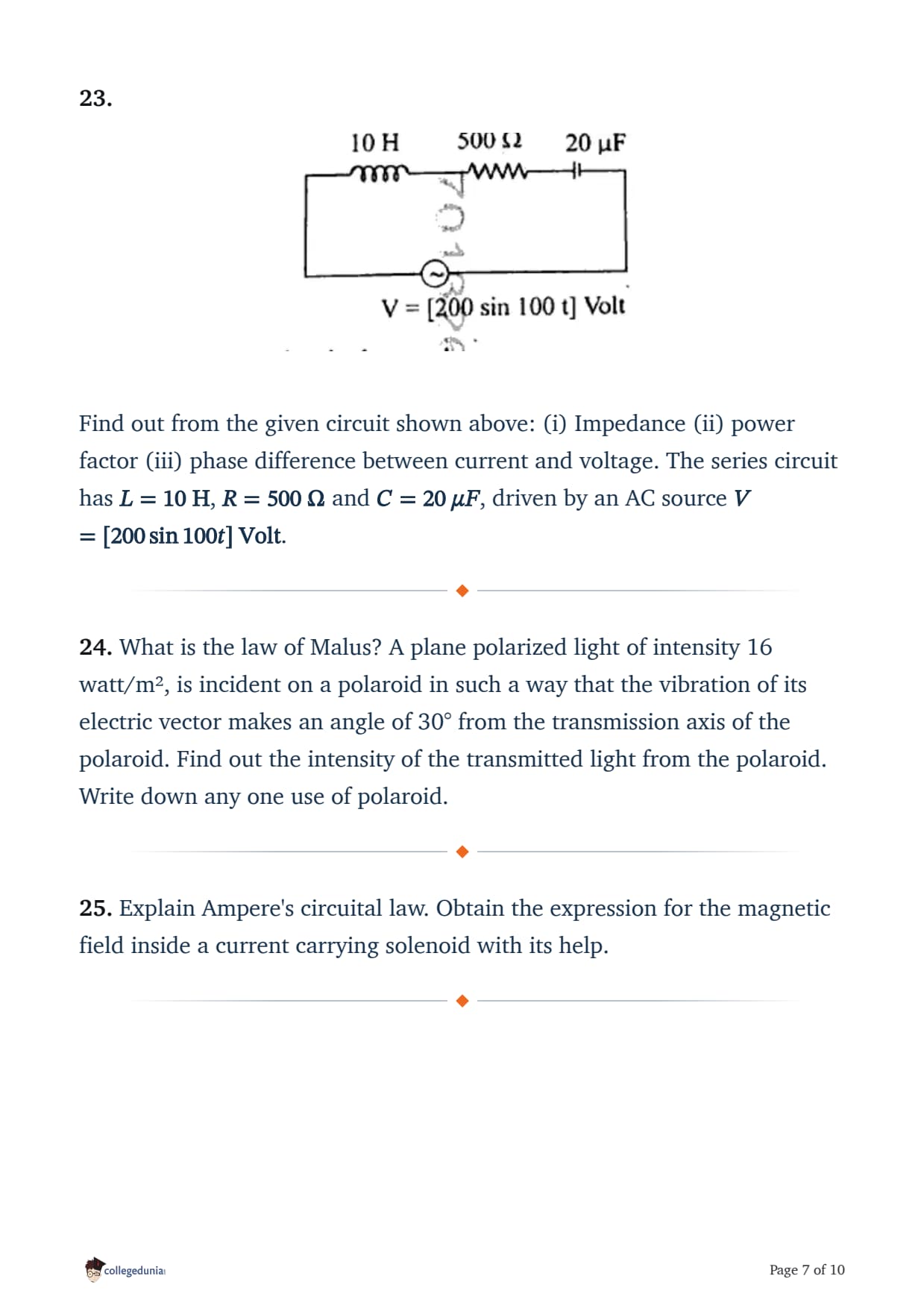
Find out from the given circuit shown above: (i) Impedance (ii) power factor (iii) phase difference between current and voltage. The series circuit has \(L = 10\ \text{H}\), \(R = 500\ \Omega\) and \(C = 20\ \mu F\), driven by an AC source \(V = [200\sin 100t]\ \text{Volt}\).
What is the law of Malus? A plane polarized light of intensity 16 watt/m², is incident on a polaroid in such a way that the vibration of its electric vector makes an angle of 30° from the transmission axis of the polaroid. Find out the intensity of the transmitted light from the polaroid. Write down any one use of polaroid.
Explain Ampere's circuital law. Obtain the expression for the magnetic field inside a current carrying solenoid with its help.

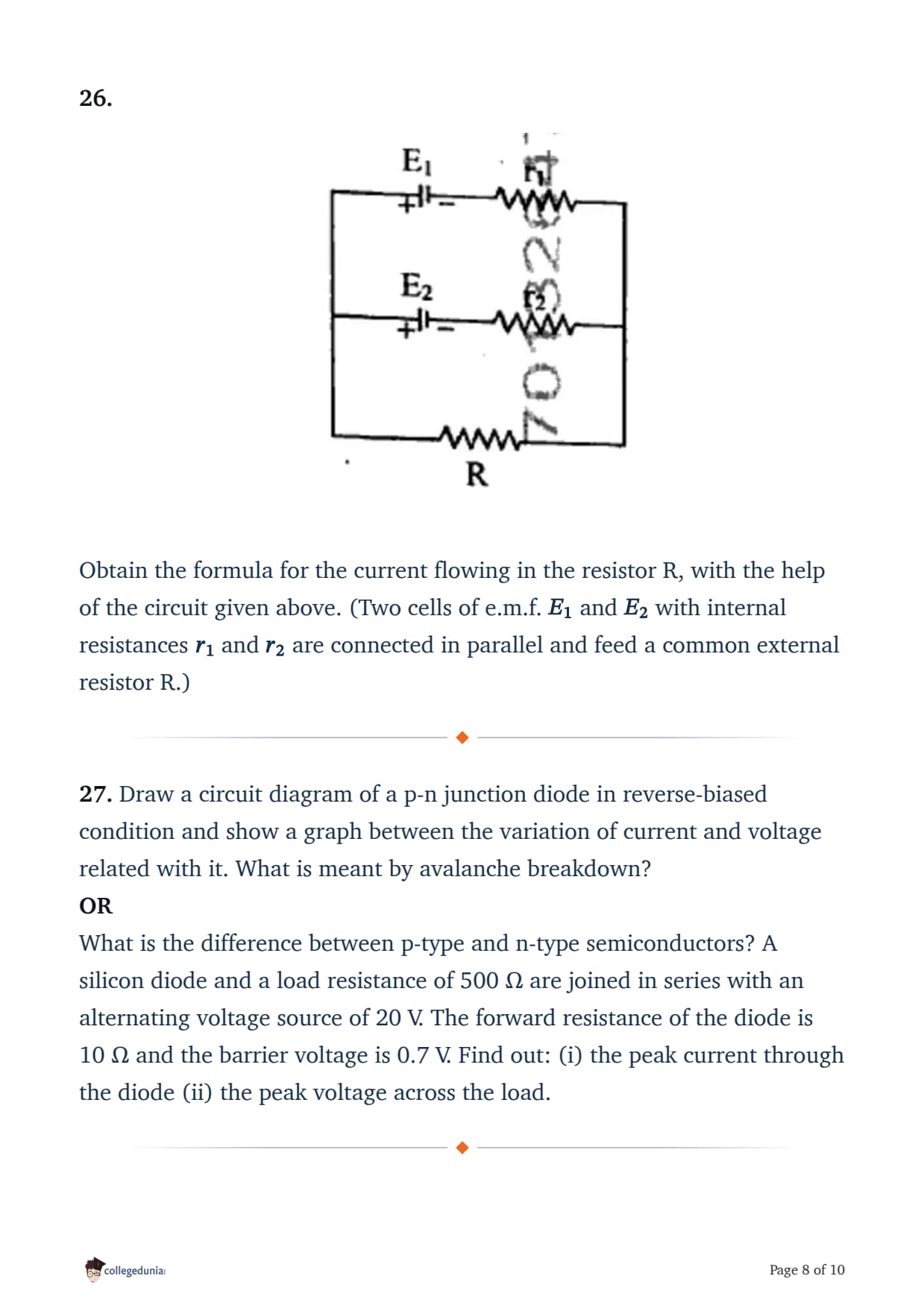
Obtain the formula for the current flowing in the resistor R, with the help of the circuit given above. (Two cells of e.m.f. \( E_1 \) and \( E_2 \) with internal resistances \( r_1 \) and \( r_2 \) are connected in parallel and feed a common external resistor R.)
Draw a circuit diagram of a p-n junction diode in reverse-biased condition and show a graph between the variation of current and voltage related with it. What is meant by avalanche breakdown?
OR
What is the difference between p-type and n-type semiconductors? A silicon diode and a load resistance of 500 Ω are joined in series with an alternating voltage source of 20 V. The forward resistance of the diode is 10 Ω and the barrier voltage is 0.7 V. Find out: (i) the peak current through the diode (ii) the peak voltage across the load.
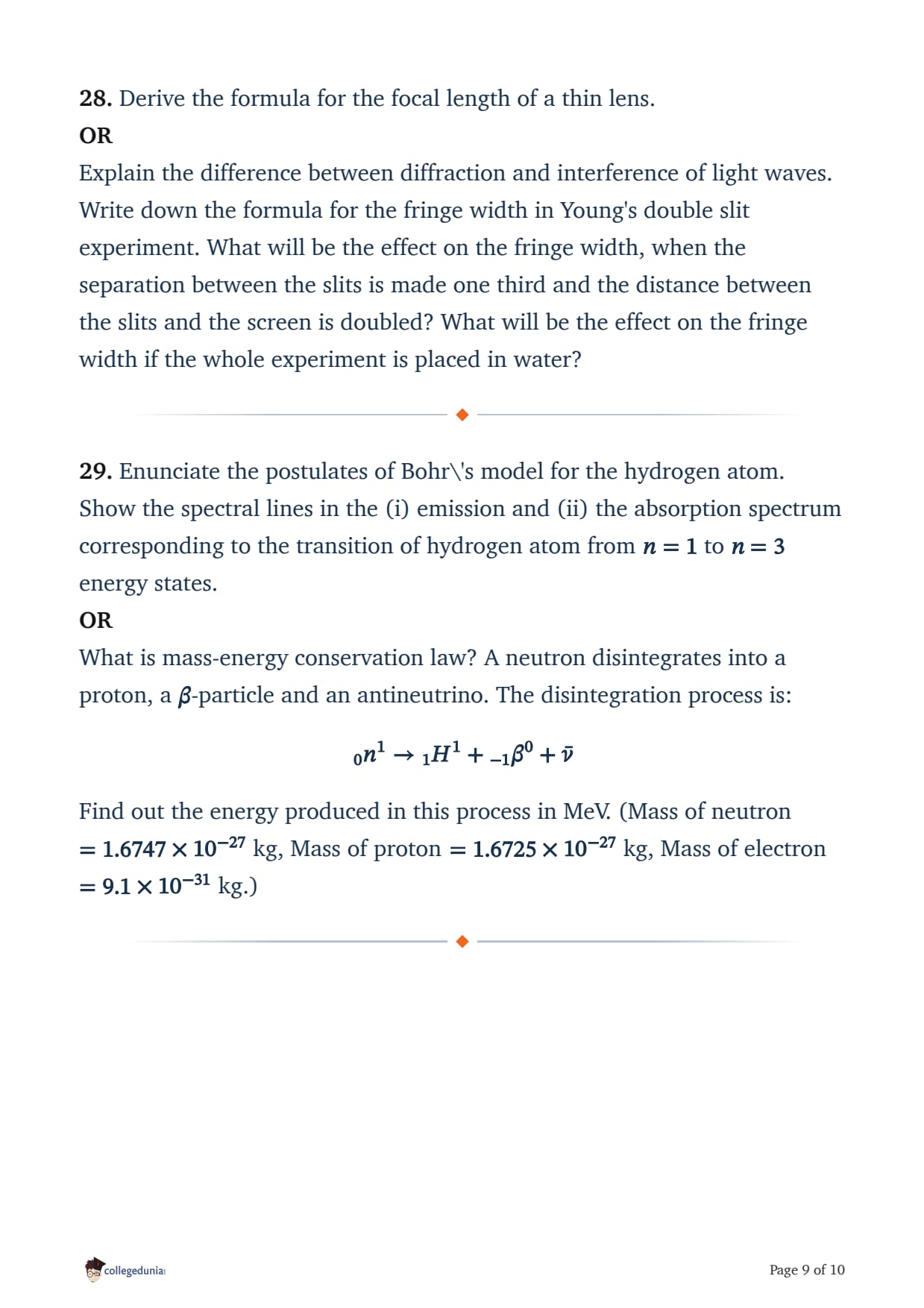
Derive the formula for the focal length of a thin lens.
OR
Explain the difference between diffraction and interference of light waves. Write down the formula for the fringe width in Young's double slit experiment. What will be the effect on the fringe width, when the separation between the slits is made one third and the distance between the slits and the screen is doubled? What will be the effect on the fringe width if the whole experiment is placed in water?
Enunciate the postulates of Bohr\'s model for the hydrogen atom. Show the spectral lines in the (i) emission and (ii) the absorption spectrum corresponding to the transition of hydrogen atom from \(n = 1\) to \(n = 3\) energy states.
OR
What is mass-energy conservation law? A neutron disintegrates into a proton, a \(\beta\)-particle and an antineutrino. The disintegration process is: \[ {}_{0}n^{1} \rightarrow {}_{1}H^{1} + {}_{-1}\beta^{0} + \bar{\nu} \] Find out the energy produced in this process in MeV. (Mass of neutron \(= 1.6747\times10^{-27}\) kg, Mass of proton \(= 1.6725\times10^{-27}\) kg, Mass of electron \(= 9.1\times10^{-31}\) kg.)
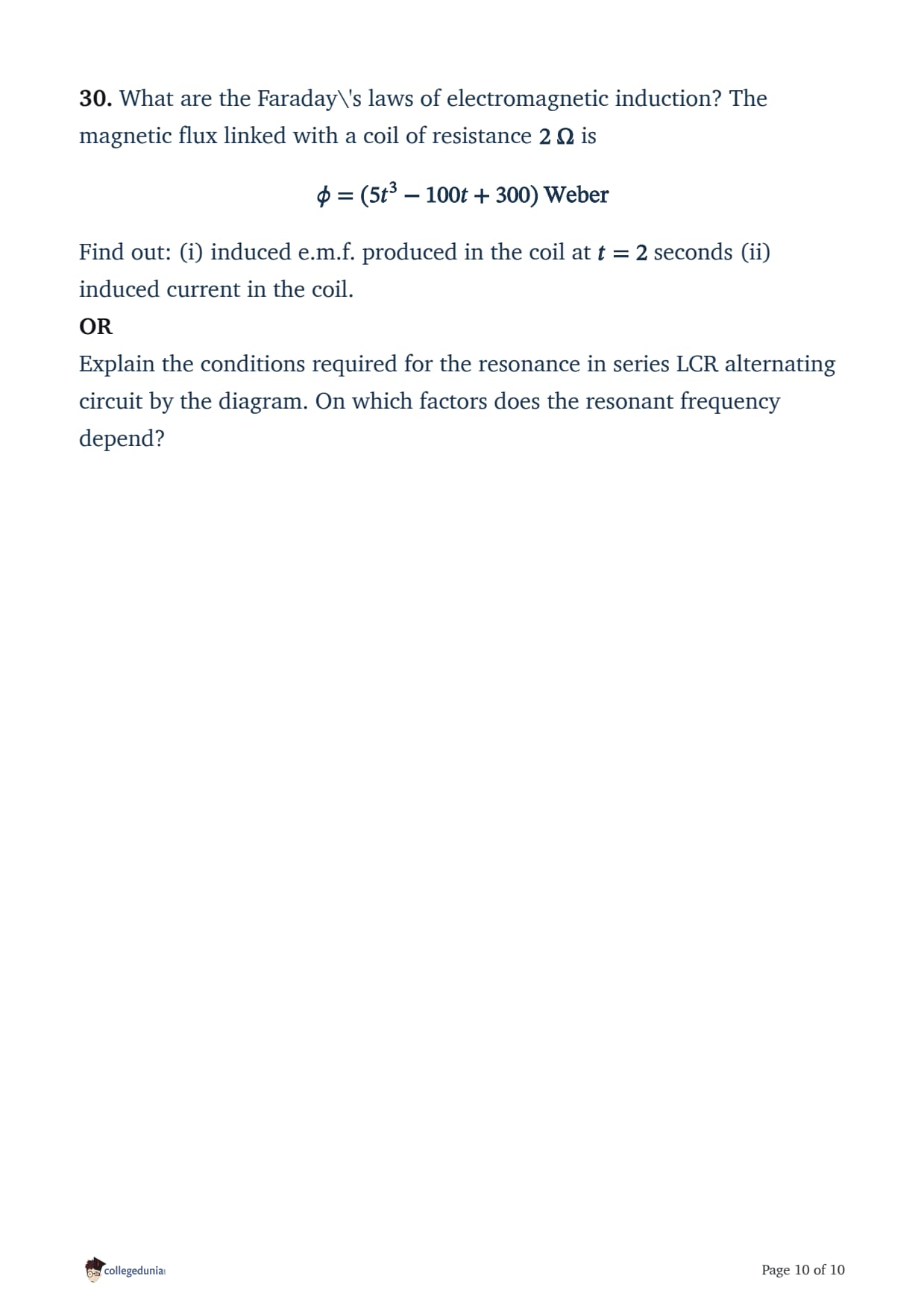
What are the Faraday\'s laws of electromagnetic induction? The magnetic flux linked with a coil of resistance \(2\ \Omega\) is \[ \phi = (5t^{3} - 100t + 300)\ \text{Weber} \] Find out: (i) induced e.m.f. produced in the coil at \(t = 2\) seconds (ii) induced current in the coil.
OR
Explain the conditions required for the resonance in series LCR alternating circuit by the diagram. On which factors does the resonant frequency depend?
UP Board Class 12 Physics 2026 Set 346 DY Exam Pattern and Marking Scheme
As per the UPMSP scheme on the official website (upmsp.edu.in), the Set 346 DY theory paper is a 70-mark single paper with all 30 questions compulsory and no negative marking.
- Total questions: 30, all compulsory, spread across Sections A to E
- Objective block: 6 single-correct MCQs of 1 mark each in Section A
- Subjective block: 24 short-answer, long-answer and numerical questions across Sections B to E
- Total marks: 70 for theory, plus 30 for practical (100 overall)
- Duration: 3 hours 15 minutes, afternoon shift 2:00 PM to 5:15 PM
- Marking scheme: no negative marking, so attempt every question
High-Weightage Topics in UP Board Class 12 Physics 2026 Set 346 DY
Set 346 DY stayed easy to moderate and textbook-based, with the marks concentrated in the same core chapters every year. Focus your revision here first.
- Electrostatics and Current Electricity: Coulomb's law numericals, potential, capacitance and equivalent resistance carried the heaviest 1-mark and numerical load
- Magnetism and Electromagnetic Induction: coil-and-loop questions, induced EMF and AC circuits appeared as both MCQ and derivation
- Optics: spherical mirror magnification, ray diagrams and lens numericals were direct textbook pickups
- Dual Nature, Atoms and Nuclei: de Broglie wavelength, nuclear reactions and particle identification opened the MCQ set
- Electronic Devices: semiconductor and diode short-answer questions closed out the paper
UP Board Class 12 Physics 2026 Set 346 DY Paper Solution Video
Source: Rastogi online coaching classes
How to Use the UP Board Class 12 Physics Set 346 DY Question Paper for Practice
Treat Set 346 DY as a full timed mock before you check the solutions, so you know exactly which sections cost you time.
- Solve all 30 questions in one 3 hour 15 minute sitting, keeping about 12 minutes aside for the 6 Section A MCQs
- Only then open the solution PDF and mark every step you missed, especially in numericals and derivations
- Redo the ray diagrams and Coulomb's law numericals until you can reproduce them without looking
- Since there is no negative marking, practise writing at least a partial attempt for every long-answer question to bank easy marks
UP Board Class 12 Physics 2026 Set 346 DY Question Paper FAQs
Ques. Was the UP Board Class 12 Physics 2026 Set 346 DY paper tough?
Ans. No, Set 346 DY was easy to moderate. Most of the 30 questions were direct textbook and NCERT-style problems on Electrostatics, Optics and Modern Physics, with only a few numericals and derivations that needed careful calculation.
Ques. How many questions are there in UP Board Class 12 Physics 2026 Set 346 DY?
Ans. There are 30 compulsory questions across Sections A to E for 70 theory marks. Section A has 6 single-correct MCQs of 1 mark each, and Sections B to E carry 24 short-answer, long-answer and numerical questions.
Ques. Which topics had the highest weightage in UP Board Class 12 Physics 2026?
Ans. Electrostatics and Current Electricity carried the most marks, followed by Magnetism and Electromagnetic Induction, Optics, and Modern Physics (Dual Nature, Atoms and Nuclei). Electronic Devices added a few short-answer marks at the end.
Ques. Is there negative marking in the UP Board Class 12 Physics paper?
Ans. No, UP Board Class 12 Physics has no negative marking. All 30 questions are compulsory, so you should attempt every one, including a partial answer on the long-answer questions to pick up easy marks.
Ques. Where can I download the UP Board Class 12 Physics 2026 Set 346 DY question paper with solutions PDF for free?
Ans. Download the full paper with step-by-step solutions from the table above on Collegedunia. For the official paper and scheme, visit the UPMSP website at upmsp.edu.in.



Comments