




UP Board Class 12 Mathematics 2026 Question Paper (Set 324 DA) is available for download here with the Collegedunia question paper PDF and the question paper with solutions PDF. The UP Board Class 12 Mathematics theory paper was held on 23 February 2026 from 2:00 PM to 5:15 PM (3 hours 15 minutes including 15 minutes of reading time) and carried 100 marks, with 31 of the 34 printed questions to be attempted.
Also Check: UP Board Class 12 Question Paper 2026 (All Subjects)
The Mathematics question paper (Set 324 DA) includes the following types of questions:
- Q.1: five multiple choice questions of 1 mark each
- Q.2: five very short answer questions of 1 mark each
- Q.3 and Q.4: four short answer questions of 2 marks each in each question
- Q.5 and Q.6: five long answer questions of 5 marks each in each question
- Q.7, Q.8 and Q.9: very long answer questions of 8 marks each, with a choice between parts (a) and (b)
UP Board Class 12 Mathematics 2026 Question Paper (Set 324 DA) with Solutions PDF
| CD PDF | CD PDF with Solutions |
|---|---|
| Download Collegedunia PDF 0.67 MB | Download solutions PDF 4.51 MB |
UP Board Class 12 Mathematics 2026 (Set 324 DA) Questions with Solutions
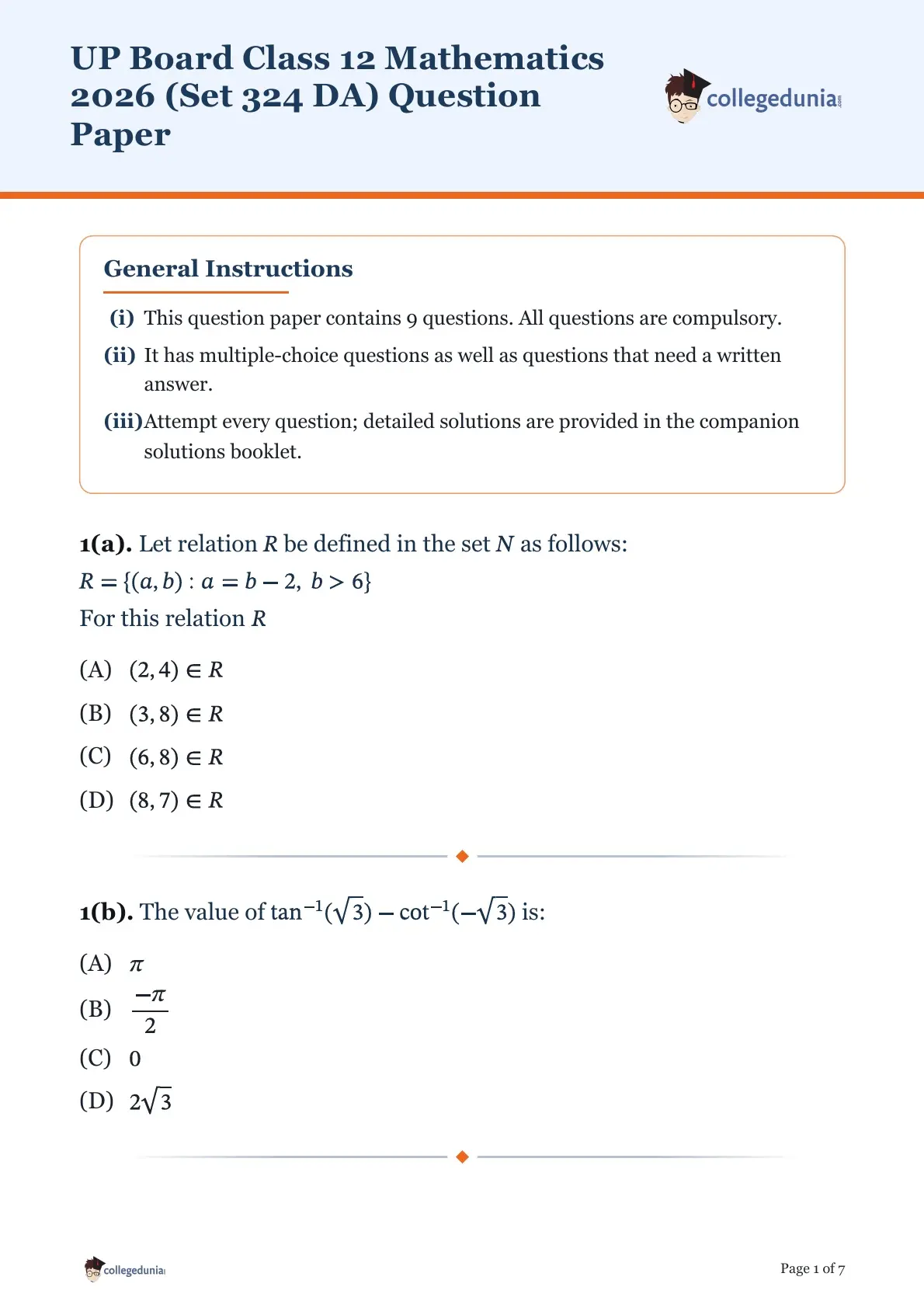
Let relation \(R\) be defined in the set \(N\) as follows:
\(R = \{(a,b) : a = b-2,\ b \gt 6\}\)
For this relation \(R\)
The value of \(\tan^{-1}(\sqrt{3}) - \cot^{-1}(-\sqrt{3})\) is:
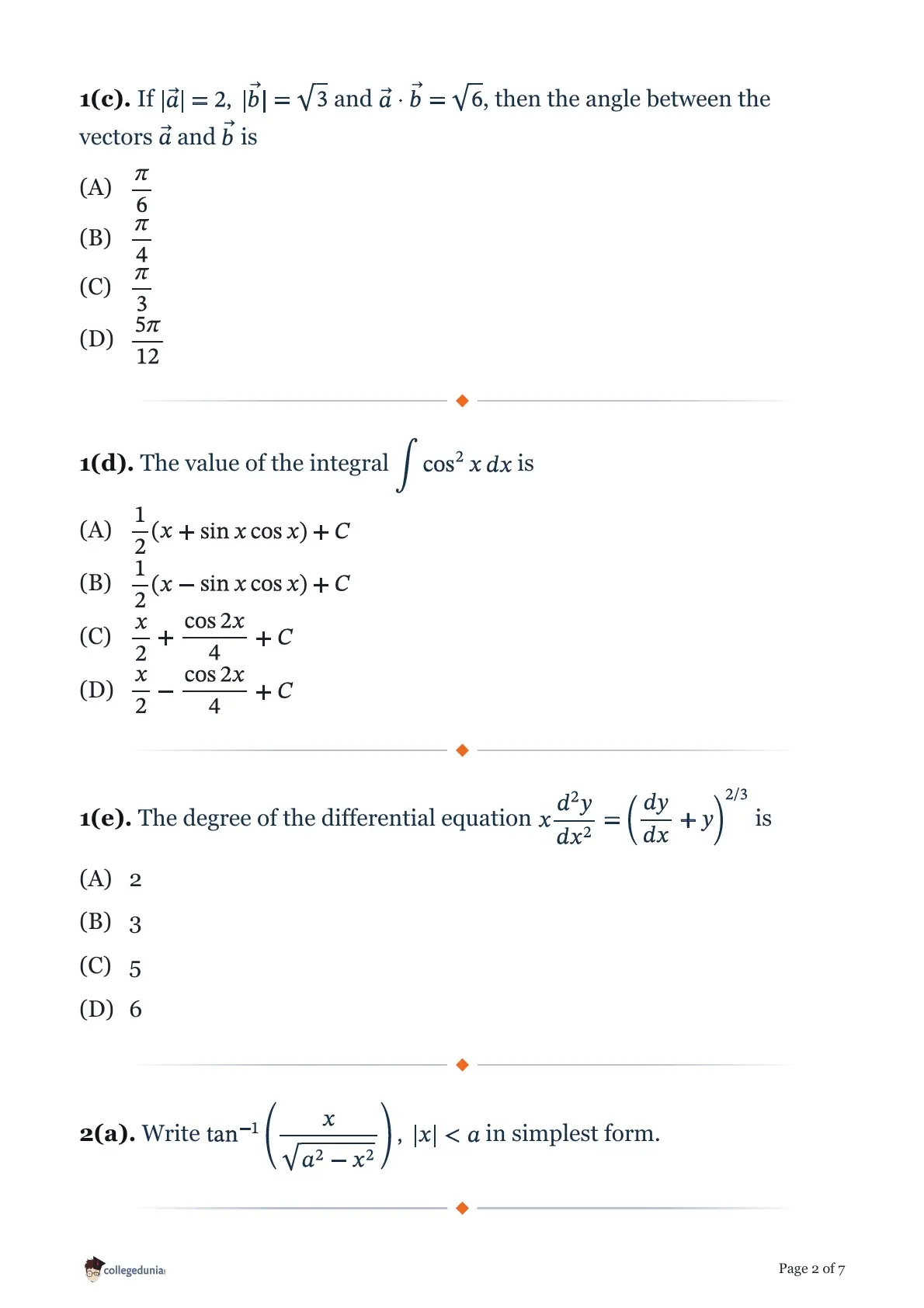
If \(|\vec{a}| = 2,\ |\vec{b}| = \sqrt{3}\) and \(\vec{a}\cdot\vec{b} = \sqrt{6}\), then the angle between the vectors \(\vec{a}\) and \(\vec{b}\) is
The value of the integral \(\displaystyle\int \cos^2 x\,dx\) is
The degree of the differential equation \(x\dfrac{d^2y}{dx^2} = \left(\dfrac{dy}{dx} + y\right)^{2/3}\) is
Write \(\tan^{-1}\left(\dfrac{x}{\sqrt{a^2-x^2}}\right),\ |x|<a\) in simplest form.
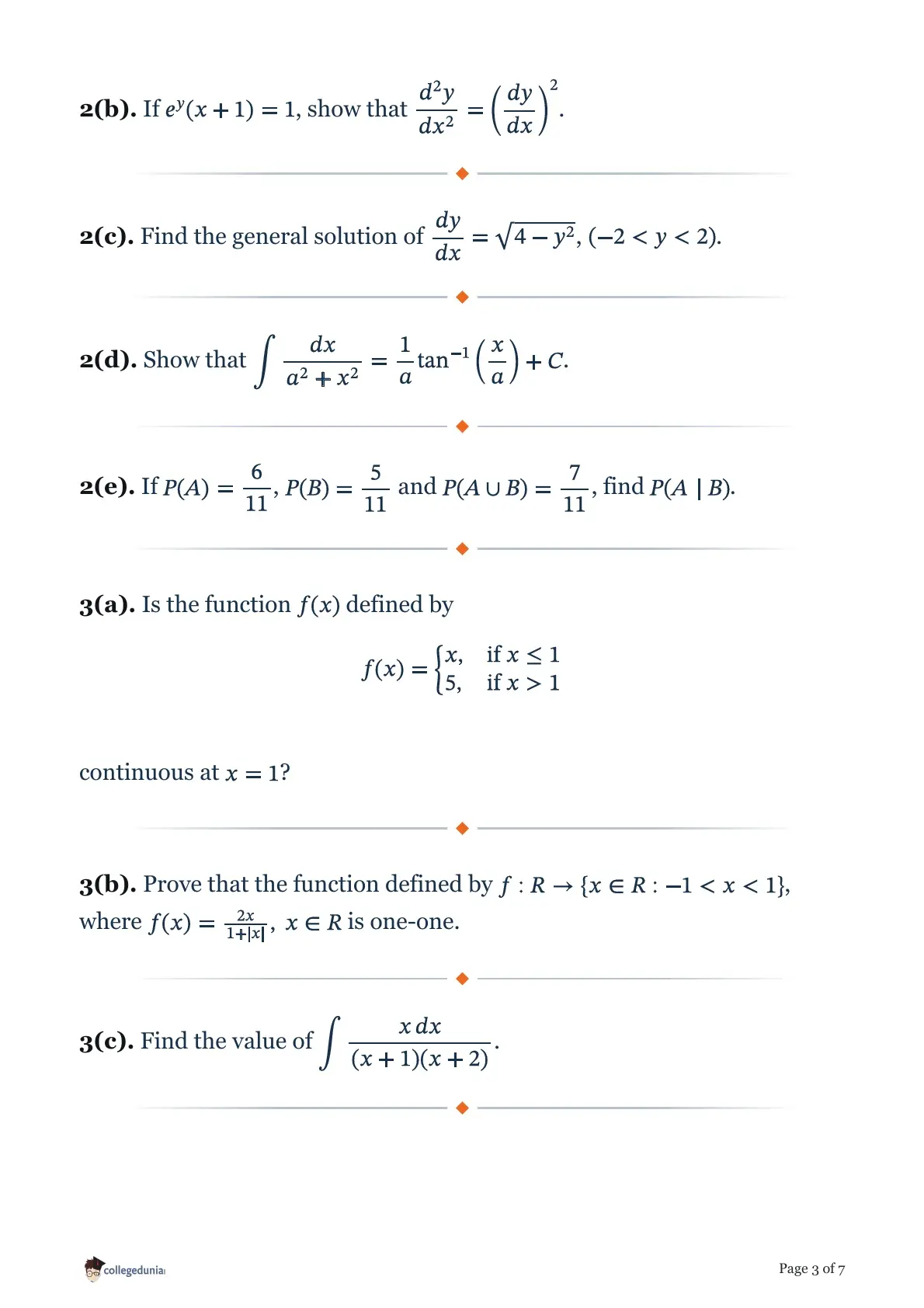
If \(e^{y}(x+1)=1\), show that \(\dfrac{d^{2}y}{dx^{2}}=\left(\dfrac{dy}{dx}\right)^{2}\).
Find the general solution of \(\dfrac{dy}{dx}=\sqrt{4-y^{2}}\), \((-2\lt y\lt 2)\).
Show that \(\displaystyle\int\dfrac{dx}{a^{2}+x^{2}}=\dfrac{1}{a}\tan^{-1}\left(\dfrac{x}{a}\right)+C\).
If \(P(A)=\dfrac{6}{11}\), \(P(B)=\dfrac{5}{11}\) and \(P(A\cup B)=\dfrac{7}{11}\), find \(P(A\mid B)\).
Is the function \(f(x)\) defined by
\[ f(x) = \begin{cases} x, & \text{if } x \le 1 \\ 5, & \text{if } x \gt 1 \end{cases} \]
continuous at \(x = 1\)?
Prove that the function defined by \( f : R \to \{x \in R : -1 \lt x \lt 1\} \), where \( f(x) = \frac{2x}{1+|x|},\ x \in R \) is one-one.
Find the value of \(\displaystyle\int \dfrac{x\,dx}{(x+1)(x+2)}\).
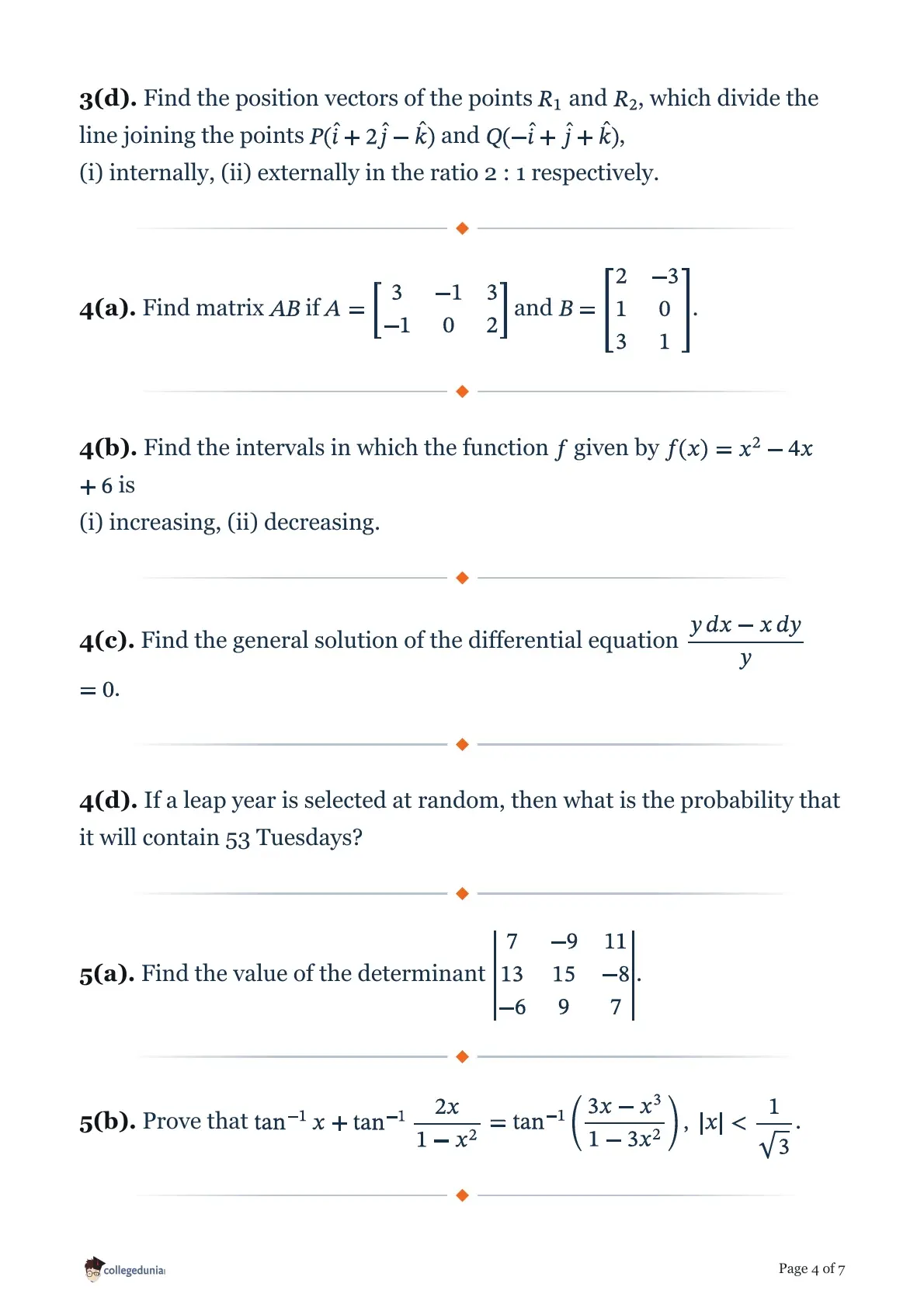
Find the position vectors of the points \( R_1 \) and \( R_2 \), which divide the line joining the points \( P(\hat{i}+2\hat{j}-\hat{k}) \) and \( Q(-\hat{i}+\hat{j}+\hat{k}) \),
(i) internally, (ii) externally in the ratio 2 : 1 respectively.
Find matrix \( AB \) if \( A = \begin{bmatrix} 3 & -1 & 3 \\ -1 & 0 & 2 \end{bmatrix} \) and \( B = \begin{bmatrix} 2 & -3 \\ 1 & 0 \\ 3 & 1 \end{bmatrix} \).
Find the intervals in which the function \( f \) given by \( f(x) = x^2 - 4x + 6 \) is
(i) increasing, (ii) decreasing.
Find the general solution of the differential equation \(\dfrac{y\,dx - x\,dy}{y} = 0\).
If a leap year is selected at random, then what is the probability that it will contain 53 Tuesdays?
Find the value of the determinant \( \begin{vmatrix} 7 & -9 & 11 \\ 13 & 15 & -8 \\ -6 & 9 & 7 \end{vmatrix} \).
Prove that \( \tan^{-1}x + \tan^{-1}\dfrac{2x}{1-x^2} = \tan^{-1}\left(\dfrac{3x - x^3}{1 - 3x^2}\right),\ |x| \lt \dfrac{1}{\sqrt{3}} \).
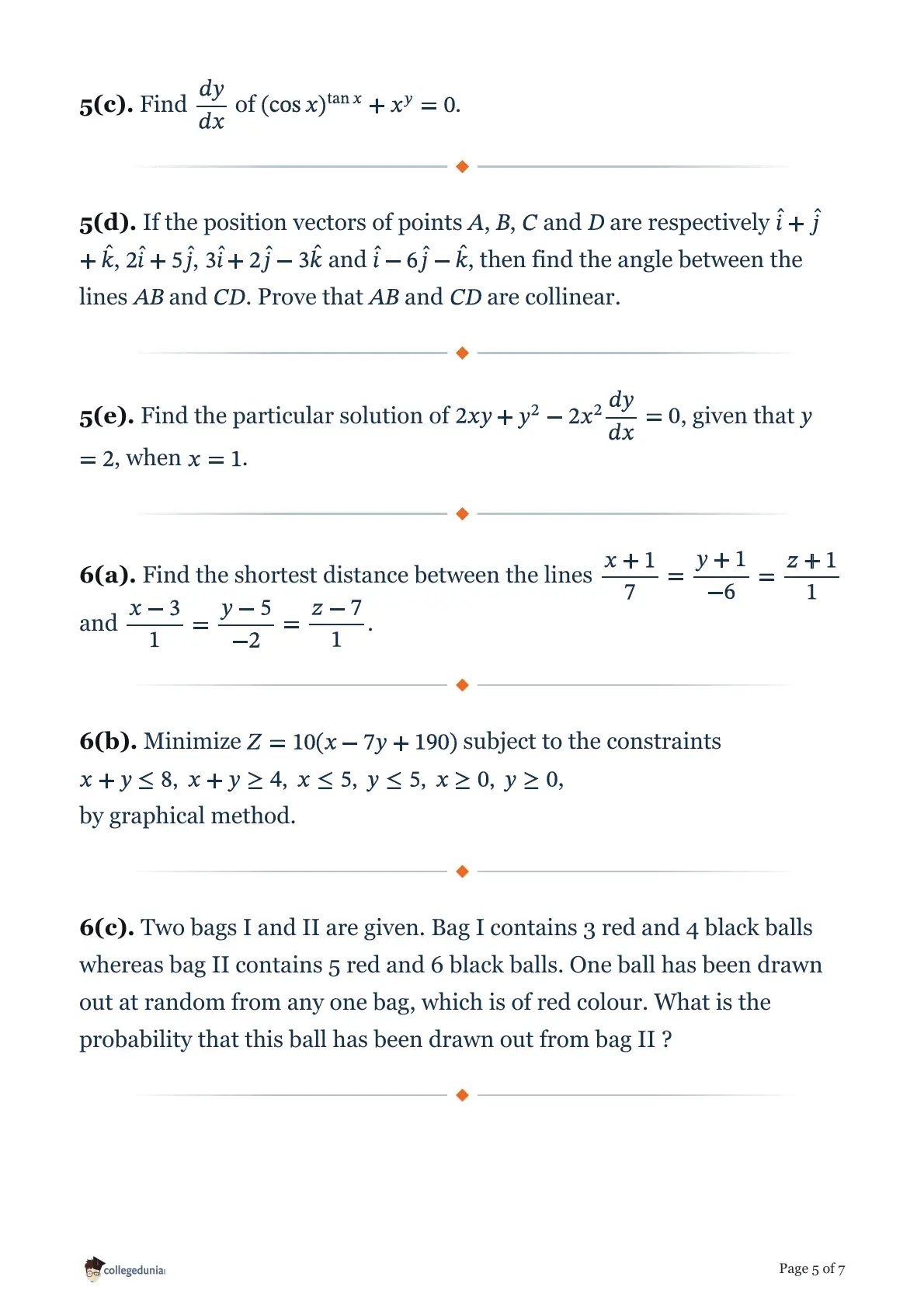
Find \( \dfrac{dy}{dx} \) of \( (\cos x)^{\tan x} + x^{y} = 0 \).
If the position vectors of points \(A\), \(B\), \(C\) and \(D\) are respectively \(\hat i+\hat j+\hat k\), \(2\hat i+5\hat j\), \(3\hat i+2\hat j-3\hat k\) and \(\hat i-6\hat j-\hat k\), then find the angle between the lines \(AB\) and \(CD\). Prove that \(AB\) and \(CD\) are collinear.
Find the particular solution of \( 2xy + y^2 - 2x^2\dfrac{dy}{dx} = 0 \), given that \( y = 2 \), when \( x = 1 \).
Find the shortest distance between the lines \( \dfrac{x+1}{7} = \dfrac{y+1}{-6} = \dfrac{z+1}{1} \) and \( \dfrac{x-3}{1} = \dfrac{y-5}{-2} = \dfrac{z-7}{1} \).
Minimize \( Z = 10(x - 7y + 190) \) subject to the constraints
\( x + y \le 8,\ x + y \ge 4,\ x \le 5,\ y \le 5,\ x \ge 0,\ y \ge 0 \),
by graphical method.
Two bags I and II are given. Bag I contains 3 red and 4 black balls whereas bag II contains 5 red and 6 black balls. One ball has been drawn out at random from any one bag, which is of red colour. What is the probability that this ball has been drawn out from bag II ?
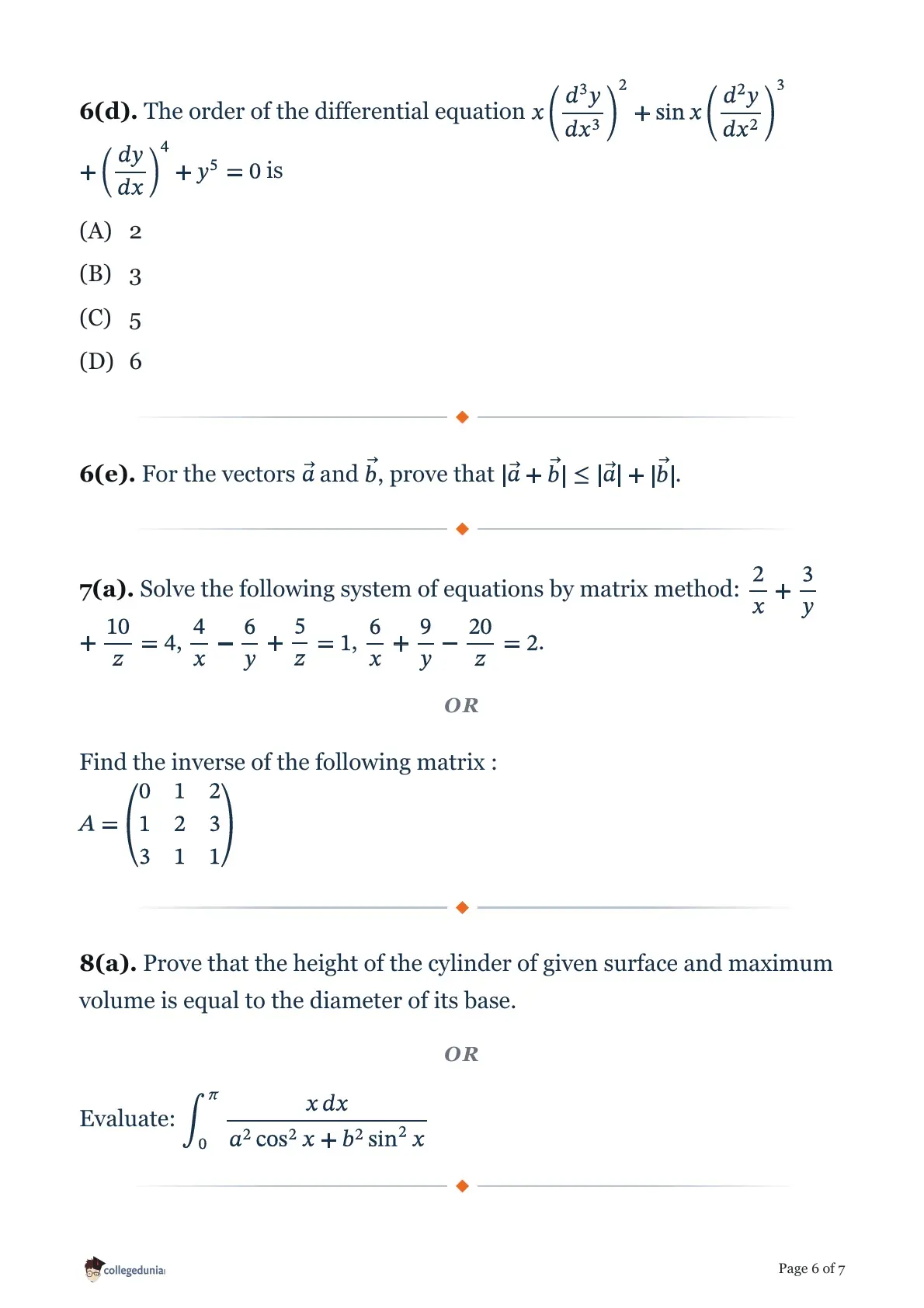
The order of the differential equation \(x\left(\dfrac{d^3y}{dx^3}\right)^2+\sin x\left(\dfrac{d^2y}{dx^2}\right)^3+\left(\dfrac{dy}{dx}\right)^4+y^5=0\) is
For the vectors \(\vec{a}\) and \(\vec{b}\), prove that \(|\vec{a}+\vec{b}| \le |\vec{a}| + |\vec{b}|\).
Solve the following system of equations by matrix method: \(\dfrac2x+\dfrac3y+\dfrac{10}z=4\), \(\dfrac4x-\dfrac6y+\dfrac5z=1\), \(\dfrac6x+\dfrac9y-\dfrac{20}z=2\).
OR
Find the inverse of the following matrix :
\( A = \begin{pmatrix} 0 & 1 & 2 \\ 1 & 2 & 3 \\ 3 & 1 & 1 \end{pmatrix} \)
Prove that the height of the cylinder of given surface and maximum volume is equal to the diameter of its base.
OR
Evaluate: \(\displaystyle\int_0^\pi \frac{x\,dx}{a^2\cos^2x+b^2\sin^2x}\)
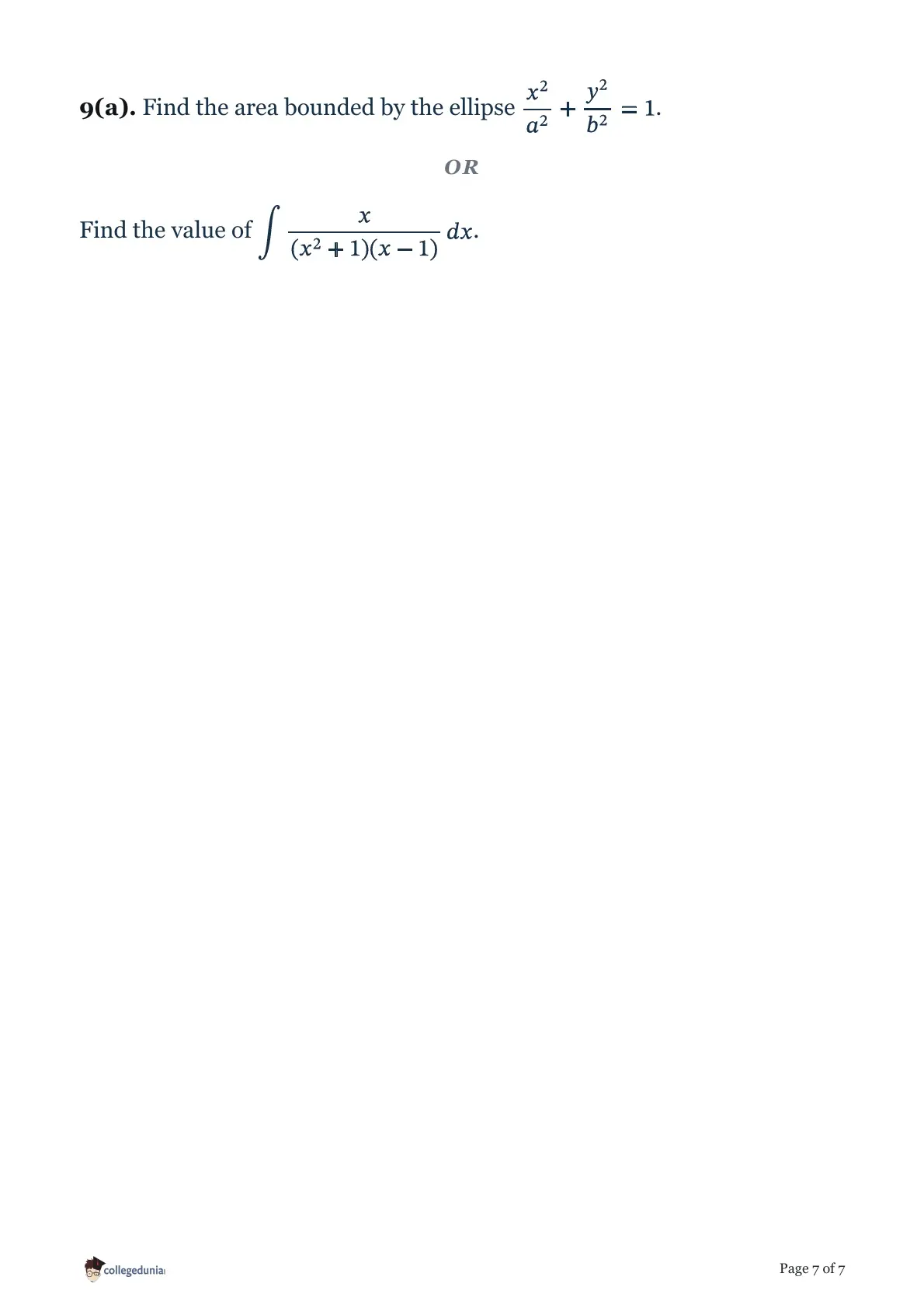
Find the area bounded by the ellipse \(\dfrac{x^2}{a^2}+\dfrac{y^2}{b^2}=1\).
OR
Find the value of \(\displaystyle\int \dfrac{x}{(x^2+1)(x-1)}\,dx\).
UP Board Class 12 Mathematics 2026 Question Paper Pattern
| Q. No. | Type | Parts | Choice | Marks each | Total |
|---|---|---|---|---|---|
| 1 | Multiple choice | 5 | All compulsory | 1 | 5 |
| 2 | Very short answer | 5 | All compulsory | 1 | 5 |
| 3 and 4 | Short answer | 4 + 4 | All compulsory | 2 | 16 |
| 5 and 6 | Long answer | 5 + 5 | All compulsory | 5 | 50 |
| 7, 8 and 9 | Very long answer | 3 | Attempt any one of (a) or (b) in each | 8 | 24 |
| Total | 100 | ||||
UP Board Class 12 Mathematics 2026 (Set 324 DA) Chapter-Wise Marks Distribution
| Chapter | Marks | Weightage |
|---|---|---|
| Differential Equations | 14 | 14.0% |
| Vector Algebra | 13 | 13.0% |
| Determinants | 13 | 13.0% |
| Application of Derivatives | 10 | 10.0% |
| Continuity and Differentiability | 8 | 8.0% |
| Probability | 8 | 8.0% |
| Application of Integrals | 8 | 8.0% |
| Inverse Trigonometric Functions | 7 | 7.0% |
| Three Dimensional Geometry | 5 | 5.0% |
| Linear Programming | 5 | 5.0% |
| Integrals | 4 | 4.0% |
| Relations and Functions | 3 | 3.0% |
| Matrices | 2 | 2.0% |
| Total | 100 | 100% |
Marks are counted from the first alternative of each question as printed in the paper (Code 324 DA); internal-choice alternatives carry the same marks.



Comments