




The UP Board Syllabus 2027 for the 2026-2027 academic session has been released by the Uttar Pradesh Madhyamik Shiksha Parishad (UPMSP) for Classes 9, 10, 11 & 12 on its official website, upmsp.edu.in. The revised syllabus includes changes in certain subjects, such as Class 12 Hindi, along with a new division of units.
- The UP Board 2027 syllabus covers Class 10 (High School) and Class 12 (Intermediate) examinations across Arts, Science, and Commerce streams.
- UPMSP Syllabus for Classes 9 and 10 covers core subjects such as Hindi, English, Mathematics, Science, and Social Science, along with an additional language or vocational subject as applicable.
- UP Board Classes 11 and 12 Science stream includes Physics, Chemistry, Mathematics or Biology, along with Hindi, English, and other applicable subjects.
- Most subjects carry 70 marks in theory and 30 marks in practical or project work, totalling 100 marks per subject.
- Mathematics in Class 12 is a 100-mark theory paper with no practical component.
- Students should use UPMSP-prescribed textbooks as the primary study resource — UP Board questions are directly based on them.
- UP Board Class 10: Mathematics’ Algebra, Geometry & Statistics & Probability carry around 70% of the theory marks, while Science gives 40 marks (~57%) to Chemistry- and Biology-related units.
- UP Board Class 12: Optics carries about 20% of the Physics theory paper (14/70 marks), while English Literature accounts for 40% (40/100 marks), making these important areas for focused preparation.
Related Links:
- UP Board Exam Pattern 2027: 100 Marks Per Subject, Marking Scheme and Question Paper Pattern
- UP Board Previous Year Papers Class 12 PDF (Available): Download Here
How to Download UP Board Class 10 Syllabus 2027?
UP Board Class 10 Syllabus 2027 can be downloaded from the official UPMSP website by visiting the Syllabus section and selecting Class 10 and the required subject. Students can download the subject-wise syllabus PDF and save it for exam preparation.
How to Download UP Board Class 12 Syllabus 2027?
UP Board Class 12 Syllabus 2027 can be downloaded from the official UPMSP website by visiting the Syllabus section and selecting Class 10 and the required subject. Students can download the subject-wise syllabus PDF and save it for exam preparation.
UP Board Syllabus 2027: Key Highlights
| Particular | Details |
|---|---|
| Conducting Body | Uttar Pradesh Madhyamik Shiksha Parishad (UPMSP) |
| Academic Session | 2026-27 |
| Examination Year | 2027 |
| Classes Covered | Classes 9, 10, 11 and 12 |
| Syllabus | Revised syllabus for the 2026-27 session |
| Class 10 Exam | UP Board High School Examination 2027 |
| Class 12 Exam | UP Board Intermediate Examination 2027 |
| Syllabus Availability | Subject-wise PDF |
| Official Website | upmsp.edu.in |
| Key Changes | Changes in selected subjects and revised unit-wise division |
| Preparation Focus | Students should cover all topics prescribed in the respective class and subject syllabus |
Also Read:
- UP Board 12th Application, Important Dates, Steps to Apply and Fee Details
- UP Board Exam Dates 2027: Exam from February 1, UPMSP Time Table and Date Sheet

Source: Quora
A Quora user asked a question on the forum, which is, “What is the new syllabus of the UP Board?” about which we would like you inform you that there has not been any significant change in either the UP Board Class 10 Syllabus or the UP Board Class 12 Syllabus. It’s just that some new divisions have been added in 1 or 2 subjects. Students should check the latest subject-wise syllabus released by UPMSP to identify these changes. The revised syllabus should be followed for the UP Board 2027 examinations.
Subject-wise UP Board Syllabus 2027 for Class 10
Subject-wise UP Board 10th Syllabus covers six subjects, including Hindi, English, Mathematics, Science, Social Science & one optional subject. Students should prioritise high-weightage chapters and understand the revised topic distribution for effective preparation.
UP Board Class 10 Hindi Syllabus
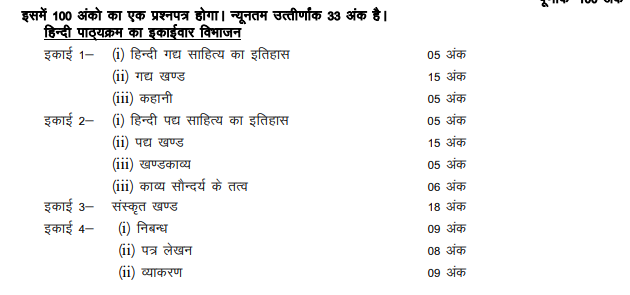
The UP Board Class 10 Hindi Syllabus 2027 gives major weightage to prose and poetry (11 marks each), while the History of Prose and Poetry carries 5 marks each.
Khand Kavya, Kavy-Saundarya & essay writing also contribute important marks, so students should prioritise these areas.
Source: UPMSP Syllabus
UP Board Class 10 English Syllabus
The UP Board Class 10 English Syllabus 2027 carries the highest weightage in Literature (35 marks, 50%), followed by Grammar (15 marks, 21.4%). Within Literature, Prose carries 15 marks (21.4%), while Poetry carries 8 marks (11.4%) and the Supplementary Reader carries 12 marks (17.1%).
| Section | Topics Covered | Weightage |
|---|---|---|
| Reading | Unseen passages, comprehension | 15 marks |
| Writing | Letter writing, descriptive/creative writing | 10 marks |
| Grammar | Tenses, parts of speech, narration, voice, punctuation, vocabulary | 15 marks |
| Prose | Prescribed prose lessons and comprehension | 15 marks |
| Poetry | Prescribed poems, explanation and comprehension | 8 marks |
| Supplementary Reader | Prescribed supplementary prose/chapters | 12 marks |
| Total | Theory paper | 75 marks |
UP Board Class 10 Mathematics Syllabus
UP Board Class 10 Mathematics Syllabus 2027 gives the highest weightage to Algebra (18 marks; 25.7%), followed by Trigonometry (12 marks; 17.1%). Geometry, Mensuration, and Statistics & Probability each carry 10 marks (14.3%), making them important scoring areas.
| Unit | Topics Covered | Marks | Weightage |
|---|---|---|---|
| Number System | Real Numbers | 5 | 7.1% |
| Algebra | Polynomials, Pair of Linear Equations, Quadratic Equations, Arithmetic Progressions | 18 | 25.7% |
| Coordinate Geometry | Lines, Distance Formula, Section Formula | 5 | 7.1% |
| Geometry | Triangles, Circles | 10 | 14.3% |
| Trigonometry | Trigonometric Ratios, Identities, Heights & Distances | 12 | 17.1% |
| Mensuration | Areas Related to Circles, Surface Areas & Volumes | 10 | 14.3% |
| Statistics & Probability | Mean, Median, Mode, Probability | 10 | 14.3% |
| Total Written Paper | — | 70 | 100% |
UP Board Class 10 Science Syllabus
The UP Board Class 10 Science Syllabus 2027 allocates the highest weightage to Chemical Substances – Nature and Behaviour and World of Living, with 20 marks each (28.6%). Effects of Current carries 13 marks (18.6%), followed by Natural Phenomena with 12 marks (17.1%), while Natural Resources carries 5 marks (7.1%).
| Unit | Topics Covered | Marks | Weightage |
|---|---|---|---|
| Chemical Substances – Nature & Behaviour | Chemical reactions, acids, bases & salts, metals & non-metals, carbon compounds | 20 | 28.6% |
| World of Living | Life processes, control & coordination, reproduction, heredity | 20 | 28.6% |
| Natural Phenomena | Light: reflection & refraction, human eye, colourful world | 12 | 17.1% |
| Effects of Current | Electricity, magnetic effects of electric current | 13 | 18.6% |
| Natural Resources | Ecosystem, environmental problems, ozone depletion, waste management | 5 | 7.1% |
| Total Theory | — | 70 | 100% |
| Practical Examination | Practical work, projects, viva, internal assessment | 30 | — |
| Grand Total | Theory + Practical | 100 | — |
UP Board Class 10 Social Science Syllabus
The UP Board Class 10 Social Science Syllabus 2027 gives the highest weightage to History and Geography, with 20 marks each (28.6%). Civics and Economics carry 15 marks each (21.4%), while 5 marks in both History and Geography are allocated to map work, making these areas important for scoring.
| Subject/Unit | Major Topics | Marks | Weightage |
|---|---|---|---|
| History – India & Contemporary World-II | Nationalism in Europe, Nationalism in India, Global World, Industrialisation, Print Culture & Modern World, Map Work | 20 | 28.6% |
| Geography – Contemporary India-II | Resources & Development, Forest & Wildlife, Water Resources, Agriculture, Minerals & Energy, Manufacturing Industries, Lifelines of National Economy, Map Work | 20 | 28.6% |
| Civics – Democratic Politics-II | Power Sharing, Federalism, Gender/Religion/Caste, Political Parties, Outcomes of Democracy | 15 | 21.4% |
| Economics – Understanding Economic Development | Development, Sectors of Indian Economy, Money & Credit, Globalisation, Consumer Rights | 15 | 21.4% |
| Total Theory | — | 70 | 100% |
| Project Work/Internal Assessment | Project and internal assessment activities | 30 | — |
| Grand Total | Theory + Internal Assessment | 100 | — |
UP Board Class 10 Home Science Syllabus
The UP Board Class 10 Home Science Syllabus 2027 carries the highest weightage in Home Management, Health Care & Transport, Food & Nutrition, and First Aid & Home Care, with 15 marks each (21.4%). Clothing & Textile Science carries 10 marks (14.3%), while the remaining 30 marks are allocated to practical and internal assessment.
| Unit | Major Topics Covered | Marks | Weightage |
|---|---|---|---|
| Home Management | Budgeting, income-expenditure, savings, home cleanliness & decoration, household mathematics | 15 | 21.4% |
| Health Care & Transport | Water purification, water-borne diseases, environmental health, common diseases, road safety and traffic rules | 15 | 21.4% |
| Clothing & Textile Science | Sewing kit, stitching, washing and care of clothes, ironing | 10 | 14.3% |
| Food & Nutrition Science | Kitchen management, cooking methods, food safety, diet for patients and nutrition | 15 | 21.4% |
| First Aid & Home Care | Human skeletal system, fractures, respiratory system, artificial respiration, first aid and patient care | 15 | 21.4% |
| Total Theory | — | 70 | 100% |
| Practical & Internal Assessment | Cooking, sewing, projects, viva & practical activities | 30 | — |
| Grand Total | Theory + Practical/Internal Assessment | 100 | — |
UP Board Class 10 Commerce Syllabus
The UP Board Class 10 Commerce Syllabus 2027 has a 70-mark theory paper and 30 marks for internal assessment. Final Accounts carries the highest weightage at 20 marks (28.6%), while Banking Elements and Economics carry 15 marks each (21.4%).
| Unit | Major Topics Covered | Marks | Weightage |
|---|---|---|---|
| Unit 1: Final Accounts | Trading & Profit-Loss Account, Balance Sheet, adjustments, cash book, pass book, bank reconciliation, cheques, bills and hundis | 20 | 28.6% |
| Unit 2: Business Systems | Filing systems, indexing, communication systems, office machines, wholesale & retail trade, invoices and sales statements | 20 | 28.6% |
| Unit 3: Elements of Banking | Meaning, definition, functions and importance of banks; RBI, State Bank, commercial and cooperative banks | 15 | 21.4% |
| Unit 4: Economics | Law of diminishing utility, expenditure and saving, mutual relationship, social importance of saving, factors and characteristics of production | 15 | 21.4% |
| Total Theory | — | 70 | 100% |
| Project & Internal Assessment | Two projects + unit-test-based assessment | 30 | — |
| Grand Total | Theory + Internal Assessment | 100 | — |
UP Board Class 10 Physical Education Syllabus
The UP Board Class 10 Physical Education Syllabus 2027 has a 50-mark written paper and a 50-mark practical examination. In the written component, Yoga carries the highest weightage at 20 marks (40%), while Moral Education and Sports & Physical Education carry 15 marks each (30%).
| Section | Major Topics Covered | Marks | Weightage |
|---|---|---|---|
| Moral Education | Lives of great personalities, human rights, child rights, complaint system and rights protection | 15 | 30% |
| Sports & Physical Education | Physical education, growth & development, injuries, muscular system, camps, physical fatigue & mental stress, traffic rules | 15 | 30% |
| Yoga Education | Types of yoga, Ashtanga Yoga, Pranayama, Shatkarma, adolescent health and yogic practices | 20 | 40% |
| Total Written Examination | — | 50 | 100% |
| Practical Examination | PT, yoga, march-past, gymnastics/folk dance, sports, athletics, competitions, national ideals and community activities | 50 | — |
| Grand Total | Written + Practical | 100 | — |
UP Board Class 10 IT Syllabus
The UP Board Class 10 IT Syllabus 2027 carries 70 marks for the written and internal assessment components, with the highest theory weightage given to Presentation (10 marks; 14.3%). Internet Searching & GPS and Modern Communication Devices together form another major part of the syllabus, while practical/project work carries 30 marks.
| Unit | Major Topics Covered | Marks | Weightage* |
|---|---|---|---|
| Unit 1: Introduction to Computer | Computer diagram, blocks, components, input/output and storage devices | 8 | 11.4% |
| Unit 2: Operating System | Modern operating systems, user interface, display properties, devices, files and directory management | 8 | 11.4% |
| Unit 3: Word Processing & Advanced Features | Document creation, editing, formatting, tables, images, mail merge and security | 8 | 11.4% |
| Unit 4: Spreadsheet | Cells, data entry/editing, rows & columns, formulas, functions and charts | 8 | 11.4% |
| Unit 5: Internet Searching & GPS | Internet, LAN/MAN/WAN, email, ISPs, troubleshooting, GPS, Wi-Fi and communication | 9 | 12.9% |
| Unit 6: Modern Communication Devices | Communication types, media, mobile communication, internet and social media | 9 | 12.9% |
| Unit 7: Presentation | Presentation elements, templates, text editing, tables, images, animations and audio | 10 | 14.3% |
| Project Work | Projects based on Word, Excel and PowerPoint | 10 | 14.3% |
| Total | — | 70 | 100% |
Subject-wise UP Board Syllabus 2027 for Class 12
Subject-wise UP Board 12th Syllabus covers various subjects, including Hindi, English, Mathematics, Science, Social Science & one optional subject. Students should prioritise high-weightage chapters and understand the revised topic distribution for effective preparation.
UP Board Class 12 Hindi Syllabus
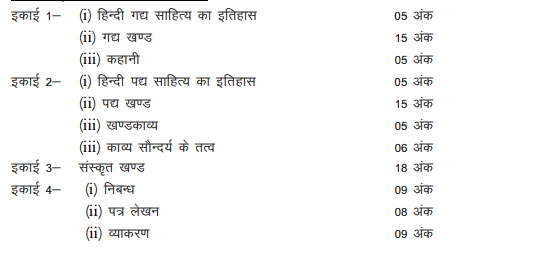
The UP Board Class 12 Hindi Syllabus 2027 carries 100 marks, with the highest weightage given to Hindi Prose and Poetry sections (15 marks each), followed by the Sanskrit section (18 marks). Essay, grammar & letter writing carry 9, 9 & 8 marks, respectively.
Source: UPMSP Syllabus
UP Board Class 12 English Syllabus
The UP Board Class 12 English Syllabus 2027 gives the highest weightage to Literature (40 marks; 40%), followed by Grammar (25 marks; 25%) and Writing (20 marks; 20%). Reading carries 15 marks (15%), making Literature and Grammar the key areas for scoring in the 100-mark paper.
| Unit | Major Topics Covered | Marks | Weightage |
|---|---|---|---|
| Reading | Unseen passage, comprehension and vocabulary | 15 | 15% |
| Writing | Article writing, letters to the editor, complaint/business letters | 20 | 20% |
| Grammar | Narration, synthesis, transformation, syntax, idioms/phrasal verbs, synonyms, antonyms, one-word substitution, homophones, Hindi-to-English translation | 25 | 25% |
| Literature – Flamingo Prose | Prescribed prose chapters, short and long-answer questions | 15 | 15% |
| Literature – Poetry | Prescribed poems, central idea and figures of speech | 10 | 10% |
| Literature – Vistas | Prescribed supplementary reader chapters, short and long-answer questions | 15 | 15% |
| Total | — | 100 | 100% |
UP Board Class 12 Mathematics
The UP Board Class 12 Mathematics Syllabus 2027 gives the highest weightage to Calculus with 44 marks (44%), followed by Vector Algebra & Three-Dimensional Geometry with 18 marks (18%). Algebra carries 15 marks (15%), while Relations & Functions, Linear Programming & Probability account for 10%, 5% & 8%, respectively.
| Unit | Major Topics Covered | Marks | Weightage |
|---|---|---|---|
| Relations & Functions | Types of relations, functions, composition of functions, inverse trigonometric functions | 10 | 10% |
| Algebra | Matrices, determinants and applications of determinants | 15 | 15% |
| Calculus | Continuity & differentiability, applications of derivatives, integrals, applications of integrals, differential equations | 44 | 44% |
| Vector Algebra & 3D Geometry | Vectors, scalar/vector products, lines and their equations, distance and angle between lines | 18 | 18% |
| Linear Programming | Constraints, objective function, feasible region and graphical solutions | 5 | 5% |
| Probability | Conditional probability, multiplication theorem, independent events, total probability and Bayes' theorem | 8 | 8% |
| Total | — | 100 | 100% |
UP Board Class 12 Science
| Subject | Major Units / Topics | Theory Marks | Weightage |
|---|---|---|---|
| Physics | Electrostatics, Current Electricity, Magnetism, Electromagnetic Induction & AC, Electromagnetic Waves, Optics, Dual Nature, Atoms & Nuclei, Electronic Devices | 70 | 100% |
| Chemistry | Solutions, Electrochemistry, Chemical Kinetics, d & f Block, Coordination Compounds, Haloalkanes & Haloarenes, Alcohols/Phenols/Ethers, Aldehydes/Ketones/Carboxylic Acids, Amines, Biomolecules | 70 | 100% |
| Biology | Reproduction, Genetics & Evolution, Biology & Human Welfare, Biotechnology & Applications, Ecology & Environment | 70 | 100% |
UP Board Class 12 Commerce
The UP Board Class 12 Commerce Syllabus 2027 gives the highest weightage in Accountancy to Partnership Firm Reconstitution (13%), Retirement/Death (13%), Dissolution (13%) and Share Capital (13%). In Business Studies, Marketing carries the highest weightage at 16%, while Economics gives 18% each to Consumer Equilibrium & Demand and Producer Behaviour & Supply.
| Subject | Highest-Weightage Units | Marks | Weightage |
|---|---|---|---|
| Accountancy | Admission of Partner | 13 | 13% |
| Retirement/Death of Partner | 13 | 13% | |
| Dissolution of Partnership Firm | 13 | 13% | |
| Accounting for Share Capital | 13 | 13% | |
| Business Studies | Marketing Management | 16 | 16% |
| Financial Management | 12 | 12% | |
| Consumer Protection | 12 | 12% | |
| Business Environment | 10 | 10% | |
| Organising | 10 | 10% | |
| Directing | 10 | 10% | |
| Economics | Consumer Equilibrium & Demand | 18 | 18% |
| Producer Behaviour & Supply | 18 | 18% | |
| Income & Employment | 14 | 14% | |
| National Income | 12 | 12% | |
| Markets & Price Determination | 10 | 10% |
UP Board Class 12 Social Science
| Subject | Major Units / Topics | Marks | Weightage |
|---|---|---|---|
| History | Harappan Civilisation, Early States, Kinship/Caste/Class, Thinkers/Beliefs & Buildings, Travellers, Bhakti-Sufi Traditions, Vijayanagara, Mughal Empire, Colonialism, Revolt of 1857, Gandhi & National Movement, Constitution & Making of India | 100 | 100% |
| Geography | Human Geography, Population, Human Settlements, Resources, Agriculture, Water Resources, Mineral & Energy Resources, Manufacturing Industries, Planning, Transport & Communication, International Trade | 70 | 100% |
| Civics / Political Science | Contemporary World Politics, End of Bipolarity, Contemporary Centres of Power, Challenges of Nation-Building, Era of One-Party Dominance, Politics of Planned Development, India's External Relations, Emergency, Regional Aspirations, Recent Developments in Indian Politics | 100 | 100% |
UP Board Class 12 Sociology Syllabus
The UP Board Class 12 Sociology Syllabus 2027 is divided equally into Indian Society and Change & Development in India, with 50 marks (50%) assigned to each section. The highest-weightage units are Social Institutions & Change and Cultural Diversity and Social Movements, each carrying 10 marks (10%).
| Unit / Section | Major Topics Covered | Marks | Weightage |
|---|---|---|---|
| Indian Society: An Introduction | Introduction to Indian Society | 2 | 2% |
| Demographic Structure of Indian Society | Population, demographic concepts, rural-urban differences, population policy | 10 | 10% |
| Social Institutions: Continuity & Change | Family, kinship, caste, tribal society | 10 | 10% |
| Market as a Social Institution | Markets, globalisation, liberalisation and state-market relations | 6 | 6% |
| Patterns of Social Inequality & Exclusion | Social inequality, exclusion, caste, tribes, women, persons with disabilities | 7 | 7% |
| Challenges of Cultural Diversity | Communalism, secularism, regionalism, minority rights, nation-building | 10 | 10% |
| Suggestions for Project Work | Survey, interview, observation and small research projects | 5 | 5% |
| India: Change & Development – Structural Change | Colonialism, industrialisation and urbanisation | 5 | 5% |
| Cultural Change | Sanskritisation, westernisation, modernisation, secularisation and social reform | 5 | 5% |
| Constitution & Social Change | Constitutional provisions, social justice, Panchayati Raj and democratic politics | 6 | 6% |
| Change & Development in Rural Society | Agrarian structure, land reforms, Green Revolution and rural change | 6 | 6% |
| Change & Development in Industrial Society | Industrialisation, globalisation, labour movements and workers' unions | 7 | 7% |
| Globalisation & Social Change | Globalisation, employment, politics, culture and consumer culture | 5 | 5% |
| Mass Media & Communications | Development of mass media, television, radio, newspapers and globalisation | 6 | 6% |
| Social Movements | Peasant, workers', Dalit, backward-caste, women's, tribal and environmental movements | 10 | 10% |
| Total | — | 100 | 100% |
UP Board Class 12 Home Science Syllabus
The UP Board Class 12 Home Science Syllabus 2027 has a 70-mark theory paper and 30-mark practical examination. In theory, Nutrition, Food Science & Technology and Human Development & Family Studies carry the highest weightage at 15 marks each (21.4%), while the remaining four units carry 10 marks each (14.3%).
| Unit | Major Topics Covered | Marks | Weightage |
|---|---|---|---|
| Work, Livelihood & Life | Work, livelihood and life | 10 | 14.3% |
| Nutrition, Food Science & Technology | Clinical nutrition, community nutrition & health, food processing & technology, food quality & safety | 15 | 21.4% |
| Human Development & Family Studies | Early childhood care & education, support services/institutions/programmes for children, youth & elderly | 15 | 21.4% |
| Clothing & Apparel | Design for clothing & apparel, fashion design & merchandising, care and maintenance of textiles in institutions | 10 | 14.3% |
| Resource Management | Hospitality management, consumer education & protection | 10 | 14.3% |
| Communication & Extension | Development communication & journalism, corporate communication & public relations | 10 | 14.3% |
| Total Theory | — | 70 | 100% |
| Practical Examination | Food preparation, nutrition-based diet planning, sewing, projects, viva and practical activities | 30 | — |
| Grand Total | Theory + Practical | 100 | — |
UP Board Class 12 Physical Science Syllabus
The UP Board Class 12 Physical Education Syllabus 2027 has a 50-mark theory paper and a 50-mark practical examination. In theory, Yoga Education carries the highest weightage at 20 marks (40%), followed by Moral Education with 17 marks (34%) and Sports & Physical Education with 13 marks (26%).
| Section / Unit | Major Topics Covered | Marks | Weightage |
|---|---|---|---|
| Sports & Physical Education | Development of Physical Education in India, physical growth & development, drugs and doping, personality & leadership, major sports, international competitions, sports awards | 13 | 26% |
| Moral Education | Human rights, fundamental rights, constitutional rights, Right to Education, RTI, complaint systems and Human Rights Commission | 17 | 34% |
| Yoga Education | History and development of Yoga, Ashtanga Yoga, physical & mental health, adolescent problems, Yoga therapy, Yoga & Ayurveda | 20 | 40% |
| Total Theory | — | 50 | 100% |
| Practical Examination | Asanas, Pranayama, Yogic exercises, physical fitness and sports skills | 50 | — |
| Grand Total | Theory + Practical | 100 | — |
UP Board Syllabus 2027: Reduced Syllabus
This year, changes have been introduced in certain subjects of the UP Board Exam Syllabus 2027, such as Class 12 Hindi, along with a revised division of units.
- However, UPMSP has not released any separate reduced syllabus for the UP Board Syllabus 2027.
- Students should therefore follow the latest subject-wise syllabus PDFs available on the official website.
UP Board Syllabus 2027 Total Marks
The exact theory and practical distribution varies by Class 12 subject. For example, subjects such as Mathematics and Hindi have a 100-mark theory paper, while Science subjects generally have 70 marks theory + 30 marks practical. UPMSP also provides separate model papers for the prescribed subjects.
| Class | Assessment Component | Marks | Key Details |
|---|---|---|---|
| Class 10 | Theory/Written Examination | 70 marks | Subject-wise written paper based on the prescribed syllabus |
| Internal Assessment/Project | 30 marks | Internal activities, projects, practical work or subject-specific assessment | |
| Total | 100 marks | Theory + Internal Assessment | |
| Class 12 | Theory Examination | 70/100 marks* | Marks vary according to the subject |
| Practical/Internal Assessment | 30/50 marks* | Applicable to practical and selected subjects | |
| Total | 100 marks | Theory + practical/internal assessment | |
| Physical Education | Theory | 50 marks | Moral Education, Sports & Physical Education, and Yoga |
| Practical | 50 marks | Sports, physical activities and yoga-based assessment | |
| Total | 100 marks | Theory + Practical |
Best Books to Cover UP Board Class 10 Syllabus
For effective preparation, students should first complete the UP Board Books 2027 prescribed by UPMSP. Then use reference books for additional practice, previous-year questions, and sample papers.
| Subject | Recommended Book(s) | Best For |
|---|---|---|
| Hindi | UP Board Hindi Textbook; Arihant UP Board Class 10 Hindi Guide | Chapter preparation, grammar & writing practice |
| English | UP Board English Textbook; Arihant UP Board Class 10 English Guide | Literature, grammar & comprehension |
| Mathematics | UP Board Mathematics Textbook; NCERT Mathematics Class 10; R.D. Sharma Class 10 Mathematics | Concepts, numerical practice & advanced questions |
| Science | UP Board Science Textbook; NCERT Science Class 10; Arihant UP Board Science Guide | Concepts, diagrams & numerical/problem practice |
| Social Science | UP Board Social Science Textbook; NCERT Social Science Class 10; Arihant UP Board Social Science Guide | History, Geography, Civics & Economics |
| Commerce | UP Board Commerce Textbook; UP Board Class 10 Commerce Guide | Accountancy, Banking, Business Systems & Economics |
| Physical Education | UP Board Physical Education Textbook; UP Board Physical Education Guide | Theory, Yoga & practical preparation |
| Home Science | UP Board Home Science Textbook; UP Board Class 10 Home Science Guide | Nutrition, Home Management, Health & First Aid |
| IT | UP Board IT/IT-ITES Textbook; UP Board Class 10 IT Guide | Computer fundamentals, Office tools, Internet & practical skills |
Best Books to Cover UP Board Class 12 Syllabus
The UP Board Class 12 Syllabus 2027 requires focused preparation across all subjects. Mathematics, Physics, Chemistry & Accountancy generally need more preparation due to their numerical and application-based questions. Students should devote extra preparation time to these subjects while using prescribed textbooks as their primary study material.
| Subject | Recommended Books | Best For |
|---|---|---|
| Hindi | UP Board Class 12 Hindi Textbook; Arihant UP Board Hindi Guide | Literature, grammar & writing |
| English | UP Board English Textbook; Arihant UP Board English Guide | Literature, grammar & comprehension |
| Mathematics | UP Board Mathematics Textbook; NCERT Mathematics Class 12; R.D. Sharma Class 12 | Concepts & numerical practice |
| Physics | UP Board Physics Textbook; NCERT Physics Class 12; HC Verma | Concepts, numericals & problem-solving |
| Chemistry | UP Board Chemistry Textbook; NCERT Chemistry Class 12; Pradeep's New Course Chemistry | Concepts, reactions & numericals |
| Biology | UP Board Biology Textbook; NCERT Biology Class 12; Trueman's Elementary Biology | Concepts, diagrams & revision |
| History | UP Board History Textbook; NCERT History Class 12 | Concepts, events & answer writing |
| Civics | UP Board Civics Textbook; NCERT Political Science Class 12 | Political concepts & contemporary issues |
| Geography | UP Board Geography Textbook; NCERT Geography Class 12 | Concepts, maps & case studies |
| Accountancy | UP Board Accountancy Textbook; T.S. Grewal Class 12 | Numerical practice & accounting concepts |
| Business Studies | UP Board Business Studies Textbook; Poonam Gandhi Business Studies | Concepts & case-based questions |
| Economics | UP Board Economics Textbook; Sandeep Garg Class 12 Economics | Concepts, diagrams & numerical questions |
| Sociology | UP Board Sociology Textbook; NCERT Sociology Class 12 | Concepts, examples & answer writing |
| Physical Education | UP Board Physical Education Textbook; Arihant UP Board Physical Education Guide | Theory, Yoga & practical preparation |
| Home Science | UP Board Home Science Textbook; Arihant Home Science Guide | Nutrition, human development & resource management |
| IT | UP Board IT/IT-ITES Textbook; UP Board Class 12 IT Guide | Computer concepts, applications & practical preparation |

Source: Quora
Another Quora user asked whether the syllabus of 2 distinct boards (CBSE & UPMSP) is the same or not? “Are the UP board syllabus or the CBSE board syllabus the same or not?”
Ans. No, the UP Board syllabus and CBSE syllabus are not exactly the same. While both cover several similar concepts, the subjects, chapter-wise syllabus, exam pattern, marking scheme, and question-paper structure differ. Students should follow the syllabus prescribed by their respective board.
How to prepare based on the UP Board Syllabus 2027?
A UP Board Syllabus 2027-based preparation strategy should focus first on completing the prescribed syllabus and prioritising high-weightage topics. Regular revision, PYQs, sample papers, and practice tests can help improve accuracy, speed, and exam readiness.
| Preparation Tip | What Should Students Do? |
|---|---|
| Understand the Syllabus | Review the UP Board Syllabus 2027, marking scheme & chapter-wise weightage before starting preparation. |
| Prioritise Important Topics | Begin with high-weightage chapters and topics, then cover the remaining syllabus systematically. |
| Use UP Board Books | Thoroughly study the prescribed UP Board Books 2027 before referring to additional study material. |
| Practise & Revise | Solve numerical questions, revise key concepts & make short notes for quick revision. |
| Solve PYQs & Sample Papers | Practise previous-year questions and sample papers to understand the exam pattern and improve time management. |
| Track Weak Areas | Take regular tests and focus additional revision on topics where you make mistakes. |
UP Board Syllabus 2027 FAQs
Ques. What are the highest marks in Class 12 UP Board?
Ans. The highest score in the UP Board Class 12 exams 2025-26 was 97.00%. The topper scored 485 out of 500 marks, reflecting strong performance across all subjects.
Ques. How can I get 95% in Class 12 from the UP Board?
Ans. To score 95% in UP Board Class 12, complete the prescribed syllabus thoroughly, prioritise high-weightage topics, and practise numerical subjects regularly. Solve previous-year papers and sample papers, revise consistently, and take timed mock tests to improve accuracy and time management.
Ques. Can we score 90% + in the 10th UP Board in 10 days?
Ans. Yes, scoring 90%+ in the UP Board Class 10 exams in 10 days is possible with focused preparation, especially if your basics are clear. Prioritise high-weightage topics, revise UP Board Books 2027, practise PYQs, and take timed mock tests.
Ques. When will the UP Board 2027 examinations begin?
Ans. The UP Board 2027 Class 10 and 12 board examinations are scheduled to begin in February 2027, as per the UPMSP academic calendar. The detailed subject-wise date sheet is yet to be released by UPMSP.
Ques. Is Calculus the most important unit in UP Board Class 12 Mathematics?
Ans. Yes. Calculus carries approximately 44 marks out of 100 in UP Board Class 12 Mathematics — more than any other unit. It covers Differential Calculus, Integral Calculus, and Differential Equations. Skipping any chapter within Calculus will directly affect your score.
Ques. Is NCERT enough for UP Board 2027 preparation?
Ans. NCERT is the strongest foundation for UP Board 2027. The UP Board syllabus closely aligns with NCERT Class 10 and 12 textbooks for Science and Mathematics. You should also use UPMSP-prescribed textbooks for Hindi and supplement with subject-specific practice books for numericals and past year papers.
Ques. What books should I follow for Chemistry in UP Board Class 12?
Ans. NCERT Chemistry Part I and Part II (Class 12) are the primary books for UP Board 2027 Chemistry. Complete all NCERT chapter exercises and in-text examples first. For Organic Chemistry reaction practice, you can supplement with VK Jaiswal after completing NCERT thoroughly.
Ques. How many streams are available in UP Board Class 12?
Ans. UP Board Class 12 offers three streams — Science, Commerce, and Arts. Science students choose between Mathematics and Biology as their fourth subject. Commerce students take Accountancy, Business Studies, and Economics. Arts students select three optional subjects from History, Geography, Political Science, Economics, Sociology, Psychology, and others.



Comments