




The UP Board Class 12 Physics 2026 question paper with solutions (Set 346 DT) is available here for free download. UP Board Class 12 Physics 2026 was conducted by the UP Madhyamik Shiksha Parishad (UPMSP) on February 27, 2026, in the 2:00 PM to 5:15 PM shift, as a 70-mark theory paper of 30 questions spread across five sections (A to E).
| UP Board Class 12 Physics 2026 Question Paper with Solutions (Set 346 DT) | Download PDF | Check Solutions |
UP Board Class 12 Physics 2026 Questions with Solutions
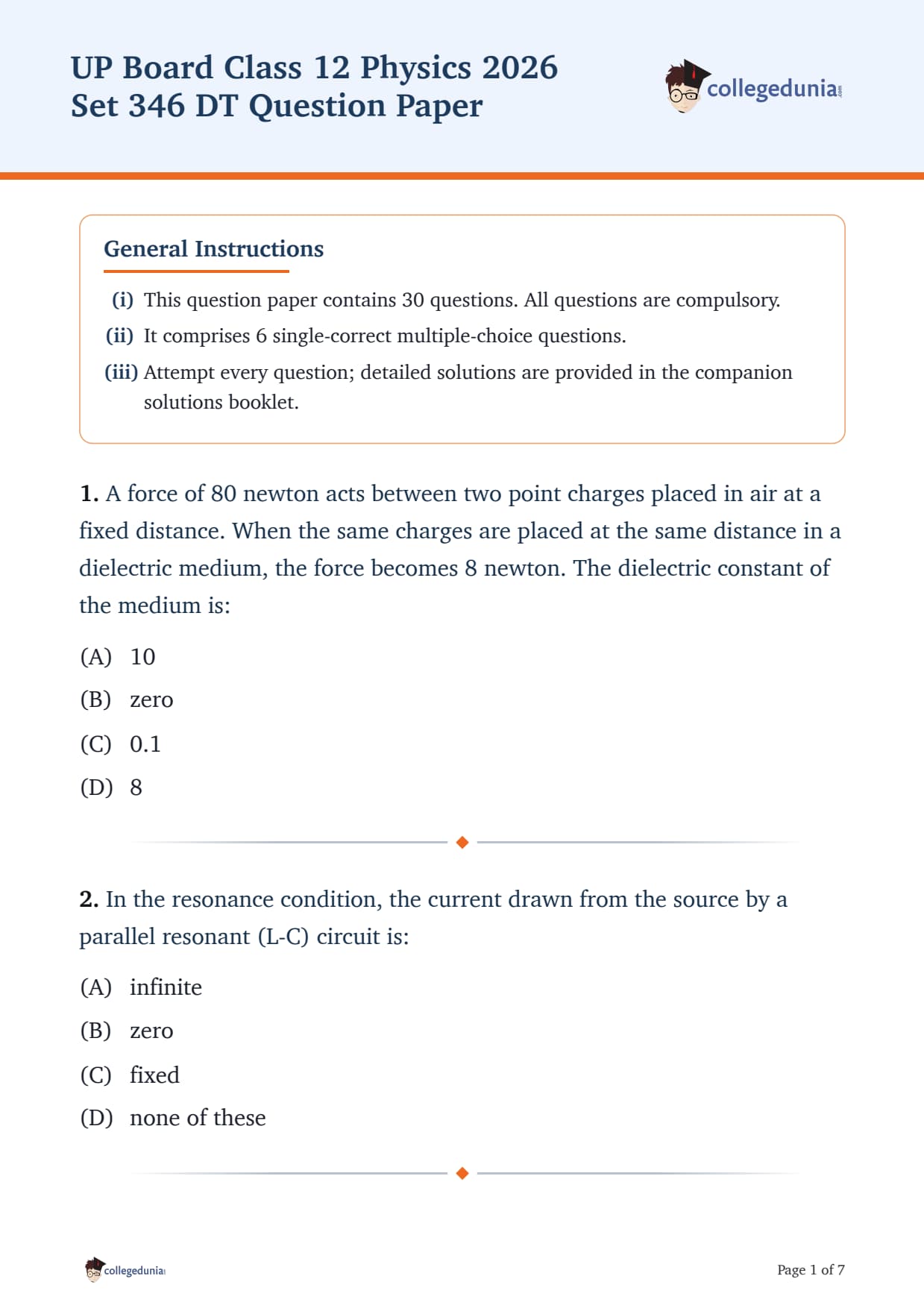
A force of 80 newton acts between two point charges placed in air at a fixed distance. When the same charges are placed at the same distance in a dielectric medium, the force becomes 8 newton. The dielectric constant of the medium is:
In the resonance condition, the current drawn from the source by a parallel resonant (L-C) circuit is:
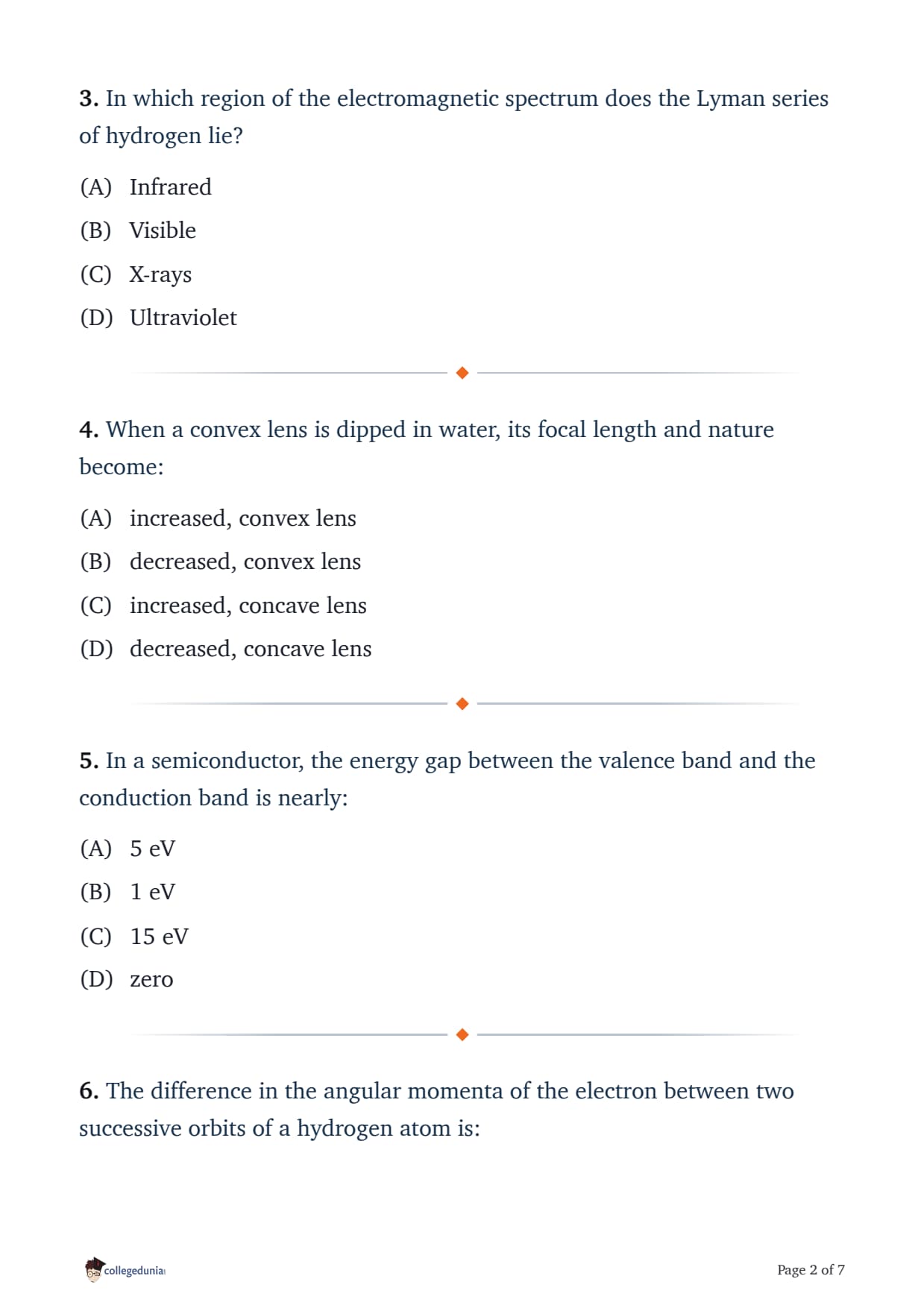
In which region of the electromagnetic spectrum does the Lyman series of hydrogen lie?
When a convex lens is dipped in water, its focal length and nature become:
In a semiconductor, the energy gap between the valence band and the conduction band is nearly:
The difference in the angular momenta of the electron between two successive orbits of a hydrogen atom is:

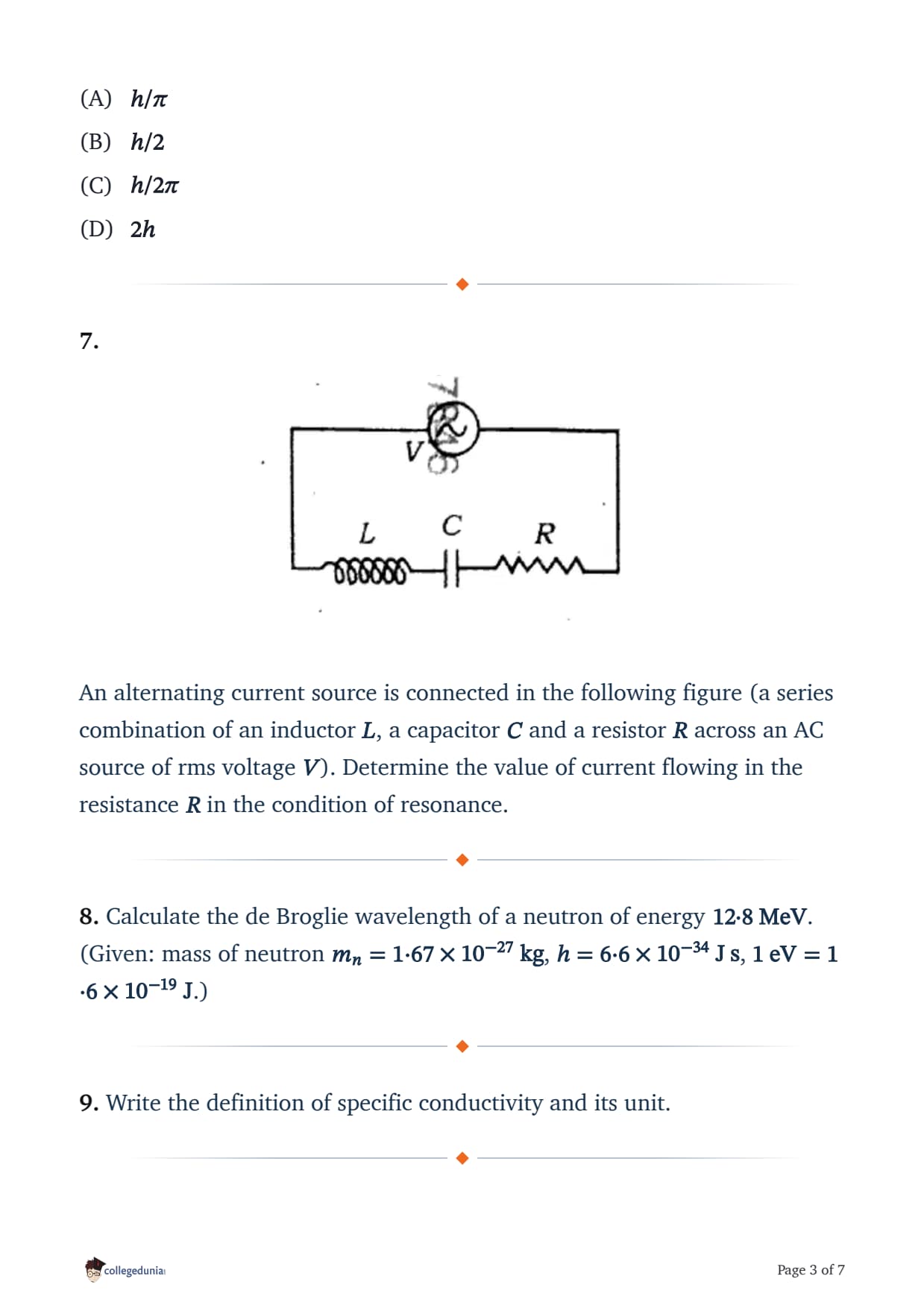
An alternating current source is connected in the following figure (a series combination of an inductor \(L\), a capacitor \(C\) and a resistor \(R\) across an AC source of rms voltage \(V\)). Determine the value of current flowing in the resistance \(R\) in the condition of resonance.
Calculate the de Broglie wavelength of a neutron of energy \(12{\cdot}8\ \text{MeV}\). (Given: mass of neutron \(m_{n}=1{\cdot}67\times10^{-27}\ \text{kg}\), \(h=6{\cdot}6\times10^{-34}\ \text{J s}\), \(1\ \text{eV}=1{\cdot}6\times10^{-19}\ \text{J}\).)
Write the definition of specific conductivity and its unit.
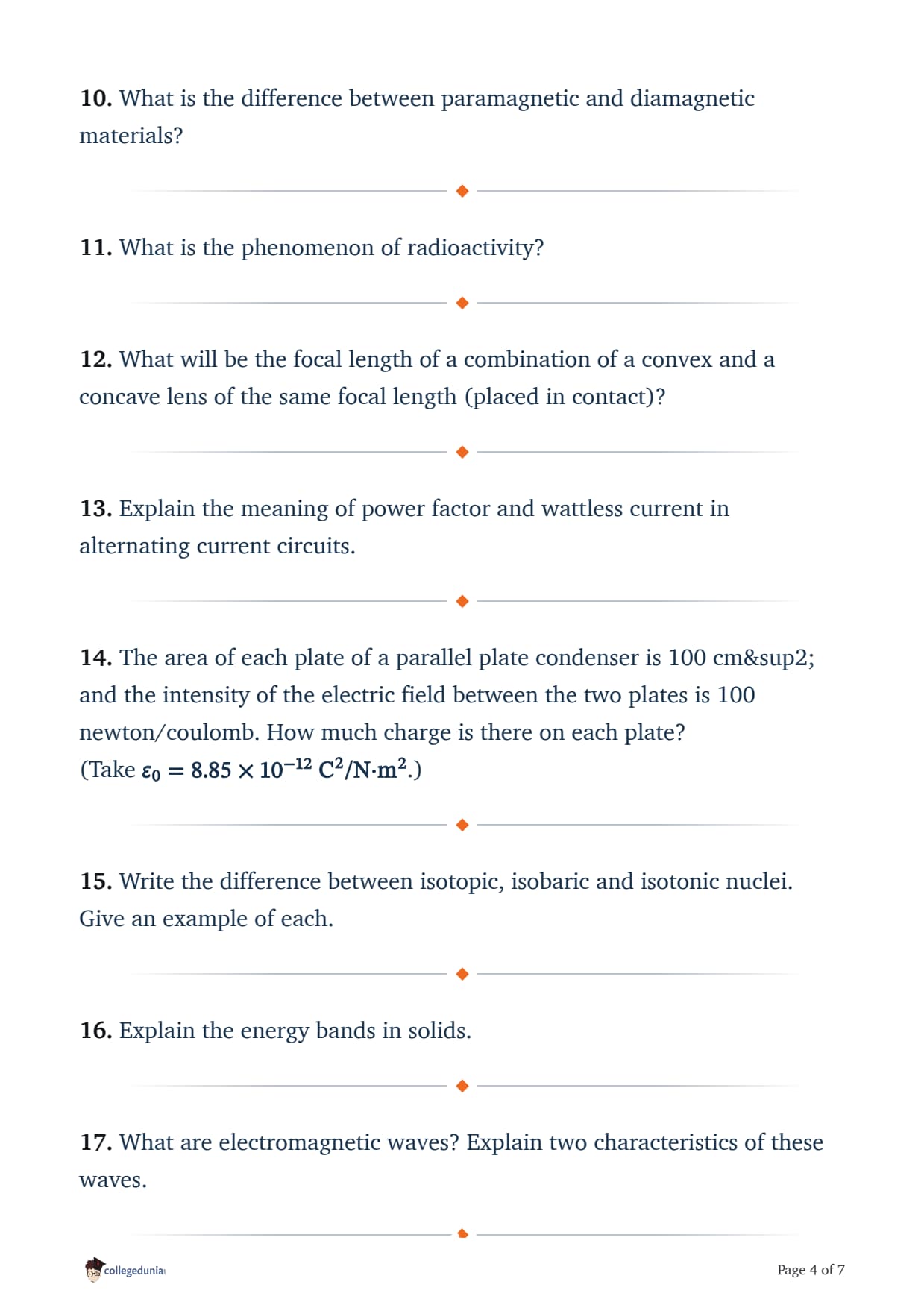
What is the difference between paramagnetic and diamagnetic materials?
What is the phenomenon of radioactivity?
What will be the focal length of a combination of a convex and a concave lens of the same focal length (placed in contact)?
Explain the meaning of power factor and wattless current in alternating current circuits.
The area of each plate of a parallel plate condenser is 100 cm² and the intensity of the electric field between the two plates is 100 newton/coulomb. How much charge is there on each plate?
(Take \( \varepsilon_0 = 8.85\times10^{-12}\ \text{C}^2/\text{N·m}^2 \).)
Write the difference between isotopic, isobaric and isotonic nuclei. Give an example of each.
Explain the energy bands in solids.
What are electromagnetic waves? Explain two characteristics of these waves.
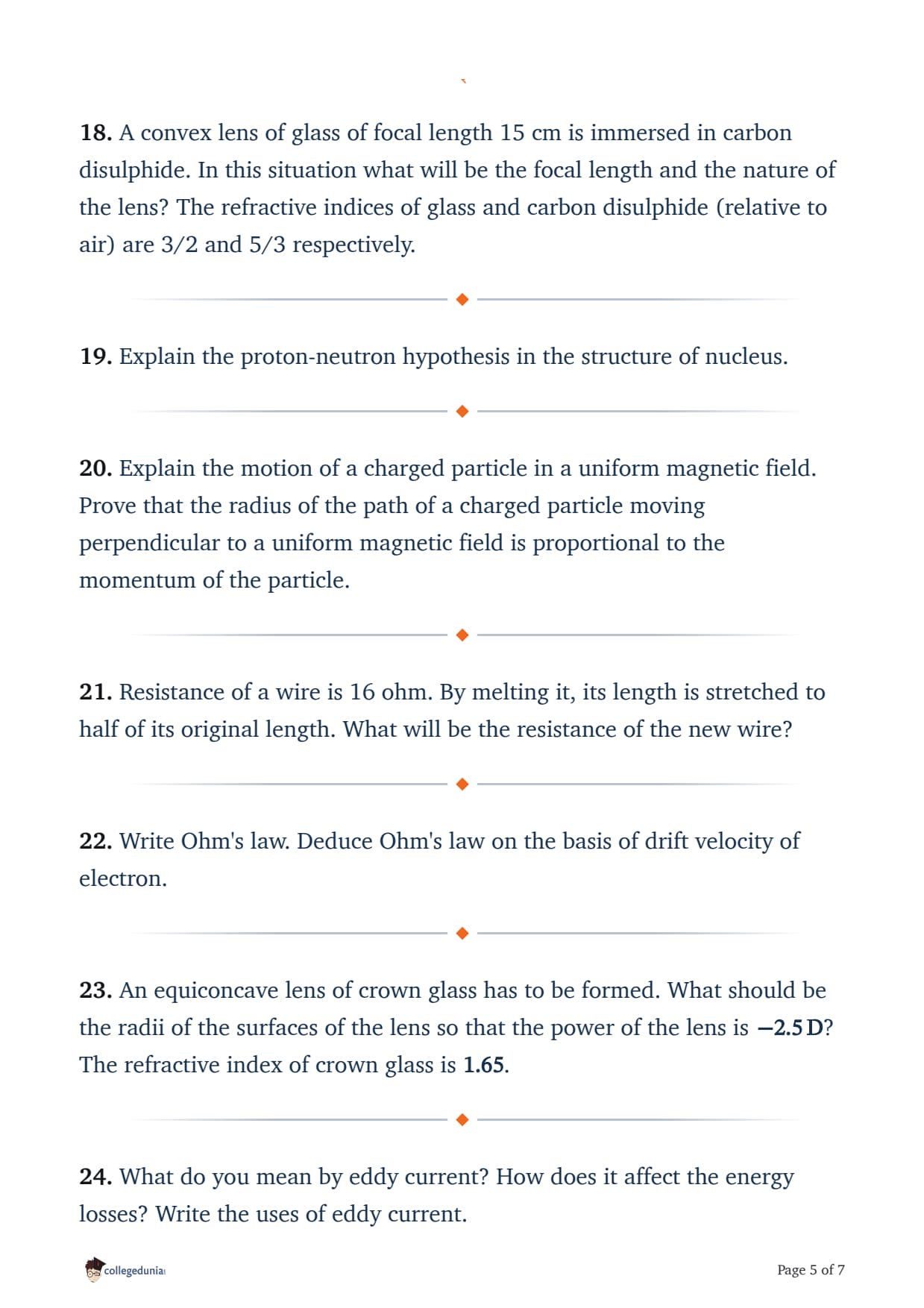
A convex lens of glass of focal length 15 cm is immersed in carbon disulphide. In this situation what will be the focal length and the nature of the lens? The refractive indices of glass and carbon disulphide (relative to air) are 3/2 and 5/3 respectively.
Explain the proton-neutron hypothesis in the structure of nucleus.
Explain the motion of a charged particle in a uniform magnetic field. Prove that the radius of the path of a charged particle moving perpendicular to a uniform magnetic field is proportional to the momentum of the particle.
Resistance of a wire is 16 ohm. By melting it, its length is stretched to half of its original length. What will be the resistance of the new wire?
Write Ohm's law. Deduce Ohm's law on the basis of drift velocity of electron.
An equiconcave lens of crown glass has to be formed. What should be the radii of the surfaces of the lens so that the power of the lens is \(-2.5\,\text{D}\)? The refractive index of crown glass is \(1.65\).
What do you mean by eddy current? How does it affect the energy losses? Write the uses of eddy current.
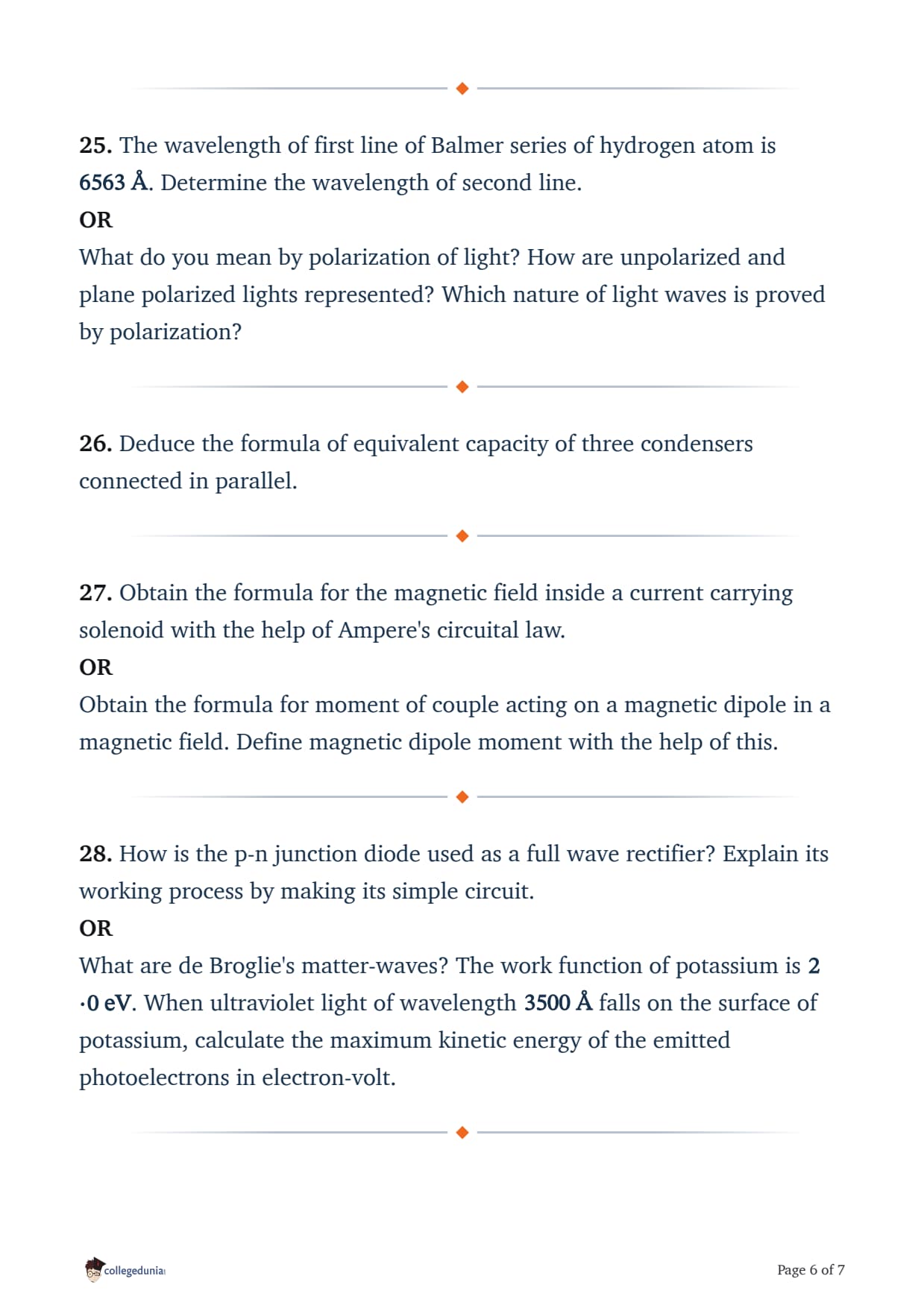
The wavelength of first line of Balmer series of hydrogen atom is \( 6563\ \text{\AA} \). Determine the wavelength of second line.
OR
What do you mean by polarization of light? How are unpolarized and plane polarized lights represented? Which nature of light waves is proved by polarization?
Deduce the formula of equivalent capacity of three condensers connected in parallel.
Obtain the formula for the magnetic field inside a current carrying solenoid with the help of Ampere's circuital law.
OR
Obtain the formula for moment of couple acting on a magnetic dipole in a magnetic field. Define magnetic dipole moment with the help of this.
How is the p-n junction diode used as a full wave rectifier? Explain its working process by making its simple circuit.
OR
What are de Broglie's matter-waves? The work function of potassium is \( 2\!\cdot\!0\ \text{eV} \). When ultraviolet light of wavelength \( 3500\ \text{\AA} \) falls on the surface of potassium, calculate the maximum kinetic energy of the emitted photoelectrons in electron-volt.
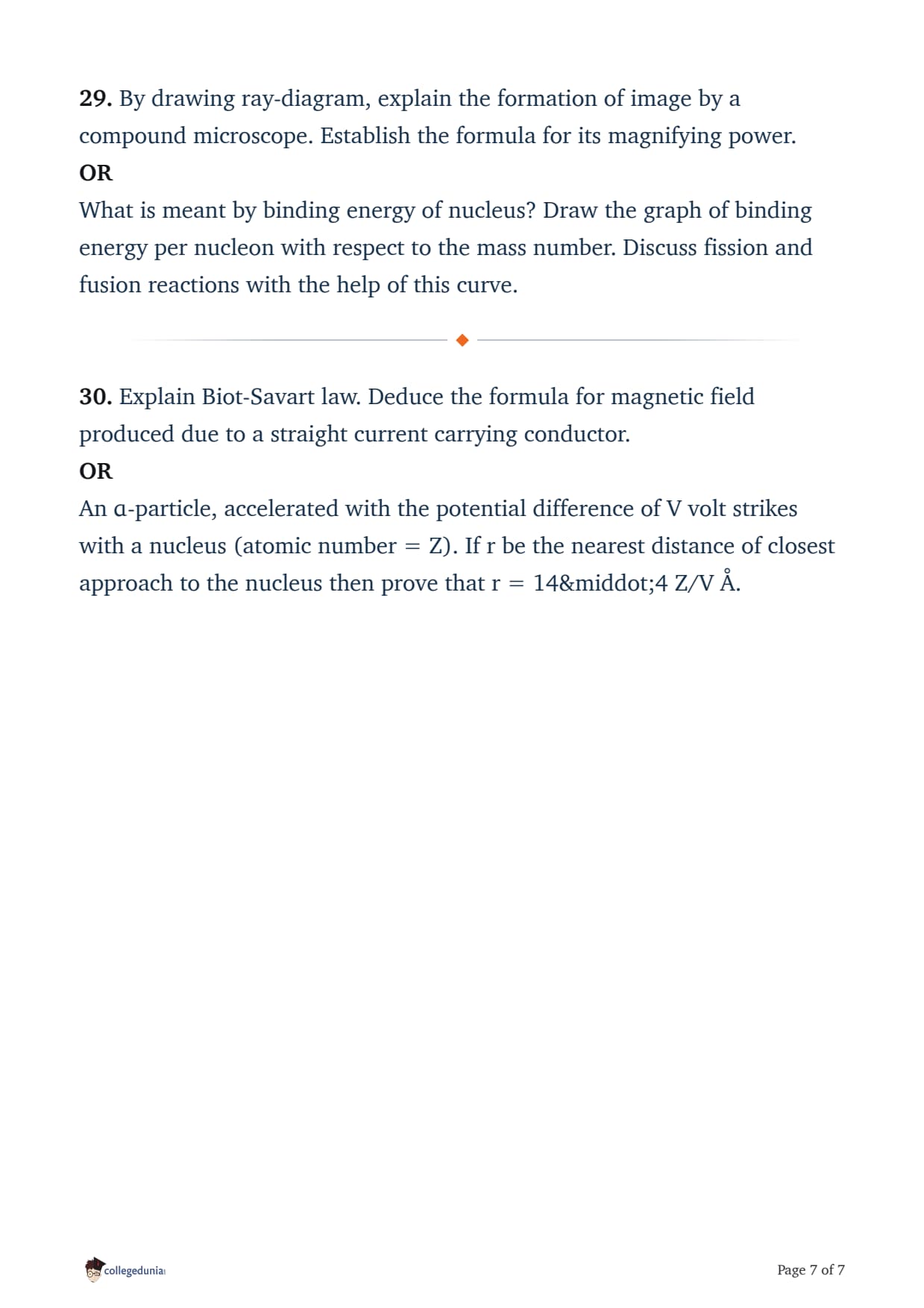
By drawing ray-diagram, explain the formation of image by a compound microscope. Establish the formula for its magnifying power.
OR
What is meant by binding energy of nucleus? Draw the graph of binding energy per nucleon with respect to the mass number. Discuss fission and fusion reactions with the help of this curve.
Explain Biot-Savart law. Deduce the formula for magnetic field produced due to a straight current carrying conductor.
OR
An α-particle, accelerated with the potential difference of V volt strikes with a nucleus (atomic number = Z). If r be the nearest distance of closest approach to the nucleus then prove that r = 14·4 Z/V Å.
UP Board Class 12 Physics 2026 Exam Pattern and Marking Scheme Explained
The UP Board Class 12 Physics 2026 theory paper carried 70 marks in 3 hours 15 minutes, with all 30 questions compulsory and no negative marking. A separate 30-mark practical exam is held for the remaining marks out of 100.
- Total: 30 questions, 70 marks, 3 hours 15 minutes (2:00 PM to 5:15 PM shift, with 15 minutes of reading time)
- Section A: Q1 (a to f), objective multiple-choice, 1 mark each (6 marks)
- Section B: Q2 (a to f), very short answer, 1 mark each (6 marks)
- Section C: Q3 (a to d), short answer-I, 2 marks each (8 marks)
- Section D: Q4 and Q5 (a to e each), short answer-II, 3 marks each (30 marks)
- Section E: Q6 to Q9, long answer, 5 marks each with internal OR choice (20 marks)
- No negative marking; internal choice is given in every long-answer question of Section E
High-Weightage Chapters in UP Board Class 12 Physics 2026 to Focus On First
This paper leaned heavily on Optics and Modern Physics, which together made up more than half the 70 marks. Lead your revision with the chapters that actually dominated Set 346 DT:
- Ray and Wave Optics - around 16 marks across lens focal-length numericals, the compound microscope derivation and a polarization question
- Modern Physics (Atoms, Nuclei, Dual Nature) - the single biggest block, covering de Broglie wavelength, the Balmer and Lyman series, binding energy and the closest-approach numerical
- Magnetism and Moving Charges - about 13 marks, including the solenoid field, Biot-Savart law and the radius-momentum proof
- Current Electricity - Ohm's law from drift velocity plus the stretched-wire resistance numerical
- Alternating Current and Electromagnetic Induction - resonance current, power factor, wattless current and eddy currents
- Electrostatics and Capacitance - dielectric constant, parallel-plate charge and the parallel-combination capacitance derivation
UP Board Class 12 Physics 2026 Question Paper Solution Video
Source: Rastogi Online Coaching Classes
How to Use the UP Board Class 12 Physics Question Paper for Practice
Solve Set 346 DT as a timed 3 hour 15 minute mock first, then check every answer against the solutions before revising your weak chapters.
- Attempt all 30 questions in one sitting - there is no negative marking, so leave nothing blank
- Review every answer against the solution PDF, especially the lens and de Broglie numericals that carried the heaviest marks this year
- Redo the Section D and E derivations first - at 50 of the 70 marks the 3-mark and 5-mark questions decide your score
- Practise the internal OR choices in Section E both ways so no long-answer question can surprise you
UP Board Class 12 Physics Good Score and Passing Benchmark
- The pass mark is 33%, i.e. about 23 out of 70 in the theory paper
- Aim for 55+ out of 70 for a strong board result, since the paper was rated easy to moderate and textbook-based
- UPMSP repeats numericals, derivations and ray diagrams from previous years, so solving past papers like this one directly lifts your marks
UP Board Class 12 Physics 2026 Question Paper FAQs
Ques. Was the UP Board Class 12 Physics 2026 question paper tough?
Ans. Most students rated Set 346 DT easy to moderate. The theory questions and derivations were straightforward and textbook-based, while a few numericals on lenses, de Broglie wavelength and the closest-approach formula were slightly tricky. It stayed fully within the UP Board syllabus.
Ques. What is a good score in UP Board Class 12 Physics?
Ans. The pass mark is 33%, about 23 out of 70 in the theory paper. A good score is 55+ out of 70, which is realistic here because the paper was easy to moderate and most marks came from standard derivations and numericals.
Ques. Which chapters had the highest weightage in UP Board Class 12 Physics 2026?
Ans. Optics led with around 16 marks across lens numericals, the compound microscope and polarization, followed by Modern Physics (atoms, nuclei and dual nature) as the biggest overall block. Magnetism and Moving Charges added about 13 marks through the solenoid, Biot-Savart law and the radius-momentum proof.
Ques. Is there negative marking in UP Board Class 12 Physics?
Ans. No. There is no negative marking in the UP Board Class 12 Physics theory paper, so you should attempt every question, including all six one-mark MCQs in Section A.
Ques. Does UPMSP release the official UP Board Class 12 Physics question paper?
Ans. Yes. UPMSP conducts the exam and its papers are published through the official board website upmsp.edu.in. The set-wise solutions on this page are prepared by subject experts for quick self-checking.
Ques. Where can I download the UP Board Class 12 Physics 2026 question paper with solutions PDF for free?
Ans. You can download the UP Board Class 12 Physics 2026 (Set 346 DT) question paper with full solutions free from the table above on Collegedunia, and check every question with its worked solution in the index below.



Comments