




The UP Board Class 12 Physics 2026 question paper (Set 346 DS) is now available with detailed solutions for free download. This paper was conducted by the UP Madhyamik Shiksha Parishad (UPMSP) on 27 February 2026 in the afternoon shift (2:00 PM to 5:15 PM), and carried 30 questions across five sections (A to E) for 70 marks in 3 hours 15 minutes.
| UP Board Class 12 Physics 2026 Set 346 DS Question Paper with Solutions | Download PDF | Check Solutions |
UP BOARD CLASS 12 PHYSICS 2026 SET 346 DS WITH SOLUTIONS Questions with Solutions
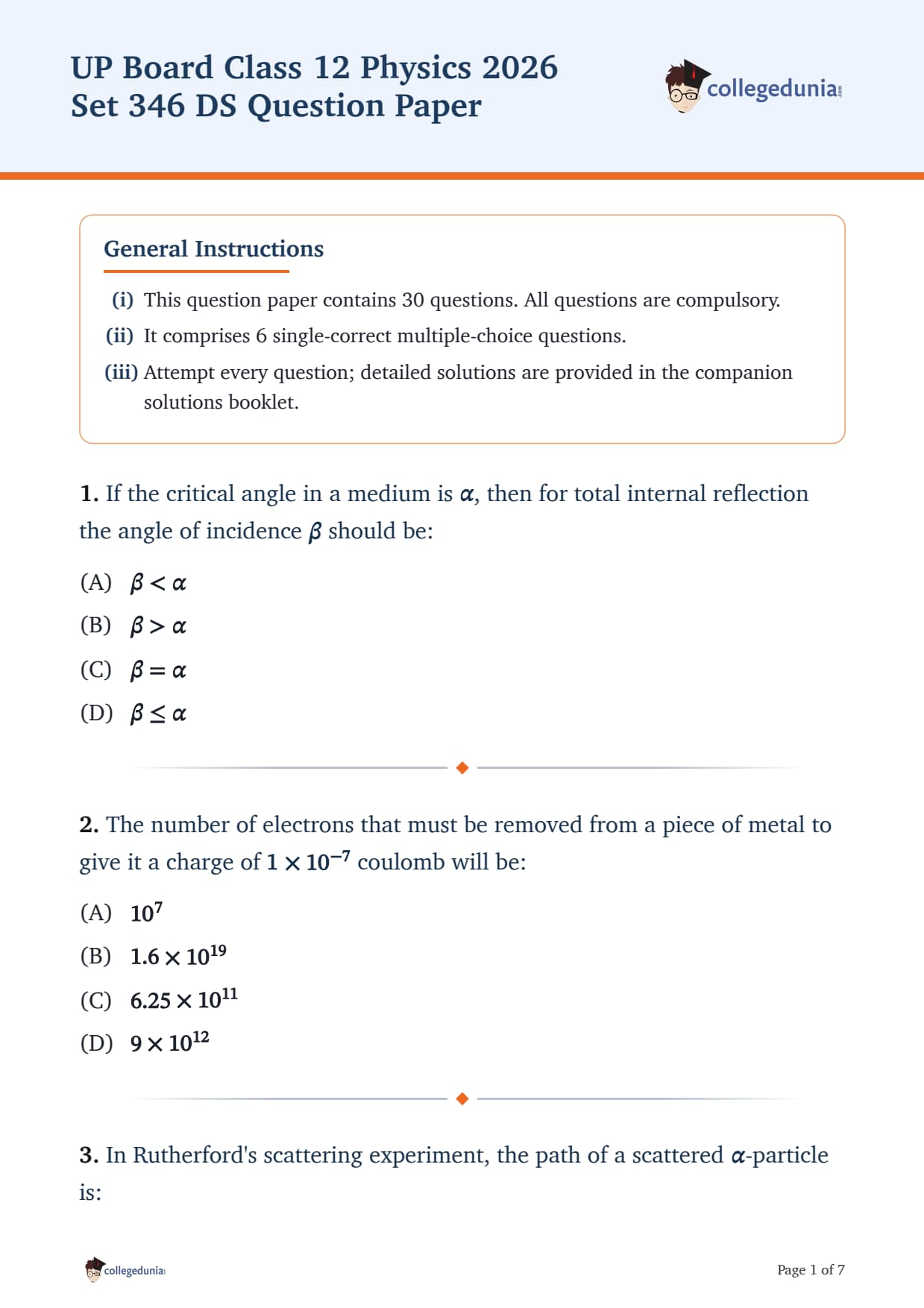
If the critical angle in a medium is \( \alpha \), then for total internal reflection the angle of incidence \( \beta \) should be:
The number of electrons that must be removed from a piece of metal to give it a charge of \( 1\times10^{-7} \) coulomb will be:
In Rutherford's scattering experiment, the path of a scattered \( \alpha \)-particle is:
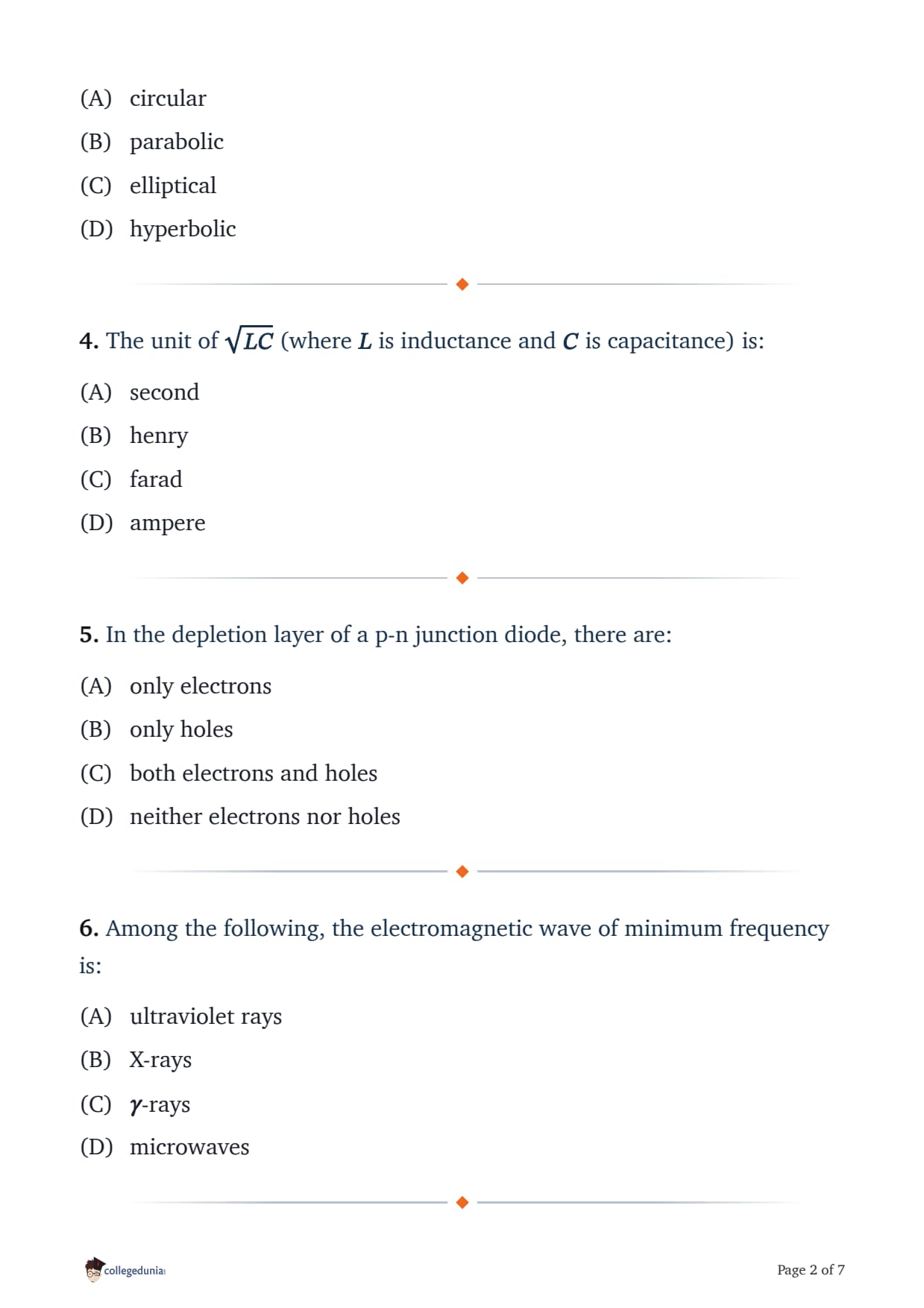
The unit of \( \sqrt{LC} \) (where \( L \) is inductance and \( C \) is capacitance) is:
In the depletion layer of a p-n junction diode, there are:
Among the following, the electromagnetic wave of minimum frequency is:
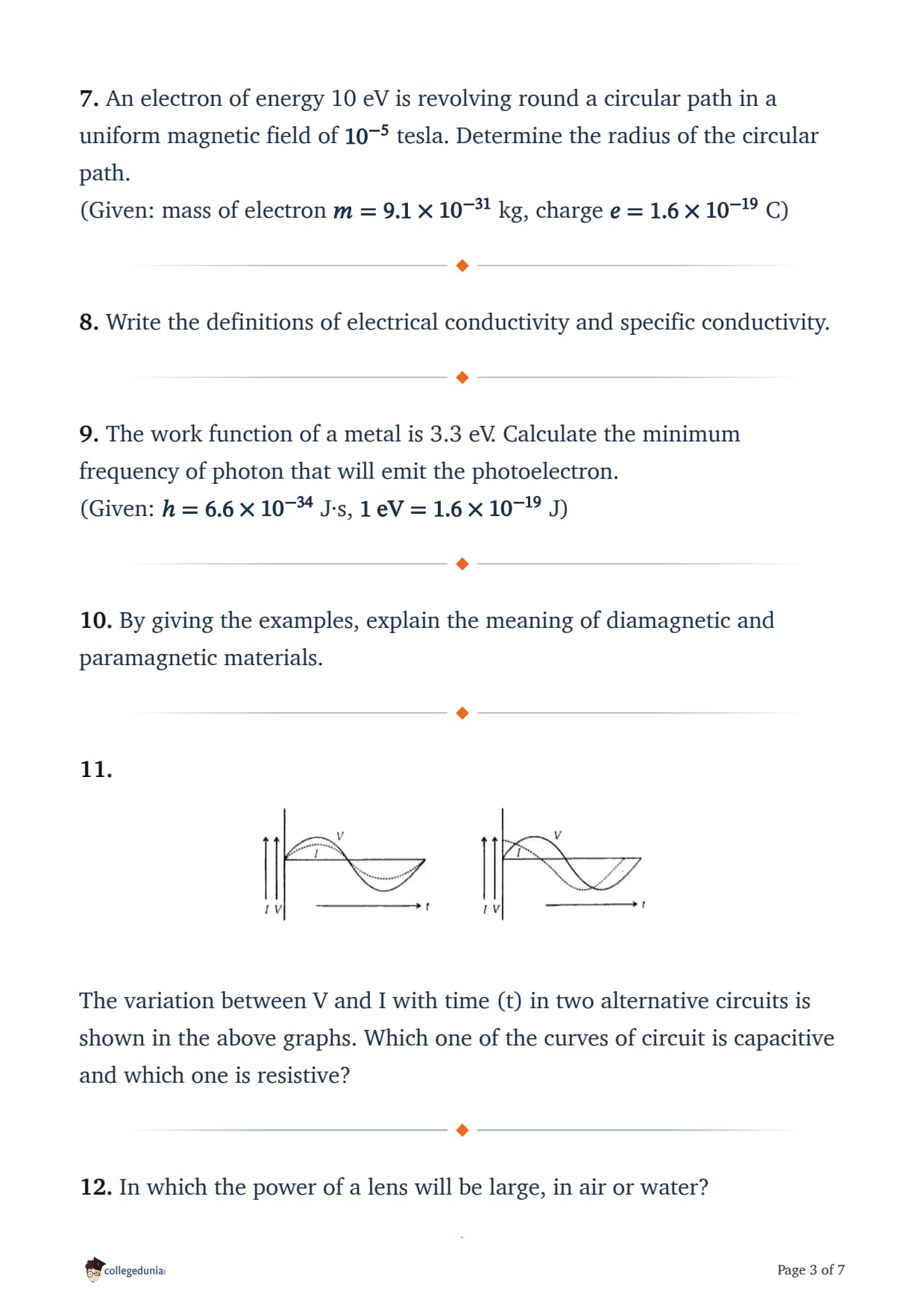
An electron of energy 10 eV is revolving round a circular path in a uniform magnetic field of \( 10^{-5} \) tesla. Determine the radius of the circular path.
(Given: mass of electron \( m = 9.1\times10^{-31} \) kg, charge \( e = 1.6\times10^{-19} \) C)
Write the definitions of electrical conductivity and specific conductivity.
The work function of a metal is 3.3 eV. Calculate the minimum frequency of photon that will emit the photoelectron.
(Given: \( h = 6.6\times10^{-34} \) J·s, \( 1\ \text{eV} = 1.6\times10^{-19} \) J)
By giving the examples, explain the meaning of diamagnetic and paramagnetic materials.

The variation between V and I with time (t) in two alternative circuits is shown in the above graphs. Which one of the curves of circuit is capacitive and which one is resistive?
In which the power of a lens will be large, in air or water?
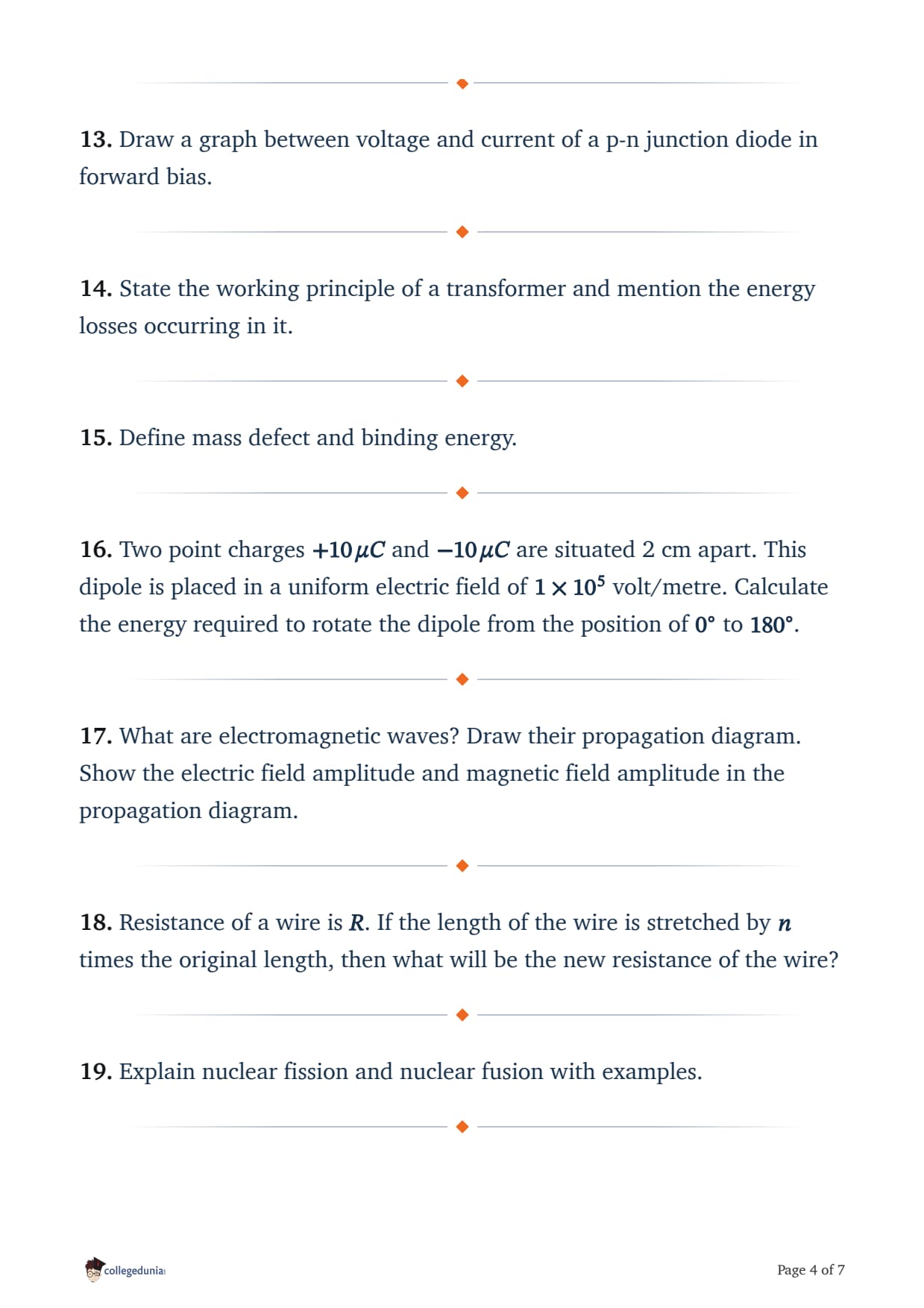
Draw a graph between voltage and current of a p-n junction diode in forward bias.
State the working principle of a transformer and mention the energy losses occurring in it.
Define mass defect and binding energy.
Two point charges \( +10\,\mu C \) and \( -10\,\mu C \) are situated 2 cm apart. This dipole is placed in a uniform electric field of \( 1\times10^{5} \) volt/metre. Calculate the energy required to rotate the dipole from the position of \( 0^\circ \) to \( 180^\circ \).
What are electromagnetic waves? Draw their propagation diagram. Show the electric field amplitude and magnetic field amplitude in the propagation diagram.
Resistance of a wire is \( R \). If the length of the wire is stretched by \( n \) times the original length, then what will be the new resistance of the wire?
Explain nuclear fission and nuclear fusion with examples.
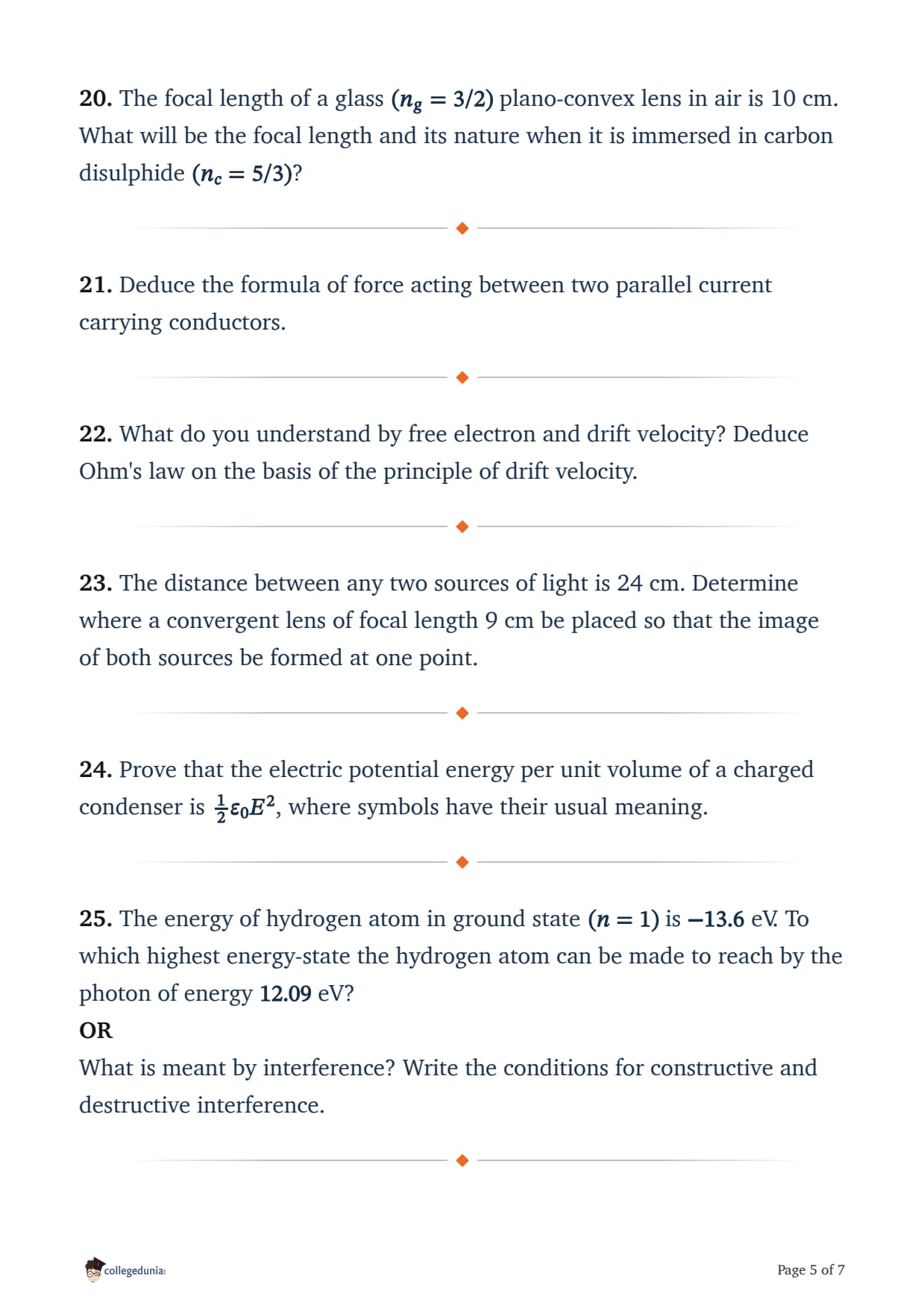
The focal length of a glass \((n_g = 3/2)\) plano-convex lens in air is 10 cm. What will be the focal length and its nature when it is immersed in carbon disulphide \((n_c = 5/3)\)?
Deduce the formula of force acting between two parallel current carrying conductors.
What do you understand by free electron and drift velocity? Deduce Ohm's law on the basis of the principle of drift velocity.
The distance between any two sources of light is 24 cm. Determine where a convergent lens of focal length 9 cm be placed so that the image of both sources be formed at one point.
Prove that the electric potential energy per unit volume of a charged condenser is \(\tfrac{1}{2}\varepsilon_0 E^2\), where symbols have their usual meaning.
The energy of hydrogen atom in ground state \( (n = 1) \) is \( -13.6 \) eV. To which highest energy-state the hydrogen atom can be made to reach by the photon of energy \( 12.09 \) eV?
OR
What is meant by interference? Write the conditions for constructive and destructive interference.
What is meant by mutual inductance? Define coefficient of mutual inductance and write its unit.
Write the Bohr's postulates for hydrogen atom. How did Bohr remove the drawbacks of Rutherford's model of atom?
OR
Derive the formula for the electric field outside a charged hollow sphere with the help of Gauss's law.

What is the meaning of wavefront? Explain the laws of reflection on the basis of Huygens' principle of wavefront.
OR
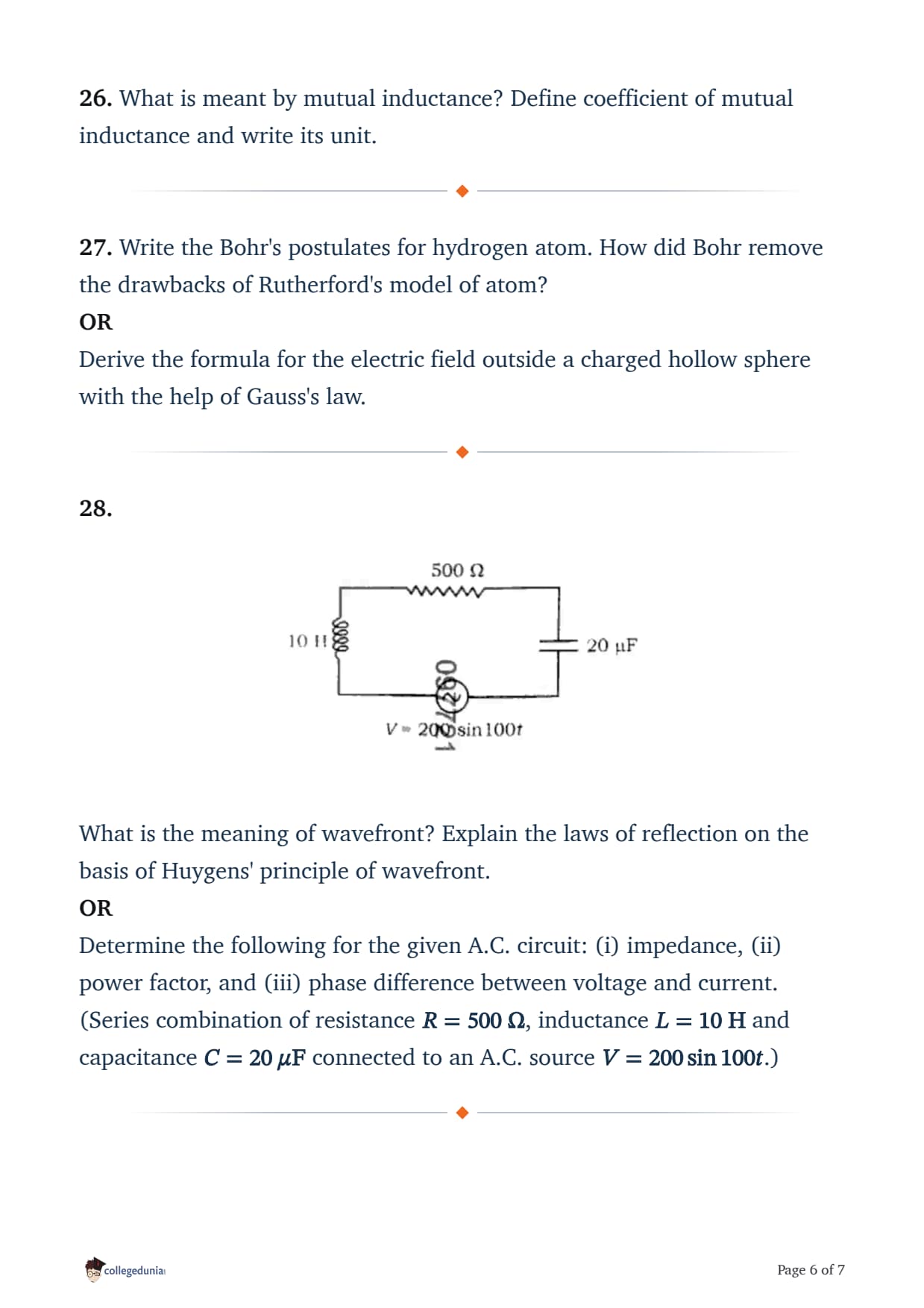
Determine the following for the given A.C. circuit: (i) impedance, (ii) power factor, and (iii) phase difference between voltage and current. (Series combination of resistance \( R = 500\ \Omega \), inductance \( L = 10\ \text{H} \) and capacitance \( C = 20\ \mu\text{F} \) connected to an A.C. source \( V = 200\sin 100t \).)
Explain full wave rectifying action of p-n junction diode with the help of circuit diagram.
OR
Draw the diffraction pattern of light due to single slit and write the expression for position of minima. On what factors does the width of central maxima depend?
What do you understand by electromagnetic induction? State the Faraday's laws of electromagnetic induction.
OR
Obtain the formula for the capacitance of a parallel plate capacitor when a dielectric medium is partially filled between its plates.
UP Board Class 12 Physics 2026 Set 346 DS Exam Pattern and Marking Scheme
Set 346 DS followed the standard UPMSP intermediate Physics blueprint, mixing one-mark objective questions with short and long descriptive answers you clear section by section.
- Total questions: 30, spread across five sections (A to E)
- Total marks: 70 for theory (the practical exam adds another 30 marks separately)
- Duration: 3 hours 15 minutes, including the first 15 minutes for reading the paper
- Question types: 6 single-answer MCQs of 1 mark each, plus 24 short-answer, long-answer and case-study questions carrying 2 to 5 marks
- Marking scheme: no negative marking, so attempt every question
High-Weightage Topics in UP Board Class 12 Physics 2026 Set 346 DS
The objective section opened with Ray Optics (critical angle and total internal reflection) and Electrostatics, and students found the Optics case study the trickiest part of the paper.
- Ray Optics and Optical Instruments: Q1 tested the critical angle and total internal reflection condition, and a full case study was built on optics
- Electrostatics: Q2 asked for the number of electrons removed for a given charge, a repeat-style numerical
- Atoms and Nuclei: Q3 covered Rutherford's alpha-particle scattering path
- Alternating Current: Q4 checked the unit of the square root of LC (time), a common trap
- Semiconductor Devices: Q5 on the p-n junction depletion layer, plus an easier semiconductor case study
- Electromagnetic Waves: Q6 on identifying the wave of minimum frequency
UP Board Class 12 Physics 2026 Set 346 DS Full Solution Video
Source: Rastogi online coaching classes
How to Use the UP Board Physics 2026 Set 346 DS Paper for Practice
Treat Set 346 DS as a timed mock before you check a single answer, then review with the solution PDF above.
- Solve the full paper in 3 hours in one sitting so you match the real section-wise pressure
- Score yourself against the solutions, then redo the derivations and ray diagrams you got wrong
- Focus first on Optics and Modern Physics, since those questions surprised most students in 2026
- Repeat the same drill with 5 to 6 previous year papers to comfortably cross 60 in theory
UP Board Class 12 Physics 2026 Set 346 DS Question Paper FAQs
Ques. Was the UP Board Class 12 Physics 2026 paper hard?
Ans. No, the overall difficulty was easy to moderate. Most questions came straight from NCERT concepts and previous year patterns, though the Optics case study and a few numericals were tricky.
Ques. Which topics had the highest weightage in UP Board Physics 2026 Set 346 DS?
Ans. Ray Optics, Electrostatics, Atoms and Nuclei, Alternating Current and Semiconductor Devices all appeared in the objective section, and Optics carried a dedicated case study, making it the most demanding chapter.
Ques. What is the marking scheme for UP Board Class 12 Physics 2026?
Ans. The theory paper is 70 marks with no negative marking, so you should attempt all 30 questions. MCQs carry 1 mark each and descriptive questions carry 2 to 5 marks. Practicals add a separate 30 marks.
Ques. Are UP Board Physics questions repeated from previous years?
Ans. Yes, students noticed repeated concepts from Electrostatics, Current Electricity, Optics, Electromagnetic Induction and Modern Physics. Solving 5 to 6 past papers, including this Set 346 DS, covers most recurring numericals and derivations.
Ques. Where can I download the UP Board Class 12 Physics 2026 Set 346 DS question paper with solutions PDF for free?
Ans. Download it free from the table at the top of this page on Collegedunia. The official paper and datesheet come from UPMSP on its website (upmsp.edu.in).



Comments