





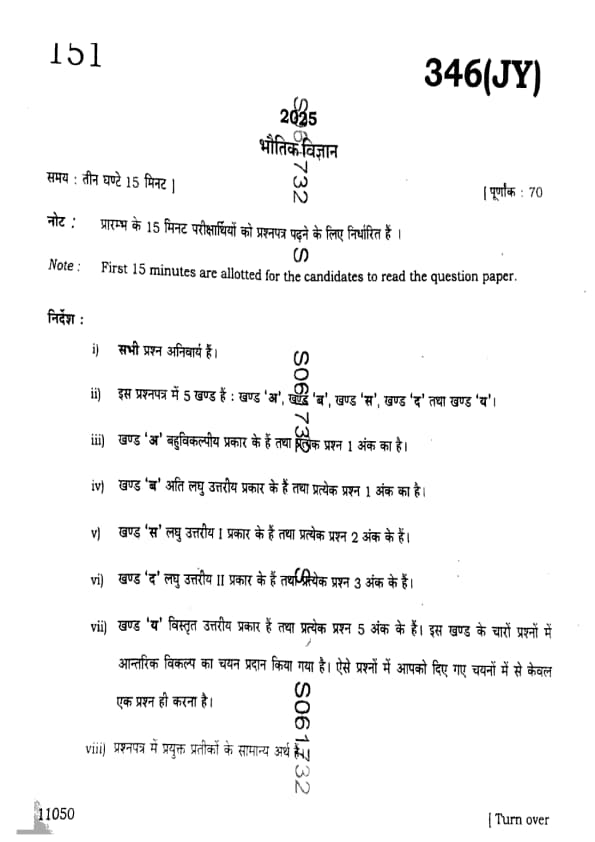
UP Board Class 12 Physics Question Paper 2025 PDF (Code 346 JY) is available for download here. The Mathematics exam was conducted on March 6, 2025 in the Morning Shift from 2:00 PM to 5:15 PM. The total marks for the theory paper are 100. Students reported the paper to be easy to moderate.
Latest- Download UP Board Class 12 Physics Question Paper 2026
UP Board Class 12 Physics Question Paper 2025 (Code 346 JY) with Solutions
| UP Board Class Physics Question Paper with Answer Key |  Download Download |
Check Solutions |
UP Board Class 12 Physics Questions with Solutions
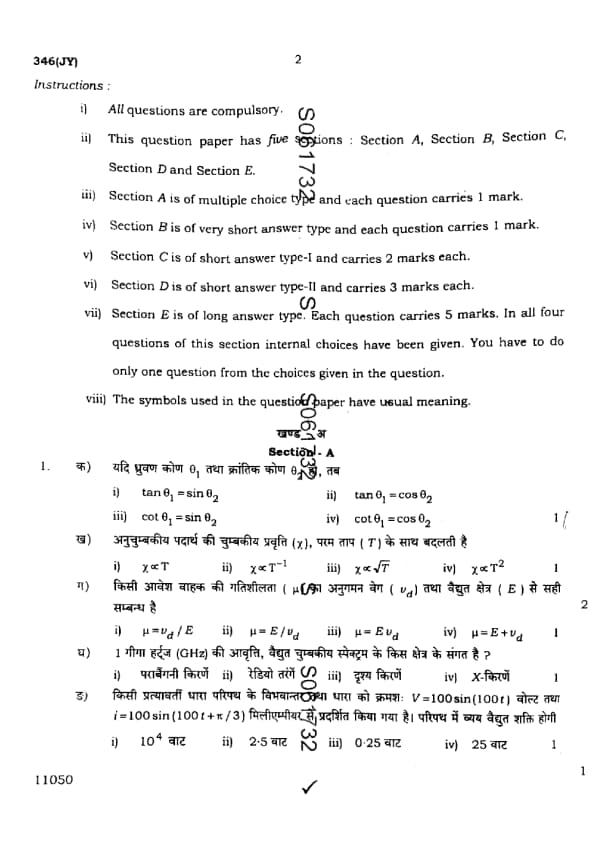
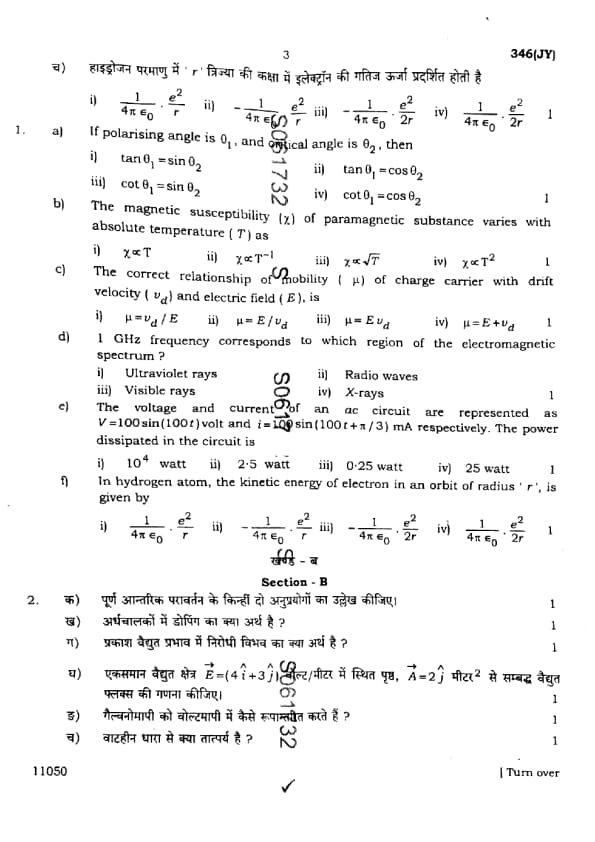
If polarising angle is \( \theta_1 \), and critical angle is \( \theta_2 \), then:
The magnetic susceptibility \( \chi \) of paramagnetic substance varies with absolute temperature \( T \) as:
The correct relationship of mobility \( \mu \) of charge carrier with drift velocity \( v_d \) and electric field \( E \), is:
1 GHz frequency corresponds to which region of the electromagnetic spectrum?
The voltage and current of an ac circuit are represented as \( V = 100 \sin(100t) \) volt and \( i = 100 \sin(100t + \frac{\pi}{3}) \) mA respectively. The power dissipated in the circuit is:
In hydrogen atom, the kinetic energy of electron in an orbit of radius \( r \), is given by:
Mention any two applications of total internal reflection.
What is meant by doping in semiconductors?
What is the meaning of stopping potential in photoelectric effect?
Compute the electric flux linked with a surface \( \vec{A} = 2 \hat{j} \, m^2 \), placed in a uniform electric field \( \vec{E} = (4 \hat{i} + 3 \hat{j}) \, V/m \).
How is a galvanometer converted into a voltmeter?
What is meant by wattless current?
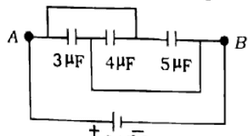
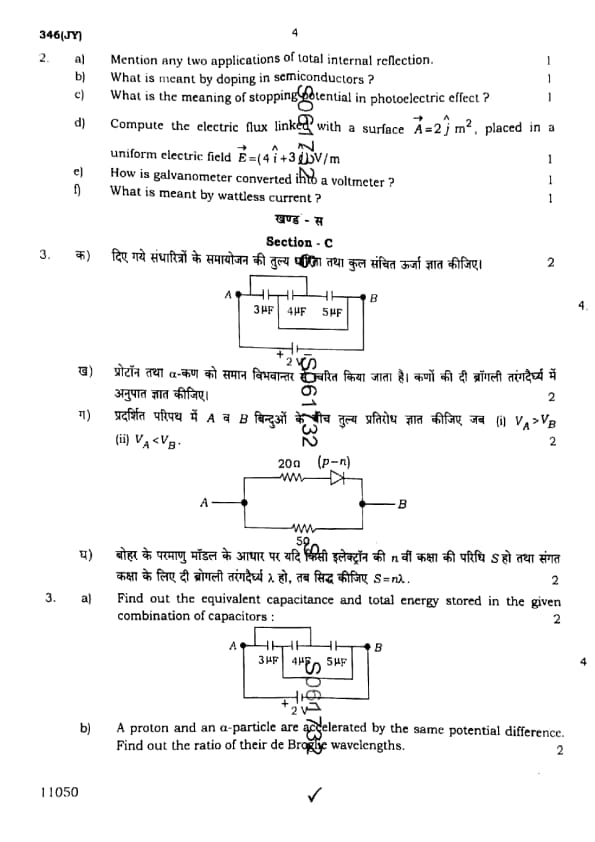
Find out the equivalent capacitance and total energy stored in the given combination of capacitors:
A proton and an \( \alpha \)-particle are accelerated by the same potential difference. Find out the ratio of their de Broglie wavelengths.
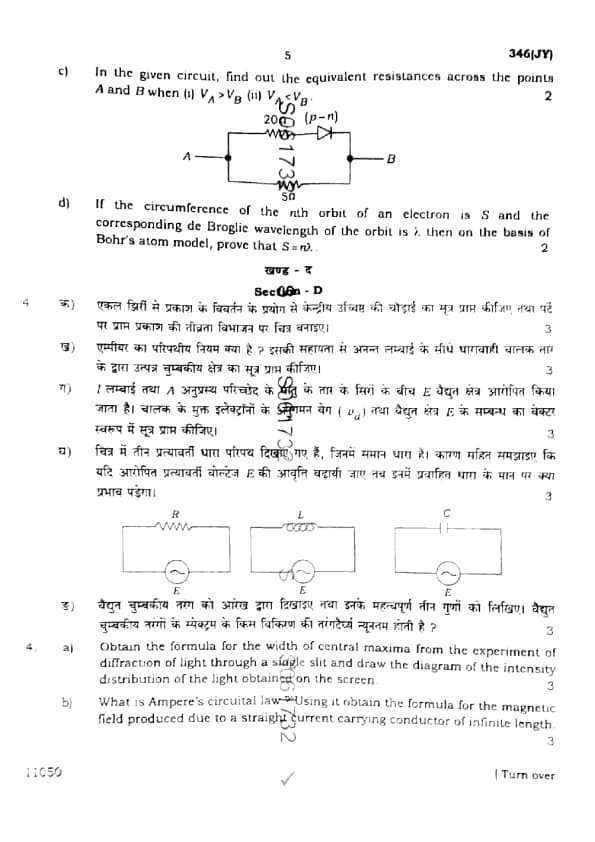
In the given circuit, find out the equivalent resistances across the points A and B when:
(i) \(V_A > V_B\), (ii) \(V_A < V_B\).

If the circumference of the nth orbit of an electron is \(S\) and the corresponding de Broglie wavelength of the orbit is \(\lambda\), then on the basis of Bohr's atom model, prove that \(S = n\lambda\).
Obtain the formula for the width of central maxima from the experiment of diffraction of light through a single slit and draw the diagram of the intensity distribution of the light obtained on the screen.
What is Ampere's circuital law? Using it, obtain the formula for the magnetic field produced due to a straight current-carrying conductor of infinite length.
Electric field \( E \) is applied across a metallic wire of length \( l \) and area of cross-section \( A \). Obtain the formula of the relationship between the drift velocity (\( v_d \)) of free electrons of the conductor and electric field \( E \) in vector form.
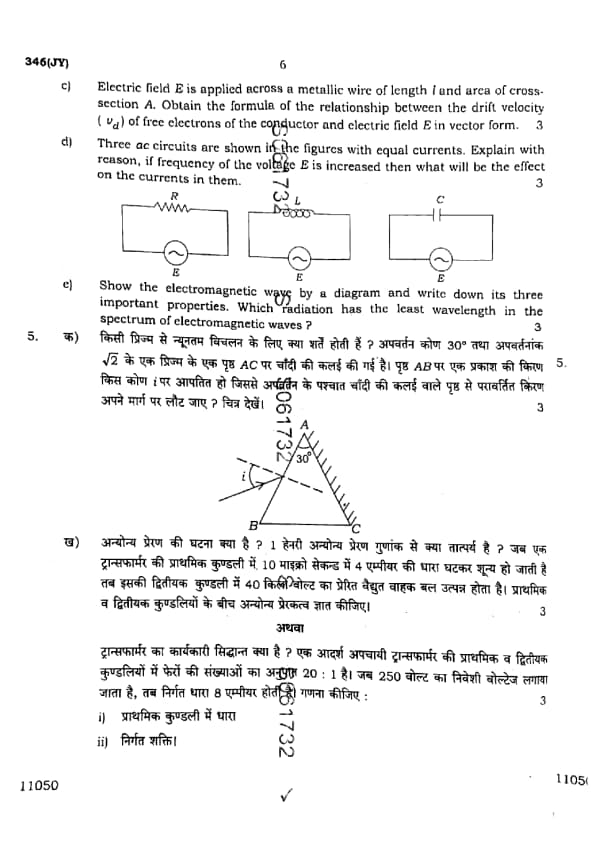
Three ac circuits are shown in the figures with equal currents. Explain with reason, if the frequency of the voltage \( E \) is increased then what will be the effect on the currents in them.

Show the electromagnetic wave by a diagram and write down its three important properties. Which radiation has the least wavelength in the spectrum of electromagnetic waves?
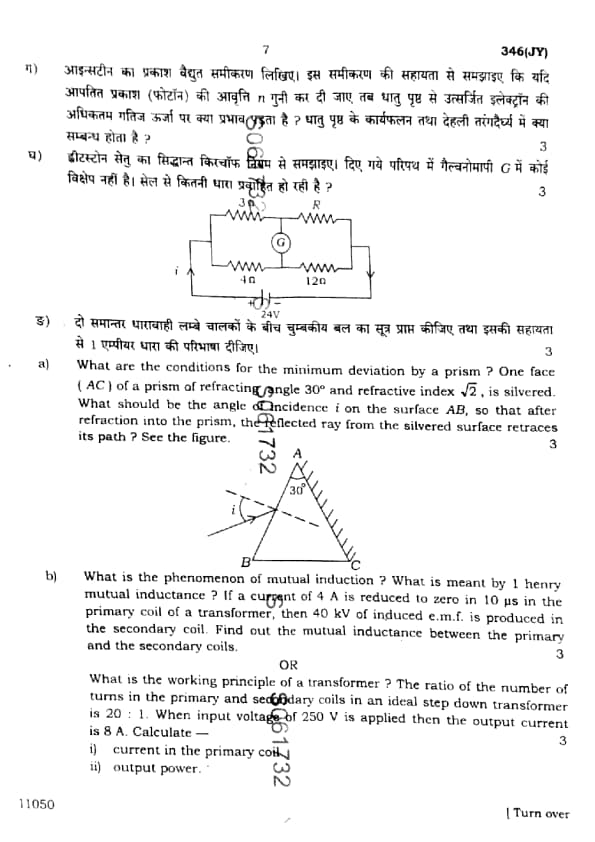
What are the conditions for the minimum deviation by a prism? One face (AC) of a prism of refracting angle 30° and refractive index \( \sqrt{2} \), is silvered. What should be the angle of incidence \( i \) on the surface AB, so that after refraction into the prism, the reflected ray from the silvered surface retraces its path? See the figure.

What is the phenomenon of mutual induction? What is meant by 1 henry mutual inductance? If a current of 4 A is reduced to zero in 10 \(\mu\)s in the primary coil of a transformer, then 40 kV of induced e.m.f. is produced in the secondary coil. Find out the mutual inductance between the primary and the secondary coils.
What is the working principle of a transformer? The ratio of the number of turns in the primary and secondary coils in an ideal step-down transformer is 20 : 1. When input voltage of 250 V is applied, then the output current is 8 A. Calculate:
i) Current in the primary coil
ii) Output power
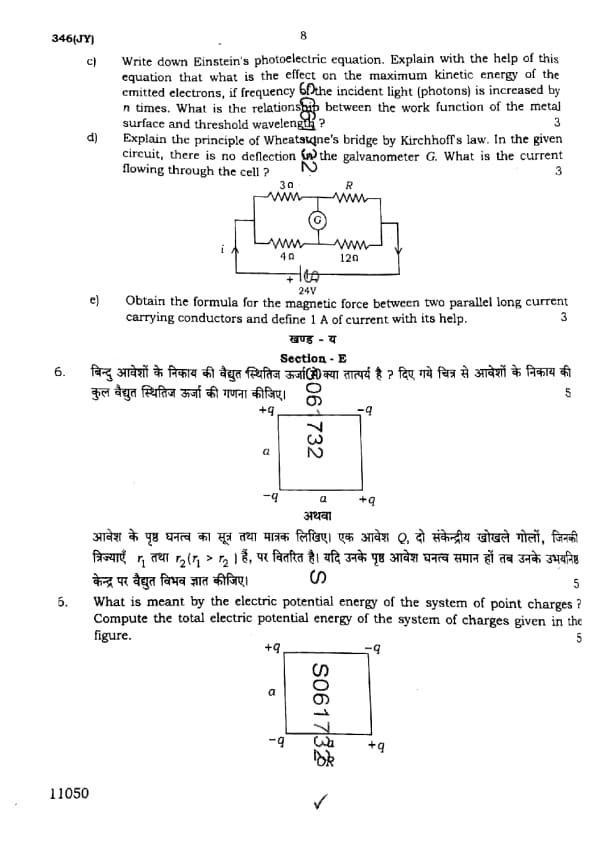
Write down Einstein's photoelectric equation. Explain with the help of this equation that what is the effect on the maximum kinetic energy of the emitted electrons, if frequency of the incident light (photons) is increased by \( n \) times. What is the relationship between the work function of the metal surface and threshold wavelength?
Explain the principle of Wheatstone's bridge by Kirchhoff's law. In the given circuit, there is no deflection in the galvanometer \( G \). What is the current flowing through the cell?

Obtain the formula for the magnetic force between two parallel long current carrying conductors and define 1 A of current with its help.
What is meant by the electric potential energy of the system of point charges? Compute the total electric potential energy of the system of charges given in the figure.

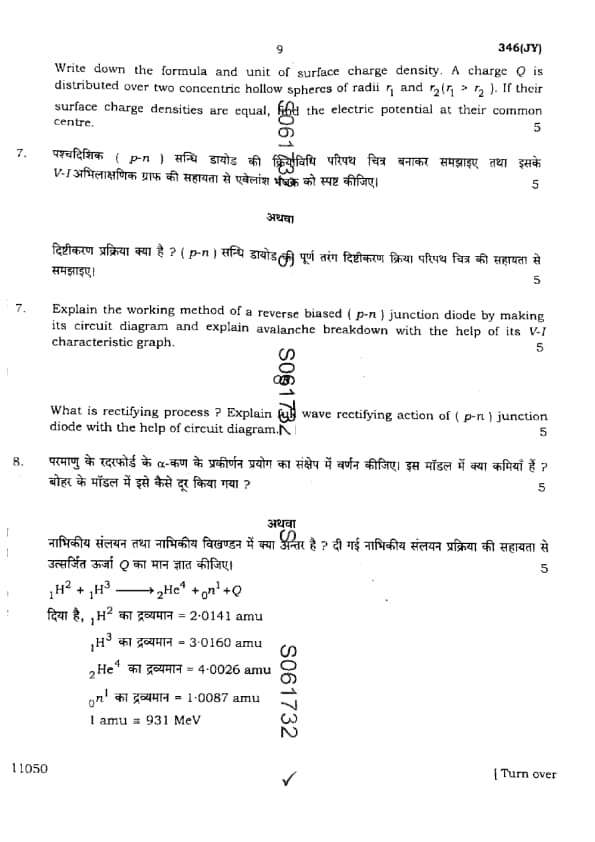
Write down the formula and unit of surface charge density. A charge \( Q \) is distributed over two concentric hollow spheres of radii \( r_1 \) and \( r_2 (r_1 > r_2) \). If their surface charge densities are equal, find the electric potential at their common centre.
Explain the working method of a reverse biased (p-n) junction diode by making its circuit diagram and explain avalanche breakdown with the help of its V-I characteristic graph.
What is the rectifying process? Explain the half-wave rectifying action of a (p-n) junction diode with the help of a circuit diagram.
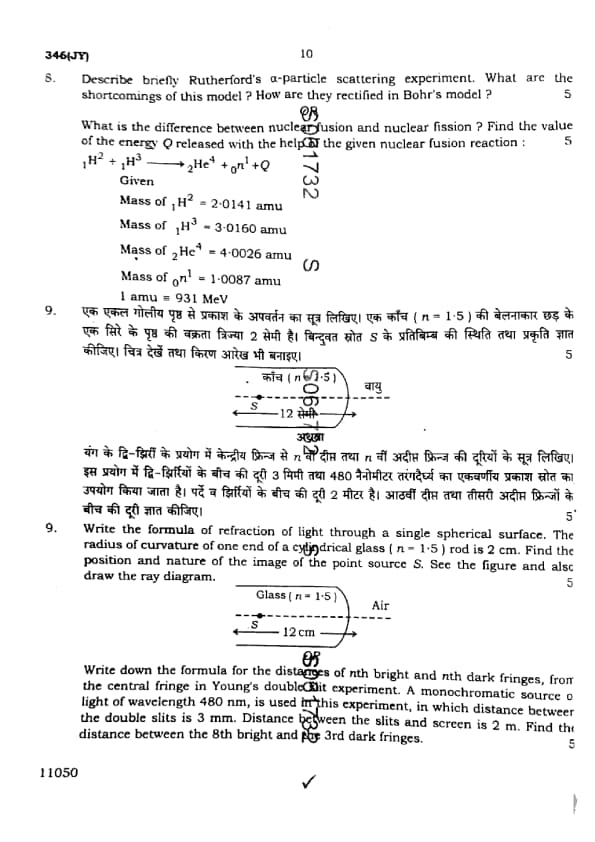
Describe briefly Rutherford's \(\alpha\)-particle scattering experiment. What are the shortcomings of this model? How are they rectified in Bohr's model?
What is the difference between nuclear fusion and nuclear fission? Find the value of the energy \( Q \) released with the help of the given nuclear fusion reaction:
\[ 1 \, ^1H_2 + \, ^1H_3 \rightarrow \, ^2He_4 + \, ^1n^1 + Q \]
Given:
Mass of \( ^1H_2 = 2.0141 \, amu \)
Mass of \( ^1H_3 = 3.0160 \, amu \)
Mass of \( ^2He_4 = 4.0026 \, amu \)
Mass of \( ^1n^1 = 1.0087 \, amu \)
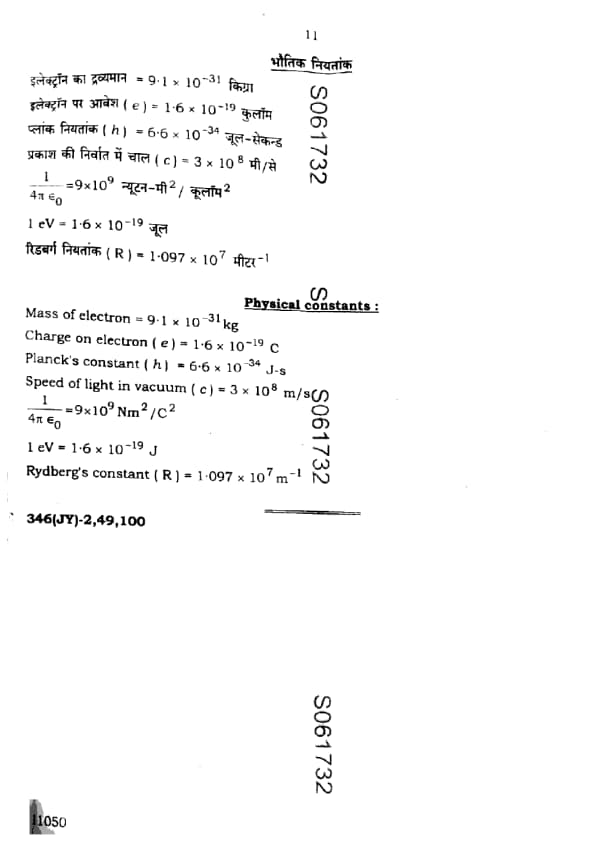
1 amu = 931 MeV
Write the formula of refraction of light through a single spherical surface. The radius of curvature of one end of a cylindrical glass (n = 1.5) rod is 2 cm. Find the position and nature of the image of the point source S. See the figure and also draw the ray diagram.

Write down the formula for the distances of nth bright and nth dark fringes, from the central fringe in Young's double slit experiment. A monochromatic source of light with wavelength 480 nm, is used in this experiment, in which distance between the double slits is 3 mm. Distance between the slits and screen is 2 m. Find the distance between the 8th bright and the 3rd dark fringes.



Comments