




UP Board Class 12 Physics 2025 Question Paper (Code 346 JU) is available for download here with the Collegedunia question paper PDF and the question paper with solutions PDF. The UP Board Class 12 Physics theory paper was held on 6 March 2025 from 2:00 PM to 5:15 PM (3 hours 15 minutes including 15 minutes of reading time) and carried 70 marks, with 30 of the 35 printed questions to be attempted.
Also Check: UP Board Class 12 Question Paper 2025 (All Subjects)
The Physics question paper (Code 346 JU) includes the following types of questions:
- Section A: Q.1, six multiple choice questions of 1 mark each
- Section B: Q.2, six very short answer questions of 1 mark each
- Section C: Q.3, four short answer type-I questions of 2 marks each
- Section D: Q.4 and Q.5, five short answer type-II questions of 3 marks each in each question
- Section E: Q.6 to Q.9, long answer questions of 5 marks each, each with an internal choice
UP Board Class 12 Physics 2025 Question Paper (Code 346 JU) with Solutions PDF
| UP Board Official PDF | CD PDF | CD PDF with Solutions |
|---|---|---|
| Download official PDF 0.34 MB | Download Collegedunia PDF 0.65 MB | Download solutions PDF 4.90 MB |
UP Board Class 12 Physics 2025 (Code 346 JU) Questions with Solutions
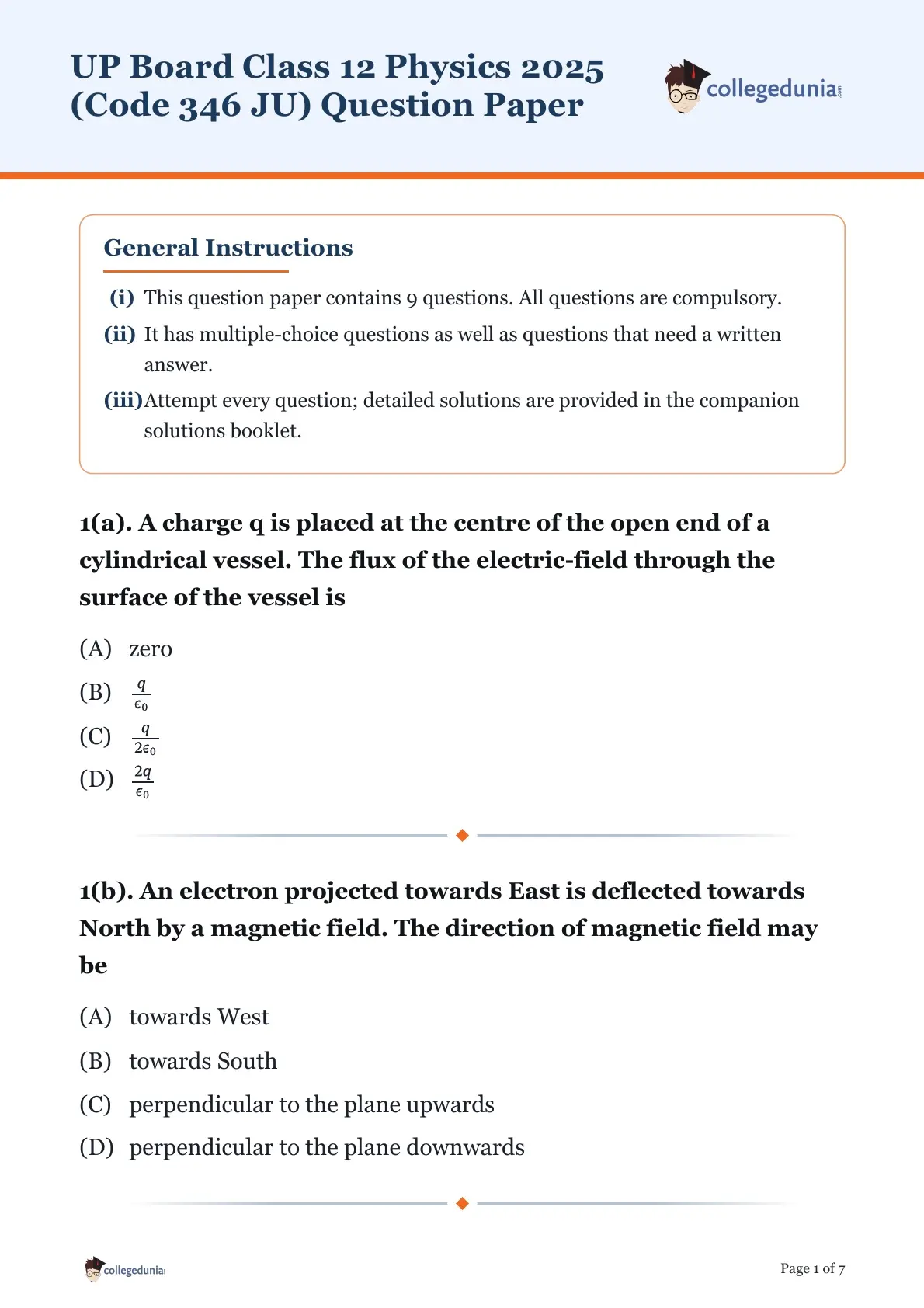
A charge q is placed at the centre of the open end of a cylindrical vessel. The flux of the electric-field through the surface of the vessel is
An electron projected towards East is deflected towards North by a magnetic field. The direction of magnetic field may be
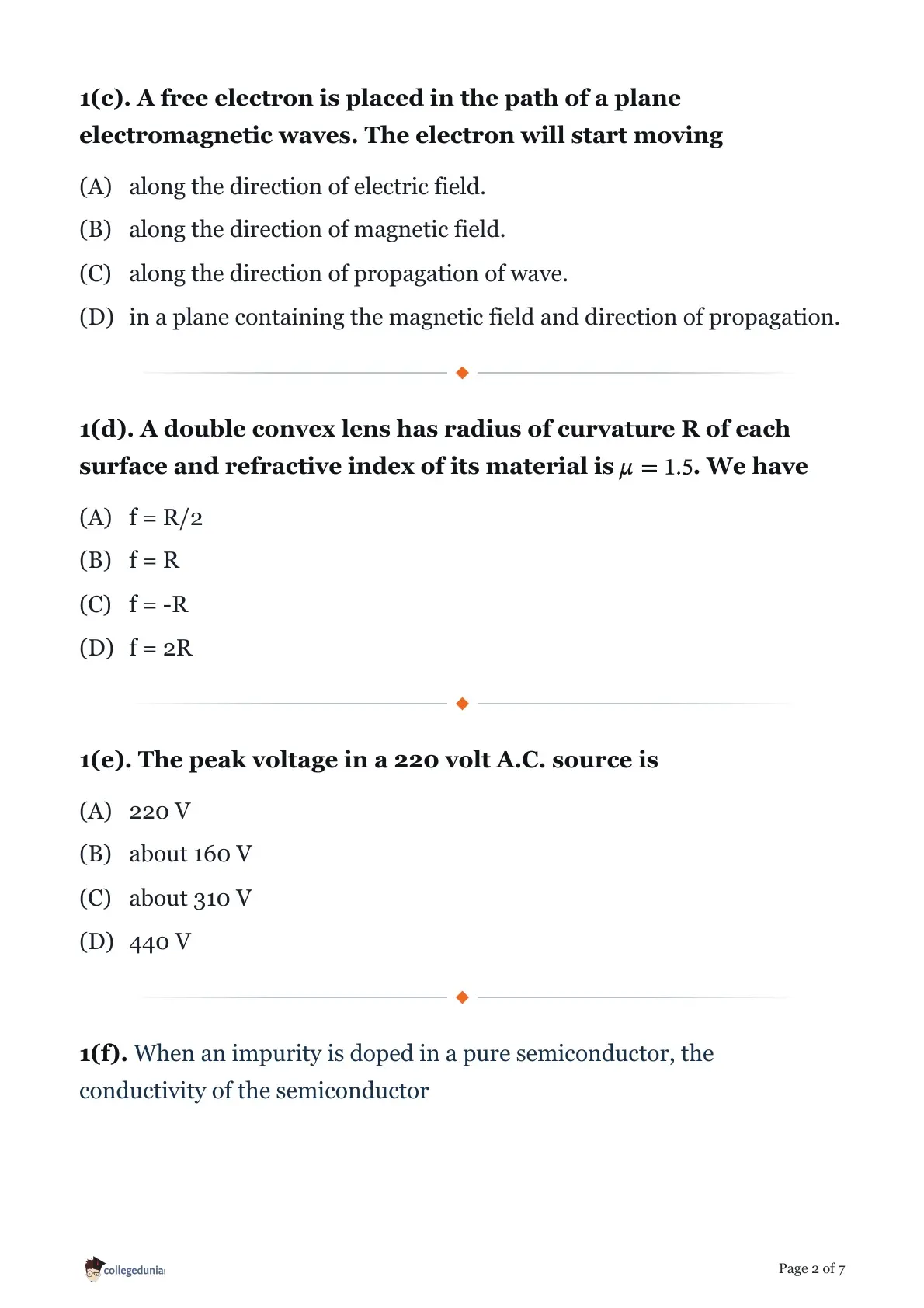
A free electron is placed in the path of a plane electromagnetic waves. The electron will start moving
A double convex lens has radius of curvature R of each surface and refractive index of its material is \(\mu = 1.5\). We have
The peak voltage in a 220 volt A.C. source is
When an impurity is doped in a pure semiconductor, the conductivity of the semiconductor
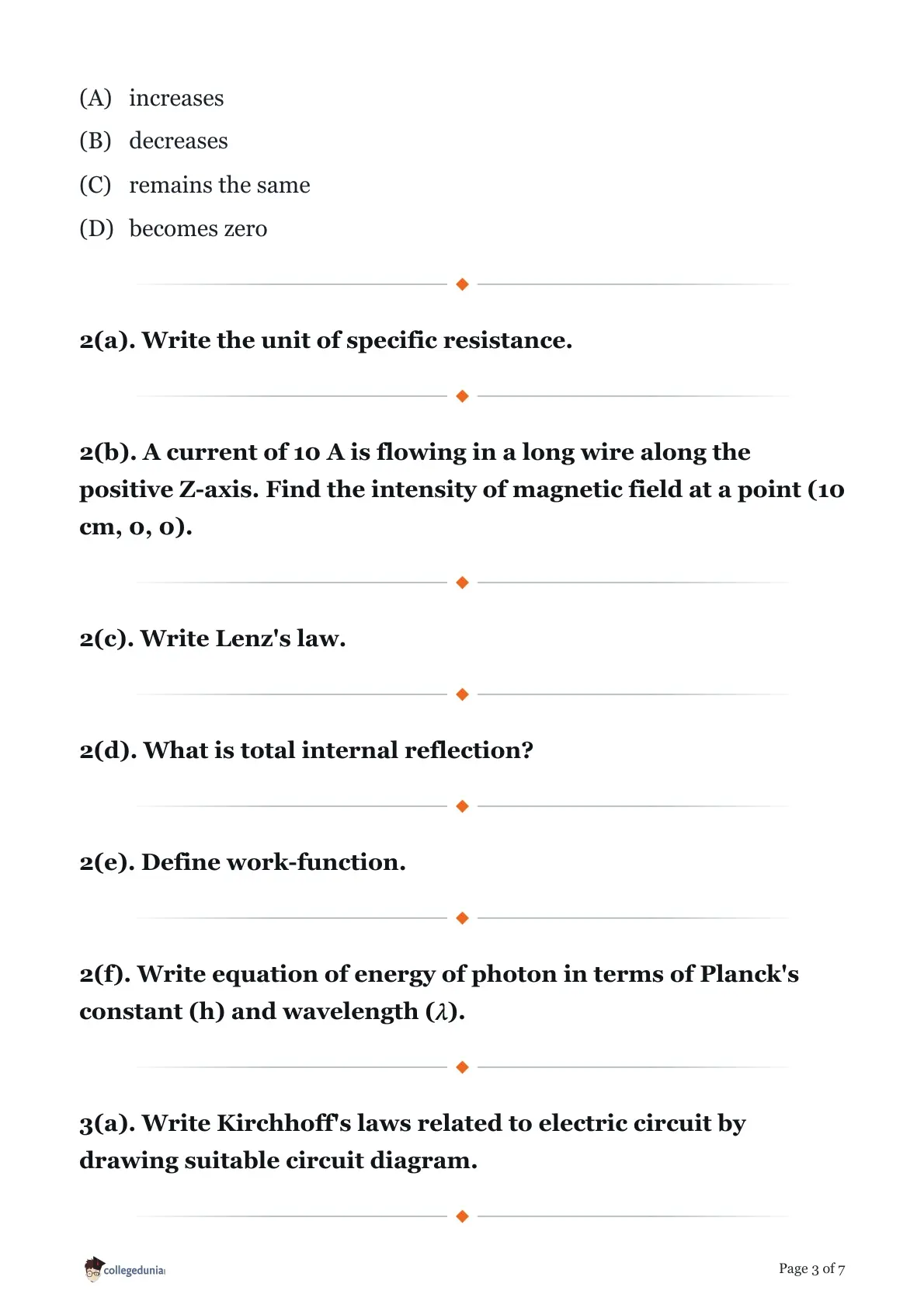
Write the unit of specific resistance.
A current of 10 A is flowing in a long wire along the positive Z-axis. Find the intensity of magnetic field at a point (10 cm, 0, 0).
Write Lenz's law.
What is total internal reflection?
Define work-function.
Write equation of energy of photon in terms of Planck's constant (h) and wavelength (\(\lambda\)).
Write Kirchhoff's laws related to electric circuit by drawing suitable circuit diagram.
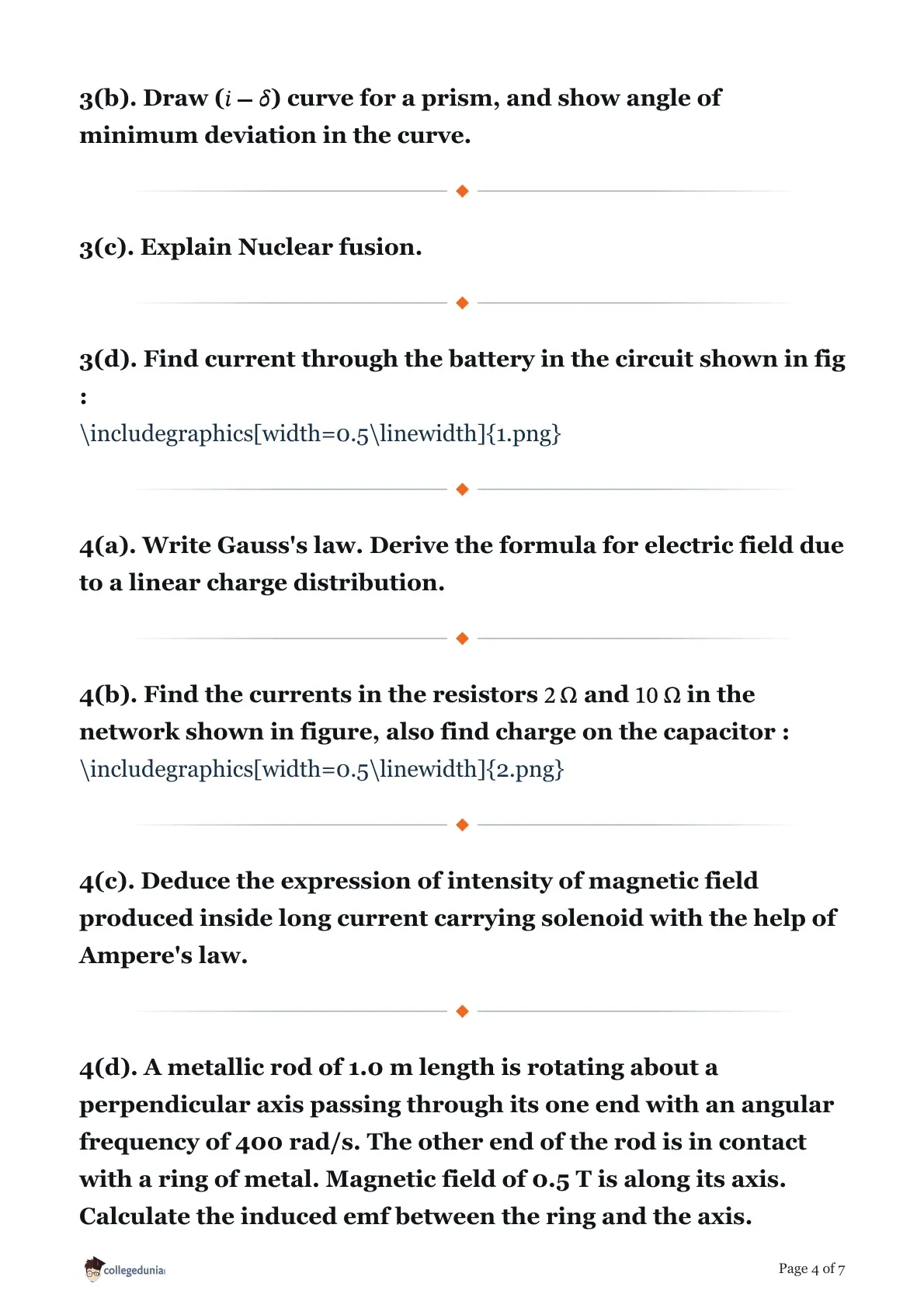
Draw (\(i - \delta\)) curve for a prism, and show angle of minimum deviation in the curve.
Explain Nuclear fusion.
Find current through the battery in the circuit shown in fig :
\includegraphics[width=0.5\linewidth]{1.png}
Write Gauss's law. Derive the formula for electric field due to a linear charge distribution.
Find the currents in the resistors \(2 \, \Omega\) and \(10 \, \Omega\) in the network shown in figure, also find charge on the capacitor :
\includegraphics[width=0.5\linewidth]{2.png}
Deduce the expression of intensity of magnetic field produced inside long current carrying solenoid with the help of Ampere's law.
A metallic rod of 1.0 m length is rotating about a perpendicular axis passing through its one end with an angular frequency of 400 rad/s. The other end of the rod is in contact with a ring of metal. Magnetic field of 0.5 T is along its axis. Calculate the induced emf between the ring and the axis.
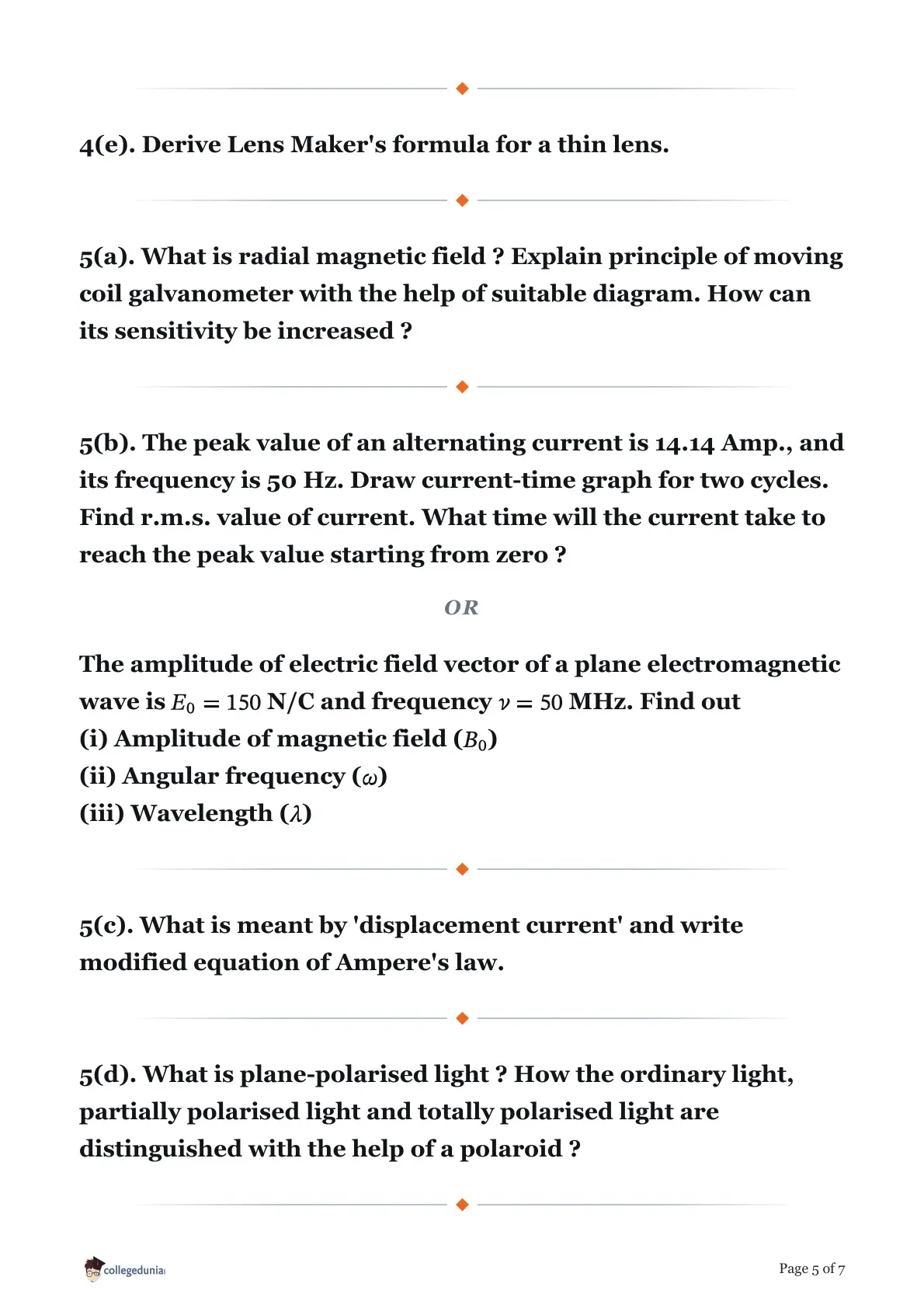
Derive Lens Maker's formula for a thin lens.
What is radial magnetic field ? Explain principle of moving coil galvanometer with the help of suitable diagram. How can its sensitivity be increased ?
The peak value of an alternating current is 14.14 Amp., and its frequency is 50 Hz. Draw current-time graph for two cycles. Find r.m.s. value of current. What time will the current take to reach the peak value starting from zero ?
OR
The amplitude of electric field vector of a plane electromagnetic wave is \(E_0 = 150\) N/C and frequency \(\nu = 50\) MHz. Find out
(i) Amplitude of magnetic field (\(B_0\))
(ii) Angular frequency (\(\omega\))
(iii) Wavelength (\(\lambda\))
What is meant by 'displacement current' and write modified equation of Ampere's law.
What is plane-polarised light ? How the ordinary light, partially polarised light and totally polarised light are distinguished with the help of a polaroid ?
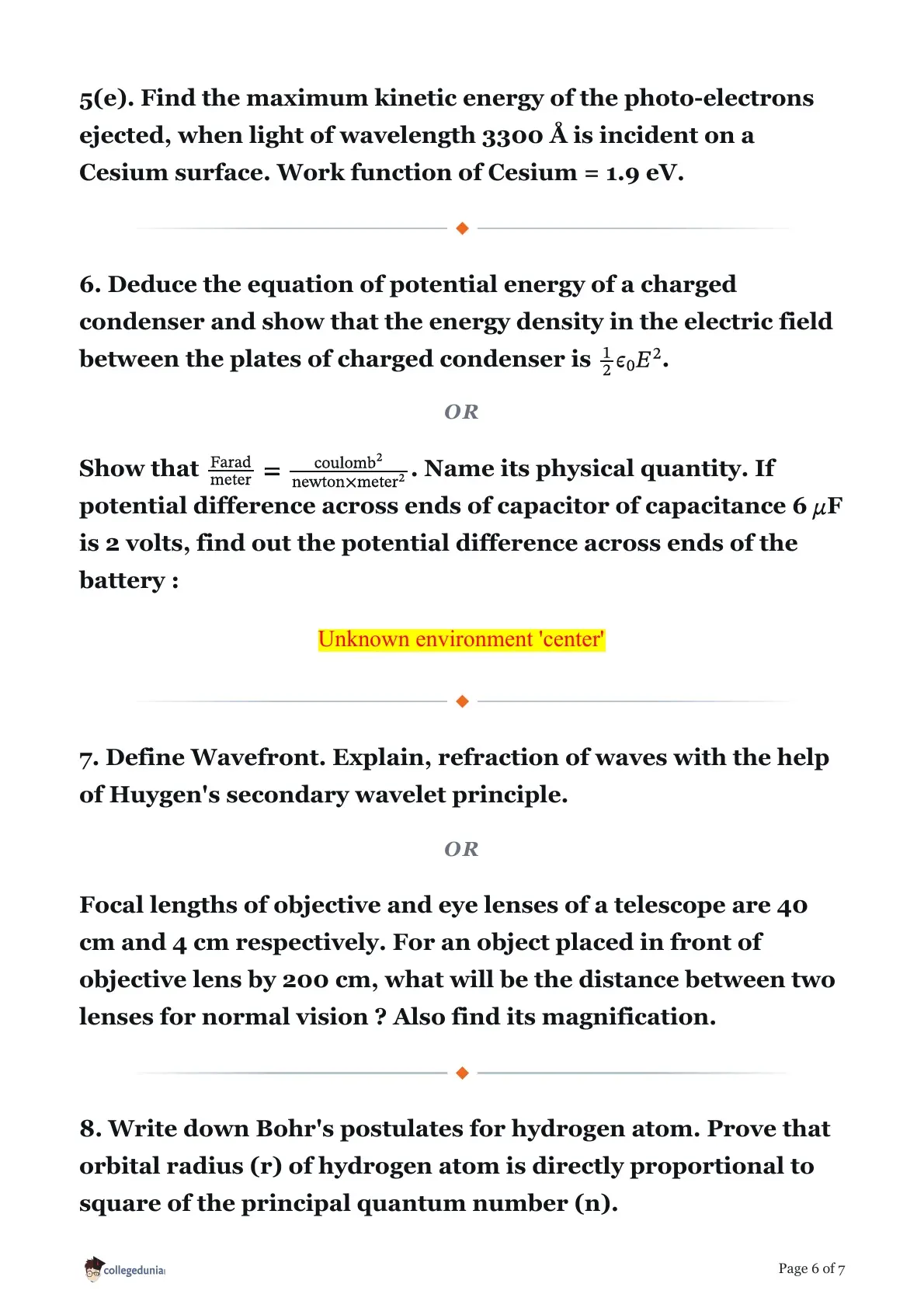
Find the maximum kinetic energy of the photo-electrons ejected, when light of wavelength 3300 Å is incident on a Cesium surface. Work function of Cesium = 1.9 eV.
Deduce the equation of potential energy of a charged condenser and show that the energy density in the electric field between the plates of charged condenser is \(\frac{1}{2} \epsilon_0 E^2\).
OR
Show that \(\frac{\text{Farad}}{\text{meter}} = \frac{\text{coulomb}^2}{\text{newton} \times \text{meter}^2}\). Name its physical quantity. If potential difference across ends of capacitor of capacitance 6 \(\mu\)F is 2 volts, find out the potential difference across ends of the battery :
\begin{center}
\begin{circuitikz}
\draw (0,2) to[C, l=4F] (2,2) to[C, l=6F] (4,2);
\draw (4,2) -- (4,0);
\draw (4,0) to[battery1, l=V] (0,0);
\draw (0,0) -- (0,2);
\end{circuitikz}
\end{center}
Define Wavefront. Explain, refraction of waves with the help of Huygen's secondary wavelet principle.
OR
Focal lengths of objective and eye lenses of a telescope are 40 cm and 4 cm respectively. For an object placed in front of objective lens by 200 cm, what will be the distance between two lenses for normal vision ? Also find its magnification.
Write down Bohr's postulates for hydrogen atom. Prove that orbital radius (r) of hydrogen atom is directly proportional to square of the principal quantum number (n).
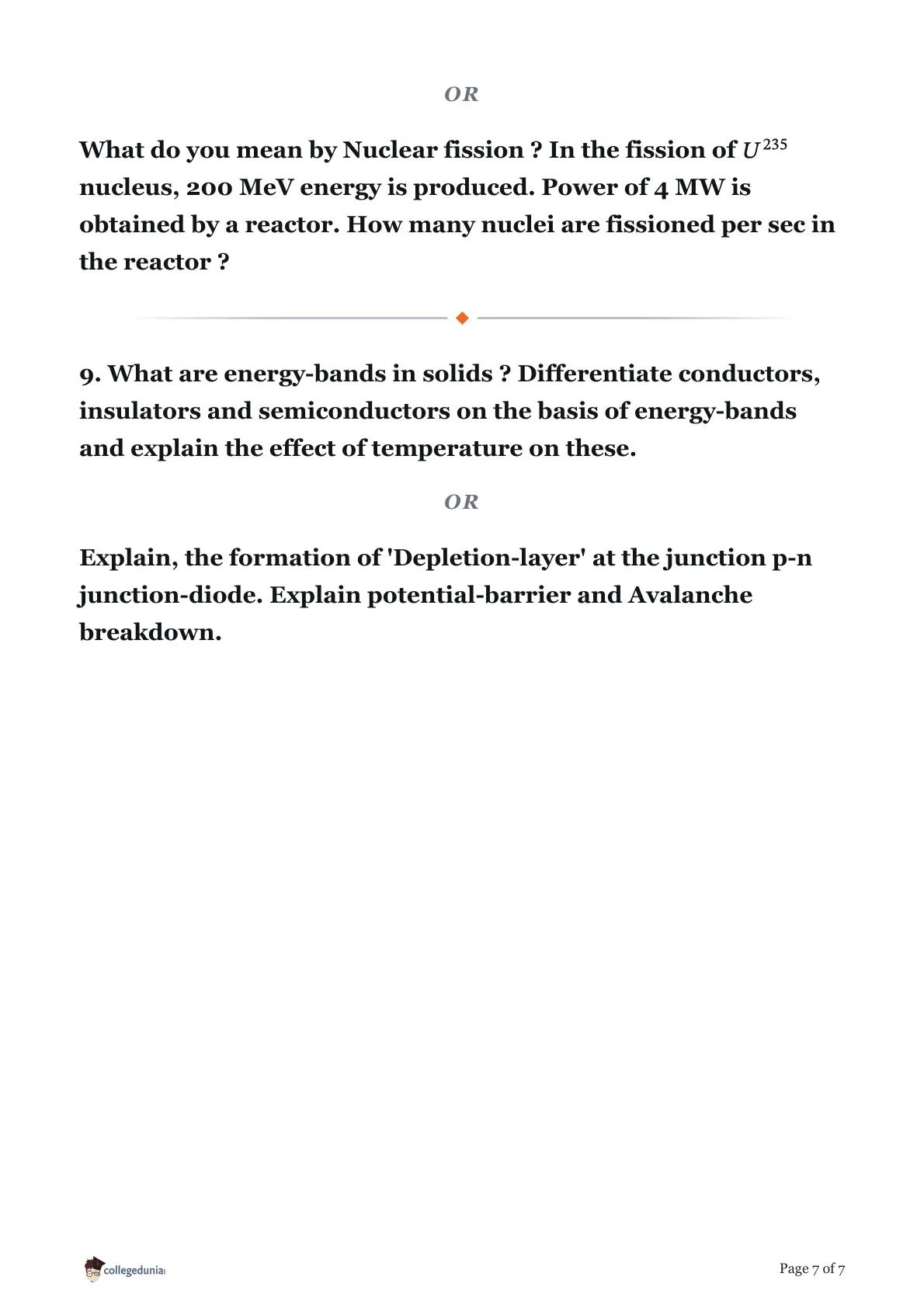
OR
What do you mean by Nuclear fission ? In the fission of \(U^{235}\) nucleus, 200 MeV energy is produced. Power of 4 MW is obtained by a reactor. How many nuclei are fissioned per sec in the reactor ?
What are energy-bands in solids ? Differentiate conductors, insulators and semiconductors on the basis of energy-bands and explain the effect of temperature on these.
OR
Explain, the formation of 'Depletion-layer' at the junction p-n junction-diode. Explain potential-barrier and Avalanche breakdown.
UP Board Class 12 Physics 2025 Question Paper Pattern
| Section | Q. No. | Type | Parts | Choice | Marks each | Total |
|---|---|---|---|---|---|---|
| A | 1 | Multiple choice | 6 | All compulsory | 1 | 6 |
| B | 2 | Very short answer | 6 | All compulsory | 1 | 6 |
| C | 3 | Short answer type-I | 4 | All compulsory | 2 | 8 |
| D | 4 and 5 | Short answer type-II | 5 + 5 | Q.5 has an internal choice | 3 | 30 |
| E | 6 to 9 | Long answer | 4 | Internal choice in every question | 5 | 20 |
| Total | 70 | |||||
UP Board Class 12 Physics 2025 (Code 346 JU) Chapter-Wise Marks Distribution
| Chapter | Marks | Weightage |
|---|---|---|
| Moving Charges and Magnetism | 8 | 11.4% |
| Semiconductor Electronics: Materials, Devices and Simple Circuits | 8 | 11.4% |
| Wave Optics | 8 | 11.4% |
| Ray Optics and Optical Instruments | 7 | 10.0% |
| Current Electricity | 6 | 8.6% |
| Dual Nature of Radiation and Matter | 5 | 7.1% |
| Electrostatic Potential and Capacitance | 5 | 7.1% |
| Atoms | 5 | 7.1% |
| Electric Charges and Fields | 4 | 5.7% |
| Electromagnetic Waves | 4 | 5.7% |
| Alternating Current | 4 | 5.7% |
| Electromagnetic Induction | 4 | 5.7% |
| Nuclei | 2 | 2.9% |
| Total | 70 | 100% |
Marks are counted from the first alternative of each question as printed in the paper (Code 346 JU); internal-choice alternatives carry the same marks.



Comments