




UP Board Class 12 Physics 2025 Question Paper (Code 346 JT) is available for download here with the Collegedunia question paper PDF and the question paper with solutions PDF. The UP Board Class 12 Physics theory paper was held on 6 March 2025 from 2:00 PM to 5:15 PM (3 hours 15 minutes including 15 minutes of reading time) and carried 70 marks, with 30 of the 35 printed questions to be attempted.
Also Check: UP Board Class 12 Question Paper 2025 (All Subjects)
The Physics question paper (Code 346 JT) includes the following types of questions:
- Section A: Q.1, six multiple choice questions of 1 mark each
- Section B: Q.2, six very short answer questions of 1 mark each
- Section C: Q.3, four short answer type-I questions of 2 marks each
- Section D: Q.4 and Q.5, five short answer type-II questions of 3 marks each in each question
- Section E: Q.6 to Q.9, long answer questions of 5 marks each, each with an internal choice
UP Board Class 12 Physics 2025 Question Paper (Code 346 JT) with Solutions PDF
| UP Board Official PDF | CD PDF | CD PDF with Solutions |
|---|---|---|
| Download official PDF 0.34 MB | Download Collegedunia PDF 0.64 MB | Download solutions PDF 4.56 MB |
UP Board Class 12 Physics 2025 (Code 346 JT) Questions with Solutions
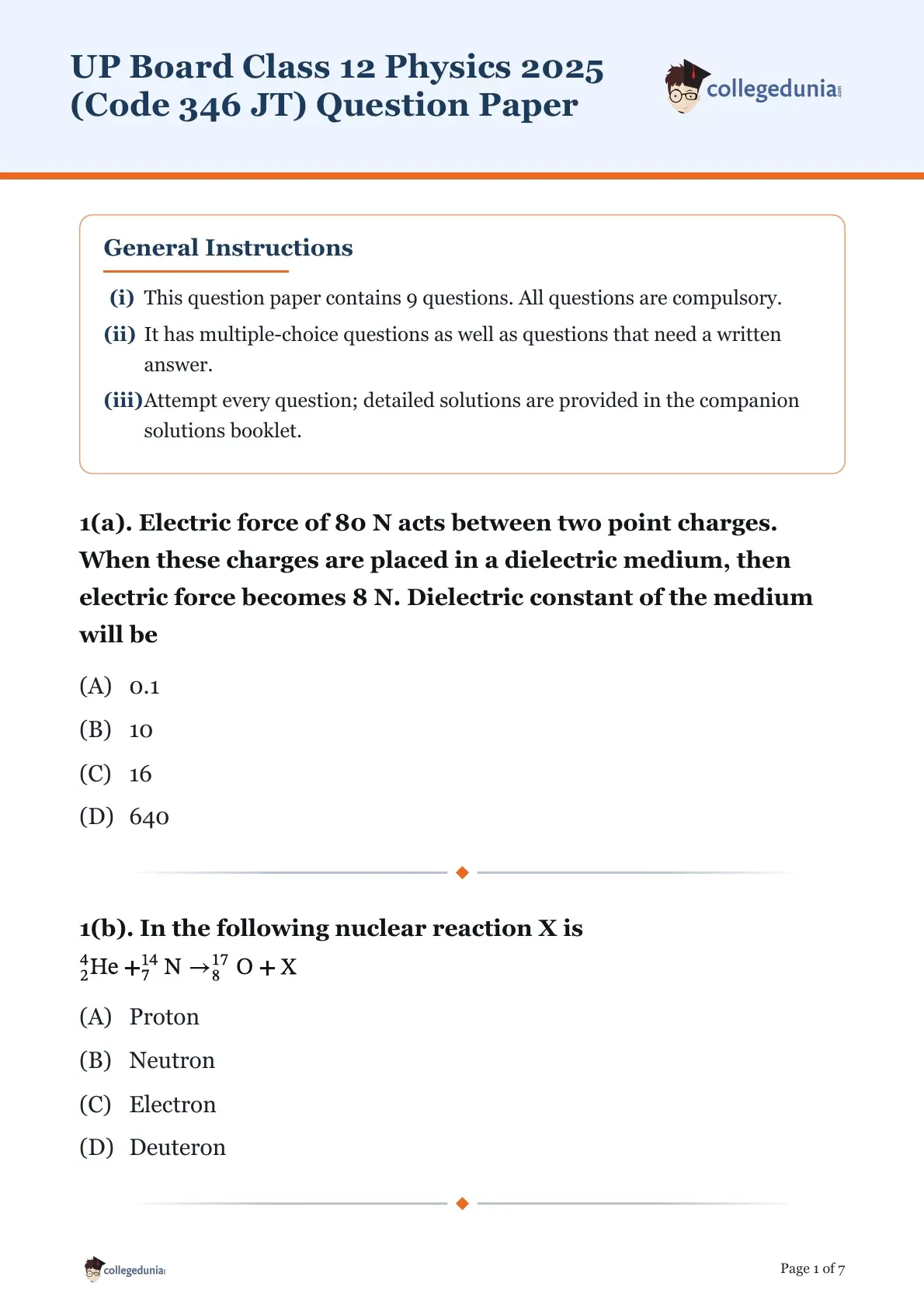
Electric force of 80 N acts between two point charges. When these charges are placed in a dielectric medium, then electric force becomes 8 N. Dielectric constant of the medium will be
In the following nuclear reaction X is
\(_{2}^{4}\text{He} + _{7}^{14}\text{N} \rightarrow _{8}^{17}\text{O} + \text{X}\)
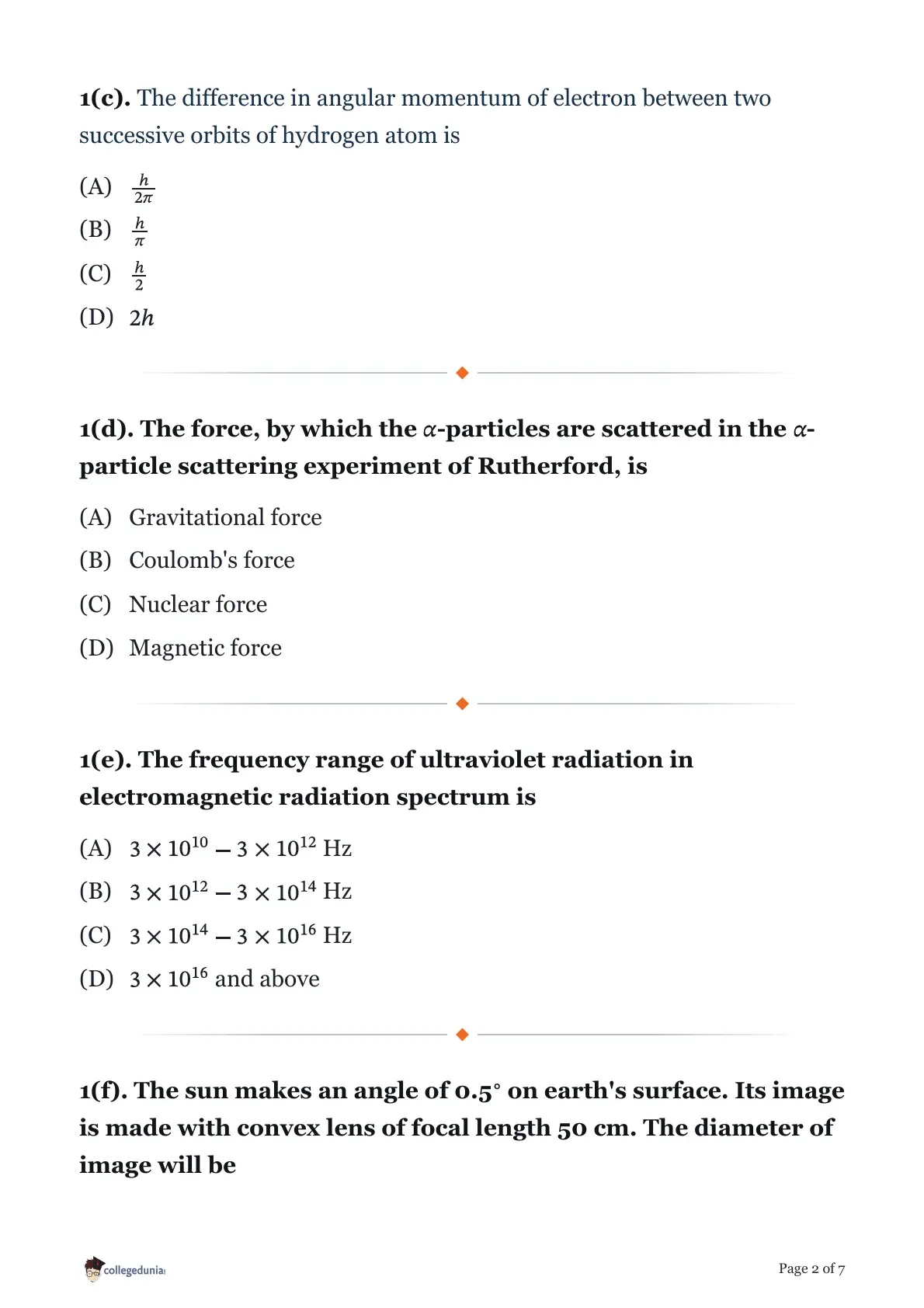
The difference in angular momentum of electron between two successive orbits of hydrogen atom is
The force, by which the \(\alpha\)-particles are scattered in the \(\alpha\)-particle scattering experiment of Rutherford, is
The frequency range of ultraviolet radiation in electromagnetic radiation spectrum is
The sun makes an angle of 0.5\(^\circ\) on earth's surface. Its image is made with convex lens of focal length 50 cm. The diameter of image will be
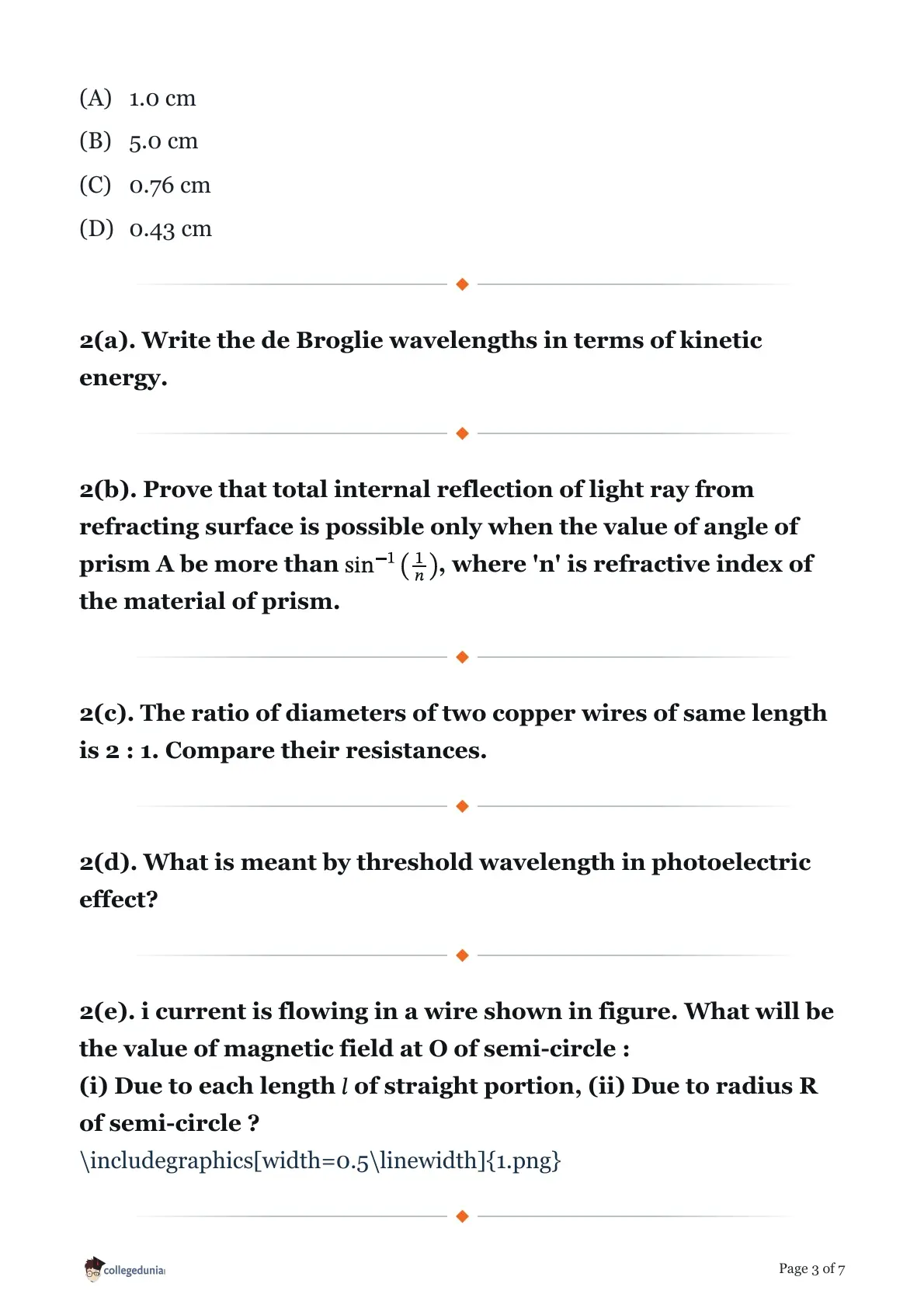
Write the de Broglie wavelengths in terms of kinetic energy.
Prove that total internal reflection of light ray from refracting surface is possible only when the value of angle of prism A be more than \(\sin^{-1}\left(\frac{1}{n}\right)\), where 'n' is refractive index of the material of prism.
The ratio of diameters of two copper wires of same length is 2 : 1. Compare their resistances.
What is meant by threshold wavelength in photoelectric effect?
i current is flowing in a wire shown in figure. What will be the value of magnetic field at O of semi-circle :
(i) Due to each length \(l\) of straight portion, (ii) Due to radius R of semi-circle ?
\includegraphics[width=0.5\linewidth]{1.png}
What do you understand by coherent source?
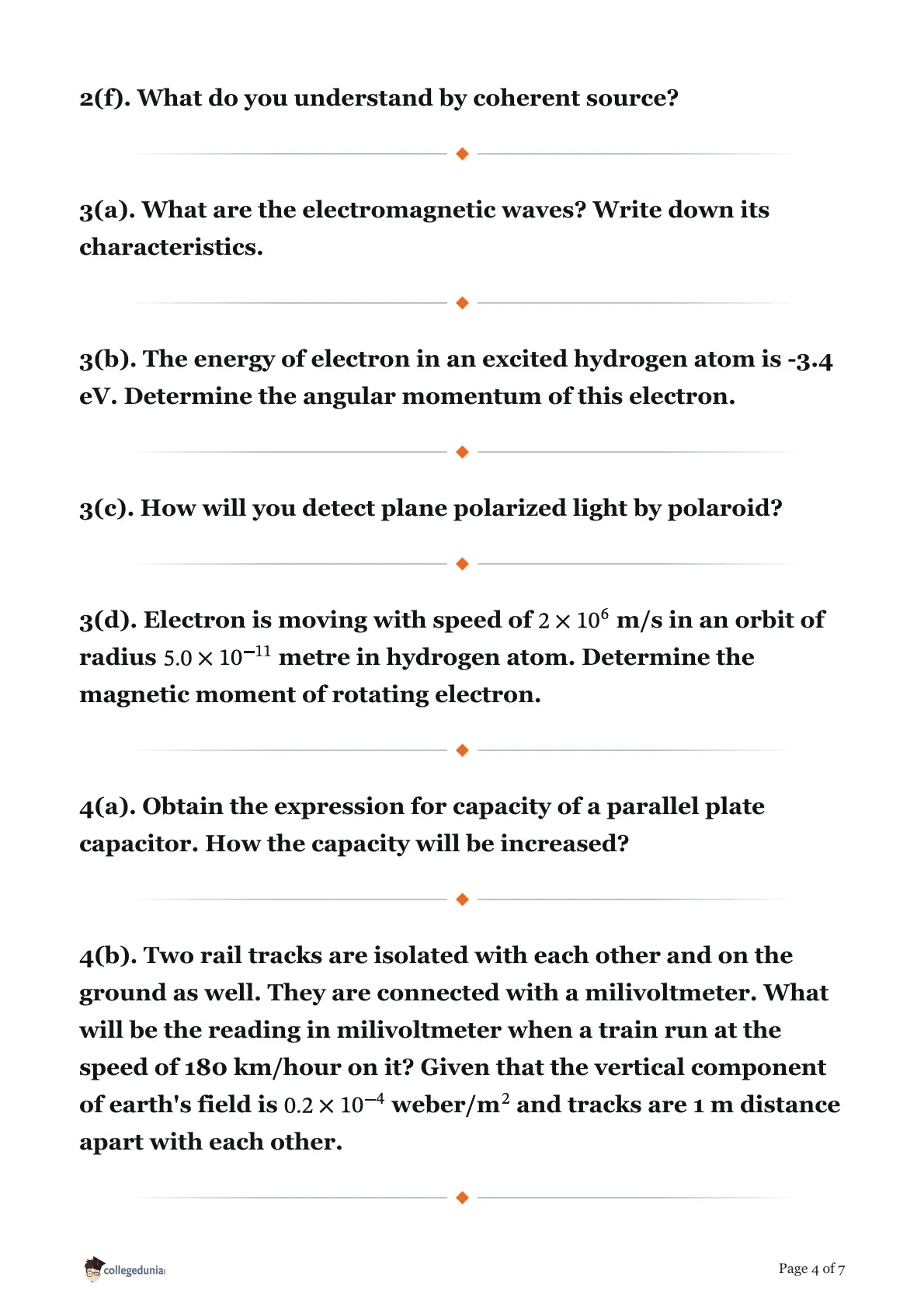
What are the electromagnetic waves? Write down its characteristics.
The energy of electron in an excited hydrogen atom is -3.4 eV. Determine the angular momentum of this electron.
How will you detect plane polarized light by polaroid?
Electron is moving with speed of \(2 \times 10^6\) m/s in an orbit of radius \(5.0 \times 10^{-11}\) metre in hydrogen atom. Determine the magnetic moment of rotating electron.
Obtain the expression for capacity of a parallel plate capacitor. How the capacity will be increased?
Two rail tracks are isolated with each other and on the ground as well. They are connected with a milivoltmeter. What will be the reading in milivoltmeter when a train run at the speed of 180 km/hour on it? Given that the vertical component of earth's field is \(0.2 \times 10^{-4}\) weber/m\(^2\) and tracks are 1 m distance apart with each other.
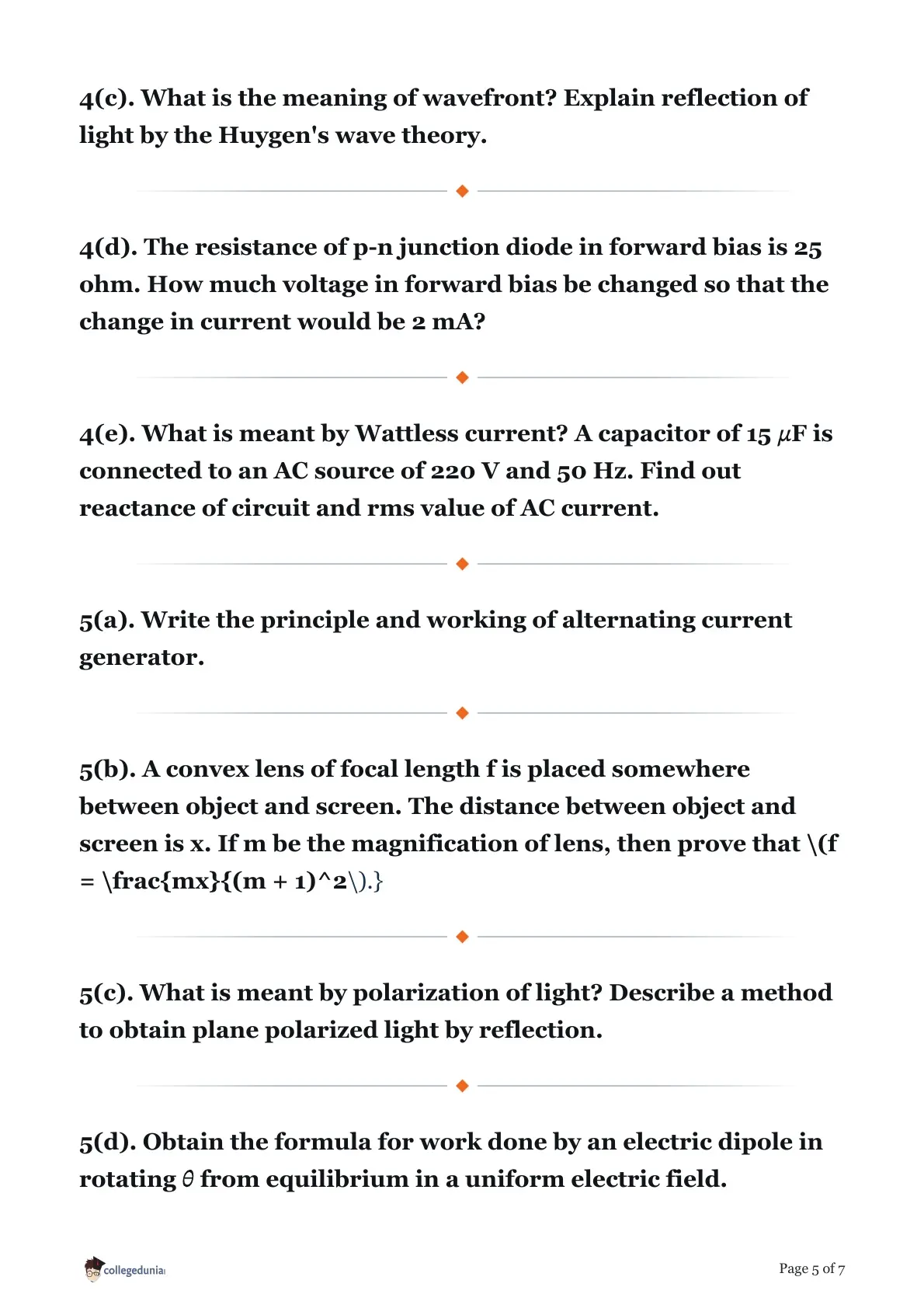
What is the meaning of wavefront? Explain reflection of light by the Huygen's wave theory.
The resistance of p-n junction diode in forward bias is 25 ohm. How much voltage in forward bias be changed so that the change in current would be 2 mA?
What is meant by Wattless current? A capacitor of 15 \(\mu\)F is connected to an AC source of 220 V and 50 Hz. Find out reactance of circuit and rms value of AC current.
Write the principle and working of alternating current generator.
A convex lens of focal length f is placed somewhere between object and screen. The distance between object and screen is x. If m be the magnification of lens, then prove that \(f = \frac{mx}{(m + 1)^2\).}
What is meant by polarization of light? Describe a method to obtain plane polarized light by reflection.
Obtain the formula for work done by an electric dipole in rotating \(\theta\) from equilibrium in a uniform electric field.
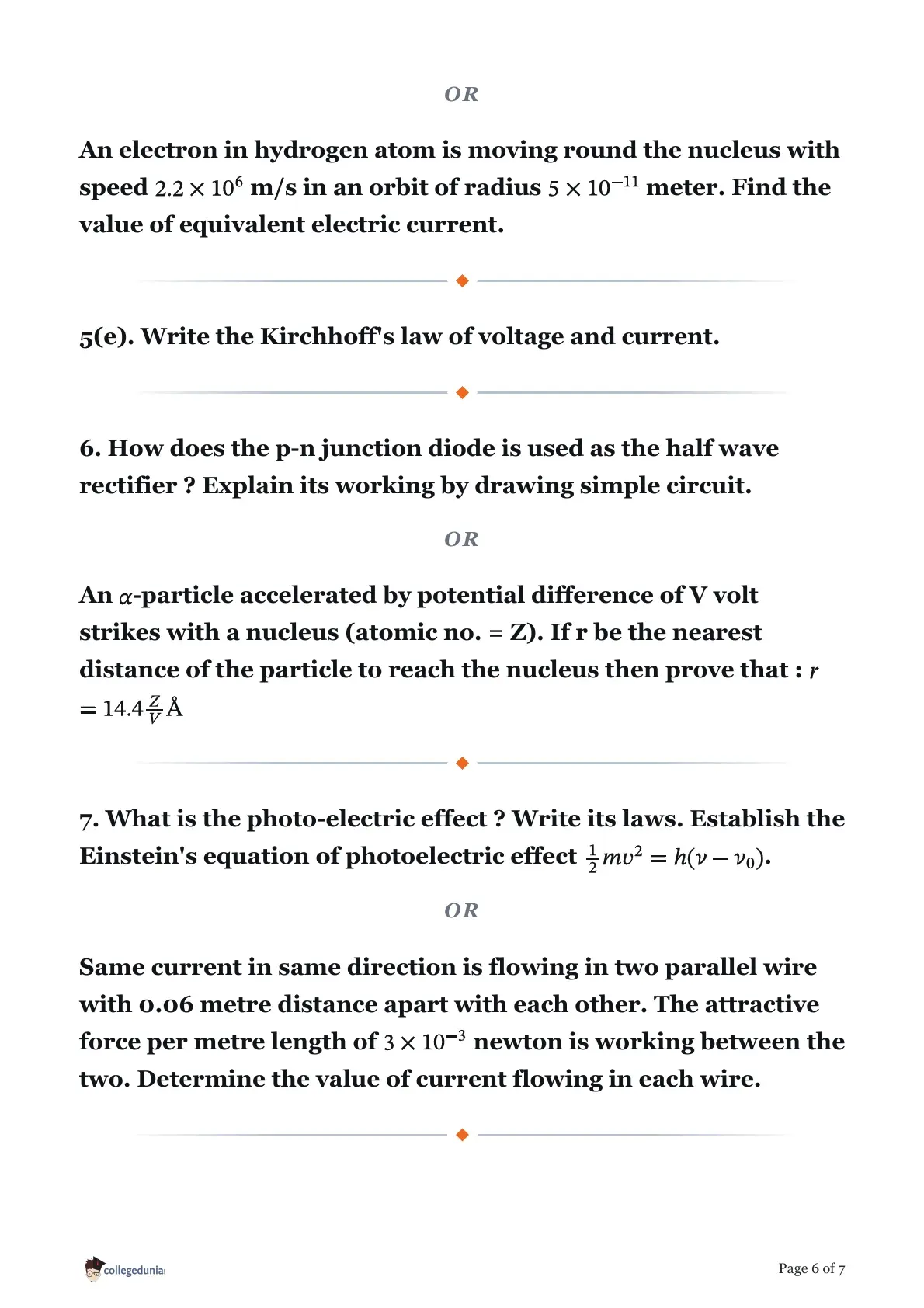
OR
An electron in hydrogen atom is moving round the nucleus with speed \(2.2 \times 10^6\) m/s in an orbit of radius \(5 \times 10^{-11}\) meter. Find the value of equivalent electric current.
Write the Kirchhoff's law of voltage and current.
How does the p-n junction diode is used as the half wave rectifier ? Explain its working by drawing simple circuit.
OR
An \(\alpha\)-particle accelerated by potential difference of V volt strikes with a nucleus (atomic no. = Z). If r be the nearest distance of the particle to reach the nucleus then prove that : \(r = 14.4 \frac{Z}{V} \AA\)
What is the photo-electric effect ? Write its laws. Establish the Einstein's equation of photoelectric effect \(\frac{1}{2} mv^2 = h(\nu - \nu_0)\).
OR
Same current in same direction is flowing in two parallel wire with 0.06 metre distance apart with each other. The attractive force per metre length of \(3 \times 10^{-3}\) newton is working between the two. Determine the value of current flowing in each wire.
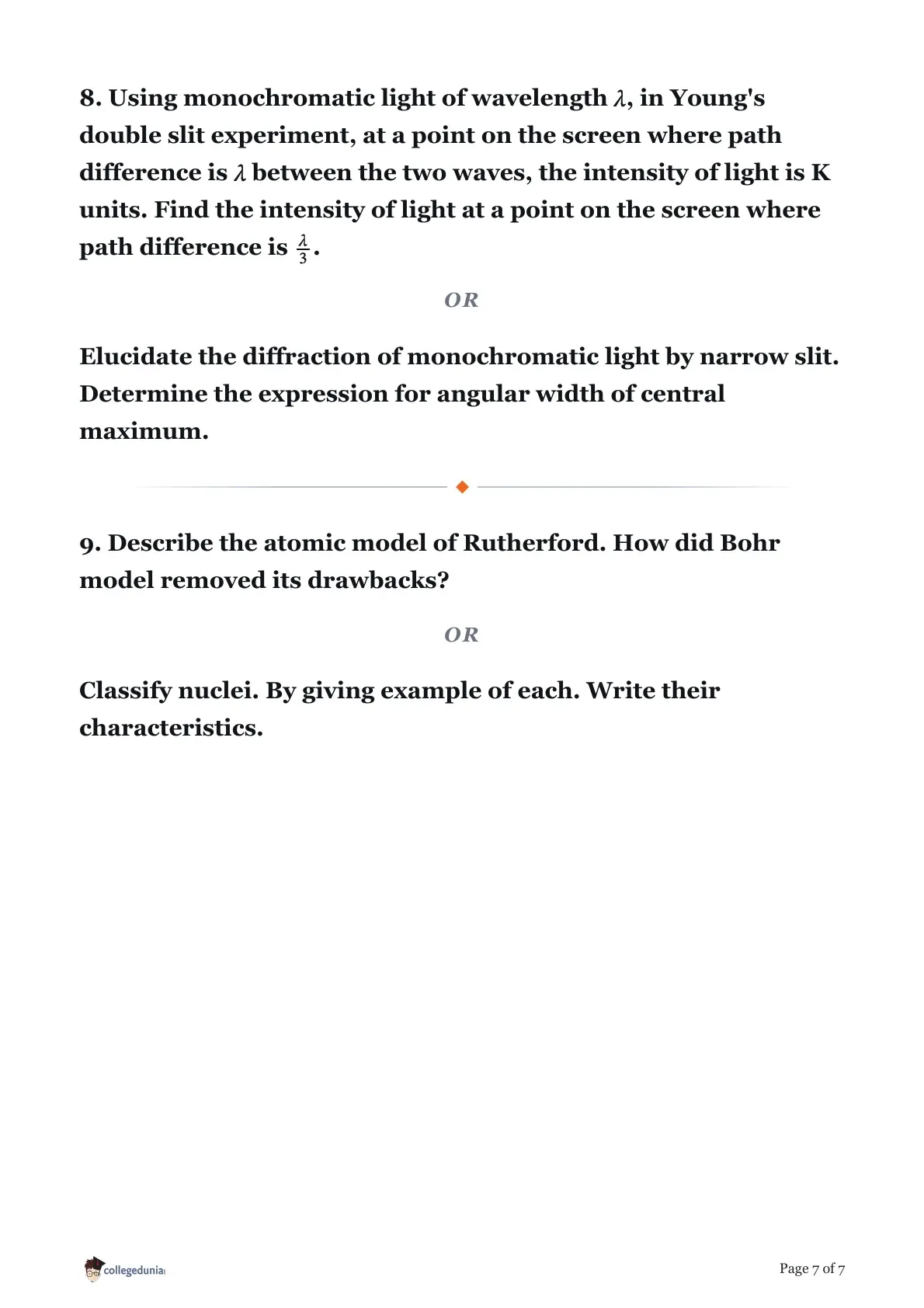
Using monochromatic light of wavelength \(\lambda\), in Young's double slit experiment, at a point on the screen where path difference is \(\lambda\) between the two waves, the intensity of light is K units. Find the intensity of light at a point on the screen where path difference is \(\frac{\lambda}{3}\).
OR
Elucidate the diffraction of monochromatic light by narrow slit. Determine the expression for angular width of central maximum.
Describe the atomic model of Rutherford. How did Bohr model removed its drawbacks?
OR
Classify nuclei. By giving example of each. Write their characteristics.
UP Board Class 12 Physics 2025 Question Paper Pattern
| Section | Q. No. | Type | Parts | Choice | Marks each | Total |
|---|---|---|---|---|---|---|
| A | 1 | Multiple choice | 6 | All compulsory | 1 | 6 |
| B | 2 | Very short answer | 6 | All compulsory | 1 | 6 |
| C | 3 | Short answer type-I | 4 | All compulsory | 2 | 8 |
| D | 4 and 5 | Short answer type-II | 5 + 5 | Q.5 has an internal choice | 3 | 30 |
| E | 6 to 9 | Long answer | 4 | Internal choice in every question | 5 | 20 |
| Total | 70 | |||||
UP Board Class 12 Physics 2025 (Code 346 JT) Chapter-Wise Marks Distribution
| Chapter | Marks | Weightage |
|---|---|---|
| Wave Optics | 14 | 20.0% |
| Atoms | 9 | 12.9% |
| Semiconductor Electronics: Materials, Devices and Simple Circuits | 8 | 11.4% |
| Dual Nature of Radiation and Matter | 7 | 10.0% |
| Electrostatic Potential and Capacitance | 6 | 8.6% |
| Electromagnetic Induction | 6 | 8.6% |
| Ray Optics and Optical Instruments | 5 | 7.1% |
| Current Electricity | 4 | 5.7% |
| Electromagnetic Waves | 3 | 4.3% |
| Moving Charges and Magnetism | 3 | 4.3% |
| Alternating Current | 3 | 4.3% |
| Electric Charges and Fields | 1 | 1.4% |
| Nuclei | 1 | 1.4% |
| Total | 70 | 100% |
Marks are counted from the first alternative of each question as printed in the paper (Code 346 JT); internal-choice alternatives carry the same marks.



Comments