




UP Board Class 12 Physics 2025 Question Paper (Code 346 JS) is available for download here with the Collegedunia question paper PDF and the question paper with solutions PDF. The UP Board Class 12 Physics theory paper was held on 6 March 2025 from 2:00 PM to 5:15 PM (3 hours 15 minutes including 15 minutes of reading time) and carried 70 marks, with 30 of the 35 printed questions to be attempted.
Also Check: UP Board Class 12 Question Paper 2025 (All Subjects)
The Physics question paper (Code 346 JS) includes the following types of questions:
- Section A: Q.1, six multiple choice questions of 1 mark each
- Section B: Q.2, six very short answer questions of 1 mark each
- Section C: Q.3, four short answer type-I questions of 2 marks each
- Section D: Q.4 and Q.5, five short answer type-II questions of 3 marks each in each question
- Section E: Q.6 to Q.9, long answer questions of 5 marks each, each with an internal choice
UP Board Class 12 Physics 2025 Question Paper (Code 346 JS) with Solutions PDF
| UP Board Official PDF | CD PDF | CD PDF with Solutions |
|---|---|---|
| Download official PDF 0.32 MB | Download Collegedunia PDF 0.65 MB | Download solutions PDF 5.32 MB |
UP Board Class 12 Physics 2025 (Code 346 JS) Questions with Solutions
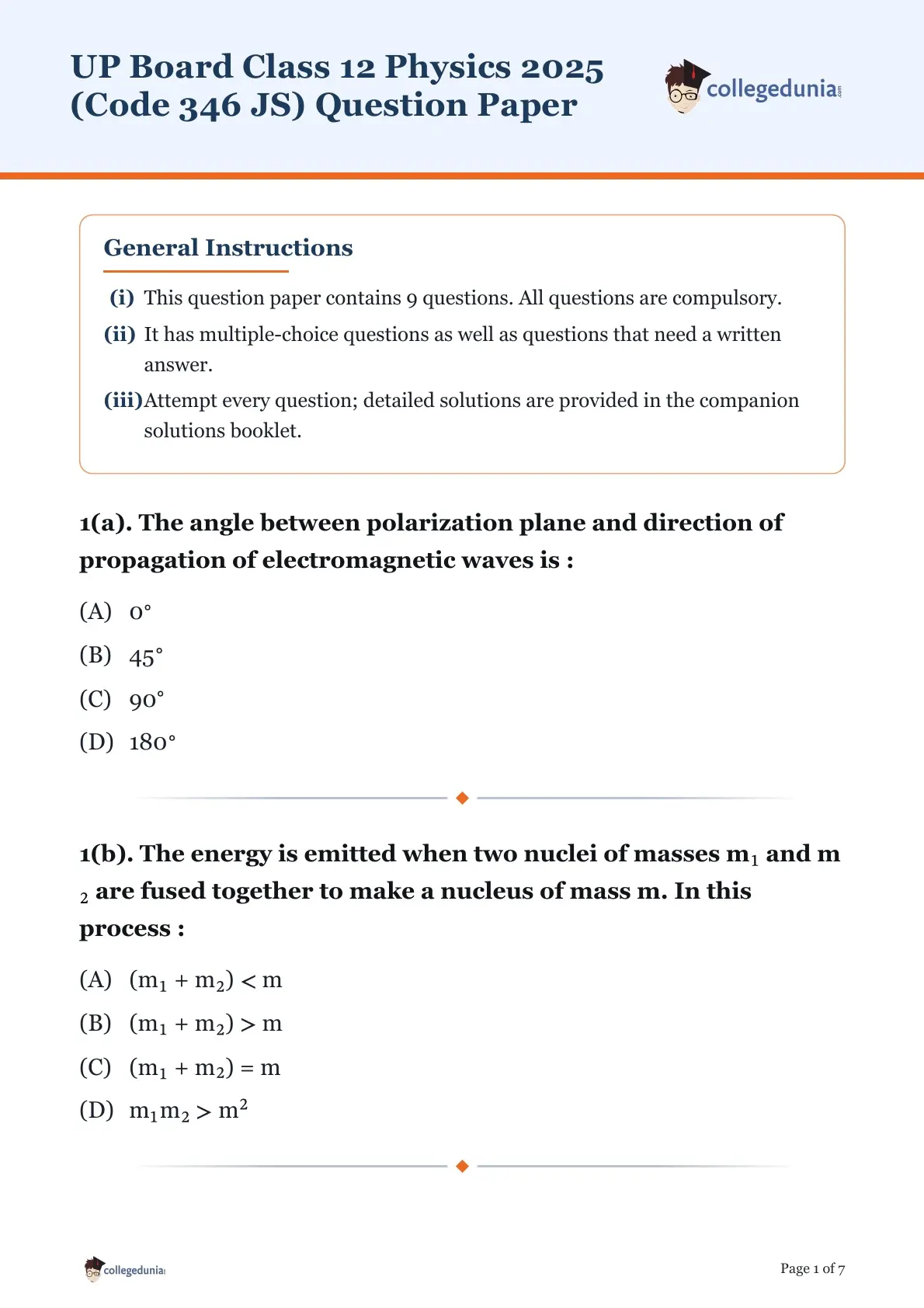
The angle between polarization plane and direction of propagation of electromagnetic waves is :
The energy is emitted when two nuclei of masses m\(_1\) and m\(_2\) are fused together to make a nucleus of mass m. In this process :
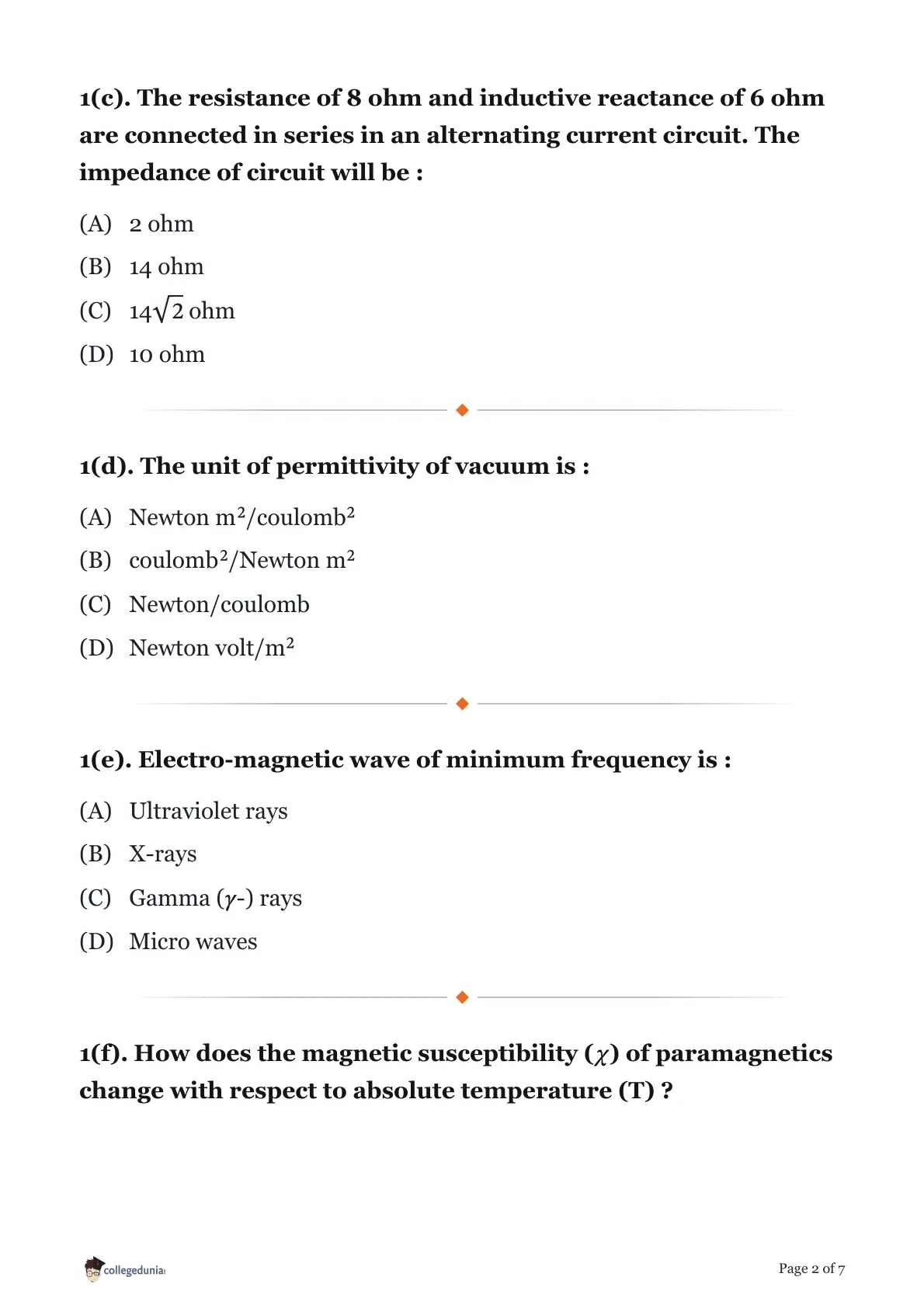
The resistance of 8 ohm and inductive reactance of 6 ohm are connected in series in an alternating current circuit. The impedance of circuit will be :
The unit of permittivity of vacuum is :
Electro-magnetic wave of minimum frequency is :
How does the magnetic susceptibility (\(\chi\)) of paramagnetics change with respect to absolute temperature (T) ?
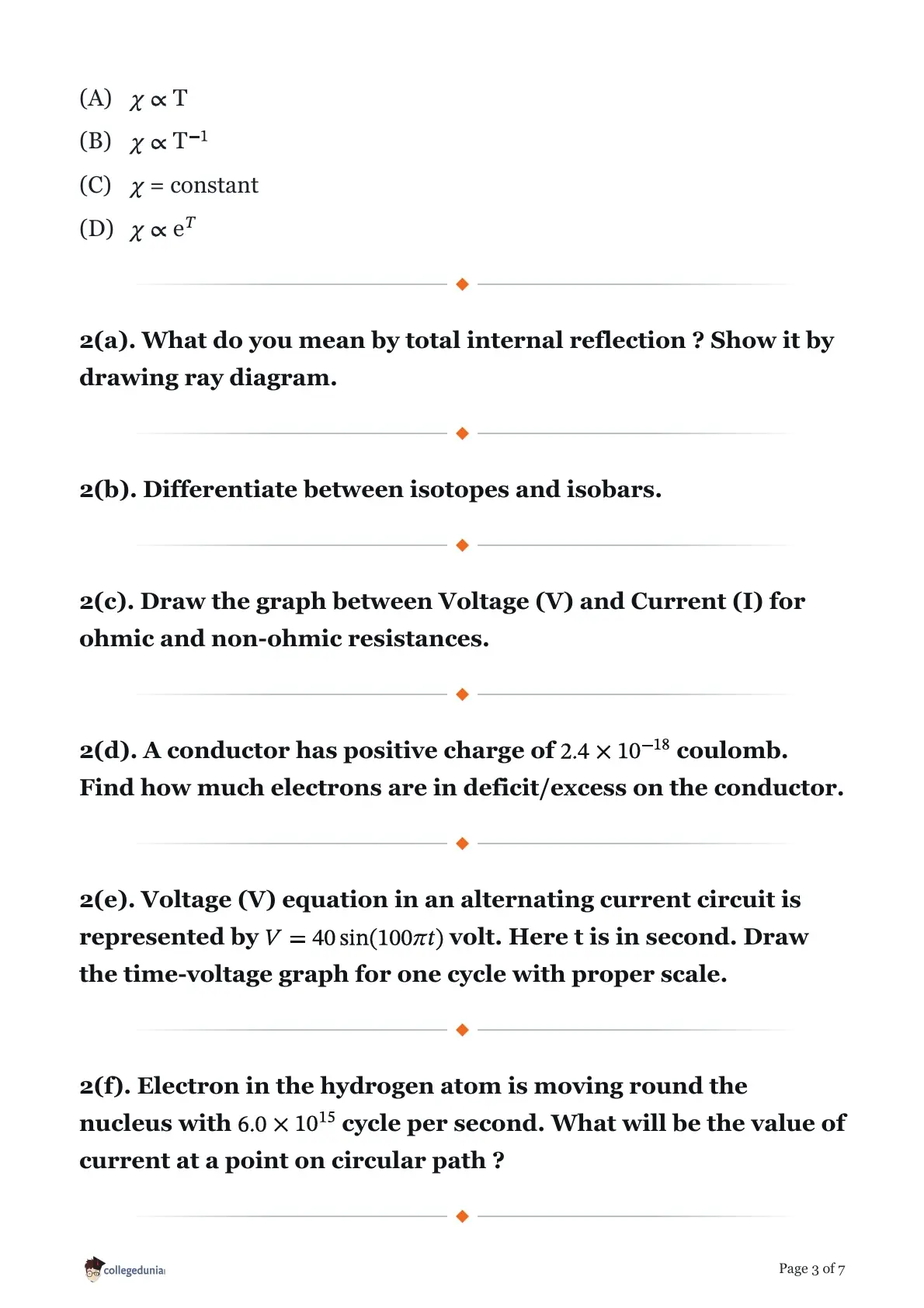
What do you mean by total internal reflection ? Show it by drawing ray diagram.
Differentiate between isotopes and isobars.
Draw the graph between Voltage (V) and Current (I) for ohmic and non-ohmic resistances.
A conductor has positive charge of \(2.4 \times 10^{-18}\) coulomb. Find how much electrons are in deficit/excess on the conductor.
Voltage (V) equation in an alternating current circuit is represented by \( V = 40 \sin(100 \pi t) \) volt. Here t is in second. Draw the time-voltage graph for one cycle with proper scale.
Electron in the hydrogen atom is moving round the nucleus with \(6.0 \times 10^{15}\) cycle per second. What will be the value of current at a point on circular path ?
What are the demerits of Rutherford model of an atom ?
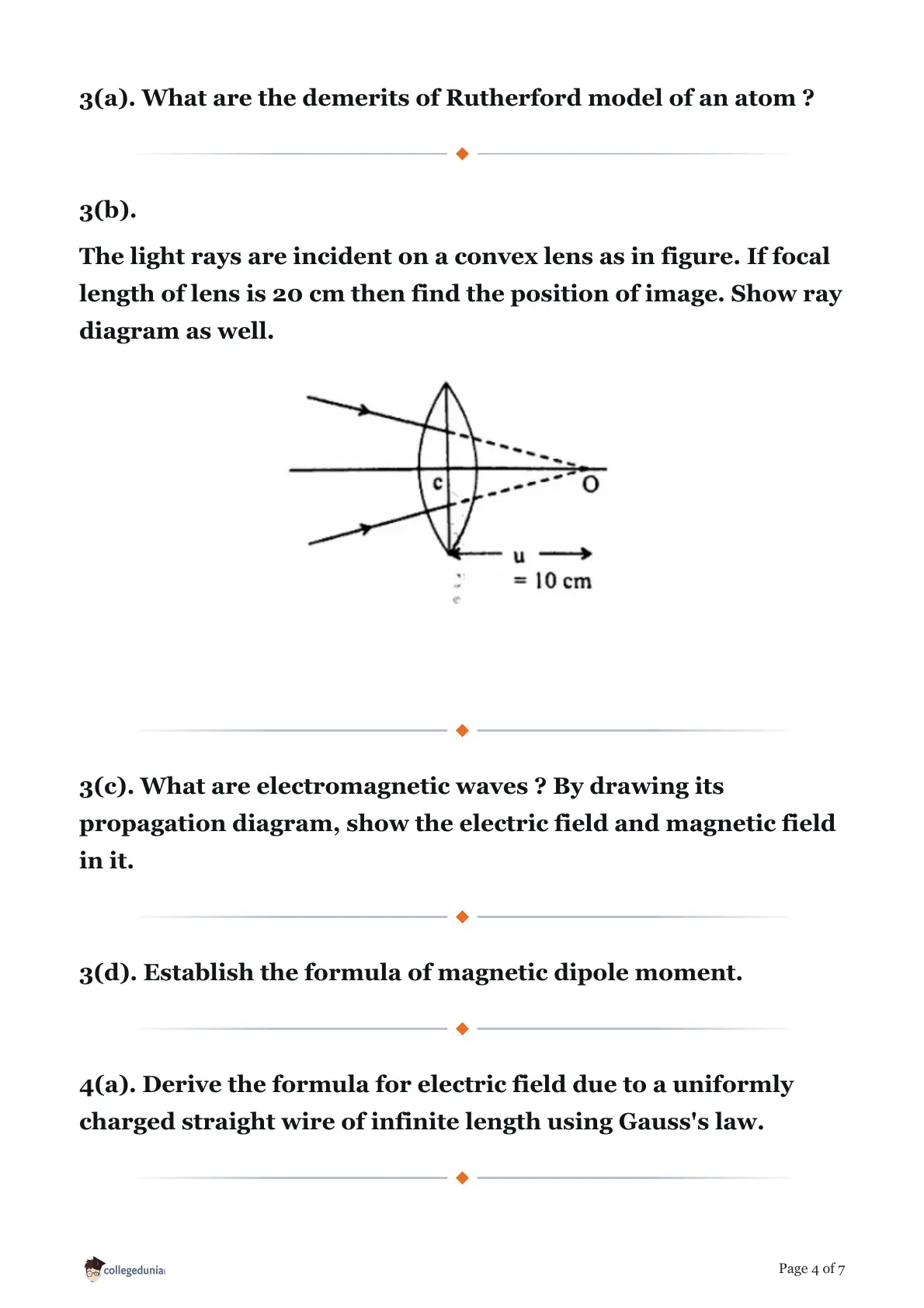
The light rays are incident on a convex lens as in figure. If focal length of lens is 20 cm then find the position of image. Show ray diagram as well. 
What are electromagnetic waves ? By drawing its propagation diagram, show the electric field and magnetic field in it.
Establish the formula of magnetic dipole moment.
Derive the formula for electric field due to a uniformly charged straight wire of infinite length using Gauss's law.
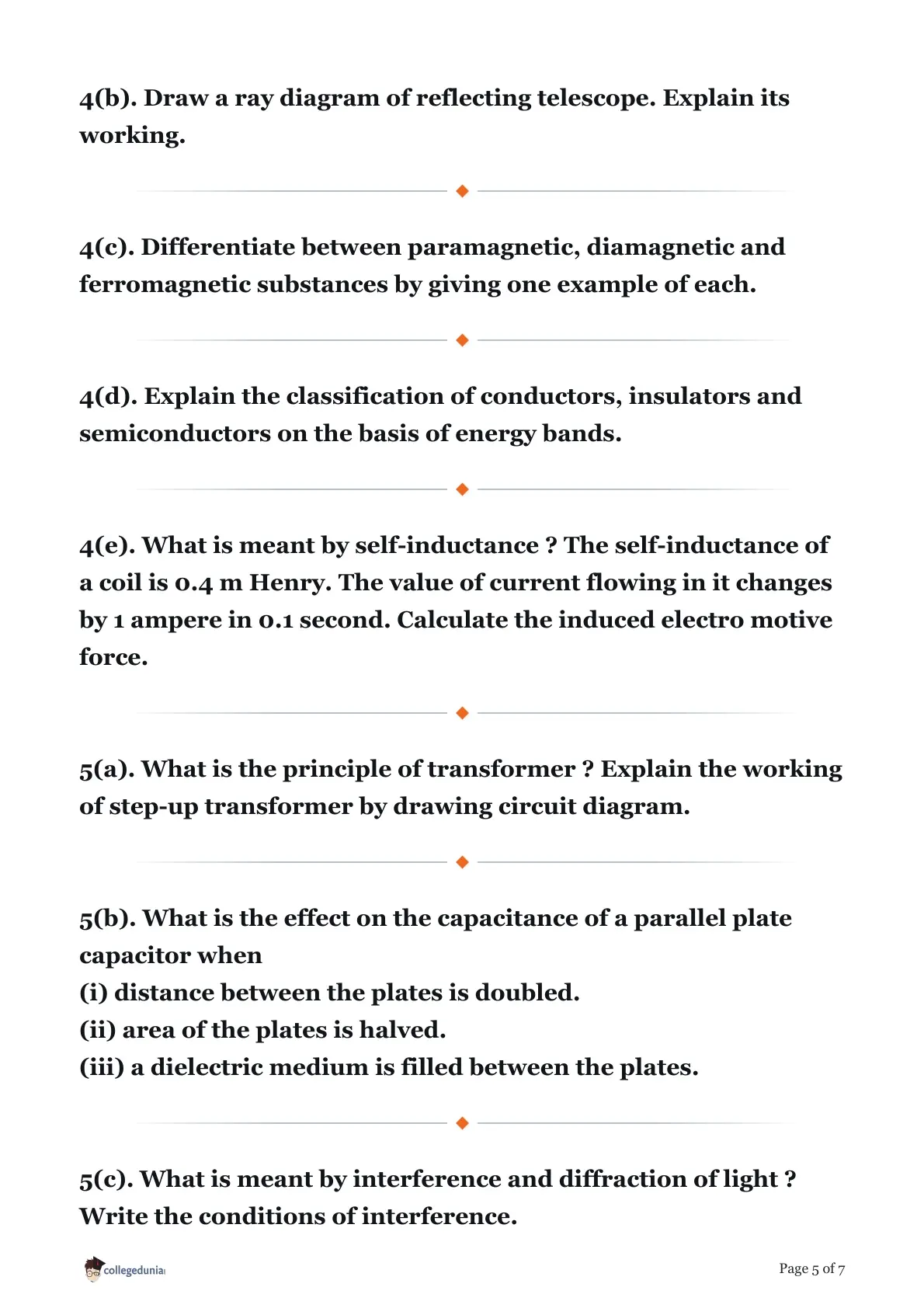
Draw a ray diagram of reflecting telescope. Explain its working.
Differentiate between paramagnetic, diamagnetic and ferromagnetic substances by giving one example of each.
Explain the classification of conductors, insulators and semiconductors on the basis of energy bands.
What is meant by self-inductance ? The self-inductance of a coil is 0.4 m Henry. The value of current flowing in it changes by 1 ampere in 0.1 second. Calculate the induced electro motive force.
What is the principle of transformer ? Explain the working of step-up transformer by drawing circuit diagram.
What is the effect on the capacitance of a parallel plate capacitor when
(i) distance between the plates is doubled.
(ii) area of the plates is halved.
(iii) a dielectric medium is filled between the plates.
What is meant by interference and diffraction of light ? Write the conditions of interference.
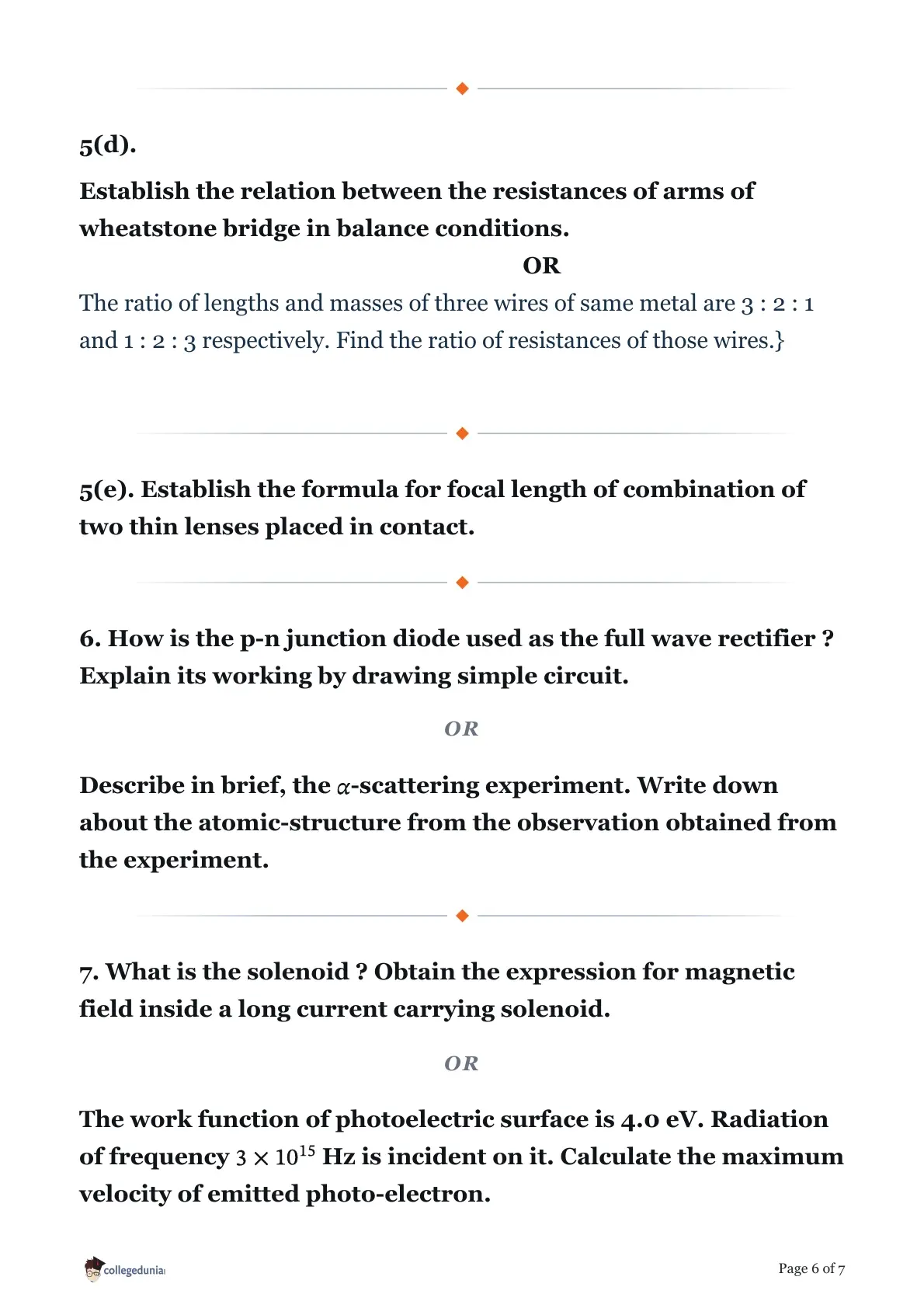
Establish the relation between the resistances of arms of wheatstone bridge in balance conditions.
OR
The ratio of lengths and masses of three wires of same metal are 3 : 2 : 1 and 1 : 2 : 3 respectively. Find the ratio of resistances of those wires.}
Establish the formula for focal length of combination of two thin lenses placed in contact.
How is the p-n junction diode used as the full wave rectifier ? Explain its working by drawing simple circuit.
OR
Describe in brief, the \(\alpha\)-scattering experiment. Write down about the atomic-structure from the observation obtained from the experiment.
What is the solenoid ? Obtain the expression for magnetic field inside a long current carrying solenoid.
OR
The work function of photoelectric surface is 4.0 eV. Radiation of frequency \(3 \times 10^{15}\) Hz is incident on it. Calculate the maximum velocity of emitted photo-electron.
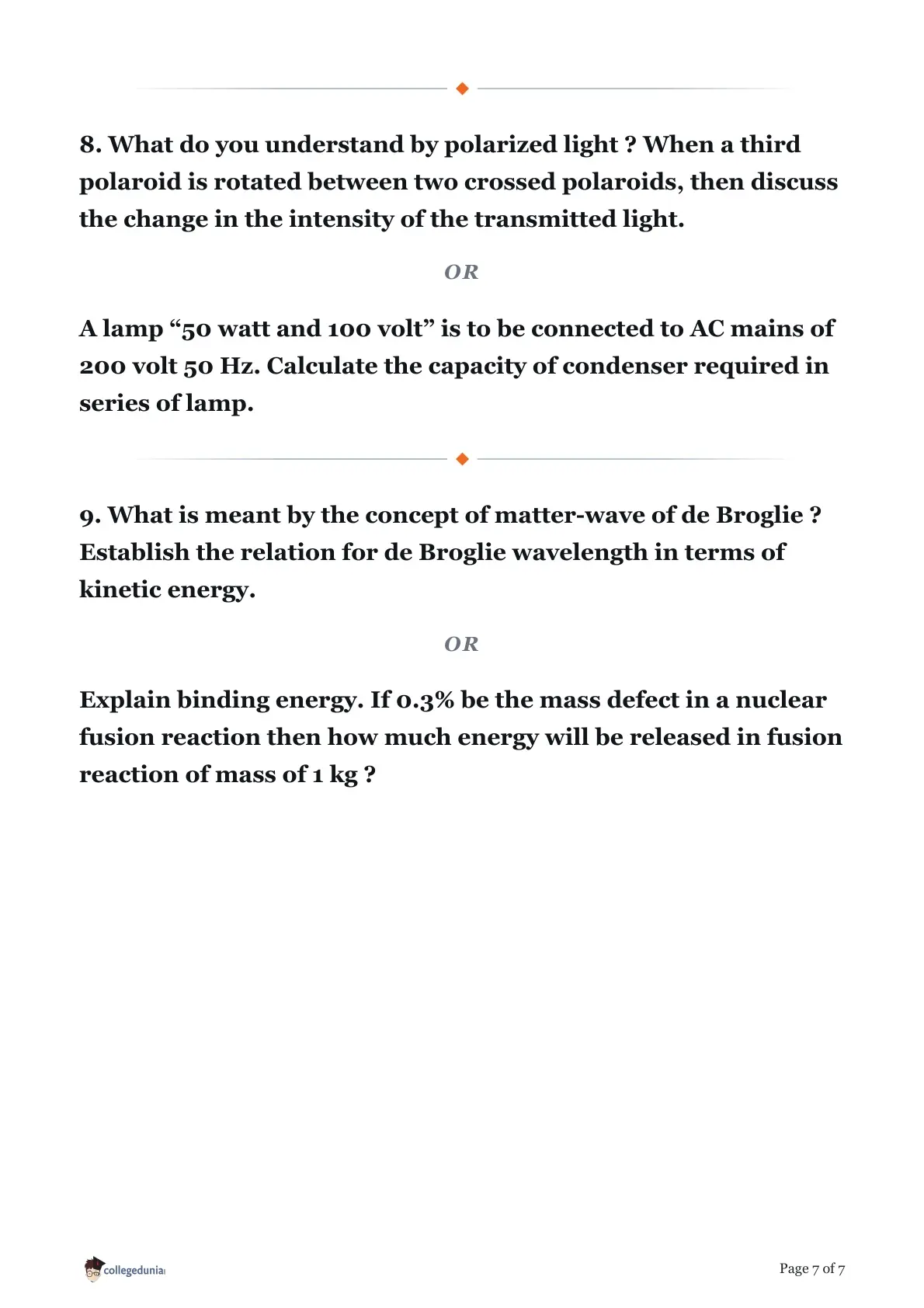
What do you understand by polarized light ? When a third polaroid is rotated between two crossed polaroids, then discuss the change in the intensity of the transmitted light.
OR
A lamp “50 watt and 100 volt” is to be connected to AC mains of 200 volt 50 Hz. Calculate the capacity of condenser required in series of lamp.
What is meant by the concept of matter-wave of de Broglie ? Establish the relation for de Broglie wavelength in terms of kinetic energy.
OR
Explain binding energy. If 0.3% be the mass defect in a nuclear fusion reaction then how much energy will be released in fusion reaction of mass of 1 kg ?
UP Board Class 12 Physics 2025 Question Paper Pattern
| Section | Q. No. | Type | Parts | Choice | Marks each | Total |
|---|---|---|---|---|---|---|
| A | 1 | Multiple choice | 6 | All compulsory | 1 | 6 |
| B | 2 | Very short answer | 6 | All compulsory | 1 | 6 |
| C | 3 | Short answer type-I | 4 | All compulsory | 2 | 8 |
| D | 4 and 5 | Short answer type-II | 5 + 5 | Q.5 has an internal choice | 3 | 30 |
| E | 6 to 9 | Long answer | 4 | Internal choice in every question | 5 | 20 |
| Total | 70 | |||||
UP Board Class 12 Physics 2025 (Code 346 JS) Chapter-Wise Marks Distribution
| Chapter | Marks | Weightage |
|---|---|---|
| Ray Optics and Optical Instruments | 9 | 12.9% |
| Semiconductor Electronics: Materials, Devices and Simple Circuits | 8 | 11.4% |
| Wave Optics | 8 | 11.4% |
| Moving Charges and Magnetism | 7 | 10.0% |
| Alternating Current | 5 | 7.1% |
| Electric Charges and Fields | 5 | 7.1% |
| Current Electricity | 5 | 7.1% |
| Dual Nature of Radiation and Matter | 5 | 7.1% |
| Electromagnetic Waves | 4 | 5.7% |
| Magnetism and Matter | 4 | 5.7% |
| Electromagnetic Induction | 3 | 4.3% |
| Electrostatic Potential and Capacitance | 3 | 4.3% |
| Nuclei | 2 | 2.9% |
| Atoms | 2 | 2.9% |
| Total | 70 | 100% |
Marks are counted from the first alternative of each question as printed in the paper (Code 346 JS); internal-choice alternatives carry the same marks.



Comments