




UP Board Class 12 Physics 2024 Question Paper (Code 346 FX) is available for download here with the Collegedunia question paper PDF and the question paper with solutions PDF. The UP Board Class 12 Physics theory paper was held on 4 March 2024 from 2:00 PM to 5:15 PM (3 hours 15 minutes including 15 minutes of reading time) and carried 70 marks, with 30 of the 35 printed questions to be attempted.
Also Check: UP Board Class 12 Question Paper 2024 (All Subjects)
The Physics question paper (Code 346 FX) includes the following types of questions:
- Section A: Q.1, six multiple choice questions of 1 mark each
- Section B: Q.2, six very short answer questions of 1 mark each
- Section C: Q.3, four short answer type-I questions of 2 marks each
- Section D: Q.4 and Q.5, five short answer type-II questions of 3 marks each in each question
- Section E: Q.6 to Q.9, long answer questions of 5 marks each, each with an internal choice
UP Board Class 12 Physics 2024 Question Paper (Code 346 FX) with Solutions PDF
| UP Board Official PDF | CD PDF | CD PDF with Solutions |
|---|---|---|
| Download official PDF 3.42 MB | Download Collegedunia PDF 0.89 MB | Download solutions PDF 3.73 MB |
UP Board Class 12 Physics 2024 (Code 346 FX) Questions with Solutions
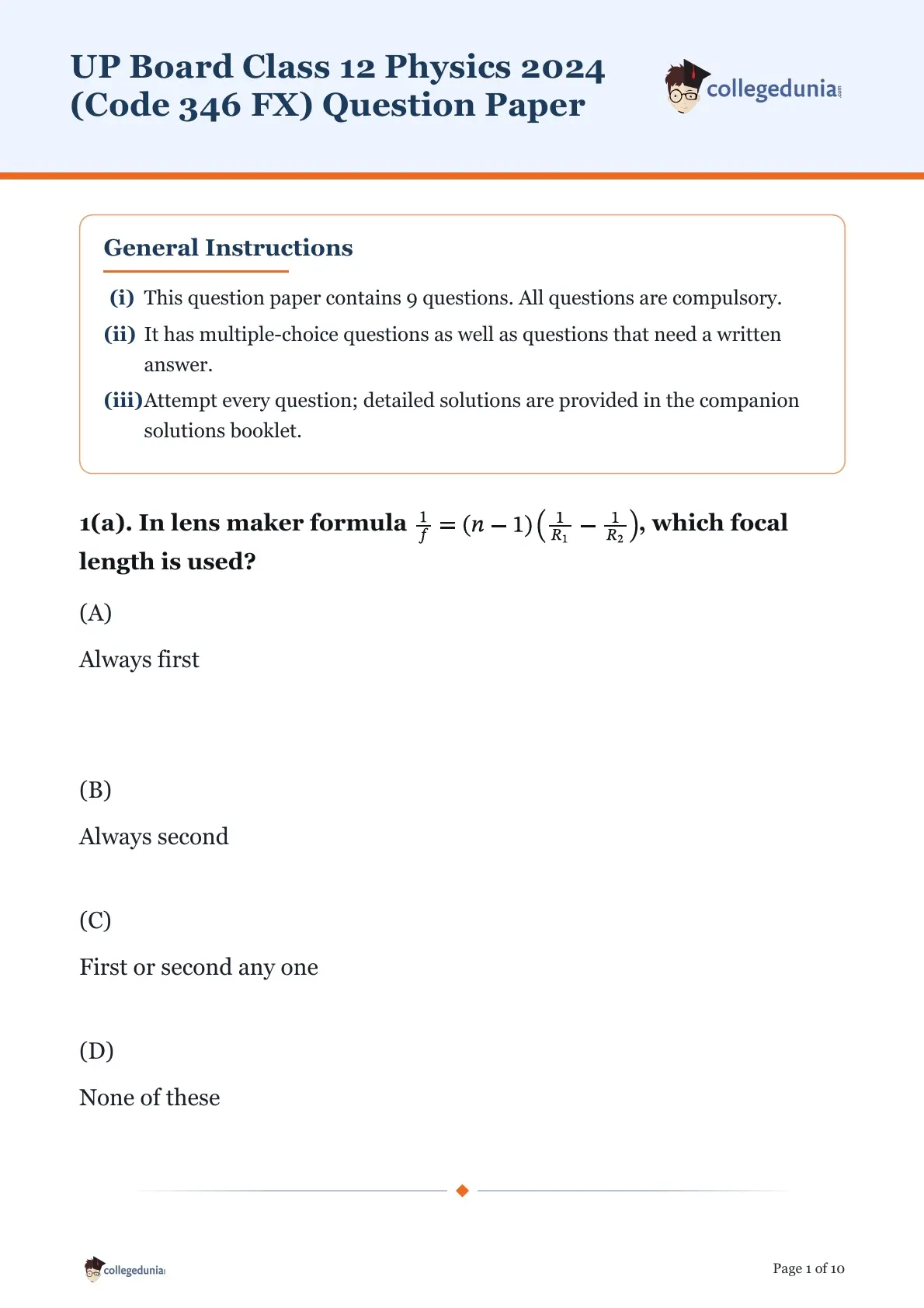
In lens maker formula \( \frac{1}{f} = (n-1) \left( \frac{1}{R_1} - \frac{1}{R_2} \right) \), which focal length is used?
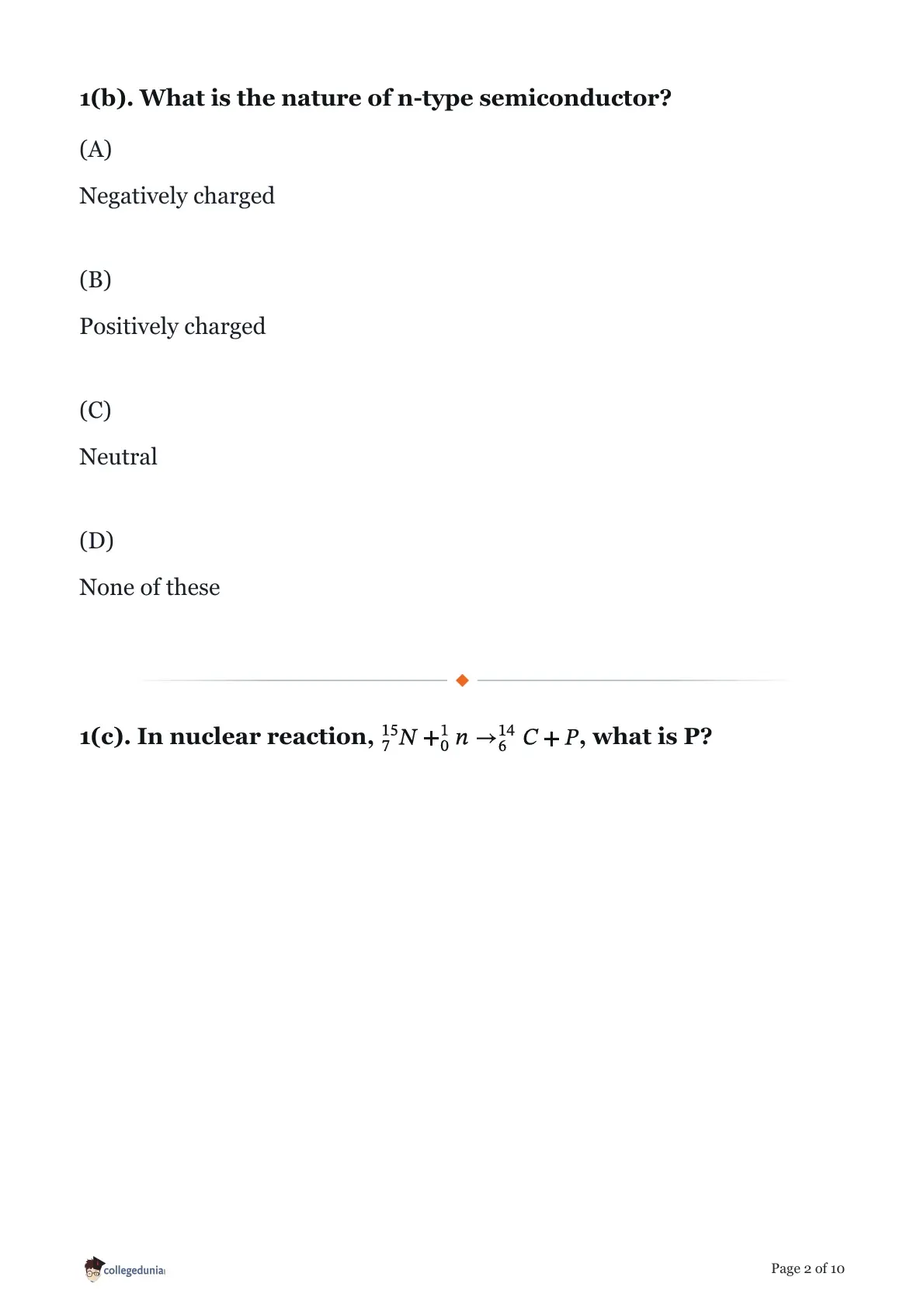
What is the nature of n-type semiconductor?
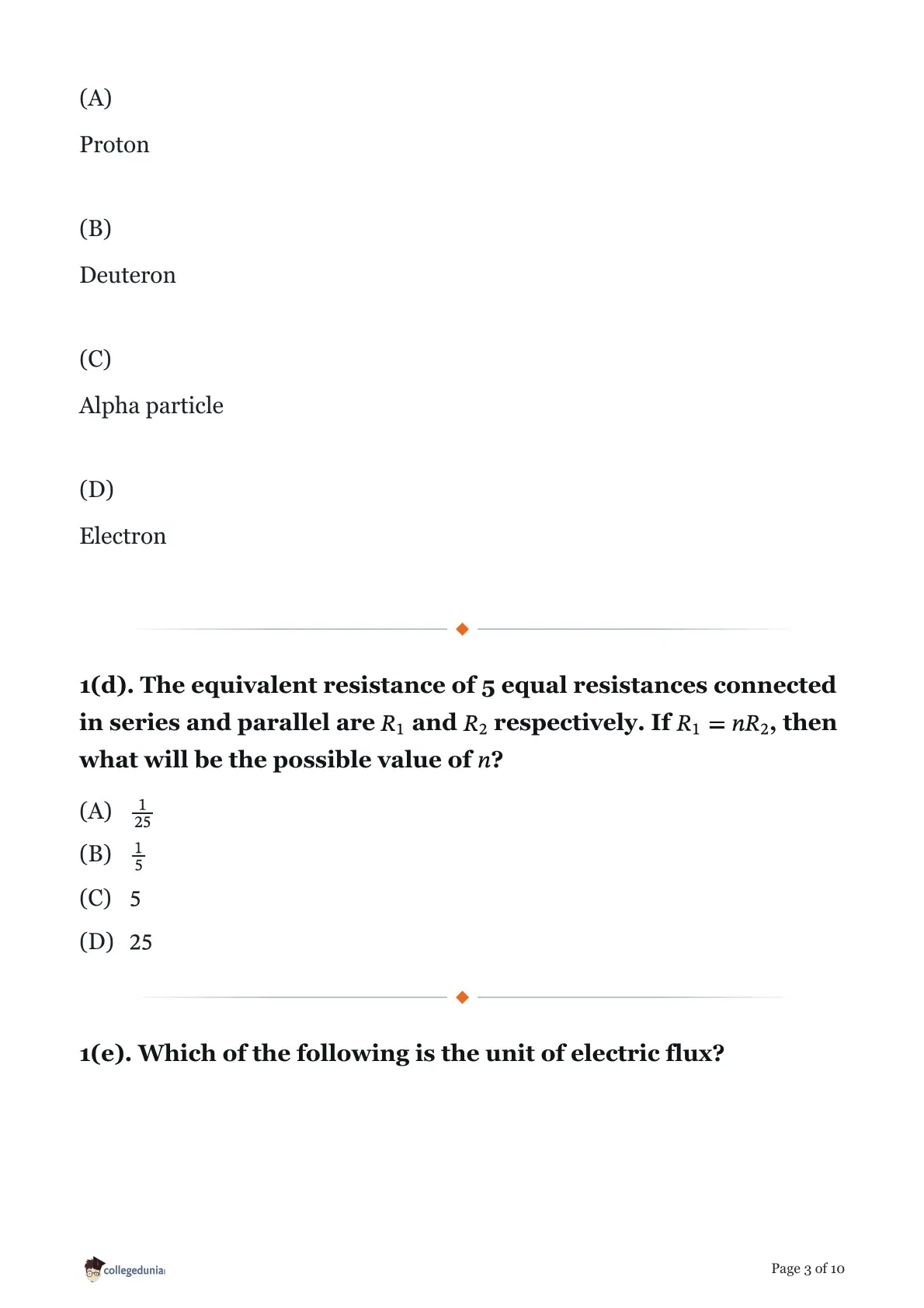
In nuclear reaction, \( _{7}^{15}N + _{0}^{1}n \rightarrow _{6}^{14}C + P \), what is P?
The equivalent resistance of 5 equal resistances connected in series and parallel are \( R_1 \) and \( R_2 \) respectively. If \( R_1 = nR_2 \), then what will be the possible value of \( n \)?
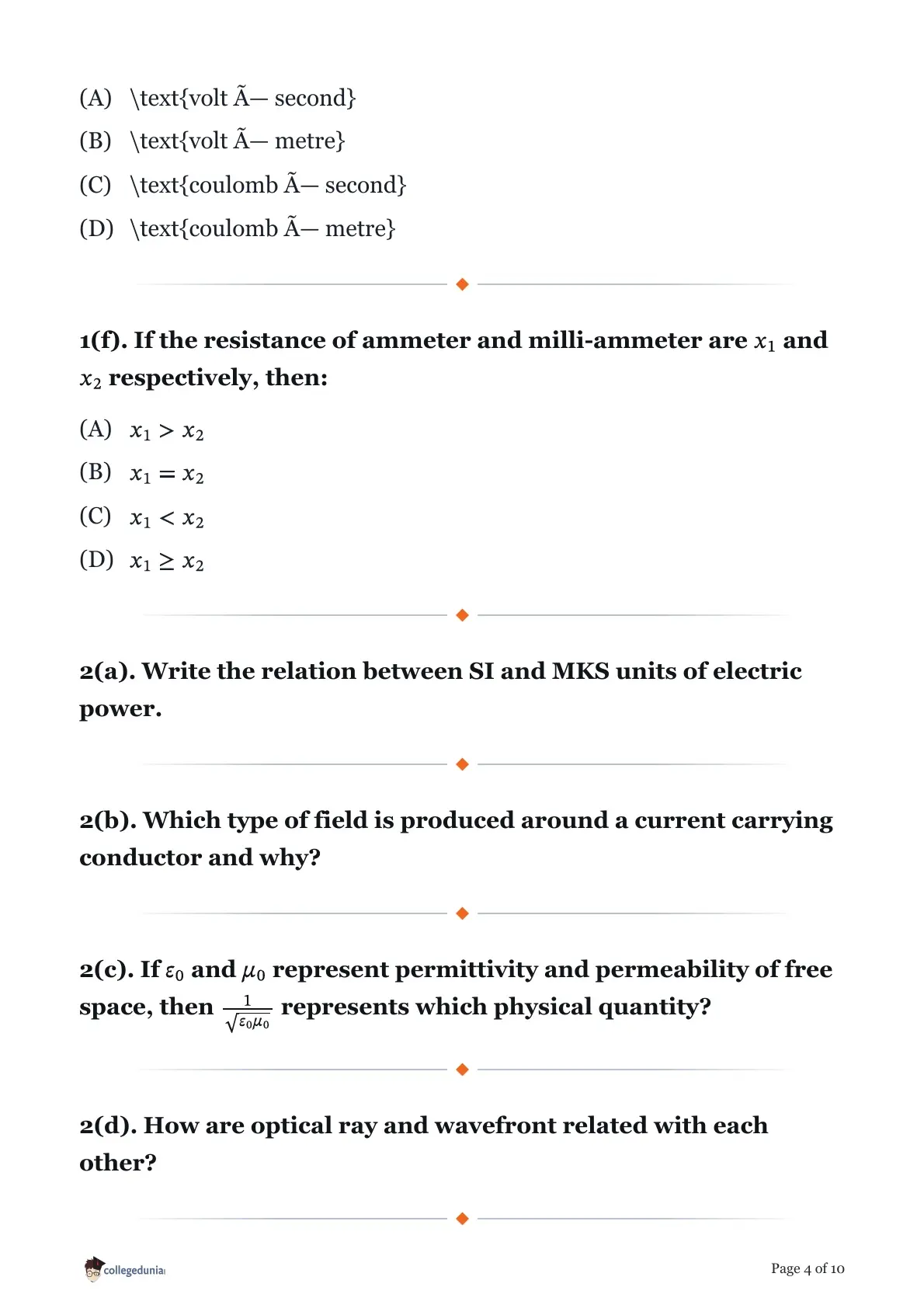
Which of the following is the unit of electric flux?
If the resistance of ammeter and milli-ammeter are \( x_1 \) and \( x_2 \) respectively, then:
Write the relation between SI and MKS units of electric power.
Which type of field is produced around a current carrying conductor and why?
If \( \varepsilon_0 \) and \( \mu_0 \) represent permittivity and permeability of free space, then \( \frac{1}{\sqrt{\varepsilon_0 \mu_0}} \) represents which physical quantity?
How are optical ray and wavefront related with each other?
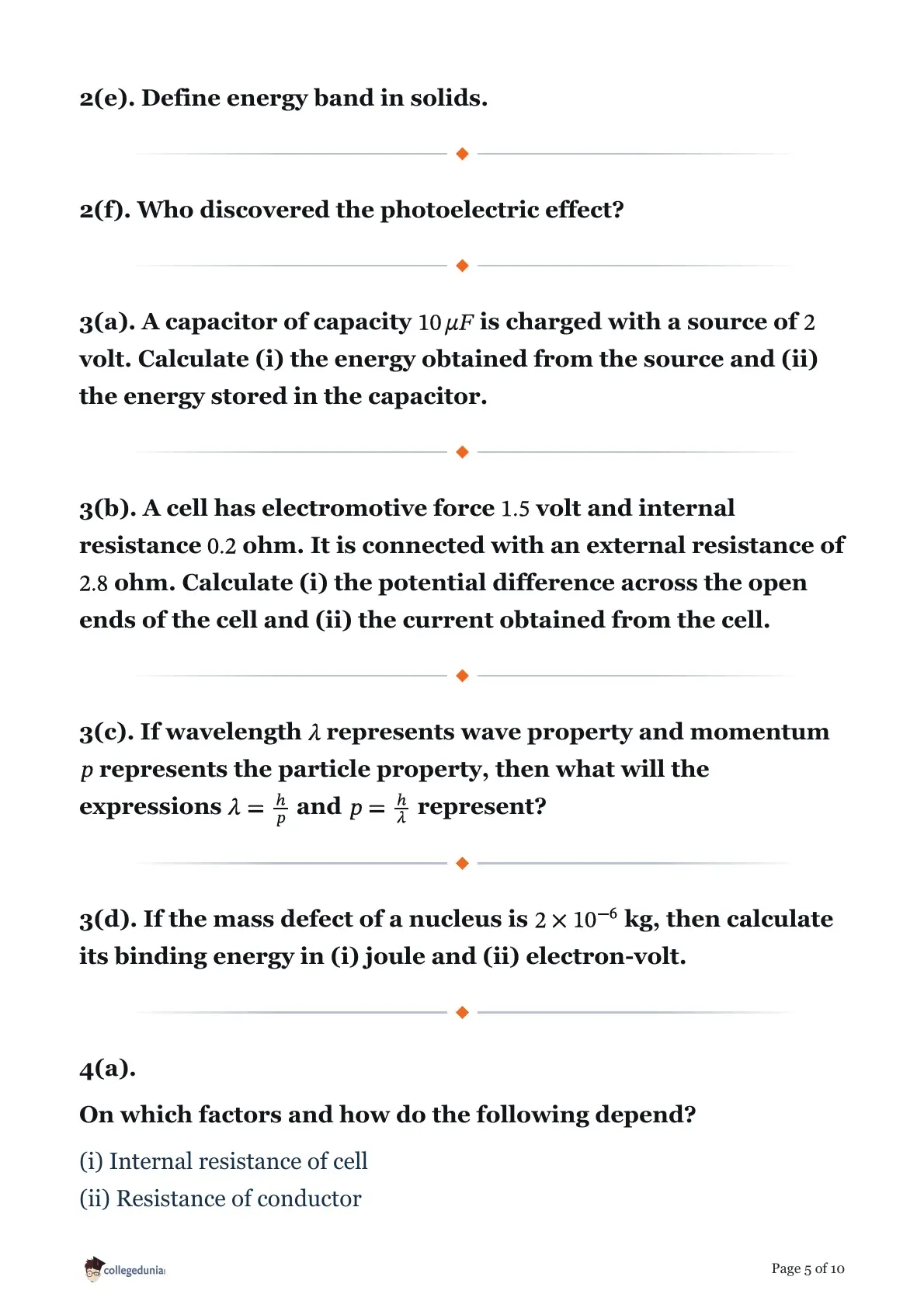
Define energy band in solids.
Who discovered the photoelectric effect?
A capacitor of capacity \(10 \, \mu F\) is charged with a source of \(2\) volt. Calculate (i) the energy obtained from the source and (ii) the energy stored in the capacitor.
A cell has electromotive force \(1.5\) volt and internal resistance \(0.2\) ohm. It is connected with an external resistance of \(2.8\) ohm. Calculate (i) the potential difference across the open ends of the cell and (ii) the current obtained from the cell.
If wavelength \( \lambda \) represents wave property and momentum \( p \) represents the particle property, then what will the expressions \( \lambda = \frac{h}{p} \) and \( p = \frac{h}{\lambda} \) represent?
If the mass defect of a nucleus is \(2 \times 10^{-6}\) kg, then calculate its binding energy in (i) joule and (ii) electron-volt.
On which factors and how do the following depend?
(i) Internal resistance of cell
(ii) Resistance of conductor
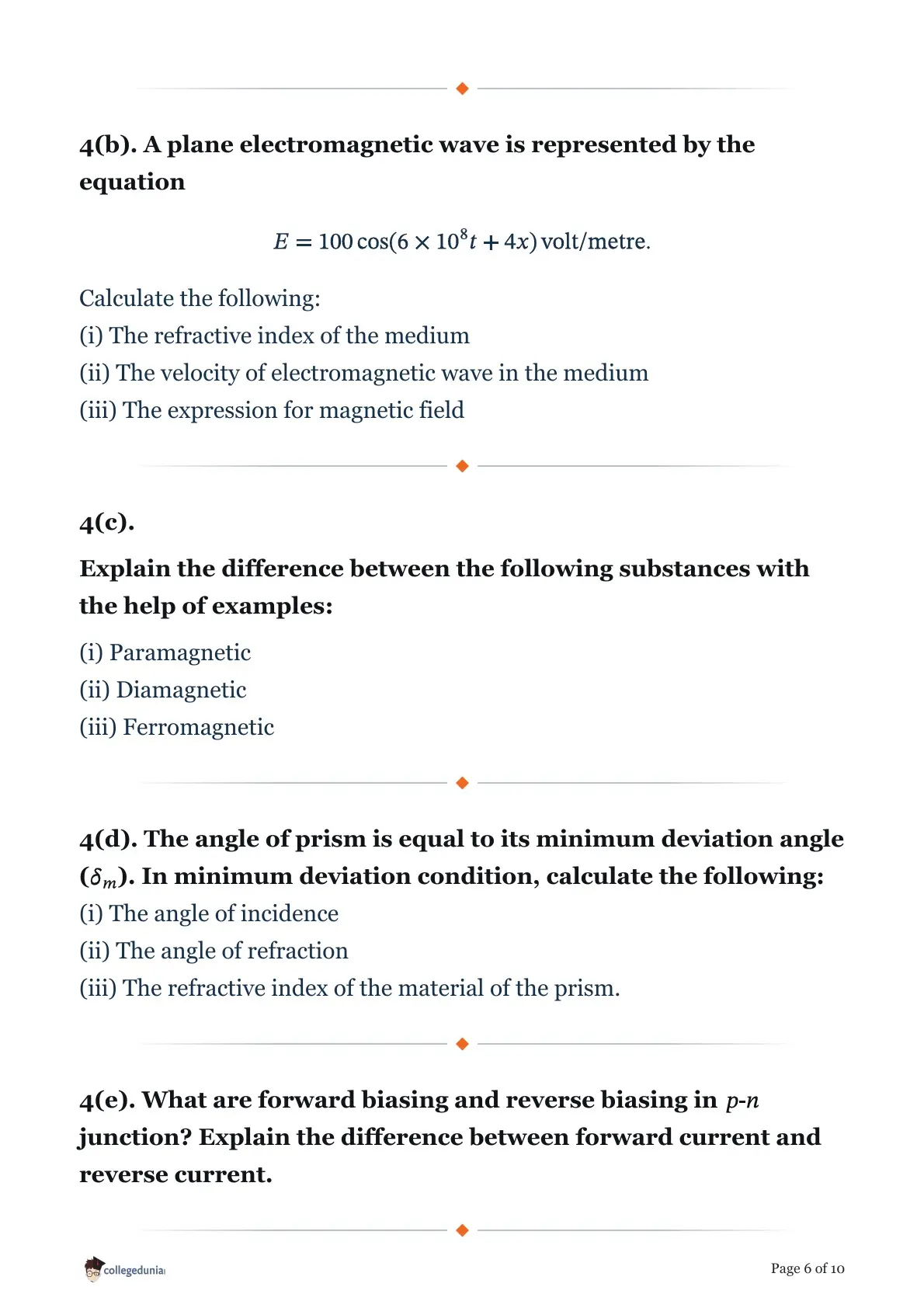
A plane electromagnetic wave is represented by the equation
\[
E = 100 \cos(6 \times 10^8 t + 4x) \, \text{volt/metre}.
\]
Calculate the following:
(i) The refractive index of the medium
(ii) The velocity of electromagnetic wave in the medium
(iii) The expression for magnetic field
Explain the difference between the following substances with the help of examples:
(i) Paramagnetic
(ii) Diamagnetic
(iii) Ferromagnetic
The angle of prism is equal to its minimum deviation angle (\( \delta_m \)). In minimum deviation condition, calculate the following:
(i) The angle of incidence
(ii) The angle of refraction
(iii) The refractive index of the material of the prism.
What are forward biasing and reverse biasing in \( p\text{-}n \) junction? Explain the difference between forward current and reverse current.
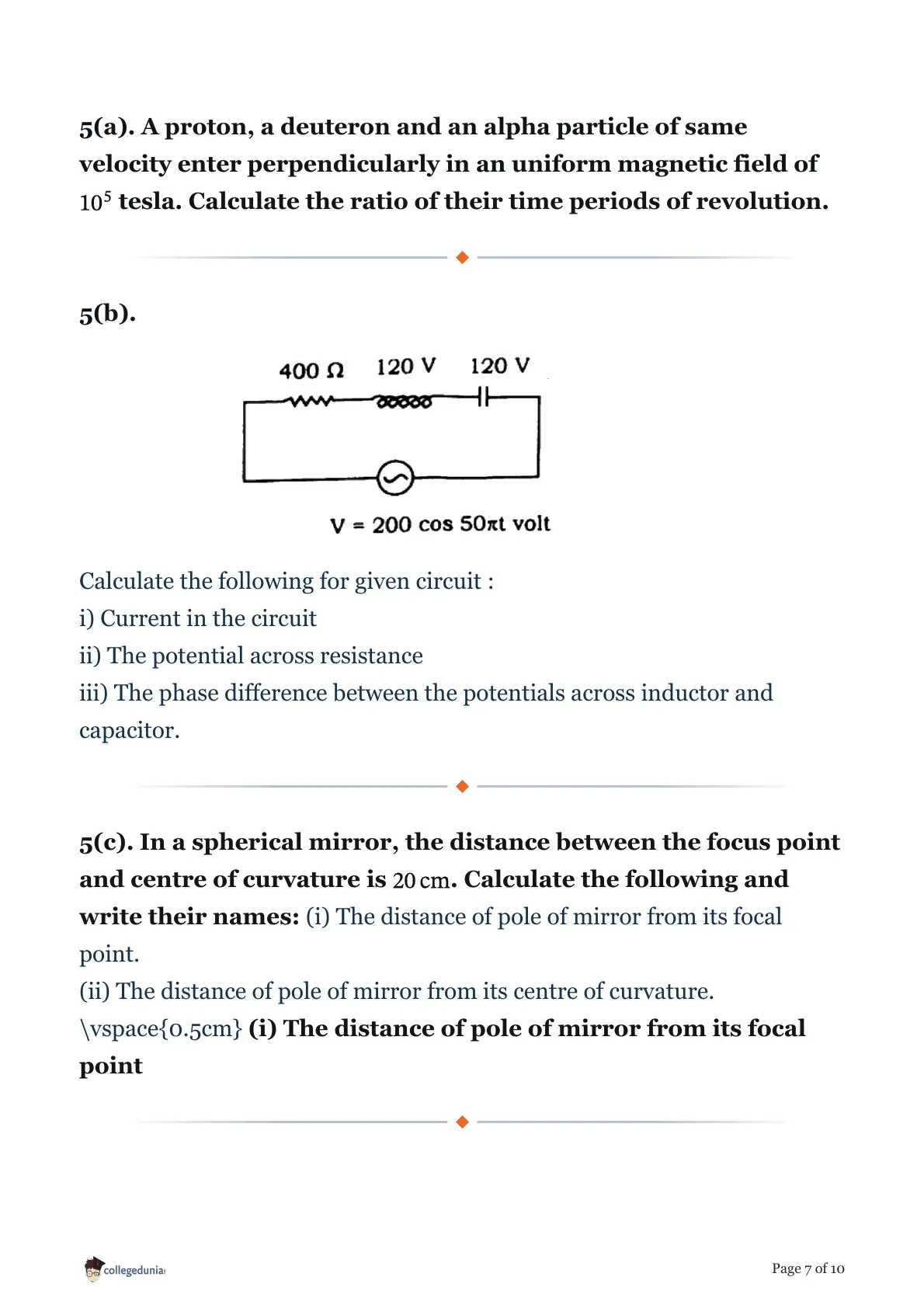
A proton, a deuteron and an alpha particle of same velocity enter perpendicularly in an uniform magnetic field of \( 10^5 \) tesla. Calculate the ratio of their time periods of revolution.

Calculate the following for given circuit :
i) Current in the circuit
ii) The potential across resistance
iii) The phase difference between the potentials across inductor and capacitor.
In a spherical mirror, the distance between the focus point and centre of curvature is \( 20 \, \text{cm} \). Calculate the following and write their names:
(i) The distance of pole of mirror from its focal point.
(ii) The distance of pole of mirror from its centre of curvature.
\vspace{0.5cm}
(i) The distance of pole of mirror from its focal point
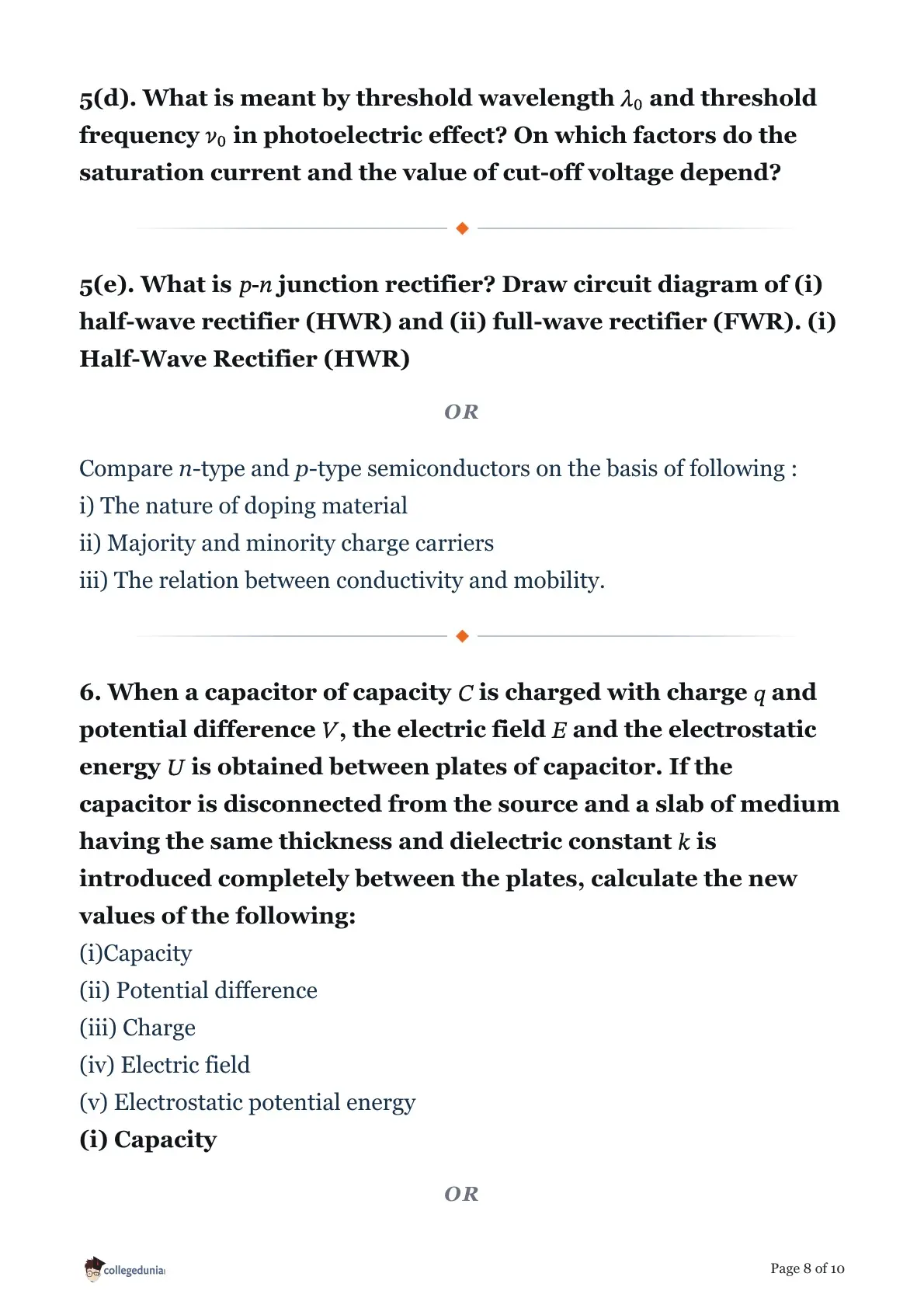
What is meant by threshold wavelength \( \lambda_0 \) and threshold frequency \( \nu_0 \) in photoelectric effect? On which factors do the saturation current and the value of cut-off voltage depend?
What is \( p\text{-}n \) junction rectifier? Draw circuit diagram of (i) half-wave rectifier (HWR) and (ii) full-wave rectifier (FWR). (i) Half-Wave Rectifier (HWR)
OR
Compare n-type and p-type semiconductors on the basis of following :
i) The nature of doping material
ii) Majority and minority charge carriers
iii) The relation between conductivity and mobility.
When a capacitor of capacity \( C \) is charged with charge \( q \) and potential difference \( V \), the electric field \( E \) and the electrostatic energy \( U \) is obtained between plates of capacitor. If the capacitor is disconnected from the source and a slab of medium having the same thickness and dielectric constant \( k \) is introduced completely between the plates, calculate the new values of the following:
(i)Capacity
(ii) Potential difference
(iii) Charge
(iv) Electric field
(v) Electrostatic potential energy
(i) Capacity
OR
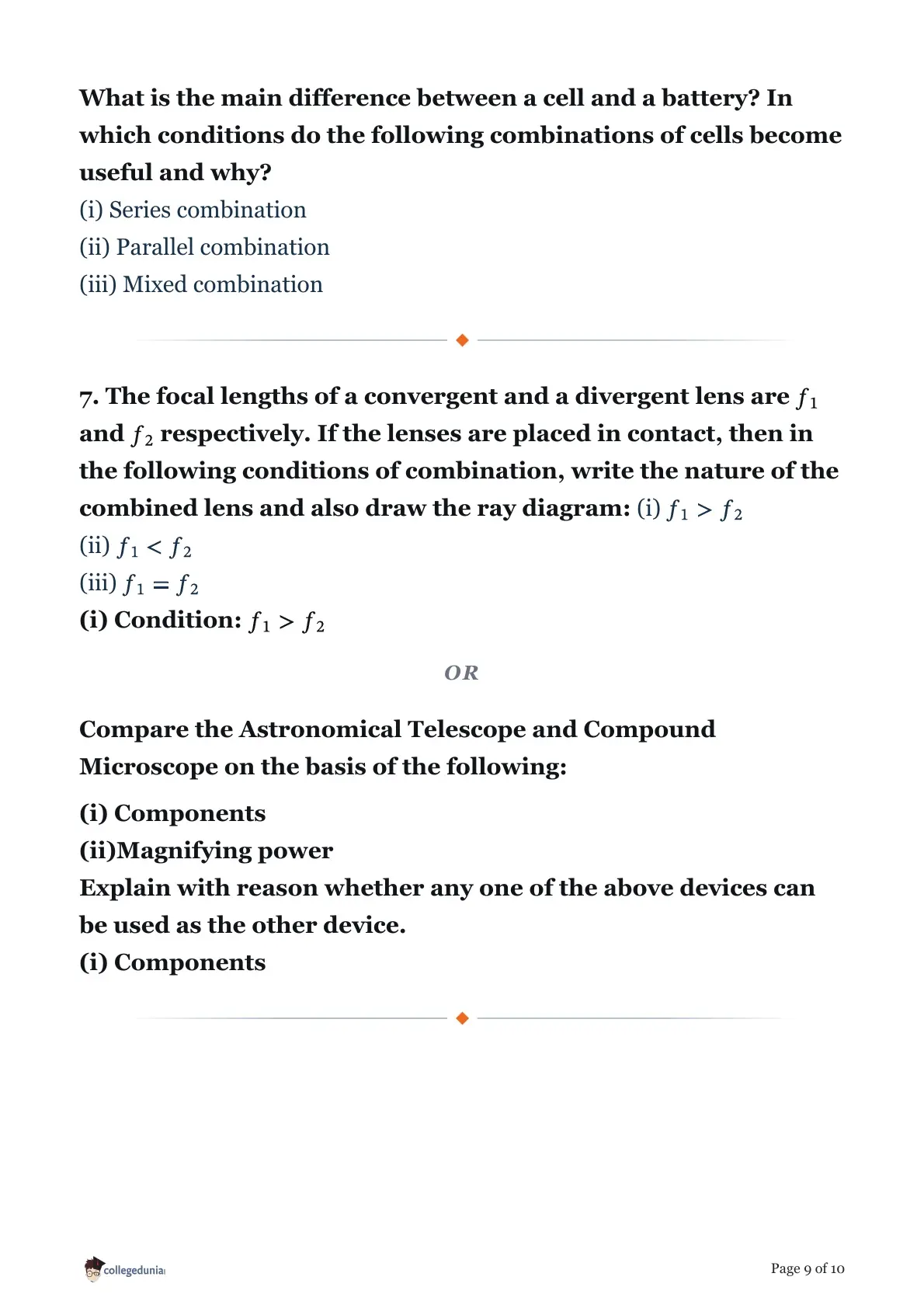
What is the main difference between a cell and a battery? In which conditions do the following combinations of cells become useful and why?
(i) Series combination
(ii) Parallel combination
(iii) Mixed combination
The focal lengths of a convergent and a divergent lens are \( f_1 \) and \( f_2 \) respectively. If the lenses are placed in contact, then in the following conditions of combination, write the nature of the combined lens and also draw the ray diagram:
(i) \( f_1>f_2 \)
(ii) \( f_1<f_2 \)
(iii) \( f_1 = f_2 \)
(i) Condition: \( f_1>f_2 \)
OR
Compare the Astronomical Telescope and Compound Microscope on the basis of the following:
(i) Components
(ii)Magnifying power
Explain with reason whether any one of the above devices can be used as the other device.
(i) Components
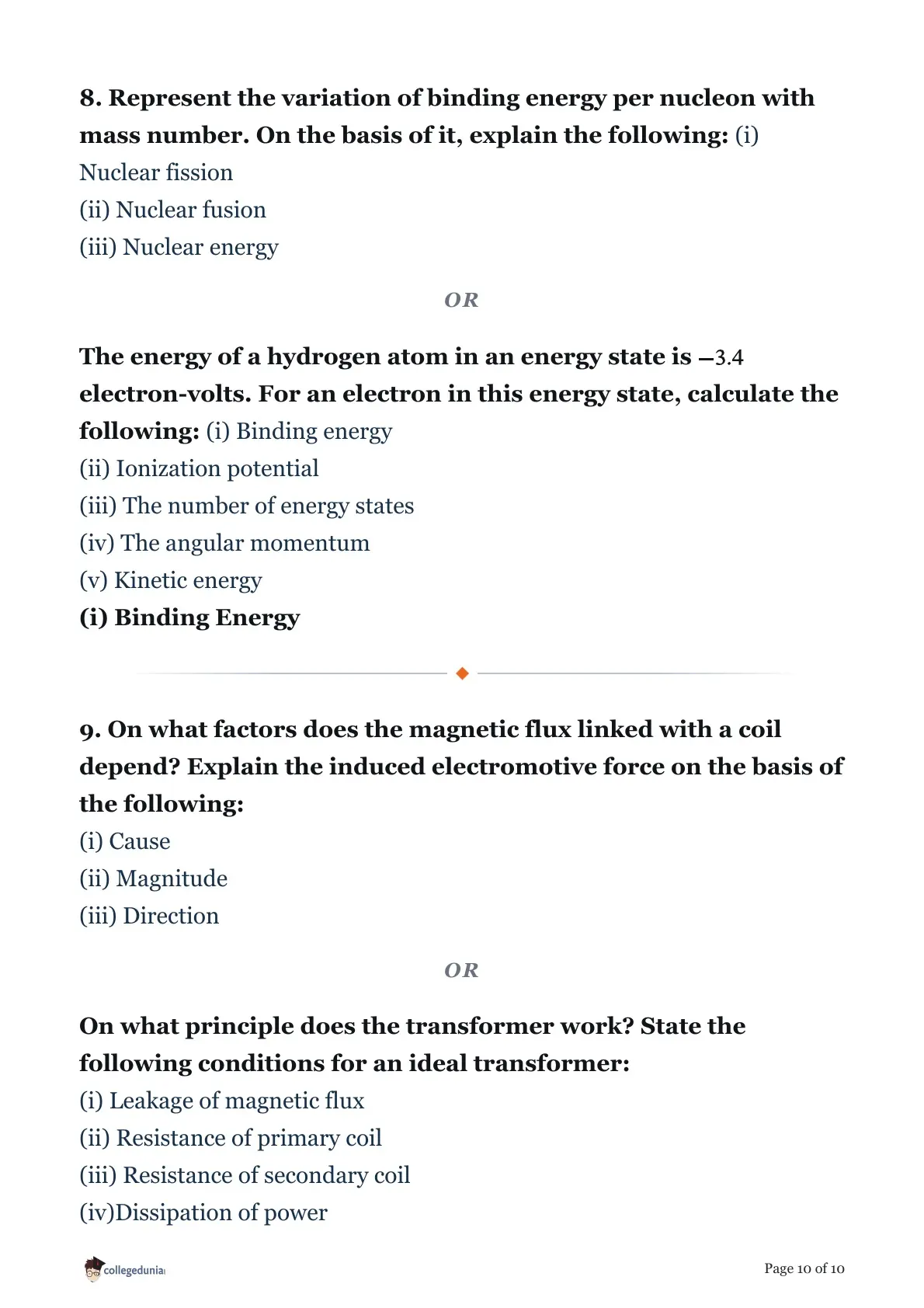
Represent the variation of binding energy per nucleon with mass number. On the basis of it, explain the following:
(i) Nuclear fission
(ii) Nuclear fusion
(iii) Nuclear energy
OR
The energy of a hydrogen atom in an energy state is \( -3.4 \) electron-volts. For an electron in this energy state, calculate the following:
(i) Binding energy
(ii) Ionization potential
(iii) The number of energy states
(iv) The angular momentum
(v) Kinetic energy
(i) Binding Energy
On what factors does the magnetic flux linked with a coil depend? Explain the induced electromotive force on the basis of the following:
(i) Cause
(ii) Magnitude
(iii) Direction
OR
On what principle does the transformer work? State the following conditions for an ideal transformer:
(i) Leakage of magnetic flux
(ii) Resistance of primary coil
(iii) Resistance of secondary coil
(iv)Dissipation of power
UP Board Class 12 Physics 2024 Question Paper Pattern
| Section | Q. No. | Type | Parts | Choice | Marks each | Total |
|---|---|---|---|---|---|---|
| A | 1 | Multiple choice | 6 | All compulsory | 1 | 6 |
| B | 2 | Very short answer | 6 | All compulsory | 1 | 6 |
| C | 3 | Short answer type-I | 4 | All compulsory | 2 | 8 |
| D | 4 and 5 | Short answer type-II | 5 + 5 | Q.5 has an internal choice | 3 | 30 |
| E | 6 to 9 | Long answer | 4 | Internal choice in every question | 5 | 20 |
| Total | 70 | |||||
UP Board Class 12 Physics 2024 (Code 346 FX) Chapter-Wise Marks Distribution
| Chapter | Marks | Weightage |
|---|---|---|
| Ray Optics and Optical Instruments | 12 | 17.1% |
| Semiconductor Electronics: Materials, Devices and Simple Circuits | 8 | 11.4% |
| Nuclei | 8 | 11.4% |
| Current Electricity | 7 | 10.0% |
| Electrostatic Potential and Capacitance | 7 | 10.0% |
| Dual Nature of Radiation and Matter | 6 | 8.6% |
| Moving Charges and Magnetism | 5 | 7.1% |
| Electromagnetic Induction | 5 | 7.1% |
| Electromagnetic Waves | 4 | 5.7% |
| Magnetism and Matter | 3 | 4.3% |
| Alternating Current | 3 | 4.3% |
| Electric Charges and Fields | 1 | 1.4% |
| Wave Optics | 1 | 1.4% |
| Total | 70 | 100% |
Marks are counted from the first alternative of each question as printed in the paper (Code 346 FX); internal-choice alternatives carry the same marks.



Comments