




UP Board Class 12 Physics 2024 Question Paper (Code 346 FW) is available for download here with the Collegedunia question paper PDF and the question paper with solutions PDF. The UP Board Class 12 Physics theory paper was held on 4 March 2024 from 2:00 PM to 5:15 PM (3 hours 15 minutes including 15 minutes of reading time) and carried 70 marks, with 30 of the 35 printed questions to be attempted.
Also Check: UP Board Class 12 Question Paper 2024 (All Subjects)
The Physics question paper (Code 346 FW) includes the following types of questions:
- Section A: Q.1, six multiple choice questions of 1 mark each
- Section B: Q.2, six very short answer questions of 1 mark each
- Section C: Q.3, four short answer type-I questions of 2 marks each
- Section D: Q.4 and Q.5, five short answer type-II questions of 3 marks each in each question
- Section E: Q.6 to Q.9, long answer questions of 5 marks each, each with an internal choice
UP Board Class 12 Physics 2024 Question Paper (Code 346 FW) with Solutions PDF
| UP Board Official PDF | CD PDF | CD PDF with Solutions |
|---|---|---|
| Download official PDF 4.02 MB | Download Collegedunia PDF 1.06 MB | Download solutions PDF 3.54 MB |
UP Board Class 12 Physics 2024 (Code 346 FW) Questions with Solutions
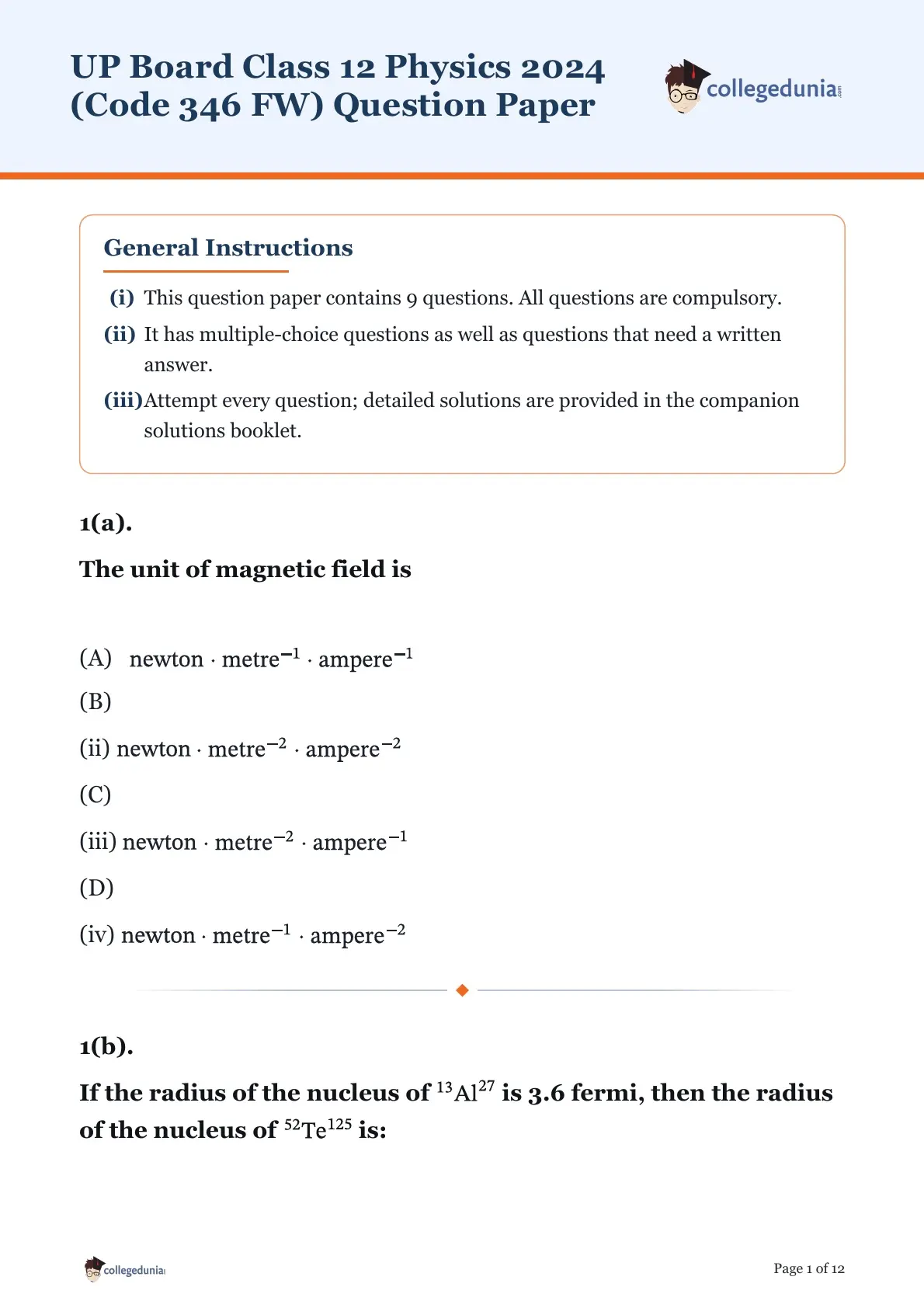
The unit of magnetic field is
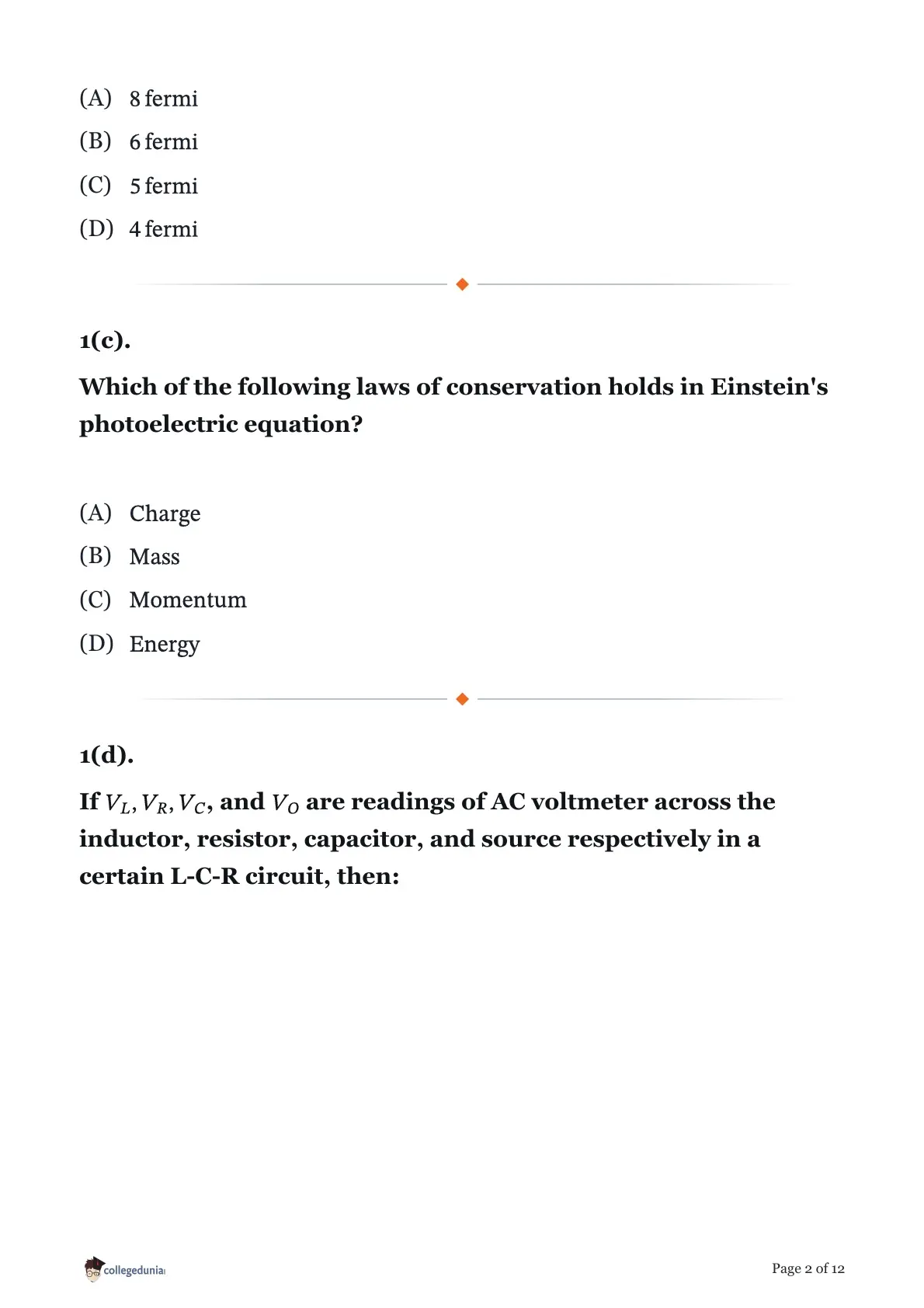
If the radius of the nucleus of \(^{13} \text{Al}^{27}\) is 3.6 fermi, then the radius of the nucleus of \(^{52} \text{Te}^{125}\) is:
Which of the following laws of conservation holds in Einstein's photoelectric equation?
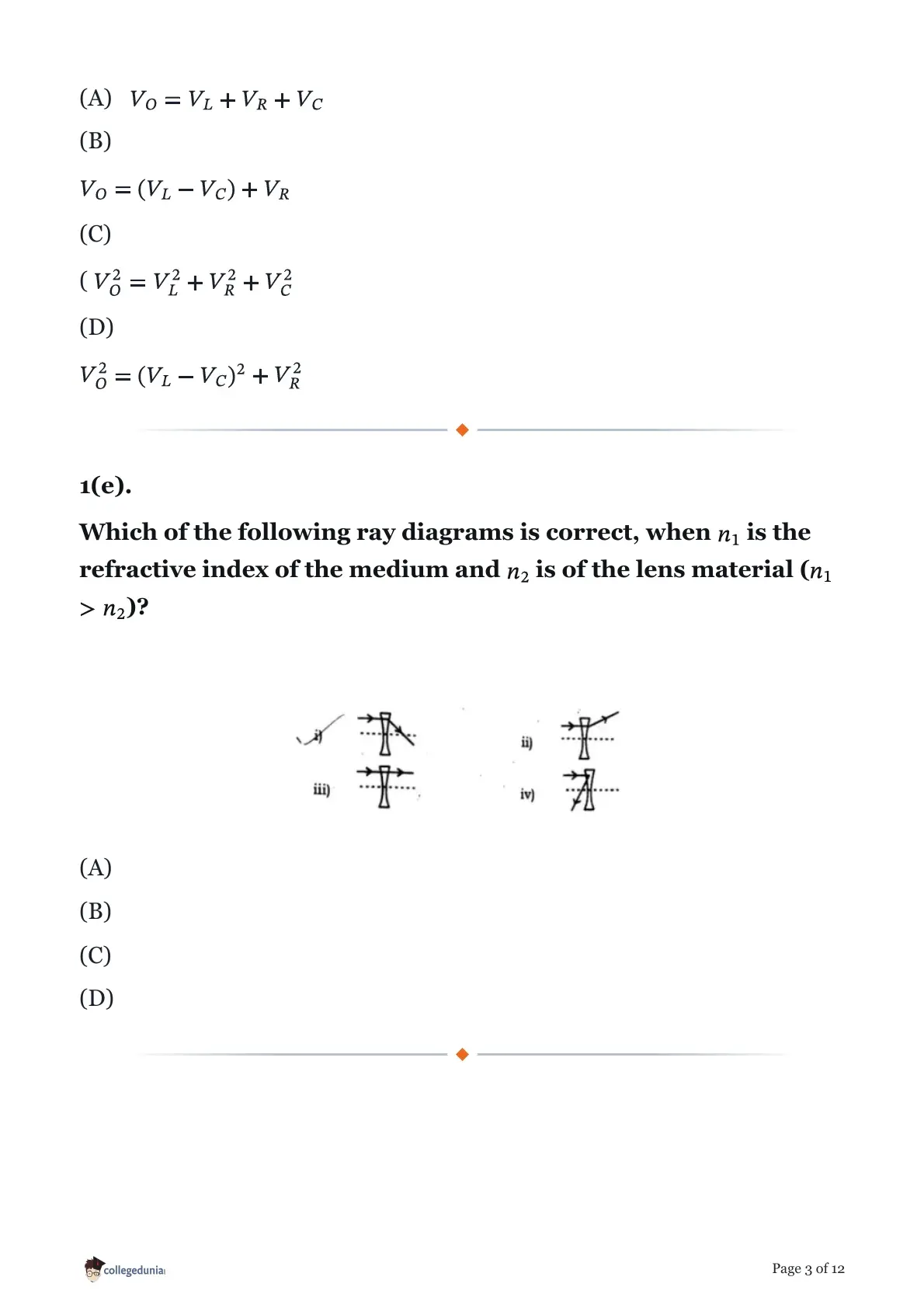
If \( V_L, V_R, V_C \), and \( V_O \) are readings of AC voltmeter across the inductor, resistor, capacitor, and source respectively in a certain L-C-R circuit, then:
Which of the following ray diagrams is correct, when \( n_1 \) is the refractive index of the medium and \( n_2 \) is of the lens material (\( n_1>n_2 \))?

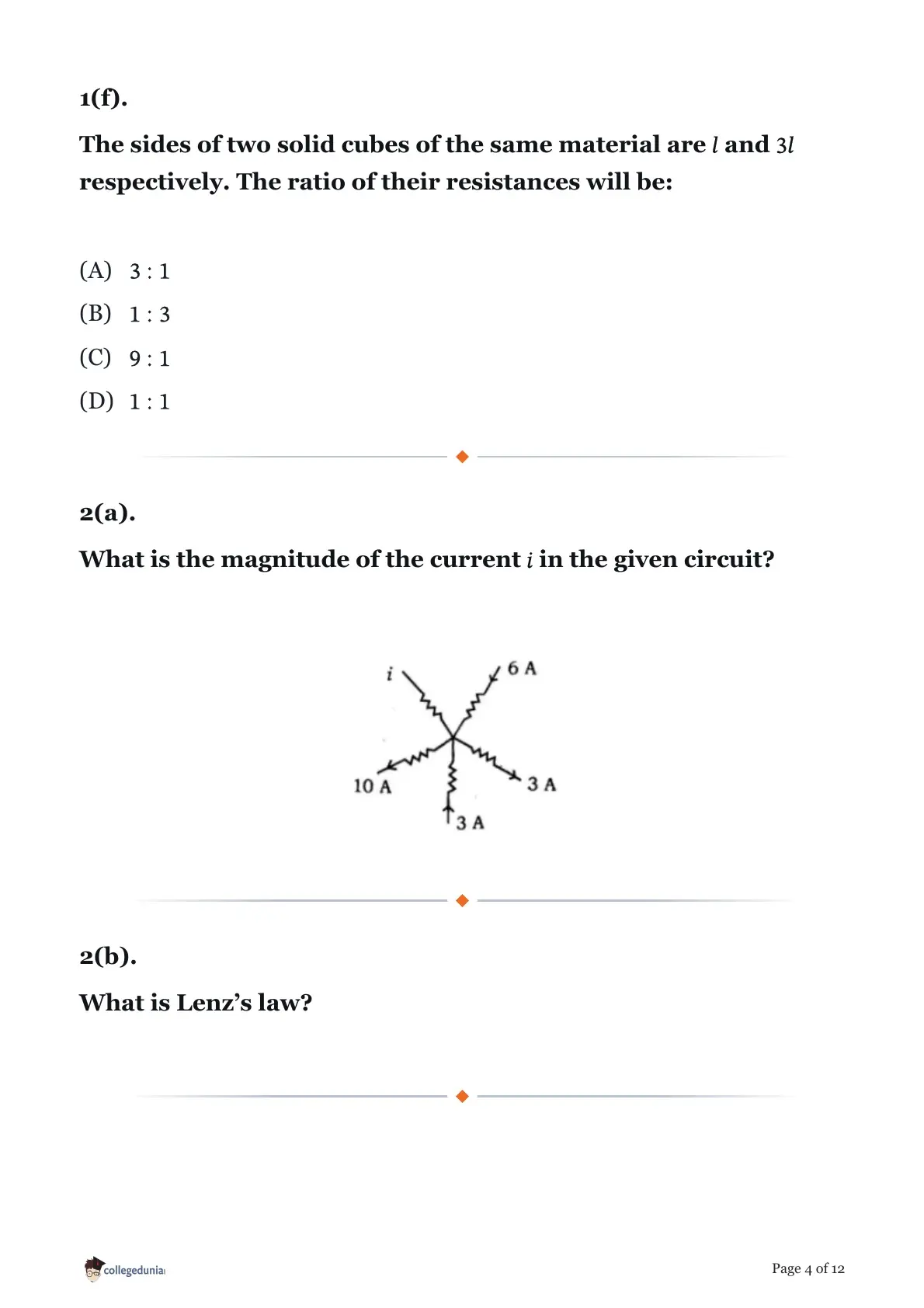
The sides of two solid cubes of the same material are \(l\) and \(3l\) respectively. The ratio of their resistances will be:

What is Lenz’s law?
What is meant by the depletion layer in a \(p\)-\(n\) junction?
Find out the angle of refraction in a medium of refractive index \(\sqrt{3}\), when the angle of incidence is \(60^\circ\).
The amplitude of the magnetic field of an electromagnetic wave in vacuum is \(B_0 = 510 \, \text{nT}\). What is the amplitude of the electric field of the wave?
What is the main difference between paramagnetic and ferromagnetic substances?
Explain the energy bands in solids.
State the conclusions of Rutherford's \( \alpha \)-particle scattering experiment.
If the corresponding de Broglie wavelengths of a proton and a neutron are obtained as same, then which of the two will have greater kinetic energy?
A current is passed in a wire of \( 4 \, \Omega \) resistance by a battery. Find out the internal resistance of the battery, when current is passed in another \( 9 \, \Omega \) resistor by the same battery; while the same heat is produced during the same time in both wires.
A charge \( Q \) is distributed over two concentric hollow spheres of radii \( r \) and \( R \) (\( R>r \)) such that their surface charge densities are equal. Find the electric potential at their common center.
What are electromagnetic waves ? Explain two characteristics of these waves.
What is Biot-Savart law? Obtain the formula and direction for the intensity of the magnetic field on the axis of an anti-clockwise current-carrying loop with its help.
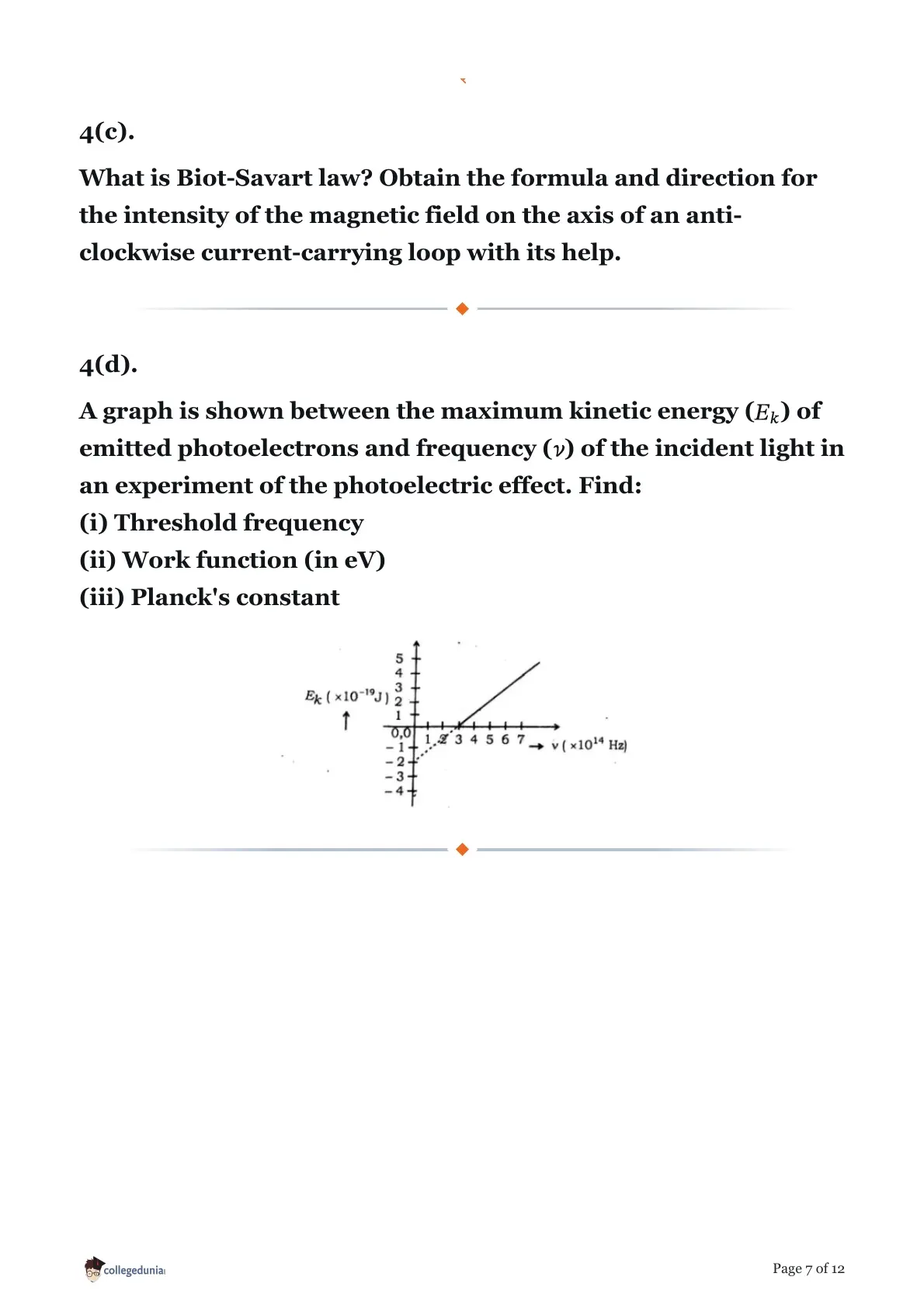
A graph is shown between the maximum kinetic energy (\( E_k \)) of emitted photoelectrons and frequency (\( \nu \)) of the incident light in an experiment of the photoelectric effect. Find:
(i) Threshold frequency
(ii) Work function (in eV)
(iii) Planck's constant

Define the coefficient of mutual inductance.
The coefficient of mutual inductance (\(M\)) is a measure of the ability of one coil to induce an electromotive force (EMF) in a nearby coil due to a changing current in the first coil. It is given by: \[ e = -M \frac{di}{dt} \]
If a current \( i = 10 \sin(100 \pi t) \, \mathrm{A} \) is flowing in a primary coil, and the maximum induced electromotive force in the secondary coil placed near it is \( 5 \pi \, \mathrm{volt} \), then the coefficient of mutual induction between these coils needs to be determined.
A concave mirror forms a real image 4 times the size of an object. The magnification is 3 times by moving the object 3 cm away from the mirror. Find out the radius of curvature of the mirror.
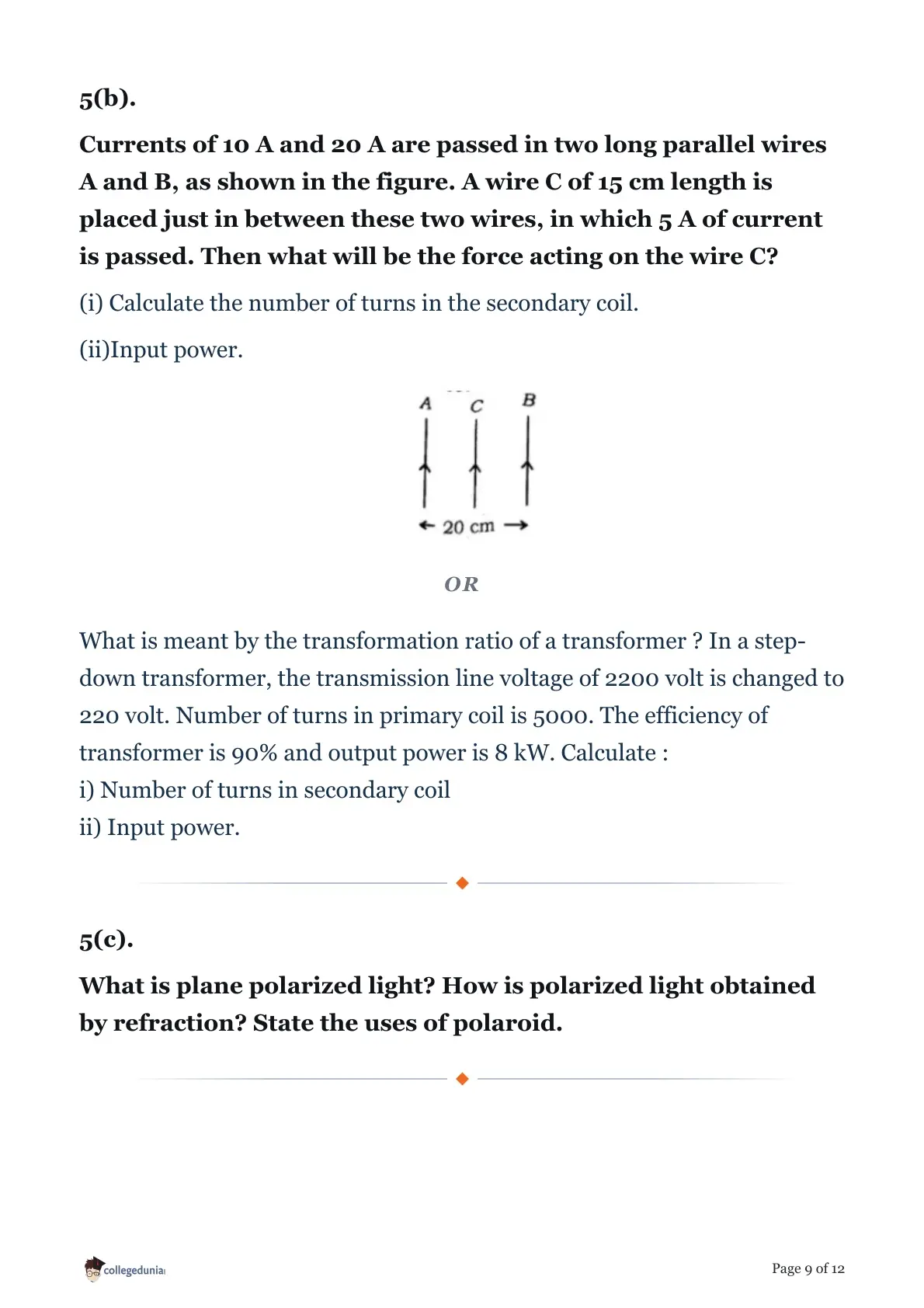
Currents of 10 A and 20 A are passed in two long parallel wires A and B, as shown in the figure. A wire C of 15 cm length is placed just in between these two wires, in which 5 A of current is passed. Then what will be the force acting on the wire C?
(i) Calculate the number of turns in the secondary coil.
(ii)Input power.

OR
What is meant by the transformation ratio of a transformer ? In a step-down transformer, the transmission line voltage of 2200 volt is changed to 220 volt. Number of turns in primary coil is 5000. The efficiency of transformer is 90% and output power is 8 kW. Calculate :
i) Number of turns in secondary coil
ii) Input power.
What is plane polarized light? How is polarized light obtained by refraction? State the uses of polaroid.
Obtain the formula for the internal resistance of a cell in terms of \( E \), \( V \), and \( R \), where \( E \), \( V \), and \( R \) are the electromotive force of the cell, potential difference across the external resistance, and external resistance, respectively.
What do you mean by the current sensitivity of a moving coil galvanometer? Resistance of a galvanometer is \( 50 \, \Omega \) and for full-scale deflection, the current is \( 0.05 \, \mathrm{A} \). What would be the required length of a wire to convert it into an ammeter of 5 A range? (Area of cross-section of wire = \( 2.7 \times 10^{-6} \, \mathrm{m^2} \), specific resistance of the wire material = \( 5.0 \times 10^{-7} \, \Omega \cdot \mathrm{m} \))
Explain the working of forward biased configuration of a p-n junction diode. Draw by making a graph between forward voltage and forward current, show the knee voltage.
OR
Explain the working of reverse biased configuration of a p-n junction diode. Drawing a graph between reverse voltage and reverse current, show the breakdown voltage.
Show that the circumference of the orbit of an electron revolving in the \( n \)-th orbit is equal to \( n\lambda \) with the help of Bohr's quantum theory. Also, show the emission and absorption spectral lines between energy levels \( n = 1 \) and \( n = 3 \) of hydrogen atom.
OR
What do you mean by binding energy? Atomic mass of \( {}_{8}^{16}\mathrm{O} = 16.00000 \) amu. Find out its binding energy per nucleon.
Given:
mass of electron = 0.00055 amu
mass of proton = 1.007593 amu
mass of neutron = 1.008982 amu
1 amu = 931 MeV
Differentiate between interference and diffraction of light. Explain qualitatively the diffraction phenomenon of light by a single slit. Light of 6000 Ã… wavelength is incident normally on a single slit of width \( 3 \times 10^{-4} \, \text{cm} \). Find out the angular width of the central maxima.
OR
Draw a ray diagram of reflecting telescope. The magnifying power of an astronomical telescope is 5 and distance between the objective and eye-piece lenses is 36 cm. If the final image is formed at infinity, then find out focal lengths of the two lenses.

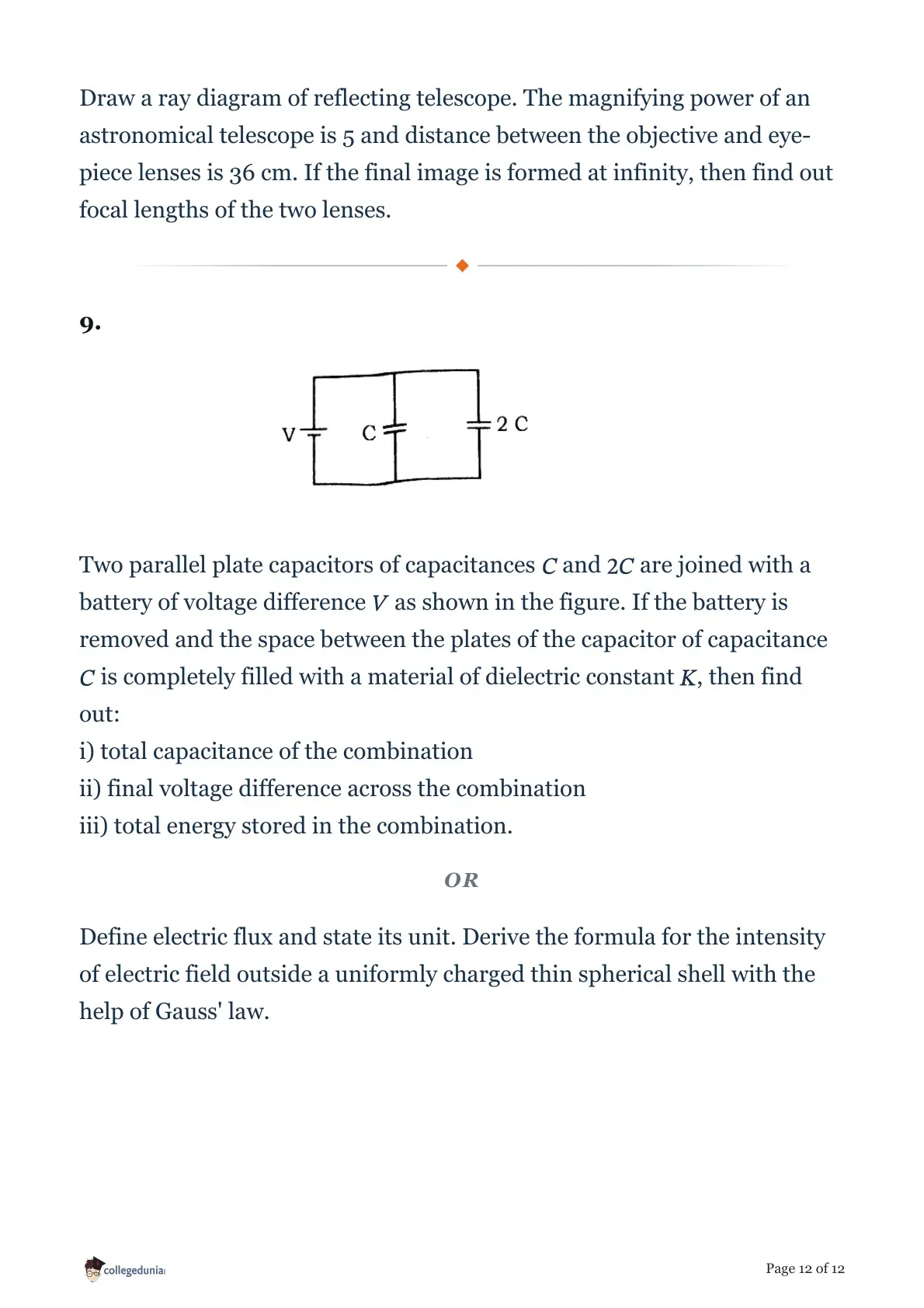
Two parallel plate capacitors of capacitances \( C \) and \( 2C \) are joined with a battery of voltage difference \( V \) as shown in the figure. If the battery is removed and the space between the plates of the capacitor of capacitance \( C \) is completely filled with a material of dielectric constant \( K \), then find out:
i) total capacitance of the combination
ii) final voltage difference across the combination
iii) total energy stored in the combination.
OR
Define electric flux and state its unit. Derive the formula for the intensity of electric field outside a uniformly charged thin spherical shell with the help of Gauss' law.
UP Board Class 12 Physics 2024 Question Paper Pattern
| Section | Q. No. | Type | Parts | Choice | Marks each | Total |
|---|---|---|---|---|---|---|
| A | 1 | Multiple choice | 6 | All compulsory | 1 | 6 |
| B | 2 | Very short answer | 6 | All compulsory | 1 | 6 |
| C | 3 | Short answer type-I | 4 | All compulsory | 2 | 8 |
| D | 4 and 5 | Short answer type-II | 5 + 5 | Q.5 has an internal choice | 3 | 30 |
| E | 6 to 9 | Long answer | 4 | Internal choice in every question | 5 | 20 |
| Total | 70 | |||||
UP Board Class 12 Physics 2024 (Code 346 FW) Chapter-Wise Marks Distribution
| Chapter | Marks | Weightage |
|---|---|---|
| Moving Charges and Magnetism | 10 | 14.3% |
| Semiconductor Electronics: Materials, Devices and Simple Circuits | 8 | 11.4% |
| Electrostatic Potential and Capacitance | 8 | 11.4% |
| Wave Optics | 8 | 11.4% |
| Current Electricity | 7 | 10.0% |
| Atoms | 7 | 10.0% |
| Dual Nature of Radiation and Matter | 6 | 8.6% |
| Ray Optics and Optical Instruments | 5 | 7.1% |
| Electromagnetic Induction | 4 | 5.7% |
| Electromagnetic Waves | 4 | 5.7% |
| Nuclei | 1 | 1.4% |
| Alternating Current | 1 | 1.4% |
| Magnetism and Matter | 1 | 1.4% |
| Total | 70 | 100% |
Marks are counted from the first alternative of each question as printed in the paper (Code 346 FW); internal-choice alternatives carry the same marks.



Comments