




The UP Board Class 12 Physics 2026 question paper with solutions (Set 346 DU) is available here for free download. UP Board Class 12 Physics 2026 was conducted by the UP Madhyamik Shiksha Parishad (UPMSP) on February 27, 2026, as a 70-mark, 3-hour-15-minute theory paper of 30 questions across five sections (A to E).
| UP Board Class 12 Physics 2026 Question Paper with Solutions (Set 346 DU) | Download PDF | Check Solutions |
UP Board Class 12 Physics 2026 Questions with Solutions
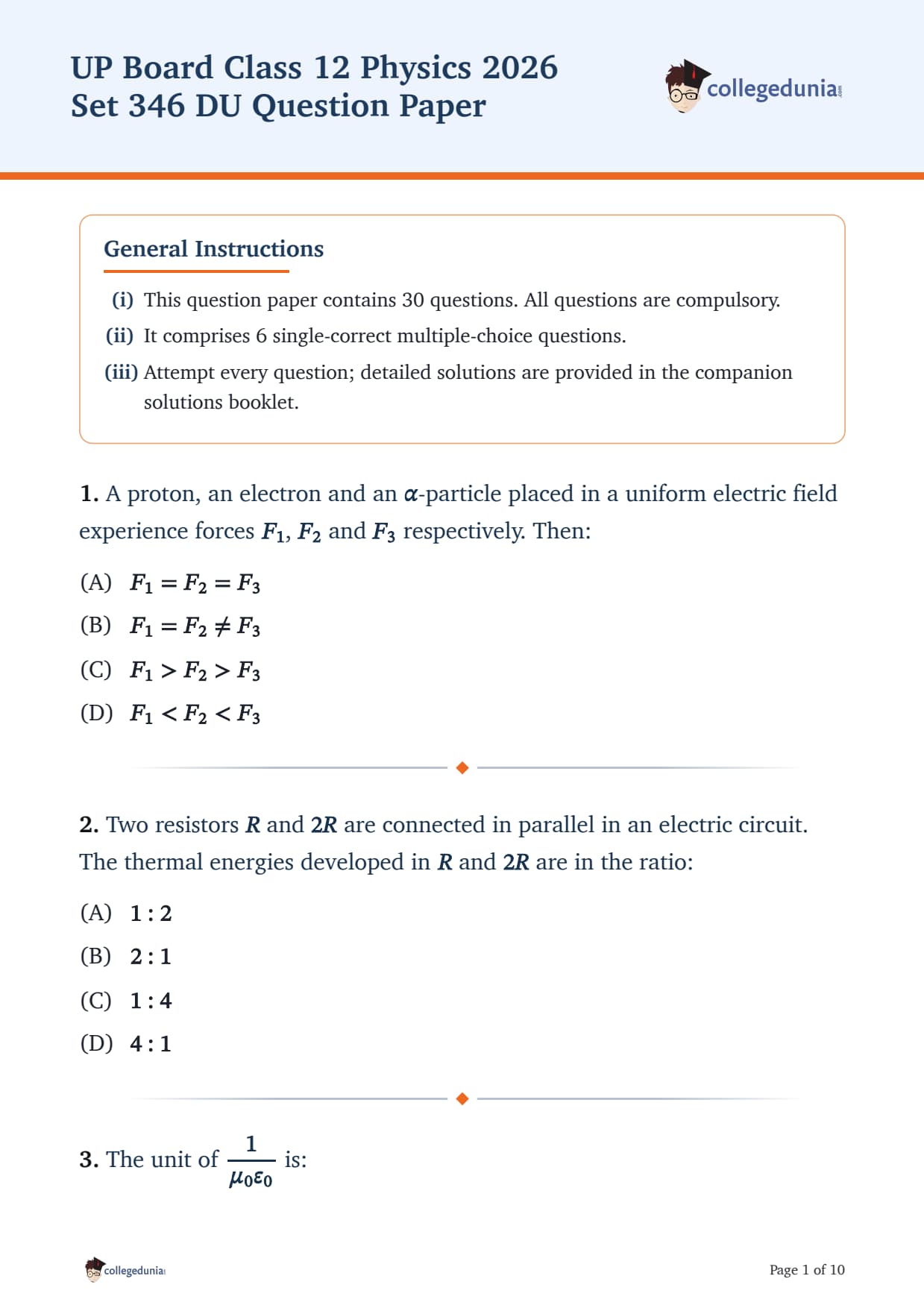
A proton, an electron and an \(\alpha\)-particle placed in a uniform electric field experience forces \(F_1\), \(F_2\) and \(F_3\) respectively. Then:
Two resistors \(R\) and \(2R\) are connected in parallel in an electric circuit. The thermal energies developed in \(R\) and \(2R\) are in the ratio:
The unit of \(\dfrac{1}{\mu_0 \varepsilon_0}\) is:
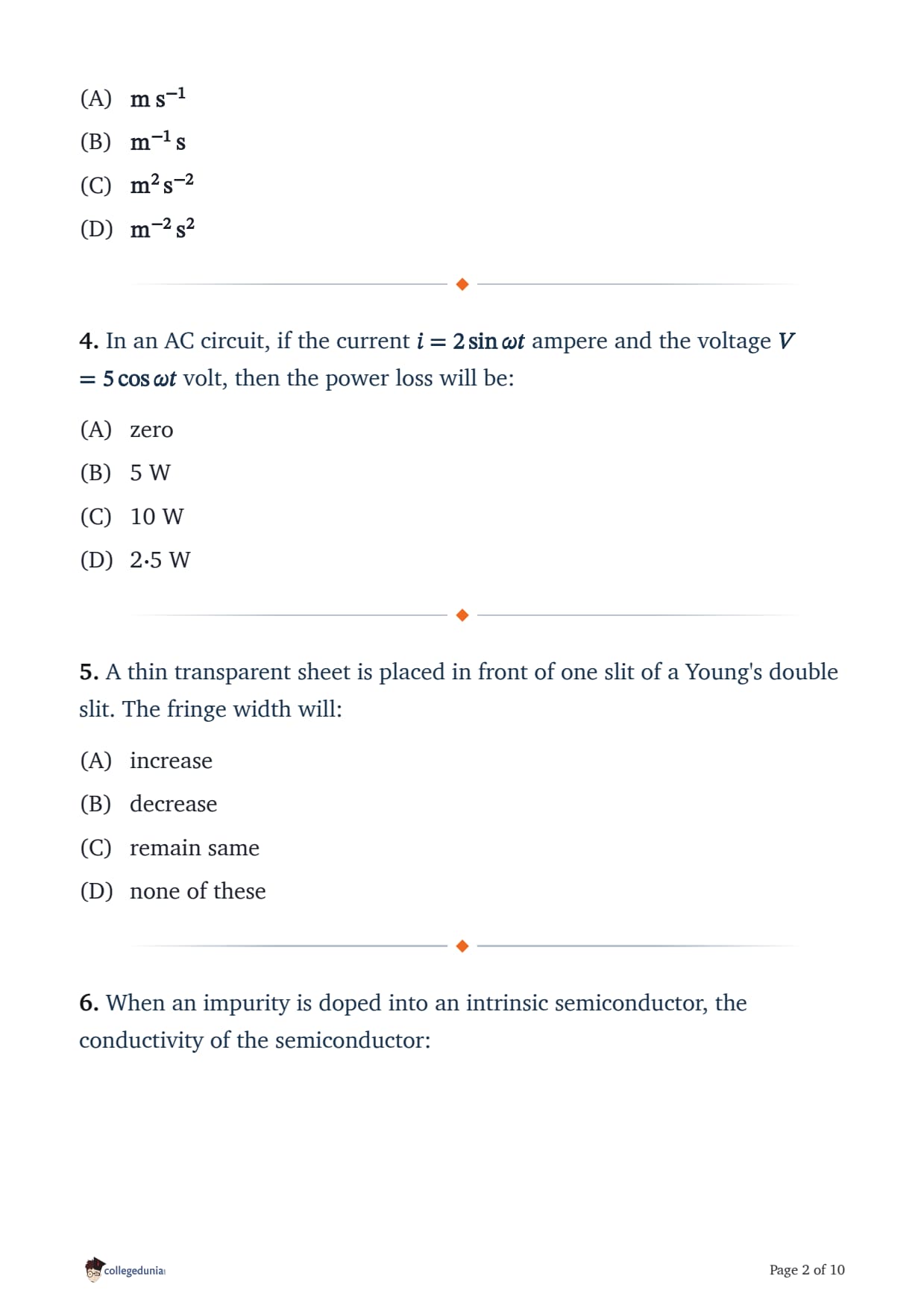
In an AC circuit, if the current \(i = 2\sin\omega t\) ampere and the voltage \(V = 5\cos\omega t\) volt, then the power loss will be:
A thin transparent sheet is placed in front of one slit of a Young's double slit. The fringe width will:
When an impurity is doped into an intrinsic semiconductor, the conductivity of the semiconductor:
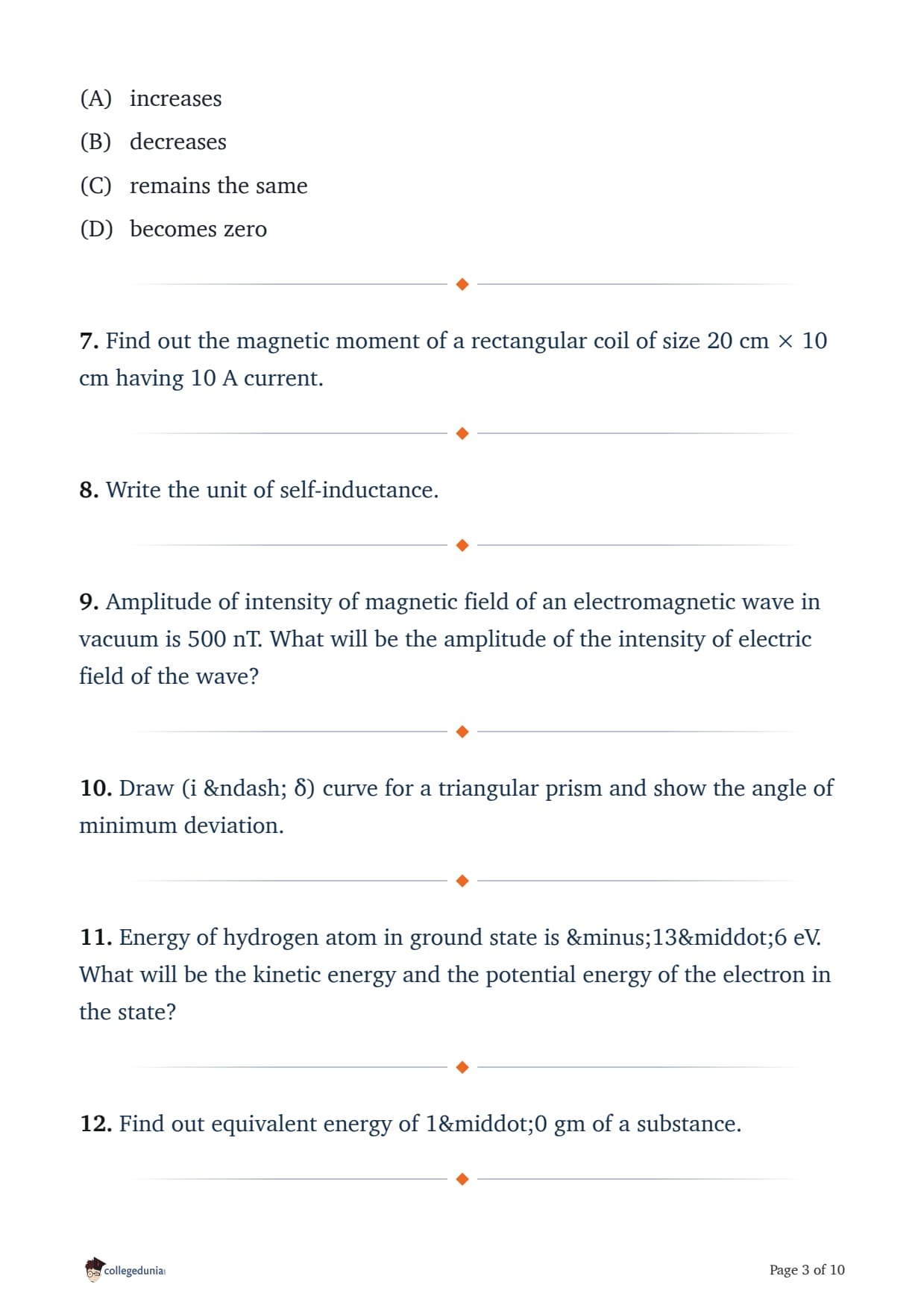
Find out the magnetic moment of a rectangular coil of size 20 cm × 10 cm having 10 A current.
Write the unit of self-inductance.
Amplitude of intensity of magnetic field of an electromagnetic wave in vacuum is 500 nT. What will be the amplitude of the intensity of electric field of the wave?
Draw (i – δ) curve for a triangular prism and show the angle of minimum deviation.
Energy of hydrogen atom in ground state is −13·6 eV. What will be the kinetic energy and the potential energy of the electron in the state?
Find out equivalent energy of 1·0 gm of a substance.
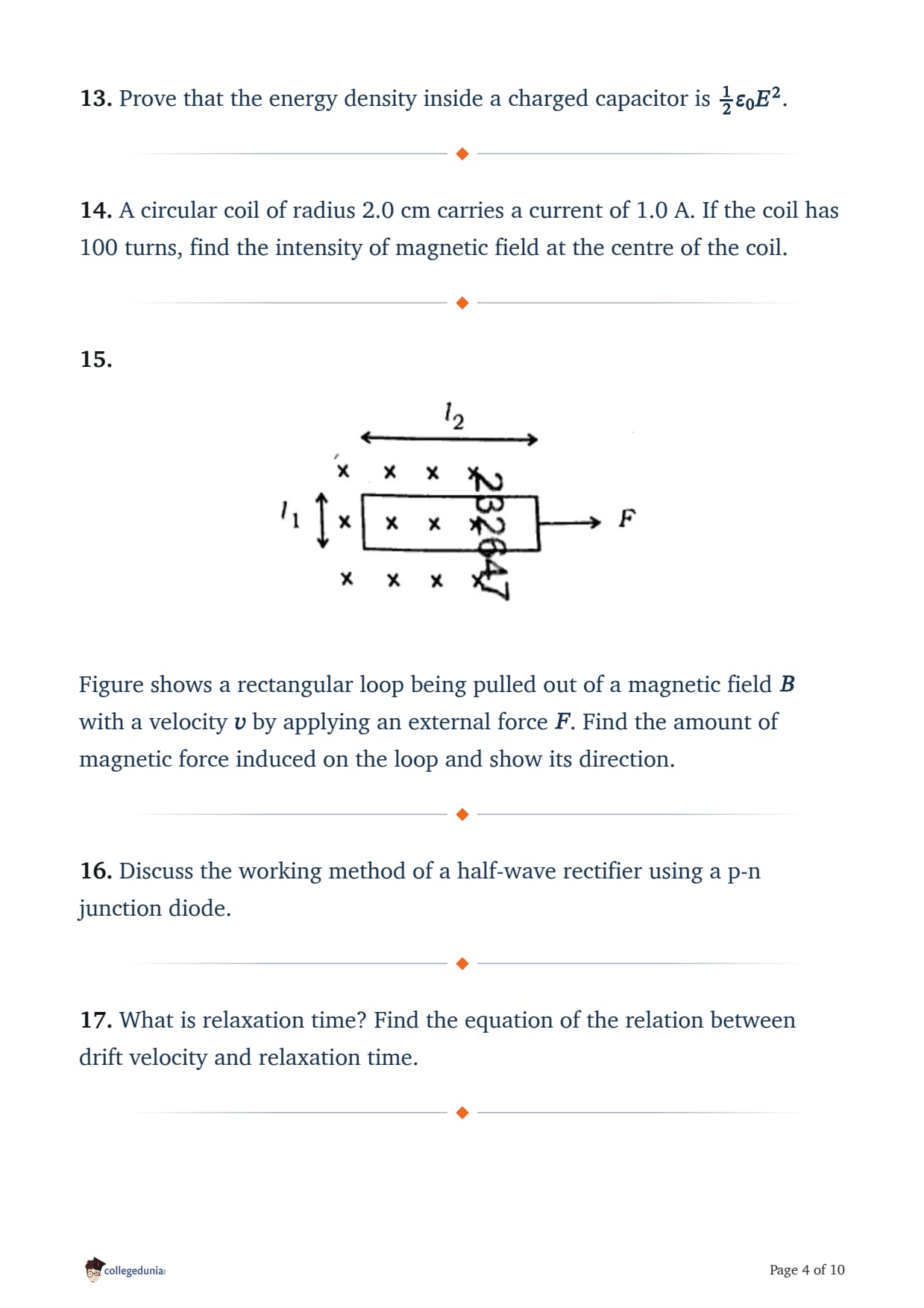
Prove that the energy density inside a charged capacitor is \( \tfrac{1}{2}\varepsilon_0 E^2 \).
A circular coil of radius 2.0 cm carries a current of 1.0 A. If the coil has 100 turns, find the intensity of magnetic field at the centre of the coil.

Figure shows a rectangular loop being pulled out of a magnetic field \( B \) with a velocity \( v \) by applying an external force \( F \). Find the amount of magnetic force induced on the loop and show its direction.
Discuss the working method of a half-wave rectifier using a p-n junction diode.
What is relaxation time? Find the equation of the relation between drift velocity and relaxation time.
In an L-C-R circuit, the inductive reactance of a coil is 400 Ω and the capacitive reactance of a condenser is 100 Ω and \( R = 400\ \Omega \). Find the power factor of the circuit.
Explain total internal reflection. Discuss the working of an optical fibre.
The energy of a photon is 10 eV. Determine (i) the dynamic mass of the photon, (ii) the frequency of the photon.
(Given: \( h = 6.6\times10^{-34}\ \text{J s} \), \( c = 3\times10^{8}\ \text{m/s} \), \( 1\ \text{eV} = 1.6\times10^{-19}\ \text{J} \).)
Explain displacement current and write the formula related to Ampere-Maxwell's law.
Draw the ray diagram of a compound microscope. Find the expression for its magnifying power.

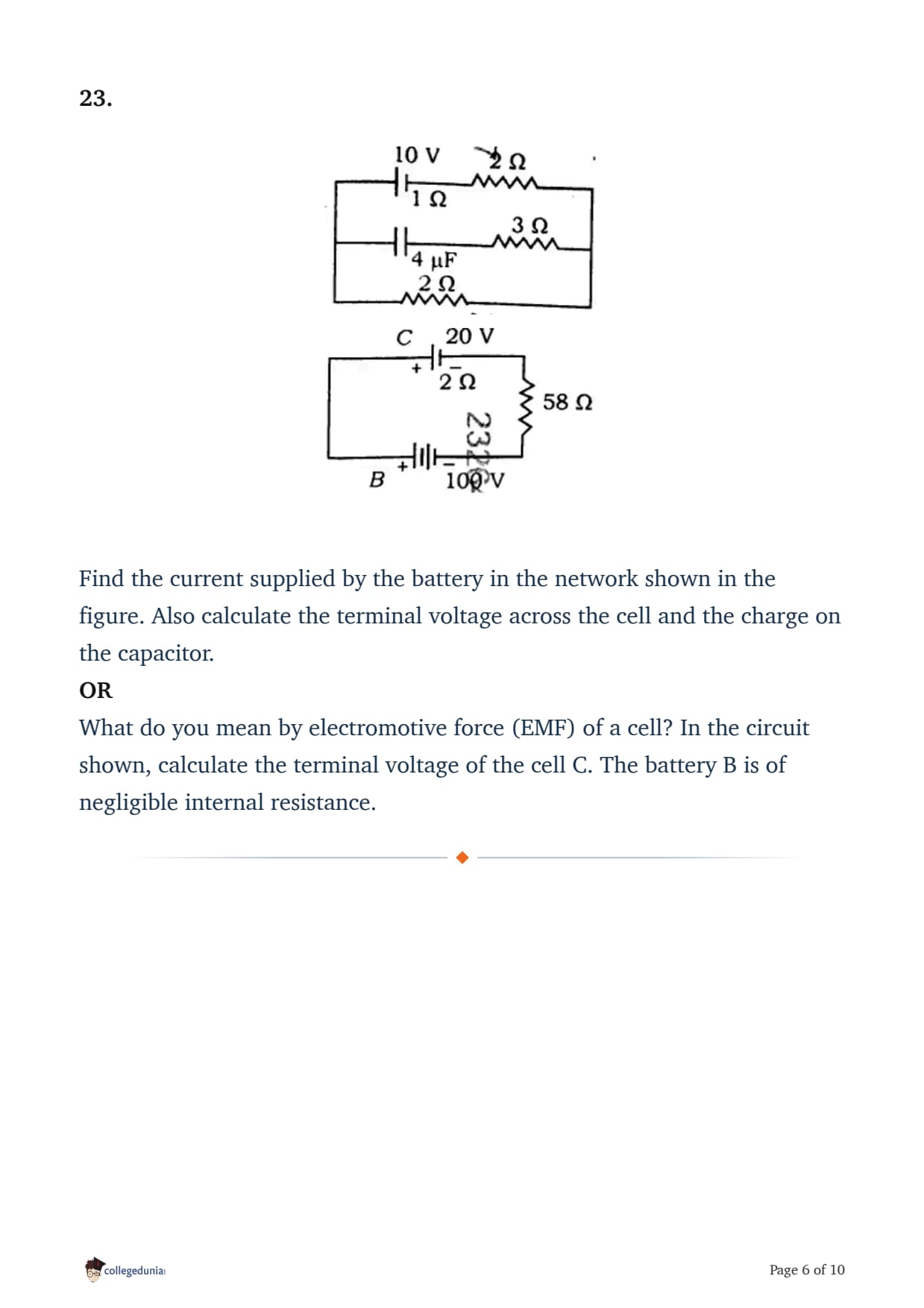
Find the current supplied by the battery in the network shown in the figure. Also calculate the terminal voltage across the cell and the charge on the capacitor.
OR
What do you mean by electromotive force (EMF) of a cell? In the circuit shown, calculate the terminal voltage of the cell C. The battery B is of negligible internal resistance.

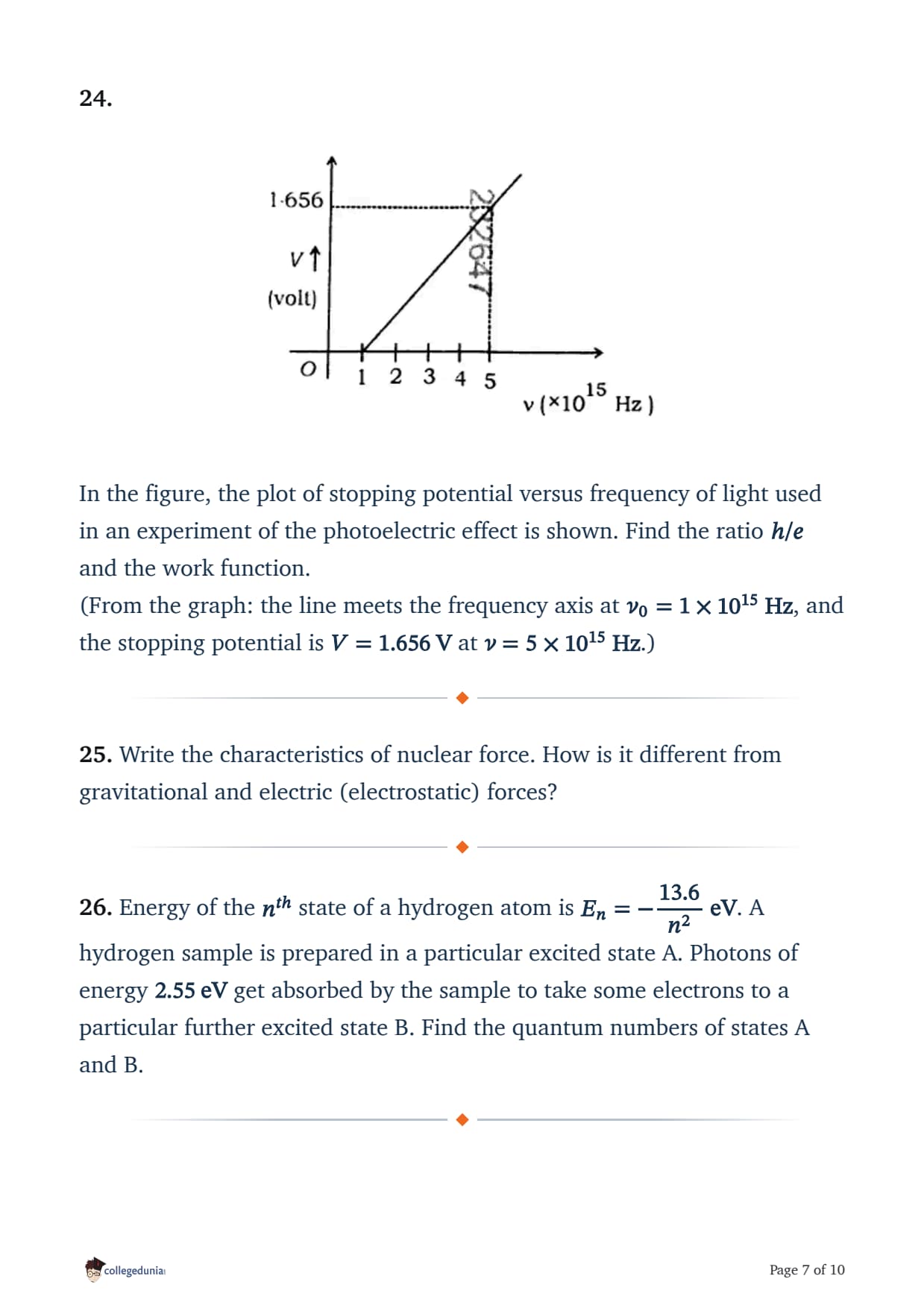
In the figure, the plot of stopping potential versus frequency of light used in an experiment of the photoelectric effect is shown. Find the ratio \( h/e \) and the work function.
(From the graph: the line meets the frequency axis at \( \nu_0 = 1\times10^{15}\ \text{Hz} \), and the stopping potential is \( V = 1.656\ \text{V} \) at \( \nu = 5\times10^{15}\ \text{Hz} \).)
Write the characteristics of nuclear force. How is it different from gravitational and electric (electrostatic) forces?
Energy of the \(n^{th}\) state of a hydrogen atom is \(E_n=-\dfrac{13.6}{n^2}\ \text{eV}\). A hydrogen sample is prepared in a particular excited state A. Photons of energy \(2.55\ \text{eV}\) get absorbed by the sample to take some electrons to a particular further excited state B. Find the quantum numbers of states A and B.

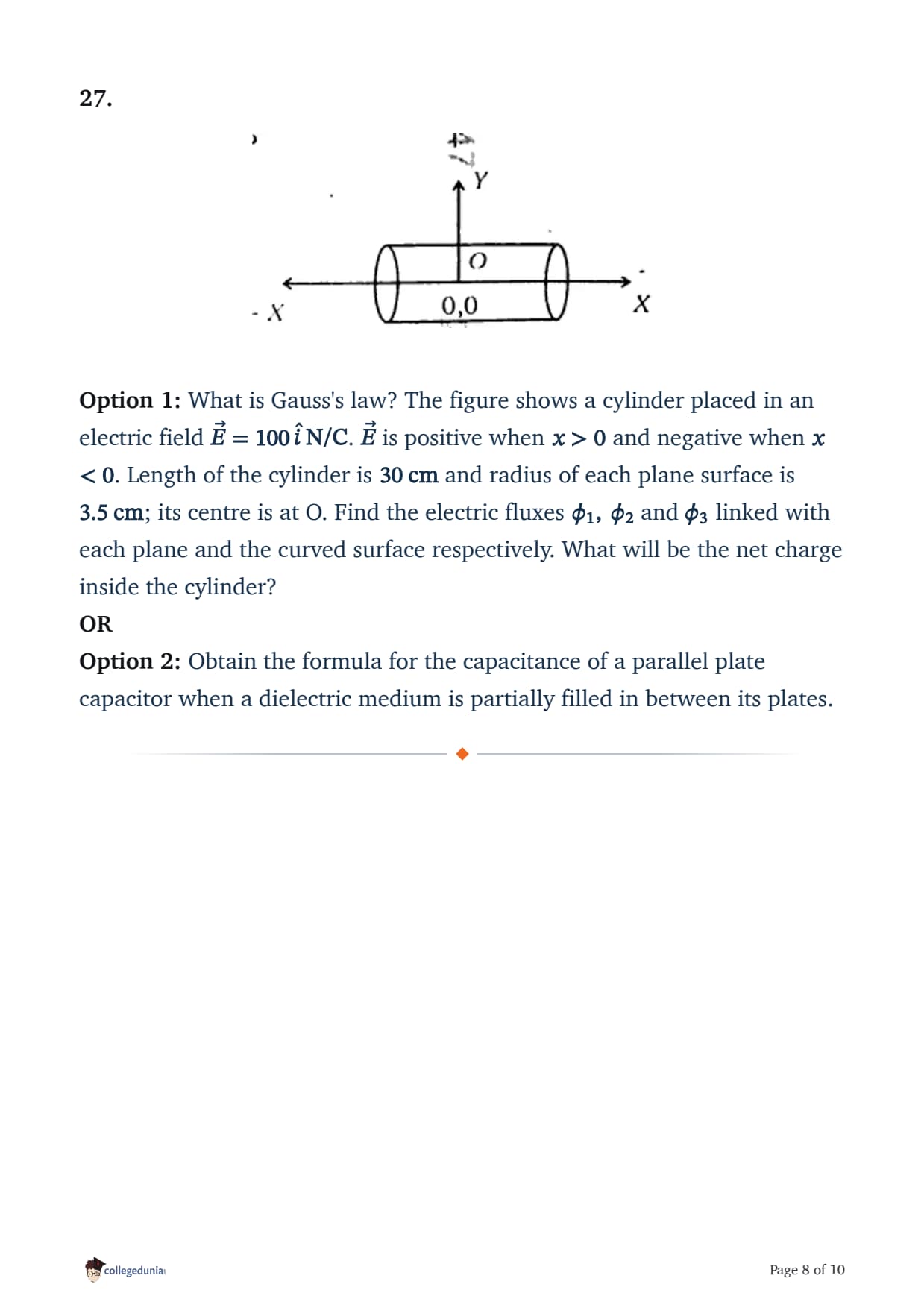
Option 1: What is Gauss's law? The figure shows a cylinder placed in an electric field \(\vec{E}=100\,\hat{i}\ \text{N/C}\). \(\vec{E}\) is positive when \(x>0\) and negative when \(x<0\). Length of the cylinder is \(30\ \text{cm}\) and radius of each plane surface is \(3.5\ \text{cm}\); its centre is at O. Find the electric fluxes \(\phi_1,\ \phi_2\) and \(\phi_3\) linked with each plane and the curved surface respectively. What will be the net charge inside the cylinder?
OR
Option 2: Obtain the formula for the capacitance of a parallel plate capacitor when a dielectric medium is partially filled in between its plates.

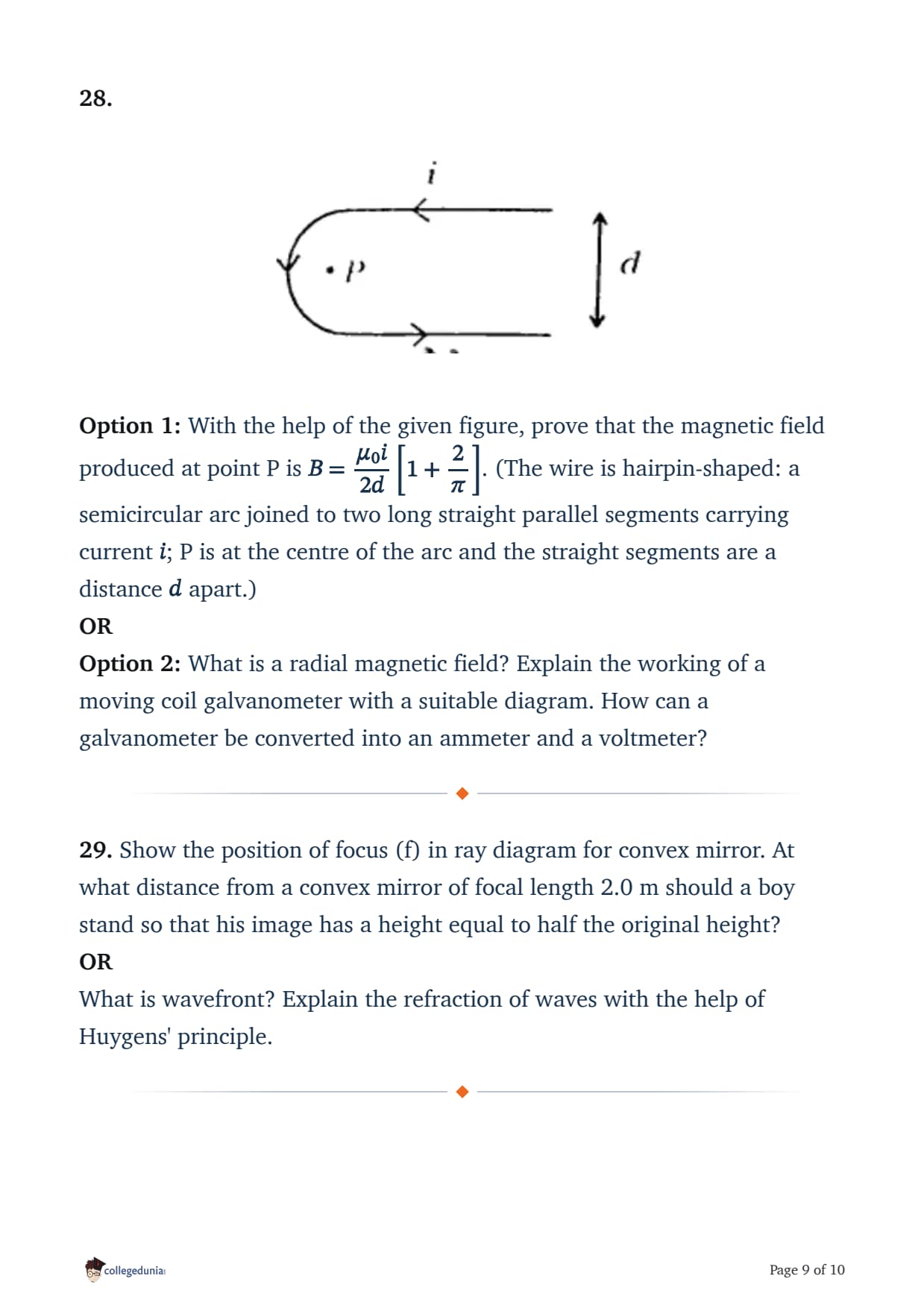
Option 1: With the help of the given figure, prove that the magnetic field produced at point P is \(B=\dfrac{\mu_0 i}{2d}\left[1+\dfrac{2}{\pi}\right]\). (The wire is hairpin-shaped: a semicircular arc joined to two long straight parallel segments carrying current \(i\); P is at the centre of the arc and the straight segments are a distance \(d\) apart.)
OR
Option 2: What is a radial magnetic field? Explain the working of a moving coil galvanometer with a suitable diagram. How can a galvanometer be converted into an ammeter and a voltmeter?
Show the position of focus (f) in ray diagram for convex mirror. At what distance from a convex mirror of focal length 2.0 m should a boy stand so that his image has a height equal to half the original height?
OR
What is wavefront? Explain the refraction of waves with the help of Huygens' principle.
How can p-type and n-type crystal from pure semiconductor be formed? Find the maximum wavelength of electromagnetic radiation which can create a hole-electron pair in germanium of a band-gap 0.65 eV.
OR
How is the conductivity of a metal and semiconductor changed with raising temperature? Calculate the conductivity of an n-type semiconductor from the following data: Density of conduction electrons = 8×10¹³ /cm3, Density of holes = 5×10¹² /cm3, Mobility of conduction electrons = 2.3×104 cm2/V·s, Mobility of holes = 100 cm2/V·s.
UP Board Class 12 Physics 2026 Exam Pattern and Marking Scheme Explained
The UP Board Class 12 Physics 2026 theory paper carried 70 marks in 3 hours 15 minutes (2:00 PM to 5:15 PM), with a separate 30 marks for the practical. All 30 questions were compulsory and there was no negative marking.
- Total: 30 questions, 70 marks, 3 hours 15 minutes
- Section A: Q1 (a to f), multiple choice, 1 mark each (6 marks)
- Section B: Q2 (a to f), very short answer, 1 mark each (6 marks)
- Section C: Q3 (a to d), short answer-I, 2 marks each (8 marks)
- Section D: Q4 and Q5 (a to e each), short answer-II, 3 marks each (30 marks)
- Section E: Q6 to Q9, long answer, 5 marks each with internal choice (20 marks)
- No negative marking; internal OR choice is given only in the four Section E long-answer questions
High-Weightage Chapters in UP Board Class 12 Physics 2026 to Focus On First
This Set 346 DU paper leaned heavily on Modern Physics, Optics and Semiconductors, so lead your revision with the units that returned the most marks:
- Dual Nature, Atoms and Nuclei - about 12 marks across the photon energy, hydrogen-atom energy, photoelectric stopping-potential graph and nuclear-force questions
- Ray Optics and Wave Optics - close to 11 marks, including the compound microscope, total internal reflection, convex mirror numerical and Huygens' principle
- Semiconductor Electronics - around 9 marks, spanning doping, the half-wave rectifier and the n-type conductivity numerical
- Electrostatics - roughly 8 marks, led by the 5-mark Gauss's law cylinder-flux question and the capacitor energy-density proof
- Current Electricity and Magnetic Effects - about 8 marks, from relaxation time and the battery-network circuit to the hairpin-wire magnetic-field derivation
UP Board Class 12 Physics 2026 Question Paper Solution Video
Source: Rastogi online coaching classes
How to Use the UP Board Class 12 Physics Question Paper for Practice
Solve this Set 346 DU paper as a timed 3-hour-15-minute mock first, then check every answer against the solutions before revising your weak topics.
- Attempt all 30 questions in one sitting - there is no negative marking, so leave nothing blank, including the six 1-mark MCQs in Section A
- Review every answer against the solution PDF, especially the Section E 5-mark derivations like the Gauss's law flux and the hairpin-wire magnetic field
- Redo the numericals first - the photon dynamic mass, the h/e stopping-potential graph and the n-type conductivity sums are the marks most students dropped this year
UP Board Class 12 Physics Good Score and Passing Benchmark
- The pass mark is 33%, i.e. about 23 out of 70 in the theory paper
- Aim for 55+ out of 70 for a strong Intermediate result, since this paper was rated easy to moderate and stayed close to the NCERT textbook
- Practise the derivations and diagrams - UP Board repeats the same 5-mark long-answer set every year with only small changes in the given numbers
UP Board Class 12 Physics 2026 Question Paper FAQs
Ques. Was the UP Board Class 12 Physics 2026 question paper tough?
Ans. No. Most students rated the Set 346 DU paper easy to moderate. The MCQs and very-short-answer questions were direct, and the derivations were standard textbook ones, though a few numericals like the photoelectric h/e graph and the n-type conductivity sum needed careful calculation.
Ques. Which chapters had the highest weightage in UP Board Class 12 Physics 2026?
Ans. Modern Physics (Dual Nature, Atoms and Nuclei) led with about 12 marks, followed by Optics at close to 11 marks and Semiconductor Electronics at around 9 marks. Electrostatics and Current Electricity each returned roughly 8 marks, led by the 5-mark Gauss's law cylinder question.
Ques. Is there negative marking in the UP Board Class 12 Physics paper?
Ans. No. There is no negative marking in the UP Board Class 12 Physics theory paper, so you should attempt every one of the 30 questions, including all six 1-mark MCQs in Section A.
Ques. What is a good score in UP Board Class 12 Physics?
Ans. The pass mark is 33% (about 23 out of 70 in theory). A good score is 55+ out of 70; with a separate 30-mark practical, a strong theory plus practical total pushes your Physics percentage well above 80.
Ques. Does UPMSP release the official Class 12 Physics question paper and answer key?
Ans. Yes. The UP Madhyamik Shiksha Parishad publishes exam information and results on its official website upmsp.edu.in. The Set 346 DU solutions on this page are prepared by subject experts for quick checking against the official paper.
Ques. Where can I download the UP Board Class 12 Physics 2026 question paper with solutions PDF for free?
Ans. You can download the UP Board Class 12 Physics 2026 (Set 346 DU) question paper with full solutions free from the table above on Collegedunia, and check every question with its worked solution in the index below.



Comments