




The UP Board Class 12 Chemistry 2026 question paper for Set EF (paper code 347) is now available with full solutions for free download. This paper was conducted by the Uttar Pradesh Madhyamik Shiksha Parishad (UPMSP) in the 2026 Intermediate board exam session, and it carried 26 questions for 70 marks in 3 hours 15 minutes.
| UP Board Class 12 Chemistry 2026 Set 347 EF Question Paper with Solutions | Download PDF | Check Solutions |
UP Board Class 12 Chemistry 2026 Set 347 EF Questions with Solutions
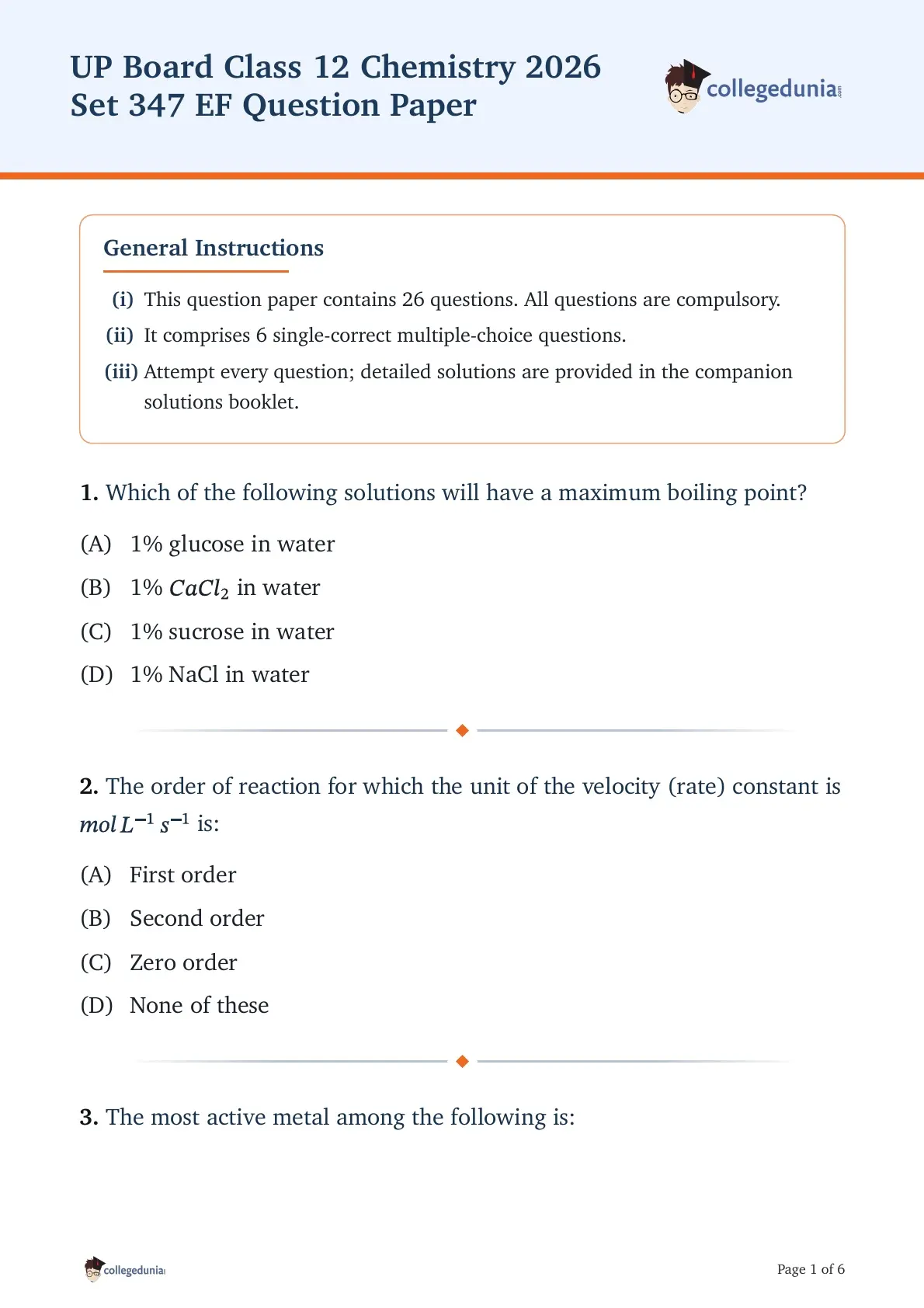
Which of the following solutions will have a maximum boiling point?
The order of reaction for which the unit of the velocity (rate) constant is \(mol\,L^{-1}\,s^{-1}\) is:
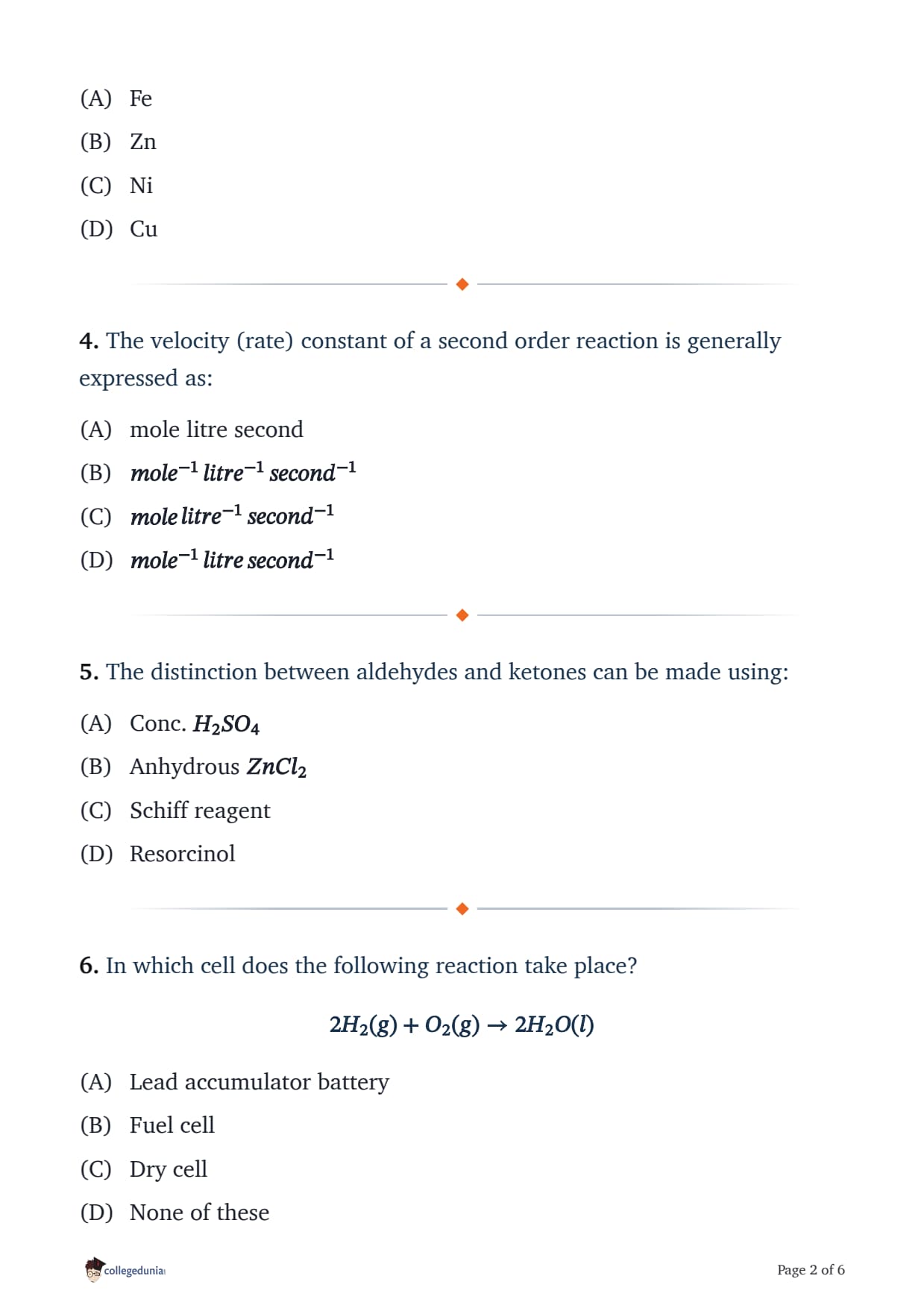
The most active metal among the following is:
The velocity (rate) constant of a second order reaction is generally expressed as:
The distinction between aldehydes and ketones can be made using:
In which cell does the following reaction take place? \[2H_2(g) + O_2(g) \rightarrow 2H_2O(l)\]
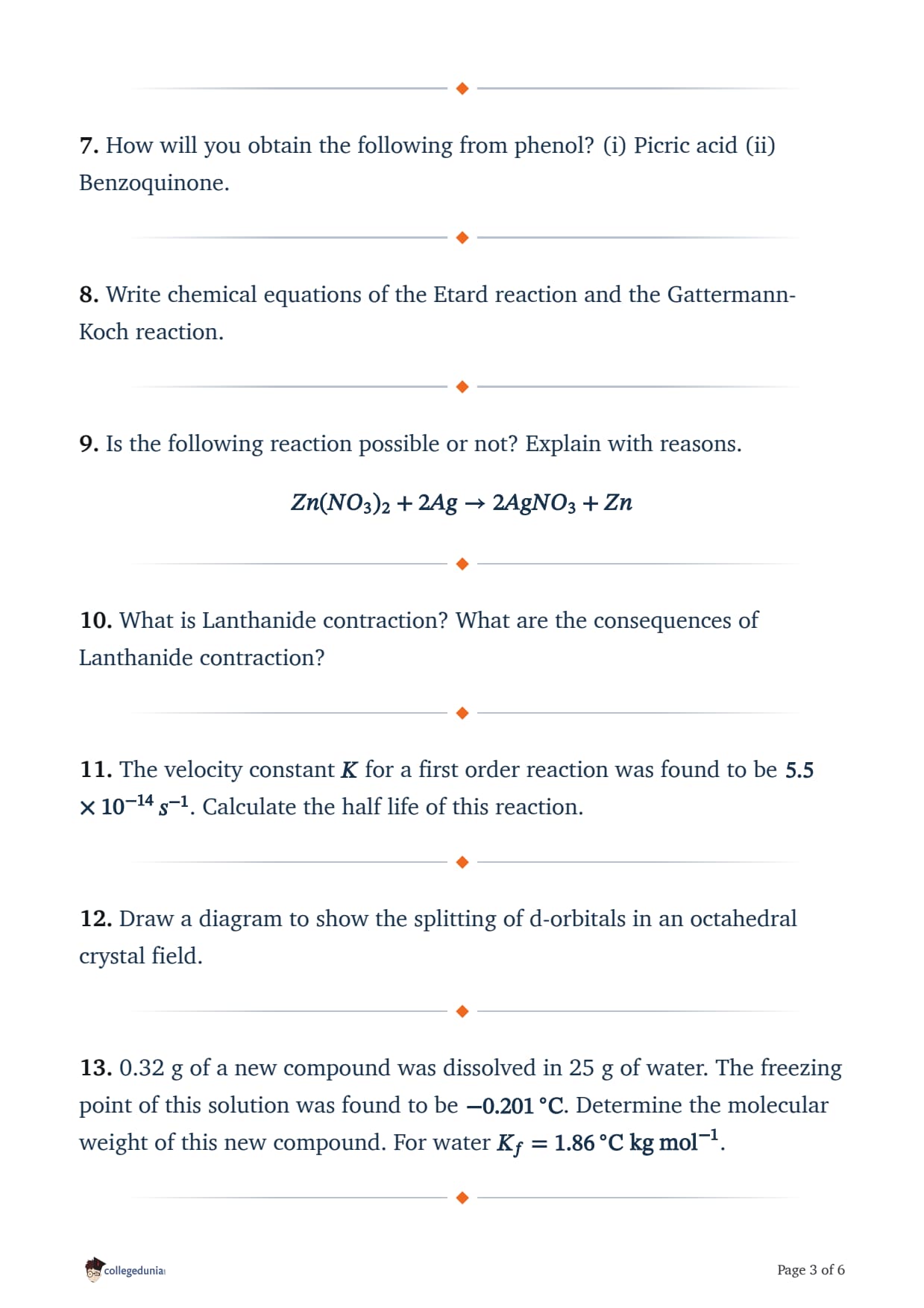
How will you obtain the following from phenol? (i) Picric acid (ii) Benzoquinone.
Write chemical equations of the Etard reaction and the Gattermann-Koch reaction.
Is the following reaction possible or not? Explain with reasons. \[Zn(NO_3)_2 + 2Ag \rightarrow 2AgNO_3 + Zn\]
What is Lanthanide contraction? What are the consequences of Lanthanide contraction?
The velocity constant \(K\) for a first order reaction was found to be \(5.5 \times 10^{-14}\,s^{-1}\). Calculate the half life of this reaction.
Draw a diagram to show the splitting of d-orbitals in an octahedral crystal field.
0.32 g of a new compound was dissolved in 25 g of water. The freezing point of this solution was found to be \(-0.201\,^\circ\text{C}\). Determine the molecular weight of this new compound. For water \(K_f = 1.86\,^\circ\text{C}\;\text{kg mol}^{-1}\).
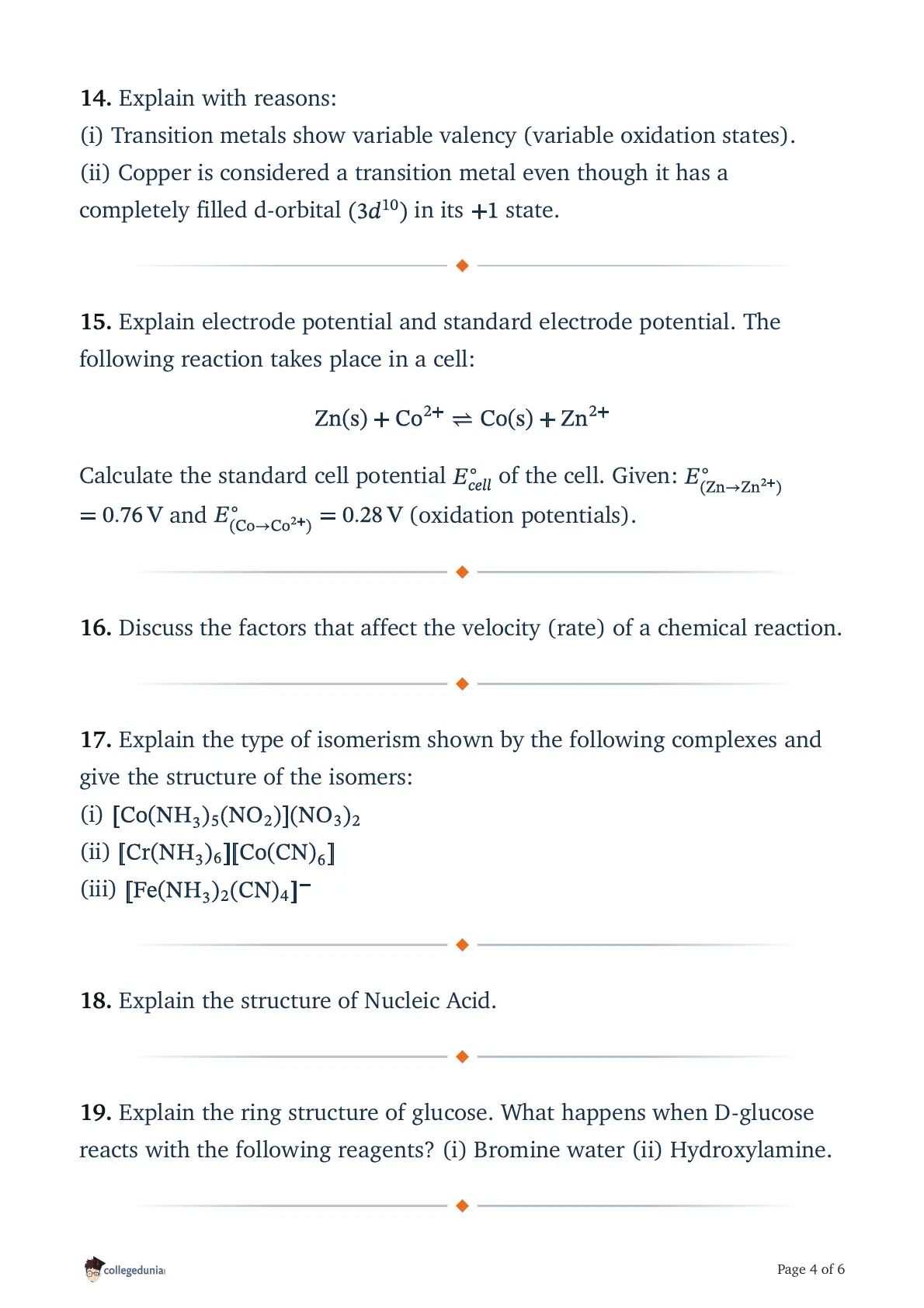
Explain with reasons:
(i) Transition metals show variable valency (variable oxidation states).
(ii) Copper is considered a transition metal even though it has a completely filled d-orbital \((3d^{10})\) in its \(+1\) state.
Explain electrode potential and standard electrode potential. The following reaction takes place in a cell: \[ \text{Zn(s)} + \text{Co}^{2+} \rightleftharpoons \text{Co(s)} + \text{Zn}^{2+} \] Calculate the standard cell potential \(E^\circ_{cell}\) of the cell. Given: \(E^\circ_{(\text{Zn} \rightarrow \text{Zn}^{2+})} = 0.76\,\text{V}\) and \(E^\circ_{(\text{Co} \rightarrow \text{Co}^{2+})} = 0.28\,\text{V}\) (oxidation potentials).
Discuss the factors that affect the velocity (rate) of a chemical reaction.
Explain the type of isomerism shown by the following complexes and give the structure of the isomers:
(i) \([\text{Co(NH}_3)_5(\text{NO}_2)](\text{NO}_3)_2\)
(ii) \([\text{Cr(NH}_3)_6][\text{Co(CN)}_6]\)
(iii) \([\text{Fe(NH}_3)_2(\text{CN})_4]^-\)
Explain the structure of Nucleic Acid.
Explain the ring structure of glucose. What happens when D-glucose reacts with the following reagents? (i) Bromine water (ii) Hydroxylamine.
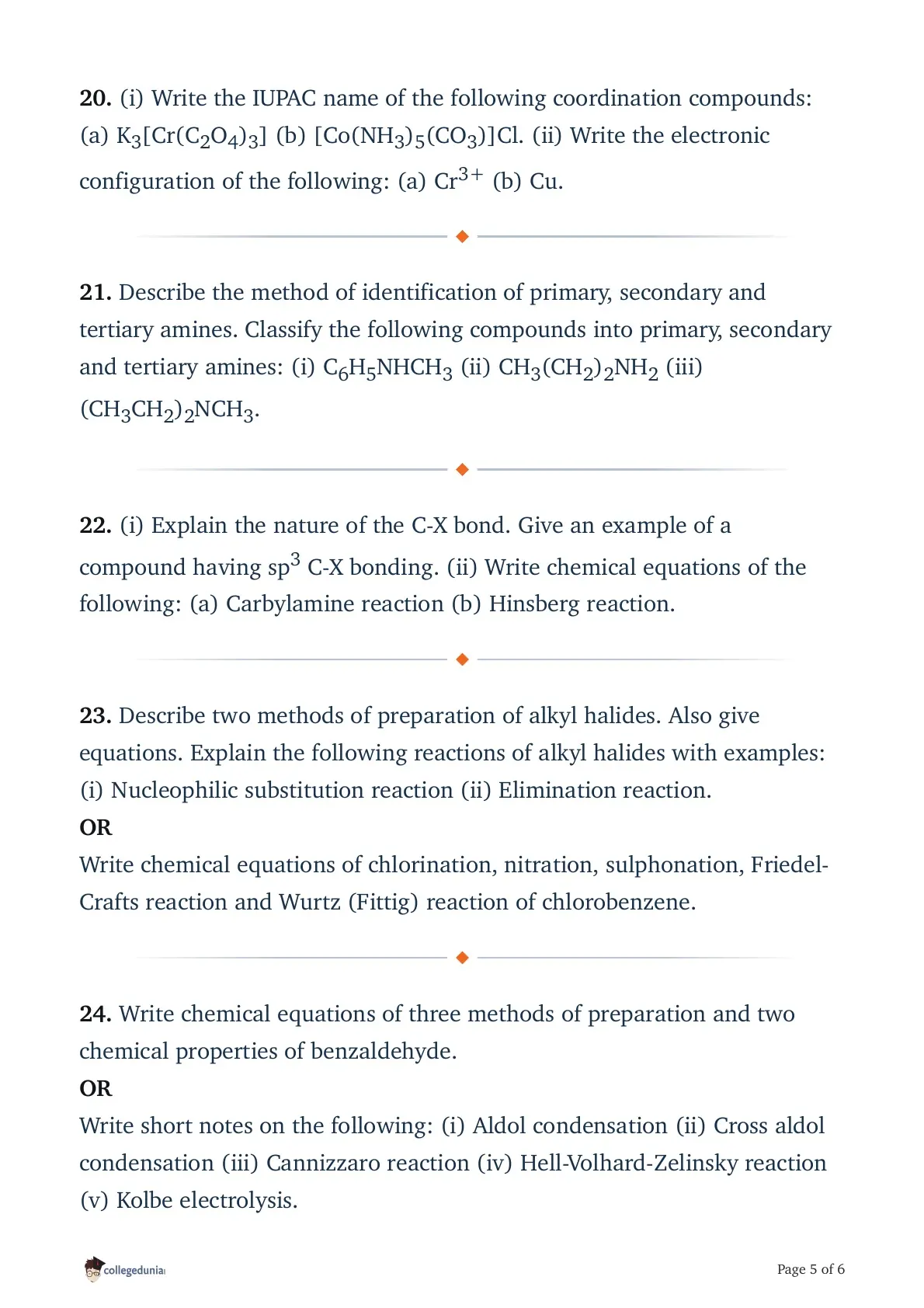
(i) Write the IUPAC name of the following coordination compounds: (a) K3[Cr(C2O4)3] (b) [Co(NH3)5(CO3)]Cl. (ii) Write the electronic configuration of the following: (a) Cr3+ (b) Cu.
Describe the method of identification of primary, secondary and tertiary amines. Classify the following compounds into primary, secondary and tertiary amines: (i) C6H5NHCH3 (ii) CH3(CH2)2NH2 (iii) (CH3CH2)2NCH3.
(i) Explain the nature of the C-X bond. Give an example of a compound having sp3 C-X bonding. (ii) Write chemical equations of the following: (a) Carbylamine reaction (b) Hinsberg reaction.
Describe two methods of preparation of alkyl halides. Also give equations. Explain the following reactions of alkyl halides with examples: (i) Nucleophilic substitution reaction (ii) Elimination reaction.
OR
Write chemical equations of chlorination, nitration, sulphonation, Friedel-Crafts reaction and Wurtz (Fittig) reaction of chlorobenzene.
Write chemical equations of three methods of preparation and two chemical properties of benzaldehyde.
OR
Write short notes on the following: (i) Aldol condensation (ii) Cross aldol condensation (iii) Cannizzaro reaction (iv) Hell-Volhard-Zelinsky reaction (v) Kolbe electrolysis.
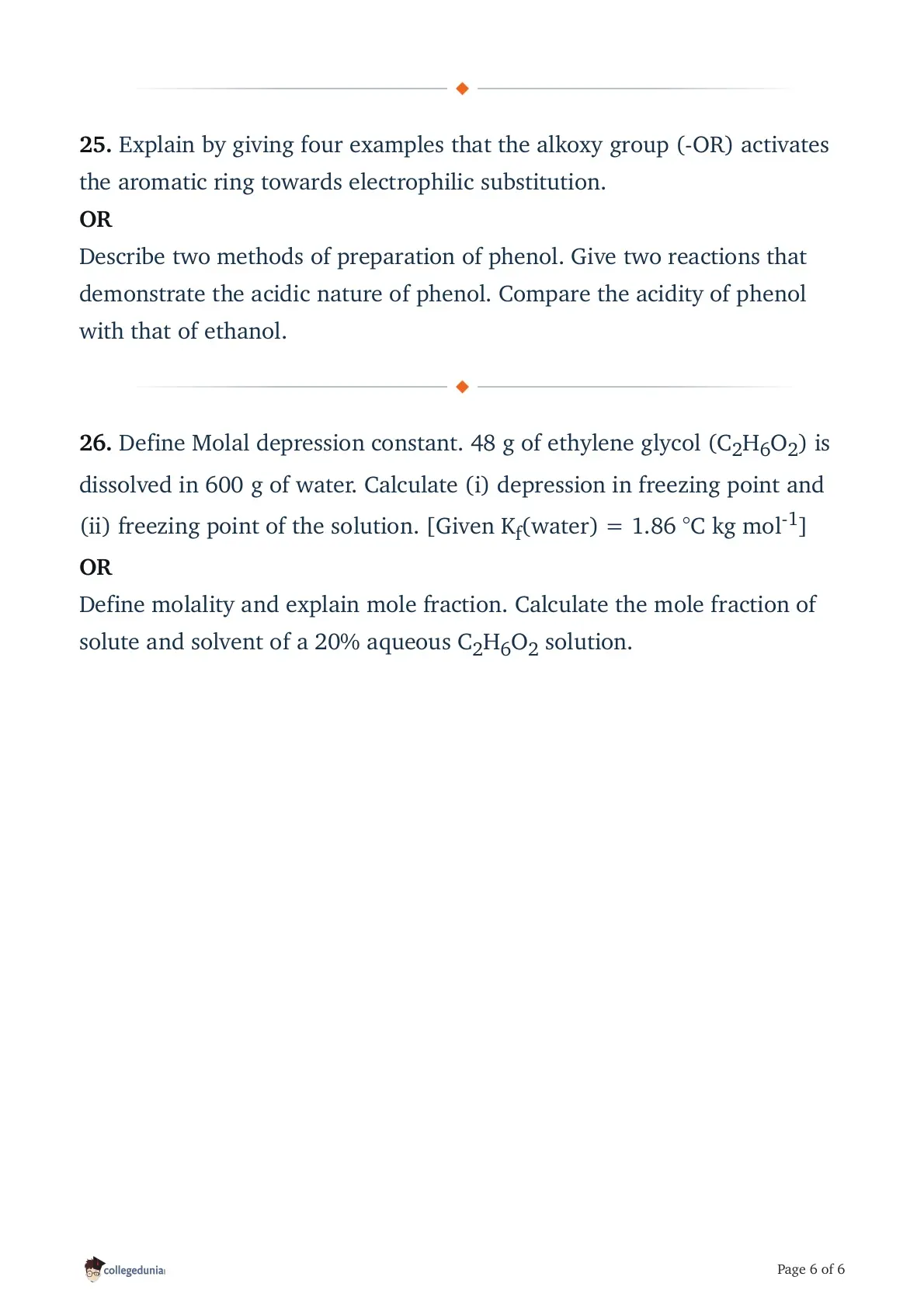
Explain by giving four examples that the alkoxy group (-OR) activates the aromatic ring towards electrophilic substitution.
OR
Describe two methods of preparation of phenol. Give two reactions that demonstrate the acidic nature of phenol. Compare the acidity of phenol with that of ethanol.
Define Molal depression constant. 48 g of ethylene glycol (C2H6O2) is dissolved in 600 g of water. Calculate (i) depression in freezing point and (ii) freezing point of the solution. [Given Kf(water) = 1.86 °C kg mol-1]
OR
Define molality and explain mole fraction. Calculate the mole fraction of solute and solvent of a 20% aqueous C2H6O2 solution.
UP Board Class 12 Chemistry 2026 Set 347 EF Exam Pattern and Marking Scheme
The Set EF theory paper follows the standard UPMSP Chemistry blueprint, a mixed objective and descriptive format. The 26-question bilingual paper (Hindi and English) is spread across five sections.
- Total questions: 26 questions for 70 marks
- Duration: 3 hours 15 minutes, including 15 minutes of reading time
- Section A: Question 1 (a to f) is 6 multiple-choice questions of 1 mark each
- Sections B and C: very short and short answer questions of 2 marks each
- Section D: descriptive questions of 3 marks and 4 marks each
- Section E: long answer questions 6 and 7 of 5 marks each, with internal OR choice
High-Weightage Chapters in UP Board Class 12 Chemistry 2026 to Focus On First
The 70-mark paper leans on the same high-scoring units every year, so target these first when you redo Set EF.
- Electrochemistry: the single highest-weightage unit at about 9 marks (roughly 12.86 percent), so master Nernst equation, conductance and cell EMF numericals
- Aldehydes, Ketones and Carboxylic Acids: around 11.43 percent, heavy on name reactions and distinction tests in Section D and E
- Chemical Kinetics: rate law, order and half-life numericals that repeat almost every session
- Coordination Compounds: IUPAC naming, hybridisation and isomerism, a reliable 5-mark long answer
- p-Block Elements: group trends and compound-based reasoning across Sections B and C
- Amines and Haloalkanes: conversions and mechanisms in the internal-choice long answers
UP Board Class 12 Chemistry 2026 Set EF Paper Analysis Video
Source: Alpha Institute
How to Use the UP Board Class 12 Chemistry Set 347 EF Paper for Practice
Treat Set EF as a full mock before you open the solution PDF, scoring yourself against the real 70-mark board pattern.
- Solve all 26 questions in one timed 3 hour 15 minute sitting to build exam stamina
- Attempt Question 1 (the 6 MCQs) in under 8 minutes so you protect time for Section E long answers
- Check every answer against the solutions PDF and mark the numericals you got wrong
- Redo the Section D and E questions from Electrochemistry and Organic Chemistry until your steps match the marking scheme
UP Board Class 12 Chemistry Passing Marks and Scoring Benchmark
- You need at least 33 percent in theory and practical separately, about 24 out of 70 in theory
- The 30-mark practical (15 exam plus 15 internal) pushes many students above 80 overall
- Lock all 6 MCQ marks and both 5-mark long answers first, that is 16 secure marks
UP Board Class 12 Chemistry 2026 Set 347 EF Question Paper FAQs
Ques. Where can I download the UP Board Class 12 Chemistry 2026 Set 347 EF question paper with solutions PDF for free?
Ans. Download both the question paper and the full solutions PDF from the table above on Collegedunia at no cost. The official paper is also published by UPMSP on upboardonline.com.
Ques. How many questions and marks are there in the UP Board Class 12 Chemistry 2026 paper?
Ans. The Set EF (code 347) theory paper has 26 questions for 70 marks in 3 hours 15 minutes. It starts with 6 one-mark MCQs and ends with two 5-mark long answers that carry internal OR choice.
Ques. Which chapter has the highest weightage in UP Board Class 12 Chemistry 2026?
Ans. Electrochemistry is the top-weightage unit at roughly 9 marks (about 12.86 percent), followed by Aldehydes, Ketones and Carboxylic Acids at about 11.43 percent. Together with Chemical Kinetics and Coordination Compounds, these decide most of your score.
Ques. Is the UP Board Class 12 Chemistry Set 347 EF paper bilingual?
Ans. Yes, the paper is printed in both Hindi and English, so you can answer in either language. The solutions PDF on Collegedunia walks through every one of the 26 questions step by step.
Ques. What are the passing marks for UP Board Class 12 Chemistry 2026?
Ans. You must score at least 33 percent in theory and practical separately, about 24 out of 70 in theory and 10 out of 30 in practical. Both have to be cleared to pass.
Ques. Are UP Board Class 12 Chemistry questions repeated from previous years?
Ans. Yes, the Electrochemistry and Chemical Kinetics numericals and the Organic Chemistry name reactions recur almost every session with only changed values. Solving Set EF alongside older UP Board papers is the fastest way to spot these repeats.



Comments