




The UP Board Class 12 Chemistry 2026 question paper (Set 347 ED) is now available with full solutions for free download. UP Board Class 12 Chemistry 2026 was conducted by the Uttar Pradesh Madhyamik Shiksha Parishad (UPMSP) on February 25, 2026, and the paper carried 26 questions for 70 marks in 3 hours 15 minutes.
| UP Board Class 12 Chemistry 2026 Set 347 ED Question Paper with Solutions | Download PDF | Check Solutions |
UP Board Class 12 Chemistry 2026 Set 347 ED Questions with Solutions
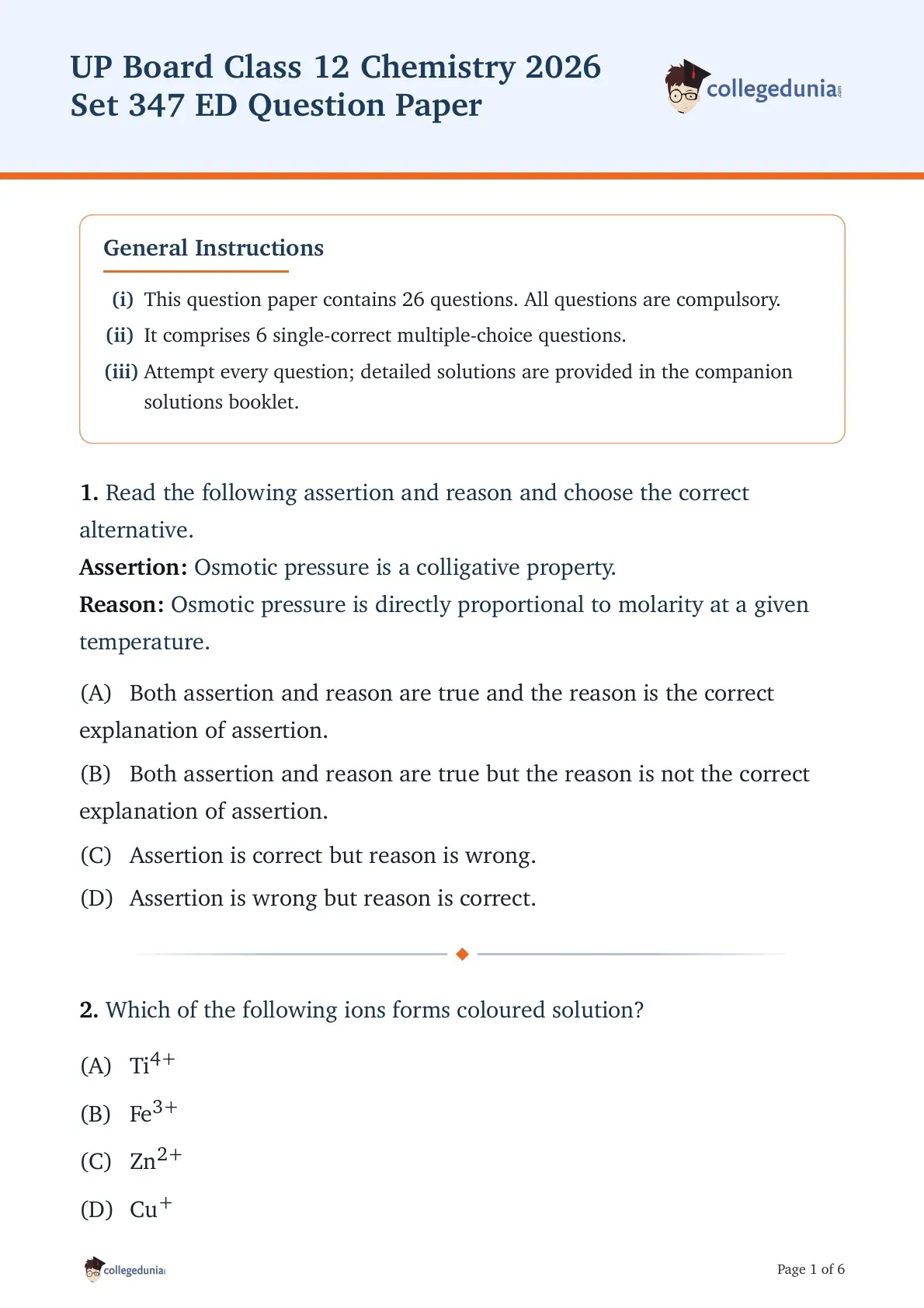
Read the following assertion and reason and choose the correct alternative.
Assertion: Osmotic pressure is a colligative property.
Reason: Osmotic pressure is directly proportional to molarity at a given temperature.
Which of the following ions forms coloured solution?
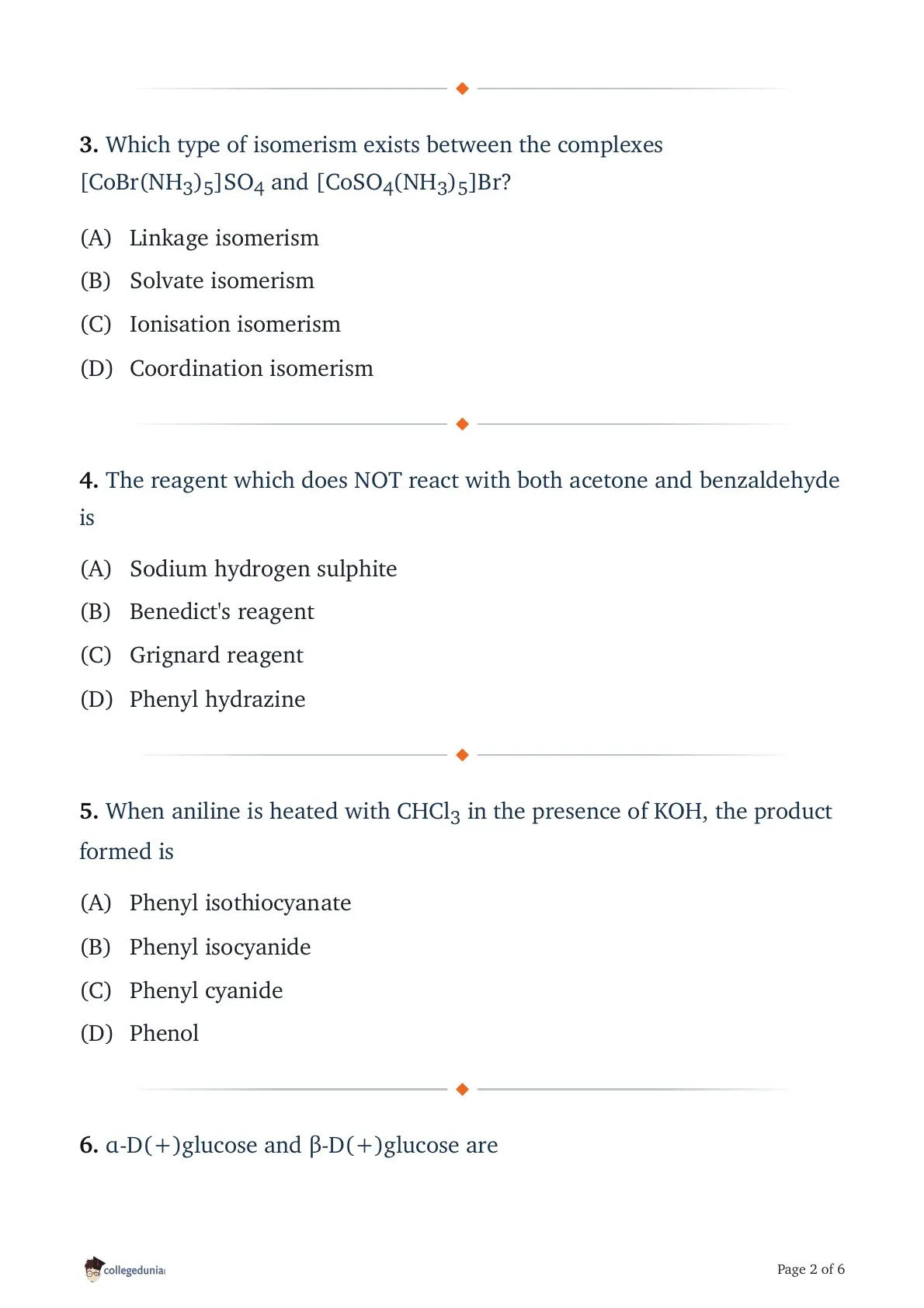
Which type of isomerism exists between the complexes [CoBr(NH3)5]SO4 and [CoSO4(NH3)5]Br?
The reagent which does NOT react with both acetone and benzaldehyde is
When aniline is heated with CHCl3 in the presence of KOH, the product formed is
α-D(+)glucose and β-D(+)glucose are
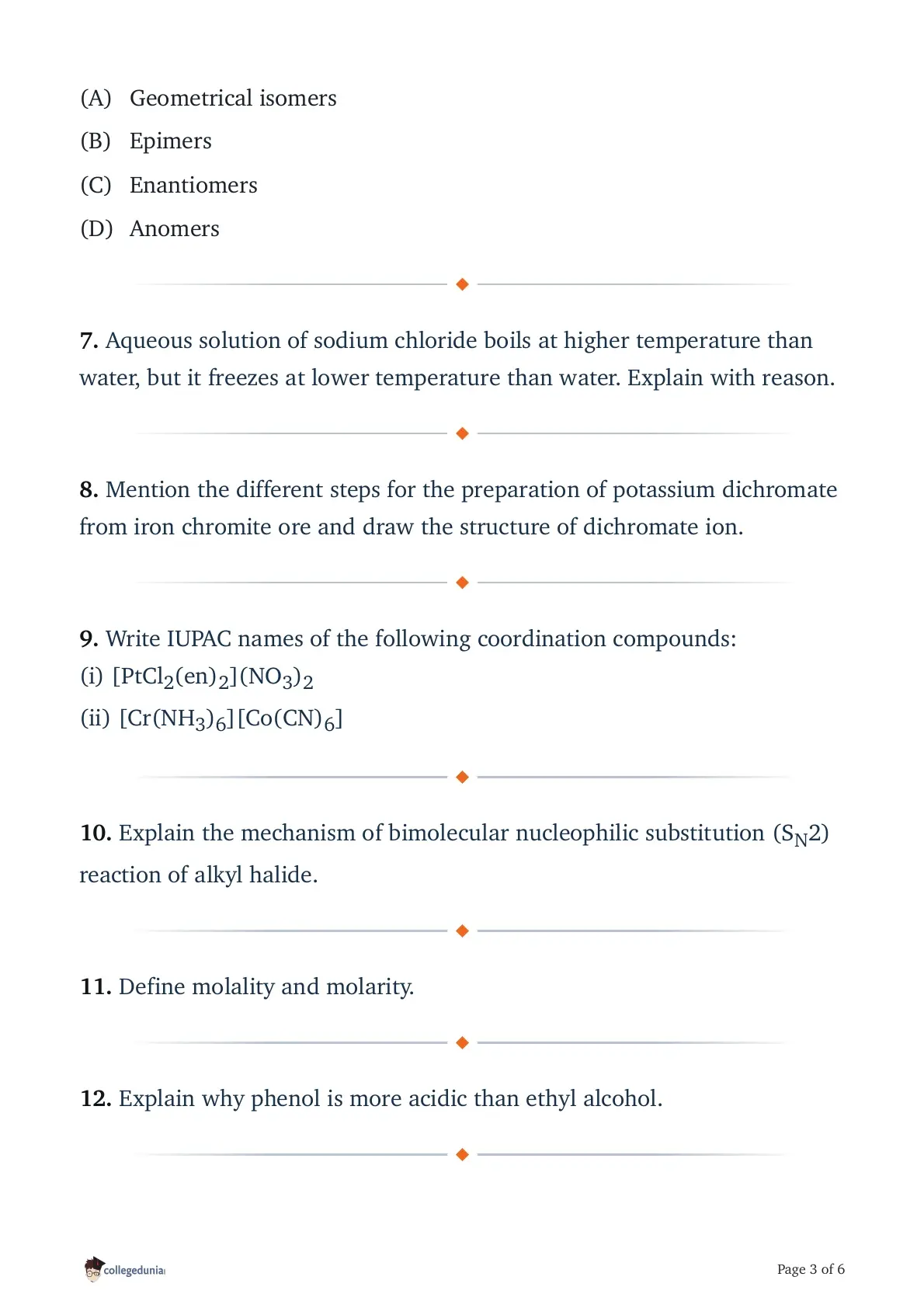
Aqueous solution of sodium chloride boils at higher temperature than water, but it freezes at lower temperature than water. Explain with reason.
Mention the different steps for the preparation of potassium dichromate from iron chromite ore and draw the structure of dichromate ion.
Write IUPAC names of the following coordination compounds:
(i) [PtCl2(en)2](NO3)2
(ii) [Cr(NH3)6][Co(CN)6]
Explain the mechanism of bimolecular nucleophilic substitution (SN2) reaction of alkyl halide.
Define molality and molarity.
Explain why phenol is more acidic than ethyl alcohol.
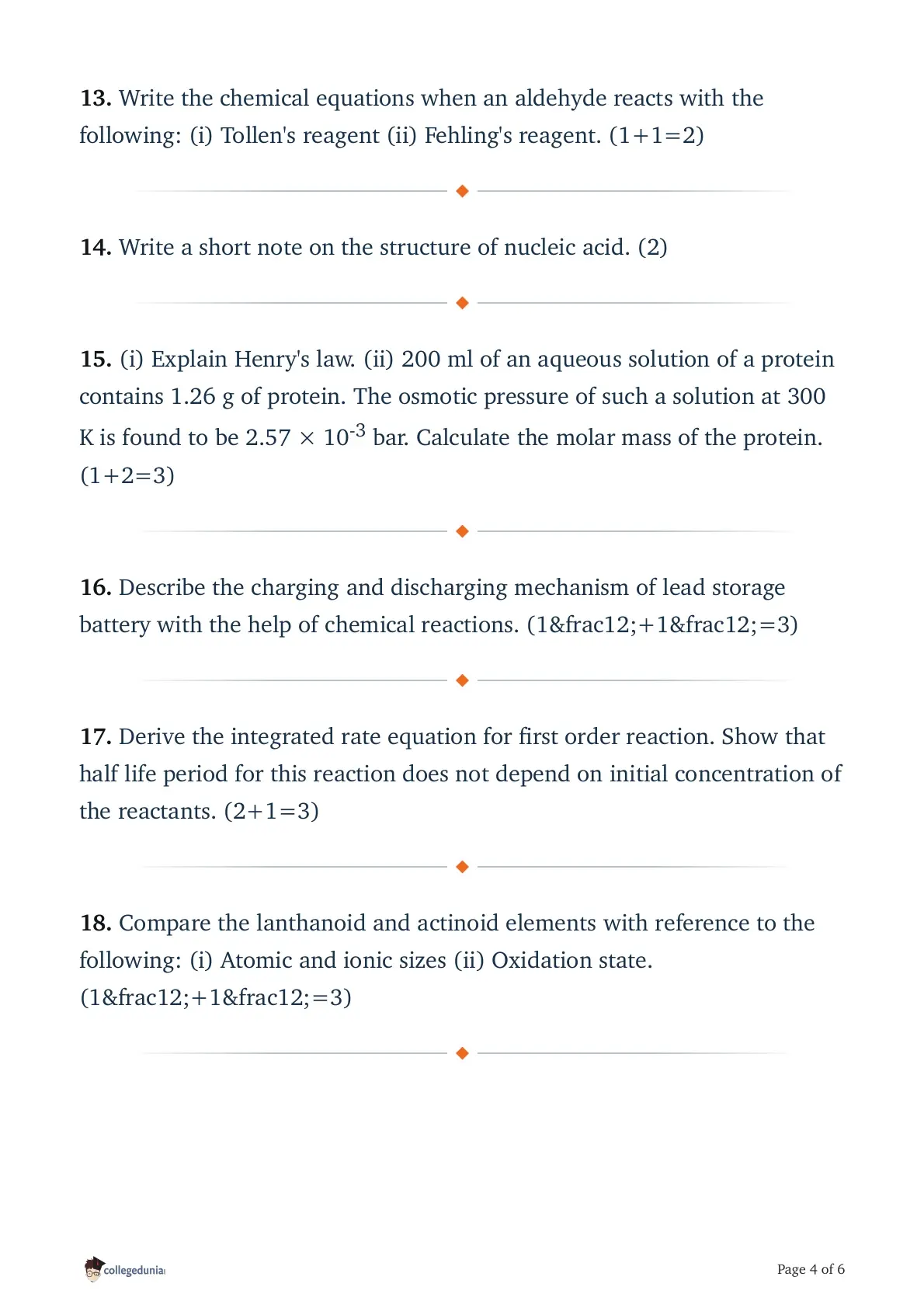
Write the chemical equations when an aldehyde reacts with the following: (i) Tollen's reagent (ii) Fehling's reagent. (1+1=2)
Write a short note on the structure of nucleic acid. (2)
(i) Explain Henry's law. (ii) 200 ml of an aqueous solution of a protein contains 1.26 g of protein. The osmotic pressure of such a solution at 300 K is found to be 2.57 × 10⁻³ bar. Calculate the molar mass of the protein. (1+2=3)
Describe the charging and discharging mechanism of lead storage battery with the help of chemical reactions. (1½+1½=3)
Derive the integrated rate equation for first order reaction. Show that half life period for this reaction does not depend on initial concentration of the reactants. (2+1=3)
Compare the lanthanoid and actinoid elements with reference to the following: (i) Atomic and ionic sizes (ii) Oxidation state. (1½+1½=3)
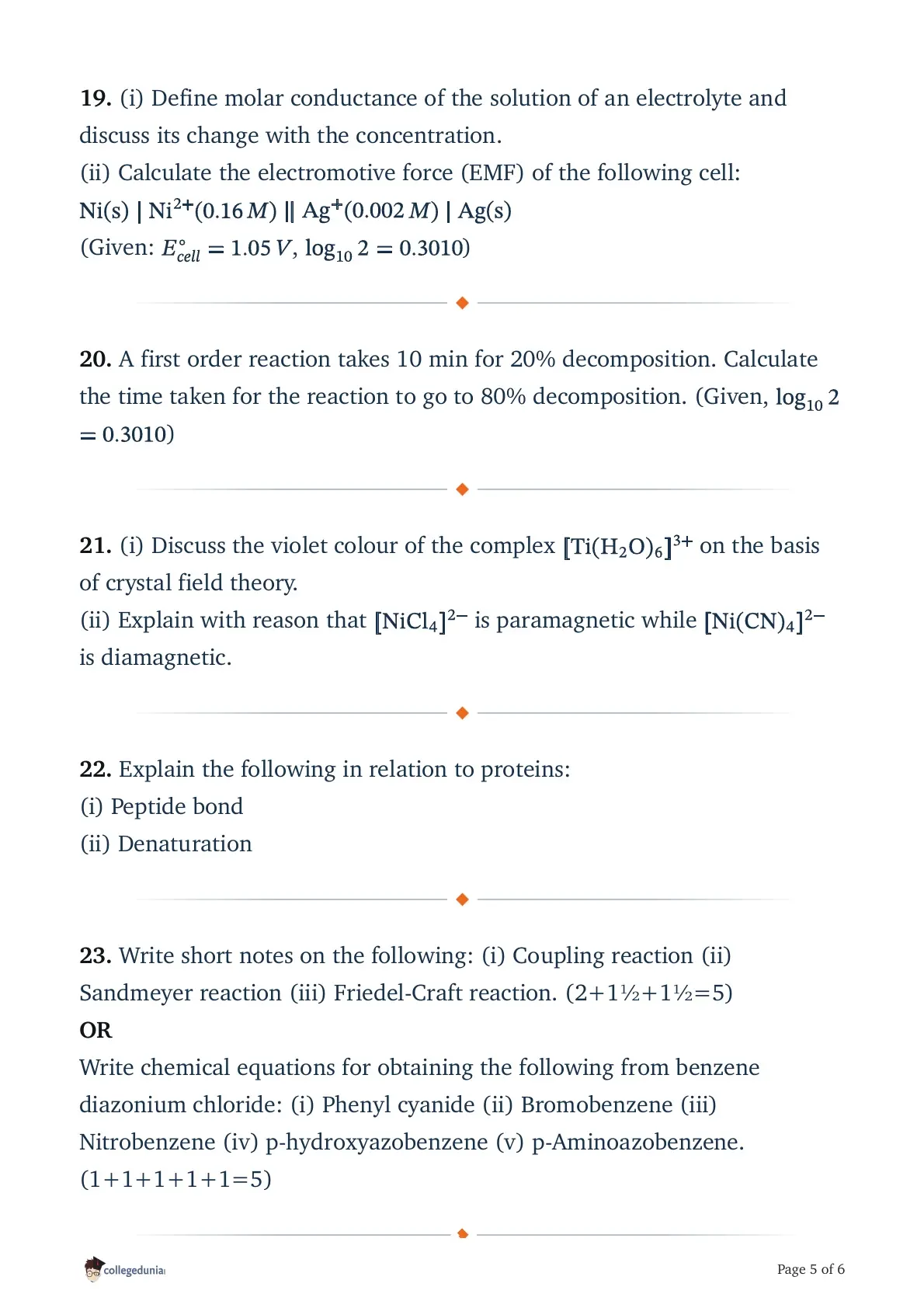
(i) Define molar conductance of the solution of an electrolyte and discuss its change with the concentration.
(ii) Calculate the electromotive force (EMF) of the following cell:
\( \text{Ni(s)} \mid \text{Ni}^{2+}(0.16\,M) \parallel \text{Ag}^{+}(0.002\,M) \mid \text{Ag(s)} \)
(Given: \( E^{\circ}_{cell} = 1.05\,V \), \( \log_{10}2 = 0.3010 \))
A first order reaction takes 10 min for 20% decomposition. Calculate the time taken for the reaction to go to 80% decomposition. (Given, \( \log_{10}2 = 0.3010 \))
(i) Discuss the violet colour of the complex \( [\text{Ti}(\text{H}_2\text{O})_6]^{3+} \) on the basis of crystal field theory.
(ii) Explain with reason that \( [\text{NiCl}_4]^{2-} \) is paramagnetic while \( [\text{Ni}(\text{CN})_4]^{2-} \) is diamagnetic.
Explain the following in relation to proteins:
(i) Peptide bond
(ii) Denaturation
Write short notes on the following: (i) Coupling reaction (ii) Sandmeyer reaction (iii) Friedel-Craft reaction. (2+1½+1½=5)
OR
Write chemical equations for obtaining the following from benzene diazonium chloride: (i) Phenyl cyanide (ii) Bromobenzene (iii) Nitrobenzene (iv) p-hydroxyazobenzene (v) p-Aminoazobenzene. (1+1+1+1+1=5)
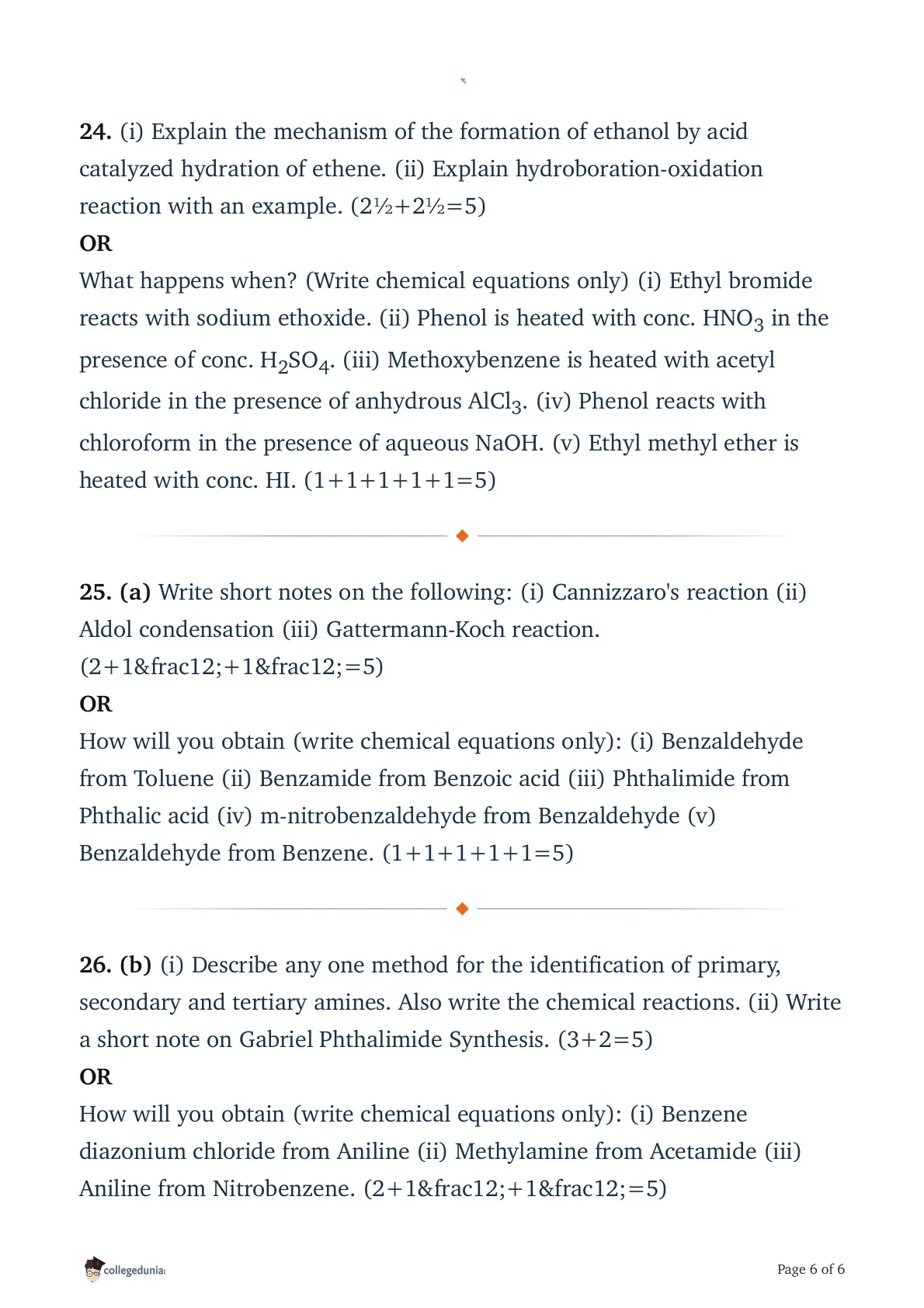
(i) Explain the mechanism of the formation of ethanol by acid catalyzed hydration of ethene. (ii) Explain hydroboration-oxidation reaction with an example. (2½+2½=5)
OR
What happens when? (Write chemical equations only) (i) Ethyl bromide reacts with sodium ethoxide. (ii) Phenol is heated with conc. HNO3 in the presence of conc. H2SO4. (iii) Methoxybenzene is heated with acetyl chloride in the presence of anhydrous AlCl3. (iv) Phenol reacts with chloroform in the presence of aqueous NaOH. (v) Ethyl methyl ether is heated with conc. HI. (1+1+1+1+1=5)
(a) Write short notes on the following: (i) Cannizzaro's reaction (ii) Aldol condensation (iii) Gattermann-Koch reaction. (2+1½+1½=5)
OR
How will you obtain (write chemical equations only): (i) Benzaldehyde from Toluene (ii) Benzamide from Benzoic acid (iii) Phthalimide from Phthalic acid (iv) m-nitrobenzaldehyde from Benzaldehyde (v) Benzaldehyde from Benzene. (1+1+1+1+1=5)
(b) (i) Describe any one method for the identification of primary, secondary and tertiary amines. Also write the chemical reactions. (ii) Write a short note on Gabriel Phthalimide Synthesis. (3+2=5)
OR
How will you obtain (write chemical equations only): (i) Benzene diazonium chloride from Aniline (ii) Methylamine from Acetamide (iii) Aniline from Nitrobenzene. (2+1½+1½=5)
UP Board Class 12 Chemistry 2026 Set 347 ED Exam Pattern and Marking Scheme
Set 347 ED is the bilingual (Hindi and English) Chemistry paper, so every question is printed in both languages. The paper moves from short objective questions to long descriptive answers, and there is no negative marking.
- Total questions: 26 questions for 70 marks
- Duration: 3 hours 15 minutes, including 15 minutes reading time
- Question 1 (a to f): 6 objective type MCQs of 1 mark each
- Section B and C: very short and short answer questions worth 2 marks each
- Section D: a mix of 3-mark and 4-mark descriptive questions
- Section E (Q6 to Q7): long answer questions of 5 marks each with an internal OR choice
- Marking: no negative marking; step marks are given for correct method and reactions
High-Weightage Chapters in UP Board Class 12 Chemistry 2026 Set 347 ED
The 5-mark long answers in Section E and the 3 and 4-mark questions in Section D decide your score, so focus on the chapters that feed them first.
- Electrochemistry: Nernst equation and cell EMF numericals appear in the higher-mark questions almost every year
- Chemical Kinetics: rate law, order of reaction, and half-life numericals are reliable 2 to 3-mark scorers
- Coordination Compounds: IUPAC naming, hybridisation, and the crystal field theory colour questions
- Aldehydes, Ketones and Carboxylic Acids: name reactions and distinction tests carry heavy weightage in Section D and E
- d and f Block Elements: short-answer questions on transition metal properties and lanthanoid contraction
- Solutions and Biomolecules: colligative property numericals and structure-based short questions round off the paper
UP Board Class 12 Chemistry 2026 Question Paper Solution Video
Source: Alpha Institute
How to Use the UP Board Class 12 Chemistry Set 347 ED Paper for Practice
Treat this paper as a timed mock before you open the solution PDF. It shows you exactly how UP Board frames its Chemistry questions across the objective, short and long-answer sections.
- Solve the full paper in one 3 hour 15 minute sitting to build real exam stamina
- Answer Question 1 (a to f) MCQs in the first 10 minutes to lock in 6 easy marks
- Attempt every Section E 5-mark question with balanced chemical equations, since step marks add up fast
- Check your answers against the solution PDF and redo the numericals from Electrochemistry and Chemical Kinetics you got wrong
UP Board Class 12 Chemistry 2026 Set 347 ED Question Paper FAQs
Ques. Was the UP Board Class 12 Chemistry 2026 Set 347 ED paper hard?
Ans. Most students rated the Set 347 ED Chemistry paper moderate. The 6 MCQs and the 2-mark questions were direct from NCERT, while the 5-mark Section E questions on Electrochemistry and organic name reactions needed careful, step-by-step answers.
Ques. How many questions and marks are there in the UP Board Class 12 Chemistry 2026 paper?
Ans. The paper has 26 questions for a total of 70 marks, to be completed in 3 hours 15 minutes. It starts with 6 one-mark MCQs and ends with 5-mark long-answer questions that carry an internal OR choice.
Ques. Which chapters had the highest weightage in UP Board Class 12 Chemistry 2026?
Ans. Electrochemistry, Chemical Kinetics, Coordination Compounds, and Aldehydes, Ketones and Carboxylic Acids carried the most marks. These four chapters dominate the 3, 4 and 5-mark questions, so students should focus on them first.
Ques. Is there negative marking in the UP Board Class 12 Chemistry exam?
Ans. No, UP Board Class 12 Chemistry has no negative marking. Even the 1-mark MCQs are marked positive only, and descriptive answers earn step marks for correct reactions and methods, so students should attempt every question.
Ques. When was the UP Board Class 12 Chemistry 2026 exam conducted?
Ans. The UP Board Class 12 Chemistry 2026 exam was conducted by UPMSP on February 25, 2026. The official question papers and details are published on the board website, upmsp.edu.in.
Ques. Where can I download the UP Board Class 12 Chemistry 2026 Set 347 ED question paper with solutions PDF for free?
Ans. You can download the Set 347 ED question paper and its full solutions PDF for free from the table at the top of this Collegedunia page. The original paper is also released on the official UPMSP website.



Comments