




The UP Board Class 12 Chemistry 2026 question paper (Set 347 EB) is now available with full solutions for free download. This Chemistry paper was conducted by the Uttar Pradesh Madhyamik Shiksha Parishad (UPMSP) in 2026, and it carried 26 questions for 70 marks in 3 hours 15 minutes.
| UP Board Class 12 Chemistry 2026 Set 347 EB Question Paper with Solutions | Download PDF | Check Solutions |
UP Board Class 12 Chemistry 2026 Set 347 EB Questions with Solutions
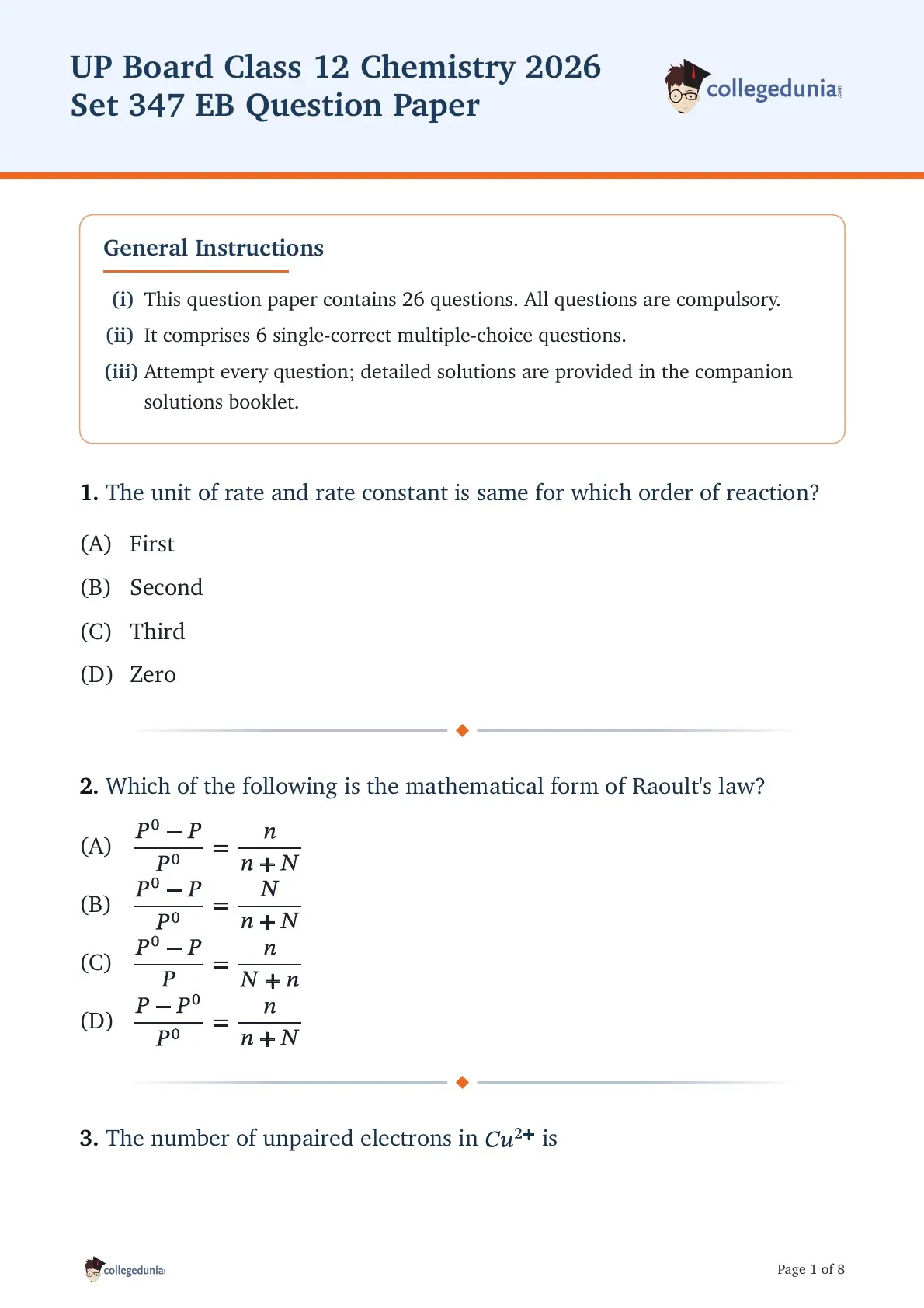
The unit of rate and rate constant is same for which order of reaction?
Which of the following is the mathematical form of Raoult's law?
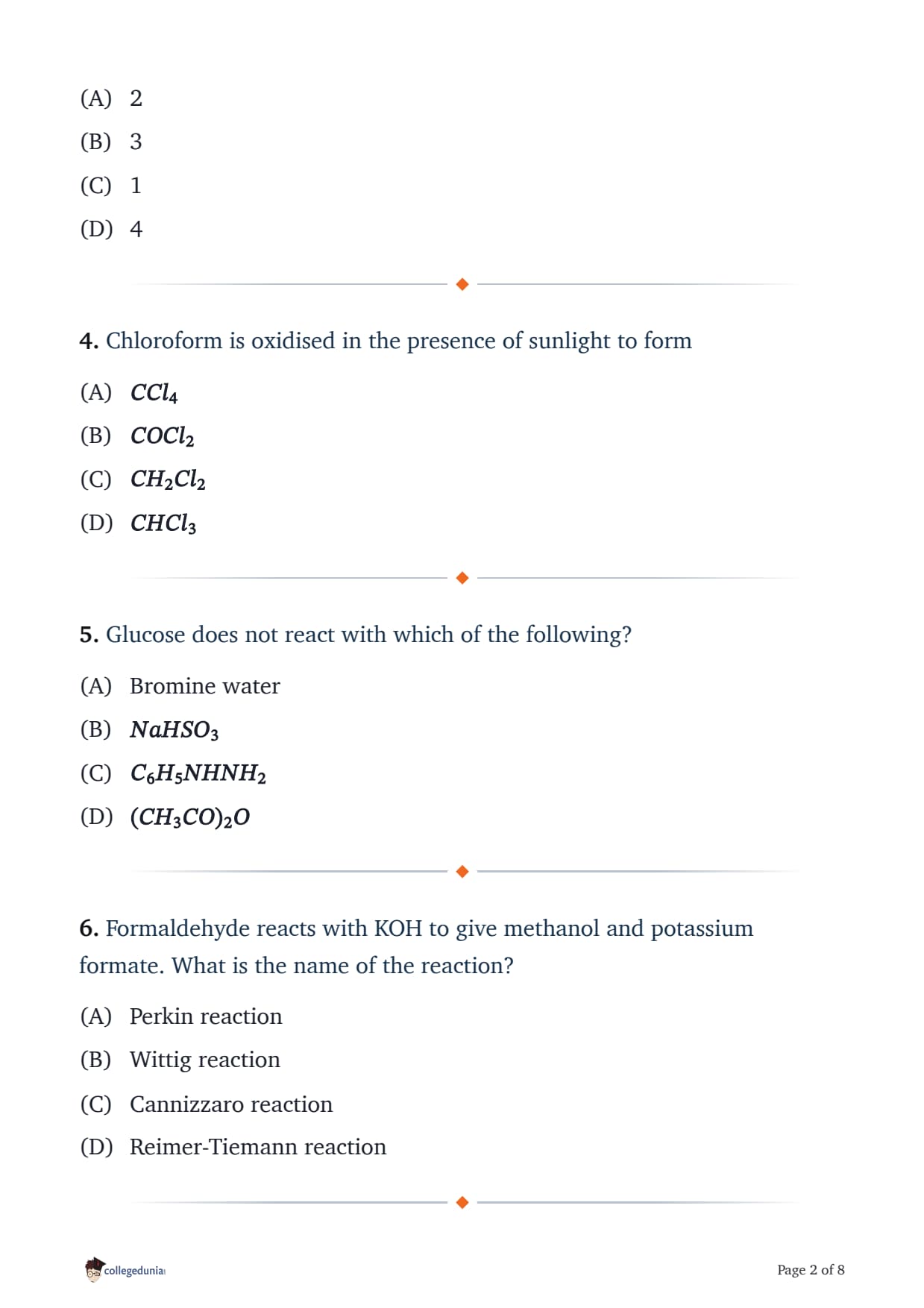
The number of unpaired electrons in \( Cu^{2+} \) is
Chloroform is oxidised in the presence of sunlight to form
Glucose does not react with which of the following?
Formaldehyde reacts with KOH to give methanol and potassium formate. What is the name of the reaction?
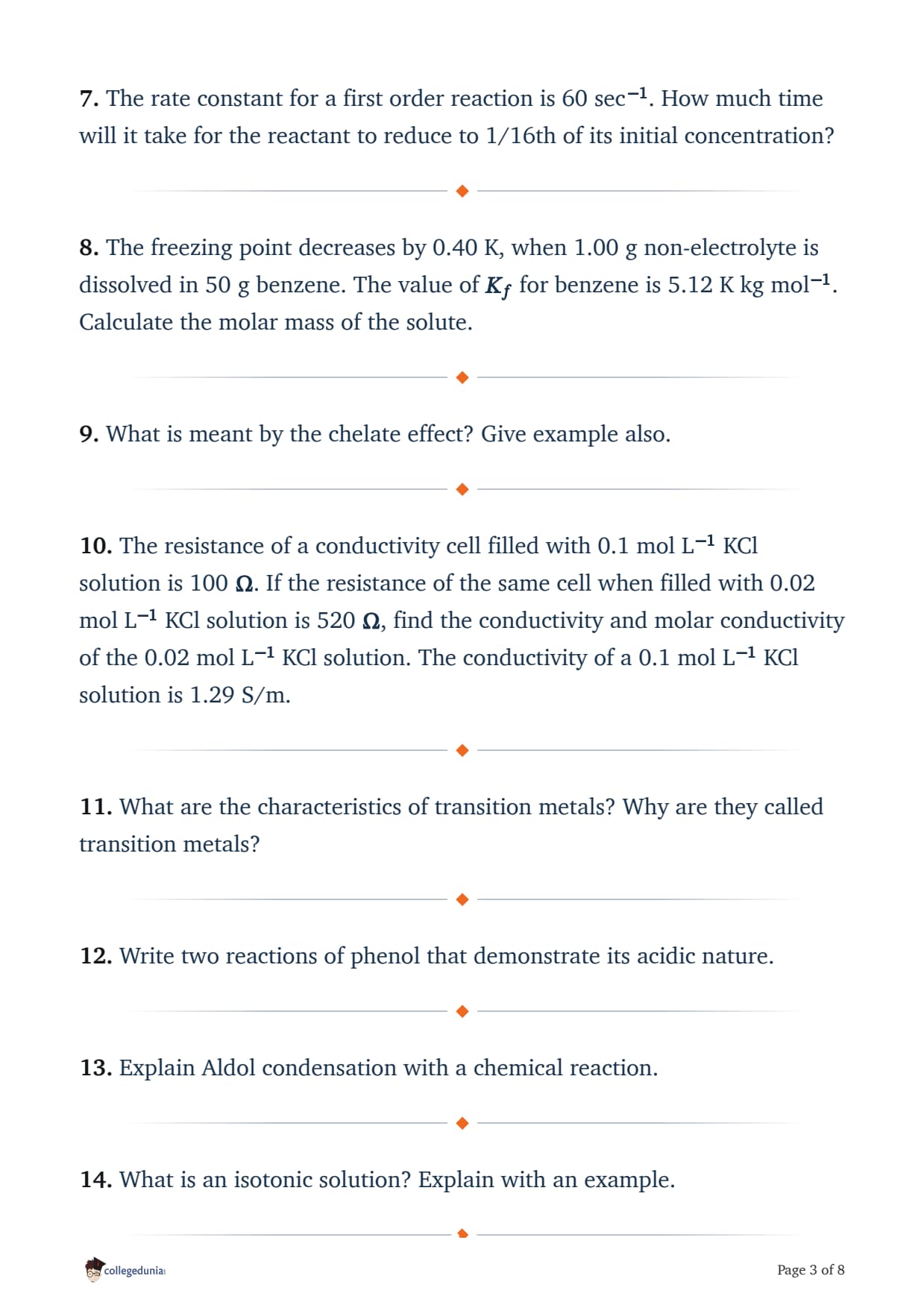
The rate constant for a first order reaction is 60 sec\(^{-1}\). How much time will it take for the reactant to reduce to 1/16th of its initial concentration?
The freezing point decreases by 0.40 K, when 1.00 g non-electrolyte is dissolved in 50 g benzene. The value of \( K_f \) for benzene is 5.12 K kg mol\(^{-1}\). Calculate the molar mass of the solute.
What is meant by the chelate effect? Give example also.
The resistance of a conductivity cell filled with 0.1 mol L\(^{-1}\) KCl solution is 100 \( \Omega \). If the resistance of the same cell when filled with 0.02 mol L\(^{-1}\) KCl solution is 520 \( \Omega \), find the conductivity and molar conductivity of the 0.02 mol L\(^{-1}\) KCl solution. The conductivity of a 0.1 mol L\(^{-1}\) KCl solution is 1.29 S/m.
What are the characteristics of transition metals? Why are they called transition metals?
Write two reactions of phenol that demonstrate its acidic nature.
Explain Aldol condensation with a chemical reaction.
What is an isotonic solution? Explain with an example.
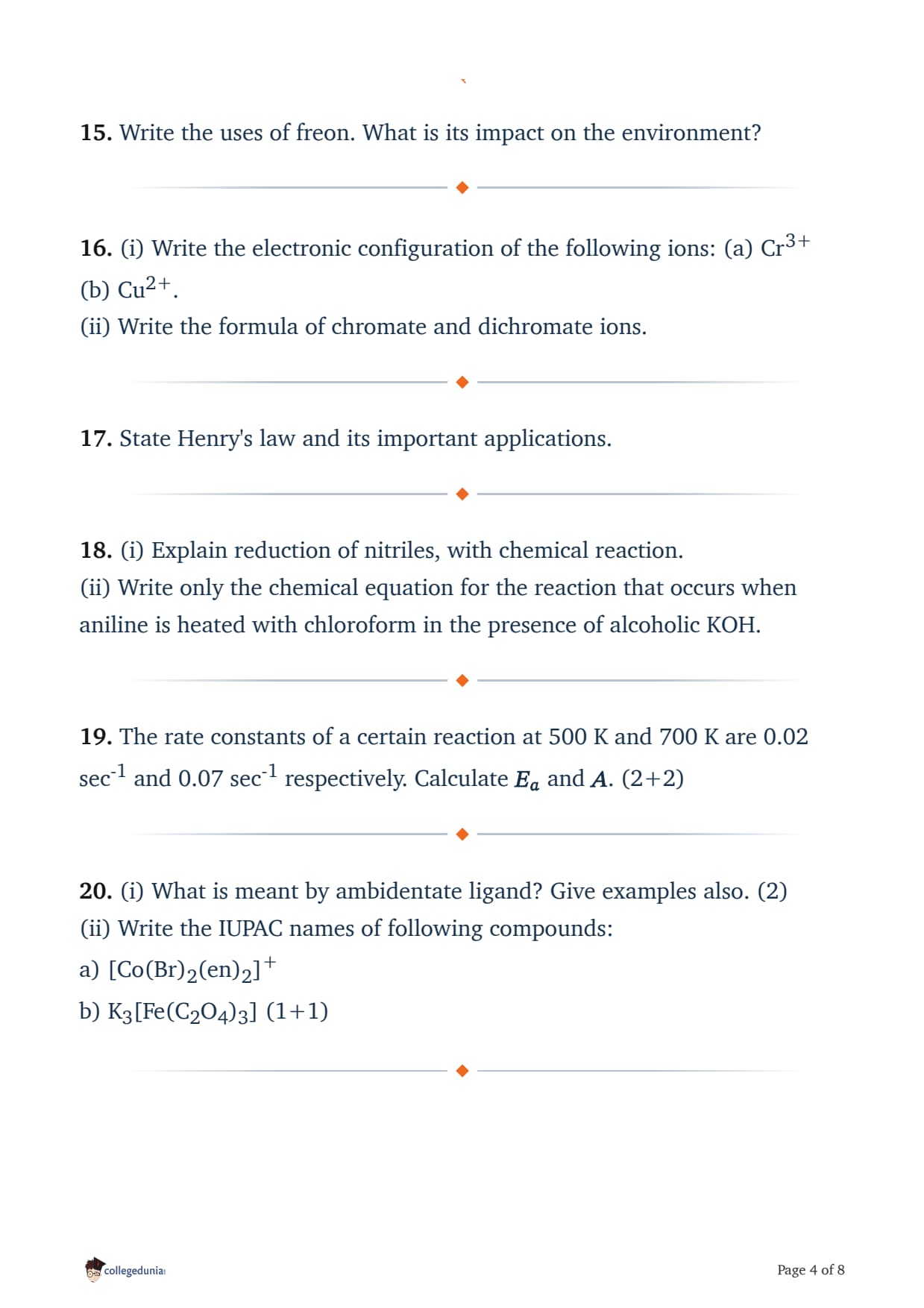
Write the uses of freon. What is its impact on the environment?
(i) Write the electronic configuration of the following ions: (a) Cr3+ (b) Cu2+.
(ii) Write the formula of chromate and dichromate ions.
State Henry's law and its important applications.
(i) Explain reduction of nitriles, with chemical reaction.
(ii) Write only the chemical equation for the reaction that occurs when aniline is heated with chloroform in the presence of alcoholic KOH.
The rate constants of a certain reaction at 500 K and 700 K are 0.02 sec-1 and 0.07 sec-1 respectively. Calculate \( E_a \) and \( A \). (2+2)
(i) What is meant by ambidentate ligand? Give examples also. (2)
(ii) Write the IUPAC names of following compounds:
a) [Co(Br)2(en)2]+
b) K3[Fe(C2O4)3] (1+1)
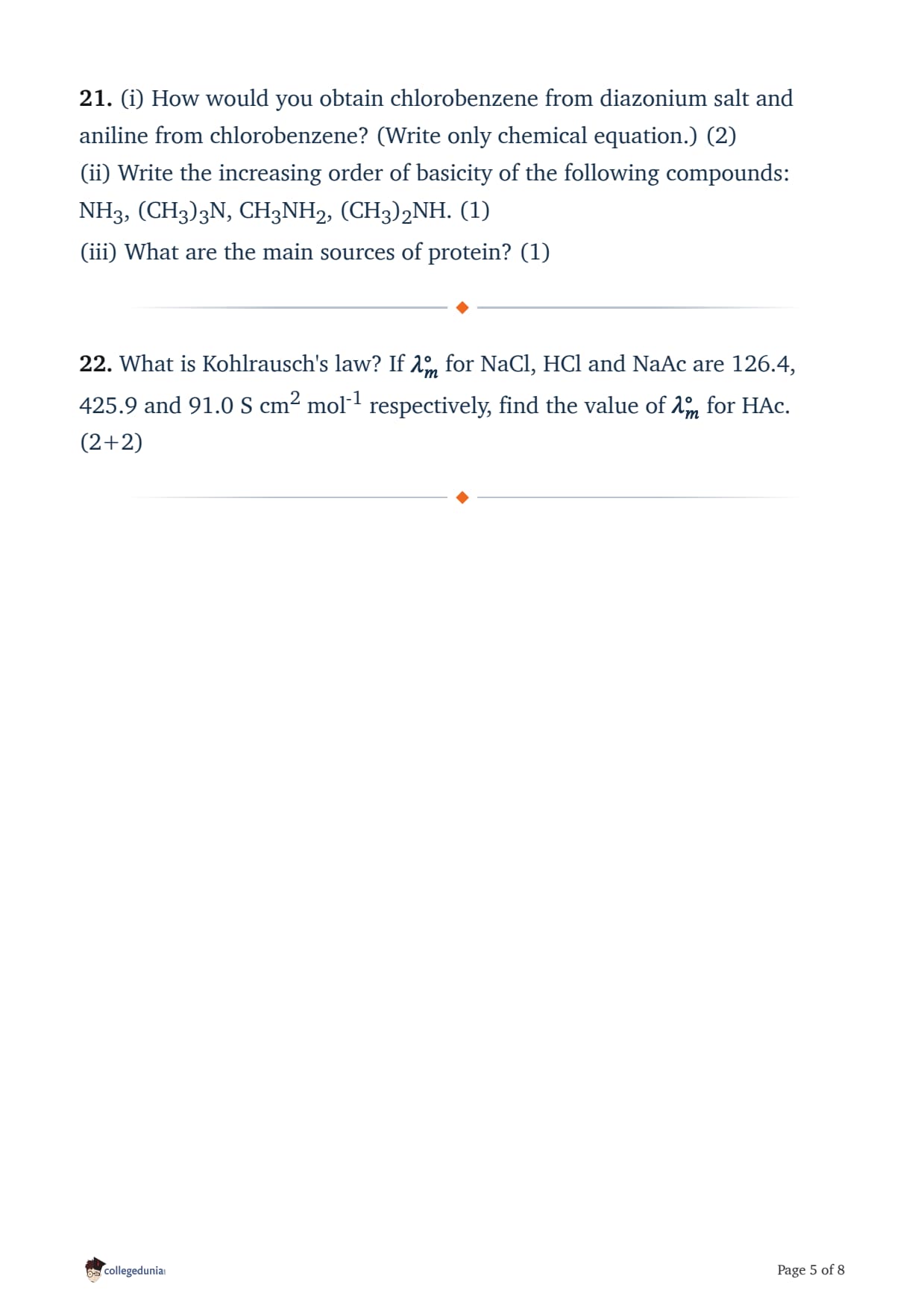
(i) How would you obtain chlorobenzene from diazonium salt and aniline from chlorobenzene? (Write only chemical equation.) (2)
(ii) Write the increasing order of basicity of the following compounds: NH3, (CH3)3N, CH3NH2, (CH3)2NH. (1)
(iii) What are the main sources of protein? (1)
What is Kohlrausch's law? If \( \lambda^{\circ}_m \) for NaCl, HCl and NaAc are 126.4, 425.9 and 91.0 S cm2 mol-1 respectively, find the value of \( \lambda^{\circ}_m \) for HAc. (2+2)

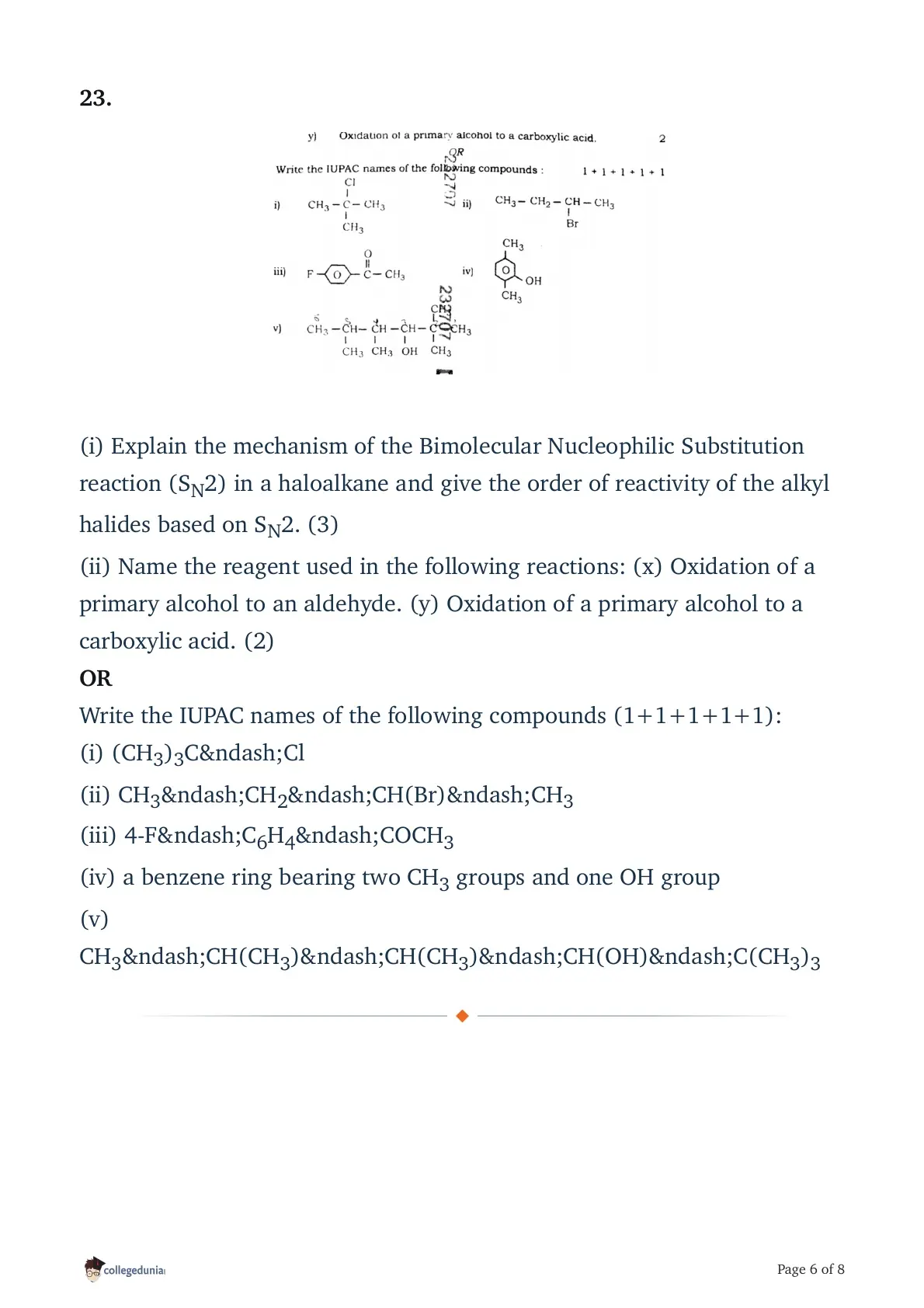
(i) Explain the mechanism of the Bimolecular Nucleophilic Substitution reaction (SN2) in a haloalkane and give the order of reactivity of the alkyl halides based on SN2. (3)
(ii) Name the reagent used in the following reactions: (x) Oxidation of a primary alcohol to an aldehyde. (y) Oxidation of a primary alcohol to a carboxylic acid. (2)
OR
Write the IUPAC names of the following compounds (1+1+1+1+1):
(i) (CH3)3C–Cl
(ii) CH3–CH2–CH(Br)–CH3
(iii) 4-F–C6H4–COCH3
(iv) a benzene ring bearing two CH3 groups and one OH group
(v) CH3–CH(CH3)–CH(CH3)–CH(OH)–C(CH3)3
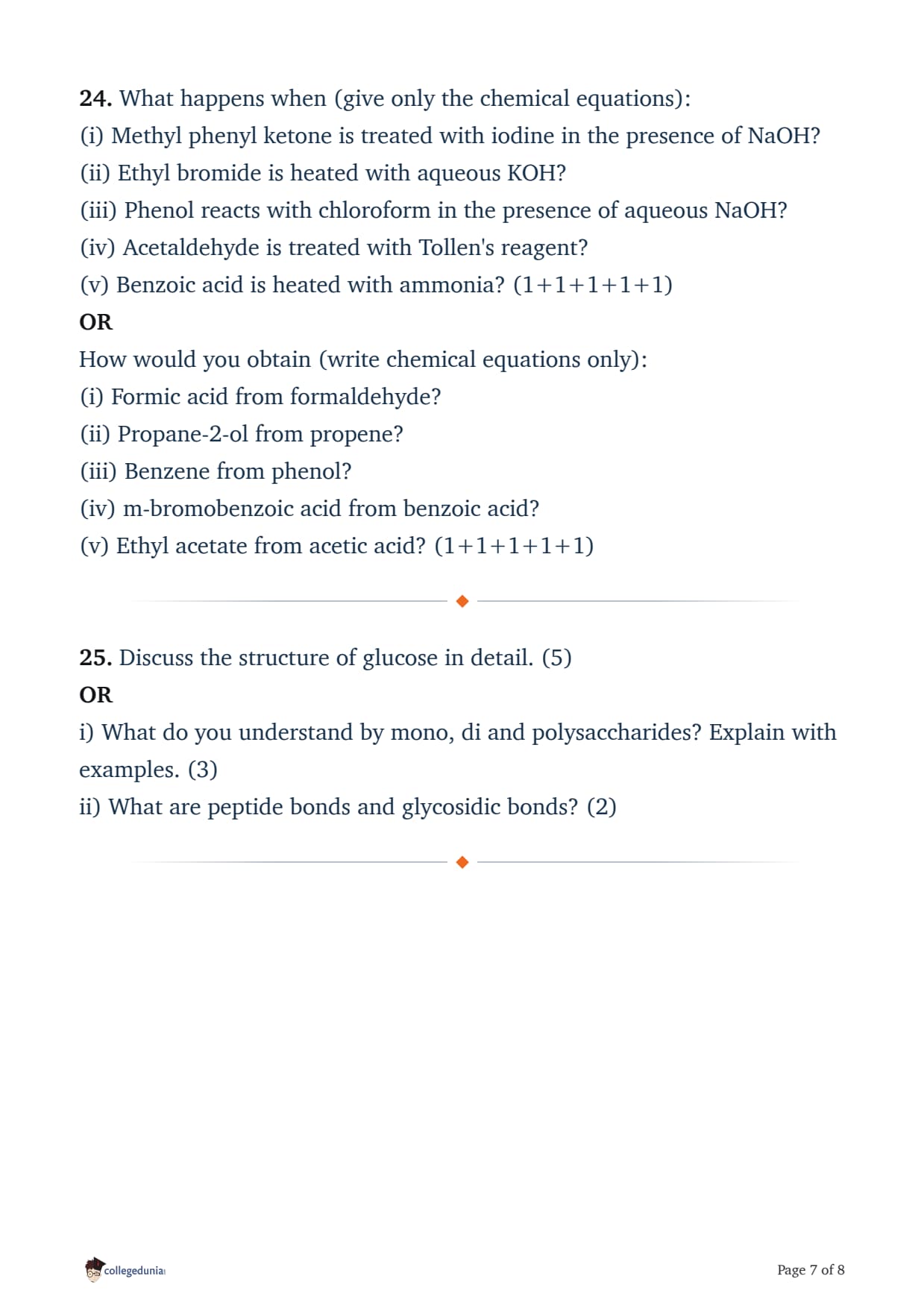
What happens when (give only the chemical equations):
(i) Methyl phenyl ketone is treated with iodine in the presence of NaOH?
(ii) Ethyl bromide is heated with aqueous KOH?
(iii) Phenol reacts with chloroform in the presence of aqueous NaOH?
(iv) Acetaldehyde is treated with Tollen's reagent?
(v) Benzoic acid is heated with ammonia? (1+1+1+1+1)
OR
How would you obtain (write chemical equations only):
(i) Formic acid from formaldehyde?
(ii) Propane-2-ol from propene?
(iii) Benzene from phenol?
(iv) m-bromobenzoic acid from benzoic acid?
(v) Ethyl acetate from acetic acid? (1+1+1+1+1)
Discuss the structure of glucose in detail. (5)
OR
i) What do you understand by mono, di and polysaccharides? Explain with examples. (3)
ii) What are peptide bonds and glycosidic bonds? (2)
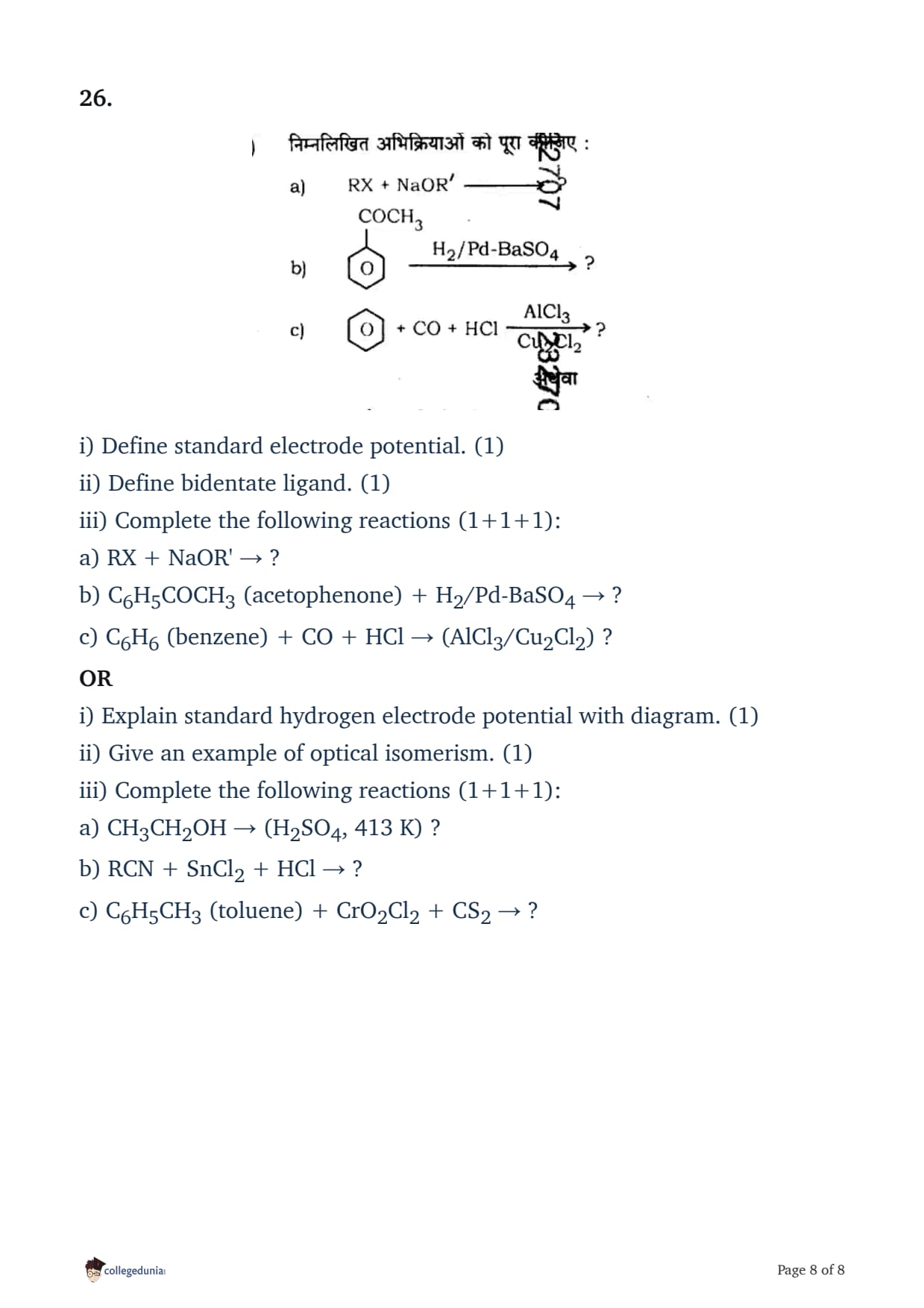
 i) Define standard electrode potential. (1)
ii) Define bidentate ligand. (1)
iii) Complete the following reactions (1+1+1):
a) RX + NaOR' → ?
b) C6H5COCH3 (acetophenone) + H2/Pd-BaSO4 → ?
c) C6H6 (benzene) + CO + HCl → (AlCl3/Cu2Cl2) ?
OR
i) Explain standard hydrogen electrode potential with diagram. (1)
ii) Give an example of optical isomerism. (1)
iii) Complete the following reactions (1+1+1):
a) CH3CH2OH → (H2SO4, 413 K) ?
b) RCN + SnCl2 + HCl → ?
c) C6H5CH3 (toluene) + CrO2Cl2 + CS2 → ?
UP Board Class 12 Chemistry 2026 Set 347 EB Exam Pattern and Marking Scheme
Set 347 EB followed the standard UPMSP Intermediate Chemistry blueprint, so the 70-mark theory paper moved from 1-mark objective questions up to 5-mark long answers in order. Practical marks (30) are assessed separately.
- Total questions: 26 questions across five sections
- Duration: 3 hours 15 minutes (includes 15 minutes reading time)
- Total marks: 70 for theory
- Objective block: Question 1 (a to f) has 6 MCQs of 1 mark each
- Short answers: Section B and Section C carry 2-mark questions
- Descriptive block: Section D holds the 3-mark and 4-mark questions
- Long answers: Section E has Question 6 and Question 7 at 5 marks each, with an internal OR choice
- Language: the paper is bilingual (Hindi and English), and Set 347 EB prints some organic structures directly in the questions
High-Weightage Chapters in UP Board Class 12 Chemistry 2026 Set 347 EB
The 5-mark long answers in Section E decide your score, and they leaned on the same high-value units students expect every year. Lead your revision with these before touching the rest.
- Electrochemistry: the single highest-weightage unit at around 9 marks, so a Nernst equation or conductance numerical here is almost guaranteed
- Aldehydes, Ketones and Carboxylic Acids: close behind at roughly 8 marks, driving the printed organic structures and named reactions in this set
- Coordination Compounds: reliable 3 to 4 marks from IUPAC naming, hybridisation and isomerism
- Chemical Kinetics: a favourite 3-mark numerical on rate constant and order of reaction
- p-Block Elements: 2 to 3 marks of short questions on trends and compound preparation
- Amines and Haloalkanes: steady 2-mark conversions and distinction reactions
UP Board Class 12 Chemistry 2026 Set 347 EB Paper Review Video
Source: Alpha Institute
How to Use the UP Board Class 12 Chemistry Question Paper for Practice
Treat Set 347 EB as a timed mock, not a reading exercise. Students who scored above 60 in theory almost always solved 5 to 6 full papers under the clock first.
- Solve the full paper in one 3 hour 15 minute sitting, then mark it against the solutions PDF above
- Answer every organic conversion and named reaction in your own hand, since the printed structures in this set reward exact mechanisms
- Redo the 5-mark Electrochemistry and Aldehydes questions until both OR choices feel easy
- Note the numericals you missed and repeat only those the next day
UP Board Class 12 Chemistry 2026 Difficulty and Scoring Benchmark
- The 2026 Chemistry paper stayed moderate and textbook-based, sticking close to the NCERT pattern with only small changes in numerical values
- Scoring above 60 out of 70 in theory is realistic if you finish NCERT examples, all named reactions and 5 to 6 previous year papers
- The full objective block of 6 marks is the easiest to lock, so never leave Question 1 blank
UP Board Class 12 Chemistry 2026 Set 347 EB Question Paper FAQs
Ques. Was the UP Board Class 12 Chemistry 2026 paper hard?
Ans. No, the 2026 Chemistry paper was moderate and textbook-based. It stayed very close to the NCERT pattern, with the board repeating familiar formats and only changing numerical values, organic conversions and mechanisms rather than adding new question types.
Ques. Which chapters had the highest weightage in UP Board Class 12 Chemistry 2026?
Ans. Electrochemistry carried the most marks at around 9, followed by Aldehydes, Ketones and Carboxylic Acids at about 8. Coordination Compounds, Chemical Kinetics, p-Block Elements and Amines filled the remaining 3-mark and 2-mark slots.
Ques. How many questions and marks are there in the UP Board Class 12 Chemistry Set 347 EB paper?
Ans. The paper has 26 questions for 70 marks in 3 hours 15 minutes. Question 1 (a to f) is 6 one-mark MCQs, Sections B and C are 2-mark questions, Section D holds the 3-mark and 4-mark questions, and Section E has two 5-mark long answers with internal choice.
Ques. What is Set 347 EB in the UP Board Class 12 Chemistry 2026 exam?
Ans. 347 is the UP Board paper code for Class 12 Chemistry, and EB is the specific set or series printed on this booklet. All sets test the same syllabus and blueprint, so this set is fully usable practice no matter which code you received.
Ques. Is the UP Board Class 12 Chemistry question paper bilingual?
Ans. Yes. The UPMSP Chemistry paper is printed in both Hindi and English, so you can answer in either language. Set 347 EB also prints a few organic structures directly in the questions, which you should copy carefully while solving.
Ques. Where can I download the UP Board Class 12 Chemistry 2026 Set 347 EB question paper with solutions PDF for free?
Ans. Use the download table above on Collegedunia for the free question paper and full solutions PDF. For the official paper and syllabus, visit the UPMSP site at upmsp.edu.in or the paper portal upboardonline.com.



Comments