




KCET 2026 Physics Question Paper is available for download here. KEA conducted KCET 2026 Physics exam on April 23 in Shift 1 from 10.30 AM to 11.50 AM.
Also Check: Expected KCET Marks vs Rank for April 23 Physics Exam
- KCET Physics Question Paper consists of 60 questions to be attempted in 80 minutes.
- Each correct answer will get you 1 mark and there is no negative marking for incorrect answers.
Candidates can download KCET 2026 Physics Question Paper with Answer Key and Solution PDF from the links provided below. Based on initital student reaction, KCET 2026 Physics Paper was of moderate level with more theory based questions.
KCET 2026 Physics Question Paper with Solution PDF
| KEAM 2026 Physics Question Paper Code C2 | Download PDF | Check Solution |
An electron falls through a distance 1.5 cm in a uniform electric field of magnitude 2.0 \(\times\) 10\(^4\) N/C from rest. The time taken to cover this distance in second is \textunderscore\textunderscore\textunderscore\textunderscore\textunderscore.
(e = 1.6 \(\times\) 10\(^{-19}\) C, m\(_e\) = 9.11 \(\times\) 10\(^{-31}\) kg)
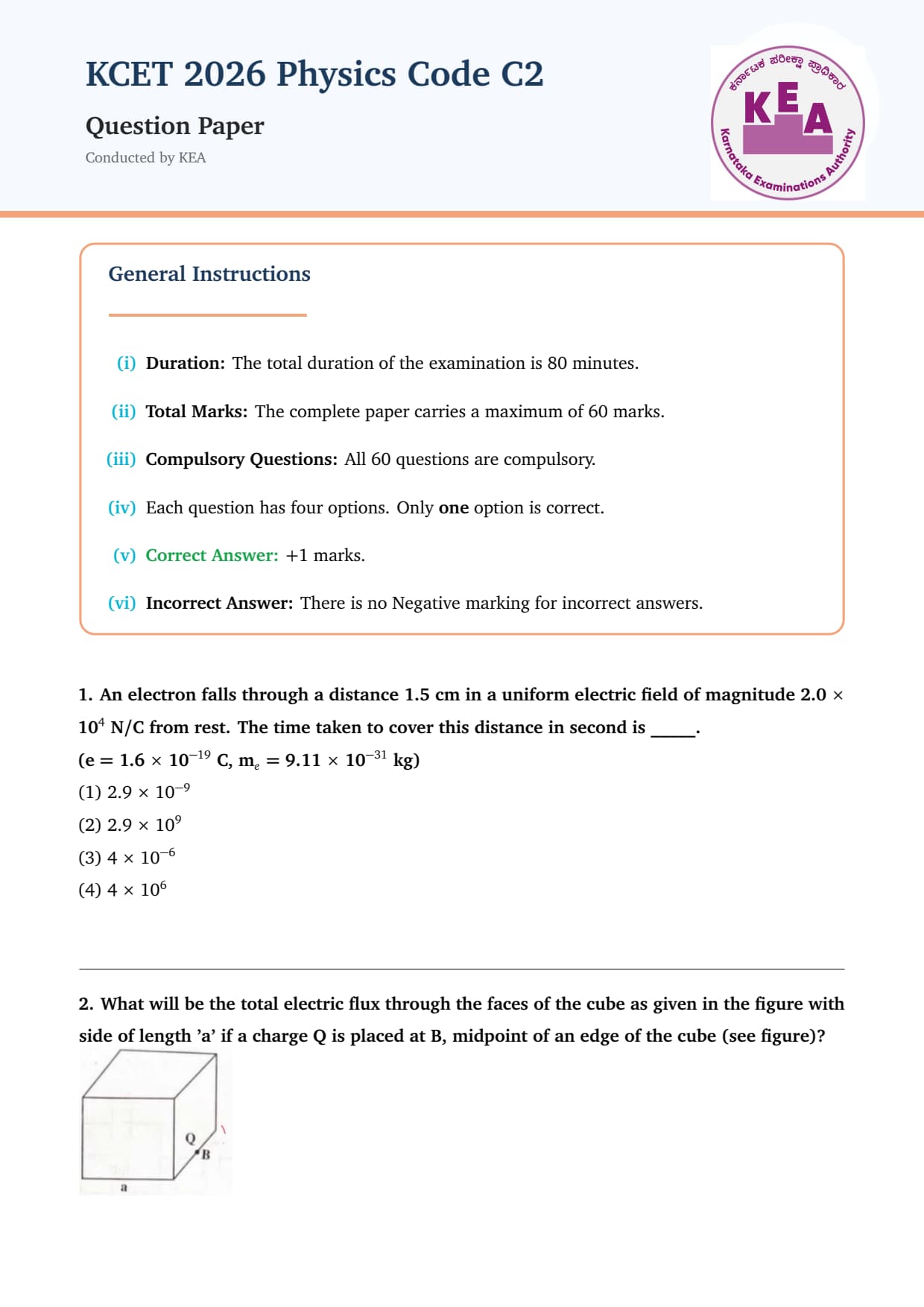
What will be the total electric flux through the faces of the cube as given in the figure with side of length 'a' if a charge Q is placed at B, midpoint of an edge of the cube (see figure)?

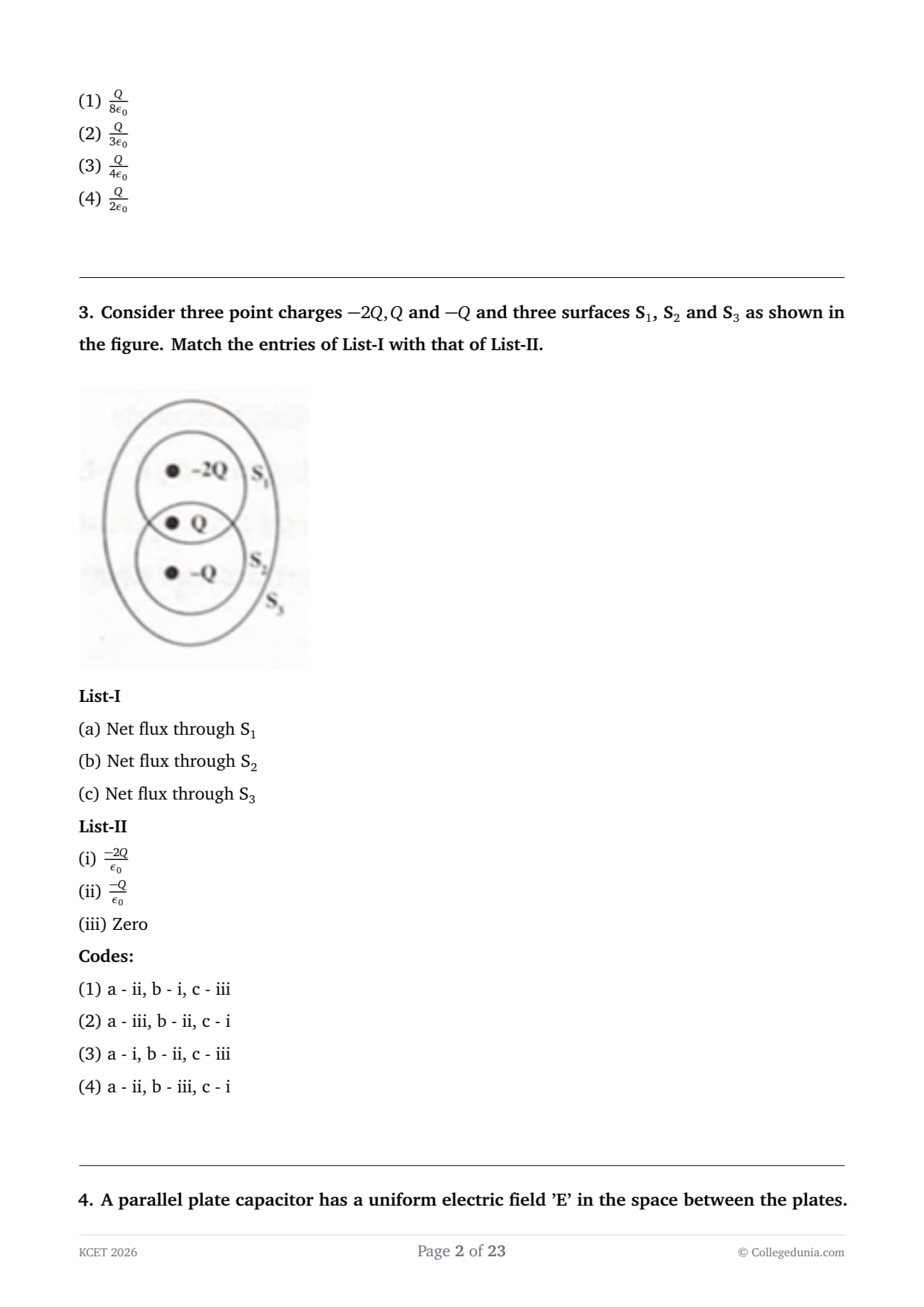
Consider three point charges \(-2Q, Q\) and \(-Q\) and three surfaces S\(_1\), S\(_2\) and S\(_3\) as shown in the figure. Match the entries of List-I with that of List-II.

List-I
(a) Net flux through S\(_1\)
(b) Net flux through S\(_2\)
(c) Net flux through S\(_3\)
List-II
(i) \(\frac{-2Q}{\epsilon_0}\)
(ii) \(\frac{-Q}{\epsilon_0}\)
(iii) Zero
Codes:
A parallel plate capacitor has a uniform electric field 'E' in the space between the plates. If the distance between the plates is 'd' and area of each plate is 'A', the energy stored in the capacitor is
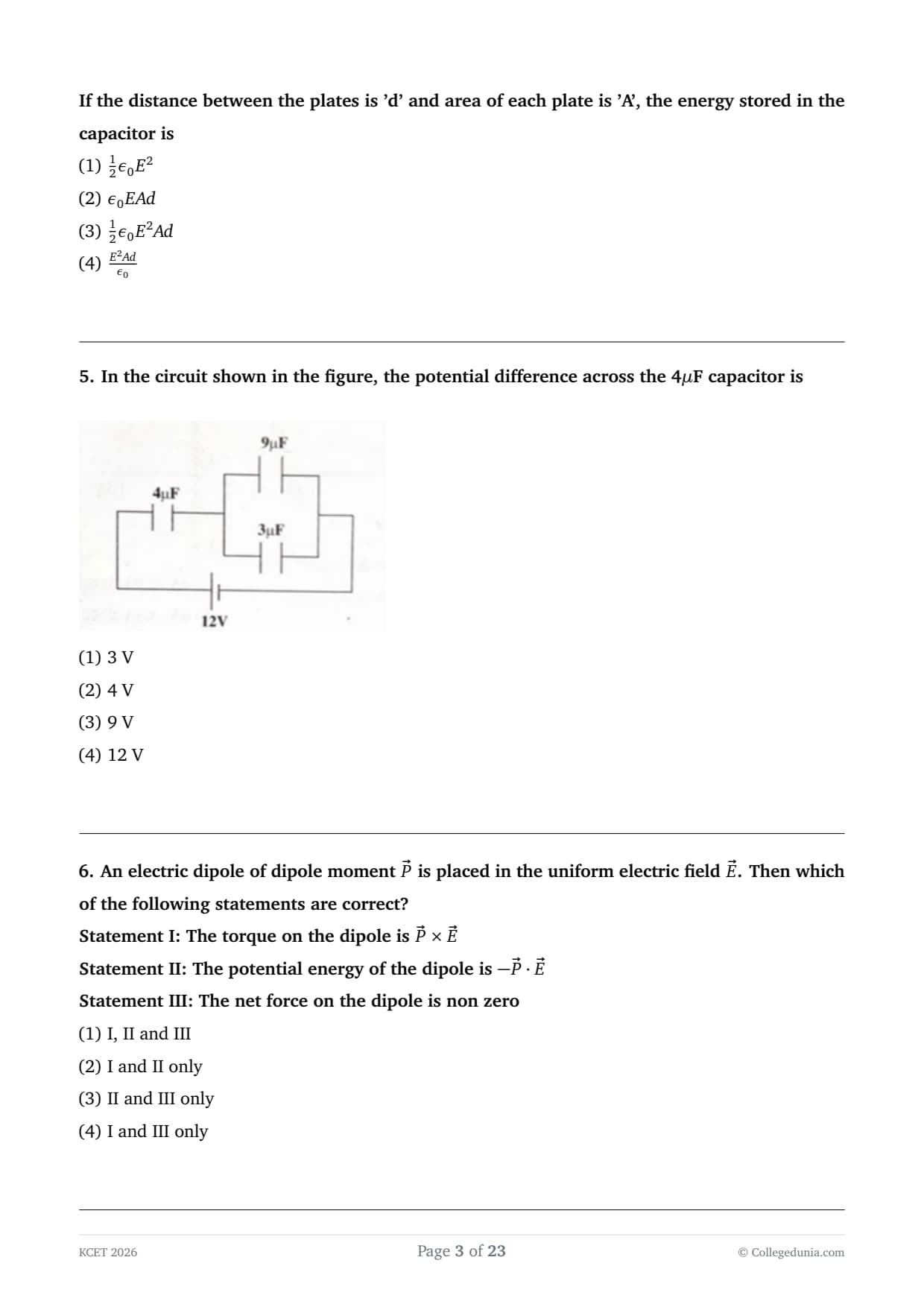
In the circuit shown in the figure, the potential difference across the 4\(\mu\)F capacitor is

An electric dipole of dipole moment \(\vec{P}\) is placed in the uniform electric field \(\vec{E}\). Then which of the following statements are correct?
Statement I: The torque on the dipole is \(\vec{P} \times \vec{E}\)
Statement II: The potential energy of the dipole is \(-\vec{P} \cdot \vec{E}\)
Statement III: The net force on the dipole is non zero
A 200 J of work is done in moving a charge 5C from a point A where the potential is - 20 V to another point B where potential is V volt. The value of V at B is
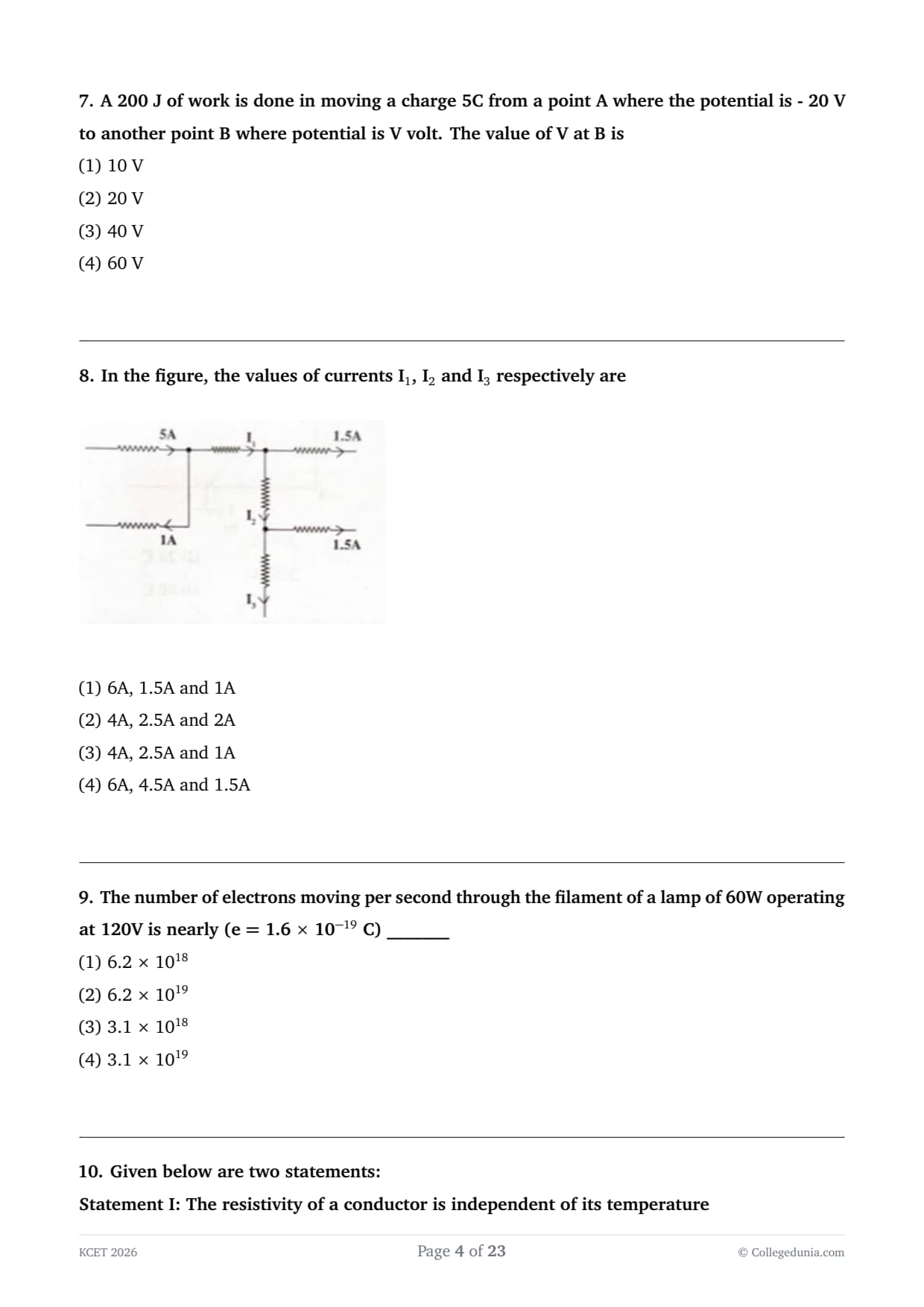
In the figure, the values of currents I\(_1\), I\(_2\) and I\(_3\) respectively are

The number of electrons moving per second through the filament of a lamp of 60W operating at 120V is nearly (e = 1.6 \(\times\) 10\(^{-19}\) C)
Given below are two statements:
Statement I: The resistivity of a conductor is independent of its temperature
Statement II: The resistivity of a semiconductor decreases with increase in temperature
Select the correct option.
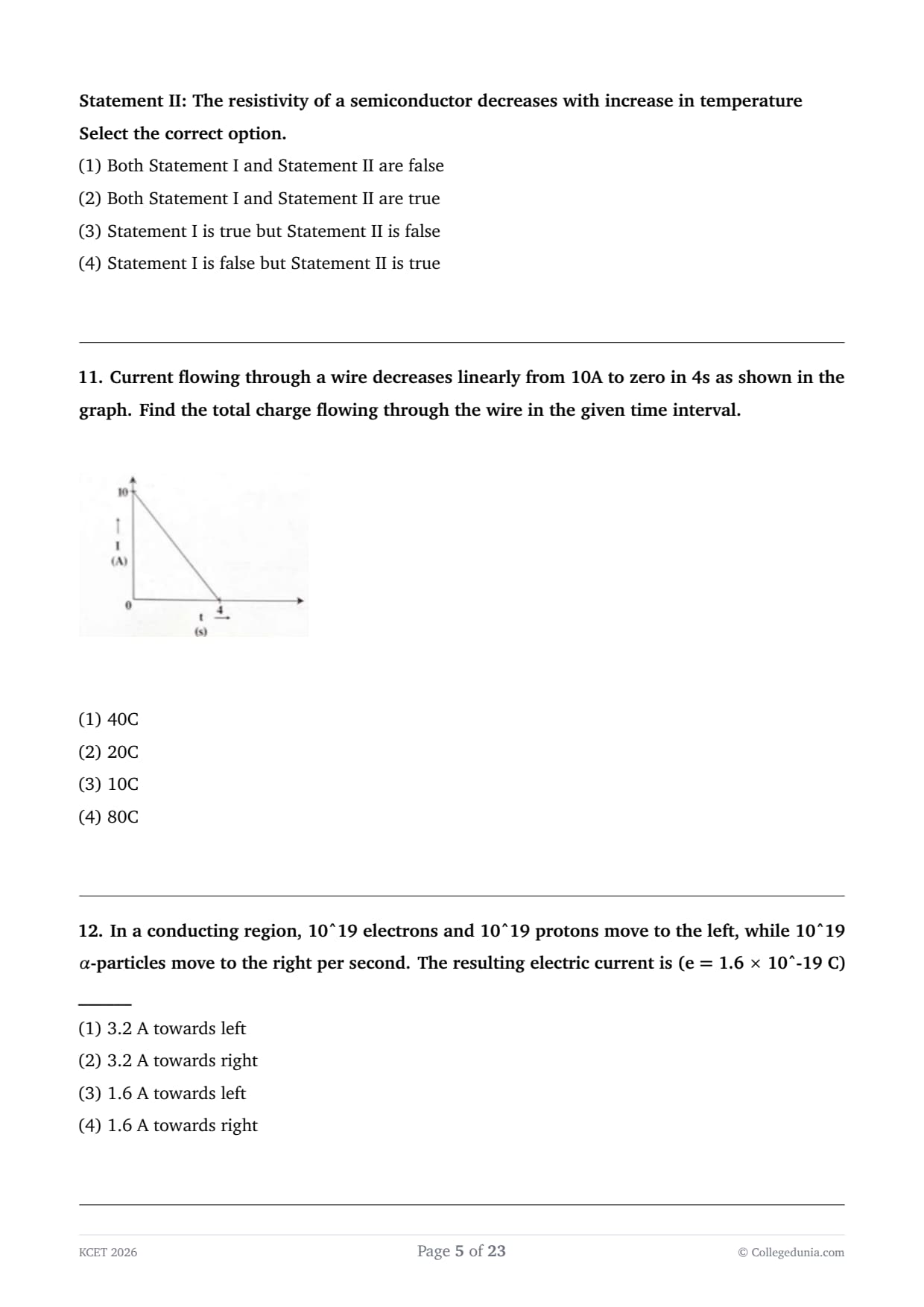
Current flowing through a wire decreases linearly from 10A to zero in 4s as shown in the graph. Find the total charge flowing through the wire in the given time interval.

In a conducting region, \( 10^{19} \) electrons and \( 10^{19} \) protons move to the left, while \( 10^{19} \) \( \alpha \)-particles move to the right per second. The resulting electric current is \( (e = 1.6 \times 10^{-19} \, \text{C}) \).
A point charge is placed in a moving train. A passenger A sitting in the train and person B on the ground observe the fields due to this charge. Then
A proton, an electron and an \(\alpha\)-particle enter at right angles to a uniform magnetic field with the same velocity. If R\(_p\), R\(_e\) and R\(_\alpha\) are the radii of circular paths of these particles, then
Biot-Savart law indicates that an electron moving with a velocity \( \vec{V} \) produces a magnetic field \( \vec{B} \) around it such that
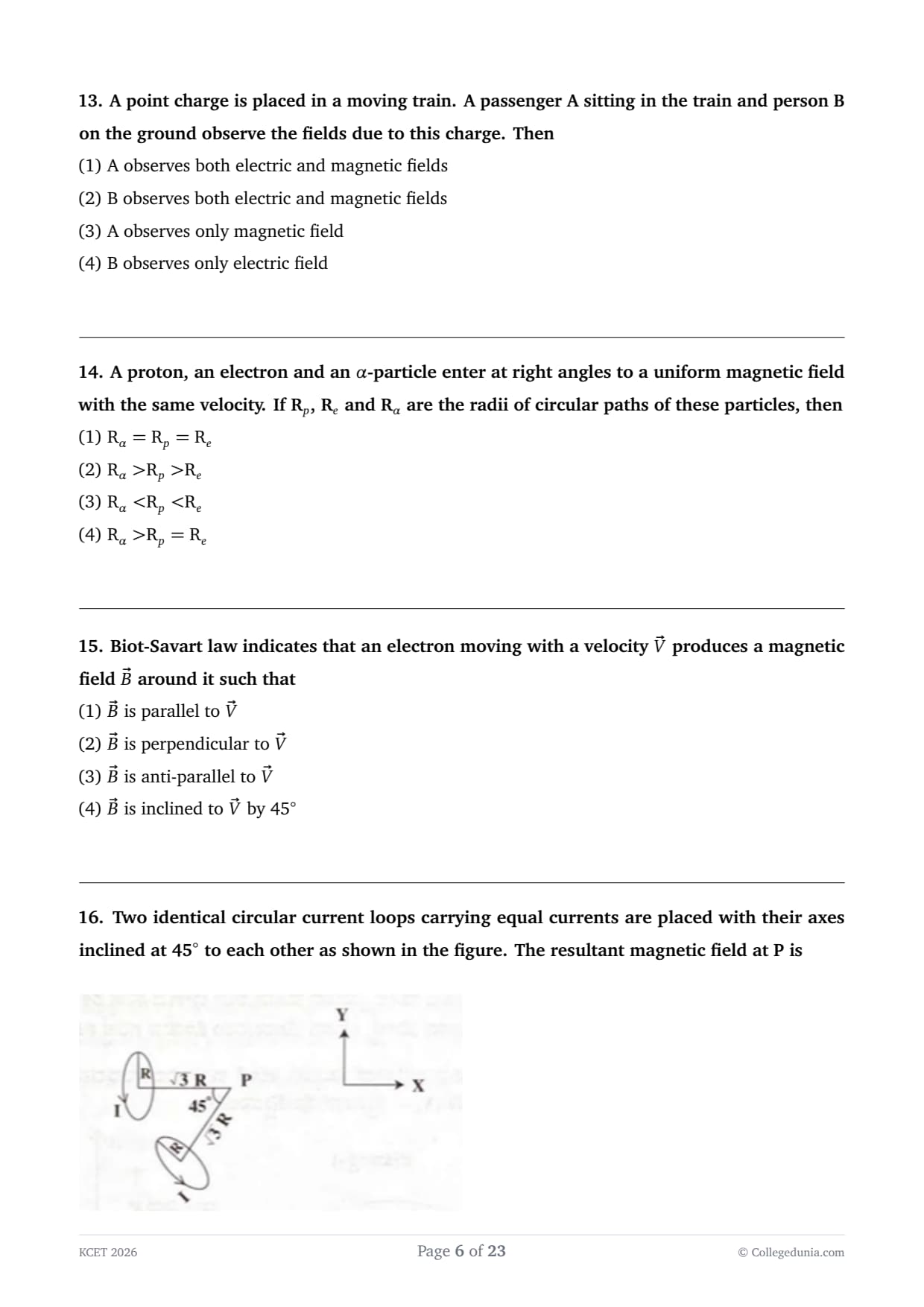
Two identical circular current loops carrying equal currents are placed with their axes inclined at 45\(^{\circ}\) to each other as shown in the figure. The resultant magnetic field at P is

If a paramagnetic bar is brought near a bar magnet, then it is
Pick out the WRONG statements about magnetic substances (\(\chi\) = magnetic susceptibility) (\(\mu_r\) = relative permeability).
I. Substances with \(-1 \le \chi < 0\) are diamagnetic
II. Substances with \(\chi \gg 1\) are paramagnetic
III. Substances with \(\chi \ll 1\) are ferromagnetic
IV. Substances with \(\mu_r \gg 1\) are ferromagnetic
Work function of the metal is
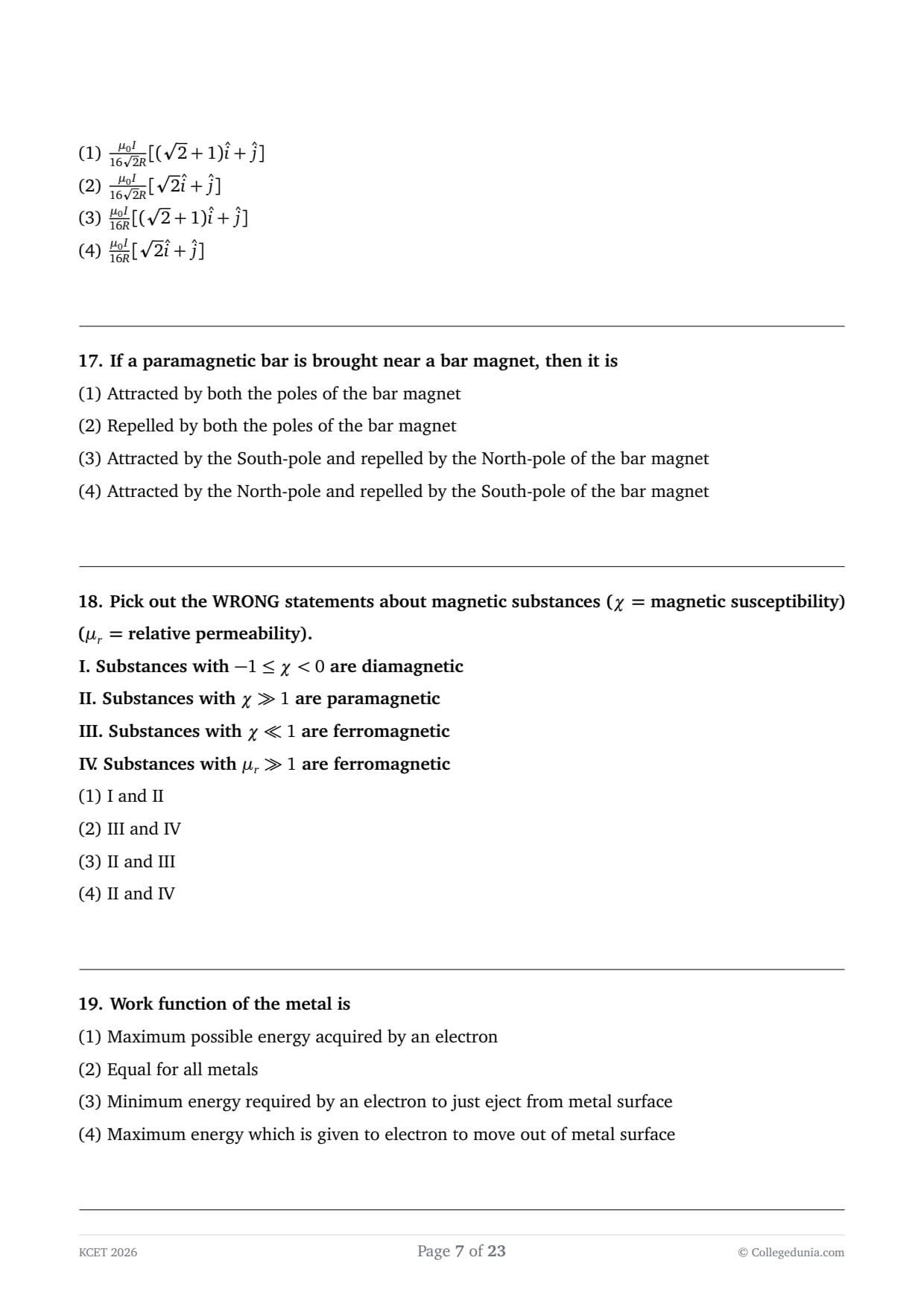
Variation of photoelectric current with anode potential is shown below. Choose the correct option (V\(_0\) = stopping potential).


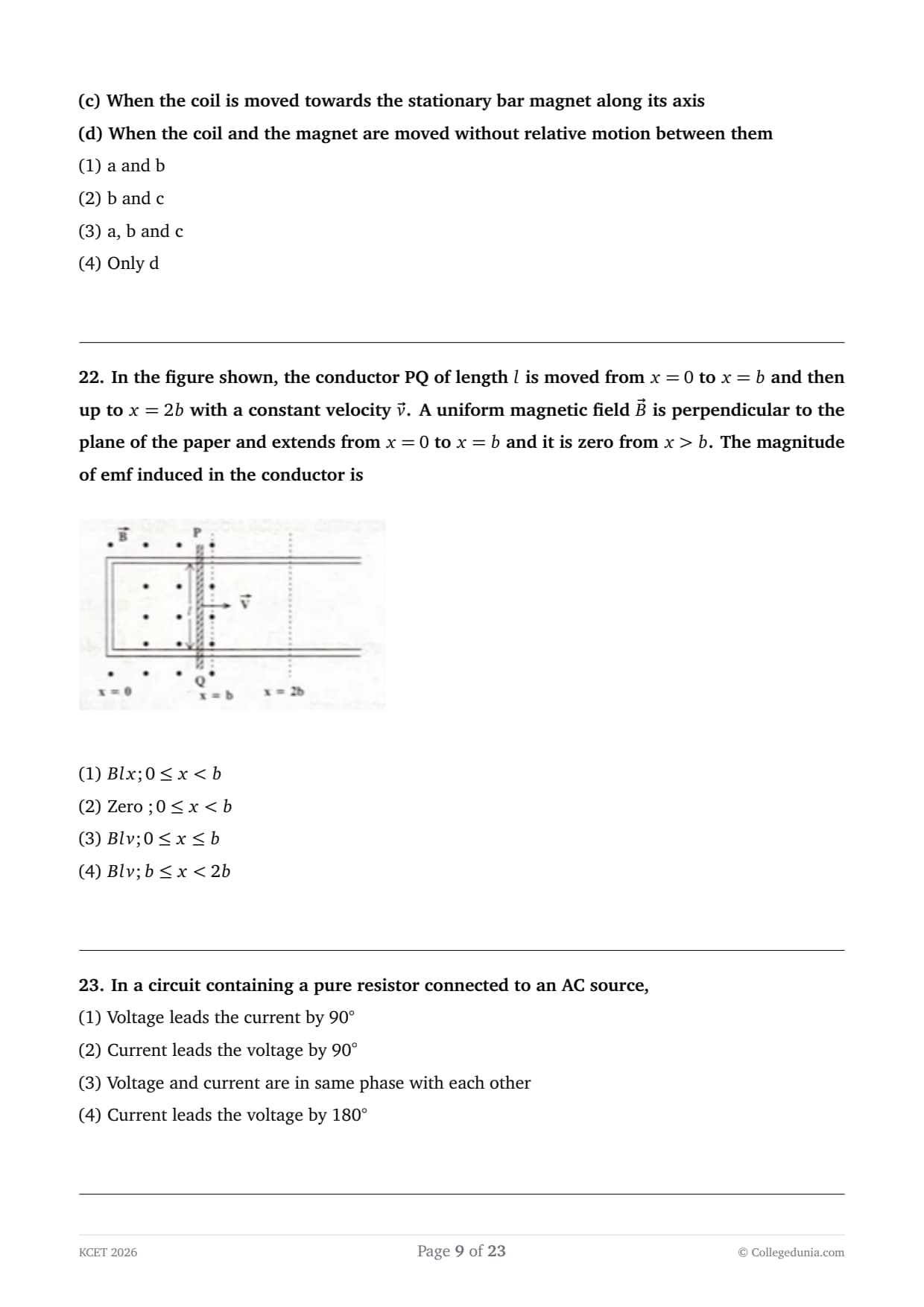
In Faraday-Henry's experiment, a coil is connected to a galvanometer. For the deflection of pointer in the galvanometer, which of the following statement/s is/are WRONG?
The pointer in the galvanometer deflects -
(a) When the bar magnet is moved towards the stationary coil along its axis
(b) When the bar magnet is moved away from the stationary coil along its axis
(c) When the coil is moved towards the stationary bar magnet along its axis
(d) When the coil and the magnet are moved without relative motion between them
In the figure shown, the conductor PQ of length \(l\) is moved from \(x = 0\) to \(x = b\) and then up to \(x = 2b\) with a constant velocity \(\vec{v}\). A uniform magnetic field \(\vec{B}\) is perpendicular to the plane of the paper and extends from \(x = 0\) to \(x = b\) and it is zero from \(x > b\). The magnitude of emf induced in the conductor is

In a circuit containing a pure resistor connected to an AC source,
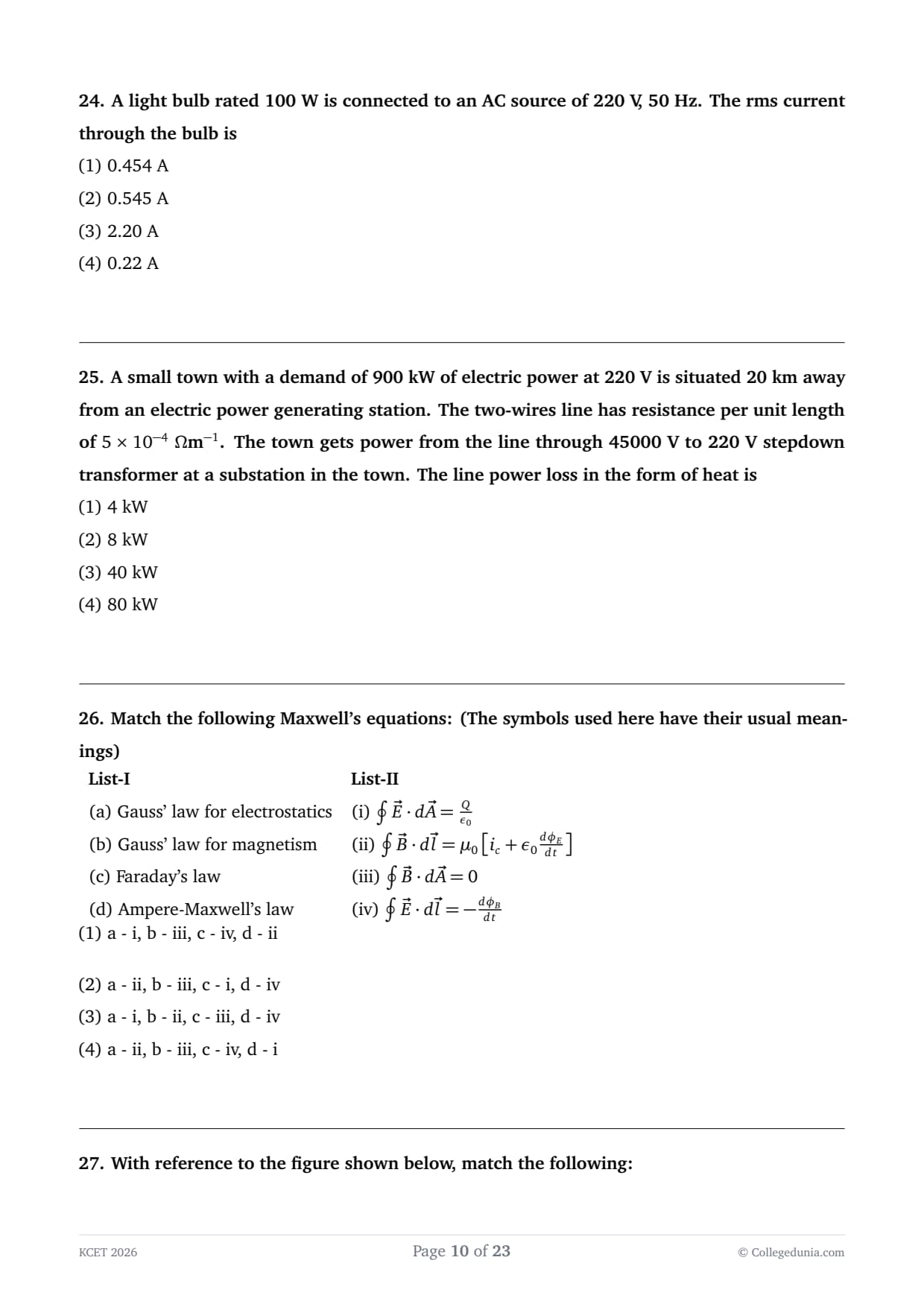
A light bulb rated 100 W is connected to an AC source of 220 V, 50 Hz. The rms current through the bulb is
A small town with a demand of 900 kW of electric power at 220 V is situated 20 km away from an electric power generating station. The two-wires line has resistance per unit length of \( 5 \times 10^{-4} \ \Omega m^{-1} \). The town gets power from the line through 45000 V to 220 V stepdown transformer at a substation in the town. The line power loss in the form of heat is
Match the following Maxwell's equations: (The symbols used here have their usual meanings)
| List-I | List-II |
|---|---|
| (a) Gauss' law for electrostatics | (i) ∮ E · dA = Q / ε₀ |
| (b) Gauss' law for magnetism | (ii) ∮ B · dl = μ₀ [ ic + ε₀ (dΦE/dt) ] |
| (c) Faraday's law | (iii) ∮ B · dA = 0 |
| (d) Ampere-Maxwell's law | (iv) ∮ E · dl = − dΦB / dt |
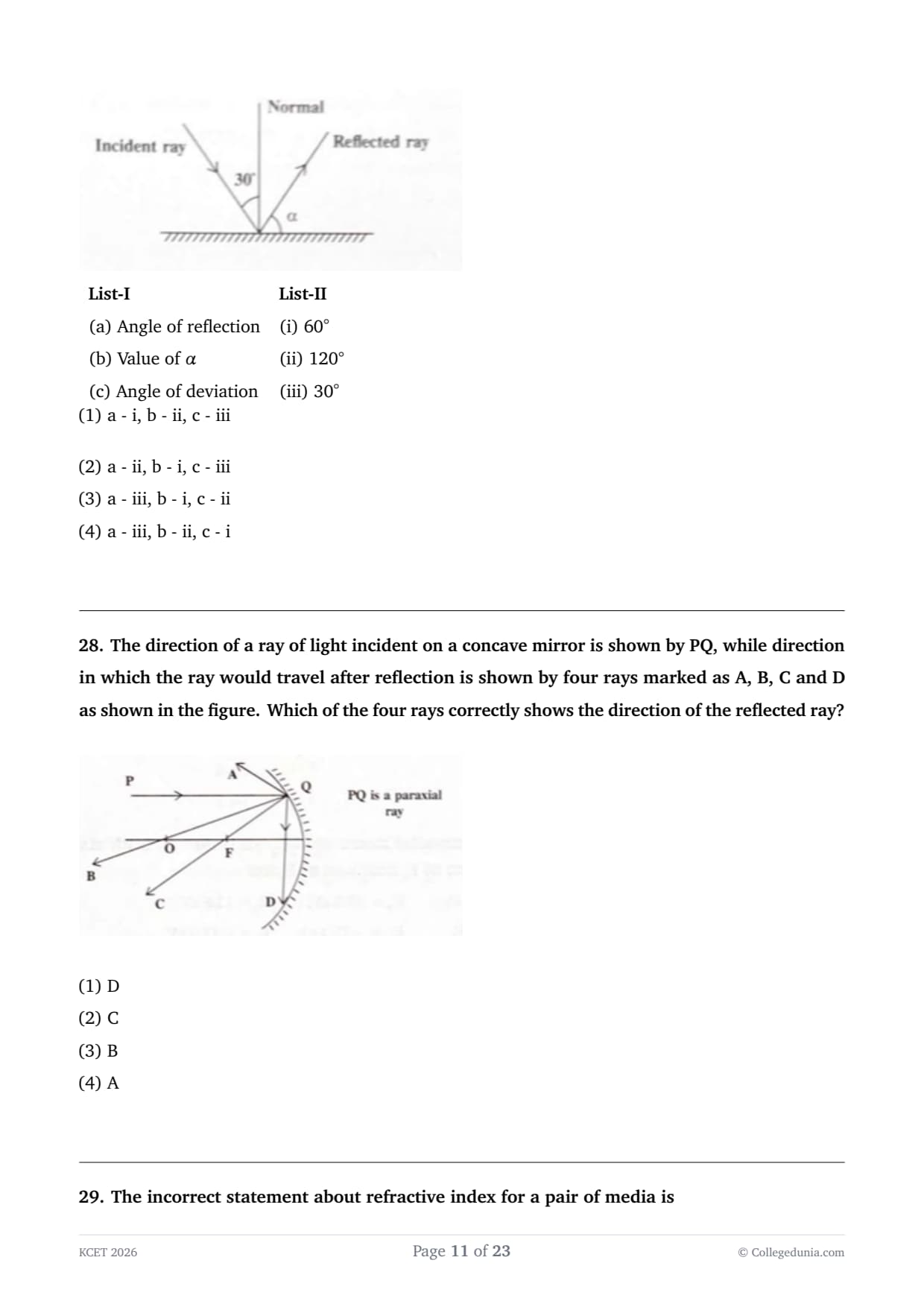
With reference to the figure shown below, match the following:

Match the following:
| List-I | List-II |
|---|---|
| (a) Angle of reflection | (i) 60° |
| (b) Value of α | (ii) 120° |
| (c) Angle of deviation | (iii) 30° |
The direction of a ray of light incident on a concave mirror is shown by PQ, while direction in which the ray would travel after reflection is shown by four rays marked as A, B, C and D as shown in the figure. Which of the four rays correctly shows the direction of the reflected ray?

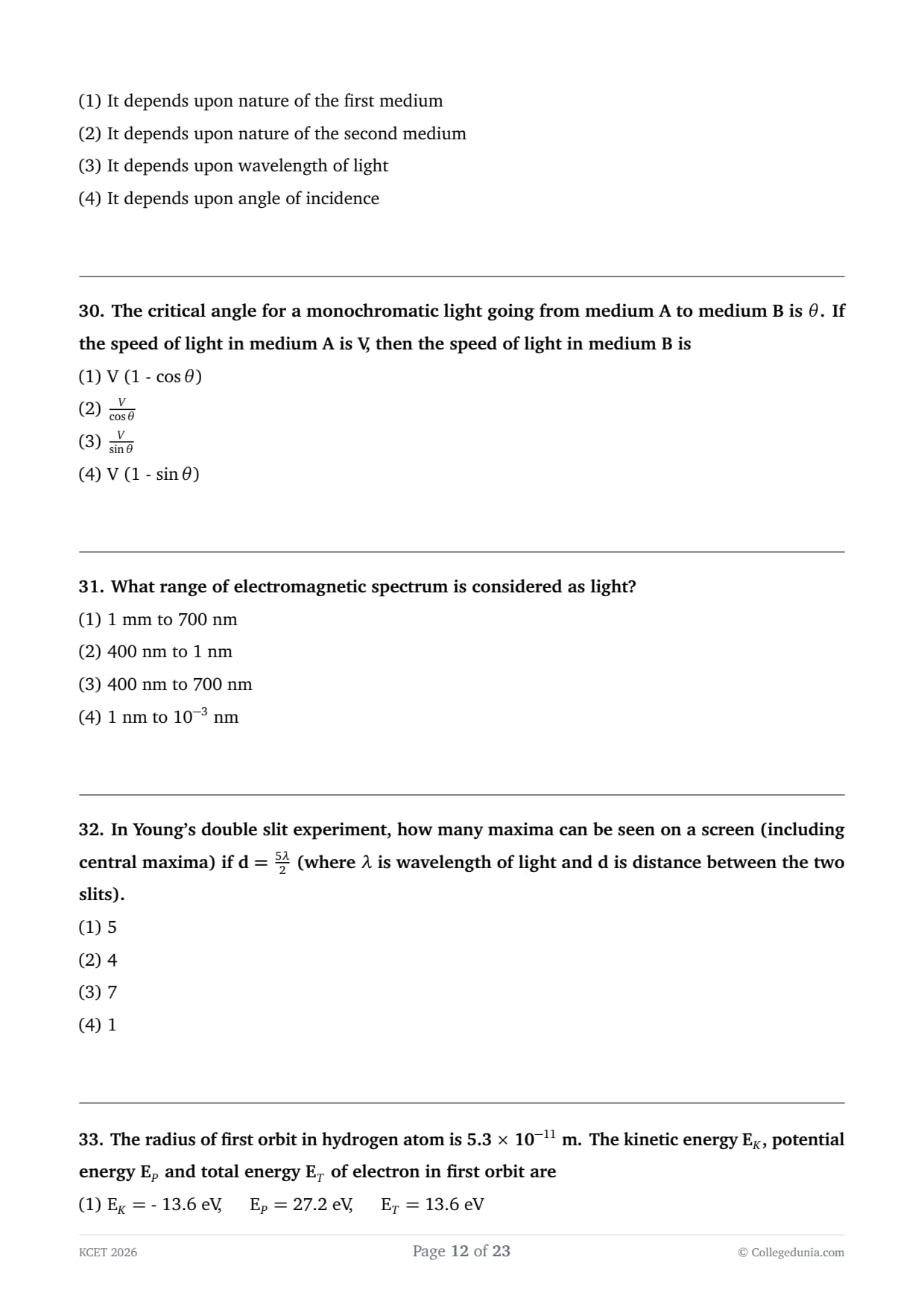
The incorrect statement about refractive index for a pair of media is
The critical angle for a monochromatic light going from medium A to medium B is \(\theta\). If the speed of light in medium A is V, then the speed of light in medium B is
What range of electromagnetic spectrum is considered as light?
In Young's double slit experiment, how many maxima can be seen on a screen (including central maxima) if d = \(\frac{5\lambda}{2}\) (where \(\lambda\) is wavelength of light and d is distance between the two slits).
The radius of first orbit in hydrogen atom is 5.3 \(\times\) 10\(^{-11}\) m. The kinetic energy E\(_K\), potential energy E\(_P\) and total energy E\(_T\) of electron in first orbit are
Bohr's second postulate implies quantisation of
An electron transition takes place from excited state to ground state in hydrogen atom, then
An n-type and p-type semiconductor can be obtained by respectively doping pure silicon with
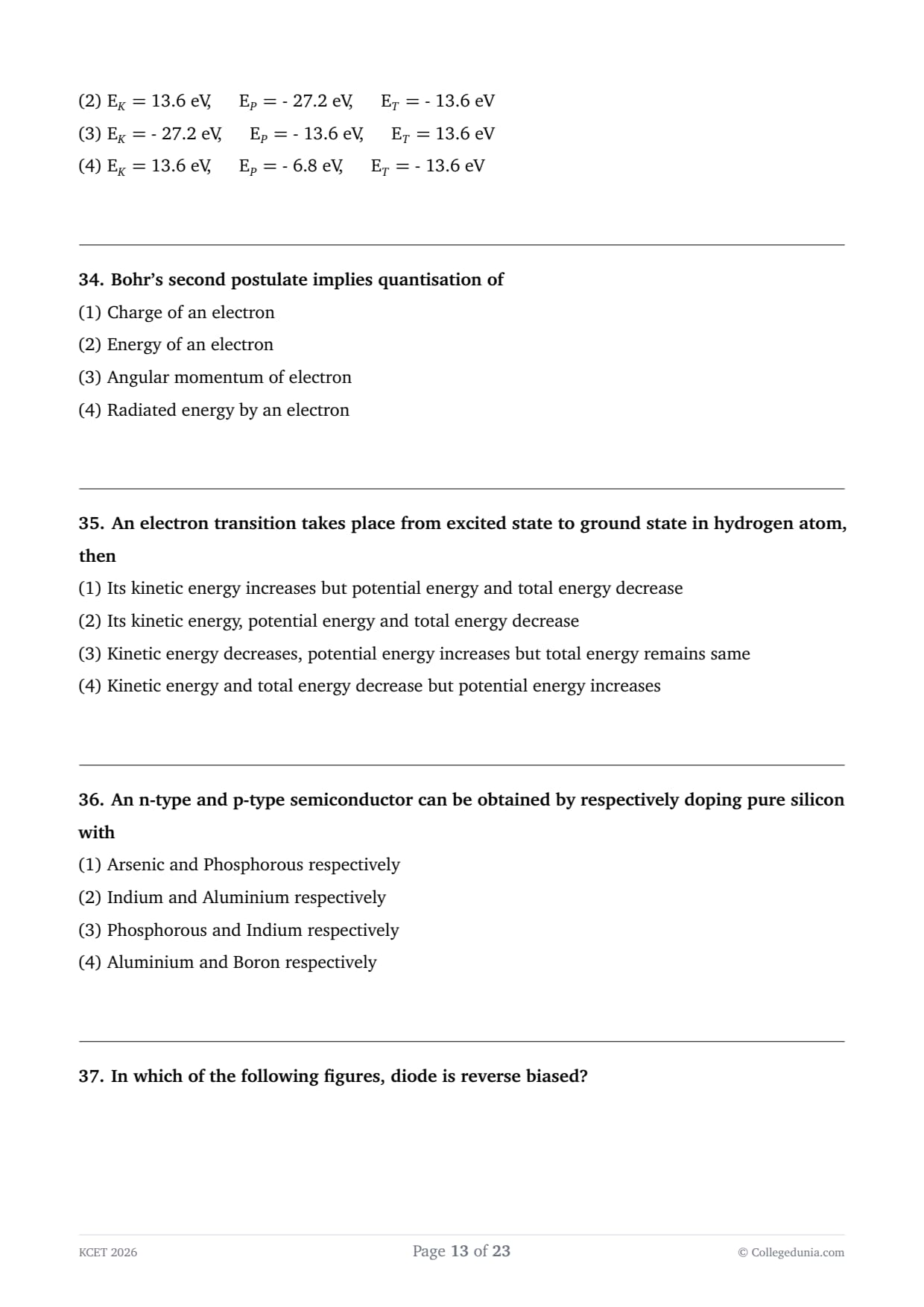
In which of the following figures, diode is reverse biased?


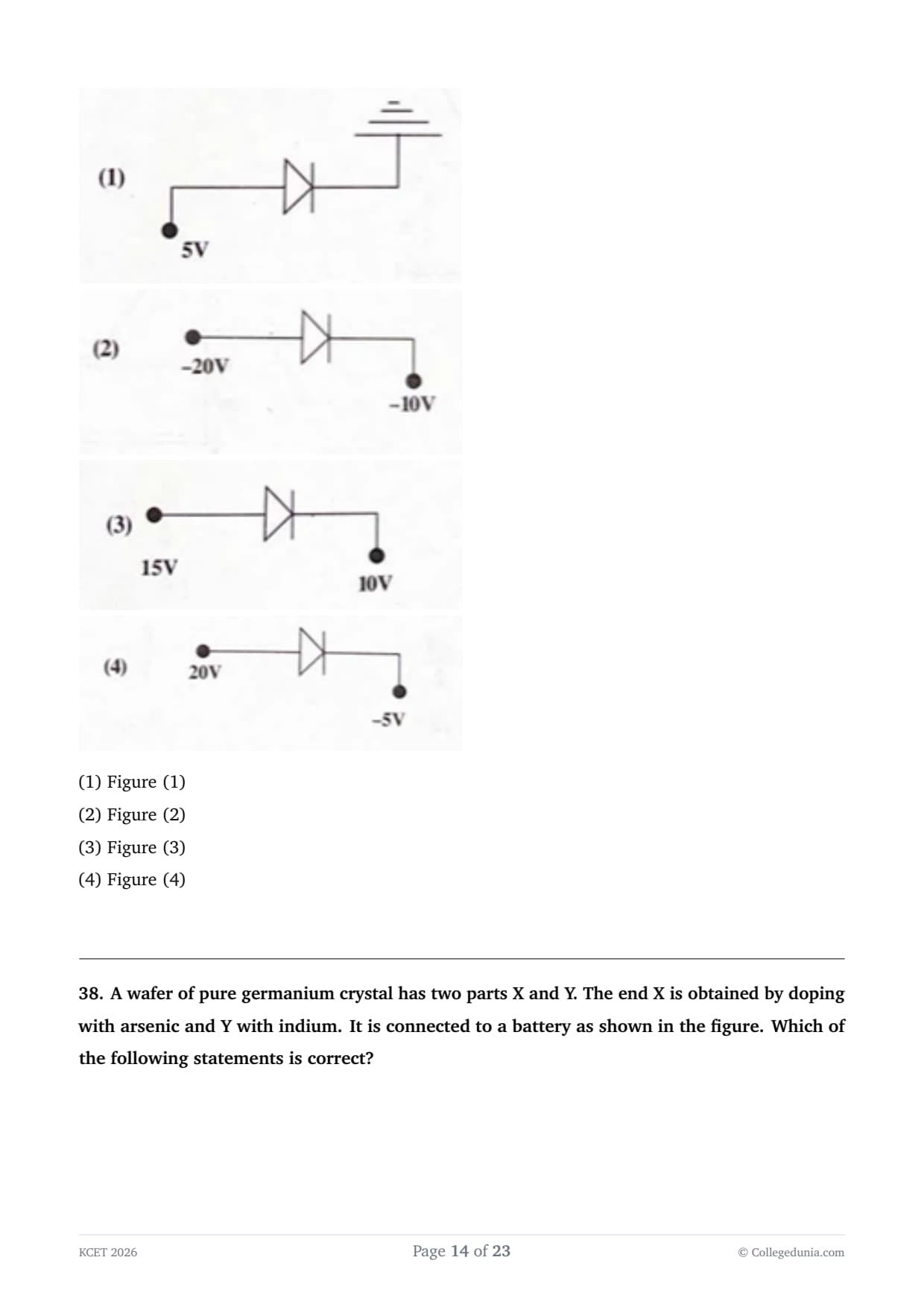
A wafer of pure germanium crystal has two parts X and Y. The end X is obtained by doping with arsenic and Y with indium. It is connected to a battery as shown in the figure. Which of the following statements is correct?

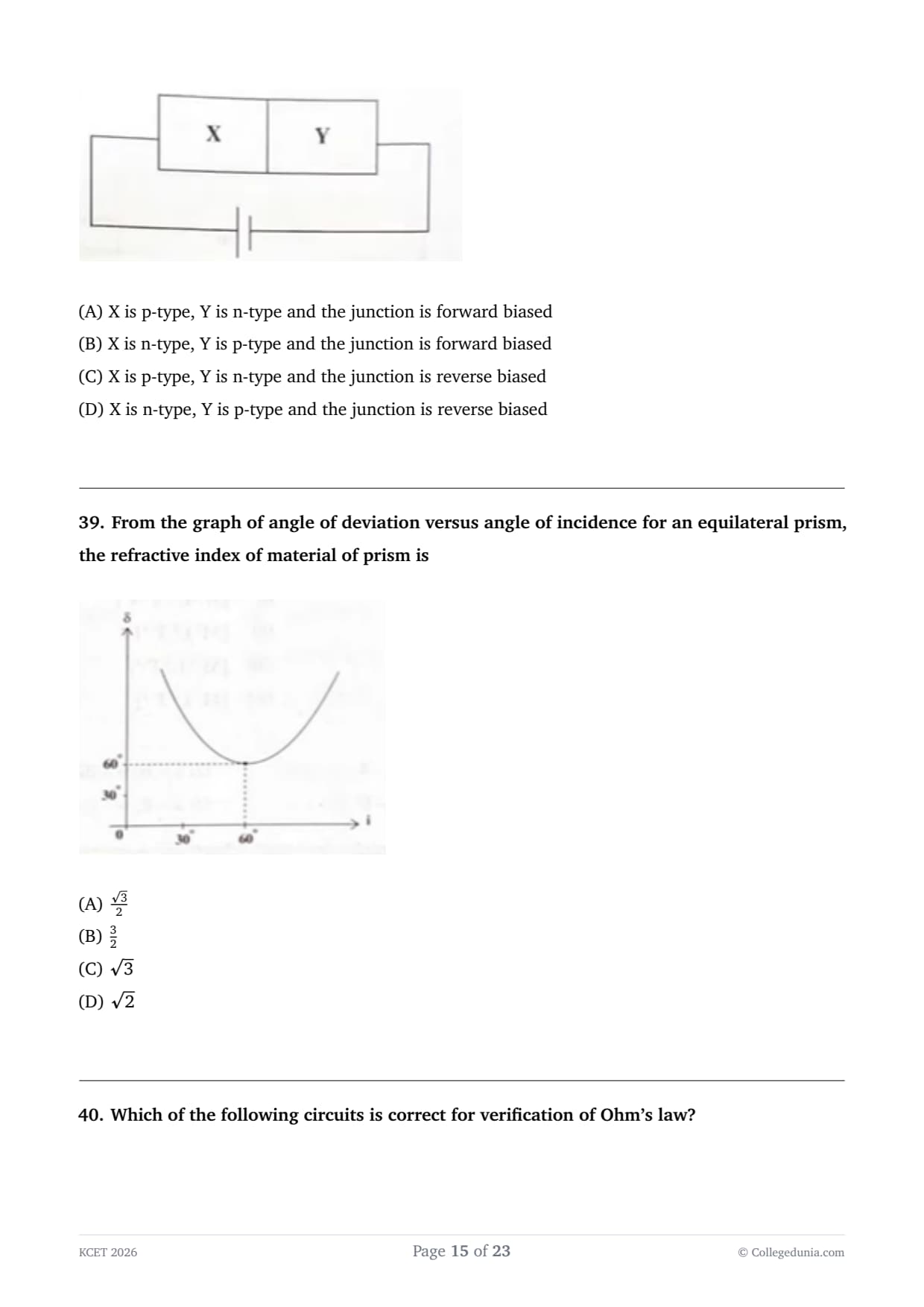
From the graph of angle of deviation versus angle of incidence for an equilateral prism, the refractive index of material of prism is

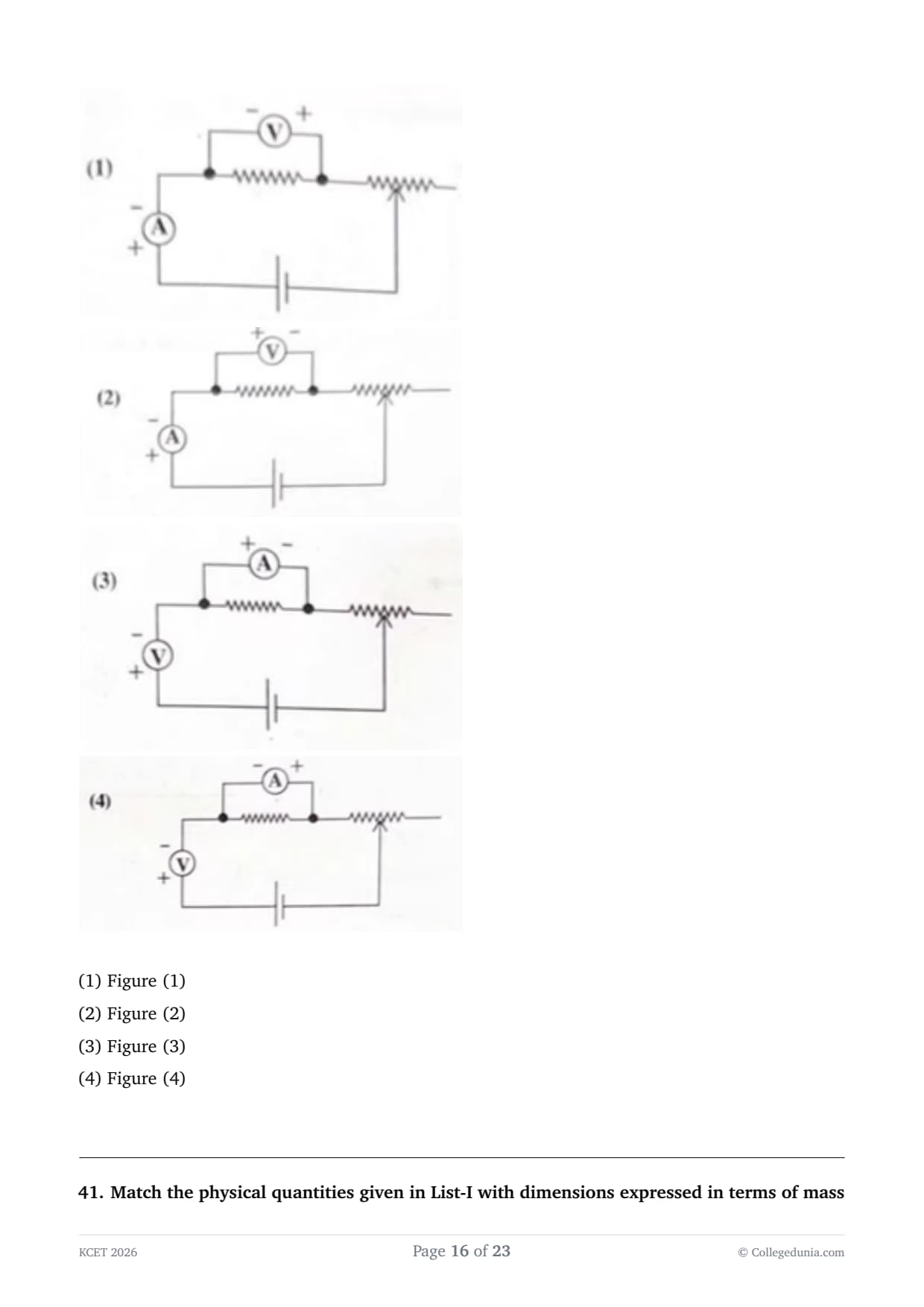
Which of the following circuits is correct for verification of Ohm's law?


Match the physical quantities given in List-I with dimensions expressed in terms of mass (M), length (L), time (T) and electric current (A) given in List-II.
| List-I | List-II |
|---|---|
| (a) Torque | (i) [M-1L-2T4A2] |
| (b) Gravitational constant | (ii) [M1L2T-1] |
| (c) Capacitance | (iii) [M-1L3T-2] |
| (d) Planck's constant | (iv) [M1L2T-2] |
Codes:
A car covers the first half of the distance between two places at 40 km/h and another half at 50 km/h. The average speed of the car is
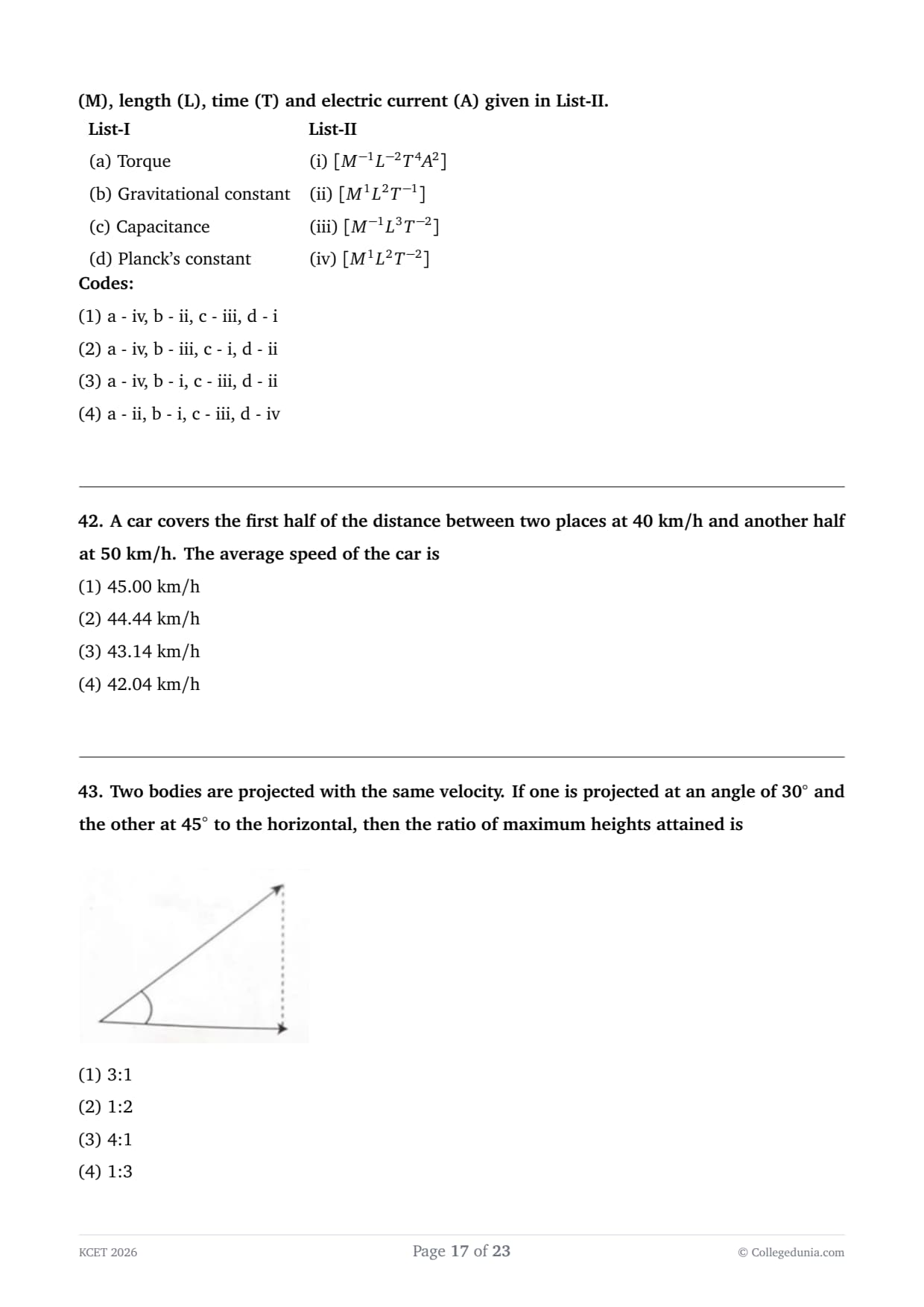
Two bodies are projected with the same velocity. If one is projected at an angle of 30\(^{\circ}\) and the other at 45\(^{\circ}\) to the horizontal, then the ratio of maximum heights attained is

The velocity of a particle moving along x-axis is given as \( V = x^2 - 5x + 4 \) (in m/s) where x denotes the x-coordinate of the particle in metres. The magnitude of the acceleration of the particle when the velocity of the particle zero is
A man weighs 80 kg. He stands on a weighing scale in a lift which is moving upwards with a uniform acceleration of 6 m/s\(^2\). What would be his weight in kg? (g = 10 m/s\(^2\))
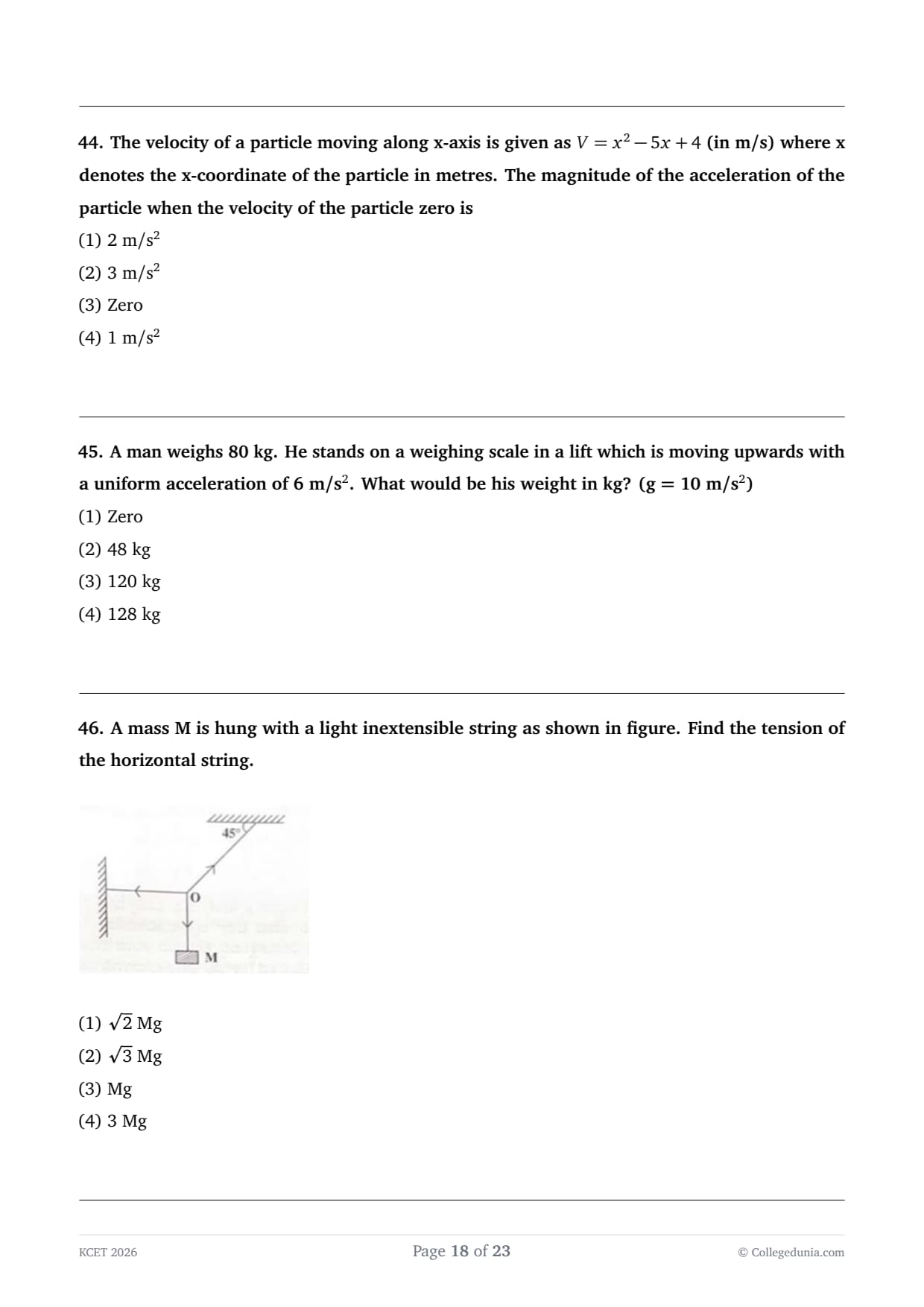
A mass M is hung with a light inextensible string as shown in figure. Find the tension of the horizontal string.

Two bodies with kinetic energies in the ratio of 3:1 are moving with equal linear momentum. The ratio of their masses is
A horizontal force of 5 N is applied on a stationary body of mass 5 kg, which is initially at rest on a frictionless table. The change in kinetic energy of the body in 10 s is
The angular momentum of a moving body remains constant, if
If the earth were to suddenly contract to half of its present radius, what would be the duration of the day?
Imagine a new planet having the same density as that of the earth, but it is two times bigger than the earth in size. If the acceleration due to gravity on the surface of the new planet is g' and that on the surface of the earth is g, then
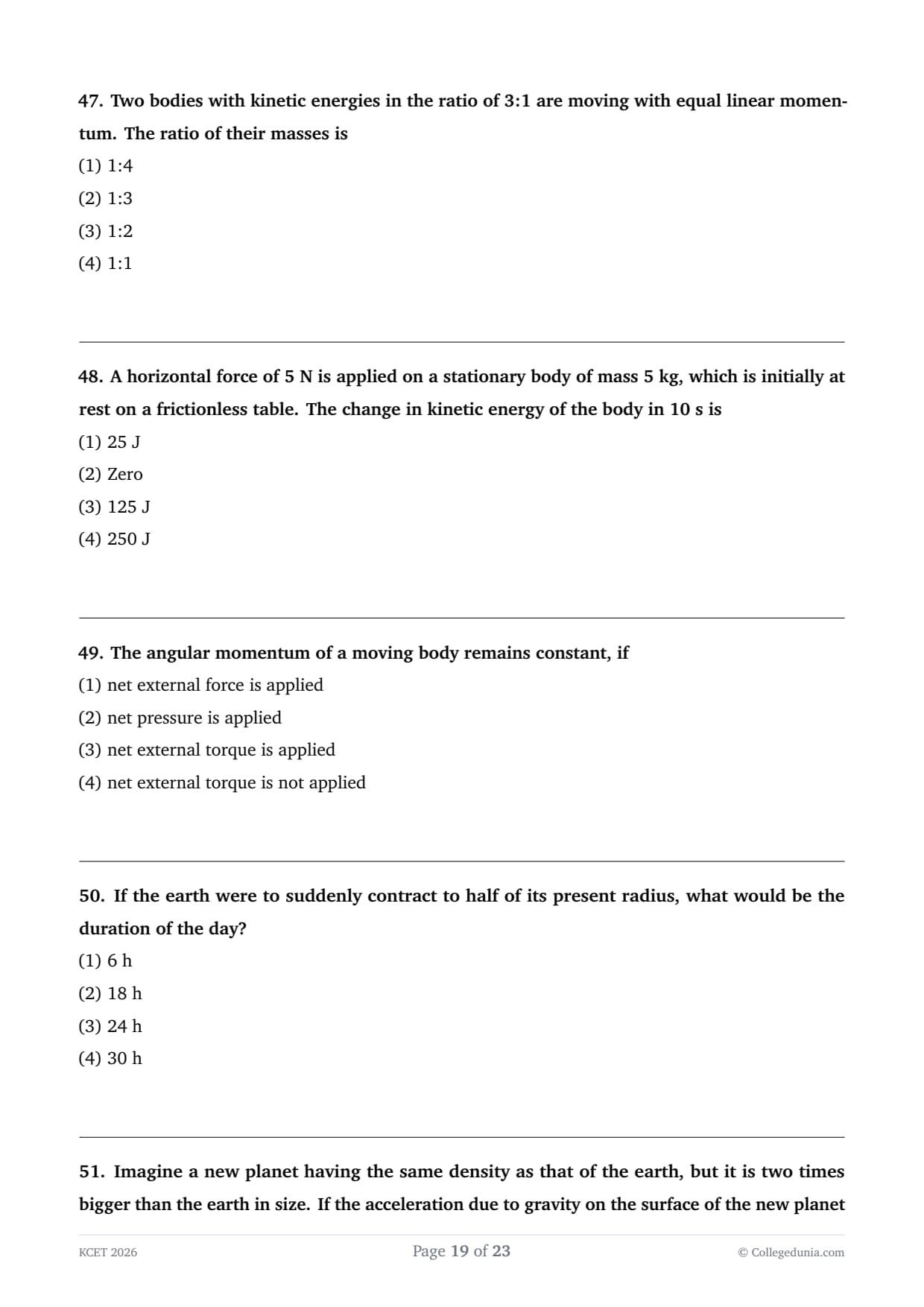
Suppose the acceleration due to gravity at the earth's surface is g m/s\(^2\) and at the surface of moon it is g' m/s\(^2\). An M kg passenger goes from the earth to the moon in a spaceship moving with a constant velocity (Neglect all other objects in the sky). Which curve best represents the weight (net gravitational force) as a function of time?

Instrument fitted in the carburetor of the automobile to provide the correct mixture of air and fuel necessary for combustion works on
There are two wires of same material and same length while the diameter of second wire is two times the diameter of the first wire. Then the ratio of extensions produced in the wires by applying same load will be
In a capillary tube experiment, a vertical 30 cm long capillary tube is dipped in water, water rises upto a height of 10 cm due to capillarity. If this experiment is conducted in a freely falling elevator, then the length of the water column becomes
In thermodynamic processes, which of the following statements is not true?
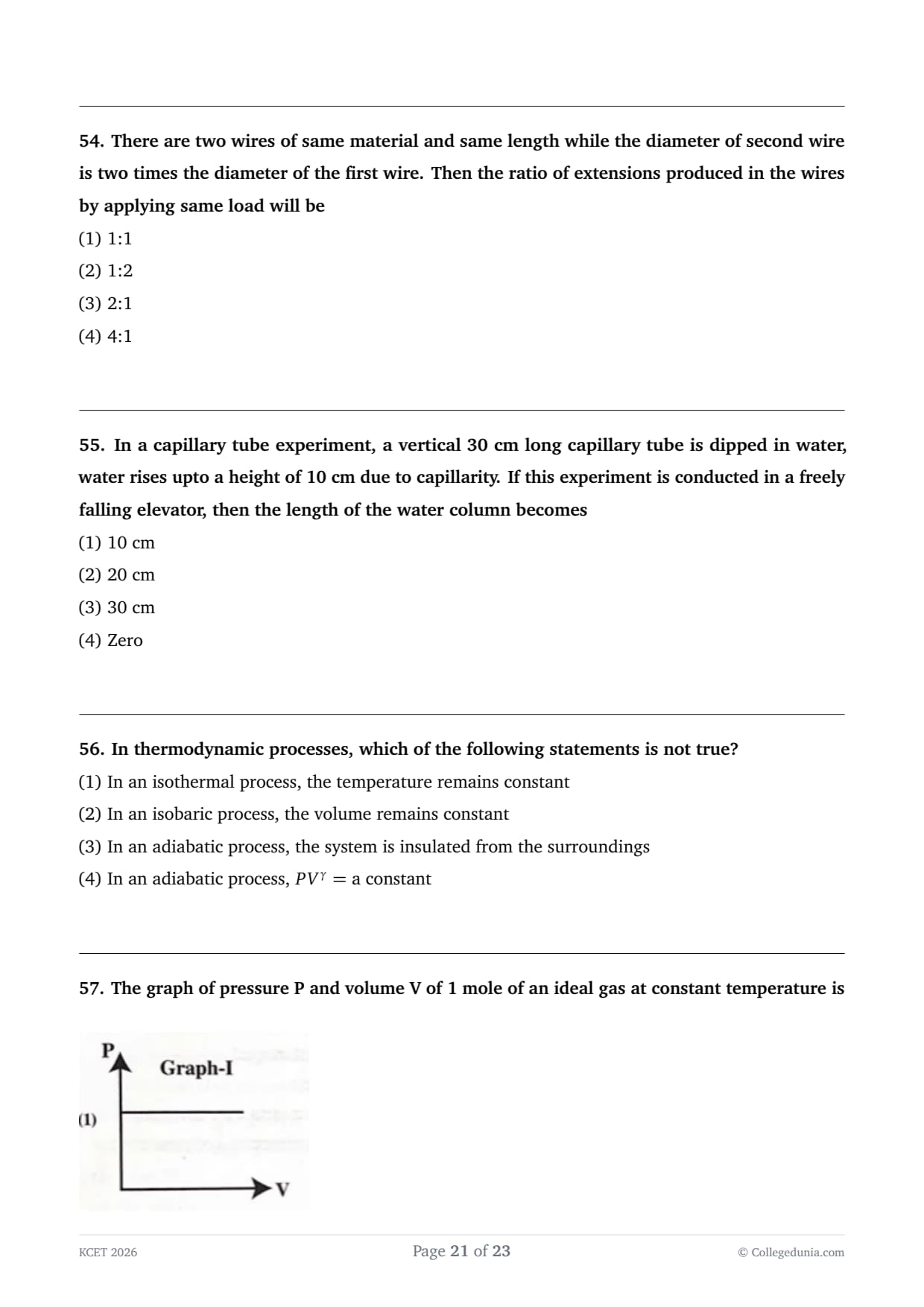
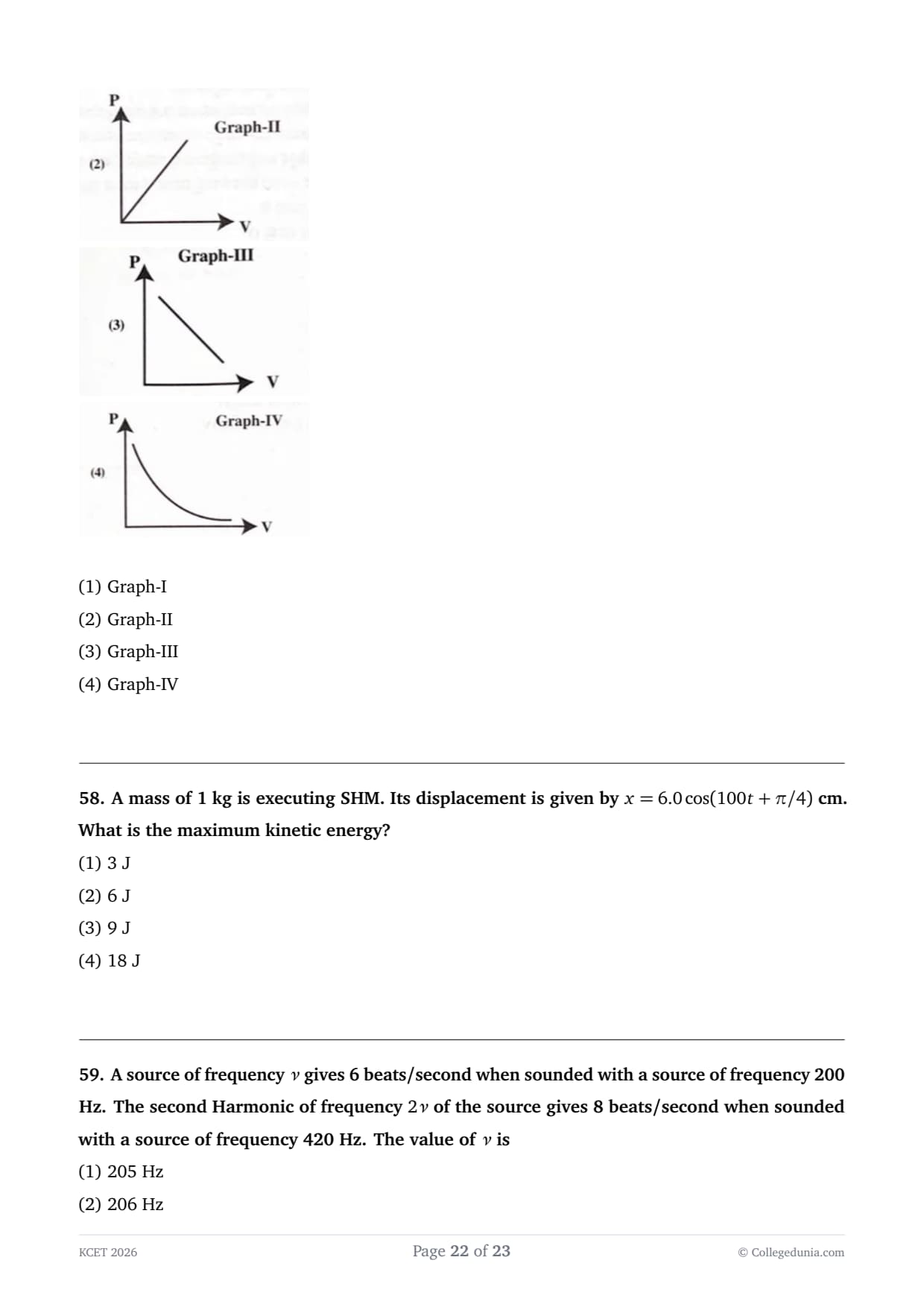
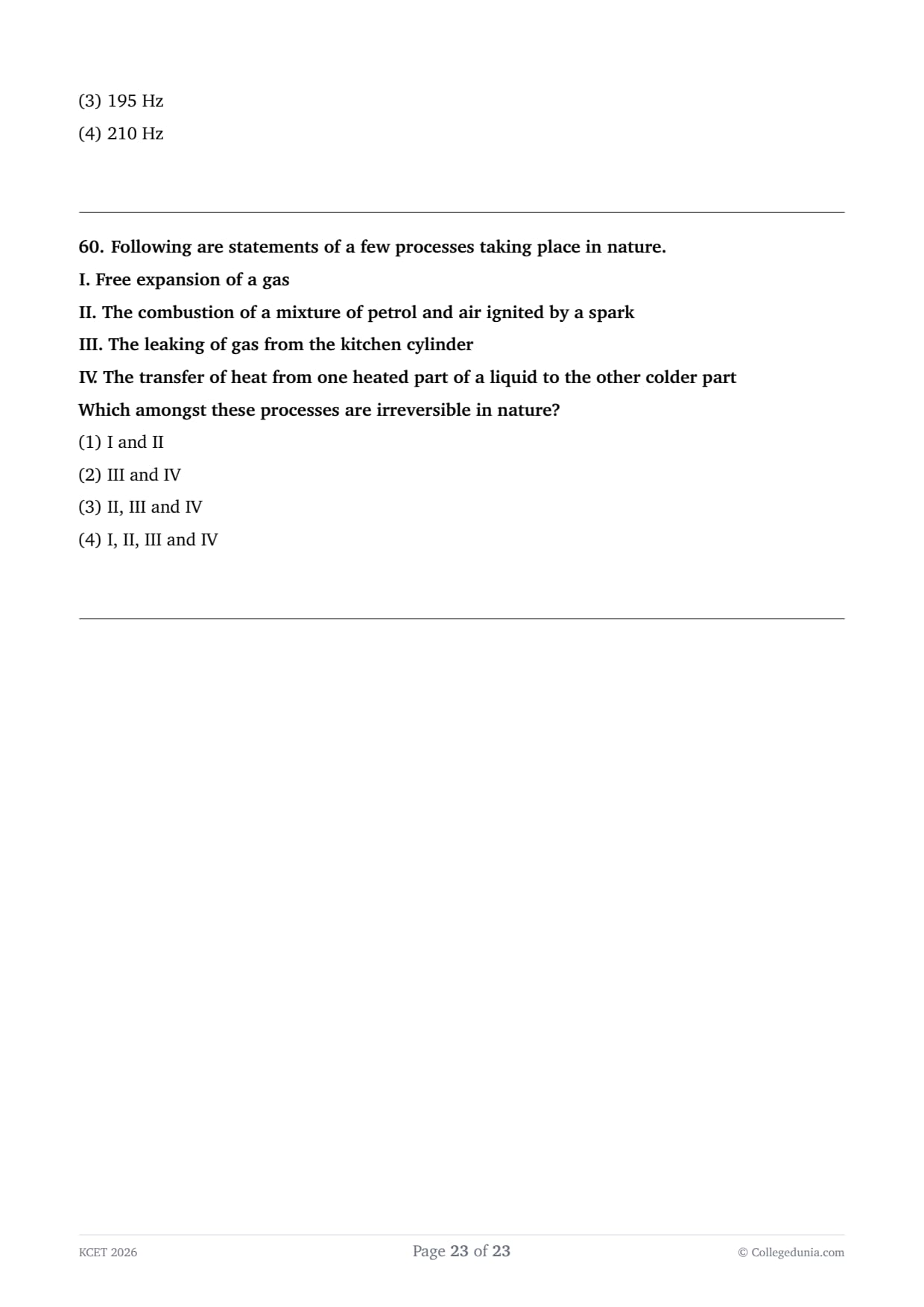
The graph of pressure P and volume V of 1 mole of an ideal gas at constant temperature is


A mass of 1 kg is executing SHM. Its displacement is given by \( x = 6.0 \cos(100t + \pi/4) \) cm. What is the maximum kinetic energy?
A source of frequency \( \nu \) gives 6 beats/second when sounded with a source of frequency 200 Hz. The second Harmonic of frequency \( 2\nu \) of the source gives 8 beats/second when sounded with a source of frequency 420 Hz. The value of \( \nu \) is
Following are statements of a few processes taking place in nature.
I. Free expansion of a gas
II. The combustion of a mixture of petrol and air ignited by a spark
III. The leaking of gas from the kitchen cylinder
IV. The transfer of heat from one heated part of a liquid to the other colder part
Which amongst these processes are irreversible in nature?
KCET 2026 Physics: Expected Section-Wise Weightage
| Section | Expected No. of Questions | Weightage (%) |
|---|---|---|
| Mechanics | 12–14 | 20–23% |
| Electrodynamics | 10–12 | 18–20% |
| Modern Physics | 7–8 | 12–14% |
| Thermodynamics & Heat | 5–6 | 8–10% |
| Optics | 5–6 | 8–10% |
| Waves & Oscillations | 3–4 | 5–7% |
| Properties of Matter | 3–4 | 5–7% |
| Kinematics & Units | 3–4 | 5–6% |



Comments