




To score a 99 percentile in CAT 2026 with 150 days of preparation, candidates should aim for a realistic raw score of 80–85 marks, which translates to roughly 27–30 net correct questions out of 66.
Balancing Quantitative Aptitude (QA), Data Interpretation & Logical Reasoning (DILR), and Verbal Ability & Reading Comprehension (VARC) demands daily sectional benchmarks rather than generic study hours.
- Prioritise Arithmetic and Algebra in QA, as these two modules consistently account for over 60% of the section.
- Master 1–2 DILR sets daily under timed conditions to sharpen pattern recognition and set selection intuition.
- Solve 2 Reading Comprehension (RC) passages daily while analyzing accuracy trends across main-idea and inference questions.
- Aim for 29–32 accurate answers across all three sections to cross the 99 percentile threshold.
- Execute a 5-stage plan transitioning from concept building to intense mock analysis.
- Maintain a dedicated error log to track repeating conceptual traps, calculation slip-ups, and time sinks across mocks.
With 150 days remaining, consistency, timed sectional tests, and smart question selection will determine your final score.
Related Links:

How to Allocate Time Across CAT Sections in 150 Days?
A practical starting point is around 6 hours of focused preparation per day, which can be adjusted according to individual schedules.
- QA receives the highest daily allocation because Arithmetic and Algebra together represented 73.9% of the questions in a five-year analysis of CAT QA.
- VARC preparation should include daily reading because RC forms a major part of the section, while DILR requires repeated set-solving practice to improve selection speed.
- Candidates who are weak in one section can temporarily add 30-45 minutes to that section without completely reducing practice in the other two.
| CAT Section | Daily Time Allocation | High-Weightage Focus Areas |
|---|---|---|
| Quantitative Aptitude (QA) | 2.5 Hours | Arithmetic, Algebra, Geometry |
| Data Interpretation & Logical Reasoning (DILR) | 1.5 Hours | Seating Arrangement, Caselets, Tables, Puzzles |
| Verbal Ability & Reading Comprehension (VARC) | 2.0 Hours | RC Passages, Para Jumbles, Para Summary |
What is the ideal month-by-month study plan for CAT 2026?
The ideal plan starts with foundational learning, moves into PYQs and topic tests, and finishes with high-intensity full-length mocks.
- The first 60 days should build the base and complete major topics, while the next 60 days should shift progressively towards timed testing.
- During the final 30 days, revision and mock analysis should take priority over learning large numbers of new concepts.
- Candidates should use PYQs throughout the 150 days rather than postponing them until the final stage
| Section / Topic | Focus & Strategy | Daily / Weekly Target |
|---|---|---|
| Quant (QA) | • Finish syllabus by Sept 15–30. • Cover Arithmetic (8–10 Qs), Algebra (7–9 Qs), Geometry/Mensuration (3–5 Qs), and Number System (1–2 Qs). | • 15–20 quality Qs/day • 120–150+ Qs/chapter for Arithmetic, Algebra, Geometry. • 40–50+ Qs/chapter for Number System. |
| DILR | • Practice across 8–12 topics. • Focus on unsolved/difficult sets taking 12–18+ mins. • Aim to solve 2–3 sets in exams/mocks. | • 3 quality sets daily. • 20–22 sets weekly. |
| VARC | • Maintain consistent reading and practice momentum. | • 30–40 mins reading daily. • 2 RCs + 8–10 VA Qs daily. • Alternate 3 RCs one day, 15 VA Qs the next day. |
| Mocks & Sectionals | • Master all 22 QA Qs within 24 hours of taking a mock. • Self-analyze time spent, errors, and unattempted Qs in an Analysis Notebook. | • 2 Full-Length Mocks/week (~24 total over 12–13 weeks). • 1 Sectional/week per subject (~30 total sectionals). |
| Revision Strategy | • Combine class note revision with topic-wise PYQs. • Give equal time to all 3 subjects for sectional cutoffs. | • Block Revision: 10 days Arithmetic, 10 days Algebra, 5 days Geometry/Mensuration. • Daily timer-based practice. |
This detailed video breaks down CAT preparation into stages for 99 percentile growth within 90 days.
Related Links:
CAT 2026 Preparation Strategy: 5 Stages for 150 Days
A structured multi-stage plan divides the preparation timeline into focused 20-to-30-day blocks. This ensures candidates do not burn out while progressively increasing difficulty and exam stamina.
Stage 1 & 2:
The first 40–50 days are better dedicated to formulas, high-weightage topics, core concepts, and solving the last 5–9 years' CAT previous-year questions.
| Preparation Phase | Focus Topics | Target Deliverables |
|---|---|---|
| Days 1–30 (Stage 1) | Concepts & Basics | Build core conceptual foundation across Quant, VARC & DILR; complete basic drills and formula recording |
| Days 31–60 (Stage 2) | Topic-wise PYQs | Solve 15–20 topic-wise PYQs daily per section (last 5–9 years) |
Stage 3, 4 & 5:
The final stages focus on timed testing of dedicated topics, increasing mock frequency, and fixing recurring errors through deep performance logs.
- Take foundational and advanced topic tests (10 questions in 20–25 minutes) to test stress handling.
| Preparation Phase | Focus Topics | Target Deliverables |
|---|---|---|
| Days 61–90 (Stage 3) | Sectional Tests | 8–10 timed sectional tests per section to build accuracy and pacing |
| Days 91–120 (Stage 4) | Full-Length Mocks | 2–3 full-length mocks/week with 1:1 analysis ratio |
| Days 121–150 (Stage 5) | Revision & Mock Analysis | Deep error-log review; revise weak zones and taper mock frequency before exam |
This video helps students with concept revision, PYQ importance, and section-wise preparation roadmaps for CAT 2026
Related Links:
Ques. How many mock tests should I take to score 99 percentile in CAT 2026?
Ans. Candidates should target taking 25–30 full-length mock tests along with 30+ sectional tests, spending equal time analyzing every attempt.
CAT 2026 Preparation: Previous Year Questions
Below are the previous year questions PDF with solutions for 2025-2021. The PYQs are for the Slot 1 exam of each section:
| Year | CAT DILR Slot | Question Paper | Solution PDF |
|---|---|---|---|
| CAT 2025 | DILR Question Paper | Download Pdf | Click Here |
| VARC Question Paper | Download Pdf | Click Here | |
| Quant Question Paper | Download Pdf | Click Here | |
| CAT 2024 | VARC Question Paper | Download PDF | Click Here |
| DILR Question Paper | Download PDF | Click Here | |
| QA Question Paper | Download PDF | Click Here | |
| CAT 2023 | DILR Question Paper | Download PDF | Click Here |
| VARC Question Paper | Download PDF | Click Here | |
| Quant Question Paper | Download PDF | Click Here | |
| CAT 2022 | DILR Question Paper | Download PDF | Check Solutions |
| VARC Question Paper | Download PDF | Check Solutions | |
| Quant Question Paper | Download PDF | Check Solutions | |
| CAT 2021 | DILR Question Paper | Download PDF | Check Solutions |
| VARC Question Paper | Download PDF | Check Solutions | |
| Quant Question Paper | Download PDF | Check Solutions |
How Many Questions Should You Attempt to Score 99 Percentile in CAT 2026?
- There is no fixed number of attempts that guarantees a 99 percentile.
- The current CAT 2026 pattern has 68 questions, with each correct answer carrying 3 marks and an incorrect MCQ attracting a 1-mark penalty. Each section has a 40-minute time limit.
- Historical data shows that the net number of correct questions corresponding to the 99 percentile has varied across CAT years.
- For example, analysis of CAT 2021–2024 shows approximately 26–33 net correct questions at the 99 percentile level, depending on the year.
| Strategy | Attempt Approach | Accuracy Goal |
|---|---|---|
| Conservative | Attempt only highly confident questions | 90%+ |
| Balanced | Attempt confident + selected moderate questions | 85–90%+ |
| Aggressive | Attempt a larger number after strong set/question selection | 80–85%+ |
Related Links:
Ques. Why is mock analysis more important than attempting the mock test itself?
Ans. Mock analysis reveals question selection errors and time-sink traps, allowing candidates to convert skipped doable questions into scoring opportunities.
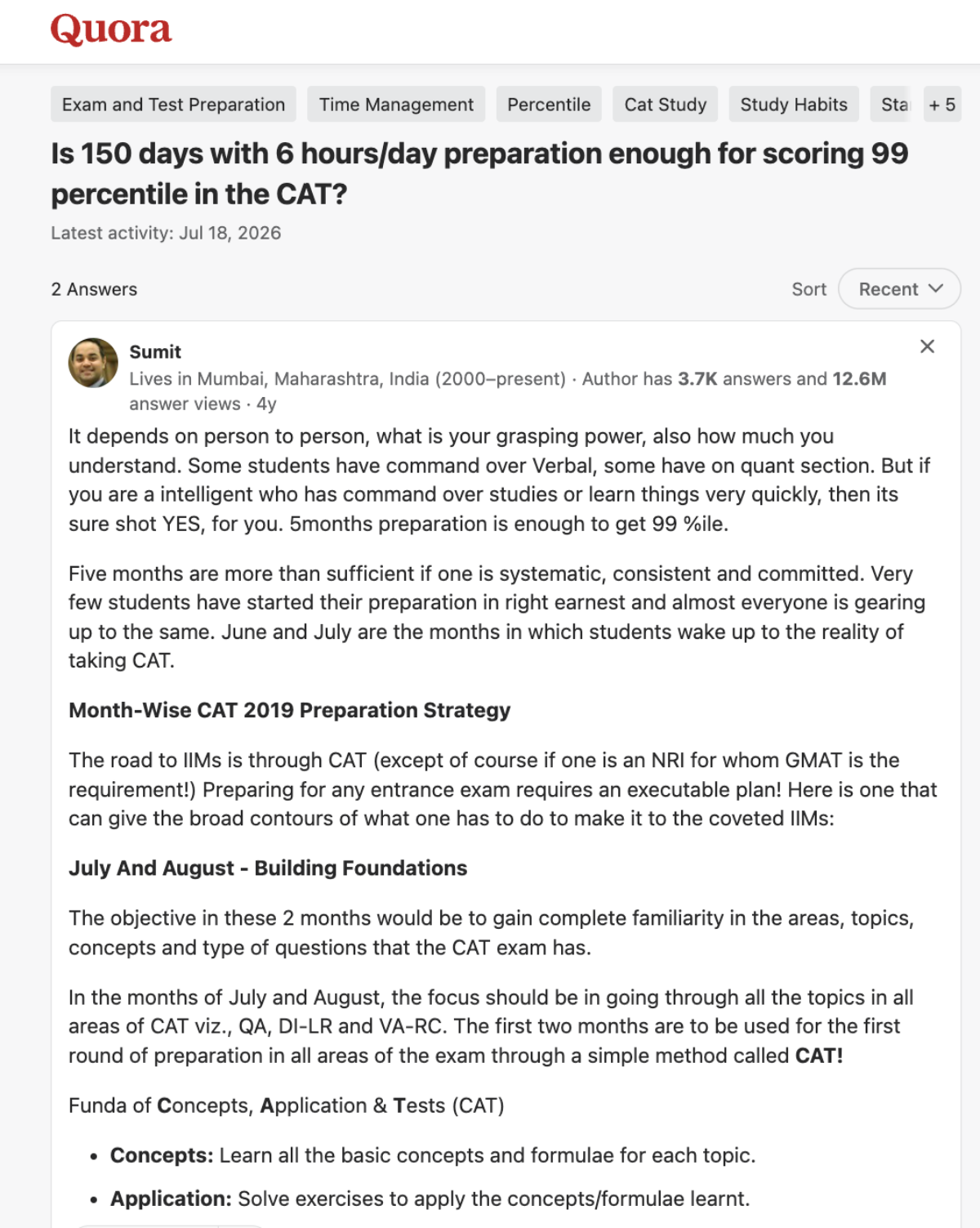
Score 99 Percentile in CAT 2026 with 150 Days of Preparation: Quora Discussion
Most users on community platforms agree that a 150-day preparation window with 5 to 6 hours of dedicated daily study is sufficient if you maintain high focus and consistent effort.
Source: Quora
How Many Mock Tests Should You Take for CAT 2026?
The number of mocks should depend on preparation quality rather than a fixed target. Candidates can begin with one mock every 1-2 weeks, increase to 1-2 per week during the middle phase and reach 2-3 full-length mocks per week during the intensive preparation period.
| Preparation Phase | Suggested Mock Frequency | Main Objective |
|---|---|---|
| Initial Preparation | 1 every 2 weeks | Identify baseline |
| Middle Phase | 1–2/week | Improve pacing |
| Days 91–120 | 2–3/week | Exam simulation |
| Final 30 Days | 2–3/week | Accuracy + strategy |
The priority should be mock analysis, not simply completing a large number of tests. A candidate who takes 20 well-analysed mocks can gain more useful feedback than someone who takes 30 tests without reviewing mistakes.
Check Out:
- CAT VARC Mock Test: Free Mock Test Series
- CAT DILR Mock Test: Free Mock Test Series
- CAT DILR Mock Test: Free Mock Test Series
How to Score 99 Percentile in CAT 2026 with 150 Days of Preparation? FAQs
Ques. Is 150 days enough for CAT 2026?
Ans. Yes, 150 days is a realistic timeline for a 99 percentile shot at CAT 2026. What matters more than the day count is structure: try to cover the QA, VARC, and DILR syllabus in the first 8–9 weeks, then dedicate the rest almost entirely to full-length mocks, error-log review, and revision.
Ques. How many hours should I study daily?
Ans. A steady 3-4 hours daily has been proven to sustain across all 150 days and consistently outperforms occasional 8-hour marathons.
Full-time aspirants can aim for roughly 5-7 focused hours a day, while working professionals and college students usually manage 2-4 hours on weekdays, stepping up to longer sessions on weekends.
Ques. Can I prepare for CAT 2026 from scratch in 150 days?
Ans. Yes, if you have basic mathematical exposure (up to class 10 level), stick to a disciplined daily schedule, and treat mock analysis as seriously as syllabus coverage.
Beginners should start with concept-building in the first 6–8 weeks before shifting into mock-heavy practice for the remainder.
Ques. How many mocks should I take?
Ans. Most 99-percentile aspirants attempt around 20–30 well-analysed full-length mocks in the run-up to the exam, starting with one every 1–2 weeks and increasing to 2–3 per week in the final month.
Ques. Which topics should I prioritise?
Ans. In QA, Arithmetic and Algebra carry the heaviest weightage and reward early focus.
In VARC, Reading Comprehension dominates the section, so building reading speed and inference skills pays off fastest.
In DILR, practice a wide variety of set types so you can quickly judge which sets are solvable in time, rather than attempting every set blindly.
Ques. How should I analyse CAT mocks?
Ans. After every mock, sort your questions into four buckets: correct and fast, correct but slow, wrong (log these in an error log), and skipped-but-doable.
This tells you whether your real bottleneck is accuracy, speed, or question selection, and exactly what to fix before the next attempt.



Comments