




CAT LCM and HCF formula sheet, free to download as a 5-page PDF that also covers base systems. These carry about 4 to 8 marks in Quant.
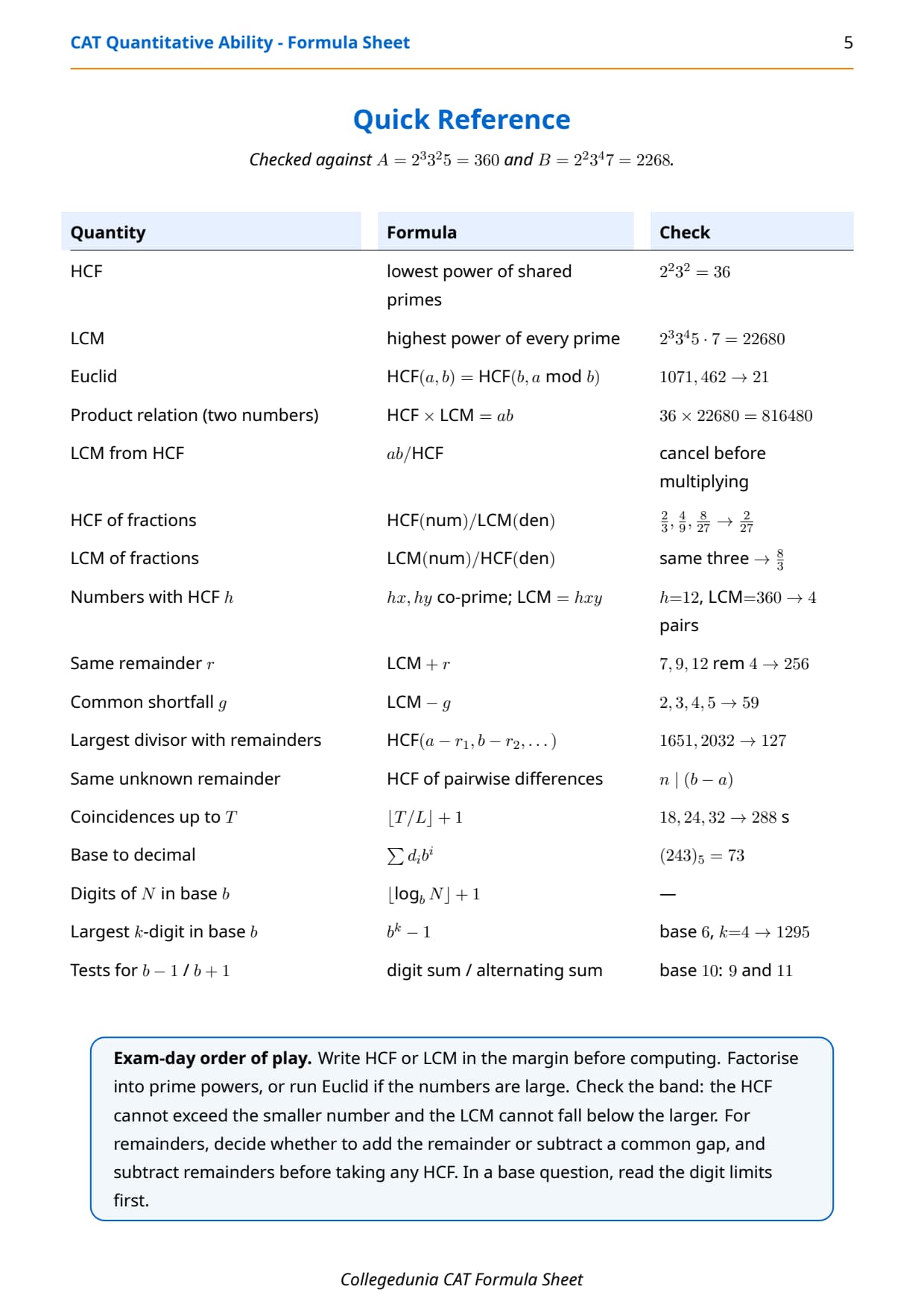
Written for CAT rather than school level, and every formula carries the one-line reason it holds. For the full explanations, the LCM, HCF and base systems notes cover the same ground in 19 pages.
It Opens With a Classifier, Not a Formula
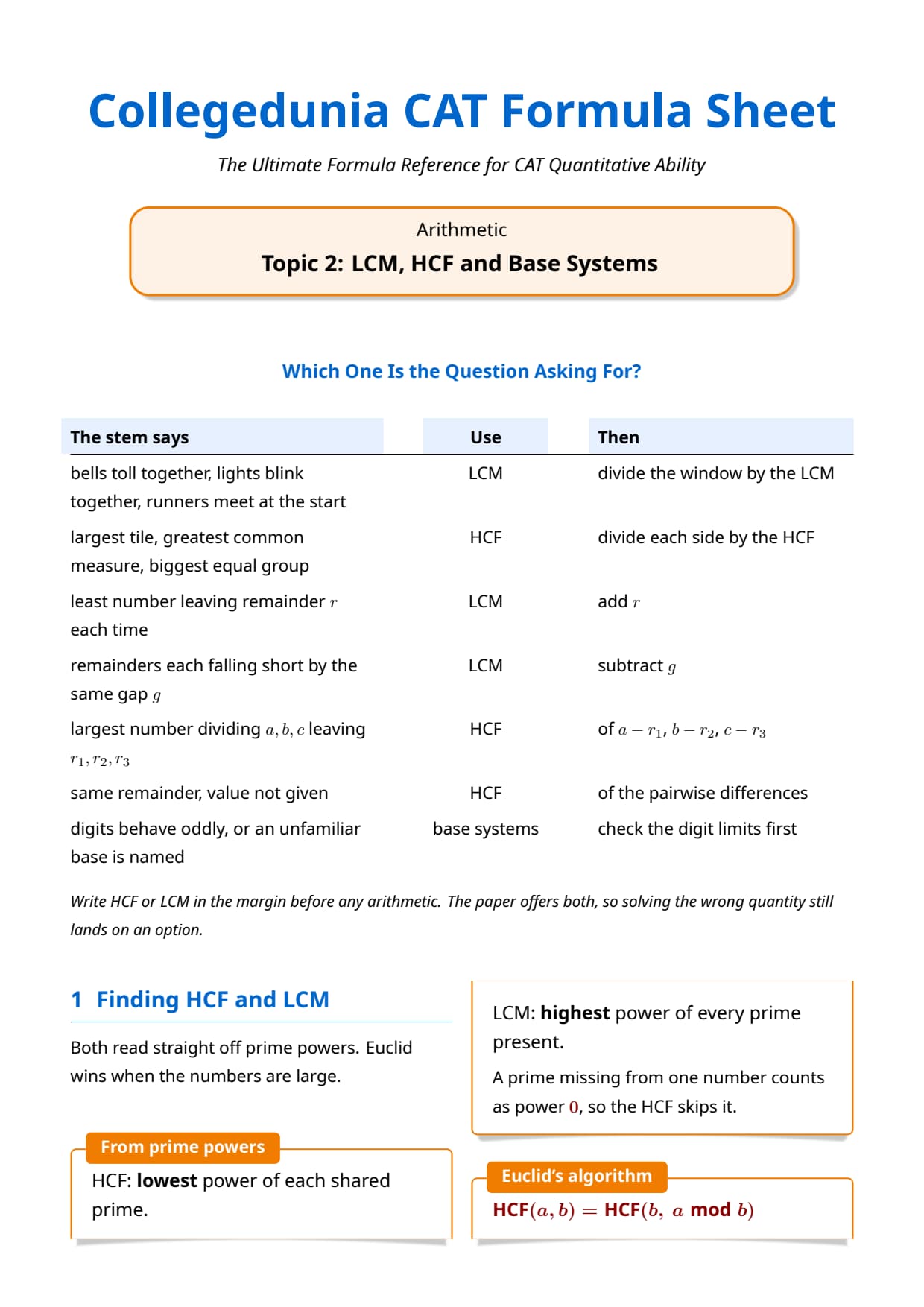
The first page is a full-width table that maps question wording to the quantity wanted, because that is where the marks are actually lost.
- Bells, lights, runners meeting at the start point to LCM
- Largest tile or greatest common measure points to HCF
- A least number leaving remainder r each time is the LCM, then add r
- Remainders each falling short by the same gap means LCM minus that gap
- A largest divisor with given remainders means subtract them, then take the HCF
Everything Reads Off Prime Powers
Two methods and one bound cover the whole topic. Which method you reach for depends only on how large the numbers are.
- Prime powers: HCF takes the lowest power of shared primes, LCM the highest power of every prime
- Euclid: replace the larger number by the remainder until it hits zero
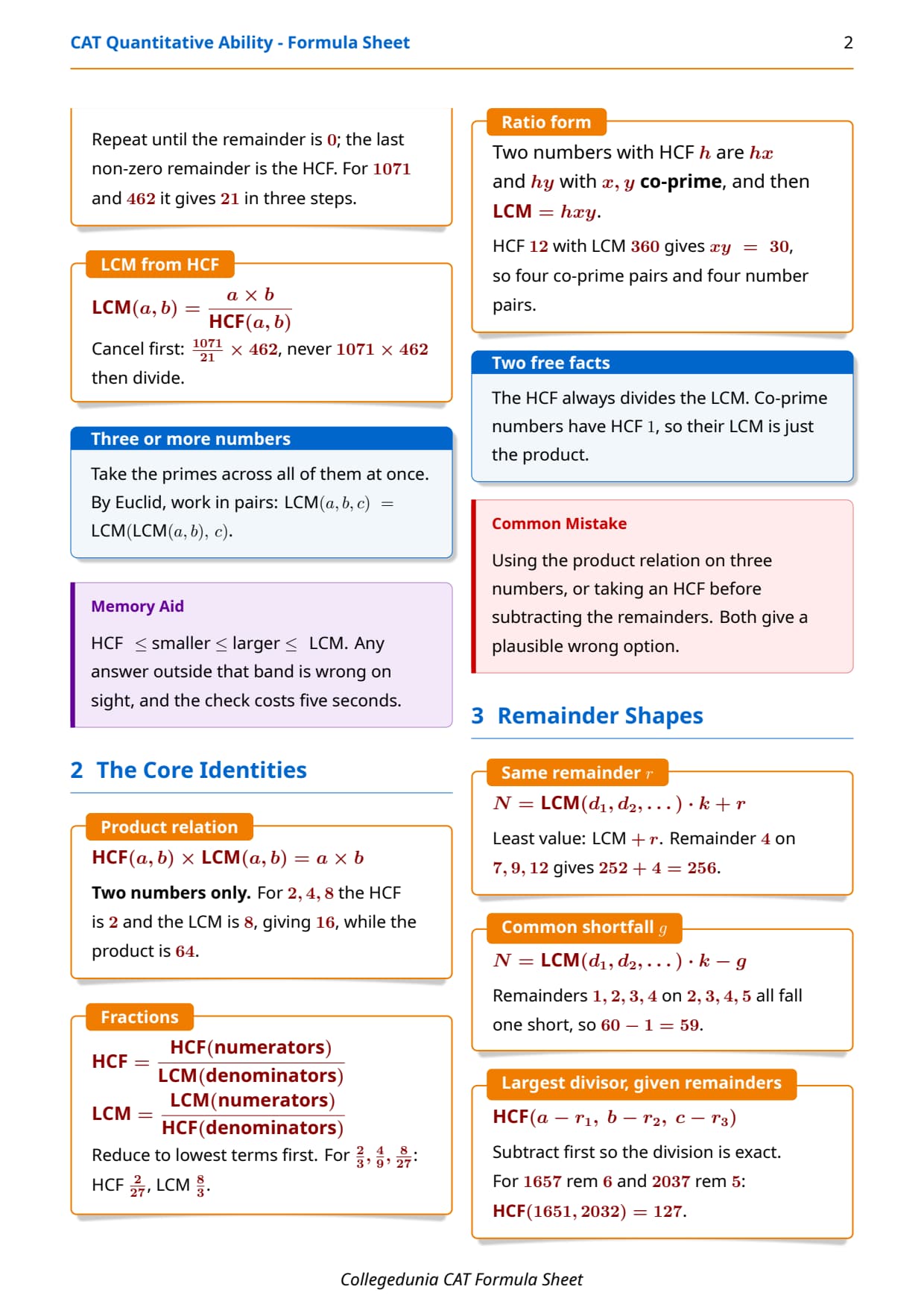
- LCM from HCF: the product over the HCF, cancelling before multiplying
- The band: HCF at most the smaller number, LCM at least the larger
That last bound is the cheapest check in the topic. It costs five seconds and catches almost every arithmetic slip.
The Two Conditions Students Drop
Both appear on the sheet in bold, because a plausible wrong option is always waiting.
- HCF times LCM equals the product for two numbers only. For 2, 4 and 8 it gives 16 against a product of 64
- Fraction formulas need the fractions reduced first
- Two numbers with HCF h are h times x and h times y with x and y co-prime, not any factor pair
Five Remainder Shapes on One Page
Each is a single line, and between them they cover nearly every remainder question CAT sets on this topic.
- Same remainder: the LCM plus it
- Common shortfall: the LCM minus it
- Largest divisor with given remainders: subtract, then HCF
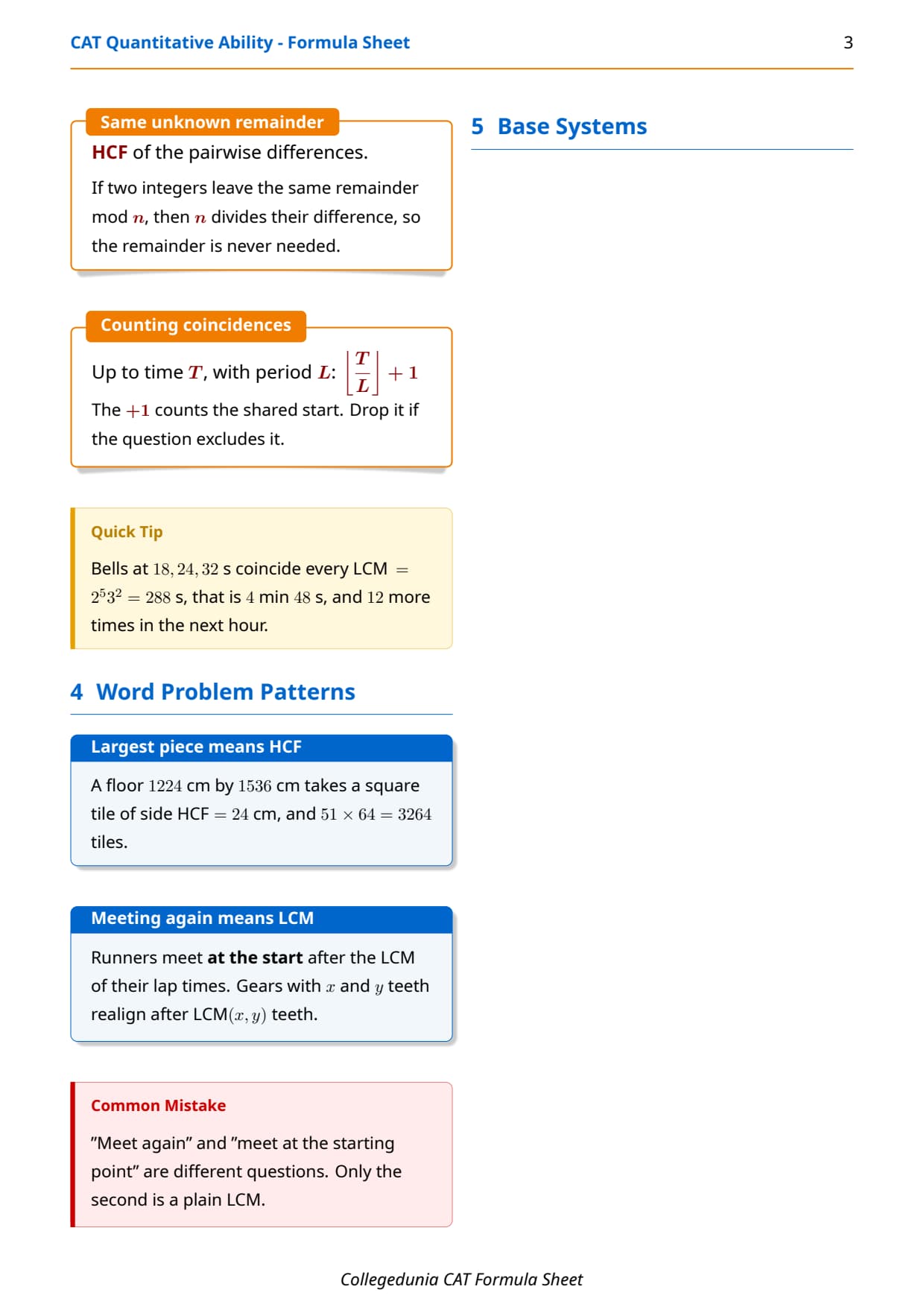
- Same remainder but not stated: HCF of the pairwise differences
- Counting coincidences: divide the window by the period, add one for the start
Watch HCF and LCM Worked Through
Source: Rodha
Base Systems Without the Theory
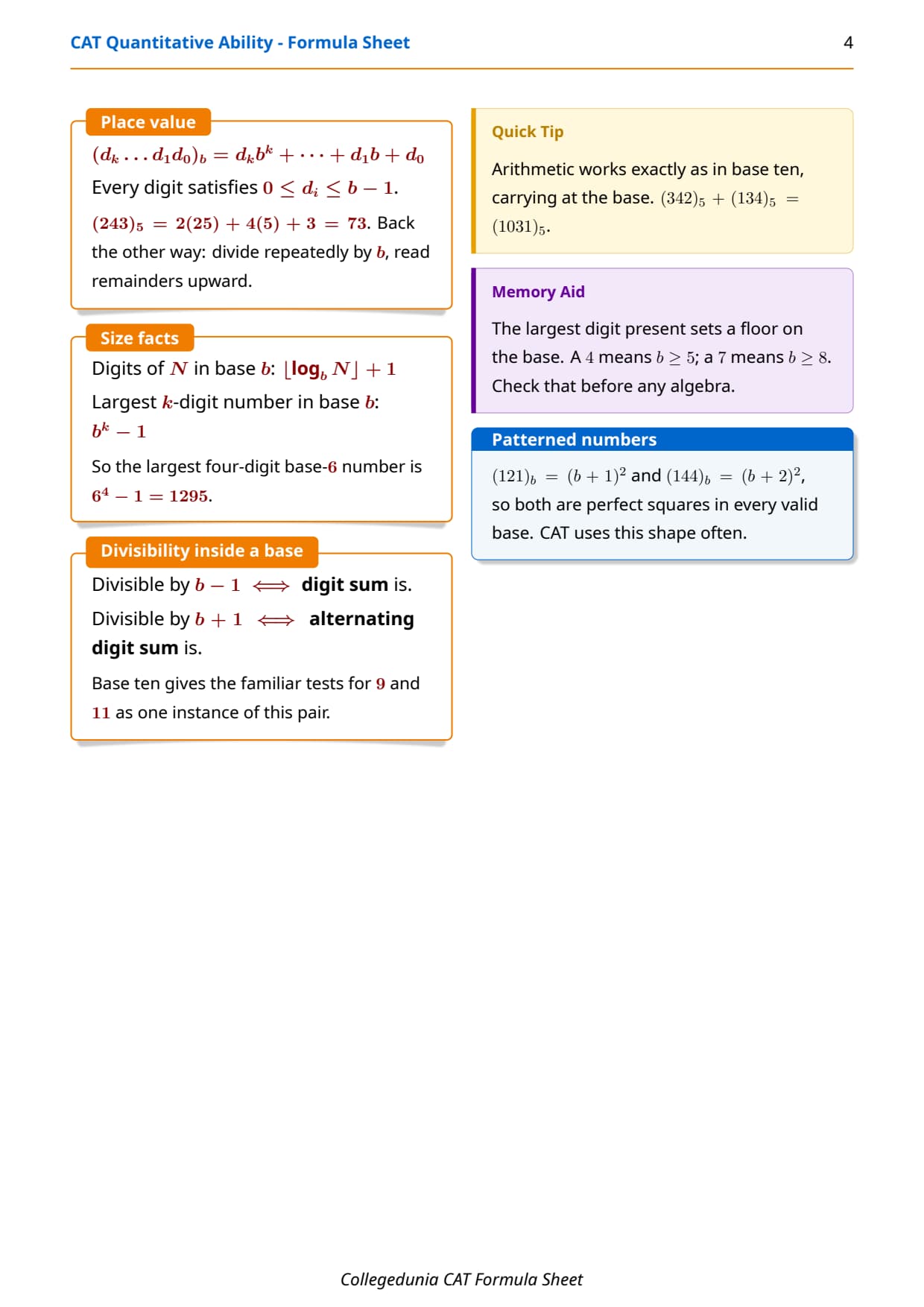
Four entries handle it: place value, the digit limit, the size facts, and the two general divisibility tests.
- Digits of a number in base b are the log in that base, plus one
- The largest k-digit number in base b is b to the k, minus one
- In base b, digit sum tests b minus one and alternating sum tests b plus one
- Patterned numbers like 121 and 144 in base b are always perfect squares
Those two divisibility tests are why the familiar rules for 9 and 11 work in base ten. They are one general rule, not two separate facts.
How to Revise From It
The final page repeats every formula in one table with a worked check beside it, against 360 and 2268.
- Cover the right column and reproduce each formula from memory
- Say the reason out loud, not just the formula
- Re-derive the two divisibility tests from the base rather than memorising them
- Attempt the notes practice set with the sheet closed
CAT LCM HCF Formula Sheet FAQs
Ques. Does HCF times LCM work for three numbers?
Ans. No. It holds for two numbers only, and this is one of the most common lost marks in the topic. For 2, 4 and 8 the HCF is 2 and the LCM is 8, giving 16, while the product is 64. With three or more numbers, work from prime powers.
Ques. What do I do when a question says the same remainder without giving it?
Ans. Take the HCF of the pairwise differences. If two integers leave the same remainder on division by n then n divides their difference, so the remainder itself never has to be found.
Ques. Is this sheet enough on its own?
Ans. It is a revision aid rather than a first read. Each formula carries a one-line reason, so it works well once the topic is learnt. Students new to it should start with the 19 page notes.
Ques. Are base systems really tested in CAT?
Ans. Roughly once every few papers, usually as a single quick question on conversion or a digit condition. The return on preparing it is high because the whole idea fits into one section of the sheet.



Comments