




The CAT 2023 VARC Slot 3 question paper with solutions covers the 24-question Verbal Ability and Reading Comprehension section that ran in the evening slot held by IIM Lucknow on November 26, 2023, from 4:30 PM to 6:30 PM. You get all 24 questions with detailed answers and explanations, carrying 72 marks at 3 marks each within a 40-minute sectional limit. The slot had 16 Reading Comprehension questions across 4 passages and 8 Verbal Ability questions, with around 4 to 5 TITA questions that carried no negative marking. Use this solved paper to time yourself, check your answers against worked solutions, and judge where you lose accuracy.
| CAT 2023 VARC Slot 3 Question Paper with Solutions | Download PDF | Check Solutions |
CAT 2023 Slot 3 VARC Questions with Solutions
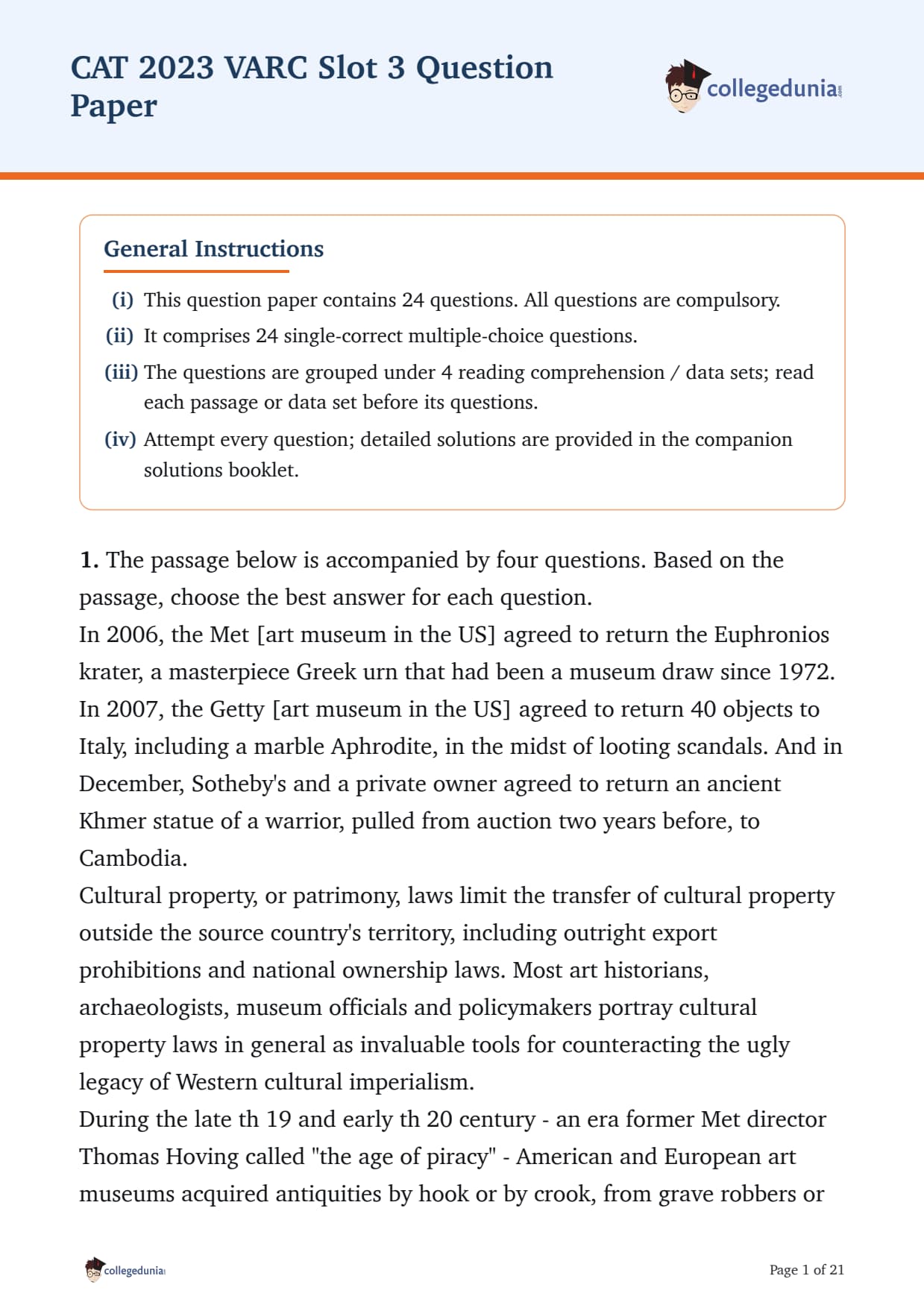
Comprehension:
The passage below is accompanied by four questions. Based on the passage, choose the best answer for each question.
In 2006, the Met [art museum in the US] agreed to return the Euphronios krater, a masterpiece Greek urn that had been a museum draw since 1972. In 2007, the Getty [art museum in the US] agreed to return 40 objects to Italy, including a marble Aphrodite, in the midst of looting scandals. And in December, Sotheby's and a private owner agreed to return an ancient Khmer statue of a warrior, pulled from auction two years before, to Cambodia.
Cultural property, or patrimony, laws limit the transfer of cultural property outside the source country's territory, including outright export prohibitions and national ownership laws. Most art historians, archaeologists, museum officials and policymakers portray cultural property laws in general as invaluable tools for counteracting the ugly legacy of Western cultural imperialism.
During the late th 19 and early th 20 century - an era former Met director Thomas Hoving called "the age of piracy" - American and European art museums acquired antiquities by hook or by crook, from grave robbers or souvenir collectors, bounty from digs and ancient sites in impoverished but art-rich source countries. Patrimony laws were intended to protect future archaeological discoveries against Western imperialist designs. ...
Read More
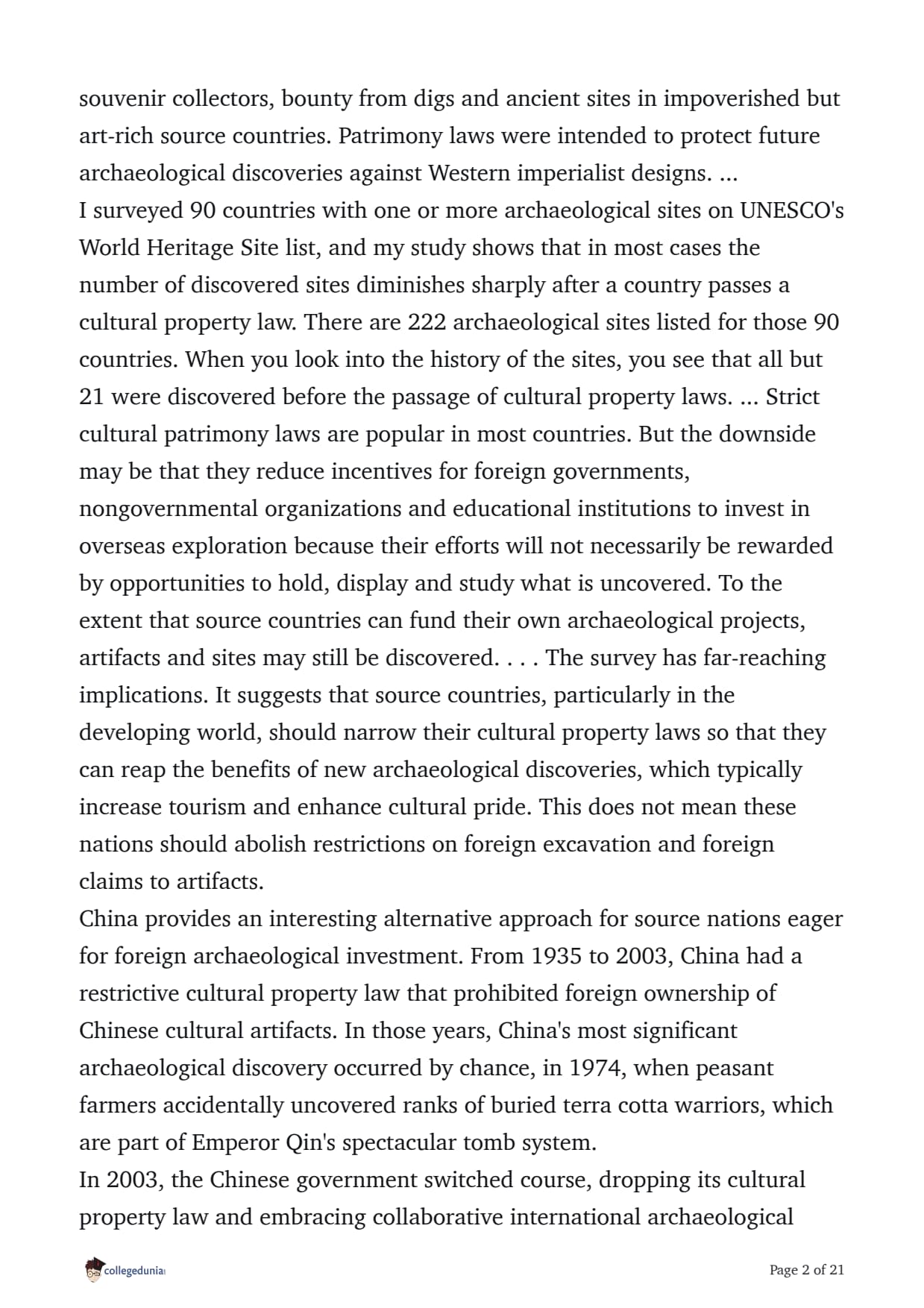
I surveyed 90 countries with one or more archaeological sites on UNESCO's World Heritage Site list, and my study shows that in most cases the number of discovered sites diminishes sharply after a country passes a cultural property law. There are 222 archaeological sites listed for those 90 countries. When you look into the history of the sites, you see that all but 21 were discovered before the passage of cultural property laws. ... Strict cultural patrimony laws are popular in most countries. But the downside may be that they reduce incentives for foreign governments, nongovernmental organizations and educational institutions to invest in overseas exploration because their efforts will not necessarily be rewarded by opportunities to hold, display and study what is uncovered. To the extent that source countries can fund their own archaeological projects, artifacts and sites may still be discovered. . . . The survey has far-reaching implications. It suggests that source countries, particularly in the developing world, should narrow their cultural property laws so that they can reap the benefits of new archaeological discoveries, which typically increase tourism and enhance cultural pride. This does not mean these nations should abolish restrictions on foreign excavation and foreign claims to artifacts.China provides an interesting alternative approach for source nations eager for foreign archaeological investment. From 1935 to 2003, China had a restrictive cultural property law that prohibited foreign ownership of Chinese cultural artifacts. In those years, China's most significant archaeological discovery occurred by chance, in 1974, when peasant farmers accidentally uncovered ranks of buried terra cotta warriors, which are part of Emperor Qin's spectacular tomb system.
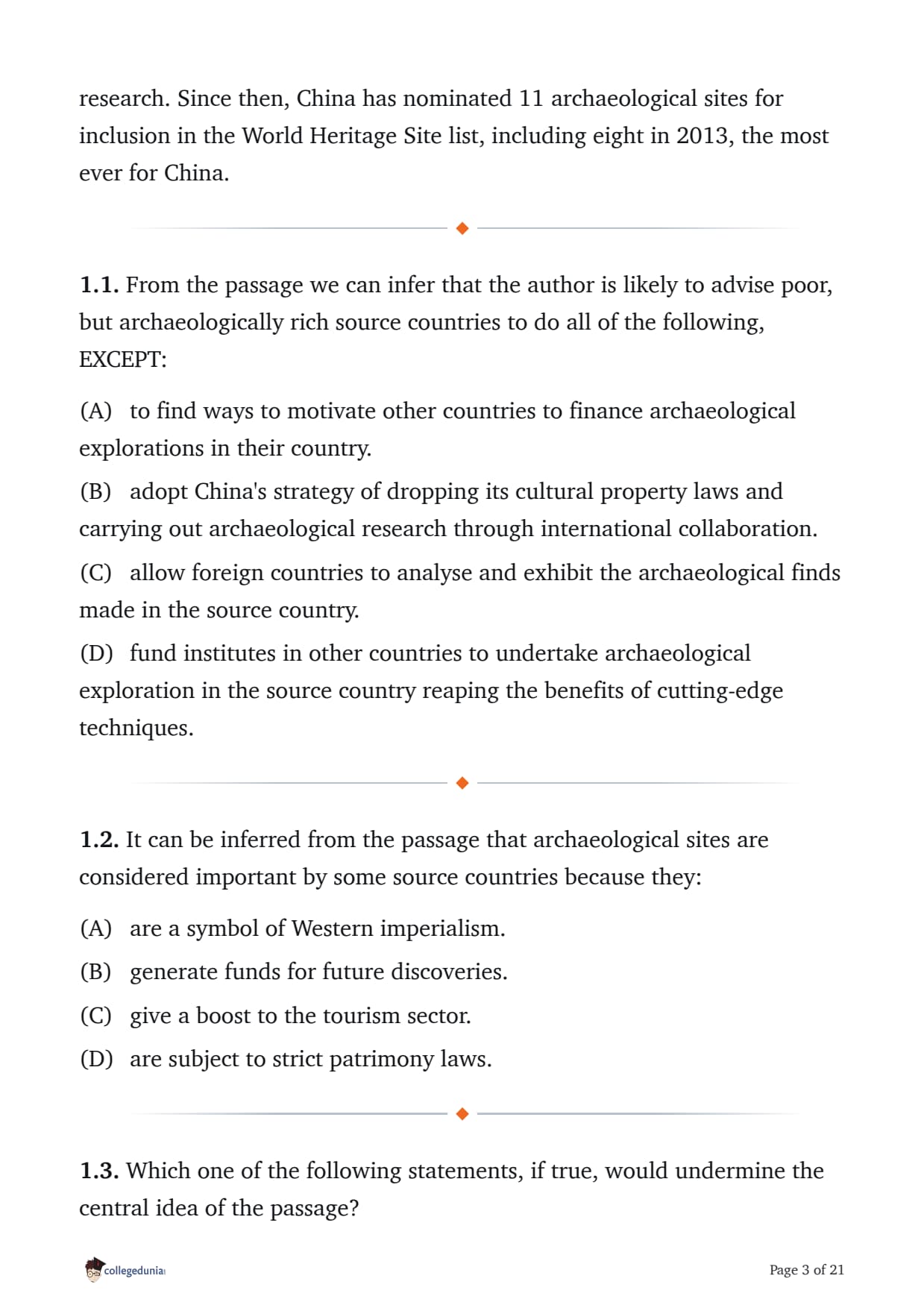
In 2003, the Chinese government switched course, dropping its cultural property law and embracing collaborative international archaeological research. Since then, China has nominated 11 archaeological sites for inclusion in the World Heritage Site list, including eight in 2013, the most ever for China.
From the passage we can infer that the author is likely to advise poor, but archaeologically rich source countries to do all of the following, EXCEPT:
It can be inferred from the passage that archaeological sites are considered important by some source countries because they:
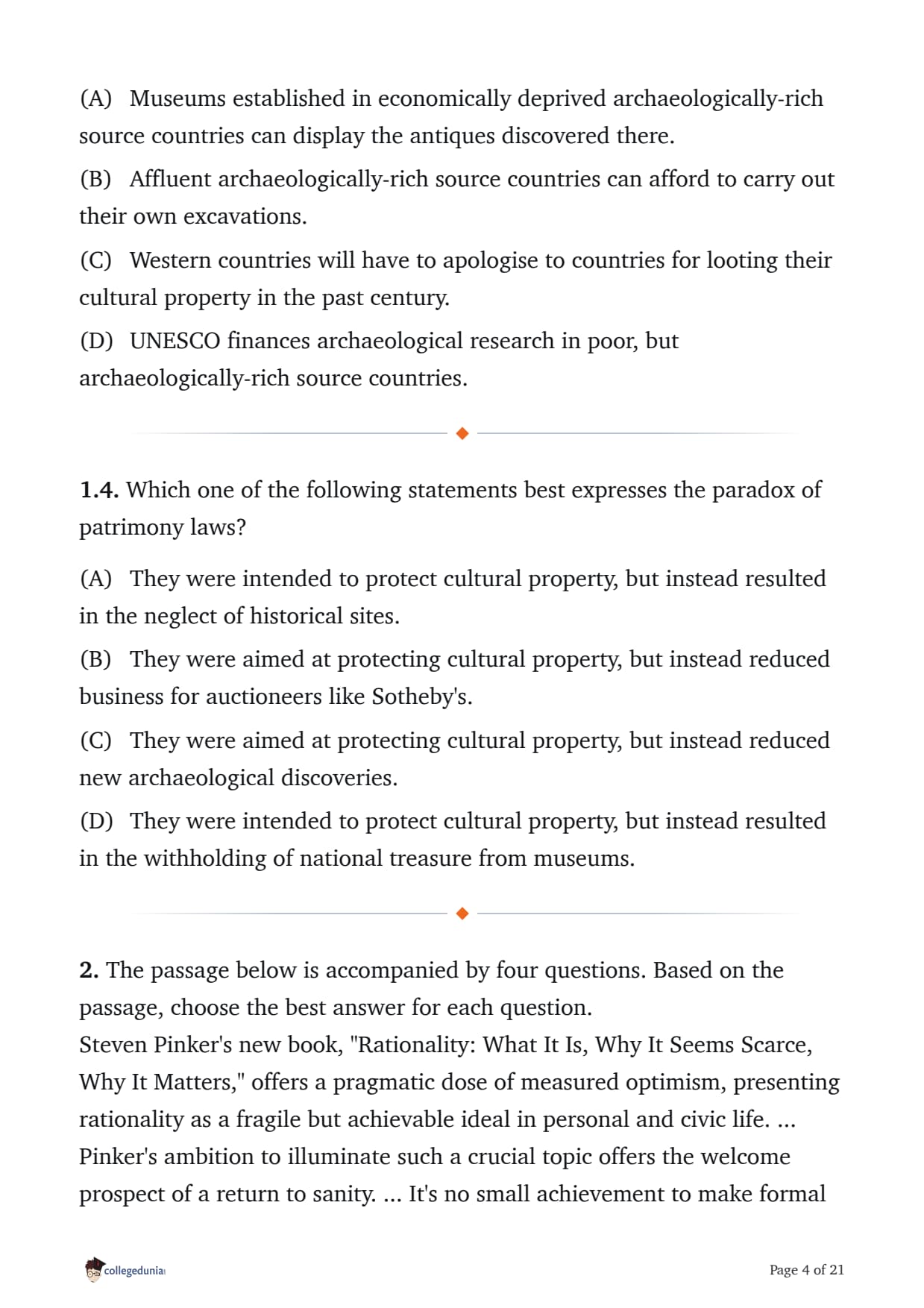
Which one of the following statements, if true, would undermine the central idea of the passage?
Which one of the following statements best expresses the paradox of patrimony laws?
Comprehension:
The passage below is accompanied by four questions. Based on the passage, choose the best answer for each question.
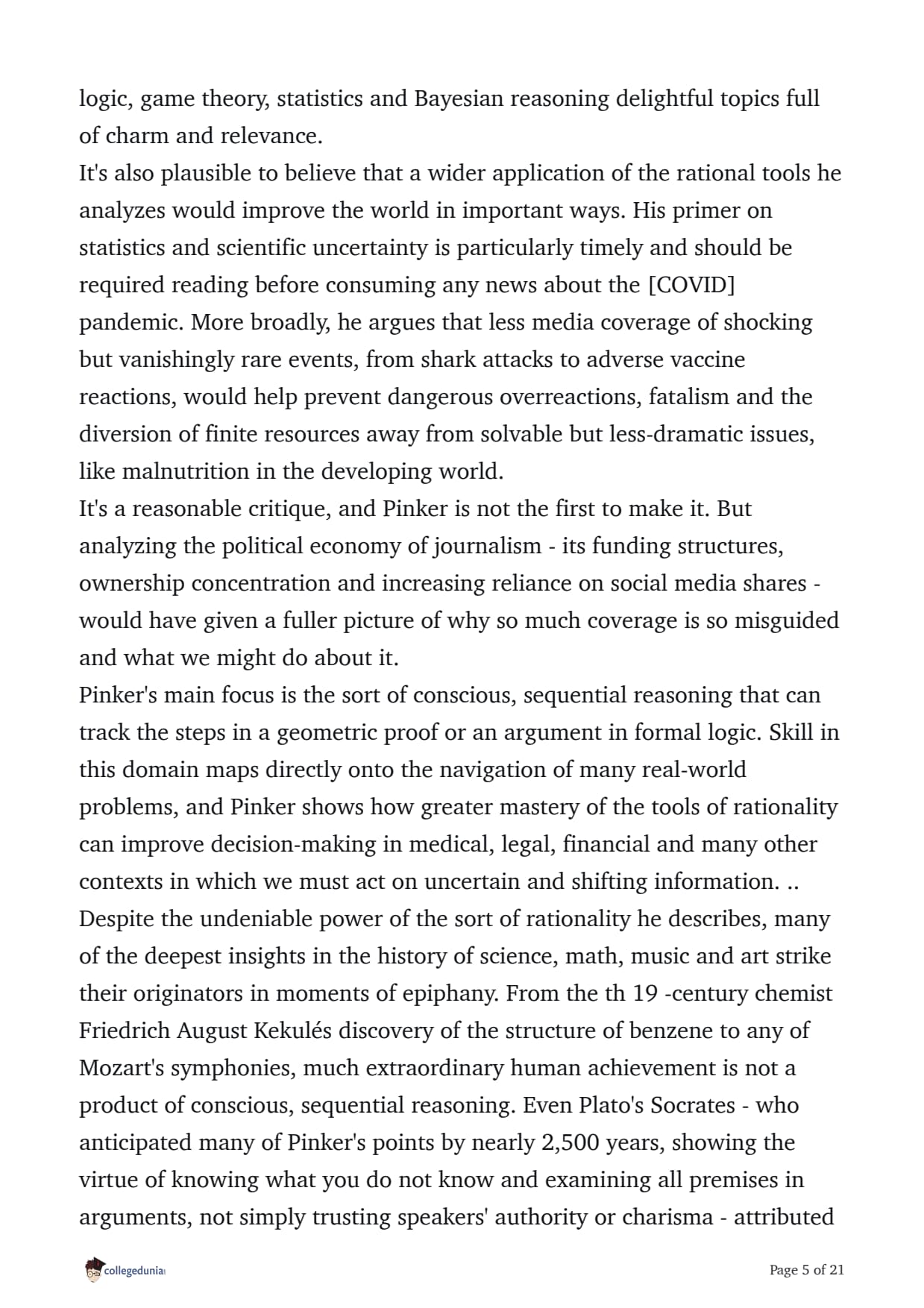
Steven Pinker's new book, "Rationality: What It Is, Why It Seems Scarce, Why It Matters," offers a pragmatic dose of measured optimism, presenting rationality as a fragile but achievable ideal in personal and civic life. ... Pinker's ambition to illuminate such a crucial topic offers the welcome prospect of a return to sanity. ... It's no small achievement to make formal logic, game theory, statistics and Bayesian reasoning delightful topics full of charm and relevance.
It's also plausible to believe that a wider application of the rational tools he analyzes would improve the world in important ways. His primer on statistics and scientific uncertainty is particularly timely and should be required reading before consuming any news about the [COVID] pandemic. More broadly, he argues that less media coverage of shocking but vanishingly rare events, from shark attacks to adverse vaccine reactions, would help prevent dangerous overreactions, fatalism and the diversion of finite resources away from solvable but less-dramatic issues, like malnutrition in the developing world.
It's a reasonable critique, and Pinker is not the first to make it. But analyzing the political economy of journalism - its funding structures, ownership concentration and increasing reliance on social media shares - would have given a fuller picture of why so much coverage is so misguided and what we might do about it.
Read More
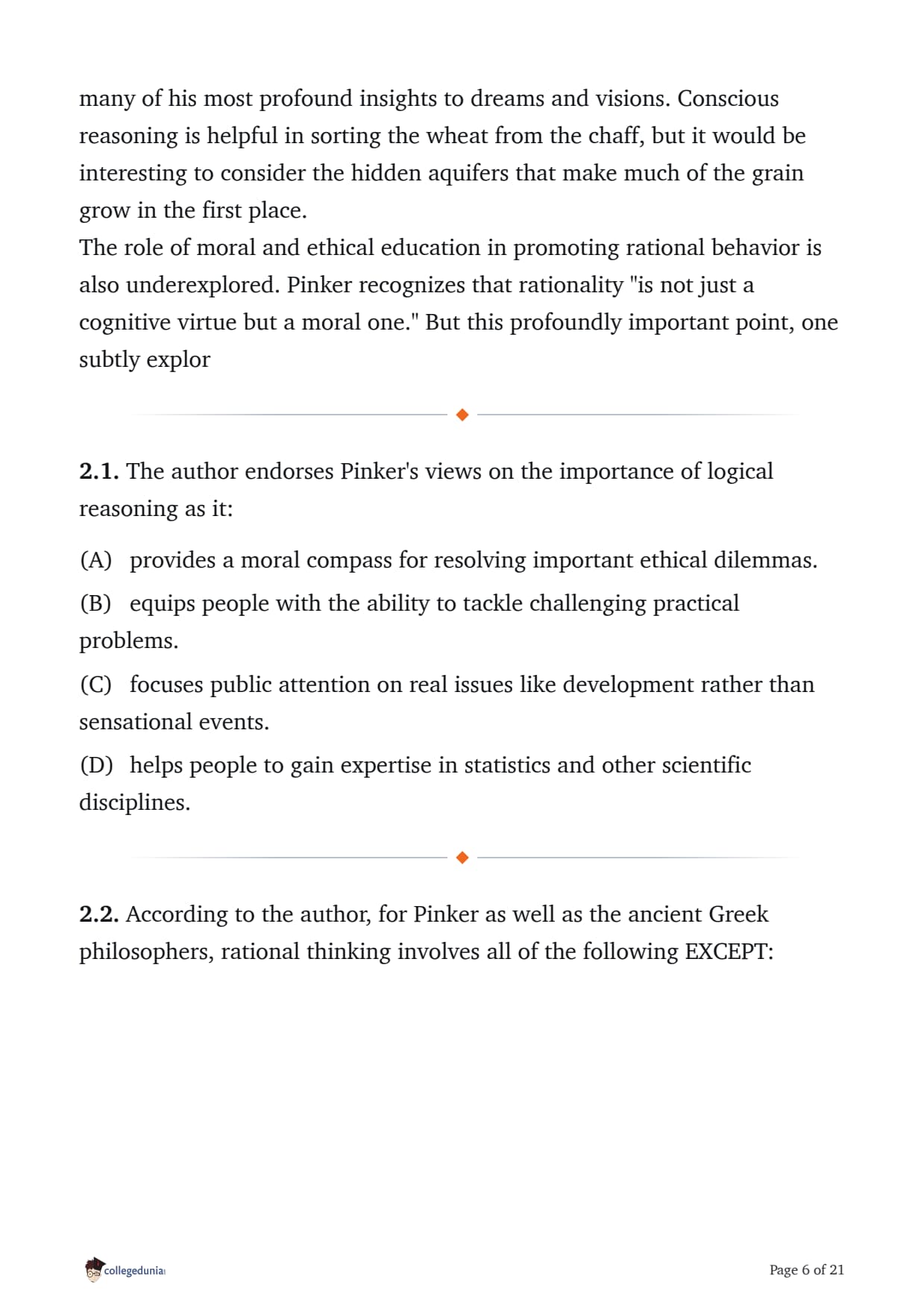
Pinker's main focus is the sort of conscious, sequential reasoning that can track the steps in a geometric proof or an argument in formal logic. Skill in this domain maps directly onto the navigation of many real-world problems, and Pinker shows how greater mastery of the tools of rationality can improve decision-making in medical, legal, financial and many other contexts in which we must act on uncertain and shifting information. ..Despite the undeniable power of the sort of rationality he describes, many of the deepest insights in the history of science, math, music and art strike their originators in moments of epiphany. From the th 19 -century chemist Friedrich August Kekulés discovery of the structure of benzene to any of Mozart's symphonies, much extraordinary human achievement is not a product of conscious, sequential reasoning. Even Plato's Socrates - who anticipated many of Pinker's points by nearly 2,500 years, showing the virtue of knowing what you do not know and examining all premises in arguments, not simply trusting speakers' authority or charisma - attributed many of his most profound insights to dreams and visions. Conscious reasoning is helpful in sorting the wheat from the chaff, but it would be interesting to consider the hidden aquifers that make much of the grain grow in the first place.
The role of moral and ethical education in promoting rational behavior is also underexplored. Pinker recognizes that rationality "is not just a cognitive virtue but a moral one." But this profoundly important point, one subtly explor
The author endorses Pinker's views on the importance of logical reasoning as it:
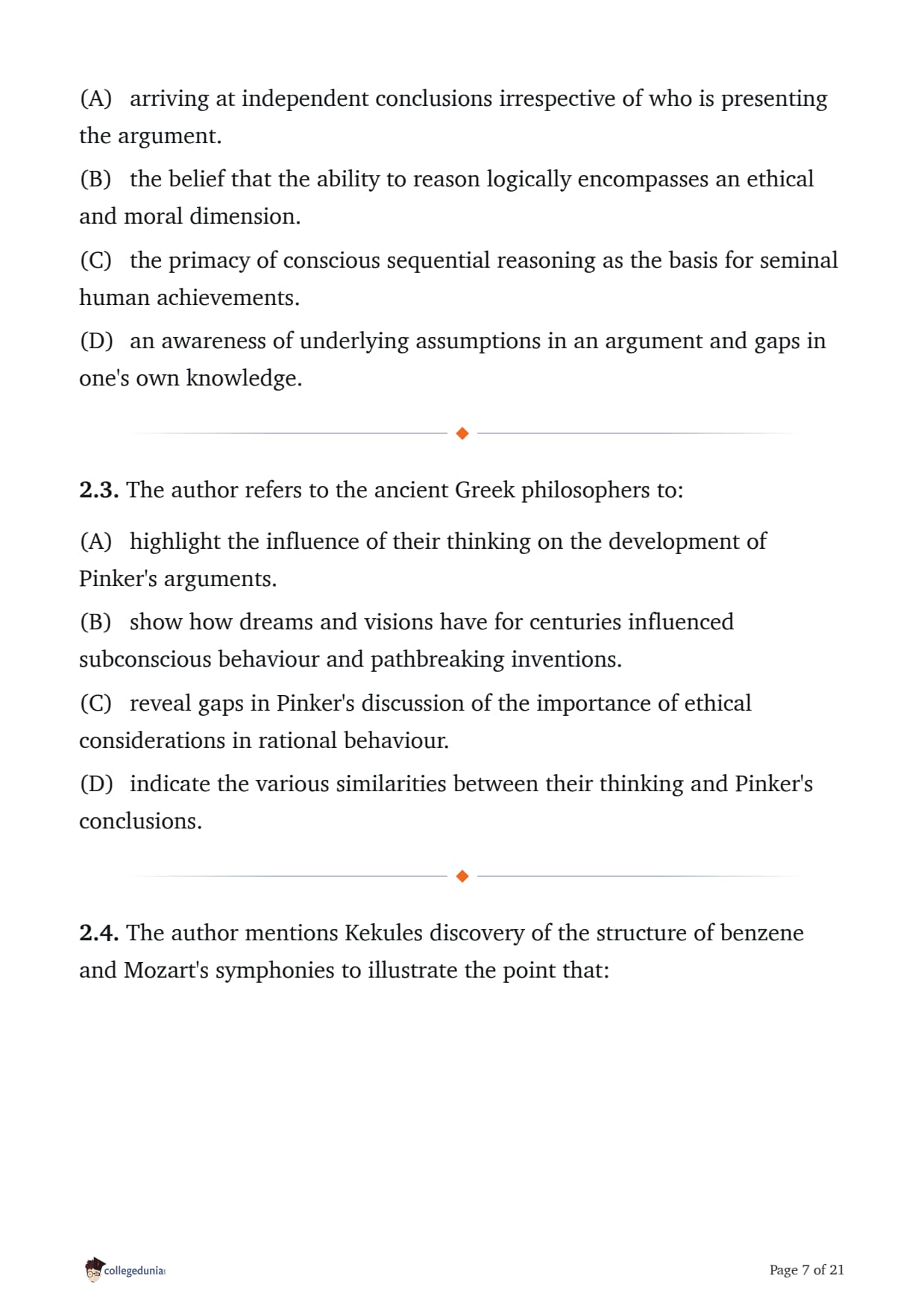
According to the author, for Pinker as well as the ancient Greek philosophers, rational thinking involves all of the following EXCEPT:
The author refers to the ancient Greek philosophers to:
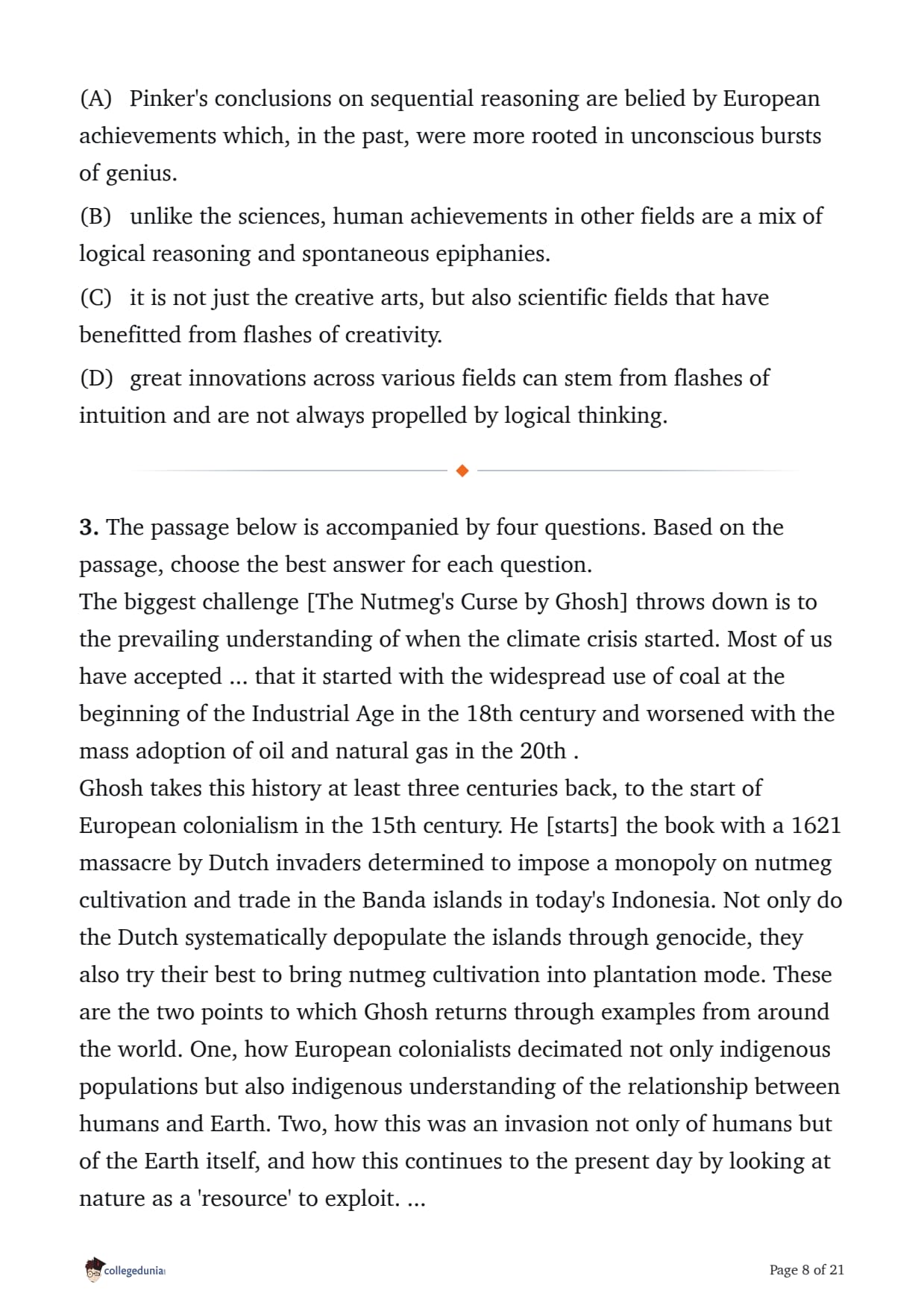
The author mentions Kekules discovery of the structure of benzene and Mozart's symphonies to illustrate the point that:
Comprehension:
The passage below is accompanied by four questions. Based on the passage, choose the best answer for each question.
The biggest challenge [The Nutmeg's Curse by Ghosh] throws down is to the prevailing understanding of when the climate crisis started. Most of us have accepted ... that it started with the widespread use of coal at the beginning of the Industrial Age in the 18th century and worsened with the mass adoption of oil and natural gas in the 20th .
Ghosh takes this history at least three centuries back, to the start of European colonialism in the 15th century. He [starts] the book with a 1621 massacre by Dutch invaders determined to impose a monopoly on nutmeg cultivation and trade in the Banda islands in today's Indonesia. Not only do the Dutch systematically depopulate the islands through genocide, they also try their best to bring nutmeg cultivation into plantation mode. These are the two points to which Ghosh returns through examples from around the world. One, how European colonialists decimated not only indigenous populations but also indigenous understanding of the relationship between humans and Earth. Two, how this was an invasion not only of humans but of the Earth itself, and how this continues to the present day by looking at nature as a 'resource' to exploit. ...
Read More
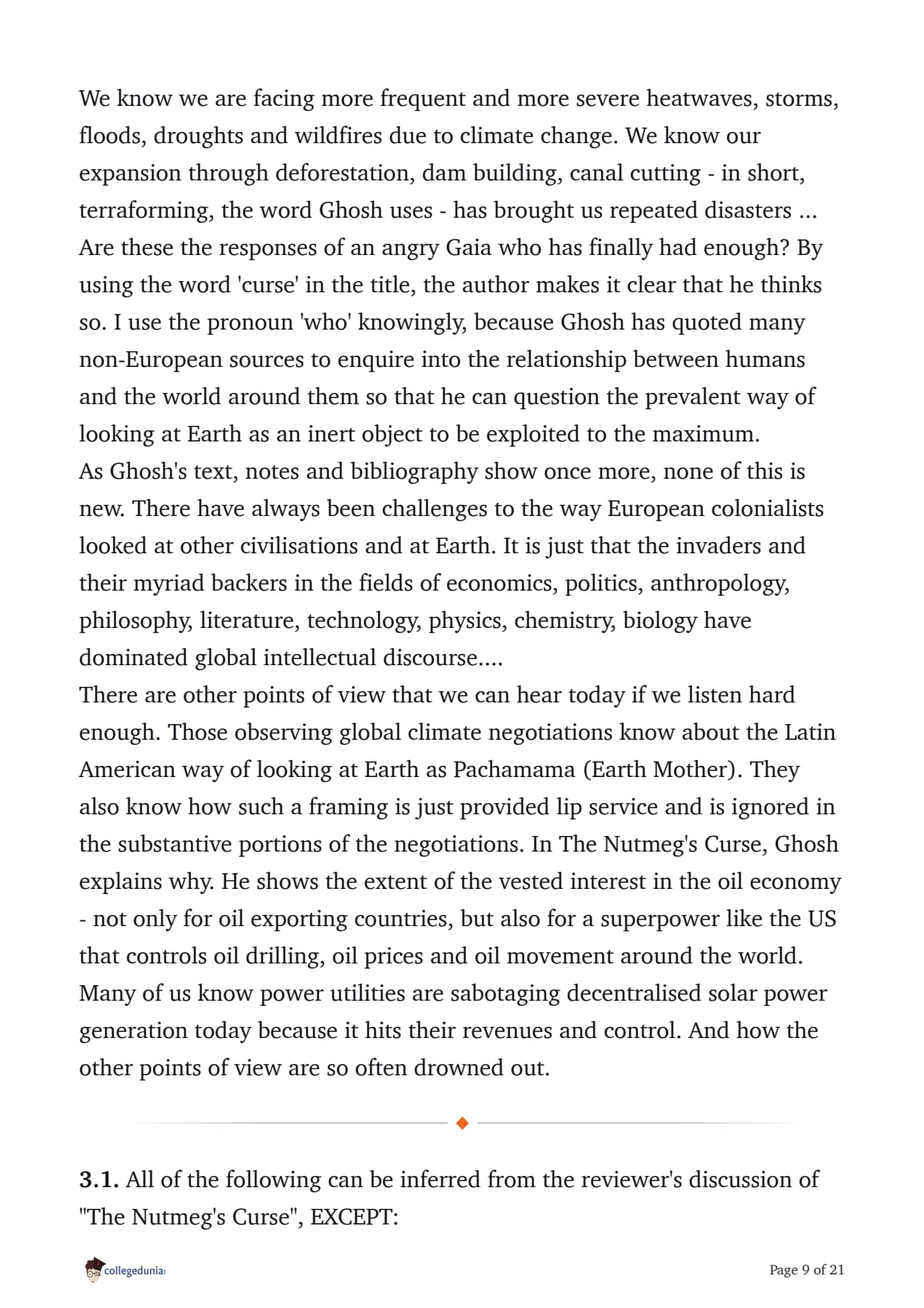
We know we are facing more frequent and more severe heatwaves, storms, floods, droughts and wildfires due to climate change. We know our expansion through deforestation, dam building, canal cutting - in short, terraforming, the word Ghosh uses - has brought us repeated disasters ... Are these the responses of an angry Gaia who has finally had enough? By using the word 'curse' in the title, the author makes it clear that he thinks so. I use the pronoun 'who' knowingly, because Ghosh has quoted many non-European sources to enquire into the relationship between humans and the world around them so that he can question the prevalent way of looking at Earth as an inert object to be exploited to the maximum.As Ghosh's text, notes and bibliography show once more, none of this is new. There have always been challenges to the way European colonialists looked at other civilisations and at Earth. It is just that the invaders and their myriad backers in the fields of economics, politics, anthropology, philosophy, literature, technology, physics, chemistry, biology have dominated global intellectual discourse....
There are other points of view that we can hear today if we listen hard enough. Those observing global climate negotiations know about the Latin American way of looking at Earth as Pachamama (Earth Mother). They also know how such a framing is just provided lip service and is ignored in the substantive portions of the negotiations. In The Nutmeg's Curse, Ghosh explains why. He shows the extent of the vested interest in the oil economy - not only for oil exporting countries, but also for a superpower like the US that controls oil drilling, oil prices and oil movement around the world. Many of us know power utilities are sabotaging decentralised solar power generation today because it hits their revenues and control. And how the other points of view are so often drowned out.
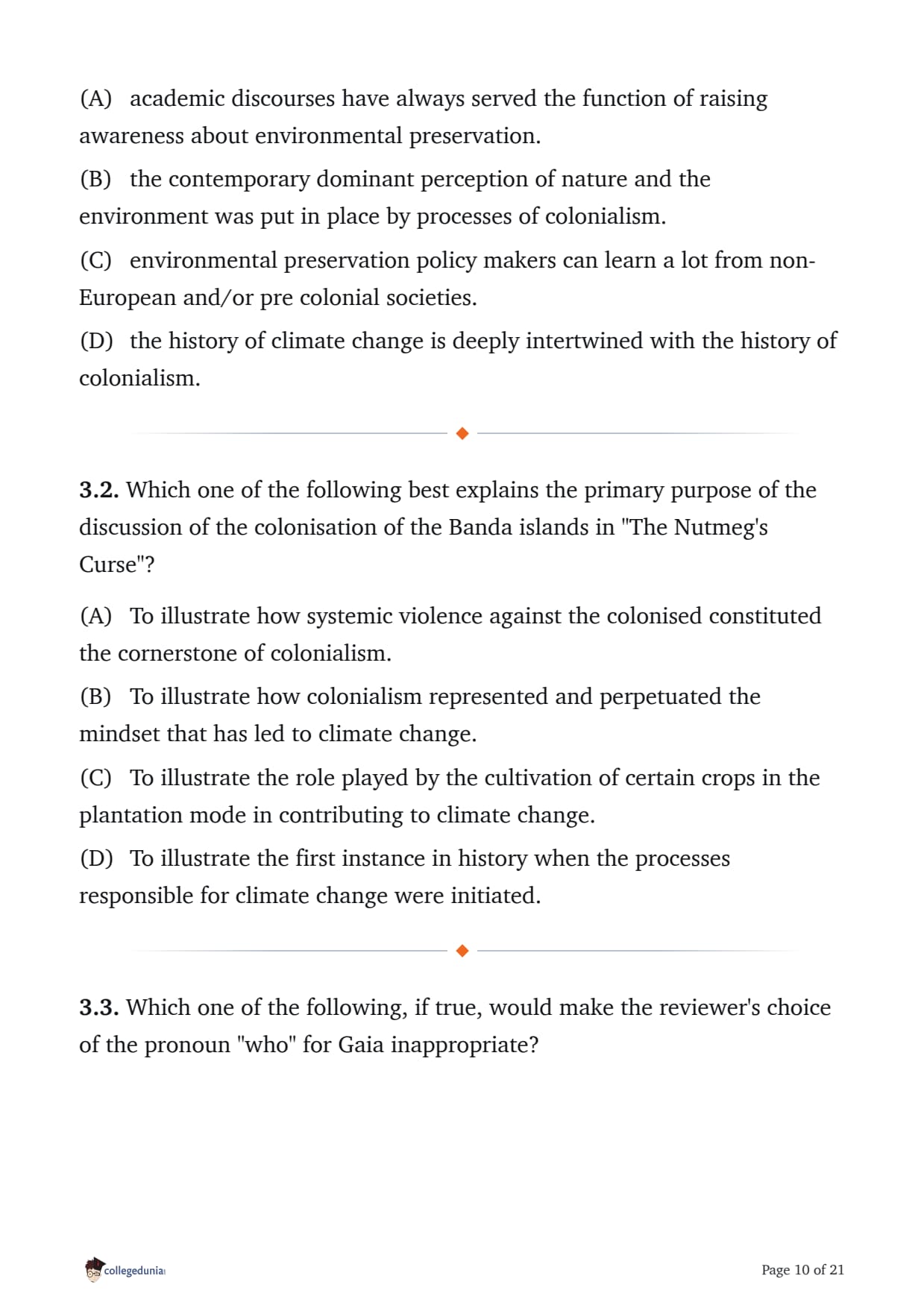
All of the following can be inferred from the reviewer's discussion of "The Nutmeg's Curse", EXCEPT:
Which one of the following best explains the primary purpose of the discussion of the colonisation of the Banda islands in "The Nutmeg's Curse"?
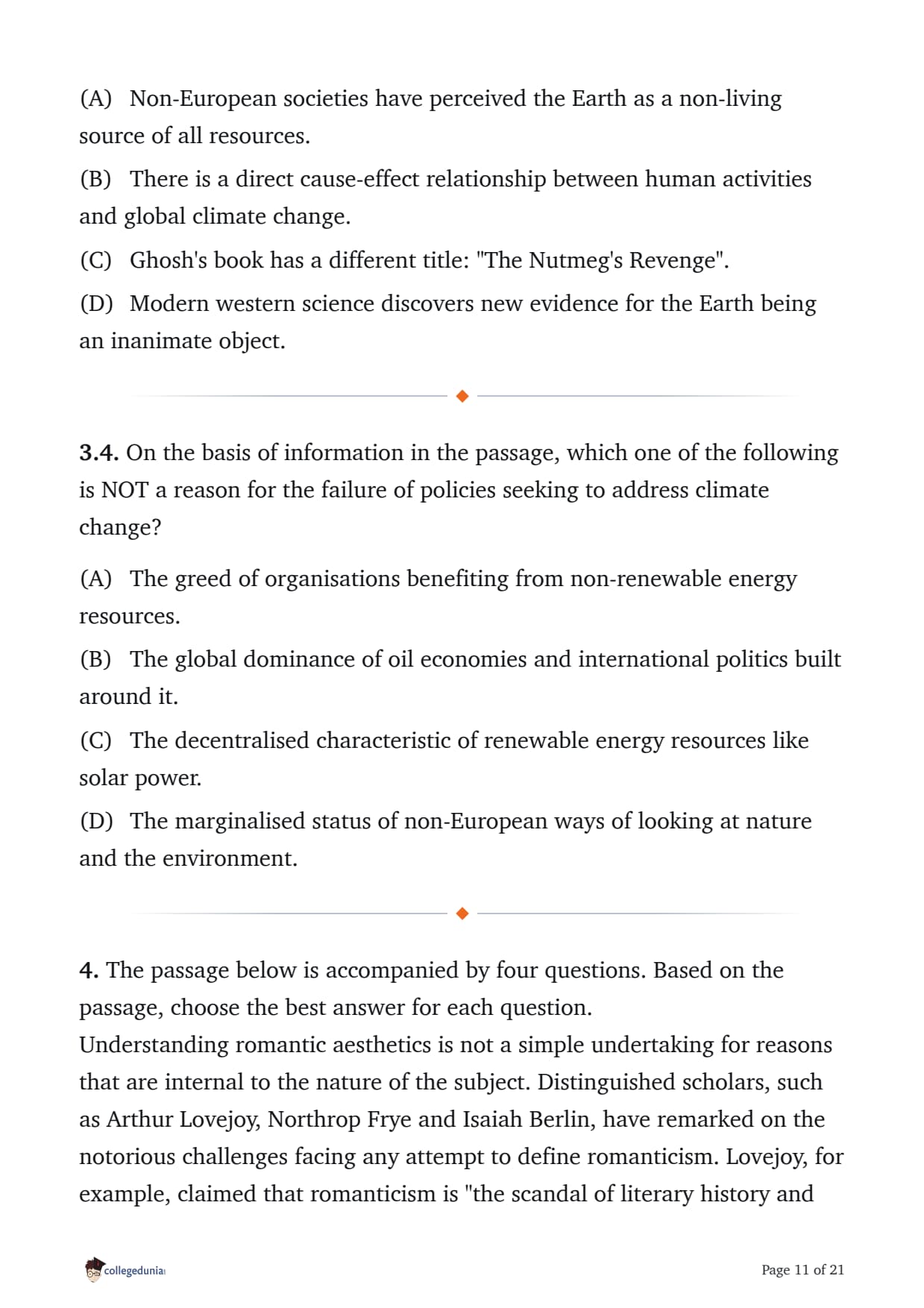
Which one of the following, if true, would make the reviewer's choice of the pronoun "who" for Gaia inappropriate?
On the basis of information in the passage, which one of the following is NOT a reason for the failure of policies seeking to address climate change?
Comprehension:
The passage below is accompanied by four questions. Based on the passage, choose the best answer for each question.
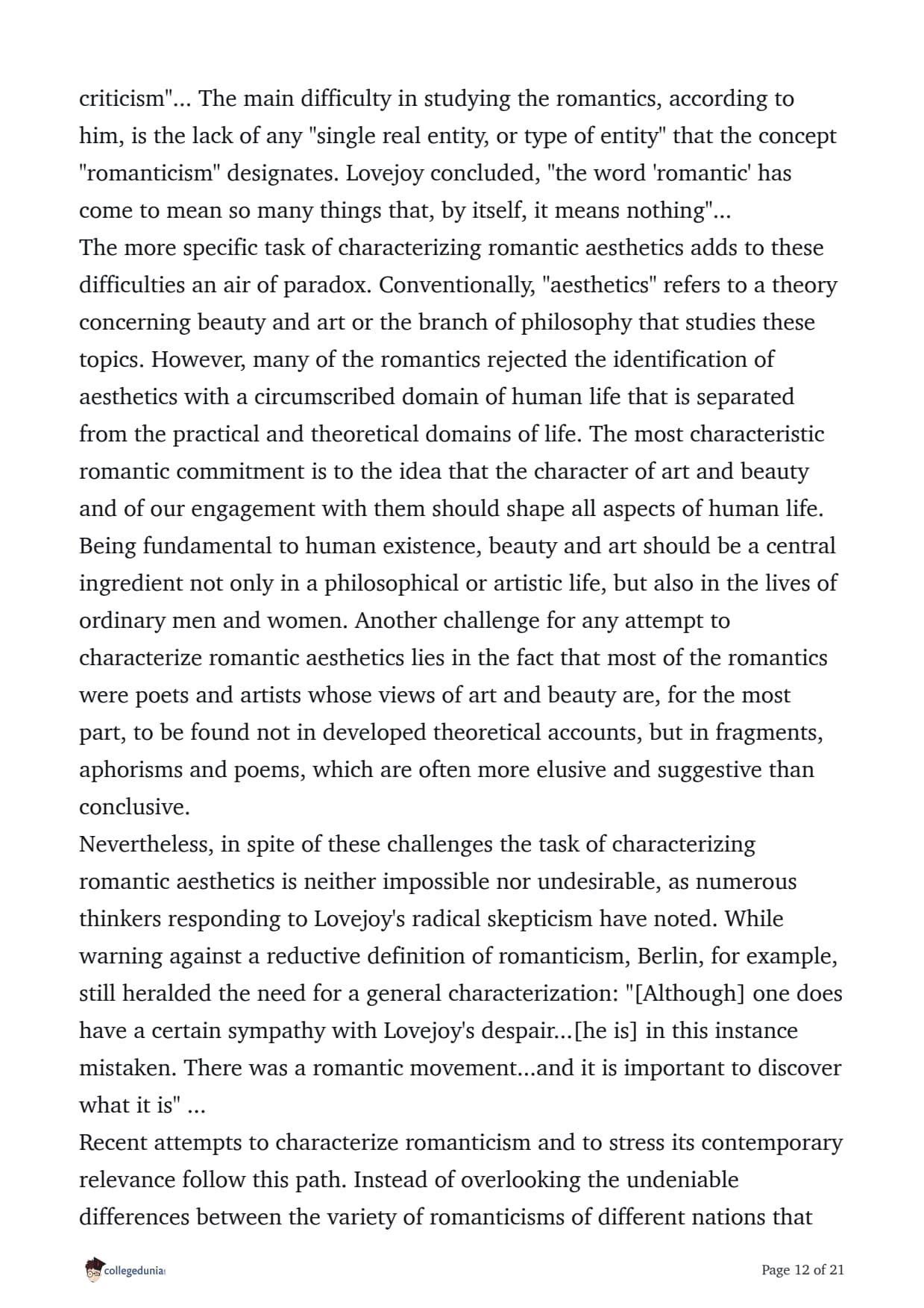
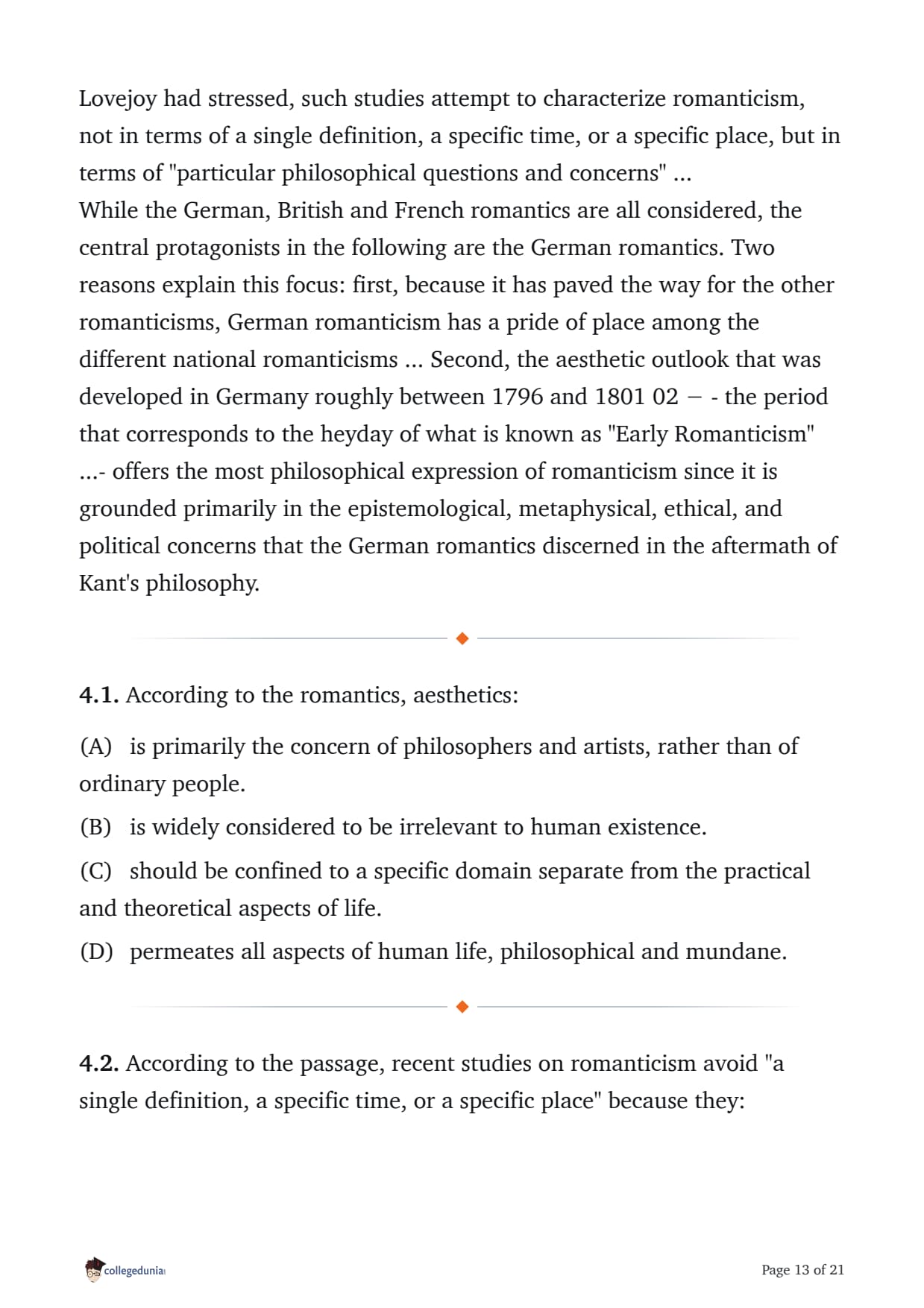
Understanding romantic aesthetics is not a simple undertaking for reasons that are internal to the nature of the subject. Distinguished scholars, such as Arthur Lovejoy, Northrop Frye and Isaiah Berlin, have remarked on the notorious challenges facing any attempt to define romanticism. Lovejoy, for example, claimed that romanticism is "the scandal of literary history and criticism"... The main difficulty in studying the romantics, according to him, is the lack of any "single real entity, or type of entity" that the concept "romanticism" designates. Lovejoy concluded, "the word 'romantic' has come to mean so many things that, by itself, it means nothing"...
The more specific task of characterizing romantic aesthetics adds to these difficulties an air of paradox. Conventionally, "aesthetics" refers to a theory concerning beauty and art or the branch of philosophy that studies these topics. However, many of the romantics rejected the identification of aesthetics with a circumscribed domain of human life that is separated from the practical and theoretical domains of life. The most characteristic romantic commitment is to the idea that the character of art and beauty and of our engagement with them should shape all aspects of human life. Being fundamental to human existence, beauty and art should be a central ingredient not only in a philosophical or artistic life, but also in the lives of ordinary men and women. Another challenge for any attempt to characterize romantic aesthetics lies in the fact that most of the romantics were poets and artists whose views of art and beauty are, for the most part, to be found not in developed theoretical accounts, but in fragments, aphorisms and poems, which are often more elusive and suggestive than conclusive.
Read More
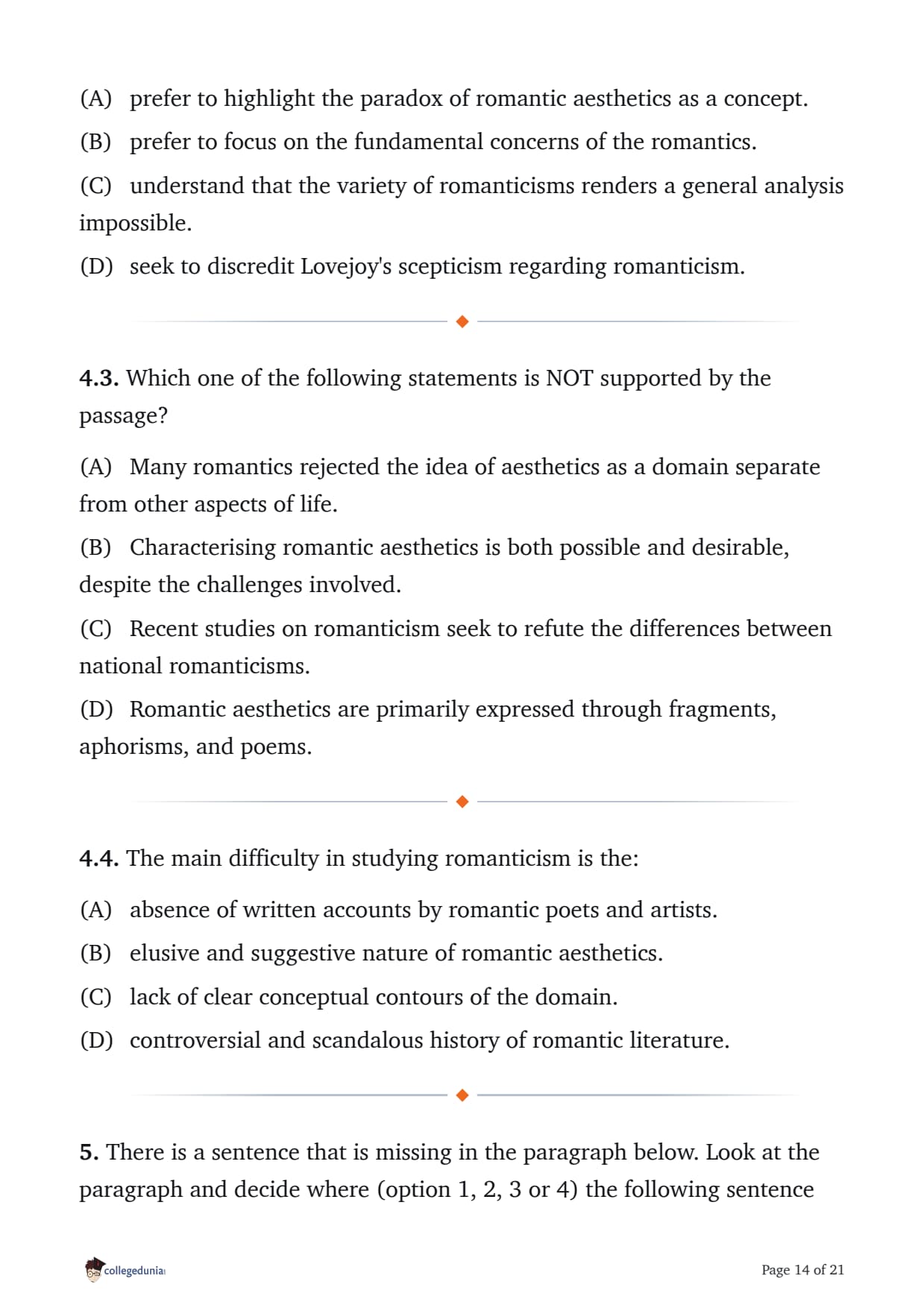
Nevertheless, in spite of these challenges the task of characterizing romantic aesthetics is neither impossible nor undesirable, as numerous thinkers responding to Lovejoy's radical skepticism have noted. While warning against a reductive definition of romanticism, Berlin, for example, still heralded the need for a general characterization: "[Although] one does have a certain sympathy with Lovejoy's despair...[he is] in this instance mistaken. There was a romantic movement...and it is important to discover what it is" ...Recent attempts to characterize romanticism and to stress its contemporary relevance follow this path. Instead of overlooking the undeniable differences between the variety of romanticisms of different nations that Lovejoy had stressed, such studies attempt to characterize romanticism, not in terms of a single definition, a specific time, or a specific place, but in terms of "particular philosophical questions and concerns" ...
While the German, British and French romantics are all considered, the central protagonists in the following are the German romantics. Two reasons explain this focus: first, because it has paved the way for the other romanticisms, German romanticism has a pride of place among the different national romanticisms ... Second, the aesthetic outlook that was developed in Germany roughly between 1796 and 1801 02 − - the period that corresponds to the heyday of what is known as "Early Romanticism" ...- offers the most philosophical expression of romanticism since it is grounded primarily in the epistemological, metaphysical, ethical, and political concerns that the German romantics discerned in the aftermath of Kant's philosophy.
According to the romantics, aesthetics:
According to the passage, recent studies on romanticism avoid "a single definition, a specific time, or a specific place" because they:
Which one of the following statements is NOT supported by the passage?
The main difficulty in studying romanticism is the:
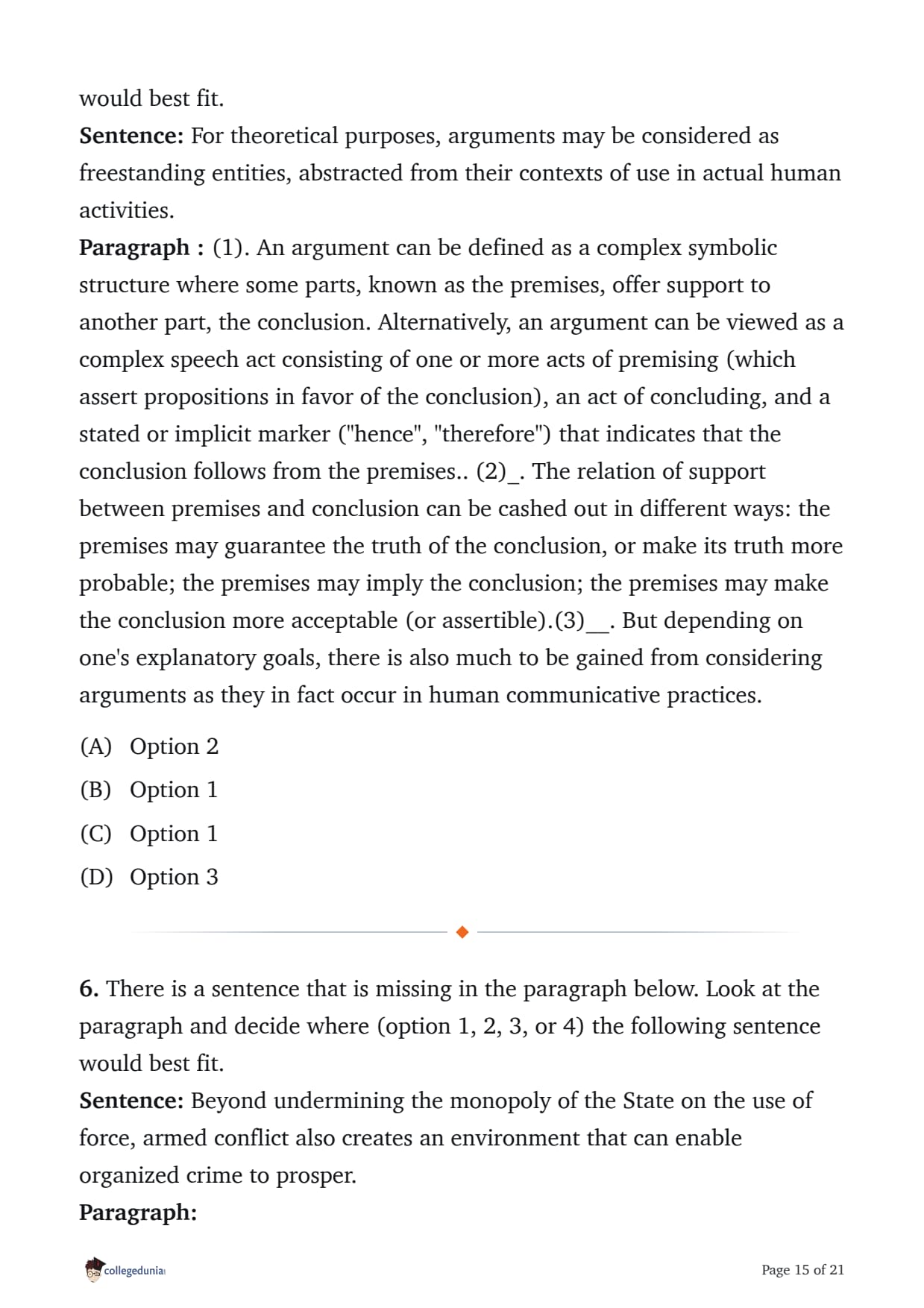
There is a sentence that is missing in the paragraph below. Look at the paragraph and decide where (option 1, 2, 3 or 4) the following sentence would best fit.
Sentence: For theoretical purposes, arguments may be considered as freestanding entities, abstracted from their contexts of use in actual human activities.
Paragraph : (1). An argument can be defined as a complex symbolic structure where some parts, known as the premises, offer support to another part, the conclusion. Alternatively, an argument can be viewed as a complex speech act consisting of one or more acts of premising (which assert propositions in favor of the conclusion), an act of concluding, and a stated or implicit marker ("hence", "therefore") that indicates that the conclusion follows from the premises.. (2)_. The relation of support between premises and conclusion can be cashed out in different ways: the premises may guarantee the truth of the conclusion, or make its truth more probable; the premises may imply the conclusion; the premises may make the conclusion more acceptable (or assertible).(3)__. But depending on one's explanatory goals, there is also much to be gained from considering arguments as they in fact occur in human communicative practices.
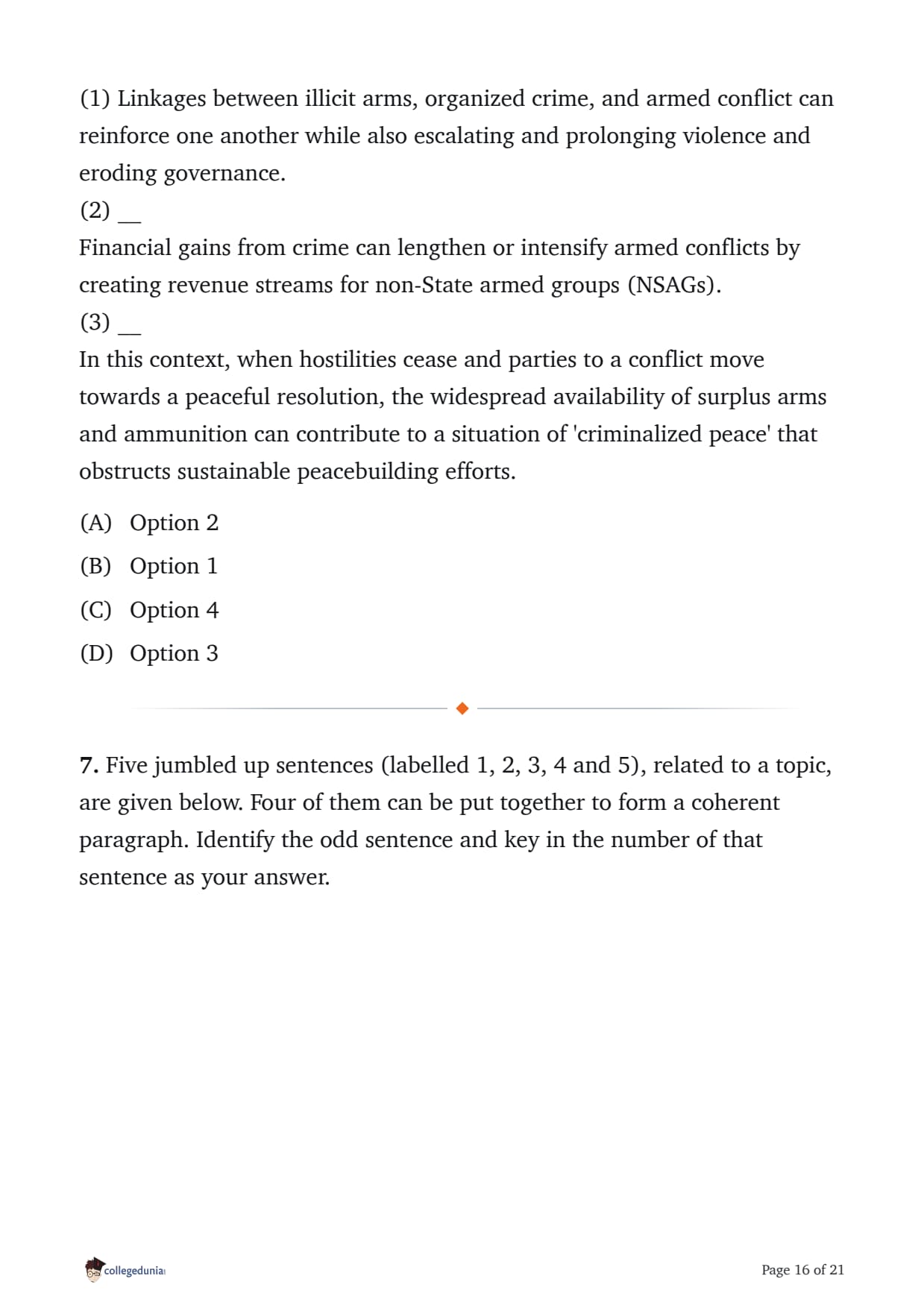
There is a sentence that is missing in the paragraph below. Look at the paragraph and decide where (option 1, 2, 3, or 4) the following sentence would best fit.
Sentence: Beyond undermining the monopoly of the State on the use of force, armed conflict also creates an environment that can enable organized crime to prosper.
Paragraph:
(1) Linkages between illicit arms, organized crime, and armed conflict can reinforce one another while also escalating and prolonging violence and eroding governance.
(2) __
Financial gains from crime can lengthen or intensify armed conflicts by creating revenue streams for non-State armed groups (NSAGs).
(3) __
In this context, when hostilities cease and parties to a conflict move towards a peaceful resolution, the widespread availability of surplus arms and ammunition can contribute to a situation of 'criminalized peace' that obstructs sustainable peacebuilding efforts.
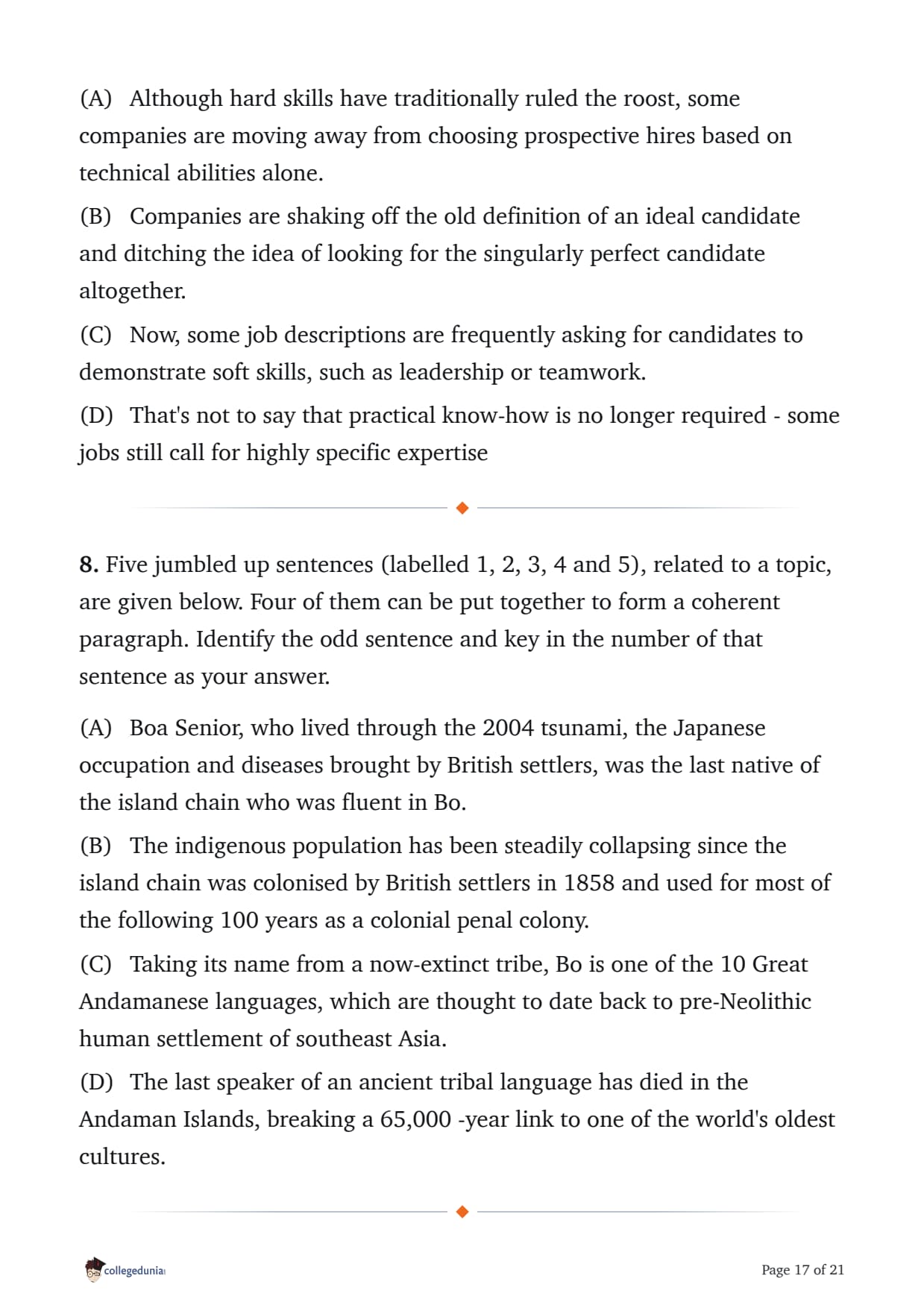
Five jumbled up sentences (labelled 1, 2, 3, 4 and 5), related to a topic, are given below. Four of them can be put together to form a coherent paragraph. Identify the odd sentence and key in the number of that sentence as your answer.
Five jumbled up sentences (labelled 1, 2, 3, 4 and 5), related to a topic, are given below. Four of them can be put together to form a coherent paragraph. Identify the odd sentence and key in the number of that sentence as your answer.
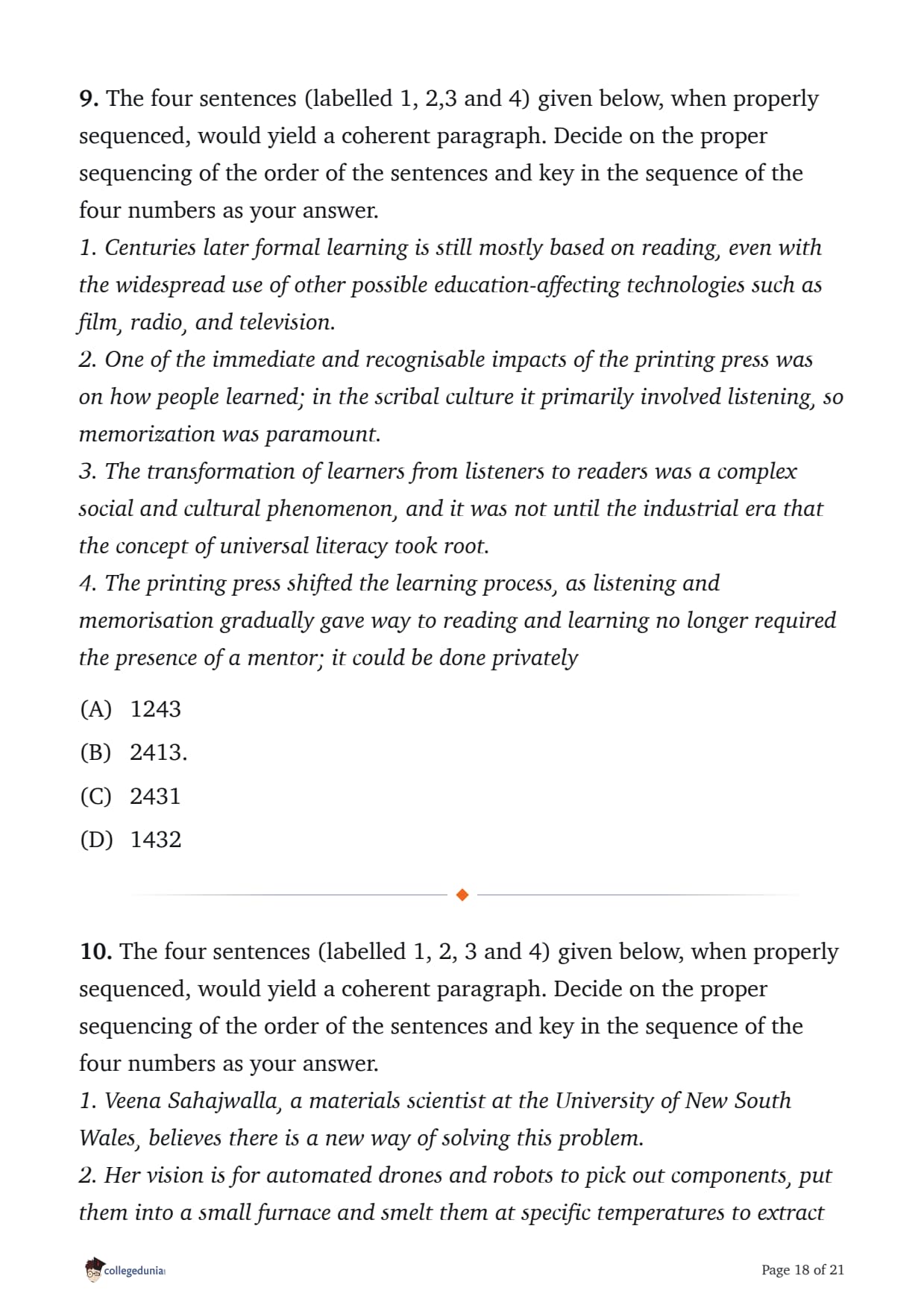
The four sentences (labelled 1, 2,3 and 4) given below, when properly sequenced, would yield a coherent paragraph. Decide on the proper sequencing of the order of the sentences and key in the sequence of the four numbers as your answer.
1. Centuries later formal learning is still mostly based on reading, even with the widespread use of other possible education-affecting technologies such as film, radio, and television.
2. One of the immediate and recognisable impacts of the printing press was on how people learned; in the scribal culture it primarily involved listening, so memorization was paramount.
3. The transformation of learners from listeners to readers was a complex social and cultural phenomenon, and it was not until the industrial era that the concept of universal literacy took root.
4. The printing press shifted the learning process, as listening and memorisation gradually gave way to reading and learning no longer required the presence of a mentor; it could be done privately
The four sentences (labelled 1, 2, 3 and 4) given below, when properly sequenced, would yield a coherent paragraph. Decide on the proper sequencing of the order of the sentences and key in the sequence of the four numbers as your answer.
1. Veena Sahajwalla, a materials scientist at the University of New South Wales, believes there is a new way of solving this problem.
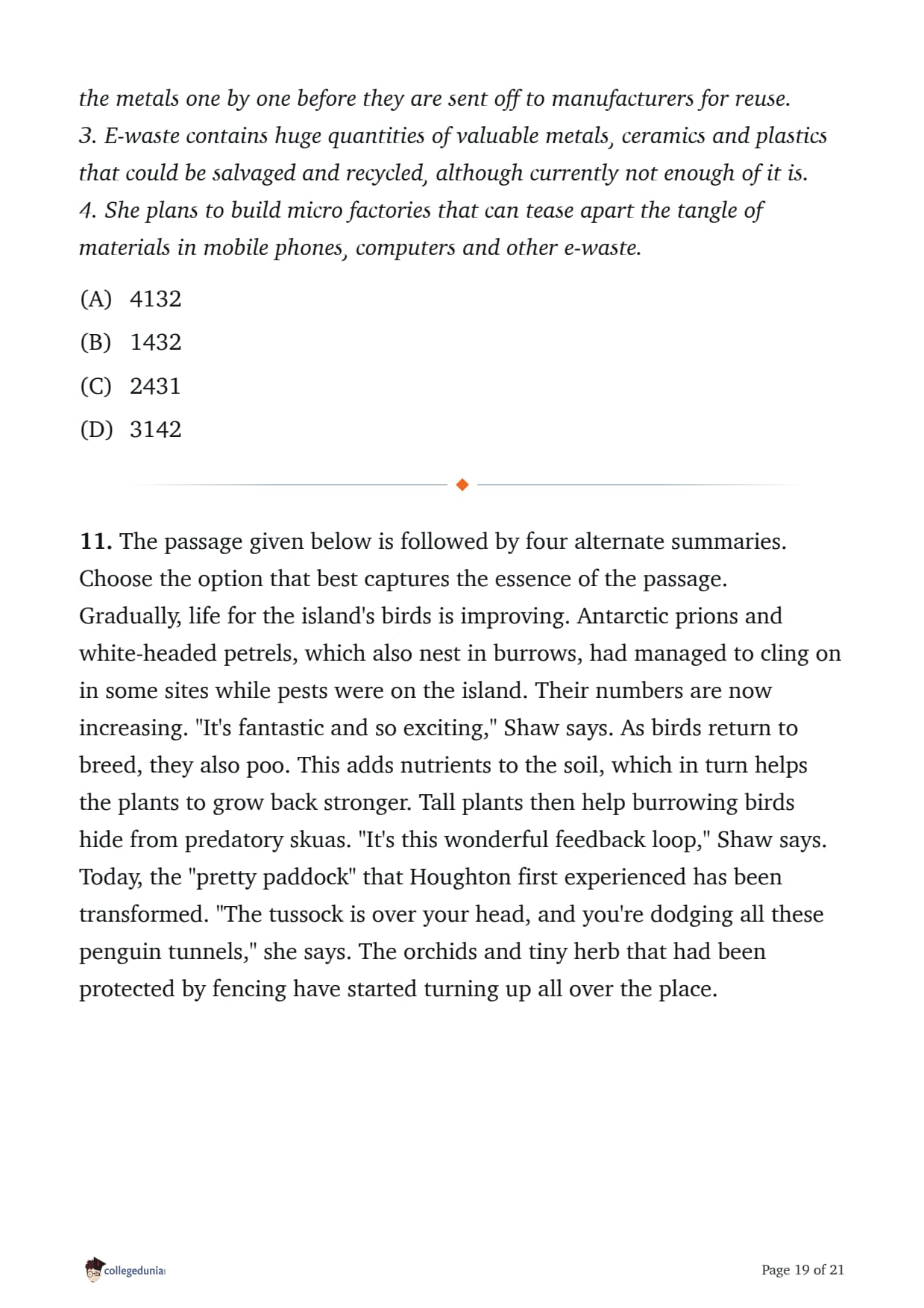
2. Her vision is for automated drones and robots to pick out components, put them into a small furnace and smelt them at specific temperatures to extract the metals one by one before they are sent off to manufacturers for reuse.
3. E-waste contains huge quantities of valuable metals, ceramics and plastics that could be salvaged and recycled, although currently not enough of it is.
4. She plans to build micro factories that can tease apart the tangle of materials in mobile phones, computers and other e-waste.
The passage given below is followed by four alternate summaries. Choose the option that best captures the essence of the passage.
Gradually, life for the island's birds is improving. Antarctic prions and white-headed petrels, which also nest in burrows, had managed to cling on in some sites while pests were on the island. Their numbers are now increasing. "It's fantastic and so exciting," Shaw says. As birds return to breed, they also poo. This adds nutrients to the soil, which in turn helps the plants to grow back stronger. Tall plants then help burrowing birds hide from predatory skuas. "It's this wonderful feedback loop," Shaw says. Today, the "pretty paddock" that Houghton first experienced has been transformed. "The tussock is over your head, and you're dodging all these penguin tunnels," she says. The orchids and tiny herb that had been protected by fencing have started turning up all over the place.
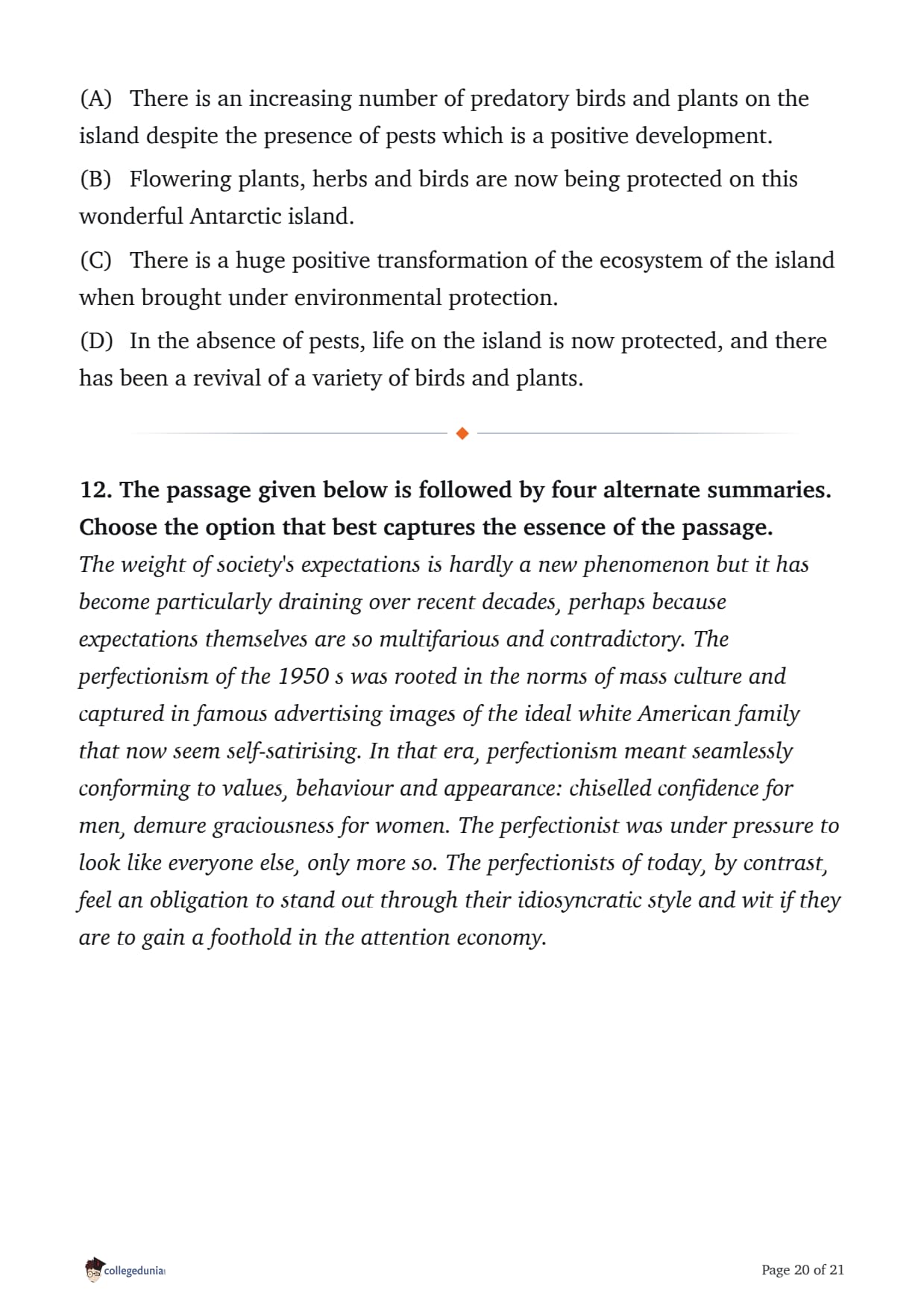
The passage given below is followed by four alternate summaries. Choose the option that best captures the essence of the passage.
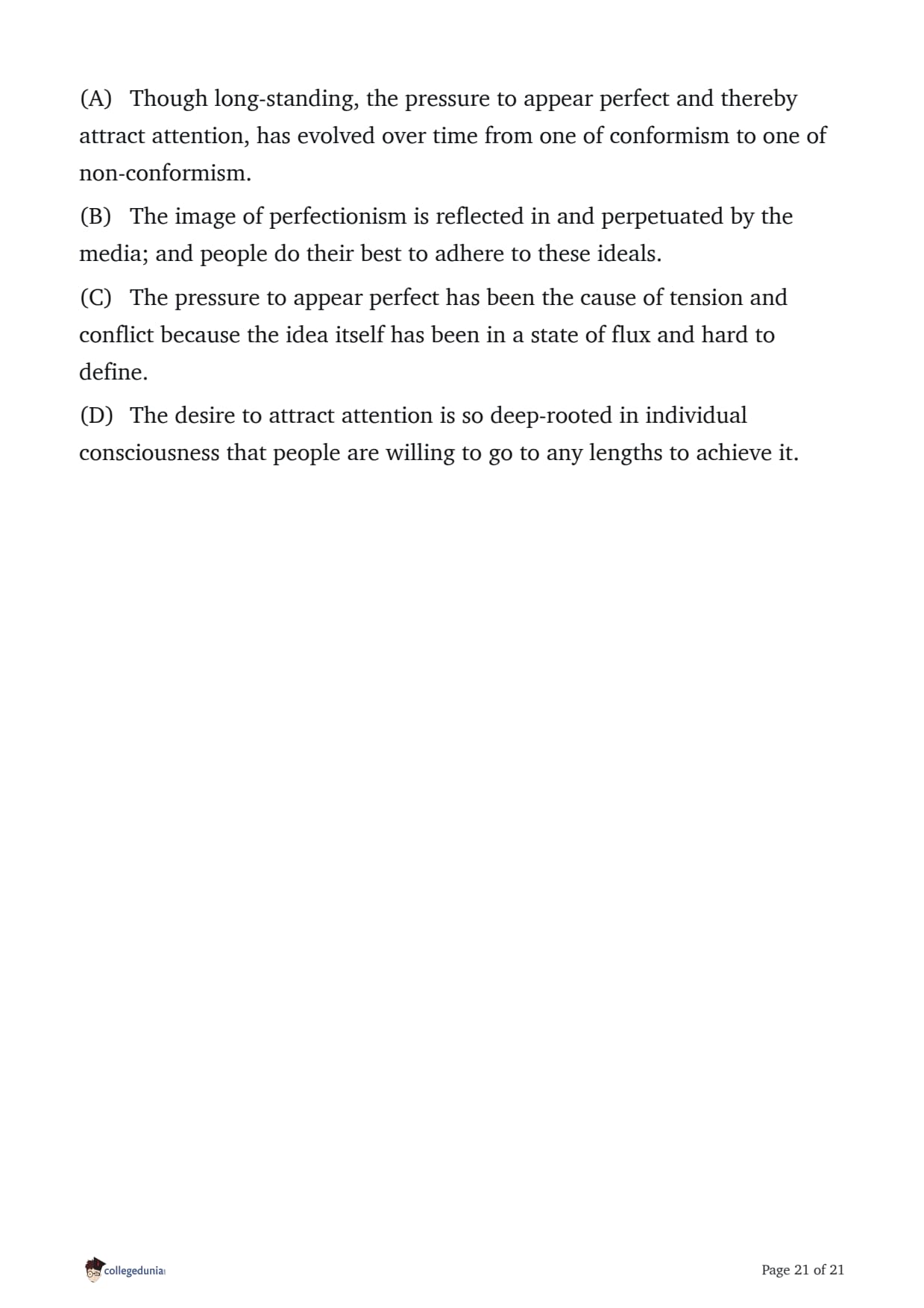
The weight of society's expectations is hardly a new phenomenon but it has become particularly draining over recent decades, perhaps because expectations themselves are so multifarious and contradictory. The perfectionism of the 1950 s was rooted in the norms of mass culture and captured in famous advertising images of the ideal white American family that now seem self-satirising. In that era, perfectionism meant seamlessly conforming to values, behaviour and appearance: chiselled confidence for men, demure graciousness for women. The perfectionist was under pressure to look like everyone else, only more so. The perfectionists of today, by contrast, feel an obligation to stand out through their idiosyncratic style and wit if they are to gain a foothold in the attention economy.
CAT 2023 Slot 3 VARC Exam Pattern and Marking Scheme
The VARC section of CAT 2023 Slot 3 had 24 questions to be solved in a 40-minute sectional time limit, for a total of 72 marks. Each question carried 3 marks, with about 4 to 5 of the 24 being TITA (type in the answer) questions and the rest MCQs. Here is how the section was structured and scored.
- Total questions: 24 in the Verbal Ability & Reading Comprehension section
- Section duration: 40 minutes (sectional time limit)
- Total marks: 72 (3 marks per question)
- Marking (MCQ): +3 for a correct answer, -1 for a wrong one
- Marking (TITA): +3 for a correct answer, no negative marking
- Question types: 16 Reading Comprehension questions across 4 passages (4 questions each) plus 8 Verbal Ability questions split as 2 para-summary, 2 para-completion, 2 para-jumble, and 2 odd-sentence-out. The para-jumble and odd-sentence-out questions were TITA, so you could attempt them without fear of negative marking.
CAT 2023 Slot 3 VARC Topic Weightage and Passage Themes
Reading Comprehension dominated the section with 16 of 24 questions (about 67%), while Verbal Ability contributed the remaining 8 questions (about 33%). The 4 passages were 350 to 500 words each, dense but with manageable questions. Here is the split you should plan your strategy around.
- Reading Comprehension: 16 questions across 4 passages of 4 questions each, themed on romanticism and romantic aesthetics, cultural property and archaeology (the Euphronios krater repatriation), rationality and intuition (based on Steven Pinker), and the climate crisis and colonialism (based on The Nutmeg's Curse).
- Verbal Ability: 8 questions made up of 2 para-summary (MCQ), 2 para-completion (MCQ), 2 para-jumble (TITA), and 2 odd-sentence-out (TITA), with no standalone grammar or vocabulary questions.
- MCQ vs TITA: roughly 19 to 20 MCQs carried the -1 penalty, while the 4 to 5 TITA questions in Verbal Ability carried no negative marking, making them safer attempts.
CAT 2023 Slot 3 VARC Question Paper Solutions Video
Source: SuperGrads CAT Coaching by Toprankers
How to Use the CAT 2023 Slot 3 VARC Solved Paper
Work through this paper the way you would a real attempt before opening the solutions. The section leaned toward the upper end of moderate, with dense passages that demanded reading stamina, so build that endurance here.
- Attempt all 24 questions in one 40-minute block first, then mark your raw score using +3 for correct and -1 for wrong MCQs.
- Target the 4 RC passages by accuracy, not order: about 9 to 12 RC questions could be answered with high accuracy, so pick your strongest passages first.
- Attempt the 4 TITA Verbal Ability questions (para-jumble and odd-sentence-out) since they carry no negative marking.
- Review every wrong answer against the detailed solution and note whether you misread the passage or eliminated the wrong option.
Good Attempts and Percentile Benchmark for VARC Slot 3
- A good performance was 16 to 18 questions attempted with about 70% accuracy, which works out to roughly 11 to 13 correct.
- On the scaled VARC score, around 38 to 40 marks was enough for about a 95 to 96 sectional percentile, while 28 to 30 marks pointed to roughly the mid-80s.
- Slot 3 was treated as the relatively easier slot, so normalization adjusted scaled scores down by close to 4 marks compared with raw totals, which you should keep in mind when comparing your score across slots.
VARC Slot 3 Question Paper FAQs
Ques. How many questions were in the CAT 2023 VARC Slot 3 section?
Ans. The CAT 2023 Slot 3 VARC section had 24 questions worth 72 marks, made up of 16 Reading Comprehension questions across 4 passages and 8 Verbal Ability questions, to be solved in a 40-minute sectional limit.
Ques. What was the difficulty level of CAT 2023 Slot 3 VARC?
Ans. It was moderate, leaning to the upper end of moderate. The 4 passages of 350 to 500 words were dense and interpretative, but the questions themselves were manageable, and about 9 to 12 RC questions could be answered with high accuracy.
Ques. What is a good number of attempts in CAT 2023 Slot 3 VARC?
Ans. Attempting 16 to 18 of the 24 questions with around 70% accuracy was considered a good performance, which translates to roughly 11 to 13 correct answers.
Ques. What was the marking scheme for CAT 2023 Slot 3 VARC?
Ans. Every question carried 3 marks. MCQs gave +3 for a correct answer and -1 for a wrong one, while the 4 to 5 TITA questions gave +3 for a correct answer with no negative marking.
Ques. What scaled score gave a 95 percentile in VARC for CAT 2023?
Ans. In the VARC section, a scaled score of roughly 38 to 40 marks pointed to about a 95 to 96 sectional percentile, while around 28 to 30 marks indicated the mid-80s. Slot 3 saw a downward normalization of close to 4 marks.
Ques. Where can I find the official CAT 2023 exam details and dates?
Ans. Official CAT exam information, including conduct dates, slot timings, and notifications, is published on the IIM admission portal at iimcat.ac.in. CAT 2023 was conducted by IIM Lucknow on November 26, 2023, with Slot 3 running from 4:30 PM to 6:30 PM.



Comments