




The CAT 2023 DILR Slot 3 question paper carried 20 questions worth 60 marks, and you got just 40 minutes to clear them. Conducted by IIM Lucknow on November 26, 2023, the Slot 3 (evening) session ran from 4:30 PM to 6:30 PM. The section was rated Medium to Difficult, built around 4 sets of 5 questions each, with 3 of the 4 sets leaning heavily on quantitative reasoning and not a single set that was purely logical reasoning. Use the solved paper below to work through every set, check each answer, and time yourself against the 40-minute limit.
| CAT 2023 DILR Slot 3 Question Paper with Solutions | Download PDF | Check Solutions |

CAT 2023 Slot 3 DILR Questions with Solutions
Comprehension:
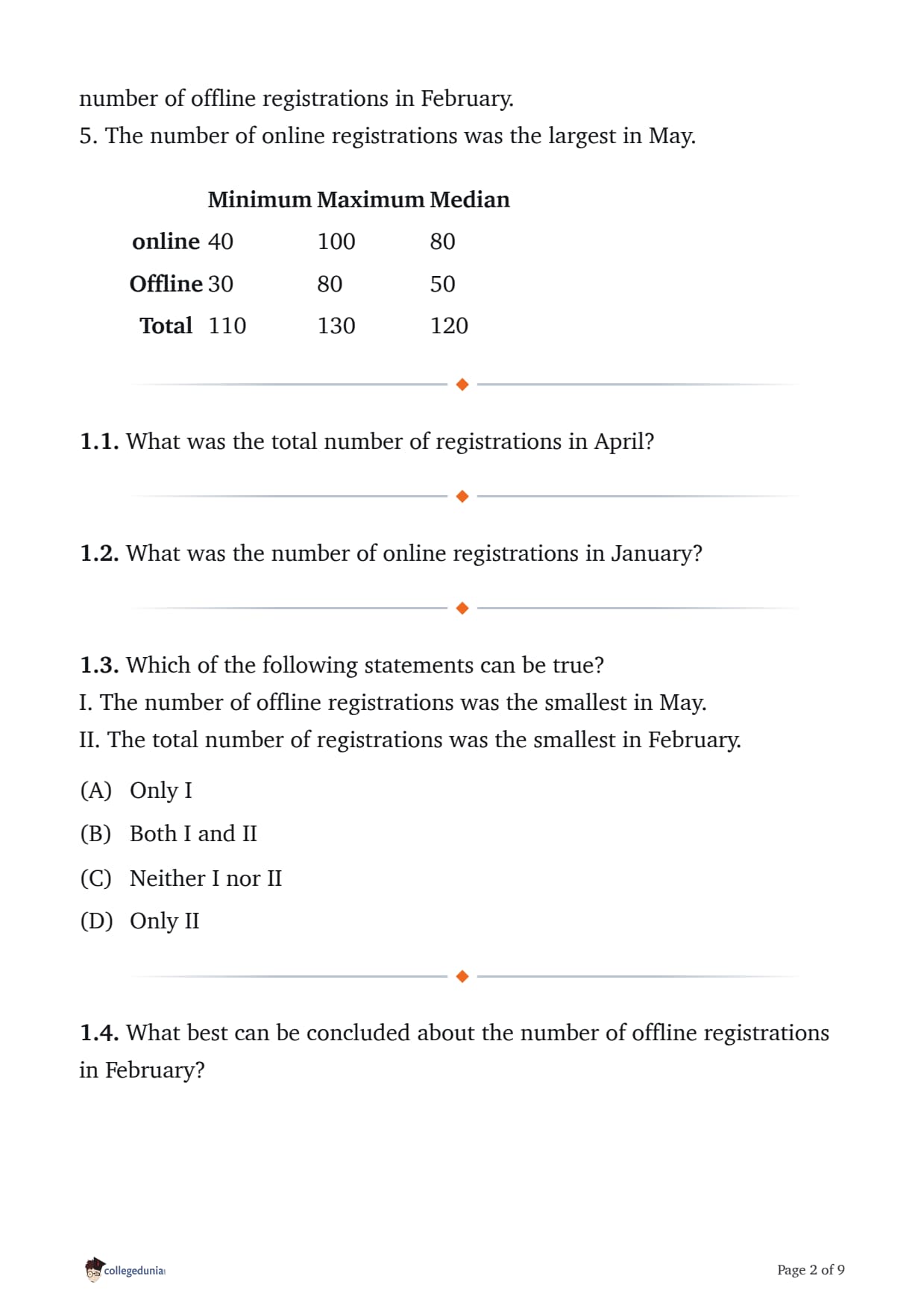
In a coaching class, some students register online, and some others register offline. No student registers both online and offline; hence the total registration number is the sum of online and offline registrations. The following facts and table pertain to these registration numbers for the five months - January to May of 2023. The table shows the minimum, maximum, median registration numbers of these five months, separately for online, offline and total number of registrations. The following additional facts are known.
1. In every month, both online and offline registration numbers were multiples of 10 .
2. In January, the number of offline registrations was twice that of online registrations.
3. In April, the number of online registrations was twice that of offline registrations.
4. The number of online registrations in March was the same as the number of offline registrations in February.
5. The number of online registrations was the largest in May.
Read More
| Minimum | Maximum | Median | |
|---|---|---|---|
| online | 40 | 100 | 80 |
| Offline | 30 | 80 | 50 |
| Total | 110 | 130 | 120 |
What was the total number of registrations in April?
What was the number of online registrations in January?
Which of the following statements can be true?
I. The number of offline registrations was the smallest in May.
II. The total number of registrations was the smallest in February.
What best can be concluded about the number of offline registrations in February?
Which pair of months definitely had the same total number of registrations?
I. January and April
II. February and May
Comprehension:
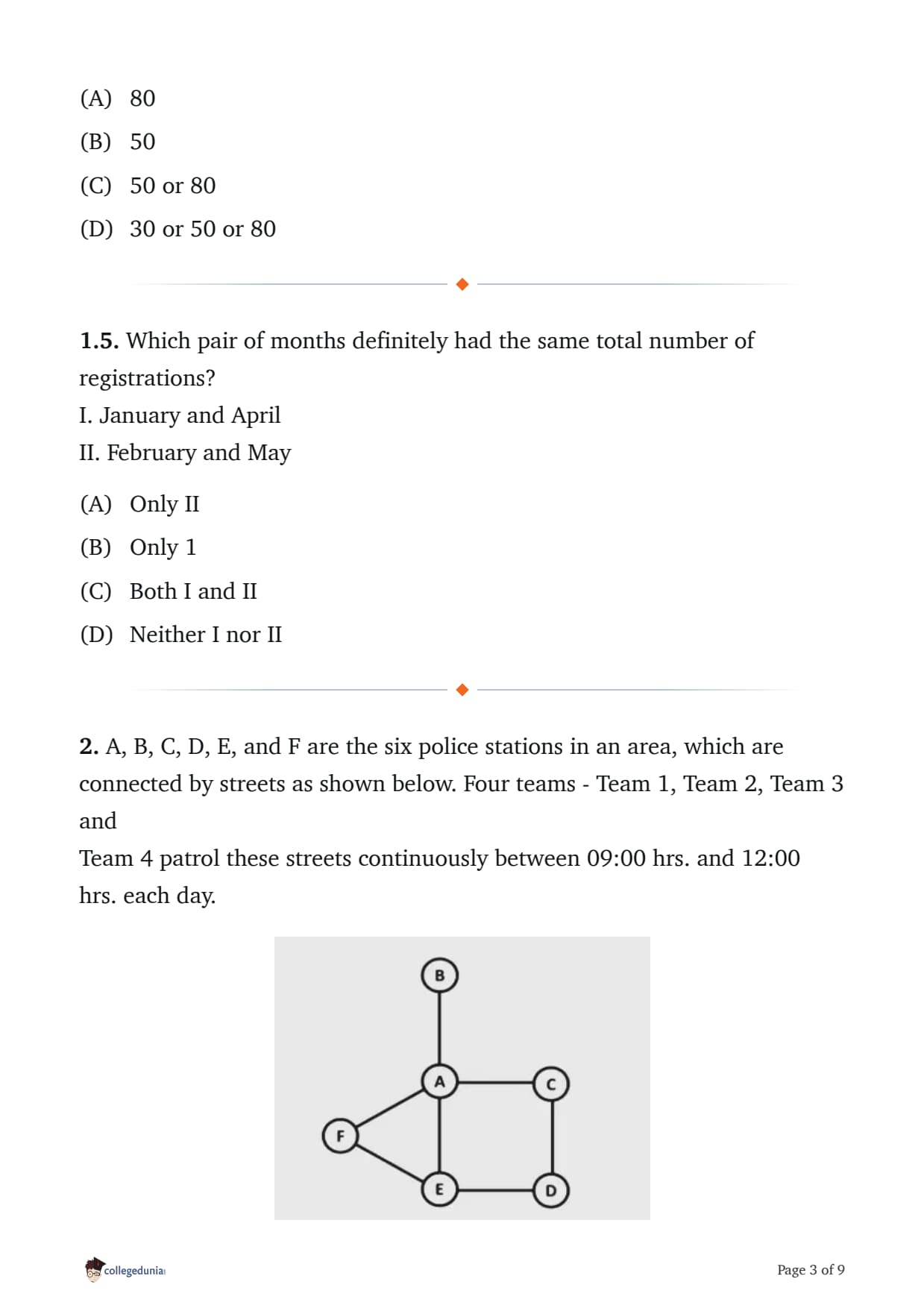
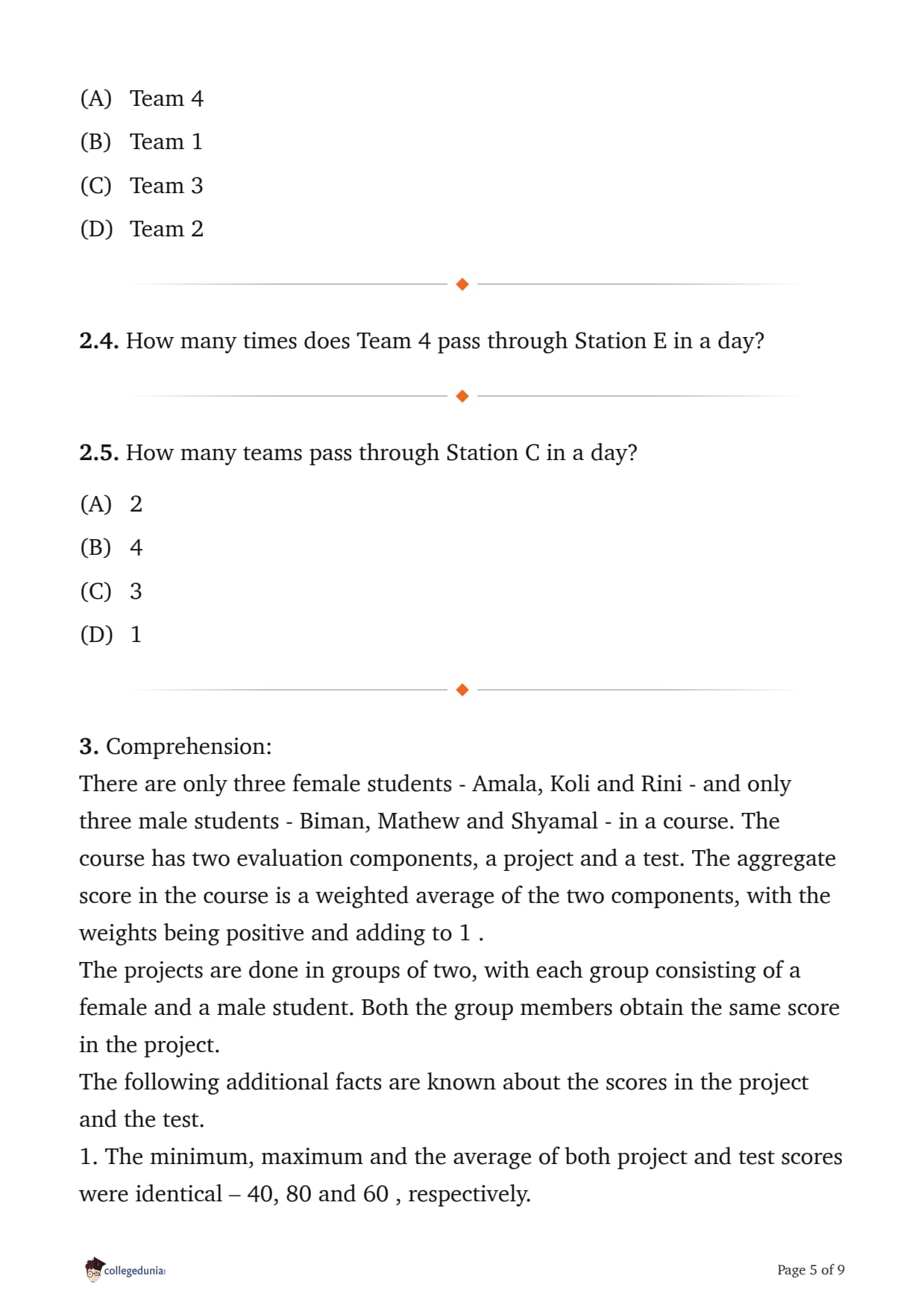
A, B, C, D, E, and F are the six police stations in an area, which are connected by streets as shown below. Four teams - Team 1, Team 2, Team 3 and
Team 4 patrol these streets continuously between 09:00 hrs. and 12:00 hrs. each day.

Read More
The following facts are known.1. None of the streets has more than one team traveling along it in any direction at any point in time.
2. Teams 2 and 3 are the only ones in stations E and D respectively at 10:00 hrs.
3. Teams 1 and 3 are the only ones in station E at 10:30 hrs.
4. Teams 1 and 4 are the only ones in stations B and E respectively at 11:30 hrs.
5. Team 1 and Team 4 are the only teams that patrol the street connecting stations A and E.
6. Team 4 never passes through Stations B, D or F.
Which one among the following stations is visited the largest number of times?
How many times do the teams pass through Station B in a day?
Which team patrols the street connecting Stations D and E at 10:15 hrs?
How many times does Team 4 pass through Station E in a day?
How many teams pass through Station C in a day?
Comprehension:
Comprehension:
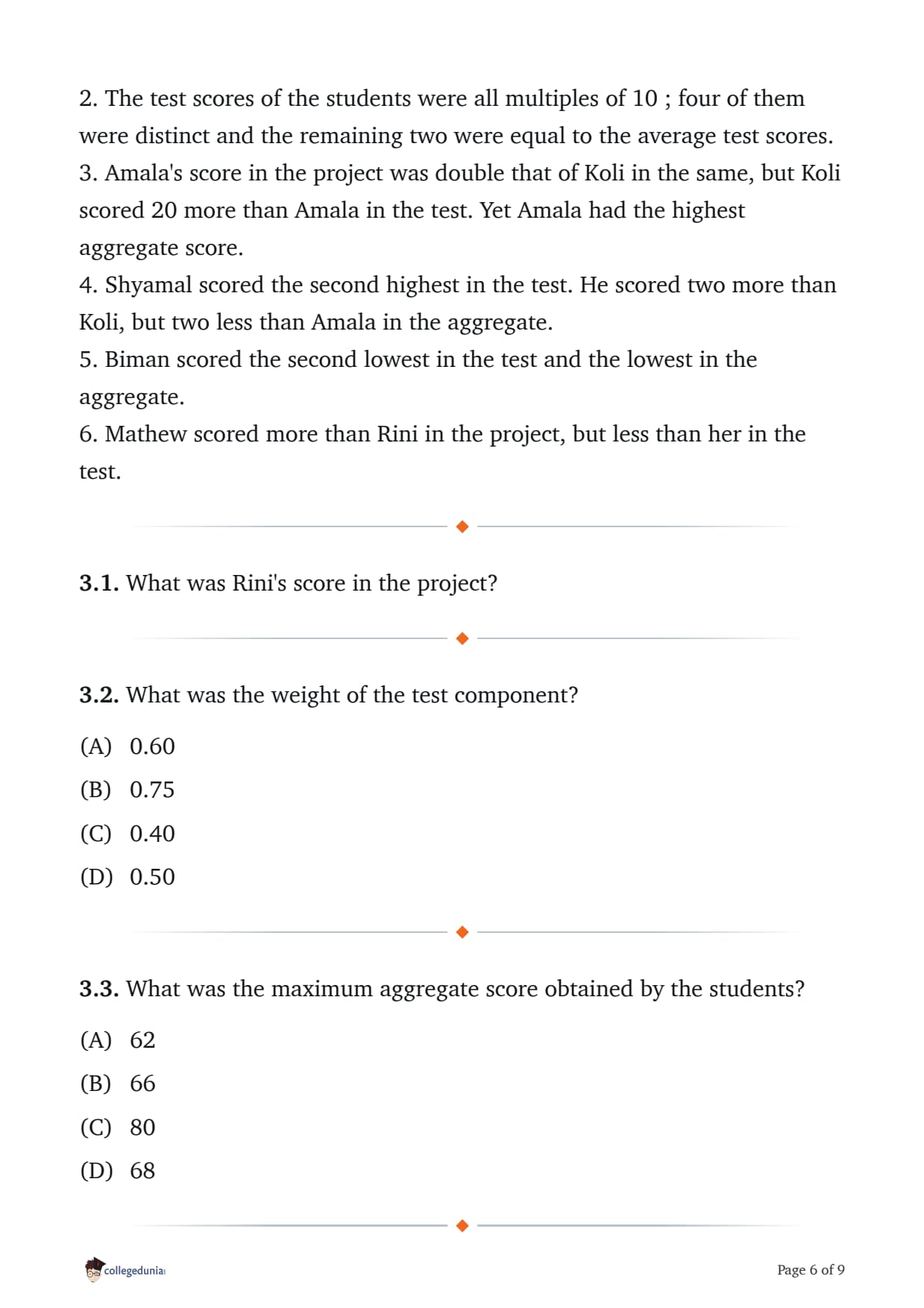
There are only three female students - Amala, Koli and Rini - and only three male students - Biman, Mathew and Shyamal - in a course. The course has two evaluation components, a project and a test. The aggregate score in the course is a weighted average of the two components, with the weights being positive and adding to 1 .
The projects are done in groups of two, with each group consisting of a female and a male student. Both the group members obtain the same score in the project.
The following additional facts are known about the scores in the project and the test.
1. The minimum, maximum and the average of both project and test scores were identical – 40, 80 and 60 , respectively.
Read More
2. The test scores of the students were all multiples of 10 ; four of them were distinct and the remaining two were equal to the average test scores.3. Amala's score in the project was double that of Koli in the same, but Koli scored 20 more than Amala in the test. Yet Amala had the highest aggregate score.
4. Shyamal scored the second highest in the test. He scored two more than Koli, but two less than Amala in the aggregate.
5. Biman scored the second lowest in the test and the lowest in the aggregate.
6. Mathew scored more than Rini in the project, but less than her in the test.
What was Rini's score in the project?
What was the weight of the test component?
What was the maximum aggregate score obtained by the students?
What was Mathew's score in the test?
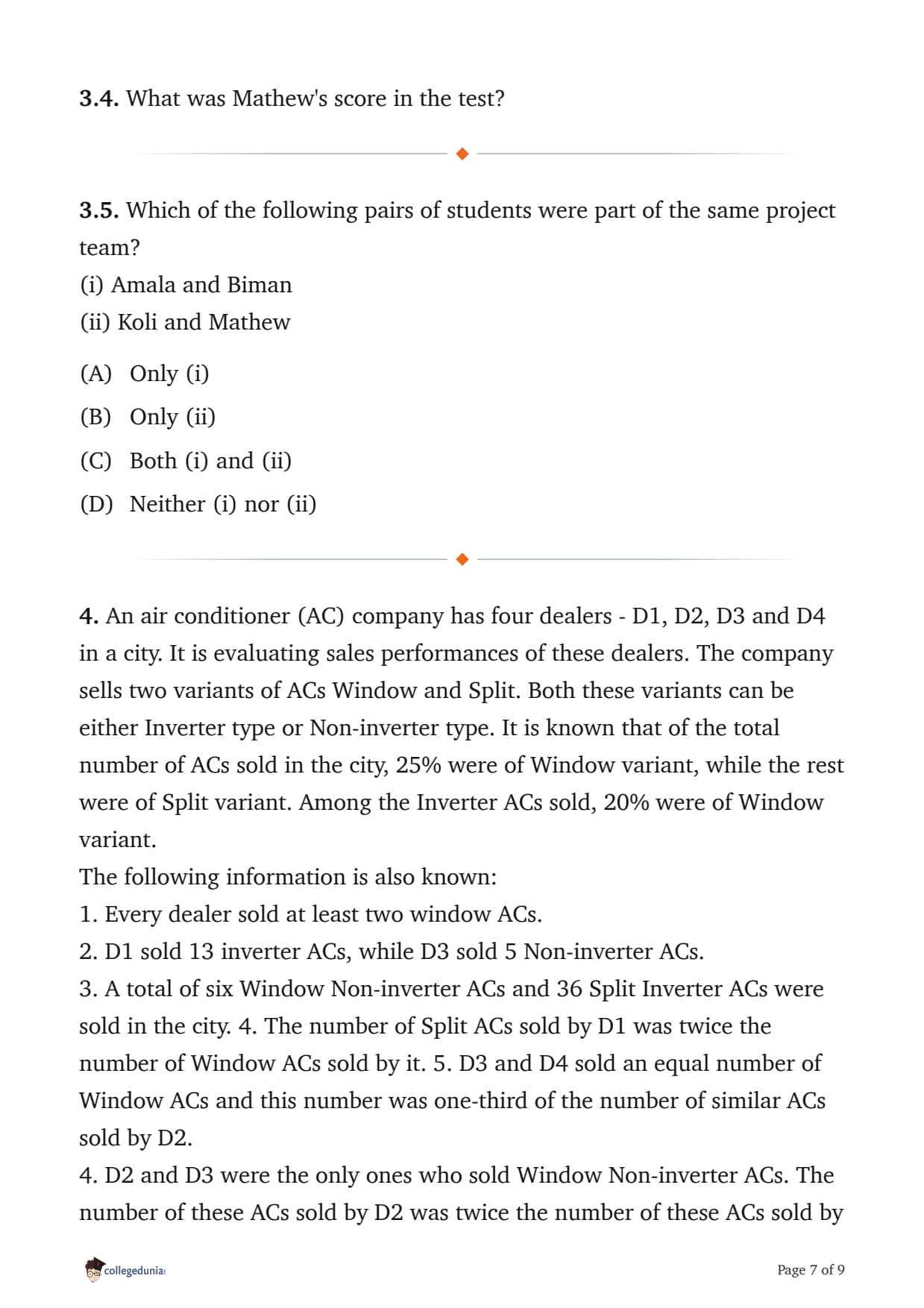
Which of the following pairs of students were part of the same project team?
(i) Amala and Biman
(ii) Koli and Mathew
Comprehension:
An air conditioner (AC) company has four dealers - D1, D2, D3 and D4 in a city. It is evaluating sales performances of these dealers. The company sells two variants of ACs Window and Split. Both these variants can be either Inverter type or Non-inverter type. It is known that of the total number of ACs sold in the city, 25% were of Window variant, while the rest were of Split variant. Among the Inverter ACs sold, 20% were of Window variant.
The following information is also known:
1. Every dealer sold at least two window ACs.
2. D1 sold 13 inverter ACs, while D3 sold 5 Non-inverter ACs.
Read More
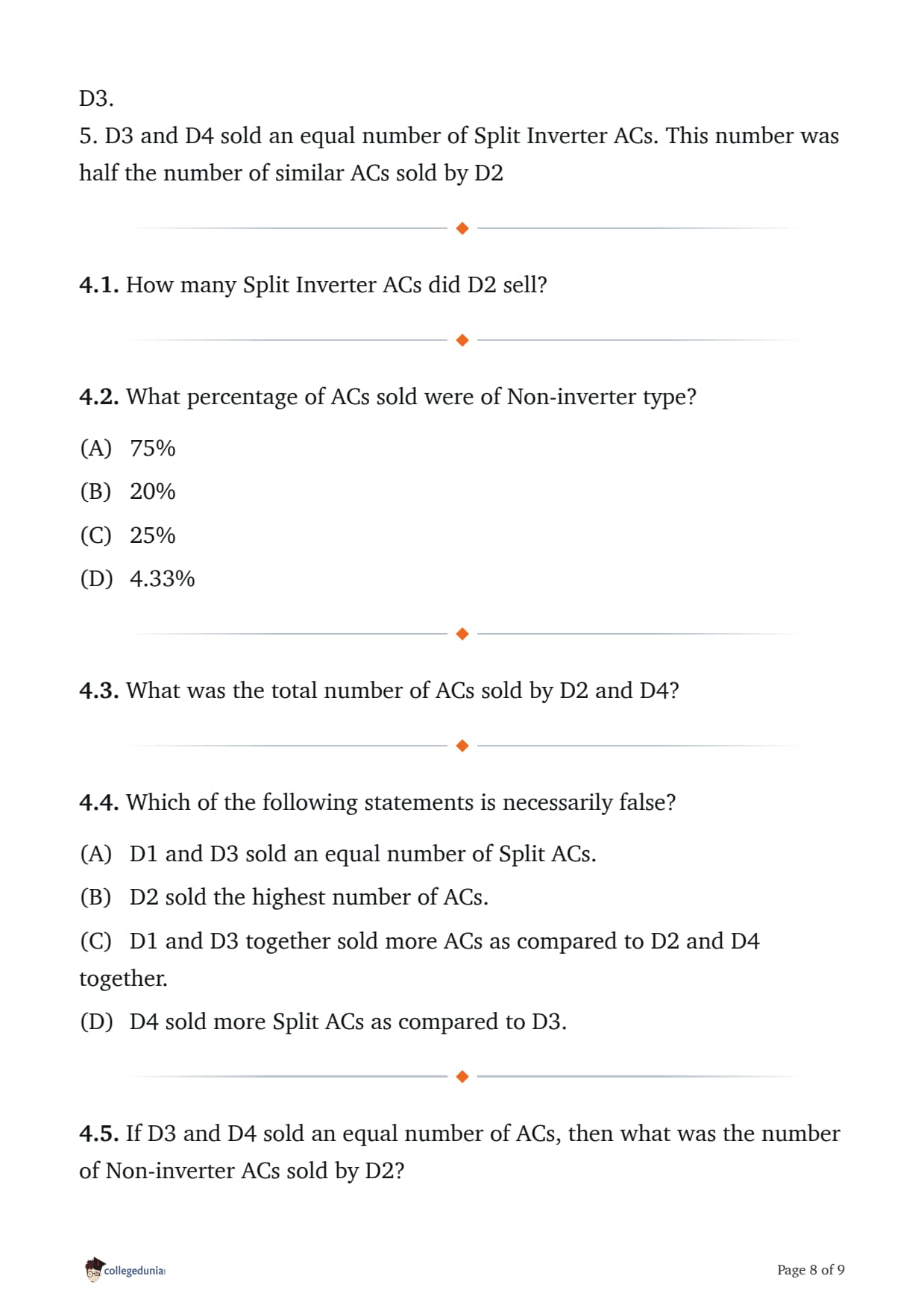
3. A total of six Window Non-inverter ACs and 36 Split Inverter ACs were sold in the city. 4. The number of Split ACs sold by D1 was twice the number of Window ACs sold by it. 5. D3 and D4 sold an equal number of Window ACs and this number was one-third of the number of similar ACs sold by D2.4. D2 and D3 were the only ones who sold Window Non-inverter ACs. The number of these ACs sold by D2 was twice the number of these ACs sold by D3.
5. D3 and D4 sold an equal number of Split Inverter ACs. This number was half the number of similar ACs sold by D2
How many Split Inverter ACs did D2 sell?
What percentage of ACs sold were of Non-inverter type?
What was the total number of ACs sold by D2 and D4?
Which of the following statements is necessarily false?
If D3 and D4 sold an equal number of ACs, then what was the number of Non-inverter ACs sold by D2?
CAT 2023 DILR Slot 3 Exam Pattern and Marking Scheme
The DILR section in CAT 2023 Slot 3 had 20 questions to be solved in a 40-minute sectional window, for a maximum of 60 marks at 3 marks per question. Of the 20 questions, 6 were TITA (type-in-the-answer) questions with no negative marking, while the remaining MCQs carried a penalty for wrong answers. Here is the exact breakdown you were tested on.
- Total questions: 20 in the Data Interpretation & Logical Reasoning section
- Section duration: 40 minutes (sectional time limit)
- Total marks: 60 (3 marks per question)
- Marking (MCQ): +3 for a correct answer, -1 for a wrong one
- Marking (TITA): +3 for a correct answer, no negative marking
- Question types: 4 sets of 5 questions each, mixing Data Interpretation and Logical Reasoning - 14 MCQs and 6 TITA questions covering tables, distributions, arrangements, and a routes/network set
CAT 2023 DILR Slot 3 Set-Wise Themes and Difficulty
All 20 marks-worth of questions came from 4 sets of 5 questions each. Three of the four sets were quant-based reasoning, so strong arithmetic and a comfort with statistical terms like median mattered as much as logic. Here is what each set covered.
- Set 1 - Student Evaluation: 5 questions on 3 female and 3 male students scored through mixed-gender project pairs and individual tests, with aggregate scores from weighted components - calculation-heavy and time-consuming.
- Set 2 - Monthly Registrations: 5 questions on online and offline registrations across 5 months, using minimum, maximum, and median values in a table - one of the more doable sets but still demanding.
- Set 3 - AC Sales Distribution: 5 questions on 4 dealers selling 2 AC variants (Window/Split) in 2 types (Inverter/Non-inverter), needing careful distribution work across multiple constraints.
- Set 4 - Police Station Patrols: 5 questions on 4 teams patrolling streets that connect 6 police stations within a 3-hour window - a routes and network set rated Difficult.
CAT 2023 Slot 3 DILR Question Paper Solutions Video
Source: Aptitude Jab
How to Use the CAT 2023 DILR Slot 3 Solved Paper
DILR rewards smart set selection over raw speed, and Slot 3 proved it - students were generally able to fully crack a maximum of 2 sets in the 40 minutes. Use the solved paper to build that judgement.
- Attempt each set under a strict 8-10 minute timer first, then read the solution to see where you bled time.
- Pick the 2 most readable sets early - here Set 2 and one other were the doable ones - and bank them fully before touching the harder routes set.
- Master the statistical terms (median, maximum, minimum) the paper assumes, since two sets needed that prior knowledge.
- Tackle all 6 TITA questions you can reach, because they carry no negative marking and only upside.
- Re-solve any set you got wrong without looking, until you can reproduce the full logic from scratch.
Good Attempts and Percentile Benchmark for DILR Slot 3
- A good performance was attempting 9 to 11 questions at roughly 75-80% accuracy.
- Fully solving 2 of the 4 sets was a realistic target for most strong test-takers.
- On the scaled DILR score, around 26 to 27 marks was enough for a 99 percentile, since DILR was the toughest section of CAT 2023.
- Slot 3 was seen as marginally easier, so normalisation trimmed close to 4 marks off raw DILR scores - clearing the sectional cut-off mattered more than chasing volume.
DILR Slot 3 Question Paper FAQs
Ques. How difficult was the DILR section in CAT 2023 Slot 3?
Ans. It was rated Medium to Difficult, on par with the DILR of Slot 1. With 3 of the 4 sets being quant-heavy and no purely logical-reasoning set, most students could fully crack only about 2 sets in the 40 minutes.
Ques. How many questions and marks were in CAT 2023 Slot 3 DILR?
Ans. The section had 20 questions for 60 marks, split into 4 sets of 5 questions each. Each question carried 3 marks, with 14 MCQs and 6 TITA questions, all to be solved in a 40-minute sectional limit.
Ques. What was the marking scheme for CAT 2023 DILR Slot 3?
Ans. Every question was worth 3 marks. MCQs awarded +3 for a correct answer and -1 for a wrong one, while the 6 TITA questions gave +3 for a correct answer and carried no negative marking.
Ques. What counted as a good attempt in CAT 2023 DILR Slot 3?
Ans. Attempting 9 to 11 questions at around 75-80% accuracy was considered a good performance. Fully solving 2 of the 4 sets was a realistic and strong outcome for the difficulty level.
Ques. How many marks gave a 99 percentile in CAT 2023 DILR?
Ans. DILR was the toughest section of CAT 2023, and a scaled score of roughly 26 to 27 marks was enough to reach the 99 percentile. Because Slot 3 was seen as slightly easier, normalisation reduced raw DILR scores by close to 4 marks.
Ques. Where can I check official CAT 2023 details and answer keys?
Ans. All official information, including the answer key and response sheet, is released on the IIM CAT portal at iimcat.ac.in. CAT 2023 was conducted by IIM Lucknow on November 26, 2023, with Slot 3 running from 4:30 PM to 6:30 PM.



Comments