




GRE 2025 Verbal Reasoning Sample Paper Set 3 Question Paper with Solutions PDF is available for download. The overall test time is about 1 hour and 58 minutes. GRE has total 5 sections:
- Analytical Writing (One "Analyze an Issue" task, Alloted time 30 minutes)
- Verbal Reasoning (Two Sections, with 12 questions and 15 questions respectively)
- Quantitative Reasoning (Two Sections, with 12 questions and 15 questions respectively)
GRE 2025 Verbal Reasoning Sample Paper Set 3 Question Paper with Solutions PDF
| GRE 2025 Verbal Reasoning Set 3 Question Paper with Solutions PDF |  Download Download |
Check Solutions |

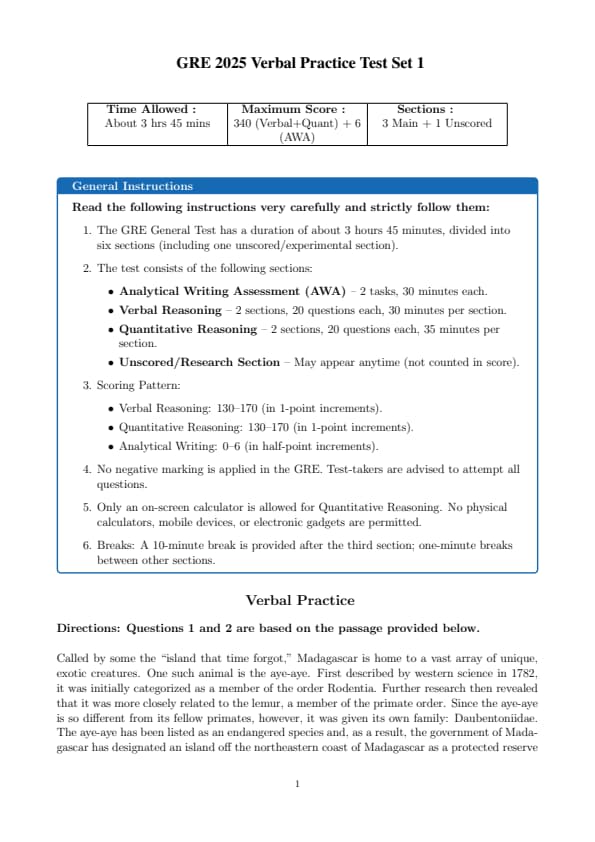
Based on the information given in the passage, the intended audience would most likely be
View Solution
Step 1: Consider the tone and content of the passage.
The passage provides information about a unique animal, the aye-aye, and it discusses the scientific aspects of its classification as well as the cultural significance it holds for the local people. This suggests that the intended audience is one that is interested in scientific or natural history topics.
Step 2: Analyze the options.
- (A) Visitors to a natural science museum are the most likely audience, as they are typically interested in learning about exotic animals and the natural world.
- (B) Professors of evolutionary science would already be familiar with the information presented in the passage.
- (C) A third-grade science class is unlikely to be the intended audience due to the complexity of the topic.
- (D) Students of comparative religions may find the passage of interest, but it is not focused on religious studies.
- (E) Attendees at a world cultural symposium would likely focus on cultural and social topics rather than specific wildlife issues.
Step 3: Conclusion.
Given that the passage discusses scientific information, the most appropriate audience would be visitors to a natural science museum.
Final Answer: \[ \boxed{(A) visitors to a natural science museum} \] Quick Tip: When analyzing a passage, consider the tone and subject matter to help identify the most appropriate audience.
Consider each of the choices separately and select all that apply. Which of the following statements can be logically inferred from the passage?
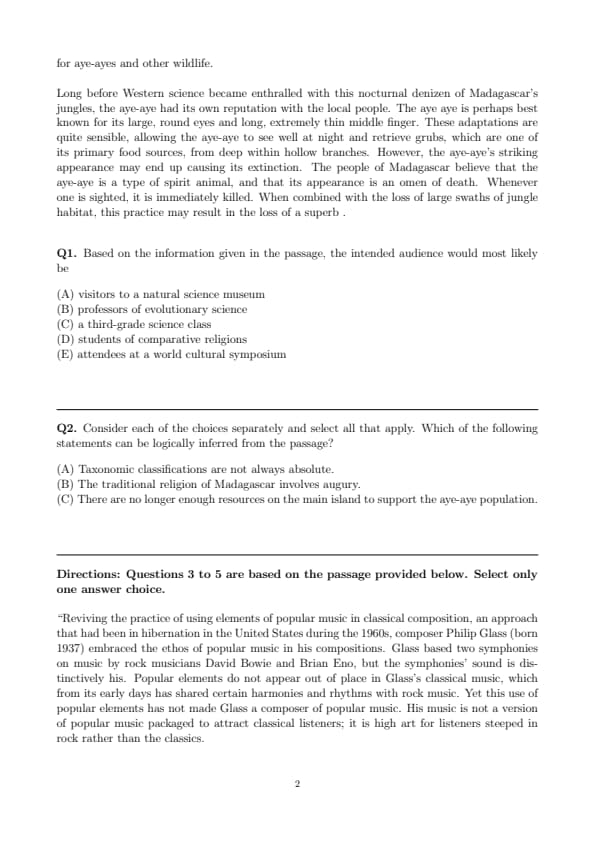
The passage addresses which of the following issues related to Glass's use of popular elements in his classical compositions?
Consider each of the three choices separately and select all that apply from the passage above. Which of the following statements can be logically inferred from the passage?
From the passage above, select the sentence that distinguishes two ways of integrating rock and classical music from the passage provided above.
View Solution
Step 1: Focus on the distinction in the passage.
The passage describes Glass's music as integrating popular elements but distinguishes it from being "popular music." This distinction highlights two ways of incorporating rock and classical music—by integrating elements while maintaining a classical approach and by creating music that appeals to a different audience.
Step 2: Analyze the sentence.
- The sentence "Yet this use of popular elements has not made Glass a composer of popular music" distinguishes Glass's method of integrating rock music into a more classical framework.
Step 3: Conclusion.
This sentence directly contrasts Glass's classical compositions with popular music, highlighting the distinction between the two approaches.
Final Answer: \[ \boxed{"Yet this use of popular elements has not made Glass a composer of popular music."} \] Quick Tip: When distinguishing two concepts, look for phrases that emphasize contrasts, such as "yet," "however," or "despite."
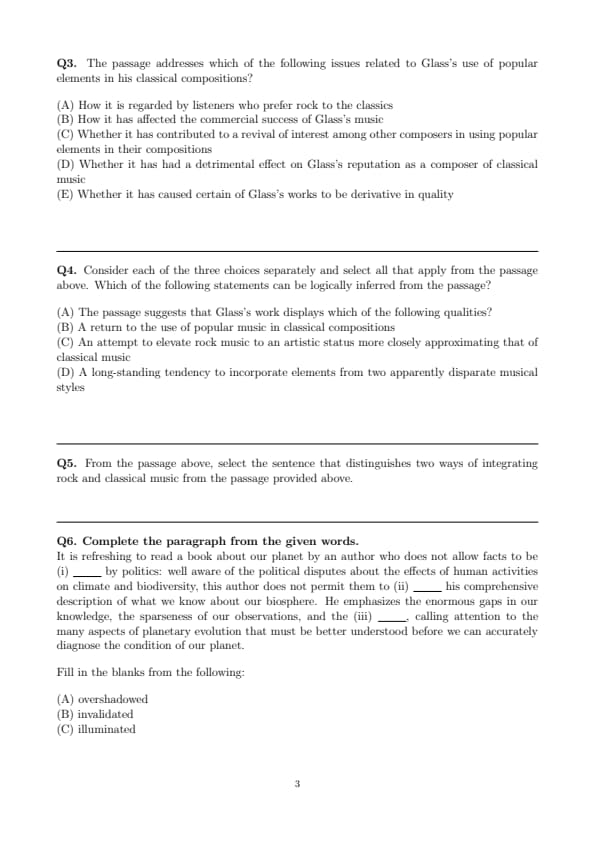
Complete the paragraph from the given words.
It is refreshing to read a book about our planet by an author who does not allow facts to be (i)______________ by politics: well aware of the political disputes about the effects of human activities on climate and biodiversity, this author does not permit them to (ii)______________ his comprehensive description of what we know about our biosphere. He emphasizes the enormous gaps in our knowledge, the sparseness of our observations, and the (iii) ______________, calling attention to the many aspects of planetary evolution that must be better understood before we can accurately diagnose the condition of our planet.
Fill in the blanks from the following:
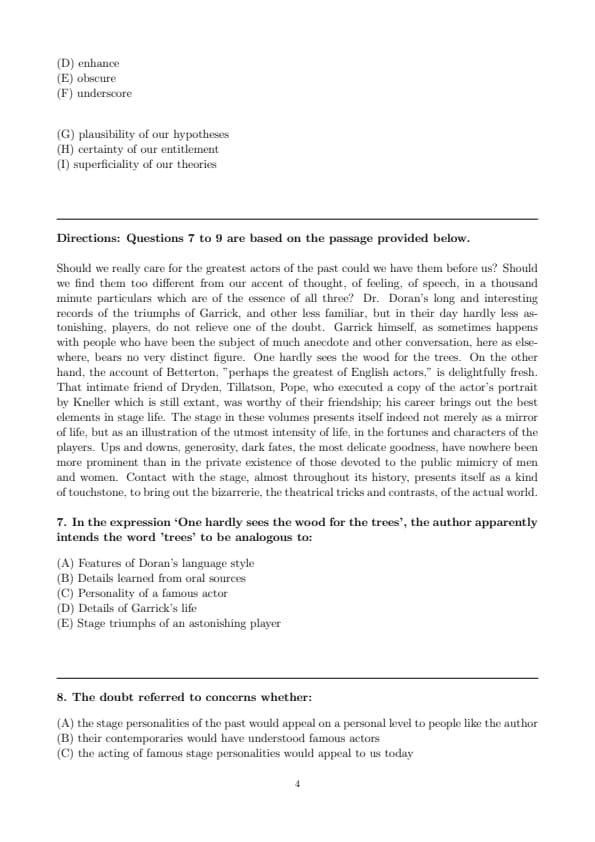
In the expression ‘One hardly sees the wood for the trees’, the author apparently intends the word 'trees' to be analogous to:
The doubt referred to concerns whether:
View Solution
Step 1: Understanding the doubt in the passage.
The doubt in the passage revolves around whether the greatness of famous historical actors, like Garrick, is accurately captured in records or exaggerated. The author questions if Garrick was truly as great as historical accounts portray him to be.
Step 2: Analyzing the options.
- (A) The stage personalities of the past would appeal on a personal level to people like the author: This is not the main doubt expressed in the passage. The passage is more concerned with Garrick's greatness rather than personal appeal.
- (B) Their contemporaries would have understood famous actors: This option is not discussed in the passage, which focuses on the doubt about historical portrayal.
- (C) The acting of famous stage personalities would appeal to us today: This is a relevant question but not the specific doubt addressed in the passage.
- (D) Garrick was as great as he is portrayed: This is the correct answer as the passage directly questions whether historical accounts exaggerate Garrick's greatness.
- (E) Historical records can reveal personality: This is relevant to the passage, but it is not the central doubt expressed.
Thus, the correct answer is (D), as the passage directly questions the accuracy of the portrayal of Garrick’s greatness. Quick Tip: When reading for doubts or uncertainties, focus on phrases that express skepticism or question accuracy. Here, the author is unsure whether Garrick was as great as the records suggest.
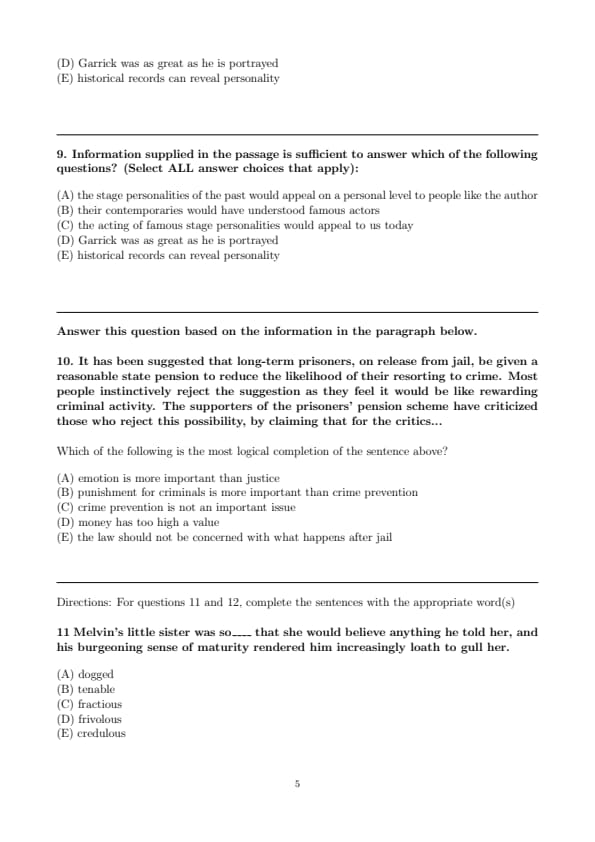
Information supplied in the passage is sufficient to answer which of the following questions? (Select ALL answer choices that apply):
It has been suggested that long-term prisoners, on release from jail, be given a reasonable state pension to reduce the likelihood of their resorting to crime. Most people instinctively reject the suggestion as they feel it would be like rewarding criminal activity. The supporters of the prisoners' pension scheme have criticized those who reject this possibility, by claiming that for the critics...
Which of the following is the most logical completion of the sentence above?
Melvin’s little sister was so____ that she would believe anything he told her, and his burgeoning sense of maturity rendered him increasingly loath to gull her.
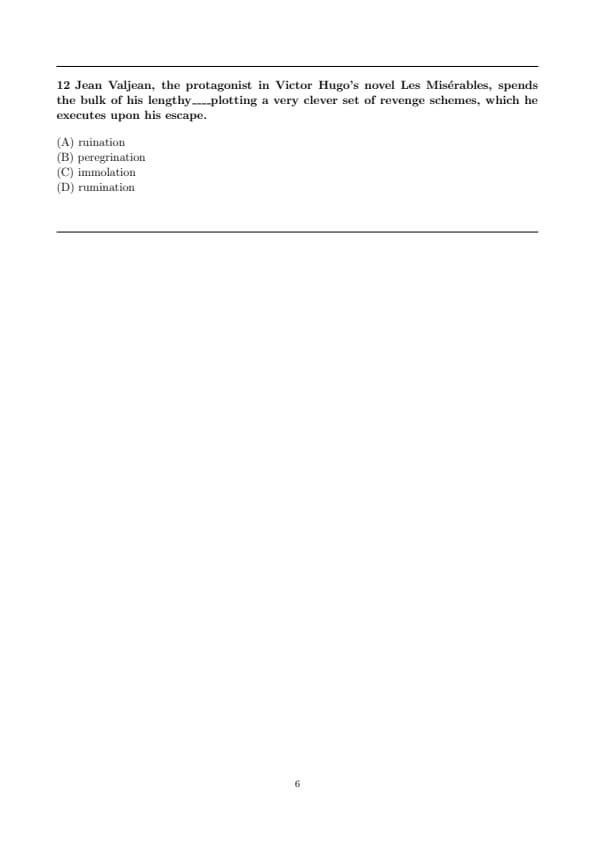
Jean Valjean, the protagonist in Victor Hugo’s novel Les Misérables, spends the bulk of his lengthy____plotting a very clever set of revenge schemes, which he executes upon his escape.



Comments