

.png?h=56&w=56&mode=stretch)


GRE vocabulary is essential for scoring well in the Verbal Reasoning section, particularly in Text Completion and Sentence Equivalence questions. Mastering high-frequency GRE words with their meanings, synonyms, antonyms, and contextual usage can significantly improve vocabulary and reading skills.
Applicants can learn important GRE vocabulary words, flashcards, memorization techniques, and study resources to strengthen your GRE exam Verbal performance. Applicants can learn these words with easy methods such as Active learning and Quick Revision.
- What Are GRE Vocabulary Flashcards 2026?
- Why Are Flashcards Effective for GRE Preparation 2026?
- Download Free Essential GRE Words PDFs 2026
- Benefits of Using GRE Vocabulary Flashcards 2026
- How to Use GRE Flashcards Effectively in 2026
- Daily GRE Vocabulary Study Plan for 2026
- Common Mistakes While Using GRE Flashcards 2026
- Tips to Remember GRE Words Faster
- GRE Vocabulary Books for Effective Preparation 2026
- FAQs
What Are GRE Vocabulary Flashcards 2026?
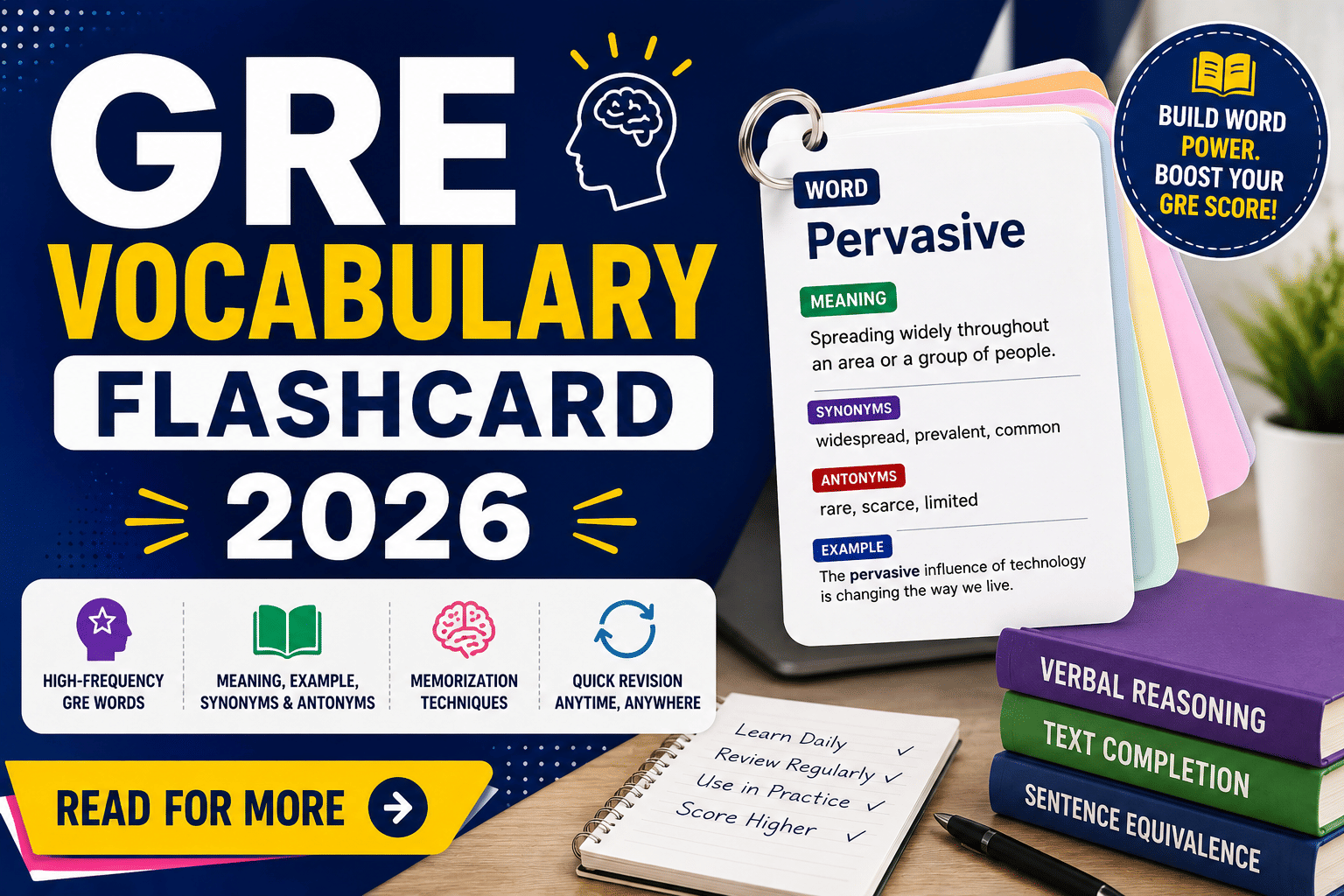
GRE vocabulary flashcards are study cards designed to help you memorize high-frequency words tested in the GRE Verbal Reasoning section. Each flashcard typically includes:
- Word - The GRE vocabulary term.
- Meaning - A concise definition.
- Example Sentence - Shows how the word is used in context.
- Synonyms and Antonyms - Help understand related meanings.
- Mnemonic (optional) - A memory trick to recall the word.
Flashcards are especially useful for Text Completion and Sentence Equivalence questions, where a strong vocabulary is essential. They can be physical cards or digital flashcards available through apps like Anki and Quizlet.
Why Are Flashcards Effective for GRE Preparation 2026?
Flashcards improve vocabulary retention by using active recall and spaced repetition. Follow these 4 GRE learning strategies to learn words and enhance your vocabulary easily:
| Method | How to Use it |
|---|---|
| Active Recall | Instead of rereading a word list, you actively try to remember the meaning before flipping the card. This strengthens long-term memory. |
| Spaced Repetition | Words are reviewed at increasing intervals based on how well you remember them. Difficult words appear more frequently, while familiar words are reviewed less often. |
| Context-Based Learning | Many GRE flashcards include example sentences and synonyms, helping you understand how words appear in actual GRE Verbal questions. |
| Quick Revision | Flashcards allow you to review vocabulary during short study sessions, making them ideal for daily practice. |
Also read: Check GRE Preparation Strategies 2026
Download Free Essential GRE Words PDFs 2026
Prepare GRE vocabulary with flashcards, reading books, and using free and paid GRE vocab apps. Check GRE essential words and flashcards PDF to learn new vocabulary:
Benefits of Using GRE Vocabulary Flashcards 2026
Learning new words and phrases can actively enhance the overall performance of any applicant. Here are some benefits of GRE vocabulary flashcards and how they can help you:
| Benefit | How It Helps |
|---|---|
| Improves vocabulary retention | Regular review moves words into long-term memory. |
| Saves study time | Short review sessions are more efficient than reading long word lists. |
| Enhances GRE Verbal performance | Strong vocabulary helps in Text Completion and Sentence Equivalence questions. |
| Tracks learning progress | Digital apps mark mastered and difficult words automatically. |
| Encourages daily revision | Easy to study anywhere using a phone or printed cards. |
| Supports active recall | Improves memory more effectively than passive reading. |
How to Use GRE Flashcards Effectively in 2026
Applicants can learn new vocabulary easily yet lose marks in exams. The major reason for this is not being able to use the new words and vocabulary effectively. Follow these tips to use your newly learnt words effectively:
- Learn 20-30 new words daily instead of memorizing hundreds at once.
- Read the example sentence to understand the word's usage.
- Say the word aloud to improve recognition.
- Create your own sentence using the word.
- Group similar words by themes or meanings.
- Review old flashcards every day before learning new ones.
- Separate difficult words into a dedicated revision pile.
- Use spaced repetition apps like Anki for automatic review scheduling.
- Take weekly quizzes to measure progress.
- Revise vocabulary in context by solving GRE Verbal practice questions.
Also read: How to Improve GRE Verbal Scores in 2026
Daily GRE Vocabulary Study Plan for 2026
Applicants who are planning to appear for the GRE exam in August or July can follow this study plan to improve their performance. Here is a 1 hour 10 minutes daily study plan:
| Time | Activity |
|---|---|
| 15 minutes | Review previously learned flashcards. |
| 20 minutes | Learn 20-30 new GRE words. |
| 15 minutes | Read example sentences and note synonyms/antonyms. |
| 20 minutes | Solve Text Completion or Sentence Equivalence questions using the new words. |
| 10 minutes | Revise difficult or frequently forgotten words. |
Weekly Goal
- Learn 120-180 new words
- Revise all previously learned vocabulary
- Take one vocabulary quiz at the end of the week
- Identify weak words and add them to your revision list
Also read: Check How Much Time Do You Need to Prepare for GRE 2026
Common Mistakes While Using GRE Flashcards 2026
Applicants who are appearing for the GRE exam must mind these common mistakes. Avoid these common mistakes and learn their solutions from the table below:
| Mistake | Solution |
|---|---|
| Memorizing only definitions | Learn the word through example sentences and usage. |
| Skipping regular revision | Review flashcards daily using spaced repetition. |
| Learning too many words in one day | Limit yourself to 20-30 new words daily. |
| Ignoring synonyms and antonyms | Study related words to improve contextual understanding. |
| Not applying words in practice questions | Solve GRE Verbal questions after each study session. |
| Studying passively | Test yourself before revealing the answer on each flashcard. |
| Focusing only on easy words | Spend extra time reviewing difficult vocabulary. |
Tips to Remember GRE Words Faster
Applicants who have problems memorising words and effectively using vocabulary must follow these tips to remember GRE words faster. The following are the tips:
- Learn words through context, not just definitions.
- Break words into roots, prefixes, and suffixes (e.g., bene = good, mal = bad).
- Use mnemonics to associate difficult words with memorable images or stories.
- Study synonyms together to understand subtle differences.
- Write one original sentence for every new word.
- Review vocabulary at regular intervals (1 day, 3 days, 7 days, and 14 days).
- Use digital flashcards with spaced repetition for long-term retention.
- Read editorials, academic articles, or essays to encounter GRE words in context.
- Revise weak words more frequently than familiar ones.
- Test yourself every week to reinforce memory.
Also read: Check How Can You Self-Prepare for the GRE Exam 2026
GRE Vocabulary Books for Effective Preparation 2026
One of the best ways to learn GRE Vocabulary by reading your academic and verbal prep books. GRE verbal books include new vocabulary words and question papers with sample answers. The official GRE verbal reasoning book, The Princeton Review's Word Smart for the GRE, Magoosh GRE Vocabulary Flashcards, and Barron's 1100 Words You Need to Know are some of the best books for vocabulary preparation. You can check or download the mentioned GRE vocabulary books as PDFs for effective preparation:
- Webster’s New World: Essential Vocabulary: Check PDF
- GRE Barron’s Vocabulary Book PDF: Check PDF
- GRE Flashcard: Check PDF
- GRE Vocabulary List PDF: Check PDF
- Learning Express - GRE Flashcard: Check PDF
Building a strong GRE vocabulary requires consistent practice rather than memorizing long word lists. Learning 20-30 words daily, reviewing them through active recall and spaced repetition, and regularly solving Text Completion and Sentence Equivalence questions can improve vocabulary retention and Verbal performance. Using flashcards, weekly revision, and trusted GRE vocabulary resources helps reinforce word usage and prepares applicants for the GRE Verbal Reasoning section.
FAQs
Ques. Which GRE section requires a strong vocabulary?
Ans. A strong vocabulary is most important for the GRE Verbal Reasoning section, especially for Text Completion, Sentence Equivalence, and Reading Comprehension questions.
Ques. What skills does the GRE Verbal Reasoning section assess?
Ans. According to ETS, the Verbal Reasoning section measures your ability to analyze written material, understand the meanings of words and sentences, recognize relationships among words and concepts, and draw conclusions from written passages.
Ques. What types of questions are included in the GRE Verbal Reasoning section?
Ans. The GRE Verbal Reasoning section includes Reading Comprehension, Text Completion, and Sentence Equivalence questions.
Ques. Does the GRE test only vocabulary knowledge?
Ans. No. In addition to vocabulary, the GRE Verbal Reasoning section evaluates reading comprehension, critical reasoning, understanding of sentence and passage meaning, and the ability to analyze relationships among ideas
Ques. Why is vocabulary important for the GRE?
Ans. Vocabulary is important because the GRE Verbal Reasoning section measures your ability to understand the meanings of words, sentences, and passages, and to interpret relationships among ideas accurately.
*The article might have information for the previous academic years, which will be updated soon subject to the notification issued by the University/College.



Comments