

.png?h=56&w=56&mode=stretch)


GRE Quantitative Reasoning (Quant) is one of the most important sections for Indian students applying to graduate programs abroad, especially in STEM fields like engineering, computer science, data science, economics, or business analytics. Many Indian applicants find the GRE Quant relatively easier than Verbal due to strong high-school math foundations (Class 10-12 level from CBSE, ICSE, or equivalent), but it emphasizes reasoning, problem-solving under time pressure, and tricky formats rather than advanced calculations.
GRE Quantitative Practice Tests 2026
Check out some free GRE quantitative practice tests by Collegedunia in the table below:
GRE Quantitative Test Format 2026
The entire GRE General Test now takes about 1 hour 58 minutes (no unscored section or long break). Below are the details for the quantitative section:
- Total: 27 questions, 47 minutes
- 2 sections:
- Section 1: 12 questions, 21 minutes
- Section 2: 15 questions, 26 minutes
- The test is section-level adaptive. The first Quant section is medium difficulty. Your performance on it determines whether the second section is easier or harder. Your final score reflects accuracy across both sections, plus the difficulty level.
- An on-screen basic calculator is provided (you cannot bring your own).
Is the GRE calculator enough, or should I practice mental math?
The on-screen calculator is basic and slow. High scorers on Reddit often suggest minimizing calculator use and improving mental math to save time.
GRE Quantitative Syllabus 2026
The GRE quantitative section assesses basic mathematical skills, understanding of elementary concepts, and quantitative reasoning, the ability to interpret data, model problems, and solve them logically. All content is high-school level (no calculus, trigonometry, or advanced statistics).
The 4 main subject areas are:
1. Arithmetic (most frequent)
- Integers, divisibility, factorization, primes, remainders, odd/even numbers.
- Fractions, decimals, ratios, proportions, percentages, rates.
- Exponents, roots, absolute value, number lines, sequences, and estimation.
2. Algebra
- Operations with algebraic expressions, factoring, and simplifying.
- Linear and quadratic equations/inequalities.
- Systems of equations, functions, coordinate geometry (slopes, intercepts, graphs).
- Word problems translated into equations.
3. Geometry
- Lines, angles, parallel and perpendicular lines.
- Triangles (including special ones like 30-60-90, isosceles, equilateral), congruence, similarity.
- Polygons, circles, quadrilaterals, 3D figures (cubes, cylinders).
- Area, perimeter, volume, Pythagorean theorem.
- Coordinate geometry.
- Important: Figures are not drawn to scale unless stated. Therefore, you are advised to rely on reasoning, not visual estimation.
4. Data Analysis
- Descriptive statistics: mean, median, mode, range, standard deviation, quartiles, percentiles.
- Data interpretation: tables, bar graphs, line graphs, pie charts, boxplots, scatterplots.
- Elementary probability (independent or dependent events, conditional probability).
- Counting methods: permutations, combinations, Venn diagrams.
- Basic distributions (e.g., normal distribution).
GRE Quantitative Question Types
The GRE Quant section has 4 main question types (discrete questions or in sets for Data Interpretation):
1. Quantitative Comparison (QC): Very common and unique to GRE.
- Compare Quantity A and Quantity B.
- Choose: A > B, B > A, A = B, or the relationship cannot be determined.
- Tips: Plug in numbers (including 0, 1, fractions, negatives), simplify algebraically, and avoid unnecessary calculation.
Sample Question:
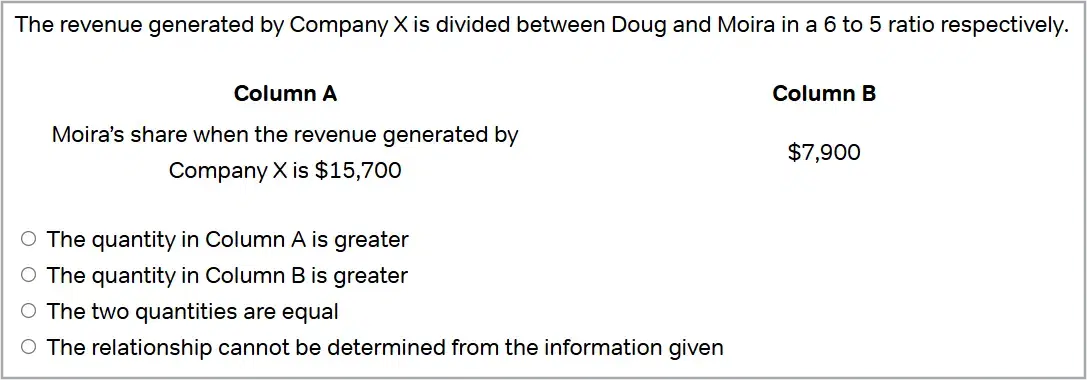
Difficulty: Easy
Check Answer
Ans. B. The quantity in Column B is greater
2. Multiple-Choice (Select One Answer): Standard 5 options.
Sample Question:
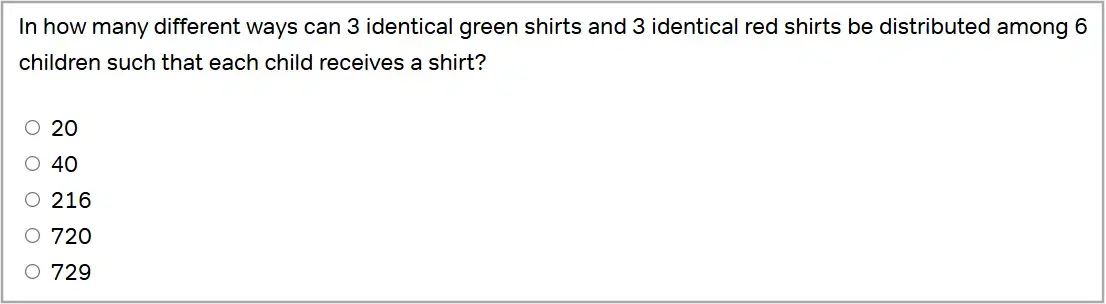
Difficulty: Hard
Check Answer
Ans. A. 20
3. Multiple-Choice (Select One or More): "All that apply". No partial credit system is there.
Sample Question:
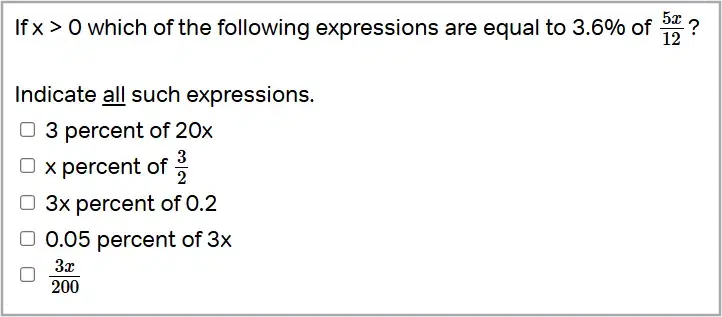
Difficulty: Medium
Check Answer
Ans. B. x percent of 3/2, and E. 3x/200
4. Numeric Entry: Type your answer (integer, decimal, or fraction). No options.
Sample Question:
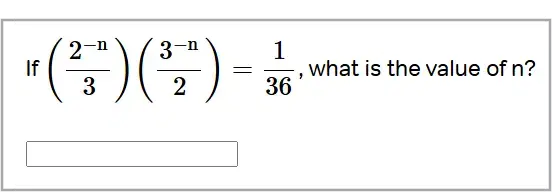
Difficulty: Medium
Check Answer
Ans. 1
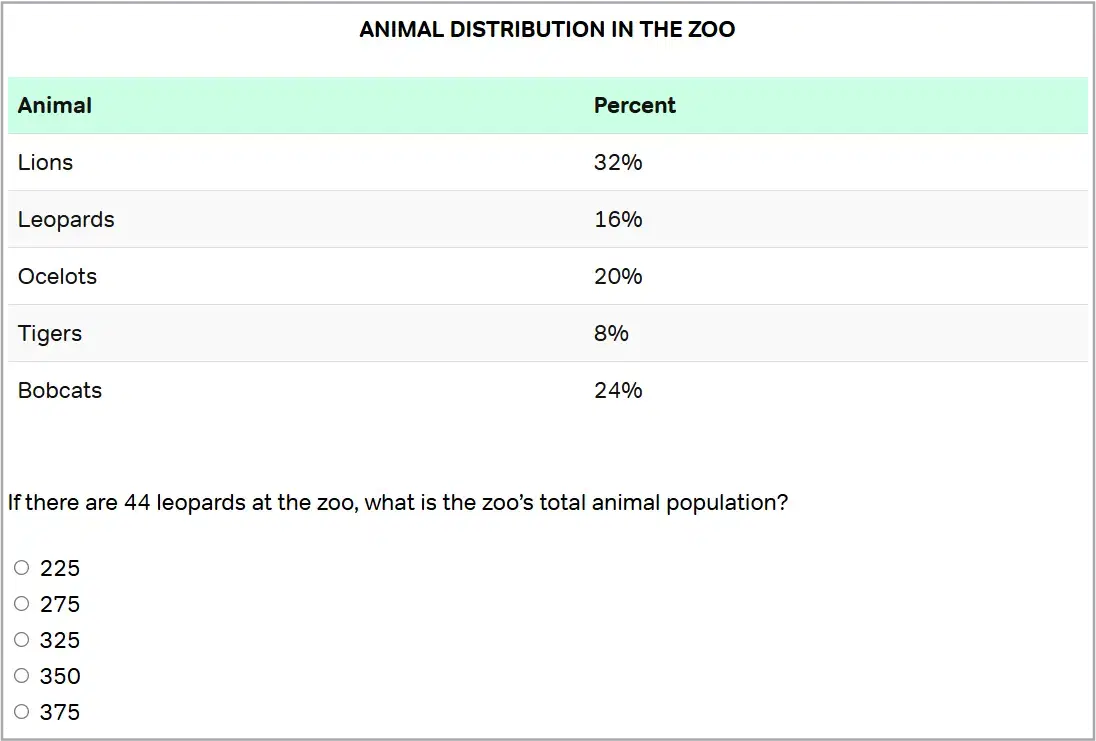
5. Data Interpretation questions (2-4 per test) are based on shared graphs or tables and can use any of the above formats.
Sample Question:
Difficulty: Easy
Check Answer
Ans. B. 275
How to Prepare for GRE Quantitative?
Indian students often excel in pure math but struggle with:
- Word problems (English-heavy).
- Quantitative Comparison traps (assumptions about variables).
- Time management and test anxiety.
- Data Interpretation speed.
Recommended 2-4 Month Study Plan:
- Diagnostic: Take a full official POWERPREP practice test (free on the ETS site) to identify weak areas.
- Build Foundations: Review ETS Math Review PDF (free, comprehensive).
- Topic-wise Practice: Master one area at a time (Arithmetic, Algebra, Geometry, Data Analysis).
- Question-Type Focus: Spend extra time on Quantitative Comparison and Numeric Entry.
- Timed Practice: Move to mixed sets and full sections.
- Full Tests: Take 4-6 official-style mocks under timed conditions. Review every mistake thoroughly.
- Error Log: Track recurring errors (e.g., careless calculation, misreading questions).
Best Resources:
- Official (Must-have): ETS GRE Math Review (PDF), POWERPREP Online practice tests, Official GRE Quantitative Reasoning Practice Questions book (150 real questions).
- Free: Khan Academy GRE math videos (linked by ETS).
- Paid and Supplementary: Magoosh GRE Prep (excellent video explanations), Manhattan Prep 5 lb Book (tons of practice), Target Test Prep or GregMat for targeted drills.
- Indian coaching (optional): Jamboree, IMS, or Career Launcher for structured classes and mocks.
Daily Tips:
- Practice 30-50 Quant questions daily.
- Focus on accuracy first, then speed.
- Learn to eliminate wrong answers quickly.
- Simulate test conditions (no distractions, timed).
- Many Indians score 160+ with consistent practice; aim higher to stand out in competitive pools.
How Important is Quant for Admissions?
The GRE Quant score plays a crucial role in graduate admissions, especially for competitive programs. Its importance varies by field, but a strong score can significantly strengthen your overall application.
- Highly important for STEM, finance, and data-related programs (often the deciding factor alongside GPA and research).
- Less critical for humanities and social sciences (but still part of the application).
- Many programs are test-optional now, but submitting a strong GRE score (especially Quant 165+) can strengthen your profile, particularly for scholarships or competitive funding.
- Check specific university or program requirements (e.g., via their websites or GradCafe).
The GRE Quantitative section tests high-school level math, but rewards logical thinking, accuracy, and speed under time pressure. With a clear understanding of the syllabus, regular timed practice, and official mock tests, most students can steadily improve their scores. Since Quant can significantly impact admissions and funding decisions, especially for STEM and data-driven programs, consistent, structured preparation is key.
FAQs
Ques. Is GRE Quant really getting harder in recent years?
Ans. Officially, ETS does not change the syllabus, but many Reddit test-takers say recent exams feel trickier in wording and logic. The math level is the same, but questions test deeper reasoning and time pressure.
Ques. What is a “good” GRE Quant score for top US universities?
Ans. For top 50 STEM programs, Indian applicants often need 165+ to stay competitive. For top 20 engineering or CS programs, 167-170 is common among admitted students (based on GradCafe and university data trends).
Ques. Do US universities compare Indian students differently in Quant?
Ans. Yes, informally. Since many Indian applicants score high in Quant, admissions committees may expect stronger Quant scores from Indian engineering backgrounds compared to other majors.
Ques. Does a 170 in Quant guarantee admission?
Ans. No. Even a perfect 170 cannot compensate for a weak GPA, SOP, or research profile. GRE is just one part of a holistic review process.
*The article might have information for the previous academic years, which will be updated soon subject to the notification issued by the University/College.



Comments