

.png?h=56&w=56&mode=stretch)


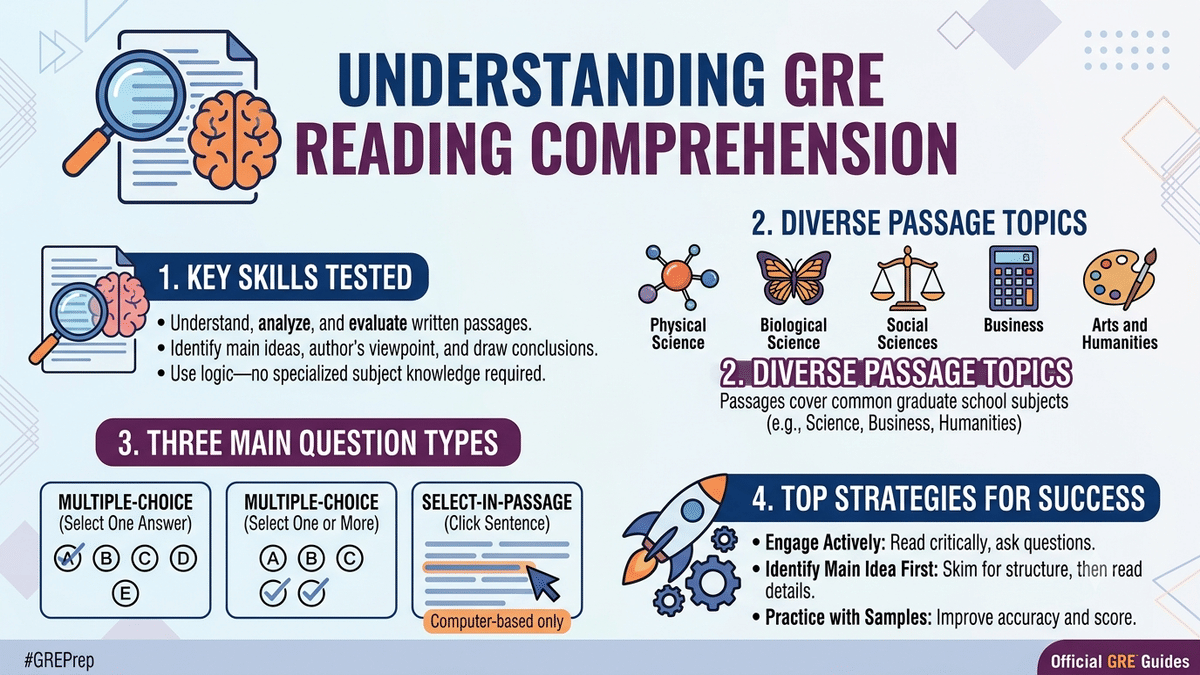
The GRE Reading Comprehension section tests how well you understand, analyze, and evaluate written passages. It is an important part of the GRE Verbal Reasoning section and measures the reading skills needed for graduate-level study. In GRE Reading Comprehension passages can come from subjects such as science, business, social sciences, arts, and humanities.
In GRE Reading Comprehension, questions may ask you to identify the main idea, draw logical conclusions, interpret the author's viewpoint, or select evidence from the passage. Understanding the question types, practicing with sample passages, and using the right strategies can help you improve both your accuracy and GRE score.
- What is GRE Reading Comprehension 2026?
- GRE Reading Comprehension Question Types 2026
2.1 Multiple-Choice Questions (Select One Answer)
2.2 Multiple-Choice Questions (Select One or More Answers)
2.3 Select-in-Passage Questions
- What Types of GRE Reading Comprehension Passages are there in 2026?
3.1 From where are the ETS passages taken?
- GRE Reading Comprehension Sample Questions 2026
4.3 Passage 3 (Short & Medium)
4.4 Passage 4 (Short & Medium)
- Top GRE Reading Comprehension Strategies and Tips 2026
- How to Read GRE RC Passages Faster: Skimming vs Close Reading
- Common Mistakes to Avoid in GRE Reading Comprehension 2026
- Free Books PDFs to Prepare for GRE Vocabulary 2026
- FAQs
What is GRE Reading Comprehension 2026?
GRE Reading Comprehension is a verbal reasoning section of the GRE General test. The GRE Reading Comprehension section examines applicants' reading skills. This section analyses the ability to evaluate complex written material.
In GRE Reading Comprehension, there can be one to several passages. Each passage may contain 1-2 questions. The Reading Comprehension section measures:
- Ability to understand the meaning of words, sentences, paragraphs, and entire passages.
- Ability to distinguish ideas, summarize information, and evaluate arguments and logical conclusions.
- Ability to recognize how different parts of a passage work together.
Note: ETS emphasizes that no specialized subject knowledge is required because every question can be answered using only the information provided in the passage. The passages are taken from academic as well as non-academic sources, similar to the reading expected in graduate school.
GRE Reading Comprehension Question Types 2026
The GRE exam, Reading Comprehension section has 3 types of questions, which are multiple-choice questions and select-in passage questions. The complete description of these 3 types of questions is as follows:
Multiple-Choice Questions (Select One Answer)
The first question format in the GRE Reading and Comprehension section is multiple-choice questions. In these questions, there will be multiple options out of which only 1 answer is correct.
Applicants are advised to answer the questions carefully, as out of 5 options given, only 1 is correct. Any mistake can impact the scores. Applicants need to read the passage carefully to select the correct answer.
Multiple-Choice Questions (Select One or More Answers)
The GRE Reading Comprehension section has another multiple-choice answer set in which more than 1 option can be correct. In this section, applicants are given 3 options out of which 1, 2, or all 3 options can be correct.
To get the full score in this section, you need to select all 3 correct answers. If there are 2 or 3 options correct, select them all. There is no partial credit if only some of the correct answers are chosen.
Select-in-Passage Questions
The GRE Reading Comprehension has select-in-passage questions in which applicants need to identify and click on the sentence in the passage itself that correctly describes the question. This type of question appears only in the computer-based GRE exam.
In Select-in-passage questions, applicants need to identify the main idea of the author or the passage, supporting evidence, and evaluate evidence present in the passage. If there are multiple passages, the question will be passage-specific.
Note: If you opt for paper-based GRE, instead of Select-in-passage questions, applicants will get equivalent multiple-choice questions.
What Types of GRE Reading Comprehension Passages are there in 2026?
The GRE Reading and Comprehension passages vary in content and length. The ETS can set the GRE Reading Comprehension questions with diverse content topics. The lengths can be short or long.
It is noted that most passages in GRE Reading Comprehension are of a single paragraph. On the other hand, there can be 1-2 passages in the verbal section that are longer and have multiple paragraphs.
Some of the areas from which the ETS selects GRE Reading Comprehension passages are topics that are common in graduate education. The subjects or areas from which ETS selects passages are:
- Physical Sciences
- Biological Sciences
- Social Sciences
- Business
- Arts and Humanities
- Everyday Topics
From where are the ETS passages taken?
The GRE Reading Comprehension passages are adapted from books, journals, magazines, newspapers, and other academic or non-academic publications. ETS emphasizes that candidates are not expected to possess prior knowledge of these subjects, as every question is answerable using only the information provided in the passage.
GRE Reading Comprehension Sample Questions 2026
Passage 1 (Short & Easy)
Coral reefs, though they occupy less than one percent of the ocean floor, support nearly a quarter of all known marine species. This disproportionate richness has long puzzled ecologists, since reef waters are typically nutrient-poor compared to the open ocean. The resolution to this apparent paradox lies in the efficiency of nutrient cycling within the reef ecosystem itself: rather than depending on external nutrient influx, reef organisms recycle available nutrients so rapidly and completely that very little is lost to the surrounding water. Symbiotic relationships, such as that between coral polyps and the algae living within their tissues, are central to this efficiency, allowing energy and nutrients to be exchanged directly between organisms rather than dispersed into the water column.
Q1. The passage is primarily concerned with
(A) describing the symbiotic relationship between coral and algae
(B) explaining why reefs harbor such extensive biodiversity despite limited nutrients
(C) arguing that reef ecosystems are more fragile than previously believed
(D) comparing nutrient cycling in reefs to that in the open ocean
(E) proposing a new method for measuring marine biodiversity
Q2. It can be inferred that if nutrients in reef waters were lost to the surrounding ocean at a higher rate, which would most likely occur?
(A) Coral polyps would develop new symbiotic relationships
(B) The reef would occupy a larger portion of the ocean floor
(C) The reef's biodiversity would likely be reduced
(D) Algae would become the dominant species on the reef
(E) The open ocean would become more nutrient-rich
Passage 2 (Long & Hard)
Historians of science have traditionally treated the Scientific Revolution as a sharp break with medieval thought, a moment when empirical observation and mathematical reasoning triumphed over inherited authority and scholastic argument. This narrative, while appealing in its clarity, has come under sustained revision in recent decades. Scholars now argue that many of the conceptual tools credited to seventeenth-century natural philosophers—including careful observation, quantification, and even skepticism toward received wisdom—were already present, if less systematically applied, in medieval natural philosophy. Figures such as Robert Grosseteste and later scholars working within university faculties of arts had developed methods of controlled observation and mathematical modeling centuries before Galileo.
What changed in the seventeenth century, on this revised account, was not the invention of new intellectual tools but a shift in institutional and social context. The rise of scientific societies, the development of print culture that allowed rapid dissemination and cross-checking of results, and a growing willingness among natural philosophers to communicate across national and religious boundaries created conditions under which existing methods could be applied more consistently and their results more widely scrutinized. The revolution, in this view, was less a matter of new ideas than of new infrastructure for testing and circulating ideas.
This revisionist account is not without its critics. Some historians contend that it risks minimizing genuine conceptual innovations of the period, particularly the mechanical philosophy's rejection of Aristotelian teleology and its insistence on explaining natural phenomena solely through matter and motion. To collapse this shift into a mere change of institutional context, these critics argue, is to overlook a transformation in how nature itself was conceived—one that cannot be reduced to improvements in communication or method alone.
Q3. The primary purpose of the passage is to
(A) refute the traditional narrative of the Scientific Revolution and replace it with a definitive alternative
(B) present a revisionist account of the Scientific Revolution and note a significant objection to it
(C) trace the biographical contributions of medieval natural philosophers to modern science
(D) argue that institutional context is more important than ideas in the history of science
(E) reconcile two seemingly opposed accounts into a single synthesis
Q4. According to the passage, proponents of the revisionist account would most likely agree with which statement?
(A) Medieval natural philosophers achieved the same results as Galileo using identical methods
(B) The methods associated with the Scientific Revolution existed, in less systematic form, before the seventeenth century
(C) Print culture was more important to scientific progress than mathematical reasoning
(D) The mechanical philosophy's rejection of teleology was the central achievement of the period
(E) Scholastic argument was ultimately compatible with empirical observation in all respects
Q5. The author mentions "the mechanical philosophy's rejection of Aristotelian teleology" primarily to
(A) provide an example of a medieval concept later adopted by seventeenth-century thinkers
(B) illustrate a conceptual shift that critics of the revisionist view see as more than a change in context
(C) support the claim that institutional infrastructure was irrelevant to scientific progress
(D) undermine the credibility of historians who study medieval natural philosophy
(E) demonstrate that Robert Grosseteste anticipated the mechanical philosophy
Q6. Which, if true, would most weaken the revisionist account in paragraph 2?
(A) Scientific societies in the seventeenth century admitted members regardless of nationality (B) Medieval universities lacked the print technology needed to disseminate results widely
(C) Several major seventeenth-century discoveries occurred independently of any new institutional support, in isolated settings lacking access to societies or print networks
(D) Robert Grosseteste's methods were mathematical in nature
(E) Galileo corresponded with natural philosophers in other countries
Passage 3 (Short & Medium)
In economic theory, "sunk costs" are expenditures that have already been made and cannot be recovered, regardless of a decision-maker's future choices. Rational choice models hold that sunk costs should have no bearing on decisions going forward, since only future costs and benefits are relevant to optimal decision-making. Yet behavioral economists have documented that people routinely honor sunk costs, continuing to invest time or money in a failing project simply because they have already invested so much—a pattern termed the "sunk cost fallacy." Some researchers have questioned whether this behavior is truly irrational, however, suggesting that persisting with a sunk-cost investment may sometimes serve a reputational function, signaling to others a valuable trait of commitment or follow-through that is not captured by narrow economic modeling.
Q7. The word "honor" as used in the passage most nearly means
(A) respect ceremonially
(B) act in accordance with
(C) publicly praise
(D) financially reward
(E) formally acknowledge
Q8. The passage suggests that some researchers believe the sunk cost fallacy might
(A) be eliminated through better economic education
(B) actually be a rational response once reputational effects are considered
(C) only occur in laboratory settings and not in real-world decisions
(D) be more common among trained economists than among laypeople
(E) disprove the validity of rational choice models entirely
Passage 4 (Short & Medium)
Octopuses possess a distributed nervous system in which roughly two-thirds of their neurons are located not in the brain but in their arms. Each arm can independently process sensory information and initiate movement without direct instruction from the central brain, a fact that has led some researchers to describe octopus cognition as fundamentally decentralized. This arrangement stands in sharp contrast to the vertebrate model of cognition, in which a central brain typically coordinates nearly all bodily action. Whether this difference implies that octopuses experience a qualitatively different form of consciousness—one distributed across multiple semi-autonomous centers—remains a matter of speculation rather than settled science, though the question has attracted increasing attention from philosophers of mind as well as biologists.
Q9. The author's attitude toward the claim that octopuses possess a "qualitatively different form of consciousness" is best described as
(A) fully convinced
(B) dismissive
(C) cautiously open but noncommittal
(D) actively skeptical to the point of rejection
(E) enthusiastically supportive
Q10. The passage implies that the vertebrate model of cognition is distinguished from that of the octopus primarily by
(A) the total number of neurons present in the organism
(B) the degree to which bodily action is centrally coordinated
(C) the presence or absence of sensory processing in the limbs
(D) the size of the brain relative to body mass
(E) the capacity for independent movement
Download the PDF for More GRE Reading Comprehension Practice Passages with Answers
Top GRE Reading Comprehension Strategies and Tips 2026
The applicants need to engage with the given passage in GRE Reading Comprehension and understand the overall message and purpose of the passage. This helps them to eliminate the wrong options in multiple-choice and multiple-answer questions.
Here are some tips and strategies to solve GRE Reading Comprehension:
- Actively engage with the passage rather than reading passively. A good readers constantly ask questions, evaluates ideas, and thinks about how different parts of the passage relate to one another.
- Candidates should focus on identifying the main idea before paying attention to smaller details. Understanding the overall context of the passage that makes individual questions easier to answer.
- It is recommended to distinguish between major ideas and supporting evidence. Readers should recognize whether the author is presenting their own opinion or simply reporting someone else's viewpoint.
- Pay attention to transitions such as contrast, comparison, cause and effect, and examples. Understanding how ideas connect helps candidates answer organization and inference questions.
- For multiple-choice questions, read every answer choice before selecting an answer. Many incorrect options contain information that is only partially correct or true but does not answer the question completely.
- For multiple-answer questions, candidates should evaluate each option independently, since there may be more than one correct response.
- It is recommended to use the “Mark and Review” feature during the computer-based GRE. If a passage seems unusually difficult or unfamiliar, candidates may skip it temporarily and return later if time allows.
How to Read GRE RC Passages Faster: Skimming vs Close Reading
The best strategy to solve the GRE Reading Comprehension passage is through skimming and close reading. But both methods have their own advantages and disadvantages. The following points discuss which method should be used to get the right answer:
- Applicants should read the passage and understand the author's argument, identifying assumptions, recognizing ideas, and distinguishing major points from supporting details. These tasks require more than simply scanning the passage.
- Some passages may appear especially difficult or unfamiliar. In such situations, candidates may choose to skip the passage temporarily and return later using the “Mark and Review” feature.
- Applicants should first understand the passage's overall purpose, identify the main point before focusing on specific details, pay attention to transitions that indicate comparison, contrast, or cause and effect, and revisit relevant sections whenever a question asks about specific information rather than relying on memory.
- It is advised to do efficient close reading, where candidates understand the structure and meaning of the passage without attempting to memorize every sentence.
Common Mistakes to Avoid in GRE Reading Comprehension 2026
The common mistakes that occur in GRE Reading Comprehension are:
- Selecting an answer simply because it contains a true statement. The correct answer must directly answer the question and be fully supported by the passage.
- Failing to read every answer option before making a selection. Some options may appear correct initially but are only partially accurate.
- For multiple-answer questions, candidates often select only 1 correct option. ETS clearly states that all correct answers must be selected because no partial credit is awarded.
- Avoid relying on outside knowledge. Every Reading Comprehension question can be answered using only the information provided in the passage.
- Confusing the author's opinion with viewpoints merely described within the passage. Readers are to distinguish ideas the author supports from ideas presented only for discussion.
- Spending excessive time on 1 difficult passage. The Mark and Review feature allows candidates to move ahead and return later if necessary.
Free Books PDFs to Prepare for GRE Vocabulary 2026
Below is a list of the top GRE vocabulary books to help your preparation:
- Barron’s Essential Words for the GRE: Check PDF
- Kaplan GRE Exam Vocabulary Flashcards: Check PDF
- Word Power Made Easy: Check PDF
- GRE Vocabulary Flash Review: Check PDF
- Webster’s New World Essential Vocabulary: Check PDF
GRE Reading Comprehension tests your ability to understand, analyze, and evaluate passages rather than your subject knowledge. Since the questions are based entirely on the given passage, regular practice with different question types and reading strategies can significantly improve your accuracy. Solving official GRE Reading Comprehension passages and managing your time effectively will help you perform better on the GRE Verbal Reasoning section.
FAQs
Ques. What skills does the GRE Reading Comprehension section test?
Ans. GRE Reading Comprehension measures your ability to understand, analyze, and evaluate written passages. It tests skills such as identifying the main idea, understanding the author's viewpoint, drawing logical conclusions, recognizing relationships between ideas, and evaluating arguments based only on the information given in the passage.
Ques. Do I need subject knowledge to answer GRE Reading Comprehension questions?
Ans. No. ETS clearly states that no specialized knowledge is required. Every question can be answered using only the information provided in the passage, even if the topic is unfamiliar.
Ques. Are GRE Reading Comprehension passages taken from real publications?
Ans. Yes. ETS states that Reading Comprehension passages are adapted from books, journals, periodicals, and other academic or non-academic publications. They are selected to reflect the type of reading expected in graduate school.
Ques. Are GRE Reading Comprehension passages taken from real publications?
Ans. Yes. ETS states that Reading Comprehension passages are adapted from books, journals, periodicals, and other academic or non-academic publications. They are selected to reflect the type of reading expected in graduate school.
Ques. Does the GRE Reading Comprehension test vocabulary only?
Ans. No. While understanding vocabulary is helpful, Reading Comprehension mainly evaluates your ability to understand ideas, interpret arguments, identify relationships between concepts, and draw conclusions from the passage.
Ques. Are all GRE Reading Comprehension passages the same length?
Ans. No. According to ETS, some Reading Comprehension passages consist of a single paragraph, while others contain multiple paragraphs. Different passages may have different numbers of questions.
Ques. How many types of GRE Reading Comprehension questions are there?
Ans. According to ETS, GRE Reading Comprehension includes three question types:
- Multiple-choice (Select One Answer)
- Multiple-choice (Select One or More Answers)
- Select-in-Passage questions, where you click on the sentence that answers the question.
*The article might have information for the previous academic years, which will be updated soon subject to the notification issued by the University/College.



Comments