




GRE 2025 Verbal Reasoning Sample Paper Set 1 Question Paper with Solutions PDF is available for download. The overall test time is about 1 hour and 58 minutes. GRE has total 5 sections:
- Analytical Writing (One "Analyze an Issue" task, Alloted time 30 minutes)
- Verbal Reasoning (Two Sections, with 12 questions and 15 questions respectively)
- Quantitative Reasoning (Two Sections, with 12 questions and 15 questions respectively)
GRE 2025 Verbal Reasoning Sample Paper Set 1 Question Paper with Solutions PDF
| GRE 2025 Verbal Reasoning Set 1 Question Paper with Solutions PDF |  Download Download |
Check Solutions |

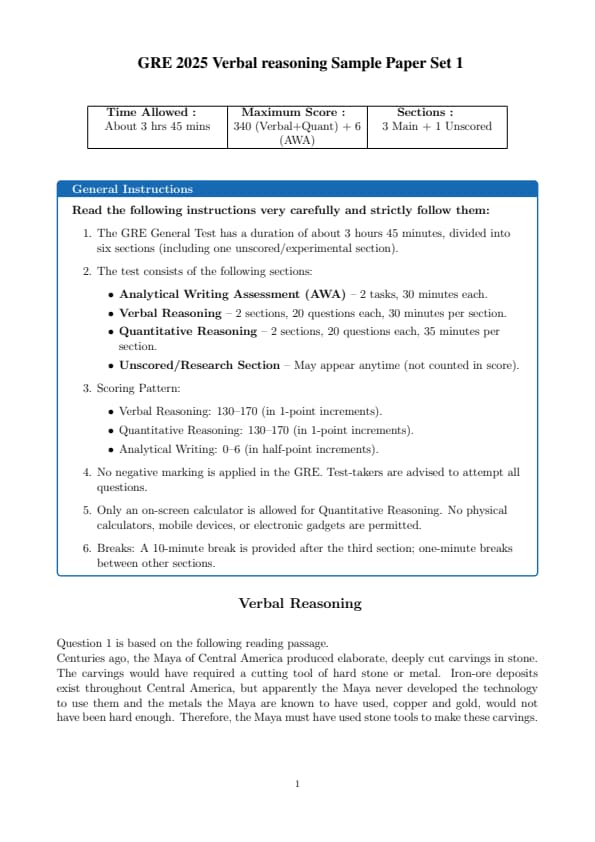
Question 1 is based on the following reading passage.
Centuries ago, the Maya of Central America produced elaborate, deeply cut carvings in stone. The carvings would have required a cutting tool of hard stone or metal. Iron-ore deposits exist throughout Central America, but apparently the Maya never developed the technology to use them and the metals the Maya are known to have used, copper and gold, would not have been hard enough. Therefore, the Maya must have used stone tools to make these carvings.
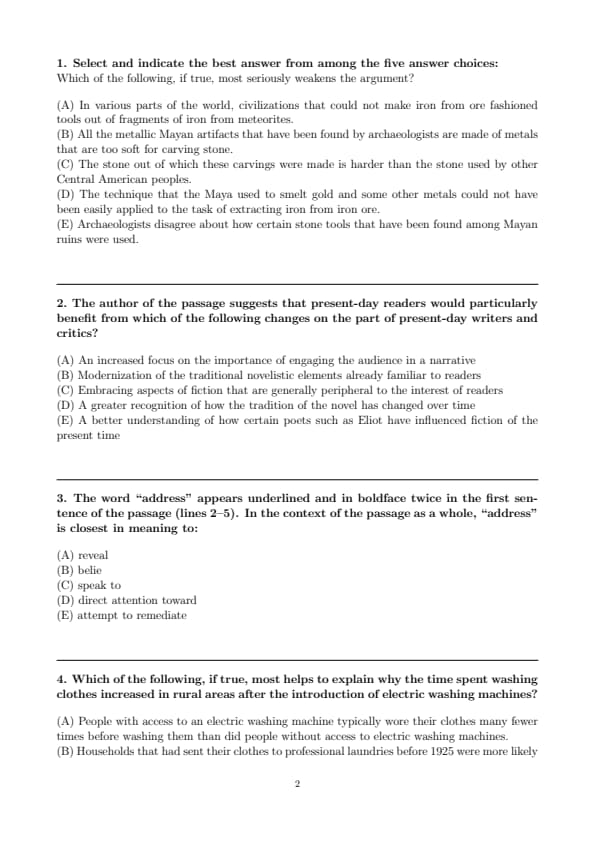
1. Select and indicate the best answer from among the five answer choices:
Which of the following, if true, most seriously weakens the argument?
The author of the passage suggests that present-day readers would particularly benefit from which of the following changes on the part of present-day writers and critics?
The word “address” appears underlined and in boldface twice in the first sentence of the passage (lines 2–5). In the context of the passage as a whole, “address” is closest in meaning to:
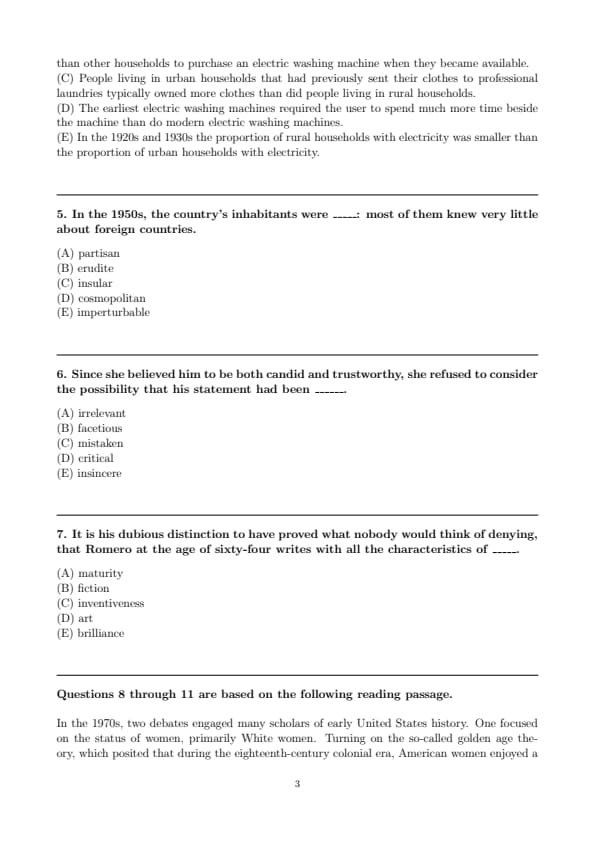
Which of the following, if true, most helps to explain why the time spent washing clothes increased in rural areas after the introduction of electric washing machines?
In the 1950s, the country’s inhabitants were _____: most of them knew very little about foreign countries.
Since she believed him to be both candid and trustworthy, she refused to consider the possibility that his statement had been ______.
It is his dubious distinction to have proved what nobody would think of denying, that Romero at the age of sixty-four writes with all the characteristics of _____.
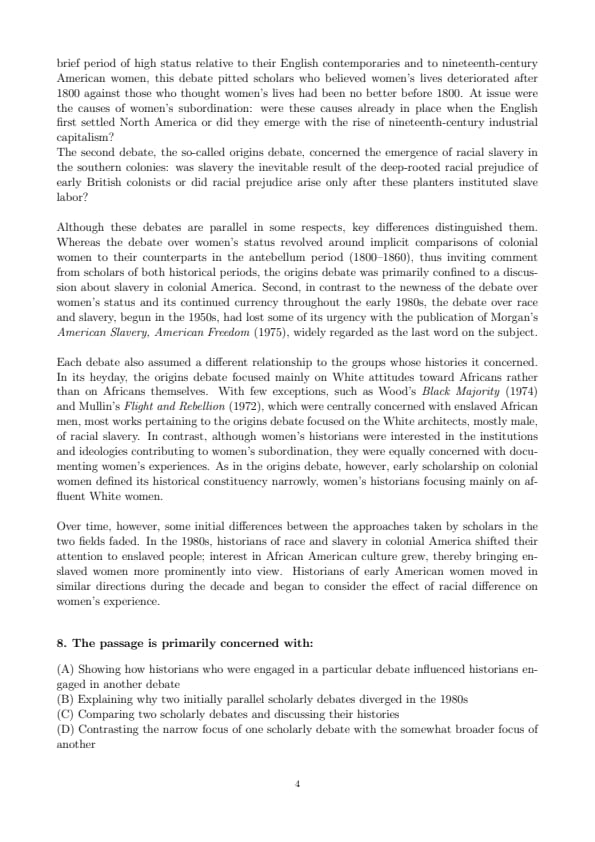
In the 1970s, two debates engaged many scholars of early United States history. One focused on the status of women, primarily White women. Turning on the so-called golden age theory, which posited that during the eighteenth-century colonial era, American women enjoyed a brief period of high status relative to their English contemporaries and to nineteenth-century American women, this debate pitted scholars who believed women’s lives deteriorated after 1800 against those who thought women’s lives had been no better before 1800. At issue were the causes of women’s subordination: were these causes already in place when the English first settled North America or did they emerge with the rise of nineteenth-century industrial capitalism?
The second debate, the so-called origins debate, concerned the emergence of racial slavery in the southern colonies: was slavery the inevitable result of the deep-rooted racial prejudice of early British colonists or did racial prejudice arise only after these planters instituted slave labor?
Although these debates are parallel in some respects, key differences distinguished them. Whereas the debate over women’s status revolved around implicit comparisons of colonial women to their counterparts in the antebellum period (1800--1860), thus inviting comment from scholars of both historical periods, the origins debate was primarily confined to a discussion about slavery in colonial America. Second, in contrast to the newness of the debate over women’s status and its continued currency throughout the early 1980s, the debate over race and slavery, begun in the 1950s, had lost some of its urgency with the publication of Morgan’s \textit{American Slavery, American Freedom} (1975), widely regarded as the last word on the subject.
Each debate also assumed a different relationship to the groups whose histories it concerned. In its heyday, the origins debate focused mainly on White attitudes toward Africans rather than on Africans themselves. With few exceptions, such as Wood’s \textit{Black Majority} (1974) and Mullin’s Flight and Rebellion (1972), which were centrally concerned with enslaved African men, most works pertaining to the origins debate focused on the White architects, mostly male, of racial slavery. In contrast, although women’s historians were interested in the institutions and ideologies contributing to women’s subordination, they were equally concerned with documenting women’s experiences. As in the origins debate, however, early scholarship on colonial women defined its historical constituency narrowly, women’s historians focusing mainly on affluent White women.\\
Over time, however, some initial differences between the approaches taken by scholars in the two fields faded. In the 1980s, historians of race and slavery in colonial America shifted their attention to enslaved people; interest in African American culture grew, thereby bringing enslaved women more prominently into view. Historians of early American women moved in similar directions during the decade and began to consider the effect of racial difference on women’s experience.
Question 8:
The passage is primarily concerned with:
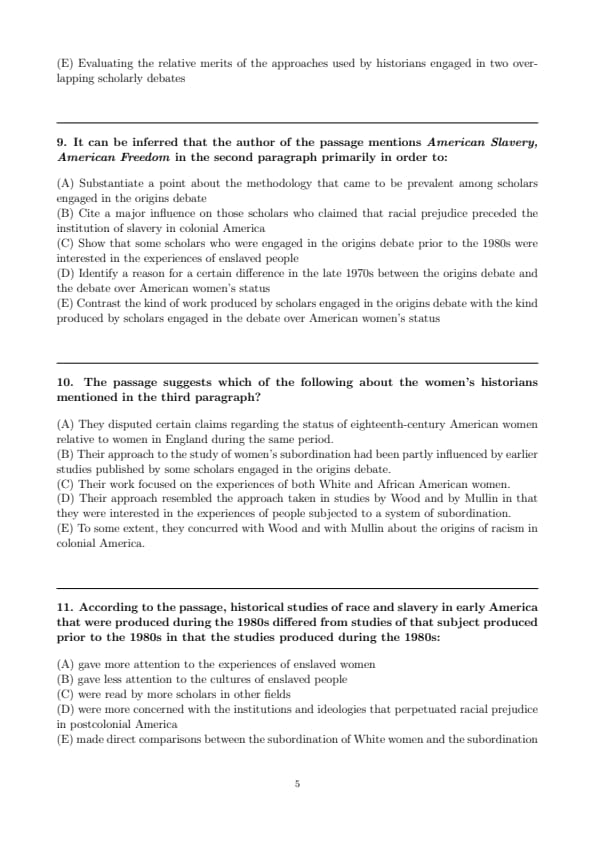
It can be inferred that the author of the passage mentions \emph{American Slavery, American Freedom} in the second paragraph primarily in order to:
The passage suggests which of the following about the women’s historians mentioned in the third paragraph?
According to the passage, historical studies of race and slavery in early America that were produced during the 1980s differed from studies of that subject produced prior to the 1980s in that the studies produced during the 1980s:
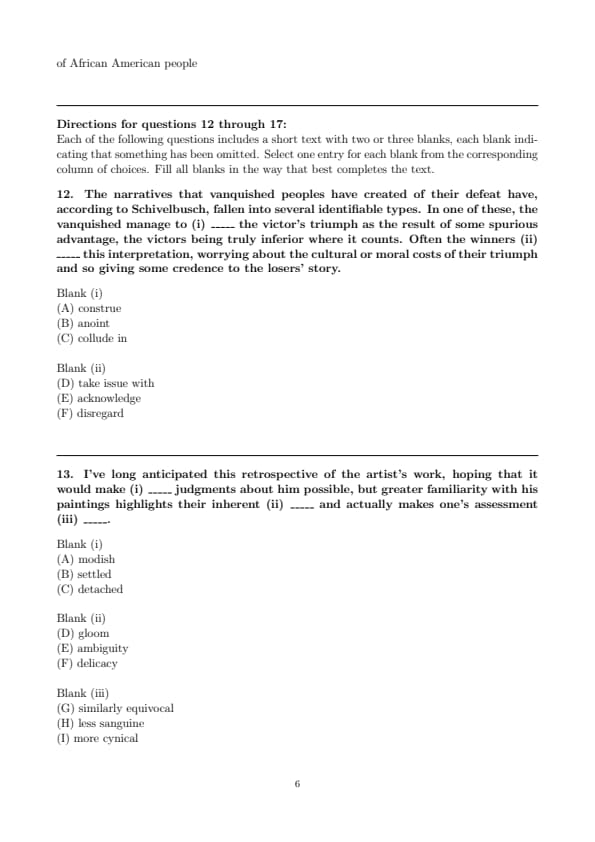
The narratives that vanquished peoples have created of their defeat have, according to Schivelbusch, fallen into several identifiable types. In one of these, the vanquished manage to (i) _____ the victor’s triumph as the result of some spurious advantage, the victors being truly inferior where it counts. Often the winners (ii) _____ this interpretation, worrying about the cultural or moral costs of their triumph and so giving some credence to the losers’ story.
View Solution
Step 1: Analyze Blank (i).
The losers interpret the victors’ triumph as based on some false advantage. The word “construe” (interpret) fits. “Anoint” (bless) does not fit, and “collude in” makes no sense here.
Step 2: Analyze Blank (ii).
The winners “worry about cultural or moral costs,” so they give some credence to the losers’ interpretation. This means they “acknowledge” it. “Take issue with” (oppose) and “disregard” (ignore) are the opposite of what is described.
Step 3: Conclusion.
The best completion is: construe … acknowledge.
Quick Tip: For Text Completion, always check if the second blank “agrees” or “contrasts” with the first statement—this ensures logical consistency.
I’ve long anticipated this retrospective of the artist’s work, hoping that it would make (i) _____ judgments about him possible, but greater familiarity with his paintings highlights their inherent (ii) _____ and actually makes one’s assessment (iii) _____.
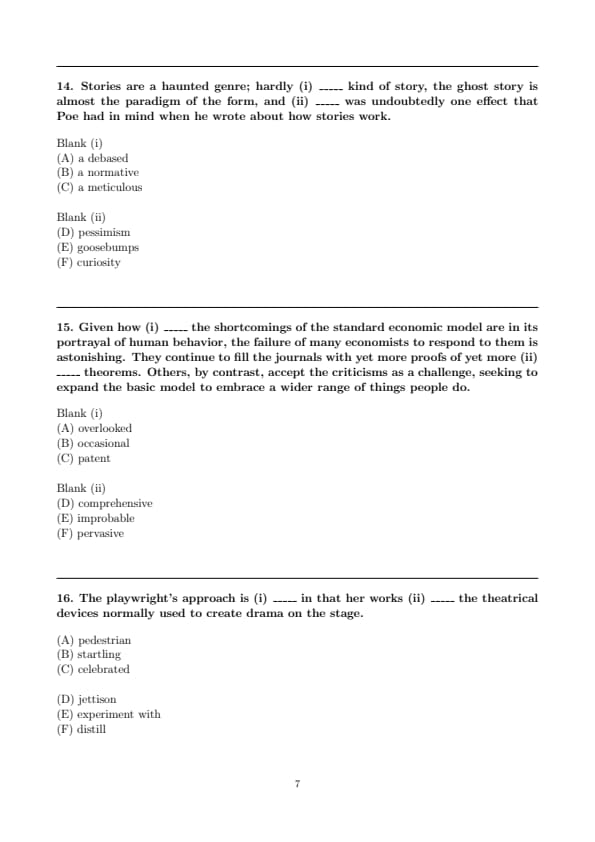
Stories are a haunted genre; hardly (i) _____ kind of story, the ghost story is almost the paradigm of the form, and (ii) _____ was undoubtedly one effect that Poe had in mind when he wrote about how stories work.
Given how (i) _____ the shortcomings of the standard economic model are in its portrayal of human behavior, the failure of many economists to respond to them is astonishing. They continue to fill the journals with yet more proofs of yet more (ii) _____ theorems. Others, by contrast, accept the criticisms as a challenge, seeking to expand the basic model to embrace a wider range of things people do.
The playwright’s approach is (i) _____ in that her works (ii) _____ the theatrical devices normally used to create drama on the stage.
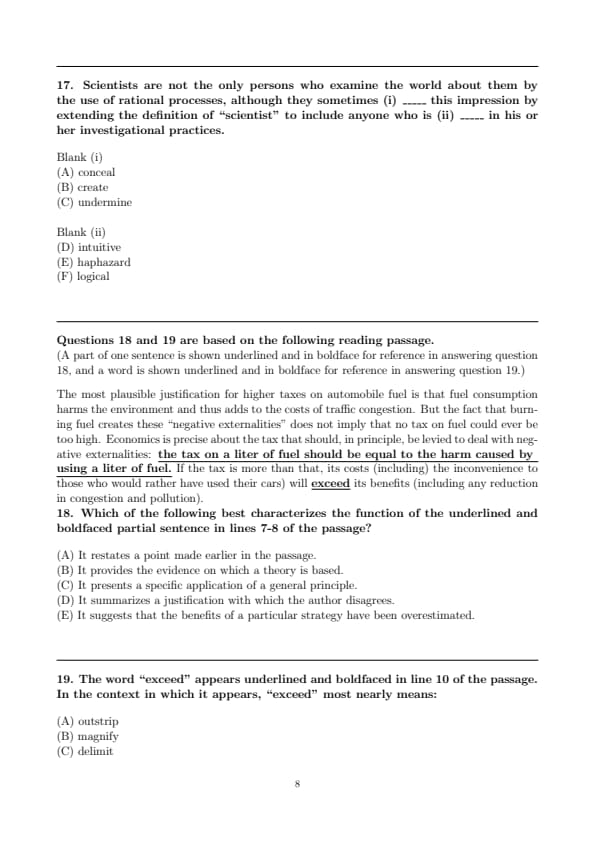
Scientists are not the only persons who examine the world about them by the use of rational processes, although they sometimes (i) _____ this impression by extending the definition of “scientist” to include anyone who is (ii) _____ in his or her investigational practices.
Which of the following best characterizes the function of the underlined and boldfaced partial sentence in lines 7-8 of the passage?
The word “exceed” appears underlined and boldfaced in line 10 of the passage. In the context in which it appears, “exceed” most nearly means:
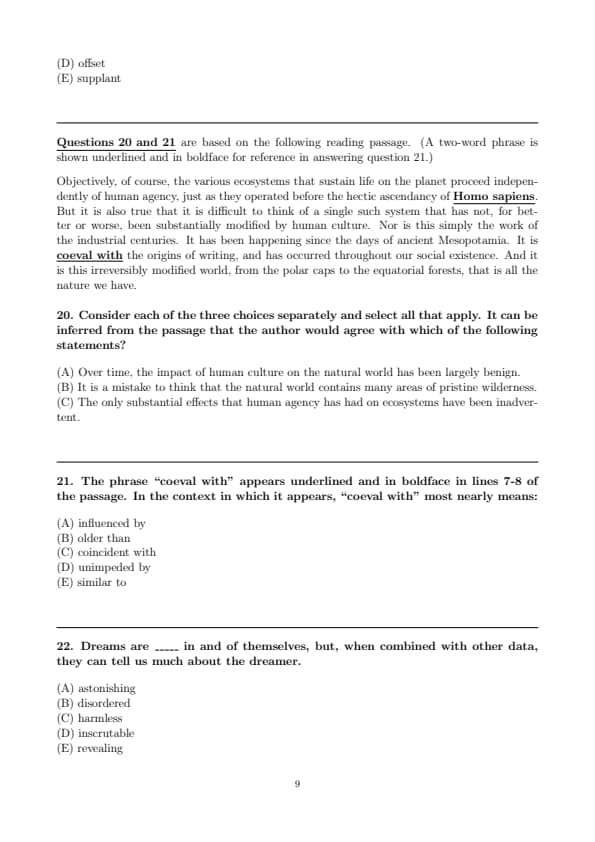
Objectively, of course, the various ecosystems that sustain life on the planet proceed independently of human agency, just as they
operated before the hectic ascendancy of \underline{\textbf{Homo sapiens}}. But it is also true that it is difficult to think of a single such system that has
not, for better or worse, been substantially modified by human culture. Nor is this simply the work of the industrial centuries. It has
been happening since the days of ancient Mesopotamia. It is coeval with the origins of writing, and has occurred throughout our social
existence. And it is this irreversibly modified world, from the polar caps to the equatorial forests, that is all the nature we have.
Question 20:
Consider each of the three choices separately and select all that apply. It can be inferred from the passage that the author would agree with which of the following statements?
The phrase “coeval with” appears underlined and in boldface in lines 7-8 of the passage. In the context in which it appears, “coeval with” most nearly means:
View Solution
Step 1: Understand the phrase “coeval with.”
The phrase means existing or happening at the same time as something else, which is closest to “coincident with.”
Step 2: Analyze the options.
- (A): “Influenced by” doesn’t fit the idea of being contemporary or simultaneous.
- (B): “Older than” is the opposite of what “coeval” implies.
- (C): Correct, “coeval with” means contemporaneous or coincident in time.
- (D): “Unimpeded by” has no relation to the concept of time.
- (E): “Similar to” is too vague and not time-related.
Step 3: Conclusion.
Thus, the correct answer is (C).
Quick Tip: When encountering specific terms like "coeval with," focus on the meaning of simultaneity or co-existence in time.
Dreams are _____ in and of themselves, but, when combined with other data, they can tell us much about the dreamer.
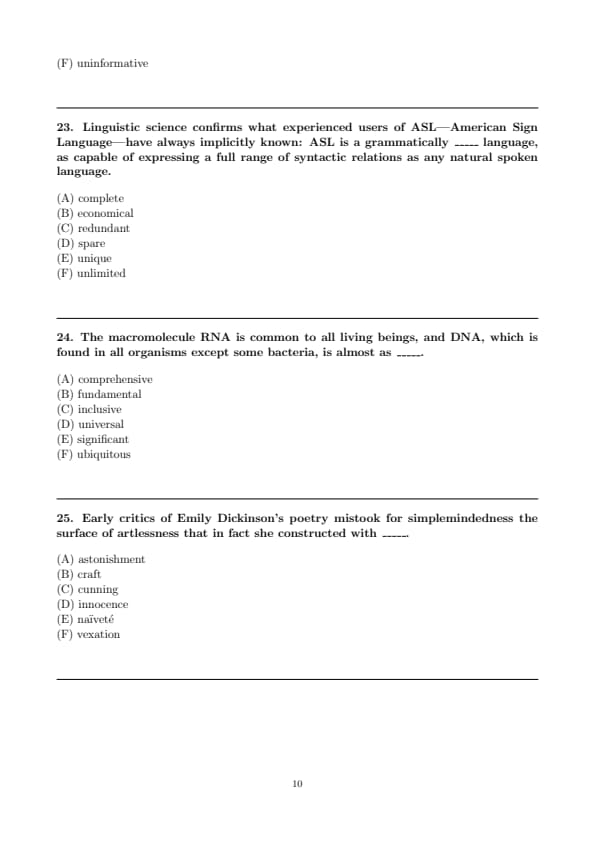
Linguistic science confirms what experienced users of ASL—American Sign Language—have always implicitly known: ASL is a grammatically _____ language, as capable of expressing a full range of syntactic relations as any natural spoken language.
The macromolecule RNA is common to all living beings, and DNA, which is found in all organisms except some bacteria, is almost as _____.
Early critics of Emily Dickinson’s poetry mistook for simplemindedness the surface of artlessness that in fact she constructed with _____.



Comments