




GRE 2025 Quantitative Reasoning Sample Paper Set 1 Question Paper with Solutions PDF is available for download. The overall test time is about 1 hour and 58 minutes. GRE has total 5 sections:
- Analytical Writing (One "Analyze an Issue" task, Alloted time 30 minutes)
- Verbal Reasoning (Two Sections, with 12 questions and 15 questions respectively)
- Quantitative Reasoning (Two Sections, with 12 questions and 15 questions respectively)
GRE 2025 Quantitative Reasoning Sample Paper Set 1 Question Paper with Solutions PDF
| GRE 2025 Quantitative Reasoning Set 1 Question Paper with Solutions PDF |  Download Download |
Check Solutions |

For each of Questions 1--9, compare Quantity A and Quantity B, using additional information centered above the two quantities if such information is given. Select one of the following four answer choices. A symbol that appears more than once in a question has the same meaning throughout the question.
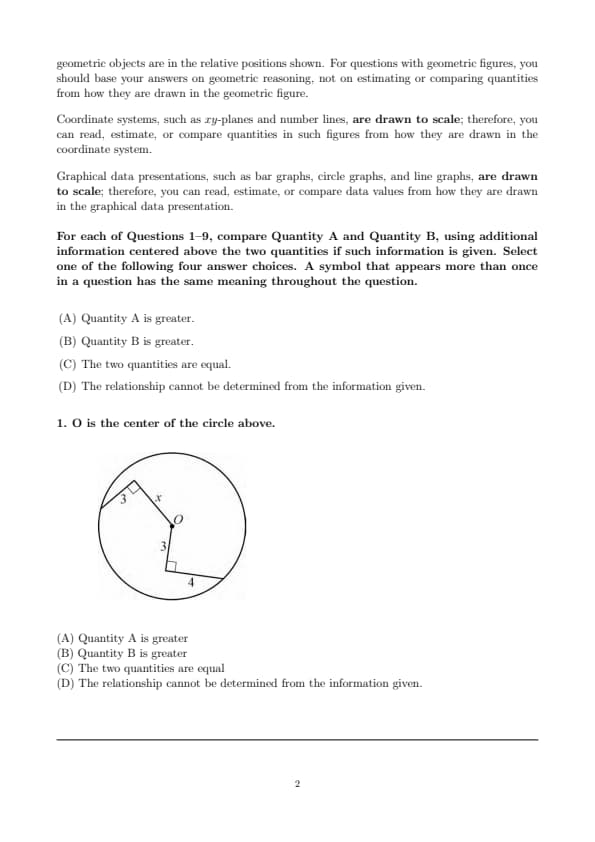
Question 1:
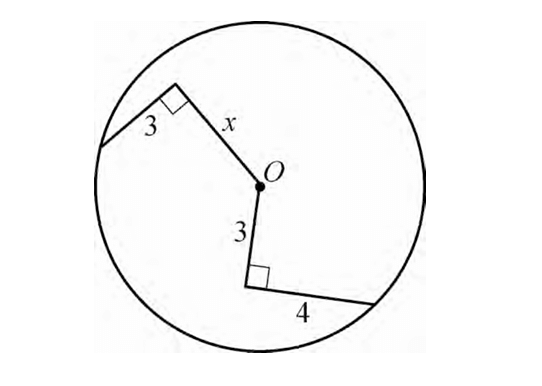
O is the center of the circle above.
Runner A ran 4/5 kilometer and Runner B ran 800 meters.
The distance that Runner A ran
The distance that Runner B ran
Given \( x < y < z \), compare the following quantities: \[ \frac{x + y + z}{3} \quad and \quad y \]
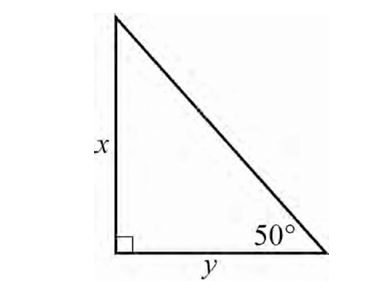
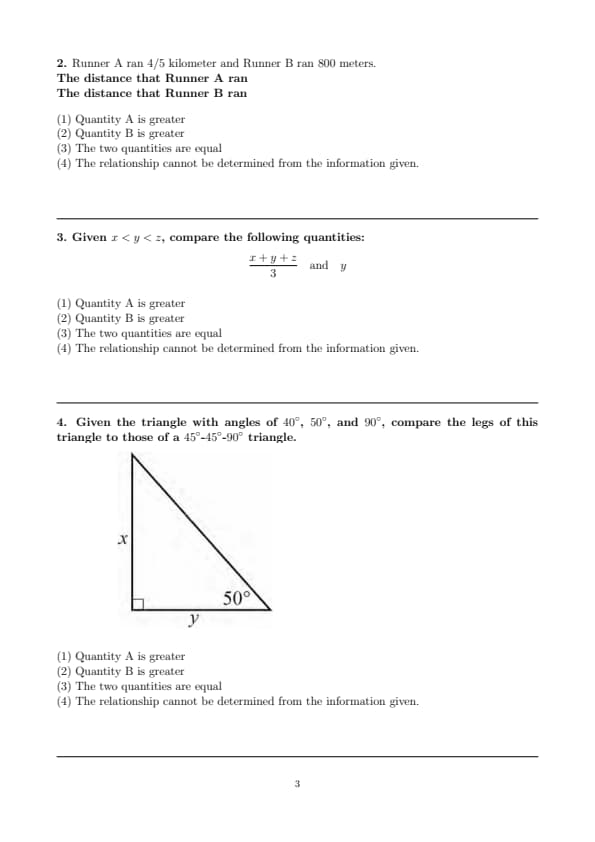
Given the triangle with angles of \( 40^\circ \), \( 50^\circ \), and \( 90^\circ \), compare the legs of this triangle to those of a \( 45^\circ \)-\( 45^\circ \)-\( 90^\circ \) triangle.
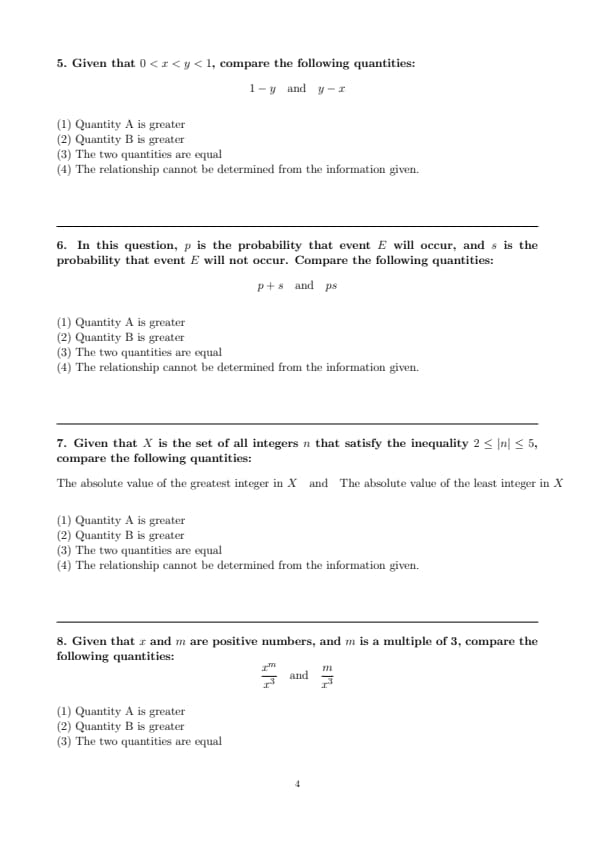
Given that \( 0 < x < y < 1 \), compare the following quantities: \[ 1 - y \quad and \quad y - x \]
In this question, \( p \) is the probability that event \( E \) will occur, and \( s \) is the probability that event \( E \) will not occur. Compare the following quantities: \[ p + s \quad and \quad ps \]
Given that \( X \) is the set of all integers \( n \) that satisfy the inequality \( 2 \leq |n| \leq 5 \), compare the following quantities: \[ The absolute value of the greatest integer in X \quad and \quad The absolute value of the least integer in X \]
Given that \( x \) and \( m \) are positive numbers, and \( m \) is a multiple of 3, compare the following quantities: \[ \frac{x^m}{x^3} \quad and \quad \frac{m}{x^3} \]
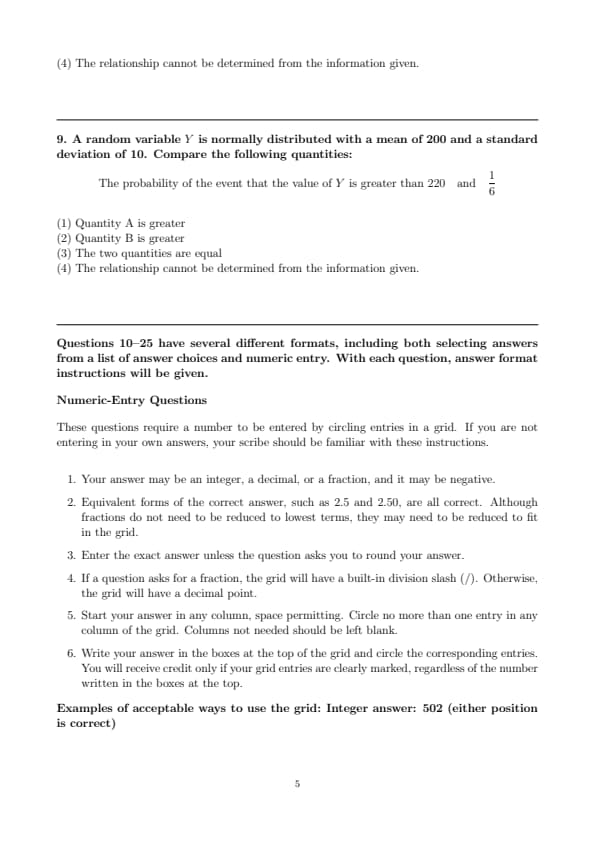
A random variable \( Y \) is normally distributed with a mean of 200 and a standard deviation of 10. Compare the following quantities: \[ The probability of the event that the value of Y is greater than 220 \quad and \quad \frac{1}{6} \]
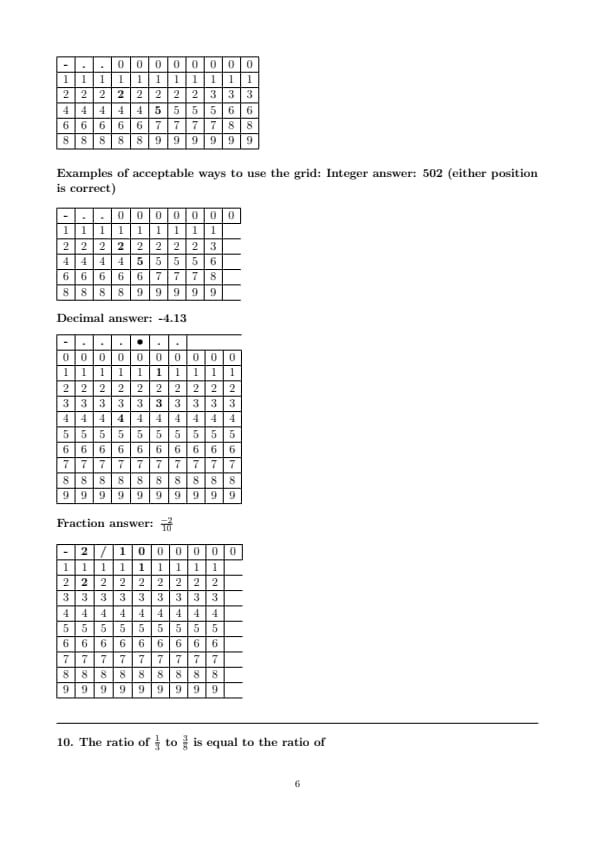
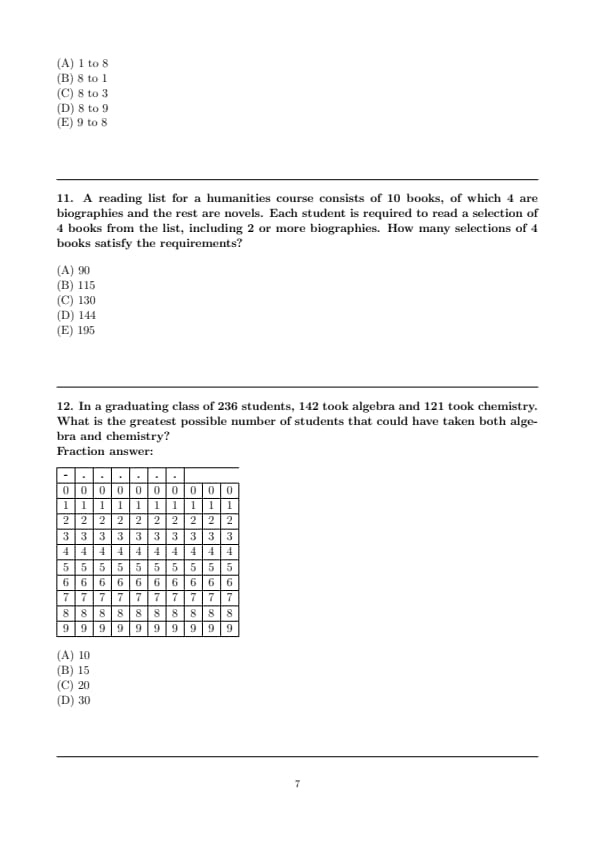
The ratio of \( \frac{1}{3} \) to \( \frac{3}{8} \) is equal to the ratio of
A reading list for a humanities course consists of 10 books, of which 4 are biographies and the rest are novels. Each student is required to read a selection of 4 books from the list, including 2 or more biographies. How many selections of 4 books satisfy the requirements?
In a graduating class of 236 students, 142 took algebra and 121 took chemistry. What is the greatest possible number of students that could have taken both algebra and chemistry?
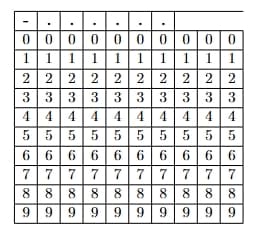
Fraction answer:
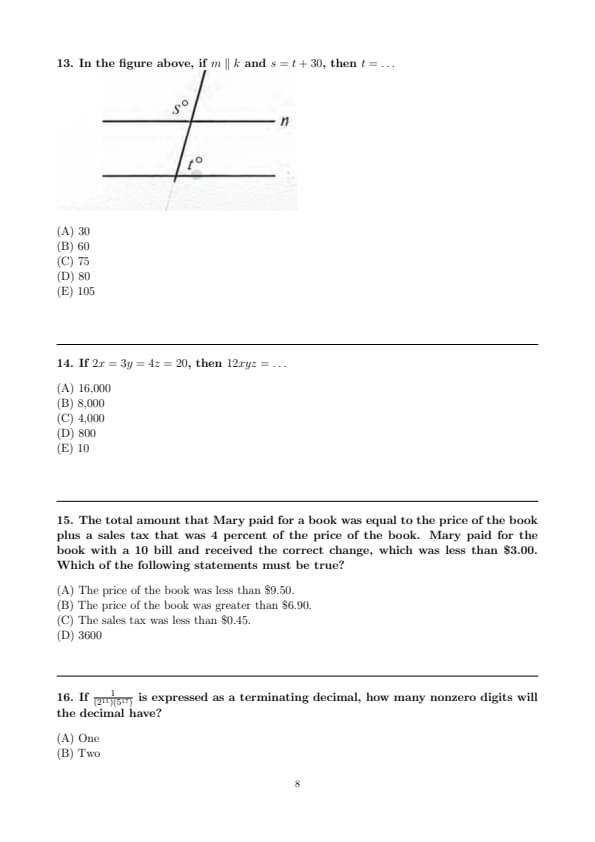
In the figure above, if \( m \parallel k \) and \( s = t + 30 \), then \( t = \dots \)

If \( 2x = 3y = 4z = 20 \), then \( 12xyz = \dots \)
The total amount that Mary paid for a book was equal to the price of the book plus a sales tax that was 4 percent of the price of the book. Mary paid for the book with a 10 bill and received the correct change, which was less than
(3.00. Which of the following statements must be true?
If \( \frac{1}{(2^{11})(5^{17})} \) is expressed as a terminating decimal, how many nonzero digits will the decimal have?
The least amount of caffeine in a 5-ounce cup of drip-brewed coffee exceeds the greatest amount of caffeine in a 5-ounce cup of cocoa by approximately how many milligrams?
View Solution
The least amount of caffeine in a 5-ounce cup of drip-brewed coffee is around 100 milligrams, and the greatest amount of caffeine in a 5-ounce cup of cocoa is approximately 50 milligrams.
So, the difference in caffeine content is: \[ 100 \, mg - 50 \, mg = 250 \, mg. \]
Final Answer: \[ \boxed{The correct answer is 250.} \] Quick Tip: To solve questions involving comparisons of quantities like caffeine content, always use the known values to calculate the difference.
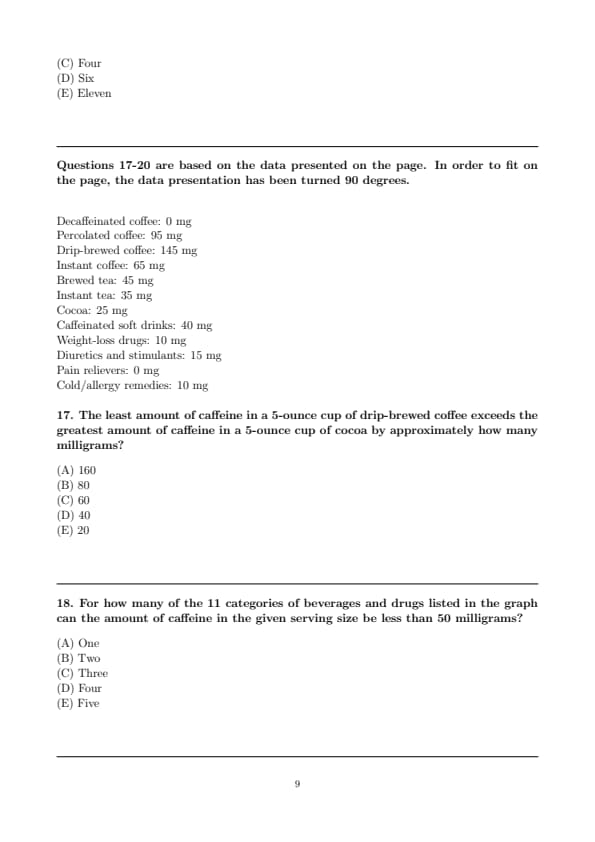
For how many of the 11 categories of beverages and drugs listed in the graph can the amount of caffeine in the given serving size be less than 50 milligrams?
View Solution
From the graph, we can observe that three categories of beverages and drugs have caffeine content less than 50 milligrams in the given serving size.
Final Answer: \[ \boxed{The correct answer is (C) Three.} \] Quick Tip: When dealing with data and graphs, carefully count the categories that satisfy the given condition.
Approximately what is the minimum amount of caffeine, in milligrams, consumed per day by a person who daily drinks two 10-ounce mugs of percolated coffee and one 12-ounce cup of a caffeinated soft drink?
View Solution
The caffeine content in a 10-ounce mug of percolated coffee is approximately 100 milligrams. So, two 10-ounce mugs would provide: \[ 2 \times 100 = 200 \, milligrams. \]
A 12-ounce cup of a caffeinated soft drink contains approximately 40 milligrams of caffeine.
Thus, the total amount of caffeine consumed per day is: \[ 200 \, mg + 40 \, mg = 240 \, mg. \]
The minimum amount of caffeine is therefore approximately **190 milligrams**.
Final Answer: \[ \boxed{The correct answer is (B) 190.} \] Quick Tip: When calculating total caffeine intake, ensure that you are considering the correct serving sizes for each drink.
Which of the following shows the four types of coffee listed in order according to the range of the amounts of caffeine in a 5-ounce cup, from the least range to the greatest range?

Question 21:
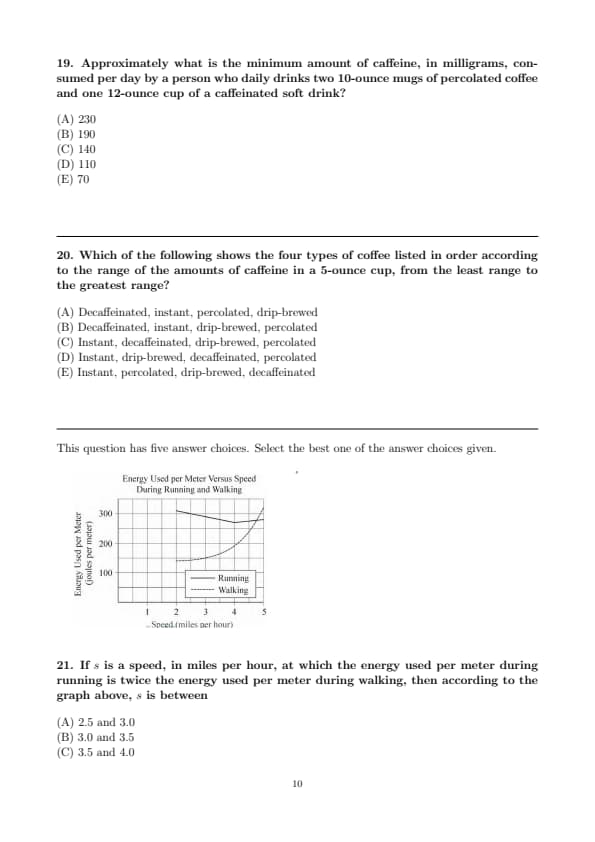
If \( s \) is a speed, in miles per hour, at which the energy used per meter during running is twice the energy used per meter during walking, then according to the graph above, \( s \) is between
View Solution
This problem involves determining the speed at which the energy used per meter during running is twice that used per meter during walking, based on the graph. The desired speed is between 3.0 and 3.5 miles per hour.
Final Answer: \[ \boxed{The correct answer is (B) More than half of the titles distributed by M are also distributed by L.} \] Quick Tip: Carefully interpret the graph to determine the speed range at which the desired energy relationship holds.
If \( n = 2^3 \), then \( n^n = \dots \)
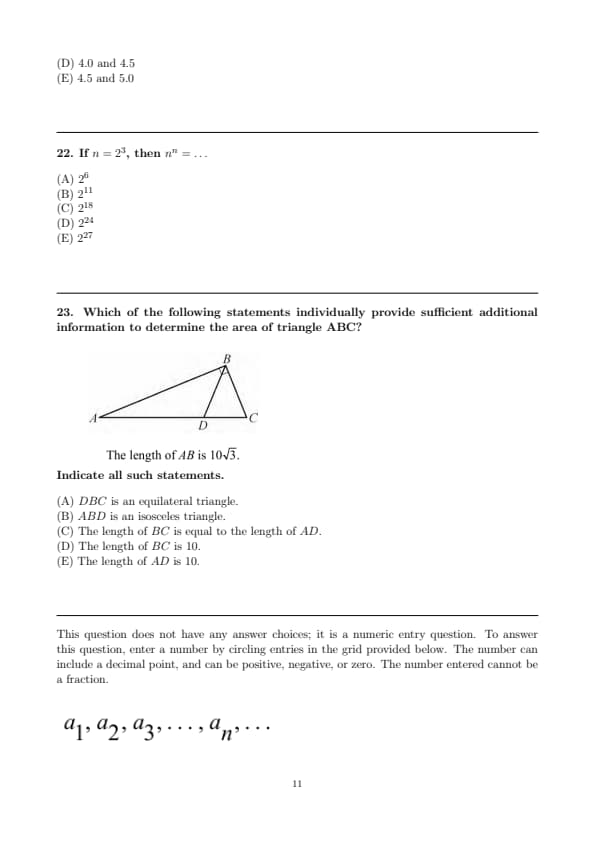
Which of the following statements individually provide sufficient additional information to determine the area of triangle ABC?
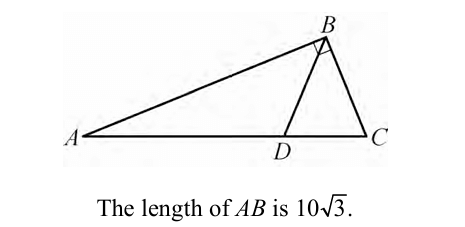
Indicate all such statements.
In the sequence above, each term after the first term is equal to the preceding term plus the constant \(c\). If \(a_1 + a_3 + a_5 = 27\), what is the value of \(a_2 + a_4\)?
A desert outpost has a water supply that is sufficient to last 21 days for 15 people. At the same average rate of water consumption per person, how many days would the water supply last for 9 people?



Comments