




GRE 2024 Verbal Reasoning Sample Question Paper with Solutions PDF is available for download. The overall test time is about 1 hour and 58 minutes. GRE has total 5 sections:
- Analytical Writing (One "Analyze an Issue" task, Alloted time 30 minutes)
- Verbal Reasoning (Two Sections, with 12 questions and 15 questions respectively)
- Quantitative Reasoning (Two Sections, with 12 questions and 15 questions respectively)
GRE 2024 Verbal Reasoning Sample Question Paper with Solutions PDF
| GRE 2024 Verbal Reasoning Sample Question Paper with Solutions PDF |  Download Download |
Check Solutions |
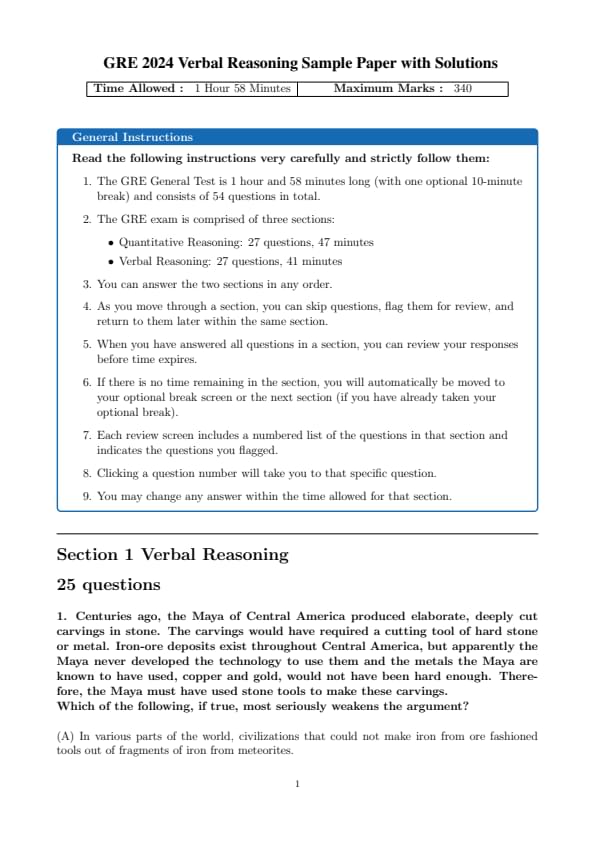
Centuries ago, the Maya of Central America produced elaborate, deeply cut carvings in stone. The carvings would have required a cutting tool of hard stone or metal. Iron-ore deposits exist throughout Central America, but apparently the Maya never developed the technology to use them and the metals the Maya are known to have used, copper and gold, would not have been hard enough. Therefore, the Maya must have used stone tools to make these carvings.
Which of the following, if true, most seriously weakens the argument?
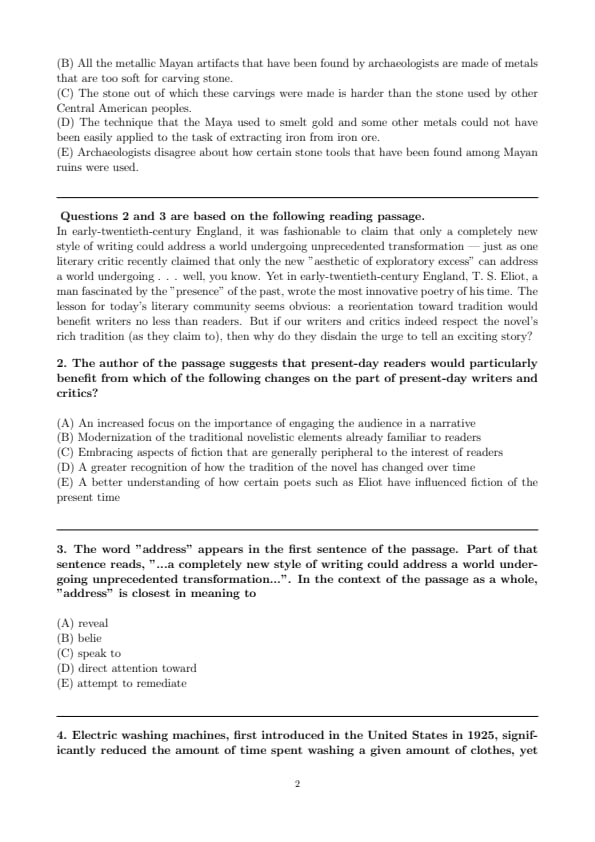
The author of the passage suggests that present-day readers would particularly benefit from which of the following changes on the part of present-day writers and critics?
The word "address" appears in the first sentence of the passage. Part of that sentence reads, "...a completely new style of writing could address a world undergoing unprecedented transformation...". In the context of the passage as a whole, "address" is closest in meaning to
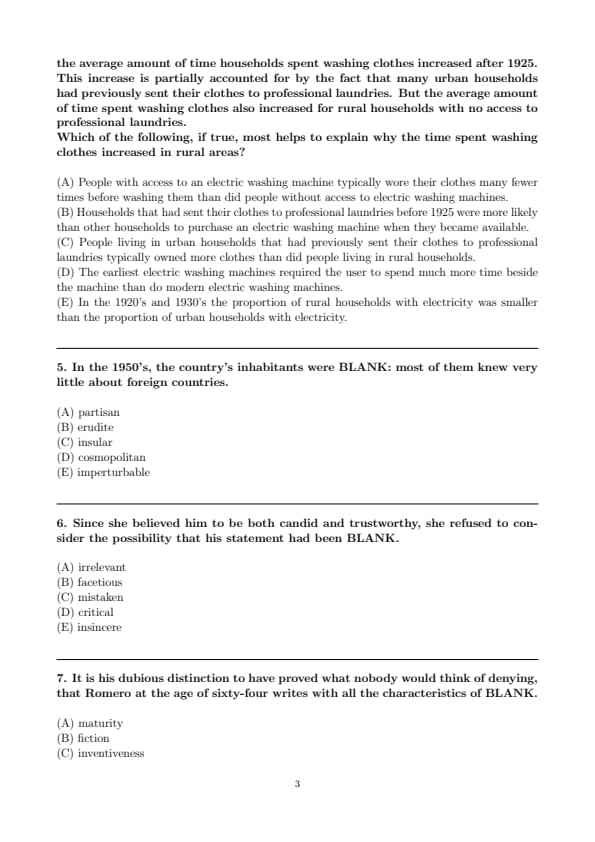
Electric washing machines, first introduced in the United States in 1925, significantly reduced the amount of time spent washing a given amount of clothes, yet the average amount of time households spent washing clothes increased after 1925. This increase is partially accounted for by the fact that many urban households had previously sent their clothes to professional laundries. But the average amount of time spent washing clothes also increased for rural households with no access to professional laundries.
Which of the following, if true, most helps to explain why the time spent washing clothes increased in rural areas?
In the 1950's, the country's inhabitants were BLANK: most of them knew very little about foreign countries.
Since she believed him to be both candid and trustworthy, she refused to consider the possibility that his statement had been BLANK.
It is his dubious distinction to have proved what nobody would think of denying, that Romero at the age of sixty-four writes with all the characteristics of BLANK.
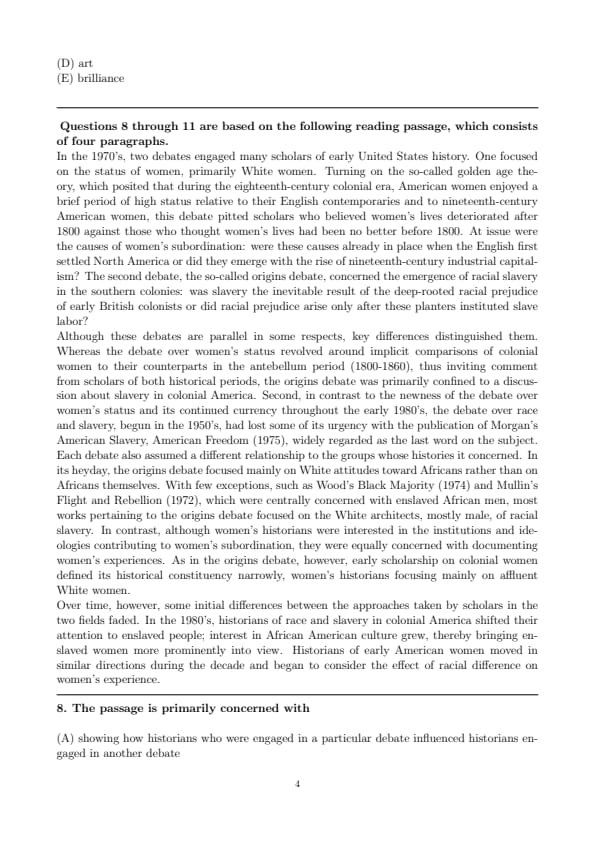
The passage is primarily concerned with
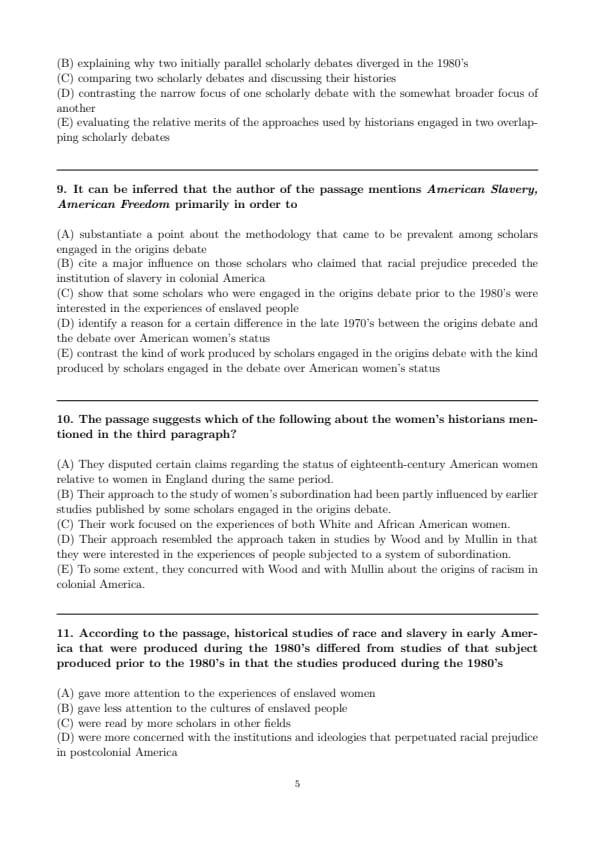
It can be inferred that the author of the passage mentions American Slavery, American Freedom primarily in order to
The passage suggests which of the following about the women's historians mentioned in the third paragraph?
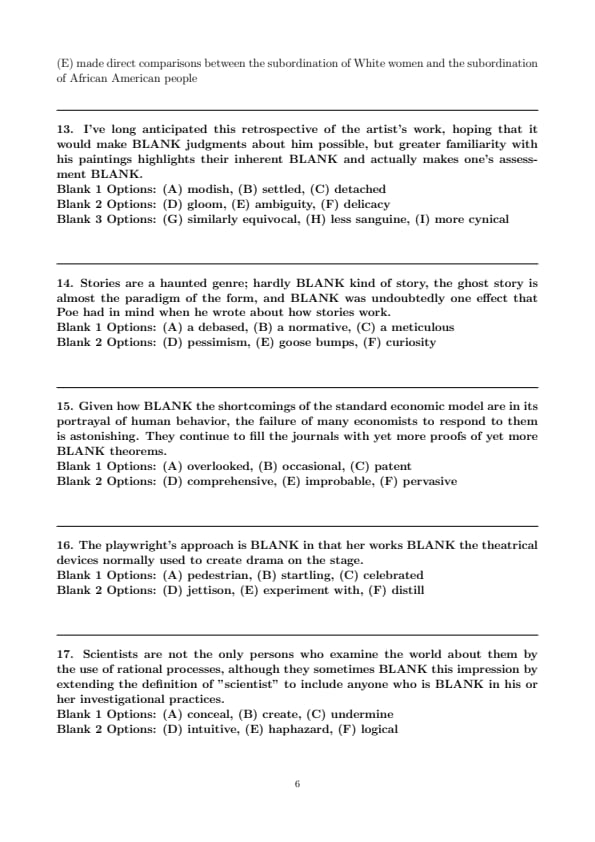
According to the passage, historical studies of race and slavery in early America that were produced during the 1980's differed from studies of that subject produced prior to the 1980's in that the studies produced during the 1980's
I've long anticipated this retrospective of the artist's work, hoping that it would make BLANK judgments about him possible, but greater familiarity with his paintings highlights their inherent BLANK and actually makes one's assessment BLANK.
Blank 1 Options: (A) modish, (B) settled, (C) detached
Blank 2 Options: (D) gloom, (E) ambiguity, (F) delicacy
Blank 3 Options: (G) similarly equivocal, (H) less sanguine, (I) more cynical
Stories are a haunted genre; hardly BLANK kind of story, the ghost story is almost the paradigm of the form, and BLANK was undoubtedly one effect that Poe had in mind when he wrote about how stories work.
Blank 1 Options: (A) a debased, (B) a normative, (C) a meticulous
Blank 2 Options: (D) pessimism, (E) goose bumps, (F) curiosity
Given how BLANK the shortcomings of the standard economic model are in its portrayal of human behavior, the failure of many economists to respond to them is astonishing. They continue to fill the journals with yet more proofs of yet more BLANK theorems.
Blank 1 Options: (A) overlooked, (B) occasional, (C) patent
Blank 2 Options: (D) comprehensive, (E) improbable, (F) pervasive
The playwright's approach is BLANK in that her works BLANK the theatrical devices normally used to create drama on the stage.
Blank 1 Options: (A) pedestrian, (B) startling, (C) celebrated
Blank 2 Options: (D) jettison, (E) experiment with, (F) distill
Scientists are not the only persons who examine the world about them by the use of rational processes, although they sometimes BLANK this impression by extending the definition of "scientist" to include anyone who is BLANK in his or her investigational practices.
Blank 1 Options: (A) conceal, (B) create, (C) undermine
Blank 2 Options: (D) intuitive, (E) haphazard, (F) logical
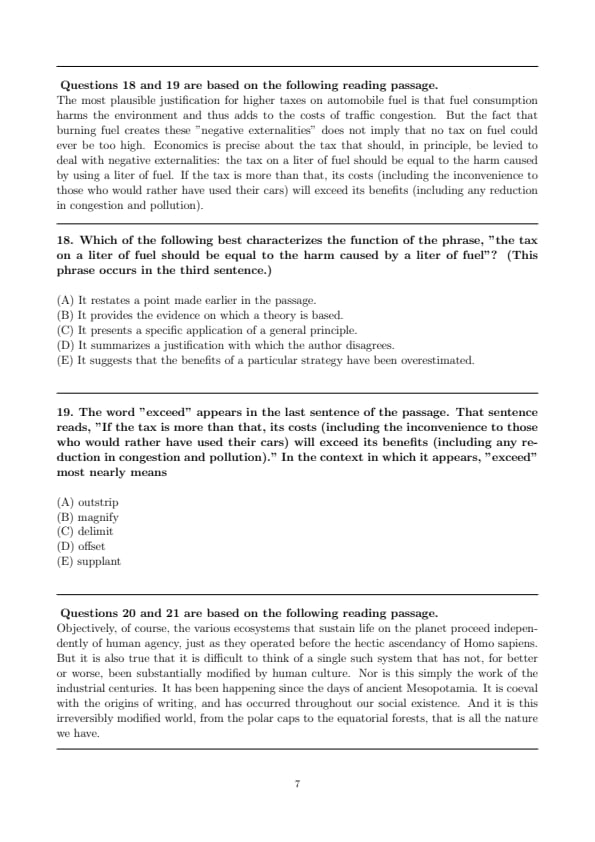
Which of the following best characterizes the function of the phrase, "the tax on a liter of fuel should be equal to the harm caused by a liter of fuel"? (This phrase occurs in the third sentence.)
The word "exceed" appears in the last sentence of the passage. That sentence reads, "If the tax is more than that, its costs (including the inconvenience to those who would rather have used their cars) will exceed its benefits (including any reduction in congestion and pollution)." In the context in which it appears, "exceed" most nearly means
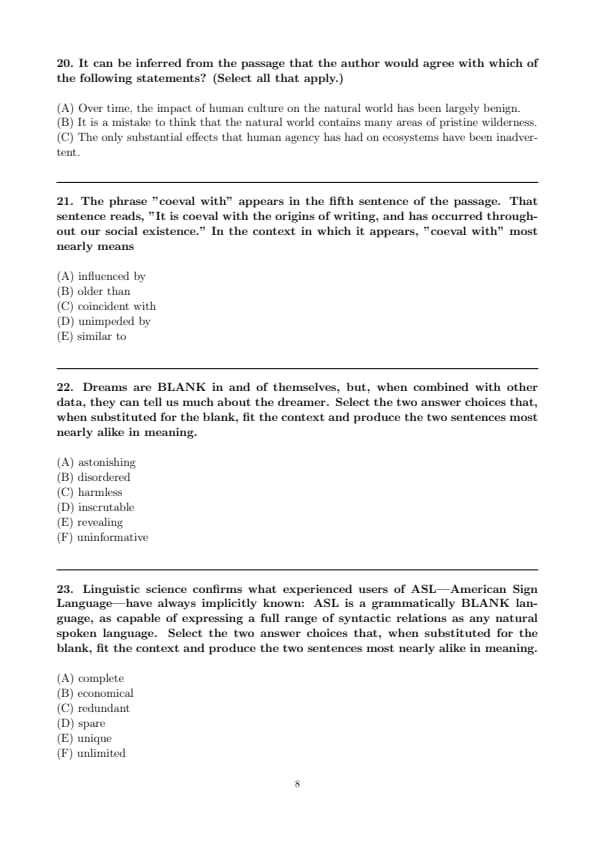
It can be inferred from the passage that the author would agree with which of the following statements? (Select all that apply.)
The phrase "coeval with" appears in the fifth sentence of the passage. That sentence reads, "It is coeval with the origins of writing, and has occurred throughout our social existence." In the context in which it appears, "coeval with" most nearly means
Dreams are BLANK in and of themselves, but, when combined with other data, they can tell us much about the dreamer. Select the two answer choices that, when substituted for the blank, fit the context and produce the two sentences most nearly alike in meaning.
Linguistic science confirms what experienced users of ASL—American Sign Language—have always implicitly known: ASL is a grammatically BLANK language, as capable of expressing a full range of syntactic relations as any natural spoken language. Select the two answer choices that, when substituted for the blank, fit the context and produce the two sentences most nearly alike in meaning.
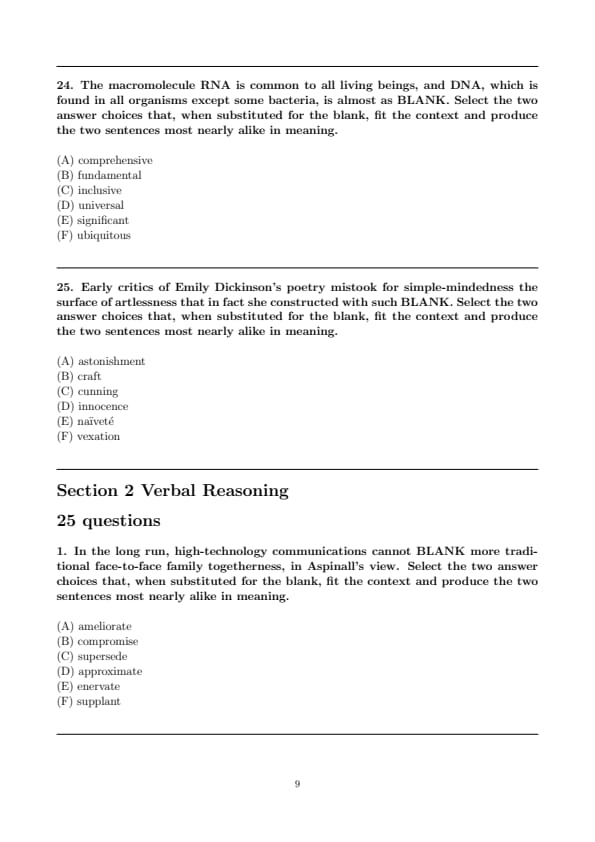
The macromolecule RNA is common to all living beings, and DNA, which is found in all organisms except some bacteria, is almost as BLANK. Select the two answer choices that, when substituted for the blank, fit the context and produce the two sentences most nearly alike in meaning.
Early critics of Emily Dickinson's poetry mistook for simple-mindedness the surface of artlessness that in fact she constructed with such BLANK. Select the two answer choices that, when substituted for the blank, fit the context and produce the two sentences most nearly alike in meaning.
In the long run, high-technology communications cannot BLANK more traditional face-to-face family togetherness, in Aspinall's view. Select the two answer choices that, when substituted for the blank, fit the context and produce the two sentences most nearly alike in meaning.
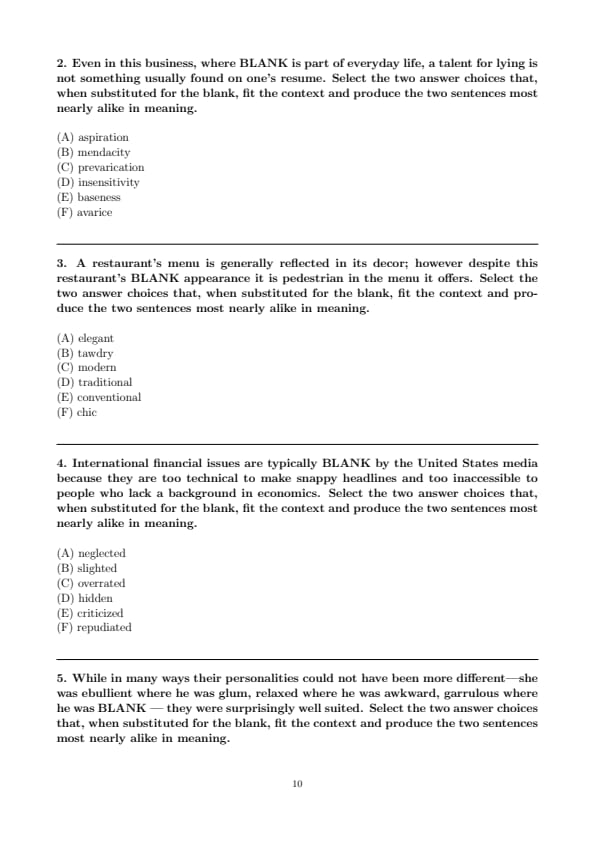
Even in this business, where BLANK is part of everyday life, a talent for lying is not something usually found on one's resume. Select the two answer choices that, when substituted for the blank, fit the context and produce the two sentences most nearly alike in meaning.
A restaurant's menu is generally reflected in its decor; however despite this restaurant's BLANK appearance it is pedestrian in the menu it offers. Select the two answer choices that, when substituted for the blank, fit the context and produce the two sentences most nearly alike in meaning.
International financial issues are typically BLANK by the United States media because they are too technical to make snappy headlines and too inaccessible to people who lack a background in economics. Select the two answer choices that, when substituted for the blank, fit the context and produce the two sentences most nearly alike in meaning.
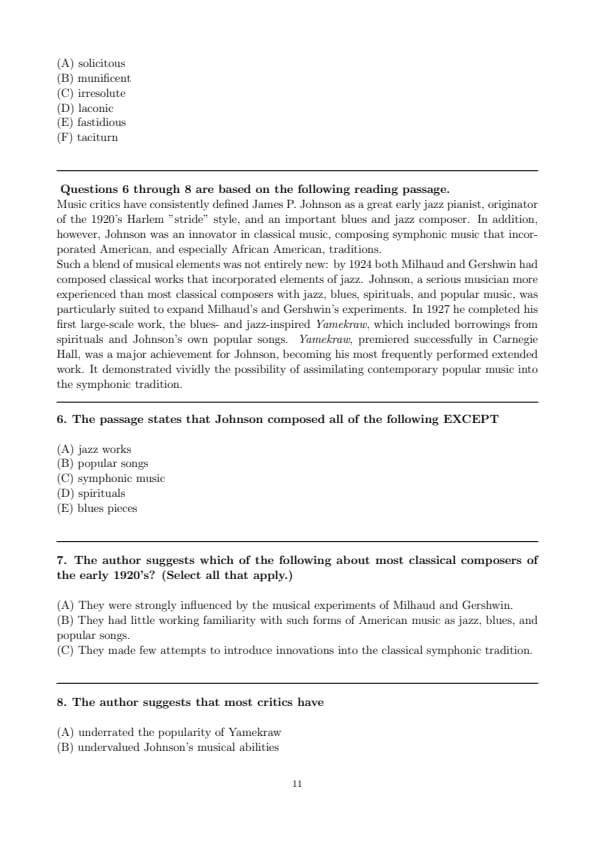
While in many ways their personalities could not have been more different—she was ebullient where he was glum, relaxed where he was awkward, garrulous where he was BLANK — they were surprisingly well suited. Select the two answer choices that, when substituted for the blank, fit the context and produce the two sentences most nearly alike in meaning.
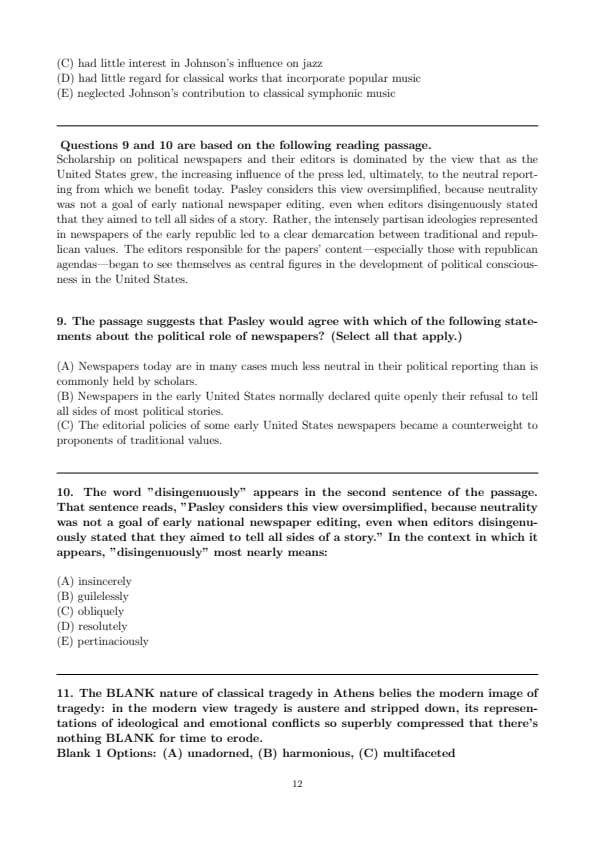
The passage states that Johnson composed all of the following EXCEPT
The author suggests which of the following about most classical composers of the early 1920's? (Select all that apply.)
The author suggests that most critics have
The passage suggests that Pasley would agree with which of the following statements about the political role of newspapers? (Select all that apply.)
The word "disingenuously" appears in the second sentence of the passage. That sentence reads, "Pasley considers this view oversimplified, because neutrality was not a goal of early national newspaper editing, even when editors disingenuously stated that they aimed to tell all sides of a story." In the context in which it appears, "disingenuously" most nearly means:
The BLANK nature of classical tragedy in Athens belies the modern image of tragedy: in the modern view tragedy is austere and stripped down, its representations of ideological and emotional conflicts so superbly compressed that there's nothing BLANK for time to erode.
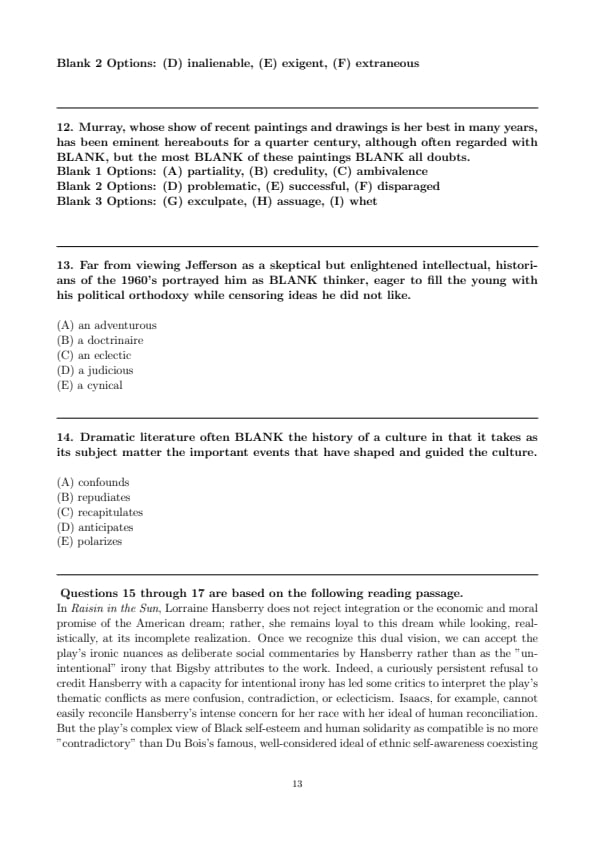
Blank 1 Options: (A) unadorned, (B) harmonious, (C) multifaceted
Blank 2 Options: (D) inalienable, (E) exigent, (F) extraneous
Murray, whose show of recent paintings and drawings is her best in many years, has been eminent hereabouts for a quarter century, although often regarded with BLANK, but the most BLANK of these paintings BLANK all doubts.
Blank 1 Options: (A) partiality, (B) credulity, (C) ambivalence
Blank 2 Options: (D) problematic, (E) successful, (F) disparaged
Blank 3 Options: (G) exculpate, (H) assuage, (I) whet
Far from viewing Jefferson as a skeptical but enlightened intellectual, historians of the 1960's portrayed him as BLANK thinker, eager to fill the young with his political orthodoxy while censoring ideas he did not like.
Dramatic literature often BLANK the history of a culture in that it takes as its subject matter the important events that have shaped and guided the culture.
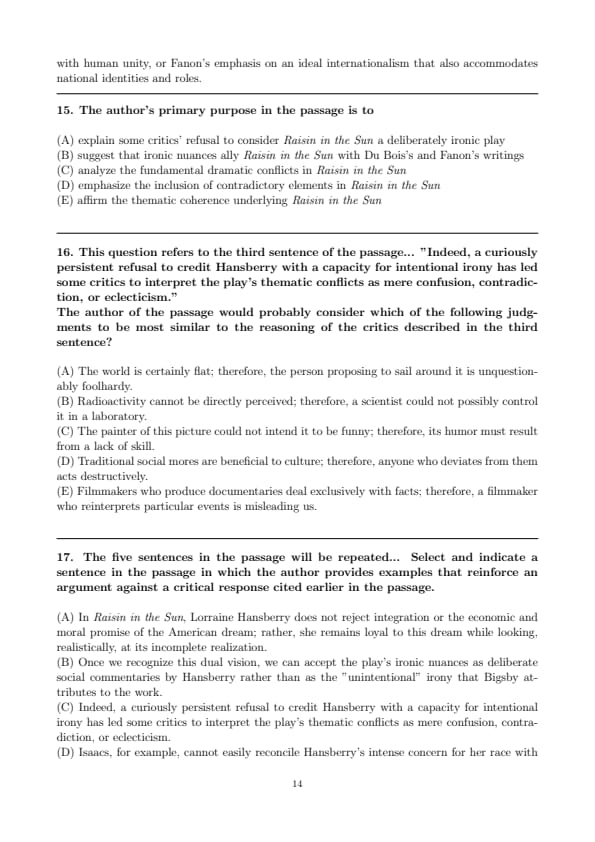
The author's primary purpose in the passage is to
This question refers to the third sentence of the passage... "Indeed, a curiously persistent refusal to credit Hansberry with a capacity for intentional irony has led some critics to interpret the play's thematic conflicts as mere confusion, contradiction, or eclecticism."
The author of the passage would probably consider which of the following judgments to be most similar to the reasoning of the critics described in the third sentence?
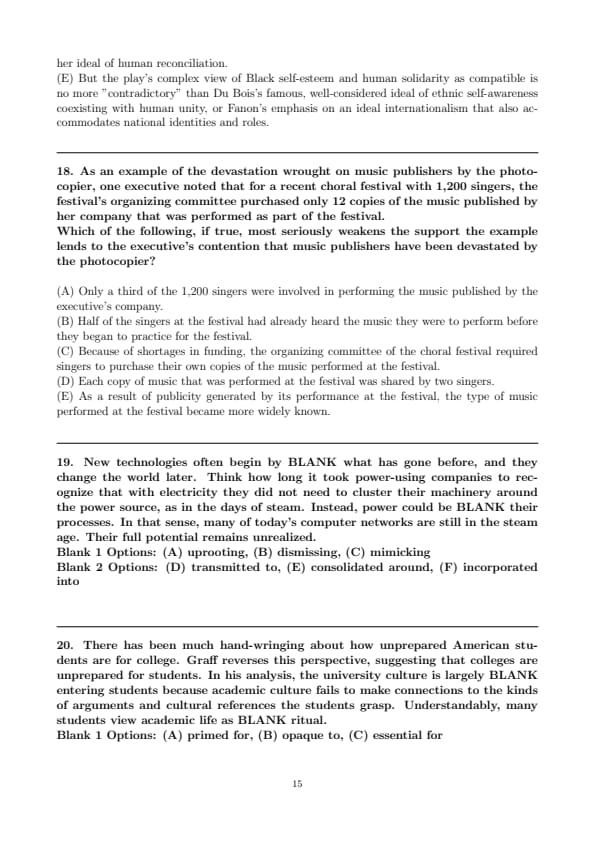
The five sentences in the passage will be repeated... Select and indicate a sentence in the passage in which the author provides examples that reinforce an argument against a critical response cited earlier in the passage.
As an example of the devastation wrought on music publishers by the photocopier, one executive noted that for a recent choral festival with 1,200 singers, the festival's organizing committee purchased only 12 copies of the music published by her company that was performed as part of the festival.
Which of the following, if true, most seriously weakens the support the example lends to the executive's contention that music publishers have been devastated by the photocopier?
New technologies often begin by BLANK what has gone before, and they change the world later. Think how long it took power-using companies to recognize that with electricity they did not need to cluster their machinery around the power source, as in the days of steam. Instead, power could be BLANK their processes. In that sense, many of today's computer networks are still in the steam age. Their full potential remains unrealized.
Blank 1 Options: (A) uprooting, (B) dismissing, (C) mimicking
Blank 2 Options: (D) transmitted to, (E) consolidated around, (F) incorporated into
There has been much hand-wringing about how unprepared American students are for college. Graff reverses this perspective, suggesting that colleges are unprepared for students. In his analysis, the university culture is largely BLANK entering students because academic culture fails to make connections to the kinds of arguments and cultural references the students grasp. Understandably, many students view academic life as BLANK ritual.
Blank 1 Options: (A) primed for, (B) opaque to, (C) essential for
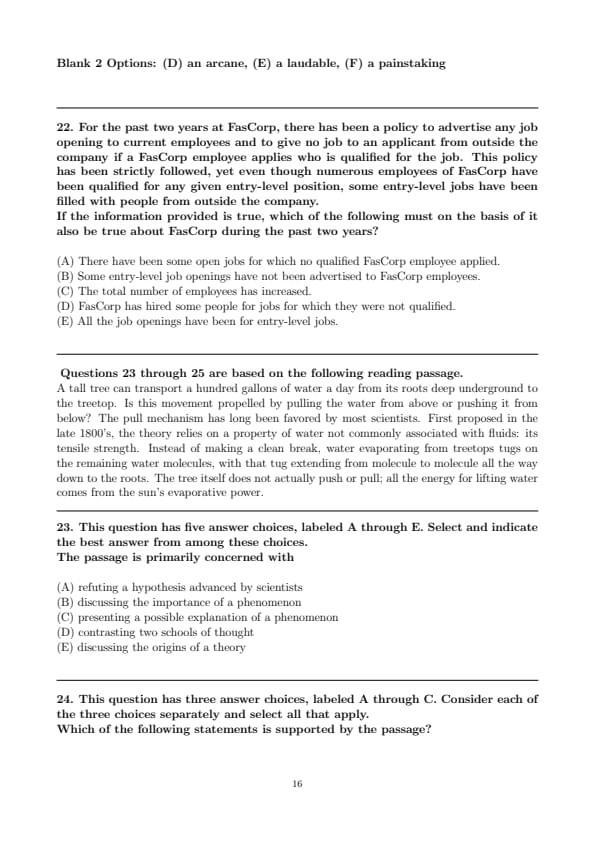
Blank 2 Options: (D) an arcane, (E) a laudable, (F) a painstaking
For the past two years at FasCorp, there has been a policy to advertise any job opening to current employees and to give no job to an applicant from outside the company if a FasCorp employee applies who is qualified for the job. This policy has been strictly followed, yet even though numerous employees of FasCorp have been qualified for any given entry-level position, some entry-level jobs have been filled with people from outside the company.
If the information provided is true, which of the following must on the basis of it also be true about FasCorp during the past two years?
This question has five answer choices, labeled A through E. Select and indicate the best answer from among these choices.
The passage is primarily concerned with
View Solution
Step 1: Understanding the Concept:
This is a primary purpose question, asking for the main idea of the passage. We need to analyze the overall structure and content to determine what the author is trying to achieve.
Step 2: Detailed Explanation:
The passage begins by describing a phenomenon: how a tall tree transports hundreds of gallons of water. It then poses a question: is it a push or pull mechanism? The rest of the passage is dedicated to explaining the favored theory—the "pull mechanism." It describes how this theory works, what property it relies on (tensile strength), and its energy source (the sun). The passage's main goal is to explain this scientific theory.
Analyzing the Options:
(A) refuting a hypothesis advanced by scientists: The author does not refute the pull theory; they explain and support it as the "favored" one.
(B) discussing the importance of a phenomenon: The passage explains \textit{how water transport works, not \textit{why it is important to the tree or ecosystem.
(C) presenting a possible explanation of a phenomenon: This accurately describes the passage. The phenomenon is water transport in trees, and the passage presents the "pull mechanism" as the leading explanation.
(D) contrasting two schools of thought: While the passage briefly mentions "pushing from below," it spends almost the entire time explaining the "pull" theory. It does not give equal weight to two schools of thought or contrast them in detail.
(E) discussing the origins of a theory: The passage mentions the theory was "first proposed in the late 1800's," but this is a minor detail. The primary focus is on explaining how the theory works, not on its historical development.
Step 3: Final Answer:
The main focus of the passage is to lay out the details of the "pull" theory as an explanation for the phenomenon of water transport in trees. Quick Tip: For primary purpose questions, look at the balance of the passage. Ask yourself where the author spends the most time. In this short passage, the vast majority of the text is dedicated to explaining the details of the pull theory, making "presenting a possible explanation" the most accurate description of its purpose.
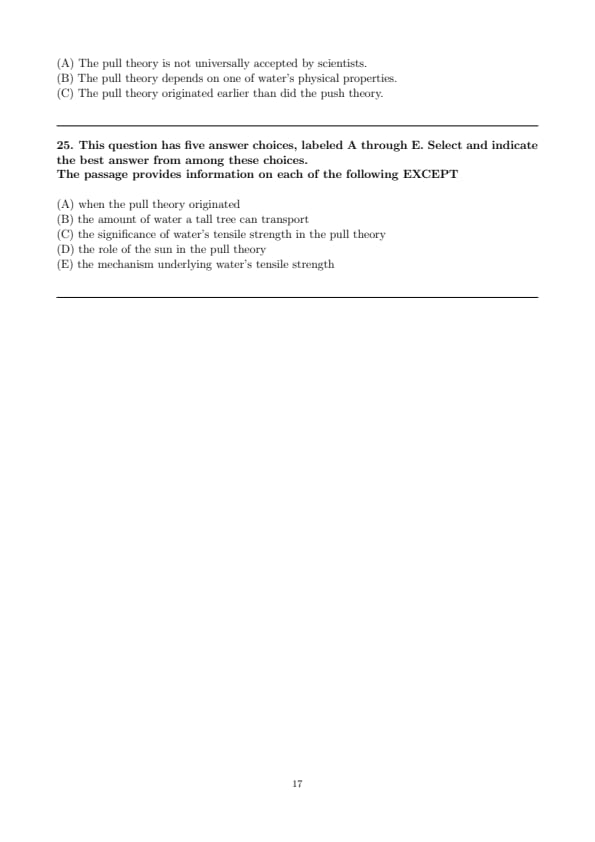
This question has three answer choices, labeled A through C. Consider each of the three choices separately and select all that apply.
Which of the following statements is supported by the passage?
This question has five answer choices, labeled A through E. Select and indicate the best answer from among these choices.
The passage provides information on each of the following EXCEPT
View Solution
Step 1: Understanding the Concept:
This is an "EXCEPT" question. We must find which of the five topics is NOT discussed in the passage. The correct answer will be the one for which no information is provided. We can use a process of elimination by finding the information for the other four options.
Step 2: Detailed Explanation:
Let's locate the information for each option in the passage:
(A) when the pull theory originated: The passage states, "First proposed in the late 1800's...". This information is provided.
(B) the amount of water a tall tree can transport: The first sentence says, "A tall tree can transport a hundred gallons of water a day...". This information is provided.
(C) the significance of water's tensile strength in the pull theory: The passage says the theory "relies on a property of water... its tensile strength." and explains how this property allows water to be tugged down from the treetop. Its significance is clearly explained. This information is provided.
(D) the role of the sun in the pull theory: The last sentence says, "...all the energy for lifting water comes from the sun's evaporative power." This information is provided.
(E) the mechanism underlying water's tensile strength: The passage states that the theory relies on tensile strength, but it never explains \textit{what causes this property in water. It does not mention cohesion, adhesion, or hydrogen bonds, which are the underlying mechanisms. This information is NOT provided in the passage.
Step 3: Final Answer:
The passage mentions and uses the concept of tensile strength, but it does not explain the physical mechanism that causes it. Therefore, (E) is the correct answer. Quick Tip: For EXCEPT questions, treat it as a scavenger hunt. Your goal is to find the sentence or phrase that corresponds to each of the incorrect answer choices (A, B, C, D). The choice that is left over, for which you can find no specific information, is the correct answer.



Comments